
Showing 98 items matching "knitting items"
-
 Kew Historical Society Inc
Booklet, Australian Comforts Fund (Victorian Divsion), Guide to Knitting Standard Socks Scarf Balaclava Cap for Active Service, 1939
... Booklet advising on standards for knitting items for soldiers...Reference books have entered the collection through donation, presentation, collection and purchase. australian comforts fund (victoria) second world war 1939-1945 Booklet advising on standards for knitting items for soldiers Guide to Knitting Standard Socks Scarf Balaclava Cap for Active Service Booklet Australian Comforts Fund (Victorian Divsion) ...Kew Historical Society, founded in 1958, has an extensive reference library, of which this book is a part. Volumes in the library are used by members for research into aspects of local history and/or to support the Society's collections of pictures, maps, fashion and artefacts. Reference books have entered the collection through donation, presentation, collection and purchase.Booklet advising on standards for knitting items for soldiersaustralian comforts fund (victoria), second world war 1939-1945 -
 Hume City Civic Collection
Photograph, October 2012
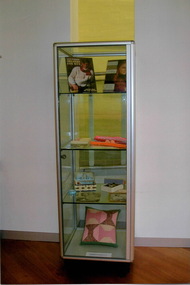
... ...Knitting items...A non-digital coloured photograph of a display in a tall glass case of items relevant to knitting and sewing...Exhibitions Sweet and Simple Pleasures Sewing aids Knitting items A non-digital coloured photograph of a display in a tall glass case of items relevant to knitting and sewing Photograph Sunbury & District Heritage Association Inc. ...The display was part of the 'Sweet and Simple Pleasures' exhibition that was mounted in the former George Evans Museum by the Sunbury and District Heritage Association in October 2012.A non-digital coloured photograph of a display in a tall glass case of items relevant to knitting and sewingexhibitions, sweet and simple pleasures, sewing aids, knitting items -
 Orbost & District Historical Society
ledger
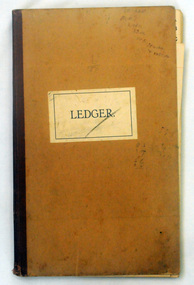
... It contains accounts for sewing and knitting items. The hand - written entries are in pencil and blue pen....It contains accounts for sewing and knitting items. The hand - written entries are in pencil and blue pen. ledger ...This ledger was used in Orbost as many of the names written inside are locals. It may have been used at a haberdashery store or by a local person who made items in a private business.This appears to be a record of a small commercial enterprise conducted by an Orbost local. It would have been used in a time when the needlework / knitting skills of women were important for the economy of the family.A buff coloured cardboard covered ledger book. On the front cover is a white rectangular sticker with "LEDGER" in black print. It contains accounts for sewing and knitting items. The hand - written entries are in pencil and blue pen.On front cover - hand -written is "...ANNE MUM's WORK BOOK FOR SEWING & KNITTING". There are some calculations in pen.haberdashery sewing knitting -
 Bendigo Military Museum
Book - BOOK, CWA, Country Women's Association, Vic, Warworkers Woolcraft, c.1930
... Book, khaki soft cover with title on black panel on front which is illustrated with black line drawing of a ball of wool. 32 pages of knitting patterns for items suitable for soldiers....Book, khaki soft cover with title on black panel on front which is illustrated with black line drawing of a ball of wool. 32 pages of knitting patterns for items suitable for soldiers. Warworkers Woolcraft Book BOOK, CWA Country Women's Association, Vic Australian Wool Board ...Book belonged to Melba Bennett, her story is on notes enclosed with worksheet.Book, khaki soft cover with title on black panel on front which is illustrated with black line drawing of a ball of wool. 32 pages of knitting patterns for items suitable for soldiers.Front cover: “M Bennett” , also handwritten on top of 1st page.books - collections, handcraft - knitting, cwa -
 Kew Historical Society Inc
Leisure object - Knitting Nancy
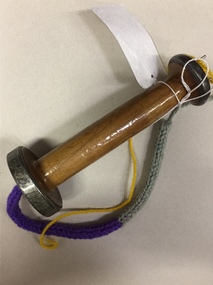
... Probably handmade functional item - a knitting nancy - made of wood and metal with a sample of knitting attached to demonstrate its function...knitting nancy Probably handmade functional item - a knitting nancy - made of wood and metal with a sample of knitting attached to demonstrate its function Leisure object Knitting Nancy ...Probably handmade functional item - a knitting nancy - made of wood and metal with a sample of knitting attached to demonstrate its functionknitting nancy -
 Frankston RSL Sub Branch
Booklet, WW1 era
... Small booklet produced by the Australian Branch of the Red Cross Society, Headquarters and Central Depot, with guidelines for making donations of goods such as clothing, linen, blankets, bandages, books and food items to the Australian War effort and instructions for knitting woollen items of clothing intended for defence personnel on active service. ...Small booklet produced by the Australian Branch of the Red Cross Society, Headquarters and Central Depot, with guidelines for making donations of goods such as clothing, linen, blankets, bandages, books and food items to the Australian War effort and instructions for knitting woollen items of clothing intended for defence personnel on active service. ...Small booklet produced by the Australian Branch of the Red Cross Society, Headquarters and Central Depot, with guidelines for making donations of goods such as clothing, linen, blankets, bandages, books and food items to the Australian War effort and instructions for knitting woollen items of clothing intended for defence personnel on active service. The booklet is not dated however it is from the WW1 era and has twenty pages.The booklet front page has the following text: "RED CROSS SOCIETY", "AUSTRALIAN BRANCH", "Headquarters and Central Depot" and a note printed in red "When forwarding parcels, send by post complete duplicate list with number of each article to Officer-in-Charge." The Red Cross symbol is featured in the form of a red +. -
 Frankston RSL Sub Branch
Booklet, "Guide to Knitting"
... Small booklet produced by the Australian Comforts Fund, Victorian Division, with instructions for knitting twelve different woollen items of clothing intended for defence personnel on active service. ...The booklet front page has the following text: "AUSTRALIAN COMFORTS FUND", "Victorian Division", "Guide to Knitting" and a list of the twelve items that are included. The "A.C.F." symbol is featured in a red, six pointed star....Small booklet produced by the Australian Comforts Fund, Victorian Division, with instructions for knitting twelve different woollen items of clothing intended for defence personnel on active service. ...Small booklet produced by the Australian Comforts Fund, Victorian Division, with instructions for knitting twelve different woollen items of clothing intended for defence personnel on active service. The booklet is dated July, 1941 and has twenty pages.The booklet front page has the following text: "AUSTRALIAN COMFORTS FUND", "Victorian Division", "Guide to Knitting" and a list of the twelve items that are included. The "A.C.F." symbol is featured in a red, six pointed star. -
 Bendigo Military Museum
Booklet - BOOKLET, AUSTRALIAN COMFORTS FUND, Australian Comforts Fund, GUIDE TO KNITTING, July 1940
... Booklet showing servicemen how to knit clothing Items for knitting shown as: Socks Stockings Cap Pullovers Scarf Mittens Neck muffs airmans gloves balaclava cap...Booklet showing servicemen how to knit clothing Items for knitting shown as: Socks Stockings Cap Pullovers Scarf Mittens Neck muffs airmans gloves balaclava cap knitting clothing uniform Comforts fund Paper booklet, black ink printing, red A.C.F star in middle of front cover, 20 pages GUIDE TO KNITTING Booklet BOOKLET, AUSTRALIAN COMFORTS FUND Australian Comforts Fund ...Booklet showing servicemen how to knit clothing Items for knitting shown as: Socks Stockings Cap Pullovers Scarf Mittens Neck muffs airmans gloves balaclava capPaper booklet, black ink printing, red A.C.F star in middle of front cover, 20 pagesknitting, clothing, uniform, comforts fund -
 National Wool Museum
Book, Knitting, Patons Craft Book no. C.14
... It was produced by Patons and Baldwins and contains knitting patterns for craft items such as toys, tea cosies, socks, rugs, and cushions....It was produced by Patons and Baldwins and contains knitting patterns for craft items such as toys, tea cosies, socks, rugs, and cushions. knitting handicrafts - history patons and baldwins (australia) ltd knitting handicrafts - history PATONS / BOOK / C.14 / GIFTS TO KNIT / Tea Cosies . ...This book was owned by the late Dr Elizabeth Kerr and was donated to the Museum by the executor of her estate, Margaret Cameron. It was produced by Patons and Baldwins and contains knitting patterns for craft items such as toys, tea cosies, socks, rugs, and cushions.PATONS / BOOK / C.14 / GIFTS TO KNIT / Tea Cosies . Toys . Afghans / T.V. Socks Cushion / PATONS / BOOK / C.14 / Patons / CRAFT BOOK / No. C.14 / P&B / WOOLS / 2'-knitting handicrafts - history, patons and baldwins (australia) ltd, knitting, handicrafts - history -
 Flagstaff Hill Maritime Museum and Village
Functional object - Needle Pin Case, 1860 to 1900
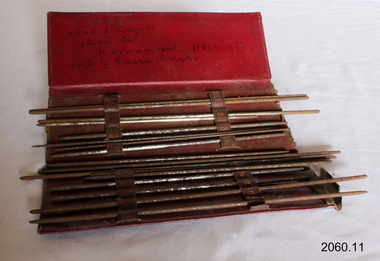
... knitting needle case is believed to belong to his wife Ellen Amelia (nee Heywood), daughter of George Heywood and Dinah Turton. She had married Mr Edwin Rodgers on 30 Jan 1863 in Warrnambool, and they had continued to resided in Warrnambool. Ellen Amelia Heywood was born Oct to Dec 1839 in Stockport, Cheshire England & christened on 5 Jul 1840 in St Thomas, Stockport, Cheshire. She died on 8 Dec 1922 in 284 Merri Street, Warrnambool, Victoria 10 and was buried on 11 Dec 1922 in the Warrnambool Cemetery. A significant item ...Knitting, as a household task, has been traced back to 1100 AD where archaeologists in Egypt found remnants of socks. Evidently socks or stockings became a household necessity and creating them by knitting was the easiest way to get a good fit. The Tudors wore hand knit caps and King Henry the VIII made hand knit silk stockings, imported from Spain, a fashion staple. Meanwhile in Paris in 1525, men formed one of the first worker's unions for hand knitters. Knitting by machine first appeared during this same period and with the spread of fashion of the silk stockings and the basic needs of people to keep warm helped to fuel the popularity of knitting. By the 1850's, knitting machines were common place and apprenticing in such a factory, was considered honourable employment. But the main tool of knitting has always remained the needle, that is said to have it's origins in Arabia. The first needles were made of copper and looked more like hooks than needles. In other locations around the world, knitting needles have been found constructed from wood, ivory, bone, bamboo, amber and iron as well. They are also known as woods, skewers or wires depending where in the world they are found. Context: Edwin Rodgers was born in Lincolnshire England estimated at 1830-1832, records document that he was working as a Miller in Jan 1863 and that he resided in Warrnambool until his death in 1887. The knitting needle case is believed to belong to his wife Ellen Amelia (nee Heywood), daughter of George Heywood and Dinah Turton. She had married Mr Edwin Rodgers on 30 Jan 1863 in Warrnambool, and they had continued to resided in Warrnambool. Ellen Amelia Heywood was born Oct to Dec 1839 in Stockport, Cheshire England & christened on 5 Jul 1840 in St Thomas, Stockport, Cheshire. She died on 8 Dec 1922 in 284 Merri Street, Warrnambool, Victoria 10 and was buried on 11 Dec 1922 in the Warrnambool Cemetery.A significant item that belonged to one of the early families of Warrnambool and as such is regarded by the Warrnambool community as significant because it helps to document Warrnambool's development.Medium sized cardboard foldable maroon knitting pin case with numbered sections to fit relevant sized metal pins 10 in all case called the peacock knitting pin case.On lid of case written in italic Mrs E A Rodgers, Warrnambool 1860-1922, Wife of Edwin Rodgersflagstaff hill, warrnambool, shipwrecked-coast, flagstaff-hill, flagstaff-hill-maritime-museum, maritime-museum, shipwreck-coast, flagstaff-hill-maritime-village -
 Greensborough Historical Society
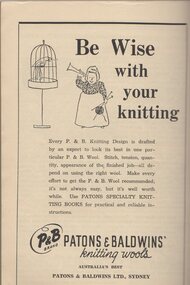
Document - Advertisement - Digital Image, NSW Cookery Teachers' Association, Patons and Baldwins' Knitting Wool: in Domestic Science Handbook, 1942_
... Knitting Wool in "Domestic Science Handbook: for use by the pupils of domestic science schools". An example of 1940s advertising through cooking and homemaker books. In this book, instructions are given for many aspects of household management, interspersed with advertisements for useful items. ...Knitting Wool in "Domestic Science Handbook: for use by the pupils of domestic science schools". An example of 1940s advertising through cooking and homemaker books. In this book, instructions are given for many aspects of household management, interspersed with advertisements for useful items. ...Advertisement for Patons and Baldwins' Knitting Wool in "Domestic Science Handbook: for use by the pupils of domestic science schools". An example of 1940s advertising through cooking and homemaker books. In this book, instructions are given for many aspects of household management, interspersed with advertisements for useful items. This advertisement is for Patons and Baldwins' Knitting Wool and knitting books.An example of mid 20th century advertising through 'how-to' books.Digital copy of advertisement from a bookhistoric advertisements, domestic science, nsw cookery teachers association, knitting patterns, patons and baldwins knitting wool -
 Federation University Historical Collection
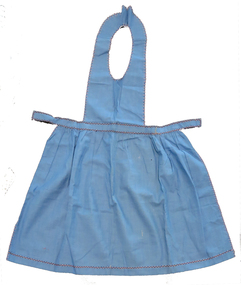
Clothing - Textiles, Ruth McGannon, Needlework, c 1950-70s
... These items were made as samplers either at school or most likely college. They are samples of embroidery stitches, seam types and sewing and knitting techniques....These items were made as samplers either at school or most likely college. They are samples of embroidery stitches, seam types and sewing and knitting techniques. embroidery sampler gloves stitches sewing knitting apron costume needlework dressmaking textiles Written on paper and stitched on to a couple of items - Ruth McGannon V.3 - 312 Written on paper and stitched to the gloves - Margaret Russell x No2 Nos 1-16 are group of samplers made from cotton lawn, cotton with sateen weave and flannel and made by Ruth McGannon. ...These items were made as samplers either at school or most likely college. They are samples of embroidery stitches, seam types and sewing and knitting techniques.Nos 1-16 are group of samplers made from cotton lawn, cotton with sateen weave and flannel and made by Ruth McGannon. No 17 is a pair of gloves made by Margaret Russell. .1) A small square of yellow lawn with three horizontal rows in blue thread and three vertical rows in red thread of running stitch each 3.5 centimeters apart. The edges are frayed to 1.2 centimeters. .2) A larger rectangle of yellow lawn with three horizontal rows 7.8 centimeters apart and three vertical rows 10 centimeters apart of long stitch, stitched in blue thread. The edges are frayed to 2 centimeters. .3) A small square of yellow lawn with three horizontal rows and three vertical rows of blue thread of running stitch, each 1.9 centimeters apart. The edges are frayed to 1.5 centimeters. .4) A larger rectangle of yellow lawn with three horizontal rows 9 centimeters apart and three vertical rows 11.2 centimeters apart of running stitch, stitched in red thread. The edges are hemmed with two rows of long stitch .5 centimeter apart with a loose blue thread of laced running stitch weaving in and out of the red long stitch. .5) A rectangle of hemmed yellow lawn with a pocket formed at each end. Two rows of long stitch in red thread hem the edges with a blue thread stitched between each red stitch. The pockets are formed by turning back the edges and stitching them down in brown thread. R.M. is embroidered in brown chain stitch on the right side. .6) A rectangle of hemmed blue lawn the same as the previous piece but with five rows of back stitch in yellow and orange thread creating a pattern. .7) A rectangle of blue lawn with the top and bottom edges hemmed with two rows of long stitch close together in yellow and orange. The other two edge are frayed to 2.5 centimeters and has four rows of long stitch .7 centimeter apart in yellow and orange thread. .8) A blue lawn bag with two packets was made by hemming a rectangle of fabric on three sides in long stitch with orange thread, then yellow thread between the stitches. The fourth side is hemmed in hemming stitch in yellow thread with blanket stitch in yellow thread along the edge. This edge is folded up by one third to create a pocket. The edges on either side are stitched together. A row of chain stitch in orange thread is stitched down the middle to create two pockets. A tape is stitched to either side at the top and this is folded over the pocket. .9) A cream cotton with sateen weave rectangle is hemmed with a double row of orange thread in long stitch. On both sides is embroidery in orange and yellow thread. .10) A yellow cotton with sateen weave baby's bib is made from a rectangle of fabric with a semi circle cut out of the top. The edges are turned and hemmed with a narrower turning on the neck. A tape is stitched at either side of the neck. On the front is embroidered a train in blue and yellow threads. .11) A yellow lawn embroidery sampler using blue and brown thread shows long stitch, stem stitch, herringbone stitch, chain stitch, fly stitch, lazy daisy stitch, cross stitch and satin stitch. It is hemmed using drawn thread work and the bottom is scalloped and finished in blanket stitch. .12) A pink lawn embroidery sampler with green thread shows herringbone stitch, stem stitch, running stitch, chain stitch, cross stitch, lazy daisy stitch, fly stitch, feather stitch, satin stitch and back stitch. The bottom is scalloped and finished in buttonhole stitched. The other three edges are hemmed using drawn thread work. .13) A small cream flannel square with two smaller squares are stitched together down the middle in decreasing sizes using chain stitch. The largest piece is hemmed using both herringbone and a decorative blanket stitch. It also has a run and fell seam on the opposite side using both running and herringbone stitches. A row of feather stitch is on either side of the seam. The two smaller squares are frayed on the edges. .14) A cream rectangular flannel sampler has two seams along the length. One is a run and fell seam using running and herringbone stitches and the other is an open seam using running stitch and both edges are stitched down with herringbone stitch. The two shorter edges are bound and the longer edges have a tape which is stitched down to neaten the edges. On the right side are two rows of feather stitch. .15) This blue lawn apron has a rectangular gathered skirt which is attached to a waistband and in turn attached to a bib front which goes over the head. The bib and skirt sides are hemmed using decorative blanket stitch in pink and dark blue thread. The skirt hem and both sides of the waistband are stitched in two rows of herringbone in pink and dark blue thread. .16) This pale pink lawn child's shirt has french seam side seams, a waist band to which the shirt is attached using slight gathering. The sleeves have cuffs. There is a front facing and a collar and there is a small pocket in the left hand breast. .17) These yellow knitted gloves are made using plain stitch for the hand and rib for the wrist.Written on paper and stitched on to a couple of items - Ruth McGannon V.3 - 312 Written on paper and stitched to the gloves - Margaret Russell x No2embroidery, sampler, gloves, stitches, sewing, knitting, apron, costume, needlework, dressmaking, textiles -
 Flagstaff Hill Maritime Museum and Village
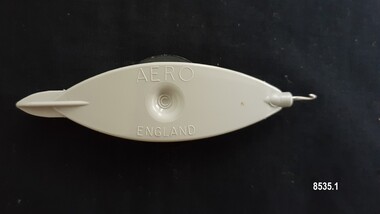
Domestic object - Tatting Shuttle, Aero Needles Group Ltd, Mid to late 20th century
... knitting needles. The classic plastic "Aero" tatting shuttle was manufactured in England from the early 1970's until the 1990's. These items ...Tatting is a form of knotted lace making using thread and a small shuttle. Twisted threads are tied around or through small, pointed shuttles that can be made of bone, mother of pearl, tortoise shell, steel or plastic. This produces a stable, strong lace using simple knots of two half hitches to make rings and chains embellished with picots.The origins of tatting are not clear but early versions of decorative knotting were used by the Egyptians on their ceremonial dress. Tatting also has elements of fishermen's net making techniques and the decorative knotting that was practiced by aristocratic women from the 15th century.Tatting, as we know it today, emerged in the first half of the 19th century. The new availability of mercerised thread from 1835 encouraged a burgeoning of lace crafts of all sorts. It was known in Italy as "occhi" and in France as "la frivolite". Tatting looks fragile but is both strong and durable. An article in a column named "Wives and Daughters" published in the Star newspaper in May 1910 describes the durability of tatting lace - "there is edging and insertion still in existence that have outworn two sets of pillow slips." In the 19th century and well into the 20th century, tatting was used like crochet and knitted lace for decorative edgings, collars, doylies, tray cloths etc. At first, different tatting patterns were passed along by word of mouth from person to person, however in time, patterns regularly appeared in newspapers and magazines well into the 1950's. A shuttle is a small tool that looks like a small boat "sailing" in and out of the thread. Tatting is called "schiffchenarbeit" in German, which means "the work of a little boat". There are two popular types of shuttles. The first has closed ends and a removable bobbin where the thread is wound around - often made from metal or plastic (as is item 8535.1). The second type has a post in the center where the thread is wound (e.g. item 8535.2). The ends of this bobbin are open but snug. Because it is constructed in two pieces, it can be made from materials like bone, ivory or mother of pearl. Shuttles hold a larger amount of thread (as compared with needles) which means fewer ends to weave in. Fishermen in the past are thought to have used large shuttles to weave cord into certain knots whilst making their fishing nets. Their methods were copied by weavers, who innovated by using threads and smaller shuttles to make lace. One type of tatting shuttle produced by "Aero" from the 1930's to the late 1960's was an anodized grey coated aluminium shuttle with a sharp pick at one end. In the 1970's it was superseded by the grey plastic "Aero" which has a removeable bobbin which you can put on the end of the shuttle to make thread winding easier and an embedded crochet hook for joining picots. The "Aero" company developed in Redditch, England - a town renowned as a centre for manufacturing needles. Firms run by Henry Milward and Abel Morrall were based in Redditch and by the 18th century Redditch was manufacturing one million sewing needles per year. Abel Morrall Ltd launched the "Aero" brand in 1936 and greatly expanded the firm's product line to include tatting shuttles and knitting needles. The classic plastic "Aero" tatting shuttle was manufactured in England from the early 1970's until the 1990's. These items are significant as examples of easily accessible handiwork tools that enabled women in the 1930s -1960s to be able to decorate and personalize their household linen and clothing.Shuttle no. 8535.1 is a beige, boat shaped plastic shuttle with enclosed ends, small round central indentations on both sides and an enclosed black removeable bobbin. The shuttle has a grooved point at one end to hold a bobbin and a small metal crochet hook at the other end. Shuttle no. 8535.2 is a beige, boat shaped metal shuttle with pointed ends that are open but snug, small round central indentations and two smaller circular markings (on both sides) and two internal posts with cream thread wound around.Shuttle no. 8535.1 - "AERO" / "ENGLAND" Shuttle no. 8535.2 - "AERO' / "ENGLAND" "39c" (written in ball point pen)flagstaff hill maritime museum and village, flagstaff hill, warrnambool, shipwreck coast, great ocean road, tatting shuttle, aero company, handwork, handwork tool, craft, handcraft, needlework, tatting -
 City of Moorabbin Historical Society (Operating the Box Cottage Museum)
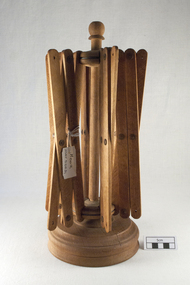
Craft - Craft equipment, wool winder, c1860
... items they thought would assist them in the new Country. They had to be self reliant and made their own clothing and utensils while establishing their market gardens and farms. A wooden wool winder, with extending arms for winding hanks of wool into balls prior to knitting...items they thought would assist them in the new Country. They had to be self reliant and made their own clothing and utensils while establishing their market gardens and farms. A wooden wool winder, with extending arms for winding hanks of wool into balls prior to knitting ...Pioneers migrating to Moorabbin Shire brought items they thought would assist them in the new Country. They had to be self reliant and made their own clothing and utensils while establishing their market gardens and farms. A wooden wool winder, with extending arms for winding hanks of wool into balls prior to knitting. For ease of use the winder also rotates. Circa 1860s this winder was made in Ireland.The pioneer settlers and market gardeners of Moorabbin Shire had to be self reliant and made their own clothing and utensils. This is one of many items used to exhibit the skill and craftsmanship of the women in these families. Phillip Jones migrated from Ireland c1852 and his son, James Jones 1857 – 1940 was born in East Brighton , married Mary Ann Moore and raised his family in Bentleigh, as the area became known. A wooden wool winder, with extending arms for winding hanks of wool into balls prior to knitting. For ease of use the winder also rotates. Circa 1860s this winder was made in Ireland.brighton, moorabbin, pioneers, bentleigh, market gardeners, wool, craft work, early settlers, knitting, craft equipment, jones mary ann, jones james, jones phillip, herron john -
 Orbost & District Historical Society
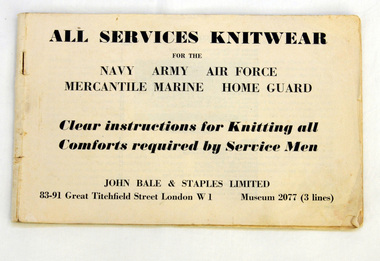
booklet, John Bales & Staples, All Services Knitwear, World War 11
... items donated to the Orbost Op Shop by Orbost House. Orbost House, believed to have been established by the Macalister family around the turn of the 20th century was a boarding house in Lochiel Street, Orbost. knitting-patterns booklet handcraft A stapled paper handbook of knitting patterns for defence force knitwear. ...This booklet was in a box of items donated to the Orbost Op Shop by Orbost House. Orbost House, believed to have been established by the Macalister family around the turn of the 20th century was a boarding house in Lochiel Street, Orbost. A stapled paper handbook of knitting patterns for defence force knitwear. All Services Knitwear for the Navy, Army, Air Force, Mercantile Marine and Home Guard. Contains 27 pages in paper covers and states that it gives clear instructions for knitting all comforts required by Service men. . Contents include instructions for knitting mittens for the Navy, steering gloves for the Army, other gloves, socks, knee caps, wristlets, helmet with cape pieces for all services, ribbed helmet for the Navy, hospital stockings, scarf, service jacket and pullover and fisherman's sea-boot stockings. It is Illustrated with black/white photographs. knitting-patterns booklet handcraft -
 Orbost & District Historical Society
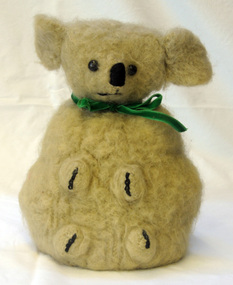
Koala tea cosy, Early 1900's
... tea-cosy domestic-item tableware handcraft knitting powell-selena...This item is an excellent local example of the type of hand made tea cosies which were used in an Australian domestic setting during the 1920's through to the 1960's. tea-cosy domestic-item tableware handcraft knitting powell-selena Fawn coloured hand-knitted tea cosy. ...This was probably used by the Powell family. Selena Powell came from Eden to Orbost at the age of 18. She met and married Henry James Powell in Orbost.This item is an excellent local example of the type of hand made tea cosies which were used in an Australian domestic setting during the 1920's through to the 1960's. Fawn coloured hand-knitted tea cosy. The wool has been brushed to resemble the fur. It has brown button eyes and the nose and mouth are sewn in black yarn. The feet are embroidered in black and it has a narrow green velvet ribbon around the neck.tea-cosy domestic-item tableware handcraft knitting powell-selena -
 Orbost & District Historical Society
pillow shams, Eaton, Julia (Mrs) nee Thomas, first half 20th century
... This item is an example of a handcrafted item and reflects the needlework skills of women in the first half of the 20th century. pillow-shams bedding manchester handcrafts knitting lacemaking Two white knitted pillow shams with pink knitted through front. ...Julia Thomas was daughter of George and Granny Thomas much respected Aboriginal couple of Newmerella. George was a stockman for Jas Stirling. Julia married Henry Eaton, road construction at Gilbert's Gulch.This item is an example of a handcrafted item and reflects the needlework skills of women in the first half of the 20th century.Two white knitted pillow shams with pink knitted through front. Lace edging.pillow-shams bedding manchester handcrafts knitting lacemaking -
 Orbost & District Historical Society
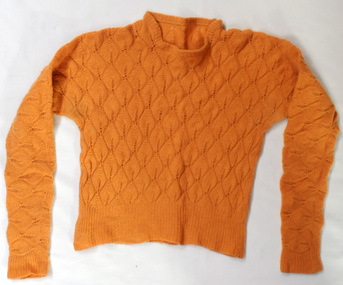
knitted jumper, 1938-1940
... item and reflects the handcraft skills of women necessary during WW11 when clothing became scarce. Clothes rationing began on June 1, 1941, two years after food rationing started. Clothes rationing ended on 15 March 1949. handcraft knitting ...This was knitted by Marjorie Burton during WW11 in England. She used to knit while in an air raid shelter escaping the bombing with her young daughter. Air raid shelters were built specifically to serve as protection against enemy air raids. However, pre-existing structures such as underground stations (tube or subway stations), tunnels, cellars in houses or basements in larger establishments, and railway arches, above ground, were suitable for safeguarding people during air raids. This item is an example of a handcrafted item and reflects the handcraft skills of women necessary during WW11 when clothing became scarce. Clothes rationing began on June 1, 1941, two years after food rationing started. Clothes rationing ended on 15 March 1949.A hand-knitted orange/tan woolen jumper. It is a lady's long-sleeved jumper.handcraft knitting ww11 -
 Orbost & District Historical Society
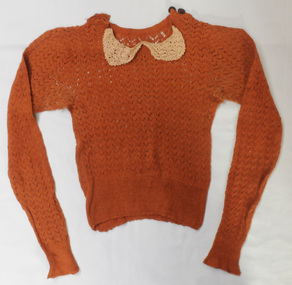
knitted jumper, Burton, Marjorie, 1938 - 1940
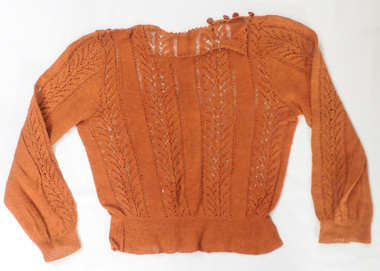
... This item is an example of a handcrafted item and reflects the handcraft skills of women necessary during WW11 when clothing became scarce. Clothes rationing began on June 1, 1941, two years after food rationing started. Clothes rationing ended on 15 March 1949. knitting ...This was knitted by Marjorie Burton during WW11 in England. She used to knit while in an air raid shelter escaping the bombing with her young daughter. Marjorie Burton ( nee Whiteman), born 12 June, in Birmingham, England came to Orbost in 1995. In England she did office work – typing, shorthand and secretarial work - in accountants’ offices and also trained as a comptometrist with Burroughs in London. She came from middle-class working church-going family. Her mother was a milliner who mad all of Marjorie’s clothes, hats and outfits. Marjorie married in 1938 to a salesman who later became a mechanic in the R.A.F. during WW11. Her father served in Civil Defence during the war. Marjorie was in Birmingham during the war and remembered sheltering with her young daughter, Anne (Quaadgras) in the air raid shelter during bombing. This was knitted by Marjorie Burton during WW11 in England. She used to knit while in an air raid shelter escaping the bombing with her young daughter. This item is an example of a handcrafted item and reflects the handcraft skills of women necessary during WW11 when clothing became scarce. Clothes rationing began on June 1, 1941, two years after food rationing started. Clothes rationing ended on 15 March 1949.A brown cotton hand-knitted lacy jumper. it is a long-sleeved lady'e jumper with a tea-coloured crocheted collar sewn on. On each shoulder are two brown buttons.knitting jumper handcraft ww11 burton-marjorie -
 Orbost & District Historical Society
knitted jumper, Burton, Marjorie, 1938-1940
... This item is an example of a handcrafted item and reflects the handcraft skills of women necessary during WW11 when clothing became scarce. Clothes rationing began on June 1, 1941, two years after food rationing started. Clothes rationing ended on 15 March 1949. knitting ...Marjorie Burton ( nee Whiteman), born 12 June, in Birmingham, England came to Orbost in 1995. In England she did office work – typing, shorthand and secretarial work - in accountants’ offices and also trained as a comptometrist with Burroughs in London. She came from middle-class working church-going family. Her mother was a milliner who mad all of Marjorie’s clothes, hats and outfits. Marjorie married in 1938 to a salesman who later became a mechanic in the R.A.F. during WW11. Her father served in Civil Defence during the war. Marjorie was in Birmingham during the war and remembered sheltering with her young daughter, Anne (Quaadgras) in the air raid shelter during bombing. This was knitted by Marjorie Burton during WW11 in England. She used to knit while in an air raid shelter escaping the bombing with her young daughter. This item is an example of a handcrafted item and reflects the handcraft skills of women necessary during WW11 when clothing became scarce. Clothes rationing began on June 1, 1941, two years after food rationing started. Clothes rationing ended on 15 March 1949. This item is an example of a handcrafted item and reflects the handcraft skills of women necessary during WW11 when clothing became scarce. Clothes rationing began on June 1, 1941, two years after food rationing started. Clothes rationing ended on 15 March 1949.A brown hand-knitted lacy cotton jumper. It is a long-sleeved lady's jumper and has 4 brown buttons on each shoulder opening.knitting jumper handcraft burton-marjorie ww11 -
 Orbost & District Historical Society
night gowns, C1920's
... This item is an example of a handcrafted item and reflects the handcraft skills of women needed in the first half of the 20th century. handcraft knitting sleepwear nightgowns burton-marjorie Two hand-knitted pink woollen night gowns. ...These night gowns were knitted by Mrs Whiteman for Marjorie and were probably worn when she had bronchitis. Marjorie Burton ( nee Whiteman), born 12 June, in Birmingham, England came to Orbost in 1995. In England she did office work – typing, shorthand and secretarial work - in accountants’ offices and also trained as a comptometrist with Burroughs in London. She came from middle-class working church-going family. Her mother was a milliner who made all of Marjorie’s clothes, hats and outfits. This item is an example of a handcrafted item and reflects the handcraft skills of women needed in the first half of the 20th century.Two hand-knitted pink woollen night gowns. They have square necks, no sleeves and a lace pattern on the bodice and hem. Both are waisted. They have been knitted but are different size from the same pattern. 2483.11 is smaller and possibly older as it appears to have had more washes.handcraft knitting sleepwear nightgowns burton-marjorie -
 Orbost & District Historical Society
six pairs of gloves, Burton, Marjorie, 1940's -1950's
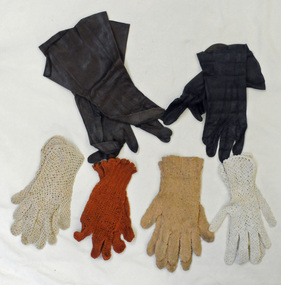
... items and reflect the handcraft skills of women necessary during WW11 when clothing became scarce. Clothes rationing began on June 1, 1941, two years after food rationing started. Clothes rationing ended on 15 March 1949. women's-accessories gloves crochet knitting ...Marjorie Burton ( nee Whiteman), born 12 June, in Birmingham, England came to Orbost in 1995. In England she did office work – typing, shorthand and secretarial work - in accountants’ offices and also trained as a comptometrist with Burroughs in London. She came from middle-class working church-going family. Her mother was a milliner who made all of Marjorie’s clothes, hats and outfits. Marjorie married in 1938 to a salesman who later became a mechanic in the R.A.F. during WW11. Her father served in Civil Defence during the war. Marjorie was in Birmingham during the war and remembered sheltering with her young daughter, Anne (Quaadgras) in the air raid shelter during bombing. These items are examples of handcrafted items and reflect the handcraft skills of women necessary during WW11 when clothing became scarce. Clothes rationing began on June 1, 1941, two years after food rationing started. Clothes rationing ended on 15 March 1949.Six pairs of ladies' gloves. 2483.16 is a white crocheted cotton pair. 2483.17 is a light tan knitted woolen pair. 2483.18 is a brown crocheted cotton pair. 2483.19 is an ecru crocheted cotton pair. 2483.20 is a black leather pair and 2483.21 is a brown leather pair. women's-accessories gloves crochet knitting burton-marjorie -
 City of Moorabbin Historical Society (Operating the Box Cottage Museum)
Craft Equipment, knitting needles, c1880
... Knitting was a necessary task for the women of the families of these pioneers. Early settlers and market gardeners established their families in Moorabbin Shire and this item shows the skill and craftsmanship of the these families early settlers craftwork knitting pioneers moorabbin bentleigh ormond cheltenham market gardeners A pair of long wooden knitting needles Craft Equipment, knitting needles Unrecorded early settler ...Early settlers in Moorabbin Shire had to be self reliant and made their own clothes and tools. Knitting was a necessary task for the women of the families of these pioneers.Early settlers and market gardeners established their families in Moorabbin Shire and this item shows the skill and craftsmanship of the these families A pair of long wooden knitting needlesearly settlers, craftwork, knitting, pioneers, moorabbin, bentleigh, ormond, cheltenham, market gardeners -
 Flagstaff Hill Maritime Museum and Village
Textile - Bedspread and Cushion, 1982
... The handmade items were knitted in the late 20th century using a craft and design that augment the late-19th to early 20th-century furnishings where they are displayed. flagstaff hill warrnambool shipwrecked-coast flagstaff-hill-maritime-museum flagstaff-hill-maritime-village knitted bedspread knitting bedspread giles collection henry giles vera giles tower hill cooramook warrnambool breakwater mailor’s flat wangoom manchester cushion Hand knitted white cotton bedspread and cushion with knitted floral pattern. ...This hand-knitted, white double-bed bedspread and matching round cushion were hand-made by Vera Giles. The process took her nine-and-a-half months. She presented it to Flagstaff Hill to be part of the Giles Collection. There are many 19th-century items of furniture, linen and crockery donated to Flagstaff Hill Maritime Village by Vera and Aurelin Giles. The items are associated with the Giles Family and are known as the “Giles Collection”. These items mostly came from the simple home of Vera’s parents-in-law, Henry Giles and his wife Mary Jane (nee Freckleton), whose photos are in the parlour. They married in 1880. Henry Giles was born at Tower Hill in 1858. He was a labourer on the construction of the Breakwater before leaving in 1895 to build bridges in N.S.W. for about seven years. Mary Jane was born in 1860 at Cooramook. She attended Mailor’s Flat State School where she was also a student teacher before, as a family legend has it, she became a governess at “Injemiara” where her grandfather, Francis Freckleton, once owned land. Henry and Mary’s family of six, some of whom were born at Mailor’s Flat and later children at Wangoom, lived with their parents at Wangoom and Purnim west, where Henry died in 1933 and Mary Jane in 1940.The Giles family collection has social significance at a local level because it illustrates the level of material support the Warrnambool community gave to Flagstaff Hill when the Museum was established. The handmade items were knitted in the late 20th century using a craft and design that augment the late-19th to early 20th-century furnishings where they are displayed.Hand knitted white cotton bedspread and cushion with knitted floral pattern. Items are both part of the Giles Collection. flagstaff hill, warrnambool, shipwrecked-coast, flagstaff-hill-maritime-museum, flagstaff-hill-maritime-village, knitted bedspread, knitting, bedspread, giles collection, henry giles, vera giles, tower hill, cooramook, warrnambool breakwater, mailor’s flat, wangoom, manchester, cushion -
 Flagstaff Hill Maritime Museum and Village
Functional object - Crochet Hook, Mid 19th Century
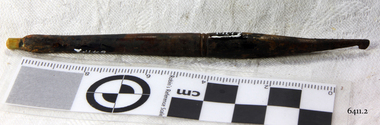
... knitting came about, along with the shepherd’s hook. It’s thicker than a modern crochet hook but still with a hooked end. By the mid-1800s, it became known as crochet or slip stitch crochet. In the 60s, the granny square and crocheted home ware appeared and became more popular. A significant domestic item ...Crochet came from the Old French word crochet, meaning ‘small hook.’ This word comes from Croche. Croche comes from the Germanic word croc. Both mean hook and crochetage, which means a single stitch used to join separate pieces of lace together. People used this term in making French lace in the 1600s and the word crochet describes the hook and the craft. Evidence shows the starting point was the mid-1800s but as early as the late 16th and early 17th century, crocheted braiding was used in clothing and other products. Like on a man’s cape at the Victoria and Albert Museum. Crochet evolved in the early 1700s when stitching material on a tambourine reached Europe after going through India, Persia, North America, Turkey, North Africa and other places around the world. People removed the background fabric used for tambouring. The French named the new technique “crochet in the air.” In the early 1800s, shepherd’s knitting came about, along with the shepherd’s hook. It’s thicker than a modern crochet hook but still with a hooked end. By the mid-1800s, it became known as crochet or slip stitch crochet. In the 60s, the granny square and crocheted home ware appeared and became more popular.A significant domestic item used in crochet or craft work and recovered from the wreck of the Schomberg in the 1970s. For more information regard the wrecking of the Schomberg see note sect this document. The Schomberg has historical significance as one of the first luxurious ships built to bring emigrants to Australia. The collection of recovered artefacts from the Schomberg wreck and held at Flagstaff Hill Museum are significant because of their potential to interpret the story of the Schomberg and its passengers.Crochet hook made from Bovine Bone. It has two sections that screw apart. Recovered from the wreck of the Schomberg. Nonewarrnambool, shipwrecked-coast, flagstaff-hill, flagstaff-hill-maritime-museum, maritime-museum, shipwreck-coast, flagstaff-hill-maritime-village, schomberg, shipwrecked-artefact, clipper ship, black ball line, 1855 shipwreck, aberdeen clipper ship, captain forbes, peterborough shipwreck, ss queen, crochet hook, crocheterage, craft -
 Orbost & District Historical Society
framed certificate, 1917
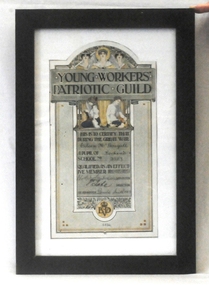
... item reflects the war efforts of Victorian children during WW1. McDougall-Eileen WW1 certificate-Young-Workers'-Patriotic-Guild education fundraising A coloured certificate framed in dark plain wooden frame. The certificate is from the Young Workers' Patriotic Guild, and includes mythical representations of 'Justice' and 'Peace' at the top, together with a female face wearing a laurel wreath. Below the banner headline are two young girls, one shown knitting ...The Young Workers' Patriotic Guild was formed in Victorian schools in 1916. Each child who raised one pound 'by personal productive effort' received a certificate. The money was used for the war effort. This certificate was presented to Eileen McDougall, a pupil of Lochend School, in 1917 in recognition of becoming a member of the Young Workers' Patriotic Guild.This item reflects the war efforts of Victorian children during WW1.A coloured certificate framed in dark plain wooden frame. The certificate is from the Young Workers' Patriotic Guild, and includes mythical representations of 'Justice' and 'Peace' at the top, together with a female face wearing a laurel wreath. Below the banner headline are two young girls, one shown knitting a black and red sock, and the second holding what appears to be a hammer and a block of wood. The certificate commemorates the work done by a pupil at a Victorian school as a member of the Guild. It is dated 1917, and signed by the Minister of Education, the Director of Education, and the Headmaster of Kennington school. The name of the designer appears at the bottom of the certificate; it appears to be Harold Herbert. Laurel leaves and berries, and the initials 'EVD' [Education Department Victoria] appear at the base of the certificate. (from Museum Victoria)mcdougall-eileen ww1 certificate-young-workers'-patriotic-guild education fundraising -
 Bendigo Military Museum
Booklet - BOOKLET, ACF, Australian Comforts Fund Victorian Division, August 1941
... There were many Comforts funds providing items for our troops overseas. Comforts fund Knitting ACF On the back of page 23 printed, “Renwick Pride” Thirty two pages, white with black print, “ACF” badge in red on the front. ...There were many Comforts funds providing items for our troops overseas.Thirty two pages, white with black print, “ACF” badge in red on the front. The book as per the cover contains a guide to the various sections mentioned regarding of clothing .On the back of page 23 printed, “Renwick Pride”comforts fund, knitting, acf -
 Bendigo Military Museum
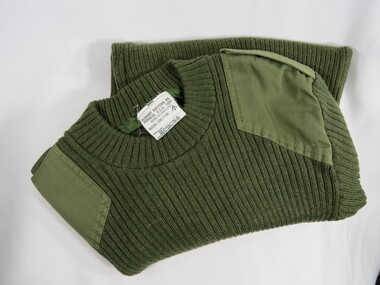
Uniform - PULLOVER - HOWARD GREEN, Elegant Knitting Co, 1985
... item issued to "Rod Hosking". Pullover Howard Green Passchendaele Barracks Trust Rod Hosking ELEGANT KNITTING CO - PENRITH, NSW 1985. 8405-66-093-2704. ...Uniform item issued to "Rod Hosking".Pullover Howard Green with cotton shoulder pads with Velcro epaulettes and sewn on Warrant Officer One patches.ELEGANT KNITTING CO - PENRITH, NSW 1985. 8405-66-093-2704. SIZE: 105-115l.pullover howard green, passchendaele barracks trust, rod hosking -
 Bendigo Military Museum
booklet - KNITTING BOOK, RED CROSS, Rusnin Press Pty Ltd
... Booklet donated to the Red Cross Society for the people to knit items for the troops. Red Cross Booklet Knitting for the troops front cover “ AUSTRALIAN RED CROSS SOCIETY VICTORIAN DIVISION “Printed for and donated to the Australian Red Cross by Lincoln Mills (Australia) Lyd Small booklet, white paper cover, Cover has a plain Red Cross along the the title printed in black ink. 23 pages of knitting instructions written in black ink. ...Booklet donated to the Red Cross Society for the people to knit items for the troops. Small booklet, white paper cover, Cover has a plain Red Cross along the the title printed in black ink. 23 pages of knitting instructions written in black ink. Folded and bound with 2 staples. front cover “ AUSTRALIAN RED CROSS SOCIETY VICTORIAN DIVISION “Printed for and donated to the Australian Red Cross by Lincoln Mills (Australia) Lydred cross, booklet, knitting for the troops -
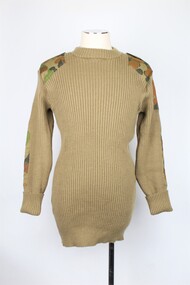 Warrnambool RSL Sub Branch
Jumper, Elegant Knitting Co, 1993
... item is a representative example of previously standard issue Airforce uniform and is in excellent condition. As a set, the uniform has aesthetic significance in it’s design, incorporating the Disruptive Pattern style of camouflage which has its roots in the 1980s and continues to be adapted into uniform design by the Defence Force. camouflage general purpose uniform airforce uniform australian defence force Label on interior of collar reads: “ELEGANT KNITTING CO. ...This jumper is part of a Disruptive Pattern Combat Uniform issued by the Australian Airforce to Bernard Farley during service. This uniform type was used in base and field activities and was replaced in 2014 by the General Purpose Uniform as the uniform worn during general base duties and in non-warlike environments.This woolen jumper was presumably a winter addition to the DPCU.This item has social significance, as an item of uniform worn by Warrnambool RSL community member and Secretary (2019), Bernard Farley during service with the Australian Airforce. The item is a representative example of previously standard issue Airforce uniform and is in excellent condition. As a set, the uniform has aesthetic significance in it’s design, incorporating the Disruptive Pattern style of camouflage which has its roots in the 1980s and continues to be adapted into uniform design by the Defence Force.Khaki ribbed knitted jumper with stitched Disruptive Pattern cotton elbow patches, rectangular in shape running the length of the forearm. Similar rectangular shaped patches on the left and right shoulder, bearing two epaulettes, stiched at one end and fastened with velcro and the other. The left upper arm carries a rectangular Disruptive Pattern patch with a seam down the centre, creating two long narrow pockets. Arm cuffs have external seam for approximately 100 mm from the end, indicating that the jumper may have been worn with cuffs folded over. Synthetic strip of green fabric on the interior collar behind a cream coloured label.Label on interior of collar reads: “ELEGANT KNITTING CO./PENRITH, N.S.W. 1993/(047) 32 2491/8405-66-134-9381/SIZE 115cm-125cm XL (broad arrow)/SERVICE No........./NAME.........../“ Reverse of label carries a series of care instructions including “Fasten shoulder straps before/washing/ 80% Wool 20% Nylon”camouflage, general purpose uniform, airforce, uniform, australian defence force
