
Showing 18 items matching "knot garden"
-
 Robin Boyd Foundation
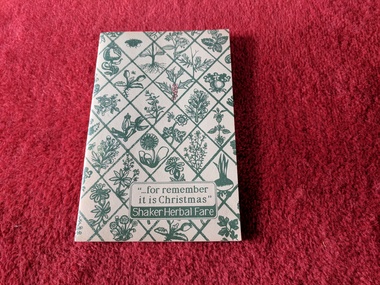
Book, Martha Boice, "...for remember it is Christmas" Shaker Herbal Fare, 1989
... ...Knot Garden Press...Walsh St library Two postcards Andrew Ivanyi Gallery openings with Arthur Boyd illustrations Softcover "...for remember it is Christmas" Shaker Herbal Fare Book Martha Boice Knot Garden Press ...SoftcoverTwo postcards Andrew Ivanyi Gallery openings with Arthur Boyd illustrationswalsh st library -
 University of Melbourne, Burnley Campus Archives
Plan, Henderson Residence, 1991
... ...knot garden...Hawthorn planting plan knot garden Landscape plans for a residence at 37 Auburn Road Hawthorn, Victoria by Patrick and Wallace Pty. ...Landscape plans for a residence at 37 Auburn Road Hawthorn, Victoria by Patrick and Wallace Pty. Ltd. For Mr. and Mrs. N. Henderson. Drawn by RK February 1991. (1) Tracing paper and paper copies, Drawing No.9080/LD1, 'Hardworks Plan.' (2) Tracing paper copy, Drawing No. 9080/LD2 Hardworks Details.' (3) Tracing paper copy, Drawing No. 9080/3 'Planting Plann. henderson, patrick and wallace pty. ltd., hawthorn, planting plan, knot garden -
 Embroiderers Guild, Victoria
Functional Object - Pincushions (4) & Needlecase, Mrs Win Saunders, 1984
... Pincushion - design based on knot gardens wool embroidery C. Pincushion - design based on knot gardens wool embroidery D. ...Pincushion - design based on knot gardens wool embroidery C. Pincushion - design based on knot gardens wool embroidery D. ...Mrs Win Saunders (member) designed and made by her.A.. Large pincushion - design of stitched flowers random or wild daisy B. Pincushion - design based on knot gardens wool embroidery C. Pincushion - design based on knot gardens wool embroidery D. Needlecase - design based on knot gardens and coptic cross, wool embroidery E. Walnut shell pincushion (half shell), tatted edge, wool embroidery F. Sea shell - pink and green French knots. wool embroidery, embroidery, canvas work, small articles, australia, 1980-2000 -
 Flagstaff Hill Maritime Museum and Village
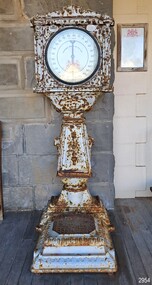
Instrument - Scale, Weighing Machine, G. Salter & Co, 1884-1909
... gardens, theatres, exhibition halls, clubs, baths and places of public resort. The company was established in 1760 by brothers Richard and William Salter, and manufactured springs and pocket steelyards (spring balances). After several generations, the company was taken over in 1855 by a nephew, George, and renamed George Salter & Co. In 1884, Salter registered the trademark of a Staffordshire knot...gardens, theatres, exhibition halls, clubs, baths and places of public resort. The company was established in 1760 by brothers Richard and William Salter, and manufactured springs and pocket steelyards (spring balances). After several generations, the company was taken over in 1855 by a nephew, George, and renamed George Salter & Co. In 1884, Salter registered the trademark of a Staffordshire knot ...This ornate, Victorian-era automatic weighing machine was made in England around 1884-1909, by George Salter and Co. of West Bromwich, UK, makers of scales since 1760. It is protected by Queen Victoria’s Royal Letters Patent, signed in 1900. The scale stood outside the Warrnambool Post Office in Timor Street from around 1909 to 1966, as shown on postcards and photographs held at the State Library of Victoria. The scale is identified by the Serial Number '665', and was installed by the distributors, the Australasian Automatic Weighing Machine Co. Ltd.. The scale’s weight measurements were in Imperial stones and pounds up to 20 stone (127 kg). The scale’s face included charts of average weights, for men, women, boys and girls, by various heights, in feet and inches. The coin slot and its face were converted to metric measurements by the Eastern Scale Company Pty. Ltd; that firm was registered on October 2, 1974. The Australasian Automatic Weighing Machine Co. Ltd was a large supplier of weighing scales in Australia and held the Royal Letters patent for their machines, distributing them in prominent locations. In 1902, the firm was listed under the Import Entries Passed at His Majesty’s Customs, importing into Sydney, NSW, eight cases of scales. In 1911, the company asked permission from the Port Pirie Corporation to install a machine in Alexander Street. In 1913, the company applied to the City of Sydney to install machines around the city, including at the tram depot. One application mentions “… three machines in three places for three pounds per year”. In 1923, the firm tendered for the right to place Automatic Weighing Machines on railway and tram premises throughout New South Wales, subsequently for five-year terms, in return for a fixed payment per machine and a portion of the revenue to the NSW Government. In 1928, the Sydney Harbour Trust gave the firm the right to place the weighing machines on various ferry jetties. The firm was still operating in 1941, advertising for two boys aged 14-16 for the workshop and messages, at the Rialto building, 497 Collins St., Melbourne. On December 21, 1946, the Commonwealth government invited offers to tender for the right to place automatic weighing machines on postal premises throughout the six states; the successful company then made arrangements with the federal Postmaster General's Department to place machines outside post offices across the country. A few years later, on September 11, 1950, the firm's Adelaide branch ceased trading. From 11th July 1950, the Australian and Eastern Engineering Company Pty. Ltd took over at the same premises, at 179 Pirie Street, Adelaide. The Perth branch ceased business in WA on July 6th, 1950. Percival Everitt invented and patented the automatic, coin-operated personal scale design. Everitt was a Norfolk-born engineer and regarded as the father of the coin-operated industry. As a young man in 1877, he invented a hay and corn pitcher, a turnip thinner in 1878 and an Automatic Travelling Anchor in 1880. But his fame came in 1883 with the first postcard-vending machine, over a hundred of which he distributed around London. In 1884, he patented one of his many inventions, the coin-operated scales for use in public places; for many people, it was their first exposure to coin-operated machines. His success prompted the formation of the Weighing Machine Company in 1885. Further inventions followed: a blow tester in 1887, the machine for testing a person's grip in 1888, and in 1889, the dispensing machine for hiring out opera glasses, and a device for shutting down the coin entry slot if the machine was empty. In 1890, he invented a fortune-telling machine. Everitt sadly did not make his fortune; he died suddenly in February 1893, in his late forties, with £71 to his name. George Salter & Co., West Bromwich, England, produced automatic weighing scale machines from Everitt’s patented design, and advertised them as suitable for hotels, pleasure gardens, theatres, exhibition halls, clubs, baths and places of public resort. The company was established in 1760 by brothers Richard and William Salter, and manufactured springs and pocket steelyards (spring balances). After several generations, the company was taken over in 1855 by a nephew, George, and renamed George Salter & Co. In 1884, Salter registered the trademark of a Staffordshire knot pierced by an arrow. The company's expanded range of products included the first coin-operated public weighing machines in the 1880s and, in 1895, the first English-made typewriter. In 1915, Salter became a limited company, Geo. Salter & Co. Ltd. When the last George Salter died in 1917, the company passed into the hands of other relatives, but continued to grow before being bought out by Staveley Industries in 1973. Despite several subsequent mergers, the Salter name continues to be seen on household products such as digital scales. This patented, coin-operated weight machine is significant for its association with Percival Everitt, the inventor of the world’s first slot machine, with the renowned maker of scales, G. Salter & Co., which began operating in 1760, and also with the Australasian Automatic Weighing Scale Co., which imported and widely distributed the scales throughout Australia from the early-to-mid 20th century. It is a rare example of an early vending machine used in public places from the late 19th through to the mid-20th century. These machines were the early step in the evolution of coin-in-the-slot machines, which are still used today. The scales give a glimpse into our history; they became quickly popular with the public, which, until then, had little access to weight scales apart from those at medical services. They also provided inexpensive entertainment for families, especially while waiting for trains or visiting the post office. The machines were also attractive and lucrative to the distributors; once installed, they required very little maintenance, and their low cost to customers kept the money coming in. This automatic weighing machine is also significant for its decades of service to the local and regional community of Warrnambool, for personal and commercial purposes. A public coin-operated weighing scale, also called a penny scale. It is a large, silver-painted cast metal stand with a square top on a pedestal that flares outwards to join a rectangular platform base with posts on the side and corners that may have had fitted wheels. The round, white face on top has red and black measurements and inscriptions. A slim indicator with a point at one end and an arc at the other is attached to the face’s centre. The coin slot is above the face, on the left, and the scale’s identification number is engraved on an oval plate on the right. Moulded motifs decorate the pedestal’s front and are repeated on its sides; they depict a tall, narrow urn with a bowl on top and fancy scrolls on either side. There is a decorative panel across the front top of the stand. The top of the pedestal has a small keyhole. The size of the coin slot fitted a penny coin, and the weight measurements on the face were in Imperial stones and pounds. Quite some time after 1966, when Australia introduced new decimal weights, measurements and currency, the scale was updated; the coin slot size was changed, and a new face with metric measurements was installed. The scale now accepts a $1 coin (one dollar) and the scale measures weight in kilograms and grams, from 0 to 125 kg.. The rear of the scale has a small, rectangular metal plate with printed text. The scale was made by G Salter & Co. of West Bromwich, UK, distributed by the Australasian Automatic Weighing Platform Co., and updated to metric measurements by Eastern Scale Co. Pty Ltd. It was previously installed at the Warrnambool Post Office. Engraved on an oval plate on the right: "665" Top centre of the face, in red: "$1 coin" Top of face: "EASTERN SCALE CO. PTY LTD" Base of face, in red: "[Royal Coat of Arms of Britain]" with words, below in red: "BY ROYAL LETTERS PATENT" Around the face, in black: "[numbers 0 to 125, in increments 5, and makes between the numbers for each 500g]" "kg" Below the face, moulded letters within a shield: "AUSTRALASIAN AUTOMATIC WEIGHING MACHINES CO. LTD." At the back of the weighing platform: "G SALTER & CO. / WEST BROMWICH", remnants of logo “[Staffordshire knot pierced by an arrow]” Plate on rear: THIS SCALE REMAINS THE PROPERTY OF EASTERN SCALE CO. PTY. LTD., 8 GEORGE COURT, GREENSBOROUGH, VIC, 3088. PHONE (03 ) _ 34 _ _ 33” (434 9333 ?_flagstaff hill, warrnambool, maritime village, maritime museum, flagstaff hill maritime museum and village, shipwreck coast, great ocean road, scale, weighing scale, salter, australasian, 1 dollar, $1 coin, 1p, 1 penny coin, penny scale, coin in slot scale, eastern scale co. pty. ltd., british royal coat of arms, royal letters patent, letters patent, health, ending machine, coin-operated machine, percival everett, weighing machine co., george salter & co., g salter & co, west bromwich, vending machine, weights & balances, measurements, slot machine, coin operated machine, penny-in-the-slot, coin fed, coin op scale, weights & measures, australasian automatic weighing machine co. ltd., warrnambool post office, machine 665, no. 665, blalnce technology, scales and weights, weights and measures, penny weight scales, vintage, weighing machine, coin in the slot, coin operated, public scale, public weighing machine, penny-weighing machines, penny weighing machines, penny scales, coin operated weighing machine, scale weighing machine -
 Federation University Historical Collection
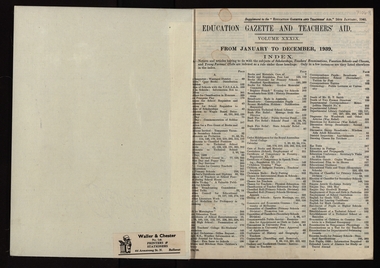
Book, Education Gazette, 1930s, 1930s
... Train Journey Through Germany, History Handwork - Roman Times, Claude Seareby (photo), Norsemen, Techncical Schools Exhibition, Knots, Balllarat Junior Technical School Terraced Gardens...Gardens 10 hard covered, black books with red spine. The books contain the bound Victoria Education Gazettes for the 1930s. .4) Handwork in rural schools, Young Farmers' Clubs, Domestic Arts, Arbour Day, LEague of Youth of Australia. Health Education, Metal Trades, Industrial Studies, HOrticulture, Hinkler Memoria Trees, Musical Appreciation, British Breeds of Sheep. Train Journey Through Germany, History Handwork - Roman Times, Claude Seareby (photo), Norsemen, Techncical Schools Exhibition, Knots ...10 hard covered, black books with red spine. The books contain the bound Victoria Education Gazettes for the 1930s. .4) Handwork in rural schools, Young Farmers' Clubs, Domestic Arts, Arbour Day, LEague of Youth of Australia. Health Education, Metal Trades, Industrial Studies, HOrticulture, Hinkler Memoria Trees, Musical Appreciation, British Breeds of Sheep. Train Journey Through Germany, History Handwork - Roman Times, Claude Seareby (photo), Norsemen, Techncical Schools Exhibition, Knots, Balllarat Junior Technical School Terraced Gardenseducation gazette, ballarat junior technical school terrace gardens -
 Embroiderers Guild, Victoria
Textile - Crinoline Lady Embroidered Picture, 1922
... Figure embroidered in peach and blue long and short stich, buttonhole, French knots and bullion stitches. Standing in a garden under tree with bird bath, two birds, hollyhocks and daisies....Figure embroidered in peach and blue long and short stich, buttonhole, French knots and bullion stitches. Standing in a garden under tree with bird bath, two birds, hollyhocks and daisies. ...Popular theme betwwen 1920-1940's. Inspiration from earlier Victorian and colonial designs,'Crinoline Lady' vintage embroidery. Figure embroidered in peach and blue long and short stich, buttonhole, French knots and bullion stitches. Standing in a garden under tree with bird bath, two birds, hollyhocks and daisies. -
 Embroiderers Guild, Victoria
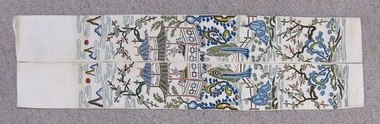
Accessory - Pair of Chinese Embroidered Sleeve Bands, 19 th C
... Embroidery Garments Silk Embroidery China garden figures lanscape Cream satin, silk embroidery in Pekin knot stitch. ...Chinese sleeve embroidery bands, or wanxiu became popular in the late 19th century during the Qing Dynasty, evolving from the traditional Han cuff embroidery and Manchu styles. These detachable, decorated bands were added to women's informal jackets and robes, often featuring symbolic motifs like landscapes, flowers, and auspicious symbols. They served both a decorative function, displaying artistic skill and personal wishes, and a practical one by covering the sleeves when hands were folded at the waist. History and evolution: Origins: The practice of embroidering cuffs on robes existed during the previous Ming Dynasty for Han women, and this was adopted by the Manchu rulers who founded the Qing Dynasty. Qing Dynasty (1644-1911): The practice was popularized and elaborated upon during this era, with detachable bands becoming a fashionable element for informal wear. Symbolism: The embroidery included a complex visual vocabulary of wishes for a long life, many offspring, and a happy marriage, derived from nature, mythology, and classical literature. Functionality: Women would fold their arms, often with their hands inside the sleeves, so the embroidered bands, which were sewn to hang down the back of the jacket, would be displayed prominently down the front. 19th century peak: The late 19th century was the peak of their popularity, with intricate designs becoming fashionable and even influenced by court tastes, such as those favoured by the Empress Dowager Cixi. Later developments: The late 19th century saw the introduction of chemical 'aniline' dyes from Europe, leading to brighter, bolder colours in embroidery. Motifs and their Meanings: Auspicious symbols: Designs often included symbols for good fortune, wealth, and longevity. Natural imagery: Birds, flowers, and landscapes were common motifs that could represent natural beauty or convey specific symbolic meanings. Figurative scenes: Bands could also feature narrative scenes from classical stories or legends. The choice of motifs allowed women to express personal desires, cultural values, and aesthetic preferences, reflecting a more personal and informal style than official court attire.Cream satin, silk embroidery in Pekin knot stitch. Fine couched cord. Rural setting with figures, trees and pagoda.embroidery, garments, silk embroidery, china, garden, figures, lanscape -
 Embroiderers Guild, Victoria
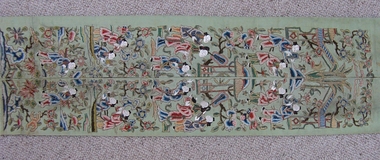
Accessory - Pair of Chinese Sleeve Bands, Late 19th century
... Embroidery Garments Silk Embroidery China Sleeve Bands Late 19th century garden figures Pair of Chinese Sleeve bands using Pekin knots, satin stitch. ...Chinese sleeve embroidery bands, or wanxiu became popular in the late 19th century during the Qing Dynasty, evolving from the traditional Han cuff embroidery and Manchu styles. These detachable, decorated bands were added to women's informal jackets and robes, often featuring symbolic motifs like landscapes, flowers, and auspicious symbols. They served both a decorative function, displaying artistic skill and personal wishes, and a practical one by covering the sleeves when hands were folded at the waist. History and evolution: Origins: The practice of embroidering cuffs on robes existed during the previous Ming Dynasty for Han women, and this was adopted by the Manchu rulers who founded the Qing Dynasty. Qing Dynasty (1644-1911): The practice was popularized and elaborated upon during this era, with detachable bands becoming a fashionable element for informal wear. Symbolism: The embroidery included a complex visual vocabulary of wishes for a long life, many offspring, and a happy marriage, derived from nature, mythology, and classical literature. Functionality: Women would fold their arms, often with their hands inside the sleeves, so the embroidered bands, which were sewn to hang down the back of the jacket, would be displayed prominently down the front. 19th century peak: The late 19th century was the peak of their popularity, with intricate designs becoming fashionable and even influenced by court tastes, such as those favoured by the Empress Dowager Cixi. Later developments: The late 19th century saw the introduction of chemical 'aniline' dyes from Europe, leading to brighter, bolder colours in embroidery. Motifs and their Meanings: Auspicious symbols: Designs often included symbols for good fortune, wealth, and longevity. Natural imagery: Birds, flowers, and landscapes were common motifs that could represent natural beauty or convey specific symbolic meanings. Figurative scenes: Bands could also feature narrative scenes from classical stories or legends. The choice of motifs allowed women to express personal desires, cultural values, and aesthetic preferences, reflecting a more personal and informal style than official court attire. Looking at the cuffs from bottom to top: there is a rock formation, a zig zag fence and flowers (chrysanthemums and a branch with Buddha's hand citron). Next is a male figure carrying a halberd over his shoulder and surrounded by flowers, foliage and hillocks. Above are two more males in a boat. One is standing, the other kneeling. The one kneeling holds a bamboo pipe, while the one standing holds a branch with pomegranates. The men are surrounded by more flowers, foliage, rocks and bats . Three more figures come next. A male holding a fan, a woman holding a dish and another male. The woman on the left cuff holds a dish which appears to hold fruit, whereas the woman on the right cuff holds a dish containing a ? hat. Further up is a pagoda with a pomegranate tree and two more male figures. One holds the sacred fungus, the other a vase with a lotus flower. Finally there are two pagodas, leaves, flowers and clouds. Symbolism: Buddha's (foshou) hand citron. This plant derives it's name from the shape of the fruit, which is said to resemble Buddha's hand. 'Foshou' is used as a pun from blessings (fu) and longevity (shou). Chrysanthemum - longevity. Halberd - a spear like object symbolizing rank and military achievement. Halberd (ji) is a pun for rank (ji) and represents rapid promotion and doing well in officialdom or politics. Bamboo pipe or mouth organ (skeng) is a pun for giving birth (skeng). The image of a boy with a mouth organ implies the wish for a son. Pomegranate- symbolizes many sons (or possibly children). Boat - may be travelling from or to. Fan (shan)- longevity, and also a pun for goodness (shan). Boy pointing upwards (?to the sun) - may you rise in rank (zhri goosheng). The act of pointing at the sun is a pun for 'soon' (zhri). Fungus - resembles the head of a wish granting wand (ruyi) and has the same meaning of 'as you wish'. Lotus flower - (he) is a pun for harmony. Vase - (ping) a pun for peace (ping'an) therefore a vase with lotus - peace and harmony. These sleeve bands are more generic but they do convey a wish for many sons who will become officials and bring fortune. Dr Rachel Silberstein, visiting Associate Professor at Rhode Island School of Design.Pair of Chinese Sleeve bands using Pekin knots, satin stitch. Depicts an outdoor scene with pagodas, people, zig zag fences, boats and plants embroidered on a pale green silk ground. Both cuffs have been joined at the bottom.embroidery, garments, silk embroidery, china, sleeve bands, late 19th century, garden, figures -
 Embroiderers Guild, Victoria
Textile - Mountmellick Embroidered Pillow Sham, Late 19th century
... Inspired by the local Irish flora, including blackberries, brambles, oak leaves, dog roses, ivy, ferns, and shamrocks, as well as later cultivated garden plants. Features heavily padded and knotted stitches, such as satin stitch, French knots, stem stitch, buttonhole stitch, and the signature Mountmellick stitch (which creates a triangle-like, spiked outline effect)....Inspired by the local Irish flora, including blackberries, brambles, oak leaves, dog roses, ivy, ferns, and shamrocks, as well as later cultivated garden plants. Features heavily padded and knotted stitches, such as satin stitch, French knots, stem stitch, buttonhole stitch, and the signature Mountmellick stitch (which creates a triangle-like, spiked outline effect). ...The design suggests it was made as a wedding gift. Mountmellick embroidery is a traditional, heavy white-on-white (whitework) hand embroidery style that originated around 1825 in the town of Mountmellick in County Laois, Ireland. Developed by Johanna Carter, the craft is celebrated for its deeply textured, sculptural appearance and all-Irish origins. Strictly monochrome white-on-white (white thread on white fabric). Traditionally worked on heavy, firm cotton satin jean, providing a sturdy, durable base for household items like bedspreads, tablecloths, and doilies. Uses thick, matte, twistless or heavy cotton threads that do not divide, contrasting with the sheen of the cotton jean fabric. Inspired by the local Irish flora, including blackberries, brambles, oak leaves, dog roses, ivy, ferns, and shamrocks, as well as later cultivated garden plants. Features heavily padded and knotted stitches, such as satin stitch, French knots, stem stitch, buttonhole stitch, and the signature Mountmellick stitch (which creates a triangle-like, spiked outline effect).One of pair of pillow shams - see 651. The design is of bull-rushes, water lilies, insects and a bird. The monogramme is decorated with leaves and flowers. Knitted fringe.Mcembroidery, mountmellick, ireland, late 19th century, pillow cases -
 Embroiderers Guild, Victoria
Clothing - Mountmellick Embroidered Nightgown Case, 1880-1890
... Inspired by the local Irish flora, including blackberries, brambles, oak leaves, dog roses, ivy, ferns, and shamrocks, as well as later cultivated garden plants. Features heavily padded and knotted stitches, such as satin stitch, French knots, stem stitch, buttonhole stitch, and the signature Mountmellick stitch (which creates a triangle-like, spiked outline effect)...Inspired by the local Irish flora, including blackberries, brambles, oak leaves, dog roses, ivy, ferns, and shamrocks, as well as later cultivated garden plants. Features heavily padded and knotted stitches, such as satin stitch, French knots, stem stitch, buttonhole stitch, and the signature Mountmellick stitch (which creates a triangle-like, spiked outline effect) Embroidery Mountmellick Late 19th century Australia Satin jean fabric, with 3 large flower sprays using bullions, satin stitch, knots and detached lace stitches. ...Mountmellick embroidery is a traditional, heavy white-on-white (whitework) hand embroidery style that originated around 1825 in the town of Mountmellick in County Laois, Ireland. Developed by Johanna Carter, the craft is celebrated for its deeply textured, sculptural appearance and all-Irish origins. Strictly monochrome white-on-white (white thread on white fabric). Traditionally worked on heavy, firm cotton satin jean, providing a sturdy, durable base for household items like bedspreads, tablecloths, and doilies. Uses thick, matte, twistless or heavy cotton threads that do not divide, contrasting with the sheen of the cotton jean fabric. Inspired by the local Irish flora, including blackberries, brambles, oak leaves, dog roses, ivy, ferns, and shamrocks, as well as later cultivated garden plants. Features heavily padded and knotted stitches, such as satin stitch, French knots, stem stitch, buttonhole stitch, and the signature Mountmellick stitch (which creates a triangle-like, spiked outline effect)Satin jean fabric, with 3 large flower sprays using bullions, satin stitch, knots and detached lace stitches. Flap is "V" shaped and case is trimmed with wide lace on 3 sides.embroidery, mountmellick, late 19th century, australia -
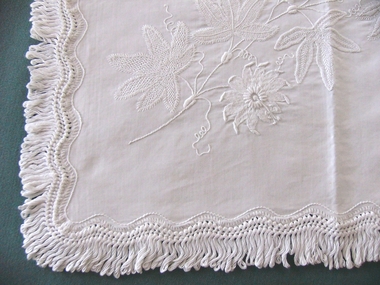 Embroiderers Guild, Victoria
Textile - Mountmellick Embroidered Pillow Sham, Mid 19th century
... Inspired by the local Irish flora, including blackberries, brambles, oak leaves, dog roses, ivy, ferns, and shamrocks, as well as later cultivated garden plants. Features heavily padded and knotted stitches, such as satin stitch, French knots, stem stitch, buttonhole stitch, and the signature Mountmellick stitch (which creates a triangle-like, spiked outline effect)....Inspired by the local Irish flora, including blackberries, brambles, oak leaves, dog roses, ivy, ferns, and shamrocks, as well as later cultivated garden plants. Features heavily padded and knotted stitches, such as satin stitch, French knots, stem stitch, buttonhole stitch, and the signature Mountmellick stitch (which creates a triangle-like, spiked outline effect). ...Mountmellick embroidery is a traditional, heavy white-on-white (whitework) hand embroidery style that originated around 1825 in the town of Mountmellick in County Laois, Ireland. Developed by Johanna Carter, the craft is celebrated for its deeply textured, sculptural appearance and all-Irish origins. Strictly monochrome white-on-white (white thread on white fabric). Traditionally worked on heavy, firm cotton satin jean, providing a sturdy, durable base for household items like bedspreads, tablecloths, and doilies. Uses thick, matte, twistless or heavy cotton threads that do not divide, contrasting with the sheen of the cotton jean fabric. Inspired by the local Irish flora, including blackberries, brambles, oak leaves, dog roses, ivy, ferns, and shamrocks, as well as later cultivated garden plants. Features heavily padded and knotted stitches, such as satin stitch, French knots, stem stitch, buttonhole stitch, and the signature Mountmellick stitch (which creates a triangle-like, spiked outline effect).Satin jean, diagonal spray of flowers and leaves in the classical mountmellick style. Traditional heavy fringed edge.C.W.embroidery, mountmellick, ireland, mid 19th century -
 Embroiderers Guild, Victoria
Textile - Mountmellick Embroidered Supper Cloth, 1900-20
... Inspired by the local Irish flora, including blackberries, brambles, oak leaves, dog roses, ivy, ferns, and shamrocks, as well as later cultivated garden plants. Features heavily padded and knotted stitches, such as satin stitch, French knots, stem stitch, buttonhole stitch, and the signature Mountmellick stitch (which creates a triangle-like, spiked outline effect)...Inspired by the local Irish flora, including blackberries, brambles, oak leaves, dog roses, ivy, ferns, and shamrocks, as well as later cultivated garden plants. Features heavily padded and knotted stitches, such as satin stitch, French knots, stem stitch, buttonhole stitch, and the signature Mountmellick stitch (which creates a triangle-like, spiked outline effect) Embroidery Table Cloth Mountmellick style Australia 1900-20 White linen with white embroidery around the turn of the century in the Mountmellick style. ...Made by aunt of donor. Mountmellick embroidery is a traditional, heavy white-on-white (whitework) hand embroidery style that originated around 1825 in the town of Mountmellick in County Laois, Ireland. Developed by Johanna Carter, the craft is celebrated for its deeply textured, sculptural appearance and all-Irish origins. Strictly monochrome white-on-white (white thread on white fabric). Traditionally worked on heavy, firm cotton satin jean, providing a sturdy, durable base for household items like bedspreads, tablecloths, and doilies. Uses thick, matte, twistless or heavy cotton threads that do not divide, contrasting with the sheen of the cotton jean fabric. Inspired by the local Irish flora, including blackberries, brambles, oak leaves, dog roses, ivy, ferns, and shamrocks, as well as later cultivated garden plants. Features heavily padded and knotted stitches, such as satin stitch, French knots, stem stitch, buttonhole stitch, and the signature Mountmellick stitch (which creates a triangle-like, spiked outline effect)White linen with white embroidery around the turn of the century in the Mountmellick style. Large sprays of classical flowers and leaves decorate two sides of the cloth using traditional stitchery. The edge has a fine border and a scalloped finish.embroidery, table cloth, mountmellick style, australia, 1900-20 -
 Embroiderers Guild, Victoria
Textile - Mountmellick Embroidered Pillow Sham, Late 19th century
... Inspired by the local Irish flora, including blackberries, brambles, oak leaves, dog roses, ivy, ferns, and shamrocks, as well as later cultivated garden plants. Features heavily padded and knotted stitches, such as satin stitch, French knots, stem stitch, buttonhole stitch, and the signature Mountmellick stitch (which creates a triangle-like, spiked outline effect)....Inspired by the local Irish flora, including blackberries, brambles, oak leaves, dog roses, ivy, ferns, and shamrocks, as well as later cultivated garden plants. Features heavily padded and knotted stitches, such as satin stitch, French knots, stem stitch, buttonhole stitch, and the signature Mountmellick stitch (which creates a triangle-like, spiked outline effect). ...Mountmellick embroidery is a traditional, heavy white-on-white (whitework) hand embroidery style that originated around 1825 in the town of Mountmellick in County Laois, Ireland. Developed by Johanna Carter, the craft is celebrated for its deeply textured, sculptural appearance and all-Irish origins. Strictly monochrome white-on-white (white thread on white fabric). Traditionally worked on heavy, firm cotton satin jean, providing a sturdy, durable base for household items like bedspreads, tablecloths, and doilies. Uses thick, matte, twistless or heavy cotton threads that do not divide, contrasting with the sheen of the cotton jean fabric. Inspired by the local Irish flora, including blackberries, brambles, oak leaves, dog roses, ivy, ferns, and shamrocks, as well as later cultivated garden plants. Features heavily padded and knotted stitches, such as satin stitch, French knots, stem stitch, buttonhole stitch, and the signature Mountmellick stitch (which creates a triangle-like, spiked outline effect).Probably one of a pair. Worked on white cotton satin jean. Textured white cotton stitches. Knitted white cotton fringe. Motif of bird, lilies and monogrammed "D".Monogrammed "D"embroidery, mountmellick, pillow cases, late 19th century, ireland -
 Embroiderers Guild, Victoria
Textile - Mountmellick Embroidered Pillow Shams, 1880-90
... Inspired by the local Irish flora, including blackberries, brambles, oak leaves, dog roses, ivy, ferns, and shamrocks, as well as later cultivated garden plants. Features heavily padded and knotted stitches, such as satin stitch, French knots, stem stitch, buttonhole stitch, and the signature Mountmellick stitch (which creates a triangle-like, spiked outline effect)...Inspired by the local Irish flora, including blackberries, brambles, oak leaves, dog roses, ivy, ferns, and shamrocks, as well as later cultivated garden plants. Features heavily padded and knotted stitches, such as satin stitch, French knots, stem stitch, buttonhole stitch, and the signature Mountmellick stitch (which creates a triangle-like, spiked outline effect) Embroidery Mountmellick Pillow cases Late 19th century Australia White cotton satin jean fabric with white cotton embroidery threads - thick and thin. ...Mountmellick embroidery is a traditional, heavy white-on-white (whitework) hand embroidery style that originated around 1825 in the town of Mountmellick in County Laois, Ireland. Developed by Johanna Carter, the craft is celebrated for its deeply textured, sculptural appearance and all-Irish origins. Strictly monochrome white-on-white (white thread on white fabric). Traditionally worked on heavy, firm cotton satin jean, providing a sturdy, durable base for household items like bedspreads, tablecloths, and doilies. Uses thick, matte, twistless or heavy cotton threads that do not divide, contrasting with the sheen of the cotton jean fabric. Inspired by the local Irish flora, including blackberries, brambles, oak leaves, dog roses, ivy, ferns, and shamrocks, as well as later cultivated garden plants. Features heavily padded and knotted stitches, such as satin stitch, French knots, stem stitch, buttonhole stitch, and the signature Mountmellick stitch (which creates a triangle-like, spiked outline effect)White cotton satin jean fabric with white cotton embroidery threads - thick and thin. Four flower, leaf and stem designs in each corner of both shams. Satin stitch, bullions, braid stitch, knots, chain stitch, buttonhole, stem and detached buttonhole stitch, single feather stitch, scalloped buttonhole edging. embroidery, mountmellick, pillow cases, late 19th century, australia -
 Embroiderers Guild, Victoria
Textile - Mountmellick Embroidered Pyjama Case, Late 19th century
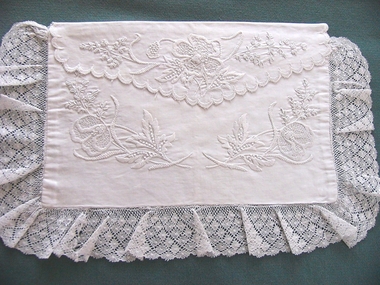
... Inspired by the local Irish flora, including blackberries, brambles, oak leaves, dog roses, ivy, ferns, and shamrocks, as well as later cultivated garden plants. Features heavily padded and knotted stitches, such as satin stitch, French knots, stem stitch, buttonhole stitch, and the signature Mountmellick stitch (which creates a triangle-like, spiked outline effect)...Inspired by the local Irish flora, including blackberries, brambles, oak leaves, dog roses, ivy, ferns, and shamrocks, as well as later cultivated garden plants. Features heavily padded and knotted stitches, such as satin stitch, French knots, stem stitch, buttonhole stitch, and the signature Mountmellick stitch (which creates a triangle-like, spiked outline effect) Embroidery Mountmellick Ireland Late 19th century Pyjama case Classic Mountmellick embroidery on satin jean with decorative scalloped edges top and base and fringed. ...Mountmellick embroidery is a traditional, heavy white-on-white (whitework) hand embroidery style that originated around 1825 in the town of Mountmellick in County Laois, Ireland. Developed by Johanna Carter, the craft is celebrated for its deeply textured, sculptural appearance and all-Irish origins. Strictly monochrome white-on-white (white thread on white fabric). Traditionally worked on heavy, firm cotton satin jean, providing a sturdy, durable base for household items like bedspreads, tablecloths, and doilies. Uses thick, matte, twistless or heavy cotton threads that do not divide, contrasting with the sheen of the cotton jean fabric. Inspired by the local Irish flora, including blackberries, brambles, oak leaves, dog roses, ivy, ferns, and shamrocks, as well as later cultivated garden plants. Features heavily padded and knotted stitches, such as satin stitch, French knots, stem stitch, buttonhole stitch, and the signature Mountmellick stitch (which creates a triangle-like, spiked outline effect)Classic Mountmellick embroidery on satin jean with decorative scalloped edges top and base and fringed. Heavily embroidered with flowers, wheat and leaves.embroidery, mountmellick, ireland, late 19th century, pyjama case -
 Embroiderers Guild, Victoria
Accessory - Mountmellick Embroidered Sachet, Late 19th century
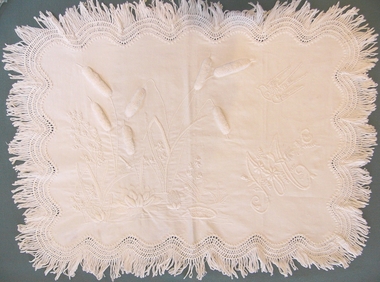
... Inspired by the local Irish flora, including blackberries, brambles, oak leaves, dog roses, ivy, ferns, and shamrocks, as well as later cultivated garden plants. Features heavily padded and knotted stitches, such as satin stitch, French knots, stem stitch, buttonhole stitch, and the signature Mountmellick stitch (which creates a triangle-like, spiked outline effect)...Inspired by the local Irish flora, including blackberries, brambles, oak leaves, dog roses, ivy, ferns, and shamrocks, as well as later cultivated garden plants. Features heavily padded and knotted stitches, such as satin stitch, French knots, stem stitch, buttonhole stitch, and the signature Mountmellick stitch (which creates a triangle-like, spiked outline effect) Embroidery Mountmellick Late 19th century Ireland White satin jean. ...Mountmellick embroidery is a traditional, heavy white-on-white (whitework) hand embroidery style that originated around 1825 in the town of Mountmellick in County Laois, Ireland. Developed by Johanna Carter, the craft is celebrated for its deeply textured, sculptural appearance and all-Irish origins. Strictly monochrome white-on-white (white thread on white fabric). Traditionally worked on heavy, firm cotton satin jean, providing a sturdy, durable base for household items like bedspreads, tablecloths, and doilies. Uses thick, matte, twistless or heavy cotton threads that do not divide, contrasting with the sheen of the cotton jean fabric. Inspired by the local Irish flora, including blackberries, brambles, oak leaves, dog roses, ivy, ferns, and shamrocks, as well as later cultivated garden plants. Features heavily padded and knotted stitches, such as satin stitch, French knots, stem stitch, buttonhole stitch, and the signature Mountmellick stitch (which creates a triangle-like, spiked outline effect)White satin jean. Design is passion-fruit flowers, leaves and brambles in a variety of stitches. The sachet is edged in long and short buttonhole stitch and the decorative fringe which usually edges this work has been cut away.embroidery, mountmellick, late 19th century, ireland -
 Embroiderers Guild, Victoria
Textile - Mountmellick Embroidered Pair of Pillow Covers, Miss Beamish, Late 19th C
... Inspired by the local Irish flora, including blackberries, brambles, oak leaves, dog roses, ivy, ferns, and shamrocks, as well as later cultivated garden plants. • Stitches: Features heavily padded and knotted stitches, such as satin stitch, French knots, stem stitch, buttonhole stitch, and the signature Mountmellick stitch (which creates a triangle-like, spiked outline effect)...Inspired by the local Irish flora, including blackberries, brambles, oak leaves, dog roses, ivy, ferns, and shamrocks, as well as later cultivated garden plants. • Stitches: Features heavily padded and knotted stitches, such as satin stitch, French knots, stem stitch, buttonhole stitch, and the signature Mountmellick stitch (which creates a triangle-like, spiked outline effect) Embroidery White work Late 19th century Australia Each cover is made of nine squares with designs embroidered in Mountmellick work. ...Made by three ladies, one of whom was Miss Beamish. Mountmellick embroidery is a traditional, heavy white-on-white (whitework) hand embroidery style that originated around 1825 in the town of Mountmellick in County Laois, Ireland. Developed by Johanna Carter, the craft is celebrated for its deeply textured, sculptural appearance and all-Irish origins. Strictly monochrome white-on-white (white thread on white fabric). Traditionally worked on heavy, firm cotton satin jean, providing a sturdy, durable base for household items like bedspreads, tablecloths, and doilies. Uses thick, matte, twistless or heavy cotton threads that do not divide, contrasting with the sheen of the cotton jean fabric. Inspired by the local Irish flora, including blackberries, brambles, oak leaves, dog roses, ivy, ferns, and shamrocks, as well as later cultivated garden plants. • Stitches: Features heavily padded and knotted stitches, such as satin stitch, French knots, stem stitch, buttonhole stitch, and the signature Mountmellick stitch (which creates a triangle-like, spiked outline effect)Each cover is made of nine squares with designs embroidered in Mountmellick work. Worked in a variety of designs and stitches, including some open work fillings. The covers are joined and edged with lace.embroidery, white work, late 19th century, australia -
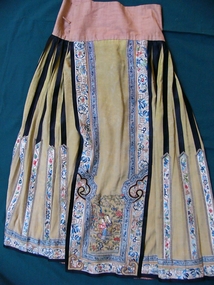 Embroiderers Guild, Victoria
Clothing - Chinese Embroidered Skirt, 19th century
... garden setting is embroidered on silk mesh and appliqued onto the background fabric. One of the women holds a fan, the other has her arms raised up and she bends slightly forward. Behind the woman with the fan there a is a little fence/bridge. To the left of the other woman is what appears to be a vase with a flower, next to what may be a gourd shaped vase. Worked in Pekin knot...garden setting is embroidered on silk mesh and appliqued onto the background fabric. One of the women holds a fan, the other has her arms raised up and she bends slightly forward. Behind the woman with the fan there a is a little fence/bridge. To the left of the other woman is what appears to be a vase with a flower, next to what may be a gourd shaped vase. Worked in Pekin knot ...Symbolism: Woman with a fan (shan) - a symbol of longevity and a pun for goodness. Gourds: fertility and good fortune. Peony: wealth and honour (fugui). Blossoms: bring forth fruit and therefore bring forth prosperity. Meander pattern: represents longevity.Lemon silk skirt lined with coral coloured silk. There is a broad cotton waist band with loops at each end, through which a tie would have been used to fasten the skirt. The reason for the cotton at the top was so that it didn't slip, as silk would have done. There is a central front panel bordered in black satin. within this is an embroidered floral and 'meander' or Greek key pattern. The 'meander' pattern is done in couched goldwork. Within this is another border of embroidered, machine made braid. The central motif of two women in a garden setting is embroidered on silk mesh and appliqued onto the background fabric. One of the women holds a fan, the other has her arms raised up and she bends slightly forward. Behind the woman with the fan there a is a little fence/bridge. To the left of the other woman is what appears to be a vase with a flower, next to what may be a gourd shaped vase. Worked in Pekin knot stitch and couched gold.embroidery, garment, silk embroidery, oriental, 19th century, china
