
Showing 261 items matching "language groups"
-
 Victorian Aboriginal Corporation for Languages
Book, Barry J Blake, Kulin and its neighbours, 2013
... ...language groups...Documents shared vocabulary and grammatical and phonetic correspondences between languages, including Mathi Group, Colac Language, Warrnambool Language and Bunganditj....Documents shared vocabulary and grammatical and phonetic correspondences between languages, including Mathi Group, Colac Language, Warrnambool Language and Bunganditj. ...Technical linguistic grammar of Kulin languages. Documents shared vocabulary and grammatical and phonetic correspondences between languages, including Mathi Group, Colac Language, Warrnambool Language and Bunganditj.Maps, word lists, graphslinguistics, language groups, dialects, kulin, mathi, bunganditj, colac, warrnambool -
 Victorian Aboriginal Corporation for Languages
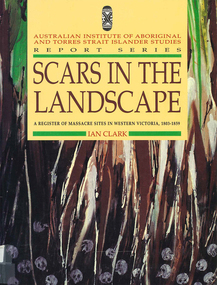
Book, Ian Clark, Scars in the landscape : a register of massacre sites in Western Victoria 1803-1859, 1995
... Register and documentation of massacre sites in ten language groups of Western Victoria; each language group includes details of clans, history of European occupation and government policy....Dhauwurd wurrung Djab wurrung Djadja wurrung Djargurd wurrung Gadubanud Girai wurrung Keerray-Woorroong Gulidjan Jardwadjali Watha wurrung Wathaurong Wergaia colonisation race relations racism European occupation government policy maps, colour photographs, b&w photographs Register and documentation of massacre sites in ten language groups of Western Victoria; each language group includes details of clans, history of European occupation and government policy. ...Register and documentation of massacre sites in ten language groups of Western Victoria; each language group includes details of clans, history of European occupation and government policy.maps, colour photographs, b&w photographsdhauwurd wurrung, djab wurrung, djadja wurrung, djargurd wurrung, gadubanud, girai wurrung, keerray-woorroong, gulidjan, jardwadjali, watha wurrung, wathaurong, wergaia, colonisation, race relations, racism, european occupation, government policy -
 Victorian Aboriginal Corporation for Languages
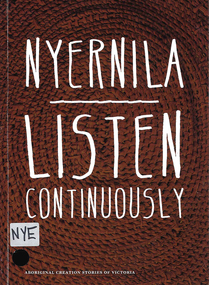
Book, Arts Victoria et al, Nyernila : listen continuously : Aboriginal Creation stories of Victoria, 2014
... Creation stories from Language groups around Victoria...Bidawal Gunai/Kurnai Ngarigu Boonwurrung Woiwurrung Taungurung Dja Dja Wurrung Wathaurong Yorta Yorta Gunditjmara Dhauwurd wurrung Tyakoort Woorroong Keerray woorroong Kee wooroong Gadubanud Djab wurrung Wergaia Wadiwadi Dadi dadi Yita Yita Mutti Mutti Wemba Wemba creation stories Colour photographs, maps, word lists Creation stories from Language groups around Victoria Nyernila : listen continuously : Aboriginal Creation stories of Victoria Book Arts Victoria VACL Vicki Couzens ...Creation stories from Language groups around VictoriaColour photographs, maps, word listsbidawal, gunai/kurnai, ngarigu, boonwurrung, woiwurrung, taungurung, dja dja wurrung, wathaurong, yorta, yorta, gunditjmara, dhauwurd wurrung, tyakoort woorroong, keerray woorroong, kee wooroong, gadubanud, djab wurrung, wergaia, wadiwadi dadi dadi, yita yita, mutti mutti, wemba wemba, creation stories, -
 Nillumbik Shire Council
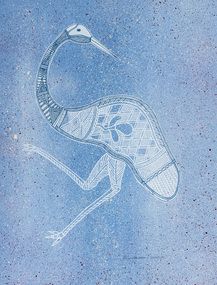
Work on paper - Print (Serigraph): Ray Thomas, Brolga, c2000
... handwritten artist signature and language group "Ray Thomas - GUNNAI" ...handwritten artist signature and language group "Ray Thomas - GUNNAI" This work is a serigraph (screenprint) on cartridge paper using blue oil based inks of the 'Brolga' (Australian Crane); a common, gregarious wetland bird species of tropical and south-eastern Australia and New Guinea / It is a tall, upright bird with a small head, long beak, slender neck and long legs / The pose of the bird represents their stance when calling out to their mate, which sounds like a loud trumpet / The decorative markings on the bird's plumage is from the traditional carved/etched Gunnai shields from Gippsland Eastern Victoria, which is where Thomas' people are from. ...This work is a serigraph (screenprint) on cartridge paper using blue oil based inks of the 'Brolga' (Australian Crane); a common, gregarious wetland bird species of tropical and south-eastern Australia and New Guinea / It is a tall, upright bird with a small head, long beak, slender neck and long legs / The pose of the bird represents their stance when calling out to their mate, which sounds like a loud trumpet / The decorative markings on the bird's plumage is from the traditional carved/etched Gunnai shields from Gippsland Eastern Victoria, which is where Thomas' people are from. Underneath 'Brolga', on slant, lower right in greylead pencil (?) handwritten artist signature and language group "Ray Thomas - GUNNAI" -
 Bendigo Historical Society Inc.
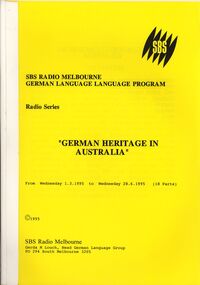
Book - STRACUH COLLECTION: GERMAN HERITAGE IN AUSTRALIA
... SBS Radio Melbourne Gerda m Louch, Head German Language Group PO 294 South Melbourne 3205, written in German....SBS Radio Melbourne Gerda m Louch, Head German Language Group PO 294 South Melbourne 3205, written in German. ...BHS CollectionSBS Radio Melbourne German Language Language Program, Radio Series, German Heritage In Australia. SBS Radio Melbourne Gerda m Louch, Head German Language Group PO 294 South Melbourne 3205, written in German.books, technical, german, radio-sbs-german heritage -
 Victorian Aboriginal Corporation for Languages
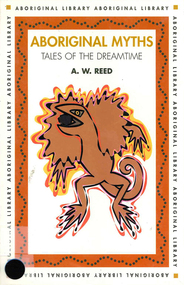
Book, A W Reed, Aboriginal myths : tales of the Dreamtime, 1999
... Stories involving animals, gathered from Language groups throughout Australia. Gathered from often quite isolated Aboriginal groups throughout Australia and passed down over thousands of years, some of the myths have striking similarities. ...Creation stories Stories involving animals, gathered from Language groups throughout Australia. Gathered from often quite isolated Aboriginal groups throughout Australia and passed down over thousands of years, some of the myths have striking similarities. ...Stories involving animals, gathered from Language groups throughout Australia. Gathered from often quite isolated Aboriginal groups throughout Australia and passed down over thousands of years, some of the myths have striking similarities. Aboriginal Myths gives a fascinating glimpse of the wild and entertaining deeds of the mythic beings populating Aboriginal spiritual life. Does not include a glossary.creation stories -
 City of Whittlesea Art Collection
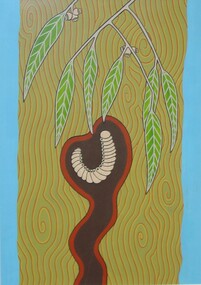
Painting - Gouache on paper, Mandy Nicholson, Djerri (Grub)
... Mandy also has connections to the Dja Dja wurrung and Ngurai illam wurrung language groups of the Central/Eastern Kulin Nation on her fathers side and German on her mothers....Mandy also has connections to the Dja Dja wurrung and Ngurai illam wurrung language groups of the Central/Eastern Kulin Nation on her fathers side and German on her mothers. wurundjeri aboriginal kulin Djerri (Grub) Painting Gouache on paper Mandy Nicholson ...Born in Healesville, Many Nicholson is a Wurundjeri-willam (Wurundjeri-baluk patriline) artist and Traditional Custodian of Melbourne and surrounds. Mandy also has connections to the Dja Dja wurrung and Ngurai illam wurrung language groups of the Central/Eastern Kulin Nation on her fathers side and German on her mothers.wurundjeri, aboriginal, kulin -
 City of Whittlesea Art Collection
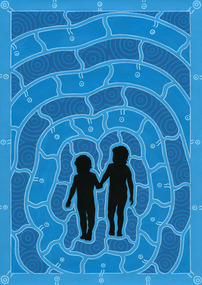
Painting - Gouache on paper, Mandy Nicholson, Yan Yean and Mernda
... Mandy also has connections to the Dja Dja wurrung and Ngurai illam wurrung language groups of the Central/Eastern Kulin Nation on her fathers side and German on her mothers....Mandy also has connections to the Dja Dja wurrung and Ngurai illam wurrung language groups of the Central/Eastern Kulin Nation on her fathers side and German on her mothers. wurundjeri aboriginal kulin Yan Yean and Mernda Painting Gouache on paper Mandy Nicholson ...Born in Healesville, Many Nicholson is a Wurundjeri-willam (Wurundjeri-baluk patriline) artist and Traditional Custodian of Melbourne and surrounds. Mandy also has connections to the Dja Dja wurrung and Ngurai illam wurrung language groups of the Central/Eastern Kulin Nation on her fathers side and German on her mothers.wurundjeri, aboriginal, kulin -
 Federation University Art Collection
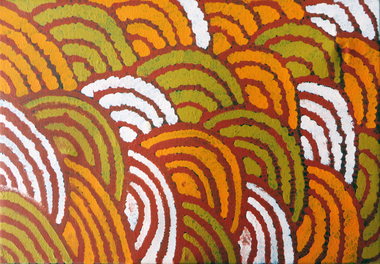
Painting - Artwork - Painting, 'Bushfood' by Anne Ferguson, 09/2006
... Ann FERGUSON (1939- ) Country: Wingetllina Area: Alice Spring, Kalka/Pipalyatjara Language group: Pitjantjarara Ann Ferguson (Ann Cleary Nyankulya Bnaka) is a member of the Stolen Generation, she was removed from her family and take to Kalgoorlie Mission, South Australia. ...Ann FERGUSON (1939- ) Country: Wingetllina Area: Alice Spring, Kalka/Pipalyatjara Language group: Pitjantjarara Ann Ferguson (Ann Cleary Nyankulya Bnaka) is a member of the Stolen Generation, she was removed from her family and take to Kalgoorlie Mission, South Australia. ...Ann FERGUSON (1939- ) Country: Wingetllina Area: Alice Spring, Kalka/Pipalyatjara Language group: Pitjantjarara Ann Ferguson (Ann Cleary Nyankulya Bnaka) is a member of the Stolen Generation, she was removed from her family and take to Kalgoorlie Mission, South Australia. She started painting in 1973 when her care givers noticed her artistic talent. Ann Ferguson is also a basket weaver, carver and lino block printmaker at Indulkana Community, South Australia, Acrylic painting on stretched canvasaboriginal, bushfood, anne ferguson, bush food, bush foods, ann cleary, ann ferguson, indulkana -
 Victorian Aboriginal Corporation for Languages
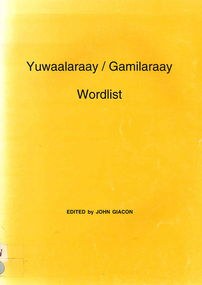
Book, John Giacon, Yuwaalaraay/Gamilaraay Wordlist, 1999
... A book of wordlists in the Yuwaalaraay/Gamilaraay languages, which contains word groups, pronunciation guides etc....Gamilaraay Yuwaalaraay Moree Boggabilla Narrabri Gunnedah Tamworth Mungindi word lists A book of wordlists in the Yuwaalaraay/Gamilaraay languages, which contains word groups, pronunciation guides etc. ...A book of wordlists in the Yuwaalaraay/Gamilaraay languages, which contains word groups, pronunciation guides etc.word listsgamilaraay, yuwaalaraay, moree, boggabilla, narrabri, gunnedah, tamworth, mungindi -
 Federation University Historical Collection
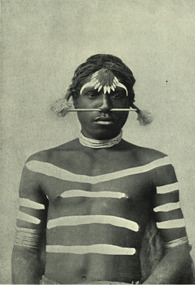
Image - black and white, Barwon River Man (New South Wales)
... Aboriginal people from six language groups originally occupied the area of the Barwon River wetlands. ...Aboriginal people from six language groups originally occupied the area of the Barwon River wetlands. ...Digitised directly from 'The Native Races of the British Empire: Victoria' The Barwon River in New South Wales is formed through the confluence of the Macintyre River and Weir River (part of the Border Rivers system), north of Mungindi, in the Southern Downs region of Queensland. The Barwon River generally flows south and west, joined by 36 tributaries, including major inflows from the Boomi, Moonie, Gwydir, Mehi, Namoi, Macquarie, Bokhara and Bogan rivers. During major flooding, overflow from the Narran Lakes and the Narran River also flows into the Barwon. The confluence of the Barwon and Culgoa rivers, between Brewarrina and Bourke, marks the start of the Darling River.Black and white Image of an Aboriginal man from Barwon River, New South Wales. Aboriginal people from six language groups originally occupied the area of the Barwon River wetlands. These were the Ngemba, the Baranbinja, the Murrawari, the Ualayai, the Weilwan, and the Kamilaroi peoples. The Aboriginal people generally used the wetlands for hunting, fishing, and gathering uses, and for cultural association.(Wikipedia) The name "barwon" is derived from the Australian Aboriginal words of barwum or bawon, meaning great, wide, awful river of muddy water; and also baawan, a Ngiyambaa name for both the Barwon and Darling rivers. The history, culture and livelihoods of the local Aboriginal people are closely intertwined with the Barwon River and its associated tributaries and downstream flows. (Wikipedia)aborigine, aboriginal, barwon river -
 Federation University Art Collection
Sculpture - Artwork, 'The More Bones the Better' by Yhonnie Scarce, 2016
... Yhonnie SCARCE (1973- ) Born Woomera, South Australia Language group: Kokatha, Southern desert region and Nukunu, Spencer region Yhonnie Scarce works predominantly in glass. ...Yhonnie SCARCE (1973- ) Born Woomera, South Australia Language group: Kokatha, Southern desert region and Nukunu, Spencer region Yhonnie Scarce works predominantly in glass. ...Yhonnie SCARCE (1973- ) Born Woomera, South Australia Language group: Kokatha, Southern desert region and Nukunu, Spencer region Yhonnie Scarce works predominantly in glass. She majored in glass withing a Bachelor of Visual Arts (Honours) course at the South Australian School of Art, Adelaide, and holds a Master of Fine Arts from Monash University. One of the first contemporary Australian artists to explore the political and aesthetic power of glass, Scarce describes her work as ‘politically motivated and emotionally driven’. Scarce’s work often references the on-going effects of colonisation on Aboriginal people, In particular her research focus has explored the impact of the removal and relocation of Aboriginal people from their homelands and the forcible removal of Aboriginal children from their families. (https://thisisnofantasy.com/artist/yhonnie-scarce/, accessed 10 September 2018)Artist's Statement 'The More Bones the Better', 2016 Yhonnie Scarce was born in Woomera, SA and belongs to the Kokatha and Nukunu peoples. Scarce embraces a non traditional approach to glass blowing using glass as more than a mere material, acting as a lens and a mirror, Scarce reflects and exposes the tragedies of Australia’s colonisation. She applies the technical rigours of traditional glass blowing techniques in an innovative and unconventional manner. In particular Scarce uses glass to explore the lives and histories of Aboriginal Australians. Hand blown glass is shaped, engraved, painted and smashed to create indigenous fruits and vegetables such as bush bananas, bush plums and long yams symbolic of her peoples culture and traditions. With their elongated, torso-like shapes, they even evoke human bodies. Akin to a gatherer of bush food Scarce creates glass-gatherings of the persecuted. The repetition of brittle ambiguous bodies collected for experimentation and examination conjures the relentless impact of colonisation and the litany of abuses suffered by Aboriginal people. Within her research Scarce encountered a variety of ethnographic studies examining the use of scientific interventions amongst Indigenous cultures. These include Government sanctioned illegal drug testing of children in orphanages and other dubious medical practices amongst indigenous prison inmates. This work metaphorically looks at these situations and poses questions of what might have gone on in such a laboratory. The judge of the 2017 Guirguis New Art Prize (GNAP), Simon Maidment, Senior Curator, Contemporary Art, National Gallery of Victoria said; “The winning work by Yhonnie Scarce captures the sensitivity to materials she displays throughout her artistic practice. The blown and shattered glass elements are a delicate contrast to the shocking and little discussed histories of Aboriginal exploitation and abuse in the name of science in Australia. Engaging this topic, this work is haunting, in the same way those lived and documented experiences continue to haunt the collective unconscious of this country. Yhonnie Scarce’s work, The More Bones the Better 2016, I believe makes an important contribution to the Collection of Federation University Australia and will engage and move diverse audiences with its technical accomplishment, beauty and message. Yhonnie Scarce was born in Woomera SA and belongs to the Kokatha and Nukunu peoples. Scarce embraces a non-traditional approach to glass blowing using her medium as more than a mere material. Applying the technical rigours of traditional glass blowing in an innovative and unconventional manner, Scarce’s glass objects act as a lens and a mirror to reflect and expose the tragedies of Australia’s colonisation and, in particular, explore the lives and histories of Aboriginal Australians. Hand-blown glass is shaped, engraved, painted and smashed to represent indigenous fruits and vegetables such as bush bananas, bush plums and long yams, symbolic of Scarce’s people’s culture and traditions. While these elongated shapes on the one hand represent fruit and vegetables, gathered and grouped as in the gathering of bush food, Scarce’s torso-like bodies and forms are glass ‘gatherings’ representative of the gathering of people. Here, the many brittle bodies act as a metaphor for the collection, experimentation and examinations undertaken by government authorities on Aboriginal communities researched by Scarce. Exposing a variety of ethnographic studies, examining the use of scientific interventions on Indigenous cultures, Scarce also revealed Government sanctioned illegal drug testing of children in orphanages and other dubious medical practices undertaken on indigenous prison inmates. Scarce’s gatherings also reflect the impact of colonisation and the relentless conjuring and litany of abuses suffered by Aboriginal people. The More Bones the Better metaphorically looks at these situations and poses questions of what was undertaken and investigated in these laboratories. guirguis new art prize, yhonnie scarce, glass, aboriginal -
 Federation University Art Collection
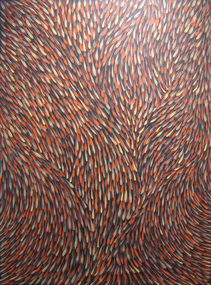
Painting, Gloria Petyarre, 'Bush Medicine' by Gloria Petyarre
... Gloria PETYARRE (c.1942 - 2021) Born: Mosquito Bore, Utopia, Northern Territory Language Group: Anmatyerre Community: Utopia, Northern Territory Gloria Petyarre's depiction of the Kurrajong bush medicine leaves with her layered, swirling brushstrokes is her iconic motif. ...Gloria PETYARRE (c.1942 - 2021) Born: Mosquito Bore, Utopia, Northern Territory Language Group: Anmatyerre Community: Utopia, Northern Territory Gloria Petyarre's depiction of the Kurrajong bush medicine leaves with her layered, swirling brushstrokes is her iconic motif. ...Gloria PETYARRE (c.1942 - 2021) Born: Mosquito Bore, Utopia, Northern Territory Language Group: Anmatyerre Community: Utopia, Northern Territory Gloria Petyarre's depiction of the Kurrajong bush medicine leaves with her layered, swirling brushstrokes is her iconic motif. In 1999 Gloria Petyarre became the first Indigenous Australian artist to win the 'Wynne Prize for Landscape' at the New South Wales Gallery. She is credited with being the creator of this popular style, which was adopted and adapted by several generations of her family members over Gloria's retirement in 2019. The artistic tradition in Utopia started in the Utopia Women's Silk Batik Group introduced in 1977. Gloria Petyarre and her aunt Emily Karne Kngwarrye were found members of this group. Gloria Petyarre started painting on canvas in 1988 with her brushstrokes and layered paint having foundations in the batik tradition. This item is part of the Federation University Art Collection. The Art Collection features over 2000 works and was listed as a 'Ballarat Treasure' in 2007.Utopian Art Movement‘Bush Medicine Dreaming’ depicts the leaves of a special plant that is used to aid in the healing process. The leaves are collected and then boiled to extract the resin. Following this, the resin is mixed with kangaroo fat collected from the kangaroo’s stomach. This creates a paste that can be stored for up to six months in bush conditions. This medicine is used to heal cuts, wounds, bites, rashes and as an insect repellent. The Dreaming that is the basis for Petyarre’s paintings comes from the important ceremonies and traditions held by the people of Atnwengerrp. art, artwork, gloria petyarre, aboriginal, utopia -
 The Beechworth Burke Museum
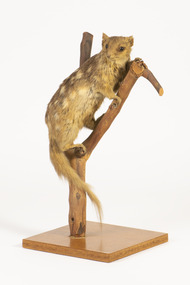
Animal specimen - Eastern quoll, Trustees of the Australian Museum, 1860-1880
... Tjilpa is the name given to the quoll amongst the Northern Arrernte language group of Australian Aboriginal people. ...Tjilpa is the name given to the quoll amongst the Northern Arrernte language group of Australian Aboriginal people. ...Quolls are small carnivorous marsupials native to Australia and New Guinea. Tjilpa is the name given to the quoll amongst the Northern Arrernte language group of Australian Aboriginal people. Quolls are primarily nocturnal and spend most of the day in a den. Of the six species of quoll, four are found in Australia and two in New Guinea. The six species vary in weight and size, from 300g to 7kg. They live in coastal heathlands, sub-alpine woodlands, temperate woodlands and forests, riparian forests and wet sclerophyll forests. This specimen is part of a collection of almost 200 animal specimens that were originally acquired as skins from either the Trustees of the Australian Museum or from the amateur anthropologist Reynell Eveleigh Johns between 1860-1880 and mounted by members of the Burke Museum Committee around the same time. When all taxidermy mounts were completed, they were quickly put-on display in the formal space of the Museum’s original exhibition hall where they continue to be on display. This display of taxidermy mounts initially served to instruct visitors to the Burke Museum of the natural world around them, today it serves as an insight into the collecting habits of the 19th century. This specimen is part of a significant and rare taxidermy mount collection in the Burke Museum. This collection is scientifically and culturally important for reminding us of how science continues to shape our understanding of the modern world. They demonstrate a capacity to hold evidence of how Australia’s fauna history existed in the past and are potentially important for future environmental research. This collection continues to be on display in the Museum and has become a key part to interpreting the collecting habits of the 19th century.Small quoll with a small round head, long body, and long, thin tail perched on a branch attached to a wooden mount. The quoll has four skinny legs which have long, dark claws. The quoll's hair is a fawn colour with cream spots. There are two black eyes made of glass, two short pointed ears and black whiskers.On wooden mount: BMM5897 /taxidermy, quoll, animal, australia, burke museum, beechworth, reynell eveleigh johns, taxidermy mount, marsupial -
 The Beechworth Burke Museum
Ceremonial object - Message Sticks, Dja Dja Wurrung
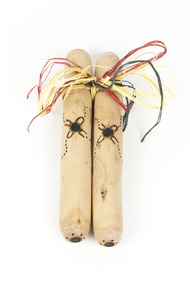
... Message sticks are a form of communication between Aboriginal nations, clans and language groups even within clans. Traditional message sticks were made and crafted from wood and were generally small and easy to carry (between 10 and 20 cm). ...Message sticks are a form of communication between Aboriginal nations, clans and language groups even within clans. Traditional message sticks were made and crafted from wood and were generally small and easy to carry (between 10 and 20 cm). ...These Message Sticks acknowledge the return of Dja Dja Wurrung Cultural material held by the Burke Museum. The Burke Museum is the current custodian of a significant collection of First Peoples’ cultural material from across South-Eastern Australia. These objects were sold to the Museum by Reynold Everly Johns in 1868. We recognise the harm caused by dispossession of cultural material, and by any inappropriate display and interpretation of this collection over the past 150 years. The Burke Museum is continuing to build relationships and collaborate with traditional owners, Aboriginal communities and the museum sector to ensure culturally appropriate outcomes for the collection, including repatriation of objects to communities of origin. Message sticks are a form of communication between Aboriginal nations, clans and language groups even within clans. Traditional message sticks were made and crafted from wood and were generally small and easy to carry (between 10 and 20 cm). They were carved, incised and painted with symbols and decorative designs conveying messages and information. Some were prepared hastily, like you might create a note left on a friend’s desk or a quick text message; others were prepared with more time to make the markings neat and ornate. There were always marks that were distinctive to the particular group or nation sending the message and often marks identifying the relationship of the carrier to their group. This way it could be identified and authenticated by neighboring groups and by translators when the message stick was taken long distances. Two solid cylindrical shaped pieces of wood bound together with black, red and yellow string. Each stick has etchings with angular lines and dots. dja dja wurrung, message sticks, burke museum, beechworth, beechworth museum, repatriation, reynold everly johns -
 Federation University Art Collection
Painting - Natural pigment on bark, Mawurndjul, John, 'Female Wayarra Spirit' by John Mawurndjul, 1995
... Balang [John MAWURNDJUL] (1952 - )
Born Mumeka, Northern Territory
Country: Milmilngkan, West Arnham Land, Northern Territory
Clan: Na-Kurulk
Language Group: Kunwinjku
Location: Milmilngkan
John Mawurndjul is an Australian indigenous artist. ...Balang [John MAWURNDJUL] (1952 - )
Born Mumeka, Northern Territory
Country: Milmilngkan, West Arnham Land, Northern Territory
Clan: Na-Kurulk
Language Group: Kunwinjku
Location: Milmilngkan
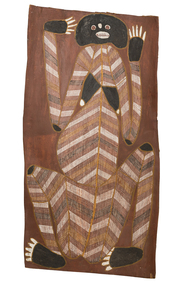
John Mawurndjul is an Australian indigenous artist. ...Balang [John MAWURNDJUL] (1952 - ) Born Mumeka, Northern Territory Country: Milmilngkan, West Arnham Land, Northern Territory Clan: Na-Kurulk Language Group: Kunwinjku Location: Milmilngkan John Mawurndjul is an Australian indigenous artist. He is a member of the Kuninjku people of West Arnhem Land, Northern Territory. Growing up John had only occasional contact with non-indigenous people and culture. He was tutored in rarrk, a traditional painting technique using fine cross hatching and infill, working on small barks. During the 1980s he started producing larger and more complex works. The artist has painted 'Wayarra', a generic term which can include both malevolent spirit beings which continually inhabit certain sites or objects but can also mean the Spirit of a recently deceased person. These spirits are one of two spirits of the dead, the other being the 'Kun-malng' soul. The 'Wayarra' is the shadow or 'shade' of the dead and may take on the form of the deceased and haunt areas where the deceased recently inhabited. In order to prevent Wayarra spirits from harassing relative of the recently deceased, a smoking ceremont is performed where Ironwood leaves are burnt around the camp of the recently deceased and ochre is rubbed on all objects belonging to the deceased. Ochre may also be rubbed on vehicles, houses and trees. Some Wayarra are a particular Dreaming totem for people of certain clans. This is why many artists depict Wayarra in their bark paintings and sculptures. They are depicting clan totems particular to their lineage and which are celebrated in major regional patrimoiety ceremonies. In 1989 the work of John Mawurndjul was included in the landmark exhibition "Magiciens de la Terra' at the Centre Pompidou and Grande Halle de la Vilette in Paris, France. His works have also been exhibited in numerous solo and group exhibitions in Australia, New York, Paris and Japan. Mawurndjul is one of eight artists whose work in part of the largest inernational commission of contemporary Indigenous art from Australia at the Musee du Quai Branly, Paris. The work was exhibited in the Australian survey "John Mawurndjul: I Am The Old And The New", at the Museum of Contemporary Art, one of the 160-odd works all chosen by Mawurndjul for inclusion in the exhibition. This item is part of the Federation University Art Collection. The Art Collection features over 1000 works and was listed as a 'Ballarat Treasure' in 2007.This artwork was chosen by John Murwurndjul as on of around 160 works for exhibition in the 2018 Australian Survey of his work at the Museum of Contemporary Art. The artist is known for his rarrk work, which is evident in 'Female Wayarra Spirit'.Aboriginal bark painting featurung rarrk. The artwork is associated with Dilebang, a duwa moiety place that belongs to the Kurulk clan. This work is currently on loan for exhibition in 'John Mawurndjul: I am the old and the new'. The exhibition will be shown at the Museum of Contemporary Art Australia (Sydney) from 6 July – 23 September 2018, and the Art Gallery of South Australia, Adelaide from 26 October 2018 – 28 January 2019.art, artwork, john mawurndjul, aboriginal, bark painting, rarrk, wayarra, kuninjku, maningrida, loan -
Federation University Historical Collection
Article - Article - Women, Federation University: Women of Note; Dr Doris Paton, Academic and Aboriginal Elder
... Her skill and expertise have been acknowledged through roles as Director Vice-Chairperson of the Victorian Aboriginal Languages Corporation (VACL) and as Chairperson of the Victorian Indigenous Languages Implementation Reference Group, Victorian Curriculum Assessment Authority, where she developed the framework to accredit “Indigenous Languages of Victoria: Revival and Reclamation”, a VCE accredited subject contributing toward the preservation of Indigenous languages across Australia. ...Her skill and expertise have been acknowledged through roles as Director Vice-Chairperson of the Victorian Aboriginal Languages Corporation (VACL) and as Chairperson of the Victorian Indigenous Languages Implementation Reference Group, Victorian Curriculum Assessment Authority, where she developed the framework to accredit “Indigenous Languages of Victoria: Revival and Reclamation”, a VCE accredited subject contributing toward the preservation of Indigenous languages across Australia. ...Dr Doris Paton is an accomplished academic and respected Aboriginal Elder with a passion for the advancement of First Nations People through education, and the reclamation and revival of Aboriginal languages across Australia. She graduated with a Bachelor of Arts (Social Science) from Monash University, Gippsland campus in 1993, and went on to complete a Graduate Diploma Education (Secondary); Master of Education Studies (Aboriginal Education); Master of Education (Aboriginal Education); and a PhD Philosophy (Education). Her skill and expertise have been acknowledged through roles as Director Vice-Chairperson of the Victorian Aboriginal Languages Corporation (VACL) and as Chairperson of the Victorian Indigenous Languages Implementation Reference Group, Victorian Curriculum Assessment Authority, where she developed the framework to accredit “Indigenous Languages of Victoria: Revival and Reclamation”, a VCE accredited subject contributing toward the preservation of Indigenous languages across Australia. A Federation University Council Member since 2020, Doris is also long-serving Director of the Nindi Ngujarn Ngarigo Monero Aboriginal Corporation; and has served on boards for Parks Victoria, the Victorian Aboriginal Heritage Council, and the East Gippsland School for Aboriginal Health Professionals. Her work has been presented at conferences including the World Indigenous Peoples Conference on Education, and recognised with several awards including the GippsTAFE Staff Excellence Awards in the Community Development, and Personal Achievement categories, The Wurreker Award for Community Based Employee, and the Parks Victoria Regional Achiever Award.women of note, federation university, doris paton, aboriginal elder, academic, aboriginal languages, monash university gippsland, graduate diploma education, bachelor of arts, master of education, phd philosophy, victorian aboriginal languages corporation, vacl, councillor -
 Victorian Aboriginal Corporation for Languages
Book, John Henderson, Language in native title, 2002
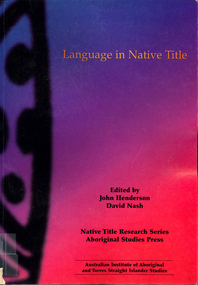
... Tamsin Donaldson Labels, language and native title groups: the Miriuwung-Gajerrong case /? ...Tamsin Donaldson Labels, language and native title groups: the Miriuwung-Gajerrong case /? ...Introduction /? John Henderson and David Nash Language and native title /? John Henderson Linguistic evidence and native title cases in Australia /? Peter Sutton Linguistic continuity in colonised country /? Jeanie Bell Country and the word: linguistic evidence in the Croker Sea claim /? Nicholas Evans Linguistics and the Yorta Yorta native title claim /? Heather Bowe The language of the Peak Hill Aboriginal people: a linguistic report in a native title claim /? Tamsin Donaldson Labels, language and native title groups: the Miriuwung-Gajerrong case /? Greg McIntyre and Kim Doohan Historical linguistic geography of south-east Western Australia /? David Nash Language ownership: a key issue for native title /? Michael Walsh Can lexicostatistics contribute an absolute time-scale to discussions of continuity of occupation in native title determinations? /? Barry Alpher Linguistic stratigraphy and native title: the case of ethnonyms /? Patrick McConvell Making your skin fit properly: displaced equivalence in 'skin' systems in the Barkly /? Gavan BreenMaps, tables, b&w diagramsyorta yorta, yoda yoda, yabala yabala, bangerang, shepparton, miriuwung, gajerrong, native title -
 Victorian Aboriginal Corporation for Languages
Book, Brett Baker, Indigenous language and social identity : papers in honour of Michael Walsh, 2010
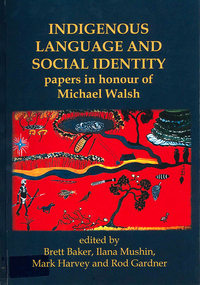
... Aboriginal languages and social groups in the Canberra region : interpreting the historical documentation /? ...Aboriginal languages and social groups in the Canberra region : interpreting the historical documentation /? ...For almost 40 years, Michael Walsh has been working alongside Indigenous people: documenting language, music and other traditional knowledge, acting on behalf of claimants to land in the Northern Territory, and making crucial contributions to the revitalisation of Aboriginal languages in NSW. This volume, with contributions from his colleagues and students, celebrates his abiding interest in and commitment to Indigenous society with papers in two broad themes. ?Language, identity and country? addresses the often complex relations between Aboriginal social groups and countries, and linguistic identity. In ?Language, identity and social action? authors discuss the role that language plays in maintaining social identities in the realms of conversation, story-telling, music, language games, and in education. ?Language and Social Identity in Australian Indigenous Communities? will be of interest to students of linguistics, Indigenous studies, anthropology, and sociology. Contents: 1. Introduction /? Rod Gardner ... [et al.] 2. Michael Walsh : a personal reflection /? Ros Fraser 3. Place and property at Yintjingga/?Port Stewart under Aboriginal Law and Queensland Law /? Bruce Rigsby and Diane Hafner 4. Linguistic identities in the eastern Western Desert : the Tindale evidence /? Peter Sutton Juwaliny : dialectal variation and ethnolinguistic identity in the Great Sandy Desert /? Sally Dixon 6. Who were the 'Yukul'? and who are they now? /? Brett Baker 7. Colonisation and Aboriginal concepts of land tenure in the Darwin region /? Mark Harvey 8. Aboriginal languages and social groups in the Canberra region : interpreting the historical documentation /? Harold Koch 9. The Kuringgai puzzle : languages and dialects on the NSW Mid Coast /? Jim Wafer and Amanda Lissarrague 10. Dawes' Law generalised : cluster simplification in the coastal dialect of the Sydney language /? David Nash 11. Space, time and environment in Kala Lagaw Ya /? Lesley Stirling 12. Turn management in Garrwa mixed-language conversations /? Ilana Mushin and Rod Gardner 13. Laughter is the best medicine : roles for prosody in a Murriny Patha conversational narrative /? Joe Blythe 14. Collaborative narration and cross-speaker repetition in Umpila and Kuuku Ya'u /? Clair Hill 15. Co-narration of a Koko-Bera story : giants in Cape York Peninsula /? Paul BlackMaps, b&w photographs, charts, word listslanguage and identity, language maintenance, language and culture, language and country -
 Victorian Aboriginal Corporation for Languages
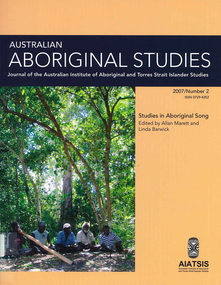
Periodical, Australian Institute of Aboriginal and Torres Strait Islander Studies, Australian Aboriginal studies : journal of the Australian Institute of Aboriginal and Torres Strait Islander Studies, 2007
... Drawing upon a set of songs from the Arandic language group, I describe the CA song as having three independent obligatory components (text, rhythm and melody) and specify how text is set to rhythm within a rhythmic and a phonological constraint. ...Drawing upon a set of songs from the Arandic language group, I describe the CA song as having three independent obligatory components (text, rhythm and melody) and specify how text is set to rhythm within a rhythmic and a phonological constraint. ...1. Musical and linguistic perspectives on Aboriginal song Allan Marett and Linda Barwick Song brings language and music together. Great singers are at once musicians and wordsmiths, who toss rhythm, melody and word against one another in complex cross-play. In this paper we outline some initial findings that are emerging from our interdisciplinary study of the musical traditions of the Cobourg region of western Arnhem Land, a coastal area situated in the far north of the Australian continent 350 kilometres northeast of Darwin. We focus on a set of songs called Jurtbirrk, sung in Iwaidja, a highly endangered language, whose core speaker base is now located in the community of Minjilang on Croker Island. We bring to bear analytical methodologies from both musicology and linguistics to illuminate this hitherto undocumented genre of love songs. 2. Iwaidja Jurtbirrk songs: Bringing language and music together Linda Barwick (University of Sydney), Bruce Birch and Nicholas Evans (University of Melbourne) Song brings language and music together. Great singers are at once musicians and wordsmiths, who toss rhythm, melody and word against one another in complex cross-play. In this paper we outline some initial findings that are emerging from our interdisciplinary study of the musical traditions of the Cobourg region of western Arnhem Land, a coastal area situated in the far north of the Australian continent 350 kilometres northeast of Darwin. We focus on a set of songs called Jurtbirrk, sung in Iwaidja, a highly endangered language, whose core speaker base is now located in the community of Minjilang on Croker Island. We bring to bear analytical methodologies from both musicology and linguistics to illuminate this hitherto undocumented genre of love songs. 3. Morrdjdjanjno ngan-marnbom story nakka, ?songs that turn me into a story teller?: The morrdjdjanjno of western Arnhem Land Murray Garde (University of Melbourne) Morrdjdjanjno is the name of a song genre from the Arnhem Land plateau in the Top End of the Northern Territory and this paper is a first description of this previously undocumented song tradition. Morrdjdjanjno are songs owned neither by individuals or clans, but are handed down as ?open domain? songs with some singers having knowledge of certain songs unknown to others. Many morrdjdjanjno were once performed as part of animal increase rituals and each song is associated with a particular animal species, especially macropods. Sung only by men, they can be accompanied by clap sticks alone or both clap sticks and didjeridu. First investigations reveal that the song texts are not in everyday speech but include, among other things, totemic referential terms for animals which are exclusive to morrdjdjanjno. Translations from song language into ordinary register speech can often be ?worked up? when the song texts are discussed in their cultural and performance context. The transmission of these songs is severely endangered at present as there are only two known singers remaining both of whom are elderly. 4. Sung and spoken: An analysis of two different versions of a Kun-barlang love song Isabel O?Keeffe (nee Bickerdike) (University of Melbourne) In examining a sung version and a spoken version of a Kun-barlang love song text recorded by Alice Moyle in 1962, I outline the context and overall structure of the song, then provide a detailed comparative analysis of the two versions. I draw some preliminary conclusions about the nature of Kun-barlang song language, particularly in relation to the rhythmic setting of words in song texts and the use of vocables as structural markers. 5. Simplifying musical practice in order to enhance local identity: Rhythmic modes in the Walakandha wangga (Wadeye, Northern Territory) Allan Marett (University of Sydney) Around 1982, senior performers of the Walakandha wangga, a repertory of song and dance from the northern Australian community of Wadeye (Port Keats), made a conscious decision to simplify their complex musical and dance practice in order to strengthen the articulation of a group identity in ceremonial performance. Recordings from the period 1972?82 attest to a rich diversity of rhythmic modes, each of which was associated with a different style of dance. By the mid-1980s, however, this complexity had been significantly reduced. I trace the origin of the original complexity, explore the reasons why this was subsequently reduced, and trace the resultant changes in musical practice. 6. ?Too long, that wangga?: Analysing wangga texts over time Lysbeth Ford (University of Sydney) For the past forty or so years, Daly region song-men have joined with musicologists and linguists to document their wangga songs. This work has revealed a corpus of more than one hundred wangga songs composed in five language varieties Within this corpus are a few wangga texts recorded with their prose versions. I compare sung and spoken texts in an attempt to show not only what makes wangga texts consistently different from prose texts, but also how the most recent wangga texts differ from those composed some forty years ago. 7. Flesh with country: Juxtaposition and minimal contrast in the construction and melodic treatment of jadmi song texts Sally Treloyn (University of Sydney) For some time researchers of Centralian-style songs have found that compositional and performance practices that guide the construction and musical treatment of song texts have a broader social function. Most recently, Barwick has identified an ?aesthetics of parataxis or juxtaposition? in the design of Warumungu song texts and musical organisation (as well as visual arts and dances), that mirrors social values (such as the skin system) and forms 'inductive space' in which relationships between distinct classes of being, places, and groups of persons are established. Here I set out how juxtaposition and minimal contrast in the construction and melodic treatment of jadmi-type junba texts from the north and north-central Kimberley region similarly create 'inductive space' within which living performers, ancestral beings, and the country to which they are attached, are drawn into dynamic, contiguous relationships. 8. The poetics of central Australian Aboriginal song Myfany Turpin (University of Sydney) An often cited feature of traditional songs from Central Australia (CA songs) is the obfuscation of meaning. This arises partly from the difficulties of translation and partly from the difficulties in identifying words in song. The latter is the subject of this paper, where I argue it is a by-product of adhering to the requirements of a highly structured art form. Drawing upon a set of songs from the Arandic language group, I describe the CA song as having three independent obligatory components (text, rhythm and melody) and specify how text is set to rhythm within a rhythmic and a phonological constraint. I show how syllable counting, for the purposes of text setting, reflects a feature of the Arandic sound system. The resultant rhythmic text is then set to melody while adhering to a pattern of text alliteration. 9. Budutthun ratja wiyinymirri: Formal flexibility in the Yol?u manikay tradition and the challenge of recording a complete repertoire Aaron Corn (University of Sydney) with Neparr? a Gumbula (University of Sydney) Among the Yol?u (people) of north-eastern Arnhem Land, manikay (song) series serve as records of sacred relationships between humans, country and ancestors. Their formal structures constitute the overarching order of all ceremonial actions, and their lyrics comprise sacred esoteric lexicons held nowhere else in the Yol?u languages. A consummate knowledge of manikay and its interpenetrability with ancestors, country, and parallel canons of sacred y�ku (names), bu?gul (dances) and miny'tji (designs) is an essential prerequisite to traditional leadership in Yol?u society. Drawing on our recordings of the Baripuy manikay series from 2004 and 2005, we explore the aesthetics and functions of formal flexibility in the manikay tradition. We examine the individuation of lyrical realisations among singers, and the role of rhythmic modes in articulating between luku (root) and bu?gul'mirri (ceremonial) components of repertoire. Our findings will contribute significantly to intercultural understandings of manikay theory and aesthetics, and the centrality of manikay to Yol?u intellectual traditions. 10. Australian Aboriginal song language: So many questions, so little to work with Michael Walsh Review of the questions related to the analysis of Aboriginal song language; requirements for morpheme glossing, component package, interpretations, prose and song text comparison, separation of Indigenous and ethnographic explanations, candour about collection methods, limitations and interpretative origins.maps, colour photographs, tablesyolgnu, wadeye, music and culture -
 Flagstaff Hill Maritime Museum and Village
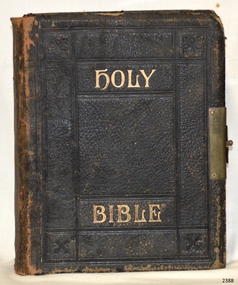
Book - Religious, University Press, The Holy Bible, Ca. 1850s
... group of learned scholars who worked in teams and compared notes, working to ensure a true and accurate version. It was completed in 1611 and became widely known as the King James Version (KJV) of the Bible and is still widely used and greatly respected for its poetic language. ...group of learned scholars who worked in teams and compared notes, working to ensure a true and accurate version. It was completed in 1611 and became widely known as the King James Version (KJV) of the Bible and is still widely used and greatly respected for its poetic language. ...This Bible belonged to the Bell family. Joseph Bell was born on May 9th 1829. He married Elizabeth, who was born on October 22nd, 1833. Their marriage was conducted on September 12th, 1854, at St Pauls, Bristol, England. On the front pages of the bible there used to be a list of their ten children and their birthdates but there are only remnants of a heavy weight paper; the opposite Fly page with publication details is also missing, along with the Family Records section, which no longer has pages for Births and Marriages, only precise edges of two pages . The Bible is the King James Version, named after James Charles Stuart (1556-1625) who was King James VI of Scotland from 24 July 1567, and who was crowned King James I of England, France and Ireland from 24 March 1603 until his death in 1625. The Hampton Court Conference of 1604 commissioned a new and more accurate version of the Holy Bible that was translated from the original Sacred Scriptures and that included only the approved books. This task was undertaken be a group of learned scholars who worked in teams and compared notes, working to ensure a true and accurate version. It was completed in 1611 and became widely known as the King James Version (KJV) of the Bible and is still widely used and greatly respected for its poetic language. The first printed page of this Bible is the Translators Speech at the completed work which was handed over to King James I in 1611.This Bible was published after 1611, and likely to have been purchased at the time of the marriage of the previous owners, Joseph and Elizabeth Bell, in 1854, so it is possibly a century and a half old. The decorative cover and metal clasp are a sign that the Bible was a book to be treasured,. Indeed, our Collection included several Bibles brought to Australia by immigrants, even though luggage was tightly restricted. This Bible was once used as a family record, similar to Bibles printed in modern times, with lined blank pages in the centre for the owners to record their own, their ancestors' and their descendants' life events. Sadly, these pages are no longer within the Bible.Book, black textured leather front and back covers, gold leaf page edges, metal clasp on centre edge of front and back covers holds them together. The title is inscribed in gold embossing on the front cover. The Bible has coloured illustrations, cross references and maps. The front inside cover has remnants of a previous stuck-down page, the Fly page, and the Family Records pages for Births and Marriages has been cut out of the book. TITLE: The Holy Bible. PRINTER: University Press, London, England PREVIOUS OWNERS; Joseph and Elizabeth Bell, married in Bristol, England in 1854.Embossed in gold on cover: "HOLY BIBLE"warrnambool, shipwreck coast, flagstaff hill, flagstaff hill maritime museum, flagstaff hill maritime village, religious book, bible, holy bible, king james bible, king james vi, king james i, 1611, kjv, joseph bell, elizabeth bell, st paul's church bristol, 1829, 1833, 1854, authorised king james version, authorised version, av, sacred scriptures -
 Frankston RSL Sub Branch
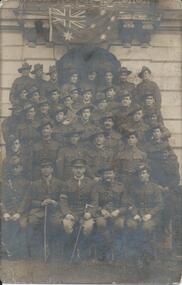
Postcard
... group of unidentified Australian soldiers. There are 38 soldiers, including two officers, in the uniform typical of the World War 1 era. The soldiers are standing in front of a building draped with the Australian flag. The soldiers are in rows with each row elevated sufficiently to raise the row above that in front. It is possible that this photograph was taken somewhere in France during World War 1. The normal postcard format is printed on the rear of the photograph and is in the French language...group of unidentified Australian soldiers. There are 38 soldiers, including two officers, in the uniform typical of the World War 1 era. The soldiers are standing in front of a building draped with the Australian flag. The soldiers are in rows with each row elevated sufficiently to raise the row above that in front. It is possible that this photograph was taken somewhere in France during World War 1. The normal postcard format is printed on the rear of the photograph and is in the French language ...Postcard with a photograph of a group of unidentified Australian soldiers. There are 38 soldiers, including two officers, in the uniform typical of the World War 1 era. The soldiers are standing in front of a building draped with the Australian flag. The soldiers are in rows with each row elevated sufficiently to raise the row above that in front. It is possible that this photograph was taken somewhere in France during World War 1. The normal postcard format is printed on the rear of the photograph and is in the French language."CARTE POSTALE" and the headings "Correspondance" and "Adresse" -
 Federation University Historical Collection
Book, Edward Lhuyd, Archaeologia Britannica, 1707, 1707
... In the late 17th century, Lhuyd was contacted by a group of scholars, led by John Keigwin of Mousehole, who were trying to preserve and further the Cornish language and he accepted the invitation to travel to Cornwall to study the language. ...In the late 17th century, Lhuyd was contacted by a group of scholars, led by John Keigwin of Mousehole, who were trying to preserve and further the Cornish language and he accepted the invitation to travel to Cornwall to study the language. ...Printed at the Theater for the author, MDCCVII . And sold by Mr . Bateman in Pater -Noster-Row, London: and Jeremiah Pepyat bookseller at Dublin. Lhuyd [Lhwyd; formerly Lloyd], Edward (1659/60?-1709), was a naturalist and philologist and the Keeper of the Ashmolean Museum. Lhuyd was a pioneering linguist. In the late 17th century, Lhuyd was contacted by a group of scholars, led by John Keigwin of Mousehole, who were trying to preserve and further the Cornish language and he accepted the invitation to travel to Cornwall to study the language. Early Modern Cornish was the subject of a study published by Lhuyd in 1702; it differs from the medieval language in having a considerably simpler structure and grammar. In 1707, having been assisted in his research by fellow Welsh scholar Moses Williams, he published the first volume of Archaeologia Britannica: an Account of the Languages, Histories and Customs of Great Britain, from Travels through Wales, Cornwall, Bas-Bretagne, Ireland and Scotland. This book is an important source for its linguistic description of Cornish, but even more so for its understanding of historical linguistics. Some of the ideas commonly attributed to linguists of the nineteenth century have their roots in this work by Lhuyd, who was "considerably more sophisticated in his methods and perceptions than [Sir William] Jones’’. Lhuyd noted the similarity between the two Celtic language families: Brythonic or P–Celtic (Breton, Cornish and Welsh); and Goidelic or Q–Celtic (Irish, Manx and Scottish Gaelic). He argued that the Brythonic languages originated in Gaul (France), and that the Goidelic languages originated in the Iberian Peninsula. Lhuyd concluded that as the languages had been of Celtic origin, the people who spoke those languages were Celts. From the 18th century, the peoples of Brittany, Cornwall, Ireland, Isle of Man, Scotland and Wales were known increasingly as Celts, and are regarded as the modern Celtic nations today. (Wikipedia)Oversize book. Includes the original languages of England and Ireland, Amoric Grammar, Amoric-English Vocabulary, Welsh words ommitted from Dr Davies' dictionary, Cornish Grammar, Ancient Scottish language, Irish-English Dictionary. Four page index which includes the errata, has the list of subscribers, mainly 3 columns per page. Includes a Cornish Grammar and dictionary of the Irish language, Archaeologia Britannica, Giving Some Account Additional to What Has Been Hitherto Published, of The Languages, Histories and Customs of the Original Inhabitants of Great Britain: From Collections and Observations in Travels Through Wales, Cornwal, Bas-Bretagne, Ireland and Scotland. Chapters on: The comparative Etymology, The comparative Vocabulary, The Armoric Grammar and Vocabulary, Dr Davies's Dictionary, Cornish Grammar, Catalogue of British Manuscripts in Welsh and Latin, Essay towards a British Etymologicon, The Introduction to the Irish, Irish Dictionary etc. language, gaelic, irish, scottish, edward lhuyd, welsh, latin, greek, etymologicon, celtic -
 Lara RSL Sub Branch
Group of Maps World War One, Group of Maps World War One - Dardanelles and Anzac Gallipoli Maps Circ 1915, Circ 1916
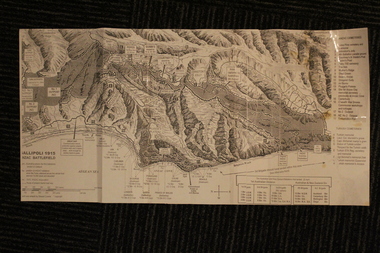
... Languages. C0olor version main roads and distances. (and copy).. 4. Map of ANZAC Trench Diagram. World War One.Color. (and copy). 5.Panorama of Chunuk Blair from 3 miles south of Nibrunesi Point, 3 November 1915 and Anzac from 1 mile N. E. of Ari Burnu, 21 November 1915. Black & White 6. Color Map of ANZAC positions with topographical Details, notes. Group ...Gallipoli 1915 Maps and Naval plan of Operations World War One ANZACRare examples that explain both ANZAC and Naval Operations during World War One Gallipoli & Dardanelles Passage .!. Black and White Photocopy of Gallipoli 1915 ANZAC Battlefield - detailed positions of troops and Cemeteries. 2.The Allied Failure to Force The Dardanelles Passage 18 March 1915 - detailed line of Attack Naval Organisation, Mine layout, Plan of Attack (and copy).. 3. Map of Turkey and surrounding area written in Turkish and German Languages. C0olor version main roads and distances. (and copy).. 4. Map of ANZAC Trench Diagram. World War One.Color. (and copy). 5.Panorama of Chunuk Blair from 3 miles south of Nibrunesi Point, 3 November 1915 and Anzac from 1 mile N. E. of Ari Burnu, 21 November 1915. Black & White 6. Color Map of ANZAC positions with topographical Details, notes. 1. Artwork and copyright by Srewart Cownie, Gallipoli 1915 ANZAC Battlefield with Landings and later evacuation marked. 2. Details of Naval actions taken in the Dardanelles Passage 18 March 1918. 3. Local area Map or Turkey. Shows roads network and townships. 4. ANZAC Trench Diagram, copyright Whitcombe & Tombs Limited , Wellington N.Z. 1919 5. Panorama of two coast views of ANZAC area. Australian War Memorial, 6. Map of ANZAC positions of World War One, Gallipoli 1915. Published by H.E.C. Roberinson, George Street, Sydney N.S.W.18 April 1916maps operational of anzac and naval opations during 1915 etc, dardanelles naval opations -
 Flagstaff Hill Maritime Museum and Village
Flag - The Mission to Seafarers, circa 2000
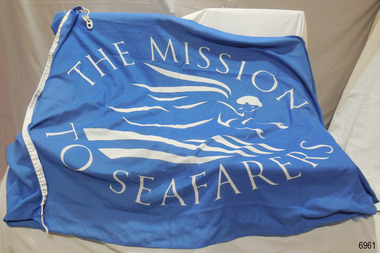
... language and people. The ‘Flying Angel’ (the angel of Revelation) became the official logo of the Society and gained great popularity. In July 2000 the Missions to Seamen changed its name to the Mission to Seafarers to better reflect the group's function, an unbiased society that cares for all who earn their living at sea. ...language and people. The ‘Flying Angel’ (the angel of Revelation) became the official logo of the Society and gained great popularity. In July 2000 the Missions to Seamen changed its name to the Mission to Seafarers to better reflect the group's function, an unbiased society that cares for all who earn their living at sea. ...The flag represents The Mission to Seafarers worldwide organisation. From about the year 2000 particular flag was once flown from Flagstaff Hill's masthead on top of the turret on the St Nicholas Seamen's Church but this practice ceased around 2010 for safety reasons. The Australian beginnings were in 1856 when the Church of England (Anglican Church) established the ‘Society for Promoting Missions to Seamen Afloat, at Home and Abroad. Lord Shaftesbury was the first President and Mr William Kingston was the first Secretary. Its Constitution declared: (1)) the Object is the spiritual welfare of the seafaring classes at home and abroad. (2) In pursuance of this Object, Society will use every means consistent with the principles and received practice of the Church of England. Mr Kingston’s wife and sister designed a flag to clearly depict the Society’s Objects. It depicted the first of the three angels in Revelation 14, who possessed ‘an eternal gospel to proclaim to those who dwell on the earth, to every nation and tribe and language and people. The ‘Flying Angel’ (the angel of Revelation) became the official logo of the Society and gained great popularity. In July 2000 the Missions to Seamen changed its name to the Mission to Seafarers to better reflect the group's function, an unbiased society that cares for all who earn their living at sea. The Logo was modernised and simplified, the word changed to 'seafarer' to be gender-neutral. The angel logo no longer holds a book (Bible). The organisation states: “The Mission to Seafarers is an Anglican organisation ... The Mission offers fellowship and a warm welcome in centres where seafarers can relax away from their ships, meet local people and contact their homes, from ports around the world. The Mission provides and promotes” … “The Mission to Seafarers now has a presence in 200 ports in 50 countries worldwide. This makes us the largest sea-port-based welfare organisation in the world. We provide support to seafarers 365 days per year, regardless of their rank, nationality, gender or religion” This flag was a gift from the Mission to Seafarers Victoria at the time of the organisation's change of name from the Missions to Seamen. It was flown from the Masthead on top of the turret on the St Nicholas Seamen's Church at Flagstaff Hill from the years 2000 to around 2010. The donation of this flag signifies the ongoing association between the historical organisation and St Nicholas Seamen's Church building at Flagstaff Hill', which displays an extensive collection of furniture and furnishings from that organisation's Williamstown branch. The design on the flag is an example of several updates of the flag over the organisation's lifetime.Flag, fine linen, The Mission to Seafarers. Rectangle of blue fabric with white text around white flying angel logo. Flag has a plastic hook on top of the halyard.Printed "THE MISSION TO SEAFARERS" and logo of FLYING ANGEL symbolflagstaff hill, warrnambool, shipwrecked coast, flagstaff hill maritime museum, maritime museum, shipwreck coast, flagstaff hill maritime village, great ocean road, missions to seamen victoria, mission to seafarers, flying angel’s club, st nicholas seaman’s church williamstown, mission to seafarers flag, flag, missions to seamen, turret -
 Flagstaff Hill Maritime Museum and Village
Book - A Fictional Adventure Story, Jules Verne, Abandoned, 1892
... (For more information on the Pattison Collection see item 3678 Flagstaff Hill collections) https://victoriancollections.net.au/items/5580c7e72162f114d8b758db warrnambool shipwrecked-coast flagstaff-hill flagstaff-hill-maritime-museum maritime-museum flagstaff-hill-maritime-village shipwrecked-artefact book warrnambool mechanics’ institute pattison collection warrnambool library corangamite regional library service warrnambool city librarian mechanics’ institute library victorian library board warrnambool books and records warrnambool children’s library Ralph Eric Pattison Jules Verne Voyages Extraordinaire series L’École des Robinson's "Abandoned" is the second part of Jules Verne’s “The Mysterious Island trilogy”, continuing the story of a group of castaways testing their ingenuity and courage on a remote Pacific island. The 1892 Sampson Low, Marston, Searle & Rivington edition is an early English language reprint of this work.This novel is not among Verne’s absolute core masterpieces like “Twenty Thousand Leagues Under the Seas” or “Around the World in Eighty Days”. ..."Abandoned" is the second part of Jules Verne’s “The Mysterious Island trilogy”, continuing the story of a group of castaways testing their ingenuity and courage on a remote Pacific island. The 1892 Sampson Low, Marston, Searle & Rivington edition is an early English language reprint of this work.This novel is not among Verne’s absolute core masterpieces like “Twenty Thousand Leagues Under the Seas” or “Around the World in Eighty Days”. Abandoned (also known as its original French title, "L’Île mystérieuse: Deuxième partie L’Abandonné" picks up the narrative of five or six men (including the engineer Cyrus Harding and the sailor Pencroff) who have already survived a balloon crash and built a rudimentary civilisation on a seemingly uninhabited island. As they explore the island further, they discover signs of a mysterious benefactor and eventually meet the “abandoned” character Ayrton, a former convict who has lived in isolation while the island itself faces natural and human threats that test their survival and moral choices. The story blends adventure, technology, and social Utopian themes, showing how rational cooperation can triumph over hardship and moral degeneration.Hard cover book, Abandoned. Author: Jules Verne Publisher: Sampson Low Marston Searle and Rivington, St. Dunstans House, Fetter Lane Fleet Street, London. EC. Date: 1892 Light blue hardcover with the title on the spine having lettering to spine in black hand written text pen. fiction"Abandoned" is the second part of Jules Verne’s “The Mysterious Island trilogy”, continuing the story of a group of castaways testing their ingenuity and courage on a remote Pacific island. The 1892 Sampson Low, Marston, Searle & Rivington edition is an early English language reprint of this work.This novel is not among Verne’s absolute core masterpieces like “Twenty Thousand Leagues Under the Seas” or “Around the World in Eighty Days”. Abandoned (also known as its original French title, "L’Île mystérieuse: Deuxième partie L’Abandonné" picks up the narrative of five or six men (including the engineer Cyrus Harding and the sailor Pencroff) who have already survived a balloon crash and built a rudimentary civilisation on a seemingly uninhabited island. As they explore the island further, they discover signs of a mysterious benefactor and eventually meet the “abandoned” character Ayrton, a former convict who has lived in isolation while the island itself faces natural and human threats that test their survival and moral choices. The story blends adventure, technology, and social Utopian themes, showing how rational cooperation can triumph over hardship and moral degeneration.warrnambool, shipwrecked-coast, flagstaff-hill, flagstaff-hill-maritime-museum, maritime-museum, flagstaff-hill-maritime-village, shipwrecked-artefact, book, warrnambool mechanics’ institute, pattison collection, warrnambool library, corangamite regional library service, warrnambool city librarian, mechanics’ institute library, victorian library board, warrnambool books and records, warrnambool children’s library, ralph eric pattison, jules verne, voyages extraordinaire series, l’école des robinson's -
 Flagstaff Hill Maritime Museum and Village
Book - Ethnographic survey, Edward Micklethwaite Curr, The Australian Race Vol 1, 1886-1887
... Volume one is chiefly a comparative on various vocabularies and linguistic materials, with early observations used to identify and compare Aboriginal language groups. This volume also documents specific rites and regional practices, as part of his broader attempt to synthesize ethnographic and linguistic data across Australia. ...The Australian Race Vol. 1 by Edward M. Curr is the highly illustrated first part of Curr’s four volume ethnographic survey of Aboriginal Australia. It consolidates his findings on origins, languages, customs, and distributions, and its atlas volume furnishes a large comparative language map and ethnographic plates. The four volume set is a broad survey of Aboriginal peoples’ origins, languages, social customs, and movements across the Australian continent. Volume one is chiefly a comparative on various vocabularies and linguistic materials, with early observations used to identify and compare Aboriginal language groups. This volume also documents specific rites and regional practices, as part of his broader attempt to synthesize ethnographic and linguistic data across Australia. The work is considered a foundational reference work although in today's modern world is is regarded as dated and eurocentric set of volumes as a reference in Australian Indigenous studies and anthropology.Hard cover book, The Australian Race Vol 1. Author: Edward Micklethwaite Curr Publisher: John Ferres, Government Printer Melbourne Aus. Date: 1886-1887 Light brown cloth hardcover and spine and blue edging to hard covers lettering in blue . The spine has a label with an inscription.non-fictionThe Australian Race Vol. 1 by Edward M. Curr is the highly illustrated first part of Curr’s four volume ethnographic survey of Aboriginal Australia. It consolidates his findings on origins, languages, customs, and distributions, and its atlas volume furnishes a large comparative language map and ethnographic plates. The four volume set is a broad survey of Aboriginal peoples’ origins, languages, social customs, and movements across the Australian continent. Volume one is chiefly a comparative on various vocabularies and linguistic materials, with early observations used to identify and compare Aboriginal language groups. This volume also documents specific rites and regional practices, as part of his broader attempt to synthesize ethnographic and linguistic data across Australia. The work is considered a foundational reference work although in today's modern world is is regarded as dated and eurocentric set of volumes as a reference in Australian Indigenous studies and anthropology.flagstaff hil, warrnambool, flagstaff hill maritime museum, maritime museum, shipwreck coast, flagstaff hill maritime village, great ocean road, book, pattison collection, warrnambool library, warrnambool mechanics’ institute, ralph eric pattison, corangamite regional library service, warrnambool city librarian, mechanics’ institute library, victorian library board, warrnambool books and records, warrnambool children’s library, the australian race vol 4, aboriginal studies, languages, native langauge -
 Flagstaff Hill Maritime Museum and Village
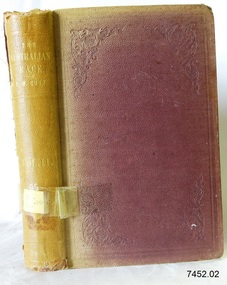
Book - Ethnographic survey, Edward Micklethwaite Curr, The Australian Race Vol 2, 1886-1887
... Volume one is chiefly a comparative on various vocabularies and linguistic materials, with early observations used to identify and compare Aboriginal language groups. This volume also documents specific rites and regional practices, as part of his broader attempt to synthesize ethnographic and linguistic data across Australia. ...The Australian Race Vol. 2 by Edward M. Curr is the second part of Curr’s four volume ethnographic survey of Aboriginal Australia. Volume two continues the language and vocabulary work from volume one, and goes on in expanding the comparative material available across more regions and groups of Aboriginal tribes or mobs. The four volume set is a broad survey of Aboriginal peoples’ origins, languages, social customs, and movements across the Australian continent. Volume one is chiefly a comparative on various vocabularies and linguistic materials, with early observations used to identify and compare Aboriginal language groups. This volume also documents specific rites and regional practices, as part of his broader attempt to synthesize ethnographic and linguistic data across Australia. The work is considered a foundational reference work although in today's modern world is is regarded as dated and eurocentric set of volumes as a reference in Australian Indigenous studies and anthropology.Hard cover book, The Australian Race Vol 2. Author: Edward Micklethwaite Curr Publisher: John Ferres, Government Printer Melbourne Aus. Date: 1886-1887 Light brown cloth hardcover and spine and blue edging to hard covers lettering in blue . The spine has a label with an inscription.non-fictionThe Australian Race Vol. 2 by Edward M. Curr is the second part of Curr’s four volume ethnographic survey of Aboriginal Australia. Volume two continues the language and vocabulary work from volume one, and goes on in expanding the comparative material available across more regions and groups of Aboriginal tribes or mobs. The four volume set is a broad survey of Aboriginal peoples’ origins, languages, social customs, and movements across the Australian continent. Volume one is chiefly a comparative on various vocabularies and linguistic materials, with early observations used to identify and compare Aboriginal language groups. This volume also documents specific rites and regional practices, as part of his broader attempt to synthesize ethnographic and linguistic data across Australia. The work is considered a foundational reference work although in today's modern world is is regarded as dated and eurocentric set of volumes as a reference in Australian Indigenous studies and anthropology.flagstaff hil, warrnambool, flagstaff hill maritime museum, maritime museum, shipwreck coast, flagstaff hill maritime village, great ocean road, book, pattison collection, warrnambool library, warrnambool mechanics’ institute, ralph eric pattison, corangamite regional library service, warrnambool city librarian, mechanics’ institute library, victorian library board, warrnambool books and records, warrnambool children’s library, the australian race vol 4, aboriginal studies, languages, native langauge -
 Flagstaff Hill Maritime Museum and Village
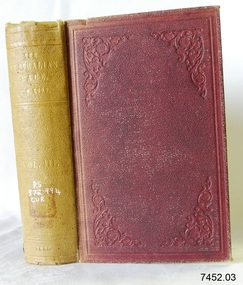
Book - Ethnographic survey, Edward Micklethwaite Curr, The Australian Race Vol 3, 1886-1887
... Volume one is chiefly a comparative on various vocabularies and linguistic materials, with early observations used to identify and compare Aboriginal language groups. This volume continuing in documenting specific rites and regional practices, as part of his broader attempt to synthesize ethnographic and linguistic data across Australia. ...The Australian Race Vol. 3 by Edward M. Curr is the third part of Curr’s four volume ethnographic survey of Aboriginal Australia. Volume three moves further into Aboriginal customs their social practices, and regional accounts gathered from settlers, missionaries, and other correspondents of the time. The four volume set is a broad survey of Aboriginal peoples’ origins, languages, social customs, and movements across the Australian continent. Volume one is chiefly a comparative on various vocabularies and linguistic materials, with early observations used to identify and compare Aboriginal language groups. This volume continuing in documenting specific rites and regional practices, as part of his broader attempt to synthesize ethnographic and linguistic data across Australia. The work is considered a foundational reference work although in today's modern world is is regarded as dated and eurocentric set of volumes as a reference in Australian Indigenous studies and anthropology.Hard cover book, The Australian Race Vol 3. Author: Edward Micklethwaite Curr Publisher: John Ferres, Government Printer Melbourne Aus. Date: 1886-1887 Light brown cloth hardcover and spine and blue edging to hard covers lettering in blue . The spine has a label with an inscription.non-fictionThe Australian Race Vol. 3 by Edward M. Curr is the third part of Curr’s four volume ethnographic survey of Aboriginal Australia. Volume three moves further into Aboriginal customs their social practices, and regional accounts gathered from settlers, missionaries, and other correspondents of the time. The four volume set is a broad survey of Aboriginal peoples’ origins, languages, social customs, and movements across the Australian continent. Volume one is chiefly a comparative on various vocabularies and linguistic materials, with early observations used to identify and compare Aboriginal language groups. This volume continuing in documenting specific rites and regional practices, as part of his broader attempt to synthesize ethnographic and linguistic data across Australia. The work is considered a foundational reference work although in today's modern world is is regarded as dated and eurocentric set of volumes as a reference in Australian Indigenous studies and anthropology.flagstaff hil, warrnambool, flagstaff hill maritime museum, maritime museum, shipwreck coast, flagstaff hill maritime village, great ocean road, book, pattison collection, warrnambool library, warrnambool mechanics’ institute, ralph eric pattison, corangamite regional library service, warrnambool city librarian, mechanics’ institute library, victorian library board, warrnambool books and records, warrnambool children’s library, the australian race vol 4, aboriginal studies, languages, native langauge -
 Camperdown & District Historical Society
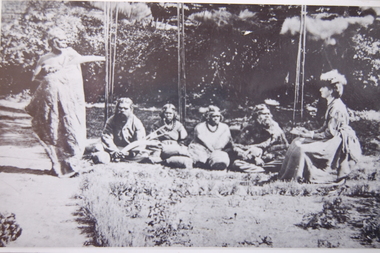
Photograph - Isabella Dawson with First Nations informants, c1865
... languages. With her father, James Dawson, she wrote the book "Australian Aborigines" (1881). CDHS Miss Mary Turner Shaw Kaawirn Kuunawarn Hissing Swan CDHSFirstNations James Dawson's daughter, Isabella, learning from the Aborigines on her father's station at "Kangatong" (From the original belonging to Miss M. Turner Shaw of S. Yarra. Copied by A.E. Jackson of Timboon.) Black and white photograph taken at "Kangatong", near Hawkesdale showing group ...Isabella Park Taylor, nee Dawson (1842-1929), friend of Western Victorian First Nations people, and student of their languages and customs. Isabella grew up at "Kangatong" (1844-1866) in the company of First Nations people and became fluent in their languages. With her father, James Dawson, she wrote the book "Australian Aborigines" (1881). Black and white photograph taken at "Kangatong", near Hawkesdale showing group of First Nations people in conversation with Isabella Dawson, seated on right with notebook in hand. Standing at left is Kaawirn Kuunawarn (also know as Hissing Swan and King David).James Dawson's daughter, Isabella, learning from the Aborigines on her father's station at "Kangatong" (From the original belonging to Miss M. Turner Shaw of S. Yarra. Copied by A.E. Jackson of Timboon.)cdhs, miss mary turner shaw, kaawirn kuunawarn, hissing swan, cdhsfirstnations
