
Showing 7 items matching "latin-and-class-work"
-
 Ballarat Clarendon College
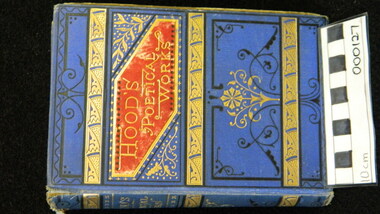
Book, The Poetical works of Thomas Hood, [n.d.]
... ...latin-and-class-work...This book The Poetical Works of Thomas Hood was awarded to Margaret Jane McGowan as second prize for Latin and Class work. Margaret was one of the first enrolments to Clarendon Ladies' College at the age of 12. ...Book plate inside front cover: CLARENDON LADIES' COLLEGE/BALLARAT/Second PRIZE/ Latin and Class work/AWARDED TO/J McGowan/R KENNEDY PRINCIPAL/18TH December, 1879 Hand-written inscription on flyleaf: This book was a Prize/at the first Prize-giving/of the College/The College having been/ established/in 1878. ...This book The Poetical Works of Thomas Hood was awarded to Margaret Jane McGowan as second prize for Latin and Class work. Margaret was one of the first enrolments to Clarendon Ladies' College at the age of 12. ...This book The Poetical Works of Thomas Hood was awarded to Margaret Jane McGowan as second prize for Latin and Class work. Margaret was one of the first enrolments to Clarendon Ladies' College at the age of 12. Margaret's father, Samuel, and mother, were personal friends of the Reverand Robert and Mrs. Kennedy. Margaret attended school in the same class as the Kennedy's eldest son Tom who was 11 at the time. Margaret's sister Edith was the 2nd enrolment to the college. Margaret resided at 15 Royal Terrace Webster Street, Ballarat. Her parents were employed as Carrier and forwarding agents. Margaret's married name became Steele. Archives also hold a second book prize awarded to Margaret (000126). Socially significant due to connection with first prize-giving ceremony for Clarendon Ladies' College. Blue and gold decorative cloth cover, corners and edges rubbed, page edges gilt, gold lettering on front cover and spine; embossed border on back cover; two black and white plates; 414 p. Book plate inside front cover: CLARENDON LADIES' COLLEGE/BALLARAT/Second PRIZE/ Latin and Class work/AWARDED TO/J McGowan/R KENNEDY PRINCIPAL/18TH December, 1879 Hand-written inscription on flyleaf: This book was a Prize/at the first Prize-giving/of the College/The College having been/ established/in 1878. margaret-j-mcgowan, elizabeth-kennedy, robert-kennedy, tom-kennedy, clarendon-ladies-college, latin-and-class-work, book-prize -
 Flagstaff Hill Maritime Museum and Village
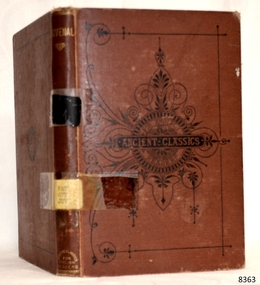
Book - Reference Book / Classics, Rev. W. Lucas Collins, Juvenal, 1872
... The work is significant because, during the 19th century, this series was a massive cultural milestone. In Victorian Britain, a "Classical education" (learning Latin and Greek) was a strict status symbol reserved for upper-class men. ...The subject book is a specific volume from a highly popular Victorian series called "Ancient Classics for English Readers." While Rev. W. Lucas Collins was the overarching editor of the entire 28-volume series (which explains why his name is prominently attached to it), the specific volume on Juvenal published in 1872 was actually written by a scholar named Edward Walford, M.A. The book is an introduction to Juvenal (Decimus Iunius Iuvenalis), a famous Roman poet active in the late 1st and early 2nd centuries AD. Juvenal is renowned for his Satires, which fiercely attacked the corruption, decadence, vice, and hypocrisy of Roman society under the Empire. In line with the rest of the series, this volume provides a translated, summarized, and curated overview of Juvenal's work. Because Juvenal's raw, unedited Latin can be incredibly explicit and vulgar, the Victorian authors heavily sanitized ("bowdlerized") the text, smoothing over the more scandalous elements to make his brilliant satire safe for a general English audience.Juvenal Author: Edward Walford, M.A. Editor:Rev. W. Lucas Collins Publisher: William Blackwood & Sons Date: 1872 non-fiction The subject book is a specific volume from a highly popular Victorian series called "Ancient Classics for English Readers." While Rev. W. Lucas Collins was the overarching editor of the entire 28-volume series (which explains why his name is prominently attached to it), the specific volume on Juvenal published in 1872 was actually written by a scholar named Edward Walford, M.A. The book is an introduction to Juvenal (Decimus Iunius Iuvenalis), a famous Roman poet active in the late 1st and early 2nd centuries AD. Juvenal is renowned for his Satires, which fiercely attacked the corruption, decadence, vice, and hypocrisy of Roman society under the Empire. In line with the rest of the series, this volume provides a translated, summarized, and curated overview of Juvenal's work. Because Juvenal's raw, unedited Latin can be incredibly explicit and vulgar, the Victorian authors heavily sanitized ("bowdlerized") the text, smoothing over the more scandalous elements to make his brilliant satire safe for a general English audience. flagstaff hil, warrnambool, flagstaff hill maritime museum, maritime museum, shipwreck coast, flagstaff hill maritime village, great ocean road, book, pattison collection, warrnambool library, warrnambool mechanics’ institute, ralph eric pattison, corangamite regional library service, warrnambool city librarian, mechanics’ institute library, victorian library board, warrnambool books and records, warrnambool children’s library, juvenal, lucas collins -
 Flagstaff Hill Maritime Museum and Village
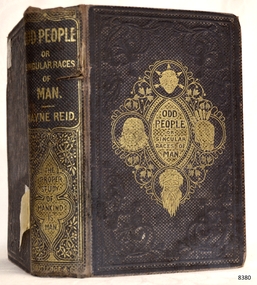
Book - Anthropological Travelogue/Fictional, Captain Mayne Reid, Odd People being A Popular Description of Singular Races of Man, 1860
... The book is an early work of popular ethnology and anthropology, written for a general audience and heavily marketed toward young readers and armchair travelers of the Victorian era. Handwritten inscription, seven lines of text: "Second Prize Latin Class ...Odd People: Being a Popular Description of Singular Races of Man (1860) is an interesting piece of 19th-century literature. The book was written by Captain Thomas Mayne Reid (1818–1883), a Scots-Irish American novelist and adventurer. He was immensely popular in the mid-to-late 19th century for his boys' adventure novels, tales of the American West, and travelogues. The true first edition was published in London by Routledge, Warne & Routledge in 1860. In the United States, it was published around the same time (1860/1861) by Ticknor and Fields in Boston, and later editions were retitled The Man-Eaters and Other Odd People. The book is an early work of popular ethnology and anthropology, written for a general audience and heavily marketed toward young readers and armchair travelers of the Victorian era.Book, brown covers, embossed with borders and patterns and gilt decoration and titles. The book includes illustrations. Handwritten inscription on the front paste-down page. The opposite page has a stamped and a handwritten inscription. The book was presented as a prize to a Latin student at the National School, Warrnambool in 1861. Title: Odd People being a Popular Description of Singular Races of Man. Alternate title: Odd People or Singular Races of Man Author: Captain Mayne Reid Publisher: Routledge Warne & Routledge, London Date: 1860 Further information: additional text on the spine reads 'A Proper Study of Mankind is Man' fiction Odd People: Being a Popular Description of Singular Races of Man (1860) is an interesting piece of 19th-century literature. The book was written by Captain Thomas Mayne Reid (1818–1883), a Scots-Irish American novelist and adventurer. He was immensely popular in the mid-to-late 19th century for his boys' adventure novels, tales of the American West, and travelogues. The true first edition was published in London by Routledge, Warne & Routledge in 1860. In the United States, it was published around the same time (1860/1861) by Ticknor and Fields in Boston, and later editions were retitled The Man-Eaters and Other Odd People. The book is an early work of popular ethnology and anthropology, written for a general audience and heavily marketed toward young readers and armchair travelers of the Victorian era. shipwrecked-coast, flagstaff-hill, flagstaff-hill-maritime-museum, warrnambool, maritime-museum, shipwreck-coast, flagstaff-hill-maritime-village, shipwrecked-artefact, book, odd people, captain mayne reid, national school warrnambool., daniel b sellers, classic fiction, the proper study of mankind is man, singular races of man, , routledge warne and routledge, latin student -
 Orbost & District Historical Society
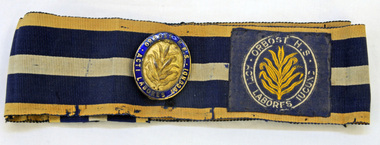
hat band and badge
... The school badge was designed by Clarke Cowell, a student in the first Senior class at Orbost Higher Elementary School in 1912. The Latin inscription "Acti labores jucundi"can be freely translated as "Finished work is pleasant." ...The school badge was designed by Clarke Cowell, a student in the first Senior class at Orbost Higher Elementary School in 1912. The Latin inscription "Acti labores jucundi"can be freely translated as "Finished work is pleasant." ...The hat band was part of the girls' school uniform and attached to their straw hats. The school badge was designed by Clarke Cowell, a student in the first Senior class at Orbost Higher Elementary School in 1912. The Latin inscription "Acti labores jucundi"can be freely translated as "Finished work is pleasant." The hat band and badges formed part of the Mary Gilbert Collection. Miss Mary Gilbert attended Orbost Higher Elementary School 1917-1920. She was dux of the school in 1920 and returned as a trained teacher in 1927. She taught at Mordialloc H.S. in 1932, at Lilydale in 1933/34 and returned to Orbost H.E.S. in 1935, remaining there until her retirement in 1969. Mary Gilbert, the first curator of the Orbost Museum, was recognised for her work in education and the community when she was awarded the British Empire Medal. Orbost High School / Orbost Secondary College has played a significant part in the education of senior students in the Orbost district . It is the sole senior educational institution. This uniform is representative of its history. A yellow, navy and white striped hat band. A badge of the Orbost Higher Elementary School emblem is sewn on. A metal badge with the school emblem is attached. gilbert-mary orbost-secondary-college education-orbost -
 Orbost & District Historical Society
badges
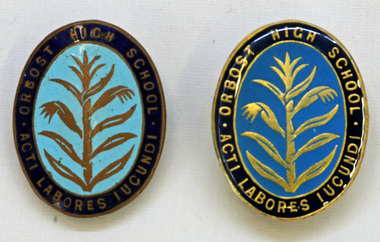
... The school badge with its stalk of maize was designed by Clarke Cowell, who was in the first Senior Class of Orbost Higher Elementary School in 1912. The Latin inscription, :acti labores lucundi" can be freely translated as "finished work is pleasant"....The school badge with its stalk of maize was designed by Clarke Cowell, who was in the first Senior Class of Orbost Higher Elementary School in 1912. The Latin inscription, :acti labores lucundi" can be freely translated as "finished work is pleasant". ...The school badge with its stalk of maize was designed by Clarke Cowell, who was in the first Senior Class of Orbost Higher Elementary School in 1912. The Latin inscription, :acti labores lucundi" can be freely translated as "finished work is pleasant". Orbost High School / Orbost Secondary College has been the sole senior educational institution in the Orbost district and therefore has played a significant community role in education. These badges are representative of its history. Two oval-shaped metal badges. They are school badges from Orbost High School. They have the school motto "acti labores lucundi" around the perimeter with a yellow/gold stalk of maize on a blue background in the centre. .1 -1390 .2-870 badge orbost-higher-elementary education school-uniform -
 Orbost & District Historical Society
pocket badge
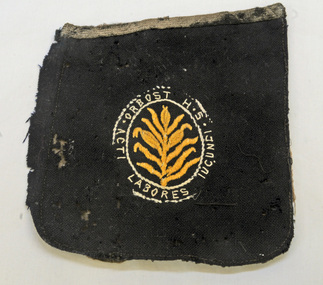
... The Latin inscription, :acti labores lucundi" can be freely translated as "finished work is pleasant". The school badge with its stalk of maize was designed by Clarke Cowell who was in the first Senior Class of Orbost Higher Elementary School in 1912....The Latin inscription, :acti labores lucundi" can be freely translated as "finished work is pleasant". The school badge with its stalk of maize was designed by Clarke Cowell who was in the first Senior Class of Orbost Higher Elementary School in 1912. ...This pocket with the school badge was part of the girls' uniform at Orbost High School. The blazer pocket forms part of the Mary Gilbert collection. The Latin inscription, :acti labores lucundi" can be freely translated as "finished work is pleasant". The school badge with its stalk of maize was designed by Clarke Cowell who was in the first Senior Class of Orbost Higher Elementary School in 1912. Orbost High School / Orbost Secondary College has played a significant role in the education of senior students in Orbost as the sole facility in the distruct. This item represents the history of the institution. A navy coloured cloth pocket badge from Orbost High School. It has the school motto, "acti labores lucundi" around a yellow/gold stalk of maize. On back lining : PR in black marker 1922 badge school-uniform education orbost-high-school -
 Orbost & District Historical Society
plaque, after 1948
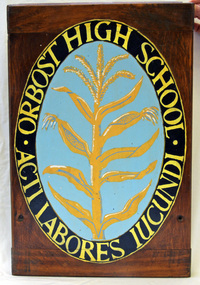
... The latin inscription, "Acti labores lucundi", can be freely translated as "Finished work is pleasant." The school badge, with its stalk of maize was designed by Clarke Cowell who was in the first Senior Class at Orbost Higher Elementary School in 1912. ...The latin inscription, "Acti labores lucundi", can be freely translated as "Finished work is pleasant." The school badge, with its stalk of maize was designed by Clarke Cowell who was in the first Senior Class at Orbost Higher Elementary School in 1912. ...The school badge was hand-painted on a wooden Art drawing board by an unknown student after the Higher Elementary School had been upgraded to a High School in 1948. The latin inscription, "Acti labores lucundi", can be freely translated as "Finished work is pleasant." The school badge, with its stalk of maize was designed by Clarke Cowell who was in the first Senior Class at Orbost Higher Elementary School in 1912. Clarke Cowell followed teaching as a career and was the first head teacher of the Corringle School, No. 4909, which opened on Feb 7 1921 and operated as a half-time school with the Marlo School No. 3433. Orbost High School / Orbost Secondary College has played a significant part in the education of senior students in the Orbost district . It is the sole senior educational institution. This uniform is representative of its history. A wooden rectangular plaque with a hanging wire attached to the back. It has an oval-shaped painted school emblem on a stained wood background. Around the circumference are the words ORBOST HIGH SCHOOL painted in yellow with the motto ACTI LABORES LUCUNDI. In the middle on a pale blue background is a painted gold stalk of maize. orbost-high-school education
