
Showing 69 items matching "law - firms"
-
 Unions Ballarat
Cutherts: A Ballarat Institution, 2016
... ...law - firms...Cuthberts was a law firm in Ballarat that was established by Sir Henry Cuthbert in 1855. ...Cuthberts was a law firm in Ballarat that was established by Sir Henry Cuthbert in 1855. ...Cuthberts was a law firm in Ballarat that was established by Sir Henry Cuthbert in 1855. In 2013, the firm amalgamated with another law practice, Harwood Andrews. The book tells the story of the firm from its beginning up until the 2000s.Of interest to the history of Ballarat and its institutions.Hardback, paper; red and brown cover; golden lettering.Title: gold lettering on front. Author has signed the title page. The book is number 187 of 200 copies.btlc, ballarat trades hall, ballarat regional trades and labour council, blee, jill, cuthberts, law, law - history, law - firms, cuthbert, sir henry, harwood andrews -
 Warrnambool and District Historical Society Inc.
Book, Cash Book, Late 19th century
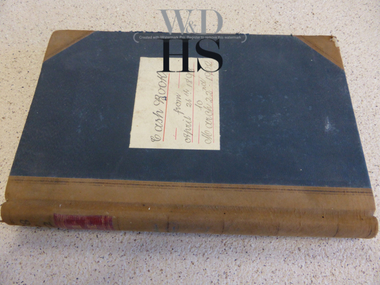
... ...warrnambool law firms...This cash book, found in the old Mackay Taylor building in Kepler Street, contains entries relating to Costs Accounts and Trust Accounts for the Warrnambool firm of Fletcher and Mackay which had been formed from the amalgamation of the law firms of George Mackay and James Fletcher in 1893. ...This cash book, found in the old Mackay Taylor building in Kepler Street, contains entries relating to Costs Accounts and Trust Accounts for the Warrnambool firm of Fletcher and Mackay which had been formed from the amalgamation of the law firms of George Mackay and James Fletcher in 1893. ...This cash book, found in the old Mackay Taylor building in Kepler Street, contains entries relating to Costs Accounts and Trust Accounts for the Warrnambool firm of Fletcher and Mackay which had been formed from the amalgamation of the law firms of George Mackay and James Fletcher in 1893. In the 1920s the firm became Mackay and Taylor after J. McD. Taylor became the partner with George Mackay. This firm was a prominent one in Warrnambool until the 1990s. This cash book is of considerable interest as the entries show the names of many well-known residents of Warrnambool at the end of the 19th century and the beginning of the 20th century. The firm of Fletcher and Mackay was an important one in Warrnambool at that time and George Mackay, one of the partners of the firm, was prominent in local community and civic affairs. This is a ledger with black binding and buff-coloured spine and corner reinforcements. There are 135 double-sided pages. The pages have been printed with red ruled lines for accounting purposes. There are red and blue mottled coloured cardboard pages at the beginning and end of the book. There are two loose pages which appear to be scrap notes only. The entries are written in black ink.White paper pasted on front cover: ‘Cash Book from April 26th 1898 to March 22nd 1902’ Spine: ‘1898-1902 Cash Book’ james fletcher and george mackay, warrnambool law firms, warrnambool -
Whitehorse Historical Society Inc.
Article, Death notice of Tom Leggatt, 17/05/1995 12:00:00 AM
... On the death of Tom Leggatt, partner of law firm, Yuncken & Yuncken and also a former councillor with the City of Nunawading....Article in Whitehorse Gazette, 17 May 1995, on the death of Tom Leggatt, partner of law firm, Yuncken & Yuncken and also a former councillor with the City of Nunawading....On the death of Tom Leggatt, partner of law firm, Yuncken & Yuncken and also a former councillor with the City of Nunawading. ...Article in Whitehorse Gazette, 17 May 1995.Article in Whitehorse Gazette, 17 May 1995, on the death of Tom Leggatt, partner of law firm, Yuncken & Yuncken and also a former councillor with the City of Nunawading.Article in Whitehorse Gazette, 17 May 1995. leggatt, tom, local government -
 Federation University Historical Collection
Book, Guide to Ballarat the Beautiful, 1923, 1923
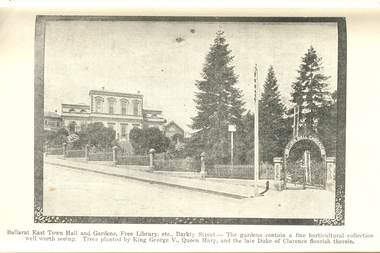
... In 2010 it was used as Cuthberts law firm....In 2010 it was used as Cuthberts law firm. ballarat cuthberts ballarat trustees sturt street tram trams ballarat town hall crag's hotel sun foundry eureka aerated waters and brewing co d. lem chinese practioner chinese herbalist hugh v. mckay sunshine harvester gordon brothers central business college george hotel edwards pyrites furnace long's biscuits ballarat eisteddfod george farmer ballarat botanical gardens eureka stockade lake wendouree ballarat school of mines moorabool falls kirks reservoir ballarat post office hepburn lagoon star of the east mine emu river ballarat observatory statues angus' rialto cafe carlyon's hotel clarendon ladies' college j.e, sang ballarat coffee palace stansfield and smith ballaray brewing company phoenix brewery rotal standard brewery john macleod co robert sim and co cobb and co\eagle foundry j.j. goller and co. mt buninyong lookout ballarat town hall ballarat east gardens hot house glass house statuary pavilion new imperial gold mining co., art gallery of ballarat st patrick's college ballarat agricultural high school lake wendouree steamer grass trees at mt clear mount clear lake burrumbeet newlyn reservoir trout lal lal falls grosvenor square netherby ramelli's motor garage buninyong gold obelisk memorial imperial gold mine botanical gardens lily pond and fernery Grey/green soft covered book. ...The image of Ballarat Trustees relates to a building on the corner of Mair and Lydiard Streets. In 2010 it was used as Cuthberts law firm.Grey/green soft covered book. Includes photographs and map. Themes include: Ballarat History pre gold, mining, Eureka Stockade, Lake Wendouree, South Street, Grand National Eisteddfod of Australasia, schools, Black Hill, Lake Burrumbeet, Creswick, Buninyong. Illustrations and advertisement include: Sturt Street,James Smith, Ballarat Town Hall, Ballarat East Town Hall, Rowlands, Ballarat brewing Co., Royal Standard Brewery, steam train, Lake Wendouree, J.S. Vickery & Son, trout, Berry, Anderson & co., Ballarat Botanical Gardens and hot houses, Claxton Memorial Fountain, statues, New Imperial Gold Mine, Art Gallery of Ballarat, St Patrick's College, Ballarat Grammar School, Ballarat School of Mines, Ballarat College, Sunnyside Woollen Mills, Ballarat Agricultural High School, Passenger Steamer on Lake Wendouree, Moorabool Falls, Lal Lal Falls, Grosvenor Square, Netherby, Buninyong, Ballarat Motor Garage.ballarat, cuthberts, ballarat trustees, sturt street, tram, trams, ballarat town hall, crag's hotel, sun foundry, eureka aerated waters and brewing co, d. lem, chinese practioner, chinese herbalist, hugh v. mckay, sunshine harvester, gordon brothers, central business college, george hotel, edwards pyrites furnace, long's biscuits, ballarat eisteddfod, george farmer, ballarat botanical gardens, eureka stockade, lake wendouree, ballarat school of mines, moorabool falls, kirks reservoir, ballarat post office, hepburn lagoon, star of the east mine, emu river, ballarat observatory, statues, angus' rialto cafe, carlyon's hotel, clarendon ladies' college, j.e, sang, ballarat coffee palace, stansfield and smith, ballaray brewing company, phoenix brewery, rotal standard brewery, john macleod co, robert sim and co, cobb and co\eagle foundry, j.j. goller and co., mt buninyong lookout, ballarat town hall ballarat east gardens, hot house, glass house, statuary pavilion new imperial gold mining co.,, art gallery of ballarat, st patrick's college, ballarat agricultural high school, lake wendouree steamer, grass trees at mt clear, mount clear, lake burrumbeet, newlyn reservoir trout, lal lal falls, grosvenor square, netherby, ramelli's motor garage, buninyong gold obelisk, memorial, imperial gold mine, botanical gardens lily pond and fernery -
 Warrnambool and District Historical Society Inc.
Book, Accounts 1898-1902, Early 19th century
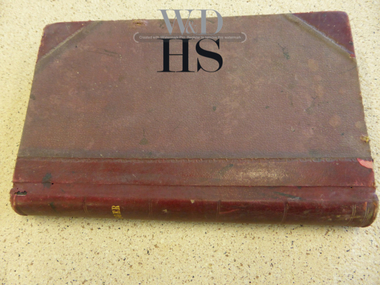
... The book was found in the old Mackay Taylor law firm building and was obviously in storage with that firm. ...The book was found in the old Mackay Taylor law firm building and was obviously in storage with that firm. ...This accounts book has been used by a Warrnambool butcher whose name is unknown. The entries date from 1913 to 1915 and the names of those with accounts are mostly well-known residents of Warrnambool at the time. The items bought include hams, shoulders, lard, sides, German sausage, pork sausages, bacon, hocks and bones. The book was found in the old Mackay Taylor law firm building and was obviously in storage with that firm. The owner of the accounts book would have been a client of the law firm. Mackay Taylor was formed in 1893 with the merger of the law firms of George Sutherland Mackay and James Fletcher, a business that was known originally as Fletcher and Mackay and then changed to Mackay and Taylor in the 1920s. The business was at 131 Kepler Street.This accounts book is of some interest as it contains the names of many prominent Warrnambool people and their meat-related purchases in the 1913-1915 time frame. These include the names Battarbee, Ward, Milvertion, Harrington, Murrell, Powell, Younger, Smith and Russell. The lists of items bought show the lifestyles and eating habits of the time with some bulk buying of large pieces of meat, some for hotels etc. This is a small maroon coloured bound book of 173 pages (double-sided). There are pages with alphabetical tabs at the start of the book. Inside the front and back covers are inserts of heavy quality paper with a blue and red design. The entries are written in black ink.On spine – ‘Ledger’warrnambool butcher, warrnambool -
 Warrnambool and District Historical Society Inc.
Book, Ledger - Trust Account, Early 20th century
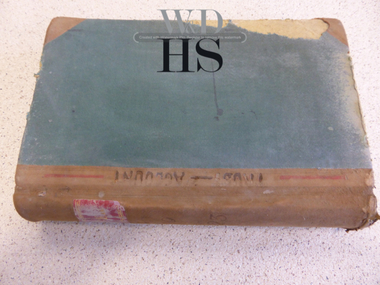
... The law firms of George Mackay and James Fletcher merged in 1893 to form Fletcher and Mackay and in the early 1920s J. ...The law firms of George Mackay and James Fletcher merged in 1893 to form Fletcher and Mackay and in the early 1920s J. ...This Trust Accounts ledger belonged to the law firm of Mackay and Taylor of Kepler Street, Warrnambool. The law firms of George Mackay and James Fletcher merged in 1893 to form Fletcher and Mackay and in the early 1920s J. Taylor became the new partner with Mackay to form the legal practice of Mackay and Taylor. This firm continued in Kepler Street until the 1990s. George Mackay was a prominent resident of Warrnambool from 1891 to his death in 1926. The Trust Accounts ledger lists the accounts of several organizations such as the Ancient Order of Foresters, the accounts of deceased estates and accounts of individual residents of Warrnambool and district. The dates covered are from 1919 to 1923. The accounts appear to refer to an investment and banking society operated by Mackay and Taylor.The ledger has some significance as it contains information on the financial dealings of many well-known Warrnambool people and organizations. It has social significance as it shows the type of investment opportunities available to Warrnambool people in the first two decades of the 20th century. This is a foolscap-size bound book of 526 pages. The covers are of blue hard cardboard with buff-coloured spine and corners. The inside thick paper covers are of a blue and red mottled design. There are pages with alphabetical tabs at the start of the book. The pages are printed with red ruled lines for accounting purposes. The entries are in black ink. Spine – ‘Ledger’, ‘1919 to Dec. 1923’ Front Cover- ‘Trust Account’ mackay taylor legal firm, warrnambool -
 Warrnambool and District Historical Society Inc.
Document - Thomas Sleeman Probate 1900, 1900
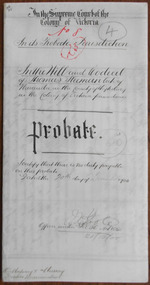
... The document has been drawn up by the law firm of O’Mahony and Murray which operated in Warrnambool early in the 20th century. ...The document has been drawn up by the law firm of O’Mahony and Murray which operated in Warrnambool early in the 20th century. ...Tait collection: item 57 of 62 This document gives details of the Will and Probate of Thomas Sleeman, a Nirranda farmer. He died in 1900 at the age of 85 and left real estate to the value of £600. The main beneficiaries were his sons and £30 was left to Mary Le Couteur, his daughter. He also bequeathed to the Wesleyan Church the half acre of land that the church was on at that time (presumably in the Nirranda district). The document has been drawn up by the law firm of O’Mahony and Murray which operated in Warrnambool early in the 20th century. The document has been passed down to successive lawyers occupying the legal premises in Kepler Street and located there in 2014 in the same building, the premises last occupied by the law firm of Mackay Taylor. This document is of some interest as it gives details of the Will and Probate of Thomas Sleeman, a farmer from Nirranda.This is a piece of white paper folded in two to make four pages. Three of the pages are ruled with blue lines and have margins ruled in blue. There is handwritten material on three pages. A seal of the Supreme Court of Victoria is attached with green ribbon and there are nine red stamps of the Master in Equity of the Supreme Court and one purple stamp of the Savings Bank (Head Office). The document is a little stained and the writing is fading but legible. The document gives details of the Will and Probate of the Nirranda farmer, Thomas Sleeman who died in September 1900. In the Supreme Court of the Colony of Victoria in its Probate Jurisdiction in the Will and Codicil of Thomas Sleeman late of Naranda in the County of Heytesbury in the Colony of Victoria farmer deceased.o’mahony and murray, warrnambool lawyers, thomas sleeman, warrnambool history, tait collection, nirranda -
 Warrnambool and District Historical Society Inc.
Book, Index of Drafts Chambers, Late 19th century
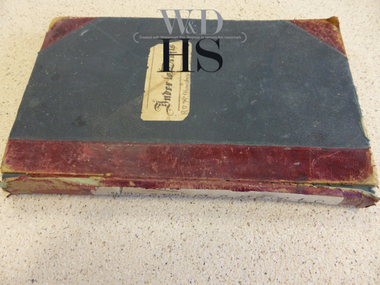
... The firm of Mackay Taylor was originally established in 1898 from the amalgamation of the law firms of George Mackay and James Fletcher. ...The firm of Mackay Taylor was originally established in 1898 from the amalgamation of the law firms of George Mackay and James Fletcher. ...This ledger contains an Index to Drafts for Mortgages, Conveyances and Deed of Covenants etc (1896 to 1913) which was in use by the Warrnambool solicitor, Ernest Chambers. He had offices in Warrnambool, Koroit and Port Fairy in the late 19th century and early 20th century and Thomas Goodall was his manager in Warrnambool until 1899 when Chambers took up permanent residence in Warrnambool. The ledger was found in the old Mackay Taylor offices in Kepler Street and presumably came into the possession of this law firm at a later stage when Ernest Chambers was no longer operating in Warrnambool. The firm of Mackay Taylor was originally established in 1898 from the amalgamation of the law firms of George Mackay and James Fletcher. In the 1920s the firm became Mackay and Taylor when J. Taylor joined as a partner and this business was prominent in Warrnambool until the 1990s.This ledger has some significance as it contains the names of many Warrnambool and district residents of the late 19th and early 20th centuries and gives some indication of what type of legal transaction they were involved with. It therefore has some historical and social connotations useful for researchersThis is a ledger with a black cover and red bindings on the spine and corner reinforcements. There are 273 pages with printed red lines for accounting purposes. The entries are written in black ink. The inside front and back covers of card paper material have a red and blue mottled pattern. Front cover: ‘Index to Drafts, E.T.H.Chambers’ Spine: ‘8-4-96 to 14-9-15 Index to Drafts’ ernest chambers, solicitor mackay taylor legal firm -
 Warrnambool and District Historical Society Inc.
Document - Richard Bright Probate 1897, 1897
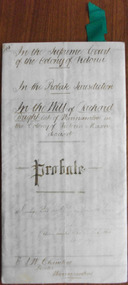
... It was handed to the Historical Society when it was found in the premises once occupied by the law firm of Mackay Taylor. Tait collection: item 14 of 62...This document was in the possession of Thomas Goodall , a law clerk managing the Ernest Chambers legal offices in Warrnambool and it was eventually passed on to the law firms operating from the same premises in Kepler Street. ...This document contains the Probate Papers following the death of Richard Bright, a Warrnambool stonemason who died in August 1897. No other information has been found on Richard Bright but he must have been a successful tradesman as he left real estate to the value of £680 and personal estate to the value of £94. His executors were his son, Daniel Bright of Terang and the law clerk, Thomas Goodall. Richard Bright left a number of properties to his wife, Elizabeth, his sons, Daniel and John and his daughters, Adelaide Scown and Martha Head. This document was in the possession of Thomas Goodall , a law clerk managing the Ernest Chambers legal offices in Warrnambool and it was eventually passed on to the law firms operating from the same premises in Kepler Street. It was handed to the Historical Society when it was found in the premises once occupied by the law firm of Mackay Taylor. Tait collection: item 14 of 62This document is of interest as it originally was drawn up by a local lawyer. Ernest Chambers, and the probate papers are for a local Warrnambool resident, Richard Bright. This is a piece of parchment paper, folded in two, with handwriting on all pages. There is a seal of the Supreme Court of the Colony of Victoria attached with a green ribbon and a red stamp of the Master in Equity of the Supreme Court. There are ruled black lines on three pages and pencilled writing in the margin of the first page. Some of the writing is a little faded. ‘In the Supreme Court of the Colony of Victoria, In the Probate Jurisdiction In the Will of Richard Bright, late of Warrnambool in the Colony of Victoria, Mason, deceased. Probate. I certify that no duty is payable herewith. J. Poole, Officer under Sec. 96, Act 1060, 16/11/97. E.J.W. Chambers, Proctor, Warrnambool’ernest chambers, thomas goodall richard bright, richard bright, tait collection -
 RSL Victoria - Anzac House Reference Library and Memorabilia Collection
Souvenir Programme
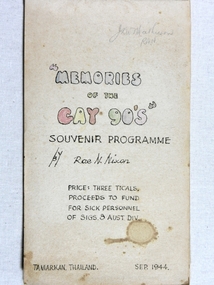
... Davis of New York law firm Davis Polk Wardwell to Herbert Robinson Brookes regarding Rivett's 1946 book, Behind Bamboo, and his (Davis) views on Russia and post-war Europe. ...Davis of New York law firm Davis Polk Wardwell to Herbert Robinson Brookes regarding Rivett's 1946 book, Behind Bamboo, and his (Davis) views on Russia and post-war Europe. ...Collection of letters and photographs of Rohan D. Rivett, war correspondent and prisoner of war. Includes letter from John W. Davis of New York law firm Davis Polk Wardwell to Herbert Robinson Brookes regarding Rivett's 1946 book, Behind Bamboo, and his (Davis) views on Russia and post-war Europe. The souvenir programme is dated September 1944, Tamarkan Thailand. Thirty three pages, brown paper cover."Memories of the Gay 90's" by Rae N. Nixonrohan d rivett, herbert robinson brookes, prisoners of war, behind bamboo, rae nixon, signals 8 division -
 Warrnambool and District Historical Society Inc.
Administrative record - Rent Ledger, 1910 to 1925
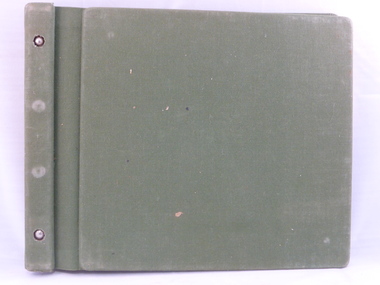
... It probably belonged to a real estate firm or an accountancy or law firm dealing in property, mortgages and financial investments. ...It probably belonged to a real estate firm or an accountancy or law firm dealing in property, mortgages and financial investments. ...The name of the business that produced the contents of this ledger is unknown. It is a record of rents paid by tenants to the property owners in Warrnambool and district from 1910 to 1925 and includes the rents paid and the dates. It probably belonged to a real estate firm or an accountancy or law firm dealing in property, mortgages and financial investments. Many of the names contained in the ledger are well-known (Coakley, Alston, Gleeson, McGennan etc) and the ones that are not so well known are mostly those with only one or two rental properties. This ledger is of some interest as a research tool giving information on property owners and renters in Warrnambool from 1910 to 1925. It will be of greater value if the name of the ledger owner can be found. This is a ledger with a cover made of wood and covered with a light brown material. It has a heavy metal insert inside to hold the pages. There are heavy card pages and white pages ruled with red and blue lines. The page entries are handwritten in ink. warrnambool renters 1910-1925, warrnambool property owners 1910-1925 -
 Warrnambool and District Historical Society Inc.
Ledger – Deed Receipts, 1940s/1950s
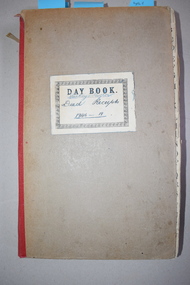
... The ledger comes from the law firm of Mackay and Taylor of Warrnambool. ...The ledger comes from the law firm of Mackay and Taylor of Warrnambool. ...This ledger contains information on deeds, wills and properties from many Warrnambool and district residents in the 1940s and 1950s. The ledger comes from the law firm of Mackay and Taylor of Warrnambool. Scottish-born George Mackay established a legal practice in Kepler Street, Warrnambool in 1891 and in 1893 bought the next-door practice of the late James Fletcher and the firm was then known as Fletcher and Mackay. In the 1920s George Mackay took John Taylor into partnership and the business then became Mackay and Taylor (later Mackay Taylor). In 1999 Taits Solicitors and Mackay Taylor merged to form Tait Taylor and today it is known as Taits Legal. This ledger is of some importance as it contains so much information on Warrnambool and district families and their property ownership in the 1940s and 50s and so will be of great use to researchers. This is a ledger with a grey cover with red binding on the spine. The cover has a white label pasted on, with printed and handwritten material. The pages have printed red lines but these have not been used. Instead the pages contain letters, typed sheets and receipts pasted in. Some of the letters and receipts are handwritten and some are typed. Day Book Mackay & Taylor Deed Receipts 1946-19…mackay & taylor, history of warrnambool, ledger – deed receipts -
 Warrnambool and District Historical Society Inc.
Slate, School/ Olive Ardlie 13.02.1911, Circa 1911
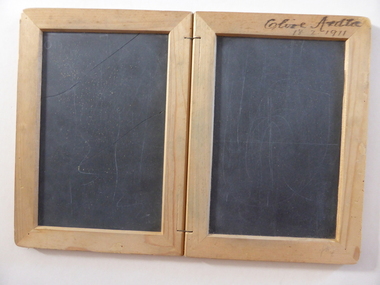
... They lived at "Aroona" 19 Princess St Warrnambool and Arthur worked as an accountant in his father's law firm. Olive was their eldest child and she died in 1912 at the age of 6. ...They lived at "Aroona" 19 Princess St Warrnambool and Arthur worked as an accountant in his father's law firm. Olive was their eldest child and she died in 1912 at the age of 6. ...Slate has been used for hundreds of years as a base for writing and many young students began their schooling using one to practise their writing. They had many advantages among them the fact that they were reusable and errors could be erased and corrected. A small duster or cloth was often attached for cleaning.This slate belonged to Olive Ardlie who was the daughter of Arthur Stanley Ardlie and Ethel Mary Lisburne (nee Ryan). They lived at "Aroona" 19 Princess St Warrnambool and Arthur worked as an accountant in his father's law firm. Olive was their eldest child and she died in 1912 at the age of 6. She was the granddaughter of William Ardlie one of Warrnambool's earliest residents and one of the state's longest serving solicitors . Olive had two sisters one of whom donated this slate. A common object with links to one of Warrnambool's oldest and well known families.Four sided slate with unpainted wooden frame. Hinged in the centre with metal hinges. Inside Olive Ardlie 13.2.1911 is written on the wood at the top of the frame.Olive Ardlie 13.2.1911 is written on the wood at the top of the frame.warrnambool, olive ardlie -
 Warrnambool and District Historical Society Inc.
Document - Henry Phillips Probate 1895, 1895
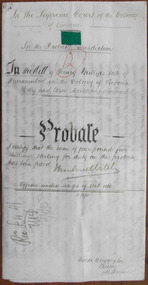
... The document was located in this building in 2014 in the former premises of the law firm of Mackay Taylor. ...The document was located in this building in 2014 in the former premises of the law firm of Mackay Taylor. This document is of considerable importance as it contains details of the Will and Probate of Henry Phillips. ...Tait collection: item 41 of 62 This document gives the details of the Will and Probate of Henry Phillips who died in Warrnambool in 1895 at the age of 55. He came to Australia from England in 1861 and established a hay and corn store in Liebig Street, Warrnambool. He was a prominent member of the Congregational Church and lived at ‘Ilfracombe’ in Lava Street. He and his wife Emma had eight children, two of whom had businesses in Warrnambool. Henry Phillips left personal estate to the value of £521 and the beneficiaries were his wife, Emma and their children. This document came into the possession of a Warrnambool lawyer, Ernest Chambers and passed down to successive lawyers occupying legal premises in Kepler Street. The document was located in this building in 2014 in the former premises of the law firm of Mackay Taylor. This document is of considerable importance as it contains details of the Will and Probate of Henry Phillips. He was a prominent businessman in Warrnambool in the 19th century. The document will be useful to researchers. This is a cream-coloured piece of parchment paper folded in two and containing the Will and Probate details of Henry Phillips, a Warrnambool hay and corn merchant who died in 1895. The document has handwritten material (black ink) on three sides of the paper. A seal of the Supreme Court of Victoria is attached with a green ribbon and there is one red stamp of the Master in Equity of the Supreme Court on the second page. The handwriting is fading in some places but is still legible. In the Supreme Court of the Colony of Victoria In the Probate Jurisdiction In the Will of Henry Phillips late of Warrnambool in the Colony of Victoria Hay and Corn Merchant deceasedhenry phillips, walter briggs and son, tait collection, ernest chambers -
 Warrnambool and District Historical Society Inc.
Ledger, Mortgagee
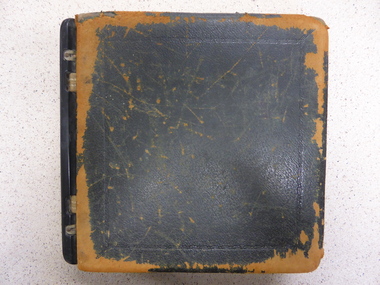
... This ledger appears to have been a mortgage document held by the law firm of Mackay Taylor and Co. with the evidence for this the presence of two loose sheets of paper in the ledger with that firm’s letterhead. ...This ledger appears to have been a mortgage document held by the law firm of Mackay Taylor and Co. with the evidence for this the presence of two loose sheets of paper in the ledger with that firm’s letterhead. ...This ledger appears to have been a mortgage document held by the law firm of Mackay Taylor and Co. with the evidence for this the presence of two loose sheets of paper in the ledger with that firm’s letterhead. Mackay Taylor was established in 1893 with the merger of the firms of George Sutherland Mackay and James Fletcher, independent practising lawyers at the time. The new firm became Fletcher and Mackay and later changed to Mackay and Taylor when J. McD. Taylor became a partner in the 1920s and the business was at 131 Kepler Street, with a new building erected in the late 1920s. The legal business closed in the 1990s with the mortgage section of the firm becoming Mackay Taylor Securities in 1990 (later Southern Securities). The ledger was recovered when the building was being cleared out and Percy Eccles, a real estate agent, handed it to the Warrnambool and District Historical SocietyThis ledger has considerable significance as an example of a law firm’s business activities in the mid 20th century. It also contains personal details of loans made to Warrnambool and district people and could be useful for research, with limited and supervised access to researchers because of the sensitive nature of the material contained therein.Ledger with leather covers and straps and metal sides; black covers are very worn leather alphabet tabs; handwritten entries for mortgagees and mortgagors and vendors and purchasers, 1938-1962; 3 loose sheetsKalamazoo Loose Leaf Books, 10/1/1938warrnambool, george sutherland mackay -
 Warrnambool and District Historical Society Inc.
Document - J E Brennan & Thomas Goodall Assignment of Interest 1912, 1912
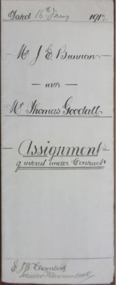
... This document was in the possession of Ernest Chambers and it has been passed down to successive lawyers occupying the legal premises in Kepler Street where it was located in 2014 (former premises of the law firm of Mackay Taylor). ...This document was in the possession of Ernest Chambers and it has been passed down to successive lawyers occupying the legal premises in Kepler Street where it was located in 2014 (former premises of the law firm of Mackay Taylor). This document is of some interest as it gives details of a business transaction between Thomas Goodall and John Brennan, both residing in the Warrnambool area early in the 20th century. ...Tait collection: item 62 of 62 This 1912 document is an agreement made between John Brennan, a farmer from Laang and Thomas Goodall, a law clerk from Warrnambool. The document shows that Thomas Goodall has given John Brennan £5 and Brennan has agreed to pass over to Goodall a 218 acre property in Laang. Brennan also agreed to pay a debt of £10-19-4 to Thomas Goodall by monthly instalments. Thomas Goodall was the law clerk for several lawyers in Warrnambool at the beginning of the 20th century and he was also the manager of the Warrnambool office of the lawyer, Ernest Chambers who had legal offices in Koroit and Port Fairy at the same time (end of 19th century and beginning of the 20th century). This document was in the possession of Ernest Chambers and it has been passed down to successive lawyers occupying the legal premises in Kepler Street where it was located in 2014 (former premises of the law firm of Mackay Taylor). This document is of some interest as it gives details of a business transaction between Thomas Goodall and John Brennan, both residing in the Warrnambool area early in the 20th century. This is a piece of buff-coloured paper folded in two to make four pages. There is typed and handwritten material on two sides of the paper. This is a 1912 document called an Assignment of Interest Under Contract with John Brennan agreeing to pay his financial debts to Thomas Goodall. The document contains the signatures of John Brennan and Thomas Goodall. Part of one page of the writing is in pencil. There is also a separate receipt sheet which is a receipt for £5 paid by Thomas Goodall to John Brennan. A yellow duty stamp is attached to this receipt. Dated 16 Jany 1912 Mr J E Brennan with Mr Thomas Goodall Assignment of Interest under Contractjohn brennan, thomas goodall, ernest chambers, warrnambool -
 Wodonga & District Historical Society Inc
Photograph - State Bank of Victoria, Wodonga
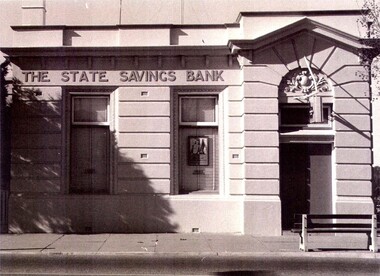
... It is now owned and used as an office by a local law firm. It is a single storey rendered masonry building with a parapet concealing the roof. ...It is now owned and used as an office by a local law firm. It is a single storey rendered masonry building with a parapet concealing the roof. ...The Title for the land on which this building stands was granted on 27 August 1857 and the land was bought by Keith Field and A. Maitland. It stood on 1 / 2 acre of land with 250 lengths down South Street and 200 lengths along Sydney Road. The 1 / 2 acre block on the northern side was also purchased by the same buyers. The State Savings Bank was built in 1915, just three years after the State Savings Bank of Victoria was established. It was branch number 731. The building served as a bank until about 1970. It is now owned and used as an office by a local law firm. It is a single storey rendered masonry building with a parapet concealing the roof. Key features of the High Street facade are horizontal bands of masonry, timber windows outlined with moulded details and ornamentation accentuated the door. A more modern branch was opened in a central location in High Street. The State Bank of Victoria was taken over by the Commonwealth Bank in 1990. These images record the premises of a bank which served the Wodonga community and businesses for many years.3 photos of the State Bank of Victoria in High Street Wodonga at various points in its history.state bank, wodonga businesses, financial institutions wodonga -
Port Melbourne Historical & Preservation Society
Document - Sale Notices, Relating to properties in Port Melbourne, "Sale Notices", 1960 - 1979
... 29 thick volumes of letters, forms, memoranda, etc. sent to the Building and Rates Departments of the former City of Port Melbourne by property owners, law firms and others. The items concern matters relating to properties and mostly are part of the process of putting a property up for sale. ...Index of each volume was carried out by Margaret Bride 2013 and Jack Bolt 2017/18. local government - city of port melbourne built environment - domestic 29 thick volumes of letters, forms, memoranda, etc. sent to the Building and Rates Departments of the former City of Port Melbourne by property owners, law firms and others. The items concern matters relating to properties and mostly are part of the process of putting a property up for sale. ...Index of each volume was carried out by Margaret Bride 2013 and Jack Bolt 2017/18.29 thick volumes of letters, forms, memoranda, etc. sent to the Building and Rates Departments of the former City of Port Melbourne by property owners, law firms and others. The items concern matters relating to properties and mostly are part of the process of putting a property up for sale. Those realting to a particular property are generally grouped together and are usually arranged in alphabetical order of streets. The volumes extend from early 1960s to late 1979. They have card front and back covers, metal holders and taped spines . (.01) prior to 30.09 1962 (.02) 1.10.1962 to 30.09.1963 (.03) 1963/64 (.04) 01.10.1964 to 30.09.1965 ; A-F (.05) 01.10.1964 to 30.09.1965 ; G-Z (.06) 01.10.1965 to 30.09.1966 (.07) 1966 to 1967 (.08) 01.10.1967 to 30.09.1968 (.09) 1968 to 1969, A-G (.10) 1968 to 1969, H-Z (.11) 01.10.1969 to 30.09.1970, A-K (.12) 01.10.1969 to 30.09.1970, L-Z (.13) 01.10.1970 to 30.09.1971, A-L (.14) 01.10.1970 to 30.09.1971, M-Z (.15) 01.10.1972 to 30.09.1973, A-H (.16) 01.10.1972 to 30.09.1973, I-Z (.17) 01.10.1973 to 30.09.1974, A-Glocal government - city of port melbourne, built environment - domestic -
 Warrnambool and District Historical Society Inc.
Document - William J Osborne Probate 1900Document, 1900
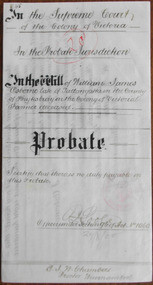
... He was in possession of this document and it has passed down to successive lawyers occupying the legal premises in Kepler Street where it was located in 2014 (former premises of the law firm of Mackay Taylor). ...He was in possession of this document and it has passed down to successive lawyers occupying the legal premises in Kepler Street where it was located in 2014 (former premises of the law firm of Mackay Taylor). This document is of interest as it gives details of the Will and Probate of William James Osborne, a farmer in the Allansford area in the 19th century. ...Tait collection: item 48 of 62 This is a document giving details of the Will and Probate of William James Osborne, a Tallangatta farmer who died in 1896 at the age of 59. His death place is given as Tower Hill. A William Osborne is listed as a Wangoom farmer in 1856, a farmer at ‘Thompson’s Old Farm’ in Allansford in 1866 and a farmer at Winton Farm on the Allansford Road near Shipley in 1869 but these references may be to William Osborne’s father as there is mention of a William Osborne, Junior at that time. William James Osborne left real estate to the value of £560 and personal estate to the value of £81 to his wife, Hannah. The lawyer who drew up this document was Ernest Chambers who had legal offices in Warrnambool, Koroit and Port Fairy at the end of the 19th century and the beginning of the 20th century. He was in possession of this document and it has passed down to successive lawyers occupying the legal premises in Kepler Street where it was located in 2014 (former premises of the law firm of Mackay Taylor). This document is of interest as it gives details of the Will and Probate of William James Osborne, a farmer in the Allansford area in the 19th century. This is a cream-coloured piece of parchment paper folded in two to make four pages. Three of the pages have handwritten material in brown ink and the pages are not ruled. A seal of the Supreme Court of Victoria is attached with a green ribbon and there is one red stamp of the Master in Equity of the Supreme Court. The document is somewhat stained but legible. The document gives details of the Will and Probate of William Osborne of Tallangatta in the County of Heytesbury. He died in 1896. In the Supreme Court of the Colony of Victoria in the Probate Jurisdiction in the Will of William James Osborne late of Tallangatta in the County of Heytesbury in the Colony of Victoria Farmer deceased. ernest chambers, warrnambool lawyer, william james osborne, tallangatta, tait collection -
 Warrnambool and District Historical Society Inc.
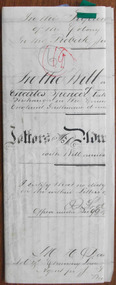
Document - Charles Spencer Letters of Administration 1898, 1899
... Mentioned in the document are the lawyers J.S.Tait and Henry Parrington who were partners in a law firm in Warrnambool at the end of the 19th century (going under the name of Higgins and Parrington). ...Mentioned in the document are the lawyers J.S.Tait and Henry Parrington who were partners in a law firm in Warrnambool at the end of the 19th century (going under the name of Higgins and Parrington). ...Tait collection: item 47 of 62 This is a document giving details of the Will and Letters of Administration following the death in 1895 of Charles Spencer of Brooklands, Birchanger, Essex, England. It is not known why the document has been drawn up in Melbourne and also makes reference to Warrnambool lawyers but it is presumed that some or all of the beneficiaries of the will lived in the Warrnambool district at the time. Charles Spencer left personal estate to the value of £689 to his wife, Emily, and children. Mentioned in the document are the lawyers J.S.Tait and Henry Parrington who were partners in a law firm in Warrnambool at the end of the 19th century (going under the name of Higgins and Parrington). The document has been passed down to successive lawyers occupying legal premises in Kepler Street and it was located in this building in 2014. The Letters of Administration for this estate was granted to Henry Parrington. The personal estate comprised £689 which had been lent to Spencer Smith on the security of land in the Parish of Wangoom, County of Villiers the repayment of which is secured by an indenture of mortgage dated 1st June 1892. [Ref: PROV. VPRS28/P0002, 73/750 Charles Spencer Grant of Administration] This document has no known local relevance except for the involvement of two Warrnambool 19th century lawyers. Further investigation has shown the personal estate mentioned in this will comprised £689 as a mortgage secured loan to a local resident, Spencer Smith.This is a cream-coloured piece of parchment paper folded in two and containing handwritten material on four pages which have black ruled lines on the edges. The 1899 document gives details of the Will and Letters of Administration of Charles Spencer, of Brooklands, Birchanger, in the County of Essex in England. The blue seal of the Supreme Court of Victoria is attached with a green ribbon and there are two red stamps of the Master in Equity of the Supreme Court. The document is a little stained but legible.In the Supreme Court of the Colony of Victoria In the Probate Jurisdiction In the Will of Charles Spencer of Brooklands Birchanger in the County of Essex England Gentleman deceasedj.s.tait, henry parrington, warrnambool history, charles spencer, tait collection, spencer smith -
 Federation University Historical Collection
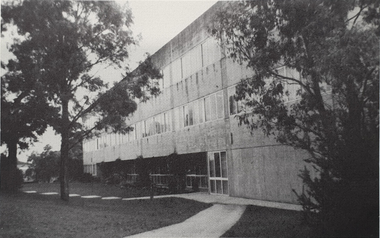
Programme, Invitation and Programme for the Naming Ceremony South Wing of the Education Building T Ian Gordon, 1995, 1995
... Ian Gordon, a partner in the Ballarat law firm Heinz and Gordon, became the first Vice-President of the new Council and was involved with the plan to transfer the former SCVB to the Mt Helen site. ...Ian Gordon, a partner in the Ballarat law firm Heinz and Gordon, became the first Vice-President of the new Council and was involved with the plan to transfer the former SCVB to the Mt Helen site. ...Ian Gordon played a prominent part in both the development of the Mt Helen Campus and in the progress the Institution made prior to becoming a University on 01 January 1994; In 1973 he was appointed President of the Council of hte newly created State College of Victorian at Ballarat (SCVB) which absorbed the former Ballarat Teachers' College. As President, he led the merger of the SCVB with Ballarat Institute of Advanced Education (BIAE), the tertiary division of the School of Mines and Industries, Ballarat. Out of the merger the Ballarat College of Advanced Education (BCAE) was established on 01 July 1976. Ian Gordon, a partner in the Ballarat law firm Heinz and Gordon, became the first Vice-President of the new Council and was involved with the plan to transfer the former SCVB to the Mt Helen site. In June 1981, Ian Gordon became President of the Council of BCAE and held that position until June 1989. He remained a member of the Council of the BCAE (later Ballarat University College) unti l31 December 1993, the eve of the creation of the University of Ballarat. He was the only person to remain a member of the BCAE and the BUC Councils for the whole of their existence. Mt Helen T Building wzs erected to house the major part of teh State College of Victorian at Ballarat when it moved to the Mount Helen Campus.Folded programme and invitation for the Naming Ceremony of the South Wing of the Education Building T "Ian Gordon".ian gordon, ballarat college of edvanced education, state college of victoria at ballarat, t building, ballarat institute of advanced education, david james, verna barry, building name, mt helen campus -
 Bendigo Historical Society Inc.
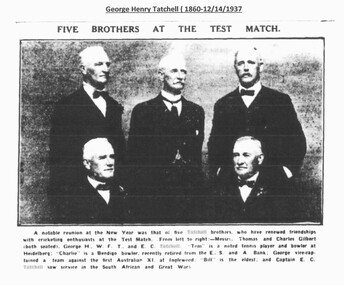
Document - Connelly,Tatchell, Dunlop, Smalley and Balmer Image, January 1925
... When Thomas Connelly died, his will stated that his share in the law firm was to be sold and if it was sold to Dunlop, he would have 3 years to pay for. ...When Thomas Connelly died, his will stated that his share in the law firm was to be sold and if it was sold to Dunlop, he would have 3 years to pay for. ...Thomas Jefferson Connelly (1858-18/10/1892) Son of Thomas James Connelly a well known JP at Inglewood. Admitted as a solicitor in the Supreme Court in 1880. Started own business as a solicitor in 1883 at Albion Chambers, View Street. By 1887 he had joined with George Henry Tatchell and in 1889 they moved their firm to Williamson Street. On 8th Jan 1885 he was elected to the Bendigo Council and was elected as Mayor 16th Aug 1887. He was the first Bendigo born Mayor and the youngest. He served on the committee of the Bendigo hospital and the Mechanics Institute and was a prominent member of the ANA. He was also a Captain of a local militia force. He married Frances Cresswell Reynolds and they had 3 children who were very young when they were left fatherless in 1892. Thomas died in Kerang, following an epileptic fit. He was attending a case at the time. He is buried at the Bendigo Public Cemetery. George Henry Tatchell was the son of Thomas Tatchell JP of Inglewood. He was admitted as an attorney by the Supreme Court in 1887 and formed a partnership with Thomas Jefferson Connelly 22/9/1887. By 1894, their practice had been joined by Adam George Dunlop. In 1904 he was elected president of the Bendigo Bar Association. George was a very bowler and was part of an Australian team that travelled to Britain in 1930, where he won the Veteran Pairs Competition competing with his brother William. He retired to “Woodford”, Toorak. Adam George Dunlop (1864 – 28/2/1921) Son of Andrew McBride Dunlop. He married Marion Ethel Nicholls, a widow in 1905. Admitted as a solicitor, proctor and conveyancer in 1892. When Thomas Connelly died, his will stated that his share in the law firm was to be sold and if it was sold to Dunlop, he would have 3 years to pay for. This clearly happened and by 1894 the firm was known as Connelly, Tatchell and Dunlop.He continued to work for the firm Tatchell, Dunlop, Smalley and Balmer for 25 years and retired several months before his death, to “Milltara”, Glyndon Ave., Brighton. He was heavily involved in the Sandhurst Mechanics Institute and served as president in 1899 and 1901. He was treasurer of the Zenith Lodge of Masons in 1907. He was president of the ANA in 1896 and president of the Bendigo Law Association in 1907. Whilst in Bendigo, the family lived in “Millewa”, Kangaroo Flat. Jonathon Smalley (1873-21/8/1961) Son of Peter, a mining investor and his wife Ellen. 1899 married Catherine Horsemann Manning with whom he had four children. Jonathon proved proficient in sign language when he stepped into a court case where the defendant was hearing impaired. In 1904 he was the president of the Eaglehawk Mechanics Institute. Other community postings included Vice President of Bendigo Football Association (1909), President Bendigo ANA (1899), Councilor for Eaglehawk Borough (1904- ), elected Mayor of Eaglehawk (1909),and President of Bendigo Law Association (1910). Jonathon and his wife resided at “Overton”, View Street, Bendigo (now Harry Little Childcare Centre). Jonathon was a champion Lawn bowler, winning the Country Singles Championship in 1913. He is buried at the Bendigo Cemetery. Sydney Raeburn Balmer (1869 – 24/11/1938) Sydney was the son of Robert and Elizabeth Balmer. He married Catherine HAswell McDonald in 1905 and they later lived in Lily Street, Bendigo. After qualifying as a barrister and solicitor, he was initially employed as a barrister for Mr Cussen (later a judge) for 2 years. He then spent 9 years working in Melbourne before joining the firm to be thenceforth known as Tatchell, Dunlop, Smalley and Balmer from 31sdt Dec. 1909 Black and White newspaper photograph of five Tatchell Brothers attending a cricket match. Undated on clipping. Clipping taken from 'The Argus, Wednesday 7th January, 1925, page 9, 'Five Brothers at the Test Match'.solicitors, councillors, connelly, t.j. connelly -
Federation University Historical Collection
Document, Dianne Campbell, Ballarat Lawyers 1853-1895 Research Folders, c2000-2021
... Folders of research notes on Ballarat Lawyers, including newspaper clippings, website information, etc. .1) Ballarat Lawyers - A (Australian Law Firm histories, Jamaican in Australia, History of the Court System, University of Melbourne Law Students c1870s, Melanie Senior, Cinque Oakley Senior Lawyers, 19th Century Castlemaine Police Courts, New Victorian County Court, Scots and the Law in Scotland, Solicitor online encyclopedia, Alfred Akehurst, Artur Akehurst, J.T. ...Ballarat Lawyers Ballarat Dianne Campbell Goldfields Lawyers Collection Folders of research notes on Ballarat Lawyers, including newspaper clippings, website information, etc. .1) Ballarat Lawyers - A (Australian Law Firm histories, Jamaican in Australia, History of the Court System, University of Melbourne Law Students c1870s, Melanie Senior, Cinque Oakley Senior Lawyers, 19th Century Castlemaine Police Courts, New Victorian County Court, Scots and the Law in Scotland, Solicitor online encyclopedia, Alfred Akehurst, Artur Akehurst, J.T. ...Folders of research notes on Ballarat Lawyers, including newspaper clippings, website information, etc. .1) Ballarat Lawyers - A (Australian Law Firm histories, Jamaican in Australia, History of the Court System, University of Melbourne Law Students c1870s, Melanie Senior, Cinque Oakley Senior Lawyers, 19th Century Castlemaine Police Courts, New Victorian County Court, Scots and the Law in Scotland, Solicitor online encyclopedia, Alfred Akehurst, Artur Akehurst, J.T. Ansdell, Butler Cole Aspinall, Alfred James Bailey, Henry Stephen Bailey, Matthew Baird, Hugh Sutherland Barrett, William Field Barrett, Redmond Barry, George Elliott Barton, George Frederick Bartrop, John Bell, Thomas Bellas, George Booker) .2) Ballarat Lawyers B (Hugh Sunderland Barrett, Peter Beckford, William Beckford, John T.F. Bowker, William Box, George Boyd, William Boykett, B. Browne, Richard Archer Burton, Alfred Butler) .3) Ballarat Lawyers C-E (Thomas B.S. Carwithen, J.B. Cathcart, John Alfred Chalk, David Clarke, John Collins, Matthew Combe, Thomas Spemcer Cope, Richard. Crouch, Charles Curwan-Walker, Frank H. Cole, John Rowland Davies, Charles J. Dawson, Christopher John Dease, J.E. Dixon, Robert Willian Dobson, Roy Dobson, Edward Doward, Charles R. Doward, Edgar R. Doward,) .4) Ballarat Lawyers F-G (Charles B. Finlayson, Peter T. Finn, John Findlay, John Fitzgerald, John Olsen Foss, Alexander Fraser, J.A. Doane, Andrew Garran, George Garrard, David Gaunson, William Gaunt, MAry Gaunt, F.T. Gell) .5) Ballarat Lawyers H-J: (Frederick Ham, Jeremy Harper, John H. Harris, solicitors, Amelia Harris, J. Henry Harris, Peter Blake, Henry Plomer, Arthur Plomer, Ballarat Chamber of Commerce, Freemasons, White Flat Drainage and Mining Company, Henry R. Nicholls, Francis Ham, Richard T. Harvey, Edward Heady, Peter Heinz, T.t. Hollway. Thomas tuke hollway, William Higgins, James V.M. Hitchins, frederick Hitchins, James Hitchins, Edward Hockley, Robert W. Holmes, Catherine Kain, JOhn Ireland, Richard D. Ireland, Peter Jacobs) .6) T.C. Williams, John Kidahl, Arthur W. King, Pendrell family, M.A. Lazarus, Edward Lewis, W.H. McCormick, Soho Foundry, Henry S, Ochiltree, James V. McCormick, McDonnell, Townsend MacDermott, Morgan McDOnnell, Percy McDonnell, Cyprian McDonnell, John McFarland, Samuel W, McGowan, Bill McGregor, David Madden, Charles Holthouse, J. Madden, Samuel Mann, Samuel F. Mann, Tobias Furneaux, Samuel Mann, Agar Wynne, thomas Mann, Henry MacDermott, Archibald Midnie, Arthur Nevett, Arthur H. Nevett, Alfred Mitchell, William Mitchell, H.W. Morrow, William Mitchell, Norman P. Must, George F. Oakley.) .7) Ballarat Lawyer Q-R (Henry S. Ochiltree, W.B. Ochiltree, Edward G. Ochiltree, J.J.P. O'Dee, Bernard O'Dowd, John Ogier, Cornish Lawyers in Central Victoria Q-R, John Bateman Paynter, J.B. Pearson, Mondle Emmanuel Phillips, Robert King Piers, Robert King Piers, Pinkerton, Frank Pinkerton, Martha Pinkerton, Charles Purcell, R.H. Ramsay, Henry Randall, James Randall, Thomas Randall, John Warrington Rogers, John M. S. Rodd, George Rutler) .8) Lawyers in Central Victoria S-W (Charles Salter, H. Holmes, George Staveley, Charles Salter, George T. Boyd, Edward Sandford, Henry G. Shaw, Thomas W. Snape, Thomas S. Standish, Charles Snape, Frederick C. Standish, Edith Snape, James Snape, Thomas Snape, Philip Snape, George Staveley, John G. Stoker, William Stone, Henry Sturt, Matthew W. Taylor, Bread and Cheese Club, R.D. Thompson, Roger D. Thompson, R.H. Ramsay, R.G. Turner, F.H. Tuthill, W.M.K. Vale, William Vale, May Vale, William L. Vardy, Gordon Vardy, William S. Vardy, Charles Von Ende) .9) Lawyers in Central Victoria W-Z (Henry Walker, Andrew Wallace, John Wellesley, Brereton Watson, C.G.M. Watson, James Watson, George Armytage, Thomas Watson, Patricius Welsh, John Westmore, Theodore Whipham, Arthur Whipham, Thomas H. Whipham, Frances Whipham, Thomas Bellas, James L. Willoughby, John Noble Williams, James Wisewould, Horace Wright, H.M. Wright, William Wright, Henry J. Wrixon, Agar Wynne, Samuel Young) . ballarat lawyers, ballarat, dianne campbell goldfields lawyers collection -
 Flagstaff Hill Maritime Museum and Village
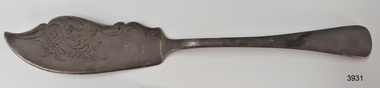
Domestic object - Butter Knife, Barker Brothers, Ca. 1885-1895
... In 1895 the unlawful practice was seen as imitating the Sheffield Silver Mark and the law was firmly applied to eradicate the deception, so items with this mark probably date before 1895...In 1895 the unlawful practice was seen as imitating the Sheffield Silver Mark and the law was firmly applied to eradicate the deception, so items with this mark probably date before 1895 ...This butter or cheese knife is a decorative example of electroplated cutlery that had become an affordable alternative to more expensive silver cutlery in the late 1800s to early 1900s. The knife has stamp marks in the back of its handle that are a combination of letters and symbols used by British silversmiths to identify their workmanship. The design and type of this knife was not normally used by everyday people but rather those of a higher social class with time and money to have a particular decorative knife to serve butter or cheese. The marks on the handle tell that it was made of nickel silver, and electroplated with superior quality Stirling silver. The Barker Brothers of Birmingham made the knife between 1885 and 1907, but most likely before 1895. It was made for the British, or British colonial, people, connected with a government department such as the navy or defence. This story may be slightly inaccurate, as some silversmiths added extra ‘pseudo marks’ to their wares to disguise the quality. THE MARKS and their meaning – - ‘A1’ The silver used in electroplating this knife was the highest level, ‘superior quality’, measured in grams of silver per table spoon or table fork, with ‘A1’ being 2 2/3 grams, and ‘D’ being 0 1/2 grams of silver. - ‘BB’ The Baker Brothers used these initials from 1885 to 1907. - ‘[crown symbol]’ – This symbol is used for Sterling silver but this knife is a metal alloy. The crown is also the town mark of Sheffield (appointed by the Sheffield Assay Office) but this knife was made in Birmingham, which has the town mark of an anchor. The Barker Brothers may have added the crown mark to this electroplated silverware as a ‘pseudo hallmark’, leading the buyer to think that it was actual Sterling silver. The use of pseudo hallmarks by electroplaters of the Victorian era was common practice but it was illegal. In 1895 the unlawful practice was seen as imitating the Sheffield Silver Mark and the law was firmly applied to eradicate the deception, so items with this mark probably date before 1895. - [EPNS] Electro Plated Nickel Silver, called nickel silver or German silver, is a metal alloy that usually combines copper, nickel and zinc (60 percent copper, 20 percent nickel, 20 percent zinc). It has a silver-white appearance and is sometimes referred to as ‘white ware’. It does not contain any silver but is often used as a base for electroplating, when the item is covered with a thin layer of silver to give it the polished appearance of pure silver. It became popular in the late 19th and early 20th century as an affordable substitute for sterling silver. - Broad Arrow - an official stamp that indicates it was once the property of Britain government, either in Britain or one of its colonies, and used in the defence force. In Great Britain, from an 1875 government act, it was, and still, is a crime to forge or wrongfully use, the broad arrow symbol. The BARKER BROTHERS of Birmingham - Barker Brothers were one of the earlies firms of Birmingham silversmiths, established in 1801 by Mary Barker. They became Barker & Creed, then William and Matthias Barker, then from 1885 they were the Barker Brothers. They were operating in Paradise Street in 1871 until in 1903 they moved to Unity Works, Constitution Hill, in Birmingham. The firm also had a showroom at 292 High Holborn, London, from the early 1900s to the 1980s. In 1907 the firm became Barker Brothers Silversmiths Ltd, then in the 1960s they merged with Ellis & Co, becoming Barker Ellis Silver Co. Ltd. In 1979 they were registered in USA as Ellis & Co., Barker Ellis, and Ellis Barker. The business went into administration in 1992, after almost 200 years of production. The firm advertised as specialists in electroplating, and used the trademarks BRITANOID, UNITY PLATE and THE HYGENIA.This knife is historically significant, dated from 1885 to 1907 but most likely pre-1895, and made by the longstanding Birmingham silversmiths, the Barker Brothers, established in 1801. The knife is an example of decorative flatware used by people of ’class’. It also has the broad arrow stamp, connecting it to the British government, in particular the ordinance department. The stamp also connects it to other items in our collection with that stamp. It may have been connected to pre-Federation government organisations and officials such as the army Garrison, government naval vessel, police, lighthouse keepers, harbour masters. The knife is the only example of its kind in our collection, being a decorative silver butter or cheese knife, made by the Barker Brothers of Birmingham. Butter knife, or cheese knife, electroplated nickel silver (EPNS). Upper blade edge has decorative shape and engraved motifs, lower blade edge is bevelled to a cutting edge, and narrow plain handle flares out to a wide, rounded end. Maker’s marks are stamped on the reverse. Made by Barker Brothers of Birmingham in the late-19th century. Stamps: “flagstaff hill, warrnambool, maritime village, maritime museum, flagstaff hill maritime museum & village, shipwreck coast, great ocean road, butter knife, cheese knife, electroplate, electro plate, nickel silver, nickel alloy, alloy composition, copper nickel zinc, german silver, epns, barker brothers, birmingham, london, silversmiths, victorian era, 19th century, a1, bb, crown inside square, broad arrow, flatware, tableware, cutlery, cutler, dining utensils, eating utensils, superior quality, pseudo hallmark, stirling silver, silver-white metal, mary barker, barker & creed, william barker, matthias barker, barker brothers silversmiths, barker ellis silver co, ellis & co, barker ellis, ellis barker, britanoid, unity plate, the hygenia, british, colonial, government use, defence department use, naval use, knife, serving knife -
 City of Melbourne Libraries
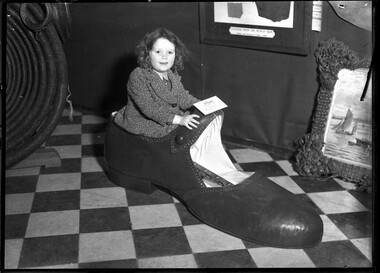
Photograph, Bull, Hugh Jones, 1897-1993, Leather Exhibition, Melbourne Town Hall
... She later worked at a law firm while she completed her degree. Study of the law had always been open to women in NZ, but its practice was still barred to them. ...She later worked at a law firm while she completed her degree. Study of the law had always been open to women in NZ, but its practice was still barred to them. ...Photographer notations on slide: At the Leather Exhib. at T. Hall Melb 1933 Age Published: Age (Melbourne, Vic.: 1854- ), 1933 THE EXHIBITS. (1933, September 20). The Age (Melbourne, Vic. : 1854 - 1954), p. 16. Retrieved January 25, 2026, from http://nla.gov.au/nla.news-article205109730 Published title: THE EXHIBITS. A COMPREHENSIVE RANGE. Curios, Novelties, Working Displays Published Caption: ONE OF THE NOVELTIES – AN OUTSIZE IN SHOES Research by Project Volunteer, Louise McKenzie: Our photo is dated 20 September 1933, and shows a happy, chubby-faced young girl sitting in a very over-sized girl’s shoe. It is labelled – “Shoe, An Out Size, loaned by Messrs Blackman & Rose”. (1) It is an effective way to capture the attention of the readership and alert them to the Melbourne Leather Show 1933. This show was designed to be a drawcard of extraordinary proportion, and there is no doubt that this leather exhibition was a really big deal for Melbourne. It completely took over the Melbourne Town Hall, and was open from 10.30 am until 10.30 pm. It seemed to contain something for everyone – the military, the man about town, the home handyman, the housewife, the child, the sporting types, the domestic workers, the outdoor enthusiasts, the horseracing fans, car enthusiasts, those wishing to show off the latest fashion – both men and women - and those just intrigued by a lot of fascinating and wide ranging exhibits. One of the most comprehensive descriptions of the Exhibition accompanies the photograph, and is worth quoting in full: “PROMINENT among exhibits which first attract attention in the foyer of the Town Hall is a comprehensive display of leather articles used by the defence forces. A conspicuous legend states that leather plays an important part in national defence, being used for saddlery, tool containers, holdalls, range-finding, surveying and signalling equipment, explosives factories, harness accoutrement, bandsmen's equipment and clothing. Three models of horses and several figures of soldiers wearing leather equipment illustrate the lesson, and a great range of leather goods used in military training and work variegate the display. Nearby are Texas cowboy, buckjumping and breaking-in saddles; whips, a walking stick, made of leather and numerous other curios. The general exhibition occupies the whole floor space of the main Town Hall, and is subdivided by partitions running most of the length of the hall. A bewildering variety, of leather goods presses for close and leisured inspection. Here and there operatives in charge of working machinery give practical demonstrations of factory processes in the production of footwear. Polishing materials are well represented. One attractive exhibit includes two bush huts constructed of leather, with wattle bark for roofing. Opossums, rosellas and a kookaburra add touches of bush realism. Adjacent exhibits include bags, fishing boots, leggings, leather covers in all colours. Factory Processes. One exhibitor has installed an automatic cinema apparatus and screen, which projects various factory processes in making a shoe, the operator being shown at work. Elsewhere an interesting exhibit depicts the five stages in the manufacture of sole leather, and the tanning materials employed. "Very handsome effects are achieved in the interior appointments of motor cars, which are attended by figures of smart chauffeurs in leather coats. Motor-trimming leather is said to be more durable and hygienic than fabric materials, and cheaper. The neat finish of the material, its excellent appearance, certainly make a very favourable impression. It takes the hides of three beasts to cover the cushions, squabs and door panels of a full-sized sedan, while to finish the entire interior, including quarter-panels and head linings would take four or even five. Special Exhibits. Amongst the special sections the display arranged by the handicrafts and home industries- committee of the Country Women's Association of Victoria is a notable one. In all there are about 130 entries which are in four classifications, viz., hand-tooled or embossed leathers, suede, hand-made gloves and undecorated leather. The glove section attracted the most numerous entries, a number being the work of members and craft subscribers of the Country Women's Association. In the leathercraft competition, organised by the Country Women's Association, the judges yesterday awarded the first prize for bookbinding (the only prize given in this division) to Miss M. Alston, of South Yarra. There is also a creditable display of exhibits submitted by boys of the orthopaedic section of the Children's Hospital at Frankston. Amongst the novelties on view in other portions of the exhibition were the following: — Leather coats worn by Sir C. Kingsford Smith on his Atlantic flight. Model Wellington boot, Phar Lap's saddle. Melbourne Cup winner's saddle. Longest whip in world, 108 feet long. (33 metres) [See our photo, to left of Girl in Shoe] Diminutive shoes. Pair of shoes 65 years old. Pair of men's working boots 75 years old. Larwood's, Tate’s and Pataudi’s cricket boots. [Three internationally revered cricketers of the day] (2) Picture frame made of leather bought 63 years ago. [See our photo, to right of Girl in Shoe] Leather frame, powder bowl, &c. Saddle used by world's champion buckjumper in U.S.A. Mexican cowboy outfit. Miniature saddle and bridle. A fireman's helmet made of sole leather. (3) Sample of the leather hat worn by porters at the Billingsgate Fish Market, London. (4) From South Australia there have been obtained sets of harness for donkeys, goats and camels, the equipment being displayed to good advantage on stuffed representations of the animals mentioned. Close to the platform is a glass case containing snow shoes and coats which have been used in Antarctic exploration work. Trade Display. Amongst the trade exhibits may be seen in operation a slipper turn shoe sewing machine, with heeling and channelling facilities, and the various stages in the production of ladies' sandals are shown. There is a wide contrast between sole leather of varying degrees of thickness on view in one stall and the choice samples of ladies' footwear in another — footwear, by the way, which could almost be used as ornaments, so dainty in colour and production are they. Again, there are displays of upholstering leathers of such soft texture that they could he readily mistaken for some of the finest cloth. Those who may be particularly interested in the production of chamois leather may gain an insight into the materials and chemicals used in the "working up” of this variety of leather. Supplies of glace kid (5) are tastefully arranged, and there may also be seen bags of all shapes and sizes, including satchels, suit cases and "sporting" cases, and bags for tennis players and golfers. Further variety is given to the exhibition by the display of antique hides, brightly coloured, with punching balls, boxing gloves and batsman's pads. There are crocodile skins and snake skins so cleverly "Worked up" that one could be almost pardoned for betraying an affection for such unpopular creatures.” “ Another wonderful article on this Exhibition, published the same day in one of the opposition daily newspapers, The Argus, is in the weekly article “Women to Women”, entitled “A Great Victorian Industry: Many Uses for Leather”. This weekly column was penned by Vesta, and she writes, with much purpose: “Yesterday afternoon I paid a hurried visit to the Leather Exhibition now being held in the Melbourne Town Hall and I was disappointed to find that the early visitors to the main exhibition were almost all men. Women, I think, should make a point of seeing every exhibition of our great industries, for women are the buyers of household requisites and goods for their own use and their tastes, and opinion influence also, to a large extent, the purchases of men. So, the welfare of industries is more or less in their hands and it becomes a duty for them to inform themselves fully of the extent and the quality of the manufacturing that is done here. The value of the output of the Australian boot and shoe factories alone was in 1930-31, the latest year for which the figures are given, Stg 3,750,000. Fully two thirds of that amount must have been spent by women on boots and shoes for themselves and their children. In a host of other directions, in the purchase of handbags, travelling bags, belts and straps, cushions, furniture coverings, purses, notebooks, spectacle cases, their annual expenditure must be very high. Their interest, therefore, in this industry is practical, and their support of it should be governed by knowledge of comparable values and qualities of the goods they buy. From the point of view of women, however, the exhibition itself is rather disappointing. There is an amazing collection of good stuff on show, but most of it is not displayed in a fashion that attracts attention. I was surprised, for example, at the range and quality of the leathers displayed, the suppleness of the finer qualities, and the varied range of colours and designs. But they are shown in such a fashion that if one set out deliberately to look for them it would be quite easy to miss most of them.” …It was surprising, too, that no one seemed to have taken advantage of the present fashion of wearing coloured gloves, or the cult of glove making, which the Country Women’s Association has fostered so successfully. Outside the collection of chamois leathers I saw no skins which were suitable to glove making. (6) However, it is perhaps a little unfair to be highly critical of the exhibition, inasmuch as it is the first of its kind. The material is there, undoubtedly, for a splendid show of every phase of this enterprising industry, and I am confident that experience will prove to those concerned that it will be worth while next time to devote a great deal of attention of the method of display.” With further research, it transpires that “Vera” is in fact NZ born Stella May Allen (nee Henderson) (1871-1962), a journalist, the first woman in NZ to begin a law course, in 1890-91). She later worked at a law firm while she completed her degree. Study of the law had always been open to women in NZ, but its practice was still barred to them. Her case “…led to amending legislation in 1896 allowing women to practise as barristers or solicitors. However, on gaining her LL.B. in November 1897 she did not apply for admission to the Bar. Instead, she became the Wellington-based correspondent and leader-writer for the Lyttelton Times. Her appointment, the first for a woman, was not welcomed by the all-male Press Gallery, and special permission had to be obtained from a subcommittee of the House before her presence was accepted. In 1900 she married Edwin Allen, a senior leader-writer for the Wellington Evening Post, and they moved to Australia in 1903 when Edwin Allen took up the post of foreign affairs leader-writer and parliamentary man for the Melbourne Argus. As Patricia Keep notes in her excellent entry of Stella Allan in the Australian Dictionary of Biography: “In 1907 The Argus commissioned her to write a series of articles on the first Australian Women's Work Exhibition held in October. They aroused much interest and next year The Argus invited her to join its full-time staff and begin a weekly section on the particular interests of women. She adopted the nom de plume 'Vesta' and called the column 'Women to Women'. Her work was unique in an Australian daily paper at that time. Her pages extended to cover every aspect of women's affairs, children's interests and community welfare, and 'Vesta' became a household word for authoritative information and advice on such matters. An excellent needlewoman and first-rate cook herself, she thoroughly tutored her staff in the work and needs of women in both country and city, as well as providing the usual training for cadet journalists. She conducted interviews and also visited the country to see at first hand the results of bushfires, mouse plagues, droughts and floods. In 1910 she was one of three women foundation members of the Australian Journalists' Association. “…she found time to become deeply involved in community affairs. She was an original committee-member of the Victorian Association of Crèches and of the Free Kindergarten Union of Victoria, and had much to do with the early days of the Victorian Bush Nursing Association, the Baby Health Centres Association and the Queen Victoria Hospital. She was a member of the National Council of Women, first in New Zealand and then in Melbourne, and of the Country Women's Association from its inception. … in 1924 she was appointed substitute delegate for Australia to the fifth assembly of the League of Nations at Geneva and was a delegate to the second Pan Pacific Women's Conference in Hawaii in 1930. A meeting held in the Melbourne Town Hall in 1938 by representatives of all the main Victorian women's organizations paid special tribute to her work and influence. She retired next year to England where she continued to write for the Argus, contributing articles on the experiences of women and children in wartime.” It is little wonder that “Vesta” was unafraid to take to task both the women of Victoria, and those who created the exhibition! One item which appears to have gone unnoticed, or at least unreported, is a framed article in the background of the photo of the chubby girl in the shoe. The display frame is labelled “Leather from the Human Skin, Tanned and Dressed by French artists.” The exhibition was certainly a cabinet of curiosities! A charming article in The Argus is a nice note on which to end. It gives a quick history and overview of the Australian leather industry and its unprecedented, and possibly unexpected, development and success, and states with pride: “Though Victoria is the largest leather producer in the Commonwealth all tanners in the Commonwealth can look back with pride on the long march of progress.” Footnotes: (1) “Blackman and Rose”. Messrs Blackman and Rose were shoe manufacturers, from 1927 located at 200 Noone Street, Clifton Hill. The Melbourne Circle describes their building as a “fine-looking building in the Federation ‘blood and bandage’ style.” It was built around 1912 for Puttifoot and Bloom, boot manufacturers, and today the building is apartments. (2) These cricketers were household names in the day: Tate: Maurice Tate, “English cricketer of the 1920s and 1930s, and leader of England’s Test bowling attack for a long time during this period. The founder of modern seam bowling. “ Larwood: Harold Larwood, “English right-arm fast bowler and the main exponent of the bowling style known as “bodyline”. Used to considerable effect in the 1932-33 Test series in Australia. Pataudi: Iftikhar A K Pataudi, “an Indian prince who in the 1930s played Test cricket for England, and in the 1940s played Test cricket for India (as Captain) – the only test cricketer to have played for both India and England. (3) “sole” leather “… is the thickest and most resistant material existing in the tanning industry … made from vegetable tanned leathers, usually bovine butts, processed in a special way to make them the hardest type of leather in existence.” (4) The hats worn by porters at Billingsgate Fish Market were also known as a “Bobbin” and look quite squat and rather unsophisticated. They were made of wood and tarred leather, with a “flat, hardened top designed to support large rectangular boxes of fish. The upturned brim protected the porter’s head against fish juice draining from the boxes of fish which would be carried on top of the hat. Some hats featured a small drain hole at the rear to allow this collected juice to drain down the back of the carrier. The hats were made using the ‘cuir bouilli’ technique. The leather was immersed in water which was heated until the leather began to shrink. It was then removed and put on a wooden former. The leather was stitched together to make the hat while still wet, and then held in place until dry.” (See article and photo on the London Museum website) (5) Glace kid – described on the Boston Museum of Fine Arts’ Cameo database as “A smooth glossy leather originally prepared from goat or sheepskin. Early glace kid had a shiny surface that was originally prepared by tawing the skin in a mixture of alum, table salt, flour, and egg yolk. Today, glace kid is prepared from many types of vegetable or chrome tanned leathers. The smooth polished surface is obtained mechanically by shaving, glazing, ironing, and/or rolling the dry leather.” (6) In the 1930s, Melbourne’s glovemaking industry was characterised by local manufacturing, with key producers like Simpson’s Gloves Pty Ltd in Richmond and the Stagg Glove Company in Clifton Hill leading the market. These factories produced high-quality leather gloves, handbags, and specialty gear, often employing a clear gendered division of labour and training young, local women. Museum Victoria holds the Simpson’s Gloves Collection, comprising over 1200 items, and the University of Melbourne Archives holds the company’s business records. References: THE EXHIBITS. (1933, September 20). The Age (Melbourne, Vic. : 1854 - 1954), p. 16. Retrieved January 25, 2026, from http://nla.gov.au/nla.news-article205109730 EXPORT LEATHER. (1929, September 17). The Argus (Melbourne, Vic. : 1848 - 1957), p. 17. Retrieved January 19, 2026, from http://nla.gov.au/nla.news-article4037647 LEATHER EXHIBITION (1933, September 18). The Argus (Melbourne, Vic. : 1848 - 1957), p. 10. Retrieved January 19, 2026, from http://nla.gov.au/nla.news-article11693362 (1933, September 23). The Argus (Melbourne, Vic. : 1848 - 1957), p. 21. Retrieved January 19, 2026, from http://nla.gov.au/nla.news-page522766 WOMEN TO WOMEN (1933, September 20). The Argus (Melbourne, Vic. : 1848 - 1957), p. 13. Retrieved January 19, 2026, from http://nla.gov.au/nla.news-article11694034 Australian Dictionary of Biography, Stella May Allan (1871–1962) https://adb.anu.edu.au/biography/allan-stella-may-4998 WOMEN TO WOMEN (1930, January 22). The Argus (Melbourne, Vic. : 1848 - 1957), p. 13. Retrieved January 19, 2026, from http://nla.gov.au/nla.news-article4063888 Museums Victoria, Simpson’s Gloves, 486-496 Victoria Street, North Richmond, VIC, Australia https://collections.museumsvictoria.com.au/articles/2702 The Argus. (1927, October 31). The Argus (Melbourne, Vic. : 1848 - 1957), p. 20. Retrieved February 7, 2026, from http://nla.gov.au/nla.news-article3888451 Melbourne Circle: stories from the suburbs: “Boots and all in Clifton Hill” https://melbournecircle.net/2015/11/20/bootmakers-of-clifton-hill/ Wikipedia, Maurice Tate, https://en.wikipedia.org/wiki/Maurice_Tate Wikipedia, Harold Larwood, https://en.wikipedia.org/wiki/Harold_Larwood Wikipedia, Iftikhar Ali Khan Pataudi, https://en.wikipedia.org/wiki/Iftikhar_Ali_Khan_Pataudi Buy Leather Online Italy, Sole leather: https://buyleatheronline.com/en/blog/outsole-and-insole-leather-n7 London Museum, Porters hats, https://www.londonmuseum.org.uk/collections/v/object-731122/hat-porters-hat/ Cameo Database, Museum of Fine Arts, Boston, Glace Kid, https://cameo.mfa.org/wiki/Glac%C3%A9_kid VICTORIAN LEATHER HAS WON RENOWN (1937, September 22). The Argus (Melbourne, Vic. : 1848 - 1957), p. 31 (March of Progress Supplement). Retrieved February 7, 2026, from http://nla.gov.au/nla.news-article1108704 Photographer notations on slide: "At the Leather Exhib. at T. Hall Melb 1933 Age B5".displays, melbourne town hall, leather, children, shoes, 1930-1939, industry, hats, gloves -
 Flagstaff Hill Maritime Museum and Village
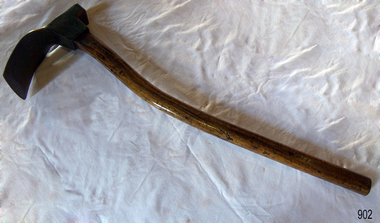
Tool - Adze, Ward & Payne Ltd, Between 1843 to Mid 20th Century
... The firm was established by David Ward (1767-1822) in 1803 the company became David Ward & Sons, in 1837 after Ward's son Edward joined the firm. In 1845 Henry Payne the founder's son-in-law became a partner but died in 1850 after which the company reverted to the Ward family. ...The firm was established by David Ward (1767-1822) in 1803 the company became David Ward & Sons, in 1837 after Ward's son Edward joined the firm. In 1845 Henry Payne the founder's son-in-law became a partner but died in 1850 after which the company reverted to the Ward family. ...An adze is an ancient and versatile cutting tool and has been in use for thousands of years. Adze are similar to an axe but with the cutting edge perpendicular to the handle rather than parallel. They have been used since the Stone Age. Adzes are hand tools used for smoothing or carving wood. The subject item was made by Ward & Payne of the Limbrick Works at Hillsborough, Sheffield England manufacturers of hand-forged tools. Their trademark registered in 1850 was a Letter "W" & "P" stamped into the steel. The firm was established by David Ward (1767-1822) in 1803 the company became David Ward & Sons, in 1837 after Ward's son Edward joined the firm. In 1845 Henry Payne the founder's son-in-law became a partner but died in 1850 after which the company reverted to the Ward family. The business then concentrated on making carving tools, chisels and gouges. In 1882 David Ward's grandson David Ward Jr. (1835-1889) purchased land and built a factory at Sheffield North known as the "Limerick Wheel". For a time Wards operated from both 106-114 West Street Sheffield and at Limbrick Road, Hillsborough on the river Loxley. By 1911 they had expanded into making spades, forks, sheep shears and many other types of edged tools including drills and wood planes. In 1967 Wilkinson Sword purchased all the company's share capital and continued to sell Ward & Payne tools until 1970 when a fire burned the factory down and housing development was built on the site.The subject item is significant as it gives a snapshot of the technological development of sailing ships and their operation before steam-powered vessels took over around the world. Tools such as the subject item demonstrate the traditional craftsmanship and skill of the shipwright and the aesthetic quality of the timber ships designs of the time. Adze with wooden handle curved painted green with patent number and maker's name inscribed on inside curve of blade. Inscribed "Patd 561 Ward" "2w". flagstaff hill, warrnambool, flagstaff-hill, flagstaff-hill-maritime-museum, maritime-museum, shipwreck-coast, flagstaff-hill-maritime-village, smoothing tool, hand tool, carpenders tool, adze, coopers tool, woodworking tools -
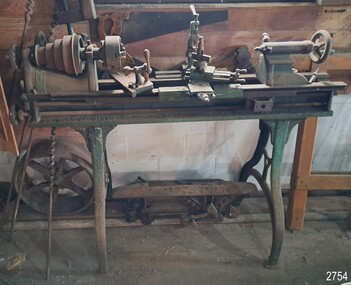 Flagstaff Hill Maritime Museum and Village
Machine - Lathe, W F & John Barnes, early 1900s
... In 1965, the firm was owned by partners Cyril Briggs and Frank Lee: Cyril died in 1967, and Frank died in 1971, so the foundry was then run by his son and daughter-in-law, Les and Eva Lee. ...In 1965, the firm was owned by partners Cyril Briggs and Frank Lee: Cyril died in 1967, and Frank died in 1971, so the foundry was then run by his son and daughter-in-law, Les and Eva Lee. ...This woodworking lathe, connected to both a pulley and a flywheel, demonstrates its historical operation with a steam engine. Such a configuration reflects manufacturing practices from the late 1800s and early 1900s, when steam power was the predominant source for driving workshop and factory machinery. Large machine shops often utilised a single power source, distributing power via roof-mounted belts and pulleys to operate several machines simultaneously. Over time, petrol-driven motors were introduced, and eventually, electricity became the standard power source. Conversion kits were made available in the late 19th and early 20th centuries to adapt older lathes to these newer, cleaner fuels. Manufacturer's History: W.F. & J. Barnes was a renowned maker of hand- and foot-powered treadle woodworking and metalworking machinery, established in 1869. The partnership between William F. Barnes and John Barnes was formalised in 1872, and the firm was incorporated in 1884. Their machines were used for both ‘farm’ applications and professional engineering. By 1881, the company began producing electrically powered machinery. By 1937, W.F. & J. Barnes expanded into manufacturing machinery for automotive assembly. The business closed in 1983, and in 1998, LeBlond Ltd. of Ohio acquired the firm. The lathe was donated by Briggs Marine, Melbourne: In Flagstaff Hill’s formative years, 1972-1975, Briggs Marine, Melbourne (Briggs Brass Foundry), donated equipment and objects used or made at their premises. The foundry was established in 1912 by Herbert Harrison Briggs. In 1965, the firm was owned by partners Cyril Briggs and Frank Lee: Cyril died in 1967, and Frank died in 1971, so the foundry was then run by his son and daughter-in-law, Les and Eva Lee. Briggs Marine’s Warrnambool Branch closed in 1972 after the death of Frank Lee in 1971. Flagstaff Hill’s founding director, John Lindsay, recalled that Briggs Marine’s family members gave personal assistance in setting up the displays in the original village shops, particularly the ‘Brass Foundry’ building, around the time the Maritime Museum opened in 1975. Briggs Marine still exists today, but the Briggs family is no longer involved. This early 1900s lathe marks a significant stage in the evolution of machinery, positioned between the era of hand-operated machines and the advent of electrically powered equipment. Its presence exemplifies the progression of industrial technology and craftsmanship during this period. The lathe is particularly notable for its association with the Briggs Brass Foundry. The foundry was known for developing a specialised brass alloy composed of non-ferrous metals, a formulation that resulted in durable products built to withstand the demanding conditions of marine environments. This focus on resilience and longevity made Briggs Brass Foundry’s goods highly sought after within the maritime sector. Briggs Maine, a long-established business, utilised the foundry’s capabilities to create cast goods tailored to the needs of the marine industry. The facility was equipped to deliver both custom-designed and mass-produced items, ensuring versatility in meeting various requirements. Many of Briggs Foundry’s products found their place on sailing and steam vessels throughout Victoria’s coastline, including in the port town of Warrnambool, where there was once a brancy of Briggs Marine. In addition to general marine fittings, Briggs Marine earned recognition for its expertise in bell-founding. The foundry’s reputation is closely linked to the restoration of the Schomberg Bell at Flagstaff Hill, a small but historically significant bell from a luxury migrant vessel dating back to the mid-19th century. The successful restoration of the Schomberg Bell demonstrates Briggs Brass Foundry’s commitment to preserving craftsmanship and maritime heritage.The lathe is a green, bench-type, steam-powered woodworking machine. Its bench is supported by decorative posts at each end, with each post dividing into arched legs. The lathe is mechanically connected to both a pulley and a flywheel, designed to be operated in conjunction with a steam engine. Included with the lathe is a range of accessories. Across the front of the machine, an inscription is cast, and a stamped, metal lathe pulley guide is attached to the drive mechanism. The lathe was manufactured by W. F. and J. Barnes, Rockford, Illinois, USA, during the 1900s.“W F and J Barnes, Rockford, USA” "1820" "1887"flagstaff hill, flagstaff hill maritime museum and village, warrnambool, maritime museum, maritime village, great ocean road, shipwreck coast, lathe, steam-operated lathe, steam-operated pulley, steam power, steam engine, machine, steam operated machine, metal work, foundry work, metal working trade, tool, pulley driven, metalworking, woodworking, barnes lathe, briggs marine, belt driven, wordworking lathe, free standing lathe, bench lathe, steam powered, vintage lathe, woodturning lathe, w. f. and j. barnes, illanois, early 20th century, briggs, briggs brass foundry, briggs marine foundry, briggs marine products, herbert harrison briggs, george edward briggs, cyril falkiner mckinnon briggs, collingwood, moorabbin, frank lee, les lee, eva lee, briggs marine warrnambool, non-ferrous founders, bell specialists, ship bell specialists, sand cast, marine equipment, marine fittings, foundry, brass foundry, founders -
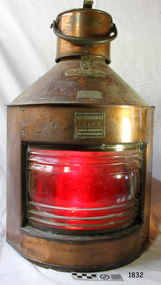 Flagstaff Hill Maritime Museum and Village
Equipment - Navigation Lamp, W. T George and Co. Ltd, ca 1941
... firm produced ship lamps. The Patent Number GB546575 on the lamp's plate was assigned to Leslie Thomas George in 1941 for improvements in, or relating to, ships' lanterns. From that time the patent number was affixed to their namufactured Meteorite lights. The ship navigation lamp is important as an example of the evolution of marine safety technology. Countries began passing laws ...William Thomas George was born in Birmingham in 1884 and was a tin plate worker. He and his wife Ellene had a son Leslie Thomas George. The firm W T George & Co was formed sometime later. In 1939 his firm produced ship lamps. The Patent Number GB546575 on the lamp's plate was assigned to Leslie Thomas George in 1941 for improvements in, or relating to, ships' lanterns. From that time the patent number was affixed to their namufactured Meteorite lights. The ship navigation lamp is important as an example of the evolution of marine safety technology. Countries began passing laws and regulations in the 1830s that required ships to show navigation lights at night or in poor weather. From the late 1840s colours were standardised; red for portside of the vessel and green for starboard, a white masthead light, and a white light at anchor. By 1914 the International Convention for the Safety of Life at Sea was formed and continues, with decisions and notifications on improvements and changes.. Lamp; Portside ship's lamp is rounded in the front with two flat sides coming to a point at the rear. Glass has circular ridging. Metal handle with lid and clasp. The reflector has red colouring. Inscribed on fixed plates on the front, with maker's details and Patent number. This Meteorite lantern was made by W T George and Co Ltd, of Birmingham. "Port" "W T George and Co Ltd" "Sherlock Street Birmingham" "Meteorite 68990 Patented No 546575 and others pending"warrnambool, shipwreck coast, flagstaff hill, flagstaff hill maritime museum, flagstaff hill maritime village, portside ships lamp, portside, port lamp, ship's lamp, marine lamp, navigation lamp, w t george & co, coloured lens, red lens, ship fitting, marine technology, navigation light, signal lamp, leslie thomas george, gb546575, patent gb546575, meteorite, lantern, lamp, light -
 Flagstaff Hill Maritime Museum and Village
Equipment - Foundry Patterns set, Briggs Brass Foundry, 1912-1972
... firm exhibited its products at the 1965 Boat Show. When Cyril passed away in 1967, Frank took over the business with two new partners. After Frank Lee died in 1971, the foundry was run by his son and daughter-in-law, Les and Eva Lee. ...firm exhibited its products at the 1965 Boat Show. When Cyril passed away in 1967, Frank took over the business with two new partners. After Frank Lee died in 1971, the foundry was run by his son and daughter-in-law, Les and Eva Lee. ...The wooden pattern forms part of a larger collection; some of them were secured within a durable wooden crate. The cast pattern was an essential tool at Briggs Brass Foundry, specifically designed for creating sand casts. Sand casting is a time-honoured technique, with a history exceeding 2,000 years. The handcrafted nature of this process produces brass and copper alloy items particularly suitable for maritime applications. Typical products include bells, boat hooks, cowls, propellers, handles, lids, rowlocks, hooks, letters, bolts, rail holders, brackets, deck plates, flanges, rudder guides, portholes and covers. The distinctive bronze mixture used at Briggs’ Foundry is copper based. It is composed of local ingots of copper, tin, zinc and lead, blended in precisely measured quantities. The resulting alloy is non-ferrous, known for its exceptional durability and longevity. HISTORY OF BRIGGS MARINE: The Briggs Brass Foundry, trading as Briggs & Son Foundry, was established in 1912 by Herbert Harrison Briggs (1863-1931) with his son George Edward Briggs. In 1922, the youngest son, Cyril Falkiner McKinnon Briggs, joined the foundry. After Herbert died in 1931, his sons George and Cyril ran the foundry. The business became known as Briggs Marine Foundry, the “non-ferrous founders” and “bell specialists”. The foundry products were made using the traditional sand-casting method, which is now over two thousand years old and is becoming a dying art. The foundry operated at 70 Wellington St, Collingwood, and specialised in casting ship bells and other marine equipment and fittings. It also made decorative items such as miniature ship propellers. The great-granddaughter of Herbert Briggs inherited a Briggs brass bell, similar to one at Flagstaff Hill Maritime Village. In 1965, Cyril was the only remaining family member involved in Briggs Marine Products. The firm relocated to Chesterville Rd, Moorabbin and Cyril went into partnership with Frank Lee. In the same year, the firm exhibited its products at the 1965 Boat Show. When Cyril passed away in 1967, Frank took over the business with two new partners. After Frank Lee died in 1971, the foundry was run by his son and daughter-in-law, Les and Eva Lee. Briggs Marine still exists today, but the Briggs family is no longer involved. Briggs Foundry had a community-minded retail branch in Warrnambool, selling cast boat fittings and equipment to fishermen and others in the regional marine industry. The branch closed in 1972. In Flagstaff Hill’s formative years, 1972-1975, many Briggs Marine brassware products were generously donated from its Melbourne foundry, along with casting patterns, tools, machinery and a cupboard. EXHIBITION and LEGACY: The donated items were displayed in a simulated Brass Foundry within the Village, where visitors could view them and gain insight into the foundering and metalwork trades that supported maritime industries, including shipwrights and boatbuilders. The castings produced at the foundry were also vital for farmers, manufacturers and other local industries. This exhibit was part of a broader showcase of working crafts, trades and services typical of a Maritime town. The display was available to the public from the completion of the building in 1986 until 1994, when the space was repurposed. It is believed that Briggs Marine’s family members gave personal assistance in setting up the displays in the original village shops, particularly the ‘Brass Foundry’ building. A notable feature of the Village Brass Foundry was the historic Cornish chimney, presented as a working model. This chimney visually demonstrated the process of smelting metal in furnaces and pouring it into sand moulds. Constructed from specially curved bricks, the chimney now stands at about two-thirds of its original height, having been relocated from the Grassmere Cheese factory. The hand-cast sand patterns hold considerable significance due to their association with Briggs Brass Founders, a firm established in the early 20th century and widely recognised for its expertise in producing, repairing, and restoring ship bells and marine equipment. Known for their specialisation in non-ferrous metal casting, Briggs Brass Founders supplied high-quality fittings and equipment for maritime use. The company extended its operations by opening a branch in Warrnambool, where it actively supported the local community. The foundry’s ability to cast essential products was important to local and regional industries, like fishing, farming, manufacturing and commercial businesses. Through its presence, its reputation was reinforced as both a skilled manufacturer and a community-minded enterprise. The foundry is notably associated with the Schomberg Bell at Flagstaff Hill, having restored this small, historic bell to its original condition. The Schomberg Bell is a fine example from a luxury migrant vessel dating back to the mid-19th century, reflecting the craftsmanship and heritage preserved by Briggs Brass Foundry. Wooden rectangular crate with removable wooden lid. Inside is a set of wooden patterns of various shapes and sizes for making sand moulds in a metal foundry. The crate is made from thick wooden planks nailed together. The extended wooden struts on the long sides form a frame to hold the wooden lid. A pair of metal handles is at each short end of the crate, fixed with strong metal bolts. Between each pair of handles is an inscription stamped into the wood. The underside of the crate has red paint splashes. There are insect holes in the wood, but no active infestation. The patterns were made and used at Briggs Brass Foundry in Melbourne.Stamped: "H.33 / II" (H may be N or a square B)flagstaff hill maritime museum and village, great ocean road, shipwreck coast, pattern, mould, foundry, brass foundry, metal foundry, crate, box, wooden container, briggs, traditional method, trade, sand cast, cast, brass alloy, copper alloy, marine equipment, marine tools, marine fittings, briggs' bronze, copper tin zinc lead, non-corrosive, briggs family, brassware, metalware, foundering, metalwork, maritime, casting, cornish chimney, curved bricks, grassmere cheese factory, 1912, herbert harrison briggs, h h briggs, george edward briggs, briggs & son foundry, collingwood, cyril falkiner mckinnon briggs, cyril briggs, h h briggs & sons foundry, bell founders, schomberg bell, alliance casting & engineering solutions, collingwood foundry, ship chandlers, marine products, flagstaff hill, warrnambool, maritime museum, maritime village, briggs & son brass foundry, briggs marine, moorabbin, briggs brass foundry, briggs marine foundry, briggs marine products, frank lee, les lee, eva lee, briggs marine warrnambool, non-ferrous founders, bell specialists, ship bell specialists, founders, metalworking, traditional sand casting, casting pattern, foundry pattern -
 Flagstaff Hill Maritime Museum and Village
Equipment - Pattern, Briggs Brass Foundry, 1912-1972
... firm exhibited its products at the 1965 Boat Show. When Cyril passed away in 1967, Frank took over the business with two new partners. After Frank Lee died in 1971, the foundry was run by his son and daughter-in-law, Les and Eva Lee. ...firm exhibited its products at the 1965 Boat Show. When Cyril passed away in 1967, Frank took over the business with two new partners. After Frank Lee died in 1971, the foundry was run by his son and daughter-in-law, Les and Eva Lee. ...The wooden pattern forms part of a larger collection; some of them were secured within a durable wooden crate. The cast pattern was an essential tool at Briggs Brass Foundry, specifically designed for creating sand casts. Sand casting is a time-honoured technique, with a history exceeding 2,000 years. The handcrafted nature of this process produces brass and copper alloy items particularly suitable for maritime applications. Typical products include bells, boat hooks, cowls, propellers, handles, lids, rowlocks, hooks, letters, bolts, rail holders, brackets, deck plates, flanges, rudder guides, portholes and covers. The distinctive bronze mixture used at Briggs’ Foundry is copper based. It is composed of local ingots of copper, tin, zinc and lead, blended in precisely measured quantities. The resulting alloy is non-ferrous, known for its exceptional durability and longevity. HISTORY OF BRIGGS MARINE: The Briggs Brass Foundry, trading as Briggs & Son Foundry, was established in 1912 by Herbert Harrison Briggs (1863-1931) with his son George Edward Briggs. In 1922, the youngest son, Cyril Falkiner McKinnon Briggs, joined the foundry. After Herbert died in 1931, his sons George and Cyril ran the foundry. The business became known as Briggs Marine Foundry, the “non-ferrous founders” and “bell specialists”. The foundry products were made using the traditional sand-casting method, which is now over two thousand years old and is becoming a dying art. The foundry operated at 70 Wellington St, Collingwood, and specialised in casting ship bells and other marine equipment and fittings. It also made decorative items such as miniature ship propellers. The great-granddaughter of Herbert Briggs inherited a Briggs brass bell, similar to one at Flagstaff Hill Maritime Village. In 1965, Cyril was the only remaining family member involved in Briggs Marine Products. The firm relocated to Chesterville Rd, Moorabbin and Cyril went into partnership with Frank Lee. In the same year, the firm exhibited its products at the 1965 Boat Show. When Cyril passed away in 1967, Frank took over the business with two new partners. After Frank Lee died in 1971, the foundry was run by his son and daughter-in-law, Les and Eva Lee. Briggs Marine still exists today, but the Briggs family is no longer involved. Briggs Foundry had a community-minded retail branch in Warrnambool, selling cast boat fittings and equipment to fishermen and others in the regional marine industry. The branch closed in 1972. In Flagstaff Hill’s formative years, 1972-1975, many Briggs Marine brassware products were generously donated from its Melbourne foundry, along with casting patterns, tools, machinery and a cupboard. EXHIBITION and LEGACY: The donated items were displayed in a simulated Brass Foundry within the Village, where visitors could view them and gain insight into the foundering and metalwork trades that supported maritime industries, including shipwrights and boatbuilders. The castings produced at the foundry were also vital for farmers, manufacturers and other local industries. This exhibit was part of a broader showcase of working crafts, trades and services typical of a Maritime town. The display was available to the public from the completion of the building in 1986 until 1994, when the space was repurposed. It is believed that Briggs Marine’s family members gave personal assistance in setting up the displays in the original village shops, particularly the ‘Brass Foundry’ building. A notable feature of the Village Brass Foundry was the historic Cornish chimney, presented as a working model. This chimney visually demonstrated the process of smelting metal in furnaces and pouring it into sand moulds. Constructed from specially curved bricks, the chimney now stands at about two-thirds of its original height, having been relocated from the Grassmere Cheese factory. The hand-cast sand patterns hold considerable significance due to their association with Briggs Brass Founders, a firm established in the early 20th century and widely recognised for its expertise in producing, repairing, and restoring ship bells and marine equipment. Known for their specialisation in non-ferrous metal casting, Briggs Brass Founders supplied high-quality fittings and equipment for maritime use. The company extended its operations by opening a branch in Warrnambool, where it actively supported the local community. The foundry’s ability to cast essential products was important to local and regional industries, like fishing, farming, manufacturing and commercial businesses. Through its presence, its reputation was reinforced as both a skilled manufacturer and a community-minded enterprise. The foundry is notably associated with the Schomberg Bell at Flagstaff Hill, having restored this small, historic bell to its original condition. The Schomberg Bell is a fine example from a luxury migrant vessel dating back to the mid-19th century, reflecting the craftsmanship and heritage preserved by Briggs Brass Foundry. Pattern; round wooden shape with a wide concave centre and a round flat handle in the middle, painted dark brown. The underside has a large wooden disc added to the centre. The pattern is part of a set of foundry patterns from Briggs Brass Foundry.flagstaff hill, flagstaff hill maritime museum and village, warrnambool, maritime museum, maritime village, great ocean road, shipwreck coast, briggs' bronze, traditional method, trade, sand cast, cast, brass alloy, copper alloy, pattern, mould, foundry, brass foundry, metal foundry, casting, sand mould, sand casting, marine equipment, marine tools, marine fittings, copper tin zinc lead, non-ferrous, non-corrosive, brassware, metalware, foundering, metalwork, maritime, bell founders, ship chandlers, marine products, biggs, briggs family, herbert harrison briggs, h h briggs, george edward briggs, cyril falkiner mckinnon briggs, cyril briggs, briggs & son brass foundry, h h briggs & sons foundry, briggs marine, alliance casting & engineering solutions, grassmere cheese factory, cornish chimney, curved bricks, collingwood, moorabbin, collingwood foundry, moorabbin foundry, 1912, briggs, briggs brass foundry, briggs marine foundry, briggs marine products, frank lee, les lee, eva lee, briggs marine warrnambool, non-ferrous founders, bell specialists, ship bell specialists, founders, metalworking, traditional sand casting, casting pattern, foundry pattern
