
Showing 12 items matching "lemnos island"
-
 Returned Nurses RSL Sub-branch
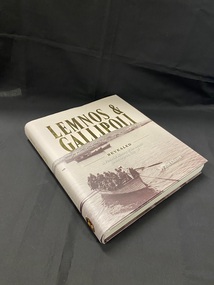
Book, Lemnos Gallipoli Commemorative Committee, Lemnos & Gallipoli revealed: a pictorial history of the ANZACz in the Aegean, 1915-16, 2019
... ...Lemnos Island...Lettering is in gold print and there is a sepia toned image that wraps around the cover depicting the first party of officers landing on Lemnos Island in 1915, this cover is replicated on the actual book as well. ...Lettering is in gold print and there is a sepia toned image that wraps around the cover depicting the first party of officers landing on Lemnos Island in 1915, this cover is replicated on the actual book as well. ...Lemnos was the advanced base for the Gallipoli campaign in 1915-16, its great harbour of Mudros Bay witnessed the arrival of the soldiers as they prepared for the landings on the 25th April. It was home to great rest camps and medical facilities, and it was where they returned to after the evacuation of the Peninsula at the end of the campaign. Lemnos’ war cemeteries would be the final resting place for 148 Australians, among over 1,300 Allied soldiers buried there. Lemnos would see the first significant interaction between Hellenes and Australians in Greece. The soldiers and nurses would wander the island, visiting its villages, taverns and natural spring baths. They enjoyed the local food and visited the local churches. Most importantly, they captured the life of Lemnos and their time there in hundreds of photographs that would come to lie in archives across Australia, overseas and in private homes. This book tells of the distinctively Hellenic connection to Australia’s Gallipoli story through the reproduction of many of these photographs, many taken by soldiers and nurses themselves, and interpreting them with the words recorded in letters and diaries of these Australians who walked on Lemnos in 1915. Not only have many of these photographs never been published before, but this is the first time that such a comprehensive selection of photographs of Lemnos during the Gallipoli campaign has been published together, a fitting tribute to the importance of Lemnos in Anzac history. [Dust jacket gate fold.]Hardcover book with dust jacket. Lettering is in gold print and there is a sepia toned image that wraps around the cover depicting the first party of officers landing on Lemnos Island in 1915, this cover is replicated on the actual book as well. non-fictionLemnos was the advanced base for the Gallipoli campaign in 1915-16, its great harbour of Mudros Bay witnessed the arrival of the soldiers as they prepared for the landings on the 25th April. It was home to great rest camps and medical facilities, and it was where they returned to after the evacuation of the Peninsula at the end of the campaign. Lemnos’ war cemeteries would be the final resting place for 148 Australians, among over 1,300 Allied soldiers buried there. Lemnos would see the first significant interaction between Hellenes and Australians in Greece. The soldiers and nurses would wander the island, visiting its villages, taverns and natural spring baths. They enjoyed the local food and visited the local churches. Most importantly, they captured the life of Lemnos and their time there in hundreds of photographs that would come to lie in archives across Australia, overseas and in private homes. This book tells of the distinctively Hellenic connection to Australia’s Gallipoli story through the reproduction of many of these photographs, many taken by soldiers and nurses themselves, and interpreting them with the words recorded in letters and diaries of these Australians who walked on Lemnos in 1915. Not only have many of these photographs never been published before, but this is the first time that such a comprehensive selection of photographs of Lemnos during the Gallipoli campaign has been published together, a fitting tribute to the importance of Lemnos in Anzac history. [Dust jacket gate fold.]ww1, wwi, world war 1, military history, gallipoli, lemnos island, australian military bases -
 Alfred Hospital Nurses League - Nursing History Collection
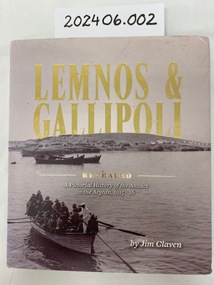
Book - Illustrated book, Jim Claven, Lemnos & Gallipoli revealed : a pictorial history of the ANZACs in the Aegean, 1915-1916
... Cover photo, black and white image of first party of officers proceeding from SS Simla to land on Lemnos Island, this is on the dust jacket. Author name printed on front of book and jacket. 352 pages, including over 300 labelled photographs and maps....Cover photo, black and white image of first party of officers proceeding from SS Simla to land on Lemnos Island, this is on the dust jacket. Author name printed on front of book and jacket. 352 pages, including over 300 labelled photographs and maps. ...The story of the Hellenic connection to Australia's Gallipoli story. Lemnos was the advance base for the Gallipoli campaign.Hardcover book. Title in gold print. Cover photo, black and white image of first party of officers proceeding from SS Simla to land on Lemnos Island, this is on the dust jacket. Author name printed on front of book and jacket. 352 pages, including over 300 labelled photographs and maps.non-fictionThe story of the Hellenic connection to Australia's Gallipoli story. Lemnos was the advance base for the Gallipoli campaign.wwi, lemnos, gallipoli, ahnl, grace wilson -
 Bendigo Military Museum
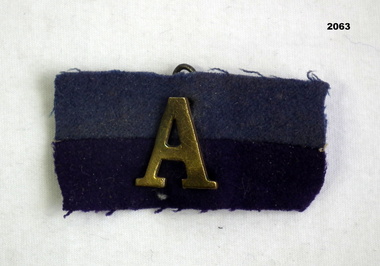
Uniform - COLOUR PATCH, WITH ANZAC BADGE WW1, (estimated); During 1914-1918
... It was also approved for soldiers who served on Lemnos, Imbros & Tenedos Islands, hospital ships on or off Gallipoli. ...It was also approved for soldiers who served on Lemnos, Imbros & Tenedos Islands, hospital ships on or off Gallipoli. ...The "A" was worn on a colour patch by those who served on Gallipoli. It was also approved for soldiers who served on Lemnos, Imbros & Tenedos Islands, hospital ships on or off Gallipoli. This patch belonged to Harold Hall No 270, 10th Batt & 7th Field Ambulance AIF. Refer 2062, 2064, 2065.Colour patch, cloth, rectangular shape, light blue over dark blue. Centre is a brass capital letter "A" attached via a pin on the rear. The patch denotes 10th Batt AIF. The "A" is for ANZAC.Nonemilitary, award, history, campaign,, anzac, a -
 Warrnambool and District Historical Society Inc.
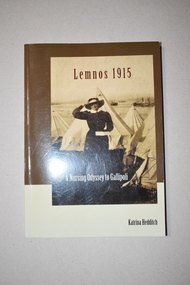
Book, Press Here, Ocean Grove, Lemnos 1915, 2011
... This book, written by Katrina Hedditch, gives details of the lives and work of the 130 Australian nurses on the island of Lemnos in World War One in 1915. A number of these nurses were from the Western District of Victoria and among those was Sister Hope Weatherhead. ...This book, written by Katrina Hedditch, gives details of the lives and work of the 130 Australian nurses on the island of Lemnos in World War One in 1915. A number of these nurses were from the Western District of Victoria and among those was Sister Hope Weatherhead. ...A history of lives and work of the 130 Australian World War One nurses on the island of Lemnos.This is a soft cover book of 195 pages. It has a cover with a cream and brown background and a black and white photograph on the front cover and a map and printed material on the back cover. The printing on the front is white, black and brown. The book has an introduction, four sections of printed material, an appendix, acknowledgements, abbreviations, bibliography and an index. The pages contain several black and white photographs.non-fictionA history of lives and work of the 130 Australian World War One nurses on the island of Lemnos.western victorian nurses in world war one, sr hope weatherhead, warrnambool -
 Alfred Hospital Nurses League - Nursing History Collection
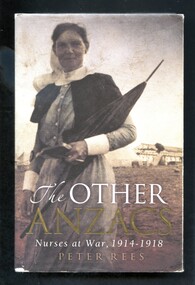
Book - Illustrated book, Peter Rees 1948, The other ANZACS: Nurses at War, 1914-1918, 2008
... Dust jacket has a coloured black and white photograph of a nurse in uniform holding an umbrella, book and pencil with tents in the background: Grace Wilson on the Aegean Island of Lemnos, 1915. Full title is printed in white and gold on front along with the author's name in gold. ...Dust jacket has a coloured black and white photograph of a nurse in uniform holding an umbrella, book and pencil with tents in the background: Grace Wilson on the Aegean Island of Lemnos, 1915. Full title is printed in white and gold on front along with the author's name in gold. ...Using diaries and letters the author takes us into the hospital camps, the wards and the tent surgeries on the edge of some of the most horrific battlefronts of human history. He also showed how the friendships and loves of these courageous and compassionate women enriched their experiences.Illustrated book with dustjacket. Book has a brown cover with abbreviated title and authors name embossed in gold on spine. Dust jacket has a coloured black and white photograph of a nurse in uniform holding an umbrella, book and pencil with tents in the background: Grace Wilson on the Aegean Island of Lemnos, 1915. Full title is printed in white and gold on front along with the author's name in gold. Abbreviated title is printed in brown and gold on spine, along with the author's name and publishers mark in whitenon-fictionUsing diaries and letters the author takes us into the hospital camps, the wards and the tent surgeries on the edge of some of the most horrific battlefronts of human history. He also showed how the friendships and loves of these courageous and compassionate women enriched their experiences.australia army-nurses, military nursing-australia, world war 1914-1918 - medical care, world war 1914-1918-female participation, nurses -
 Ballarat Heritage Services
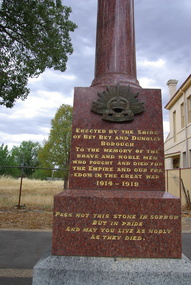
Photograph - War Memorial, Lisa Gervasoni, Dunolly War Memorial, 2025, 1921
... They had been on Lemnos Island for two weeks after leaving Galilipoli, and while there they got billeted and numerous gifts from Australia, which gave great delight. ...They had been on Lemnos Island for two weeks after leaving Galilipoli, and while there they got billeted and numerous gifts from Australia, which gave great delight. ...The Dunolly World War One Memorial Pillar, located in front of the Town Hall on Broadway Street, and was unveiled on November 18th 1921. The pillar is topped by an urn and rests on a square concrete plinth, which lists the names ninety-four locals who died serving during the First World War. On Friday afternoon the Premier, accompanied by Messrs. Pennington and Groves, M's.L.A., visited Dunolly, and unveiled a soldiers' memorial — a polished granite column on a square base, erected by the residents at a cost of £300. It bears the names of 94 district soldiers who were killed in action. The Premier, who is a native of Dunolly, referred to his early associations with the town and district. Speaking of the valiant service rendered by the Australian soldiers in the great war, he paid a tribute to those who enlisted from the country districts. He was not one of those who would withhold national memorials to the fallen because provision had not been made for all who had returned. It was right and proper to have these memorials as silent reminders of the great sacrifice made by the many as a lasting tribute to their memory. Messrs. Groves and Pennington and local clergymen also spoke. The school children sang O God, Our Help in Ages Past, and a bugler sounded the Last Post after the unveiling. The shire president entertained the visitors and committee at dinner. The Age (Melbourne), 19 November 1921. Colour photograph of the Dunolly War Memorial. Front Inscription "Erected by the Shire of Bet Bet and Dunolly Borough To the memory of the brave and noble men who fought and died for the Empire and our freedom in the Great War 1914 - 1918. Pass not this stone in sorrow but in pride, and may you live as nobly as they died." "Private L. Polinelli has written several letters to his mother at Dunolly, dated from from Tel el Kebir from January 13th till the 22nd. He had written every day or two, and this example, is a very fine one. He explains why there was an interval some weeks during which he sent no letters. This was just before the evacuation of Gallipoli, and no-one was permitted to send letters at such a critical time, as there were fears that carefully arranged plans might leak out in some way. Gallipoli had been evacuated on the 19th December, which happened to be Private Polinelli's 24th birthday, and he has cause, he says, to remember that birthday particularly, when this important movement, in which he participated, was so success-fully carried out. He was in the best of health. They had been on Lemnos Island for two weeks after leaving Galilipoli, and while there they got billeted and numerous gifts from Australia, which gave great delight. He (Private Polinelli) had got a big mail - 35 letters and a number of parcels. Both Norman Watson and himself were feeling well, although they had a pretty rough time at the front, but they were feeling better every day. Further letters speak of the arrival in Egypt and the Australian being encamped at Tel el Kebir, 40 miles from Cairo. He states that W. Lyndon had returned from England and was with them. He (W. Lyndon) looks splendid and had had a splendid time in England and Scotland. He saw Jack Lewis in England, and thinks he was to return to Australia. Reference is made to the Rev. Father Goidanich who was with their brigade, and who had been wounded at the front, but was all right again. Father Goidanich is well-known in this district. The letters were written in good spirits and many references were made to friends in Dunolly and district. A friend in Dunolly has received a letter from Private L. Polinelli, which is dated February 3rd, and written 'from the Arabian Desert.' This covers a vast extent of country, so that there is no use in speculating as to the locality, and portions of the letter which possibly would have given some indication have bean 'censored.' Private Polinelli wrote that Norman Watson and Himself were in the best of health and have stook the life well. They are right out of civilisation at time of writing. He referred to their Dtsojourns at Lemoos Island, where Christmas was spent, and where the billies and puddings assisted much in their enjoyment. But they were glad to leave Lemnos Island. After being in camp at Tel el E-bir for two weeks they were sent to where they were at the time of writing, all being in good xxxx and the open country suiting them well. He speaks with admiration of the desert work done by the camels so very largely used. The censoring was very strict so that he could not give much news. After alluding to the return to splendid health of W. Lyndon from England, he says he saw a lot of others from round Dunolly on returning to Egypt, including Tom Fishlock, R. Johnson, and J. Taylor, and some others from Betley, and all looked well. He had also seen Erie Williamson a few times, and he looked splendid. He concludes with remembrances to friends, and from himself and Norman Watson to the Loyal Prince Alfred Lodge." (Dunolly and Betbetshire Express and County of Gladstone Advertiser, Tue 14 Mar 1916) "SOLDIER'S LETTERS PRIVATE L. POLINELLI A friend in Dunolly has received another interesting letter from Private L Polinelli, son of Mrs J Davis, South Dunolly. It is from "Somewhere in France," and is dated July 23rd. He remarks with regret that a good deal of the soldiers' mail from Australia went down in the Arabia, and then goes on to say:- "Norman is back here with us again now and looking well. He had a splendid time over in England after he was able to get out of bed. It was two years on the 18th of this month (January) since Norman and I enlisted, and we celebrated the occasion by having a bit of an evening out. I am very pleased that he is back; we spend most of our time together. We are at present out of the line having a spell in a village, so we are not having a bad time just now but we will soon be going into the trenches again. I met Wally Bell a few days ago; they were going into the line to relieve our brigade. We did not have time to have a long talk. He looks rather thin, but he was always that way. He is feeling well, and wishes to be remembered to his friends in Dunolly. I also met C. Game the same day; he looked well but, as he was also going into the line, we could not have much of a talk J. Hughes and C. Atherton are also over here now; I often see them. W. Lyndon and T. Miles are well ; I was speaking to them yesterday. We are having very bad weather over here now ; it is either raining or snowing every day. The snow was about a fool deep a few days ago. When the rain comes after it, it makes things muddy, The mud is very bad over here; it takes us all our time to struggle through it in places. We will all be very glad when the winter is over. I was over in England on furlough last month, and had a splendid time. The people over there do all they can to give us a good time. I had several invitations to visit different people, and those that we did visit gave us a splendid time. At the place where I was staying they always had a guide waiting of a morning to show us any place of interest that we wanted to see. There was also always a supply of free tickets to the different theatres if we wanted them ; so you see that they go to some expense to give ns a good time. When they know yon are from France you are sure of a hearty welcome. was up in Scotland, and spent five days in Edinburgh. It is a very pretty place, especially when it is seen from Edinburgh Castle, which is on a high bill overlooking the place. We veil through the Castle; also Holyrood Palace. There are a lot of interesting things to be seen in the two places connected with the history of Scotland. It was snowing very heavily while v« were in Scotland, and we bad some fine snowballing with the Scotch people. I greatly enjoyed the trip to Scotland. It would take a very long time to see all round London. I saw a lot of the old historical places there, which were very interesting. The fogs are very bad in London. I had an experience of a London fog one day; it was the heaviest they experienced for a number of years. We could only see a few yards ahead of us. Nearly everyone carried torches; it looked very funny. . . . There are nearly always as many women drinking in the bars as men; it struck me as being very strange, a bit different to what we are used to in Australia, a trip through some parts of London is a real eye-opener to us. It is interesting to watch the traffic in some of the business parts of London it moves along in one big mass. It is a wonder that a lot more accidents do not happen. I saw Australia House, where the High Commissioner has his office, in the Strand. It is not yet finished. It looks a very fine place, and when completed will be 'some' place. Both Norman and I are well, and send remembrances to friends." (Since this letter was written we have had the sad news of the death from wounds of Privates Atherton and Hughes, and that Sergeant Miles and Corporal Norman Watson have been wounded.) (Dunolly and Betbetshire Express and County of Gladstone Advertiser , Friday 13 April 1917, page 2) "Private L Polinelli, from some of whose previous letters we have published interesting extracts, has written to a friend in Dunolly, the letter being from France, and dated April 28th. Private Polinelli says among other things, "I am pleased to say that, Norman (Watson), Les (Anderson) and myself are in the best of health. We now have been in France some time. It is a terrible place for rain ; It has been raining all the time we have been here. It has also been very cold, snowing at times, but it is starting to "fine up" now, and the last few days have been splendid. I hope it keeps like that for a while, as it makes things very miserable in the trenches when it is so wet. We get a few days spell out of the trenches every now and again; so things are not as bad here as they were at Gallipoli. It is not so lively here so far as it was over there either. I am sorry to say that Jack Sanderson, who had been Will Lyndon's mate since they joined the forces, got killed during a bombardment last night. He was terribly knocked about with a shell. I saw W. Lyndon to-day and he was telling me all about it. He seemed terribly cut up over it, and so am I, as I was with Jack a lot over at Gallipoli after Will got sent away sick. He was always bright and cheerful, always had a smile up whenever I met him. I feel very sad about it. We will do all we can to make the Germans pay for it. You will most likely know him, as be used to live in Dunolly before going to Bendigo. Will Lyndon had a narrow escape also, as he was not very far from where the shell burst. He escaped with a bit of a shock, otherwise he is in the best of health. We have a good time among the French people when we are out of the trenches. They do all they can to make us feel at home. I am getting quite expert at speaking French. They smile at us a treat trying to speak French, but we generally make ourselves understood and have a good time among them. It is very rarely we see a young Frenchman, they being all away fighting. The women do all the work on the farms themselves, and deserve every credit for it. . . . I was sorry to hear about the death of Nurse M'Mahon; she was a grand old nurse. I heard that her daughter Nelly was nurse in a hospital on Lemnos Island, and when we were there I went to two of the hospitals to try to see her, but she did not happen to be at either, and I had no time to visit any of the others, so I did not see her. I was also sorry to hear about Mrs Rokahr, as she has left so many little ones behind. (Reference is made to other happenings in Dunolly.) So far I am pleased to say Norman and I have had the luck not to have had a day's illness; I think we are very fortunate, as such a lot get sent to the hospital ill. We are also lucky to have escaped the bullets and shells so far. I hope that luck sticks to us. I am sorry that, owing to the censorship, I cannot give you any interesting news of our trip over to France and the places we have seen. I will have to keep that till I get back to Dunolly again. . . . I have just heard that the battalion that Teddy Game is in has arrived, so I am going to look him up first chance I get." (The letter concludes with remembrances to members of the Lodge and other friends.) (Dunolly and Betbetshire Express and County of Gladstone Advertiser, Tuesday 13 June 1916, page 3) "PRIVATE L POLINELLI Another very interesting letter has been received by a friend in Dunolly from Private L. Polinelli, from France dated May 4th, 1916- Private Polinelli says-" I was glad that you got the letter I wrote from the Arabian Desert. The Censor must have crossed a good deal of it out. They seem to cross out a lot more than is really necessary. We left out there all of a sudden, and in a very short while found ourselves over here. It does not take them very long to make a move. I was saying in the last letter that I was going to try and find " Teddy " Game. I met him a few days ago and had a good yarn with him; he looks real well. I also met S. Prew, and "Ted" Smyth and his son Ernie. They all looked splendid, and are in the same battalion. "Ted" Smyth sticks to it well, and looks better than he ever looked. They will be under fire for the first time in a few days. S. Prew was hit in the landing at Gallipoli, but be is quite well now. W. Smythe, who is in our brigade is well ; I see him very often. " Les " Peart is not with us now; he has joined a Pioneer battalion, and I have not seen him since he joined it. I gave all the Dunolly boys your best wishes and they all wish to be remembered to you— also the same remembrance from Dave Millar, who used to play football for Dunolly from Moliagul. He is in our battalion, having come over with reinforcements. I see him every day and he wished to be remembered to you. A brother of Mr A. J. Williamson, manager of the Bank of Victoria, Dunolly, is also in this battalion. He is a great friend of mine ; we often have a talk about Dunolly. He was not well a little while ago, having to go into a hospital, but is all right again and is back with me. Eric Williamson, son of Mr A. J. Williamson is over here ; Norman (Watson) saw him a few days ago and said he looked well. Norman has been a corporal for some time. I was also offered stripes lately, but preferred to remain a private. There is a lot of worry and running about when you are an N.C.O., so I think I will remain as I am. ... So football is about done this season. I don't think they should cut it right out. I suppose some of them have to stay at home, so they ought to have some amusement. I would very much like to have a game, but I think I would just about forget how to play now. It is very amusing for us to read some of the soldiers letters in the Australian papers. . . l told you in the last letter about xxx young "Jack "Sanderson ; I was terribly sorry about him." Private Polinelli mentions in a letter to his sister in Dunolly that he happened to be beach at Gallipoli where the late Lord Kitchener was xxxxx addressed the' soldiers and' xxxxxx to them the message from the King. Private Polinelli states that he was very proud to have been one of those addressed by the great man. He and Norman Watson have never been a day out of the lines since arriving first in Egypt. It is intended to grant special leave to all those who have been kept so close to their posts xxx three months, and they are looking forward to this relaxation with keen anticipation, hoping to visit England and Scotland. (Dunolly and Betbetshire Express and County of Gladstone Advertiser, Tue 27 Jun 1916) "SOLDIER'S LETTERS. CORPORAL L. POLINELLI. Two letters have been received by Mrs J. Davis, South Dunolly, from her son, Corporal L. Polinelli, both written subsequent to the time when he was wounded, as reported when word was received at the time. Corporal Polinelli writes from No. 12 General Hospital, Rouen, France, and his first letter is dated 7th May. He stated that he was in hospital, he having been wounded in the arm and shoulder on 3rd May. He continued— " It is not a bad wound, and will not take long to heal up, as it is a clean wound. I was very lucky to get out of the fight alive, as I was buried by a shell explosion about an hour before I was wounded. It was very rough, and the noise of all the shells was terrible. Four men were killed by the same shell that wounded me, so I was fortunate. I am feeling a bit " shook up," and my head is aching from the concussion of the shells, but after a few days' spell in bed here I will be feeling just the thing again. So you need not worry about me ; a week or two will see me quite right again. We are having very nice warm weather just now-pleasant change after all the bad weather we have had." The second letter is dated May 12, Corporal Polinelli saying— "I am getting along splendidly ; the wound is healing up fast, so it will not be very long before I am quite right. The doc-tor, the other day said it would be better not to take the piece of shell out of my shoulder yet, and that it would not interfere with me in any way ; so perhaps l will always carry it about with me. He feared lest taking it out at that time would interfere with an artery. Rouen, where the hospital is, is a very pretty city. They give us leave to visit all the places when we are well enough. It is a nice spell here, away from the firing line. We have nothing to trouble us at all, so I will soon be just the thing again. When I got buried by a shell it shook me up a good deal. I felt it far more than the wound I got after; but it has not done me any harm, as I feel hardly any effects now. My good luck sticks to me in getting out of it so lightly. I hope you are not worrying at all about me, as I am all right. We are having beautiful weather over here— sunny days just like the Australian spring. . . . The sisters in the hospital are very nice, and treat us well. They have a lot of work to do, as a good few men have been wounded lately. I would have liked to have been sent over to England, but they are not sending many over there now. They treat as many as they can in France on account of attacks on hospital ships. I would have been able to have a good time with Norman (Watson) had l got over. He was just about all right when I heard from him last." Corporal Polinelli sends kind remembrances to friends." (Dunolly and Betbetshire Express and County of Gladstone Advertiser, Friday 6 July 1917, page 2) "SOLDIERS' LETTERS. CORPORAL L. POLINELLI. The following letter, dated from London on December 27; has been received by a friend in Dunolly from Corporal L. Polinelli (son of Mrs J. Davis, South Donolly), who, at the time of writing, after long and hard service at the front, was on furlough in England. After an introduction he says:— I am having a very good time. I went over to Ireland for five days, spending the most of the time in Dublin. I like the place very much. War appearances are not so conspicuous in Ireland as in England. The hotels are open all day, and a good meal can be obtained anywhere, which is more than can be got in England. The war seems to be making things very bad in England. It is very hard to get a good meal in London ; everything is so restricted. The only way to get a good meal is to go into two places. The people have to line up outside the shops for hours to get sugar, tea, and butter, and then they sometimes fail to get any. So many of our boats getting sunk is the cause of it. If things continue to go on in this way I am afraid that there is a very hard time in store for the people in England. Several people that I have spoken to say that they are just beginning to feel the pinch now. I was in London while an air raid was on a few days ago; it caused a lot of excitement among the people. Ten were killed and 70 wounded in the raid. I was about half a mile from where the bombs fell, so I was pretty right. I thought I had left the war behind in France, but it seems to be on over here at times also. I spent Christmas day with a family at Grantham, a town between London and Newcastle; they were very nice people. I had a very enjoyable time with them. I went to a dance in the evening and enjoyed it very much. It was a bit strange for a start, as it is the first dance I have been to since Norman and I had the send off at Dunolly in January, 1915. They do the dances a bit different over here to what they are done in Australia, and that made it worse still. I went through Guinness's Brewery while I was in Dublin. It is a wonderful place, and covers 55 acres of ground. I got a great surprise when I was starting on my leave in France. We were taken to the station we had to start from in a motor lorry, and who should the driver of the lorry be but Syd. Richards (son of Mr W. Richards, South Dunolly), who used to work at the Post Office in Dunolly. I rode on the front with him, so we had a good yarn. I did not know that be had joined, so was surprised to see him. He has grown a lot since I saw him last, and is looking well. Norman and Bill Lyndon were both well when I left France. We had been having a good spell near Messines, in Flanders, but they will be in the trenches by now. We have been round about Ypres for this last four months, and had some pretty rough times there. dunolly, dunolly war memorial, l. polinelli, bet bet, world war one, world war two, j. deledio, b. battilana, c. fitzgerald, f.s. kendall, j.h. hogan, p. zampatti, louisa davis, louisa gervasoni, bill lyndon, norman lyndon, sydney lindsay -
 Alfred Hospital Nurses League - Nursing History Collection
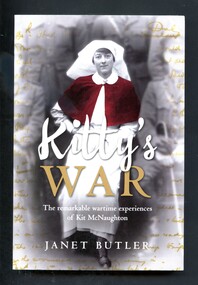
Book - Illustrated book, Janet Butler, Kitty's War: the remarkable wartime experiences of Kit McNaughton, 2013
... Kit Mcnaughton trained at the Geelong Hospital Kit Mcnaughton is the nurse portrayed in the ABC miniseries "The war that changed us" Of significance to the AHNL as it gives insight into the working conditions of nurses during World War I World War 1914-1918 Nurses Nursing This book is based upon the previously unpublished diaries of army nurse Kit Mcnaughton, who embarked on the troopship Orsova in 1915, tracing her journey through the war from Egypt (where she nursed Gallipoli veterans), Lemnos Island and then to France and the Somme. ...This book is based upon the previously unpublished diaries of army nurse Kit Mcnaughton, who embarked on the troopship Orsova in 1915, tracing her journey through the war from Egypt (where she nursed Gallipoli veterans), Lemnos Island and then to France and the Somme. Kit finished active service as Australia's first plastic surgery nurse, assisting medical pioneers in this field as they repaired the shattered faces of Australian soldiersIllustrated book. Front cover has a coloured black and white photograph of Kit McNaughton in nurse's uniform seated alongside soldiers. Book title is printed in golden-brown and white ink on the front cover along with the authors name (white ink) Spine and back cover have a golden-brown background. Abbreviated title printed in white and black ink on spine, along with the authors name in white ink. Same coloured photo of Kit McNaughton is printed at top of spine. Publishers mark is printed in white ink on a black background at base of spine. The back cover has a summary of the book along with three black and white photographs: Kit McNaughton and another nurse standing behind two soldiers in hospital beds, the photograph from which the image on the front cover was taken, and a photograph of Kit McNaughton aged 16non-fictionThis book is based upon the previously unpublished diaries of army nurse Kit Mcnaughton, who embarked on the troopship Orsova in 1915, tracing her journey through the war from Egypt (where she nursed Gallipoli veterans), Lemnos Island and then to France and the Somme. Kit finished active service as Australia's first plastic surgery nurse, assisting medical pioneers in this field as they repaired the shattered faces of Australian soldiersworld war 1914-1918, nurses, nursing -
 Ithacan Historical Society
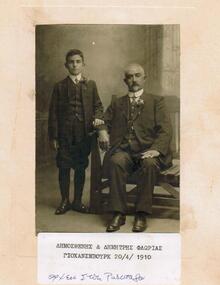
Photograph, D. & D. Florias, Johannesburg, 20/4/1910
... Initially the first first Greek migrants to South Africa were seamen who arrived in the port of Cape Town, around 1860, while 30 years later the migration became more massive, with most coming from Ithaca and Cephalonia and to a lesser extent, from Aegean islands, such as Lemnos, Lesvos and Samos. ithacan diaspora Embossed on the cream board: J.A.SIMPSON/THE ARCADE. ...Demonsthenes (Bavias) and the young Dimitris Florias were examples of the numerous families from Ithaca Greece that migrated to South Africa in the latter years of the nineteenth century and early twentieth century. Many settled in Johannesburg. Like their compatriots who migrated to Australia many became successful business people in their adopted country. UnknownA sepia photograph on a cream board of an elderly well-dressed man wearing a suit and seated on a wooden seat with a young boy wearing a knickerbocker suit standing next to him. They are both wearing floral buttonholes in their lapels. The elderly man has a groomed moustache and goatee beard and is holding a pen in his right hand.Embossed on the cream board: J.A.SIMPSON/THE ARCADE. J'BURG. The Ithacan Historical Society stamp is on the back of the board. The names of the two people are on a typed label which has been pasted under the photograph. Written on the back: ER 7.ithacan diaspora -
 Magnet Galleries Melbourne Inc
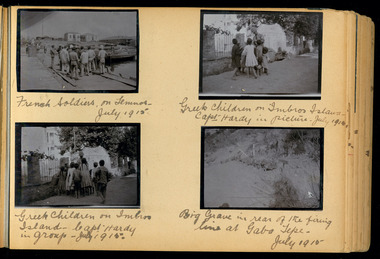
greek natives and grave in gaba tepe, red cliffs00163.tif
... ww1 world war 1 A.I.F lemnos Gaba tepe Kabatepe anzac cove greece natives greek islands 1915 Four photos on a page from an album red cliffs00163.tif greek natives and grave in gaba tepe ...Four photos on a page from an albumww1, world war 1, a.i.f, lemnos, gaba tepe, kabatepe, anzac cove, greece, natives, greek islands, 1915 -
 Returned Nurses RSL Sub-branch
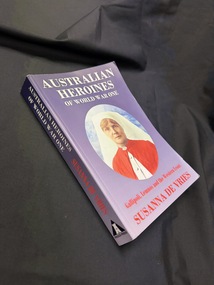
Book - Illustrated paperback book, Susanna De Vries, Australian heroines of World War One : Gallipoli, Lemnos and the Western Front, 2013
... Brisbane's Grace Wilson, ordered to establish an emergency hospital on drought-stricken Lemnos Island, arrived there to find suffering Anzacs but no drinking water, tents or medical supplies. ...'This outstanding book tells the stories of eight courageous women through diaries, letters, photos, paintings and specially drawn maps. These women had the courage and strength for with the Anzacs are renowns and the compassion and tenderness that only a woman can bring. Sister Hilda Samsing from Melbourne became a whistleblower when nursing aboard the hospital ship Gascon, outraged by the bungled evacuation of wounded Anzacs. She defied censorship and kept a very frank diary, reproduced here for the first time. In 1914, Louise Creed, a Sydney journalist, was caught in the besieged city of Antwerp and mad a hair-raising escape from a German firing squad. Brisbane's Grace Wilson, ordered to establish an emergency hospital on drought-stricken Lemnos Island, arrived there to find suffering Anzacs but no drinking water, tents or medical supplies. Grace and her nurses saved the lives of thousands who had been wounded at Lone Pine and The Nek. In France, Florence James-Wallace, Anne Donnell and Elsie Tranter nursed near the front line in the Casualty Clearing Stations, treating soldiers with hideous wounds or blinded by mustard gas. In 1918 they had to deal with an epidemic of Spanish flu, but their heroism was quickly forgotten. Two of these women received such meagre pensions, they died destitute. Publication of this book with its numerous illustrations has been facilitated by a generous donation from Dame Elizabeth Murdoch, keen that these stories become known to Australians of all ages.' [Summary from back cover] Has endnotes with full biographical details and an index.Paperback book with purple blue cover & spine, red and white text one cover & spine, black logo and text on spine and colour image of a woman in army nurses uniform on cover. Top and bottom corners of front cover curling.non-fiction'This outstanding book tells the stories of eight courageous women through diaries, letters, photos, paintings and specially drawn maps. These women had the courage and strength for with the Anzacs are renowns and the compassion and tenderness that only a woman can bring. Sister Hilda Samsing from Melbourne became a whistleblower when nursing aboard the hospital ship Gascon, outraged by the bungled evacuation of wounded Anzacs. She defied censorship and kept a very frank diary, reproduced here for the first time. In 1914, Louise Creed, a Sydney journalist, was caught in the besieged city of Antwerp and mad a hair-raising escape from a German firing squad. Brisbane's Grace Wilson, ordered to establish an emergency hospital on drought-stricken Lemnos Island, arrived there to find suffering Anzacs but no drinking water, tents or medical supplies. Grace and her nurses saved the lives of thousands who had been wounded at Lone Pine and The Nek. In France, Florence James-Wallace, Anne Donnell and Elsie Tranter nursed near the front line in the Casualty Clearing Stations, treating soldiers with hideous wounds or blinded by mustard gas. In 1918 they had to deal with an epidemic of Spanish flu, but their heroism was quickly forgotten. Two of these women received such meagre pensions, they died destitute. Publication of this book with its numerous illustrations has been facilitated by a generous donation from Dame Elizabeth Murdoch, keen that these stories become known to Australians of all ages.' [Summary from back cover] Has endnotes with full biographical details and an index.australian nurses, world war one, wwi, ww1, louise mack [creed], claire trestrail [swan], muriel wakeford, hilda theresa samsing, grace margaret wilson, anne donnell, florence james-wallace, elsie may tranter -
 Returned Nurses RSL Sub-branch
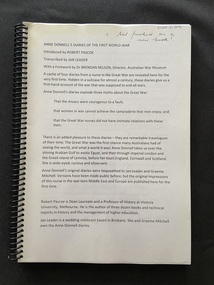
Book - Spiral bound book draft, Connor Court Publishing, Anne Donnell's diaries of the First World War, 2018
... Anne Donnell takes us over the shining Arabian Gulf to exotic Egypt, and then through Imperial London and the Greek Island of Lemnos, before her tours England, Cornwall and Scotland. ...'A cache of four diaries from a nurse in the Great war are revealed here for the very firsttime. hiiden in a suitcase for almost a century, these diaries give us a first-hand account of the war that was supposed to end all wars. Anne Donnell's diaries explode three myths about the Great War: that the ANZACs were courageous to a fault; that women in war cannot achieve the camaraderie that men enjoy ; and that the Great war nurses did not have intimate relations with these men. There is an added pleasure to these diaries - they are remarkable travelogues of their time. The Great War was the first chance many Australians had of seeing the world, and what a world it was! Anne Donnell takes us over the shining Arabian Gulf to exotic Egypt, and then through Imperial London and the Greek Island of Lemnos, before her tours England, Cornwall and Scotland. She is wide-eyed, curious and observant. Anne Donnell's original diaries were bequeathed to Jan Leader and Graeme Mitchell. Versions have been made public before, but the original impressions of this nurse in the war-torn Middle East and Europe are published here for the first time.' [Taken from cover page]Spiral bound typed document with a clear front cover and black card backcover.non-fiction'A cache of four diaries from a nurse in the Great war are revealed here for the very firsttime. hiiden in a suitcase for almost a century, these diaries give us a first-hand account of the war that was supposed to end all wars. Anne Donnell's diaries explode three myths about the Great War: that the ANZACs were courageous to a fault; that women in war cannot achieve the camaraderie that men enjoy ; and that the Great war nurses did not have intimate relations with these men. There is an added pleasure to these diaries - they are remarkable travelogues of their time. The Great War was the first chance many Australians had of seeing the world, and what a world it was! Anne Donnell takes us over the shining Arabian Gulf to exotic Egypt, and then through Imperial London and the Greek Island of Lemnos, before her tours England, Cornwall and Scotland. She is wide-eyed, curious and observant. Anne Donnell's original diaries were bequeathed to Jan Leader and Graeme Mitchell. Versions have been made public before, but the original impressions of this nurse in the war-torn Middle East and Europe are published here for the first time.' [Taken from cover page]women in war, world war 1914-1918, ww1, wwi, australian army nurses, anne donnell, australian army nursing service -
 Returned Nurses RSL Sub-branch
Book - Paperback book, Thomas Keneally, The daughhters of Mars, 2012
... Their education in medicine, valour and human degradation continues on the Greek island of Lemnos, then on the Western Front. Everywhere they are confronted by new outrages - gas, shellshock and broken men. ...In 1915 sisters Naomi and Sally Durance answer a call for nurses to join the war effort. They are escaping the family dairy farm in the Macleay Valley, and they carry a secret with them. Soon they are in Egypt, where they are put to work on the Red Cross hospital ship Archimedes as it patrols the Dardanelles. On Archimedes they witness Mars in all his ferocity, as he pummels soldiers in the massive, brutal metal brawl that is Gallipoli. Yet the sisters and their newfound nursing friends, with whom they will witness undreamt-of carnage and take care of unspeakably blighted men, find themselves courageous in the face of the horror. Naomi, Sally and their gang are then sent to northern Europe, where Naomi nurses in the visionary Australian Voluntary Hospital run by the committed and eccentric Lady Tarlton, and Sally in a casualty clearing station next to the Western Front. Here, again, they must face the inhumanity of war in its many terrible guises - where trench warfare and gas abound. But it is here, too, that the sisters meet the remarkable men with whom they wish to spend the rest of their lives. Inspired by journals of Australian nursing sisters who gave their all to the Great War effort and the men they nursed, The Daughters Of Mars is vast in scope yet extraordinarily intimate. This is Keneally at the height of his storytelling powers; a stunning tour de force to join the best of First World War literature, and one that casts a fresh light on the challenges faced by the Australian men and women who voluntarily risked their lives for peace. Naomi and Sally Durance are daughters of a dairy farmer from the Macleay Valley. Bound together in complicity by what they consider a crime, when the Great War begins in 1914 they hope to submerge their guilt by leaving for Europe to nurse the tides of young wounded. They head for the Dardanelles on the hospital ship Archimedes. Their education in medicine, valour and human degradation continues on the Greek island of Lemnos, then on the Western Front. Everywhere they are confronted by new outrages - gas, shellshock and broken men. Naomi encounters the wonderful, eccentric Lady Tarlton, who is founding a voluntary hospital near Boulogne; Sally serves in a casualty clearing station close to the front. They meet the men with whom they would wish to spend the rest of their lives. An extraordinary portrait of two ordinary young women[From Trove]Paperback book with a light olive cover and an image of a poppy field under the title and the author's name.fictionIn 1915 sisters Naomi and Sally Durance answer a call for nurses to join the war effort. They are escaping the family dairy farm in the Macleay Valley, and they carry a secret with them. Soon they are in Egypt, where they are put to work on the Red Cross hospital ship Archimedes as it patrols the Dardanelles. On Archimedes they witness Mars in all his ferocity, as he pummels soldiers in the massive, brutal metal brawl that is Gallipoli. Yet the sisters and their newfound nursing friends, with whom they will witness undreamt-of carnage and take care of unspeakably blighted men, find themselves courageous in the face of the horror. Naomi, Sally and their gang are then sent to northern Europe, where Naomi nurses in the visionary Australian Voluntary Hospital run by the committed and eccentric Lady Tarlton, and Sally in a casualty clearing station next to the Western Front. Here, again, they must face the inhumanity of war in its many terrible guises - where trench warfare and gas abound. But it is here, too, that the sisters meet the remarkable men with whom they wish to spend the rest of their lives. Inspired by journals of Australian nursing sisters who gave their all to the Great War effort and the men they nursed, The Daughters Of Mars is vast in scope yet extraordinarily intimate. This is Keneally at the height of his storytelling powers; a stunning tour de force to join the best of First World War literature, and one that casts a fresh light on the challenges faced by the Australian men and women who voluntarily risked their lives for peace. Naomi and Sally Durance are daughters of a dairy farmer from the Macleay Valley. Bound together in complicity by what they consider a crime, when the Great War begins in 1914 they hope to submerge their guilt by leaving for Europe to nurse the tides of young wounded. They head for the Dardanelles on the hospital ship Archimedes. Their education in medicine, valour and human degradation continues on the Greek island of Lemnos, then on the Western Front. Everywhere they are confronted by new outrages - gas, shellshock and broken men. Naomi encounters the wonderful, eccentric Lady Tarlton, who is founding a voluntary hospital near Boulogne; Sally serves in a casualty clearing station close to the front. They meet the men with whom they would wish to spend the rest of their lives. An extraordinary portrait of two ordinary young women[From Trove]wwi, ww1, world war one, world war 1, nurses, miles franklin award nominations, military nursing -- fiction, 1914-1918 -- australia -- fiction, historical fiction
