
Showing 8 items matching "les o’callaghan, warrnambool"
-
 Warrnambool and District Historical Society Inc.
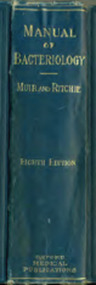
Book, Manual of Bacteriology, 1927
... ...les o’callaghan, warrnambool...This boarding house was run by May Taggart, the wife of Sam Taggart, a Warrnambool tailor. Les O’Callaghan was also a boarder there and it was through his contact with Arthur Gregory that he obtained the position of laboratory technician at the Warrnambool Cheese and Butter Factory. ...This book is of interest because of its connection to Arthur Gregory, a test room technican at the Warrnambool Cheese and Butter Factory in the 1930s and to Les O’Callaghan, the Laboratory Manager and Microbiologist at Warrnambool Cheese and Butter Factory for more than 40 years. warrnambool cheese and butter factory arthur gregory, warrnambool les o’callaghan, warrnambool history of warrnambool ‘A.S.Gregory 28 Spence Street W’bool’ This is a hard cover book of 822 pages. ...This book was a text book used by Arthur Gregory, the test room technician at Warrnambool Cheese and Butter Factory in the 1930s. He tested the suppliers’ milk and cream for butterfat percentage in order to determine the payment to the suppliers. Arthur Gregory later became the manager of Jays Laundry in Fairy Street. In the 1930s Arthur Gregory boarded at 28 Spence Street in Warrnambool. This boarding house was run by May Taggart, the wife of Sam Taggart, a Warrnambool tailor. Les O’Callaghan was also a boarder there and it was through his contact with Arthur Gregory that he obtained the position of laboratory technician at the Warrnambool Cheese and Butter Factory. Les O’Callaghan remained for over 40 years at this factory (leased at that time by the Kraft company) and was very important in the development of laboratory techniques used in the dairy industry. The Warrnambool Cheese and Butter Factory was established at Allansford in 1888 and is still in production today, operated by the Canadian firm of Saputo. This book is of interest because of its connection to Arthur Gregory, a test room technican at the Warrnambool Cheese and Butter Factory in the 1930s and to Les O’Callaghan, the Laboratory Manager and Microbiologist at Warrnambool Cheese and Butter Factory for more than 40 years. This is a hard cover book of 822 pages. It has a blue cover with gold lettering on the spine. It has 29 chapters, an appendix, a bibliography and an index. It has many black and white illustrations and drawings. The spine is slightly scuffed. The inscription is handwritten in pencil.‘A.S.Gregory 28 Spence Street W’bool’warrnambool cheese and butter factory, arthur gregory, warrnambool, les o’callaghan, warrnambool, history of warrnambool -
 Warrnambool and District Historical Society Inc.
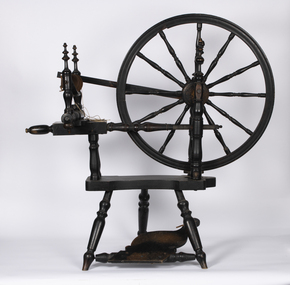
Functional object - Spinning Wheel, early 19th century
... ...Les O'Callaghan Warrnambool historian ...This spinning wheel was recovered in pieces from N.S.W. and re-assembled in the 1980s by Les O'Callaghan, a Warrnambool historian and President of the Warrnambool and District Historical Society for many years. The spinning wheel belonged to Alice Allan (nee Mullaly) who married William Osborne Allan in 1844. They had three sons. William Allan was a pioneer settler who, in 1839/40, established, with his brothers, a property (Allandale) east of the Hopkins River in the area known today as Allansford. During the 1840s the property was divided with William taking up the Allandale section and his brother John taking the Tooram section. William died in 1860 and Alice continued to manage the property with the assistance of her sons until her death in 1887 when the Allandale estate was sub-divided. A spinning wheel such as this would have been an important item in a pioneer settler's home with the wife needing to spin wool or sometimes flax to produce cloth for clothing and furnishings. It was donated by June Rhodes who is a descendant of the original Allan family of Allandale. June was one of three children belonging to William John Allan.This spinning wheel is of considerable significance as it was owned by Alice Allan (nee Mullaly) of Allandale, one of the first settlers in the district. This would make it one of the oldest and most interesting items in our collection. It has very strong provenance as it was donated by a direct descendant of the original settlers. It is a fine example of a fairly common household items and speaks of a time when many everyday items such as clothing were made in a home setting and as such required the necessary aids and tools to do the particular task. As one such piece of equipment, a spinning wheel would have been highly valued. This is a spinning wheel made of metal and wood. The base stand has a foot pedal attached to the wheel and other sections of the spinning mechanism abovealice allan of allandale, william osborne allan of allandale, vintage household items, les o'callaghan warrnambool historian, spinning wheel, 19th century spinning wheel, allan spinning wheel, alice allan, william john allan -
 Warrnambool and District Historical Society Inc.
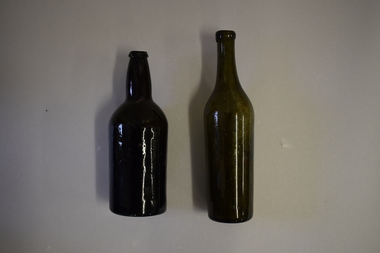
Bottles (2), Bottle, c. 1900
... Warrnambool...Les O’Callaghan History House, Warrnambool... These two bottles were found by workmen building a new retaining wall on the north side of the Les O’Callaghan History House building in Gilles Street Warrnambool. The wall replaced one damaged beyond repair following a car accident in 2019. ...These bottles are of interest as archeological finds after repair works to the Les O’Callaghan History House. Warrnambool & District Historical Society HeritageWorks Warrnambool Les O’Callaghan History House, Warrnambool History of Warrnambool .1 A dark green (or black?) ...These two bottles were found by workmen building a new retaining wall on the north side of the Les O’Callaghan History House building in Gilles Street Warrnambool. The wall replaced one damaged beyond repair following a car accident in 2019. The building was erected in 1889 as the caretaker’s cottage in the Warrnambool Sea Baths complex (for most of its existence it had two swimming pools, a hot sea water baths building and a caretaker’s cottage). The water in the baths were pumped up from the ocean and, for the hot baths, heated on site. These baths were the municipal baths until the mid 1950s. The bottles may have originated from the one of the families residing in the cottage or from passers-by in the adjoining Merri Street or from patrons of the baths. They appear to be over 100 years old but there is no way the ownership of the bottles can be established.These bottles are of interest as archeological finds after repair works to the Les O’Callaghan History House. .1 A dark green (or black?) glass bottle with a hollowed out concave base, no stopper and a slightly chipped rim on the top. The bottle is stained inside. .2 A green glass bottle with a hollowed out concave base, a moulded top with no stopper and an elongated neck. The bottle is stained inside. warrnambool & district historical society, heritageworks warrnambool, les o’callaghan history house, warrnambool, history of warrnambool -
 Warrnambool and District Historical Society Inc.
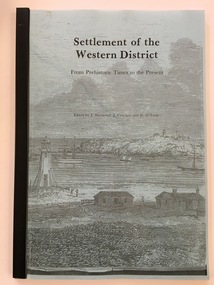
Booklet - Booklet: Settlement of the Western District, Collett, Bain and Gaspar, Printers, Settlement of the Western District From Prehistoric Times to the Present, 1985
... Warrnambool beach showing the lighthouse complex on Middle Island and the lighthouse on the beach (established 1860). There are a Contents page, a Foreword, a List of Plates and seven articles on different aspects of the Western District history by different authors. There are black and white photographs and illustrations. One page (p.17) has been annotated by Les O’Callaghan...Warrnambool beach showing the lighthouse complex on Middle Island and the lighthouse on the beach (established 1860). There are a Contents page, a Foreword, a List of Plates and seven articles on different aspects of the Western District history by different authors. There are black and white photographs and illustrations. One page (p.17) has been annotated by Les O’Callaghan ...This booklet documents a public lecture series held in Warrnambool 3rd November 1984.This is a soft-cover book of 133 pages on the settlement of the Western District from prehistoric times to the present. It has a blue paper front cover and a grey paper back cover. The front cover is covered with a clear plastic sheet and the binding is plastic. The cover has an image of a sketch of the Warrnambool beach showing the lighthouse complex on Middle Island and the lighthouse on the beach (established 1860). There are a Contents page, a Foreword, a List of Plates and seven articles on different aspects of the Western District history by different authors. There are black and white photographs and illustrations. One page (p.17) has been annotated by Les O’Callaghan.This booklet documents a public lecture series held in Warrnambool 3rd November 1984.western victorian history, edmund gill, peter ronald, john sherwood, jan critchett, tony dingle, miles lewis, kevin o’toole, warrnambool, history -
 Warrnambool and District Historical Society Inc.
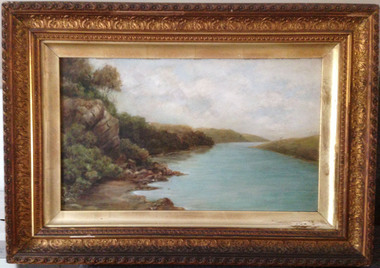
Painting, Hopkins River - Clifton Banks, Early 20th century
... Hickford, the Warrnambool picture framer and handwritten information on the artist and the artwork by Les O’Callaghan....Warrnambool. It was bought at an auction sale in Camperdown by Les O’Callaghan in 1997. ...Clifton Banks is the name given to a bank on the Hopkins River Estuary, about one kilometre upstream from Proudfoots Boathouse. It is at the foot of the property, Clifton which dates from the 1850s. There are several works of art and photographs depicting Clifton Banks which date from the 19th and early 20th centuries. This oil painting is believed to be the work of Emma McGeorge, the wife of Canon Samuel McGeorge, the Vicar of Christ Church, Warrnambool form 1899 to 1905. It is surmised that Emma McGeorge was encouraged by the artist Mary Norman to take up painting as a pastime or to continue with her art interests. Emma McGeorge may have been a pupil of Samuel Pearce Fuller and Mary Norman. She was successful as an exhibitor and entrant in art exhibitions in Warrnambool in the early 1900s. She died in Warrnambool in 1933. This is a highly significant art work as it has artistic merit and is one of the depictions of Clifton Banks on the Hopkins River and so has historical value. It is an example of the high standard of art work that was being produced, especially by women, in the late 19th and early 20th centuries in Warrnambool. It was bought at an auction sale in Camperdown by Les O’Callaghan in 1997. This is an oil painting, probably by Emma McGeorge, on art board of Clifton Banks on the Hopkins River. It has a gilt wooden frame with multi-tiered highly-ornamented outer frames in a gold colouring. The lower frame is discoloured (perhaps by smoke from a fire place) and there is a small piece of wood missing on the lower frame. All the gilding is slightly discoloured. The back has been sealed with pasted paper and there are old tacks and old wire for hanging the picture. There is a label on the back from W. Hickford, the Warrnambool picture framer and handwritten information on the artist and the artwork by Les O’Callaghan.Front: ‘E.Mc.G.’ Back: ‘W. J. Hickford, Picture Dealer, Framer and Gilder, Liebig Street, Warrnambool, Mounting and Repairing, Old Frames Re-gilt, Oakley Printer’ ‘603’ clifton banks, emma mcgeorge, warrnambool, hopkins river estuary -
 Warrnambool and District Historical Society Inc.
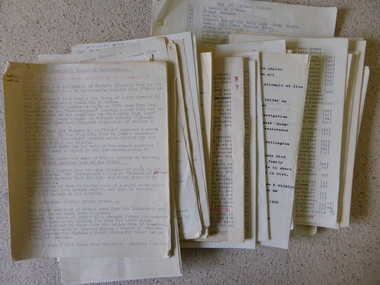
Notes, Lecture Notes - type written
... Warrnambool is named after him.He died in the late 1990s. These notes and slides were part of Wicking’s deceased estate and have been de-acquisitioned from the Flagstaff Hill collection and passed to the Warrrnambool and District Historical Society through the estate of Les O’Callaghan....Warrnambool is named after him.He died in the late 1990s. These notes and slides were part of Wicking’s deceased estate and have been de-acquisitioned from the Flagstaff Hill collection and passed to the Warrrnambool and District Historical Society through the estate of Les O’Callaghan. ...These typed notes have been prepared by Tom Wicking to be used in conjunction with his collection of slides on local history. Tom Wicking was a noted local historian, particularly well-known in the 1970s and 80s. He was an early active member of the Warrnambool and District Historical Society and was involved in the establishment of Flagstaff Hill Maritime Museum in the mid 1970s. He also produced a revised edition of the booklet containing notes on the origin of street names in Warrnambool. Wicking Place in Warrnambool is named after him.He died in the late 1990s. These notes and slides were part of Wicking’s deceased estate and have been de-acquisitioned from the Flagstaff Hill collection and passed to the Warrrnambool and District Historical Society through the estate of Les O’Callaghan.These notes were for use in slide shows etc and have a limited use today as the historical information contained therein is continually being revised and technology has changed The slide material has been scanned and will be better utilized this way in a power point presentation etc. Typed sheets on aspects of Warrnambool and district history – note-book size (13 packs); quarto size (1 pack). warrnambool, tom wicking -
 Warrnambool and District Historical Society Inc.
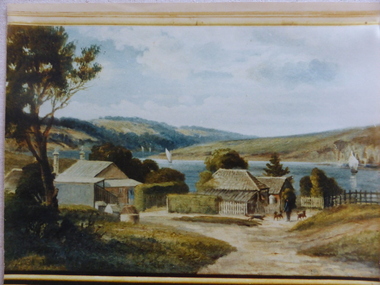
Photograph, Old Lyndoch - Photograph of Painting, Late 19th century (original painting); late 20th century (photograph of painting)
... Warrnambool landmarks as he married, in the late 1890s, Christina Lake, the step-daughter of George Rolfe who owned the property known as ‘Lyndoch’, near the mouth of the Hopkins River. Webb painted the early cottages at ‘Old Lyndoch’ using a photograph taken some time earlier. The painting was given to Dick Allan, the chauffeur in the employ of Florence Lake, Christina’s sister. Florence Lake owned and resided at Lyndoch after her parents’ death. Dick Allan’s son, living in Tasmania, acquired the painting and Les O’Callaghan...Warrnambool landmarks as he married, in the late 1890s, Christina Lake, the step-daughter of George Rolfe who owned the property known as ‘Lyndoch’, near the mouth of the Hopkins River. Webb painted the early cottages at ‘Old Lyndoch’ using a photograph taken some time earlier. The painting was given to Dick Allan, the chauffeur in the employ of Florence Lake, Christina’s sister. Florence Lake owned and resided at Lyndoch after her parents’ death. Dick Allan’s son, living in Tasmania, acquired the painting and Les O’Callaghan ...This is a photograph of a painting by the noted artist George Webb (1861-1949). Webb was best known for his portraits of civic dignitaries in Melbourne and Adelaide but he also produced many landscapes and seascapes. Some of these feature Warrnambool landmarks as he married, in the late 1890s, Christina Lake, the step-daughter of George Rolfe who owned the property known as ‘Lyndoch’, near the mouth of the Hopkins River. Webb painted the early cottages at ‘Old Lyndoch’ using a photograph taken some time earlier. The painting was given to Dick Allan, the chauffeur in the employ of Florence Lake, Christina’s sister. Florence Lake owned and resided at Lyndoch after her parents’ death. Dick Allan’s son, living in Tasmania, acquired the painting and Les O’Callaghan obtained the photograph of the painting from him. Although this is only a photograph of an original painting, it is of some considerable importance as the painting has great historical significance and this is the only representation we have of it. The man in the photograph represents George Rolfe and the story of Rolfe and his ownership and development of the property of Lyndoch is an important one in Warrnambool’s history. The original by George Webb is also an important work of art in its own right.This is a colour photograph of a painting. The frame of the original painting can be seen at the bottom of the photograph. The photograph is in on old frame which has two wooden edgings with the outer one having an ornate gold plaster edging and an inner one with a gold velvet insert next to the glass. The ornate gold plaster has a piece missing near the top left hand corner. The photograph is set into a gold-coloured wooden frame inside the glass. The photograph is mounted onto cardboard and covered with cardboard at the back with a small piece of wood attached (from the original frame). The backing is nailed on. lyndoch, george webb, george rolfe -
 Warrnambool and District Historical Society Inc.
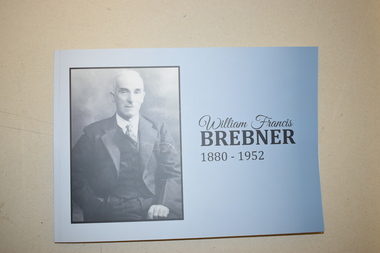
Book, Amazon Printing, William Francis Brebner 1880-1852, 2018
... By the beginning of the 20th century he was the caretaker at the Sea Baths in Gilles Street, Warrnambool and the family lived in the caretaker’s cottage (Les O’Callaghan History House today). ...By the beginning of the 20th century he was the caretaker at the Sea Baths in Gilles Street, Warrnambool and the family lived in the caretaker’s cottage (Les O’Callaghan History House today). ...This book documents the lives of William and Agnes Brebner and family. William’s father, Isaac had come to Warrnambool in the 1860s and had a tailoring business in the town. By the beginning of the 20th century he was the caretaker at the Sea Baths in Gilles Street, Warrnambool and the family lived in the caretaker’s cottage (Les O’Callaghan History House today). William Brebner established a paint shop in Timor Street in 1916 and this prominent business remained in the Brebner family until 1977. It continued in other hands until the early years of the 21st century. This book is of significance as it documents the life and times of William Brebner and his family. The Brebners have been important, particularly in the 20th century, in the business and community world of Warrnambool.This is a soft cover book of 132 pages. It has a blue cover with a black and white photograph of William Brebner and black printing on the front cover. It has four sections – one on the life of William Brebner and his wife and family, one on his ancestors and two on his descendants. The book contains many black and white and colour photographs.brebner family,, history of warrnambool
