

Historical information
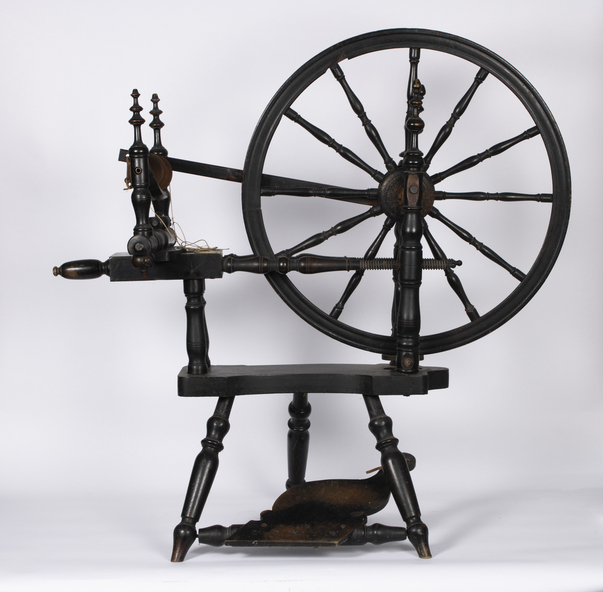
This spinning wheel was recovered in pieces from N.S.W. and re-assembled in the 1980s by Les O'Callaghan, a Warrnambool historian and President of the Warrnambool and District Historical Society for many years. The spinning wheel belonged to Alice Allan (nee Mullaly) who married William Osborne Allan in 1844. They had three sons. William Allan was a pioneer settler who, in 1839/40, established, with his brothers, a property (Allandale) east of the Hopkins River in the area known today as Allansford. During the 1840s the property was divided with William taking up the Allandale section and his brother John taking the Tooram section. William died in 1860 and Alice continued to manage the property with the assistance of her sons until her death in 1887 when the Allandale estate was sub-divided. A spinning wheel such as this would have been an important item in a pioneer settler's home with the wife needing to spin wool or sometimes flax to produce cloth for clothing and furnishings. It was donated by June Rhodes who is a descendant of the original Allan family of Allandale. June was one of three children belonging to William John Allan.
Significance
This spinning wheel is of considerable significance as it was owned by Alice Allan (nee Mullaly) of Allandale, one of the first settlers in the district. This would make it one of the oldest and most interesting items in our collection. It has very strong provenance as it was donated by a direct descendant of the original settlers. It is a fine example of a fairly common household items and speaks of a time when many everyday items such as clothing were made in a home setting and as such required the necessary aids and tools to do the particular task. As one such piece of equipment, a spinning wheel would have been highly valued.
Physical description
This is a spinning wheel made of metal and wood. The base stand has a foot pedal attached to the wheel and other sections of the spinning mechanism above
