
Showing 19 items matching "life vest"
-
 Moorabbin Air Museum
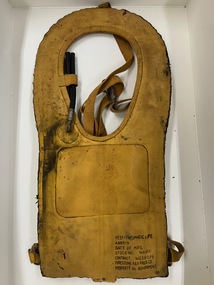
Equipment (item) - Life Vest Pneumatic AN6519
... Life Vest Pneumatic AN6519...Life Vest Pneumatic AN6519...Life Vest Pneumatic AN6519. Firestone R7D Prod.Co....Life Vest Pneumatic AN6519 Equipment Life Vest Pneumatic AN6519 ...Contract W2380P8 -
 National Vietnam Veterans Museum (NVVM)
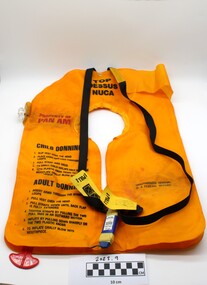
Equipment - Life vest, Pan Am
... Life vest, Pan Am......Life Vest...This life vest is of the kind issued by PAN AM Airlines during the war in Vietnam. ...National Vietnam Veterans Museum (NVVM) 25 Veterans Drive Newhaven phillip-island-and-the-bass-coast This life vest is of the kind issued by PAN AM Airlines during the war in Vietnam. ...This life vest is of the kind issued by PAN AM Airlines during the war in Vietnam. Pan Am played a significant, multifaceted role in the Vietnam War, primarily by transporting troops, supplies, and R&R personnel. They also conducted humanitarian missions like the final evacuation flights out of Saigon in April 1975, and Operation Babylift.Made of orange-coloured rubberised material with black writing printed on the front and the back. Also has red printing stating ownership, a bulb/light and two gas canisters with red rubber tubing protruding on either side of the jacket. The item is designed to pass over the head with black straps designed to secure it. pan am, life vest, doherty, signals, 110 squadron, 18975, air, air transport, safety equipment. -
 Moorabbin Air Museum
Manual (Item) - Air Cruisers Inc Airline Life Raft Vest Drawings and Specifications
... Air Cruisers Inc Airline Life Raft Vest Drawings and Specifications...Air Cruisers Inc Airline Life Raft Vest Drawings and Specifications...Moorabbin Air Museum Moorabbin Airport 12 First Street Moorabbin melbourne Air Cruisers Inc Airline Life Raft Vest Drawings and Specifications Manual Air Cruisers Inc Airline Life Raft Vest Drawings and Specifications ... -
 Nhill Aviation Heritage Centre
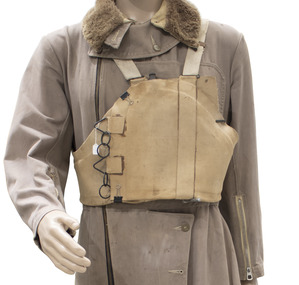
Memorabilia - Inflatable Life Vest
... Inflatable Life Vest...Memorabilia Inflatable Life Vest ...The Auliff-Perrin Life belt dates back to WW1 but was used early in WW2 by the RAF and RAAFKhaki cover with shoulder straps and inflation nozzle. -
 Bendigo Military Museum
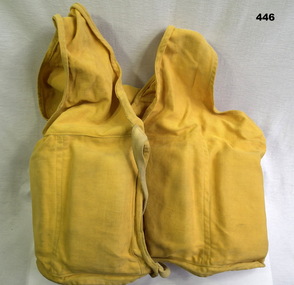
Accessory - LIFE VEST, C.1941 - 45
... LIFE VEST...Groat 1945. Accessory LIFE VEST ...Mae west vest given to A.R (Dave) GROAT 2nd AIF at the Tarakan landings in 1945 by an American. Refer Cat No 457 for his service details.8 float sections, mae west vest marked on rear top "mae west" from an American to D. Groat 1945.maritime technology - survival equipment, mae west, -
 Running Rabbits Military Museum operated by the Upwey Belgrave RSL Sub Branch
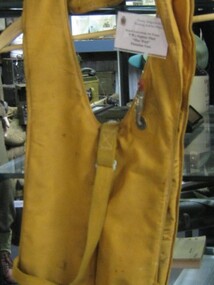
Life Preserver Vest Type
... Life Preserver Vest Type...Running Rabbits Military Museum operated by the Upwey Belgrave RSL Sub Branch 1 Mast Gully Road Upwey melbourne Equipment 1941 RAAF WW2 Fighter Piolet "Mae West" Flotation Vest Life Preserver Vest Type ...WW2 Fighter Piolet "Mae West" Flotation Vestequipment, 1941, raaf -
Glenelg Shire Council Cultural Collection
Photograph - Photograph - Portland Harbour Trust staff, n.d
... Black & white photo of a group of 9 men, 6 of whom are wearing life vests with PHT (Portland Harbour Trust)stamped on them, throwing a self inflating raft into the sea, from the edge of the wharf....Glenelg Shire Council Cultural Collection History House Cliff Street Portland great-ocean-road Port of Portland Authority Archives Port of Portland Archives Portland Harbour Trust drill tug crew Back: "Drill for Tug Crew" Black & white photo of a group of 9 men, 6 of whom are wearing life vests with PHT (Portland Harbour Trust)stamped on them, throwing a self inflating raft into the sea, from the edge of the wharf. ...Port of Portland Authority ArchivesBack: "Drill for Tug Crew"port of portland archives, portland harbour trust, drill, tug crew -
Moorabbin Air Museum
Accessory (Item) - Life Preserver Model AV-35A Part No S-21150-7300 For Demo Air Crew Only, Life Preserver Model AV-35A
... Life preserver vest for demonstration only by flight crew, suitable for Adult/Child...Moorabbin Air Museum Moorabbin Airport 12 First Street Moorabbin melbourne Life preserver vest for demonstration only by flight crew, suitable for Adult/Child Life Preserver Model AV-35A Accessory Life Preserver Model AV-35A Part No S-21150-7300 For Demo Air Crew Only ... -
Glenelg Shire Council Cultural Collection
Certificate - Certificate - Arthur Dusting, Portland Lifeboat Service, 23/08/1907
... Certificate, printed in green ink, includes imagery of rescue, boatman in life vest and use of rocket equipment. Presented to Arthur Dusting (Grand father of the donor) as a mark of appreciation of his services of 15 years as a boatman with the departmental life boat service at Portland....Arthur Dusting Portland Lifeboat lifeboat crew maritime Portland Harbour Certificate, printed in green ink, includes imagery of rescue, boatman in life vest and use of rocket equipment. Presented to Arthur Dusting (Grand father of the donor) as a mark of appreciation of his services of 15 years as a boatman with the departmental life boat service at Portland. ...Arthur Dusting was part of the Portland Lifeboat crew. His father John had also been part of the crew and had assisted in the rescue of survivors from the wreck of the Admella.Certificate, printed in green ink, includes imagery of rescue, boatman in life vest and use of rocket equipment. Presented to Arthur Dusting (Grand father of the donor) as a mark of appreciation of his services of 15 years as a boatman with the departmental life boat service at Portland.arthur dusting, portland lifeboat, lifeboat crew, maritime, portland harbour -
 Brighton Historical Society
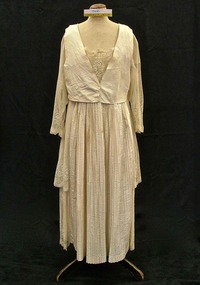
Dress, Wedding dress, 1921
... Elizabeth was very active in public life and a well-known member of the Book family. wedding dress silk 1920s elizabeth goodwin horace book st andrew's church brighton brighton Wedding dress made from cream silk purchased in China. The bodice is made of fine silk embroidered tulle with a vest ...Worn by Elizabeth Goodwin of Liverpool, England, who married Horace Book at St Andrew's Church, Brighton in 1921. The fabric was purchased by her father, a ship's captain, when he was in China. The bride had her dress made in Liverpool and made to a Butterick's pattern. Elizabeth was very active in public life and a well-known member of the Book family. Wedding dress made from cream silk purchased in China. The bodice is made of fine silk embroidered tulle with a vest of cream silk that floats over the top. The skirt has been permanently pleated, has has floating side panels of tulle and features a large butterfly-shaped bow at the back.wedding dress, silk, 1920s, elizabeth goodwin, horace book, st andrew's church brighton, brighton -
Stawell Historical Society Inc
Memorabilia, Regalia Supplies, Masonic Lodge Memoribillia, 1929 & 1986
... Masonic Vest and Cumberband, Gloves, Bow Tie, & White Lamb Skin Masonic Apron, Life Membership Badge & centenary Badge and Certificate (Instillation) of Acceptence to Numurkah Lodge. ...Stawell Historical Society Inc 46 Longfield St Stawell grampians Three Generations of Masonic Lodge Memebrs Lodge Regalia Kenneth John Hill William John Hill Masonic Vest and Cumberband, Gloves, Bow Tie, & White Lamb Skin Masonic Apron, Life Membership Badge & centenary Badge and Certificate (Instillation) of Acceptence to Numurkah Lodge. ...Three Generations of Masonic Lodge MemebrsMasonic Vest and Cumberband, Gloves, Bow Tie, & White Lamb Skin Masonic Apron, Life Membership Badge & centenary Badge and Certificate (Instillation) of Acceptence to Numurkah Lodge. Belonging to Kenneth John Hill. 1986 Certificate of (Istillation) Acceptence to Euroka Morning Star Lodge Stawell & Clearence Certificate for William John Hill ( Grandfather) May 1929 & 1932Kenneth John Hill William John Hilllodge, regalia -
Vision Australia
Administrative record - Text, Quarterly general meeting of the Queensland Society of Blind Citizens: 19/11/1974 - 17/8/1976, 1974-1976
... life governorships. Some highlights include: 19/11/1974 - the final meeting of the Queensland Musical, Literary and Self Aid Society for the Blind, dissolving it and vesting all assets to the Queensland Society of Blind Citizens. 21/11/1975 - a report of duplicity from a man who gave a false name and identification, then sold cash and property before absconding. 2/6/1976 - members in Townsville are desirous of purchasing a property to utilise as a headquarters. 41 Armstrong Street, Hermit Park was approved for purchase on 29/6/1976....life governorships. Some highlights include: 19/11/1974 - the final meeting of the Queensland Musical, Literary and Self Aid Society for the Blind, dissolving it and vesting all assets to the Queensland Society of Blind Citizens. 21/11/1975 - a report of duplicity from a man who gave a false name and identification, then sold cash and property before absconding. 2/6/1976 - members in Townsville are desirous of purchasing a property to utilise as a headquarters. 41 Armstrong Street, Hermit Park was approved for purchase on 29/6/1976. ...Minutes of the Queensland Society of Blind Citizens committee including centre activities, staffing changes, fund raising appointment and resignation of committee members and life governorships. Some highlights include: 19/11/1974 - the final meeting of the Queensland Musical, Literary and Self Aid Society for the Blind, dissolving it and vesting all assets to the Queensland Society of Blind Citizens. 21/11/1975 - a report of duplicity from a man who gave a false name and identification, then sold cash and property before absconding. 2/6/1976 - members in Townsville are desirous of purchasing a property to utilise as a headquarters. 41 Armstrong Street, Hermit Park was approved for purchase on 29/6/1976.1 bookqueensland society of blind citizens, queensland musical literary and self aid society for the blind -
 Wodonga & District Historical Society Inc
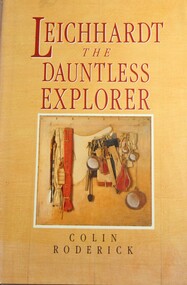
Book - Leichhardt the Dauntless Explorer, Colin Roderick, 1988
... life. Not assisting in these efforts is the fact that his journals and logbooks were all written in the Gothic form of the German language and have been largely indecipherable and, in places, open to misinterpretation. With the publication of this volume, the story has been set straight. Using unprecedented access to Leichhardt's writings, including his personal correspondence, the author throws new light upon the scandals and defamations which historians - many with vested ...Ludwig Leichhardt (1813 -1848) is known as one of the most individualistic of Australian explorers. This is the first substantial account of his life and work, based on his diaries, logs and field books. Leichhardt's accomplishments have been uncarefully handled by many researchers and much hearsay and supposition has marred the record of the explorer's life. Not assisting in these efforts is the fact that his journals and logbooks were all written in the Gothic form of the German language and have been largely indecipherable and, in places, open to misinterpretation. With the publication of this volume, the story has been set straight. Using unprecedented access to Leichhardt's writings, including his personal correspondence, the author throws new light upon the scandals and defamations which historians - many with vested interests - have heaped upon him. It also includes Leichhardt’s observations of Aboriginal culture round Durundur Station; references to meetings with groups by 1844-1845 expedition to Port Essington; predominantly friendly relations with tribes; instruction in bush foods and medicines; Koko-Pera attack; appendix includes table of Tribal areas traversed 1844-5.non-fictionLudwig Leichhardt (1813 -1848) is known as one of the most individualistic of Australian explorers. This is the first substantial account of his life and work, based on his diaries, logs and field books. Leichhardt's accomplishments have been uncarefully handled by many researchers and much hearsay and supposition has marred the record of the explorer's life. Not assisting in these efforts is the fact that his journals and logbooks were all written in the Gothic form of the German language and have been largely indecipherable and, in places, open to misinterpretation. With the publication of this volume, the story has been set straight. Using unprecedented access to Leichhardt's writings, including his personal correspondence, the author throws new light upon the scandals and defamations which historians - many with vested interests - have heaped upon him. It also includes Leichhardt’s observations of Aboriginal culture round Durundur Station; references to meetings with groups by 1844-1845 expedition to Port Essington; predominantly friendly relations with tribes; instruction in bush foods and medicines; Koko-Pera attack; appendix includes table of Tribal areas traversed 1844-5.ludwig leichhardt 1813 - 1848, exploration australia, australia -- discovery and exploration, leichhardt biography -
 National Wool Museum
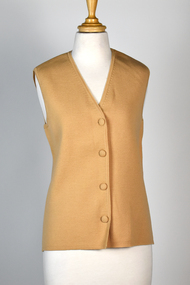
Textile - Vest, Tina Knitwear, 1980-2000
... We will forever be grateful that our parents’ life journey gave us the opportunity to live in a home filled with creativity, dedication and passion, amazing work ethic and mutual respect, lifelong friendships and a lifetime of love. knitwear clothing italy migrants brighton knitting machine linking machine garments business family community Sleeveless beige vest with four front self covered buttons. ...Part of a selection of garments knitted by ‘Tina Knitwear’. Tina Knitwear was a successful made to order knitwear business in Brighton from the mid-1960s to around 2010, run by Assunta and Franco Liburti. Daughter Melissa Persi writes: Our parents Assunta (Mum) and Franco (Dad) Liburti ran a successful made to order knitwear business in Brighton from the mid-1960s to around 2010. Assunta was affectionately known to her family as Assuntina, therefore the business was named "Tina Knitwear" after her. Assunta and Franco were born in the beautiful seaside town of Terracina in Italy in 1933 and 1930 respectively. As was so common in Italy in the 1950s, Assunta who was in her late teens and early twenties learnt the intricate skills of machine knitting, dressmaking and pattern making. Franco on the other hand, learnt the building trade with his 2 brothers and specialised in bricklaying and tiling. As was so common after the war, Assunta and Franco yearned for a better life so they decided that they would get engaged and then migrate to Australia to be married and raise their family in Australia, a land of much opportunity which they no longer felt their beloved Italy held for them. Assunta migrated to Australia first in 1957 and later Franco joined her in 1958 where they were married. For the first few years, Franco (also known as Frank) worked as bricklayer /tiler on buildings such as the Robert Menzies building at Monash University in Clayton and various buildings in the Melbourne CBD. Assunta on the other hand put her machine knitting skills to use working in factories doing piece machine knitting for various knitwear companies. The hours were long, the conditions were difficult, and travel was onerous without a car. After their 2 older children were born, it was decided that dad would leave the building trade and they would start their own made to order knitwear business. That way they could work from home and raise their family together. Mum taught dad everything he needed to know so he could operate the knitwear machinery. They purchased COPPO knitting machines from Italy and a Linking machine from Germany. Initially they had a knitwear shopfront in Bay Street Brighton where a store assistant would take the orders and client’s measurements and Assunta would then make the garments from a small workshop in their home. Unfortunately, the assistants were not skilled dressmakers and often measurements and orders were incorrectly taken. Assunta being the perfectionist and highly skilled machinist that she was, decided that she needed to oversee the entire process from meeting the client, to taking their order, right thru to the fittings and completion of the garment. It therefore made sense that they should close the shop front and run their business from their own home in Brighton and hence “Tina Knitwear” was born. Together, for more than 40 years they ran their very respected and successful business and were well known in the Bayside area. They specialised in made to order knitwear for both men and women using mainly pure wool (from Patons, Wangaratta Mills, Japan and Italy) but also lurex and estacel. Over those years, many of their clients became their close friends. It wasn't unusual for clients to come to order garments and then end up in the kitchen chatting over a cup of Italian espresso coffee and homemade biscuits. Some of their clients were especially memorable and became lifelong friends. Mrs Connell was a dear friend of mum’s, each year she would buy tickets for the “Gown of the Year” fashion show. She would insist on taking Assunta and her 2 daughters so that we could see the latest fashions. Then there was their dear friend Ms Griffiths. She had been a Matron nurse at the Queen Victoria Hospital when she met my parents in the 1970s. She returned to live in New Zealand in the 1980s but came back to Melbourne every year to stay for 2 weeks with the sole purpose of visiting my parents (she adored them) and order garments. For those 2 solid weeks, mum and dad would only knit for Ms Griffiths and she would go back to New Zealand with at least 5 or 6 new outfits. I actually think she enjoyed mum’s homemade pasta almost as much as her new clothes! Over the years, my parents learnt to speak English very well given that majority of their clients were not Italian speaking. Their oldest child John born in 1960 learnt to speak English with the help of those clients who were such a big part of our childhood. Mum and dad always went above and beyond to ensure their clients were satisfied. Mum was an absolute perfectionist and it showed in her attention to detail and the quality of their beautiful work. You only need to look at the garments that have stood the test of time or speak to their clients to know that this is true. Their clients would always comment on how well their clothes would last and much of their clients came via word of mouth and recommendations. Occasionally there would be disagreements because mum had found an error in dad's knitting (either a wrong stitch or a sizing mistake mainly) and would ask him to redo a piece, he would argue back saying that it was fine, but we always knew who would win the argument and that the piece would get remade! Similarly, we recall discussions where mum would ask dad to find a particular colour of wool in the garage where the stock was kept. He would try to convince her that they were out of stock of that colour and that the client should choose a different colour. She would insist they had it and then after hours of searching, he would return into the house sheepishly holding the wool! Our childhood is full of beautiful memories of mum and dad always being present, clients coming and going, mum humming her favourite songs as she worked often late into the night and sometimes, we even fell asleep to the hum of the machinery. They put their heart and soul into "Tina Knitwear" and took pride in providing only the best quality garments for their clients. In Italian there is a saying “lei ha le mani d’oro” which literally translated means “she has hands of gold”. Franco enjoyed his work but for Assunta, it was more than just work and there is no better way to describe her skills, passion and dedication to her machine knitting… she truly did have “hands of gold”. We will forever be grateful that our parents’ life journey gave us the opportunity to live in a home filled with creativity, dedication and passion, amazing work ethic and mutual respect, lifelong friendships and a lifetime of love. Sleeveless beige vest with four front self covered buttons. knitwear, clothing, italy, migrants, brighton, knitting machine, linking machine, garments, business, family, community -
 National Wool Museum
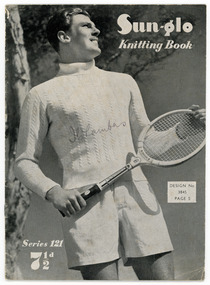
Book - Sun-glo Knitting Book, Series 121, F. W. Hughes Pty. Ltd, c.1940s
... Life Patterns front: [printed] Sun-glo / Knitting Book / DESIGN No. / 3845 / PAGE 5 / Series 121 / 7 ½ d [handwritten] H Lambas? Sixteen page black and white knitting pattern book featuring men’s jumpers and vests. ...Sixteen page black and white knitting pattern book featuring men’s jumpers and vests. Book contains black and white photographs and printed text. Front cover shows a man wearing a knitted jumper and shorts holding a tennis racquet. front: [printed] Sun-glo / Knitting Book / DESIGN No. / 3845 / PAGE 5 / Series 121 / 7 ½ d [handwritten] H Lambas?fashion, women, magazine, knitting, crochet, home life, patterns -
 National Wool Museum
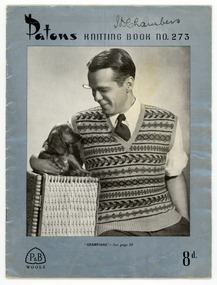
Book - Patons Knitting Book No. 273, Patons and Baldwins, c.1950s
... Life Patterns front: [printed] Patons / KNITTING BOOK NO. 273 / “GRAMPIANS” – See page 10 / P & B / WOOLS / 8d. [handwritten] I D [?] Chambers Twenty page book with black and white printed text and graphics. The front cover features an image of a man wearing a vest ...Twenty page book with black and white printed text and graphics. The front cover features an image of a man wearing a vest and tie, with his arm around a puppy on a basket. front: [printed] Patons / KNITTING BOOK NO. 273 / “GRAMPIANS” – See page 10 / P & B / WOOLS / 8d. [handwritten] I D [?] Chambersfashion, women, knitting, crochet, home life, patterns -
 National Wool Museum
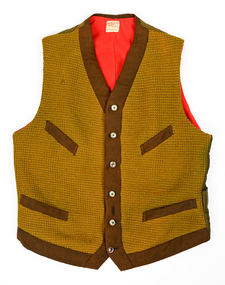
Textile - Waistcoat, R. Collins Hocking, c.1910
... Vest...Design...Textiles...Fashion...Alfred White...Sheep Farming...Mt Duneed...Rural Life...life, continuing the family tradition. After his father’s death in 1975, the waistcoat became his and so passed to a third generation of the family. Waistcoat Vest ...The Waistcoat’s Owners The first owner of the waistcoat was Alfred (Alf) Gilbert White, 1868 Stretton Park, Connewarre – 1946, Mt Duneed. He was the fourth child of Andrew White, 1828-1900, and Jane Roberts, 1827-1871. His father Andrew White was born at Stretton-on-Dunsmore, Warwickshire, England, the sixth child of William White and Sarah Elkington. Andrew had come to Victoria on the James L. Bogart in 1852 with his first wife, Emily Walker. From 1854, records show he was the owner of livery stables in central Geelong before he moved into land ownership. In 1862, Andrew became a landowner with 1,400 acres in Connewarre, the Salt Water Run, then re-named Stretton Park by Andrew. Thereafter he is usually noted as a Farmer or Sheep Farmer. Emily died in 1861 and Andrew remarried Jane Roberts in 1863. Jane was the daughter of Jane (Jenefer) Pearce and William Roberts in Crowan, Cornwell, England and it is thought arrived in Victoria on the British Trident in 1855. In 1878 Andrew moved to the newly purchased “Hillside” at Mt Duneed with his family including Alfred. By 1880 Andrew held 11,095 acres in South Barwon and Barrabool. As well as being a landowner, he had other business interests including Auctioneers, Stock and Station Agents Learmonth White from 1886. However farming at Hillside, particularly wool production, was an important part of his life. For example, in 1893 10,350 sheep were shorn although the highest number of bales of wool produced was in 1892 with 174 bales under AW’s wool mark and 8 under that of Stretton Park. This was the result of shearing 9,234 sheep. There were usually six or seven shearers, shearing over a two to three week period, beginning in early or mid October. Some of the shearers bore names familiar in the district such as Gogoll, Duffield, and Baensch. Andrew White held a number of local positions including: •1863-1874 Connewarre Road Board, Chairman 1871-73 •1875-1900 South Barwon Shire Council. When the Board amalgamated with South Barwon to form the Shire of South Barwon, he was an inaugural representative of Connewarre. He was a council member for 44 years and president for the following terms: 1878-1879; 1885-1887; 1889; 1894; 1895-1896; and 1898-1899. •1878-1886, Barrabool Shire Council, President 1882 •In 1885 he was appointed a Justice of the Peace in the Southern Bailiwick •Committee member of the Geelong Racing Club, 1890-96 •In 1892 he was appointed returning officer for the South-Western Province and the electoral district of Barwon •Foundation President of Torquay Racing Club, 1893 •Mount Duneed Cemetery Trustee, 1893 Alfred Gilbert White went to Connewarre School and then to Mt Duneed School after the family moved to Mt Duneed. He then went to Geelong Grammar School as a boarder from 31 July 1883. After leaving school, in 1886, he worked as a bookkeeper for the family business Learmonth-White stock and station agents and lived at home at Hillside. He and Bessie Orchard Mathews were married in 1894. Bessie was born in Geelong in 1869, the sixth child of William Matthews and Amelia Orchard. Her family lived at “Turley,” Malop Street, Geelong, named after the hamlet of Turleigh in West Wiltshire, England. Bessie’s father, William Mathews, a butcher from Winsley, Wiltshire, arrived on the Queen of the East in Sydney in 1854 and established a successful butcher’s business with his brother James in Geelong. Her mother, Amelia Orchard, also from Winsley, arrived on the Thames in Melbourne in 1857. Alfred, Bessie and their family lived at Stretton Park, Connewarre, leasing it from Andrew. They had six children including their fourth child Douglas Alfred White, the second owner of the waistcoat. His father Andrew supported Alfred’s sheep farming at Stretton Park. In 1896 “.... eight splendid 2-tooth Lincoln rams in the wool were purchased by Mr Andrew White for his son, Mr Alfred G. White….intended for Mr White’s sheep run at Connewarre.“ Alfred White bought ‘Hillside’, 640 acres, after his father’s death and moved there with his family from Stretton Park in Connewarre. (Stretton Park was bought by his half sister Emily and her family and renamed “Morangarell”.) A family partnership was formed to run the wider station. It was then Alfred who managed the new partnership, called Stretton Park. Alfred meticulously kept the financial records of the station, as might be expected from a former bookkeeper. The detail kept is exemplified in the annual shearing records, including the names of the paddocks, the number of lambs and ewes and the shearers’ tallies. In the spring of 1900, after Andrew White had died, shearing began on 7 October and was finished on 6 November. On some days well over 500 sheep were shorn. The highest tally was 616 on 11 October. That year the overall total of sheep shorn was 9,101. Alfred was an active community member including: •South Barwon Council member (46 years), president: 1903-04; 1906-07; 1921-22; and 1931-33 •Geelong Grammar School Council member, 1908-1946 (over 37 years) •Active member of St. Wilfred’s Church of England, Mt Duneed •Director of Dennys Lascelles, 1932-1946 •Mt Duneed Cemetery Trustee, 1900 •Honorary member of the Mt Duneed Rifle Club, 1900 •Mt Duneed Mutual Improvement Association •Mt Duneed Recreation Reserve Trustee •Torquay Improvement Association Trustee •Barwon Returning Officer Douglas Alfred White, 1900 Stretton Park, Connewarre-1976, Geelong. Initially Douglas and his sisters were taught at home by a governess. Then, like his father, Douglas attended Geelong Grammar. After finishing school, he studied Engineering at Melbourne University where he met Violet Fullerton, 1900-1992, who was studying Medicine. They married in 1926 and had two children including Douglas Robert Stretton (DRS) White Melbourne, 1928–Geelong, 1989, the final owner of the waistcoat. After a successful career as an engineer with the Department of Main Roads, NSW, and serving as a Major in the Royal Australian Engineers in NT, New Guinea and Borneo during the Second World War, Douglas purchased part of Stretton Park when it was sold in 1952. He farmed “South Beach Farm” until his death in 1975. (This area now includes The Sands and Stretton Estate subdivisions.) His son DRS White also attended Geelong Grammar before studying at Dookie Agricultural College. In 1955 DRS purchased land from Peter Fisher, John Fisher and Frank Walter, naming the property “Lambidgee”. (This was part of the land that had originally belonged to Andrew White that had been sold previously.) He farmed this land for the rest of his life, continuing the family tradition. After his father’s death in 1975, the waistcoat became his and so passed to a third generation of the family.Chartreuse green and red waistcoat featuring woven wool front with six buttons, silk back with metal clasp, and red lining. The buttons feature small green beads in the centre.Label [printed]: R. Collins Hocking / GEELONG Label [handwritten]: A. G. White Esqwaistcoat, vest, design, textiles, fashion, alfred white, sheep farming, mt duneed, rural life -
 National Wool Museum
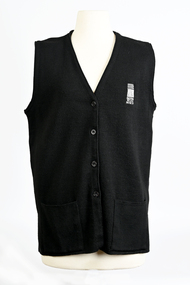
Textile - Black Woollen Vest, 2000s
... " - Lynette Wekwerth Working Life Volunteer National Wool Museum Clothing Uniform Lynette Wekwerth Staff Employment Wool Clothing Geelong printed [label]: BELLA / Collection / made in australia / WEKWERTH / TO FIT / SIZE / 12 Black woollen vest with four buttons at the front, and two pockets. ...This vest was worn by Lynette Wekwerth when she worked as a volunteer in the National Wool Museum shop during the early 2000s. Lynette volunteered at the National Wool Museum for 25 years from 2001 until her passing in 2025, and was a much loved and respected member of the team. "I was born at Coonara Private Hospital at 173 Yarra Street, Geelong, on the 29th of March 1944, the third of five children. My father was in the RAAF when I was born, and on leaving the air force he became a carpenter/joiner. When I was young, we had the bread and milk delivered. There was a special tin for the bread and a big billy for the milk left of the front veranda to collect these items. My mother, elder sister, Wendy and my younger sister Zaidee, all went to “Physical Culture” held downstairs under the old Plaza Theatre building in Ryrie Street. We girls made our own sports clothes to do exercises (rods, dumbbells, and song and dance). It kept us fit, and we all won medals at some stage at the end-of-year concert. I was the only girl of my age in the street where I lived. There were boys my age, so I learned to play cricket and kick a football, all of which I did well. I attended Tate Street and then went on to Matthew Flinders Girls Secondary College in 1956. Matthew Flinders was a domestic arts school, where I learnt sewing, cookery, home management, and how to be a ‘good’ housekeeper. I enjoyed all the domestic subjects. Ray and I were engaged in August 1963. We purchased our engagement ring in Melbourne and went to dinner at the Playboy Club in Melbourne to celebrate. In preparation for our wedding, I spent many hours making my own wedding dress (with assistance from my mother). We were married at 11 am on Saturday, the 10th April 1965 at St. Matthew’s, Church of England, Geelong. When Ray retired, he responded to an advertisement for volunteers at the National Wool Museum to be a volunteer. He started in 1998. The year that the ‘Pharaohs exhibition’ started. That was fine by me, as he wouldn’t be getting under my feet. At this time I was playing golf regularly and didn’t want to miss out on this activity. I joined the volunteers in the Wool Museum in March/April 2001. I was allocated to the Museum Shop and thoroughly enjoyed being a member of the shop staff. I then became shop assistant. I enjoyed talking and serving the customers. I was soon asked if I would mind repairing some of the garments that may have pulled a thread or a minor fault. I also enjoyed doing ‘stock taking’ in the shop. (Not many staff enjoyed this job, but I did.) In those early days, the Museum staff wore the red blazer and the black wool cardigan." - Lynette WekwerthBlack woollen vest with four buttons at the front, and two pockets. Vest has National Wool Museum logo on left chest. printed [label]: BELLA / Collection / made in australia / WEKWERTH / TO FIT / SIZE / 12working life, volunteer, national wool museum, clothing, uniform, lynette wekwerth, staff, employment, wool clothing, geelong -
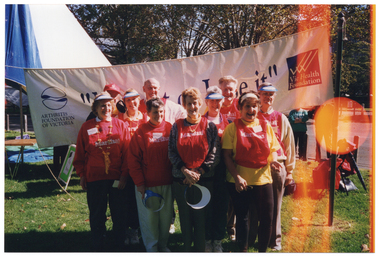 Musculoskeletal Health Australia (now held by the Glen Eira Historical Society)
Photograph - Group photo, 1996
... Life Easier" expo held on the day. In this photo, marshalls for the Joint Walk pose for a photo in a park. There is a brief report on this and other events held during the week on pages 9 and 10 of the 1996 Annual Report. arthritis foundation of victoria afv osteoporosis victoria ov national arthritis week naw ring the bells for arthritis joint walk marshalls banner annual report 1996 COL photo of a group of people posing for a photo in a park. They are wearing red vests ...The theme for the 1996 National Arthritis Week (NAW) was "Ring the Bells for Arthritis", with the Glen Iris Handbell Ringers performing at the launch. There was a Joint Walk along Southgate, beside the Yarra River in Melbourne - one of around 24 Joint Walks held across Victoria during the 1996 NAW. In addition, there was a "Making Life Easier" expo held on the day. In this photo, marshalls for the Joint Walk pose for a photo in a park. There is a brief report on this and other events held during the week on pages 9 and 10 of the 1996 Annual Report.COL photo of a group of people posing for a photo in a park. They are wearing red vests with 'Marshall' printed in white on the front, and two of them are holding a blue and white sunvisor in one hand. The group is standing in front of a large banner. On the banner, there is the text, 'Move It Or Lose It' in large letters across the centre, and logos for the Arthritis Foundation of Victoria and VicHealth Foundation on either side. Behind the banner, there is a large marquee on one side, and a few people (partially obscured) standing behind the edge of the banner at the other end.arthritis foundation of victoria, afv, osteoporosis victoria, ov, national arthritis week, naw, ring the bells for arthritis, joint walk, marshalls, banner, annual report, 1996
