
Showing 279 items matching "line closures"
-
 Brunswick Community History Group
Archive - Upfield Railway Line 1989-90 File 6, 1989-1990
... State Government documents relating to proposed Upfield Line closure 1989-90....State Government documents relating to proposed Upfield Line closure 1989-90....State Government documents relating to proposed Upfield Line closure 1989-90. State Government documents relating to proposed Upfield Line closure 1989-90. ...State Government documents relating to proposed Upfield Line closure 1989-90.State Government documents relating to proposed Upfield Line closure 1989-90. -
 Victorian Railway History Library
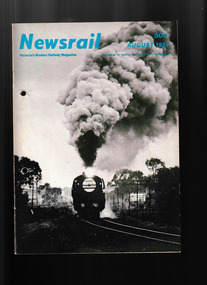
Journal - Newsrail August 1974, Australian Railway Historical Society, Victorian Division, VR Airconditioned Carriages, Mirboo North Line Closes, 1974
... ...Line Closures...Government Railways Victoria Line Closures Comments on VR air conditioned carriages and closure of Morwell to Mirboo North Line Index, ill, p. 32. ...Comments on VR air conditioned carriages and closure of Morwell to Mirboo North LineIndex, ill, p. 32.non-fictionComments on VR air conditioned carriages and closure of Morwell to Mirboo North Linegovernment railways victoria, line closures -
 Melbourne Tram Museum
Document - Notice, The Met, Public Transport Corporation, "Staff Bulletin No. 2 - 17/2/93", 17/02/1993 12:00:00 AM
... Notice - 3 A4 sheets stapled in the top left hand corner, titled "Staff Bulletin No. 2 - 17/2/93" - follows an agreement with the ATMOEA union, about fare collection, workshops, line closure (just Northcote to Thornbury), Infrastructure, service levels, retention of tram services, tendering of bus services, and various other reforms, consultation, arbitration hearings and revised interim management structure. ...Trams tramways Services Buses Bus Replacement Tram Replacement Railways Contracts Preston Depot Met Ticket Maintenance Unions ATMOEA Agreements Notice - 3 A4 sheets stapled in the top left hand corner, titled "Staff Bulletin No. 2 - 17/2/93" - follows an agreement with the ATMOEA union, about fare collection, workshops, line closure (just Northcote to Thornbury), Infrastructure, service levels, retention of tram services, tendering of bus services, and various other reforms, consultation, arbitration hearings and revised interim management structure. ...Notice - 3 A4 sheets stapled in the top left hand corner, titled "Staff Bulletin No. 2 - 17/2/93" - follows an agreement with the ATMOEA union, about fare collection, workshops, line closure (just Northcote to Thornbury), Infrastructure, service levels, retention of tram services, tendering of bus services, and various other reforms, consultation, arbitration hearings and revised interim management structure. Signed by John McMillan. See also 3049 and 3052trams, tramways, services, buses, bus replacement, tram replacement, railways, contracts, preston depot, met ticket, maintenance, unions, atmoea, agreements -
 Ballarat Tramway Museum
Slide - 35mm slide/s, Peter Moses, 21/08/1971 12:00:00 AM
... North for the passengers to travel on the ARHS/ TMSV specials on Saturday 21/8/1971 to undertake the last tour of Ballarat Tramways, prior to the closure of the system. The first line closure (Victoria St.) took place the following day. ...North for the passengers to travel on the ARHS/ TMSV specials on Saturday 21/8/1971 to undertake the last tour of Ballarat Tramways, prior to the closure of the system. The first line closure (Victoria St.) took place the following day. ...Photo of SEC Ballarat trams waiting in Lydiard St. North for the passengers to travel on the ARHS/ TMSV specials on Saturday 21/8/1971 to undertake the last tour of Ballarat Tramways, prior to the closure of the system. The first line closure (Victoria St.) took place the following day. The organising group is discussing the arrangements with the SEC tramway inspector. Bob Whitehead, Len Millar, Keith Kings, Eildon Hogan, Jim Dowell and the Inspector? Kodak cardboard mount slide, taken by Peter Moses 21 August 1971.On the rear of the slide in black ink "Ballarat Lydiard St. / ARHS Specials" and "P. Moses" in the bottom right hand corner.tramways, trams, arhs, lydiard st north -
 Ballarat Tramway Museum
Slide - 35mm slide/s, Peter Moses, 21/08/1971 12:00:00 AM
... North for the arrival of the ARHS special on Saturday 21/8/1971 to undertake the last tour of Ballarat Tramways, prior to the closure of the system. The first line closure (Victoria St.) took place the following day. ...North for the arrival of the ARHS special on Saturday 21/8/1971 to undertake the last tour of Ballarat Tramways, prior to the closure of the system. The first line closure (Victoria St.) took place the following day. ...Photo of SEC Ballarat 26, with No. 14 and possibly No. 42 (Briquette roof advertisement and features on the same special trams in Reg. item 2064) waiting in Lydiard St. North for the arrival of the ARHS special on Saturday 21/8/1971 to undertake the last tour of Ballarat Tramways, prior to the closure of the system. The first line closure (Victoria St.) took place the following day. Has Reid's Coffee Palace building in the background and other buildings on the east and west side of Lydiard St. North. No. 26 has an SEC briquettes roof advertisement Kodak cardboard mount slide, taken by Peter Moses 21 August 1971.On back of slide in light black ink "Ballarat / ARHS outside station / special trams Lydiard St." and "P. Moses" in black ink in the upper right hand side of the slide.tramways, trams, arhs, lydiard st, tram 26 -
 Orbost & District Historical Society
newspaper clippings, August, September 1987
... Because of the decline in traffic and heavy operating costs, the line was finally closed in August, 1987. The closure of this railway was a controversial issue at the time with many public protests in the district. ...closure of the Bairnsdale - Orbost Railway in 1987. They are from the Snowy River Mail and The News. They contain photographs, news articles and the history of the line and its closure. ...closure of the Bairnsdale - Orbost Railway in 1987. They are from the Snowy River Mail and The News. They contain photographs, news articles and the history of the line and its closure. newspaper clippings Snowy River Mail ...The Bairnsdale-Orbost railway was opened in 1916 to serve the agricultural and timber industry. Because of the decline in traffic and heavy operating costs, the line was finally closed in August, 1987. The closure of this railway was a controversial issue at the time with many public protests in the district. These articles are contemporary record of a significant event in Orbost history.Three articles relating to the closure of the Bairnsdale - Orbost Railway in 1987. They are from the Snowy River Mail and The News. They contain photographs, news articles and the history of the line and its closure. orbost-bairnsdale-railway east-gippsland-railway snowy-river-mail -
 Ballarat Tramway Museum
Slide - 35mm slide/s, Peter Moses, 21/08/1971 12:00:00 AM
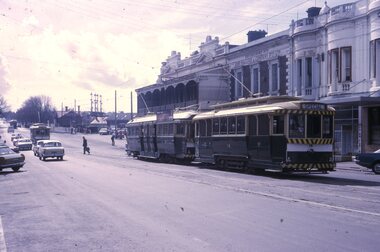
... North for the arrival of the ARHS special on Saturday 21/8/1971 to undertake the last tour of Ballarat Tramways, prior to the closure of the system. The first line closure (Victoria St.) took place the following day. ...North for the arrival of the ARHS special on Saturday 21/8/1971 to undertake the last tour of Ballarat Tramways, prior to the closure of the system. The first line closure (Victoria St.) took place the following day. ...Photo of SEC Ballarat No. 14 and possibly No. 42 (Briquette roof advertisement and features on the same special trams in Reg. item 2064) waiting in Lydiard St. North for the arrival of the ARHS special on Saturday 21/8/1971 to undertake the last tour of Ballarat Tramways, prior to the closure of the system. The first line closure (Victoria St.) took place the following day. Has Reid's Coffee Palace building in the background and other buildings on the east side of Lydiard St. North. Two other single truck cars in the photo as are the railway gates at the station. Kodak cardboard mount slide, taken by Peter Moses 21 August 1971.On back of slide in light black ink "N14 Ballarat / ARHS / 4 trams special Lydiard St" and "P. Moses" in black ink in the upper right hand side of the slide.tramways, trams, arhs, lydiard st north, railway crossing, tram 14, tram 42 -
 Ballarat Tramway Museum
Slide - 35mm slide/s - set of 4, Peter Moses, 21/08/1971 12:00:00 AM
... Series of four photographs featuring the Special trains on the occasion of the ARHS special train on Saturday 21/8/1971 to undertake the last tour of Ballarat Tramways, prior to the closure of the system. The first line closure (Victoria St.) took place the following day. .1 - R761 just arrival in platform 2 of the Special train. .2 - ditto .3 - R761 shunting across the Lydiard St. with the Victoria Hotel in the background. .4 - R761 leaving Ballarat station (note slide from a different roll of film). ...Series of four photographs featuring the Special trains on the occasion of the ARHS special train on Saturday 21/8/1971 to undertake the last tour of Ballarat Tramways, prior to the closure of the system. The first line closure (Victoria St.) took place the following day. .1 - R761 just arrival in platform 2 of the Special train. .2 - ditto .3 - R761 shunting across the Lydiard St. with the Victoria Hotel in the background. .4 - R761 leaving Ballarat station (note slide from a different roll of film). ...Series of four photographs featuring the Special trains on the occasion of the ARHS special train on Saturday 21/8/1971 to undertake the last tour of Ballarat Tramways, prior to the closure of the system. The first line closure (Victoria St.) took place the following day. .1 - R761 just arrival in platform 2 of the Special train. .2 - ditto .3 - R761 shunting across the Lydiard St. with the Victoria Hotel in the background. .4 - R761 leaving Ballarat station (note slide from a different roll of film). Kodak cardboard mount slide, taken by Peter Moses 21 August 1971. Note: Train/tram tour operated in conjunction with the TMSV.On back of slide: .1 - In black ink "Ballarat / R761 Station" and "P. Moses" in bottom left hand corner. .2 - In black ink "Ballarat / R761 ARHS Train / Ballarat Station" and "P. Moses" in bottom left hand corner. .3 - In blue ink "Ballarat / R761 shunting" and in upper left hand corner "P. Moses". .4 - In red ink "Ballarat / ARHS Train departs" and on other side of slide "P. Moses" in black ink.tramways, trams, arhs, lydiard st north, ballarat railway station -
 Kew Historical Society Inc
Clothing - Fringed Cut Velvet & Chenille Evening Cape, 1890s
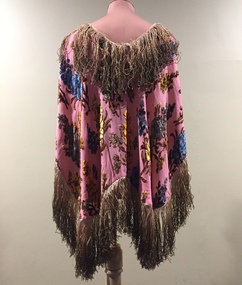
... Chenille trim and long silk fringe, Centre front hook and eye closure, Lined with pale pink silk....Chenille trim and long silk fringe, Centre front hook and eye closure, Lined with pale pink silk. Clothing Fringed Cut Velvet & Chenille Evening Cape ...The Fashion & Design collection of Kew Historical Society includes examples of women’s, men’s, children’s and infants' clothing from the 18th, 19th and 20th centuries. While the collection includes some examples of international fashion, most items were handmade or purchased in Melbourne. Cut velvet pelerine featuring multicoloured garlands of flowers in shades of gold, brown and blue on a pink ground. Chenille trim and long silk fringe, Centre front hook and eye closure, Lined with pale pink silk.women's clothing, outerwear -- capes, fashion -- 1890s, fashion design -
Lakes Entrance Historical Society
Book, Save Our Train Project - Railway Melbourne to Gippsland, 2015c
... Display folder containing information on railway from Melbourne to Gippsland the save our train project ater closure of line from Sale to Bairnsdale plus other Austalian railways Gippsland Victoria...Transport Display folder containing information on railway from Melbourne to Gippsland the save our train project ater closure of line from Sale to Bairnsdale plus other Austalian railways Gippsland Victoria Save Our Train Project - Railway Melbourne to Gippsland Book ...Display folder containing information on railway from Melbourne to Gippsland the save our train project ater closure of line from Sale to Bairnsdale plus other Austalian railways Gippsland Victoriatransport -
 Melbourne Tram Museum
Newspaper, "The end for two lines", "Safety at risk - Union", "Buses to take over from 8pm", 7/01/1993 12:00:00 AM
... Also includes that airport and football bus likely to rise under Vic Govt. polices. .2 - Page 5 - "Safety at risk - Union" - ARU remarks about Safety on public transport, tram conductors (photo of Merv Peters), photo of a lone passenger on a No. 72 tram at 10.25, union .3 - page 6 - map showing planned tram route closures (82 and part of 9), and bus replacements after 8pm, with the headline ""Buses to take over from 8pm", closure of rail lines and impacts on trains and trams. .4 - page 7 - map of rail line closures and bus replacement in the evening, "nine country lines for sale", and "The long and the short of a rort" - item about restrictive work practices and awards in public transport....Also includes that airport and football bus likely to rise under Vic Govt. polices. .2 - Page 5 - "Safety at risk - Union" - ARU remarks about Safety on public transport, tram conductors (photo of Merv Peters), photo of a lone passenger on a No. 72 tram at 10.25, union .3 - page 6 - map showing planned tram route closures (82 and part of 9), and bus replacements after 8pm, with the headline ""Buses to take over from 8pm", closure of rail lines and impacts on trains and trams. .4 - page 7 - map of rail line closures and bus replacement in the evening, "nine country lines for sale", and "The long and the short of a rort" - item about restrictive work practices and awards in public transport. ...Series of four newspaper cuttings from The Herald Sun 7/1/1993, about the closure of rail lines, buses to replace trains, all pages headed "Transport Revolution". The front page not collected. .1 - Page 4 - "The end for two lines" and "Buses to run all night" - about the planned closure of rail lines (Williamstown and Upfield), operation of buss on nine different routes between midnight and down on Friday and Saturday nights. Also includes that airport and football bus likely to rise under Vic Govt. polices. .2 - Page 5 - "Safety at risk - Union" - ARU remarks about Safety on public transport, tram conductors (photo of Merv Peters), photo of a lone passenger on a No. 72 tram at 10.25, union .3 - page 6 - map showing planned tram route closures (82 and part of 9), and bus replacements after 8pm, with the headline ""Buses to take over from 8pm", closure of rail lines and impacts on trains and trams. .4 - page 7 - map of rail line closures and bus replacement in the evening, "nine country lines for sale", and "The long and the short of a rort" - item about restrictive work practices and awards in public transport.trams, tramways, ptc, tramways, melbourne, railways, upfield, closure, buses, unions, public transport, conductors -
 Flagstaff Hill Maritime Museum and Village
Instrument - Sphygmomanometer, Riester, 1948 -1969
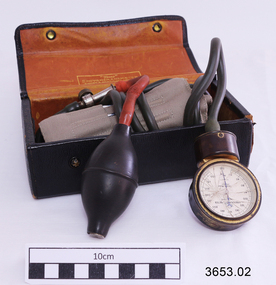
... The case is of black leather with press-stud closure, lined in brown leather with gilded maker's embossing inside lid. ...The case is of black leather with press-stud closure, lined in brown leather with gilded maker's embossing inside lid. ...This blood pressure monitor (sphygmomanometer) belonged to Dr William Roy Angus, surgeon and oculist. It was donated to Flagstaff Hill Maritime Village by his daughter, Berry McDade in January 2015. . It is part of the “W.R. Angus Collection” that includes historical medical equipment, surgical instruments and material once belonging to Dr Edward Ryan and Dr Thomas Francis Ryan, (both of Nhill, Victoria) as well as Dr Angus’ own belongings. The Collection’s history spans the medical practices of the two Doctors Ryan, from 1885-1926 plus that of Dr Angus, up until 1969. The approximate manufacture date of the blood pressure monitor coincides with the time when Doctor William Roy Angus had his practice in Warrnambool. The company Short & Mason Ltd. London used the brand name TYCOS between 1907-1969 and Rudolf Riester (the brand on the cuff) formed the company ‘Riester” in Germany in 1948, where he developed and produced the first mercury blood pressure monitors. In 1939 Dr Angus and his family moved to Warrnambool where he purchased “Birchwood,” the 1852 home and medical practice of Dr John Hunter Henderson, at 214 Koroit Street. (This property was sold in1965 to the State Government and is now the site of the Warrnambool Police Station.). Dr Angus was appointed on a part-time basis as Port Medical Officer (Health Officer) in Warrnambool and held this position until the 1940’s when the government no longer required the service of a Port Medical Officer in Warrnambool; he was thus Warrnambool’s last serving Port Medical Officer. (The duties of a Port Medical Officer were outlined by the Colonial Secretary on 21st June, 1839 under the terms of the Quarantine Act. Masters of immigrant ships arriving in port reported incidents of diseases, illness and death and the Port Medical Officer made a decision on whether the ship required Quarantine and for how long, in this way preventing contagious illness from spreading from new immigrants to the residents already in the colony.) Dr Angus was a member of the Australian Medical Association, for 35 years and surgeon at the Warrnambool Base Hospital 1939-1942, He served as a Surgeon Captain during WWII1942-45, in Ballarat, Victoria, and in Bonegilla, N.S.W., completing his service just before the end of the war due to suffering from a heart attack. During his convalescence he carved an intricate and ‘most artistic’ chess set from the material that dentures were made from. He then studied ophthalmology at the Royal Melbourne Eye and Ear Hospital and created cosmetically superior artificial eyes by pioneering using the intrascleral cartilage. Angus received accolades from the Ophthalmological Society of Australasia for this work. He returned to Warrnambool to commence practice as an ophthalmologist, pioneering in artificial eye improvements. He was Honorary Consultant Ophthalmologist to Warrnambool Base Hospital for 31 years. He made monthly visits to Portland as a visiting surgeon, to perform eye surgery. He represented the Victorian South-West subdivision of the Australian Medical Association as its secretary between 1949 and 1956 and as chairman from 1956 to 1958. In 1968 Dr Angus was elected member of Spain’s Barraquer Institute of Barcelona after his research work in Intrasclearal cartilage grafting, becoming one of the few Australian ophthalmologists to receive this honour, and in the following year presented his final paper on Living Intrasclearal Cartilage Implants at the Inaugural Meeting of the Australian College of Ophthalmologists in Melbourne. In his personal life Dr Angus was a Presbyterian and treated Sunday as a Sabbath, a day of rest. He would visit 3 or 4 country patients on a Sunday, taking his children along ‘for the ride’ and to visit with him. Sunday evenings he would play the pianola and sing Scottish songs to his family. One of Dr Angus’ patients was Margaret MacKenzie, author of a book on local shipwrecks that she’d seen as an eye witness from the late 1880’s in Peterborough, Victoria. In the early 1950’s Dr Angus, painted a picture of a shipwreck for the cover jacket of Margaret’s book, Shipwrecks and More Shipwrecks. She was blind in later life and her daughter wrote the actual book for her. Dr Angus and his wife Gladys were very involved in Warrnambool’s society with a strong interest in civic affairs. Their interests included organisations such as Red Cross, Rostrum, Warrnambool and District Historical Society (founding members), Wine and Food Society, Steering Committee for Tertiary Education in Warrnambool, Local National Trust, Good Neighbour Council, Housing Commission Advisory Board, United Services Institute, Legion of Ex-Servicemen, Olympic Pool Committee, Food for Britain Organisation, Warrnambool Hospital, Anti-Cancer Council, Boys’ Club, Charitable Council, National Fitness Council and Air Raid Precautions Group. He was also a member of the Steam Preservation Society and derived much pleasure from a steam traction engine on his farm. He had an interest in people and the community. He and his wife Gladys were both involved in the creation of Flagstaff Hill, including the layout of the gardens. After his death (28th March 1970) his family requested his practitioner’s plate, medical instruments and some personal belongings be displayed in the Port Medical Office surgery at Flagstaff Hill Maritime Village, and be called the “W. R. Angus Collection”. The W.R. Angus Collection is significant for still being located at the site it is connected with, Doctor Angus being the last Port Medical Officer in Warrnambool.. The collection of medical instruments and other equipment is culturally significant, being an historical example of medicine from late 19th to mid-20th century. Dr Angus assisted Dr Tom Ryan, a pioneer in the use of X-rays and in ocular surgery. Sphygmomanometer (blood pressure meter), from the collection of W.R. Angus. Brand TYCOS by Short & Mason Ltd, London. The case is of black leather with press-stud closure, lined in brown leather with gilded maker's embossing inside lid. The meter has a grey fabric cuff attached to two black rubber tubes, one tube has a pump bulb on a short brown extension tube on the end, the other has a round meter with glass covered dial on the end. Dial registers 20 – 300. There are maker's details on both meter and box."Patent 9535. No. 39370". Gold maker's stamp " "TYCOS" "SPHYGMOMANOMETER / SHORT & MASON LTD. LONDON / company’s logo”. Cloth label sewn on cuff "GERMANY / RIESTER"flagstaff hill, flagstaff hill warrnambool, maritime museum, shipwreck coast, flagstaff hill maritime village, great ocean road, sphygmomanometer, chemist equipment, dr w.r. angus, medical instrument, warrnambool base hospital, medical treatment, medical history -
 Melbourne Tram Museum
Newspaper, The Herald, final day of operation of Collingwood cable trams, 15/4/1939
... Has a photo of passengers with the Gripman and the Conductor on the grip. Time line book gives the closure at 15/4/1939. Refer to Reg Item 1806 for a photo of services being closed in Lonsdale St. ...Closure Has "April 1939" written in ink on the top edge. Newspaper Clipping - from a newspaper a photograph of the final day of operation of Collingwood cable trams in Lonsdale Street, noting that buses take over tomorrow. Has a photo of passengers with the Gripman and the Conductor on the grip. Time line ...Newspaper Clipping - from a newspaper a photograph of the final day of operation of Collingwood cable trams in Lonsdale Street, noting that buses take over tomorrow. Has a photo of passengers with the Gripman and the Conductor on the grip. Time line book gives the closure at 15/4/1939. Refer to Reg Item 1806 for a photo of services being closed in Lonsdale St. Newspaper not known at the time of cataloguing could be The Herald, as it mentions "today" in the photo caption.Has "April 1939" written in ink on the top edge.trams, tramways, cable trams, lonsdale st, collingwood, gripmen, conductors, closure -
 Otway Districts Historical Society
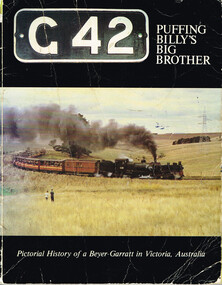
Book, Puffing Billy Preservation Society, G42: Puffing Billy's Big Brother, 1981
... G42 soon followed and duly began work on the equally steep and tortuous but shorter Moe-Walhalla line. Following the closure of the Moe line in 1955 G42 was refurbished and went to Colac. ...G42 soon followed and duly began work on the equally steep and tortuous but shorter Moe-Walhalla line. Following the closure of the Moe line in 1955 G42 was refurbished and went to Colac. ...Victoria's narrow gauge railways were from Wangaratta to Whitfield (covering 30.5 miles/49 km) opening in 1899, Colac to Beech Forest (29 miles/46.7 km) opening in 1902 with an addition to Crowes (14.1 miles/22.7 km) opening in 1910, Upper Ferntree Gully to Gembrook (18.2 miles/29.3 km) opening in 1900, and Moe to Walhalla (26 miles/41.3 km) opening in 1910. From the outset these narrow gauge lines proved very uneconomical in operation and were plagued with continuing financial losses. The lines most difficult to work were those carrying the most business, and in particular the trains from Colac and Moe with their 1 in 30 grades and countless curves precluded having engines with large coupled driving wheels operating. Having examined the possible use of articulated locomotives to reduce operating costs on the narrow gauge lines the Victorian Railways decided upon the Beyer-Garratt type of locomotive in 1925 and an order was placed in England for two engines of the 2-6-0 plus 0-6-2 wheel arrangements. These arrived in April 1926. Assembly of the new Garratts was duly completed and steaming trials carried out at Newport, Victoria, the engines being classed as "G" and given the running numbers "41" and "42". G41 was taken to Colac where, on 5 June 1926, it was put to work on the Colac-Beech Forest-Crowes line. G42 soon followed and duly began work on the equally steep and tortuous but shorter Moe-Walhalla line. Following the closure of the Moe line in 1955 G42 was refurbished and went to Colac. G41 was overhauled, but not as thoroughly as G42, at then returned to Colac where both Garratts shared regular work on the line until its closure in 1962. From 1978 G42 continues its operation on the Upper Ferntree Gully-Gembrook line as part of the Puffing Billy Preservation Society.G42: Puffing Billy's Big Brother. Pictorial history of a Beyer-Garratt in Victoria, Australia. Phil A'Vard, Larry James, Ron Peach (concept). Puffing Billy Preservation Society; Belgrave (Vic); 1980. 64 p.; illus; map. Soft cover. ISBN 0 9598392 7 5victorian railways; narrow gauge; moe; walhalla; colac; beech forest; crowes; upper ferntree gully; gembrook; beyer-garratt; -
 Flagstaff Hill Maritime Museum and Village
Surgical instrument set, early 20th century
... Case has hinged lid, lock, removable compartment; inlaid brass strips, nameplate on lid, brass hook closures. Lined with purple fabric and fitted to hold surgical instruments; brass protective strip under tips of sharp instruments. ...Case has hinged lid, lock, removable compartment; inlaid brass strips, nameplate on lid, brass hook closures. Lined with purple fabric and fitted to hold surgical instruments; brass protective strip under tips of sharp instruments. ...This object was donated to Flagstaff Hill Maritime Village by the family of Doctor William Roy Angus, Surgeon and Oculist. It is part of the “W.R. Angus Collection” that includes historical medical equipment, surgical instruments and material once belonging to Dr Edward Ryan and Dr Thomas Francis Ryan, (both of Nhill, Victoria) as well as Dr Angus’ own belongings. The Collection’s history spans the medical practices of the two Doctors Ryan, from 1885-1926 plus that of Dr Angus, up until 1969. ABOUT THE “W.R.ANGUS COLLECTION” Doctor William Roy Angus M.B., B.S., Adel., 1923, F.R.C.S. Edin.,1928 (also known as Dr Roy Angus) was born in Murrumbeena, Victoria in 1901 and lived until 1970. He qualified as a doctor in 1923 at University of Adelaide, was Resident Medical Officer at the Royal Adelaide Hospital in 1924 and for a period was house surgeon to Sir (then Mr.) Henry Simpson Newland. Dr Angus was briefly an Assistant to Dr Riddell of Kapunda, then commenced private practice at Curramulka, Yorke Peninsula, SA, where he was physician, surgeon and chemist. In 1926, he was appointed as new Medical Assistant to Dr Thomas Francis Ryan (T.F. Ryan, or Tom), in Nhill, Victoria, where his experiences included radiology and pharmacy. In 1927 he was Acting House Surgeon in Dr Tom Ryan’s absence. Dr Angus had become engaged to Gladys Forsyth and they decided he would take time to further his studies overseas in the UK in 1927. He studied at London University College Hospital and at Edinburgh Royal Infirmary and in 1928, was awarded FRCS (Fellow from the Royal College of Surgeons), Edinburgh. He worked his passage back to Australia as a Ship’s Surgeon on the on the Australian Commonwealth Line’s SS Largs Bay. Dr Angus married Gladys in 1929, in Ballarat. (They went on to have one son (Graham 1932, born in SA) and two daughters (Helen (died 12/07/1996) and Berenice (Berry), both born at Mira, Nhill ) Dr Angus was a ‘flying doctor’ for the A.I.M. (Australian Inland Ministry) Aerial Medical Service in 1928 . The organisation began in South Australia through the Presbyterian Church in that year, with its first station being in the remote town of Oodnadatta, where Dr Angus was stationed. He was locum tenens there on North-South Railway at 21 Mile Camp. He took up this ‘flying doctor’ position in response to a call from Dr John Flynn; the organisation was later known as the Flying Doctor Service, then the Royal Flying Doctor Service. A lot of his work during this time involved dental surgery also. Between 1928-1932 he was surgeon at the Curramulka Hospital, Yorke Peninsula, South Australia. In 1933 Dr Angus returned to Nhill where he’d previously worked as Medical Assistant and purchased a share of the Nelson Street practice and Mira hospital from Dr Les Middleton one of the Middleton Brothers, the current owners of what was once Dr Tom Ryan’s practice. Dr L Middleton was House Surgeon to the Nhill Hospital 1926-1933, when he resigned. [Dr Tom Ryan’s practice had originally belonged to his older brother Dr Edward Ryan, who came to Nhill in 1885. Dr Edward saw patients at his rooms, firstly in Victoria Street and in 1886 in Nelson Street, until 1901. The Nelson Street practice also had a 2 bed ward, called Mira Private Hospital ). Dr Edward Ryan was House Surgeon at the Nhill Hospital 1884-1902 . He also had occasions where he successfully performed veterinary surgery for the local farmers too. Dr Tom Ryan then purchased the practice from his brother in 1901. Both Dr Edward and Dr Tom Ryan work as surgeons included eye surgery. Dr Tom Ryan performed many of his operations in the Mira private hospital on his premises. He too was House Surgeon at the Nhill Hospital 1902-1926. Dr Tom Ryan had one of the only two pieces of radiology equipment in Victoria during his practicing years – The Royal Melbourne Hospital had the other one. Over the years Dr Tom Ryan gradually set up what was effectively a training school for country general-practitioner-surgeons. Each patient was carefully examined, including using the X-ray machine, and any surgery was discussed and planned with Dr Ryan’s assistants several days in advance. Dr Angus gained experience in using the X-ray machine there during his time as assistant to Dr Ryan. Dr Tom Ryan moved from Nhill in 1926. He became a Fellow of the Royal Australasian College of Surgeons in 1927, soon after its formation, a rare accolade for a doctor outside any of the major cities. He remained a bachelor and died suddenly on 7th Dec 1955, aged 91, at his home in Ararat. Scholarships and prizes are still awarded to medical students in the honour of Dr T.F. Ryan and his father, Dr Michael Ryan, and brother, John Patrick Ryan. ] When Dr Angus bought into the Nelson Street premises in Nhill he was also appointed as the Nhill Hospital’s Honorary House Surgeon 1933-1938. His practitioner’s plate from his Nhill surgery states “HOURS Daily, except Tuesdays, Fridays and Saturday afternoons, 9-10am, 2-4pm, 7-8pm. Sundays by appointment”. This plate is now mounted on the doorway to the Port Medical Office at Flagstaff Hill Maritime Village, Warrnambool. Dr Edward Ryan and Dr Tom Ryan had an extensive collection of historical medical equipment and materials spanning 1884-1926 and when Dr Angus took up practice in their old premises he obtained this collection, a large part of which is now on display at the Port Medical Office at Flagstaff Hill Maritime Village in Warrnambool. During his time in Nhill Dr Angus was involved in the merging of the Mira Hospital and Nhill Public Hospital into one public hospital and the property titles passed on to Nhill Hospital in 1939. In 1939 Dr Angus and his family moved to Warrnambool where he purchased “Birchwood,” the 1852 home and medical practice of Dr John Hunter Henderson, at 214 Koroit Street. (This property was sold in1965 to the State Government and is now the site of the Warrnambool Police Station. ). The Angus family was able to afford gardeners, cooks and maids; their home was a popular place for visiting dignitaries to stay whilst visiting Warrnambool. Dr Angus had his own silk worm farm at home in a Mulberry tree. His young daughter used his centrifuge for spinning the silk. Dr Angus was appointed on a part-time basis as Port Medical Officer (Health Officer) in Warrnambool and held this position until the 1940’s when the government no longer required the service of a Port Medical Officer in Warrnambool; he was thus Warrnambool’s last serving Port Medical Officer. (The duties of a Port Medical Officer were outlined by the Colonial Secretary on 21st June, 1839 under the terms of the Quarantine Act. Masters of immigrant ships arriving in port reported incidents of diseases, illness and death and the Port Medical Officer made a decision on whether the ship required Quarantine and for how long, in this way preventing contagious illness from spreading from new immigrants to the residents already in the colony.) Dr Angus was a member of the Australian Medical Association, for 35 years and surgeon at the Warrnambool Base Hospital 1939-1942, He served as a Surgeon Captain during WWII1942-45, in Ballarat, Victoria, and in Bonegilla, N.S.W., completing his service just before the end of the war due to suffering from a heart attack. During his convalescence he carved an intricate and ‘most artistic’ chess set from the material that dentures were made from. He then studied ophthalmology at the Royal Melbourne Eye and Ear Hospital and created cosmetically superior artificial eyes by pioneering using the intrascleral cartilage. Angus received accolades from the Ophthalmological Society of Australasia for this work. He returned to Warrnambool to commence practice as an ophthalmologist, pioneering in artificial eye improvements. He was Honorary Consultant Ophthalmologist to Warrnambool Base Hospital for 31 years. He made monthly visits to Portland as a visiting surgeon, to perform eye surgery. He represented the Victorian South-West subdivision of the Australian Medical Association as its secretary between 1949 and 1956 and as chairman from 1956 to 1958. In 1968 Dr Angus was elected member of Spain’s Barraquer Institute of Barcelona after his research work in Intrasclearal cartilage grafting, becoming one of the few Australian ophthalmologists to receive this honour, and in the following year presented his final paper on Living Intrasclearal Cartilage Implants at the Inaugural Meeting of the Australian College of Ophthalmologists in Melbourne In his personal life Dr Angus was a Presbyterian and treated Sunday as a Sabbath, a day of rest. He would visit 3 or 4 country patients on a Sunday, taking his children along ‘for the ride’ and to visit with him. Sunday evenings he would play the pianola and sing Scottish songs to his family. One of Dr Angus’ patients was Margaret MacKenzie, author of a book on local shipwrecks that she’d seen as an eye witness from the late 1880’s in Peterborough, Victoria. In the early 1950’s Dr Angus, painted a picture of a shipwreck for the cover jacket of Margaret’s book, Shipwrecks and More Shipwrecks. She was blind in later life and her daughter wrote the actual book for her. Dr Angus and his wife Gladys were very involved in Warrnambool’s society with a strong interest in civic affairs. Their interests included organisations such as Red Cross, Rostrum, Warrnambool and District Historical Society (founding members), Wine and Food Society, Steering Committee for Tertiary Education in Warrnambool, Local National Trust, Good Neighbour Council, Housing Commission Advisory Board, United Services Institute, Legion of Ex-Servicemen, Olympic Pool Committee, Food for Britain Organisation, Warrnambool Hospital, Anti-Cancer Council, Boys’ Club, Charitable Council, National Fitness Council and Air Raid Precautions Group. He was also a member of the Steam Preservation Society and derived much pleasure from a steam traction engine on his farm. He had an interest in people and the community He and his wife Gladys were both involved in the creation of Flagstaff Hill, including the layout of the gardens. After his death (28th March 1970) his family requested his practitioner’s plate, medical instruments and some personal belongings be displayed in the Port Medical Office surgery at Flagstaff Hill Maritime Village, and be called the “W. R. Angus Collection”. The W.R. Angus Collection is significant for still being located at the site it is connected with, Doctor Angus being the last Port Medical Officer in Warrnambool. The collection of medical instruments and other equipment is culturally significant, being an historical example of medicine from late 19th to mid-20th century. Dr Angus assisted Dr Tom Ryan, a pioneer in the use of X-rays and in ocular surgery. Surgical instrument set in wooden case contains instruments for ophthalmic (eye) surgery. Case has hinged lid, lock, removable compartment; inlaid brass strips, nameplate on lid, brass hook closures. Lined with purple fabric and fitted to hold surgical instruments; brass protective strip under tips of sharp instruments. Contains 8 fine instruments and 3 long, glass head pins. Scissors have corrosion. (Set is incomplete). Inlaid cream strip along inside edge with black print "ARNOLD & SONS" WEST SMITHFIELD LONDON" Instrument have varying impressed marks "MAYER & MELTZER, LONDON or "M&M LONDON" or "M&M Co" or "GRESCOE" (W.R. Angus Collection) Inlaid cream strip along inside edge with black print "ARNOLD & SONS" WEST SMITHFIELD LONDON" Instrument have varying impressed marks "MAYER & MELTZER, LONDON or "M&M LONDON" or "M&M Co" or "GRESCOE"flagstaff hill, warrnambool, shipwrecked-coast, flagstaff-hill, flagstaff-hill-maritime-museum, maritime-museum, shipwreck-coast, flagstaff-hill-maritime-village, surgical instrument set, dr w r angus, medical equipment, surgical instrument, dr ryan, ophthalmology, s.s. largs bay, warrnambool base hospital, nhill base hospital, flying doctor, medical history, medical treatment, mira hospital, medical education, medical text book -
 Ballarat Tramway Museum
Photograph - Black & White Photograph/s - set of 5 - tram operations on the Victoria St, Richard Gilbert, c August 1971
... Series of 5 Black and white photographs of tram operations on the Victoria St line prior to its closure in August 1971. .1 - View of the Victoria St terminus as you arrive in Ballarat from Melbourne, with the divided highway and a tram warning sign. ...Yields information about the appearance of the Victoria St line shortly before the closure of the Victoria St line. ...Yields information about the appearance of the Victoria St line shortly before the closure of the Victoria St line. Series of 5 Black and white photographs of tram operations on the Victoria St line prior to its closure in August 1971. .1 - View of the Victoria St terminus as you arrive in Ballarat from Melbourne, with the divided highway and a tram warning sign. Has a tram at the terminus. .2 - Tram 39, running a special tour with St Alipius church in the background. A new bus stop sing has been positioned. Another tram has departed the King St loop. .3 - No. 13, (Gardens via Sturt St West and a Twin Lakes sign) entering the King St loop. .4 - No. 31 (to Gardens crossing No. 39) at the King St loop. .5 - No. 31 leaving Stones Corner for Victoria St with Stones Corner building in the background along with the Caltex service station and Viscount Ambassador caravans.trams, tramways, victoria st, king st, stones corner, tram 39, tram 13, tram 31 -
 Kew Historical Society Inc
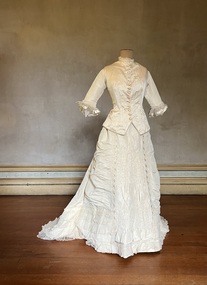
Clothing - Ivory silk and tulle bridesmaid's outfit, 1874
... The ivory silk satin peplum jacket is boned, tailored, and fitted with many princess line panels. The front closure has handmade embroidered buttonholes and covered buttons. ...The ivory silk satin peplum jacket is boned, tailored, and fitted with many princess line panels. The front closure has handmade embroidered buttonholes and covered buttons. ...This bridesmaid's dress was owned and first worn by Alice Frances Henty, the daughter of Francis Henty and Mary Ann (Lawrence) Henty. The outfit was worn at the marriage of her friend Miss Hopkins to Mr ST Staughnton in 1874. Alice's father, Francis Henty, was the youngest son of Thomas Henty, who with his family, their retainers and property moved to the Australian colonies between 1829 and 1832. In 1834, Francis’ older brother, Edward, sailed from Launceston in Van Diemen’s Land to what was to become Portland in the western part of Port Phillip District [Victoria]. Francis, together with the first flock of Merino sheep [in Victoria], followed some months later. The first and second generations of the Henty family established vast pastoral properties in the Western part of the Port Phillip District. Francis Henty managed ‘Merino Downs’ near Casterton, while also living in his retirement at ‘Field Place' in Kew. The Henty Collection of nineteenth and twentieth century clothing, including outerwear and underwear, was collected, stored and exhibited over time by female family members descended from Francis and Mary Ann Henty. During the twentieth century, items from the collection were modelled in two fashion parades by various descendants [1937, 1959]. The items in the collection are historically and aesthetically significant, with provenance provided by oral and written tradition within or held by the family. A number of the items in the collection are very rare survivors, and provide researchers with the evidence needed to reconstruct the lives of notable women in the Port Phillip District [later Victoria] during the nineteenth and early twentieth century.An ivory silk skirt and matching jacket worn by Alice Henty, aged 22, at the marriage of her friend Lizzie Hopkins and S.T. Staugnton in 1874. The ivory silk satin peplum jacket is boned, tailored, and fitted with many princess line panels. The front closure has handmade embroidered buttonholes and covered buttons. The collar and sleeves are decorated with gathered silk tulle frills. The peplum back features a silk cord bow decoration. The skirt with bustle and train features a central panel with hand ruching and silk satin piping. It is decorated with five rows of pleated silk tulle frills. Measurements (mm): PEPLUM JACKET Girth - Neck 317.5, Chest 914.4, Waist 698.5, Hip 965.2, Cuff 279.4, Hem circumference 1168.4. Vertical - From neck to hem 558.8, Front waist to hem 254, Back neck to hem 838.2, Back waist to hem 241.3, Sleeve length 279.4. Horizontal - Neck to sleeve head 165.1,Cross back 292.1, Underarm to underarm 393.7. SKIRT Girth - Waist 635, Hip 914.4, Hem circumference 3810. Vertical - Front waist to hem 1092.2, Back waist to hem 1701.8. fashion -- 1870s, alice frances (henty) hindson, women's clothing, bridesmaid's dresses -
 Bendigo Military Museum
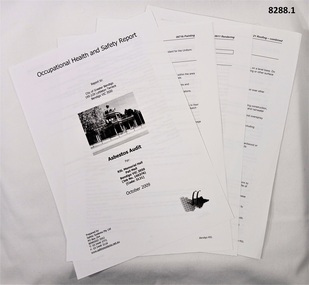
Mixed media - SOLDIERS MEMORIAL INSTITUTE RESTORATION & REDEVELOPEMENT 2009 - 2015
... C/C Peter to Co Ordinate a time line of works, Museum closures and draw up basic plans for Office upgrade. 1.9.2011 P1. ...C/C Peter to Co Ordinate a time line of works, Museum closures and draw up basic plans for Office upgrade. 1.9.2011 P1. ...These records, plans, maps and documentation revolve around the Soldiers Memorial Institute Pall Mall Bendigo. (Now Bendigo Military Museum) This sequence of events regarding works begins in 2009 and goes through to 2015.It can be broken up into Phase 1 (P1) ongoing Works and Phase 2 (P2) Redevelopment/Revitalisation as one followed the other and overlapped. The following list by date/year is a very brief outline of the discussions, meetings, planning and works completed. October 2009 P1. Asbestos Audit carried out. 2010 P1. First assessments of Asbestos in the Office, Foyer, Passage & Meeting room. Asbestos was removed from the Men’s toilet. This would also include a new Trap door over the Mine situated under the Billiard room. 11.10.2011 P1. New trap door installed in the Billiard room. 15.10.2011 P1. Mine is checked with ground penetrating Radar. June 2011 P1. Asbestos removal in the kitchen. (Not in use) Following on : Asbestos in the Meeting room & Passage is clear, carpet in the Office to come up, asbestos removal in the Women’s toilets. Structural damage to the front wall of the Office and Fireplace wall, false ceiling in the office (refer Cat No 8218) At this point a group being CoGB Property Manager, Heritage, Contractors, Museum Curator/Chairman Sub Committee Peter Ball (C/C) RSL Secretary Paul Penno, RSL Club Manager Erik & Maiintenance Ken to be involved. C/C Peter to Co Ordinate a time line of works, Museum closures and draw up basic plans for Office upgrade. 1.9.2011 P1. Due to Office walls damage talks decided to upgrade the Office, the room is stripped and the false ceiling comes down. 15.9.2011 P1. Foyer, asbestos tiles removed. 20.9.2011 P1. Floor and timber finish approved by Property Manager. Some works being done in the kitchen. Phase 2 beginnings. P2. During 2011 the Sec RSL Paul discussed with C/C Peter a broader upgrade of the entire building with emphasis on the Rear Fibro addition which incorporated the stage, toilets and storage. Sec Paul, Pres Cliff Richards, C/C Peter met to form a plan forward. 20.10.2011 P2. Letter to C of GB regarding this phase and request for a meeting. 22.11.2011 P2. Meeting between 2 x C o GB and Sec Paul, Pres Cliff, C/C Peter RSL. C/C Peter to draw up a Dot point plan. 23.11.2011 P1. Office is completed enough to move in. 2.1.2012 P1. Works in the kitchen had begun but now to be fully gutted. 20.2.2012 P1. C/C Peter to draw up a basic plan of kitchen for use by the Museum/RSL. Mid July 2012 PI. Kitchen completed enough for use. 23.10.2012 P2. Meeting with C of GB and 3 x Museum to draw up a Business plan, a new Conservation Management Plan (CMP), $ commitment discussed. 10.12.2012 P2. Facilitator Murray Poustie RSL Historian, C/C Peter and 2 x Museum Sub Committee Marg Andrea and John Young to put together a business plan. 4.1.2013 P2. New CMP arrives, number of issues with. 15.1.2013 P2. Meeting with C of GB, Heritage, C/C Peter and M Poustie re corrections CMP. 16.1.2013 P2. First meeting of Museum group with basic plans put together. 23.1.2013 P2. Second meeting of Museum group, alterations made. 30.1.2023 P2. New CMP arrives. 7.2.2013 P1. Final Kitchen finished with Air con installed. 8.2.2013 P2. Plans adopted by Museum group. 13.2.2013 P2. Plans put to Bendigo RSL. 15.3.2013 P2. Plans updated with meeting between C/C Peter, Sec Paul, Pres Cliff, Manager Erik, forwarded to Council. 26.3.2013 P2. Scope of planning arrives back from C of GB. August 2013 P2. New Working group formed, Sec Paul, C/C Peter, Sub/comm member John. Meeting with Ian Ross & 1 SED & W/Group to develope the Business plan further, one item that no works to be done before 1.1.2016 due to 2015 being Centenary of Anzac. A 2nd meeting a week later. P1. At this point the Rotunda was not part of the initial process 23.9.2013 P1. Inspection of the North front wall by C of GB, Heritage & C/C Peter. Asbestos sample taken & positive. Water damage/cracks as in Office Walls. 11.10.2013 P1. C of GB, Heritage have another look at Rotunda. No works before to be done until the dryer months. 11.10.2013 P2. First meeting with Concept planners Lovell Chen x 3, Council x 3, Heritage x 2, SED x 1 & Museum x 3 group. Introductory meeting so all up to date, Museum walk through. 12.11.2013 P2. 2nd meeting of the above with draft proposals of extension upgrade of SMI presented. 18.12.2013 P2. 3rd meeting with above, number of small changes made. 2014 P2. Sec Paul, Pres Cliff, C/C Peter met with full Council to put the case to them. 2014 P1. Meeting with Council, Contractors, C/C Peter re Rotunda maintenance, asbestos removal to be on 30.5.2014 to fit in with current Museum Bookings. 4.11.2014 P2. An Orientation day was held for prospective detailed Planning. 11.11.2014, C/C Peter met with C of GB group to choose the tender for the final detailed drawings, Lovell Chen chosen, to be finalised by April 2015. 20.1.2015 P2. Bore holes drilled at rear of SMI re possible below ground structure. 18.2.2015 P2 1st meeting of Working group, 4 x Lovell Chen, various Council departments x 10, Museum x 3, Art Gallery x 1. 17.3.2015 P2. 2nd meeting of W/Group, a meeting with SED and SED presentation to the RSL. 5.5.2015 P2. 3rd meeting of the W/group with latest plans & possibly final. 4.6.2015 P2. 4th meeting of the W/group, planning permit & Heritage applications will now go ahead. On paper still 2 years planning & 4 years construction. P1. The Rotunda completed with new membrane and touch up painting. 30.6.2015 P2. Final meeting of W/group, from now on just planning, approvals, Heritage & Public objections. Fund raising to begin. Further to this scope. 3.8.2015 P2. Sec Paul & C/C Peter put the plans to Committee BDRSL and are approved. 5.8.2015 P2. Plans signed by Sec Paul and forwarded to C of GB Council. Cat No 8328.11 is another part in the ongoing Plans. .1) Occupational Health and Safety Report re Asbestos in the Soldiers Memorial Institute Hall Pall Mall Bendigo for the City of Greater Bendigo - prepared by “Safety Systems PTY LTD Bendigo - October 2009”. 55 pages double sided, all print in B & W. .2) Correspondence, 80 pages A4 dated 20.10.2011 to 23.12.2013, letters, emails, plans, maps, fund raising relating to Phase 2. Items involve, RSL, C of GB, Heritage, SED, Political Parties, Government. .3) .4) Conservation Management plans Returned Soldiers Memorial Hall Pall Mall Bendigo, both 65 pages, A4, Colour and B & W, contains Contents, maps, diagrams, charts, photos put together by "Context PTY LTD Brunswick Victoria. .3) Draft copy dated 19.12.2012, has green Texta markings throughout and biro notes. .4) Final report with corrections dated 24.1.2013. .5) .6) Soldiers Memorial Institute Museum Business Plan, January 2013, A4 17 pages, In Colour & B & W, contents, maps and planning. .5) Revised edition in plastic insert folder. .6) Revised edition for presentation purposes. .7) .8) Business Planning documents by Ian Ross SED Advisory 2013. .7) Business Plan A4, B & W, 12 pages, copy of the initial plan dated 19.8.2013. .8) Bendigo Soldiers Memorial Institute Museum Business Plan December 2013, updated presentation version, plastic covers, A4, Colour & B & W, 31 pages, covers, Vision, Priorities, strategic actions/interventions, action/outcome plan. Appendix A, Appendix B. Photos, plans, potential funding and where from. .9) Letter, documents, drawing relating to the replacement of the Balcony Membrane of the Soldiers Memorial Institute. The letter is 4 pages from Meagan, Heritage C of GB to Sec Paul, C/C Peter regarding the replacement of the Membrane dated 18.2.2014. 15 pages of Membrane works prepared by Lovell Chen to be carried out, dated 14.2.2014. The drawing shows the detail of how the replacement will be. .10) Photographs of the Soldiers memorial Institute (55), taken during phase 2, A4, colour showing external walls and roofing and damage, internal taken in the loft, all rooms, damage to areas. .11) Three folders, spiral bound, plastic covers, Colour and B & W images, the 3 front pages are all different. Contents are plans, sketches, proposals, from Demolition maps to final specifications. Folder 1. 11 pages, one sided dated December 2013, Lovell Chen. Folder 2. 14 pages, one sided dated December 2014, Lovel Chen. Folder 3. 21 pages, one sided dated December 2104 and May 2015, Lovel Chen.brsl, smirsl, restoration, asbestos, business, plans, conservation -
 Flagstaff Hill Maritime Museum and Village
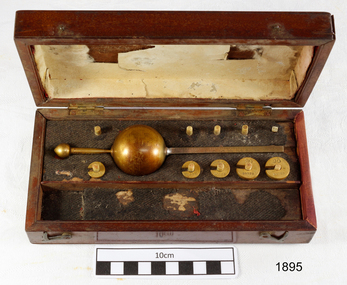
Instrument - Hydrometer, 1878 to 1930s
... The fitted, fabric-lined box has two brass closures and two brass hinges. The scientific instrument shows signs of heavy use and repairs. ...The fitted, fabric-lined box has two brass closures and two brass hinges. The scientific instrument shows signs of heavy use and repairs. ...This Sikes brass hydrometer was manufactured by the optical and scientific instrument makers Kasner & Moss of 17 Collins Street West, Melbourne, in the latter part of the nineteenth century. The firm adverted hydrometers, as well as optical instruments, as early as August 13th, 1864, in The Age, Melbourne. This hydrometer set was donated to Flagstaff Hill in 1979 by local wine and spirits merchants Lynch Bros of Fairy Street, Warrnambool. Giffen Russell had established the business in 1878, and Harry Lynch took it over in the 1930s, and after he passed away in 1953 Kevin Matthew Lynch became proprietor of K M Lynch Food and Liquor. The business closed in the 2010s. The hydrometer may date back to the establishment of the business in 1878, as Kasner & Moss were selling hydrometers in Melbourne from 1864. Hydrometers were used to measure the density, or relative density, of liquids from the late 1600s. In 1816 Bartholomew Sikes won the competition for the most useful accurate hydrometer. Hydrometers were commonly used by distillers, vintners, and brewers to establish accurate measures of alcohol concentration in their beverages. Following this manufacturing process, government inspectors and excise officers used them to check that the labelled indications of alcohol-proof were correct and that the right amounts of duty were being paid. This hydrometer and its fitted and hinged wooden container show signs of heavy and protracted use in a working environment. Although the instrument has some parts missing and has been recently repaired, the original quality of the inlaid box and the fine engraving on the instrument and the attachable weights, are indications of the hydrometer’s very real value when new. This Sikes hydrometer, bearing the maker's mark of “Kasner & Moss Melbourne” and the registered number “20373”, was presented to the purchasing public as a precision-made instrument designed for professional use. The Sikes hydrometer is of local significance because of its implied association with the alcohol trade in the southwest region of Victoria. It was donated by a family member of Lynch Bros, a local licensed outlet for wines and spirits in the period before the general relaxation of liquor licensing laws in the State of Victoria. It may have belonged to Griffin Russell who established the liquor store in 1878.Hydrometer; original Sikes brass hydrometer in a polished wooden case with an inlaid plaque on the lid. The brass float is a sphere with a thin flat upper stem and a short, lower stem with a bulb-shaped end. The upper stem is engraved scale on both sides with the numbers 1 to 10, and five divisions between each number. There are ten fixed pegs in the base to secure the thick brass horseshoe-shaped, numbered, various-sized weights (20, 30, 40, 80, 90); the free pegs would have originally stored another five weights (10, 50, 60, 70, and 100). The empty compartment in the box suggests another part in the initial set, probably a thermometer. The fitted, fabric-lined box has two brass closures and two brass hinges. The scientific instrument shows signs of heavy use and repairs. The Serial Number on the float matches the Serial Numbers on the weights. The plaque on the lid, the float and the weights have inscriptions. Made by Kasner & Moss, Melbourne. Plaque: “SIKES HYDROMETER / KASNER & MOSS / MELBOURNE” On float's lower stem: “SIKES 20373” On one thin edge of the float's scale, engraved in script “Kasner & Moss” and stamped “MELBOURNE”, and symbol“P” rotated 90 degrees. On the opposite thin edge of the float: “N20.373”, “SIKES”, “I P % II O” (in ornate capitals). Each weight has s unique number, and the same serial number “20373”.flagstaff hill, flagstaff hill maritime museum and village, warrnambool, maritime museum, maritime village, great ocean road, shipwreck coast, sikes hydrometer, scientific instrument, pressure measurement, measuring instrument, ullage tool, customs, excise duty, tax, alcohol content, proof, calibrate, standard weights and measures, tariff, kasner & moss, scientific instrument makers, specific gravity, liquid density, alcohol testing, technology, alcohol measurement, proof spirit, wine and spirits merchants, local business, brass measuring instrument, k m lynch, giffen russell, harry lynch -
 Flagstaff Hill Maritime Museum and Village
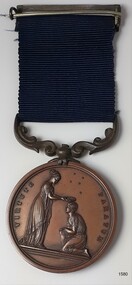
Award - Medal, James Patten, 18-041890
... Case is padded and lined with blue silk and has a fitted hook. The round medal has a bronze bar with pin closure, dark blue, braided ribbon with brass swivel mount. ...Case is padded and lined with blue silk and has a fitted hook. The round medal has a bronze bar with pin closure, dark blue, braided ribbon with brass swivel mount. ...The Bronze Medal and Certificate of Merit of the Royal Humane Society of Australasia were awarded to James Patten for the bravery he displayed on 18th April 1890, and presented to him on 21st May 1890. The Royal Humane Society of Australasia was founded in 1874 with the aim to recognise those who risked their lives to save others and to assist those whose acts of bravery caused them or their surviving dependants to be disadvantaged in some way. Details of the incident were published in the Argus, Saturday 19 April 1890, page 11 - "FATAL BOATING ACCIDENT, (BY TELEGRAPH FROM OUR CORRESPONDENT.), WARRNAMBOOL, FRIDAY A fatal boating disaster occurred in Lady Bay this morning, the victim being Joseph Lowe, licensee of the Bay View Hotel, South Warrnambool. The deceased, in company with two lads named James Ferrier and James Patten, went out in a small dingy to shoot musk ducks. The water was perfectly smooth, and the party were tempted to proceed as far as the mouth of the Hopkins River. In their eagerness they neglected to keep clear of the breakers, and were presently carried in on the crest of a large wave, and the boat cap sized within a cable's length of the shore, precipitating the occupants into the water. Patten and Lowe stuck to the overturned boat, Ferrier striking out for the shore, which he reached in an exhausted state. In the meantime his companions had been washed off the boat, and were struggling in the breakers. Lowe was unable to swim, and Patten kept him afloat, at the same time making gallant attempts to get him ashore, but finally had to leave him to his fate. Ferrier, seeing Lowe's danger, undressed and swam out, but became exhausted. Ferrier and Patten were both found in a fainting condition by persons who saw the catastrophe from the jetty, and ran along the beach to render assistance. Attempts were subsequently made to rescue Lowe's body, which could be seen washing abort in the surf. These proved unsuccessful, and no hope is now entertained of recovering it. Lowe was a smart young man, 28 years of age, and unmarried. He was formerly bar-man at the Commercial Hotel here, having been engaged in Melbourne ..." This medal recognises the bravery of James Patten, a local citizen who risked his life to save the life of his friend Joseph Lowe whilst at sea and was recognised for this act by the Royal Humane Society of Australasia.Medal awarded to James Patten by the Royal Humane Society of Australasia for his bravery on18 April 1890 and presented to him on 21 May 1890. Bronze medal in hard black rectangular case. Lid and base have centre hinge and brass spring button catch. Case is padded and lined with blue silk and has a fitted hook. The round medal has a bronze bar with pin closure, dark blue, braided ribbon with brass swivel mount. The case has a gold embossed rectangular border on the lid and base. Embossed inscription on lid. The obverse shows a woman on the left in long robe placing a wreath on the head of a kneeling man at right, with the five stars of the Southern Cross constellation above his head. A motto is inscribed around the edge. The reverse has inscriptions around the edge, a wreath of two overlapping olive branches, and engraved text.OBVERSE: Embossed around "VIRTUTE PARATUM" REVERSE: Embossed on the medal around the edge "ROYAL HUMANE SOCIETY OF AUSTRALASIA INSTD. A.D. 1874", in the centre "AWARDED TO" Engraved in the centre "James Patten/ 18th April / 1890" CASE LID: "PRESENTED BY / THE ROYAL HUMANE SOCIETY / OF AUSTRALASIA / TO / JAS. PATTEN. / 21ST MAY 1890."flagstaff hill, warrnambool, flagstaff-hill, maritime museum, maritime village, shipwreck-coast, flagstaff hill maritime museum & village, bronze medal 1890, royal humane society of australasia, james patten, medal, australian award medal, commemorative medal, numismatics, life saving, lifesaving, rescue, bravery, drowning, joseph lowe, james ferrier, lady bay, hopkins river, boating accident, certificate of merit, north eastern bight -
 The Beechworth Burke Museum
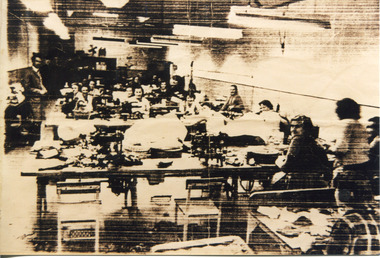
Photograph, Between 1946 and 1961
... line with the ‘White Australia Policy’. In 1954 Beechworth had 170 migrants from the UK, 102 from Hungary, and 63 from Germany. The factory closed in 1961 as increased centralisation of both populations and industry in the larger nearby towns of Wangaratta and Wodonga lead to the closure of many factories in small towns in the 1960s and 1970s. ...line with the ‘White Australia Policy’. In 1954 Beechworth had 170 migrants from the UK, 102 from Hungary, and 63 from Germany. The factory closed in 1961 as increased centralisation of both populations and industry in the larger nearby towns of Wangaratta and Wodonga lead to the closure of many factories in small towns in the 1960s and 1970s. ...Elgin Shoes Pty., Ltd., established a branch shoe factory in Beechworth in 1946. Managing director, Mr T Nagle Pitman, selected Beechworth as a suitable location for the factory due to the availability of labour in the town, particularly girls under sixteen years of age. At its peak, the shoe factory employed thirty six women and girls, which also included post-war migrants. After the Second World War, Australia admitted increasing numbers of immigrants in order to fulfil labour requirements for a rapidly inflating demand of consumer goods. These migrants were largely from European Countries in line with the ‘White Australia Policy’. In 1954 Beechworth had 170 migrants from the UK, 102 from Hungary, and 63 from Germany. The factory closed in 1961 as increased centralisation of both populations and industry in the larger nearby towns of Wangaratta and Wodonga lead to the closure of many factories in small towns in the 1960s and 1970s. This photograph is historically significant as it shows the working conditions in a factory primarily staffed by women at some point between the late 1940s and early 1960s. Sepia rectangular photograph printed on matte photographic paperReverse: 14 / AFGA / 6982 / pitman shoe factory, elgin shoe company, industry, shoe factory, shoemaking, working women, post-war migration, factory, white australia policy, mid-twentieth century women's working conditions, twentieth-century working conditions, pitman, elgin, shoe, sewing machine, leather, pittman -
Marysville & District Historical Society
THE TRIANGLE NEWS-VOL 41 NO 48-DECEMBER 5 2014
... marysville victoria australia marysville ugly duckling comes of age the tower motel vibe hotel & conference centre what's on when in december donation accepted by peter cobb the committee of management of the gallipoli park precinct public notice proposed sale of land buxton tennis courts buxton post office trading hours marysville golf report church notices promote your community group on line mayor's chair by councillor margaret rae murrindindi shire council half day council office and library closures planning & environmental act 1987 murrindindi planning scheme marysville & triangle community men's shed advertisements great victorian bike ride road closures & event information open gardens marysville marysville triangle real estate THE TRIANGLE NEWS-VOL 41 NO 48-DECEMBER 5 2014 ...marysville, victoria, australia, marysville ugly duckling comes of age, the tower motel, vibe hotel & conference centre, what's on when in december, donation accepted by peter cobb, the committee of management of the gallipoli park precinct, public notice proposed sale of land, buxton tennis courts, buxton post office trading hours, marysville golf report, church notices, promote your community group on line, mayor's chair by councillor margaret rae, murrindindi shire council, half day council office and library closures, planning & environmental act 1987, murrindindi planning scheme, marysville & triangle community men's shed, advertisements, great victorian bike ride, road closures & event information, open gardens marysville, marysville triangle real estate -
 Flagstaff Hill Maritime Museum and Village
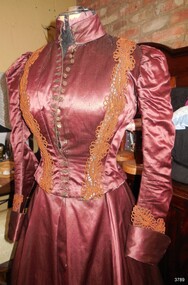
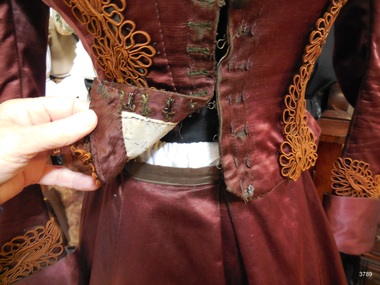
Clothing - Jacket, before April 1874
... The amber coloured satin jacket is fully lined, has turned-back cuffs, a band collar, and looped, coffee-coloured braid trim. A row of closely spaced, round bronze buttons with a floral motif form a decorative closure most of the way down the front of the jacket, below which are metal hooks and eyes that finish at the waist. ...The buttons may have been used to replace missing buttons on the front of the jacket or perhaps to repair worn cuffs antique satin jacket colonial evening jacket ladies evening jacket 19th century ladies satin jacket evening outfit The amber coloured satin jacket is fully lined, has turned-back cuffs, a band collar, and looped, coffee-coloured braid trim. A row of closely spaced, round bronze buttons with a floral motif form a decorative closure most of the way down the front of the jacket, below which are metal hooks and eyes that finish at the waist. ...THE JACKET This jacket has been tailored to flatter the wearer’s figure. It also has elements that keep it in good shape and condition, preserve it from soiling and give it a longer life: - the hooks and eyes that join the jacket to the skirt allow the outfit to be made in two pieces but fit close to the body without exposing undergarments - the seams for the metal stays have been cut and stitched to allow maximum movement of the wearer and still keep a trim figure - the discreet breast pocket allows the wearer to keep a handkerchief, coins or other small items close at hand - the lining includes removable padded shields to absorb underarm perspiration - the lining has two cotton loops attached for hanging up to air and freshen it - new cuffs have been attached over the original sleeves that have buttonholes but no buttons. The buttons may have been used to replace missing buttons on the front of the jacket or perhaps to repair worn cuffs The amber coloured satin jacket is fully lined, has turned-back cuffs, a band collar, and looped, coffee-coloured braid trim. A row of closely spaced, round bronze buttons with a floral motif form a decorative closure most of the way down the front of the jacket, below which are metal hooks and eyes that finish at the waist. Underneath the cuffs there is a closely fitted cuff with a row of three button holes but no buttons. The jacket lining has vertical metal stays spaced around the midriff, sides and back. There is an absorbent, removable pad hand-stitched to the underarm section of each sleeve opening. A small satin pocket is stitched discreetly onto the lining above the chest on the right-hand side. There are also two cotton loops sewn onto the lining. Several small metal rings are sewn at intervals around the inside of the waist A satin bow from the same fabric is attached at the centre back of the jacket at waist level. antique satin jacket, colonial evening jacket, ladies evening jacket, 19th century ladies satin jacket, evening outfit -
 Flagstaff Hill Maritime Museum and Village
Clothing - Skirt, before April 1874
... lined, floor-length, amber satin skirt has gentle folds that gather into a fitted waistband. One of the folds at the back conceals the opening of the skirt that fastens using metal hooks and eyes. The bow at the back of the jacket covers the top of the closure...lined, floor-length, amber satin skirt has gentle folds that gather into a fitted waistband. One of the folds at the back conceals the opening of the skirt that fastens using metal hooks and eyes. The bow at the back of the jacket covers the top of the closure ...THE SKIRT The skirt has a gentle, soft, feminine design which keeps it in good shape and condition, preserving it from soiling and prolonging its life: - the satin fabric is softly pleated at the waist and falls gently to almost floor length - the opening is concealed at the back within one of the folds and closes with hooks and eyes underneath the bow at the back of the jacket - the horizontal stitching at the base of the skirt joins the lining to the skirt, and the firmness it creates allows it to gently flare out at the base without the need of hooped petticoats - a removable fabric lining at the hem protects the front and back of the skirt from friction and soiling from the wearer’s footwear THE SKIRT This evening outfit is significant for its connection with colonial Australia, Victoria and Warrnambool. It is a fine example of female fashion of the mid to late 1900s. The outfit is significant for its connection with a wedding uniting two colonial families from Northern Ireland who immigrated to Australia in the mid-1850s. The families had a significant role in the history of Warrnambool and district. The outfit is significant too for connecting the colonial families to the indigenous culture of the district and the contact between the native and European people. The lined, floor-length, amber satin skirt has gentle folds that gather into a fitted waistband. One of the folds at the back conceals the opening of the skirt that fastens using metal hooks and eyes. The bow at the back of the jacket covers the top of the closure. There are metal hooks distributed around the top of the waistband. The skirt is stitched horizontally around the hem in several rows. There is a removable fabric lining at the base of the skirt.evening skirt, ladies 1h century skirt, satin skirt, antique satin skirt -
 Flagstaff Hill Maritime Museum and Village
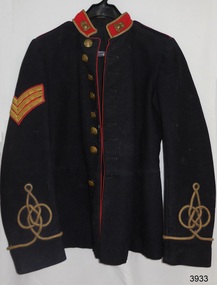
Uniform - Tunic, 1899-1903
... Sleeves lined with blue striped, white cotton. Front closure has eight brass buttons. ...Sleeves lined with blue striped, white cotton. Front closure has eight brass buttons. ...This original tunic or jacket is part of the full dress uniform of the pre-Federation Victorian Permanent Artillery regiment. Its owner had the rank of Sergeant, as indicated by the three inverted chevrons. The Artillery design of the badges and buttons indicate the date of the tunic to be from 1893 to 1903. However the maker of the tunic, W. Moncton, began manufacture in Melbourne in 1899, so this the tunic can be dated between 1899 and 1903. The donor's grandfather was given this tunic but not the name of the original owner. It has since been suggested to the family that the tunic was worn by a local Western District Light Horse member. This could very well have been the case because mounted troops were officially referred to as the Light Horse in the late 19th to early 20th century. Several local men were involved in the Light Horse during the First World War. The donor's grandfather wore this tunic in the local district when riding a penny farthing bicycle. The donor's father also wore the tunic when dressed as a 'Captain' hosting a local disco dance. BRIEF MILITARY HISTORY- The Crimean War began In 1854 and many people in colonial Australia were afraid of a Russian attack. Volunteer forces were established to strengthen the British Imperial troops posted here. A battery of artillery was raised in Victoria as well as in other Australian states. In 1870 Australia became responsible for its own naval and military defence. The Volunteer Corps and Victorian Navy shared the responsibility of defending the existing forts, assisted by volunteer coastal and mobile field batteries. The Permanent Victorian Artillery force was established. It was disbanded in 1880 then re-formed in 1882 as the Victorian Garrison Artillery Corps. In 1895 the Geelong, Warrnambool, Port Fairy and Portland Batteries became part of the Western District Garrison Artillery. Many of the volunteers who served in the Artillery were from rural areas. They belonged to rifle clubs and were experience horsemen as well. Australia's defence at this time relied on these mounted troops, or Light Horse men. In 1899 the Victorian Garrison Artillery Corps amalgamated with the New South Wales and Queensland Permanent Artillery to become the Victorian Regiment of the Royal Australian Artillery (RAA). Then prior to Federation, the RAA and the Permanent Artillery of South Australia, Western Australia and Tasmania all combined, becoming the Royal Australian Artillery Regiment with two Batteries of Field Artillery; Battery A from Sydney and Battery B from Melbourne.This original uniform tunic of the pre-Federation Victorian Permanent Artillery is significant for its association with Australia's military defence and the fortifications of our district, state and country. The tunic is also significant, representing part of the history and evolution of uniforms in the Australian military forces. The tunic is also significant in its representation of Australia's independence in forming its own defences. The tunic has local significance in its connection with local social events.Tunic or jacket, part of the full dress uniform of the pre-Federation Victorian Permanent Artillery operating from 1893 to 1903. Original, single-breasted tunic of dark blue wool, red piping trim, black cotton lining in body. Sleeves lined with blue striped, white cotton. Front closure has eight brass buttons. Red band-style collar with hook-and-eye closure has gold bullion braid trim and a brass badge pinned each side at the front. Upper right sleeve has three inverted chevrons on red fabric with gold bullion braid trim (rank of Sergeant). Both sleeves have gold bullion braid 'Austrian knot' emblems stitched onto lower arm, with ends finishing on the inner sleeve. Shoulder epaulettes have red piping and smaller brass buttons. Closed back vent has vertical scalloped design with six brass buttons, in two columns of three, and red piping trim. Brass belt hook is attached to the left back waist, close to the seam (right side has a mark indicating a previous similar clip). Inside left breast is a concealed pocket. Tunic has both machine and hand stitching. All brass shank-style buttons have matching Artillery emblems with inscriptions on the back. The two brass collar badges have additional artillery emblems of exploding grenade and star as well as an inscription. Buttons were made for W. Moncton, of Melbourne and marked with his name. He traded from 1899, dating the tunic to between 1899 and 1903.Button front: Artillery emblem on front (field cannon facing left, in front of a muzzle-loading ram rod). Button back: engraved "W. MONCTON . MELBOURNE ." Collar badges: Artillery emblem (field cannon facing right | stars | exploding grenade | "AUSTRALIA")flagstaff hill, warrnambool, shipwrecked coast, flagstaff hill maritime museum, maritime museum, shipwreck coast, flagstaff hill maritime village, great ocean road, uniform jacket, uniform tunic, garrison volunteer uniform, fortifications in victoria, victorian permanent artillery, pre-federation military uniform, sergeant's uniform, jacket, militia, victoria, victorian volunteer forces, victorian regiment, royal australian artillery, raa, field gun, sergeant, w. moncton, garrison, dress uniform, tunic, scarlet collar, red collar, scarlet piping, red piping, gold bullion, artillery emblem, light horse, artillery, mounted troops, victorian garrison artillery corps -
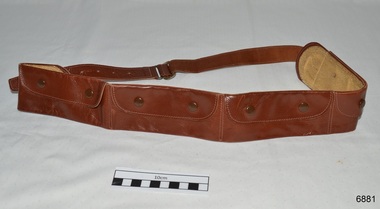 Flagstaff Hill Maritime Museum and Village
Money Belt, c. 1942
... Brown leather money belt, genuine calf, lined, 4 pouches with stud closure flaps included. Issued to W.R. ...ANGUS / 61-3 9803 5228” Brown leather money belt, genuine calf, lined, 4 pouches with stud closure flaps included. Issued to W.R. ...This money belt was issued to Dr W.R. Angus when he served in the Army 1942-1945 as a medical officer at Ballarat, Victoria, and Bonegilla, N.S.W.. (Surgeon Captain A.A.M.C., 108 A.G.H., and 106 A.G.H., Captain A.A.M.C. retired list.) The belt was donated to Flagstaff Hill Maritime Village by the family of Doctor William Roy Angus, Surgeon and Oculist. It is part of the “W.R. Angus Collection” that includes historical medical equipment, surgical instruments and material once belonging to Dr Edward Ryan and Dr Thomas Francis Ryan, (both of Nhill, Victoria) as well as Dr Angus’ own belongings. The Collection’s history spans the medical practices of the two Doctors Ryan, from 1885-1926 plus that of Dr Angus, up until 1969. ABOUT THE “W.R.ANGUS COLLECTION” Doctor William Roy Angus M.B., B.S., Adel., 1923, F.R.C.S. Edin.,1928 (also known as Dr Roy Angus) was born in Murrumbeena, Victoria in 1901 and lived until 1970. He qualified as a doctor in 1923 at University of Adelaide, was Resident Medical Officer at the Royal Adelaide Hospital in 1924 and for a period was house surgeon to Sir (then Mr.) Henry Simpson Newland. Dr Angus was briefly an Assistant to Dr Riddell of Kapunda, then commenced private practice at Curramulka, Yorke Peninsula, SA, where he was physician, surgeon and chemist. In 1926, he was appointed as new Medical Assistant to Dr Thomas Francis Ryan (T.F. Ryan, or Tom), in Nhill, Victoria, where his experiences included radiology and pharmacy. In 1927 he was Acting House Surgeon in Dr Tom Ryan’s absence. Dr Angus had become engaged to Gladys Forsyth and they decided he further his studies overseas in the UK in 1927. He studied at London University College Hospital and at Edinburgh Royal Infirmary and in 1928, was awarded FRCS (Fellow from the Royal College of Surgeons), Edinburgh. He worked his passage back to Australia as a Ship’s Surgeon on the on the Australian Commonwealth Line’s T.S.S. Largs Bay. Dr Angus married Gladys in 1929, in Ballarat. (They went on to have one son (Graham 1932, born in SA) and two daughters (Helen (died 12/07/1996) and Berenice (Berry), both born at Mira, Nhill ) According to Berry, her mother Gladys made a lot of their clothes. She was very talented and did some lovely embroidery including lingerie for her trousseau and beautifully handmade baby clothes. Dr Angus was a ‘flying doctor’ for the A.I.M. (Australian Inland Ministry) Aerial Medical Service in 1928 . Its first station was in the remote town of Oodnadatta, where Dr Angus was stationed. He was locum tenens there on North-South Railway at 21 Mile Camp. He took up this ‘flying doctor’ position in response to a call from Dr John Flynn; the organisation was later known as the Flying Doctor Service, then the Royal Flying Doctor Service. A lot of his work during this time involved dental surgery also. Between 1928-1932 he was surgeon at the Curramulka Hospital, Yorke Peninsula, South Australia. In 1933 Dr Angus returned to Nhill and purchased a share of the Nelson Street practice and Mira hospital (a 2 bed ward at the Nelson Street Practice) from Dr Les Middleton one of the Middleton Brothers, the current owners of what previously once Dr Tom Ryan’s practice. Dr Tom and his brother had worked as surgeons included eye surgery. Dr Tom Ryan performed many of his operations in the Mira private hospital on his premises. He had been House Surgeon at the Nhill Hospital 1902-1926. Dr Tom Ryan had one of the only two pieces of radiology equipment in Victoria during his practicing years – The Royal Melbourne Hospital had the other one. Over the years Dr Tom Ryan had gradually set up what was effectively a training school for country general-practitioner-surgeons. Each patient was carefully examined, including using the X-ray machine, and any surgery was discussed and planned with Dr Ryan’s assistants several days in advance. Dr Angus gained experience in using the X-ray machine there during his time as assistant to Dr Ryan. When Dr Angus bought into the Nelson Street premises in Nhill he was also appointed as the Nhill Hospital’s Honorary House Surgeon 1933-1938. His practitioner’s plate from his Nhill surgery is now mounted on the doorway to the Port Medical Office at Flagstaff Hill Maritime Village, Warrnambool. When Dr Angus took up practice in the Dr Edward and Dr Tom Ryan’s old premises he obtained their extensive collection of historical medical equipment and materials spanning 1884-1926. A large part of this collection is now on display at the Port Medical Office at Flagstaff Hill Maritime Village in Warrnambool. In 1939 Dr Angus and his family moved to Warrnambool where he purchased “Birchwood,” the 1852 home and medical practice of Dr John Hunter Henderson, at 214 Koroit Street. (This property was sold in1965 to the State Government and is now the site of the Warrnambool Police Station. and an ALDI sore is on the land that was once their tennis court). The Angus family was able to afford gardeners, cooks and maids; their home was a popular place for visiting dignitaries to stay whilst visiting Warrnambool. Dr Angus had his own silk worm farm at home in a Mulberry tree. His young daughter used his centrifuge for spinning the silk. Dr Angus was appointed on a part-time basis as Port Medical Officer (Health Officer) in Warrnambool and held this position until the 1940’s when the government no longer required the service of a Port Medical Officer in Warrnambool; he was thus Warrnambool’s last serving Port Medical Officer. (Masters of immigrant ships arriving in port reported incidents of diseases, illness and death and the Port Medical Officer made a decision on whether the ship required Quarantine and for how long, in this way preventing contagious illness from spreading from new immigrants to the residents already in the colony.) Dr Angus was a member of the Australian Medical Association, for 35 years and surgeon at the Warrnambool Base Hospital 1939-1942, He served as a Surgeon Captain during WWII1942-45, in Ballarat, Victoria, and in Bonegilla, N.S.W., completing his service just before the end of the war due to suffering from a heart attack. During his convalescence he carved an intricate and ‘most artistic’ chess set from the material that dentures were made from. He then studied ophthalmology at the Royal Melbourne Eye and Ear Hospital and created cosmetically superior artificial eyes by pioneering using the intrascleral cartilage. Angus received accolades from the Ophthalmological Society of Australasia for this work. He returned to Warrnambool to commence practice as an ophthalmologist, pioneering in artificial eye improvements. He was Honorary Consultant Ophthalmologist to Warrnambool Base Hospital for 31 years. He made monthly visits to Portland as a visiting surgeon, to perform eye surgery. He represented the Victorian South-West subdivision of the Australian Medical Association as its secretary between 1949 and 1956 and as chairman from 1956 to 1958. In 1968 Dr Angus was elected member of Spain’s Barraquer Institute of Barcelona after his research work in Intrasclearal cartilage grafting, becoming one of the few Australian ophthalmologists to receive this honour, and in the following year presented his final paper on Living Intrasclearal Cartilage Implants at the Inaugural Meeting of the Australian College of Ophthalmologists in Melbourne In his personal life Dr Angus was a Presbyterian and treated Sunday as a Sabbath, a day of rest. He would visit 3 or 4 country patients on a Sunday, taking his children along ‘for the ride’ and to visit with him. Sunday evenings he would play the pianola and sing Scottish songs to his family. One of Dr Angus’ patients was Margaret MacKenzie, author of a book on local shipwrecks that she’d seen as an eye witness from the late 1880’s in Peterborough, Victoria. In the early 1950’s Dr Angus, painted a picture of a shipwreck for the cover jacket of Margaret’s book, Shipwrecks and More Shipwrecks. She was blind in later life and her daughter wrote the actual book for her. Dr Angus and his wife Gladys were very involved in Warrnambool’s society with a strong interest in civic affairs. He had an interest in people and the community They were both involved in the creation of Flagstaff Hill, including the layout of the gardens. After his death (28th March 1970) his family requested his practitioner’s plate, medical instruments and some personal belongings be displayed in the Port Medical Office surgery at Flagstaff Hill Maritime Village, and be called the “W. R. Angus Collection”. The W.R. Angus Collection is significant for still being located at the site it is connected with, Doctor Angus being the last Port Medical Officer in Warrnambool. The collection of medical instruments and other equipment is culturally significant, being an historical example of medicine from late 19th to mid-20th century. Dr Angus assisted Dr Tom Ryan, a pioneer in the use of X-rays and in ocular surgery. The collection of Army objects is an example of items issued to Doctors and Surgeons in the Medical Services of the Australian Army in World War 2. Brown leather money belt, genuine calf, lined, 4 pouches with stud closure flaps included. Issued to W.R. Angus in WWII and part of the W.R. Angus Collection. Gold embossed label. Hand written inscription with name and serial number. Gold embossed “GENUINE CALF” under silver coloured buckle. Hand written inside of belt “W.R. ANGUS / 61-3 9803 5228”flagstaff hill, warrnambool, shipwrecked coast, flagstaff hill maritime museum, maritime museum, shipwreck coast, flagstaff hill maritime village, great ocean road, dr w r angus, dr ryan, military money belt, surgeon captain, royal australian army, military service australian army, wwii uniform, world war 2 -
 Flagstaff Hill Maritime Museum and Village
Equipment - Canvas Bag, mid-to-late 19th century
... Flagstaff Hill Maritime Museum and Village Flagstaff Hill Maritime Museum Maritime Village Warrnambool Great Ocean Road Lady Bay shipwreck life-saving lifesaving rescue crew rescue rocket rescue rocket crew lifeboat men beach rescue line rescue rescue equipment volunteer lifesavers volunteer crew life saving rescue crew lifesaving rescue crew rocket apparatus survival kit rescue kit canvas bag storage bag carry bag equipment bag drawerstring bag Canvas bag; thick beige canvas bag, cylindrical with a round base. The top has a thin rope in a drawstring closure ...This drawstring canvas bag is amongst the Rocket Rescue equipment. It could have been used to carry equipment, clothing or provisions between the crew on the shore and the victims of a shipwreck or other rescue need. It could be worn on the shoulder or as a backpack or winched out to a vessel on the block and pulley system. The strong canvas could be weatherproof and waterproof to a large extent, provided the drawstring was pulled tight. Saving lives in Warrnambool – The coastline of South West Victoria is the site of over 600 shipwrecks and many lost lives; even in Warrnambool’s Lady Bay, there were around 16 known shipwrecks between 1850 and 1905, with eight lives lost. Victoria’s Government responded to the need for lifesaving equipment and, in 1858, the provision of rocket and mortar apparatus was approved for the lifeboat stations. In 1859 the first Government-built lifeboat arrived at Warrnambool Harbour and a shed was soon built for it on the Tramway Jetty, followed by a rocket house in 1864 to safely store the rocket rescue equipment. In 1878 the buildings were moved to the Breakwater (constructed from 1874-1890), and in 1910 the new Lifeboat Warrnambool arrived with its ‘self-righting’ design. For almost a hundred years the lifesaving and rescue crews, mostly local volunteers, trained regularly to rehearse and maintain their rescue skills. They were summoned when needed by alarms, gunshots, ringing bells and foghorns. In July 1873 a brass bell was erected at Flagstaff Hill specifically to call the rescue crew upon news of a shipwreck. Some crew members became local heroes but all served an important role. Rocket apparatus was used as recently as the 1950s. Rocket Rescue Method - The Government of Victoria adopted lifesaving methods based on Her Majesty’s Coast Guard in Great Britain. It authorised the first line-throwing rescue system in 1858. Captain Manby’s mortar powered a projectile connected to a rope, invented in 1808. The equipment was updated to John Dennett’s 8-foot shaft and rocket method that had a longer range of about 250 yards. From the 1860s the breeches buoy apparatus was in use. The apparatus was suspended on a hawser line and manually pulled to and from the distressed vessel carrying passengers and items. In the early 1870s Colonel Boxer’s rocket carried the light line, which was faked, or coiled, in a particular way between pegs in a faking box to prevent twists and tangles when fired. The angle of firing the rocket to the vessel in distress was measured by a quadrant-type instrument on the side of the rocket machine. Decades later, in about 1920, Schermuly invented the line-throwing pistol that used a small cartridge to fire the rocket. The British Board of Trade published instructions for both the beach rescue crew and ship’s crew. It involved setting up the rocket launcher on shore at a particular angle measured by the quadrant, inserting a rocket that had a lightweight line threaded through its shaft, and then firing it across the stranded vessel, the line issuing freely from the faking board. A tally board was then sent out to the ship with instructions in four languages. The ship’s crew would haul on the line to bring out the heavier, continuous whip line, then secure the attached whip block to the mast or other sturdy part of the ship. The rescue crew on shore then hauled out a stronger hawser line, which the ship’s crew fixed above the whip block. The hawser was then tightened using the block on the shore end of the whip. The breeches buoy and endless whip are then attached to the traveller block on the hawser, allowing the shore crew to haul the breeches buoy to and from the vessel, rescuing the stranded crew one at a time. Beach apparatus equipment - In the mid-1800s the equipment could include a line throwing set, coiled line in a wooden carrying case, rockets, cartridges, breeches buoy, hawser and traveller block, line-throwing pistol, beach cart, hand barrow, sand anchor, crotch pole, and tools such as spade, pick, mallet and hawser cutter. Around the 1860s Warrnambool had a Rocket House installed beside the Harbour. This canvas bag is significant for its connection with local history, maritime history and marine technology. Lifesaving has been an important part of the services performed from Warrnambool's very early days, supported by State and Local Government, and based on the methods and experience of Great Britain. Hundreds of shipwrecks along the coast are evidence of the rough weather and rugged coastline. Ordinary citizens, the Harbour employees, and the volunteer boat and rescue crew saved lives in adverse circumstances. Some were recognised as heroes, others went unrecognised. In Lady Bay, Warrnambool, there were around 16 known shipwrecks between 1850 and 1905. Many lives were saved but tragically, eight lives were lost.Canvas bag; thick beige canvas bag, cylindrical with a round base. The top has a thin rope in a drawstring closure. flagstaff hill maritime museum and village, flagstaff hill, maritime museum, maritime village, warrnambool, great ocean road, lady bay, shipwreck, life-saving, lifesaving, rescue crew, rescue, rocket rescue, rocket crew, lifeboat men, beach rescue, line rescue, rescue equipment, volunteer lifesavers, volunteer crew, life saving rescue crew, lifesaving rescue crew, rocket apparatus, survival kit, rescue kit, canvas bag, storage bag, carry bag, equipment bag, drawerstring bag -
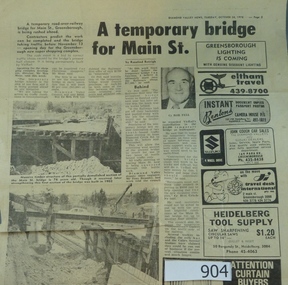 Greensborough Historical Society
Newspaper clipping, A temporary bridge for Main Street, 24/10/1978
... Leading up to the opening of Greensborough Plaza, traffic along Main Street was affected by the part closure due to the construction of a road bridge over the railway line....Leading up to the opening of Greensborough Plaza, traffic along Main Street was affected by the part closure due to the construction of a road bridge over the railway line. Significant infrastructure changes in Greensborough at the time of the opening of Greensborough Plaza in 1978. main street greensborough para road railway greensborough plaza Original news clipping (Item 904) and photocopy of same (Item 958). ...Leading up to the opening of Greensborough Plaza, traffic along Main Street was affected by the part closure due to the construction of a road bridge over the railway line.Significant infrastructure changes in Greensborough at the time of the opening of Greensborough Plaza in 1978.Original news clipping (Item 904) and photocopy of same (Item 958). Text and black and white images.main street greensborough, para road, railway, greensborough plaza -
 Greensborough Historical Society
Newspaper Clipping, Diamond Valley Leader, Prepare for rail disarray, 14/03/2018
... hurstbridge train line closure...Roads will be thrown into chaos when a chunk of the Hurstbridge train line is closed for six weeks for track upgrades and the level crossing removal at Rosanna station. level crossing removal project hurstbridge train line closure rosanna station hurstbridge rail line News article 1 page, black text and colour image . ...Roads will be thrown into chaos when a chunk of the Hurstbridge train line is closed for six weeks for track upgrades and the level crossing removal at Rosanna station.News article 1 page, black text and colour image .level crossing removal project, hurstbridge train line closure, rosanna station, hurstbridge rail line -
Glenelg Shire Council Cultural Collection
Costume - Costume - Cape, n.d
... Hand-made long black velvet evening cape with collar, smocking around shoulder region and diamante clasp at neckline, 3 press stud closures at neckline, lined with black taffeta....Hand-made long black velvet evening cape with collar, smocking around shoulder region and diamante clasp at neckline, 3 press stud closures at neckline, lined with black taffeta. Costume Costume - Cape ...Hand-made long black velvet evening cape with collar, smocking around shoulder region and diamante clasp at neckline, 3 press stud closures at neckline, lined with black taffeta.
