
Showing 142 items matching "living room"
-
 Ringwood and District Historical Society
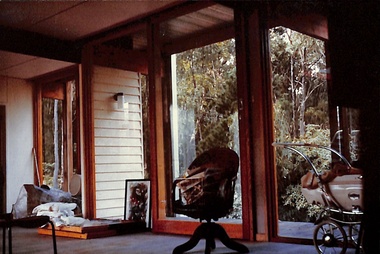
Photograph, Interior-Living Room of 2 Hearthside Crt, North Ringwood, designed and built by Architect Ian Napier mid 1960's - "Just moved in"
... Interior-Living Room of 2 Hearthside Crt, North Ringwood, designed and built by Architect Ian Napier mid 1960's - "Just moved in"...Single colour photograph of Living Room in newly built house at No 2 Hearthside Court, North Ringwood. ...Just Moved into living room...Just Moved into living room Single colour photograph of Living Room in newly built house at No 2 Hearthside Court, North Ringwood. ...Single colour photograph of Living Room in newly built house at No 2 Hearthside Court, North Ringwood. Undated but probably mid 1960's. See also VC Items 11345-11347, and 11349Just Moved into living room -
 Eltham District Historical Society Inc
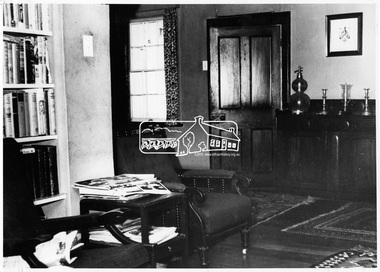
Photograph, Eltham - Interior of the living room at Sweeney's, 1971
... Eltham - Interior of the living room at Sweeney's...The cottage is important in the history of Eltham and of architectural interest as an example of a Colonial Style dwelling. The Living room shows a wooden door and floor with rug. ...The cottage is important in the history of Eltham and of architectural interest as an example of a Colonial Style dwelling. The Living room shows a wooden door and floor with rug. ...Sweeney's, originally Culla Hill, a former homestead, located on a site bought from the crown in 1842 by Irishman Thomas Sweeney. The cottage is important in the history of Eltham and of architectural interest as an example of a Colonial Style dwelling. The Living room shows a wooden door and floor with rug. A window to the left, two seats and a book case. This was the home of V.C. Burston.This photo forms part of a collection of photographs gathered by the Shire of Eltham for their centenary project book, "Pioneers and Painters: 100 years of the Shire of Eltham" by Alan Marshall (1971). The collection of over 500 images is held in partnership between Eltham District Historical Society and Yarra Plenty Regional Library (Eltham Library) and is now formally known as 'The Shire of Eltham Pioneers Photograph Collection.' It is significant in being the first community sourced collection representing the places and people of the Shire's first one hundred years.Digital imagesepp, shire of eltham pioneers photograph collection, eltham, sweeney's cottage, v.c. burston -
 Eltham District Historical Society Inc
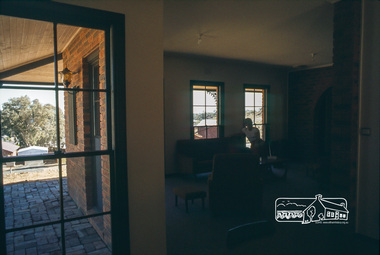
Photograph, Carla Vermey in living room from dining room, April 1980
... Carla Vermey in living room from dining room, April 1980...It was one of the earliest estates in Eltham following the nearby Woodridge Estate development. stokes place eltham stokes orchard stokes orchard estate streets houses peter and carla vermey Scanned by EDHS from 49 x 35mm colour transparencies provided on loan Digital file Carla Vermey in living room from dining room, April 1980 Photograph ...14 Stokes Place (Lot 83) was the home of Peter and Carla Vermey. The land was purchased in May 1979 and construction commenced September 1979. The home was built by Peter and Carla Vermey after the developer, Macquarie Builders went bankrupt. Sold October 2017 by Morrison and Kleeman Real Estate. Stokes Place was part of the Stokes Orchard Estate which was developed from the break-up of the the orchard owned by Frank Stokes who lived on the northeast corner of Nyora Road and Eucalyptus Road. His daughter Beryl advised that the Shire had levied a rate assessment on individual parcels of land within the orchard which became unaffordable resulting in its sub-division and sell off. The Stokes Orchard Estate was developed by Macquarie Builders in two stages starting with stage 1 in 1976. Stokes Place was part of Stage 2 in 1979. The Estate was bounded between Nyora Road, Eucalyptus Road, Diosma Road and Stokes Place. The original orchard only just reached the left most portions of Stokes Place and did not go fully up to Diosma, rather to just beyond the extant of Stokes Place. Stokes Place was known within the family as "The Oats" as that is where they grew oats. Frank Stokes moved to Eltham c.1945 after visiting Harold Bird to view his orchard, located diagonally opposite Stokes Orchard from the intersection of Eucalyptus Road, Pitt Street and Nyora Road. It was on Harold Bird's recommendation that Frank purchased the land.The Stokes Orchard Estate collection is typical of housing developments of the late 1970s and 1980s. It was one of the earliest estates in Eltham following the nearby Woodridge Estate development.Digital fileScanned by EDHS from 49 x 35mm colour transparencies provided on loanstokes place, eltham, stokes orchard, stokes orchard estate, streets, houses, peter and carla vermey -
 Eltham District Historical Society Inc
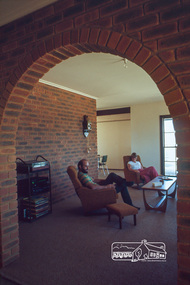
Photograph, Peter and Carla Vermey in living room from entry hall, April 1980
... Peter and Carla Vermey in living room from entry hall, April 1980...It was one of the earliest estates in Eltham following the nearby Woodridge Estate development. stokes place eltham stokes orchard stokes orchard estate streets houses peter and carla vermey Scanned by EDHS from 49 x 35mm colour transparencies provided on loan Digital file Peter and Carla Vermey in living room from entry hall, April 1980 Photograph ...14 Stokes Place (Lot 83) was the home of Peter and Carla Vermey. The land was purchased in May 1979 and construction commenced September 1979. The home was built by Peter and Carla Vermey after the developer, Macquarie Builders went bankrupt. Sold October 2017 by Morrison and Kleeman Real Estate. Stokes Place was part of the Stokes Orchard Estate which was developed from the break-up of the the orchard owned by Frank Stokes who lived on the northeast corner of Nyora Road and Eucalyptus Road. His daughter Beryl advised that the Shire had levied a rate assessment on individual parcels of land within the orchard which became unaffordable resulting in its sub-division and sell off. The Stokes Orchard Estate was developed by Macquarie Builders in two stages starting with stage 1 in 1976. Stokes Place was part of Stage 2 in 1979. The Estate was bounded between Nyora Road, Eucalyptus Road, Diosma Road and Stokes Place. The original orchard only just reached the left most portions of Stokes Place and did not go fully up to Diosma, rather to just beyond the extant of Stokes Place. Stokes Place was known within the family as "The Oats" as that is where they grew oats. Frank Stokes moved to Eltham c.1945 after visiting Harold Bird to view his orchard, located diagonally opposite Stokes Orchard from the intersection of Eucalyptus Road, Pitt Street and Nyora Road. It was on Harold Bird's recommendation that Frank purchased the land.The Stokes Orchard Estate collection is typical of housing developments of the late 1970s and 1980s. It was one of the earliest estates in Eltham following the nearby Woodridge Estate development.Digital fileScanned by EDHS from 49 x 35mm colour transparencies provided on loanstokes place, eltham, stokes orchard, stokes orchard estate, streets, houses, peter and carla vermey -
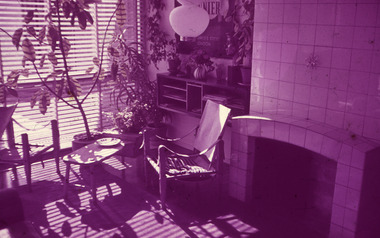 Robin Boyd Foundation
Slide, Robin Boyd, 1950
... Colour slide in a mount. Living room of architect Bent Karlby's home in Ordrup, Copenhagen, Denmark. ...Copenhagen / Ordrup / Karlby, arch / Own home - Living room / 1950 (Handwritten)...Living room of architect Bent Karlby's home in Ordrup, Copenhagen, Denmark. ...Penleigh Boyd, Robin and Patricia Boyd's son, writes “Prior to 1950 Robin, like most other amateur or hobby photographers, took black and white printed photographs. The oldest slides date from 1950 when Robin and Patricia travelled to Europe on Robin’s Robert Haddon Travelling Scholarship.” In 1948 Robin Boyd was awarded ‘joint first place’ in the Robert Haddon competition for his design of Mildura art gallery. The scholarship helped fund their first overseas trip. Robin and Patricia were passengers on the Greek ship “Cyrenia” departing in May 1950, passing through the Suez Canal and landing in Genoa five weeks later. For six months, they travelled extensively throughout Europe (predominantly driving themselves) - France, Italy, United Kingdom, Sweden, Denmark, Germany, Austria, Switzerland and Spain.Colour slide in a mount. Living room of architect Bent Karlby's home in Ordrup, Copenhagen, Denmark. Note, Karlby's Peanut Pendant Lamp (1946) - centre top; two Safari Model 4700 chairs (1933) by Kaare Klint (Architect: Bent Karlby.)Copenhagen / Ordrup / Karlby, arch / Own home - Living room / 1950 (Handwritten)haddon travelling scholarship, haddon, robin boyd, slide -
 Glen Eira Historical Society
Document - Regent Street, 5/1B, Elsternwick
... Small newspaper clipping with colour photo of a living room...Elsternwick Flats Regent Street Tvarkovski Larissa Real estate agents Brick Small newspaper clipping with colour photo of a living room Document Regent Street, 5/1B, Elsternwick ...A property ad with date noted as 06/08/03, giving details of luxury interior features for forthcoming sale of first floor apartment.Small newspaper clipping with colour photo of a living roomelsternwick, flats, regent street, tvarkovski larissa, real estate agents, brick -
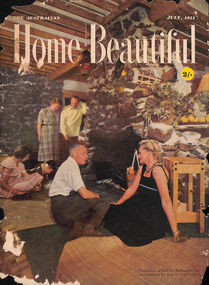 Robin Boyd Foundation
Magazine - Clipping, Australian Home Beautiful, Jul-51
... Family around living room fireplace made of stones...Walsh St library Family around living room fireplace made of stones Cover page Australian Home Beautiful Magazine Clipping ...Robin Boyd the Anglesea E. McK. Paton House in Anglesea, c 1951. It featured on the cover of Australian Home Beautiful accompanied with the article by Nora Cooper 'Seaside Haven' pp 36-39. This image was the cover image of this volume.Cover pageFamily around living room fireplace made of stoneswalsh st library -
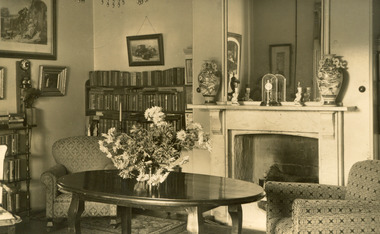 The Beechworth Burke Museum
Postcard, Eda P Beckmann, c1935
... ...living room...This postcard depicts an interior room which is presumed to be a living or reception room. It is filled with period furnishings. ...This postcard depicts an interior room which is presumed to be a living or reception room. It is filled with period furnishings. ...Mayday Hills Mental Hospital was originally constructed in 1864 under the name of the Beechworth Lunatic Asylum. It was built for locals in need of help who were kept in the local gaol. In its first decade, the residents of the hospital were used as menial labourers but over time, as mental healthcare progressed, were cared for in more nuanced ways. This site became a training hospital for nurses in the 1960's. Eventually, mental health patients were moved to other care facilities and Mayday Hills was operating as a geriatric care facility. It was closed in 1995, after which the buildings and their grounds were purchased to La Trobe University to be used as a campus. The university sold the site in 2011 to private ownership. This postcard depicts an interior room which is presumed to be a living or reception room. It is filled with period furnishings. Mayday Hills Mental Hospital is a historically significant site for many factors. It is representative of healthcare practice in nineteenth century Victoria. It contains rare examples of construction and architecture. It is also significant for aesthetic and technical reasons.Black and white postcard printed on matte cardReverse: 11.5.35/ Miss Peach/ Best wishes/ from/ P. Beckman mayday, mayday hills hospital, mayday hills, mayday hills mental asylum, mayday hills mental hospital, beechworth, beechworth asylum, beechworth hospital for the insane, beechworth lunatic asylum, lunatic asylum, healthcare, health, living in country towns, living room, furniture, interior -
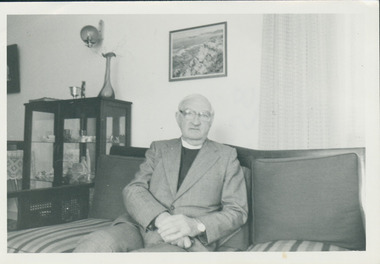 Uniting Church Archives - Synod of Victoria
Photograph, C1978
... William Morgan sitting in a living room....William Morgan sitting in a living room. Photograph ...Rev.William Morgan (b. 1915) was Moderator of Victoria in 1971.Gloss, black and white image of Rev. William Morgan sitting in a living room.morgan, w., presbyterian -
 Flagstaff Hill Maritime Museum and Village
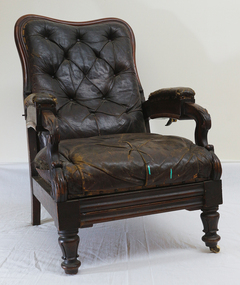
Furniture - Chair, Haberfield Chair, Michael Bradshaw, Circa 1860s-1890s
... ...living room furniture...Flagstaff Hill Maritime Museum and Village Great Ocean Road Shipwreck Coast armchair reclining armchair reading board Mahogany chair Haberfield Chair furniture living room furniture domestic furniture 19th century luxury Morroco leather book stand book rest side table music stand reading stand reading rest foot rest reading table In pen and ink: “Made from Mahogany Ship wrecked near Tower Hill, July 3, 1835: made by Michael Bradshaw 18-2-“ [originally thought to read 1842] The Haberfield Chair is a reclining armchair that includes a footrest and a detachable book rest. ...This elegant reclining armchair is generously on loan from the local Haberfield family. Mrs Haberfield is a member of the Anderson family from the Tower Hill region, and the chair was handed down to her from them. When it arrived at Flagstaff Hill in 2009, it was at least 100 years old. The maker, Michael Bradshaw, is currently unknown. The origin of the chair's timber has been lost through the generations, but some have named the armchair the 'Mahogany Chair' after the legendary Mahogany Ship. In August 2009, the wood was expertly examined. The structure of the wood specimens was found to be consistent with: • Pale coloured carcass timber - Fagus sylvatica – Beech (European) • Pale coloured frame timber - Agathis sp – NZ Kauri • Dark coloured timber chair legs (solid) - Swietenia sp. – True Mahogany • Dark coloured timber veneer - Swietenia sp. – True Mahogany • Repair fill-in piece – Quercus sp. – White Oak ( Northern hemisphere) • Repair fill-in piece (fine textured) – Populus sp. – Poplar • Runner wood - Eucalyptus sp – Pale coloured ash group, or messmate The chair is significant for its local origin and history, being connected to generations of the Anderson and Haberfield families. It is also significant for its elaborate and unusual design, the quality of its workmanship and materials. It is a fine example of good quality furniture of the late 19th century.The Haberfield Chair is a reclining armchair that includes a footrest and a detachable book rest. The chair features a dark timber frame and dark burgundy (now dark brown), Morocco goat skin leather upholstery. The backrest is finished with button detailing, and its frame is distinguished by gracefully curved corners, lending the chair an elegant appearance. The chair’s padded leather armrests have attractive, crafted carvings at each end. A lever located below the armrest operates the recliner’s ratchet mechanism, which also causes a footrest to slide forward for greater comfort. The turned and carved front legs are equipped with wheels, allowing for easy movement. The removable book rest is mounted on a brass pedestal. Its angle can be conveniently adjusted using a screw to move the ball and socket joint, ensuring personalised reading comfort. There is a handwritten inscription on the underside of the back rail. The chair is kindly on loan from the local Haberfield family. In pen and ink: “Made from Mahogany Ship wrecked near Tower Hill, July 3, 1835: made by Michael Bradshaw 18-2-“ [originally thought to read 1842]flagstaff hill maritime museum and village, great ocean road, shipwreck coast, armchair, reclining armchair, reading board, mahogany chair, haberfield chair, furniture, living room furniture, domestic furniture, 19th century, luxury, morroco leather, book stand, book rest, side table, music stand, reading stand, reading rest, foot rest, reading table -
 Flagstaff Hill Maritime Museum and Village
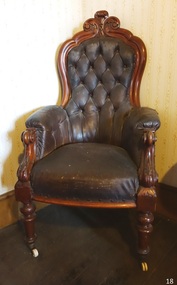
Furniture - Armchair, 1870
... ...living room furniture...An item probably made in Australia during the latter half of the Victorian era and is significant as it was made in Australia at a time when furniture and many other household items were imported from either America or England. flagstaff hill warrnambool shipwrecked coast flagstaff hill maritime museum maritime museum shipwreck coast flagstaff hill maritime village great ocean road furniture chair armchair gentleman's chair lady's chair leather upholstery buttoned upholstery living room furniture lounge room furniture formal furniture domestic Armchair: gentleman's armchair of Cedar wood with brown leather upholstery, tacked and buttoned in a crocodile-skin-like effect. ...A gentleman's chair, gent's chair or grandfather chair is a term usually applied in Australia to a deep upholstered Victorian easy chair, often button-backed and with upholstered arms. The chair generally stood on short cabriole legs and had a 'spoon' or a wide balloon back. The 'show wood', that is, the polished frame, was usually mahogany or walnut, although many examples in Australian red cedar have survived. There are Australian versions of the gentleman's chair, lady's chair and matching settees, usually made from cedar, and occasionally from blackwood. As cedar is a softer timber than walnut, mahogany and rosewood, from which the English versions were made, the carving is usually not as crisp as in the imported version. However, the Australian blackwood gentleman's chair is often difficult to distinguish from a good-quality English walnut example. The Edwardian form of the gentleman's chair is much squarer in outline, with short turned legs and the arms are often supported by spindles. There was sometimes a row of spindles, like a gallery, beneath the top rail. The chairs were frequently upholstered in leather.An item probably made in Australia during the latter half of the Victorian era and is significant as it was made in Australia at a time when furniture and many other household items were imported from either America or England.Armchair: gentleman's armchair of Cedar wood with brown leather upholstery, tacked and buttoned in a crocodile-skin-like effect. The wood is scalloped and carved with a Prince of Wales Feather on the back. The arms are scrolled and carved with an Acanthus leaf design, finished on tulip turned legs. All four legs have brass and porcelain castors. circa 1870, Australian-made. flagstaff hill, warrnambool, shipwrecked coast, flagstaff hill maritime museum, maritime museum, shipwreck coast, flagstaff hill maritime village, great ocean road, furniture, chair, armchair, gentleman's chair, lady's chair, leather upholstery, buttoned upholstery, living room furniture, lounge room furniture, formal furniture, domestic -
 Whitehorse Historical Society Inc.
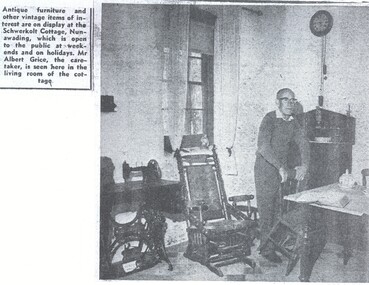
Article - photocopy, Albert Grice, 1965
... Schwerkolt Cottage has been furnished with vintage items of interest as evidenced by a living room photo of Albert Grice, caretaker....Schwerkolt Cottage has been furnished with vintage items of interest as evidenced by a living room photo of Albert Grice, caretaker. ...Schwerkolt Cottage has been furnished with vintage items of interest as evidenced by a living room photo of Albert Grice, caretaker.Schwerkolt Cottage has been furnished with vintage items of interest as evidenced by a living room photo of Albert Grice, caretaker.Schwerkolt Cottage has been furnished with vintage items of interest as evidenced by a living room photo of Albert Grice, caretaker.schwerkolt cottage, grice, albert -
 Bendigo Military Museum
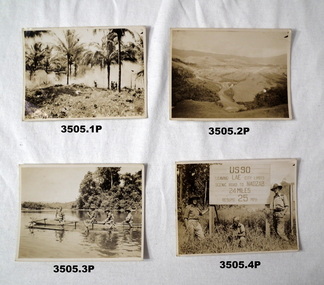
Photograph - PHOTOGRAPHS WW2, 1940 - 45
... .2) “ Handwritten inscriptions on back” .22) Labeled: “Taken outside our tent March 1944” .23) Labeled: “Entrance to our living room April '44”...See also Cat No 3506. photography-photographs military history - army .2) “ Handwritten inscriptions on back” .22) Labeled: “Taken outside our tent March 1944” .23) Labeled: “Entrance to our living room April '44” 23 x loose sepia photos with album. .11) Postcard photo. ...See Cat No 3504P a connection to Warick JOHANSON. See also Cat No 3506.23 x loose sepia photos with album. .11) Postcard photo. Items are of various sizes. .2) “ Handwritten inscriptions on back” .22) Labeled: “Taken outside our tent March 1944” .23) Labeled: “Entrance to our living room April '44”photography-photographs, military history - army -
 Whitehorse Historical Society Inc.
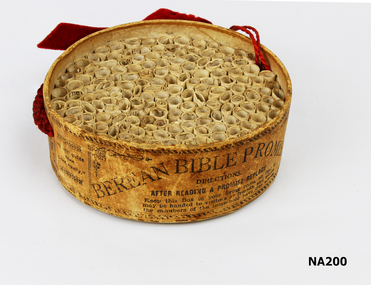
Book - Bible Promises Box
... Berean Bible Promises/Directions/After reading a promise replace/Keep this box in your living room so that it may be handed to visitors or friends/and where the members of the household have free access....religion christian Berean Bible Promises/Directions/After reading a promise replace/Keep this box in your living room so that it may be handed to visitors or friends/and where the members of the household have free access. ...Circular cardboard box containing tightly rolled pieces of paper with Biblical quotes on them. Red ribbon handle with red felt bow.Berean Bible Promises/Directions/After reading a promise replace/Keep this box in your living room so that it may be handed to visitors or friends/and where the members of the household have free access.religion, christian -
Port Melbourne Historical & Preservation Society
Container - Red Seal Iced Coffee Carton
... Found under floorboards of living room of a house in Poolman Street...Found under floorboards of living room of a house in Poolman Street Woodruffs Dairies P/L Business and Traders - Dairies One half pint Pure Pak, gable top iced coffee carton. ...Found under floorboards of living room of a house in Poolman StreetOne half pint Pure Pak, gable top iced coffee carton. Yellow & light brown printing. From Woodruff's' Dairy P/L.woodruffs dairies p/l, business and traders - dairies -
 Stawell Historical Society Inc
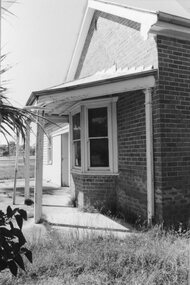
Photograph, Wehl Family home "Carlsruhe" on the Western Highway
... Front Corner of Living Room and bay Windows Private Home "Carlsruhe" Western Highway (Wehl) Family Demolished 1993...Front Corner of Living Room and bay Windows Private Home "Carlsruhe" Western Highway (Wehl) Family Demolished 1993 Stawell Wehl Family home "Carlsruhe" on the Western Highway Photograph ...Front Corner of Living Room and bay Windows Private Home "Carlsruhe" Western Highway (Wehl) Family Demolished 1993stawell -
Robin Boyd Foundation
Furniture - Coffee table
... It was moved around, at times it was in the downstairs living room by the fireplace and for a time it was upstairs....It was moved around, at times it was in the downstairs living room by the fireplace and for a time it was upstairs. ...Patricia Boyd bought this minimal table after Robin Boyd's death. It was moved around, at times it was in the downstairs living room by the fireplace and for a time it was upstairs.Low curved single piece of clear perspexwalsh st furnishings -
 Robin Boyd Foundation
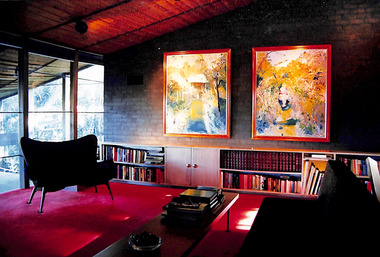
Photograph
... Images of upstairs living room at Walsh St with two Arthur Boyd oil paintings and Featherston and Boyd sofas, from late 1990s perhaps....Images of upstairs living room at Walsh St with two Arthur Boyd oil paintings and Featherston and Boyd sofas, from late 1990s perhaps. ...Images of upstairs living room at Walsh St with two Arthur Boyd oil paintings and Featherston and Boyd sofas, from late 1990s perhaps.Set of 6 colour photographs -
 Robin Boyd Foundation
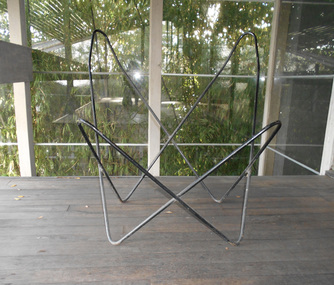
Furniture - Chair, Jorge Ferrari-Hardoy, Antonio Bonet and Juan Kurchan, BKF Butterfly chair, 1946
... These BFK Butterfly chairs were used in the living room in Robin Boyd's first family home in Camberwell. ...These BFK Butterfly chairs were used in the living room in Robin Boyd's first family home in Camberwell. ...These BFK Butterfly chairs were used in the living room in Robin Boyd's first family home in Camberwell. The BKF was originally designed in Argentina, later becoming popular throughout the world.A pair of BKF Butterfly chair. Black iron/steel. They have a canvas sling hung from the frame's highest points, creating a suspended seatwalsh st furnishings, robin boyd -
 Williamstown Historical Society Inc
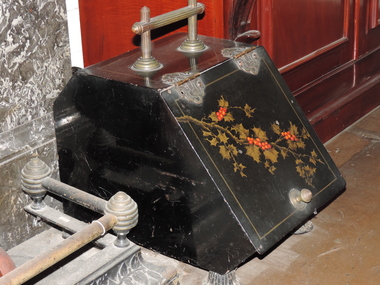
Domestic object - Coal scuttle, c.1890
... More decorative examples, such as this one, would have been reserved for the living room. ...More decorative examples, such as this one, would have been reserved for the living room. Local history Domestic life Coal scuttle, black painted metal, decorated with a painted gold holly spray and red berries. ...A coal scuttle or other container would have been standard in dwellings befroe the advent of town gas. More decorative examples, such as this one, would have been reserved for the living room. Coal scuttle, black painted metal, decorated with a painted gold holly spray and red berries. Brass handle, four brass feet and brass pull knob, opening at front with brass hinges. Removable tray, containing a poker. local history, domestic life -
 Bendigo Historical Society Inc.
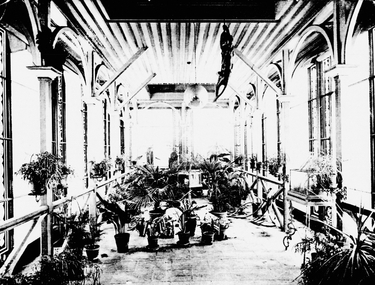
Photograph - Fortuna - Photos (Photo-copies) of Furnished Rooms, Abt 1900
... Fortuna - Photos (Photo-copies) of Furnished Rooms This item contains the following 12 documents: 11217.76a Black and White photo of the Gymnasium, a man standing between the horizontal bars and another behind sitting on the exercise bench 11217.76b Black and White photo of a living room with chairs and small table 11217.76c Black and White photo of the conservatory with pot plants 11217.76d Black and White photo of a music room with piano, chairs and a coffee table 11217.76e Black and White photo of a bedroom with sofa, chair and iron framed bed 11217.76f Black and White photo of the games room complete with Billiard Table 11217.76g Black and White photo of the living room, the walls adorned with painting and photographs 11217.76h Black and White photo of the family bedroom, with a child's bed and a large four-poseter with curtains 11217.76i Black and White photo of possibly the function or ballroom 11217.76j Black and White photo of a small room or elcove for quiet conversations 11217.76k Black and White photo of the staircase and statue 11217.76l Black and White photo of the conservatory...The relationship between mining and domestic areas and the. close proximity of the two is considered rare to Australian domestic building of that time. bendigo fortuna george lansell fortuna furnishings Fortuna - Photos (Photo-copies) of Furnished Rooms This item contains the following 12 documents: 11217.76a Black and White photo of the Gymnasium, a man standing between the horizontal bars and another behind sitting on the exercise bench 11217.76b Black and White photo of a living room with chairs and small table 11217.76c Black and White photo of the conservatory with pot plants 11217.76d Black and White photo of a music room with piano, chairs and a coffee table 11217.76e Black and White photo of a bedroom with sofa, chair and iron framed bed 11217.76f Black and White photo of the games room complete with Billiard Table 11217.76g Black and White photo of the living room, the walls adorned with painting and photographs 11217.76h Black and White photo of the family bedroom, with a child's bed and a large four-poseter with curtains 11217.76i Black and White photo of possibly the function or ballroom 11217.76j Black and White photo of a small room or elcove for quiet conversations 11217.76k Black and White photo of the staircase and statue 11217.76l Black and White photo of the conservatory Photograph Fortuna - Photos (Photo-copies) of Furnished Rooms ...Theodore Ballerstedt originally purchased the Fortuna site from the Crown in 1857. The firstimprovements at Fortuna were undertaken by the Ballerstedt family and consisted of a small mill and house. At the peak of the mining era (c.1860s) Fortuna was central to the deep alluvial gold mining operations of Bendigo. In 1871 Theodore Ballerstedt sold the house, mine and associated works to George Lansell 'The Quartz King'. During his time at Fortuna, Lansell owned 13 mines and directed a further 73 in Bendigo. The primary building on the site is the Fortuna Villa. With the wealth Lansell generated from gold mining he funded the continuous expansion of the Villa and surrounding grounds. The Villa is built in a number of architectural styles, namely Victorian Italianate and Victorian Free Classical, with Federation influences. The surrounding landscape featured up to seven decorative lakes in the early 1870s, including one larger lake which still remains today. The former lakes were originally used as disposal points for tailings produced in the gold processing activities at the site. Heritage investigations note that the uniqueness of Fortuna lies in the mixture of architectural styles of the Villa. The relationship between mining and domestic areas and the. close proximity of the two is considered rare to Australian domestic building of that time.Fortuna - Photos (Photo-copies) of Furnished Rooms This item contains the following 12 documents: 11217.76a Black and White photo of the Gymnasium, a man standing between the horizontal bars and another behind sitting on the exercise bench 11217.76b Black and White photo of a living room with chairs and small table 11217.76c Black and White photo of the conservatory with pot plants 11217.76d Black and White photo of a music room with piano, chairs and a coffee table 11217.76e Black and White photo of a bedroom with sofa, chair and iron framed bed 11217.76f Black and White photo of the games room complete with Billiard Table 11217.76g Black and White photo of the living room, the walls adorned with painting and photographs 11217.76h Black and White photo of the family bedroom, with a child's bed and a large four-poseter with curtains 11217.76i Black and White photo of possibly the function or ballroom 11217.76j Black and White photo of a small room or elcove for quiet conversations 11217.76k Black and White photo of the staircase and statue 11217.76l Black and White photo of the conservatorynon-fictionbendigo, fortuna, george lansell, fortuna furnishings -
 Bendigo Historical Society Inc.
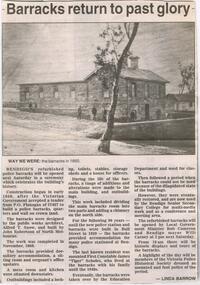
Newspaper - JENNY FOLEY COLLECTION: BARRACKS RETURN TO PAST GLORY
... It included accommodation, mess room, kitchen and living room. Outhouses included lock-up, stables, toilets, storage and an officers house. ...It included accommodation, mess room, kitchen and living room. Outhouses included lock-up, stables, toilets, storage and an officers house. ...Building of the Police Barracks began in 1860. It included accommodation, mess room, kitchen and living room. Outhouses included lock-up, stables, toilets, storage and an officers house. It was decommissioned in 1939 and was later refurbished and used by the Bendigo Senior Secondary College.Newspaper article by Linda Barrrow date unknown. '' Barracks return to past glory'' Bendigo's refurbished police barracks will be opened next Saturday in a ceremony which celebrates the buildings' history. The refurbished barracks will be opened by Local Government minister Bob Cameron and Bendigo Mayor Willi Carney. The article briefly details the history of the barracks. There is a photo showing the barracks in 1860. The clip is in a plastic folder.newspaper, bendigo advertiser, news items -
 Robin Boyd Foundation
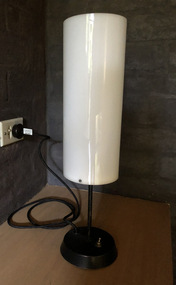
Functional object - Lamp, Don Brown from Brown Evans and Co. - BECO in Australia
... This was originally a bedside reading lamp in the upper living room, as seen in the Mark Strizic 1958 photograph in Robin Boyd's book Living in Australia p129....This was originally a bedside reading lamp in the upper living room, as seen in the Mark Strizic 1958 photograph in Robin Boyd's book Living in Australia p129. ...This Beco lamp was designed by Donald Brown, a pre-eminent Australian lighting designer in the '50s and '60s. Robin Boyd often specified BECO lighting, including elsewhere in his own home. This was originally a bedside reading lamp in the upper living room, as seen in the Mark Strizic 1958 photograph in Robin Boyd's book Living in Australia p129.Beco 720 lamp, with black stand base with switch and white glass shadeBrown Evans & Cowalsh st furnishings, robin boyd, ohm2022, ohm2022_25 -
 Robin Boyd Foundation
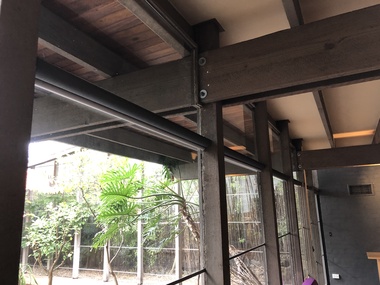
Functional object - Blinds
... Robin and Patricia did things as they could afford them -- hence the very early Strizic photos of Suzy in the lower living room do not show blinds (the image on the cover of the 2013 edition of Living in Australia) but they were added shortly after, by Robin....Robin and Patricia did things as they could afford them -- hence the very early Strizic photos of Suzy in the lower living room do not show blinds (the image on the cover of the 2013 edition of Living in Australia) but they were added shortly after, by Robin. ...Penleigh Boyd recalls the original holland blinds, which had beautiful little brackets fitted to the columns. The replacement blinds may not be as elegant. Robin and Patricia did things as they could afford them -- hence the very early Strizic photos of Suzy in the lower living room do not show blinds (the image on the cover of the 2013 edition of Living in Australia) but they were added shortly after, by Robin.Holland blinds on 7 windows and 2 on doorswalsh st furnishings -
 Darebin Parklands Association
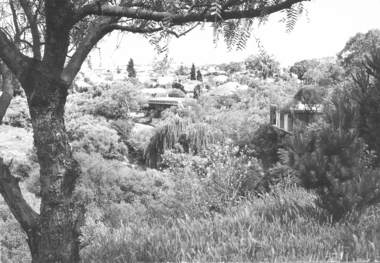
Houses bordering Rockbeare Park 1970s, Rockbeare Park Conservation Group, 1973-1980
... He designed Clifton Bridge in Darebin Parklands and built the wooden formwork for it in his living room in this house. It was built with volunteers and funded by a grant from Heidelberg and Northcote Councils. ...He designed Clifton Bridge in Darebin Parklands and built the wooden formwork for it in his living room in this house. It was built with volunteers and funded by a grant from Heidelberg and Northcote Councils. ...Sidney Clifton was a mechanical engineer and a lecturer at Melbourne University. He built the house, which is still in the family. He was a foundation member and treasurer of Darebin Parklands Association. He designed Clifton Bridge in Darebin Parklands and built the wooden formwork for it in his living room in this house. It was built with volunteers and funded by a grant from Heidelberg and Northcote Councils. He was a foundation member and treasurer of Darebin Parklands Association.B&W photograph. Sidney Clifton's house is on the right. This item and all other Darebin Parklands Association archival material is now held by State Library Victoria (Accession No: YMS 13746). Please contact State Library Victoria if access is required. -
 Robin Boyd Foundation
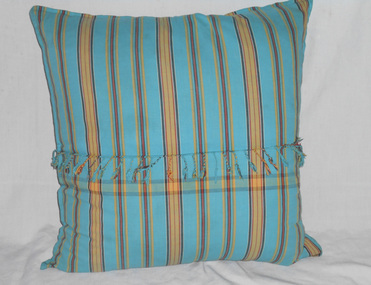
Functional object - Cushion
... Penleigh Boyd recalls: "the upstairs living room in the 1980s and 1990s was a much more colourful space. ...Penleigh Boyd recalls: "the upstairs living room in the 1980s and 1990s was a much more colourful space. ...These are not original cushions in the photos by Mark Strizic in 'Living in Australia' p 83 and p129. Penleigh Boyd recalls: "the upstairs living room in the 1980s and 1990s was a much more colourful space. Arthur Boyd’s large paintings dominated the south wall and the Phillip Fox paintings as well as Tony Wood's 'In the Studio Psychologically Challenged' coloured the north wall. Patricia Boyd was experimenting with colour". These cushions were on the bed in Walsh St until around 2019.Indian cotton turquoise, rust, charcoal, mustard, beige stripe with tassels along centre. Zip on opposite side through centre square.walsh st furnishings, robin boyd -
 Robin Boyd Foundation
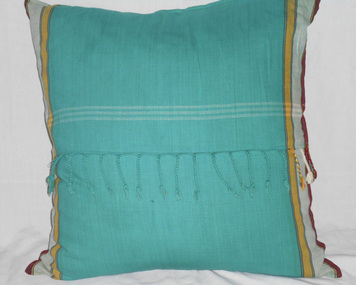
Functional object - Cushion
... Penleigh Boyd recalls: "the upstairs living room in the 1980s and 1990s was a much more colourful space. ...Penleigh Boyd recalls: "the upstairs living room in the 1980s and 1990s was a much more colourful space. ...These are not original cushions in the photos by Mark Strizic in 'Living in Australia' p 83 and p129. Penleigh Boyd recalls: "the upstairs living room in the 1980s and 1990s was a much more colourful space. Arthur Boyd’s large paintings dominated the south wall and the Phillip Fox paintings as well as Tony Wood's 'In the Studio Psychologically Challenged' coloured the north wall. Patricia Boyd was experimenting with colour". These cushions were on the bed in Walsh St until around 2019.Indian cotton red, emerald green, mustard, white. Tassels and white stripes along centre. Zip on opposite side through centre square.walsh st furnishings, robin boyd -
 Vision Australia
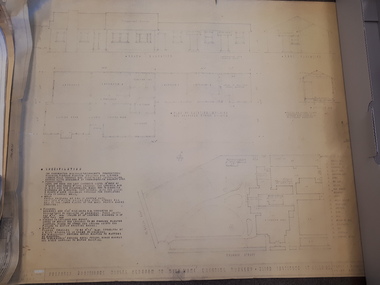
Plan - Image, Proposed additional nurses bedroom to "Myer Home" existing nursery, Blind Institute, St Kilda Rd, 23/8/1949
... The south and eastern elevations are detailed, as well as a plan of the nursery, which had 4 bedrooms, a living room, a dinning room , bathroom, 2 kitchen areas and the proposed additional nurses bedroom next to Bedroom 4....The south and eastern elevations are detailed, as well as a plan of the nursery, which had 4 bedrooms, a living room, a dinning room , bathroom, 2 kitchen areas and the proposed additional nurses bedroom next to Bedroom 4. royal victorian institute for the blind rvib nursery plans Myer House Percy E Everett, Chief Architect 1 architectural plan of Myer House and proposed extension Proposed additional nurses bedroom to "Myer Home" existing nursery, Blind Institute, St Kilda Rd Plan Image ...In 1949 an architect produced this plan to detail the addition of a bedroom for the nursing staff, who looked after children in the Blind Babies nursery. The plan shows a layout of the RVIB site, including the 'Myers Home' (the name of the nursery) where young children were cared for. The south and eastern elevations are detailed, as well as a plan of the nursery, which had 4 bedrooms, a living room, a dinning room , bathroom, 2 kitchen areas and the proposed additional nurses bedroom next to Bedroom 4.1 architectural plan of Myer House and proposed extensionPercy E Everett, Chief Architectroyal victorian institute for the blind, rvib nursery, plans, myer house -
 Eltham District Historical Society Inc
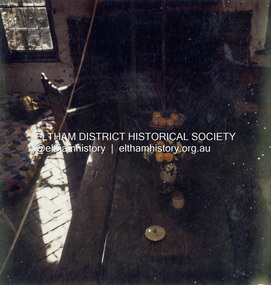
Colour Print, David Taylor, Interior, Peter Garner Mudbrick Studio, c.1976
... Plan rectangular; living room occupies northern two thirds, with kitchen in remainder and bedroom on top of the kitchen. ...Plan rectangular; living room occupies northern two thirds, with kitchen in remainder and bedroom on top of the kitchen. ...Mudbrick cottage, heritage listed, Lillies on Brougham Street Peter Garner Mud Brick Studio Victorian Heritage Database Listed https://vhd.heritagecouncil.vic.gov.au/places/55317 From Shire of Eltham Heritage Study (Bick 1992) Cultural Significance: Constructed by Peter Garner when he was just 16 years old, this studio exemplifies the highly creative structures erected in the Shire of Eltham during the I960s and 1970s and the social movement behind them, both of which Eltham is well known for. The Garner studio is one of the two finest small examples of these structures anywhere in the Municipality and is distinguished by the quality of its fittings, also all designed and made by Peter Garner. Sharing the common use of mud brick and second-hand materials, these structures reflect the physical involvement (and individual creativity) of their owners, often, as in Garner' s case, through building the building and making all of its fittings and artworks. The tree branch framed spiral stair and wrought metalwork are particularly fine. History: Arthur F. Munday who was associated with the Montsalvat Artists' Colony, subdivided a property bounded by Maria Street (now Main Road) and Brougham Street in 1964. The largest portion, three acres of land facing Brougham Street in Lot 2, was sold to Leslie and Lenore Garner. A sketch in Lodge Plan 65141 drawn at the time of the subdivision showed that the southern part of the land was subject to flooding. By 1967 a brick house with an iron roof and outbuildings had been constructed for the Garners and Peter Garner's separate studio followed in 1969. DESCRIPTION: Studio Style Eltham style. Design unique. Plan rectangular; living room occupies northern two thirds, with kitchen in remainder and bedroom on top of the kitchen. A store adjoins the kitchen. Single storey with attic bedroom; living room has a cathedral ceiling. Walls adobe (solid single skin mud brick), bluestone chimney. Roof gabled with eaves, corrugated iron clad. Features are the modest size, living room into which the front door opens directly, exposed mud brick walls internally, fireplace, most unusual spiral stair and small gallery off the bedroom, herringbone brick floor, log faced internal doorway that separates kitchen and living room, timber lined ceiling, exposed truss, the various second-hand windows and their placement and the outbuilding. Also the kitchen doorway, adzed table and benches, fireplace high relief metal panel and other art works are features and all were presumably made by Peter Garner, following the ethic of the time. The present owner has advised (4 May 2025) the spiral staircase was removed prior to their taking possession of the property.david taylor collection, eltham, 62 brougham street, peter garner adobe studio -
 Eltham District Historical Society Inc
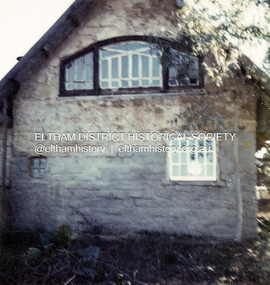
Colour Print, David Taylor, Exterior, Peter Garner Mudbrick Studio, c.1976
... Plan rectangular; living room occupies northern two thirds, with kitchen in remainder and bedroom on top of the kitchen. ...Plan rectangular; living room occupies northern two thirds, with kitchen in remainder and bedroom on top of the kitchen. ...Mudbrick cottage, heritage listed, Lillies on Brougham Street Peter Garner Mud Brick Studio Victorian Heritage Database Listed https://vhd.heritagecouncil.vic.gov.au/places/55317 From Shire of Eltham Heritage Study (Bick 1992) Cultural Significance: Constructed by Peter Garner when he was just 16 years old, this studio exemplifies the highly creative structures erected in the Shire of Eltham during the I960s and 1970s and the social movement behind them, both of which Eltham is well known for. The Garner studio is one of the two finest small examples of these structures anywhere in the Municipality and is distinguished by the quality of its fittings, also all designed and made by Peter Garner. Sharing the common use of mud brick and second-hand materials, these structures reflect the physical involvement (and individual creativity) of their owners, often, as in Garner' s case, through building the building and making all of its fittings and artworks. The tree branch framed spiral stair and wrought metalwork are particularly fine. History: Arthur F. Munday who was associated with the Montsalvat Artists' Colony, subdivided a property bounded by Maria Street (now Main Road) and Brougham Street in 1964. The largest portion, three acres of land facing Brougham Street in Lot 2, was sold to Leslie and Lenore Garner. A sketch in Lodge Plan 65141 drawn at the time of the subdivision showed that the southern part of the land was subject to flooding. By 1967 a brick house with an iron roof and outbuildings had been constructed for the Garners and Peter Garner's separate studio followed in 1969. DESCRIPTION: Studio Style Eltham style. Design unique. Plan rectangular; living room occupies northern two thirds, with kitchen in remainder and bedroom on top of the kitchen. A store adjoins the kitchen. Single storey with attic bedroom; living room has a cathedral ceiling. Walls adobe (solid single skin mud brick), bluestone chimney. Roof gabled with eaves, corrugated iron clad. Features are the modest size, living room into which the front door opens directly, exposed mud brick walls internally, fireplace, most unusual spiral stair and small gallery off the bedroom, herringbone brick floor, log faced internal doorway that separates kitchen and living room, timber lined ceiling, exposed truss, the various second-hand windows and their placement and the outbuilding. Also the kitchen doorway, adzed table and benches, fireplace high relief metal panel and other art works are features and all were presumably made by Peter Garner, following the ethic of the time. The present owner has advised (4 May 2025) the spiral staircase was removed prior to their taking possession of the property.david taylor collection, eltham, 62 brougham street, peter garner adobe studio
