
Showing 185 items matching "loading information"
-
 Moorabbin Air Museum
Manual - Sikorsky S76 helicopters, S-76C++ Flight Manual For Training Purposes Only
... ...Loading information...Sikorsky S76 helicopters Operating limitations Normal procedures Emergency procedures Performance data System descriptions Loading information Noise abatement Full flight manual for training purposes on Sikorsky S76C++ helicopter, circa 2008 Large 3 clip folder S-76C++ Flight Manual For Training Purposes Only Manual Sikorsky S76 helicopters ...Full flight manual for training purposes on Sikorsky S76C++ helicopter, circa 2008Large 3 clip foldernon-fictionFull flight manual for training purposes on Sikorsky S76C++ helicopter, circa 2008operating limitations, normal procedures, emergency procedures, performance data, system descriptions, loading information, noise abatement -
 Melbourne Tram Museum
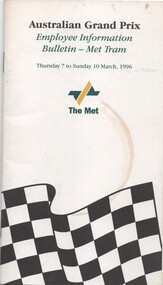
Booklet, The Met, "Employee Information 1996 Australia Formula 1 Grand Prix", 1996
... Booklet issued to staff involved in the "1996 Australia Formula 1 Grand Prix", with maps, overview, introduction, light-rail services, altered services, general information, major loading points, rosters, stabling of trams, traffic management, gate locations, staff access to South Melbourne, PTC crew buses and calendar of events. ...Booklet issued to staff involved in the "1996 Australia Formula 1 Grand Prix", with maps, overview, introduction, light-rail services, altered services, general information, major loading points, rosters, stabling of trams, traffic management, gate locations, staff access to South Melbourne, PTC crew buses and calendar of events. ...Booklet issued to staff involved in the "1996 Australia Formula 1 Grand Prix", with maps, overview, introduction, light-rail services, altered services, general information, major loading points, rosters, stabling of trams, traffic management, gate locations, staff access to South Melbourne, PTC crew buses and calendar of events. This was the first Formula 1 Grand Prix at Albert Park.Demonstrates a Grand Prix information booklet.Booklet with fold out map at rear, 20 pages centre stapled.tramways, grand prix, met tram, the met, information -
 Flagstaff Hill Maritime Museum and Village
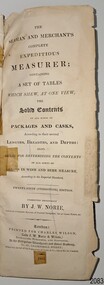
Book - Reference, navigation, J. W. Norie (author and editor), The Seaman and Merchants Complete Expeditious Measurer, 1853
... On October 6th, 1866, Rose Anna went ashore while loading wheat at Sandridge, Port Phillip Bay, in severe gales and heavy seas and became a total wreck. The book is significant for its association with reference information to instruct sea merchant traders and naval officers. ...The book was published at the same address as London’s Navigation Waterhouse and Naval Academy. It is likely to be one of the textbooks used in educating seafarers, both naval and merchant. It is the twenty-fifth edition, showing that it was in great demand in the early to mid-19th century. Sea merchants could have used this as a reference for working out freight costs for their cargo. Customs Officers could have referred to it as well to calculate fees and taxes. The book’s owner had inscribed in pen and ink "Rose Anna, Schooner, Melbourne, March 25th 1857". At that time, the registered owners were Thomas Lamb & E. Keays, who were freighting cargo between Melbourne and Geelong. Schooner, ROSE ANNA: - The schooner Rose Anna was built in 1844 at Fremantle, W.A., by H. Edwards for Capt. William Heard. The 2-masted wooden vessel was carvel-built. Captain Heard registered Rose Anna at Fremantle in 1845 and in the same year, registered it at Port Adelaide. in 1852, Rose Anna was crushed and sunk at Port Adelaide by the Selma and raised. In 1852, the schooner was lengthened by William Hardy. In 1853, William Burton and W. Roberts registered Rose Anna at Melbourne. In 1855, W. Roberts registered, followed by John Balston & Thomas Ross. In 1856, it was registered by Thomas Lamb & E. Keays, in 1857 by William Howes & Charles Holland, in 1865 by Charles Holland & John Balfour, and in 1866 registered in Melbourne by mariners John Balfour & David Griffiths. In the 1940s, Rose Anna traded between Hobart, Melbourne, Adelaide, Sydney, Circular Head, Port Fairy, and Port Albert. In the 1950s and 1960s, it traded between Geelong Heads and Hobsons Bay, Melbourne, in lime, wool, general cargo and ballast. In 1857, when Rose Anna’s registered owners were Thomas Lamb & E. Keays, an advertisement was placed in The Age on March 9th, announcing that the Rose Anna was taking freight from Melbourne to Geelong. Later in the year, in October, the registered owners were William Howes & Charles Holland. They were still trading with Geelong, as on October 7th, The Age announced that Rose Anna arrived in Geelong from Melbourne on October 5th. On October 6th, 1866, Rose Anna went ashore while loading wheat at Sandridge, Port Phillip Bay, in severe gales and heavy seas and became a total wreck. The book is significant for its association with reference information to instruct sea merchant traders and naval officers. The publication is in its twenty-fifth edition, indicating the importance of such an instructional book. The book of tables and calculations shows the evolution of such reference texts, going from handwritten notes, to printed tables like these, and forward to slide rules, calculators, and to modern time computers. it demonstrates the importance of accuracy in calculating weights and measures at sea and for the purposes of fess, charges and taxes. The book is important to the history of the schooner Rose Anna, which is listed as a significant vessel on the Victorian Heritage Register, S582, as it has an inscription with the ship's name, date, and destination. Book, tall and narrow, with index tabs on the side edges of the pages. FULL Title: The Seaman and Merchants Complete Expeditious Measurer: The Seaman and Merchants Complete Expeditious Measure; containing a set of tables which show, at one view, the solid contents of all kinds of packags and casks, according to their several lengths, breadths and depths: also, rules for determining the contents of all sorts of casks in wine and beer measure, according to the Imperial Standard. Twenty-Fifth (Stereotype) Edition. Author: Mr J W Norie (John William Norie) Date: 1853 Publisher: Charles Wilson (late J.W. Norrie & Wilson), Bookseller, Publisher and Stationer, At the Navigation Waterhouse and Naval Academy, No. 157, Leadenhall Street, where may be had all the publications of Steel & Co. Late at No. 70, Cornhill. Printer: Bateman and Dennis, 95 Leadenhall Street, London, England, 1853 The book has handwritten, pen and ink inscriptions. It refers to the Schooner, Rose Anna, Melbourne, March 25th 1857.Handwritten in script with pen and ink: "Rose Anna / Schooner / Melbourne, / March 25th 1857"flagstaff hill, warrnambool, shipwrecked-coast, flagstaff-hill, flagstaff-hill-maritime-museum, maritime-museum, shipwreck-coast, flagstaff-hill-maritime-village, the seaman and merchants complete expeditious measurer, book, sea merchants, cargo, calculations, measurements, sea trade, maritime book, sea transportation, cargo rate calculations, naval academy, navy education, navigation, navigation instruction, navigation waterhouse and naval academy, twenty-fifth edition, 19th century, 1853, 1857, customs, freight, ullage, rose anna, schooner, 2-masted, march 25th 1857, melbourne, 25 march 1857, thomas lamb & e. keays, geelong, 1844, h. edwards, fremantle, carvel-built, port adelaide, selma, william hardy, william burton and w. roberts, john balston & thomas ross., charles holland & john balfour, john balfour & david griffiths, hobart, sydney, circular head, port fairy, port albert, hobsons bay, sandridge, port phillip bay -
 Federation University Historical Collection
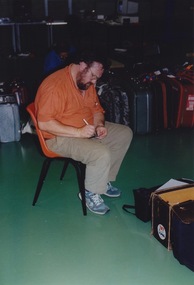
Photograph - Photographs - colour, VIOSH: Postgraduate Student, Geoffrey Dell's PhD, 1996, c1996
... information gathered will provide an understanding of back injury causation modes, and will focus attention on the specific tasks for which engineering solutions should be sought. Engineering solutions identified will be subject to controlled trial, to confirm their validity." This led to the construction of a full scale plywood baggage compartment model and a partnership with Ballarat University's School of Human Movement and Sports Science. Three different loading...information gathered will provide an understanding of back injury causation modes, and will focus attention on the specific tasks for which engineering solutions should be sought. Engineering solutions identified will be subject to controlled trial, to confirm their validity." This led to the construction of a full scale plywood baggage compartment model and a partnership with Ballarat University's School of Human Movement and Sports Science. Three different loading ...Victorian Institute of Occupational Safety and Health (VIOSH) Australia is the Asia-Pacific centre for teaching and research in occupational health and safety (OHS) and is known as one of Australia's leaders on the field. VIOSH has a global reputation for its innovative approach within the field of OHS management. VIOSH Australia enrolled its first PhD candidate in 1995 and during 1996 focused on attracting increasing numbers of students. In 1996, three candidates were enrolled through VIOSH Australia.They were John Culvenor, Geoffrey Dell and Thomas Mitchell. All had Prof Dennis Else as their supervisor. Previously, Geoffrey Dell was in Intake 7, 1985, Occupational Hazard Management. Geoffrey Dell's topic was "Airline Baggage Handler Back Injuries - Causes and Prevention." "The aim of this study is to investigate the work practises and operational systems used by baggage handlers in a range of airlines, worldwide. Where possible the investigation will include an epidemiological study of baggage handler back injury occurrence in those airlines. The information gathered will provide an understanding of back injury causation modes, and will focus attention on the specific tasks for which engineering solutions should be sought. Engineering solutions identified will be subject to controlled trial, to confirm their validity." This led to the construction of a full scale plywood baggage compartment model and a partnership with Ballarat University's School of Human Movement and Sports Science. Three different loading systems were tested. Qantas baggage handlers travelled to Ballarat University to fill the human frame of the investigation. The photographs show this aspect of the research. In 1997, Geoffrey Dell was awarded the Eric Wigglesworth Prize. The prize acknowledges publication of an article which constitutes a significant contribution to the body of occupational health and safety knowledge in an approved OH&S journal.32 co;our photographs showing procedure of baggage handlers.viosh, victorian institute of occupational safety and health, geoffrey dell, john culvenor, thomas mitchell, phd, airline baggage handler back injuries, work practises, operational systems, engineering solutions, causes of injury, qantas baggage handlers, prof dennis else, eric wiggles worth prize, oh&s journal, ballarate university, school of human movement and sports science, plywood compartment model, loading systems -
 Federation University Historical Collection
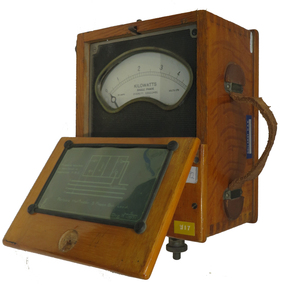
Instrument - Electrical Instrument, Everett AC Wattmeter, 1923
... Schematic diagram on inside lid showing how to connect the Wattmeter to measure a 3 phase balanced load. Paper sticker on top "1/92" Information for voltage and current ranges painted with white paint on left hand side by Voltage terminals Voltage terminals labelled A and N Also white on black "W8" on same surface Aluminium plate "67" on right hand side near current terminals which are engraved To A and Ti A to indicate current flow direction Aluminium sticker with Ballarat CAE Electrical Engineering by carry handle...In working condition and a good example of early 20th century electrical instruments. everett instruments single phase wattmeter electrical scientific instruments Schematic diagram on inside lid showing how to connect the Wattmeter to measure a 3 phase balanced load. Paper sticker on top "1/92" Information for voltage and current ranges painted with white paint on left hand side by Voltage terminals Voltage terminals labelled A and N Also white on black "W8" on same surface Aluminium plate "67" on right hand side near current terminals which are engraved To A and Ti A to indicate current flow direction Aluminium sticker with Ballarat CAE Electrical Engineering by carry handle A polished natural timber case with partial flip top lid and leather carry handle, housing a single phase AC Wattmeter, rated at 170 volts , 30 amps Scale 0 to 5 kilowatt. ...Would have been used by staff and students of electrical Engineering at the School of Mines, Lydiard St. campus up until the start of the Mount Helen campus E building third floor. The meter would have had limited use in classes until 2009. This Wattmeter became part of the historical collection in 2011 after the movement of Engineering out of the E building. In working condition and a good example of early 20th century electrical instruments.A polished natural timber case with partial flip top lid and leather carry handle, housing a single phase AC Wattmeter, rated at 170 volts , 30 amps Scale 0 to 5 kilowatt. Serial no :210088Schematic diagram on inside lid showing how to connect the Wattmeter to measure a 3 phase balanced load. Paper sticker on top "1/92" Information for voltage and current ranges painted with white paint on left hand side by Voltage terminals Voltage terminals labelled A and N Also white on black "W8" on same surface Aluminium plate "67" on right hand side near current terminals which are engraved To A and Ti A to indicate current flow direction Aluminium sticker with Ballarat CAE Electrical Engineering by carry handleeverett instruments, single phase, wattmeter, electrical, scientific instruments -
Marysville & District Historical Society
THE TRIANGLE NEWS-VOL 39 NO 48-DECEMBER 14 2012
... marysville victoria australia buxton community christmas party ymca marysville project a success what's on when in december public notice councillor allowances creative triangle thanks patricia whittingham emotions anonymous international marysville hotel and conference centre construction & trades information session church notices kidz bizz youth impact christmas treat family fellowship funding carols by candlelight lions park mops position vacant office administrator marysville preschool councillor comment installation of wildflower plaques mayor's chair maryton beer & platter garden maryton park advertisements small businesses are now better prepared marysville golf report prepare for australia day 2013 real estate buxton post office public notice free mulch loading is expected this weekend triangle art group unpalatable super call will be paid early feedback sought for tracks & trails council services over christmas and new year period black spur inn new year's eve & new year's day celebrations mystic mountain tourism merry christmas the committee of management of the gallipoli park precinct THE TRIANGLE NEWS-VOL 39 NO 48-DECEMBER 14 2012 ...marysville, victoria, australia, buxton community christmas party, ymca marysville project a success, what's on when in december, public notice councillor allowances, creative triangle, thanks patricia whittingham, emotions anonymous international, marysville hotel and conference centre, construction & trades information session, church notices, kidz bizz youth impact christmas treat, family fellowship funding, carols by candlelight lions park, mops, position vacant office administrator, marysville preschool, councillor comment, installation of wildflower plaques, mayor's chair, maryton beer & platter garden, maryton park, advertisements, small businesses are now better prepared, marysville golf report, prepare for australia day 2013, real estate, buxton post office public notice, free mulch loading is expected this weekend, triangle art group, unpalatable super call will be paid early, feedback sought for tracks & trails, council services over christmas and new year period, black spur inn new year's eve & new year's day celebrations, mystic mountain tourism merry christmas, the committee of management of the gallipoli park precinct -
Marysville & District Historical Society
THE TRIANGLE NEWS-VOL 40 NO 19-MAY 24 2013
... marysville victoria australia $28 million vibe hotel marsyville breaks ground deputy premier and minister for regional & rural development peter ryan what's on when in may and june buxton recreational reserve working bee intrepid triangle bushwalkers the committee of management of the gallipoli park precinct marysville community market creative triangle fire services levy now part of rates notices church notices triangle community dinner el kanah village biggest morning tea a success vale brian moore murrindindi shire council payment of rate installment position vacant mayor's chair marysville primary school mother's day raffle advertisements buxton fire brigade anna's mobile patchwork quilt shop open capital works program supports existing infrastructure villains storm home to first ever away victory staff wanted black spur inn greenlands guesthouse open by lachlan fraser building our future draft council plan released for comment emotions anonymous international buxton hotel real estate marysville golf report snowgum hillary challenge comes to marysville last quarter assault gets villains home free mulch loading triangle community dance group marysville villains sponsors and members lunch randy the puppet is back for lunch draft council plan and budget have your say melbourne international comedy festival marysville & district lions club road maintenance and construction works free information session council delivers conservative draft budget yarra valley div 1 game in marysville a success THE TRIANGLE NEWS-VOL 40 NO 19-MAY 24 2013 ...marysville, victoria, australia, $28 million vibe hotel marsyville breaks ground, deputy premier and minister for regional & rural development, peter ryan, what's on when in may and june, buxton recreational reserve, working bee, intrepid triangle bushwalkers, the committee of management of the gallipoli park precinct, marysville community market, creative triangle, fire services levy now part of rates notices, church notices, triangle community dinner, el kanah village, biggest morning tea a success, vale brian moore, murrindindi shire council, payment of rate installment, position vacant, mayor's chair, marysville primary school mother's day raffle, advertisements, buxton fire brigade, anna's mobile patchwork quilt shop open, capital works program supports existing infrastructure, villains storm home to first ever away victory, staff wanted black spur inn, greenlands guesthouse open by lachlan fraser, building our future draft council plan released for comment, emotions anonymous international, buxton hotel, real estate, marysville golf report, snowgum hillary challenge comes to marysville, last quarter assault gets villains home, free mulch loading, triangle community dance group, marysville villains sponsors and members lunch, randy the puppet is back for lunch, draft council plan and budget have your say, melbourne international comedy festival, marysville & district lions club, road maintenance and construction works free information session, council delivers conservative draft budget, yarra valley div 1 game in marysville a success -
Marysville & District Historical Society
THE TRIANGLE NEWS-VOL 40 NO 20-MAY 31 2013
... marysville victoria australia a memorable year for lions club lions club 40th anniversary celebration what's on when in june intrepid triangle bushwalkers the committee of management of the gallipoli park precinct marysville community market creative triangle council seeks to inform on its roadside code of practice murrindindi shire council triangle community dinner el kanah village church notices marysville golf report memorial service brian more council position vacant road maintenance and construction works free information session mayor's chair queen's birthday official closures advertisements buxton fire brigade councillor comment many ideas provide healthy response to community plan emotions anonymous international buxton hotel dinner lions triangle tool library real estate bushfire appeal money available to fire affected communities marysville long lunch auction funds dispersal free mulch loading buxton primary school walk safely to school triangle junior fire brigade junior volunteer development program no wasting chances to build on high service levels council's resource recovery centre melbourne international comedy festival marysville community centre THE TRIANGLE NEWS-VOL 40 NO 20-MAY 31 2013 ...marysville, victoria, australia, a memorable year for lions club, lions club 40th anniversary celebration, what's on when in june, intrepid triangle bushwalkers, the committee of management of the gallipoli park precinct, marysville community market, creative triangle, council seeks to inform on its roadside code of practice, murrindindi shire council, triangle community dinner, el kanah village, church notices, marysville golf report, memorial service brian more, council position vacant, road maintenance and construction works free information session, mayor's chair, queen's birthday official closures, advertisements, buxton fire brigade, councillor comment, many ideas provide healthy response to community plan, emotions anonymous international, buxton hotel dinner, lions triangle tool library, real estate, bushfire appeal money available to fire affected communities, marysville long lunch auction funds dispersal, free mulch loading, buxton primary school, walk safely to school, triangle junior fire brigade, junior volunteer development program, no wasting chances to build on high service levels, council's resource recovery centre, melbourne international comedy festival, marysville community centre -
 Flagstaff Hill Maritime Museum and Village
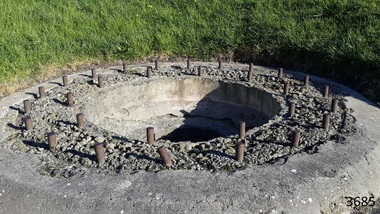
Gun Emplacement, 1890's
... Loading Smooth Bore cast in 1861 at the equally august Low Moor Foundry, number 10310 and now located on the lawn area at the entrance to Flagstaff Hill Maritime Village. It is still mounted on its original wooden garrison carriage. Its wooden slide compressor mechanism is fragile and now kept in Flagstaff Hill’s storage. There are only seven 32 Pounder SB made by Carron and fifteen 68 Pounder SB made at Low Moor known to exist in the State of Victoria [references; Flagstaff Hill Maritime Village interpretation boards, information...Loading Smooth Bore cast in 1861 at the equally august Low Moor Foundry, number 10310 and now located on the lawn area at the entrance to Flagstaff Hill Maritime Village. It is still mounted on its original wooden garrison carriage. Its wooden slide compressor mechanism is fragile and now kept in Flagstaff Hill’s storage. There are only seven 32 Pounder SB made by Carron and fifteen 68 Pounder SB made at Low Moor known to exist in the State of Victoria [references; Flagstaff Hill Maritime Village interpretation boards, information ...The Warrnambool Battery on Flagstaff Hill has embankments for 3 guns. Those on the left and right still have cannon in place but in the centre is an empty embankment, apart from this concrete ring with metal threaded studs. In 1898 a 5 inch breech loading gun (BL) was installed here. The gun had a hydro-pneumatic disappearing carriage (hence the sign on the concrete wall "5" BL HP").. This type of gun was faster to load and fire that the 80 pound RML’s installed on either side of it. Its arrival spelt the end of the 80 pound RML guns’ useful life, although they continued to be used for practice sessions. The 5 inch BL was the main defensive weapon of the Warrnambool Battery until the Battery was downgraded in importance. It was removed in 1904 and recalled to Melbourne in 1910. The gun emplacement ring is all that remains of the mounting for a 5 inch Armstrong rifled breech loading gun. HISTOR of the WARRNAMBOOL GUNS & CANNON In the years following the Crimean War (1854-1857J) there was a great concern in the Colony that Imperial Russia would attempt an invasion. Coastal defences in the colony of Victoria were greatly strengthened by the Government as a result. Warrnambool was originally protected by cannons at Cannon Hill, approximately 1 kilometer west of the Flagstaff Hill Fortifications. The cannons included two 1866 guns, both 80 Pound Rifled Muzzle Loaders (RML) purchased by Victoria’s Colonial Government. They were part of a shipment of 26 such guns sent from England in December 1866. They are registered as No. 23 (80cwt-2qr-0lbs) - Gun 1, and No.13 (81cwt-1qr-12lbs) - Gun 2. They were cast at the Royal Gun Factory, Woolwich Arsenal, in 1866 and have a 6.3 inch bore. Both barrels carry the Royal Cypher of Queen Victoria, Insignia of the Royal Engineers, within the Garter and Motto surmounted by the Crown, with the Royal Cypher of Queen Victoria within the Garter (letters in centre “VR”, motto “HONI SOIT QUI MAL Y PENSE”, "Shame be to him who thinks evil of it."). The guns were originally supplied with wooden carriages. (The Royal Arsenal at Woolwich, England, was established eleven years after the Restoration of King Charles II. It was the principal supplier of armaments to the British and Empire Governments. At the height of its operations during World War One the factory covered 1300 acres and employed very nearly 80,000 workers. Woolwich was the Headquarters of the Royal Artillery since the raising of that Regiment in 1716. The Arsenal was closed in the late 1960’s.) These two 80pdr cannons were transferred to the Warrnambool Garrison Artillery Battery Fortifications erected at Flagstaff Hill in 1887 as part of Victoria’s Coastal Defences. The original wooden carriages were subsequently replaced with the present iron garrison carriages in 1888. They are a “C” pivot. The ‘racers’ or curved track set into the floor of the gun emplacement (which enabled the guns to be traversed more quickly) are as specified for guns up to 10 inch, being of wrought iron 2.78 inches wide. A temporary third gun, now no longer on Flagstaff Hill’s site, was the 5 inch Rifled Breech Loading (BL) Armstrong gun mounted on an Elswick hydro pneumatic disappearing carriage and installed in this very concrete base or pad. The State of Victoria took over the ownership of the guns at the time of Australian Federation in 1901. In about 1901/1902 the Garrison Battery was converted to the Warrnambool Battery of the Australian Field Artillery (No 4 Field Battery). It was equipped with 4.7 inch naval guns mounted on field carriages. They were now a mobile unit but continued to use the Warrnambool Garrison area at Flagstaff Hill for practice. When the Fortifications were declared obsolete the two 80 Pounder RML were relocated to Cannon Hill in 1910. On the outbreak of World War One the 4.7 inch guns were recalled to Melbourne, and the Battery was disbanded. Most of the personnel probably re-enlisted in the local 4th Australian Light Horse Regiment. The two 80 Pounder RML were moved back to the Fortifications in 1973. They were both fully restored by Army First Year Apprentices at the Ordinance Factory in Bendigo in time for the centenary year of the fortifications in 1987. The guns are capable of firing 80 pound (32.3kg) armour piercing exploding shells 3.65kms out to sea. They were originally manned by volunteers before a paid Garrison was established. Now the Guns are again fired by volunteers on Special Event days. Since restoration the Gun Number 1 had been fired on a regular basis but Gun Number 2 hadn’t been fired since the mid 1990’s. In April 2015 Gun Number 2 was serviced in preparation for the firing of both cannons on the ANZAC Centenary commemorations on April 25th 2015. Other guns from the original Cannon Hill location were obsolete by the time the 1887 Warrnambool Garrison Artillery Battery was built. These guns are (1) a 32 Pounder Muzzle Loading Smooth Bore (SB) cast in 1813 at the famous Carron Foundry, number 80837 and now located in the Warrnambool Botanic Gardens. It is now mounted on a replica carriage due to the original carriage being in a fragile condition (the original carriage stored under cover at Flagstaff Hill). (2) a 68 Pounder Muzzle Loading Smooth Bore cast in 1861 at the equally august Low Moor Foundry, number 10310 and now located on the lawn area at the entrance to Flagstaff Hill Maritime Village. It is still mounted on its original wooden garrison carriage. Its wooden slide compressor mechanism is fragile and now kept in Flagstaff Hill’s storage. There are only seven 32 Pounder SB made by Carron and fifteen 68 Pounder SB made at Low Moor known to exist in the State of Victoria [references; Flagstaff Hill Maritime Village interpretation boards, information sheets and other documents; South Western Victoria Guns and Cannon report, May 2008, ref W/F/08] The Gun embankment is contained within the heritage listed Lady Bay Lighthouse Comples, on the Victorian Heritage Register VHR H1520. The gun emplacement base is evidence of the last defences installed on this stretch of coastline. The Warrnambool Garrison has been added to the Victorian Heritage Register H1250 “for its intact battery and guns, a strong reminder of Victoria’s wealth and determination to protect itself from the perceived threat of invasion in the 1880’s.” The City of Warrnambool is one of several custodians of a collection of artillery pieces of heritage significance at a state, national and international level. These pieces are directly related to the defence of south-west Victoria in the 19th century. The care and preservation come under the Heritage Act 1995. Gun emplacement; the remains of the mounting platform of a temporary third gun installed in 1898 in the centre of the battery. This consists of a circular concrete well or sump surrounded by two rings of mounting bolts, the inner of 10 and the outer of 20. The base once held a 5 inch Armstrong rifled breech loading gun with hydro-pneumatic disappearing. In the centre of the ring on the ground is a keyhole shaped space. The gun was removed in 1904. flagstaff hill, warrnambool, shipwrecked coast, flagstaff hill maritime museum, maritime museum, shipwreck coast, flagstaff hill maritime village, great ocean road, colonial defences, victoria’s coastal defences, warrnambool fortification, warrnambool garrison battery, warrnambool volunteer corps, ordinance, armaments, cannon hill fortifications, flagstaff hill fortifications, 4th australian light horse regiment, garrison gun, 5 inch breech loading gun, emplacement for hydro-pneumatic disappearing carriage, gun emplacement -
 Flagstaff Hill Maritime Museum and Village
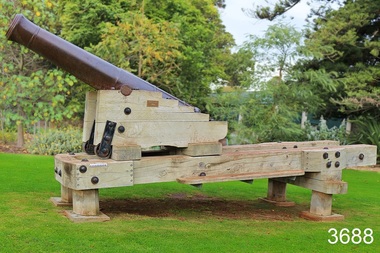
Weapon - Cannon, 1813
... INFORMATION ABOUT THE CANNON IN THE WARRNAMBOOL AREA In the years following the Crimean War (1854-1857J) there was a great concern in the Colony that Imperial Russia would attempt an invasion. Coastal defences in the colony of Victoria were greatly strengthened by the Government as a result. Warrnambool was originally protected by cannons at Cannon Hill, approximately 1 kilometer west of the Flagstaff Hill Fortifications. The cannons included two 1866 guns, both 80 Pound Rifled Muzzle Loaders...INFORMATION ABOUT THE CANNON IN THE WARRNAMBOOL AREA In the years following the Crimean War (1854-1857J) there was a great concern in the Colony that Imperial Russia would attempt an invasion. Coastal defences in the colony of Victoria were greatly strengthened by the Government as a result. Warrnambool was originally protected by cannons at Cannon Hill, approximately 1 kilometer west of the Flagstaff Hill Fortifications. The cannons included two 1866 guns, both 80 Pound Rifled Muzzle Loaders ...This 1813 cannon is classified as a carronade, having been made by the Carron Ironworks foundry in Stirling, Scotland in 1813. It is a large calibre, short range, gun mainly used on ships. The carronade model of cannon was first used when introduced into the British Royal Navy in the American War of the Revolution (1775-1883). This cannon was originally a 28pdr, 48cwt, 8ft gun. The date ‘1837’ on the barrel probably indicates the date that the Board of Ordinance accepted the change in size to a 32pdr. It may originally have been a naval gun and the conversion undertaken when it was brought ashore. It is very probably one of the 15 guns that are known to have constituted the defences of Victoria in 1860. This group of 32pdrs was the shorter model of the 4800width and 8ft length cannon and as such are different from the 32pdrs found in NSW. It was originally located on Cannon Hill in Warrnambool when it was the site of the Warrnambool Battery Western Artillery, formed in 1866. It was obsolete by the time of the 1887 fortifications, and was moved from the Warrnambool Fortifications to the Botanic Gardens in 1910, when the Fortifications were declared obsolete. HISTORIC INFORMATION ABOUT THE CANNON IN THE WARRNAMBOOL AREA In the years following the Crimean War (1854-1857J) there was a great concern in the Colony that Imperial Russia would attempt an invasion. Coastal defences in the colony of Victoria were greatly strengthened by the Government as a result. Warrnambool was originally protected by cannons at Cannon Hill, approximately 1 kilometer west of the Flagstaff Hill Fortifications. The cannons included two 1866 guns, both 80 Pound Rifled Muzzle Loaders (RML) purchased by Victoria’s Colonial Government. They were part of a shipment of 26 such guns sent from England in December 1866. They are registered as No. 23 (80cwt-2qr-0lbs) - Gun 1, and No.13 (81cwt-1qr-12lbs) - Gun 2. They were cast at the Royal Gun Factory, Woolwich Arsenal, in 1866 and have a 6.3 inch bore. Both barrels carry the Royal Cypher of Queen Victoria, Insignia of the Royal Engineers, within the Garter and Motto surmounted by the Crown, with the Royal Cypher of Queen Victoria within the Garter (letters in centre “VR”, motto “HONI SOIT QUI MAL Y PENSE”, "Shame be to him who thinks evil of it."). The guns were originally supplied with wooden carriages. (The Royal Arsenal at Woolwich, England, was established eleven years after the Restoration of King Charles II. It was the principal supplier of armaments to the British and Empire Governments. At the height of its operations during World War One the factory covered 1300 acres and employed very nearly 80,000 workers. Woolwich was the Headquarters of the Royal Artillery since the raising of that Regiment in 1716. The Arsenal was closed in the late 1960’s.) The two 80pdr cannons were transferred to the Warrnambool Garrison Artillery Battery Fortifications erected at Flagstaff Hill in 1887 as part of Victoria’s Coastal Defences. The original wooden carriages were subsequently replaced with the present iron garrison carriages in 1888. They are a “C” pivot. The ‘racers’ or curved track set into the floor of the gun emplacement (which enabled the guns to be traversed more quickly) are as specified for guns up to 10 inch, being of wrought iron 2.78 inches wide. A temporary third gun, now no longer on Flagstaff Hill’s site, was a 5 inch Rifled Breech Loading (BL) Armstrong gun mounted on an Elswick hydro pneumatic disappearing carriage It was faster to load and fire than the 80 pound RMLs and its arrival spelt the end of the older 80 pound guns’ useful life, apart from being used for practice sessions. The 5 inch BL gun was the main defensive weapon of the Warrnambool Battery until the Battery was downgraded in importance and the gun was recalled to Melbourne in 1910. The gun emplacement still remains in place set between the 2 80pdr cannon. The State of Victoria took over the ownership of the guns at the time of Australian Federation in 1901. In about 1901/1902 the Garrison Battery was converted to the Warrnambool Battery of the Australian Field Artillery (No 4 Field Battery). It was equipped with 4.7 inch naval guns mounted on field carriages. They were now a mobile unit but continued to use the Warrnambool Garrison area at Flagstaff Hill for practice. When the Fortifications were declared obsolete the two 80 Pounder RML were relocated to Cannon Hill in 1910. On the outbreak of World War 1 the 4.7 inch guns were recalled to Melbourne, and the Battery was disbanded. Most of the personnel probably re-enlisted in the local 4th Australian Light Horse Regiment. The two 80 Pounder RML were moved back to the Fortifications in 1973. They were both fully restored by Army First Year Apprentices at the Ordinance Factory in Bendigo in time for the centenary year of the fortifications in 1987. The guns are capable of firing 80 pound (32.3kg) armour piercing exploding shells 3.65kms out to sea. They were original manned by volunteers before a paid Garrison was established. Now the Guns are again fired by volunteers on Special Event days. Since restoration the Gun Number 1 had been fired on a regular basis but Gun Number 2 hadn’t been fired since the mid 1990’s. In April 2015 Gun Number 2 was serviced in preparation for the firing of both cannons on the ANZAC Centenary commemorations on April 25th 2015. Other guns from the original Cannon Hill location were obsolete by the time the 1887 Warrnambool Garrison Artillery Battery was built. These guns are (1) a 32 Pounder Muzzle Loading Smooth Bore (SB) cast in 1813 at the famous Carron Foundry, number 80837 and now located in the Warrnambool Botanic Gardens. It is now mounted on a replica carriage due to the original carriage being in a fragile condition (the original carriage stored under cover at Flagstaff Hill). (2) a 68 Pounder Muzzle Loading Smooth Bore cast in 1861 at the equally august Low Moor Foundry, number 10310 and now located on the lawn area at the entrance to Flagstaff Hill Maritime Village. It is still mounted on its original wooden garrison carriage. Its wooden slide compressor mechanism is fragile and now kept in Flagstaff Hill’s storage. There are only seven 32 Pounder SB made by Carron and fifteen 68 Pounder SB made at Low Moor known to exist in the State of Victoria Plaque attached to the carriage “This replica carriage was constructed by the Warrnambool Tritan Woodworkers club in conjunction with the generosity of local businesses and the Warrnambool community. The original carriage (circa 1860) was removed for restoration and is now located at Flagstaff Hill Maritime Village. The timber used for the replica carriage is Monterey Cypress, which was an early planting in the gardens. 2010 marked the centenary of the cannon’s relocation in the Warrnambool Botanic Gardens.” (Reference; Victorian Guns and Cannons, South Western Victoria Assessment, May 2008, item W/B/01; Flagstaff Hill Maritime Village datasheets and archives). There are only seven 32 Pounder SB made by Carron known to exist in the State of Victoria and this is one of them. On a world level, this cannon represents a high level of rarity. Further, as it has been modified (bored up) it is representative of the historical process of amending artillery in order to ensure a longer usefulness of each piece despite rapidly advancing artillery technology. The number of surviving carriages with traversing slides in this group in South Western Victoria is unique in Australia and probably in the World. Out of 10 such platforms surviving in Australia, the South Western Victorian group has half. Several survive around the world but probably not in such a large group. The wooden sliding compressor mechanism belonging to this cannon is extremely rare, and the only one in this South Western Victorian group of Guns and Cannons. As a whole, this cannon has undergone very little restoration or modification, giving it a high level of integrity. The City of Warrnambool is one of several custodians of a collection of artillery pieces of heritage significance at a state, national and international level. These pieces are directly related to the defence of south-west Victoria in the 19th century. The care and preservation come under the Heritage Act 1995. (Reference; Victorian Guns and Cannons, South Western Victoria Assessment, May 2008).Cannon, or carronade, 32pdr with wheels. Muzzle loading smooth bore (SB) cannon. Cannon has original wooden Burmese Teak carriage and slide with wrought iron fittings and iron wheels. Manufactured by Carron in Scotland, in 1813. It has been converted from a 28pdr. There is a loop for a rope on the cascabel, which was part of the original casting. Re-bored in 1837. Marks include Serial Number, Royal Cypher of King George III, broad arrow of proofing, and numbers to represent the weight. NOTE: The cannon is displayed in the Warrnambool Botanic Gardens and is mounted on a replica wooden carriage; the original wooden carriage is now stored under cover at Flagstaff Hill Maritime Village. This carriage has 4 wheels on swivel attachments and a central gear that allows the wheels to turn on rails. Pressed into left trunnion “80837 / CARRON / 1813”, cast on barrel“symbol (Royal Cypher of King George III”, “symbol (broad arrow of proofing)” and numbers “45-3-24 / 1837” . Cascable “CV” and marks with gradations from nought to three in quarters on each side, On the carriage the end of one of the main slide members carries the mark “W symbol (broad arrow) D” incised into the timber. Plaque attached to the carriage by the Warrnambool Tritan Woodworkers club, 2010, marking the centenary of the cannon’s relocation in the Warrnambool Botanic Gardens and the addition of the replica carriage. flagstaff hill, warrnambool, shipwrecked coast, flagstaff hill maritime museum, maritime museum, shipwreck coast, flagstaff hill maritime village, great ocean road, victoria’s coastal defences, warrnambool fortification, warrnambool garrison battery, ordinance, armaments, cannon hill fortifications, victorian colonial government, carron ironwroks foundary, 32pdr smooth bore cannon, 28pdr smooth bore cannon, 1813 cannon, carronade -
 Flagstaff Hill Maritime Museum and Village
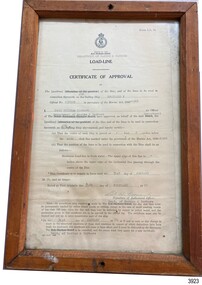
Document - Certificate of Approval, Load Line, 25-02-1970
... Certificate is an official printed form, some information is over-typed, other information is hand written and signed. Frame has a central hole in top and bottom. The Certificate relates to Load Level of the vessel Reginald M and refers to the exact placement of a disc within the vessel that indicates the maximum load in fresh water. . ... is over-typed, other information is hand written and signed. Frame has a central hole in top and bottom. The Certificate relates to Load Level of the vessel Reginald M and refers to the exact placement of a disc within the vessel that indicates the maximum load in fresh water. . ...This Certificate, Load-Line, gave approval for the vessel Reginald M to load cargo up to a certain line, marked by a disc attached to the ship and inspected by the South Australian Harbors Board. The vessel had a long and varied life of service. This Certificate relates to early 1970, before the ship was sold to the Lyall Mining and Rail Company. The Load Line on the Reginald M was carved on the ship, inside the hull and not removeable. The REGINALD M - The vessel “Reginald M” was a two-masted coastal ketch, owned and built by Mr. Jack (John) Murch of Birkenhead, Port of Adelaide, South Australia. Its construction took approximately 6 months and it was launched at Largs Bay in 1922. The Reginald M’s purpose was to serve the coastal trade of South Australia, to carry cargo cheaply and efficiently. It is believed that the keel was in fact hewn from two telegraph poles! Its builder frequented all the salvage yards for materials and fittings. Reginald M had a very shallow draft and a flat bottom that enabled it to come close to shore and to sit high and dry at low tide or to be beached on sand. The flat bottom was also to make the ship able to skim over reefs. Wagons could load and unload direct from her side. Her cargo included Guano, Barley, Wool, Horses, Cattle, Timber, Explosives, Potatoes, Shell Grit and Gypsum. After a variety of services, in late 1970 Reginald M was sold to the Mt. Lyell Mining and Railway Company and was used by them as a barge to carry explosives. In 1972 the Navy League of Strahan, Tasmania, purchased her for use by the Strahan Sea Cadet Unit to use at Macquarie Harbour and renamed her T.S. Macquarie. However this plan for use of Reginald M did not come to pass. In 1974 Mr. Andrew Rennie, of East Brighton, Melbourne, bought her for a similar purpose. , paying $5,000 and donating a ‘Cadet of the Year” trophy to the Sea Cadets. He sailed her from Strahan to Melbourne, planning to use her for pleasure sailing. Also in 1975 Reginald M was sold to Melbourne Ferry Company at auction. Later in 1975 the Reginald M was bought by Flagstaff Maritime Museum for $20,000 . She has been restored and is now one of the exhibits in the Village lagoon or lake. It was restored in 2006 using funds from a $4,000 government grant.This Certificate is significant because of its association with the last working days of REGINALD M. REGNIALD M was a coastal trading ketch from South Australia built in 1922. It was one of very few sailing coastal trading vessels still existing until 2016, and its flat bottom, single chine shape illustrated a very simple but robust method of construction, compared to other round bilged examples of trading vessels. The vessel is listed on the Australian Register of Historic Vessels (ARHV Number: HV000562.)Certificate, rectangular, behind glass in wooden frame. Certificate is an official printed form, some information is over-typed, other information is hand written and signed. Frame has a central hole in top and bottom. The Certificate relates to Load Level of the vessel Reginald M and refers to the exact placement of a disc within the vessel that indicates the maximum load in fresh water. . Issued to the vessel 'Reginald M', Official Number 137228. . Issued by the Sough Australian Harbors Board . Valid from 25-02-1970 to 31-01-1974. . Signed by Neil Cormack, 25th February 1970Certificate of Approval - Load Line for sailing vessel Reginald M, Official Number 137228. Logo of the South Australian Harbors Board. Issued by Department of Marine & Harbors, Port Adelaide, 25th February 1970. In force until 31st January 1974. Signed by Neil William Cormack, authorised officer for Department of Marine & Harbors. Typed onto form: "AUX [SAILING SIP]" "REGINALD M" "137228" "1968" " Neil William Cormack" "Department of Marine & Harbors" "1 [foot] 3 [inches below the] main [deck]" "31st JANUARY 74" "25th FEBRUARY 70" Signature: "Neil W Cormack"flagstaff hill, warrnambool, maritime village, maritime museum, flagstaff hill maritime museum & village, shipwreck coast, great ocean road, coastal trader, reginald m, ketch, john murch, ch murch, reg webb, carribie station, mt lyell copper company, melbourne ferry company, certificate of approval, load line, 137228, load line disc, 25-02-1970, neil w cormack, neil william cormack, south australian harbors board, department of marine and harbors, harbours -
 Glenelg Shire Council Cultural Collection
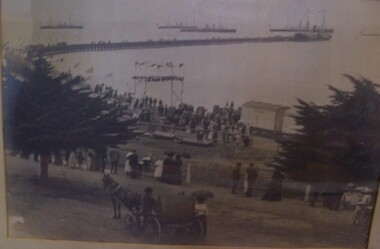
Photograph - Photograph - Opening of the New Pier, 13 February 1902, 1902
... loading at pier. Australian Squadron in background." See other information....loading at pier. Australian Squadron in background." See other information. Black and white photograph, Framed, under glass. ...See previous worksheet.Black and white photograph, Framed, under glass. Wooden frame, decorated with lines. Image: Opening of new pier, Portland Victoria, 13 February 1902. Original frame [?]Front: Label "Opening of the 'New Pier', Portland, Victoria 13.2.1902. 'Gulf of Siam' loading at pier. Australian Squadron in background." See other information.port of portland -
 Orbost & District Historical Society
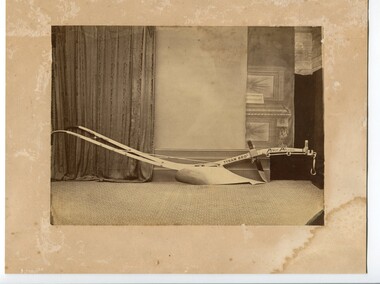
black and white photograph
... information with this item. John Tynan's Victoria Agricultural Implement Factory began making ploughs in 1857. His company is also believed to be the first to have produced drilling tools suitable for use in basalt quartz-load gold mining. ...information with this item. John Tynan's Victoria Agricultural Implement Factory began making ploughs in 1857. His company is also believed to be the first to have produced drilling tools suitable for use in basalt quartz-load gold mining. ...There is no information with this item. John Tynan's Victoria Agricultural Implement Factory began making ploughs in 1857. His company is also believed to be the first to have produced drilling tools suitable for use in basalt quartz-load gold mining. Tynan was the first person to manufacture swing ploughs. His ploughs won numerous prizes, including the first gold medal ever given in Victoria for a colonially made plough.This is a photograph of an early farming tool.A black / white photograph on a discoloured cream coloured card. It is of a shiny new plough on a carpet with walls and drapes in the background.on cutting arm - Tynan Bros Prize Ploughphotograph-plough-tynan -
 Phillip Island and District Historical Society Inc.
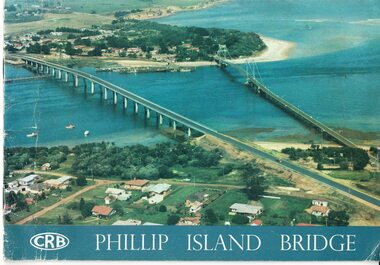
Booklet, Official Opening of the Phillip Island Bridge at San Remo 1969 and notes by the Bridge engineer, Tom Russell, 1969
... load capacity was a problem. The decision to build a new bridge was made in the 1960s. Historical Bridges 2nd phillip island bridge construction Tom Russell Phillip Island Bridge Opening 1969 Official Opening of the Phillip Island Bridge at San Remo by The Hon. M.V. Porter, MLA. Minister of Public Works. November 21 1969 Coloured, bound booklet with a photo of the old and new Phillip Island bridges on the cover and the CRB logo and name on rear. It includes the order of proceedings for the opening and bridge statistics, plans and contractor information ...Prior to 1939 access to the Island was by punt from San Remo or car ferry from Stony Point. A bridge was opened in 1940 but increased traffic and low load capacity was a problem. The decision to build a new bridge was made in the 1960s.HistoricalColoured, bound booklet with a photo of the old and new Phillip Island bridges on the cover and the CRB logo and name on rear. It includes the order of proceedings for the opening and bridge statistics, plans and contractor information. Also photos of construction and a history of travel to the Island before a bridge was built and the first bridge. There is also a 2 page typed document written by the bridge engineer who gives a brief history of access to the Island and problems at the opening with access and a rebel who tried to open it unofficially.Official Opening of the Phillip Island Bridge at San Remo by The Hon. M.V. Porter, MLA. Minister of Public Works. November 21 1969bridges, 2nd phillip island bridge construction, tom russell, phillip island bridge opening 1969 -
 Halls Gap & Grampians Historical Society
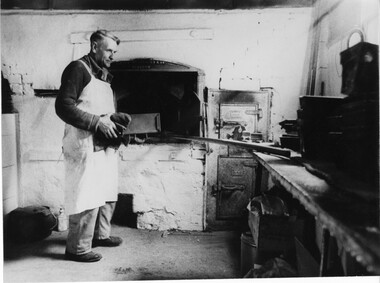
Photograph - B/W, C 1950s (?)
... Robert & Ida inherited the Bakery from Ida's father John Warren. for further information see Bridging the Gap p. 56 PEOPLE Greer BUILDINGS Bakery Folio no.48 Negative no.25 Photo shows Robert Greer, baker standing with a load tin in his hands, inside the bakery. ...Robert Greer, baker, married Ida Warren whose family started the bakery; in 1929. Robert & Ida inherited the Bakery from Ida's father John Warren. for further information see Bridging the Gap p. 56Photo shows Robert Greer, baker standing with a load tin in his hands, inside the bakery. Baking tins & ovens can be seen in the photo.Folio no.48 Negative no.25people, greer, buildings, bakery -
 Bendigo Military Museum
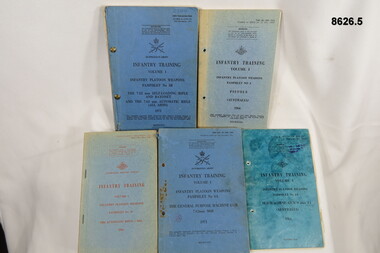
Manual - INFANTRY TRAINING, Australian Military Forces, 1966, 1971
... Provides information on the handling and firing the 9mm self loading and .38 inch revolving Pistols. 2. ...Provides information on the handling and firing the 9mm self loading and .38 inch revolving Pistols. 2. ...1. Provides information on the handling and firing the 9mm self loading and .38 inch revolving Pistols. 2. Provides information on the handling and firing of the Sub-Machine Gun 9mm F1. 3. Provides information and handling of the 262 mm Rifle. 4. provides information and handling of the General purpose Machine Gun 7.62 mm M60. 5. Provides information and handling of the Automatic Rifle M16.2. HQ 4 Task Force 16 George St FITZROY.passchendaele barracks trust, pbt 25 26 32 33 83, manual, training, weapons -
 Queenscliffe Maritime Museum
Photograph - Moving Lifeboat to QMM, Colour Photograph
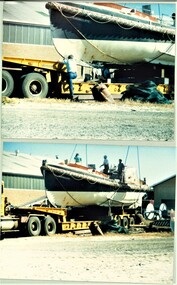
... lifeboat QUEENSCLIFFE being preserved Lifeboat community information The QUEENSCLIFFE lifeboat Reverse - 066.1 "Now just exactly what is happening?" and 066.2 "Almost there - what an achievement!" Colour photographs of the QUEENSCLIFFE Lifeboat loaded onto a low-loader trailer to move it to the QMM site [66.1 and 66.2] Colour Photograph Photograph Moving Lifeboat to QMM ...lifeboat QUEENSCLIFFE being preservedLifeboatColour photographs of the QUEENSCLIFFE Lifeboat loaded onto a low-loader trailer to move it to the QMM site [66.1 and 66.2]Reverse - 066.1 "Now just exactly what is happening?" and 066.2 "Almost there - what an achievement!"community information, the queenscliffe lifeboat -
![1986-067.1 [1st above] craning the QUEENSCLIFFE onto boat rollers / 1986.067.2 [2nd above] Two cranes moving the QUEENSCLIFFE INTO POSITION / 1986.067.3 and 4 earlier shots of the two cranes maneuvering the QUEENSCLIFFE](/media/collectors/4f729f7e97f83e03086018d1/items/634f479a46349cf64a758143/item-media/634f49f346349cf64a75bc4c/item-fit-380x285.jpg?cb=6) Queenscliffe Maritime Museum
Queenscliffe Maritime MuseumPhotograph - Moving Lifeboat into the QMM, Colour Photograph set
... lifeboat QUEENSCLIFFE being preserved Lifeboat community information The QUEENSCLIFFE lifeboat Reverse - NIL Colour photographs of the QUEENSCLIFFE Lifeboat being loaded onto a low-loader trailer to move it to the QMM site [66.1 and 66.2] Colour Photograph set Photograph Moving Lifeboat into the QMM ...lifeboat QUEENSCLIFFE being preservedLifeboatColour photographs of the QUEENSCLIFFE Lifeboat being loaded onto a low-loader trailer to move it to the QMM site [66.1 and 66.2]Reverse - NILcommunity information, the queenscliffe lifeboat -
 Glen Eira Historical Society
Article - Hopetoun Gardens
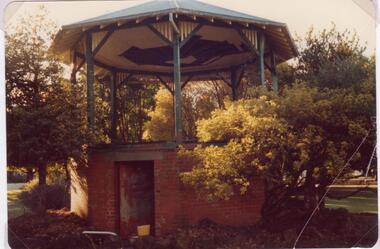
... Coxen of Queenscliff to (unnamed) Mayor of Caulfield, dated 14/04/1910, stating that he encloses information about the two eighty pound rifled muzzle loading guns now at Hopetoun Gardens, with more recently typed shot description of “The Cannon of Hopetoun Gardens.” ...Coxen of Queenscliff to (unnamed) Mayor of Caulfield, dated 14/04/1910, stating that he encloses information about the two eighty pound rifled muzzle loading guns now at Hopetoun Gardens, with more recently typed shot description of “The Cannon of Hopetoun Gardens.” ...This file contains eleven items about these Gardens: 1/Handwritten note from Pam Harrison of Monash University dated 15/06/2005, stating that she is sending the Glen Eira Historical a collection of items from her aunt, whose husband worked for Caulfield Council. Stapled together with a typed acknowledgment from Hazel Ford, Hon. Secretary of the Society dated 15/07/2005. 2/Typed letter from Walter A. Coxen of Queenscliff to (unnamed) Mayor of Caulfield, dated 14/04/1910, stating that he encloses information about the two eighty pound rifled muzzle loading guns now at Hopetoun Gardens, with more recently typed shot description of “The Cannon of Hopetoun Gardens.” Also included is a typed page dated 14/04/1910, signed by Mr Coxen on “Particulars of the two eighty-PR guns presented to the Caulfield Town Council”. 3/Two undated black and white photographs showing garden beds at Hopetoun Gardens. 4/Typed letter from Lt.-Col M.P.J. O’Brien, President, Fort Queenscliff Museum, dated 05/09/1984, to R-Ballantine, Hon. Secretary of the Caulfield Historical Society, stating that he would be happy to assist in tracing the history of the cannons in Hopetoun Gardens. 5/Photographs of the cannon at Hopetoun Gardens. Four are recent colour photographs, one dated 06/1981. One is a black and white photograph, undated (mid-1930s?), with a man sitting on the cannon. One is a black and white photocopy of a photograph of the cannon, with three children, possibly from 1910. 6/Two colour photographs dated 15/05/2009, of the bandstand at Railway Reserve, which is to be moved to a new park in Glen Huntly Road. 7/Two colour photographs of the bandstand and playground equipment at Hopetoun Gardens, dated by hand on “c. 2000” 8/Printed four page booklet (two copies), no date (c. 2000?) of “Your Guide to Hopetoun Gardens – Interpretative Tree Walk”, printed by the Glen Eira City Council Recreation Services. 9/One colour negative (two copies of each) of swimming at Hopetoun Gardens, no date 10/Printed emails of correspondence dated from 26/08/2012 to 02/10/2012, to and from the Glen Eira historical Society, about the cannons at Hopetoun Gardens. 11/Article from Glen Eira News dated March/April 2013 about the history of the cannons with a coloured photograph.hopetoun gardens, harrison pam, ford hazel, coxen walter adam, cannons, parks, fort queenscliff, elsternwick, bandstands, glen eira recreation services, trees, triarico elizabeth, dunbar margaret, rogers john (fleet engineer) -
 Bendigo Military Museum
Photograph - Royal Australian Survey Corps Field Survey Vehicles, c1950s
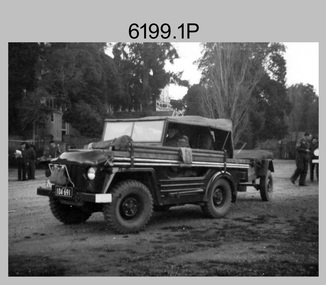
... The International truck and low loader trailer in Photo .4P was carrying RASvy’s field deployable printing press, the George Mann Double Crown. See pages 44 -45 of Valerie Lovejoy’s book for more information on how this trailer mounted printing press was used in a recruitment drive in 1948. ...The International truck and low loader trailer in Photo .4P was carrying RASvy’s field deployable printing press, the George Mann Double Crown. See pages 44 -45 of Valerie Lovejoy’s book for more information on how this trailer mounted printing press was used in a recruitment drive in 1948. ...This is a set of five photographs of vehicles used by field survey parties during the 1950s and 1960s. The first two photos show unidentified surveyors and field survey vehicles departing the Army Survey Regiment’s transport compound. The third photo of LTCOL Lindsay Lockwood and CAPT Jim Stedman standing beside an early 1950s International light truck was taken at a field survey camp at Camooweal, QLD. LTCOL Lindsay Lockwood was the CO of the Army Survey Regiment from 1951 to 1962. As the longest serving commanding officer of the unit, there was many changes implemented. LTCOL Lindsay Lockwood’s period as CO is covered in more detail in pages 48-49 of Valerie Lovejoy’s book 'Mapmakers of Fortuna – A history of the Army Survey Regiment’ ISBN: 0-646-42120-4. CAPT Jim Stedman later reached the rank of Colonel, was Director of Military Survey from 1975 to 1978 and was appointed as Colonel Commandant (honorary appointment, Retd) of the Royal Australian Survey Corps from 1978 to 1983. The International truck and low loader trailer in Photo .4P was carrying RASvy’s field deployable printing press, the George Mann Double Crown. See pages 44 -45 of Valerie Lovejoy’s book for more information on how this trailer mounted printing press was used in a recruitment drive in 1948. More photos of RASvy vehicles can be found at 9019.6P.This is a set of five photographs of vehicles used by field survey parties. c1950s – 1960s. The photographs were printed on photographic paper and are part of the Army Survey Regiment’s Collection. The photographs were scanned at 300 dpi. .1) - Photo, black & white, c1950s, unidentified surveyors in an Austin Champ field survey vehicle departing the Army Survey Regiment’s transport compound. .2) - Photo, black & white, c1950s, unidentified surveyors in a Humber 1 ton survey vehicle departing the Army Survey Regiment’s transport compound. .3) - Photo, black & white, 1958, L to R: LTCOL Lindsay Lockwood and CAPT Jim Stedman standing beside a 1950's International truck at Camooweal, QLD., .4) - Photo, black & white, c1950s, unidentified surveyor, field survey truck and trailer carrying deployable "Mann" press trailer. .5) – Photo black & white, May 1960. PTE R. Eastwood, an attached Service Corps driver on survey operations, extracts his Land Rover from the Archer River in northern Queensland..3P on back – Lindsay Lockwood (LT COL) Jim Stedman (Capt) 1958 Camooweal .4P on back – Early vehicles for field trips. .5P with card strip annotation’ Survey field parties often strike difficult terrain when driving’.royal australian survey corps, rasvy, army survey regiment, army svy regt, fortuna, asr, surveying -
4th/19th Prince of Wales's Light Horse Regiment Unit History Room
Booklet (4 copies), Infantry Training Vol 1 Infantry Platoon Weapons Pam 3B The 7.62 Self Loading Rifle and Bayonet and 7.62 Automatic Rifle, 1971
... information to develop in soldiers the confidence to handle and maintain these weapons. One booklet has amdt No 1, two have amdts 1 and 2 and one has amdts 1,2 and 3 Infantry Training Vol 1 Infantry Platoon Weapons Pam 3B The 7.62 Self Loading Rifle and Bayonet and 7.62 Automatic Rifle Booklet (4 copies) ...A soft covered booklet providing instructors with the necessary information to develop in soldiers the confidence to handle and maintain these weapons. One booklet has amdt No 1, two have amdts 1 and 2 and one has amdts 1,2 and 3DSN 7610-66-043-7060rifle 7.62 slr, automatic rifle 7.63 -
4th/19th Prince of Wales's Light Horse Regiment Unit History Room
Booklet (2 copies), Manual of Land Warfare Part 2 Infantry Training Vol 4 Pam 5: 7.62 mm Self Loading Rifle L1A1 & Automatic Rifle 7.62 mm L2A1, 1983
... Rifle SLR 7.62 automatic rifle DSN 7610-66-107-1254 A soft covered booklet aimed at providing the soldier with the necessary information for him to develop the confidence and knowledge to efficiently handle and maintain these weapons. Manual of Land Warfare Part 2 Infantry Training Vol 4 Pam 5: 7.62 mm Self Loading Rifle L1A1 & Automatic Rifle 7.62 mm L2A1 Booklet (2 copies) ...A soft covered booklet aimed at providing the soldier with the necessary information for him to develop the confidence and knowledge to efficiently handle and maintain these weapons.DSN 7610-66-107-1254rifle slr 7.62, automatic rifle -
4th/19th Prince of Wales's Light Horse Regiment Unit History Room
Booklet (2 copies), Infantry Training Vol 1 Infantry Platoon Weapons Pam 5 Pistols, 1966
... A soft covered booklet providing instructors with the necessary information to train soldiers to handle and fire the 9 mm self loading pistol and the .38 inch revolver....Pistol 9mm .38 inch revolver 7160-66-024-7171 A soft covered booklet providing instructors with the necessary information to train soldiers to handle and fire the 9 mm self loading pistol and the .38 inch revolver. ...A soft covered booklet providing instructors with the necessary information to train soldiers to handle and fire the 9 mm self loading pistol and the .38 inch revolver.7160-66-024-7171pistol, 9mm, .38 inch revolver -
 Ararat & District Historical Society (operating the Langi Morgala Museum)
Photograph, 1895
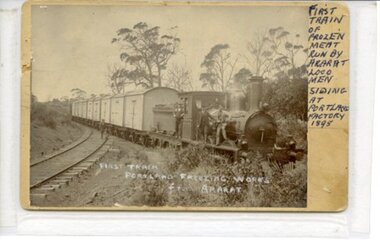
... loading" is struck out] / 1st train of frozen meat / run by Ararat Loco men / Siding at Portland Factory / 1895". Black and white photograph mounted on cardboard, featuring a steam engine with nine carriages and five men. The train has stopped in a siding surrounded by forest. The photo has text written along the right side of the image and repeated across the face of the photograph. Further information ...This photo of the first train from Ararat to the Portland Freezing Works in 1895 is a visual record of transport and industry in the early industrialisation of the region.Black and white photograph mounted on cardboard, featuring a steam engine with nine carriages and five men. The train has stopped in a siding surrounded by forest. The photo has text written along the right side of the image and repeated across the face of the photograph. Further information is written on the rear.Front: "First Train / Portland Freezing Works / from Ararat." "FIRST / TRAIN / OF / FROZEN / MEAT / RUN BY / ARARAT / LOCO / MEN / SIDING / AT / PORTLAND / FACTORY / 1895" Rear: "1st train ["loading" is struck out] / 1st train of frozen meat / run by Ararat Loco men / Siding at Portland Factory / 1895".locomotive, train, portland, ararat, portland-freezing-works, railway-siding, 1895 -
 Bendigo Historical Society Inc.
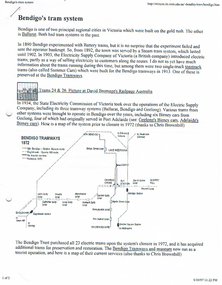
Document - LONG GULLY HISTORY GROUP COLLECTION: BENDIGO'S TRAM SYSTEM
... Other information includes Nos, First introduced, Last withdrawn, Electrics (motors), Size and Seating/Crush Load. (8 pages)....Other information includes Nos, First introduced, Last withdrawn, Electrics (motors), Size and Seating/Crush Load. (8 pages). ...Information on trams. Includes small photo of Trams 24 & 26, Map of Bendigo Tram routes 1972and 1996, Ballarat No 26 tram, S 164 tram, and No 38 tram. Mentioned is the individual history and where they can be found, operating and non operating trams, different classes of trams. Geelong's Birney Cars, two of which came to Bendigo and the Type G (Birney Safety Cars). Other information includes Nos, First introduced, Last withdrawn, Electrics (motors), Size and Seating/Crush Load. (8 pages).bendigo, history, long gully history group, the long gully history group - bendigo's tram system, battery trams, steam trams, electricity supply company of victoria, toastrack trams, david bromage, bendigo tramways, state electricity commission of victoria, the bendigo trust, chris brownbill, bendigo talking tram, david hoadley, prahran and malvern tramways trust, hawthorn tramways trust, fitzroy northcote and preston tramways trust, melbourne brunswick and coburg tramways trust, north melbourne electric tramway and lighting co, sydney tramway museum, tramway museum of victoria, railpage australia, ballarat vintage tramway, andrew cox, russell jones, australian electric transport museum, birney cars, j g brill & co, bob hawke, adelaide municipal tramways trust, tim blythman, bill winn, john radcliffe -
 Bendigo Historical Society Inc.
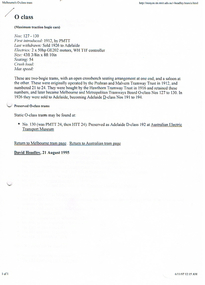
Document - LONG GULLY HISTORY GROUP COLLECTION: TRAMS INFORMATION
... Information on O Class Trams, First introduced, Last Withdrawn, Electrics, Size and Seating, W2 with a small photo, where they can be found, some went to the USA, W5 with a small photo, W6 and the Bendigo Toastrack Tram with Nos, Introduced, Withdrawn, Electrics, Size and Seating/Crush Load. ...BENDIGO History long gully history group The Long Gully History Group - Trams Information Prahan and Malvern tramway Trust Hawthorn Tramway Trust Melbourne and Metropolitan tramways Board Australian Electric Transport Museum David Hoadley Tramway Musuem of Victoria Hawthorn Tram Depot David Bromage Sydney Tramway Museum Bendigo Tramways Museum of Transport and Technology NZ Whiteman Park Tramway Museum Haddon Tramway Museum The Old Canberra Tram Company Ballarat Vintage Tramway Bendigo Toastrack Tram Kilmore Cable Tramway Railway Museum Scienceworks Tasmanian Transport Museum Launceston Tramway Museum Society Ballarat Vintage Tramway Central Deborah Gold Mine Chinese Joss House Castleton Sandhurst Shamrock Hotels Dai Gum San Wax Museum Post Office Law Courts Alexandra Fountain Beehive Store Fortuna Villa Sandhurst Town Information on O Class Trams, First introduced, Last Withdrawn, Electrics, Size and Seating, W2 with a small photo, where they can be found, some went to the USA, W5 with a small photo, W6 and the Bendigo Toastrack Tram with Nos, Introduced, Withdrawn, Electrics, Size and Seating/Crush Load. ...Information on O Class Trams, First introduced, Last Withdrawn, Electrics, Size and Seating, W2 with a small photo, where they can be found, some went to the USA, W5 with a small photo, W6 and the Bendigo Toastrack Tram with Nos, Introduced, Withdrawn, Electrics, Size and Seating/Crush Load. Also listed is where other trams can be seen. Also mentioned some early history of Bendigo, The Heritage Walk, The Central Deborah, Sandhurst Town, the early route from Melbourne to Bendigo, Creswick, Castlemaine and the Old Market. (7 pages).bendigo, history, long gully history group, the long gully history group - trams information, prahan and malvern tramway trust, hawthorn tramway trust, melbourne and metropolitan tramways board, australian electric transport museum, david hoadley, tramway musuem of victoria, hawthorn tram depot, david bromage, sydney tramway museum, bendigo tramways, museum of transport and technology nz, whiteman park tramway museum, haddon tramway museum, the old canberra tram company, ballarat vintage tramway, bendigo toastrack tram, kilmore cable tramway, railway museum, scienceworks, tasmanian transport museum, launceston tramway museum society, ballarat vintage tramway, central deborah gold mine, chinese joss house, castleton, sandhurst, shamrock hotels, dai gum san wax museum, post office, law courts, alexandra fountain, beehive store, fortuna villa, sandhurst town -
 Bendigo Historical Society Inc.
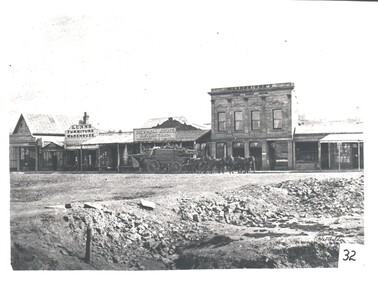
Photograph - WES HARRY COLLECTION: VIEW POINT, SANDHURST, 1861?, C. 1861
... load of timber, with a team of 5 horses and in the near foreground there are some excavations. The ground floor of the hotel appears to contain the following businesses - Imperial Fire Insurance Office, Gilles & Co. stock and sharebrokers. See Butcher & Collins book An American on the Goldfields. See Research field for further information...load of timber, with a team of 5 horses and in the near foreground there are some excavations. The ground floor of the hotel appears to contain the following businesses - Imperial Fire Insurance Office, Gilles & Co. stock and sharebrokers. See Butcher & Collins book An American on the Goldfields. See Research field for further information ...Photograph of a row of businesses in View Point Sandhurst. Depicted are .. H?. Joseph, Assay Office; Lunn's Furniture Warehouse; Victoria House; S.F. Bastard Draper; M. Langridge's View Point Hotel, and Williamson wholesale butcher. In front of the shops is a wagon load of timber, with a team of 5 horses and in the near foreground there are some excavations. The ground floor of the hotel appears to contain the following businesses - Imperial Fire Insurance Office, Gilles & Co. stock and sharebrokers. See Butcher & Collins book An American on the Goldfields. See Research field for further information.Batchelderplace, bendigo, view point, sandhurst -
 Bendigo Historical Society Inc.
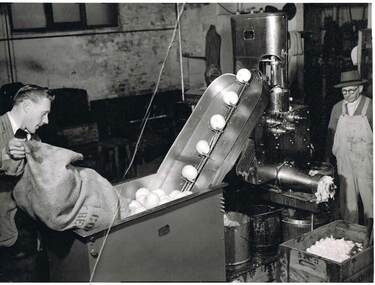
Photograph - COHN BROTHERS COLLECTION: WORKERS
... loading what may be oranges into a machine that crushes them, he is wearing a dust coat. The older man on the right is wearing a hat glasses and bib and brace overalls. By his feet is a large wooden box nearly full of the pulp (waste?). On the back is written in pencil ML45/.1 , there is also a purple stamp from the Australian news and Information...Information Bureau. Photograph of 2 men inside the factory. The young man on the left is loading what may be oranges into a machine that crushes them, he is wearing a dust coat. ...Photograph of 2 men inside the factory. The young man on the left is loading what may be oranges into a machine that crushes them, he is wearing a dust coat. The older man on the right is wearing a hat glasses and bib and brace overalls. By his feet is a large wooden box nearly full of the pulp (waste?). On the back is written in pencil ML45/.1 , there is also a purple stamp from the Australian news and Information Bureau requesting that the photo be acknowledgedAustralian News and Information Bureau.organization, business, factory workers, cohn brothers . -
 Bendigo Historical Society Inc.
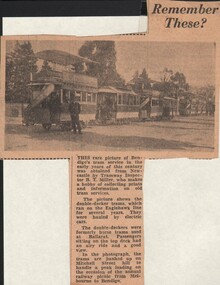
Document - BASIL MILLER COLLECTION: REMEMBER THESE, c1970s?
... information on old tram services. Picture includes Double Decker Tram, hauled by electric cars. Double Deckers were formally used in Ballarat with horses. In the photograph the trams are banked up on Mitchell Street hill to handle a peak loading on the occasion of the annual railway picnic from Melbourne to Bendigo. ...information on old tram services. Picture includes Double Decker Tram, hauled by electric cars. Double Deckers were formally used in Ballarat with horses. In the photograph the trams are banked up on Mitchell Street hill to handle a peak loading on the occasion of the annual railway picnic from Melbourne to Bendigo. ...Newspaper article. Remember These? Includes a rare picture of Bendigo's tram service in the early years of this century (20th) . B T Miller's hobby is collecting prints and information on old tram services. Picture includes Double Decker Tram, hauled by electric cars. Double Deckers were formally used in Ballarat with horses. In the photograph the trams are banked up on Mitchell Street hill to handle a peak loading on the occasion of the annual railway picnic from Melbourne to Bendigo. Article possibly post 1972.cottage, miners -
 National Vietnam Veterans Museum (NVVM)
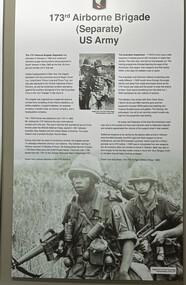
Poster - Information Board 173 Airborne Brigade (Separate) US Army, 173 Airborne Brigade (Separate) US Army
... 1RAR 173rd Airborne Brigade Bien Hoa Saigon Xuan Loc Long Khanh Phuoc Long Province Phuoc Tuy Province Central Highlands Viet Cong Main Force Iron Triangle War Zone D ANZUS Defence Treaty Australia New Zealand United States Of America Bien Hoa Air Base Killed in Action Medals of Honor Distinguished Service Cross Silver Star Purple Heart 9mm Owen Guns 7.62mm Self Loading Rifle M60 Machine Gun M26 Grenade M72 Light Anti-Tank Weapon M79 Grenade Launcher Gun Slingers Club Image from the First Three Years Pictorial History of the 173rd Describes the history of 173 Airbourne and service of 1RAR with the 173 Airbourne Brigade. There are two photographs, both with the title "Image from The First three Years Pictorial history of the 173rd" See media file for more information ...Describes the history of 173 Airbourne and service of 1RAR with the 173 Airbourne Brigade. There are two photographs, both with the title "Image from The First three Years Pictorial history of the 173rd" See media file for more informationImage from the First Three Years Pictorial History of the 173rd1rar, 173rd airborne brigade, bien hoa, saigon, xuan loc, long khanh, phuoc long province, phuoc tuy province, central highlands, viet cong main force, iron triangle, war zone d, anzus defence treaty, australia, new zealand, united states of america, bien hoa air base, killed in action, medals of honor, distinguished service cross, silver star, purple heart, 9mm owen guns, 7.62mm self loading rifle, m60 machine gun, m26 grenade, m72 light anti-tank weapon, m79 grenade launcher, gun slingers club
