
Showing 31 items matching "local government identity"
-
 Broadmeadows Historical Society & Museum
Photograph - Press Photograph, Bill McAuley, Antoinette Abela, 1987
... ...Local government identity...This photograph was produced in 1987 as a press image for The Leader Newspaper Group and references the City of Broadmeadows, a former local government area in metropolitan Melbourne. The image reflects late 20th century local government identity and community representation prior to the 1994 municipal amalgamations in Victoria....This photograph was produced in 1987 as a press image for The Leader Newspaper Group and references the City of Broadmeadows, a former local government area in metropolitan Melbourne. The image reflects late 20th century local government identity and community representation prior to the 1994 municipal amalgamations in Victoria. ...This photograph was produced in 1987 as a press image for The Leader Newspaper Group and references the City of Broadmeadows, a former local government area in metropolitan Melbourne. The image reflects late 20th century local government identity and community representation prior to the 1994 municipal amalgamations in Victoria.This photograph is significant as a visual record of the City of Broadmeadows during the late 1980s and as an example of local press photography produced by The Leader Newspaper Group. It contributes to the historical understanding of municipal identity, civic pride, and local media representation in Broadmeadows prior to council amalgamation.Black and white photographic print. The image shows a person leaning over a sign reading “CITY OF BROADMEADOWS” in hand lettered capital text. The photograph is outdoors, with foliage visible in the background. The image is composed as a press-style portrait. The verso is blank apart from handwritten notes, a copyright stamp, and an adhesive reference label.Verso, handwritten in blue ink: “Antoinette Abela / pic Bill McAuley / 1987” Verso, printed rubber stamp (faded): “THE LEADER NEWSPAPER GROUP PHOTOGRAPH / COPYRIGHT / reproduction without written authority is prohibited / 160 WHITEHORSE RD., BLACKBURN” Verso, adhesive label: “PH 1546”city of broadmeadows, municipal government, local government identity, press photography, suburban melbourne, community representation, civic signage, urban history, the leader newspaper group, 1980s victoria -
 Broadmeadows Historical Society & Museum
Flag - Municipal Flag, City of Broadmeadows Flag
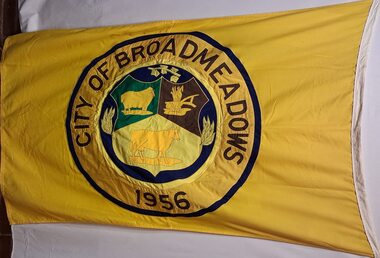
... Local Government...Municipal Administration...Municipal Symbols...Broadmeadows...Hume Region...Flags...Civic Identity...The item represents civic identity, local government administration, and municipal symbolism within Broadmeadows. ...The item represents civic identity, local government administration, and municipal symbolism within Broadmeadows. ...This flag is associated with the former City of Broadmeadows, a municipal authority that administered a large proportion of the area now incorporated within the City of Hume. The item represents civic identity, local government administration, and municipal symbolism within Broadmeadows. The former catalogue worksheet identifies the item as a "City of Broadmeadows Flag 1956".The City of Broadmeadows Flag is historically significant as a surviving municipal emblem of the former City of Broadmeadows. It demonstrates how the municipality represented itself through official civic symbols and contributes to the interpretation of local government history within Broadmeadows and the wider Hume district. The survival of a complete municipal flag enhances its research and interpretive value and provides tangible evidence of community identity and municipal heritage.Yellow oblong municipal flag manufactured from cotton. The flag bears the City of Broadmeadows civic logo on both faces and retains attachments along the hoist edge for display or flying. The flag is complete and substantially intact.No inscriptions or markings recorded. The flag incorporates the official City of Broadmeadows municipal logo on both faces.city of broadmeadows, local government, municipal administration, municipal symbols, broadmeadows, hume region, flags, civic identity -
 The Beechworth Burke Museum
Audio - Oral History, Jennifer Williams, Maxwell Pemberton, 23 June 2000
... identity. This oral history account is socially and historically significant as it is a part of a broader collection of interviews conducted by Jennifer Williams which were published in the book 'Listen to what they say: voices of twentieth-century Beechworth.' While the township of Beechworth is known for its history as a gold rush town, these accounts provide a unique insight into the day-to-day life of the town's residents during the 20th century, many of which would have been lost if they had not been preserved. Twentieth century Beechworth Benevolent asylums WWII beechworth's institutions local employment government ...Mr Maxwell Pemberton was born in Goulburn, NSW in 1923 and moved to Beechworth as a child just before the Great Depression. Mr Pemberton's father was a baker who opened a grocery store in Beechworth to support his seven children. The store, which competed with eight other grocery traders in Beechworth for finite local business, delivered goods by horse and cart to customers all over the district, including the hamlet of Stanley. Mr Pemberton's oral history testifies to the sorts of economic struggles faced by the majority of Beechworth's residents during the depression years. Mr Pemberton worked in many different industries in and around Beechworth, including in his father's grocery store, which he later took over with his brother; the Zwar Tannery, where he served as a union representative; and at the Ovens and Murray Hospital for the Aged, formally the Ovens Benovolent Asylum, established in 1862 for care of the district's destitute, disabled and aged people from Euroa to the Murray, among them, homeless people Mr Pemberton referred to as 'river-bankers'. The hospital's founding in the 1860s was driven by a committee headed by the notable figure, G.B Kerford. Beechworth's institutions were a major source of local employment in the twentieth century. Mr Pemberton joined the Australian Navy during WWII and served at Port Moresby in Papua New Guinea. During his period of service, he received an honorary award from the Royal Humane Society of Australia for aiding and saving a drowning civilian at risk to his own life. Mr Pemberton's oral history also touches on the complex relationship between Australian forces and local Papuan people during the war. This oral history recording was part of a project conducted by Jennifer Williams in the year 2000 to capture the everyday life and struggles in Beechworth during the twentieth century. This project involved recording seventy oral histories on cassette tapes of local Beechworth residents which were then published in a book titled: Listen to what they say: voices of twentieth century Beechworth. These cassette tapes were digitised in July 2021 with funds made available by the Friends of the Burke.Mr Maxwell Pemberton's oral history recalls many aspects of life in Beechworth and the Oven's district during the twentieth century and enriches our understanding of the effects of the periods of socio-economic decline and renewal that unfolded as the century progressed. His singular account of his various jobs and colourful memories of life as a youth and young man in Beechworth, and abroad as a serviceman, contributes to our understanding of society's attitudes and expectations regarding ideals of masculinity and Australian national identity. This oral history account is socially and historically significant as it is a part of a broader collection of interviews conducted by Jennifer Williams which were published in the book 'Listen to what they say: voices of twentieth-century Beechworth.' While the township of Beechworth is known for its history as a gold rush town, these accounts provide a unique insight into the day-to-day life of the town's residents during the 20th century, many of which would have been lost if they had not been preserved.This is a digital copy of a recording that was originally captured on a cassette tape. The cassette tape is black with a horizontal white strip and is currently stored in a clear flat plastic rectangular container. It holds up 40 minutes of recordings on each side.Mr Max Pemberton /twentieth century beechworth, benevolent asylums, wwii, beechworth's institutions, local employment, government institutions, listen to what they say, oral history, burke museum, maxwell pemberton, ovens and murray hospital for the aged, zwar tannery, beechworth grocers, australian navy, port morseby, papua new guinea, trade unions, welfare services, homelessness, 'river bankers', aged care, g.b kerford, ovens benevolent asylum, ovens benevolent home -
 Phillip Island and District Historical Society Inc.
Book, Articles on severance poll concerning split from Shire of Phillip Island and Woolamai 1925-1929, 1925-1929
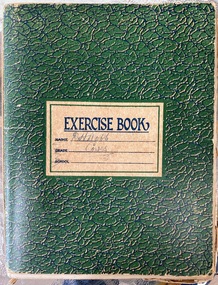
... Historical D.H.Robb Severance of Phillip Island Local government W.D.Davie AKT Sambell Women's Progress Association Phillip Island early roads Phillip Island valuations Local identities Reverend Rath Tourism Phillip Island 1920s Farming Cover states D.H.Robb, Cowes. ...Issue of severance of Phillip Island from the Shire of Phillip Island and Woolamai to become Shire of Phillip Island 1925-1929. This issue had strong opinions on both sides amongst Island residents and shows the political landscape of the times. This is a snapshot of life on Phillip Island in the 1920s. Book also contains notes, poem by D.H. Robb in his handwriting.HistoricalGreen exercise book with handwritten notes, articles from newspapers, pamphlets.Cover states D.H.Robb, Cowes. Lists of absentee ratepayers and householders, objectors,d.h.robb, severance of phillip island, local government, w.d.davie, akt sambell, women's progress association, phillip island early roads, phillip island valuations, local identities, reverend rath, tourism, phillip island 1920s, farming -
 Eltham District Historical Society Inc
Slide - Photograph, St Andrews Primary School Banner, 1985
... local government council, made the idea a very concrete and flourishing reality. The project grew from the original fourteen or so intending participant groups to fifty-seven banners; expressions of those diverse groups' interests and identities. ...local government council, made the idea a very concrete and flourishing reality. The project grew from the original fourteen or so intending participant groups to fifty-seven banners; expressions of those diverse groups' interests and identities. ...St Andrews Primary School was one of thirteen primary schools and one high school to participate in the banner project. A picture of the St Andrews Primary School banner was included in page 10 of The banner habits of the Eltham tribes : Eltham Shire "as we are" Community Banner Project report / by Jacky Talbot. The 'As We Are' Community Banner Project was the first major Community Arts project initiated and co-ordinated through the resources of the Shire of Eltham. It was originally conceived and inspired by a local textile artist, Tracey Naughton, who, together with the Community Services Manager of this local government council, made the idea a very concrete and flourishing reality. The project grew from the original fourteen or so intending participant groups to fifty-seven banners; expressions of those diverse groups' interests and identities. As a first major project it was rightly felt by Tracey Naughton, who became the Shire's first Community Arts Officer in March 1985, that it should be fully documented, so that an appraisal of the extensive growth of this community arts development process could be assessed. Given the time and money available to do this, Jacky Talbot, and her advisors, decided it was appropriate to select fifteen or twenty banners for detailed analysis. This was done by taping interviews with members of the chosen groups. The groups were chosen to cover all ages participating, from the toddlers in the Playhouse to our grand elder citizens in their Nursing Horne, and to cover a wide range of different types of groups - schools, scouts, churches, youth issue based, and the numerous women's groups of various combinations, localities and concerns. ·. Some groups who presented their banners for the culminating highlight of this project - the Exhibition, held at the Eltham Community Centre on October 9th, 1986, had no contact with the Shire or project co-ordinator, but heard about the project through the local news' networks or other participants. The extent of community participation was enormous. It involved hundreds and hundreds of people. It changed some people's lives, enlivened others. As a first step on a new road its success is notable. The 'As We Are' Community Banner Project took place in the Shire of Eltham and neighbouring environs for approximately 12 months, from October 1985.35mm colour positive transparency Mount - Cardbanners, st andrews primary school, banner project, community, emblems, flags, shire of eltham -
 Eltham District Historical Society Inc
Book, Jacky Talbot, The banner habits of the Eltham tribes : Eltham Shire "as we are" Community Banner Project report / by Jacky Talbot, 1987
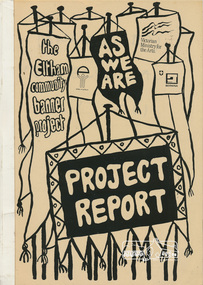
... local government council, made the idea a very concrete and flourishing reality. As the following report reveals, the project grew from the original fourteen or so intending participant groups to fifty-seven banners; expressions of those diverse groups' interests and identities. ...Also titled: Eltham Shire "As We Are"The 'As We Are' Community Banner Project was the first major Community Arts project initiated and co-ordinated through the resources of the Shire of Eltham. It was originally conceived and inspired by a local textile artist, Tracey Naughton, who, together with the Community Services Manager of this local government council, made the idea a very concrete and flourishing reality. As the following report reveals, the project grew from the original fourteen or so intending participant groups to fifty-seven banners; expressions of those diverse groups' interests and identities. As a first major project it was rightly felt by Tracey Naughton, who became the Shire's first Community Arts Officer in March 1985, that it should be fully documented, so that an appraisal of the extensive growth of this community arts development process could be assessed. Given the time and money available to do this the writer, Jacky Talbot, and her advisors, decided it was appropriate to select fifteen or twenty banners for detailed analysis. This was done by taping interviews with members of the chosen groups. The groups were chosen to cover all ages participating, from the toddlers in the Playhouse to our grand elder citizens in their Nursing Horne, and to cover a wide range of different types of groups - schools, scouts, churches, youth issue based, and the numerous women's groups of various combinations, localities and concerns. ·. Some groups who presented their banners for the culminating highlight of this project - the Exhibition, held at the Eltham Community Centre on October 9th, 1986, had no contact with the Shire or project co-ordinator, but heard about the project through the local news' networks or other participants. The extent of community participation was enormous. It involved hundreds and hundreds of people. It changed some people's lives, enlivened others. As a first step on a new road its success is notable. The 'As We Are' Community Banner Project took place in the Shire of Eltham and neighbouring environs for approximately 12 months, from October 1985. Paperback; 68, [10] leaves : ill. ; 30 cm. Two copiesflags, emblems, banners, eltham, shire of eltham, community -
Bendigo Historical Society Inc.
Newspaper - Bendigo Advertiser Collection: Schools Searching for a Future - Muskerry East Primary School 2108, August 20 1993
... The community feels the government has shifted requirements, making it harder for small schools to survive. Parents and community members are actively fighting to keep the school open, emphasizing its importance to local identity and cohesion.There is frustration that bureaucratic decisions may sever long-standing community ties and traditions. ...The community feels the government has shifted requirements, making it harder for small schools to survive. Parents and community members are actively fighting to keep the school open, emphasizing its importance to local identity and cohesion.There is frustration that bureaucratic decisions may sever long-standing community ties and traditions. ...This Article outlines the history, community role, and current challenges facing Muskerry East School, a rural Australian school. The school has existed on the same site since 1878, originally sharing a building with the Methodist church. The current weatherboard building was relocated in 1926 after the closure of Weston school. The school has experienced multiple closures due to low enrolment: from 1902–1922 and 1945–1951. Muskerry East is considered a true "neighborhood school" despite its remote location, with families like the Hicksons, Roulstons, Burkes, and Tuoheys attending for generations. The school serves as the central gathering place for the local farming community, especially for women who rely on school drop-offs and pick-ups for social interaction.It is now the only school remaining in a large area between Heathcote and Elmore, with others having closed. The Directorate of School Education is considering closing the school due to low enrolment (currently 15, projected 16–21), despite community guarantees of future students. Recent policy changes require at least 21 pupils for "non-remote" schools to remain open, putting Muskerry East at risk. The community feels the government has shifted requirements, making it harder for small schools to survive. Parents and community members are actively fighting to keep the school open, emphasizing its importance to local identity and cohesion.There is frustration that bureaucratic decisions may sever long-standing community ties and traditions. Muskerry East School stands as a symbol of rural resilience and community, now threatened by changing educational policies and declining rural populations.Schools searching for a Future. Series of photos and information about Muskeery East Primary School No. 2108. Pictures by Lisa Honeychurch. Written by Owen Davies. This item contains the following documents and Photos: 8091.604a Part of Page 11, the Bendigo Advertiser Friday August 20 1993 8091.604b Black and White Photo. Left to Right: Alma and Ron Hickson, Catherine Hamblin (attended 72 years ago), Beryl Roulston (husband was a student and both children attended the school), Joyce Moroney (student 69 years ago), Nancy Roulston, (Teacher) - Contact the BHS for details 8091.604c Black and White Photo. Left to Right: Beryl Roulston (husband was a student and both children attended the school), Joyce Moroney (student 69 years ago) - Contact the BHS for details 8091.604d Black and White Photo. Centenary Plaque (100 years of the school 9th Dec 1878 - Contact the BHS for details 8091.604e Black and White Photo. Joelene Morrissey (Grade 5) and Linda Hickson (Grade 4) - contact the BHS for details 8091.604f Black and White Photo. Ron Hickson (attended in 1927) and his grand children, L to R: Lauren Tuohey (Grade 4) Rowan Hickson (Grade 2) and Linda Hickson (Grade 5) - contact the BHS for details 8091.604g Black and White Photo. Catherine Hamblin (former pupil 72 years ago, when the school was in the old Methodist Church) - contact the BHS for details 8091.604h Black and White Photo. In the class room on the last day of school for the year 16 Dec 1993 - contact the BHS for details 8091.604i Black and White Photo. In front of the school, pupils, parents and community members - contact the BHS for detailsnewspaper, bendigo advertiser, primary school, muskerry east -
 Myrtleford and District Historical Society
Tobacco bale stencil
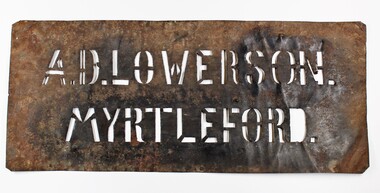
... government level. He was active locally on these issues and supported fund raising for a war memorial, memorial hall and veteran welfare. The stencil represents the achievements of A.D.Lowerson, VC as an isolated example of success as a WW1 soldier settler and as a local identity who stridently supported the need for recognition and support of ex-service personnel. lowerson a.d. merriang estate myrtleford closer settlement board tobacco st. quentin victoria cross world war 1 Stencil made of thin sheet metal, rusted .Wording of stencil "A.D.LOWERSON. ...Stencil used by Sgt. Albert David Lowerson, VC, a soldier settler on Merriang Estate near Myrtleford. Lowerson acquired one of 19 blocks assigned by the Closer Settlement Board on the 700 acre estate in 1920. The stencil marked bales of cured tobacco leaves prior to shipment to Melbourne. Lowerson was one of the few successful soldier settler farmers in the district, operating a piggery, dairy farming and growing tobacco for almost 20 years on "St. Quentin". (Lowerson was awarded the Victoria Cross at Mont St. Quentin on September 1, 1918.) His success and status enabled him to lead a submission on farm debt and infrastructure problems when the soldier settlement scheme was being reviewed at government level. He was active locally on these issues and supported fund raising for a war memorial, memorial hall and veteran welfare.The stencil represents the achievements of A.D.Lowerson, VC as an isolated example of success as a WW1 soldier settler and as a local identity who stridently supported the need for recognition and support of ex-service personnel.Stencil made of thin sheet metal, rusted .Wording of stencil "A.D.LOWERSON. MYRTLEFORD." lowerson a.d., merriang estate, myrtleford, closer settlement board, tobacco, st. quentin, victoria cross, world war 1 -
 Sunshine and District Historical Society Incorporated
Document - Heritage Council Of Victoria Former Sunshine Technical College Determination 2025, Heritage Victoria, 20th January 2025
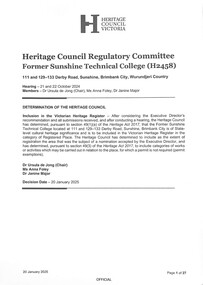
... The significance of this successful appeal was a major win for local heritage advocates (including the Sunshine & District Historical Society, RHSV, and Brimbank Council), who argued that the school’s story is inseparable from Sunshine’s identity. As the site had been under threat, with earlier proposals to demolish the buildings, this determination now gives the site strong legal protection. Developers and government ...On 15 January 2024, the Executive Director made a recommendation (‘the Recommendation’) to the Heritage Council, pursuant to Part 3, Division 3 of the Heritage Act 2017 (‘the Act’), that the Former Sunshine Technical College, at 111 and 129–133 Derby Road, Sunshine (‘the Place’), is not of State-level cultural heritage significance and should not be included in the Victorian Heritage Register (‘the Heritage Register’), pursuant to section 49(1)(b) of the Act. An appeal was made by seven submissions. • Albion and Ardeer Community Club (Neil Head), who did not support the Recommendation and requested that a hearing be held • Sunshine and Districts Historical Society (John Pardy), who did not support the Recommendation and wished to participate in any hearing • Sunshine and Districts Historical Society (Olwen Ford), who did not support the Recommendation and requested that a hearing be held • Harwood Andrews Lawyers, on behalf of the Brimbank City Council, who did not support the Recommendation and requested that a hearing be held • Royal Historical Society of Victoria, who did not support the Recommendation and wished to participate in any hearing • Lesley Preston, who did not support the Recommendation and wished to participate in any hearing. After considering the Executive Director’s recommendation and all submissions received, and after conducting a hearing, the Heritage Council has determined, pursuant to section 49(1)(a) of the Heritage Act 2017, that the Former Sunshine Technical College located at 111 and 129–133 Derby Road, Sunshine, Brimbank City is of State-level cultural heritage significance and is to be included in the Victorian Heritage Register in the category of Registered Place. The Heritage Council has determined to include as the extent of registration the area that was the subject of a nomination accepted by the Executive Director, and has determined, pursuant to section 49(3) of the Heritage Act 2017, to include categories of works or activities which may be carried out in relation to the place, for which a permit is not required (permit exemptions).The significance of this successful appeal was a major win for local heritage advocates (including the Sunshine & District Historical Society, RHSV, and Brimbank Council), who argued that the school’s story is inseparable from Sunshine’s identity. As the site had been under threat, with earlier proposals to demolish the buildings, this determination now gives the site strong legal protection. Developers and government agencies must now work within the heritage permit system, ensuring conservation of key buildings.Heritage Council Victoria Heritage Council Regulatory Committee Former Sunshine Technical College (H2458) 111 and 129–133 Derby Road, Sunshine, Brimbank City, Wurundjeri Country Hearing – 21 and 22 October 2024 Members – Dr Ursula de Jong (Chair), Ms Anna Foley, Dr Janine Majorsunshine technical school, sunshine technical college, sunshine secondary college -
 Sunshine and District Historical Society Incorporated
Booklet - Keilor 150 Years of Local Government, Keilor Historical Society, Curated by Susan Jennison OAM and Dorothy Minkoff, 2013
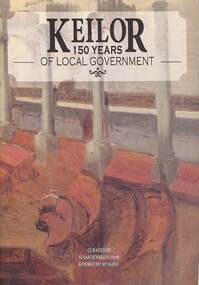
... local Government in Keilor. The 150th year of local government in Keilor marks the anniversary of Keilor’s first incorporation as a local governing body, a milestone that traces back to 3 March 1863, when Keilor was formally established as a Road District. Subsequent milestones: 22 December 1871 — Becomes the Shire of Keilor. 29 April 1961 — Proclaimed the City of Keilor. 15 December 1994 — City of Keilor abolished during statewide council amalgamations. So, the 150th anniversary in 2013 celebrated the beginning of Keilor’s civic identity ...This booklet celebrates the 150th year of local Government in Keilor.The 150th year of local government in Keilor marks the anniversary of Keilor’s first incorporation as a local governing body, a milestone that traces back to 3 March 1863, when Keilor was formally established as a Road District. Subsequent milestones: 22 December 1871 — Becomes the Shire of Keilor. 29 April 1961 — Proclaimed the City of Keilor. 15 December 1994 — City of Keilor abolished during statewide council amalgamations. So, the 150th anniversary in 2013 celebrated the beginning of Keilor’s civic identity, long before it became a shire, a city, or was later divided into Brimbank, Moonee Valley, and Hume City Councils.Keilor 150 years of local government. Curated by Susan Jennison OAM and Dorothy Minkoff.keilor, history -
Box Hill Historical Society
Book, Doncaster-Templestowe Historical Society, Doncaster-Templestowe and Warrandyte since 1837
... Doncaster Templestowe Warrandyte Local government Social history Gold Pioneers Hotels Schools Churches A short history of the Cities of Doncaster, Templestowe and Warrandyte since 1837, including a section on the history of local government within the area. The short history includes information on the pre-European occupation of the area, famous local identities ...A short history of the Cities of Doncaster, Templestowe and Warrandyte since 1837, including a section on the history of local government within the area. The short history includes information on the pre-European occupation of the area, famous local identities, industry, residential development and social history.48 pagesA short history of the Cities of Doncaster, Templestowe and Warrandyte since 1837, including a section on the history of local government within the area. The short history includes information on the pre-European occupation of the area, famous local identities, industry, residential development and social history.doncaster, templestowe, warrandyte, local government, social history, gold, pioneers, hotels, schools, churches -
Broadmeadows Historical Society & Museum
Document - Invitation, Invitation to the Official Opening of the Broadmeadows Town Hall, 1964, 1964
... It reflects mid‑twentieth‑century municipal ceremony, civic identity, and governance, and is associated with prominent local leadership and national political figure The Hon. A. A. Calwell, M.P. • Broadmeadows Town Hall • Local government • Civic ceremonies • A. ...Documents the official opening of the Broadmeadows Town Hall, a milestone in the civic development of the City of Broadmeadows during a period of rapid post‑war suburban growth. The involvement of The Hon. A. A. Calwell, M.P., highlights the event’s political and civic importance.The invitation is historically, socially, and associatively significant as documentary evidence of the official opening of the Broadmeadows Town Hall in 1964. It reflects mid‑twentieth‑century municipal ceremony, civic identity, and governance, and is associated with prominent local leadership and national political figure The Hon. A. A. Calwell, M.P.Rectangular printed invitation card on cream card stock with rounded corners. Black formal script with municipal seal printed at head.Recto: “The Mayor and Mayoress of Broadmeadows/(Cr. & Mrs H. Payne)/ request the pleasure of the company of/Cr. And Mrs. R.K. Evans/at the/Official Opening of the Broadmeadows Town Hall/by the/Leader of the Opposition, The Hon. A. A Calwell, M. P./ on Saturday, 21st November, 1964,/at 3 p.m./THE FAVOR OF A REPLY ADDRESSED TO THE TOWN CLERK, BROADMEADOWS, IS DESIRED/NOT LATER THAN 14th NOVEMBER, 1964.” Bottom right corner (in blue ink): 440501 Verso: Accession label “WI 4291” (upper left) • broadmeadows town hall, • local government, • civic ceremonies, • a. a. calwell, • city of broadmeadows, broadmeadows -
 Broadmeadows Historical Society & Museum
Document - Invitation, City of Broadmeadows, Invitation to a ball at Essendon Town Hall, 1962, 1962
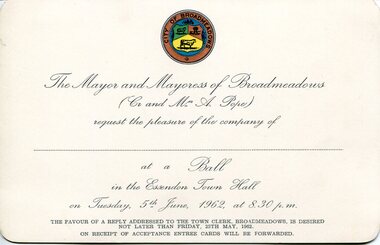
... identity, municipal authority, and community cohesion during a formative period in Broadmeadows’ development. This invitation is significant as a representative example of mid‑twentieth‑century municipal ceremonial ephemera that documents the civic and social activities of the City of Broadmeadows in 1962. It demonstrates how local government ...This item relates to the civic and social life of the City of Broadmeadows during the early 1960s, a period marked by rapid population growth and municipal consolidation. The invitation documents a formal civic ball organised by the municipality and held at Essendon Town Hall prior to Broadmeadows having its own dedicated civic facilities. The event reflects the role of ceremonial and social functions in reinforcing civic identity, municipal authority, and community cohesion during a formative period in Broadmeadows’ development.This invitation is significant as a representative example of mid‑twentieth‑century municipal ceremonial ephemera that documents the civic and social activities of the City of Broadmeadows in 1962. It demonstrates how local government used formal social events to foster community identity, reinforce civic authority, and maintain social networks during a period of post‑war expansion. The item has strong provenance and interpretive value for understanding municipal culture and civic life prior to the opening of the Broadmeadows Town Hall.Rectangular printed invitation card on cream card stock with rounded corners. Text printed in black formal script. Coloured City of Broadmeadows municipal seal printed at head.Recto: The Mayor and Mayoress of Broadmeadows/request the pleasure of the company of/......../at a Ball/in the Essendon Town Hall/on Tuesday, 5th June, 1962, at 8.30 p. m./THE FAVOUR OF A REPLY ADDRESSED TO THE TOWN CLERK, BROADMEADOWS, IS DESIRED/NOT LATER THAN FRIDAY, 25TH MAY, 1962./ON RECEIPT OF ACCEPTANCE ENTREE CARDS WILL BE FORWARDED. Verso: Accession label “WI 4258” (upper right) city of broadmeadows, civic ceremonies, municipal government, social events, essendon town hall -
 Broadmeadows Historical Society & Museum
Document - Reception Card, Reception – The Mayoress of Broadmeadows, 1979
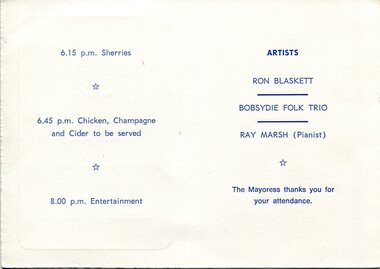
... It documents the civic and social functions of the City of Broadmeadows in 1979, highlighting hospitality practices, local performers, and the public role of the Mayoress in fostering civic identity and community engagement. The item’s provenance, intact design, and clear association with municipal leadership support its interpretive value for local government history. ...Documents municipal ceremonial and hospitality practices in Broadmeadows in the late 1970s, illustrating the role of the Mayoress in civic hosting and the use of Broadmeadows City Hall for official social functions.This reception card is a representative example of late twentieth‑century municipal ceremonial ephemera. It documents the civic and social functions of the City of Broadmeadows in 1979, highlighting hospitality practices, local performers, and the public role of the Mayoress in fostering civic identity and community engagement. The item’s provenance, intact design, and clear association with municipal leadership support its interpretive value for local government history.Folded reception card on cream‑textured card stock. Exterior bears the City of Broadmeadows municipal seal and event details; interior lists program timings and artists. Printed in blue ink.Outside (recto): “Reception / The Mayoress of Broadmeadows / Mrs. Kath Laherty / City Hall Broadmeadows / Friday 9th March 1979” with City of Broadmeadows seal. Inside: “6.15 p.m. Sherries / 6.45 p.m. Chicken, Champagne and Cider to be served / 8.00 p.m. Entertainment / Artists: Ron Blaskett; Bobsydie Folk Trio; Ray Marsh (Pianist) / The Mayoress thanks you for your attendance.” Verso: Accession label “WI‑4278”.city of broadmeadows, civic ceremonies, municipal government, social events, broadmeadows city hall -
Broadmeadows Historical Society & Museum
Archive (sub-series) - Mayoral invitation, Invitation to the Mayoral Ball, 8 April2026
... This item is of local historical and social significance as evidence of municipal ceremonial culture in Broadmeadows in 1978. It documents the role of mayoral functions in fostering civic identity, public representation, and formal social engagement within local government. ...Created by the curator, Broadmeadows Museum.Created to bring together for archival and research purposes.Arranged in the logical order of invitation and then reply card.Formal printed invitation to the Mayoral Ball issued by the City of Broadmeadows, 1978, together with a completed reply card accepting the invitation. Includes event details, dress code, RSVP instructions, and evidence of civic attendance.local government, mayors and mayoresses, civic ceremony, municipal events, city of broadmeadows, 1970s victorialocal government, mayors and mayoresses, civic ceremony, municipal events, city of broadmeadows, 1970s victoria -
 Broadmeadows Historical Society & Museum
Ephemera - Diary, City of Broadmeadows Diary 1979
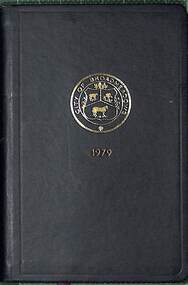
... The diary contributes to the broader understanding of local government operations, record-keeping practices, and civic identity in Broadmeadows during the late 1970s. ...This pocket diary, produced for the year 1979 and bearing the insignia of the City of Broadmeadows on its cover, was given to Councillor John Coutts during his time as a council committee member. Although unused, the diary represents a standard item issued to council members for the purpose of recording meetings, civic events, and administrative duties. Its presence in the archival collection offers insight into the materials distributed to elected officials and the branding practices of the municipality during the late 1970s. The diary also reflects the formal and practical tools of local governance, even when not actively used, and contributes to the broader understanding of council operations and civic identity in Broadmeadows during a period of suburban development and administrative evolution.This 1979 pocket diary, bearing the insignia of the City of Broadmeadows, is significant as a material representation of the administrative tools provided to council members during a period of civic development in suburban Melbourne. Although unused, the diary was issued to Councillor John Coutts, reflecting his continued involvement in municipal affairs following his earlier tenure as Mayor. Its compact format and official branding illustrate the practical and symbolic aspects of council-issued materials, intended to support the daily responsibilities of elected officials. The diary contributes to the broader understanding of local government operations, record-keeping practices, and civic identity in Broadmeadows during the late 1970s. As a preserved artifact, it offers insight into the formal structures and expectations of council service, even in its unused state.Navy Blue PVC DiaryCity of Broadmeadows Logo, 1979 coutts collection, city of broadmeadows, diary, 1979, councillor j. coutts, j. coutts -
 Melton City Libraries
Book, Ration books and cards, 1943,1945,1947, 1948
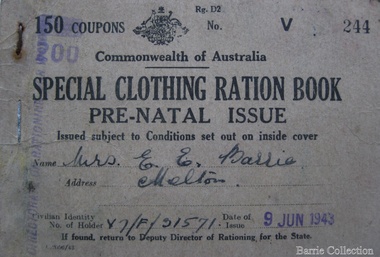
... Responding to the complaint that these penalties were inadequate, the government passed the Black Marketing Act at the end of 1942. This Act was for more serious cases and could carry a minimum penalty of £1,000. Local Identities ...Rationing regulations for food and clothing were gazetted on 14 May 1942. Rationing was introduced to manage shortages and control civilian consumption. It aimed to curb inflation, reduce total consumer spending, and limit impending shortages of essential goods. The broad reasoning behind the introduction of rationing was to ensure the equitable distribution of food and clothing. It was also hoped that a cut on consumer spending would lead to an increase in savings, which in turn could be invested in war loans. Australians were never as short of food nor rationed as heavily as civilians in the United Kingdom. Rationing was enforced by the use of coupons and was limited to clothing, tea, sugar, butter, and meat. From time to time, eggs and milk were also rationed under a system of priority for vulnerable groups during periods of shortage. Rationing was administered by the Rationing Commission. The basis for policing food rationing was through the surrender of coupons before rationed goods could be supplied. This had to occur between traders as well as consumers. Coupons were passed back from consumers to retailers, from retailers to wholesalers, and in many cases from wholesalers to producers, who were requested to return them to the commission. Breaches of rationing regulations were punishable under the general provisions of National Security Regulations by fines of to £100 or up to six-months imprisonment. Responding to the complaint that these penalties were inadequate, the government passed the Black Marketing Act at the end of 1942. This Act was for more serious cases and could carry a minimum penalty of £1,000.The clothing ration books and coupons belonged to Edna Barrie, the food ration card belonged to Wendy Barrie and the tea and butter ration card belong to Elizabeth Daley.local identities, war -
 Melton City Libraries
Document, The Willows, Unknown
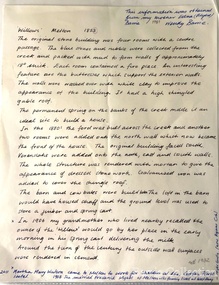
... The Willows homestead is "a scarce example of a reasonably intact building from the original era of farming in the Shire, and for its long association with the Minns family who were prominent in the local community and local government over several generations". Local Architecture Local Identities History of the Willows by Edna Barrie The Willows Document Barrie Collection ...The Willows homestead is "a scarce example of a reasonably intact building from the original era of farming in the Shire, and for its long association with the Minns family who were prominent in the local community and local government over several generations". History of the Willows by Edna Barrielocal architecture, local identities -
 Melton City Libraries
Photograph, Jongebloed Bakehouse, c.1973
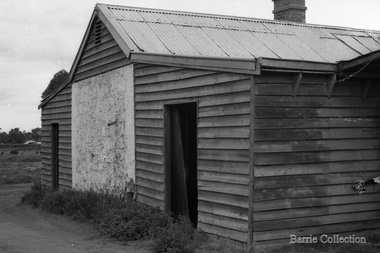
... Local identities Bakehouse owned by Gottfried Jongebloed and Auguste Shebler. Auguste Shebler came to Melton in the early 1950’s and in 1857 built a store on the corner of High and Smith Streets. Mr Shebler was the Postmaster, and Paymaster for thee Government ...Bakery Square was the location of Jongebloed shop, bakehouse and stables Bakehouse owned by Gottfried Jongebloed and Auguste Shebler. Auguste Shebler came to Melton in the early 1950’s and in 1857 built a store on the corner of High and Smith Streets. Mr Shebler was the Postmaster, and Paymaster for thee Government, who sent a batch of 400 to 500 immigrants to clear trees and fallen timber off the Ballarat Road; the wages being 5/- per day, and oversees 10/- per day. In 1865, Mr Shebler built the Golden Fleece Hotel on the present site and, although many alterations have taken place, most of the main walls still belong to the original building. He built a store some 100 yards west along High Street, and added to it a bakers’s business; then he built a butcher’s shop and leased it to the late Mr G McKenzie. Gorrfried Jongebloed was born in 1857 and came to Melton in 1887 as a Captain in the Mercantile Marine. In 1888 he married Marie Antionette, second daughter of Mr Shebler, and took over the bakery and green grocers business. Ten children were born to the family- Gerhard, Annette, Gorrfried (dec 1937), Emil, (dec 1947), Nicholas, Julius, Theckla, Augustus, Marie and Margarethe, - who settled in various parts of Victoria and are, in the bakery businesses. Mr and Mrs Jongebloed, sen., carried on the businesses in Melton until 1926, when one of their sons Emil, took over. Mr Jongebloed, sen., died in 1930 at the age of 73 years; and his wife living until 8th Oct., 1946, when she died at the age of 80 years. After the sudden death of Emil, in Jan., at the age if 49 years, the business had been conducted up to the present time by two sons “Pat” and Bryan. 1962 Express September local identities -
Canterbury History Group
Book, Cr. W.D. Vaughan, Kew's Civic Century, 1960
... Ken Lyall was a well known local identity. Kew (Victoria) - History Local government A book on the history of the suburb of Kew emphasising civic developments. ...A book on the history of the suburb of Kew emphasising civic developments. Includes foreword by R.G.Menzies and mayors message has list of mayors and Chairmen 1860-1960208 pages including black and white plates non-fictionA book on the history of the suburb of Kew emphasising civic developments. Includes foreword by R.G.Menzies and mayors message has list of mayors and Chairmen 1860-1960kew (victoria) - history, local government -
 Kew Historical Society Inc
Document - Identity Card, Commonwealth of Australia, Emily Elizabeth Foley, 89 Harp Road, East Kew, 1942, 1942
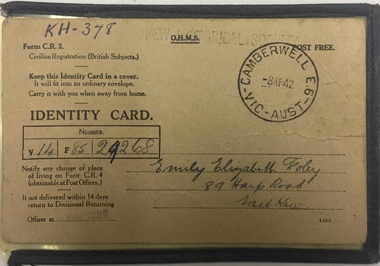
... identity card and was required to report changes of address to the government. These cards were particularly important in the identification and monitoring of Aliens (non-citizen residents) , particularly non-Europeans and Asian residents. (Source: Museum Victoria) Local ...Identity card issued to Emily Foley in 1942. This type of card was issued to British subjects who were civilians. During World War II everyone in Australia was issued with a personal identity card and was required to report changes of address to the government. These cards were particularly important in the identification and monitoring of Aliens (non-citizen residents) , particularly non-Europeans and Asian residents. (Source: Museum Victoria)Local example of an identity card issued to a Kew resident.Identity card issued to Emily Elizabeth Foley of 89 Harp Road, East Kew. The card uses the for "C.R.3 - Civilian Registration British Subjects". it bears a Camberwell stamp on the front right corner. The Identity Card includes the following inscriptions: Front "V14 / F85 / 29268" Reverse Witness signature: "Ethel Foley" same address identity cards, world war 2 - ii, second world war 1939-1945, australia -
 Broadmeadows Historical Society & Museum
Administrative record - Annual Report, Phillip Shannihan, City of Broadmeadows Annual Report 1994, 1994
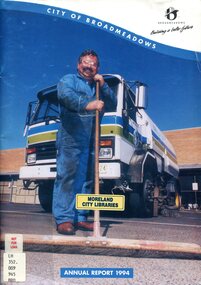
... local government amalgamations. Annual reports documented municipal governance, financial management, infrastructure projects, community services and council achievements. The publication evidences the civic identity...local government amalgamations. Annual reports documented municipal governance, financial management, infrastructure projects, community services and council achievements. The publication evidences the civic identity ...Official annual report of the City of Broadmeadows for 1994. Includes reports on council operations, administration, finance, infrastructure, community services, planning activities and municipal achievements. The publication serves as a primary source documenting local government functions and community development within Broadmeadows during 1994.Printed annual report comprising paper text pages with colour printed paper cover. The front cover depicts a municipal street-sweeping vehicle and a municipal works employee standing with a long-handled broom. The title "CITY OF BROADMEADOWS" appears at the top of the cover, with the municipal logo and slogan "Building a better future". The publication bears evidence of former ownership by Moreland City Libraries, including labels and classification markings. Softcover publication; paper and paperboard construction.non-fictionOfficial annual report of the City of Broadmeadows for 1994. Includes reports on council operations, administration, finance, infrastructure, community services, planning activities and municipal achievements. The publication serves as a primary source documenting local government functions and community development within Broadmeadows during 1994.city of broadmeadows, local government, municipal administration, annual reports, community services, infrastructure, urban development, council governance, broadmeadows history, hume region. -
Broadmeadows Historical Society & Museum
Photograph (collection) - City of Broadmeadows Trucks, Don Woods, 1991
... local government amalgamations in Victoria (1994). The images illustrate municipal branding, fleet composition, and public works operations in Broadmeadows. These photographs provide visual evidence of City of Broadmeadows municipal operations and vehicle fleet branding in 1991, contributing to the historical understanding of local government services and identity prior to council amalgamation. ...Created as part of City of Broadmeadows municipal operations. Later retained and archived by the Broadmeadows Historical Society.To document City of Broadmeadows municipal vehicles for operational, promotional, or record keeping purposes.Two colour photographs physically joined together with adhesive tape along the centre, forming a single composite photographic item. Original order maintained as received.Two colour photographs depicting City of Broadmeadows service vehicles parked at a municipal works depot: • An International ACCO 2250 water tanker marked “Broadmeadows” • An Isuzu FSR 450 tray truck bearing City of Broadmeadows livery Both images show vehicles in situ at the Broadmeadows depot.municipal vehicles, city of broadmeadows, local government, local government infrastructure, public works, council works depots, truck fleets, water tankers, utility trucks, vehicle livery, municipal branding, broadmeadows (vic.), victoria (australia), 1990s, urban services, australian local governmentmunicipal vehicles, city of broadmeadows, local government, local government infrastructure, public works, council works depots, truck fleets, water tankers, utility trucks, vehicle livery, municipal branding, broadmeadows (vic.), victoria (australia), 1990s, urban services, australian local government -
 The Beechworth Burke Museum
Photograph, Unknown c.1900s
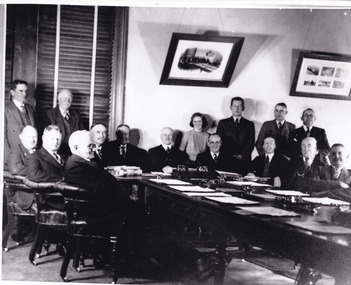
... government, boasting many industries and a multicultural population. Beechworth was proclaimed a borough on the 11th of September 1863, a formalisation of the municipal incorporation of the town seven years before. This image is associated with the history of Beechworth; it reveals the identities of local ...This image depicts a group of local counsellors from the Shire of Beechworth (est. mid to late 1900s). The identities of those within the photo remain unknown. The table and chairs featured in the image were produced in the late 19th century and have been in continual use for more than 100 years. The councellors would likely have convened in the Beechworth Town Hall. A History of Beechworth: Gold was discovered in the May Day Hills district in 1852. A canvas and timber settlement soon developed as prospectors rushed to the area. Over four million ounces of gold was recovered in the first 14 years. Between 1852 and 1857, Beechworth was a gold-producing region and centre of government, boasting many industries and a multicultural population. Beechworth was proclaimed a borough on the 11th of September 1863, a formalisation of the municipal incorporation of the town seven years before. This image is associated with the history of Beechworth; it reveals the identities of local counsellors, persons whose contribution to the Beechworth Shire could otherwise be lost to time. Black and white rectangular photograph, unmounted.beechworth council, indigo shire, local victorian government -
 Sunshine and District Historical Society Incorporated
Archive - Brimbank Tech School Victoria University Sunshine Campus Ballarat Road Sunshine
... government funded STEM innovation and learning centre located at Victoria University’s Sunshine Campus. It delivers industry‑aligned, project‑based programs for secondary students, focusing on science, technology, engineering, and design. The facility provides specialised laboratories, digital fabrication spaces, and collaborative learning environments designed to connect local schools with emerging industries and contemporary technologies. The Brimbank Tech School represents a major investment in Sunshine’s educational and industrial future, strengthening the region’s long‑standing identity ...The Brimbank Tech School is hosted at the Victoria University Sunshine Campus, 460 Ballarat Road, Sunshine North. The school was officially opened on Monday 10th August 2026 by the Victorian Premier Ben Carroll and the Victorian Minister for Education Gabrielle Williams. The Brimbank Tech School is a government funded STEM innovation and learning centre located at Victoria University’s Sunshine Campus. It delivers industry‑aligned, project‑based programs for secondary students, focusing on science, technology, engineering, and design. The facility provides specialised laboratories, digital fabrication spaces, and collaborative learning environments designed to connect local schools with emerging industries and contemporary technologies.The Brimbank Tech School represents a major investment in Sunshine’s educational and industrial future, strengthening the region’s long‑standing identity as a centre of manufacturing, engineering, and applied trades. It forms part of the broader redevelopment of the Sunshine education precinct and supports pathways into local industries, including advanced manufacturing, health technologies, and digital innovation.7205.01 - Brimbank Tech School Opening Star Weekly 2nd June 2026 Page 5.jpg 7205.02 - Brimbank Tech School Opening Star Weekly 18th September 2026 Page 2.jpgbrimbank tech school, ballarat road, sunshine north, victoria university sunshine campus -
 Broadmeadows Historical Society & Museum
Ephemera - Commemorative Cover, Australia Post, 125 Years of Local Government 1857-1982, 1982
... Local Government...Municipal Administration...Municipal History...Civic Identity...This commemorative envelope was produced to mark the 125th anniversary of local government in Victoria, calculated from the establishment of the colony's municipal system in 1857. The envelope specifically commemorates local celebrations held in Broadmeadows on 27 November 1982. The item reflects civic identity...This commemorative envelope was produced to mark the 125th anniversary of local government in Victoria, calculated from the establishment of the colony's municipal system in 1857. The envelope specifically commemorates local celebrations held in Broadmeadows on 27 November 1982. The item reflects civic identity ...This commemorative envelope was produced to mark the 125th anniversary of local government in Victoria, calculated from the establishment of the colony's municipal system in 1857. The envelope specifically commemorates local celebrations held in Broadmeadows on 27 November 1982. The item reflects civic identity and municipal pride during the City of Broadmeadows era and incorporates the municipal seal used by the municipality. The special cancellation references the Broadmeadows Leisure Centre, indicating its role in anniversary activities.This commemorative cover is historically significant for its association with the 125th anniversary of local government in Victoria and the City of Broadmeadows' participation in those celebrations. It provides evidence of civic commemoration, municipal identity, and the use of official symbols during the late twentieth century. The inclusion of a special Broadmeadows cancellation links the item directly to a local event, while the numbered limited edition enhances its documentary value. The cover contributes to understanding how local government milestones were publicly celebrated and represented within the municipality.Rectangular commercially produced paper envelope with gummed flap. Printed in black ink on cream stock. Front bears municipal insignia of the City of Broadmeadows, commemorative text, Australia Post pre-stamped floral indicium, and special pictorial cancellation. Reverse contains explanatory Australia Post text and postal markings. Limited edition numbered 0486 of 2000.city of broadmeadows, local government, municipal administration, municipal history, civic identity, municipal symbols, postal history, commemorative covers, australia post, broadmeadows leisure centre, anniversary celebrations, philately, community events, victoria. -
 Broadmeadows Historical Society & Museum
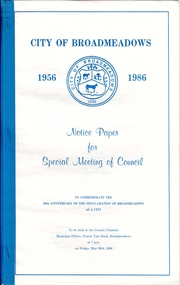
Document - Notice Paper, Broadmeadows City Council, Notice Paper for Special Meeting of Council, 30 May 1986, May 1986
... Provides evidence of civic identity and local government history in Broadmeadows. ...Commemorates the 30th anniversary of the proclamation of Broadmeadows as a City on 30 May 1956. Includes messages from Prime Minister Bob Hawke, Governor Davis McCaughey and Premier John Cain. Provides evidence of civic identity and local government history in Broadmeadows. Documents the municipality’s 30th anniversary celebrations and contains contemporary messages from prominent office holders. Eight-page document titled "Notice Paper for Special Meeting of Council, 30 May 1986". Bound with three staples and blue cloth tape. Printed in blue ink on paper.Front cover: "Notice Paper for Special Meeting of Council". Back Cover: (Top left corner) Yellow item label: WI-1937 broadmeadows city council, local government, city proclamation, 30th anniversary, civic celebrations, bob hawke, john cain. -
Broadmeadows Historical Society & Museum
Document - Letter, Edna M. Tripovich, Letter from Edna M. Tripovich to Kath Forsyth congratulating her on engagement, 20 May 1964
... identity in a rapidly developing suburban municipality. This handwritten letter is historically significant as evidence of social and civic networks in Broadmeadows during the mid 20th century, particularly in relation to the office of the Mayor. It demonstrates the intersection of personal relationships and public roles and contributes to understanding local governance culture and community life. Its provenance within a broader archival collection enhances its research and interpretive value. Broadmeadows (Vic.) — History Local government ...This letter documents a personal social exchange connected with civic leadership in the City of Broadmeadows in 1964. It reflects interpersonal networks, political office holders, and community relationships, specifically referencing the engagement of Kath Forsyth to Cr. Evans, Mayor of Broadmeadows. The document illustrates mid 20th century communication practices, gendered social conventions, and civic identity in a rapidly developing suburban municipality.This handwritten letter is historically significant as evidence of social and civic networks in Broadmeadows during the mid 20th century, particularly in relation to the office of the Mayor. It demonstrates the intersection of personal relationships and public roles and contributes to understanding local governance culture and community life. Its provenance within a broader archival collection enhances its research and interpretive value.Single handwritten letter in ink on paper. The letter comprises one page and is written in cursive handwriting. Paper shows typical ageing consistent with mid 20th century correspondence. No envelope present.(Front page, handwritten in ink) “20 5 64 /Dear Kath, /It was lovely to see you again at/Brunswick last night. You certainly/gave me a pleasant surprise when you/told me the news that you will be getting married to Cr. Evans. It has/been a pleasure having the opportunity/to get to know you during your term/as Mayoress, and I still hope that it/continues in the future. Jack & I join/in wishing you both a very happy future together, and the best of luck to you both./Yours sincerely /Edna M. Tripovich / 1 Halifax Court / Ashburton, SE11” On the outside: Yellow catalogue label: “WI 4186”broadmeadows (vic.) — history, local government — victoria — broadmeadows, mayors — social life and customs, personal correspondence — 20th century, engagements (marriage announcements), women’s social networks -
Broadmeadows Historical Society & Museum
Photograph (series) - Civic Photograph, Civic Photographs of Council, City of Broadmeadows, 2026
... Local government...Councillors...Broadmeadows City Council...Civic identity...Created within a British-derived municipal tradition, they served as formal records of governance, reflecting continuity, civic authority, and democratic representation amid migration, population expansion, and evolving community identity and administrative change across successive council terms periods. Civic Photographs City of Broadmeadows Black and white 1957 1994 Framed Local government Councillors Broadmeadows City Council Civic identity Political representation Civic Photographs of Council, City of Broadmeadows Photograph Civic Photograph Mark Moore ...Produced and retained by Broadmeadows City Council (and earlier Shire) as part of official civic and administrative practices. On loan from Hume Civic Collection, and internal collectionPhotographs were created to formally document elected councillors and municipal governance following elections; intended for official recordkeeping and display within council buildings. The series was established to consolidate the related items.Arranged chronologically by council term and displayed in civic buildings; maintains a logical sequence reflecting successive elected councils. Includes a digital reproduction of a 1991 Broadmeadows City Council group photograph held by the Hume Civic Collection.Group of formally posed photographic images depicting elected councillors across multiple terms, including the transition from Shire to City status. Typically framed and uniform in presentation.civic photographs, city of broadmeadows, black and white, 1957, 1994, framed, local government, councillors, broadmeadows city council, civic identity, political representationcivic photographs, city of broadmeadows, black and white, 1957, 1994, framed, local government, councillors, broadmeadows city council, civic identity, political representation -
 Broadmeadows Historical Society & Museum
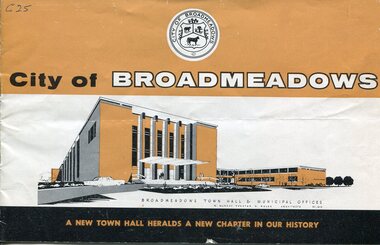
Booklet - Souvenir booklet, City of Broadmeadows Council, A New Town Hall Heralds a New Chapter in Our History, c.1964
... identity. It has artistic value in its mid-century design and layout, and social significance in portraying an all-male council, illustrating period gender norms. It supports research into local history, governance, and visual culture. Broadmeadows Town Hall Municipal government ...A commemorative booklet issued for the opening of the Broadmeadows Town Hall, providing historical background, civic information, and promotional content celebrating the municipality and its development.Stapled booklet comprising 16 pages, printed on semi gloss paper. The publication measures approximately 138 mm high × 222 mm wide (landscape format). Bound at the centre with two metal staples. Rust staining is present around both staples. The cover is worn and beginning to split along the spine, with loss to the lower centre section. Corresponding loss and chipping is evident on pages 3–4 in the same area. General wear consistent with age and handling.non-fictionA commemorative booklet issued for the opening of the Broadmeadows Town Hall, providing historical background, civic information, and promotional content celebrating the municipality and its development.broadmeadows town hall, municipal government, local history, urban development, commemorative publications
