
Showing 16 items matching "local government representation"
-
 Broadmeadows Historical Society & Museum
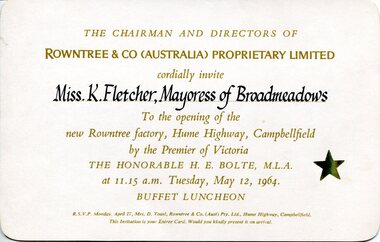
Ephemera - Invitation, Rowntree & Co. (Australia) Proprietary Limited, Invitation to opening of new Rowntree factory, Campbellfield, 1964
... ...Local government representation...Corporate events Manufacturing history Local government representation Recto (centre): “THE CHAIRMAN AND DIRECTORS OF / ROWNTREE & CO (AUSTRALIA) PROPRIETARY LIMITED / cordially invite / Miss K. ...The invitation documents the opening of Rowntree & Co. (Australia)’s Campbellfield factory in 1964, officiated by the Premier of Victoria. It demonstrates post‑war industrial expansion in Melbourne’s northern suburbs and highlights civic–corporate relationships through the invitation of the local Mayoress.This item has local historic significance for Broadmeadows and Campbellfield, providing primary evidence of major industrial development and civic engagement in Victoria during the 1960s.Rectangular printed card with rounded corners. Cream/light buff cardstock. Recto printed in gold and black ink; verso blank except for later applied catalogue label.Recto (centre): “THE CHAIRMAN AND DIRECTORS OF / ROWNTREE & CO (AUSTRALIA) PROPRIETARY LIMITED / cordially invite / Miss K. Fletcher, Mayoress of Broadmeadows / To the opening of the / new Rowntree factory, Hume Highway, Campbellfield / by the Premier of Victoria / THE HONORABLE H. E. BOLTE, M.L.A. / at 11.15 a.m. Tuesday, May 12, 1964. / BUFFET LUNCHEON” (lower margin): “R.S.V.P. Monday, April 27, Mrs. D. Youel, Rowntree & Co. (Aust) Pty. Ltd., Hume Highway, Campbellfield. / This Invitation is your Entree Card. Would you kindly present it on arrival.” Recto (right): Gold star motif Verso (upper right): “WI 4054” (typed label)industrial development, campbellfield (vic.), broadmeadows (vic.), corporate events, manufacturing history, local government representation -
 Broadmeadows Historical Society & Museum
Photograph - Press Photograph, Bill McAuley, Antoinette Abela, 1987
... Local government identity...Press photography...Suburban Melbourne...Community representation...local government area in metropolitan Melbourne. The image reflects late 20th century local government identity and community representation prior to the 1994 municipal amalgamations in Victoria....local government area in metropolitan Melbourne. The image reflects late 20th century local government identity and community representation prior to the 1994 municipal amalgamations in Victoria. ...This photograph was produced in 1987 as a press image for The Leader Newspaper Group and references the City of Broadmeadows, a former local government area in metropolitan Melbourne. The image reflects late 20th century local government identity and community representation prior to the 1994 municipal amalgamations in Victoria.This photograph is significant as a visual record of the City of Broadmeadows during the late 1980s and as an example of local press photography produced by The Leader Newspaper Group. It contributes to the historical understanding of municipal identity, civic pride, and local media representation in Broadmeadows prior to council amalgamation.Black and white photographic print. The image shows a person leaning over a sign reading “CITY OF BROADMEADOWS” in hand lettered capital text. The photograph is outdoors, with foliage visible in the background. The image is composed as a press-style portrait. The verso is blank apart from handwritten notes, a copyright stamp, and an adhesive reference label.Verso, handwritten in blue ink: “Antoinette Abela / pic Bill McAuley / 1987” Verso, printed rubber stamp (faded): “THE LEADER NEWSPAPER GROUP PHOTOGRAPH / COPYRIGHT / reproduction without written authority is prohibited / 160 WHITEHORSE RD., BLACKBURN” Verso, adhesive label: “PH 1546”city of broadmeadows, municipal government, local government identity, press photography, suburban melbourne, community representation, civic signage, urban history, the leader newspaper group, 1980s victoria -
 Brighton Historical Society
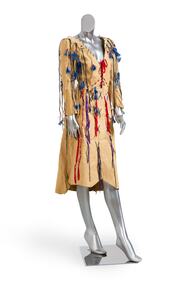
Clothing - Dress, c. 1974
... Di initiated many local projects, including the creation of a bike path along Nepean Highway and the first Brighton Festival, while balancing family life and a demanding ‘day job’ as personal assistant to Victorian Minister for Youth, Sport and Recreation Brian Dixon. She was a member of the Women’s Electoral Lobby and a champion for women’s representation, encouraging both Sally Allmand and Kate Harman to run for council (both were successfully elected). She advocated forcefully for an open, transparent local government...Di initiated many local projects, including the creation of a bike path along Nepean Highway and the first Brighton Festival, while balancing family life and a demanding ‘day job’ as personal assistant to Victorian Minister for Youth, Sport and Recreation Brian Dixon. She was a member of the Women’s Electoral Lobby and a champion for women’s representation, encouraging both Sally Allmand and Kate Harman to run for council (both were successfully elected). She advocated forcefully for an open, transparent local government ...This dress was worn by Brighton's first female mayor, Councillor Di Lopez, to a Mayoral Ball held at Brighton Technical School in 1977. Diane Margaret Lewis completed a law degree at the University of Melbourne, later marrying one of her classmates, criminal lawyer Ramon (Ray) Lopez. When she decided to run for the Brighton City Council in 1975, she was seen as an outside chance. Undeterred, she rallied a small group of friends and supporters and set out on an extensive door-knocking campaign that won voters to her side and successfully unseated former mayor Keith Devenport. She went on to serve two terms on council from 1975 to 1981. Di initiated many local projects, including the creation of a bike path along Nepean Highway and the first Brighton Festival, while balancing family life and a demanding ‘day job’ as personal assistant to Victorian Minister for Youth, Sport and Recreation Brian Dixon. She was a member of the Women’s Electoral Lobby and a champion for women’s representation, encouraging both Sally Allmand and Kate Harman to run for council (both were successfully elected). She advocated forcefully for an open, transparent local government in which ratepayers had the chance to participate and be heard. In 1976 Di became the first woman to hold the title of Mayor of Brighton, and she made it clear from the outset that she was going to do it her way. For the annual mayoral ball in 1977, ordinarily a staid traditional function, she chose a discotheque theme based on the Rod Stewart album Night on the Town, with a broad dress code of ‘black tie or jeans’: ‘You’ve got to get with the times,’ she said. ‘We want people to wear whatever they feel comfortable in.’ Di herself chose to attend in this knee-length chamois dress embellished with strings, ribbons, beads and feathers. It was both a fashion statement, exemplifying her colourful, flamboyant and forthright style, and a political one: a declaration of her intention to lead a progressive council, embracing the new and refusing to be hemmed in by dated traditions. In 2020 she was awarded an Order of Australia Medal for her service to local government and to the community of Brighton.This dress has local historical significance for its association with Brighton's first female mayor, Councillor Di Lopez, who wore it to a Mayoral Ball in 1976. The dress exemplifies her flamboyant reputation, modern outlook and willingness to break norms. At the time, the dress was a radical choice for a Mayoral Ball, where women typically wore formal evening gowns. With her choice of dress, Cr Lopez was making a public statement, breaking away from dated traditions and announcing her intention to bring the Mayor's office into the 1970s. In this way, the dress also points to the wider social and political changes taking place both in Brighton and across Australia during the mid-1970s.Three quarter length chamois dress circa 1974. Machine stitched with a v-neck and full length sleeves and an uneven raw hem, the dress is decorated with narrow thongs of chamois embellished with red beads and blue feathers. The open-fronted bodice is laced with red ribbon and the skirt is decorated with a large blue wool cross stitch and a combination of blue wool and purple ribbon cross stitch. Made in the style of an Indian 'Wild West Dress'.di lopez, chamois, brighton, brighton council, brighton technical school, mayoral ball, 1970s, feminism -
Broadmeadows Historical Society & Museum
Archive (sub-series) - Mayoral invitation, Invitation to the Mayoral Ball, 8 April2026
... representation, social customs, and inter municipal relationships. This item is of local historical and social significance as evidence of municipal ceremonial culture in Broadmeadows in 1978. It documents the role of mayoral functions in fostering civic identity, public representation, and formal social engagement within local government. ...Created by the curator, Broadmeadows Museum.Created to bring together for archival and research purposes.Arranged in the logical order of invitation and then reply card.Formal printed invitation to the Mayoral Ball issued by the City of Broadmeadows, 1978, together with a completed reply card accepting the invitation. Includes event details, dress code, RSVP instructions, and evidence of civic attendance.local government, mayors and mayoresses, civic ceremony, municipal events, city of broadmeadows, 1970s victorialocal government, mayors and mayoresses, civic ceremony, municipal events, city of broadmeadows, 1970s victoria -
 Broadmeadows Historical Society & Museum
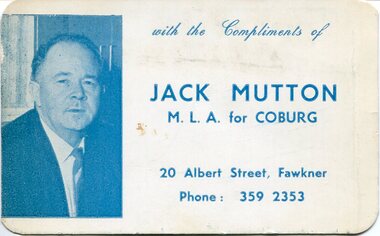
Ephemera - Calendar Card, 1970
... local electorate servicing. This item has historic and social significance as an example of locally produced political ephemera associated with state parliamentary representation in Melbourne’s northern suburbs. It provides evidence of political communication strategies, graphic design conventions, and everyday interactions between elected representatives and constituents in 1970. Local government ...The object is a promotional pocket calendar produced for distribution by a Victorian state member of parliament. Such calendars were commonly issued as electoral ephemera during the mid twentieth century, serving both a practical function and ongoing name recognition throughout the year. The inclusion of address and telephone number reflects pre mobile communication practices and local electorate servicing.This item has historic and social significance as an example of locally produced political ephemera associated with state parliamentary representation in Melbourne’s northern suburbs. It provides evidence of political communication strategies, graphic design conventions, and everyday interactions between elected representatives and constituents in 1970.Small rectangular pocket calendar card, printed in blue and white on thin card stock. Recto features a halftone photographic portrait on the left with printed political text on the right. Verso contains a full twelve month calendar for the year 1970. Corners are rounded. Visible surface wear, light staining, and minor edge abrasion consistent with use.Recto (printed): “with the Compliments of / JACK MUTTON / M.L.A. for COBURG / 20 Albert Street, Fawkner / Phone: 359 2353”. Verso (printed): “MUTTON for SERVICE / CALENDAR 1970” with monthly calendar grids January–December.local government, electoral campaigning, political ephemera, coburg and fawkner (victoria), jack mutton, 1970 -
 Broadmeadows Historical Society & Museum
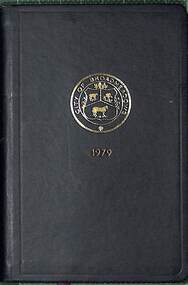
Ephemera - Diary, City of Broadmeadows Diary 1979
... representation of the administrative tools provided to council members during a period of civic development in suburban Melbourne. Although unused, the diary was issued to Councillor John Coutts, reflecting his continued involvement in municipal affairs following his earlier tenure as Mayor. Its compact format and official branding illustrate the practical and symbolic aspects of council-issued materials, intended to support the daily responsibilities of elected officials. The diary contributes to the broader understanding of local government ...This pocket diary, produced for the year 1979 and bearing the insignia of the City of Broadmeadows on its cover, was given to Councillor John Coutts during his time as a council committee member. Although unused, the diary represents a standard item issued to council members for the purpose of recording meetings, civic events, and administrative duties. Its presence in the archival collection offers insight into the materials distributed to elected officials and the branding practices of the municipality during the late 1970s. The diary also reflects the formal and practical tools of local governance, even when not actively used, and contributes to the broader understanding of council operations and civic identity in Broadmeadows during a period of suburban development and administrative evolution.This 1979 pocket diary, bearing the insignia of the City of Broadmeadows, is significant as a material representation of the administrative tools provided to council members during a period of civic development in suburban Melbourne. Although unused, the diary was issued to Councillor John Coutts, reflecting his continued involvement in municipal affairs following his earlier tenure as Mayor. Its compact format and official branding illustrate the practical and symbolic aspects of council-issued materials, intended to support the daily responsibilities of elected officials. The diary contributes to the broader understanding of local government operations, record-keeping practices, and civic identity in Broadmeadows during the late 1970s. As a preserved artifact, it offers insight into the formal structures and expectations of council service, even in its unused state.Navy Blue PVC DiaryCity of Broadmeadows Logo, 1979 coutts collection, city of broadmeadows, diary, 1979, councillor j. coutts, j. coutts -
Whitehorse Historical Society Inc.
Article, City's Chief Executive Officer goes into retreat, 31/08/1988 12:00:00 AM
... representation of Australia on the International City Management Association. He and his wife plan to run a seminar centre and executive retreat in Campaspe House, Woodend. Fell Les Fell Shirley City of Nunawading Local Government ...After five years as the City's Chief Executive Officer, Les Fell is to retire.After five years as the City's Chief Executive Officer, Les Fell is to retire. He looks back on his term with satisfaction, including his representation of Australia on the International City Management Association. He and his wife plan to run a seminar centre and executive retreat in Campaspe House, Woodend.After five years as the City's Chief Executive Officer, Les Fell is to retire. fell, les, fell, shirley, city of nunawading, local government -
Whitehorse Historical Society Inc.
Article, New councillor promises full representation, 1992
... local government. (photo) New councillor, Kevin O'Sullivan, promises to make full use of his ward meetings and restore people's faith in local government. (photo) New councillor promises full representation ...New councillor, Kevin O'Sullivan, promises to make full use of his ward meetings and restore people's faith in local government. (photo)New councillor, Kevin O'Sullivan, promises to make full use of his ward meetings and restore people's faith in local government. (photo)New councillor, Kevin O'Sullivan, promises to make full use of his ward meetings and restore people's faith in local government. (photo)city of nunawading, councillors, o'sullivan, kevin -
Whitehorse Historical Society Inc.
Article, Amalgamation could mean a cut-back of Council seats, 1986
... representation of councillors. He also said a combined union of Box Hill, Nunawading and Ringwood to create a city of 200,000 people would be difficult. Local government ...The reunion of Nunawading and Box Hill cities as favoured by Nunawading would be certain to see the abolition of several seats from both the present councils.The reunion of Nunawading and Box Hill cities as favoured by Nunawading would be certain to see the abolition of several seats from both the present councils. Chief Executive, Les Fell said in his report there would need to be an adjustment to the size of wards and the representation of councillors. He also said a combined union of Box Hill, Nunawading and Ringwood to create a city of 200,000 people would be difficult.The reunion of Nunawading and Box Hill cities as favoured by Nunawading would be certain to see the abolition of several seats from both the present councils. local government, city of nunawading, city of box hill, city of ringwood, fell, les, amalgamations -
 Vision Australia
Letter - Text, Letter to The Trustees, Clubhouse, Recreation grounds for the Blind, 16/5/1957
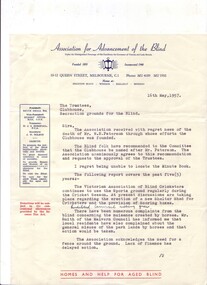
... In October 1955, the State Government offered funding through local councils, however despite a representation to the Minister, the Malvern Council were not willing to expend funds to the Association as they had committed to build an Elderly Citizens Club. ...In October 1955, the State Government offered funding through local councils, however despite a representation to the Minister, the Malvern Council were not willing to expend funds to the Association as they had committed to build an Elderly Citizens Club. ...Letter to the Trustees outlining the outcomes of a recent meeting, as the minute book was unable to be located. Below is a summary of the letter. The death of W.H. Paterson is mentioned and the recommendation to the Committee that the clubhouse by named in his honour was unanimously accepted, however requires the agreement of the Trustees. The remainder of the letter covers the past five years. The Victorian Association of Blind Cricketers are requesting the erection of a shelter shed and scoring boxes. Complaints have been received about horses using the park, which have been passed to Malvern Council who advise they have also received similar complaints from the general public. A fence is required but a lack of finance has delayed this action. The Clubhouse is being used for more activities including a dance class, indoor bowling club, pottery and craft work, therefore a new switchboard and rewiring were completed. In October 1955, the State Government offered funding through local councils, however despite a representation to the Minister, the Malvern Council were not willing to expend funds to the Association as they had committed to build an Elderly Citizens Club. A large signboard was repainted and a new signboard erected at the front entrance, along with a light controlled by a clock. The Clubhouse has also been used one night per month by the local branch of the RSL and occasional use by the Teachers College for inter College sports. There has been cooperation with the L.T.A.V. (Lawn Tennis Association of Victoria) during tennis championships, and although the Committee recognise the need to do more with the area, the impending homes been built at Ballarat and Bendigo have been a limited factor. Signed by J.W. Wilson3 pages of type letter on letterheadAssociation for the Advancement of the Blind, Under the Distinguished Patronage of His Excellency the Governor of Victoria and Lady Brooks Founded 1895 (image of shining lantern) Incorporated 1944 10-12 Queen Street, Melbourne, C.1. Phone: MU 4189 MU 1955 Homes at: Brighton Beach Windsor Ballarat Bendigo On the left hand side of the page: President: Bruce Small, Esq. Vice President: Hubert Opperman, O.B.E. Treasurer: W.J.S. Horsfall, F.C.A. Secretary: J.W. Wilson Objects: To promote the welfare of the Blind intellectually, physically and socially. To grant financial assistance in cases of necessity. To provide Homes and Hostels of an undenominational character for the Blind. To visit the Blind. To care for the adult Blind, especially the aged and infirm. Donations will be subject to the concessional allowances provided by the Income Tax Act. At the base of the page: Homes and help for aged blindassociation for the advancement of the blind, john wilson, kooyong club house -
 Wodonga & District Historical Society Inc
Plaque - Rural City of Wodonga Plaque
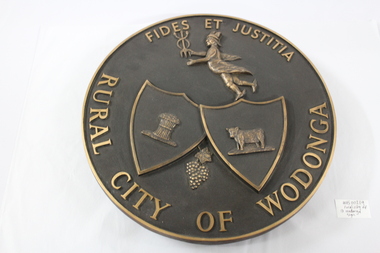
... This plate is of local historic significance as it documents the way in which the local government and community has evolved and depicts itself over time. local government wodonga rural city council logo Around the circumference of the plate is the inscription "FIDES ET JUSTITIA / RURAL CITY OF WODONGA" Circular metal plate for public display of status of Rural City of Wodonga. Inscription including the Latin terms for "Faith and Justice" are embossed around the circumference on the front of the plaque. The symbols of wheat, cattle and grapes represent the major agricultural pursuits of the area. A representation ...The current city was originally named Wodonga, but its name was changed to Belvoir then later back to Wodonga, its indigenous name. The original post office opened on June 1, 1856. Wodonga Shire was created in 1876 when the colonial government agreed to ratepayers' petitions to have their part severed from the Yackandandah Shire and form a new municipality. On 30th March 1973, the Wodonga Shire was granted rural city status and was officially named the Rural City of Wodonga by the Governor of Victoria, Sir Rohan Delacombe. The date this logo first came into use is unsure, but it was used prior to the granting of rural city status. In 1994, the name was retained in a new local government authority and so the Wodonga Rural City Council was born. In 1995 it was decided to give the city a fresh image, so the term 'rural' was be dropped from use except where there was a legal requirement. In December 2003, it was decided to rename the council removing the term "rural" and it is now legally Wodonga City Council. This plate is of local historic significance as it documents the way in which the local government and community has evolved and depicts itself over time.Circular metal plate for public display of status of Rural City of Wodonga. Inscription including the Latin terms for "Faith and Justice" are embossed around the circumference on the front of the plaque. The symbols of wheat, cattle and grapes represent the major agricultural pursuits of the area. A representation of Hermes/Mercury is at the top centre of the plate.Around the circumference of the plate is the inscription "FIDES ET JUSTITIA / RURAL CITY OF WODONGA"local government, wodonga, rural city, council logo -
 Wodonga & District Historical Society Inc
Plaque - Rural City of Wodonga Small Plaque
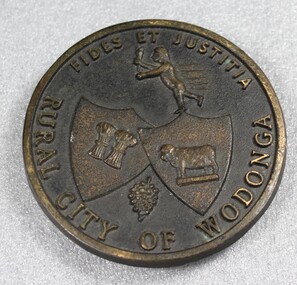
... local government and community has evolved and depicts itself over time. Designation as a rural city was a critical event in the development of Wodonga. local government wodonga council logo wodonga rural city victoria Around the circumference of the plaque is the inscription "FIDES ET JUSTITIA / RURAL CITY OF WODONGA" Small circular metal plaque for public display of status of Rural City of Wodonga. Inscription including the Latin terms for "Faith and Justice" are embossed around the circumference on the front of the plaque. The symbols of wheat, cattle and grapes represent the major agricultural pursuits of the area. A representation ...The current city was originally named Wodonga, but its name was changed to Belvoir then later back to Wodonga, its indigenous name. The original post office opened on June 1, 1856. Wodonga Shire was created in 1876 when the colonial government agreed to ratepayers' petitions to have their part severed from the Yackandandah Shire and form a new municipality. On 30th March 1973, the Wodonga Shire was granted rural city status and was officially named the Rural City of Wodonga by the Governor of Victoria, Sir Rohan Delacombe. The date this logo first came into use is unsure, but it was used prior to the granting of rural city status. In 1994, the name was retained in a new local government authority and so the Wodonga Rural City Council was born. In 1995 it was decided to give the city a fresh image, so the term 'rural' was be dropped from use except where there was a legal requirement. In December 2003, it was decided to rename the council removing the term "rural" and it is now legally Wodonga City Council.This plaque is of local historic significance as it documents the way in which the local government and community has evolved and depicts itself over time. Designation as a rural city was a critical event in the development of Wodonga.Small circular metal plaque for public display of status of Rural City of Wodonga. Inscription including the Latin terms for "Faith and Justice" are embossed around the circumference on the front of the plaque. The symbols of wheat, cattle and grapes represent the major agricultural pursuits of the area. A representation of Hermes/Mercury is at the top centre of the plate.Around the circumference of the plaque is the inscription "FIDES ET JUSTITIA / RURAL CITY OF WODONGA"local government, wodonga council logo, wodonga, rural city victoria -
Broadmeadows Historical Society & Museum
Photograph (series) - Civic Photograph, Civic Photographs of Council, City of Broadmeadows, 2026
... Local government...Councillors...Broadmeadows City Council...Civic identity...Political representation...Created within a British-derived municipal tradition, they served as formal records of governance, reflecting continuity, civic authority, and democratic representation amid migration, population expansion, and evolving community identity and administrative change across successive council terms periods. Civic Photographs City of Broadmeadows Black and white 1957 1994 Framed Local government Councillors Broadmeadows City Council Civic identity Political representation Civic Photographs of Council, City of Broadmeadows Photograph Civic Photograph Mark Moore ...Produced and retained by Broadmeadows City Council (and earlier Shire) as part of official civic and administrative practices. On loan from Hume Civic Collection, and internal collectionPhotographs were created to formally document elected councillors and municipal governance following elections; intended for official recordkeeping and display within council buildings. The series was established to consolidate the related items.Arranged chronologically by council term and displayed in civic buildings; maintains a logical sequence reflecting successive elected councils. Includes a digital reproduction of a 1991 Broadmeadows City Council group photograph held by the Hume Civic Collection.Group of formally posed photographic images depicting elected councillors across multiple terms, including the transition from Shire to City status. Typically framed and uniform in presentation.civic photographs, city of broadmeadows, black and white, 1957, 1994, framed, local government, councillors, broadmeadows city council, civic identity, political representationcivic photographs, city of broadmeadows, black and white, 1957, 1994, framed, local government, councillors, broadmeadows city council, civic identity, political representation -
Broadmeadows Historical Society & Museum
Document - Ward List, City of Broadmeadows Ward Councillors 1992/93, 1992
... The document reflects the structure and elected representation of the City of Broadmeadows immediately prior to local government amalgamations in Victoria during the mid-1990s....The document reflects the structure and elected representation of the City of Broadmeadows immediately prior to local government amalgamations in Victoria during the mid-1990s. ...The document reflects the structure and elected representation of the City of Broadmeadows immediately prior to local government amalgamations in Victoria during the mid-1990s.This item provides documentary evidence of local governance, elected representatives, and ward boundaries in Broadmeadows in the early 1990s.One printed paper sheet, black text on white paper. Recto printed, verso contains minimal unrelated markings.(printed, recto): CITY OF BROADMEADOWS/WARD COUNCILLORS/1992/93 (handwritten notes, including telephone numbers for each councillor, and in the top left corner, in pencil, is the handwritten notation "ISLE OFMAN") (verso): (yellow label) WI-3760 (handwritten in pencil): Peter Andersonlocal government, municipal councillors, city of broadmeadows, civic administration, 1992/1993 -
Broadmeadows Historical Society & Museum
Document - Council memorandum, Wayne Harvey, City Development Memo – Notes from Councillors’ Presentation, 12 December 1994
... This document holds local historical significance as a firsthand record of municipal governance, councillor representation, and administrative practices in Broadmeadows during the 1990s. City of Broadmeadows local government ...Documents the functioning of the City of Broadmeadows council during the mid 1990s, providing insight into councillor profiles, local governance priorities, and urban development issues of the period.This document holds local historical significance as a firsthand record of municipal governance, councillor representation, and administrative practices in Broadmeadows during the 1990s.Multi page document comprising typed text, reproduced images, and photocopied pages; black text on white paper.“TO: CITY DEVELOPMENT MEMO / All Councillors / FROM: Director City Development / SUBJECT: Notes – Councillors’ Presentation – 5 December / DATE: 12 December, 1994” (front page) There are no handwritten notes throughout the document.city of broadmeadows, local government, municipal council, councillors, city development, council memorandum, civic administration, urban development, governance, councillor profiles, 1990s broadmeadows, municipal history, internal council records, community leadership, victorian local government -
 Broadmeadows Historical Society & Museum
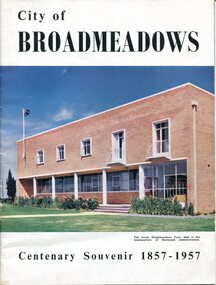
Booklet - Centenary Souvenir, City of Broadmeadows Council, City of Broadmeadows: Centenary Souvenir 1857-1957, 1957
... local government within the Broadmeadows district. The publication documents the early settlement of the municipality, the development of local government, transport, agriculture, roads, civic infrastructure and community growth. It provides an important representation...local government within the Broadmeadows district. The publication documents the early settlement of the municipality, the development of local government, transport, agriculture, roads, civic infrastructure and community growth. It provides an important representation ...This commemorative souvenir booklet was produced by the City of Broadmeadows to mark one hundred years of municipal government from 1857 to 1957. It presents an overview of the municipality's history, including early European settlement, pastoral occupation, local government formation, infrastructure development and civic achievements. Historical photographs and reproduced archival documents provide visual and documentary evidence of Broadmeadows' transformation from a rural district to an expanding metropolitan municipality. The publication was intended to celebrate community achievements while promoting civic pride and preserving local history.A 36-page illustrated stapled booklet published by the City of Broadmeadows to commemorate the centenary of local government in the municipality, 1857-1957. Contains historical text, reproductions of government records, municipal information, and black-and-white photographs.non-fictionThis commemorative souvenir booklet was produced by the City of Broadmeadows to mark one hundred years of municipal government from 1857 to 1957. It presents an overview of the municipality's history, including early European settlement, pastoral occupation, local government formation, infrastructure development and civic achievements. Historical photographs and reproduced archival documents provide visual and documentary evidence of Broadmeadows' transformation from a rural district to an expanding metropolitan municipality. The publication was intended to celebrate community achievements while promoting civic pride and preserving local history.broadmeadows, city of broadmeadows, local government, municipal history, centenary celebrations, community history, urban development, early settlement, john pascoe fawkner, duncan cameron, victoria, historical publications, civic administration, municipal officers, roads, transport, campbellfield, pascoe vale, glenroy, heritage
