
Showing 515 items matching "london hospital"
-
 City of Moorabbin Historical Society (Operating the Box Cottage Museum)
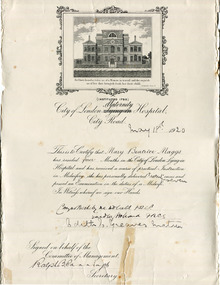
Certificate - City of London Maternity Hospital May 1920, Mary Beatrice Maggs, 18 May 1920
... City of London Maternity Hospital May 1920...City of London Maternity Hospital...When she returned to Australia in 1924 she was head nurse at a number of Hospitals, Private Hospital in Loch, Tatura Bush Nursing Home, Mooroopna. maggs mary medicine nursing thompson jean hospitals early settlers pioneers melbourne hospital City of London Maternity Hospital Certificate Mary Beatrice Maggs Certificate City of London Maternity Hospital May 1920 ...Mary Beatrice Josephine Maggs (1892-1960) came to Australia in 1914 and was a governess for Mr Alfred Rutter Clarke at his mansion "Merriwa" on Orrong Road, Toorak. Mary returned to England in 1919 and furthered her studies in nursing. When she returned to Australia in 1924 she was head nurse at a number of Hospitals, Private Hospital in Loch, Tatura Bush Nursing Home, Mooroopna.CertificateCity of London Maternity Hospitalmaggs mary, medicine, nursing, thompson jean, hospitals, early settlers, pioneers, melbourne hospital -
 Ballarat Heritage Services
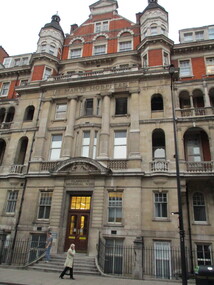
Photograph, Dorothy Wickham, St Mary's Hospital, London, 2016, 17/09/2016
... St Mary's Hospital, London, 2016...St Mary's Hospital, London...Three coloured photographs of St Mary's Hospital, London, 2016...St Mary's Hospital, London hospitals Three coloured photographs of St Mary's Hospital, London, 2016 St Mary's Hospital, London, 2016 Photograph Photograph Dorothy Wickham ...Three coloured photographs of St Mary's Hospital, London, 2016st mary's hospital, london, hospitals -
 Ballarat Base Hospital Trained Nurses League
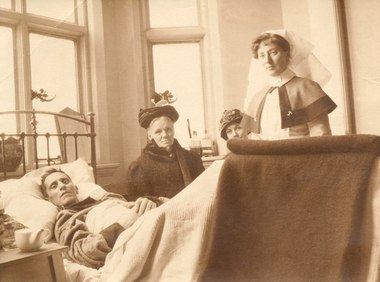
1915 April, 1st London Hospital
... 1915 April, 1st London Hospital...Photo, Langham Album 1915 April, 1st London Hospital ...Photo, Langham Album -
 Robin Boyd Foundation
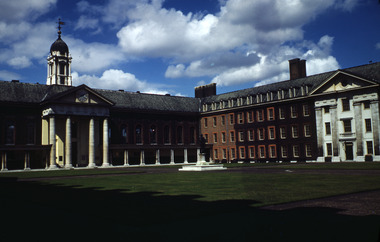
Slide, Robin Boyd, 1950
... Royal Chelsea Hospital, London, England. (Architect: Christopher Wren.)...London / Uren / Chesea Hospital (All Handwritten)...Royal Chelsea Hospital, London, England. (Architect: Christopher Wren.) ...Penleigh Boyd, Robin and Patricia Boyd's son, writes “Prior to 1950 Robin, like most other amateur or hobby photographers, took black and white printed photographs. The oldest slides date from 1950 when Robin and Patricia travelled to Europe on Robin’s Robert Haddon Travelling Scholarship.” In 1948 Robin Boyd was awarded ‘joint first place’ in the Robert Haddon competition for his design of Mildura art gallery. The scholarship helped fund their first overseas trip. Robin and Patricia were passengers on the Greek ship “Cyrenia” departing in May 1950, passing through the Suez Canal and landing in Genoa five weeks later. For six months, they travelled extensively throughout Europe (predominantly driving themselves) - France, Italy, United Kingdom, Sweden, Denmark, Germany, Austria, Switzerland and Spain.Colour slide in a mount. Royal Chelsea Hospital, London, England. (Architect: Christopher Wren.)London / Uren / Chesea Hospital (All Handwritten)haddon travelling scholarship, haddon, robin boyd, slide -
 Bendigo Military Museum
Postcard - HUMOROUS POSTCARD, WW1, c.1916
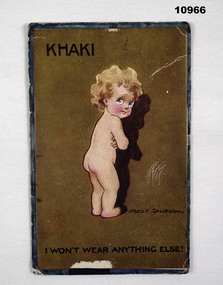
... ...3rd London General Hospital....O'Donahoo whilst he was recuperating in the 3rd London Gen Hospital, Wandsworth, following leg amputation surgery. ...O'Donahoo whilst he was recuperating in the 3rd London Gen Hospital, Wandsworth, following leg amputation surgery. ...Postcard sent to R.R. O'Donahoo whilst he was recuperating in the 3rd London Gen Hospital, Wandsworth, following leg amputation surgery. Part of the O'Donahoo Collection. See Cat No. 10928.3 for details of service for Robert Raymond O'Donahoo (no.1399).Colour postcard featuring a child looking over its shoulder. Background in khaki colour. Text “KHAKI” and “I WON'T WEAR ANYTHING ELSE” in black type. postcard format on back with handwritten details. Postmark in black ink.Handwritten in black ink on back; '“Please don't be so rash, S.R.” Handwritten in black ink on back: “Pte O'Donahoo, 14th A.I.F., B.7., 3rd London Gen Hospt, Wandsworth, S.C.”o'donahoo collection, robert raymond o'donahoo, postcard, ww1, 3rd london general hospital. -
 Returned Nurses RSL Sub-branch
Book - Hardcover book, Pitman Medical Publishing Company, The London: a study in the voluntary hospital system: volume two, the second hundred years, 1840-1948, 1963
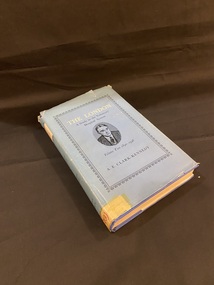
... The London: a study in the voluntary hospital system: volume two, the second hundred years, 1840-1948......London Hospital...Hospitals London Hospital history of hospitals This is the second volume of the history of the Voluntary Hospital System. ...This is the second volume of the history of the Voluntary Hospital System. 'In this volume the story flows on against the background of the social changes of the nineteenth and the tragic events of the twentieth centuries.' [From inside cover]Hardcover book with a blue dust jacket. The dust jacket has an ornate black border surrounding the title and author information and in the centre is a black pen drawing of a man in an oval template. The spine has a cream coloured box at the top with 'The London' printed in black.non-fictionThis is the second volume of the history of the Voluntary Hospital System. 'In this volume the story flows on against the background of the social changes of the nineteenth and the tragic events of the twentieth centuries.' [From inside cover]hospitals, london hospital, history of hospitals -
 Returned Nurses RSL Sub-branch
Book - Hardcover book, Pitman Medical Publishing Company, The London: a study in the voluntary hospital system: volume one, the first hundred years, 1740-1840, 1963
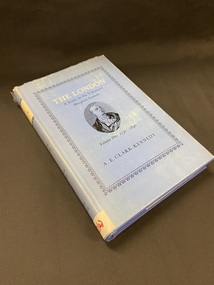
... The London: a study in the voluntary hospital system: volume one, the first hundred years, 1740-1840......London Hospital...Hospitals London Hospital history of hospitals This is the first volume of the history of the Voluntary Hospital System. ...This is the first volume of the history of the Voluntary Hospital System. 'This book is not just another history of a hospital. Rather it is the exciting early life of one, told in the entertaining style of the day against the medical, social and political history of that period.' [From dust jacket]Hardcover book with a blue dust jacket. The dust jacket has an ornate black border surrounding the title and author information and in the centre is a black pen drawing of a man in an oval template. The spine has a cream coloured box at the top with 'The London' printed in black.non-fictionThis is the first volume of the history of the Voluntary Hospital System. 'This book is not just another history of a hospital. Rather it is the exciting early life of one, told in the entertaining style of the day against the medical, social and political history of that period.' [From dust jacket]hospitals, london hospital, history of hospitals -
 Geoffrey Kaye Museum of Anaesthetic History
Equipment - Airway, Pharyngeal, Hewitt's, 1913
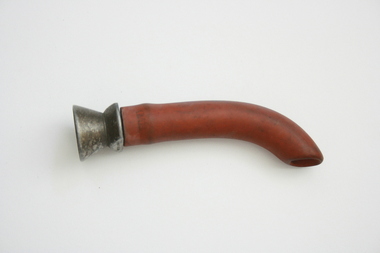
... London...Alfred Hospital...Frederick Hewitt Pharyngeal Intubation Medical Supply London Alfred Hospital Melbourne Engraved on flat portion of metal tube: MEDICAL SUPPLY / LONDON Round metal tube with a brown rubber tubing sleeve around the outside. ...This is the first iteration of a pharyngeal tube devised by Hewitt in 1913.Round metal tube with a brown rubber tubing sleeve around the outside.Engraved on flat portion of metal tube: MEDICAL SUPPLY / LONDONfrederick hewitt, pharyngeal, intubation, medical supply, london, alfred hospital, melbourne -
 Alfred Hospital Nurses League - Nursing History Collection
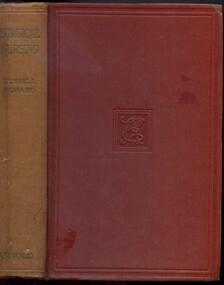
Book - Illustrated textbook, Russell Howard 1875-1942, Surgical nursing and the principals of surgery for nurses, 1917
... Book based on a series of surgical lectures given to the probationers at the London Hospital by the author, a prominent surgeon...Book based on a series of surgical lectures given to the probationers at the London Hospital by the author, a prominent surgeon Insight into early 20th century nursing practice nursing-history nursing study and teaching-history Textbook listing the principles upon which 'modern' (early 20th Century) surgical treatment is founded, as well as the details of treatment from the nurses point of view At bottom right of inside front cover 'W. ...Textbook listing the principles upon which 'modern' (early 20th Century) surgical treatment is founded, as well as the details of treatment from the nurses point of viewIllustrated book with faded maroon cover. Title author and publisher stamped on spine. Logo in centre and double line border embossed on front cover non-fictionTextbook listing the principles upon which 'modern' (early 20th Century) surgical treatment is founded, as well as the details of treatment from the nurses point of viewnursing-history, nursing study and teaching-history -
 Alfred Hospital Nurses League - Nursing History Collection
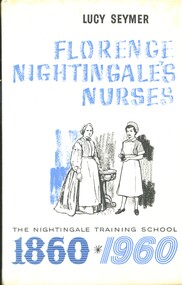
Book - Illustrated Book, Lucy Seymer 1893-1971, Florence Nightingale's Nurses: The Nightingale Training School 1860-1960, 1960
... ...St Thomas's Hospital London...Florence Nightingale St Thomas's Hospital London Nursing-education-history This book details the history and impact of the Nightingale Training School, established by Florence Nightingale at St Thoms' Hospital, London in 1860. ...This book details the history and impact of the Nightingale Training School, established by Florence Nightingale at St Thoms' Hospital, London in 1860. The book covers the school's development from its founding to its centenary in 1960. It highlights Nightingale's philosophy of nursing and its practical implementation, particularly emphasizing the importance of environmental conditions for patient health. The book also explores the school's global impact and its role in shaping modern nursing.Illustrated book with white cover with blue and white print featuring on the front a drawing of two nurses. The nurse on the left is depicted in a long 19th century style dress, while the nurse on the right is in a 20th century style uniform. The drawing is repeated on the back Title and author's name are printed on the front cover and spine.non-fictionThis book details the history and impact of the Nightingale Training School, established by Florence Nightingale at St Thoms' Hospital, London in 1860. The book covers the school's development from its founding to its centenary in 1960. It highlights Nightingale's philosophy of nursing and its practical implementation, particularly emphasizing the importance of environmental conditions for patient health. The book also explores the school's global impact and its role in shaping modern nursing.florence nightingale, st thomas's hospital london, nursing-education-history -
 Bendigo Military Museum
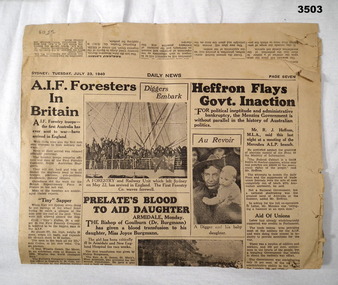
Newspaper - NEWSPAPER WW2, Daily News, 23.7.1940
... A double page from Daily News, Sydney 23.7.1940 containing various articles relating to the war including a visit by Queen Elizabeth to wounded at a London Military Hospital....documents - newspapers military history - army Daily A double page from Daily News, Sydney 23.7.1940 containing various articles relating to the war including a visit by Queen Elizabeth to wounded at a London Military Hospital. Daily News Newspaper NEWSPAPER WW2 ...A double page from Daily News, Sydney 23.7.1940 containing various articles relating to the war including a visit by Queen Elizabeth to wounded at a London Military Hospital.documents - newspapers, military history - army, daily -
 Geoffrey Kaye Museum of Anaesthetic History
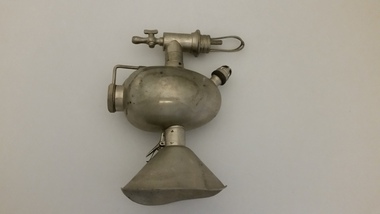
Equipment - Inhaler, Probyn Williams, c. 1900
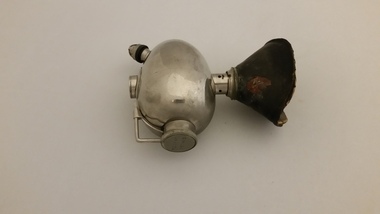
... In 1896 Robert James Probyn-Williams was appointed first honorary anaesthetist to the London Hospital and joined a select band of fulltime anaesthetists (26) in Great Britain. ...In 1896 Robert James Probyn-Williams was appointed first honorary anaesthetist to the London Hospital and joined a select band of fulltime anaesthetists (26) in Great Britain. ...In 1896 Robert James Probyn-Williams was appointed first honorary anaesthetist to the London Hospital and joined a select band of fulltime anaesthetists (26) in Great Britain. The Probyn Williams inhaler was a further modification of the Clover inhaler with narrow airways and rebreathing. The metal inhaler is ovoid shaped. The rotating gauge has a series of numbers engraved onto the inhaler for measurement. There is an elbow joint leading to a connector for attaching a re-breather bag, and at the other end is tap-style mechanism. There is a small glass bulb encased in a metal housing. The facemask is completely made of metal as well.Stamped into handle of tap: COEXTER & SONjoseph clover, frederick hewitt, robert probyn williams -
 Geoffrey Kaye Museum of Anaesthetic History
Equipment - Inhaler, Probyn Williams, Mayer & Meltzer, c. 1900
... In 1896 Robert James Probyn-Williams was appointed first honorary anaesthetist to the London Hospital and joined a select band of fulltime anaesthetists (26) in Great Britain. ...In 1896 Robert James Probyn-Williams was appointed first honorary anaesthetist to the London Hospital and joined a select band of fulltime anaesthetists (26) in Great Britain. ...In 1896 Robert James Probyn-Williams was appointed first honorary anaesthetist to the London Hospital and joined a select band of fulltime anaesthetists (26) in Great Britain. The Probyn Williams inhaler was a further modification of the Clover inhaler with narrow airways and rebreathing.Ovoid shaped metal ether inhaler device with a dark brown leather fask mask attached.Moulded into inhaler: MAYER & MELTZER / LONDONanaesthetic, anaesthesiology, medical history, ether, inhaler, probyn williams -
 Bendigo Military Museum
Print - PRINT, FRAMED WW1, Reader's Digest (Australia) Pty Limited, 2015
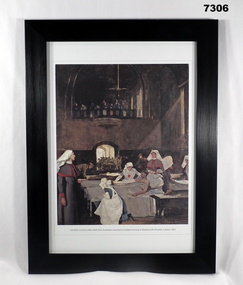
... First Australian wounded at Gallipoli arriving at Wandsworth Hospital, London". 1921. "Served with the Royal Army Medical Corps at 3rd London General Hospital at Wandsworth". 1919 Commissioned to do portrait work for the Australian War Records section. ...First Australian wounded at Gallipoli arriving at Wandsworth Hospital, London". 1921. "Served with the Royal Army Medical Corps at 3rd London General Hospital at Wandsworth". 1919 Commissioned to do portrait work for the Australian War Records section. ...From information book - "Reader's Gigest/ Gallipoli/ 25th Aril 1915 - 9th January 1916/ Centenary Commemorative Prints". Collection of 20 prints Refer Cat No. 7300.Framed print. Print - colour print on paper. Copy of an oil on canvas painting. Depicts a "Hospital ward where several nurses attend a patient in bed", against a background of "beds being made ready in the ward" and "Stretcher bearers carrying in more wounded". Frame - black plastic framing with glass front and MDF board backing with adhered black paper.Details below print - in black ink. "GEORGE COATES (1869 - 1930). First Australian wounded at Gallipoli arriving at Wandsworth Hospital, London". 1921. "Served with the Royal Army Medical Corps at 3rd London General Hospital at Wandsworth". 1919 Commissioned to do portrait work for the Australian War Records section. framed accessories, pprints, ww1, gallipoli, centenary -
 Alfred Hospital Nurses League - Nursing History Collection
Book, F. B. Smith 1932-2015, Florence Nightingale: reputation and power, 1982
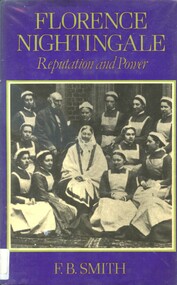
... Front of dust jacket also has a black and white photograph of 12 women and a man. 10 of these women are in dressed in nurses uniforms, another wears a white cap, and the woman in the centre is wearing a white scarf on her head (Florence Nightingale with a group of nurses from London Hospitals at Claydon. Standing behind her are her brother in-in-law Sir Henry Verney (owner of Claydon) and the matron Miss Crossland)....Front of dust jacket also has a black and white photograph of 12 women and a man. 10 of these women are in dressed in nurses uniforms, another wears a white cap, and the woman in the centre is wearing a white scarf on her head (Florence Nightingale with a group of nurses from London Hospitals at Claydon. Standing behind her are her brother in-in-law Sir Henry Verney (owner of Claydon) and the matron Miss Crossland). ...This book challenges the traditional view of Nightingale as a saintly figure, presenting a more complex and critical portrait. The book analyzes how Nightingale leveraged her personal relationships and influence to advance her public health and nursing reforms, highlighting her achievements and less savory tactics.Book with dustjacket and protective covering. The dustjacket has a purple background, with title and author's name in grey print on front and spine. Front of dust jacket also has a black and white photograph of 12 women and a man. 10 of these women are in dressed in nurses uniforms, another wears a white cap, and the woman in the centre is wearing a white scarf on her head (Florence Nightingale with a group of nurses from London Hospitals at Claydon. Standing behind her are her brother in-in-law Sir Henry Verney (owner of Claydon) and the matron Miss Crossland).non-fictionThis book challenges the traditional view of Nightingale as a saintly figure, presenting a more complex and critical portrait. The book analyzes how Nightingale leveraged her personal relationships and influence to advance her public health and nursing reforms, highlighting her achievements and less savory tactics.florence nightingale, nurse administrators-great britain, nurrse-history, nursing-history -
 Northern District School of Nursing. Managed by Bendigo Historical Society Inc.
Article - Further Distinction for Sister Nancy Long: The Hospital Magazine1947
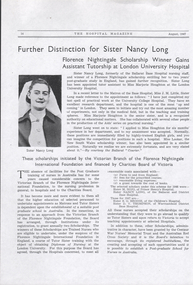
... An article from the August 1947 edition of The Hospital Magazine on the success of Sister Nancy Long (formerly of the Ballarat Bast Hospital) in obtaining an assistant tutorship at the London University Hospital in England. ...Nursing Nurse Training Post-War Nursing Nancy Long Florence Nightingale International Foundation Ballarat Base Hospital An article from the August 1947 edition of The Hospital Magazine on the success of Sister Nancy Long (formerly of the Ballarat Bast Hospital) in obtaining an assistant tutorship at the London University Hospital in England. ...The Northern District School of Nursing opened in 1950 in to address the issues around nurse recruitment, training and education that had previously been hospital based. The residential school was to provide theoretical and in-house education and practical training over three years. The students would also receive practical hands-on training in the wards of associated hospitals. The Northern District School of Nursing operated from Lister House, Rowan Street, Bendigo. It was the first independent school of nursing in Victoria and continued until it closed in 1989. The book "The First of its Kind" was published in 2015. Printed in Bendigo by "Bendigo Modern Press". Memories compiled by Peter Rosewall; who attended the last NDSN school PTS 108 between 1986 - 89.An article from the August 1947 edition of The Hospital Magazine on the success of Sister Nancy Long (formerly of the Ballarat Bast Hospital) in obtaining an assistant tutorship at the London University Hospital in England. The article talks about scholarships offered by the Florence Nightingale International Foundation and the lack of post graduate training for nurses in Australia. The article includes a photograph of Sister Nancy Long.nursing, nurse training, post-war nursing, nancy long, florence nightingale international foundation, ballarat base hospital -
 Bendigo Military Museum
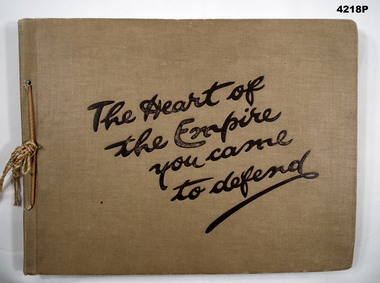
Album - ALBUM, PHOTOGRAPH WW1, London and Turnbridge Wells, The heart of the Empire you came to defend, C WW1
... Inside, “ To Lt De Araugo 14 AIF, We thank yo for your splendid service to your King and country and ask you to accept this token of our good wishes on leaving the 3rd London General Hospital (signed) H.E.Bruce Porter, Howard Williams”...Album photography London Inside, “ To Lt De Araugo 14 AIF, We thank yo for your splendid service to your King and country and ask you to accept this token of our good wishes on leaving the 3rd London General Hospital (signed) H.E.Bruce Porter, Howard Williams” Hard cardboard, cloth covered album with sepia tone photos attached brownish coloured paper with protective sheets between. ...Lt Stephen De Araugo 14th Batt AIF was presented with this album. He was one of 3 who volunteered to go with Albert Jacka VC, MC when he won the Victoria Cross on Gallipoli. Refer Cat No 551P for his service details.Hard cardboard, cloth covered album with sepia tone photos attached brownish coloured paper with protective sheets between.Inside, “ To Lt De Araugo 14 AIF, We thank yo for your splendid service to your King and country and ask you to accept this token of our good wishes on leaving the 3rd London General Hospital (signed) H.E.Bruce Porter, Howard Williams”album, photography, london -
 Alfred Hospital Nurses League - Nursing History Collection
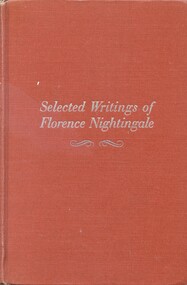
Book, Florence Nightingale 1820-1910, Selected writings of Florence Nightingale, 1954
... On page v there is a black stamp "West London Hospital". ...On page v there is a black stamp "West London Hospital". Book with brown cover, title embossed in silver on front. ...A compilation of Florence Nightingale's essays and writings: Subsidiary notes as to the introduction of female nursing into military hospitals (1858), Notes on nursing: what it is and what it is not (1859), Notes on different systems of nursing; from notes on hospitals (a pamphlet 1863), Suggestions on a system of nursing for hospitals in India (1865), Suggestions on the subject of providing, training and organizing nurses for the sick poor in workhouse infirmaries (1867) On trained nurses for the sick poor (a pamphlet, 1876), Nurses, training of , and nursing the sick (1882), Sick-nursing and health-nursing (1893), Health teaching in towns and villages, rural hygiene (1894).Book with brown cover, title embossed in silver on front. Title, editor's surname and publisher's name embossed in silver on the spine.non-fictionA compilation of Florence Nightingale's essays and writings: Subsidiary notes as to the introduction of female nursing into military hospitals (1858), Notes on nursing: what it is and what it is not (1859), Notes on different systems of nursing; from notes on hospitals (a pamphlet 1863), Suggestions on a system of nursing for hospitals in India (1865), Suggestions on the subject of providing, training and organizing nurses for the sick poor in workhouse infirmaries (1867) On trained nurses for the sick poor (a pamphlet, 1876), Nurses, training of , and nursing the sick (1882), Sick-nursing and health-nursing (1893), Health teaching in towns and villages, rural hygiene (1894).florence nightingale, nurses-history, nursing-history -
 Flagstaff Hill Maritime Museum and Village
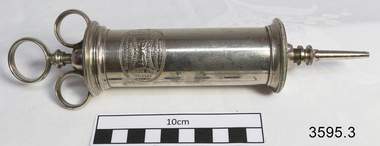
Equipment - Syringe, Late 19th - early 20th century
... He studied at London University College Hospital and at Edinburgh Royal Infirmary and in 1928, was awarded FRCS (Fellow from the Royal College of Surgeons), Edinburgh. ... Inscription on oval shaped plaque on barrel "10th / UNIVERSITY COLLEGE HOSPITAL" & "MAYER & MELTZER / MAKERS, LONDON" & " TO THE / HOSPITAL OF DESEASES (SIC) OF THE THROAT"" & "TO THE / HOSPITAL / FOR WOMEN" & "TO THE / MIDDLESEX / HOSPITAL" plus "R" inscribed on each side of the handle...He studied at London University College Hospital and at Edinburgh Royal Infirmary and in 1928, was awarded FRCS (Fellow from the Royal College of Surgeons), Edinburgh. ...How to safely syringe ear wax Irrigation, or ear syringing, should be performed only after taking a full history, doing an ear examination and explaining the potential complications to the patient. It is also important to ensure appropriate assembly and use of equipment. Gentle irrigation of the ear canal can be performed with a large syringe (20 mL) and warm water. The use of sterile water or saline as opposed to tap water or bacteriostatic agent (eg dilute hydrogen peroxide) can decrease the risk of infection. Direct visualisation of the ear canal is not necessary for safe and effective syringing. The tip of the syringe should not pass the outer one-third of the ear canal (approximately 8 mm) – the use of a rounded nozzle may assist with this. The jet of water should be aimed towards the edge of the cerumen to enable the debris to flow out of the ear canal. Cease immediately if the patient experiences pain or if bleeding occurs. Mechanical jet irrigators are available and some allow better control of water pressure and direction of spray. After syringing, examine the external canal and tympanic membrane. Document the patient’s consent, procedure, and pre- and post-examination findings. https://www.racgp.org.au/afp/2015/october/ear-wax-management This ear syringe was donated to Flagstaff Hill Maritime Village by the family of Doctor William Roy Angus, Surgeon and Oculist. It is part of the “W.R. Angus Collection” that includes historical medical equipment, surgical instruments and material once belonging to Dr Edward Ryan and Dr Thomas Francis Ryan, (both of Nhill, Victoria) as well as Dr Angus’ own belongings. The Collection’s history spans the medical practices of the two Doctors Ryan, from 1885-1926 plus that of Dr Angus, up until 1969. ABOUT THE “W.R.ANGUS COLLECTION” Doctor William Roy Angus M.B., B.S., Adel., 1923, F.R.C.S. Edin.,1928 (also known as Dr Roy Angus) was born in Murrumbeena, Victoria in 1901 and lived until 1970. He qualified as a doctor in 1923 at University of Adelaide, was Resident Medical Officer at the Royal Adelaide Hospital in 1924 and for a period was house surgeon to Sir (then Mr.) Henry Simpson Newland. Dr Angus was briefly an Assistant to Dr Riddell of Kapunda, then commenced private practice at Curramulka, Yorke Peninsula, SA, where he was physician, surgeon and chemist. In 1926, he was appointed as new Medical Assistant to Dr Thomas Francis Ryan (T.F. Ryan, or Tom), in Nhill, Victoria, where his experiences included radiology and pharmacy. In 1927 he was Acting House Surgeon in Dr Tom Ryan’s absence. Dr Angus had become engaged to Gladys Forsyth and they decided he would take time to further his studies overseas in the UK in 1927. He studied at London University College Hospital and at Edinburgh Royal Infirmary and in 1928, was awarded FRCS (Fellow from the Royal College of Surgeons), Edinburgh. He worked his passage back to Australia as a Ship’s Surgeon on the on the Australian Commonwealth Line’s T.S.S. Largs Bay. Dr Angus married Gladys in 1929, in Ballarat. (They went on to have one son (Graham 1932, born in SA) and two daughters (Helen (died 12/07/1996) and Berenice (Berry), both born at Mira, Nhill ) Dr Angus was a ‘flying doctor’ for the A.I.M. (Australian Inland Ministry) Aerial Medical Service in 1928 . The organisation began in South Australia through the Presbyterian Church in that year, with its first station being in the remote town of Oodnadatta, where Dr Angus was stationed. He was locum tenens there on North-South Railway at 21 Mile Camp. He took up this ‘flying doctor’ position in response to a call from Dr John Flynn; the organisation was later known as the Flying Doctor Service, then the Royal Flying Doctor Service. A lot of his work during this time involved dental surgery also. Between 1928-1932 he was surgeon at the Curramulka Hospital, Yorke Peninsula, South Australia. In 1933 Dr Angus returned to Nhill where he’d previously worked as Medical Assistant and purchased a share of the Nelson Street practice and Mira hospital from Dr Les Middleton one of the Middleton Brothers, the current owners of what was once Dr Tom Ryan’s practice. Dr L Middleton was House Surgeon to the Nhill Hospital 1926-1933, when he resigned. [Dr Tom Ryan’s practice had originally belonged to his older brother Dr Edward Ryan, who came to Nhill in 1885. Dr Edward saw patients at his rooms, firstly in Victoria Street and in 1886 in Nelson Street, until 1901. The Nelson Street practice also had a 2 bed ward, called Mira Private Hospital ). Dr Edward Ryan was House Surgeon at the Nhill Hospital 1884-1902 . He also had occasions where he successfully performed veterinary surgery for the local farmers too. Dr Tom Ryan then purchased the practice from his brother in 1901. Both Dr Edward and Dr Tom Ryan work as surgeons included eye surgery. Dr Tom Ryan performed many of his operations in the Mira private hospital on his premises. He too was House Surgeon at the Nhill Hospital 1902-1926. Dr Tom Ryan had one of the only two pieces of radiology equipment in Victoria during his practicing years – The Royal Melbourne Hospital had the other one. Over the years Dr Tom Ryan gradually set up what was effectively a training school for country general-practitioner-surgeons. Each patient was carefully examined, including using the X-ray machine, and any surgery was discussed and planned with Dr Ryan’s assistants several days in advance. Dr Angus gained experience in using the X-ray machine there during his time as assistant to Dr Ryan. Dr Tom Ryan moved from Nhill in 1926. He became a Fellow of the Royal Australasian College of Surgeons in 1927, soon after its formation, a rare accolade for a doctor outside any of the major cities. He remained a bachelor and died suddenly on 7th Dec 1955, aged 91, at his home in Ararat. Scholarships and prizes are still awarded to medical students in the honour of Dr T.F. Ryan and his father, Dr Michael Ryan, and brother, John Patrick Ryan. ] When Dr Angus bought into the Nelson Street premises in Nhill he was also appointed as the Nhill Hospital’s Honorary House Surgeon 1933-1938. His practitioner’s plate from his Nhill surgery states “HOURS Daily, except Tuesdays, Fridays and Saturday afternoons, 9-10am, 2-4pm, 7-8pm. Sundays by appointment”. This plate is now mounted on the doorway to the Port Medical Office at Flagstaff Hill Maritime Village, Warrnambool. Dr Edward Ryan and Dr Tom Ryan had an extensive collection of historical medical equipment and materials spanning 1884-1926 and when Dr Angus took up practice in their old premises he obtained this collection, a large part of which is now on display at the Port Medical Office at Flagstaff Hill Maritime Village in Warrnambool. During his time in Nhill Dr Angus was involved in the merging of the Mira Hospital and Nhill Public Hospital into one public hospital and the property titles passed on to Nhill Hospital in 1939. In 1939 Dr Angus and his family moved to Warrnambool where he purchased “Birchwood,” the 1852 home and medical practice of Dr John Hunter Henderson, at 214 Koroit Street. (This property was sold in1965 to the State Government and is now the site of the Warrnambool Police Station. ). The Angus family was able to afford gardeners, cooks and maids; their home was a popular place for visiting dignitaries to stay whilst visiting Warrnambool. Dr Angus had his own silk worm farm at home in a Mulberry tree. His young daughter used his centrifuge for spinning the silk. Dr Angus was appointed on a part-time basis as Port Medical Officer (Health Officer) in Warrnambool and held this position until the 1940’s when the government no longer required the service of a Port Medical Officer in Warrnambool; he was thus Warrnambool’s last serving Port Medical Officer. (The duties of a Port Medical Officer were outlined by the Colonial Secretary on 21st June, 1839 under the terms of the Quarantine Act. Masters of immigrant ships arriving in port reported incidents of diseases, illness and death and the Port Medical Officer made a decision on whether the ship required Quarantine and for how long, in this way preventing contagious illness from spreading from new immigrants to the residents already in the colony.) Dr Angus was a member of the Australian Medical Association, for 35 years and surgeon at the Warrnambool Base Hospital 1939-1942, He served as a Surgeon Captain during WWII1942-45, in Ballarat, Victoria, and in Bonegilla, N.S.W., completing his service just before the end of the war due to suffering from a heart attack. During his convalescence he carved an intricate and ‘most artistic’ chess set from the material that dentures were made from. He then studied ophthalmology at the Royal Melbourne Eye and Ear Hospital and created cosmetically superior artificial eyes by pioneering using the intrascleral cartilage. Angus received accolades from the Ophthalmological Society of Australasia for this work. He returned to Warrnambool to commence practice as an ophthalmologist, pioneering in artificial eye improvements. He was Honorary Consultant Ophthalmologist to Warrnambool Base Hospital for 31 years. He made monthly visits to Portland as a visiting surgeon, to perform eye surgery. He represented the Victorian South-West subdivision of the Australian Medical Association as its secretary between 1949 and 1956 and as chairman from 1956 to 1958. In 1968 Dr Angus was elected member of Spain’s Barraquer Institute of Barcelona after his research work in Intrasclearal cartilage grafting, becoming one of the few Australian ophthalmologists to receive this honour, and in the following year presented his final paper on Living Intrasclearal Cartilage Implants at the Inaugural Meeting of the Australian College of Ophthalmologists in Melbourne In his personal life Dr Angus was a Presbyterian and treated Sunday as a Sabbath, a day of rest. He would visit 3 or 4 country patients on a Sunday, taking his children along ‘for the ride’ and to visit with him. Sunday evenings he would play the pianola and sing Scottish songs to his family. One of Dr Angus’ patients was Margaret MacKenzie, author of a book on local shipwrecks that she’d seen as an eye witness from the late 1880’s in Peterborough, Victoria. In the early 1950’s Dr Angus, painted a picture of a shipwreck for the cover jacket of Margaret’s book, Shipwrecks and More Shipwrecks. She was blind in later life and her daughter wrote the actual book for her. Dr Angus and his wife Gladys were very involved in Warrnambool’s society with a strong interest in civic affairs. Their interests included organisations such as Red Cross, Rostrum, Warrnambool and District Historical Society (founding members), Wine and Food Society, Steering Committee for Tertiary Education in Warrnambool, Local National Trust, Good Neighbour Council, Housing Commission Advisory Board, United Services Institute, Legion of Ex-Servicemen, Olympic Pool Committee, Food for Britain Organisation, Warrnambool Hospital, Anti-Cancer Council, Boys’ Club, Charitable Council, National Fitness Council and Air Raid Precautions Group. He was also a member of the Steam Preservation Society and derived much pleasure from a steam traction engine on his farm. He had an interest in people and the community He and his wife Gladys were both involved in the creation of Flagstaff Hill, including the layout of the gardens. After his death (28th March 1970) his family requested his practitioner’s plate, medical instruments and some personal belongings be displayed in the Port Medical Office surgery at Flagstaff Hill Maritime Village, and be called the “W. R. Angus Collection”. Ear wax is an ongoing problem for many people, and its safe and easy removal is important. The W.R. Angus Collection is significant for still being located at the site it is connected with, Doctor Angus being the last Port Medical Officer in Warrnambool. The collection of medical instruments and other equipment is culturally significant, being an historical example of medicine from late 19th to mid-20th century. Dr Angus assisted Dr Tom Ryan, a pioneer in the use of X-rays and in ocular surgery. Ear syringe from the W.R. Angus Collection with barrel, plunger and tip. Inscription on oval shaped plaque on barrel. Inscription on oval shaped plaque on barrel "10th / UNIVERSITY COLLEGE HOSPITAL" & "MAYER & MELTZER / MAKERS, LONDON" & " TO THE / HOSPITAL OF DESEASES (SIC) OF THE THROAT"" & "TO THE / HOSPITAL / FOR WOMEN" & "TO THE / MIDDLESEX / HOSPITAL" plus "R" inscribed on each side of the handlewarrnambool, shipwreck coast, great ocean road, flagstaff hill maritime village, maritime museum, dr angus, w.r. angus, dr t f ryan, medical instrument, surgical equipment, warrnambool base hospital, nhill base hospital, mira hospital, flying doctor, medical treatment, syringe, ear syringe, ear wax -
 Alfred Hospital Nurses League - Nursing History Collection
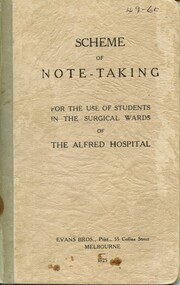
Booklet - Text booklet, Alfred Hospital, Scheme of note-taking: for the use of students in the surgical wards of the Alfred Hospital, 1925
... It was based on a similar publication produced by St Bartholomew's Hospital London...It was based on a similar publication produced by St Bartholomew's Hospital London Produced by the Alfred Hospital Medicine-study and teaching Alfred Hospital previous catalogue number handwritten [black ink] at top right of front cover. ...published by the Alfred Hospital as an aid to medical students in their watd work, more specially on their note taking. It was also hoped that it may be an aid to surgical tutors in the planning and conducting of their tutorial classes. It was based on a similar publication produced by St Bartholomew's Hospital LondonProduced by the Alfred HospitalStapled booklet, cream coloured binding ,black print with grey tape covering staples on spine. Print on front cover detalis tile, printer and publication dateprevious catalogue number handwritten [black ink] at top right of front cover. At the bottom of the front-end page is a printed black and white donation sticker: black Maltese cross in circle, "This book was donated to Alfred Archival Association Nursing Division by" M Skan [handwritten in black ink] The previous catalogue number is also handwritten [black ink]on this sticker. Handwritten [black ink] at top right of this page: W B? / Queens College / Carlton medicine-study and teaching, alfred hospital -
 Bendigo Military Museum
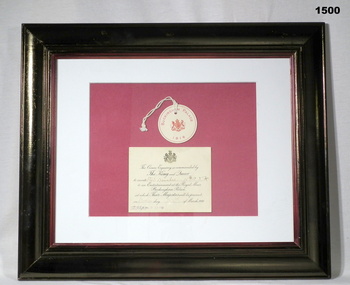
Programme - INVITATION, FRAMED, 22.3.1916
... Embarked for Egypt 2.2.1915, embark for Gallipoli 12.4.1915, WIA 27.8.1915 GSW to left leg severe, admitted 4th Field Ambulance then to Mudros Island, admitted 3rd London General Hospital England 12.9.1915, leg amputated (appears to have been halfway between knee and ankle), embark for Australia 8.5.1916, discharged from the AIF 25.12.1916 medically unfit....Embarked for Egypt 2.2.1915, embark for Gallipoli 12.4.1915, WIA 27.8.1915 GSW to left leg severe, admitted 4th Field Ambulance then to Mudros Island, admitted 3rd London General Hospital England 12.9.1915, leg amputated (appears to have been halfway between knee and ankle), embark for Australia 8.5.1916, discharged from the AIF 25.12.1916 medically unfit. documents - inviation Buckingham palace O’Donahoo In text on back: “Paul O'Donahoo” Framed, wooden, dark lacquer within which is displayed 2 items mounted on red background: 1. ...Robert Raymond O’DONAHOO No 1399 enlisted in the AIF in 2nd reinforcements to 14th Battalion on 19.10.1914 age 21 years 11 months. Embarked for Egypt 2.2.1915, embark for Gallipoli 12.4.1915, WIA 27.8.1915 GSW to left leg severe, admitted 4th Field Ambulance then to Mudros Island, admitted 3rd London General Hospital England 12.9.1915, leg amputated (appears to have been halfway between knee and ankle), embark for Australia 8.5.1916, discharged from the AIF 25.12.1916 medically unfit.Framed, wooden, dark lacquer within which is displayed 2 items mounted on red background: 1. Invitation card with Royal crest from the King & Queen to Pte O'Donahoo, Wednesday 22 March 1916. 2. Red ink, round cardboard disc - Buckingham Palace 1916.In text on back: “Paul O'Donahoo”documents - inviation, buckingham palace, o’donahoo -
 Royal Australasian College of Surgeons Museum and Archives
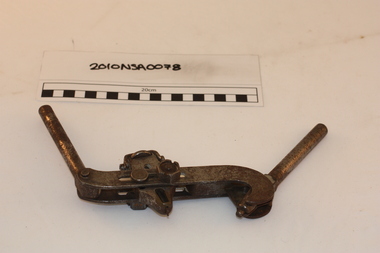
Trumble's Skull Plough
... It was a modification of an earlier instrument, similar in principle but less versatile, designed by Sir Henry Souttar(l875 - 1964), a very inventive surgeon who worked in the London Hospital. Souttar also used a motor-powered circular saw when necessary. ...It was a modification of an earlier instrument, similar in principle but less versatile, designed by Sir Henry Souttar(l875 - 1964), a very inventive surgeon who worked in the London Hospital. Souttar also used a motor-powered circular saw when necessary. ...Long term loan from Neurological Society of Australasia Museum of Neurosurgical Instruments,South Australia. Catalogue with Historical Commentaries Second Edition January 2006 Copy located at RACS MuseumTrumble's Skull Plough or craniotome devised by Hugh Trumble (1864-1962 ) CRANIOTOME. This craniotome was designed by Hugh Trumble (1894-1962) of the Alfred Hospital, Melbourne, one of the eight founders of the Neurosurgical Society of Australasia. It was a modification of an earlier instrument, similar in principle but less versatile, designed by Sir Henry Souttar(l875 - 1964), a very inventive surgeon who worked in the London Hospital. Souttar also used a motor-powered circular saw when necessary. He cut very large circular bone flaps, exposing the occipital lobes and posterior fossa in a few minutes. Trumble reported the use of this craniotome as "an expeditious method of cutting bone flaps" and in the designer's hands this claim was certainly justified. To use the crauiotome, it was necessary to hold the skull rigidly, and this was done by embedding the head in a plaster mould. Three holes were drilled in the skull to fix the pin of the craniotome, and the flap was then cut in a series of three arcs, after which the flap was elevated with levers until its base fractured. The 'Trumbolian" instrumentation was used in the Alfred Hospital by a number of Trumble's pupils. The craniotome is made of steel, not plated and apparently not stainless. It is believed that Trumble made his craniotomes himself, in a backyard workshop. -
 Bendigo Military Museum
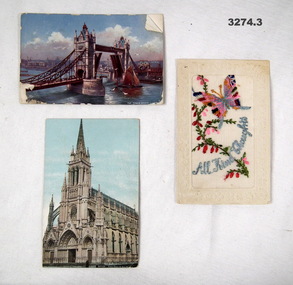
Postcard - POSTCARDS WW1, 1) 1917; .2) & .3) 1916
... .1) On rear: “From Hospital London dated 3.8.1917 to Pearl from brother, HR” .2) On rear: “Dated 12.11.1916 to Pearl from brother, Harry” .3) On front embroidered: “All Kind Thoughts. ...Postcards silk .1) On rear: “From Hospital London dated 3.8.1917 to Pearl from brother, HR” .2) On rear: “Dated 12.11.1916 to Pearl from brother, Harry” .3) On front embroidered: “All Kind Thoughts. ....1) Tower Bridge, London. Detailed letter attached. .2) Notre Dame. Detailed letter attached. .3) Embroidered post card, France. Detailed letter attached..1) On rear: “From Hospital London dated 3.8.1917 to Pearl from brother, HR” .2) On rear: “Dated 12.11.1916 to Pearl from brother, Harry” .3) On front embroidered: “All Kind Thoughts. On rear: Dated 28.6.1916 to Pearl from friend, NM”postcards, silk -
 Geoffrey Kaye Museum of Anaesthetic History
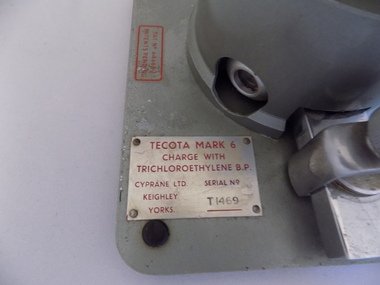
Equipment - Vaporiser, Tecota, Cyprane Ltd, c. 1970
... The machine was used in the obstetric wards at University College Hospital, London. Trilene was introduced in the 1940s. ...The machine was used in the obstetric wards at University College Hospital, London. Trilene was introduced in the 1940s. ...Used by mothers during childbirth, the anaesthetic Trilene (trichloroethylene) was inhaled through a face mask [missing] attached to the rubber tubing [missing] and the vaporising chamber. The Trilene was poured into the chamber to be turned into a vapour. The machine was used in the obstetric wards at University College Hospital, London. Trilene was introduced in the 1940s. The machine was made by Cyprane Ltd.Khaki metal multi layered cylinder. Set on top of khaki metal plate with four (4) rubber feet.Stamped in red on top level of vaporiser: Cyprane Ltd •Stamped in red on serial plate: TECOTA MARK 6 / CHARGE WITH TRICHLOROETHYLENE B.P. / CYPRANE LTD. SERIAL No / KEIGHLEY / YORKS. / T1469 •Clear sticker with red printed text stuck on metal plate: PAT No 646680 / PATENTS PENDINGtrichlorethylene vaporiser, tecota mark 6 -
 4th/19th Prince of Wales's Light Horse Regiment Unit History Room
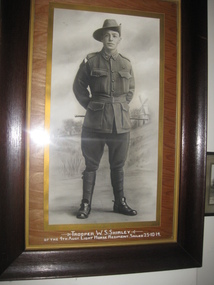
Portrait Photograph, J Williams, Trooper W S Shirley
... Wounded in action (side) 24 June 1915, 1 General Hospital Alexandria 30 June 1915, 4 London General Hospital , 23 Aug 1915. ...Wounded in action (side) 24 June 1915, 1 General Hospital Alexandria 30 June 1915, 4 London General Hospital , 23 Aug 1915. ...No 336, Tpr William Shirley, 34-yo labourer, of Yea Victoria. Enlisted B Squadron 4 LH Regiment, 20 Aug 1914, embarked 19 Oct 1914. Wounded in action (side) 24 June 1915, 1 General Hospital Alexandria 30 June 1915, 4 London General Hospital , 23 Aug 1915. Returned to Australia 8 May 1916. Previous service: No 1012 Pte, 5 VMR, Boer War. Embarked 15 Feb 1901. Returned to Australia 27 March 1902. Militia service 15 Light Horse RegimentB&W framed photograph of Trooper W S Shirley, 4th Light Horse RegimentTrooper W S Shirley of the 4th Aust Light Horse Regiment. Sailed 25.10.14photograph, ww1, w s shirley, 4th light horse regiment -
 Royal Australian and New Zealand College of Obstetricians & Gynaecologists (RANZCOG)
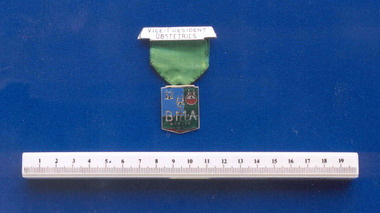
Medal - British Medical Association medal associated with Professor F J Browne, Dublin, 1933, 1933 (approximate)
... Summary of appointments include: General Practice in Wales, Maternity Department of the Edinburgh Royal Infirmary, 1st director of obstetric unit, University College Hospital London. Retired and continued postgraduate teaching in London and NSW. ...Summary of appointments include: General Practice in Wales, Maternity Department of the Edinburgh Royal Infirmary, 1st director of obstetric unit, University College Hospital London. Retired and continued postgraduate teaching in London and NSW. ...Francis James Browne died in Sydney 1963. He had a long career in obstetrics and gynaecology. Summary of appointments include: General Practice in Wales, Maternity Department of the Edinburgh Royal Infirmary, 1st director of obstetric unit, University College Hospital London. Retired and continued postgraduate teaching in London and NSW. Married to Grace Cuthbert, who was director of Maternal and Baby Welfare in NSW. Collection of objects transferred from the Archives to the Museum collection found amongst Professor FJ Browne's papers.Square medal with ribbon. Medal is decorated with blue, green, and red enamel and has silver inserts. Medal design is divided vertically and horizontally by silver lines and carries the text, "B.M.A/DUBLIN/1933". There are three symbols on the upper section of the front of the medal. Top of medal is attached to a green grosgrain ribbon, which in turn is attached to a silver bar inscribed with the words "VICE-PRESIDENT/OBSTETRICS". Small stamp printed on back of medal.numismatics, british medical association -
 Royal Australian and New Zealand College of Obstetricians & Gynaecologists (RANZCOG)
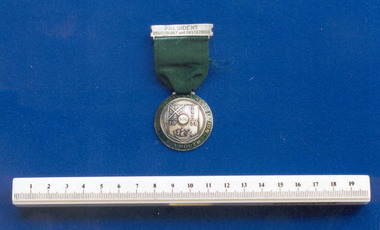
Medal - British Medical Association President of Gynaecology and Obstetrics medal associated with Professor F.J. Browne, 1938
... Summary of appointments include: General Practice in Wales, Maternity Department of the Edinburgh Royal Infirmary, 1st director of obstetric unit, University College Hospital London. Retired and continued postgraduate teaching in London and NSW. ...Summary of appointments include: General Practice in Wales, Maternity Department of the Edinburgh Royal Infirmary, 1st director of obstetric unit, University College Hospital London. Retired and continued postgraduate teaching in London and NSW. ...Francis James Browne died in Sydney 1963. He had a long career in obstetrics and gynaecology. Summary of appointments include: General Practice in Wales, Maternity Department of the Edinburgh Royal Infirmary, 1st director of obstetric unit, University College Hospital London. Retired and continued postgraduate teaching in London and NSW. Married to Grace Cuthbert, who was director of Maternal and Baby Welfare in NSW. A collection of objects found amongst Professor FJ Browne's papers were transferred from the Archives to the Museum collections in January 1994.A round metal badge with a green enamelled rim. There is a shield in the centre which is divided into three. In the left hand comer there is a flag, in the right hand comer the medical insignia, and at the bottom of the shield there is a sailing ship. The year 1938 is either side of a central white enamelled plug with the number "106" on it. Attached to the badge is a green grosgrain ribbon, to which is attached an oblong bar with a pin at the back. Inscriptions Around the edge of the badge: "THE BRITISH MEDICAL ASSOCIATION PLYMOUTH"; inscribed on the back of the badge: "BRUFORD, EASTBOURNE AND EXETER"; front lower right hand side ofbadge:"M & W"; front of bar: "PRESIDENT/ GYNAECOLOGY and OBSTETRICS"numismatics, browne fj, rcog -
 Royal Australian and New Zealand College of Obstetricians & Gynaecologists (RANZCOG)
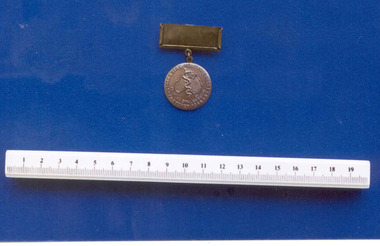
Badge - Australasian Medical Congress attendee badge associated with Professor F J Browne, 1951, 1955
... Summary of appointments include: General Practice in Wales, Maternity Department of the Edinburgh Royal Infirmary, 1st director of obstetric unit, University College Hospital London. Retired and continued postgraduate teaching in London and NSW. ...Summary of appointments include: General Practice in Wales, Maternity Department of the Edinburgh Royal Infirmary, 1st director of obstetric unit, University College Hospital London. Retired and continued postgraduate teaching in London and NSW. ...Francis James Browne died in Sydney 1963. He had a long career in obstetrics and gynaecology. Summary of appointments include: General Practice in Wales, Maternity Department of the Edinburgh Royal Infirmary, 1st director of obstetric unit, University College Hospital London. Retired and continued postgraduate teaching in London and NSW. Married to Grace Cuthbert, who was director of Maternal and Baby Welfare in NSW. A collection of objects found amongst Professor FJ Browne's papers were transferred from the Archives to the Museum collection in 1994.Round copper coloured badge attached by two metal links to a rectangular bar. The bar is designed to hold a small name plate. The badge features a map of Australia as the central design overlaid with a representation of the Staff of Asclepius (a serpent entwined around a staff). Front of badge carries the words, "AUSTRALASIAN MEDICAL CONGRESS/ (B.M.A.) 9TH SESSION/ SYDNEY 1955".browne fj, australian medical congress, numismatics -
 Alfred Hospital Nurses League - Nursing History Collection
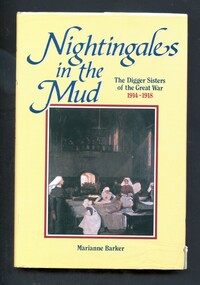
Book - Illustrated book, Marianne Baker 1944, Nightingales in the mud: the digger sisters of the Great War 1914-1918, 1989
... Front of dust jacket has a reproduction of the painting "Arrival of first Australian wounded from Gallipoli at Wandsworth Hospital, London" by George Coates, in a red/brown and white border. ...Front of dust jacket has a reproduction of the painting "Arrival of first Australian wounded from Gallipoli at Wandsworth Hospital, London" by George Coates, in a red/brown and white border. ...This book draws on many first-hand and previously unpublished accounts of the work of Australian nurses in World War one, to tell the story of courage and companionship under conditions of great hardship - in the mud of Flanders, among the cholera cases in India, on the hospital ships during the Gallipoli campaign, on the Afghanistan border, in Vladivostok, in mosquito infested Macedonia and in the Sinai Desert.Illustrated book with dust jacket. Book has a dark blue cover, abbreviated title, author's surname and publisher's name embossed in gold on spine. Front of dust jacket has a reproduction of the painting "Arrival of first Australian wounded from Gallipoli at Wandsworth Hospital, London" by George Coates, in a red/brown and white border. Rest of dustjacket is yellow brown in colour. Full title is printed in blue and red /brown above painting, author's full name is printed in blue below painting. Abbreviated title, author's surname and publishers name are printed in blue on the spinenon-fictionThis book draws on many first-hand and previously unpublished accounts of the work of Australian nurses in World War one, to tell the story of courage and companionship under conditions of great hardship - in the mud of Flanders, among the cholera cases in India, on the hospital ships during the Gallipoli campaign, on the Afghanistan border, in Vladivostok, in mosquito infested Macedonia and in the Sinai Desert.world war 1914-1918 - medical care, military nursing, nurses, australian nurses -
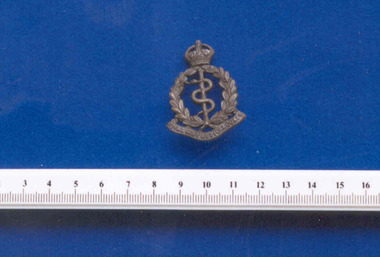 Royal Australian and New Zealand College of Obstetricians & Gynaecologists (RANZCOG)
Badge - Royal Army Medical Corps cap badge worn by F J Browne, World War I, 1915 (approximate)
... Summary of appointments include: General Practice in Wales, Maternity Department of the Edinburgh Royal Infirmary, 1st director of obstetric unit, University College Hospital London. Retired and continued postgraduate teaching in London and NSW. ...Summary of appointments include: General Practice in Wales, Maternity Department of the Edinburgh Royal Infirmary, 1st director of obstetric unit, University College Hospital London. Retired and continued postgraduate teaching in London and NSW. ...Issued to Royal Army Medical Corps soldiers, this cap badge would have been worn by Francis Browne during World War I. Francis James Browne died in Sydney 1963. He had a long career in obstetrics and gynaecology. Summary of appointments include: General Practice in Wales, Maternity Department of the Edinburgh Royal Infirmary, 1st director of obstetric unit, University College Hospital London. Retired and continued postgraduate teaching in London and NSW. Married to Grace Cuthbert, who was director of Maternal and Baby Welfare in NSW. Collection of objects transferred from the Archives to the Museum collection found amongst Professor FJ Browne's papers.Dark brown metal cap badge. Design features a crown sitting atop a laurel wreath, which surrounds a representation of the Rod of Asclepius (serpent wrapped around a rod). A scroll is affixed below the wreath which is inscribed 'ROYAL ARMY MEDICAL CORPS'.world war i, numismatics, browne fj
