
Showing 15 items matching "lost architecture"
-
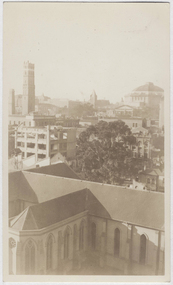 Congregation of the Blessed Sacrament and St. Francis’ Church, Heritage Centre
Photograph - Demolition of Advocate building and construction of Monastery, 1937
... ...Lost architecture...Church buildings Historic buildings Lost architecture Wrecking Melbourne St Francis' Church Elevated view from south-west corner of St Francis Church, across roof top towards the partially demolished Advocate Press Building. ...A number of buildings were demolished along the south side of Little Lonsdale Street between St Francis Street and Elizabeth Street for the construction of the new Monastery for the Blessed Sacrament Congregation including a former school building and Advocate Press building. Demolition of the Advocate begun 6 July 1937 and was completed by mid-August. Construction works for the Monastery began soon after and was officially opened by Archbishop Mannix on 1 May 1938.Elevated view from south-west corner of St Francis Church, across roof top towards the partially demolished Advocate Press Building. In background, Coop's Shot Tower to the left, State Library to the right. Photographer unknown. Faded black and white photograph. Yellowing.church buildings, historic buildings, lost architecture, wrecking, melbourne, st francis' church -
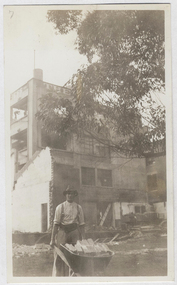 Congregation of the Blessed Sacrament and St. Francis’ Church, Heritage Centre
Photograph - Demolition of Advocate building and construction of Monastery, 1937
... ...Lost architecture...Church buildings Historic buildings Lost architecture Wrecking Melbourne St Francis' Church Man pushing a wheelbarrow of rubble with the Advocate Press Building partially demolished in the background. ...A number of buildings were demolished along the south side of Little Lonsdale Street between St Francis Street and Elizabeth Street for the construction of the new Monastery for the Blessed Sacrament Congregation including a former school building and Advocate Press building. Demolition of the Advocate begun 6 July 1937 and was completed by mid-August. Construction works for the Monastery began soon after and was officially opened by Archbishop Mannix on 1 May 1938.Man pushing a wheelbarrow of rubble with the Advocate Press Building partially demolished in the background. Photographer unknown. Faded black and white photograph. Yellowing.church buildings, historic buildings, lost architecture, wrecking, melbourne, st francis' church -
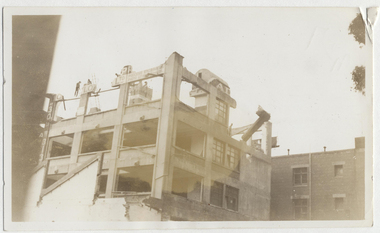 Congregation of the Blessed Sacrament and St. Francis’ Church, Heritage Centre
Photograph - Demolition of Advocate building and construction of Monastery, 1937
... ...Lost architecture...Church buildings Historic buildings Lost architecture Wrecking Melbourne St Francis' Church Advocate Press Building being demolished by hand. ...A number of buildings were demolished along the south side of Little Lonsdale Street between St Francis Street and Elizabeth Street for the construction of the new Monastery for the Blessed Sacrament Congregation including a former school building and Advocate Press building. Demolition of the Advocate begun 6 July 1937 and was completed by mid-August. Construction works for the Monastery began soon after and was officially opened by Archbishop Mannix on 1 May 1938.Advocate Press Building being demolished by hand. Shows men on the upper storey, dismantling the building. Photographer unknown. Faded black and white photograph. Yellowing.church buildings, historic buildings, lost architecture, wrecking, melbourne, st francis' church -
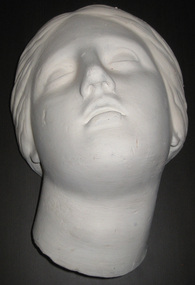 Federation University Historical Collection
Sculpture - Plaster Drawing Prop, Cast of Woman's Head
... The school inherited some casts from its predecessor institutions, and further consignments were purchased during the 1920s, including full length, bust and relief figures, as well as dozens of ornamental and architectural casts. Unfortunately, much of the collection was lost or destroyed in the late 1950s. ...The school inherited some casts from its predecessor institutions, and further consignments were purchased during the 1920s, including full length, bust and relief figures, as well as dozens of ornamental and architectural casts. Unfortunately, much of the collection was lost or destroyed in the late 1950s. ...The Ballarat Technical Art School boasted a well-stocked Antique Room replete with plaster copies of classical, Renaissance and Gothic sculptural examples, which were used as drawing props by students. The school inherited some casts from its predecessor institutions, and further consignments were purchased during the 1920s, including full length, bust and relief figures, as well as dozens of ornamental and architectural casts. Unfortunately, much of the collection was lost or destroyed in the late 1950s. This is one of the few surviving pieces, with TAFE students reportedly drawing from it into the twenty-first century. It was removed to the University's Historical Collection in 2012.White plaster cast of a woman with closed eyes. The cast is hollow, with an opening at the back. There is a metal wire at the back so it can hang on the wall.ballarat technical art school, ballarat school of mines, art, drawing, plaster, drawing the human figure from cast, drawing from the antique -
 Federation University Historical Collection
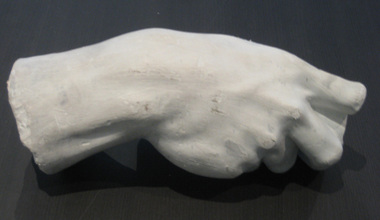
Equipment - Object, Otto Waschatz, Cast of Hand, Plaster Cast Drawing Prop
... The school inherited some casts from its predecessor institutions, and further consignments were purchased during the 1920s, including full length, bust and relief figures, as well as dozens of ornamental and architectural casts. Unfortunately, much of the collection was lost or destroyed in the late 1950s. ...The school inherited some casts from its predecessor institutions, and further consignments were purchased during the 1920s, including full length, bust and relief figures, as well as dozens of ornamental and architectural casts. Unfortunately, much of the collection was lost or destroyed in the late 1950s. ...The Ballarat Technical Art School boasted a well-stocked Antique Room replete with plaster copies of classical, Renaissance and Gothic sculptural examples, which were used as drawing props by students. The school inherited some casts from its predecessor institutions, and further consignments were purchased during the 1920s, including full length, bust and relief figures, as well as dozens of ornamental and architectural casts. Unfortunately, much of the collection was lost or destroyed in the late 1950s. This is one of the few surviving pieces, with TAFE students reportedly drawing from it into the twenty-first century. This plaster hand is inscribed “Waschatz, Modeller, Melbourne.” Otto Waschatz was a German plasterer who opened a plaster business in the Melbourne suburb of Richmond, and was responsible for the invention of the first true fibrous plaster - using a layer of hemp laid between plaster to create light and strong panels. By 1912 Waschatz's Lottoid Pty Ltd was a thriving and creative business, and possessed over 5,000 moulds for all kinds of plasterwork. The business closed in 1915, as the result of anti-German sentiment during World War One. Plaster cast of a hand used as a teaching aid at the Ballarat Technical Art School. The Victorian Education Department courses required art students to create studies based on ancient sculptures so copies of famous works were purchased as teaching aids. Among these courses were 'Drawing the Human Figure from Cast' and ‘Drawing from the Antique’. Waschatz, Modeller, Melbourneballarat school of mines, art, arts academy, ballarat technical art school, vikki nash, plaster cast, otto waschatz, lattoid pty ltd, school of mines, plaster copy, drawing from the antique, drawing the human figure from cast -
 Federation University Historical Collection
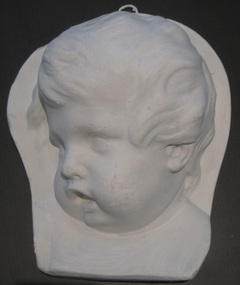
Sculpture - Plaster Drawing Prop, Cast of Child’s Head
... The school inherited some casts from its predecessor institutions, and further consignments were purchased during the 1920s, including full length, bust and relief figures, as well as dozens of ornamental and architectural casts. Unfortunately, much of the collection was lost or destroyed in the late 1950s. ...The school inherited some casts from its predecessor institutions, and further consignments were purchased during the 1920s, including full length, bust and relief figures, as well as dozens of ornamental and architectural casts. Unfortunately, much of the collection was lost or destroyed in the late 1950s. ...The Ballarat Technical Art School boasted a well-stocked Antique Room replete with plaster copies of classical, Renaissance and Gothic sculptural examples, which were used as drawing props by students. The school inherited some casts from its predecessor institutions, and further consignments were purchased during the 1920s, including full length, bust and relief figures, as well as dozens of ornamental and architectural casts. Unfortunately, much of the collection was lost or destroyed in the late 1950s. This is one of the few surviving pieces, with TAFE students reportedly drawing from it into the twenty-first century. It was removed to the University's Historical Collection in 2012.White plaster cast showing the side profile of a child's face.ballarat technical art school, ballarat school of mines, art, drawing, plaster, drawing from the antique, drawing the human figure from cast, copy, replica -
 Federation University Historical Collection
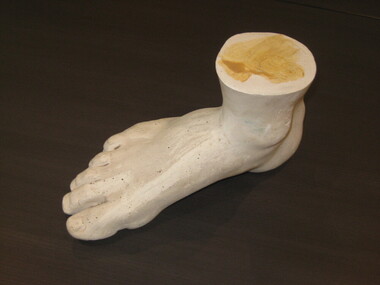
Sculpture - Plaster Drawing Prop, Cast of Foot, before 1918
... The school inherited some casts from its predecessor institutions, and further consignments were purchased during the 1920s, including full length, bust and relief figures, as well as dozens of ornamental and architectural casts. Unfortunately, much of the collection was lost or destroyed in the late 1950s. ...The school inherited some casts from its predecessor institutions, and further consignments were purchased during the 1920s, including full length, bust and relief figures, as well as dozens of ornamental and architectural casts. Unfortunately, much of the collection was lost or destroyed in the late 1950s. ...The Ballarat Technical Art School boasted a well-stocked Antique Room replete with plaster copies of classical, Renaissance and Gothic sculptural examples, which were used as drawing props by students. The school inherited some casts from its predecessor institutions, and further consignments were purchased during the 1920s, including full length, bust and relief figures, as well as dozens of ornamental and architectural casts. Unfortunately, much of the collection was lost or destroyed in the late 1950s. This is one of the few surviving pieces. The foot came into the school’s collection prior to 1920 as it appears in a photo in the SMB Annual Report. There are two possibilities where these sculptures may have originated, either Victorian and Albert Museum or the British Museum. There is a reference to the purchase of plaster casts from the Victoria and Albert Museum in the 1918 School of Mines Ballarat Minute Book. This plaster cast of a foot is of local significance as only one of a few remaining teaching pieces from the substantial collection of sculptures used in the art school. The foot also has significance as an interpretive tool complementing the complete art folio of Edith Alice Watson who was a student from 1930-1933.Plaster cast of right foot including ankle. Made from plaster of Paris. Mainly white in colour with grey patches around metatarsels, flecks of blue and green paint and pale brown paint (possibly shellac) and on top of ankle. Measurements suggest a size 11 man's right foot.plaster cast, foot, drawing aid, art school, smb, edith alice watson, 1931, 1931-33, 1918, 1920, plaster of paris, sculpture, ballarat technical art school number 10, drawing from the antique, drawing the human figure from cast -
 Federation University Historical Collection
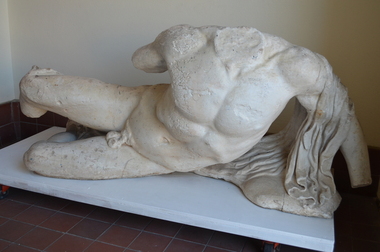
Sculpture - Plaster Replica (from original by Pheidias, 438 BCE-432 BCE), The river god Ilissos (possibly), c 1920 (from original 438 BCE-432 BCE)
... The school inherited some casts from its predecessor institutions, and further consignments were purchased during the 1920s, including full length, bust and relief figures, as well as dozens of ornamental and architectural casts. Unfortunately, much of the collection was lost or destroyed in the late 1950s....The school inherited some casts from its predecessor institutions, and further consignments were purchased during the 1920s, including full length, bust and relief figures, as well as dozens of ornamental and architectural casts. Unfortunately, much of the collection was lost or destroyed in the late 1950s. ...This ‘heroic size’ reclining figure is a copy made from one of The Parthenon Sculptures currently housed at The British Museum, and thought to represent the river-god Ilissos. This piece was part of the Ballarat Technical Art School's collection of reference for art studies, and became affectionately known as 'Hercules' by subsequent student cohorts. The cast was likely made by Brucciani and Co. London, and part of a consignment delivered to the School during the 1920s. This cast replicates one of a number of relics acquired by Thomas Bruce, seventh Earl of Elgin and ambassador to Turkey, (Lord Elgin) in Athens in the early 19th century. (Hence, these works were sometimes collectively referred to as the Elgin Marbles). Ownership of the artefacts, once part of the 2,500-year-old Parthenon temple, is disputed by Greece. It maintains that Elgin removed them illegally while the country was under Turkish occupation as part of the Ottoman Empire. The items were sold to the British Museum in 1816 and have remained there ever since. The original "Ilissos" was located on the west pediment of the Parthenon in Greece, and was created in c435 BC. It is unknown if the statue was in position or had already fallen when removed from the Parthenon by Elgin. The Royal Academy London also holds a copy of this plaster cast. The Ballarat Technical Art School boasted a well-stocked Antique Room replete with plaster copies of classical, Renaissance and Gothic sculptural examples, which were used as drawing props by students. The school inherited some casts from its predecessor institutions, and further consignments were purchased during the 1920s, including full length, bust and relief figures, as well as dozens of ornamental and architectural casts. Unfortunately, much of the collection was lost or destroyed in the late 1950s.Quality examples of heroic sized plaster replicas are now rare, as many plaster collections were destroyed or lost when the copy of antique examples fell out of favour with art schools.Plaster cast used during Drawing classes at the Ballarat Technical Arts School. It is likely a headless depiction of the river god Ilissos.hercules, ballarat technical art school, elgin marbles, plaster, plaster cast, figure of a river god, parthenon marbles, ilissos, copy, drawing the human figure from cast, drawing from the antique, visual arts -
 Flagstaff Hill Maritime Museum and Village
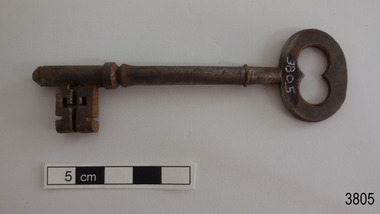
Functional object - Key, circa 1866
... lost their lives. Eva first met Jane Shields at Glenample and they became long-time friends. The keys are significant as an example of mid-19th century locksmith hardware, and for their connection with Glenample Homestead, and for their connection to the history of the Loch Ard shipwreck’s only two survivors. Glenample Homestead is of historical, social and architectural ...The key is one of a collection of seven 1860s keys once belonged to the Glenample Homestead near Princetown. They are all keyed with different bits and would have opened the external panelled doors of the Georgian building. The keys would now be around 150 years old. The keys are now part of the John Chance Collection. Locksmiths became a recognised trade by the middle of the 19th century, doing work that blacksmiths and gunsmiths would have done. They were craftsmen and trained apprentices for their trade. The local community and businesses relied on them for making a wide variety of precision objects such as locks and keys, knives, ornamental and decorative latticework, fine instruments, accurate tools and hardware items. Glenample Homestead became famous after the disastrous wreck of the sailing ship Loch Ard on June 1, 1878. The owners, Hugh Hamilton Gibson and Peter McArthur, were involved in the rescue and recovery of Eva Carmichael and Tom Pearce, the only two survivors, as well as overseeing the salvage of items from the shipwreck and the burial of those who lost their lives. Eva first met Jane Shields at Glenample and they became long-time friends. The keys are significant as an example of mid-19th century locksmith hardware, and for their connection with Glenample Homestead, and for their connection to the history of the Loch Ard shipwreck’s only two survivors. Glenample Homestead is of historical, social and architectural significance to the State of Victoria and is listed on the Victorian Heritage Register (VHR H0392). It is a historical example of early settlement and development of a run in the coastal land of South West Victoria, and it is constructed from locally quarried sandstone but doesn’t take away from its Georgian design. Glenample Homestead is of State significance through its unique connection with the wreck of the ship Loch Ard and the connection to its owners, Hugh and Lavinia Gibson and Peter McArthur, played a historically and socially significant role in the rescue and care of the survivors, the salvage of goods and the burial of those who lost their lives. The shipwreck of the Loch Ard itself is of significance for Victoria and is registered on the Victorian Heritage Register (S417). Key; steel domestic door key. Flat open bow with 'figure 8' space, collar on shank, close to the bow. Round shank flares out slightly above the collar on the bit. The rectangular bit has internal and external notches and grooves. There is a rounded pin on the end.flagstaff hill, warrnambool, flagstaff hill maritime museum, maritime museum, shipwreck coast, flagstaff hill maritime village, great ocean road, glenample homestead, victorian heritage register vhr h0392, georgian homestead, loch ard, princetown, jane shields, eva carmichael, tom pearce, blue china tea set, antique door key, glenample photographs, john chance -
 Eltham District Historical Society Inc
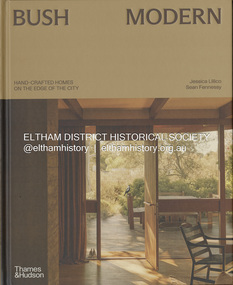
Book, Jessica Lillico, Bush Modern: Hand-crafted homes on the edge of the city, 4 Nov. 2025
... architectural aesthetic has been quietly gaining recognition. Emerging out of necessity in the post-war years, it reimagined the sleek ideals of modernism through the lens of the local landscape. Simple homes built 'of the land' from mud bricks and recycled timber captured the mood of those searching for an alternative way of life close to nature. The movement gathered momentum in the counter-cultural 1960s and culminated in near-mainstream popularity in the 1970s. After a few decades where brown lost...architectural aesthetic has been quietly gaining recognition. Emerging out of necessity in the post-war years, it reimagined the sleek ideals of modernism through the lens of the local landscape. Simple homes built 'of the land' from mud bricks and recycled timber captured the mood of those searching for an alternative way of life close to nature. The movement gathered momentum in the counter-cultural 1960s and culminated in near-mainstream popularity in the 1970s. After a few decades where brown lost ...From the publisher Thames & Hudson Australia's website: "In the bushy north-eastern fringe of Melbourne, an enduring, uniquely Australian architectural aesthetic has been quietly gaining recognition. Emerging out of necessity in the post-war years, it reimagined the sleek ideals of modernism through the lens of the local landscape. Simple homes built 'of the land' from mud bricks and recycled timber captured the mood of those searching for an alternative way of life close to nature. The movement gathered momentum in the counter-cultural 1960s and culminated in near-mainstream popularity in the 1970s. After a few decades where brown lost appeal in favour of white-washed minimalism, the style in all its warm, earthy glory is once again being embraced and revived by a new generation Through evocative photography by Sean Fennessy, personal stories and architectural insights, Bush Modern explores the timeless appeal of these character-filled homes: tactile, grounded and deeply in tune with their environment." Contents: Bush modern locations (map) Grounded in simplicity by Jessica Lillico and Sean Fennessy Time and place by Morag Fraser Houses featured - Stonygrad 1940, North Warrandyte Fraser-Jackson House 1947/1977, Montmorency Busst House 1948, Eltham Burstall House 1950, Montmorency Wright House II 1960, North Warrandyte Collis House 1966, Eltham Diskin House 1967, Eltham Redfern House 1967, North Warrandyte River Bend 1968/2022, Garambi Baan, Eltham Fisher House 1969, Warrandyte Borrack House 1970, Plenty Valley Fiddlers Elbow 1970, North Warrandyte Light Well House 1972, Donvale Birrarung House 1974, Garambi Baan, Eltham High Noon 1974, North Warrandyte Monty Sibbel 1975/2022, Montmorency Provan House 1976/2021, North Warrandyte Pizzey House 1977, Eltham Pittard House 1978, Eltham Gray House 1980, Eltham Carol Ann House 1989, Bend of Islands Wattle Glen 1999, Wattle Glen Big Hill 2001, Christmas Hills Inside front cover in ink: "Enjoy! Jess & Sean"stonygrad, fraser-jackson house, busst house, burstall house, wright house ii, collis house, diskin house, redfern house, river bend, fisher house, borrack house, fiddlers elbow, light well house, birrarung house, high noon, monty sibbel, provan house, pizzey house, pittard house, gray house, carol ann house, wattle glen, big hill -
 Bayside Gallery - Bayside City Council Art & Heritage Collection
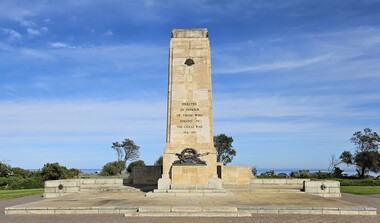
Monument - Memorial, Irwin and Stevenson, Brighton War Memorial, 1927
... The first prize of £30 was awarded to the architecture firm Irwin and Stevenson and the designs were exhibited at the Brighton Town Hall in 1925. The bronze casting, using lost wax technique, was executed by sculptor Mr. ...The first prize of £30 was awarded to the architecture firm Irwin and Stevenson and the designs were exhibited at the Brighton Town Hall in 1925. The bronze casting, using lost wax technique, was executed by sculptor Mr. ...On 23 July 1922, Brighton City Council adopted the recommendation from a sub-committee that the site for a war memorial be at Green Point, Brighton Beach. Brighton Council invited designs, limited to returned soldier architects and 18 designs were received. The first prize of £30 was awarded to the architecture firm Irwin and Stevenson and the designs were exhibited at the Brighton Town Hall in 1925. The bronze casting, using lost wax technique, was executed by sculptor Mr. Paul Montford, to the design of the architect and the central assemblage was believed to be the largest bronze casting in relief carried out in Australia at the time. The Brighton War Memorial was unveiled by His Excellency the Governor, the Right Honourable Arthur Herbert Tennyson Baron Somers, K.C.M.G., D.S.O., M.C., on Sunday 24th April 1927 in the presence of 4,000 people. The memorial was originally constructed to commemorate those from the City of Brighton who served in World War One but has since been augmented to commemorate those from the municipality of Bayside who have made the ultimate sacrifice during official periods of hostility.War memorial consisting of a sandstone cenotaph, granite base and sandstone terrace situated at Green Point, Brighton. The cenotaph is a truncated obelisk with classical decoration in stone and bronze. The cenotaph bears the Rising Sun badge in bronze relief near its top with bronze lettering running down the cenotaph reading "ERECTED IN HONOUR OF THOSE WHO FOUGHT IN THE GREAT WAR 1914 – 1919". A bronze relief assemblage of crossed weapons, a wreath, the lamp of valour and the Latin phrase "DUCIT AMOR PATRIA" (love of country leads me) sit above the base which is carved with the word "SERVICE". The terrace walls have bronze relief medallions with images of the head of an airman on the left and an infantryman on the right. The back of the cenotaph bears a torch in bronze relief near its top. On the sandstone wall behind the cenotaph are three large bronze plaques that lists the names of those from the City of Bayside who have served in the various conflicts in which Australia has been involved. At the back of the sandstone wall is carved lettering reading "HISTORY GAVE THEM A COMMON FAME. POSTERITY A COMMON MONUMENT" with 1914 carved on the left and 1919 on the right.brighton war memorial, memorial, cenotaph, green point, war memorial, brighton, service, paul montford, irwin and stevenson, rising sun, wreath, weapons, lamp of valour, great war, world war one, honour roll, honour board, roll of honour, ducit amor patriae, brighton beach, city of brighton, leighton major francis irwin, roy kenneth stevenson -
 Kew Historical Society Inc
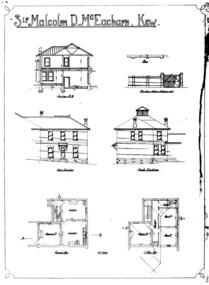
Drawing - Architectural Drawings [copy], William Pitt, Sir Malcolm D. McEacharn, Kew, 1901
... architectural drawings of additions to Goathland (originally Byram, and later Goathland and Lowan). The drawings, by the architect William Pitt represent additions to the size of Goathland. Pitt had previously worked with the original architect of the house, Edward George Kilburn, of Ellerker & Kilburn, who had designed Byram for the industrialist George Ramsden in 1888. 'Lost...architectural drawings of additions to Goathland (originally Byram, and later Goathland and Lowan). The drawings, by the architect William Pitt represent additions to the size of Goathland. Pitt had previously worked with the original architect of the house, Edward George Kilburn, of Ellerker & Kilburn, who had designed Byram for the industrialist George Ramsden in 1888. 'Lost ...A set of architectural drawings of additions to Goathland (originally Byram, and later Goathland and Lowan). The drawings, by the architect William Pitt represent additions to the size of Goathland. Pitt had previously worked with the original architect of the house, Edward George Kilburn, of Ellerker & Kilburn, who had designed Byram for the industrialist George Ramsden in 1888. 'Lost Glories: a memorial to forgotten Australian buildings' was published by David Latta in 1986. It tells the story of a number of significant Australian buildings that had previously been demolished. A chapter in the book was devoted to Goathland, later known as Tara Hall. To supplement the text, he sourced photographs from a range of suppliers, chiefly the Royal Women's Hospital which had once owned Tara Hall, but had sold it in 1960. This is one of the photographs donated to KHS by the author.Six black and white architectural drawings by the architect William Pitt for additions to the home of Sir Malcolm McEacharn in Studley Park Road. The original is in the collection of the State Library of Victoria."Sir Malcolm D. McEacharn, Kew"william pitt, malcolm mceacharn, architects -- melbourne (vic.) -- william pitt, architectural drawings, byram, tara hall, goathland -
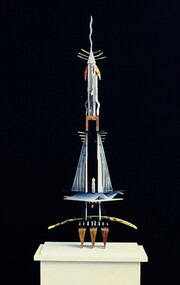 Federation University Art Collection
Sculpture, Thomas, Kylie, 'Cultural Dedication' by Kylie Thomas, 1993
... lost in the 2019 bushfires that decimated Mallacoota. Moving back to her hometown of Creswick Kylie Thomas completed a Diploma in Education qualifying as a secondary teacher, always continuing her art practice while teaching. Needing to work again, but with no desire to teach, Kylie Thomas studied Building Design and Architectural...lost in the 2019 bushfires that decimated Mallacoota. Moving back to her hometown of Creswick Kylie Thomas completed a Diploma in Education qualifying as a secondary teacher, always continuing her art practice while teaching. Needing to work again, but with no desire to teach, Kylie Thomas studied Building Design and Architectural ...Kylie THOMAS (14 May 1973 - ) Born Creswick, Victoria A graduate of the Bachelor of Arts (Visual Arts) (1993) and Diploma of Visual Arts (1995) from Federation University (then University of Ballarat) Kylie Thomas continued her art practice after studying under distinguished sculptors Peter Blizzard and Adrian Mauriks. This work was acquired from her graduate folio. Soon after completing her studies Kylie Thomas became an artist in residence at Ballarat Grammar School building a public sculpture for the grounds conceived by one of her selected students as part of the program. She became the youngest exhibiting applicant to be awarded the City of Port Phillip, Rupert Bunny Foundation artist in residence program. After moving to Mallacoota she was absorbed into the community as a visual artist, actor, playwright and assistant publicist. Her commissioned public artwork and sculptures as part of residences collections were all lost in the 2019 bushfires that decimated Mallacoota. Moving back to her hometown of Creswick Kylie Thomas completed a Diploma in Education qualifying as a secondary teacher, always continuing her art practice while teaching. Needing to work again, but with no desire to teach, Kylie Thomas studied Building Design and Architectural Drafting, homing in on other areas which could link back to her artistic practice. Working in this field for a short time she moved to Melbourne where she exhibited paintings and sculpture installations as part of The Melbourne Fringe Festival. She also worked in set design, and as a stage manager and theatre actor. This item is part of the Federation University Art Collection. The Art Collection features over 2000 works and was listed as a 'Ballarat Treasure' in 2007.This work is a spiritual totem created in the tradition of the bricoleur, dedicated to bygone cultures, lost technology and mystery referencing nature, humanity and technology. Humanity to use technology with and for nature. The materials are symbolic, the use of bone, Perspex, computer parts, found and crafted objects constructed in a resulting harmony creating a symbiotic relationship. Tapping the 4th dimension that could lift off into space and come back again, with a feeling of weightlessness, awe and suspension captured. A sculpture which stands on a white pedestal with perspex cover. 'Cultural Dedication' is the final work in a series of sculptures influenced by the ancient cultures of Egypt. art, artwork, kylie thomas, sculpture, alumni -
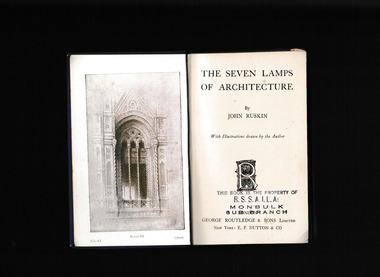 Mrs Aeneas Gunn Memorial Library
Book, George Routledge and Sons, The seven lamps of architecture
... Ruskin saw Gothic as the noblest style of architecture, but he noted that over time medieval architecture had lost the power to resist innovationt the time it was published in 1859, John Stuart Mill's On Liberty was a radical and controversial work; it argued for the right of individuals to possess freedom from the state in moral and economic matters. ...According to Ruskin, the leading principles of architecture are the “lamps” of Sacrifice, Truth, Power, Beauty, Life, Memory, and Obedience. Ruskin saw Gothic as the noblest style of architecture, but he noted that over time medieval architecture had lost the power to resist innovationt the time it was published in 1859, John Stuart Mill's On Liberty was a radical and controversial work; it argued for the right of individuals to possess freedom from the state in moral and economic matters. Mill declares that ""Over himself, over his own body and mind, the individual is sovereign"", contrasting this with the ""tyranny of the majority."" He states that an individual can do anything they like as long as it doesn't harm another.Index, ill, p.236.non-fictionAccording to Ruskin, the leading principles of architecture are the “lamps” of Sacrifice, Truth, Power, Beauty, Life, Memory, and Obedience. Ruskin saw Gothic as the noblest style of architecture, but he noted that over time medieval architecture had lost the power to resist innovationt the time it was published in 1859, John Stuart Mill's On Liberty was a radical and controversial work; it argued for the right of individuals to possess freedom from the state in moral and economic matters. Mill declares that ""Over himself, over his own body and mind, the individual is sovereign"", contrasting this with the ""tyranny of the majority."" He states that an individual can do anything they like as long as it doesn't harm another. architecture, john ruskin 1819-1900 -
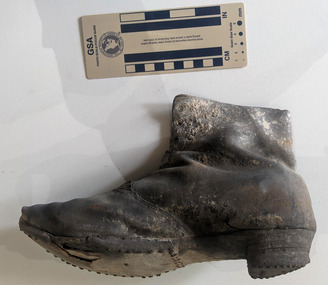 Working Heritage Crown Land Collection
Clothing - Leather Boot
... Buildings History Architecture former Royal Mint Historic Building Leather boot - Black leather men's ankle-high boot. The leather is dry and desiccated leading to hardening. There is a layer of dirt and mud over all surfaces. Most of the sole has been lost ...The boot consisted of a complete man's black leather work-boot resting on the ground sub-floor surface (Layers A-B) in front of the fireplace. Although the uppers had folded inwards and hardened, the fabric was in generally good condition. The newspaper consisted of a single folded sheet, comprising the front and rear pages of 'The Age' (January 2nd, 1872), which was crumpled together with a contemporary theatrical flyer. As the items were removed prior to inspection, a direct association between these items cannot be made, though it is possible that the crumpled newspaper had been originally been inside the boot. The boot is significant based on its connection to the construction of the former Royal Mint building and its potential in demonstrating a ritual building practice. Leather boot - Black leather men's ankle-high boot. The leather is dry and desiccated leading to hardening. There is a layer of dirt and mud over all surfaces. Most of the sole has been lost. Nails revealed in this area are corroding, the heal remains and is well attached - there has been a pronounced shrinkage of the leather of the heal. The lace is missing from the boot. buildings, history, architecture, former royal mint, historic building
