
Showing 29 items matching "louise down"
-
 Eltham District Historical Society Inc
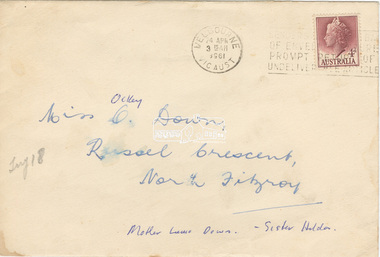
Letter - Photograph, Envelope containg four sepia photographs, 1923-1958
... ...Louise Down...Also noted in blue ink "Mother Louie (or Louise) Down - Sister Hilda". The wedding photo is unidentified except for the date 22 May 1956. ...Pinkerton Miss O. Down Louise Down Hilda Down Envelope 11.0 x 16.4 cm containg four sepia prints; 1. 15.5 x 9.7 cm 2.10.7 x 6.3 cm 3. 10.5 x 6.5 cm 4. 6.5 x 9.0 cm Envelope containg four sepia photographs Letter Photograph ...Located in the collection of Eltham District Historical Society, this envelope contains four sepia prints ranging in dates from 1923 to 1956. The envelope is postmarked 24 Apr 1958 and on the reverse is noted "Accepted 30/4/58". On the face is witten in pencil "Try 18" being No. 18 Russell Crescent, Fitzroy North. Also noted in blue ink "Mother Louie (or Louise) Down - Sister Hilda". The wedding photo is unidentified except for the date 22 May 1956. It was taken by The Lock wood Studios. Other photos are described on their reverse sides as: "Olive McKay, Mr Pinkerton and self" "Uncle Donald and Aunt Florrie, July 1923" "Jessfield, May 12th, 1928" It is not known why they are held by EDHS or the significance/relationship of the people to the Eltham district. Any information pertaining to these people is welcomed.olive mckay, mr. pinkerton, miss o. down, louise down, hilda down -
 Eltham District Historical Society Inc
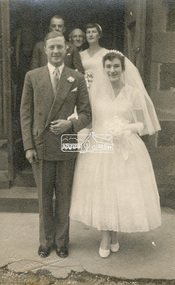
Photograph, The Lockwood Studios, Wedding, 22 May 1956
... ...Louise Down...Also noted in blue ink "Mother Louie (or Louise) Down - Sister Hilda". The wedding photo is unidentified except for the date 22 May 1956. ...Pinkerton Miss O. Down Louise Down Hilda Down Sepia print 15.5 x 9.7 cm Wedding Photograph Photograph The Lockwood Studios ...Located in the collection of Eltham District Historical Society, this envelope contains four sepia prints ranging in dates from 1923 to 1956. The envelope is postmarked 24 Apr 1958 and on the reverse is noted "Accepted 30/4/58". On the face is witten in pencil "Try 18" being No. 18 Russell Crescent, Fitzroy North. Also noted in blue ink "Mother Louie (or Louise) Down - Sister Hilda". The wedding photo is unidentified except for the date 22 May 1956. It was taken by The Lock wood Studios. Other photos are described on their reverse sides as: "Olive McKay, Mr Pinkerton and self" "Uncle Donald and Aunt Florrie, July 1923" "Jessfield, May 12th, 1928" It is not known why they are held by EDHS or the significance/relationship of the people to the Eltham district. Any information pertaining to these people is welcomed.olive mckay, mr. pinkerton, miss o. down, louise down, hilda down -
 Eltham District Historical Society Inc
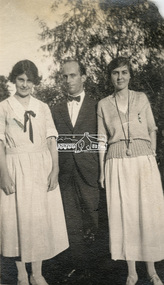
Photograph, Olive McKay, Mr Pinkerton and self, c.1923
... ...Louise Down...Also noted in blue ink "Mother Louie (or Louise) Down - Sister Hilda". The wedding photo is unidentified except for the date 22 May 1956. ...Pinkerton Miss O. Down Louise Down Hilda Down Sepia print 10.7 x 6.3 cm Olive McKay, Mr Pinkerton and self Photograph Photograph ...Located in the collection of Eltham District Historical Society, this envelope contains four sepia prints ranging in dates from 1923 to 1956. The envelope is postmarked 24 Apr 1958 and on the reverse is noted "Accepted 30/4/58". On the face is witten in pencil "Try 18" being No. 18 Russell Crescent, Fitzroy North. Also noted in blue ink "Mother Louie (or Louise) Down - Sister Hilda". The wedding photo is unidentified except for the date 22 May 1956. It was taken by The Lock wood Studios. Other photos are described on their reverse sides as: "Olive McKay, Mr Pinkerton and self" "Uncle Donald and Aunt Florrie, July 1923" "Jessfield, May 12th, 1928" It is not known why they are held by EDHS or the significance/relationship of the people to the Eltham district. Any information pertaining to these people is welcomed.olive mckay, mr. pinkerton, miss o. down, louise down, hilda down -
 Eltham District Historical Society Inc
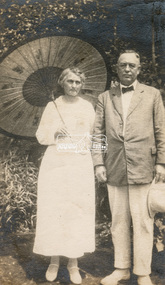
Photograph, Uncle Donald and Aunt Florrie, July 1923
... ...Louise Down...Also noted in blue ink "Mother Louie (or Louise) Down - Sister Hilda". The wedding photo is unidentified except for the date 22 May 1956. ...Pinkerton Miss O. Down Louise Down Hilda Down Sepia print 10.5 x 6.5 cm Uncle Donald and Aunt Florrie Photograph Photograph ...Located in the collection of Eltham District Historical Society, this envelope contains four sepia prints ranging in dates from 1923 to 1956. The envelope is postmarked 24 Apr 1958 and on the reverse is noted "Accepted 30/4/58". On the face is witten in pencil "Try 18" being No. 18 Russell Crescent, Fitzroy North. Also noted in blue ink "Mother Louie (or Louise) Down - Sister Hilda". The wedding photo is unidentified except for the date 22 May 1956. It was taken by The Lock wood Studios. Other photos are described on their reverse sides as: "Olive McKay, Mr Pinkerton and self" "Uncle Donald and Aunt Florrie, July 1923" "Jessfield, May 12th, 1928" It is not known why they are held by EDHS or the significance/relationship of the people to the Eltham district. Any information pertaining to these people is welcomed.olive mckay, mr. pinkerton, miss o. down, louise down, hilda down -
 Eltham District Historical Society Inc
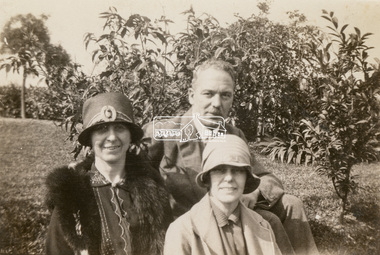
Photograph, Jessfield, 12 May 1928
... ...Louise Down...Also noted in blue ink "Mother Louie (or Louise) Down - Sister Hilda". The wedding photo is unidentified except for the date 22 May 1956. ...Pinkerton Miss O. Down Louise Down Hilda Down Sepia print 4. 6.5 x 9.0 cm Jessfield Photograph Photograph ...Located in the collection of Eltham District Historical Society, this envelope contains four sepia prints ranging in dates from 1923 to 1956. The envelope is postmarked 24 Apr 1958 and on the reverse is noted "Accepted 30/4/58". On the face is witten in pencil "Try 18" being No. 18 Russell Crescent, Fitzroy North. Also noted in blue ink "Mother Louie (or Louise) Down - Sister Hilda". The wedding photo is unidentified except for the date 22 May 1956. It was taken by The Lock wood Studios. Other photos are described on their reverse sides as: "Olive McKay, Mr Pinkerton and self" "Uncle Donald and Aunt Florrie, July 1923" "Jessfield, May 12th, 1928" It is not known why they are held by EDHS or the significance/relationship of the people to the Eltham district. Any information pertaining to these people is welcomed.olive mckay, mr. pinkerton, miss o. down, louise down, hilda down -
 Mission to Seafarers Victoria
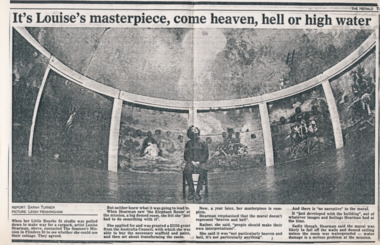
Article - Clipping, photocopy, Sarah Turner, It’s Louise’s masterpiece, come heaven, hell or high water, 1988
... It’s Louise’s masterpiece, come heaven, hell or high water Report: SARAH TURNER PICTURE: LEIGH HENNINGHAM When her Little Bourke St studio was pulled down to make way for a carpark, artist Louise Hearman, above, contacted The Seamen’s Mission in Flinders St to see whether she could use their cottage. ...The premises of the Mission also served as her studio at that time. louise hearman norla dome exhibitions 1988 elephant room flinders street melbourne leigh henningham cultural events It’s Louise’s masterpiece, come heaven, hell or high water Report: SARAH TURNER PICTURE: LEIGH HENNINGHAM When her Little Bourke St studio was pulled down to make way for a carpark, artist Louise Hearman, above, contacted The Seamen’s Mission in Flinders St to see whether she could use their cottage. ...Louise Hearman used the Norla Dome and painted a mural painted which had taken her around a year to complete. The exhibition called Elephant Room was shown from June 1988. The work was vandalised in 1989 and subsequently demolished.Louise Hearman is a Melbourne born artist and Archibald Prize winner. Hearman first came to public notice in 1987/88 when she spent a year painting the mural in the Norla Dome. The premises of the Mission also served as her studio at that time.Black and white copy of a newspaper article, printed on A3 paper.It’s Louise’s masterpiece, come heaven, hell or high water Report: SARAH TURNER PICTURE: LEIGH HENNINGHAM When her Little Bourke St studio was pulled down to make way for a carpark, artist Louise Hearman, above, contacted The Seamen’s Mission in Flinders St to see whether she could use their cottage. They agree. But neither knew what it was going to lead to. When Hearman saw ‘the Elephant Room’ at the mission, a big domed room, she felt she “just had to do something with it”. She applied for and was granted a $3250 grant from the Australia Council, with which she was able to buy the necessary scaffold and paint, and then set about transforming the room. Now, a year later, her masterpiece is complete. Hearman emphasised the the mural doesn’t represent “heaven and hell”. Rather, she said, “people should make their own interpretations”. She said it was “not particularly heaven and hell, it’s not particularly anything”. And there is “no narrative” to the mural. It “just developed with the building”, out of whatever images and feeling Hearman had at the time. Sadly though, Hearman said the mural was likely to fall off the walls and domed ceiling unless the room was waterproofed - water damage is a serious problem at the mission. louise hearman, norla dome, exhibitions, 1988, elephant room, flinders street, melbourne, leigh henningham, cultural events -
 Flagstaff Hill Maritime Museum and Village
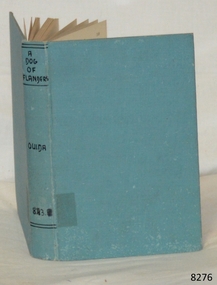
Book - A Fictional Story, Ouida (Maria Louise Ramé), A Dog of Flanders, 1873
... The label on the spine cover with typed text 843 Front loose end paper has a stamp from Corangamite Regional Library Service The Flyleaf has the name "Louise Ranie" written in blue ink. Paste down front end paper has a sticker from Warrnambool Public Library covered by a sticker from Corangamite Regional Library Service...The label on the spine cover with typed text 843 Front loose end paper has a stamp from Corangamite Regional Library Service The Flyleaf has the name "Louise Ranie" written in blue ink. Paste down front end paper has a sticker from Warrnambool Public Library covered by a sticker from Corangamite Regional Library Service Hard cover book, A Dog of Flanders Author: Ouida (Maria Louise Ramé) Publisher: George Robertson Date: 1873 Further Information: Blue cloth hardcover and spine with spine lettering in black texter. ...A Dog of Flanders (originally published in 1872) is a deeply moving, bittersweet story set in Belgium. It follows Nello, an impoverished orphan boy with a passion for art, and Patrasche a loyal, cart-pulling, abandoned, and abused draft dog whom Nello and his gentle grandfather, Jehan Daas, rescue and nurse back to health. The story focuses on the bond between Nello and Patrasche as they become inseparable, helping the aging Jehan pull a milk cart into Antwerp each day to earn a meagre living. Nello longs to become a great painter like the Baroque master Peter Paul Rubens. His only hope is to win a prestigious local drawing contest with a portrait he has laboured over. After a series of devastating setbacks his grandfather passes away, they are evicted, and Nello loses the drawing competition he and Patrasche his cart pulling dog seek shelter from a freezing Christmas Eve blizzard inside the Cathedral of Our Lady in Antwerp. There, Nello finally gazes upon Rubens’s shielded masterpieces, The Descent from the Cross and The Elevation of the Cross. The story ends sadly as, the next morning, the loyal dog and the young boy are found frozen to death, locked in a final embrace in front of the altar.Hard cover book, A Dog of Flanders Author: Ouida (Maria Louise Ramé) Publisher: George Robertson Date: 1873 Further Information: Blue cloth hardcover and spine with spine lettering in black texter. The spine has a Library label with inscription. fictionA Dog of Flanders (originally published in 1872) is a deeply moving, bittersweet story set in Belgium. It follows Nello, an impoverished orphan boy with a passion for art, and Patrasche a loyal, cart-pulling, abandoned, and abused draft dog whom Nello and his gentle grandfather, Jehan Daas, rescue and nurse back to health. The story focuses on the bond between Nello and Patrasche as they become inseparable, helping the aging Jehan pull a milk cart into Antwerp each day to earn a meagre living. Nello longs to become a great painter like the Baroque master Peter Paul Rubens. His only hope is to win a prestigious local drawing contest with a portrait he has laboured over. After a series of devastating setbacks his grandfather passes away, they are evicted, and Nello loses the drawing competition he and Patrasche his cart pulling dog seek shelter from a freezing Christmas Eve blizzard inside the Cathedral of Our Lady in Antwerp. There, Nello finally gazes upon Rubens’s shielded masterpieces, The Descent from the Cross and The Elevation of the Cross. The story ends sadly as, the next morning, the loyal dog and the young boy are found frozen to death, locked in a final embrace in front of the altar.flagstaff hill, warrnambool, shipwrecked coast, flagstaff hill maritime museum, maritime museum, shipwreck coast, flagstaff hill maritime village, great ocean road, book, pattison collection, warrnambool library, warrnambool mechanics’ institute, ralph eric pattison, corangamite regional library service, warrnambool city librarian, mechanics’ institute library, victorian library board, warrnambool books and records, warrnambool children’s library, a dog of flanders, ouida, maria louise ramé, marie louise de la ramée -
 Bendigo Historical Society Inc.
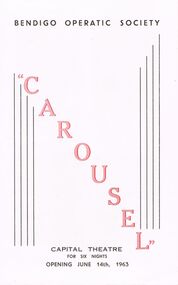
Document - CAROUSEL, CAPITAL THEATRE, June 14, 1963
... Louise: Annette Wilson, Enoch Snow Jr.: Robert Wenn, Doctor Seldon: Robert Urquart, Principle: Peter Houston. Ladies of the Ensemble: Helen Ball, Patricia Barker, Heather Beer, Wendy Bertram, Berniece Boromeo, Marlene Bradley, Dawn Carr, Barbara Downing, Dorothy Field, Eileen Florence, Valerie Foulds, Marie Friswell, Edith Glen, Helen Gray, Joan Heard, Magaret Henderson, Jan Mollison, Shirley Moon, Bernadette Mulvahill, Anne Pearson, Margery Reed, Rhonda Scott, Mary Speedy, Shirley Unmack, Joan Crane, Olga Chew and Marion Shepperbottom. ...Louise: Annette Wilson Enoch Snow Jr.: Robert Wenn Doctor Seldon: Robert Urquart Principle: Peter Houston. Ladies of the Ensemble: Helen Ball Patricia Barker Heather Beer Wendy Bertram Berniece Boromeo Marlene Bradley Dawn Carr Barbara Downing Dorothy Field Eileen Florence Valerie Foulds Marie Friswell Edith Glen Helen Gray Joan Heard Magaret Henderson Jan Mollison Shirley Moon Bernadette Mulvahill Anne Pearson Margery Reed Rhonda Scott Mary Speedy Shirley Unmack Joan Crane Olga Chew and Marion Shepperbottom. ...a/ Carousel, Capital Theatre, for six nights. Opening June 14th, 1963. Bendigo Operatic Society President: Mr J Mck. Cannon, Vice President: Mr E B Thomas, Hon. Secretary: Mrs R Boromeo, Hon. Treasurer: Mr B Ralph, Hon. Sub. Secretaty: Mrs J Cannon. Committee: Mesdames W Brown, J Smyth, Miss M Welch, Messrs. R Holyoake, J Smyth, V White. Photographs of: Miss Beatrice Oakley, Mary Ellis, Iaian Young, Fred Trewarne, Patricia McCracken, Joan Heard, Roger Sprawson, Reginald, Boromeo, Heather Lindhe, Peter Houston Annette Wilson, David Lea, Miss M Welch, Mrs R Conolan, Mr Max O'Loghlen. Synopsis of Story. Synopsis of Scenes. Bendigo Operatic Society presents By Permission of Chappell & Co. Ltd. 'Carousel' A Beatrice Oakley Production. Music by Richard Rodgers. Book and Lyrics by Oscar Hammerstein II. The Cast Carrie Pipperidge: Patricia McCraken, Julie Jordan, Mary Ellis, Mrs Mullin: Joan Heard, Billy Bigelow: Iaian Young, 1st Policeman: Peter Houston, David Bascombe: Reginald Boromeo, Nettie Fowler: Heather Lindhe, Enoch Snow: Roger Strawson, Boatswain: Alan Weatherley, 2nd Policeman: Graham Filcock, Captain: Victor White, Heavenly Friend (Brother Joshua): David Lea, Starkeeper: Robert Urquhart, Louise: Annette Wilson, Enoch Snow Jr.: Robert Wenn, Doctor Seldon: Robert Urquart, Principle: Peter Houston. Ladies of the Ensemble: Helen Ball, Patricia Barker, Heather Beer, Wendy Bertram, Berniece Boromeo, Marlene Bradley, Dawn Carr, Barbara Downing, Dorothy Field, Eileen Florence, Valerie Foulds, Marie Friswell, Edith Glen, Helen Gray, Joan Heard, Magaret Henderson, Jan Mollison, Shirley Moon, Bernadette Mulvahill, Anne Pearson, Margery Reed, Rhonda Scott, Mary Speedy, Shirley Unmack, Joan Crane, Olga Chew and Marion Shepperbottom. Gentlemen of the ensemble: Robert Aitken, Reginald Boromeo, Graham Filcock, Peter Houston, Max Rule, Roger Sprawson, Alan Weatherley, Peter White, Victor White, Robert Wenn. Ballet: Joan Hardin, Kaye Miller, Carol O'Sullivan, Melva Pennington, Sandra Searle, Barbara Sims. Children: Dianne Austin, Ray Austin, Carol Crane, Pamela Duffy, Leanne Dunbar, Win Davies, Larraine Kennard, Valda Kennard, Kaye Ruth Lyon, Cheryl Magee, Sharon Townsend, Lynette Reed, Karen Wilson. Bendigo Concert Orchestra: Violins: Miss A McNair, Mesdames A Bolton, A Foulds, F Robbins, C Messer, Dr Gault, Messrs. R Charlett, C Gill, J Jordan, O Turner, J Werry. Violas: Messrs. E Jarrett, S McNeill, Mrs. J Pinder. Cello: Mesdames C Bubb, J Borema, Miss L Slade, Mr A Rutland. Bass: Messrs. T French, S Anderson. Flutes: Mr C Bubb, Master D Bubb. Clarinets: Mr J McKay, Miss M Wilkinson. Trumpet: Mr N Pearce. Trombone: Mr J Allen. Tympani: Mr F Kennedy. Musical Numbers. Choruses from 'Carousel'. Advertisements: Allans, Music Store. Marin Washington, Portraits. John Brown Industries and Welmar Industries. Acknowledgments: Bendigo Advertiser, 3BO, BVC8, Mr B Bathe, K. Flat, Carousel Equipment, Frasers and all those people who have assister in any way. b/ Bendigo Advertiser article 15/6/63: Round and Round, 'Carousel' is Catchy, Bright. Apart from a few minor faults common on opening nights, warmly received by a small first-night audience. . . Bendigo Advertiser article 19/6/16 'Carousel' Scene. Carousel star Iaian Young, who plays the part of Billy Bigelow. . .Arthur Hocking Printprogram, music, bendigo operatic society, a/ carousel, capital theatre. june 14th, 1963. bendigo operatic society president: mr j mck. cannon, vice president: mr e b thomas, hon. secretary: mrs r boromeo, hon. treasurer: mr b ralph, hon. sub. secretaty: mrs j cannon. committee: mesdames w brown, j smyth, miss m welch, messrs. r holyoake, j smyth, v white. photographs of: miss beatrice oakley, mary ellis, iaian young, fred trewarne, patricia mccracken, joan heard, roger sprawson, reginald, boromeo, heather lindhe, peter houston annette wilson, david lea, miss m welch, mrs r conolan, mr max o'loghlen. synopsis. the cast carrie pipperidge: patricia mccraken, julie jordan, mary ellis, mrs mullin: joan heard, billy bigelow: iaian young, 1st policeman: peter houston, david bascombe: reginald boromeo, nettie fowler: heather lindhe, enoch snow: roger strawson, boatswain: alan weatherley, 2nd policeman: graham filcock, captain: victor white, heavenly friend (brother joshua): david lea, starkeeper: robert urquhart, louise: annette wilson, enoch snow jr.: robert wenn, doctor seldon: robert urquart, principle: peter houston. ladies of the ensemble: helen ball, patricia barker, heather beer, wendy bertram, berniece boromeo, marlene bradley, dawn carr, barbara downing, dorothy field, eileen florence, valerie foulds, marie friswell, edith glen, helen gray, joan heard, magaret henderson, jan mollison, shirley moon, bernadette mulvahill, anne pearson, margery reed, rhonda scott, mary speedy, shirley unmack, joan crane, olga chew and marion shepperbottom. gentlemen of the ensemble: robert aitken, reginald boromeo, graham filcock, peter houston, max rule, roger sprawson, alan weatherley, peter white, victor white, robert wenn. ballet: joan hardin, kaye miller, carol o'sullivan, melva pennington, sandra searle, barbara sims. children: dianne austin, ray austin, carol crane, pamela duffy, leanne dunbar, win davies, larraine kennard, valda kennard, kaye ruth lyon, cheryl magee, sharon townsend, lynette reed, karen wilson. bendigo concert orchestra: violins: miss a mcnair, mesdames a bolton, a foulds, f robbins, c messer, dr gault, messrs. r charlett, c gill, j jordan, o turner, j werry. violas: messrs. e jarrett, s mcneill, mrs. j pinder. cello: mesdames c bubb, j borema, miss l slade, mr a rutland. bass: messrs. t french, s anderson. flutes: mr c bubb, master d bubb. clarinets: mr j mckay, miss m wilkinson. trumpet: mr n pearce. trombone: mr j allen. tympani: mr f kennedy. musical numbers. choruses from 'carousel'. advertisements: allans, music store. marin washington, portraits. john brown industries and welmar industries. acknowledgments: bendigo advertiser, 3bo, bvc8, mr b bathe, k. flat, carousel equipment, frasers and all those people who have assister in any way. b/ bendigo advertiser article 15/6/63: round and round, 'carousel' bendigo advertiser article 19/6/16 'carousel' scene -
 Glen Eira Historical Society
Article - Olympic Games 2000
... down Hawthorn Road, between Dandenong Road and North Road. The article includes 6 colour photographs taken by Bernie Bickerton and an article written by primary school student Daniel Kontrobarsky describing the event. Author unknown. Hawthorn Road North Road Dandenong Road Olympic Games Olympic Torch Children Councillors Athletes Aged People Bickerton Bernie Gardenvale Primary School Kontrobarsky Daniel Police Caulfield Caulfield North Caulfield South Glen Eira Irwin Chris Brown Damien Stacey Jay Cordingley Louise Bentleigh East Glen Eira Town Hall Primary Schools Camden Community Rosstown Community Torres Ron Local Officials and Employees Article Olympic Games 2000 ...This file contains one item relating to the torch relay of the 2000 Olympic Games: 1/A newspaper article from the Glen Eira News, Vol. 44, September 2000, describing the events of a leg of the Olympic torch relay that went down Hawthorn Road, between Dandenong Road and North Road. The article includes 6 colour photographs taken by Bernie Bickerton and an article written by primary school student Daniel Kontrobarsky describing the event. Author unknown.hawthorn road, north road, dandenong road, olympic games, olympic torch, children, councillors, athletes, aged people, bickerton bernie, gardenvale primary school, kontrobarsky daniel, police, caulfield, caulfield north, caulfield south, glen eira, irwin chris, brown damien, stacey jay, cordingley louise, bentleigh east, glen eira town hall, primary schools, camden community, rosstown community, torres ron, local officials and employees -
 Stawell Historical Society Inc
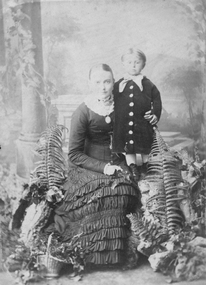
Photograph, Miss Louisa Vine nee Weir with her son Mr Richard Vine who was killed in France WW1 1918
... Louise Vine, V = Uncle Richard Vine Brother killed in France 1914 -1918 Lilar. Sister - died ?? date in the Family Bible. Brother & Sister of Florence Maud Warren (nee Vine) V = Mary Ellen Vine Studio photograph of a woman and child. The woman is seated and the child standing on a platform. The woman has she arm around the child's waist. The child outfit has buttons down ...Louisa Vine nee Weir with her brother Richard Vine who was killed in France 1918 WW1 seated in Studio portrait with fern fronds. Information in folder from Digger - Death index. Victoria 1921-1985 (page 1) 10 May 2013 Vine Mary Ellen Vine Richd Hy Louisa T Weir 1876 Stawell 70 1946 19413 D Warren Florence Maud Vine Richard H Thurga Weir 1874 Staw 83 1957 18511 D n. William Johnathan Warren b. 1864 d. 25.10.39 (75) Studio photograph of a woman and child. The woman is seated and the child standing on a platform. The woman has she arm around the child's waist. The child outfit has buttons down the front with a bow around his collar. The woman's dress is heavily frilled at the base with a lace collar. Fern frons and floral reefs decorate either side of the seated pair.E. Askew Southmolton Paradise on the back - Auntie = Louise Vine, V = Uncle Richard Vine Brother killed in France 1914 -1918 Lilar. Sister - died ?? date in the Family Bible. Brother & Sister of Florence Maud Warren (nee Vine) V = Mary Ellen Vinestawell portrait -
 Vision Australia
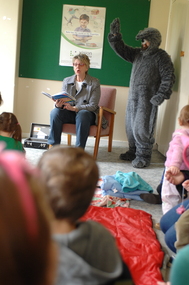
Photograph - Image, 2008 Book Week at Burwood School, 23/8/2008
... down) the house made of straw, the house made of wood and the house made of bricks, before heading back for snacks. As part of the day, a petting zoo with barnyard animals also allowed the opportunity to investigate other animals. Vision Australia Feelix Ed Gamble Ella Edwards Noah O'Brien Dominic Kennedy Matthew Johnson Tommy Papoutsidis Louise ...Based upon the story of 'The Three Little Pigs', children were invited to hear the story and see (and knock down) the house made of straw, the house made of wood and the house made of bricks, before heading back for snacks. As part of the day, a petting zoo with barnyard animals also allowed the opportunity to investigate other animals.107 digital images of attendees at the Book Week celebrationvision australia, feelix, ed gamble, ella edwards, noah o'brien, dominic kennedy, matthew johnson, tommy papoutsidis, louise curtin -
Unions Ballarat
Enemies within : Papua New Guinea, Australia and the Sandline Crisis: the inside story, O'Callaghan, Mary-Louise, 1999
... down the Chan government. Relevant to the political history of Papua New Guinea and the region. btlc ballarat trades hall ballarat trades and labour council chan, julian chan, sir julian prime ministers - papua new guinea sandline crisis sandline affair civil wars politics history bougainville civil war papua new guinea Front cover: author name and title. Paper; book. Front cover: black background; black and white military photograph; black and white text. Enemies within : Papua New Guinea, Australia and the Sandline Crisis: the inside story O'Callaghan, Mary-Louise ...Julian Chan's government attempted to resolve the Bougainville Civil War using diplomatic means and eventually by military force. These attempts brought down the Chan government.Relevant to the political history of Papua New Guinea and the region. Paper; book. Front cover: black background; black and white military photograph; black and white text.Front cover: author name and title.btlc, ballarat trades hall, ballarat trades and labour council, chan, julian, chan, sir julian, prime ministers - papua new guinea, sandline crisis, sandline affair, civil wars, politics, history, bougainville civil war, papua new guinea -
 Flagstaff Hill Maritime Museum and Village
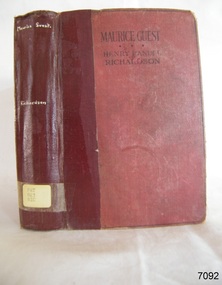
Book - A Fictional Story, Ethel Florence Lindesay ( Pen Name Henry Handel Richardson), Maurice Guest, 1929
... Louise leaving Maurice, who then walks into the countryside and shoots himself. It is essentially a naturalist tragedy of obsessive love and thwarted artistic ambition, set against a vividly rendered expatriate music-student milieu. The label on the spine with typed text PAT 823 RIC Paste down ...Set in the 1890s music world of Leipzig, Germany, the novel follows Maurice Guest, a young Englishman studying piano at the Conservatorium, who falls into an obsessive, ultimately destructive love affair with Louise Dufrayer, an Australian woman already entangled with a gifted but caddish violinist, Eugen Schilsky. The story follows Maurice's violent passion for the indolent, sensuous Louise, who is the mistress of the talented violinist Eugen Schilsky. Maurice consoles himself with another woman, but a scandal drives Schilsky away, after which Maurice and Louise come together. Maurice is forced to confront his own mediocrity as a musician, and Louise's chequered past comes to light through a former lover, leading to a violent confrontation, further betrayals, a suicide, and finally Louise leaving Maurice, who then walks into the countryside and shoots himself. It is essentially a naturalist tragedy of obsessive love and thwarted artistic ambition, set against a vividly rendered expatriate music-student milieu.Hard cover book. Maurice Guest Author: Ethel Florence Lindesay ( Pen Name Henry Handel Richardson) Publisher: William Heinemann & Co Date: 1929 Further Information: Red Cloth front hardcover with lettering in black. Rebound reinforced spine with red reinforced cloth strip. The spine has a Library label with an inscription.fictionSet in the 1890s music world of Leipzig, Germany, the novel follows Maurice Guest, a young Englishman studying piano at the Conservatorium, who falls into an obsessive, ultimately destructive love affair with Louise Dufrayer, an Australian woman already entangled with a gifted but caddish violinist, Eugen Schilsky. The story follows Maurice's violent passion for the indolent, sensuous Louise, who is the mistress of the talented violinist Eugen Schilsky. Maurice consoles himself with another woman, but a scandal drives Schilsky away, after which Maurice and Louise come together. Maurice is forced to confront his own mediocrity as a musician, and Louise's chequered past comes to light through a former lover, leading to a violent confrontation, further betrayals, a suicide, and finally Louise leaving Maurice, who then walks into the countryside and shoots himself. It is essentially a naturalist tragedy of obsessive love and thwarted artistic ambition, set against a vividly rendered expatriate music-student milieu.warrnambool, shipwrecked-coast, flagstaff-hill, flagstaff-hill-maritime-museum, maritime-museum, shipwreck-coast, flagstaff-hill-maritime-village, shipwrecked-artefact, book, maurice guest, henry handel richardson -
![Book - Novel, Ouida [Maria Louise Rame], Helianthus : a novel, 1908](/media/collectors/641920217f0478323d8a47a8/items/69d71eb47219387d7073ef03/item-media/69dc9039a54904fa4009ec5e/item-fit-380x285.jpg?cb=6) Linton Mechanics Institute and Free Library Collection
Linton Mechanics Institute and Free Library CollectionBook - Novel, Ouida [Maria Louise Rame], Helianthus : a novel, 1908
... Cover on back-to front and upside-down, result of repairs? Helianthus : a novel Book Novel Ouida [Maria Louise Rame] Macmillan and Co. ...445 p. : dark blue cover, small embossed design on front, with title in gold within it. Title and author's name embossed in gold on spine. Cover on back-to front and upside-down, result of repairs?fictionfiction, ouida -
 City of Melbourne Libraries
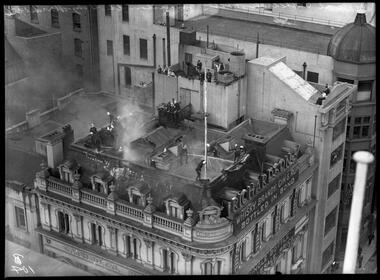
Photograph, Bull, Hugh Jones, 1897-1993, Fire at Cathedral Hotel, Swanston Street, Melbourne
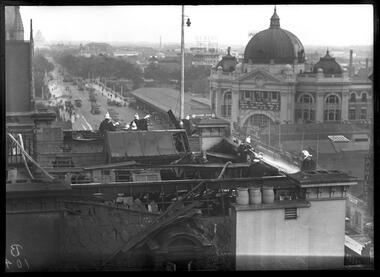
... Louise McKenzie. Photographer notations on slide: "Fire at Cathedral Hotel Swanston St City March 1936 B104" Description: View looking down on roof of the Cathedral Hotel showing 16 firefighters battling a fire. ...Louise McKenzie. Photographer notations on slide: "Fire at Cathedral Hotel Swanston St City March 1936 B104" Description: View looking down on roof of the Cathedral Hotel showing 16 firefighters battling a fire. ...Fire at the Cathedral Hotel! Bird’s eye view These firemen on the roof of the Cathedral Hotel are very bold in their approach to firefighting! One heroically aims a firehose at the roof while another holds onto the flagpole with one hand as he walks around the narrow edge, three storeys up! Onlookers from adjacent buildings make the most of their front row view, and The Age reported that on street level, hundreds of people gathered to watch, enthralled by “a thrilling spectacle when three firemen walked along the stone coping on the top floor of the building and, despite the clouds of smoke and sheets of flame which shot through the roof they ripped off the hot slate tiles and provided an outlet for the flames”. The Cathedral Hotel was built in 1883 and demolished in 1966 to make way for the City Square. Featured in "Newsworthy: Melbourne in photographs 1933-1936" exhibition at East Melbourne Library, October to December 2023. Exhibition caption by project volunteer, Louise McKenzie. Photographer notations on slide: "Fire at Cathedral Hotel Swanston St City March 1936 B104" Description: View looking down on roof of the Cathedral Hotel showing 16 firefighters battling a fire. There is smoke coming through the roof. Onlookers watch from adjoining buildings, not perturbed by the proximity of the fire. The firemen look bold and impressive in their brass helmets. Research by project volunteer, Louise McKenzie: The Age reported on 4 March 1936 that the fire broke out in rubbish between the roof space and wooden ceiling of the Cathedral Hotel at 4.30 pm. “The Eastern Hill fire brigade was notified by telephone, and an almost simultaneous call was also received at fire brigade headquarters from a street alarm.” These red fire alarm call boxes were typically installed on street corners, and when the knob was turned, a pulsed electric signal corresponding to the box’s number was received at fire headquarters. A large detachment of firemen with full fire-fighting equipment, including two large extension ladders, were quickly on the scene, pouring vast quantities of water into the hotel, causing several hundred pounds of damage to hotel and guest property, but quickly bringing the fire under control. Lengths of hose had to be carried through the front entrance and up several flights of stairs. On street level hundreds of people gathered to watch, but were controlled by police in order to keep them at a safe distance and ensure that tram and motor traffic was not seriously disorganised. The crowd were enthralled by “a thrilling spectacle when three firemen walked along the stone coping on the top floor of the building and, despite the clouds of smoke and sheets of flame which shot through the roof, they ripped off the hot slate tiles and provided an outlet for the flames”. The firemen are noteworthy for their highly polished brass helmets, known as Merryweather helmets, based on those of French sapeurs-pompiers and introduced to the British Metropolitan Fire Brigade in London in 1868. Metal helmets are conductive, a safety issue as the use of electricity became widespread, so a composite cork and rubber helmet was introduced in London from 1936. In Queensland, traditional brass helmets remained in service until 1970. The firemen are very bold in their actions – one heroically aiming a fire hose at the roof of the building, another holding onto the flagpole with one hand as he walks around the narrow top edge of the roof, three storeys up! The onlookers from adjoining buildings are interested in the spectacle, rather than dismayed by the fire. Lettering around the building exterior reads "Cathedral Hotel - Erected 1883". Prominent signage for “Richardson’s whisky, brandy, gin & rum" sits along the edge of the roof. The Cathedral Hotel was located on the corner of Swanston Street and Flinders Lane. It was built in 1883, and its name derived from St Paul’s Cathedral on the south side of Flinders Lane. It was demolished in 1966 as Melbourne City Council wished to create a City Square. Robyn Annear notes that at the time, the development was referred to as “Whelan’s Square” due to the large number of buildings which needed to be demolished to create the Square. Ironically the Hotel had been the victim of a previous fire in 1917, when its then licensee, also named Whelan, was charged with two failed arson attempts. References: No title (1936, March 4). The Age (Melbourne, Vic. : 1854 - 1954), p. 13. Retrieved February 5, 2024, from http://nla.gov.au/nla.news-article205256255 FIRE AT A CITY HOTEL. (1936, March 4). The Age (Melbourne, Vic. : 1854 - 1954), p. 12. Retrieved February 5, 2024, from http://nla.gov.au/nla.news-article205256231 FIRE IN ROOF OF CITY HOTEL (1936, March 4). The Argus (Melbourne, Vic. : 1848 - 1957), p. 8. Retrieved February 5, 2024, from http://nla.gov.au/nla.news-article11018696 Hotel Roof Fire Draws Crowd (1936, March 4). Examiner (Launceston, Tas. : 1900 - 1954), p. 8 (DAILY). Retrieved February 5, 2024, from http://nla.gov.au/nla.news-article52000751 'Flinders Lane Melbourne 1966', Peter Andrew Barrett, Facebook, 12 June 2020, https://www.facebook.com/120943481324886/photos/a.512123662206864/3025002490918956/?type=3 Fire Alarm Call Box, Wikipedia, https://en.wikipedia.org/wiki/Fire_alarm_call_box Research notes, 'A city lost and found', Robyn Annear, https://robynannear.com/docs/whelan-the-wrecker-notes.pdfPhotographer notations on slide: "Fire at Cathedral Hotel Swanston St City March 1936 B104".fires, hotels, 1930-1939 -
 City of Melbourne Libraries
Photograph, Bull, Hugh Jones, 1897-1993, Fire at Cathedral Hotel, Swanston Street, Melbourne
... Louise McKenzie. Photographer notations on slide: "Fire at Cathedral Hotel Swanston St 1936 B104" Description: This photo, taken from an adjacent building, shows 12 firemen fighting a fire on the roof of the Cathedral Hotel, Melbourne. There is evidence of considerable damage to the roof of the building as a result of the fire and fire fighting efforts. The photo gives a feeling of elevation, as the firemen are in focus, with an out of focus panoramic background, showing the dome of Flinders Street Station, and St Kilda Road down...Louise McKenzie. Photographer notations on slide: "Fire at Cathedral Hotel Swanston St 1936 B104" Description: This photo, taken from an adjacent building, shows 12 firemen fighting a fire on the roof of the Cathedral Hotel, Melbourne. There is evidence of considerable damage to the roof of the building as a result of the fire and fire fighting efforts. The photo gives a feeling of elevation, as the firemen are in focus, with an out of focus panoramic background, showing the dome of Flinders Street Station, and St Kilda Road down ...Fire at the Cathedral Hotel! Southward view Firemen in their shiny brass Merryweather style helmets battle a fire in the roof of the Cathedral Hotel, Tuesday 3 March 1936. It was located on the corner of Swanston Street and Flinders Lane and so named for its proximity to St Paul’s Cathedral, just visible at top left. The fire broke out in between the roof space and wooden ceiling of the hotel at around 4.30 pm, causing disruption to afternoon commuters – hence the banked-up trams along St Kilda Road. The hoses snaking across the roof have been dragged up through the hotel’s front door. The scene of devastation on the roof appears to be a result of both the fire and firefighting efforts. The panoramic background is dominated by the dome of Flinders Street Station, the wide, treed boulevard of St Kilda Road, and a densely built-up industrial area south of the Yarra with its elevated signage and substantial buildings. Featured in "Newsworthy: Melbourne in photographs 1933-1936" exhibition at East Melbourne Library, October to December 2023. Exhibition caption by project volunteer, Louise McKenzie. Photographer notations on slide: "Fire at Cathedral Hotel Swanston St 1936 B104" Description: This photo, taken from an adjacent building, shows 12 firemen fighting a fire on the roof of the Cathedral Hotel, Melbourne. There is evidence of considerable damage to the roof of the building as a result of the fire and fire fighting efforts. The photo gives a feeling of elevation, as the firemen are in focus, with an out of focus panoramic background, showing the dome of Flinders Street Station, and St Kilda Road down to the Shrine. Research by project volunteer, Louise McKenzie: The Age reported on 4 March 1936 that the fire broke out in rubbish between the roof space and wooden ceiling of the Cathedral Hotel at 4.30 pm. “The Eastern Hill fire brigade was notified by telephone, and an almost simultaneous call was also received at fire brigade headquarters from a street alarm.” The firemen in their dark uniforms with brass buttons, gold epaulettes and shiny brass Merryweather helmets, stand out against the broken slate tiles and dislodged timber of the damaged roofing, all of which look blackened and in disarray. Two pale water hoses snake thickly across the roof. It is a scene of some devastation and chaos. Three chimney pots by contrast sit plump and strong against the damage. The Cathedral Hotel is located on the corner of Swanston Street and Flinders Lane, so named due to its proximity to St Pauls Cathedral (just visible at far left) on the corner of Flinders and Swanston streets. This intersection is a hub and focus of Melbourne activity. The backgrounded Melbourne skyline, while not in clear focus, is of interest. On the right is the impressive dome of Flinders Street Station, with the clock at 4.50 pm. Its grand frontage, and some of the façade along Flinders Street, are visible. To the left is the wide and grand-scaled St Kilda Road, leading down to the Shrine of Remembrance. There are many trams on Princes Bridge (mostly heading northward), together with some trucks and pedestrians. The pedestrian walkway along Princes Bridge is wide, and the Bridge balustrade lined with flag poles. The middle background shows a large number of trees. This was the site of Wirths Brothers Circus, an impressive complex including an octagonal circus Hippodrome (5000 seat auditorium), Pleasure Park, roller skating rink, and Dance Hall. Today it is the site of the Melbourne Arts Centre. Adjacent to the station is a large covered area, still extant today as part of the Station precinct. Floating above the horizon is sign advertising 'DUNLOP', located in the formerly industrial area which is today’s Southbank. Port Phillip Bay is faintly visible in the distance. The city seems sprawling, but uncrowded, and well punctuated by trees. Two photos were included an Age pictorial, one showing the firefighters at work, the other a crowd scene at street level (see References). These images are not part of the McKenzie Collection. References: No title (1936, March 4). The Age (Melbourne, Vic. : 1854 - 1954), p. 13. Retrieved February 5, 2024, from http://nla.gov.au/nla.news-article205256255 FIRE AT A CITY HOTEL. (1936, March 4). The Age (Melbourne, Vic. : 1854 - 1954), p. 12. Retrieved February 5, 2024, from http://nla.gov.au/nla.news-article205256231 FIRE IN ROOF OF CITY HOTEL (1936, March 4). The Argus (Melbourne, Vic. : 1848 - 1957), p. 8. Retrieved February 5, 2024, from http://nla.gov.au/nla.news-article11018696 Hotel Roof Fire Draws Crowd (1936, March 4). Examiner (Launceston, Tas. : 1900 - 1954), p. 8 (DAILY). Retrieved February 5, 2024, from http://nla.gov.au/nla.news-article52000751 'Flinders Lane Melbourne 1966', Peter Andrew Barrett, Facebook, 12 June 2020, https://www.facebook.com/120943481324886/photos/a.512123662206864/3025002490918956/?type=3Photographer notations on slide: "Fire at Cathedral Hotel Swanston St 1936 B104".fires, 1930-1939, hotels -
![Photograph, Bull, Hugh Jones, 1897-1993, View looking along St Kilda Road [completed Centenary pylons on Princes Bridge]](/media/collectors/68524623ad73480cc6fce59f/items/68f089892b74709eaf6d30e8/item-media/68f089af2b74709eaf6d372a/item-fit-380x285.jpg?cb=6) City of Melbourne Libraries
City of Melbourne LibrariesPhotograph, Bull, Hugh Jones, 1897-1993, View looking along St Kilda Road [completed Centenary pylons on Princes Bridge]
... Trove article identifier: http://nla.gov.au/nla.news-article205880269 Research by project volunteer, Louise McKenzie: Even though this is a street scene, it feels very intimate; we are instantly immersed in the activity of a Melbourne afternoon, looking down St Kilda Road from a viewpoint near today’s Federation Square. ...Trove article identifier: http://nla.gov.au/nla.news-article205880269 Research by project volunteer, Louise McKenzie: Even though this is a street scene, it feels very intimate; we are instantly immersed in the activity of a Melbourne afternoon, looking down St Kilda Road from a viewpoint near today’s Federation Square. ...Princes Bridge Centenary pylons complete Even though this is a street scene, it feels very intimate; we are instantly immersed in the activity of a Melbourne afternoon, looking down St Kilda Road from a viewpoint near today’s Federation Square. The focus is on the Centenary Pylons, erected on Princes Bridge to mark Melbourne’s Centenary in 1934. The sixteen plastered pylons were designed by Roy Prentice, the second person to qualify as an architect at the University of Melbourne in 1933, and aged just 27. The State Electricity Commission sponsored the work and The Argus reported that the pylons were “illuminated from within to give the effect of soft radiance”. Australia Home Beautiful reported that the taller pylons were 48 feet high. Timber-framed and faced with fibrous plaster and galvanised sheet iron, each structure was bolted to a concrete foundation three feet in depth. Panels of glass were indirectly lit by forty 100 watt lamps, and the upper bank of lamps were dyed so as to flood them with a deep red light. The shields and flagpoles were illuminated by three 200 watt concealed projectors, part of an electric night light decoration scheme involving 28 miles of wire to supply more than 20,000 lights. Melbourne was converted into “a coloured fairyland by night”. Featured in "Newsworthy: Melbourne in photographs 1933-1936" exhibition at East Melbourne Library, October to December 2023. Exhibition caption by project volunteer, Louise McKenzie Photographer notations on slide: "View looking along St Kilda Road C57" Published: (1934, September 5). The Age (Melbourne, Vic. : 1854 - 1954), p. 11. Published title: DECORATIONS -- THEN AND NOW. Published caption: "The second picture shows one of the Princes-bridge pylons completed..." Trove article identifier: http://nla.gov.au/nla.news-article205880269 Research by project volunteer, Louise McKenzie: Even though this is a street scene, it feels very intimate; we are instantly immersed in the activity of a Melbourne afternoon, looking down St Kilda Road from a viewpoint near today’s Federation Square. The focus is on the Centenary Pylons, erected on Princes Bridge to mark Melbourne’s Centenary in 1934. The sixteen plastered pylons were designed by Roy Prentice, the second person to qualify as an architect at the University of Melbourne in 1933, and aged just 27. The State Electricity Commission sponsored the work and The Argus reported that the pylons were “illuminated from within to give the effect of soft radiance”. Australia Home Beautiful reported that the taller pylons were 48 feet high. Timber-framed and faced with fibrous plaster and galvanised sheet iron, each structure was bolted to a concrete foundation three feet in depth. Panels of glass were indirectly lit by forty 100 watt lamps, and the upper bank of lamps were dyed so as to flood them with a deep red light. The shields and flagpoles were illuminated by three 200 watt concealed projectors, part of an electric night light decoration scheme involving 28 miles of wire to supply more than 20,000 lights. Melbourne was converted into “a coloured fairyland by night”. References: DECORATIONS -- THEN AND NOW. (1934, September 5). The Age (Melbourne, Vic. : 1854 - 1954), p. 11. Retrieved September 21, 2023, from http://nla.gov.au/nla.news-article205880269 'Dressing Melbourne for the Duke', The Australian home beautiful: a journal for the home builder. Vol 12 No. 10 (1 October 1934), page 21, 58. Retrieved September 14, 2023, from http://nla.gov.au/nla.obj-2950922209 28 Miles of Wire (1934, October 18). The Argus (Melbourne, Vic. : 1848 - 1957), p. 1 (The Junior Argus). Retrieved September 21, 2023, from http://nla.gov.au/nla.news-article10977836Photographer notations on slide: "View looking along St Kilda Road C57".centenaries, 1930-1939, bridges -
 City of Melbourne Libraries
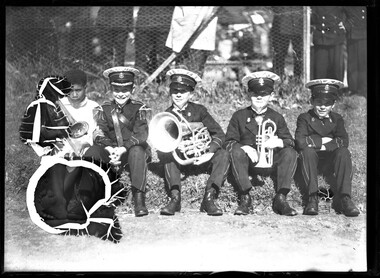
Photograph, Bull, Hugh Jones, 1897-1993, Boy bandsmen
... Louise McKenzie: A photo in the Argus on the previous day shows “two Papuans, Aloysius and Bernard, … talking to Archbishop O’Shea of Wellington (N.Z.).” In a turn of phrase which would be far from acceptable today, the caption notes that the juxtaposition of the dark skinned boys and the white skinned Archbishop makes “A picturesque Contrast”. The photo is also staged in a way that has the two dark skinned boys (wearing white shirts and white “skirts”, and no hats), standing, looking down...Louise McKenzie: A photo in the Argus on the previous day shows “two Papuans, Aloysius and Bernard, … talking to Archbishop O’Shea of Wellington (N.Z.).” In a turn of phrase which would be far from acceptable today, the caption notes that the juxtaposition of the dark skinned boys and the white skinned Archbishop makes “A picturesque Contrast”. The photo is also staged in a way that has the two dark skinned boys (wearing white shirts and white “skirts”, and no hats), standing, looking down ...Published: 7 Dec 1934 Published title: A FIJIAN TROMBONIST. Published caption: Although the young Fijian here for the Eucharistic Congress had no uniform, he did not feel out of it with the members of St. Vincent de Paul’s Band at the Sacre Coeur, East Malvern, this week. Trove article identifier: http://nla.gov.au/nla.news-article205071643 Description: A young Fijian boy sits with young members of the St Vincent de Paul’s Band, all seated on the grass in sunshine. The three young band members are jauntily dressed in braided hats, long pants and smart dark jackets, white shirts, dark bow tie, and dark long trousers and boots. One holds a French horn, one a trumpet. In contrast, the young Fijian boy is shoeless, hatless, and dressed in white – a white shirt, and possibly a white “skirt” as observed to be worn by Fijian policemen in their home country at that time. He carries a trombone, which perhaps belongs to the young band member sitting beside him. Research by project volunteer, Louise McKenzie: A photo in the Argus on the previous day shows “two Papuans, Aloysius and Bernard, … talking to Archbishop O’Shea of Wellington (N.Z.).” In a turn of phrase which would be far from acceptable today, the caption notes that the juxtaposition of the dark skinned boys and the white skinned Archbishop makes “A picturesque Contrast”. The photo is also staged in a way that has the two dark skinned boys (wearing white shirts and white “skirts”, and no hats), standing, looking down on the Archbishop in his elaborate clothing and headcovering. The Age caption advises that they are at Sacre Coeur, East Melbourne. The reason for the event – a garden party – was held as part of the National Eucharistic Congress which took place in Melbourne from Sunday 2 – Sunday 9 December 1934. An initiative of the Roman Catholic Church, it was their contribution to Melbourne’s Centenary Celebrations. At this garden party the Papal Legate, Cardinal MacRory, accompanied by dignatories including the Papal Chamberlain, met Old Girls of Sacre Coeur Convent. The Cardinal’s sister was at one time Mother Superior of this Convent. The featuring of Fijian and Papuan boys in these articles reflected the diverse nature of Catholic Church representatives worldwide who attended the Eucharistic Congress which featured as part of Melbourne’s Centenary celebrations. Notable visitors to the Congress included the Papal Legate, His Excellence Cardinal MacRory, several Monsignors from Rome, the Archbishop of Liverpool representing England, Scotland and Wales, together with representatives from New Zealand, China, South Africa, Ireland, the Islands of the Pacific, India, Malta, USA, and of course from across Australia. St Vincent de Paul “Our History” advises that the Society was founded in France in 1833 by a group of dedicated Catholics who put their faith into action to support the poor in their community. The “Vinnies” website “1854 onwards” sets out milestones of the Society’s close involvement with Melbourne from its infancy in March 1854 up to today. A well researched blog by Jeremy de Korte dated February 28, 2024 – Band Blasts from the Past – Anecdotes, Stories and Personalities, notes: Orphanage bands in Australia were a copy of practices in England where the teaching of music in boys’ institutions was commonplace (Sheldon, 2009). There was, however, a major difference to the outcomes of this musical education between the two countries. Boys who were trained as musicians in English institutions readily found themselves recruited into the bands of the British Army and Navy (Sheldon, 2009). Whereas the musicians that graduated from the Orphanage bands in Australia found themselves positions in the wider band movement. … We know that Orphanage bands in Australia have had a long and distinguished history, as well as enviable reputations. The St. Augustine’s Band from Geelong is probably the most famous of them all, and it is mentioned that by 1898 they were already putting the call out for a new set of instruments (“ST. AUGUSTINE’S ORPHANAGE BAND.,” 1898). St. Augustine’s went on to win many competitions at South Street in Ballarat and toured extensively – in one instance, in 1906 they won the A Grade Championships at South Street (Royal South Street Society, 1906). The band at St. Vincent’s de Paul in Melbourne was no less famous than their counterpart in Geelong and in 1921 they gained the services of Mr. Leslie Hoffman, a graduate of the St. Augustine’s Band, as their conductor (“St. Vincent’s Bandmaster,” 1921). This slide is quite badly damaged, reminding us of the fragility of this photographic form. The colour is washed out across most of the slide, and the left of the slide is badly degraded as if the photographic solution hasn’t quite taken. But the culprits are most likely time and mode of storage. References: A FIJIAN TROMBONIST--SUITE FOR DOLL'S HOUSE--LUNCH TIME AT THE SPORTS--A FULL SLIDE. (1934, December 7). The Age (Melbourne, Vic. : 1854 - 1954), p. 3. Retrieved April 9, 2024, from http://nla.gov.au/nla.news-article205071643 "INTERSTATE TENNIS -- EUCHARISTIC GARDEN PARTY" The Argus (Melbourne, Vic. : 1848 - 1957) 6 December 1934: 9. Web. 9 Apr 2024 Photographer notations on slide: "Boy bandsmen B61".1930-1939, bands, catholic church -
 Flagstaff Hill Maritime Museum and Village
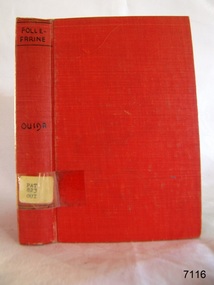
Book - Fictional Novel, Ouida/Marie Louise de la Ramée, Folle-Farine, 1873
... The label on the spine with typed text PAT 823 OUI Paste down front end paper has a sticker from Warrnambool Public Library covered by a sticker from Corangamite Regional Library Service. Front loose end paper has a stamp from Corangamite Regional Library Service The Flyleaf has the name "Louise Ranie" written in blue ink....The label on the spine with typed text PAT 823 OUI Paste down front end paper has a sticker from Warrnambool Public Library covered by a sticker from Corangamite Regional Library Service. Front loose end paper has a stamp from Corangamite Regional Library Service The Flyleaf has the name "Louise Ranie" written in blue ink. ...Folle-Farine is the child of Reine, who fled her father, Claudis, to live among Gypsies and died giving birth. Claudis, a miller, resents the child and makes her a slave at his mill. The townspeople treat her with the same contempt, but she resists. She then meets a starving painter living in a tower, helps him and falls in love with him, but he cares only about his art. In the novel, she sells her body so that her beloved can become famous. He is so egotistical that he barely notices what it costs her, and the story ends tragically.Hard cover book. Folle-Farine Author: Ouida/Marie Louise de la Ramée Publisher: George Robertson Date: 1873 Further Information: Red Cloth hardcover with lettering and patterning to spine in black. The spine has a Library label with an inscription.fictionFolle-Farine is the child of Reine, who fled her father, Claudis, to live among Gypsies and died giving birth. Claudis, a miller, resents the child and makes her a slave at his mill. The townspeople treat her with the same contempt, but she resists. She then meets a starving painter living in a tower, helps him and falls in love with him, but he cares only about his art. In the novel, she sells her body so that her beloved can become famous. He is so egotistical that he barely notices what it costs her, and the story ends tragically.book, folle-farine, ouida, maria louise ramé, marie louise de la ramée, shipwrecked-coast, flagstaff-hill, flagstaff-hill-maritime-museum, warrnambool, maritime-museum, shipwreck-coast, flagstaff-hill-maritime-village, shipwrecked-artefact, pattison collection, warrnambool library, warrnambool mechanics’ institute, ralph eric pattison, corangamite regional library service, warrnambool city librarian, mechanics’ institute library, victorian library board, warrnambool books and records, warrnambool children’s library, great ocean road -
 Flagstaff Hill Maritime Museum and Village
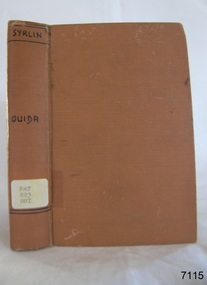
Book - Fictional Novel, Ouida/Marie Louise de la Ramée, Syrlin, 1890
... The label on the spine with typed text PAT 823 OUI The Flyleaf has the name "Louise Ranie" written in blue ink. Paste down front end paper has a sticker from Warrnambool Public Library covered by a sticker from Corangamite Regional Library Service Front loose end paper has a stamp from Corangamite Regional Library Service...The label on the spine with typed text PAT 823 OUI The Flyleaf has the name "Louise Ranie" written in blue ink. Paste down front end paper has a sticker from Warrnambool Public Library covered by a sticker from Corangamite Regional Library Service Front loose end paper has a stamp from Corangamite Regional Library Service Hard cover book. ...Syrlin was first published in 1890 as a three-volume novel by Chatto & Windus. It is also catalogued as Syrlin, or Position. The story follows Freda, Lady Avillion, who is married to a man who has never loved her and routinely cheats on her. She is perfectly pure and utterly cold, then a famous artist, Syrlin, falls in love with her and changes her life forever. One reader describes the novel as bleak, with no happy ending. It is one of the few Ouida novels that discusses English politics at length, and it is very much about social class and the role of the artist in society. Another reviewer says the hero's passion is given an unworthy object, so his suicide fails to move the reader.Hard cover book. Syrlin Author: Ouida/Marie Louise de la Ramée Publisher: Chatto & Windus Date: 1890 Further Information: Brown Cloth hardcover with lettering and patterning to spine in black. The spine has a Library label with an inscription.fictionSyrlin was first published in 1890 as a three-volume novel by Chatto & Windus. It is also catalogued as Syrlin, or Position. The story follows Freda, Lady Avillion, who is married to a man who has never loved her and routinely cheats on her. She is perfectly pure and utterly cold, then a famous artist, Syrlin, falls in love with her and changes her life forever. One reader describes the novel as bleak, with no happy ending. It is one of the few Ouida novels that discusses English politics at length, and it is very much about social class and the role of the artist in society. Another reviewer says the hero's passion is given an unworthy object, so his suicide fails to move the reader. book, santa barbara, ouida, maria louise ramé, marie louise de la ramée, shipwrecked-coast, flagstaff-hill, flagstaff-hill-maritime-museum, warrnambool, maritime-museum, shipwreck-coast, flagstaff-hill-maritime-village, shipwrecked-artefact, pattison collection, warrnambool library, warrnambool mechanics’ institute, ralph eric pattison, corangamite regional library service, warrnambool city librarian, mechanics’ institute library, victorian library board, warrnambool books and records, warrnambool children’s library, great ocean road -
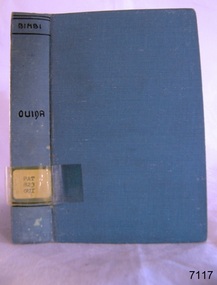 Flagstaff Hill Maritime Museum and Village
Book - Childrens Short Stories Collection, Ouida/Marie Louise de la Ramée, Bimbi, 1882
... The label on the spine with typed text PAT 823 OUI Paste down front end paper has a sticker from Warrnambool Public Library covered by a sticker from Corangamite Regional Library Service Front loose end paper has a stamp from Corangamite Regional Library Service The Flyleaf has the name "Louise Ranie" written in blue ink....The label on the spine with typed text PAT 823 OUI Paste down front end paper has a sticker from Warrnambool Public Library covered by a sticker from Corangamite Regional Library Service Front loose end paper has a stamp from Corangamite Regional Library Service The Flyleaf has the name "Louise Ranie" written in blue ink. ...Bimbi is a collection of children's stories and a lesser-known side of Ouida's output. The opening story, 'The Nurnberg Stove', is set in a snowy Tyrolean town, where a poor family of children huddles around a big, warm stove. It follows a boy, August, who is devoted to a magnificent heirloom stove made by the potter Hirschvogel. When his father is forced to sell it, August hides inside it for the journey. The story explores poverty, family bonds and childhood courage. Other stories in the collection include 'The Ambitious Rose-Tree', 'Lampblack', 'The Child of Urbino' and 'Findelkind'.Hard cover book. Bimbi Author: Ouida/Marie Louise de la Ramée Publisher: George Robertson Date: 1882 Further Information: Light Blue Cloth hardcover with lettering and patterning to spine in black. The spine has a Library label with an inscription.fictionBimbi is a collection of children's stories and a lesser-known side of Ouida's output. The opening story, 'The Nurnberg Stove', is set in a snowy Tyrolean town, where a poor family of children huddles around a big, warm stove. It follows a boy, August, who is devoted to a magnificent heirloom stove made by the potter Hirschvogel. When his father is forced to sell it, August hides inside it for the journey. The story explores poverty, family bonds and childhood courage. Other stories in the collection include 'The Ambitious Rose-Tree', 'Lampblack', 'The Child of Urbino' and 'Findelkind'.book, bimbi, ouida, maria louise ramé, marie louise de la ramée, shipwrecked-coast, flagstaff-hill, flagstaff-hill-maritime-museum, warrnambool, maritime-museum, shipwreck-coast, flagstaff-hill-maritime-village, shipwrecked-artefact, pattison collection, warrnambool library, warrnambool mechanics’ institute, ralph eric pattison, corangamite regional library service, warrnambool city librarian, mechanics’ institute library, victorian library board, warrnambool books and records, warrnambool children’s library, great ocean road -
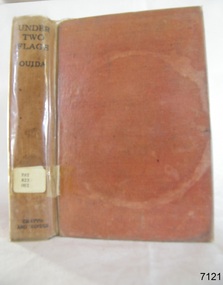 Flagstaff Hill Maritime Museum and Village
Book - Historical Novel, Ouida/Marie Louise de la Ramée, Under Two Flags, 1934
... The label on the spine with typed text PAT 823 OUI Paste down front end paper has a sticker from Warrnambool Public Library covered by a sticker from Corangamite Regional Library Service Front loose end paper has a stamp from Corangamite Regional Library Service Front loose end paper has a stamp from Warrnambool Mechanics Institute The flypaper has the name Maria Ramé in handwriting Hard cover book. Under Two Flags Author: Ouida/Marie Louise ...This novel is about Bertie Cecil, a dashing but cash-strapped officer in the First Life Guards. Threatened with a forgery charge, he flees to the French Foreign Legion under the alias Louis Victor. He fakes his death to protect his brother and a lady's honour, then serves in Algeria's desert campaigns. He is saved from execution by Cigarette, a camp follower who loves him despite her dislike of the English. He is also loved by the widowed Princess Corona. The novel is a melodramatic romance of honour, exile and sacrifice, set between the English aristocracy and French Algeria.Hard cover book. Under Two Flags Author: Ouida/Marie Louise de la Ramée Publisher:Chatto and Windus Date: 1934 Further Information: Red Cloth hardcover with lettering and patterning to spine in black. The spine has a Library label with an inscription.fictionThis novel is about Bertie Cecil, a dashing but cash-strapped officer in the First Life Guards. Threatened with a forgery charge, he flees to the French Foreign Legion under the alias Louis Victor. He fakes his death to protect his brother and a lady's honour, then serves in Algeria's desert campaigns. He is saved from execution by Cigarette, a camp follower who loves him despite her dislike of the English. He is also loved by the widowed Princess Corona. The novel is a melodramatic romance of honour, exile and sacrifice, set between the English aristocracy and French Algeria.book, under two flags, ouida, maria louise ramé, shipwrecked-coast, flagstaff-hill, flagstaff-hill-maritime-museum, warrnambool, maritime-museum, shipwreck-coast, flagstaff-hill-maritime-village, shipwrecked-artefact, pattison collection, warrnambool library, warrnambool mechanics’ institute, ralph eric pattison, corangamite regional library service, warrnambool city librarian, mechanics’ institute library, victorian library board, warrnambool books and records, warrnambool children’s library, great ocean road -
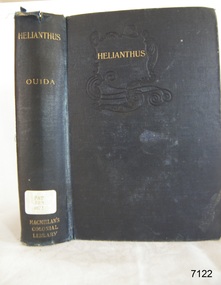 Flagstaff Hill Maritime Museum and Village
Book - Political Satire, Ouida/Marie Louise de la Ramée, Helianthus, 1908
... The label on the spine with the typed text PAT 823 OUI Paste down front end paper has a sticker from Warrnambool Mechanics Institute and Free Library covered by a sticker from Corangamite Regional Library Service. Front loose end paper has a stamp from Warrnambool Mechanics Institute Front loose end paper has a stamp from Corangamite Regional Library Service The Flyleaf has the name "Louise Ranie" written in blue ink....The label on the spine with the typed text PAT 823 OUI Paste down front end paper has a sticker from Warrnambool Mechanics Institute and Free Library covered by a sticker from Corangamite Regional Library Service. Front loose end paper has a stamp from Warrnambool Mechanics Institute Front loose end paper has a stamp from Corangamite Regional Library Service The Flyleaf has the name "Louise Ranie" written in blue ink. ...This novel Helianthus is a political satire set in an invented Mediterranean kingdom of the same name, whose capital is Helios. King John of Gunderode rules as an autocrat behind constitutional forms, with a muzzled press and police spies everywhere. His second son, Prince Elim, Duke of Othyris, is a humane, philosophical man who hates soldiering. At a military review he halts his cavalry rather than trample peasants who have strayed onto the field, and the crowd adores him for it. The King and Elim's stiff elder brother, the Crown Prince, are furious. The visiting Emperor Julius of the neighbouring 'Guthones' is a pious, vain militarist who is eyeing the kingdom's sea. He gets Elim off the hook, partly to humiliate him. A review from the time calls it a novel with a purpose, whose author's zeal sometimes tips into vituperation, and which lacks the romantic charm of Under Two Flags. In the US it was published as A Prince of Europe (Helianthus).Hard cover book. Helianthus Author: Ouida/Marie Louise de la Ramée Publisher: Macmillan and Co., Limited Date: 1908 Further Information: Black Cloth hardcover with lettering and patterning to spine in gilt. The spine has a Library label with an inscription.fictionThis novel Helianthus is a political satire set in an invented Mediterranean kingdom of the same name, whose capital is Helios. King John of Gunderode rules as an autocrat behind constitutional forms, with a muzzled press and police spies everywhere. His second son, Prince Elim, Duke of Othyris, is a humane, philosophical man who hates soldiering. At a military review he halts his cavalry rather than trample peasants who have strayed onto the field, and the crowd adores him for it. The King and Elim's stiff elder brother, the Crown Prince, are furious. The visiting Emperor Julius of the neighbouring 'Guthones' is a pious, vain militarist who is eyeing the kingdom's sea. He gets Elim off the hook, partly to humiliate him. A review from the time calls it a novel with a purpose, whose author's zeal sometimes tips into vituperation, and which lacks the romantic charm of Under Two Flags. In the US it was published as A Prince of Europe (Helianthus).book, under two flags, ouida, maria louise ramé, shipwrecked-coast, flagstaff-hill, flagstaff-hill-maritime-museum, warrnambool, maritime-museum, shipwreck-coast, flagstaff-hill-maritime-village, shipwrecked-artefact, pattison collection, warrnambool library, warrnambool mechanics’ institute, ralph eric pattison, corangamite regional library service, warrnambool city librarian, mechanics’ institute library, victorian library board, warrnambool books and records, warrnambool children’s library, great ocean road -
Flagstaff Hill Maritime Museum and Village
Book, A Village Commune
... Paste down front end paper has a sticker from Warrnambool Public Library covered by a sticker from Corangamite Regional Library Service Front loose end paper has a stamp from Corangamite Regional Library Service The Flyleaf has the name "Louise De La Ranie" written in blue ink. ...The Warrnambool Mechanics' Institute’s publication collection is of both local and state significance. book a village commune ouida maria louise ramé marie louise de la ramée Shipwrecked-coast Flagstaff-Hill Flagstaff-Hill-Maritime-Museum Warrnambool Maritime-Museum Shipwreck-coast Flagstaff-Hill-Maritime-Village Shipwrecked-artefact Pattison Collection Warrnambool Library Warrnambool Mechanics’ Institute Ralph Eric Pattison Corangamite Regional Library Service Warrnambool City Librarian Mechanics’ Institute Library Victorian Library Board Warrnambool books and records Warrnambool Children’s Library Great Ocean Road Paste down front end paper has a sticker from Warrnambool Public Library covered by a sticker from Corangamite Regional Library Service Front loose end paper has a stamp from Corangamite Regional Library Service The Flyleaf has the name "Louise De La Ranie" written in blue ink. ...This item is from the ‘Pattison Collection’, a collection of books and records that was originally owned by the Warrnambool Mechanics’ Institute, which was founded in Warrnambool in 1853. By 1886 the Warrnambool Mechanics’ Institute (WMI) had grown to have a Library, Museum and Fine Arts Gallery, with a collection of “… choice productions of art and valuable specimens in almost every branch and many wonderful national curiosities are now to be seen there, including historic relics of the town and district.” It later included a School of Design. Although it was very well patronised, the lack of financial support led the WMI in 1911 to ask the City Council to take it over. In 1935 Ralph Pattison was appointed as City Librarian to establish and organise the Warrnambool Library as it was then called. When the WMI building was pulled down in 1963 a new civic building was erected on the site and the new Warrnambool Library, on behalf of the City Council, took over all the holdings of the WMI. At this time some of the items were separated and identified as the ‘Pattison Collection’, named after Ralph Pattison. Eventually, the components of the WMI were distributed from the Warrnambool Library to various places, including the Art Gallery, Historical Society and Flagstaff Hill. Later some were even distributed to other regional branches of Corangamite Regional Library and passed to and fro. It is difficult now to trace just where all of the items have ended up. The books at Flagstaff Hill Maritime Village generally display stamps and markings from Pattison as well as a variety of other institutions including the Mechanics’ Institute itself. RALPH ERIC PATTISON Ralph Eric Pattison was born in Rockhampton, Queensland, in 1891. He married Maude Swan from Warrnambool in 1920 and they set up home in Warrnambool. In 1935 Pattison accepted a position as City Librarian for the Warrnambool City Council. His huge challenge was to make a functional library within two rooms of the Mechanics’ Institute. He tirelessly cleaned, cleared and sorted a disarrayed collection of old books, jars of preserved specimens and other items reserved for exhibition in the city’s museum. He developed and updated the library with a wide variety of books for all tastes, including reference books for students; a difficult task to fulfil during the years following the Depression. He converted all of the lower areas of the building into a library, reference room and reading room for members and the public. The books were sorted and stored using a cataloguing and card index system that he had developed himself. He also prepared the upper floor of the building and established the Art Gallery and later the Museum, a place to exhibit the many old relics that had been stored for years for this purpose. One of the treasures he found was a beautiful ancient clock, which he repaired, restored and enjoyed using in his office during the years of his service there. Ralph Pattison was described as “a meticulous gentleman whose punctuality, floorless courtesy and distinctive neat dress were hallmarks of his character, and ‘his’ clock controlled his daily routine and his opening and closing of the library’s large heavy doors to the minute.” Pattison took leave from 1942 to 1945 to serve in the Royal Australian Navy, Volunteer Reserve as Lieutenant. A few years later he converted one of the Museum’s rooms into a Children’s Library, stocking it with suitable books for the younger generation. This was an instant success. In the 1950’s he had the honour of being appointed to the Victorian Library Board and received more inspiration from the monthly conferences in Melbourne. He was sadly retired in 1959 after over 23 years of service, due to the fact that he had gone over the working age of council officers. However, he continued to take a very keen interest in the continual development of the Library until his death in 1969. WARRNAMBOOL PUBLIC LIBRARY The Warrnambool Mechanics’ Institute (WMI) was formed by a voluntary community group in 1863, within six years of Warrnambool’s beginnings, and it's Reading Room opened in 1854. The WMI operated until 1963, at which time it was one of the oldest Mechanics’ Institutes in Victoria. Mechanics’ Institutes offered important services to the public including libraries, reading rooms and places to display and store collections of all sorts such as curiosities and local historical relics. In 1886 a Museum and Fine Arts Gallery were added to the WMI and by the beginning of the 20th century, there was also a billiards room and a School of Art. By this time all Mechanics’ Institutes in country Victoria had museums attached. Over the years the Warrnambool Mechanics’ Institute Library was also known as the Warrnambool Public Library the Warrnambool Library and the Free Library. Early funding from the government was for the “Free Library”. The inscription in a book “Science of Man” was for the “Warrnambool Public Library”, donated by Joseph Archibald in 1899. Another inscription in the book “Catalogue of Plants Under Cultivation in the Melbourne Botanic Gardens 1 & 2, 1883” was presented to the “Warrnambool Library” and signed by the author W.R. Guilfoyle. In 1903 the Warrnambool Public Library decided to add a Juvenile Department to library and stock it with hundreds of books suitable for youth. In 1905 the Public Library committee decided to update the collection of books and added 100 new novels plus arrangements for the latest novels to be included as soon as they were available in Victoria. In July 1911 the Warrnambool Council took over the management of the Public Library, Art Gallery, Museum and Mechanics’ Institute and planned to double the size of the then-current building. In 1953, when Mr R. Pattison was Public Librarian, the Warrnambool Public Library’s senior section 10,000 of the 13,000 books were fiction. The children’s section offered an additional 3,400 books. The library had the equivalent of one book per head of population and served around 33 per cent of the reading population. The collection of books was made up of around 60 per cent reference and 40 per cent fiction. The library was lending 400 books per day. In 1963 the Warrnambool City Council allocated the site of the Mechanics’ Institute building, which included the Public Library, Museum and Art Gallery, for the new Municipal Offices and the Collections were dispersed until 1971. The Warrnambool Library took over the Mechanics’ Institute Library’s holdings on behalf of the Warrnambool City Council. Since the closure of the Warrnambool Mechanics’ Institute, the exact location and composition of the original WMI books and items has become unclear. Other materials have been added to the collection, including items from Terang MI, Warrnambool Court House and Customs House. Many of the books have been identified as the Pattison Collection, named after the Librarian who catalogued and numbered the books during his time as Warrnambool Public Librarian in the time before the Mechanics’ Institute closed. It seems that when Warrnambool became part of the Corangamite Regional Library some of the books and materials went to its head office in Colac and then back to Warrnambool where they were stored at the Art Gallery for quite some time. Some then went to the Warrnambool Historical Society, some stayed at the Art Gallery and some were moved to Flagstaff Hill Maritime Village. The various stamps and labels on the books held at Flagstaff Hill show the variety of the collection’s distribution and origin. The books in the collection at Flagstaff Hill Maritime Village date from the 1850s to the late 1950s and include rare and valuable volumes. Many of the books are part of the “Pattison Collection” after the Warrnambool’s Public Librarian, Mr R. Pattison. The Pattison Collection, along with other items at Flagstaff Hill Maritime Village, was originally part of the Warrnambool Mechanics' Institute’s collection. The Warrnambool Mechanics’ Institute Collection is primarily significant in its totality, rather than for the individual objects it contains. Its contents are highly representative of the development of Mechanics' Institute libraries across Australia, particularly Victoria. A diversity of publications and themes has been amassed, and these provide clues to our understanding of the nature of and changes in the reading habits of Victorians from the 1850s to the middle of the 20th century. The collection also highlights the Warrnambool community’s commitment to the Mechanics’ Institute, reading, literacy and learning in the regions, and proves that access to knowledge was not impeded by distance. These items help to provide a more complete picture of our community’s ideals and aspirations. The Warrnambool Mechanics Institute book collection has historical and social significance for its strong association with the Mechanics Institute movement and the important role it played in the intellectual, cultural and social development of people throughout the latter part of the nineteenth century and the early twentieth century. The collection of books is a rare example of an early lending library and its significance is enhanced by the survival of an original collection of many volumes. The Warrnambool Mechanics' Institute’s publication collection is of both local and state significance. A Village Commune Author: Ouida Publisher: George Robertson Ouida was the pseudonym of the English novelist Maria Louise Ramé (although she preferred to be known as Marie Louise de la Ramée). Paste down front end paper has a sticker from Warrnambool Public Library covered by a sticker from Corangamite Regional Library Service Front loose end paper has a stamp from Corangamite Regional Library Service The Flyleaf has the name "Louise De La Ranie" written in blue ink. book, a village commune, ouida, maria louise ramé, marie louise de la ramée, shipwrecked-coast, flagstaff-hill, flagstaff-hill-maritime-museum, warrnambool, maritime-museum, shipwreck-coast, flagstaff-hill-maritime-village, shipwrecked-artefact, pattison collection, warrnambool library, warrnambool mechanics’ institute, ralph eric pattison, corangamite regional library service, warrnambool city librarian, mechanics’ institute library, victorian library board, warrnambool books and records, warrnambool children’s library, great ocean road -
 Flagstaff Hill Maritime Museum and Village
Book - Novelettes, Ouida/Marie Louise de la Ramée, Cecil Castlemaines Gage, 1873
... The label on the spine with typed text PAT 823 OUI Paste down front end paper has a sticker from Warrnambool Public Library covered by a sticker from Corangamite Regional Library Service Front loose end paper has a stamp from Corangamite Regional Library Service Flyleaf has the name "Louise Ranie" written in blue ink ...The label on the spine with typed text PAT 823 OUI Paste down front end paper has a sticker from Warrnambool Public Library covered by a sticker from Corangamite Regional Library Service Front loose end paper has a stamp from Corangamite Regional Library Service Flyleaf has the name "Louise Ranie" written in blue ink Hard cover book. ...Cecil Castlemaine's Gage, and Other Novelettes is a collection of short fiction by the English novelist 'Ouida'. The title story follows Cecil Castlemaine, a proud, politically minded society beauty of a noble English family, and her romantic entanglements set against a background of Tory party politics. The collection centres on Cecil Castlemaine, a striking beauty from a noble family who navigates societal expectations, romance and loyalty to her cause amid political intrigue and personal pride. The other novelettes bundled with it in most editions are 'Little Grand and the Marchioness', 'Lady Marabout's Troubles', 'A Study à la Louis Quinze' and 'Deadly Dash' light, witty tales of fashionable London and Continental high society, Ouida's signature territory. The stories first appeared in periodicals in the 1860s and were first collected in book form by Chapman and Hall (London) in 1867.Hard cover book. Cecil Castlemaines Gage Author: Ouida/Marie Louise de la Ramée Publisher: George Robertson Date: 1873 Further Information: Light blue Cloth hardcover with lettering and patterning to spine in black. The spine has a Library label with an inscription.fictionCecil Castlemaine's Gage, and Other Novelettes is a collection of short fiction by the English novelist 'Ouida'. The title story follows Cecil Castlemaine, a proud, politically minded society beauty of a noble English family, and her romantic entanglements set against a background of Tory party politics. The collection centres on Cecil Castlemaine, a striking beauty from a noble family who navigates societal expectations, romance and loyalty to her cause amid political intrigue and personal pride. The other novelettes bundled with it in most editions are 'Little Grand and the Marchioness', 'Lady Marabout's Troubles', 'A Study à la Louis Quinze' and 'Deadly Dash' light, witty tales of fashionable London and Continental high society, Ouida's signature territory. The stories first appeared in periodicals in the 1860s and were first collected in book form by Chapman and Hall (London) in 1867.book, cecil castlemaines gage, ouida, maria louise ramé, marie louise de la ramée), shipwrecked-coast, flagstaff-hill, flagstaff-hill-maritime-museum, warrnambool, maritime-museum, shipwreck-coast, flagstaff-hill-maritime-village, shipwrecked-artefact, pattison collection, warrnambool library, warrnambool mechanics’ institute, ralph eric pattison, corangamite regional library service, warrnambool city librarian, mechanics’ institute library, victorian library board, warrnambool books and records, warrnambool children’s library, great ocean road -
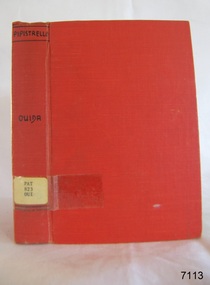 Flagstaff Hill Maritime Museum and Village
Book - Short Stories Collection, Ouida/Marie Louise de la Ramée, Pipistrello, 1880
... The label on the spine with typed text PAT 823 OUI Paste down front end paper has a sticker from Warrnambool Public Library covered by a sticker from Corangamite Regional Library Service. Front loose end paper has a stamp from Corangamite Regional Library Service. The Flyleaf has the name "Louise...The label on the spine with typed text PAT 823 OUI Paste down front end paper has a sticker from Warrnambool Public Library covered by a sticker from Corangamite Regional Library Service. Front loose end paper has a stamp from Corangamite Regional Library Service. The Flyleaf has the name "Louise ...Pipistrello is the Italian word for 'bat'. The title story is set in Italy, a frequent setting for Ouida's work, as she lived there for much of her adult life. Like much of Ouida's fiction, the story serves as social commentary on class division, human cruelty and the tragic nature of innocence. Set in a rural Italian community, the story centres on a poor, marginalised individual nicknamed Pipistrello ('the Bat') because of their nocturnal, outcast existence, poverty or physical appearance. Its core explores themes of alienation, social prejudice, unrequited devotion, and the exploitation of the poor by wealthier or more cynical figures. The collection of six short stories contains several narrative pieces typical of Ouida's later style, which shifted from her earlier, highly romantic high-society melodramas (such as Under Two Flags) toward melodramatic realism, animal welfare and sympathy for peasant life. The stories are a critique of industrialisation and greed, and the opposition to modern greed and the harshness of societal structures on vulnerable people and animals. The work is dramatic, emotional, and often tragic where pure intentions are tested by a unforgiving world.Hard cover book. Pipistrello Author: Ouida/Marie Louise de la Ramée Publisher: George Robertson Date: 1880 Further Information: Red Cloth hardcover with lettering and patterning to spine in black. The spine has a Library label with an inscription.fictionPipistrello is the Italian word for 'bat'. The title story is set in Italy, a frequent setting for Ouida's work, as she lived there for much of her adult life. Like much of Ouida's fiction, the story serves as social commentary on class division, human cruelty and the tragic nature of innocence. Set in a rural Italian community, the story centres on a poor, marginalised individual nicknamed Pipistrello ('the Bat') because of their nocturnal, outcast existence, poverty or physical appearance. Its core explores themes of alienation, social prejudice, unrequited devotion, and the exploitation of the poor by wealthier or more cynical figures. The collection of six short stories contains several narrative pieces typical of Ouida's later style, which shifted from her earlier, highly romantic high-society melodramas (such as Under Two Flags) toward melodramatic realism, animal welfare and sympathy for peasant life. The stories are a critique of industrialisation and greed, and the opposition to modern greed and the harshness of societal structures on vulnerable people and animals. The work is dramatic, emotional, and often tragic where pure intentions are tested by a unforgiving world.book, cecil castlemaines gage, ouida, maria louise ramé, marie louise de la ramée), shipwrecked-coast, flagstaff-hill, flagstaff-hill-maritime-museum, warrnambool, maritime-museum, shipwreck-coast, flagstaff-hill-maritime-village, shipwrecked-artefact, pattison collection, warrnambool library, warrnambool mechanics’ institute, ralph eric pattison, corangamite regional library service, warrnambool city librarian, mechanics’ institute library, victorian library board, warrnambool books and records, warrnambool children’s library, great ocean road -
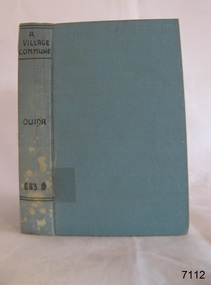 Flagstaff Hill Maritime Museum and Village
Book - Fictional Novel, Ouida/Marie Louise de la Ramée, A Village Commune, 1881–1882
... Paste down front end paper has a sticker from Warrnambool Public Library covered by a sticker from Corangamite Regional Library Service Front loose end paper has a stamp from Corangamite Regional Library Service The Flyleaf has the name "Louise De La Ranie" written in blue ink. ...Paste down front end paper has a sticker from Warrnambool Public Library covered by a sticker from Corangamite Regional Library Service Front loose end paper has a stamp from Corangamite Regional Library Service The Flyleaf has the name "Louise De La Ranie" written in blue ink. ...The story is set in the fictional Italian commune of Vezzaja and Ghiralda, centred on the village of Santa Rosalia. Like all Italian communes, it is supposed to enjoy independence guaranteed by legislative autonomy. In practice, a chain of councils and a syndicate controlled by the local mayor hands power down to a secretary and two assistants, who use bureaucratic zeal to harass the villagers. The human story follows poor villagers, including old Pippo and his granddaughter Viola, and the miller and his family. In the novel, petty municipal rules turn ugly. Dogs are poisoned, and Carmelo is put on trial before carabinieri while his family looks on in fear. Ouida's target is the petty corruption and cruelty of local officialdom in the new, unified Italy. One reader's summary describes the corruption and cronyism of government officials and the cruelty they meted out to hapless villagers.Hard cover book. A Village Commune Author: Ouida/Marie Louise de la Ramée Publisher: George Robertson Date: 1881-1882 Further Information: Light blue Cloth hardcover with lettering and patterning to spine in black. The spine has a Library inscription written in black texter.fictionThe story is set in the fictional Italian commune of Vezzaja and Ghiralda, centred on the village of Santa Rosalia. Like all Italian communes, it is supposed to enjoy independence guaranteed by legislative autonomy. In practice, a chain of councils and a syndicate controlled by the local mayor hands power down to a secretary and two assistants, who use bureaucratic zeal to harass the villagers. The human story follows poor villagers, including old Pippo and his granddaughter Viola, and the miller and his family. In the novel, petty municipal rules turn ugly. Dogs are poisoned, and Carmelo is put on trial before carabinieri while his family looks on in fear. Ouida's target is the petty corruption and cruelty of local officialdom in the new, unified Italy. One reader's summary describes the corruption and cronyism of government officials and the cruelty they meted out to hapless villagers.book, cecil castlemaines gage, ouida, maria louise ramé, marie louise de la ramée), shipwrecked-coast, flagstaff-hill, flagstaff-hill-maritime-museum, warrnambool, maritime-museum, shipwreck-coast, flagstaff-hill-maritime-village, shipwrecked-artefact, pattison collection, warrnambool library, warrnambool mechanics’ institute, ralph eric pattison, corangamite regional library service, warrnambool city librarian, mechanics’ institute library, victorian library board, warrnambool books and records, warrnambool children’s library, great ocean road -
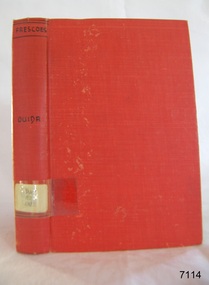 Flagstaff Hill Maritime Museum and Village
Book - Short Stories Collection, Ouida/Marie Louise de la Ramée, Frescoes, 1883
... The label on the spine with typed text PAT 823 OUI Paste down front end paper has a sticker from Warrnambool Public Library covered by a sticker from Corangamite Regional Library Service Front loose end paper has a stamp from Corangamite Regional Library Service The Flyleaf has the name "Louise Ranie" written in blue ink....Louise de la Ramée"). The title story first appeared in serial form. The January magazine Belgravia carried the first portion of a three-part story by Ouida called "Frescoes." Ouida's usual territory is Italian settings, romance, and social drama. Her style and lack of moral preaching throughout her volumes made her books popular to Victorian readers. The label on the spine with typed text PAT 823 OUI Paste down ...Frescoes is a collection of dramatic sketches of short fiction by Ouida (Maria Louise Ramé, who preferred "Marie Louise de la Ramée"). The title story first appeared in serial form. The January magazine Belgravia carried the first portion of a three-part story by Ouida called "Frescoes." Ouida's usual territory is Italian settings, romance, and social drama. Her style and lack of moral preaching throughout her volumes made her books popular to Victorian readers.Hard cover book. Frescoes Author: Ouida/Marie Louise de la Ramée Publisher: George Robertson Date: 1883 Further Information: Red Cloth hardcover with lettering and patterning to spine in black. The spine has a Library label with an inscription.fictionFrescoes is a collection of dramatic sketches of short fiction by Ouida (Maria Louise Ramé, who preferred "Marie Louise de la Ramée"). The title story first appeared in serial form. The January magazine Belgravia carried the first portion of a three-part story by Ouida called "Frescoes." Ouida's usual territory is Italian settings, romance, and social drama. Her style and lack of moral preaching throughout her volumes made her books popular to Victorian readers. book, cecil castlemaines gage, ouida, maria louise ramé, marie louise de la ramée), shipwrecked-coast, flagstaff-hill, flagstaff-hill-maritime-museum, warrnambool, maritime-museum, shipwreck-coast, flagstaff-hill-maritime-village, shipwrecked-artefact, pattison collection, warrnambool library, warrnambool mechanics’ institute, ralph eric pattison, corangamite regional library service, warrnambool city librarian, mechanics’ institute library, victorian library board, warrnambool books and records, warrnambool children’s library, great ocean road -
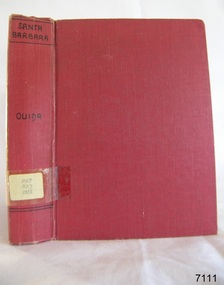 Flagstaff Hill Maritime Museum and Village
Book - Six Short Stories, Ouida/Marie Louise de la Ramée, Santa Barbara, 1891
... The label on the spine with typed text PAT 823 OUI Paste down front end paper has a sticker from Warrnambool Public Library covered by a sticker from Corangamite Regional Library Service Front loose end paper has a stamp from Corangamite Regional Library Service The Flyleaf has the name "Louise Ranie" written in blue ink. ...Louise Ramé). It contains "Santa Barbara", "Poussette", "Rinaldo", "The Halt", "The Stable Boy" and "La Rossiccia". Set against Italian backdrops, the title story follows a tragedy involving social injustice, passion, animal welfare and human suffering in rural Italy. The broader collection examines typical late-Victorian issues such as class divides, emotional betrayal, the clash between traditional Italian peasant life and industrial modernisation, and cruelty toward animals. The label on the spine with typed text PAT 823 OUI Paste down ...Santa Barbara, published in full as Santa Barbara, etc., is an 1891 collection of six short stories by the English Victorian author Ouida (the pen name of Maria Louise Ramé). It contains "Santa Barbara", "Poussette", "Rinaldo", "The Halt", "The Stable Boy" and "La Rossiccia". Set against Italian backdrops, the title story follows a tragedy involving social injustice, passion, animal welfare and human suffering in rural Italy. The broader collection examines typical late-Victorian issues such as class divides, emotional betrayal, the clash between traditional Italian peasant life and industrial modernisation, and cruelty toward animals.Hard cover book. Santa Barbara Author: Ouida/Marie Louise de la Ramée Publisher:Chatto and Windus Date: 1891 Further Information: Red Cloth hardcover with lettering and patterning to spine in black. The spine has a Library label with an inscription.fictionSanta Barbara, published in full as Santa Barbara, etc., is an 1891 collection of six short stories by the English Victorian author Ouida (the pen name of Maria Louise Ramé). It contains "Santa Barbara", "Poussette", "Rinaldo", "The Halt", "The Stable Boy" and "La Rossiccia". Set against Italian backdrops, the title story follows a tragedy involving social injustice, passion, animal welfare and human suffering in rural Italy. The broader collection examines typical late-Victorian issues such as class divides, emotional betrayal, the clash between traditional Italian peasant life and industrial modernisation, and cruelty toward animals.book, santa barbara, ouida, maria louise ramé, marie louise de la ramée, shipwrecked-coast, flagstaff-hill, flagstaff-hill-maritime-museum, warrnambool, maritime-museum, shipwreck-coast, flagstaff-hill-maritime-village, shipwrecked-artefact, pattison collection, warrnambool library, warrnambool mechanics’ institute, ralph eric pattison, corangamite regional library service, warrnambool city librarian, mechanics’ institute library, victorian library board, warrnambool books and records, warrnambool children’s library, great ocean road
