
Showing 59 items matching "machine drill"
-
 Bendigo Historical Society Inc.
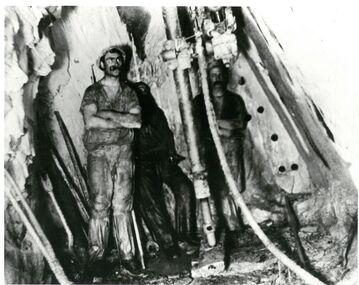
Photograph - Victoria No. 0164 Mine
... ...Machine drill...B&W photograph of miners on a machine drill. Note holes bored....Mining Machine drill Victoria mine B&W photograph of miners on a machine drill. ...B&W photograph of miners on a machine drill. Note holes bored.mining, machine drill, victoria mine -
 Flagstaff Hill Maritime Museum and Village
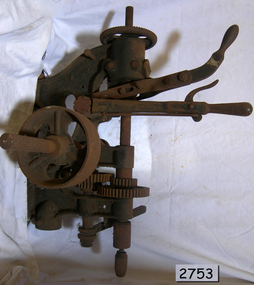
Drill Press, early to mid-20th century
... ...drilling machine...drill...The pillar, as in all “Dawn Drilling Machines” is a solid bright steel bar, in place of the usual light tubing. ...Post type drill press machine with gear driven flywheel. Drill press is attached to a post and is fitted with a pulley belt and will run at a speed of maxim 200 r.p.m. ...The pillar, as in all “Dawn Drilling Machines” is a solid bright steel bar, in place of the usual light tubing. ...This post drill press has been made by Melbourne business, Dawn Manufacturing Company. It can be operated manually or by a pulley driven flywheel, with the aid of an engine connected to a power supply. In the late 1800s early 1900s a drill press like this would have been driven by steam from a boiler, the main power source for manufacturer’s power at that time. Dawn’s Golden Anniversary 1917-1967 Catalogue describes this model 611 drill as … “Ruggedly constructed with accurately reamed bearings. The coupling between the main spindle and feed screw engages the full circumference of the spindle, and embraces a ball-bearing thrust race. The pillar, as in all “Dawn Drilling Machines” is a solid bright steel bar, in place of the usual light tubing. Adjustable automatic feed.” And “F. & l. Pulleys extra, if required”. DAWN MANUFACTURING CO. The Dawn Manufacturing Co. was founded in Coburg, Melbourne, in 1917 by the four Blake brothers, who were all engineers. After World War I Dawn was supplying drills Australia wide and the company was growing at a healthy rate. During the depression they remained busy, with employees working 60-80 hour weeks. Dawn was contracted to supply vices and clamps to the Australian Defence Department and munitions factory during the World War II. - 1959 the company was taken over by G.N. Raymond Group. - 1967 the Dawn Manufacturing Co. had distributors in Australia and overseas, including USA, Canada, New Zealand, Asia and the Middle East. - 1973 the Siddons Ramset Limited acquired Dawn. - December 1991, Dawn became a unit of the United States owned Stanley Works Pty. Ltd. - November 1998 Dawn became 100 per cent Australian owned. The drill is a typical tool of a blacksmith, cart wright, wheelwright and garage business. It is an example of the tools of the blacksmiths’ trade in Victoria in the early to mid-20th century.Post type drill press machine with gear driven flywheel. Drill press is attached to a post and is fitted with a pulley belt and will run at a speed of maxim 200 r.p.m. The machine can also be manually operated. It has an aperture in the centre, a chuck, for the drill bit and has two metal handles at the centre, on the right hand side. Gear ratio 2:1 main drive, 6" diam, 3:1 reduction gear. Made by Dawn of Melbourne, Australia. Model No. 611, Code No. 9157"DAWN MFG COY”, “MELB. AUSTRALIA", " 611"flagstaff hill, warrnambool, shipwrecked-coast, flagstaff-hill, flagstaff-hill-maritime-museum, maritime-museum, shipwreck-coast, flagstaff-hill-maritime-village, blacksmiths, blacksmith’s drill, blacksmith tools, dawn drill model no. 611, dawn drill code no. 9157, dawn manufacturing coy melbourne, dawn manufacturing coy coburg, dawn post drill, drilling machine, drill with gear driven flywheel, forging tool, metal working tool, post drill, steam powered drill, trade tool, warrnambool district 1900s -
 Stawell Historical Society Inc
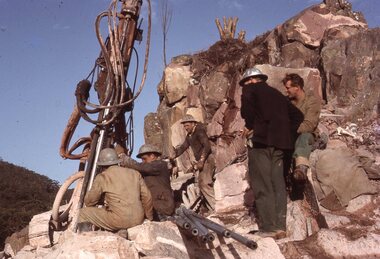
Slide, Ian McCann, Constructing Lake Bellfield
... Drilling Machine at the construction of Lake Bellfield...Lake Bellfield Drilling Machine at the construction of Lake Bellfield Constructing Lake Bellfield Slide Ian McCann ...Drilling Machine at the construction of Lake Bellfieldlake bellfield -
 Whitehorse Historical Society Inc.
Pamphlet, Stanley-Titan Pty Ltd, 1960s?
... Wood chisels, auger bits, eyed augers, machine bits, masonry drills, linoleum or leather knives, handsaws, plane irons, woos screw pilot bits and flat power bits....Hand tool catalogue: wood chisels, auger bits, eyed augers, machine bits, masonry drills, linoleum or leather knives, handsaws, plane irons, woos screw pilot bits and flat power bits....Wood chisels, auger bits, eyed augers, machine bits, masonry drills, linoleum or leather knives, handsaws, plane irons, woos screw pilot bits and flat power bits. ...Hand tool catalogue.Hand tool catalogue: wood chisels, auger bits, eyed augers, machine bits, masonry drills, linoleum or leather knives, handsaws, plane irons, woos screw pilot bits and flat power bits.Hand tool catalogue.stanley-titan pty ltd, woodworking tools -
Dandenong & District Historical Society
Booklet, UGD Vertical Drilling Machine - Asquith
... Instruction Booklet for Asquith Drilling Machines P18711 & P81715...Instruction Boklet Instruction Booklets for Asquith Instruction Booklet for Asquith Drilling Machines P18711 & P81715 Worn Cardboard Cover Paper Text UGD Vertical Drilling Machine - Asquith Booklet ...Instruction Booklets for AsquithWorn Cardboard Cover Paper Textnon-fictionInstruction Booklets for Asquith -
Dandenong & District Historical Society
Drawing - Asquith UGD Vertical Drilling M/C Square Table Hand Elevating, Drawing No 25295. Date 2.5.1941, 2 May 1941
... Technical Drawing of Drilling Machine x 2 copies...Plan View of Base Plate and machine plus some instructions Drawing No 25295 Wm Asquith Ltd. Halifax Technical Drawing of Drilling Machine x 2 copies Drawing No 25295. ...Plan View of Base Plate and machine plus some instructionsDrawing No 25295Technical Drawing of Drilling Machine x 2 copiesWm Asquith Ltd. Halifax -
 Bendigo Military Museum
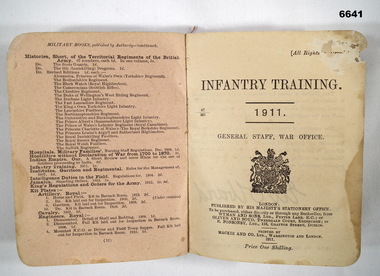
Book - BOOK, INFANTRY TRAINING 1911 (UK), His Majesty's Stationery Office/ Mackie & Co. Ltd, 1911
... It has drill movements, with and without arms, Coy and Btn level drills, machine gun drill. Infantry in battle, Attack Defence, fighting environments, Bayonet drills....It has drill movements, with and without arms, Coy and Btn level drills, machine gun drill. Infantry in battle, Attack Defence, fighting environments, Bayonet drills. ...This is a pocket sized book. Red Buckram cover. It has 217 pages, printed in black ink. It has drawings and Military Manoeuvre's. It has drill movements, with and without arms, Coy and Btn level drills, machine gun drill. Infantry in battle, Attack Defence, fighting environments, Bayonet drills.Inside in advert section p.5, is written in pencil, Coat 7918, Rifle 4809, Bayonet 4893.passchendaele barracks trust, infantry trg 1911 -
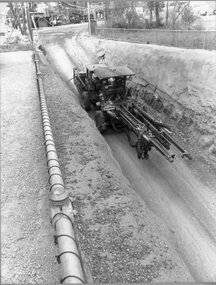 Stawell Historical Society Inc
Photograph, Stawell Joint Venture, Magdala Gold Mining's Jumbo Drilling Machine in the decline entrance
... Stawell Joint Venture. Drilling Machine in decline entrance....Stawell Joint Venture. Drilling Machine in decline entrance. Stawell Mining Stawell Joint Venture, Magdala Gold Mining's Jumbo Drilling Machine in the decline entrance Photograph ...Stawell Joint Venture. Drilling Machine in decline entrance.stawell mining -
Dandenong & District Historical Society
Booklet, Alfred Herbert Ltd, Herbert Operators Handbook, 1964
... Alfred Herbert Ltd, Coverntry, UK Drilling Machines...Alfred Herbert Ltd, Coverntry, UK Drilling Machines The booklet was to be given to machine operator and not kept in office. ...Machine Operators HandbookSpiral bound Cover and Textnon-fictionMachine Operators Handbook -
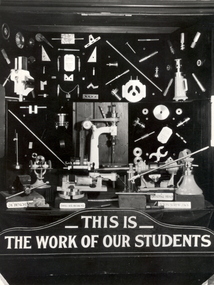 Federation University Historical Collection
Photograph - Black and White, Ballarat School of Mines Student Display, 1937, 1937
... The display features (bottom left to right) a 34 inch vice, a swivel based machine vice, a drilling machine and a 3 ton screw jack. ...The display features (bottom left to right) a 34 inch vice, a swivel based machine vice, a drilling machine and a 3 ton screw jack. ...The Ballarat School of Mines often exhibited student work during Apprenticeship WeekBlack and white photograph of Ballarat School of Mines Student work exhibited at Alfred Hall, Ballarat. The display features (bottom left to right) a 34 inch vice, a swivel based machine vice, a drilling machine and a 3 ton screw jack. ballarat school of mines, tools, apprentice, jack, vice, alfred hall -
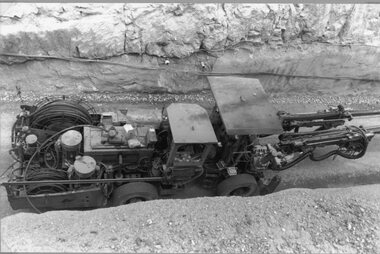 Stawell Historical Society Inc
Photograph, Stawell Joint Venture, Magdala Gold Mining's Jumbo Drilling Machine in the decline entrance
... Jumbo Drill. Drilling Machine in decline entrance....Jumbo Drill. Drilling Machine in decline entrance. Stawell Mining Stawell Joint Venture, Magdala Gold Mining's Jumbo Drilling Machine in the decline entrance Photograph ...Stawell Joint Venture. Jumbo Drill. Drilling Machine in decline entrance.stawell mining -
Glenelg Shire Council Cultural Collection
Slide - Slide - Cashmore Airport, Portland, 1980s
... Large flat area of land with drilling machine in centre. 10 long pipes on ground in front of drill, side by side....Large flat area of land with drilling machine in centre. 10 long pipes on ground in front of drill, side by side. ...Coloured slide. Large flat area of land with drilling machine in centre. 10 long pipes on ground in front of drill, side by side.portland airport, cashmore airport, construction site, machinery, engineering -
Dandenong & District Historical Society
Book, AB Aroba Maskiner, 15 Oct 2025
... Inner Text and Technical Drawings of Drilling Machine ER1830 hand typed and drawings copied...Inner Text and Technical Drawings of Drilling Machine ER1830 hand typed and drawings copied AB Aroba Maskiner Book ...Green Cardboard Cover-Red Print outer cover. Inner Text and Technical Drawings of Drilling Machine ER1830 hand typed and drawings copiednon-fiction -
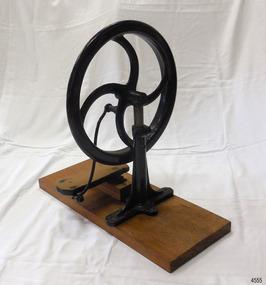 Flagstaff Hill Maritime Museum and Village
Machine - Treadle Machine, Early 20th century
... Treadle machines were used to power sewing machines, dental drills, lathes, spinning wheels and saws The machine is mounted on a board to demonstrate treadle operation....Treadle machines were used to power sewing machines, dental drills, lathes, spinning wheels and saws The machine is mounted on a board to demonstrate treadle operation. ...This foot-powered treadle machine could be used to manually operate many devices such as a sewing machine or spinning wheel. Treadle machines were used to power sewing machines, dental drills, lathes, spinning wheels and saws The machine is mounted on a board to demonstrate treadle operation.This mounted, smoothly working treadle machine demonstrates the treadle mechanism that was used in the early 20th century to power mechanical devices and in turn to save time, energy and money. The treadle was used in domestic and industrial environments. The Collection at Flagstaff Hill Maritime Museum and Village has two treadle-operated dentist's drills, a treadle sewing machine, a saw, a lathe and a treadle paper numbering machine.Treadle-powered machine; a black painted metal wheel with four curved spokes, connected to a wooden treadle. The height of the wheel is adjustable. The mechanical device is mounted on a thick rectangular wooden block. The working treadle mechanism turns smoothly. flagstaff hill, warrnambool, maritime museum, maritime village, great ocean road, shipwreck coast, treadle machine, manual machine, foot treadle, display treadle, treadle, demonstration, education, working model -
 Bendigo Historical Society Inc.
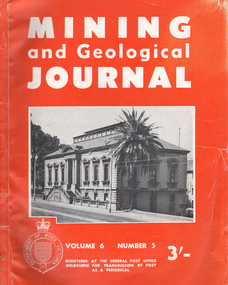
Book - Kairn Collection: Mining and Geological Journal, Department of Mines, Victoria, 1959 - 1960
... Colour photograph on back cover shows Mindrill type 13 model F 62B diamond drilling machine in PNG. ...Colour photograph on back cover shows Mindrill type 13 model F 62B diamond drilling machine in PNG. Book Kairn Collection: Mining and Geological Journal Department of Mines, Victoria ...The Mining & Geological Journal was produced by the Department of Mines, Victoria twice a year, during the period 1937 to 1972. It was an official publication of the Victorian Government, Department of Mines, devoted to issues and events surrounding mining and metallurgical engineering in Victoria along with education, research and innovations in mining. The journal also included advertisements and references to business interests. Editorial (page 3) discusses the imminent demolition of the Geological Museum, situated alongside the Old Treasury Building in Melbourne. The genesis of the Geological Museum was 'the Exhibition of 1861 when the potential value of scientific search to the community as a whole was recognised'. In 1887 the Secretary for Mines in Melbourne was strongly of the opinion that a School of Mines should be established...it was decided that a building should be erected to house a thorough staff of professsors to impart instruction.' Orange cover, white text, printed on front cover: 'Mining and Geological Journal', Volume 6, Number 5, 1965. In centre of cover, black and white photo of the Geological Museum Melbourne. Colour photograph on back cover shows Mindrill type 13 model F 62B diamond drilling machine in PNG. geology, mining, gold mining, bendigo, department of mines, water divining, origins of oil, bentonite, alluvial gold, nickle, serpentinite, hit of miss mine wedderburn, geological museum -
 Federation University Historical Collection
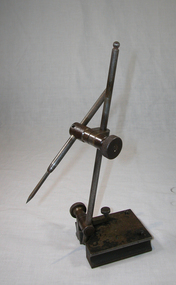
Object, Brown and Sharpe Manufacturing Co, Universal Surface Gauge
... Used to lay out Machine work, or to set up pieces on a planer, radial drill, milling machine or boring machine. ...Used to lay out Machine work, or to set up pieces on a planer, radial drill, milling machine or boring machine. ...Used to lay out Machine work, or to set up pieces on a planer, radial drill, milling machine or boring machine. To set the Scriber the spindle swivels down or up into any position where it is clamped by the knurled nut. There is a fine screw adjustment for the Scriber point (note: this is not original Scriber supplied with this instrument). The base on this Surface Gauge can be set on cylindrical work, using the ‘V’ groove in the base, or by pushing down the two gauge pins. It can be brought square with an edge or T slot. Metal gauge toolgauge, tool, trade, brown and sharp manufacturing company -
 Orbost & District Historical Society
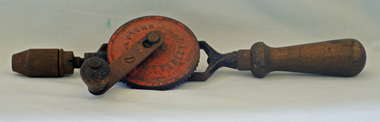
hand drill
... One of the outcomes included an array of new drilling machines. These human-powered tools were a vast improvement over earlier tools....One of the outcomes included an array of new drilling machines. These human-powered tools were a vast improvement over earlier tools. ...The invention of a hand drill is credited to Arthur James Arnot and William Blanch Brain of Melbourne, Australia who patented the electric drill in 1889. In 1895, the first portable handheld drill was created by brothers Wilhem & Carl Fein of Stuttgart, Germany. Hand-powered devices have been used for millennia. However, during the last quarter of the 19th century a radically improved generation of tools appeared. These tools took advantage of modern mass production machinery and processes (like interchangeable parts) and an increased availability in superior material (metal instead of wood). One of the outcomes included an array of new drilling machines. These human-powered tools were a vast improvement over earlier tools.This item is an example of a commonly used domestic tool - pre power tools.A Stanley hand drill with two wooden handles. The red wheel is painted metal. On red wheel - STANLEY ENGLANDwoodwork tool hand-drill -
 The Beechworth Burke Museum
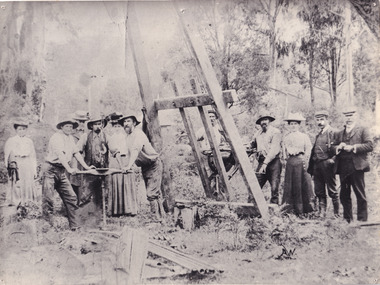
Photograph, c1900
... The longer the tunnel, the less the relative cost of tunnel boring machines versus drill and blast methods. This is because tunneling with TBMs is much more efficient and results in shortened completion times, assuming they operate successfully. ...The longer the tunnel, the less the relative cost of tunnel boring machines versus drill and blast methods. This is because tunneling with TBMs is much more efficient and results in shortened completion times, assuming they operate successfully. ...A black and white photograph depicting seven men and four women surrounded by tunnel boring machinery. A tunnel boring machine (TBM), also known as a "mole", is a machine used to excavate tunnels with a circular cross section through a variety of soil and rock strata. They may also be used for microtunneling. They can be designed to bore through anything from hard rock to sand. Tunnel boring machines are used as an alternative to drilling and blasting (D&B) methods in rock and conventional "hand mining" in soil. TBMs have the advantages of limiting the disturbance to the surrounding ground and producing a smooth tunnel wall. This significantly reduces the cost of lining the tunnel, and makes them suitable to use in heavily urbanised areas. The major disadvantage is the upfront cost. TBMs are expensive to construct, and can be difficult to transport. The longer the tunnel, the less the relative cost of tunnel boring machines versus drill and blast methods. This is because tunneling with TBMs is much more efficient and results in shortened completion times, assuming they operate successfully. Drilling and blasting however remains the preferred method when working through heavily fractured and sheared rock layers.This photograph is significant as it shows the machinery used and attire worn by men and women during the gold rush era. Black and white rectangular photograph printed on photographic paperburke museum, mining, beechworth, boring machinery, excavate, gold, gold fields, gold rush, miners -
 Bendigo Historical Society Inc.
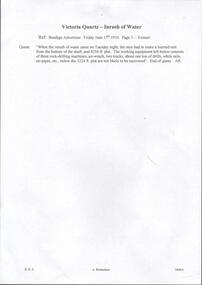
Document - DRAINAGE PROBLEMS - INRUSH OF WATER AT THE VICTORIA QUARTZ
... The working equipment left below consists of three rock-drilling machines, air-winch, two trucks, about one ton of drills, while rails, air-pipes, etc, below the 3224 ft. plat are not likely to be recovered'. ...The working equipment left below consists of three rock-drilling machines, air-winch, two trucks, about one ton of drills, while rails, air-pipes, etc, below the 3224 ft. plat are not likely to be recovered'. ...Two handwritten extracts from the Bendigo Advertiser 17/6/1910 regarding the inrush of water at the Victoria Quartz Mine. 'When the inrush of water came on Tuesday night, the men had to make a hurried exit from the bottom of the shaft and 4254 ft. plat. The working equipment left below consists of three rock-drilling machines, air-winch, two trucks, about one ton of drills, while rails, air-pipes, etc, below the 3224 ft. plat are not likely to be recovered'. Document from Albert Richardson Collection of mining history.document, gold, drainage problems, new chum drainage association, inrush of water at the victoria quartz, bendigo advertiser 17/6/1910 page 3, ar -
 Melbourne Tram Museum
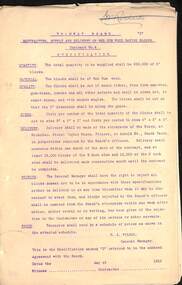
Document - Tender Document, Tramway Board, Misc. Tramway Board contracts, 1916 - 1919
... Short titles are: .1 - Contract No. 4 - supply and delivery of wood paving blocks. .2 - No. 5 - steel castings .3 - No. 7 - rolled steel bars for grip dies .4 - No. 9 - rolled mild steel plates .5 - No. 10 - Kerosene oil .6 - No. 12 - Tar paving .7 - No. 13 - steel files .8 - No. 15 - iron castings .9 - No. 16 - cotton waste .10 - No. 18 - hemp rope .11 - No. 19 - tar oils .12 - No. 23 - steel wire rope (for cables) .13 - No. 24 - cotton waste .14 - No. 26 - iron castings .15 - No. 27 - purchase and removal of cottage at 87 Acland St St Kilda .16 - No. 28 - radial drilling machine .17 - No. 29 - steel castings .18 - No. 31 - paving blocks .19 - No. 33 - cotton waste .20 - No. 40 - substation building at Rathdown Street .21 - No. 47 - iron castings .22 - No. 54 - steel castings .23 - No. 72 - tar oils - from the Board's distilling works in Flinders St extension. ...Short titles are: .1 - Contract No. 4 - supply and delivery of wood paving blocks. .2 - No. 5 - steel castings .3 - No. 7 - rolled steel bars for grip dies .4 - No. 9 - rolled mild steel plates .5 - No. 10 - Kerosene oil .6 - No. 12 - Tar paving .7 - No. 13 - steel files .8 - No. 15 - iron castings .9 - No. 16 - cotton waste .10 - No. 18 - hemp rope .11 - No. 19 - tar oils .12 - No. 23 - steel wire rope (for cables) .13 - No. 24 - cotton waste .14 - No. 26 - iron castings .15 - No. 27 - purchase and removal of cottage at 87 Acland St St Kilda .16 - No. 28 - radial drilling machine .17 - No. 29 - steel castings .18 - No. 31 - paving blocks .19 - No. 33 - cotton waste .20 - No. 40 - substation building at Rathdown Street .21 - No. 47 - iron castings .22 - No. 54 - steel castings .23 - No. 72 - tar oils - from the Board's distilling works in Flinders St extension. ...Set of 23 tender documents, typed or duplicated, for the Tramway Board, typed or printed onto Foolscap sheets. Each give some detail of the contract, quantities, delivery and quality. Short titles are: .1 - Contract No. 4 - supply and delivery of wood paving blocks. .2 - No. 5 - steel castings .3 - No. 7 - rolled steel bars for grip dies .4 - No. 9 - rolled mild steel plates .5 - No. 10 - Kerosene oil .6 - No. 12 - Tar paving .7 - No. 13 - steel files .8 - No. 15 - iron castings .9 - No. 16 - cotton waste .10 - No. 18 - hemp rope .11 - No. 19 - tar oils .12 - No. 23 - steel wire rope (for cables) .13 - No. 24 - cotton waste .14 - No. 26 - iron castings .15 - No. 27 - purchase and removal of cottage at 87 Acland St St Kilda .16 - No. 28 - radial drilling machine .17 - No. 29 - steel castings .18 - No. 31 - paving blocks .19 - No. 33 - cotton waste .20 - No. 40 - substation building at Rathdown Street .21 - No. 47 - iron castings .22 - No. 54 - steel castings .23 - No. 72 - tar oils - from the Board's distilling works in Flinders St extension. Documents note scanned, just two samples.trams, tramways, tramway board, tenders, cable trams, grip tram, equipment, substation, cable grip, cables, demolition -
 Flagstaff Hill Maritime Museum and Village
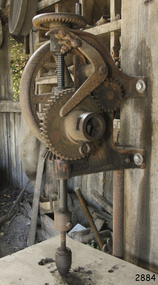
Drill Press, 1920s-1950s
... The Dawn Ball-bearing Post Drill no. 611 is described in McPherson’s Catalogue as a “drilling machine with adjustable automatic feed, with improved Dawn coupler and ball-bearing thrust’. ...The Dawn Ball-bearing Post Drill no. 611 is described in McPherson’s Catalogue as a “drilling machine with adjustable automatic feed, with improved Dawn coupler and ball-bearing thrust’. ...This drill once belonged to Goodall and Sons, who were blacksmiths in Terang. The smith was called upon to do a variety of work. In the early 1900s he was often the nearest person to be able to perform an engineer’s services for many miles around. The Dawn Ball-bearing Post Drill no. 611 is described in McPherson’s Catalogue as a “drilling machine with adjustable automatic feed, with improved Dawn coupler and ball-bearing thrust’. The heavy design of the flywheel enables it to maintain momentum” and is “fitted with pulleys for belt drive if desired” The hand crank drives an automatic feed to work off a cam-follow system opposite a large wheel. Made by Dawn Manufacturing Co. Australia 1920-1950. DAWN MANUFACTURING CO. Dawn Manufacturing Co. was founded in Coburg, Melbourne, in 1917 by the four Blake brothers, who were all engineers. After World War I Dawn was supplying drills Australia wide and the company was growing at a healthy rate. During the depression they remained busy, with employees working 60-80 hour weeks. Dawn was contracted to supply vices and clamps to the Australian Defence Department and munitions factory during the World War II. In 1959 the company was taken over by G.N. Raymond Group, then in 1973 the Siddons Ramset Limited acquired Dawn. In December 1991, Dawn became a unit of the United States owned Stanley Works Pty. Ltd. In November 1998 Dawn became 100 per cent Australian owned. HENRY GOODALL & SONS Henry Goodall (1870-1936) was proprietor of garages as H. Goodall & Sons Pty. Ltd., at both Terang (McKinnon and High Streets) and Mortlake (Dunlop Street). His business was in operation in at least in 1916 and perhaps well before, considering the date of the tyre bender and its use for wagons with wooden wheels. It was still in operation in 1953, chasing up debtors in Mount Gambier Court. Amongst the employees of H. Goodall & Sons Pty. Ltd. was Ernie Entwistle, a blacksmith (a soldier who died in 1916 ) and Alfred Hodgetts, radio expert (killed in a fatal accident in 1943, when he was in his early 30s ). Henry Goodall was involved in the community as a Justice of Peace, a deputy coroner, President of the Mortlake Hospital, trustee of the Soldiers’ Memorial Hall, and as a prominent Freemason. He and his wife had two sons (Charles and John) and one daughter (Mrs. Chas. Newton, of Skipton). The drill is locally significant as it was used by a local company in Terang and Mortlake in their blacksmith, wheelwright and garage business. It is an example of the tools of the blacksmiths’ trade in Victoria in the 1920s-1950s.Dawn Ball-bearing Post Drill no. 611, made by Dawn of Melbourne, model no 611. Hand operated drill press. Self-feeding blacksmiths’ drill-press. This drill once belonged to Harry Goodall & Sons, blacksmiths of Terang. Dated 1920s-1950s. Gear ratio 2:1 main drive, 6" diam, 3:1 reduction gear. "Dawn", "Melbourne"flagstaff hill, warrnambool, shipwrecked-coast, flagstaff-hill, flagstaff-hill-maritime-museum, maritime-museum, shipwreck-coast, flagstaff-hill-maritime-village, h. goodall & sons of terang, terang blacksmith, h. goodall & sons pty ltd, mortlake, ernie entwistle blacksmith, alfred hodgetts radio expert, charles goodall, john goodall, mrs. chas. newton nee goodall, terang 1900s, warrnambool district 1900s, post drill, blacksmith’s drill, dawn post drill, dawn ball-bearing post drill no. 611, blacksmiths, dawn of melbourne -
 Bendigo Military Museum
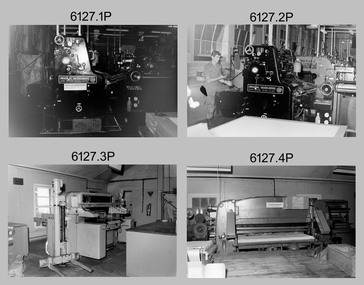
Photograph - Print Troop – Lithographic Squadron – Army Survey Regiment, Fortuna, Bendigo, 1986
... They are part of the Army Survey Regiment’s Collection. .1) - Photo, black & white, 1986, Original Heidelberg Printing Press. .2) - Photo, black & white, 1986, Original Heidelberg Printing Press, unidentified technician. .3) - Photo, black & white, 1986, Heavy-duty paper guillotine. .4) - Photo, black & white, 1986, Polygraph Heavy-duty paper guillotine. .5) - Photo, black & white, 1986, Newkoni Komori Printing Press .6) - Photo, black & white, 1986, Ultra-MAN-III Printing Press, Russ Mollenhauer. .7) - Photo, black & white, 1986, Print roller cleaning tank .8) - Photo, black & white, 1986, Planeta Polygraph Printing Press .9) - Photo, black & white, 1986, Planeta Polygraph Printing Press .10) - Photo, black & white, 1986, Roy Hicks, unidentified technician, Steve Egan, Dale Hudson. .11) and .12) - Photo, black & white, 1986, L to R: Paper drilling machine, wire stitcher. .13) - Photo, black & white, 1986, Map Despatch dock, Greg Rowe. .14) - Photo, black & white, 1986, Print area, Pear Andersen. .15) - Photo, black & white, 1986, Map Despatch dock, Pear Andersen. .16) - Photo, black & white, 1986, Map Despatch dock, .17) - Photo, black & white, 1986, Map Despatch dock, Russ Mollenhauer. .18) - Photo, black & white, 1986, Map Despatch dock, unidentified technician. .19) - Photo, black & white, 1986, Map Despatch dock. ...They are part of the Army Survey Regiment’s Collection. .1) - Photo, black & white, 1986, Original Heidelberg Printing Press. .2) - Photo, black & white, 1986, Original Heidelberg Printing Press, unidentified technician. .3) - Photo, black & white, 1986, Heavy-duty paper guillotine. .4) - Photo, black & white, 1986, Polygraph Heavy-duty paper guillotine. .5) - Photo, black & white, 1986, Newkoni Komori Printing Press .6) - Photo, black & white, 1986, Ultra-MAN-III Printing Press, Russ Mollenhauer. .7) - Photo, black & white, 1986, Print roller cleaning tank .8) - Photo, black & white, 1986, Planeta Polygraph Printing Press .9) - Photo, black & white, 1986, Planeta Polygraph Printing Press .10) - Photo, black & white, 1986, Roy Hicks, unidentified technician, Steve Egan, Dale Hudson. .11) and .12) - Photo, black & white, 1986, L to R: Paper drilling machine, wire stitcher. .13) - Photo, black & white, 1986, Map Despatch dock, Greg Rowe. .14) - Photo, black & white, 1986, Print area, Pear Andersen. .15) - Photo, black & white, 1986, Map Despatch dock, Pear Andersen. .16) - Photo, black & white, 1986, Map Despatch dock, .17) - Photo, black & white, 1986, Map Despatch dock, Russ Mollenhauer. .18) - Photo, black & white, 1986, Map Despatch dock, unidentified technician. .19) - Photo, black & white, 1986, Map Despatch dock. ...This collection of twenty photos was most likely taken in Lithographic Squadron, Army Survey Regiment, Fortuna, Bendigo in 1986. Print Troop’s technicians were most likely operating the Komoni, Planeta or Ultra-MAN-III offset printing presses and working in the map despatch dock. Although these photos are not annotated most personnel are positively identified.This is a set of twenty photographs of Print Troop personnel and equipment from Lithographic Squadron at the Army Survey Regiment, Fortuna, Bendigo, 1986. The photographs were on 35mm negative film and were scanned at 96 dpi. They are part of the Army Survey Regiment’s Collection. .1) - Photo, black & white, 1986, Original Heidelberg Printing Press. .2) - Photo, black & white, 1986, Original Heidelberg Printing Press, unidentified technician. .3) - Photo, black & white, 1986, Heavy-duty paper guillotine. .4) - Photo, black & white, 1986, Polygraph Heavy-duty paper guillotine. .5) - Photo, black & white, 1986, Newkoni Komori Printing Press .6) - Photo, black & white, 1986, Ultra-MAN-III Printing Press, Russ Mollenhauer. .7) - Photo, black & white, 1986, Print roller cleaning tank .8) - Photo, black & white, 1986, Planeta Polygraph Printing Press .9) - Photo, black & white, 1986, Planeta Polygraph Printing Press .10) - Photo, black & white, 1986, Roy Hicks, unidentified technician, Steve Egan, Dale Hudson. .11) and .12) - Photo, black & white, 1986, L to R: Paper drilling machine, wire stitcher. .13) - Photo, black & white, 1986, Map Despatch dock, Greg Rowe. .14) - Photo, black & white, 1986, Print area, Pear Andersen. .15) - Photo, black & white, 1986, Map Despatch dock, Pear Andersen. .16) - Photo, black & white, 1986, Map Despatch dock, .17) - Photo, black & white, 1986, Map Despatch dock, Russ Mollenhauer. .18) - Photo, black & white, 1986, Map Despatch dock, unidentified technician. .19) - Photo, black & white, 1986, Map Despatch dock. Peter Dillon, Mick Minchin. .20) - Photo, black & white, 1986, Map Despatch dock.No personnel are identifiedroyal australian survey corps, rasvy, army survey regiment, army svy regt, fortuna, asr, litho, printing -
 Bendigo Historical Society Inc.
Document - DRAINAGE PROBLEMS - MINERS SENSATIONAL EXPERIENCE AT THE VICTORIA QUARTZ
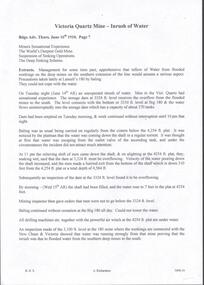
... Baling continued without cessation at the Big 180 all day and could not lower the water. Drilling machines etc and a powerful air winch at the 4254 ft plat are under water. ...Baling continued without cessation at the Big 180 all day and could not lower the water. Drilling machines etc and a powerful air winch at the 4254 ft plat are under water. ...Handwritten notes from a Bendigo Advertiser report, Thursday June 16th 1910. Management had for some time been apprehensive that the flooding in the deep mines to the south would affect them. Lansell's 180 took the precaution of baling. On the Tuesday night the men at the Victoria Quartz had a sensational experience. The storage dam at 3324 ft level receives the overflow from the flooded mines to the south. The level connects with the 3310 level at the Big 180. The water flows uninterrupted into thestorage dam which has a capacity of about 270 tanks. The dam had been emptied on Tuesday morning and work continued until 10 pm that night. The platman noticed that the water was coming down the shaft in a regular torrent. They didn't take much notice as they thought it was a leakinig outlet valve on the ascending tank. At 11 pm the releiving shift came down the shaft and said that the dam at 3,324 ft must be overflowing. The velocity of the water pouring down the shaft increased and the men made a hurried exit from the bottom of the shaft which is down 310 ft from the 4.254 ft plat (a total depth of 4,564 ft). An inspection of the dam at the 3324 ft level found it to be overflowing. By morning (Wednesday) the shaft had filled, and the water rose to 7 ft in the plat at 4254 feet. Mining inspector hgave orders that men were not to go below the 3324 ft level. Baling continued without cessation at the Big 180 all day and could not lower the water. Drilling machines etc and a powerful air winch at the 4254 ft plat are under water. An inspection made of the 3100 ft level at the 180 mine where the workings are connected with the New Chum & Victoria showed that water was running strongly from that mine proving that the inrush was due to flooded water from the southern deep mines to the south. Document from Albert Richardson Collection of mining history. Document from Albert Richardson Collection of mining history.document, gold, drainage problems, new chum drainage scheme, miners sensational experience at the victoria quartz, bendigo advertiser 16/6/1910 page7, lansell's 180, big 180, new chum & victoria -
 Federation University Historical Collection
Book, Ballarat School of Mines Students' Magazine, 1907-1909, 1907-9
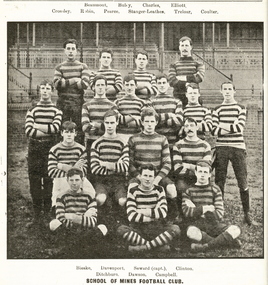
... Bradford * A holiday Trip to Queensland * The Compression of Air as Applied to Mining * Machine V Hand Drilling * The mining in the Malay States * William Thomas Grownow Obituary (includes image) * Timbering Stopes (Includes images) * Trip to Melbourne * Two Problems of Alluvial Mining by Richard Hain * The Berry Leads (includes plan of mines) * Black Pudding Supper * Observations for Meridian * NOtes on Coking Plants (includes plan) * How Old is the Earth * Conglomerations * A Pat Formula * The making of a Suitable Muffle for General Assay Work * Reduction of Gold Chloride by Charcoal * Chemical Definitions * Old Boys (R.J. ...Bradford * A holiday Trip to Queensland * The Compression of Air as Applied to Mining * Machine V Hand Drilling * The mining in the Malay States * William Thomas Grownow Obituary (includes image) * Timbering Stopes (Includes images) * Trip to Melbourne * Two Problems of Alluvial Mining by Richard Hain * The Berry Leads (includes plan of mines) * Black Pudding Supper * Observations for Meridian * NOtes on Coking Plants (includes plan) * How Old is the Earth * Conglomerations * A Pat Formula * The making of a Suitable Muffle for General Assay Work * Reduction of Gold Chloride by Charcoal * Chemical Definitions * Old Boys (R.J. ...Bound volume of the Ballarat School of Mines Students' Magazine for 1907-1909. Articles include the location and pegging of a tramway Route, the transmission of Power by Rope Driving by A.E.C. Kerr, A visit to the Briseis Mine, and New Brothers' Home, Mining Engineers in Tasmania, Obituaries for David Ham and Matthew Lyndsay, Pioneer Mining at Leichhardt, Automatic Ore Feeders and Chacedony Park by J.H. Adams. Images include the Ballarat School of Mines Football Team and the Ballarat School of Mines Sports Committee. 1907 * Hubert Krause 1908 * The location and Pegging of a Tramway Route by Yamba * The Unity of things by John Brittain * The transmission of power by Rope Driving, by A.E.C. Kerr * A visit to the Briseis Mine, and New Brothers' Home (includes photographs) * Mining Engineers in Tasmania * Limericks Sluiced at Snake Valley * David Ham Obituary * Matthew Lyndsay Obituary * Some Bunsen Memories by Professor Alfred Mica Smith * Geological Camp to Daylesford * Practical Mathematics by Hubert F. Hall * Pioneer Mining - Leickhardt * Automatic Ore Feeders * A Unique Ore Deposit (Lucknow Goldfield, NSW) * A country Ramble * The Alkaline Titration for Zinc * Chalcedony Park, Arizona, United States of America by J.H. Adams * Notetaking at Lectures * Smelter Cost-Keeping by Oliver E. Jaeger * Benefits of Physical Culture * Mineral Tasmania and its Wonderful Resources by F.F. Bradford * A holiday Trip to Queensland * The Compression of Air as Applied to Mining * Machine V Hand Drilling * The mining in the Malay States * William Thomas Grownow Obituary (includes image) * Timbering Stopes (Includes images) * Trip to Melbourne * Two Problems of Alluvial Mining by Richard Hain * The Berry Leads (includes plan of mines) * Black Pudding Supper * Observations for Meridian * NOtes on Coking Plants (includes plan) * How Old is the Earth * Conglomerations * A Pat Formula * The making of a Suitable Muffle for General Assay Work * Reduction of Gold Chloride by Charcoal * Chemical Definitions * Old Boys (R.J. Allen, W.B. Blyth, F. Brinsden, Lindsay D. Cameron, George W. Cornwell, John M. Currie, C.M. Harris, T. Wighton-Hood, W. Lakeland, W.S. Macartney, Fred A. Marriott, Karl B. Moore, G.E. Sander, Sherb. H. Sheppard, Norman S. Stuckby, John Sutherland, Lewis A. Westcott, Walter White, O.C. Witherden, Gerald Young) 1909 * The Graduates Problem * An Interesting Nevada Cyanide Plant (Bamberger De Lamar Gold Mines) * Easter Geological Camp to Ingliston * New Methods for the Volumetric Estimation of Lead * William Charles Kernott Obituary * Mount Morgan Mine by G.W. Williams * Tin Dredging at Tingha, New South Wales * Notes on the Iodide estimation of Copper * Photograph of the Ballarat School of Mines Students' Association Committee * The Importance of Mine Ventilation to the Students by F. Howells * Life in Mining Camp * Wise Words to Mining School Students * Military Search Lights * Gleaning s on resistance * Ministerial Visit to the Ballarat School of Mines by the Hon. A.A. Billson, Minister of Education , accompanied by Frank Tate, Director of Education. * Picture Making in Photography Composition * Mountains of Fire * A Walking Engine - New Military Machine - Guns into Action - Caterpillar No. 1. (Tank) * Fireless Locomotives * Elmore Concentrating Process (includes plan of Elmore Concentrator) * Mount Pani Limited * Surveying for Irrigation * Weights and Measures * Carbon Monoxide * Joseph Francis Usher obituary * The Problem of the Metalliferous Veins * Ballarat School of Mines Ambulance Class * Treatment of Gold in a battery Without the Use of Copper Plates by E.C. Hurdsfield * Meteorites * Werribee Gorge * Dredging in the Ovens Valley * Electrical Chatter - Electrocution by an Imaginary Eye-Witness * The Electric Furnace in Iron Metallurgy ballarat school of mines, ballarat school of mines football team, football, sports, tramway, mining engineers, david ham, matthew lyndsay, jack adams, berry lead, hepburn consuls, madame berry, west ristori, ristori no 1, allendale, dyke's co, charleson's mill, australian extended, mining, r.j. allen,, w.b. blyth, f. brinsden, lindsay d. cameron, george w. cornwell, john m. currie, c.m. harris, t. wighton-hood, w. lakeland, w.s. macartney, fred a. marriott, karl b. moore, g.e. sander, sherb. h. sheppard, norman s. stuckby, john sutherland, lewis a. westcott, walter white, o.c. witherden, gerald young, ballarat school of mines students' association, hubert krause, krause, vfl, afl -
 Flagstaff Hill Maritime Museum and Village
Domestic object - Sewing Machine, late 19th or early 20th century
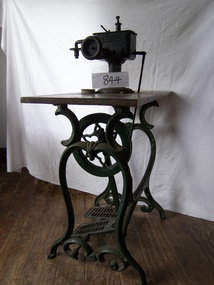
... machine, foot treadle, for sewing sails with box shape top and slim neck. Brand is Eclipse. Cast iron base is bolted to square wooden table-top with drawer under table. Drawer has 3 partitions and wood fitting with 5 drilled...machine, foot treadle, for sewing sails with box shape top and slim neck. Brand is Eclipse. Cast iron base is bolted to square wooden table-top with drawer under table. Drawer has 3 partitions and wood fitting with 5 drilled ...This Eclipse model, treadle operated sewing machine was made by the Oldham Sewing Machine Company in Greater Manchester U.K.. It was used by sailmakers for sewing sails with box shape top and slim neck. Sewing machine, foot treadle, for sewing sails with box shape top and slim neck. Brand is Eclipse. Cast iron base is bolted to square wooden table-top with drawer under table. Drawer has 3 partitions and wood fitting with 5 drilled holes for needle storage, lock has diamond shaped, decorative metal surrounds; half of inside drawer is painted black. Decorative metal stand, painted green, with 2 foot pedals; 1 foot pedal drives the wheel wheel. Padals both have "ECLIPSE" cast into the iron.flagstaff hill, warrnambool, shipwrecked-coast, flagstaff-hill, flagstaff-hill-maritime-museum, maritime-museum, shipwreck-coast, flagstaff-hill-maritime-village, textile machines, sailmaker's machine, maritime sewing machine -
 Flagstaff Hill Maritime Museum and Village
Drill Press, Champion Blower & Forge Co
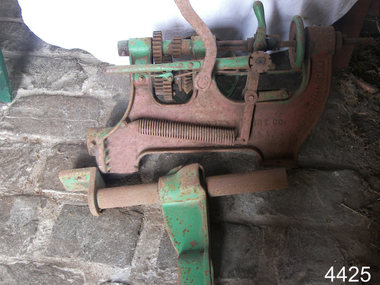
... drill belt driven with stand. Pat no 767.282.Aug.9.1804. Champion Blower & Forge Co USA. Painted red and green. Machine...drill belt driven with stand. Pat no 767.282.Aug.9.1804. Champion Blower & Forge Co USA. Painted red and green. Machine ...Bench drill belt driven with stand. Pat no 767.282.Aug.9.1804. Champion Blower & Forge Co USA. Painted red and green. Machine number No.201. large bench type. Circa 1900flagstaff hill, warrnambool, shipwrecked-coast, flagstaff-hill, flagstaff-hill-maritime-museum, maritime-museum, shipwreck-coast, flagstaff-hill-maritime-village, bench drill, champion blower & forge co -
 Federation University Historical Collection
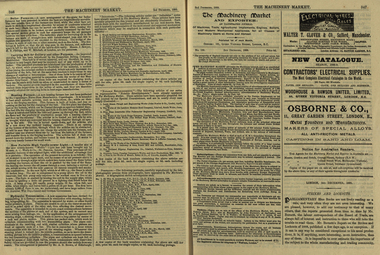
Newspaper, The Machinery Market, 02/12/1889
... s patent compound rope making machine bendh drilling machine steam launch bicycle well-boring tools A small illustrated journal with advertisements and pictures. pages 328-356 (and 26 pages of illustrated advertisements). ...It's assumed that this journal was read at the Ballarat School of MinesA small illustrated journal with advertisements and pictures. pages 328-356 (and 26 pages of illustrated advertisements). Illustrations include machinery, corn crushers, condensers, chlorination plants. stea, hammers, steam engines, steam pumps, lamps, saw bench, leather belting, casks, barrels, machinery, boiler, cohran and co, birkenhead, stern, cowles syndicate company, electric smelting works, aluminium manufacturing, w t glover and co, rope machine, steam travelling crane, webster wood fibre machine, automatic govenor expansion gear, international exhibition edinburgh, beacon light, air propeller, well boring tools and pumps, cochran and co.'s launch, tug and boat building yard, s.s. jeanette, cochran boiler, cochran and co's boiler shop, stern wheel steamer, s.s. esperanca, cowles syndicate co, milton, w.t. glover & co.'s patent compound rope making machine, bendh drilling machine, steam launch, bicycle, well-boring tools -
 Flagstaff Hill Maritime Museum and Village
Equipment - Dentist Drill, Late 19th century
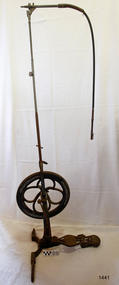
... Handmade steel burs or drills were introduced for dental handpieces, taking advantage of the significant increase in the speed of the drill. In 1891 the first machine-made steel burs were in use. ...Handmade steel burs or drills were introduced for dental handpieces, taking advantage of the significant increase in the speed of the drill. In 1891 the first machine-made steel burs were in use. ...The design of this and other similar treadle powered dental engine (or dentist drill) was in common use by dentists from the 1870’s into the 1920's. When electricity became accessible to most communities the electrically powered dental engines began to take over from the treadle power. Over the ages teeth were extracted using picks and scissors and other gouging instruments. Bow drills, hand drills and even a "bur thimble" drill were later used to prepare cavities for filling. Some drills were made bendable by attaching flexible shanks between the metal bur and the handle, giving access to the teeth at the back of the mouth. Other mechanical devices were introduced along the way, such as clockwork drills, but they were hard to handle and inefficient. Over the centuries “dentistry has been performed by priests, monks and other healers. This was followed by barbers; the barber’s chair may well have been the precursor to the dental chair. “(SA Medical Heritage Society Inc.) In 1871 James Morrison patented the first commercially manufactured 'foot treadle dental engine', the first practica dental engine although others had been introduced as early as 1790 (by John Greenwood). Handmade steel burs or drills were introduced for dental handpieces, taking advantage of the significant increase in the speed of the drill. In 1891 the first machine-made steel burs were in use. The treadle drill reduced the time to prepare a cavity from hours to less than ten minutes. In 1876 the Samuel S. White Catalogue of Dentist Instruments listed a 12 ½ inch wheel diameter dental engine, with 14 bright steel parts, for sale at US $55 In today’s market, this is the equivalent to US $1200 approx. The specifications of that dental engine are very similar to the this one in our Flagstaff Hill Maritime Village’s collection. It is interesting to note that workings of a similar treadle dentist drill were used and modified to power a treadle spinning wheel of one of the volunteer spinners at Flagstaff Hill Maritime Village. The foot treadle dental engine was a milestone in dental history. “Historic importance of treadle powered machines; they made use of human power in an optimal way” (Lowtech Magazine “Short history of early pedal powered machines”) The invention of a machine to speed up the process of excavation of a tooth lead to the invention of new burs and drills for the handpieces, improving speed and the surgical process of dentistry. They were the fore-runner of today’s electrically powered dental engines. This treadle-powered dentist drill, or dentist engine, is made of iron and steel and provides power for a mechanical dental hand-piece that would be fitted with a dental tool. The drill has a three footed cast iron base, one foot being longer than the other two. A vertical C shaped frame is joined into the centre of the base, holding an axle that has a driving-wheel (or flywheel) and connecting to a crank. A slender, shoulder height post, made from telescoping pipes, joins into the top of this frame and is height adjusted by a hand tightened screw with a round knob. On the post just above the frame is a short metal, horizontal bar (to hold the hand-piece when it is not in use). A narrow tubular arm is attached to the top of the stand at a right angle and can move up and down. At the end of the arm is a firmly fixed, flexible rubber hose protected for a short distance by a sheath of thin metal. At the end of the hose there is a fitting where the drill’s hand-piece would be attached; a small, silver coloured alligator clip is also at the end. A treadle, or foot pedal, is hinged to the heel to the long foot of the base, and joined at the toe to the crank that turns the driving-wheel. There is a spring under the toe of the treadle. The metal driving-wheel has a wide rim. Touching the inside of the rim are four tubular rings that bulge towards the outside of the driving-wheel, away from the pole, and all meet at the hub of the axle. The axle is bulbous between the inside of the driving-wheel and the frame then passes through the frame and is attached on the other side. The driving-wheel has a groove around which a belt would sit. The belt would also fit around a pulley on the arm, at the top of the post. The pulley is joined to a rod inside the arm and this spins the drill's hand-piece and dental tool holder. The two shorter feet of the base are made from a long metal bar that has been curved outwards, and its centre is bolted to the base of the pole. Under the ends of the curved legs of the base are wedge shaped feet. The driving-wheel is decorated in light coloured paint on both sides, each side having three sets of floral decals evenly spaced around them, and each about a sixth of the wheel's circumference. Similar decoration is along the sides of the frame. The foot pedal has decorative cutout patterns in the centre of the foot and at the toe. On the long foot of the stand is some lettering with a fine, light coloured border around it. The lettering is hard to read, being a dark colour and flaking off. There are also remnants of fine, light coloured flourishes. The foot pedal has lettering of the maker’s trade mark cast into the metal at the ball of the foot. Lettering on the base is peeling and difficult to read. The foot pedal has a trade mark cast into it that looks like a combination of ‘C’ , ‘S’ , ‘A’, ‘R’. flagstaff hill, warrnambool, shipwrecked coast, flagstaff hill maritime museum, maritime museum, shipwreck coast, flagstaff hill maritime village, great ocean road, dentist, teeth, dental drill, dental engine, treadle drill, foot powered drill, treadle engine, orthodontics, dental surgery, james morrison -
 Flagstaff Hill Maritime Museum and Village
Equipment - Dentist Drill, Late 19th century
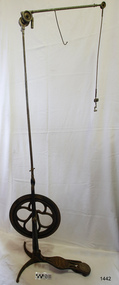
... Handmade steel burs or drills were introduced for dental handpieces, taking advantage of the significant increase in the speed of the drill. In 1891 the first machine-made steel burs were in use. ...Handmade steel burs or drills were introduced for dental handpieces, taking advantage of the significant increase in the speed of the drill. In 1891 the first machine-made steel burs were in use. ...The design of this and other similar treadle powered dental engine (or dentist drill) was in common use by dentists from the 1870’s into the 1920's. When electricity became accessible to most communities the electrically powered dental engines began to take over from the treadle power. Over the ages teeth were extracted using picks and scissors and other gouging instruments. Bow drills, hand drills and even a "bur thimble" drill were later used to prepare cavities for filling. Some drills were made bendable by attaching flexible shanks between the metal bur and the handle, giving access to the teeth at the back of the mouth. Other mechanical devices were introduced along the way, such as clockwork drills, but they were hard to handle and inefficient. Over the centuries “dentistry has been performed by priests, monks and other healers. This was followed by barbers; the barber’s chair may well have been the precursor to the dental chair. “(SA Medical Heritage Society Inc.) In 1871 James Morrison patented the first commercially manufactured 'foot treadle dental engine', the first practica dental engine although others had been introduced as early as 1790 (by John Greenwood). Handmade steel burs or drills were introduced for dental handpieces, taking advantage of the significant increase in the speed of the drill. In 1891 the first machine-made steel burs were in use. The treadle drill reduced the time to prepare a cavity from hours to less than ten minutes. In 1876 the Samuel S. White Catalogue of Dentist Instruments listed a 12 ½ inch wheel diameter dental engine, with 14 bright steel parts, for sale at US $55 In today’s market, this is the equivalent to US $1200 approx. The specifications of that dental engine are very similar to the this one in our Flagstaff Hill Maritime Village’s collection. It is interesting to note that workings of a similar treadle dentist drill were used and modified to power a treadle spinning wheel of one of the volunteer spinners at Flagstaff Hill Maritime Village. The foot treadle dental engine was a milestone in dental history. “Historic importance of treadle powered machines; they made use of human power in an optimal way” (Lowtech Magazine “Short history of early pedal powered machines”) The invention of a machine to speed up the process of excavation of a tooth lead to the invention of new burs and drills for the handpieces, improving speed and the surgical process of dentistry. They were the fore-runner of today’s electrically powered dental engines. This treadle-powered dentist drill, or dentist engine, is made of iron and steel and provides power for a mechanical dental handpiece that would be fitted with a dental tool. On the foot is painted lettering naming it "The Brentfield" and there is a fine line of light coloured paint creating a border around the name. The paint under the lettering is peeling off. The drill has a Y-shaped, three footed cast iron base, one foot being longer than the other two. A vertical frame is joined into the centre of the base, holding an axle that has a driving-wheel (or flywheel) and connecting to a crank. A slender, shoulder height post, made from adjustable telescoping pipes, joins into the top of this frame. On the post just above the frame is a short metal, horizontal bar (to hold the hand-piece when it is not in use). A narrow tubular arm is attached to the top of the stand at a right angle and can move up, down and around. There is a pulley each side of the joint of the arm and a short way along the arm is fitted a short metal pipe. A little further along the arm a frayed-ended cord hangs down from a hole. At the end of the arm is another pulley and a joint from which hangs a long, thin metal pipe with two pulleys and a fitting on the end. A treadle, or foot pedal, is joined to the long foot of the base, and joined at the toe to the crank that turns the driving-wheel. The metal driving-wheel has a wide rim. Touching the inside of the rim are four tubular rings that bulge towards the outside of the driving-wheel, away from the pole, and all meet at the hub of the axle. The axle fits between the inside of the driving-wheel and the frame then passes through the frame and is attached on the other side. The driving-wheel has a groove around which a belt would sit. The belt would also fit around a pulley on the arm, at the top of the post. The pulley is joined to a rod inside the arm and this spins the drill's hand-piece and dental tool holder. The foot pedal has a cross-hatch pattern on the heel and the ball of the foot has tread lines across it. The end of the toe and the instep areas have cut-out pattern in them. "The ____/ Brentfield / __ DE IN L___" (Made in London) painted on the long foot of the base. Marked on the drill connection is “Richter De Trey, Germany”flagstaff hill, warrnambool, shipwrecked coast, flagstaff hill maritime museum, maritime museum, shipwreck coast, flagstaff hill maritime village, great ocean road, dentist, teeth, dental drill, dental engine, treadle drill, foot powered drill, treadle engine, orthodontics, dental surgery, james morrison, the brentfield, richter de trey, german dental fitting, london dental drill -
 Flagstaff Hill Maritime Museum and Village
Book - Instruction Manual, British War Office, Manual of Siege and Garrison Artillery Exercises Vol 1, ca 24-06-1882
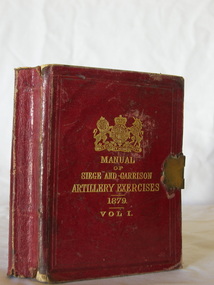
... The four parts included in this Volume I are: - Part 1 - Gunnery Part 2 - Ammunition Part 3 - Siege Artillery Part 4 - Garrison Gun Drills The remaining six of then parts are: - Part 5 - Material and Appliances Part 6 - Elementary Instruction Part 7 - Machines Part 8 - Mounting and Dismounting Ordnance Part 9 - Sleighs Part 10 - Sheers and Derricks...The four parts included in this Volume I are: - Part 1 - Gunnery Part 2 - Ammunition Part 3 - Siege Artillery Part 4 - Garrison Gun Drills The remaining six of then parts are: - Part 5 - Material and Appliances Part 6 - Elementary Instruction Part 7 - Machines Part 8 - Mounting and Dismounting Ordnance Part 9 - Sleighs Part 10 - Sheers and Derricks The book is significant to both British and Australian history, being issued for the training of the garrison defense of both countries in the late 10th Century. ...This little book has been designed to fit into a small space such as a pocket, backpack or trunk. The brass book lock helps keep the pages and covers together, preserving them from being bent, torn or damaged in handling.The book includes four of ten parts of the Manual, published for use in training the garrison troops, including the placement and firing of cannon. The four parts included in this Volume I are: - Part 1 - Gunnery Part 2 - Ammunition Part 3 - Siege Artillery Part 4 - Garrison Gun Drills The remaining six of then parts are: - Part 5 - Material and Appliances Part 6 - Elementary Instruction Part 7 - Machines Part 8 - Mounting and Dismounting Ordnance Part 9 - Sleighs Part 10 - Sheers and DerricksThe book is significant to both British and Australian history, being issued for the training of the garrison defense of both countries in the late 10th Century. It is also significant for its connection with other historical military items within the Collection at Flagstaff Hill Maritime Museum and Village.Manual of Siege and Garrison Artillery Exercises Vol 1 [Parts I, II, III, IV] Publisher Her Majestys Stationery Office Date 1879, Corrected June 24th 1882 Small, red, hard-cover book with embossed gold letters and British Coat of Arms on the front. The book has a brass closure or locking clip across the text block. There are diagrams and a foldout table within the text. flagstaff hill, flagstaff hill maritime museum and village, warrnambool, maritime museum, maritime village, great ocean road, shipwreck coast, training manual, book, british garrison, garrison artillery, siege exercises, british government training book, technical book, pocket book, manual of siege and garrison artillery exercises vol 1, garrison exercises, military training, defense training, british artillery, royal artillery, gunnery, gun drill, brass book lock, british war office, locking clip, reference book
