
Showing 10 items matching "majorca street"
-
 Sunshine and District Historical Society Incorporated
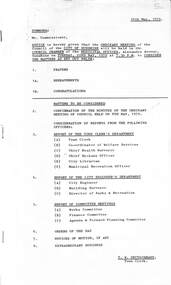
Administrative record - City of Sunshine - Commissioner Mr Alexander Alex George Gillon Collection 1976 - 1982 - Notice of ordinary meeting of the council 22nd May 1979, City of Sunshine, 16th May 1979
... ...Majorca Street...MacTaggart (Victoria) Pty Ltd Maria Street Laverton North Town and Country Planning and Health Act Objections Offensive Trades Report of the Chief By-Laws Officer Proposed No Standing Area Majorca Street St. Albans Proposed No Standing Area Martin Street Sunshine Report of the City Librarian Australian Olympic Team Fund Report of the City Engineer & Planner Planning Permit Community Health Centre Andrea Street St. ...MacTaggart (Victoria) Pty Ltd Maria Street Laverton North Town and Country Planning and Health Act Objections Offensive Trades Report of the Chief By-Laws Officer Proposed No Standing Area Majorca Street St. Albans Proposed No Standing Area Martin Street Sunshine Report of the City Librarian Australian Olympic Team Fund Report of the City Engineer & Planner Planning Permit Community Health Centre Andrea Street St. ...Notice of Ordinary Meeting of the Council 22nd May 1979 Report of the Town Clerk's Department Report of the Town Clerk Interim Report The Role of Local Government in Victoria Activities of the Municipal Association of Victoria Propose Lease Extension Tottenham Technical School 27 Duke Street Rate Recovery Sale 2nd December 1979 Land Transfer Fairbairn Road Widening Proposed Purchase of Land Station Road for Multi-Functional Building Local Authorities Superannuation Scheme Report of the Co-Ordinator of Welfare Services Teenage Holiday Programme Australian National Youth Workers' Conference Freemantle Western Australia 18th to 24th July 1979 Family and Community Service Program Election to Committee Concessions for Telephone Installation and Rental for Pensioners Residential Tenancies Bill Braybrook Pre-School Child Care Facility Cherry Crescent Braybrook Early Childhood Development Programme Braybrook Maidstone Housing Commission Liaison Committee Report of the Chief Health Surveyor Health Act registrations for 1979 Application for Transfer of Proprietorship of Premises under the Health Act J.L. MacTaggart (Victoria) Pty Ltd Maria Street Laverton North Town and Country Planning and Health Act Objections Offensive Trades Report of the Chief By-Laws Officer Proposed No Standing Area Majorca Street St. Albans Proposed No Standing Area Martin Street Sunshine Report of the City Librarian Australian Olympic Team Fund Report of the City Engineer & Planner Planning Permit Community Health Centre Andrea Street St. Albans Planning Permit Application Temporary Child Care Centre Andrea Street St. Albans Planning Permit Application Sky Sign Lot 8 Churchill Avenue Braybrook Planning Permit Application Service Premises & Caretaker's Dwelling Lots 317 & 318 Dover Street Albanvale Planning Permit Three Factories Lot 67 Somerville Road South West Corner of McDonald Road Brooklyn Planning Permit Application Hairdressing Salon Service Premise and Caretaker's Dwelling Lot 1 Ballarat Road Planning Permit Application Travel Agency Shop 1A Lot 3 Princess Street St. Albans Planning Permit Application Small Panel Sign Lot 4 McIntyre Road Sunshine North Planning Permit Application Display Homes Lots 1, 2, 3, 4, 5 & 6 Camelot Drive South East Corner Main Road West Albanvale Planning Permit Application Alterations to Shops Lots 1 & 2 Ballarat Road Deer Park Planning Permit Application Motor Workshop Lot 1 McIntyre Road Sunshine North Planning Permit Application Medical Consulting Room and Residence Lot 1 Ballarat Road South West Corner of Burnside Street Deer Park Planning Permit Application New Offices and Showrooms Railway Lot 24 North West Corner of Berkshire Road and Steers Street Sunshine North Strata Subdivision 5 & 7 Craddock Court Sunshine North Plan of Subdivision Westerngate Estate Subdivision Westerngate Estate Stage 1A Subdivision Consolidation of Title 811 - 811A Ballarat Road Deer Park Cancellation of Easement St. Albans Road Abutting Gilmour Road Sunshine North Strata Subdivision 101 Ballarat Road Maidstone Strata Subdivision 1 & 3 Craddock Court Sunshine North Replacement of Ford Falcon Utilities and Station Wagons Boring Operations by Melbourne & Metropolitan Board of Works Station Road, Gladstone Street & Washington Street St. Albans Relocation of Public Telephone Outside 38A Melton Street to between 26 & 28 Melon Street Braybrook Sewerage Facilities Declaration of Sewerage Area No 3760 Noxious Trades Outfall Sewer Replacement Lacy Street, Ballarat Road & Ashley Street, Braybrook and Thomson Street, Burns Street & Studley Street Maidstone Sewerage Facilities Council Reserve Larisa Road St. Albans Infant Welfare Centre Alexandra Avenue Sunshine Castley Hall in Poor Condition Exterior Security Lighting Central Library and Infant Welfare Centre Report of the Building Surveyor Building Over Easement 144 Murray Street Ardeer Building Over Easement 4 Tania Street Sunshine North Building Over Easement Lots 77, 78 & 79 Somers Street Sunshine North Siting of Building 39 Dunbar Avenue Sunshine Siting of Building 4 Norma Street Sunshine Building on Flood Prone Land 27 Navigator Street Maribyrnong Building on Flood Prone Land Lot 18 Riverview Court Maribyrnong Installation of Underground Tanks 3 Millers Road Brooklyn Installation of Underground Tanks Corner Ballarat Road and Lacy Street Braybrook Uniform Building Regulations Enforcement Staff Needs Report of the Director of Parks & Recreations Winslow Crescent Application to Use Land Bon Thomas Child Care Centre Landscaping Quotes Orders of the Day Accounts Submitted for Payment as at 30th April 1979 Uniform Building Regulations Enforcement Staff Needs Confirmation of Loan with the Melbourne & Metropolitan Board of Workstottenham technical school, duke street, sunshine, station road, deer park, south road, braybrook, braybrook pre-school childcare centre, cherry crescent, braybrook maidstone housing commission liaison committee, j.l. mactaggart, maria street, laverton north, majorca street, st. albans, martin street, andrea street, andrea street community health care centre, churchill avenue, dover street, albanvale, somerville road, mcdonald road, brooklyn, ballarat road, princess street, mcintyre road, sunshine north, camelot drive, main road west, burnside street, berkshire road, steers street, craddock court, maidstone, gladstone street, washington street, melton street, lacy street, ashley street, thomson street, burns street, studley street, larisa reserve, larisa road, alexandra avenue infant welfare centre, alexandra avenue, castley hall, simmie street, sunshine west, murray street, ardeer, tania street, somers street, dunbar avenue, norma street, navigator street, riverview court, maribyrnong, millers road, bon thomas child care centre, quinn street -
 Sunshine and District Historical Society Incorporated
Administrative record - City of Sunshine - Commissioner Mr Alexander Alex George Gillon Collection 1976 - 1982 - Minutes of the ordinary meeting of council held on 22nd May 1979, City of Sunshine, 22nd May 1979
... ...Majorca Street...MacTaggart (Victoria) Pty Ltd Maria Street Laverton North Town and Country Planning and Health Act Objections Offensive Trades Report of the Chief By-Laws Officer Proposed No Standing Area Majorca Street St. Albans Proposed No Standing Area Martin Street Sunshine Report of the City Librarian Australian Olympic Team Fund Report of the City Engineer & Planner Planning Permit Community Health Centre Andrea Street St. ...MacTaggart Maria Street Laverton North Majorca Street St. Albans Martin Street Andrea Street Community Health Care Centre Andrea Street Churchill Avenue Dover Street Albanvale Somerville Road McDonald Road Brooklyn Princess Street McIntyre Road Sunshine North Camelot Drive Main Road West Ballarat Road Burnside Street Berkshire Road Steers Street Craddock Court St. ...Minutes of the Ordinary Meeting of Council held on 22nd May 1979 Report of the Town Clerk's Department Report of the Town Clerk Interim Report The Role of Local Government in Victoria Activities of the Municipal Association of Victoria Propose Lease Extension Tottenham Technical School 27 Duke Street Rate Recovery Sale 2nd December 1979 Land Transfer Fairbairn Road Widening Proposed Purchase of Land Station Road for Multi-Functional Building Local Authorities Superannuation Scheme Report of the Co-Ordinator of Welfare Services Teenage Holiday Programme Australian National Youth Workers' Conference Freemantle Western Australia 18th to 24th July 1979 Family and Community Service Program Election to Committee Concessions for Telephone Installation and Rental for Pensioners Residential Tenancies Bill Braybrook Pre-School Child Care Facility Cherry Crescent Braybrook Early Childhood Development Programme Braybrook Maidstone Housing Commission Liaison Committee Report of the Chief Health Surveyor Health Act registrations for 1979 Application for Transfer of Proprietorship of Premises under the Health Act J.L. MacTaggart (Victoria) Pty Ltd Maria Street Laverton North Town and Country Planning and Health Act Objections Offensive Trades Report of the Chief By-Laws Officer Proposed No Standing Area Majorca Street St. Albans Proposed No Standing Area Martin Street Sunshine Report of the City Librarian Australian Olympic Team Fund Report of the City Engineer & Planner Planning Permit Community Health Centre Andrea Street St. Albans Planning Permit Application Temporary Child Care Centre Andrea Street St. Albans Planning Permit Application Sky Sign Lot 8 Churchill Avenue Braybrook Planning Permit Application Service Premises & Caretaker's Dwelling Lots 317 & 318 Dover Street Albanvale Planning Permit Three Factories Lot 67 Somerville Road South West Corner of McDonald Road Brooklyn Planning Permit Application Hairdressing Salon Service Premise and Caretaker's Dwelling Lot 1 Ballarat Road Planning Permit Application Travel Agency Shop 1A Lot 3 Princess Street St. Albans Planning Permit Application Small Panel Sign Lot 4 McIntyre Road Sunshine North Planning Permit Application Display Homes Lots 1, 2, 3, 4, 5 & 6 Camelot Drive South East Corner Main Road West Albanvale Planning Permit Application Alterations to Shops Lots 1 & 2 Ballarat Road Deer Park Planning Permit Application Motor Workshop Lot 1 McIntyre Road Sunshine North Planning Permit Application Medical Consulting Room and Residence Lot 1 Ballarat Road South West Corner of Burnside Street Deer Park Planning Permit Application New Offices and Showrooms Railway Lot 24 North West Corner of Berkshire Road and Steers Street Sunshine North Strata Subdivision 5 & 7 Craddock Court Sunshine North Plan of Subdivision Westerngate Estate Subdivision Westerngate Estate Stage 1A Subdivision Consolidation of Title 811 - 811A Ballarat Road Deer Park Cancellation of Easement St. Albans Road Abutting Gilmour Road Sunshine North Strata Subdivision 101 Ballarat Road Maidstone Strata Subdivision 1 & 3 Craddock Court Sunshine North Replacement of Ford Falcon Utilities and Station Wagons Boring Operations by Melbourne & Metropolitan Board of Works Station Road, Gladstone Street & Washington Street St. Albans Relocation of Public Telephone Outside 38A Melton Street to between 26 & 28 Melon Street Braybrook Sewerage Facilities Declaration of Sewerage Area No 3760 Noxious Trades Outfall Sewer Replacement Lacy Street, Ballarat Road & Ashley Street, Braybrook and Thomson Street, Burns Street & Studley Street Maidstone Sewerage Facilities Council Reserve Larisa Road St. Albans Infant Welfare Centre Alexandra Avenue Sunshine Castley Hall in Poor Condition Exterior Security Lighting Central Library and Infant Welfare Centre Report of the Building Surveyor Building Over Easement 144 Murray Street Ardeer Building Over Easement 4 Tania Street Sunshine North Building Over Easement Lots 77, 78 & 79 Somers Street Sunshine North Siting of Building 39 Dunbar Avenue Sunshine Siting of Building 4 Norma Street Sunshine Building on Flood Prone Land 27 Navigator Street Maribyrnong Building on Flood Prone Land Lot 18 Riverview Court Maribyrnong Installation of Underground Tanks 3 Millers Road Brooklyn Installation of Underground Tanks Corner Ballarat Road and Lacy Street Braybrook Uniform Building Regulations Enforcement Staff Needs Report of the Director of Parks & Recreations Winslow Crescent Application to Use Land Bon Thomas Child Care Centre Landscaping Quotes Orders of the Day Accounts Submitted for Payment as at 30th April 1979 Uniform Building Regulations Enforcement Staff Needs Confirmation of Loan with the Melbourne & Metropolitan Board of Works Extraordinary Business Report of the Town Clerk Election of Council Representative Metropolitan Fire Brigade's Boardtottenham technical school, duke street, sunshine, station road, deer park, south road, braybrook, braybrook pre-school child care facility, cherry crescent, j.l. mactaggart, maria street, laverton north, majorca street, st. albans, martin street, andrea street community health care centre, andrea street, churchill avenue, dover street, albanvale, somerville road, mcdonald road, brooklyn, princess street, mcintyre road, sunshine north, camelot drive, main road west, ballarat road, burnside street, berkshire road, steers street, craddock court, st. albans road, gilmour road, maidstone, gladstone street, washington street, melton street, lacy street, ashley street, thomson street, burns street, studley street, laris reserve, larisa road, alexandra avenue infant welfare centre, alexandra avenue, castley hall, simmie street, sunshine west, murray street, ardeer, tania street, somers street, dunbar avenue, norma street, navigator street, riverview court, maribyrnong, millers road, bon thomas child care centre, quinn street -
 Federation University Historical Collection
Book, Historic Sites Survey: North Central Study Area, 1979, 1979
... The North Central Study Area included the Shires of Avoca, Bet Bet, east Loddon, Goulburn, Untly, Kara Kara, Korong, Maldon, Marong, Metcalfe, McIvor, Newstead, Strathfieldsaye, Stawell, Talbot, Clunes, Tullaroop and Waranga. castlemaine mount alexander goldfield maldon percydale warrenmang moliagul tarnagulla stuart mill the whipstick whroo rushworth graytown ironbark forest st arnoaud new bendigo landsborough inglewood kurting wedderburn wehla kooroora langham flat mcintyre rheola diamond hill fosterville coliban water works green gully newstead muckleford forest costerfield graytown bailieston waranga irrigaiton system eucalyptus distillery mia mia bridge korokubeal township researce concegella slate quarry chewton fryerstown kingower timor talbot majorca carisbroook clunes st arnaud taradale icomos dunolly limestone castlemaine slate quarry harcourt granite taradale railway viaduct loddon united waterworks trust gouldburn weir carisbrook lock-up history of tree planting in streets history of public reserves r.u. nicholls nurseryman thomas lang francis moss ballarat botanical gardens ballarat school of mines botanical gardens lake wendouree victoria park, ballarat muont holled smith ballaarat old cemetery planting eastern oval ballarat east botanical gardens ballarat east town hall gardens eureka stockade reserve ballarat observatory plantings yarrowee creek plantings yarrowee bluestone channels ballarat woollen mill band and albion mullock heap black hill plantings yarrowee creek channels canadian creek channel specimen vale channel poverty point reserve union jack reserve buninyong imperial mine, buninyong victoria street plantings bridge mall sturt street gardens ballarat avenue of honour plantings white flat oval plantings camp street elms burnt creek 153 page book with white plastic binding. ...The North Central Study Area included the Shires of Avoca, Bet Bet, east Loddon, Goulburn, Untly, Kara Kara, Korong, Maldon, Marong, Metcalfe, McIvor, Newstead, Strathfieldsaye, Stawell, Talbot, Clunes, Tullaroop and Waranga. 153 page book with white plastic binding. It is an historic sites survey for the North Central Study Area commissioned by the Land Conservation Council, the Ministry for COnservation and the Australian Heritage Commission. castlemaine, mount alexander goldfield, maldon, percydale, warrenmang, moliagul, tarnagulla, stuart mill, the whipstick, whroo, rushworth, graytown ironbark forest, st arnoaud, new bendigo, landsborough, inglewood, kurting, wedderburn, wehla, kooroora, langham flat, mcintyre, rheola, diamond hill, fosterville, coliban water works, green gully, newstead, muckleford forest, costerfield, graytown, bailieston, waranga irrigaiton system, eucalyptus distillery, mia mia bridge, korokubeal township researce, concegella slate quarry, chewton, fryerstown, kingower, timor, talbot, majorca, carisbroook, clunes, st arnaud, taradale, icomos, dunolly, limestone, castlemaine slate quarry, harcourt granite, taradale railway viaduct, loddon united waterworks trust, gouldburn weir, carisbrook lock-up, history of tree planting in streets, history of public reserves, r.u. nicholls nurseryman, thomas lang, francis moss, ballarat botanical gardens, ballarat school of mines botanical gardens, lake wendouree, victoria park, ballarat, muont holled smith, ballaarat old cemetery planting, eastern oval, ballarat east botanical gardens, ballarat east town hall gardens, eureka stockade reserve, ballarat observatory plantings, yarrowee creek plantings, yarrowee bluestone channels, ballarat woollen mill, band and albion mullock heap, black hill plantings, yarrowee creek channels, canadian creek channel, specimen vale channel, poverty point reserve, union jack reserve buninyong, imperial mine, buninyong, victoria street plantings, bridge mall, sturt street gardens, ballarat avenue of honour plantings, white flat oval plantings, camp street, elms, burnt creek -
 Flagstaff Hill Maritime Museum and Village
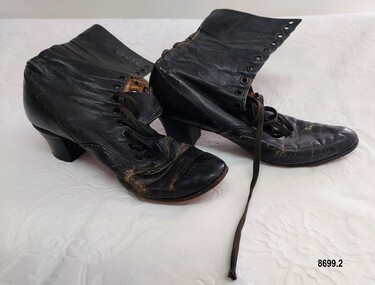
Footwear - Leather boots, Adler Boots and Shoes, circa 1920
... Street, Kensington, Melbourne. Matthew Stephenson (1861 – 1943) who had grown up on the Bendigo goldfields and shifted to Melbourne in the early 1900’s was a train driver and later, a fireman with the railways. His wife Elizabeth Jane (Betsy) Wigley (1865 – 1953) also grew up on the goldfields around Majorca...Street, Kensington, Melbourne. Matthew Stephenson (1861 – 1943) who had grown up on the Bendigo goldfields and shifted to Melbourne in the early 1900’s was a train driver and later, a fireman with the railways. His wife Elizabeth Jane (Betsy) Wigley (1865 – 1953) also grew up on the goldfields around Majorca ...This item is one of a collection of clothing items that belonged to the Stephenson family who lived at 22 McCracken Street, Kensington, Melbourne. Matthew Stephenson (1861 – 1943) who had grown up on the Bendigo goldfields and shifted to Melbourne in the early 1900’s was a train driver and later, a fireman with the railways. His wife Elizabeth Jane (Betsy) Wigley (1865 – 1953) also grew up on the goldfields around Majorca and Bendigo. They married in 1885 in Bendigo. They had two daughters – Ethel Evelyn Stephenson (1886 – 1956) and Lillian or Lila (1891 – 1977) who were milliners and dressmakers and who continued to live in the family home after the death of their parents. The family are recorded as living at 22 McCracken Street, Kensington, as early as 1914. It is not known who made or owned the clothing that makes up this collection but as it appears to be from the late Victorian and early Edwardian era, the different pieces were probably made and worn by any of the three ladies of the house – Betsy, Ethel and/or Lila. During W.W.2, a local Warrnambool couple (Meryl and Tony Everard) boarded with them – Tony was in the airforce training paratroopers to jump into (and survive) enemy territory and his wife Meryl worked in the Methodist baby Home. The Everards developed a close friendship with the Stephensons and were responsible for clearing out the house (and finding this clothing collection) after Lila died in 1977. Starting in around 1850, women began wearing boots that resembled the ones already worn by men in high society. Victorian women's boots were slightly more feminine in nature, however, than those worn by their male counterparts. The boots first worn by women extended to the middle of the calf so that her ankle would stay properly covered underneath her many skirts. These boots often featured laces or a row of buttons to keep them secure to the foot and ankle. Although usually made from durable materials like rubber and leather, boots that were worn purely for fashion were sometimes made of more elegant materials like patent leather or dyed suede. Edwardian boots were lace up or button up. The most remarkable thing about women's shoes in the 1920's was that they were visible! This led to an increase in demand for new styles every season which made ordering custom fit shoes a thing of the past. New shoes were made in standard sizes, ready to buy from local clothing stores or mail order catalogues. Working women, however, tended to wear sensible, lace up shoes and boots. These boots appear to be of a practical nature, designed for comfort, warmth, and proof against the rain and mud, rather than high fashion. They feature the brand name "adler" printed on the inner sole and have stamped letters and numbers suggesting ready-made sizes.This pair of boots are a significant example of a working woman's footwear dating around the early 20th century.Pair of lady's black leather, lace up boots featuring 3.75 cm heels, 14 pairs of lacing eyelets, a black leather tongue and black shoelaces. The leather soles have tacks on the heels and near the instep. The boots have a black leather inner sole and the inner shaft and upper part of the boots are lined with a durable cotton type fabric. Both boots have ink markings (handwritten and stamped) at the top of the shaft lining and the inner sole of the left hand boot is labelled "adler".Both boots - "0/128 /X" (handwritten) and "6MC200" (stamped). Left boot inner sole - "adler" left boot upper shaft lining - "X/8FH?" (handwritten)flagstaff hill maritime museum and village, great ocean road, shipwreck coast, warrnambool, boots, lady's boots, footwear, leather boots, lace up boots, adler, stephenson family -
 Flagstaff Hill Maritime Museum and Village
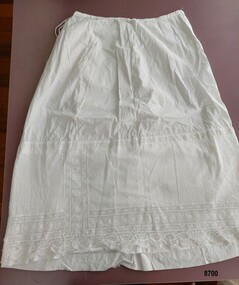
Textile - Petticoat, circa 1900
... Street, Kensington, Melbourne. Matthew Stephenson (1861 – 1943) who had grown up on the Bendigo goldfields and shifted to Melbourne in the early 1900’s was a train driver and later, a fireman with the railways. His wife Elizabeth Jane (Betsy) Wigley (1865 – 1953) also grew up on the goldfields around Majorca...Street, Kensington, Melbourne. Matthew Stephenson (1861 – 1943) who had grown up on the Bendigo goldfields and shifted to Melbourne in the early 1900’s was a train driver and later, a fireman with the railways. His wife Elizabeth Jane (Betsy) Wigley (1865 – 1953) also grew up on the goldfields around Majorca ...This item is one of a collection of clothing items that belonged to the Stephenson family who lived at 22 McCracken Street, Kensington, Melbourne. Matthew Stephenson (1861 – 1943) who had grown up on the Bendigo goldfields and shifted to Melbourne in the early 1900’s was a train driver and later, a fireman with the railways. His wife Elizabeth Jane (Betsy) Wigley (1865 – 1953) also grew up on the goldfields around Majorca and Bendigo. They married in 1885 in Bendigo. They had two daughters – Ethel Evelyn Stephenson (1886 – 1956) and Lillian or Lila (1891 – 1977) who were milliners and dressmakers and who continued to live in the family home after the death of their parents. The family are recorded as living at 22 McCracken Street, Kensington, as early as 1914. It is not known who made or owned the clothing that makes up this collection but as it appears to be from the late Victorian and early Edwardian era, the different pieces were probably made and worn by any of the three ladies of the house – Betsy, Ethel and/or Lila. During W.W.2, a local Warrnambool couple (Meryl and Tony Everard) boarded with them – Tony was in the airforce training paratroopers to jump into (and survive) enemy territory and his wife Meryl worked in the Methodist baby Home. The Everards developed a close friendship with the Stephensons and were responsible for clearing out the house (and finding this clothing collection) after Lila died in 1977. A petticoat is a lady's undergarment - worn under a skirt or dress. They provided warmth, modesty and shape to the dress. In the middle of the 19th century, petticoats were worn over hoops, bustles or in layers. Petticoats varied according to the style of the outside skirt or dress. Plain petticoats tended to be worn with everyday wear whilst better dresses (party dresses or silk gowns) were worn with petticoats that often had more trim and embellishments. Edwardian petticoats had less volume than Victorian era petticoats and they had a "dust ruffle" or lining under a lace flounce. The "dust ruffle" protected the lace flounce and gave the petticoat more flare at the bottom, greater freedom when walking as well as saving the flounce (which was often made of finer material) from everyday wear and tear. Tucks are another feature of Edwardian petticoats - when the lace at the bottom became worn, it could be cut off and the tucks released. This extended the life of the petticoat. This petticoat features an intricate trim of broderie anglaise. Although broderie anglaise was a lace that could be made by hand, it was very time consuming to make. St Gallen was a city in Switzerland that had become known for producing quality textiles. At the beginning of the 19th century, the first embroidery machines were developed in St Gallen. Factories used embroidery machines but people also had them in their homes. They were able to produce broderie anglaise for export. By the early 20th century, machine made lace, fabric, ribbons etc. were being sold in drapers shops all over England and Wales to women who were making clothes and furnishings for their families. It is highly likely that the lady who made this petticoat brought the lengths of broderie anglaise already made to embellish and personalise her petticoat.This item is an example of the needlework skills of women in the late 19th century - creating pintucks and adding lace to personalise and embellish a practical item of clothing. A lady's fine cotton and lace ankle length petticoat featuring a deep decorative hem made from sheer pinspot fabric and bands of eyelet lace. The top section of the petticoat is made from five sections of fine cotton sewn together with french seams and gathered with pleats and darts into the waistband. The waistband opening has two button holes and one button (the top button is missing) and a front section with a drawstring. The lace hem is lined with the same fine cotton as the top of the petticoat. There are three different lace bands - a narrow one featuring small flowers, a similar wider band with larger flowers and it is finished at the bottom with a broad band of lace with an intricate leaf design.flagstaff hill maritime museum and village, great ocean road, warrnambool, shipwreck coast, petticoat, lady's petticoat, broderie anglaise, decorative petticoat, draw string waist, machine sewn, dressmaker, stephenson family, pintucks, needlework -
 Flagstaff Hill Maritime Museum and Village
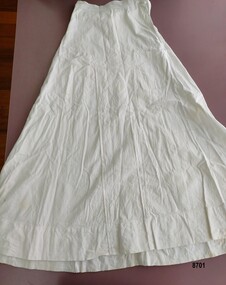
Textile - Overskirt, circa 1910
... Street, Kensington, Melbourne. Matthew Stephenson (1861 – 1943) who had grown up on the Bendigo goldfields and shifted to Melbourne in the early 1900’s was a train driver and later, a fireman with the railways. His wife Elizabeth Jane (Betsy) Wigley (1865 – 1953) also grew up on the goldfields around Majorca...Street, Kensington, Melbourne. Matthew Stephenson (1861 – 1943) who had grown up on the Bendigo goldfields and shifted to Melbourne in the early 1900’s was a train driver and later, a fireman with the railways. His wife Elizabeth Jane (Betsy) Wigley (1865 – 1953) also grew up on the goldfields around Majorca ...This item is one of a collection of clothing items that belonged to the Stephenson family who lived at 22 McCracken Street, Kensington, Melbourne. Matthew Stephenson (1861 – 1943) who had grown up on the Bendigo goldfields and shifted to Melbourne in the early 1900’s was a train driver and later, a fireman with the railways. His wife Elizabeth Jane (Betsy) Wigley (1865 – 1953) also grew up on the goldfields around Majorca and Bendigo. They married in 1885 in Bendigo. They had two daughters – Ethel Evelyn Stephenson (1886 – 1956) and Lillian or Lila (1891 – 1977) who were milliners and dressmakers and who continued to live in the family home after the death of their parents. The family are recorded as living at 22 McCracken Street, Kensington, as early as 1914. It is not known who made or owned the clothing that makes up this collection but as it appears to be from the late Victorian and early Edwardian era, the different pieces were probably made and worn by any of the three ladies of the house – Betsy, Ethel and/or Lila. During W.W.2, a local Warrnambool couple (Meryl and Tony Everard) boarded with them – Tony was in the airforce training paratroopers to jump into (and survive) enemy territory and his wife Meryl worked in the Methodist baby Home. The Everards developed a close friendship with the Stephensons and were responsible for clearing out the house (and finding this clothing collection) after Lila died in 1977. This overskirt is an outer protective garment made of durable cotton and was probably worn over a lady's skirt or dress to protect it whilst they were working. The pockets are large enough for the wearer to keep small items in and there is a loop at the back that would allow the wearer to hang it on a hook, when she finished her work. This item is an example of clothing worn by working women in the late 19th and early 20th centuryA heavy cotton ankle length overskirt made with two wide gored sections containing inset pockets joined to a middle T shaped front band. It has a waistband of grosgrain ribbon and a side opening with 3 pairs of metal snaps (one pair is missing) and a hook and eye at the top. The waistband also has a taped loop (for hanging) and an unusual double fabric overlay with unattached curved ends.flagstaff hill maritime museum and village, great ocean road, shipwreck coast, warrnambool, overskirt, needlework, sewing, protective garment, stephenson family -
 Flagstaff Hill Maritime Museum and Village
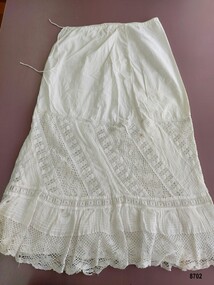
Textile - Petticoat, circa 1910
... Street, Kensington, Melbourne. Matthew Stephenson (1861 – 1943) who had grown up on the Bendigo goldfields and shifted to Melbourne in the early 1900’s was a train driver and later, a fireman with the railways. His wife Elizabeth Jane (Betsy) Wigley (1865 – 1953) also grew up on the goldfields around Majorca...Street, Kensington, Melbourne. Matthew Stephenson (1861 – 1943) who had grown up on the Bendigo goldfields and shifted to Melbourne in the early 1900’s was a train driver and later, a fireman with the railways. His wife Elizabeth Jane (Betsy) Wigley (1865 – 1953) also grew up on the goldfields around Majorca ...This item is one of a collection of clothing items that belonged to the Stephenson family who lived at 22 McCracken Street, Kensington, Melbourne. Matthew Stephenson (1861 – 1943) who had grown up on the Bendigo goldfields and shifted to Melbourne in the early 1900’s was a train driver and later, a fireman with the railways. His wife Elizabeth Jane (Betsy) Wigley (1865 – 1953) also grew up on the goldfields around Majorca and Bendigo. They married in 1885 in Bendigo. They had two daughters – Ethel Evelyn Stephenson (1886 – 1956) and Lillian or Lila (1891 – 1977) who were milliners and dressmakers and who continued to live in the family home after the death of their parents. The family are recorded as living at 22 McCracken Street, Kensington, as early as 1914. It is not known who made or owned the clothing that makes up this collection but as it appears to be from the late Victorian and early Edwardian era, the different pieces were probably made and worn by any of the three ladies of the house – Betsy, Ethel and/or Lila. During W.W.2, a local Warrnambool couple (Meryl and Tony Everard) boarded with them – Tony was in the airforce training paratroopers to jump into (and survive) enemy territory and his wife Meryl worked in the Methodist baby Home. The Everards developed a close friendship with the Stephensons and were responsible for clearing out the house (and finding this clothing collection) after Lila died in 1977. A petticoat is a lady's undergarment - worn under a skirt or dress. They provided warmth, modesty and shape to the dress. In the middle of the 19th century, petticoats were worn over hoops, bustles or in layers. Petticoats varied according to the style of the outside skirt or dress. Plain petticoats tended to be worn with everyday wear whilst better dresses (party dresses or silk gowns) were worn with petticoats that often had more trim and embellishments. Edwardian petticoats had less volume than Victorian era petticoats and they had a "dust ruffle" or lining under a lace flounce. The "dust ruffle" protected the lace flounce and gave the petticoat more flare at the bottom, greater freedom when walking as well as saving the flounce (which was often made of finer material) from everyday wear and tear. Tucks are another feature of Edwardian petticoats - when the lace at the bottom became worn, it could be cut off and the tucks released. This extended the life of the petticoat. This petticoat features an intricate trim of broderie anglaise. Although broderie anglaise was a lace that could be made by hand, it was very time consuming to make. St Gallen was a city in Switzerland that had become known for producing quality textiles. At the beginning of the 19th century, the first embroidery machines were developed in St Gallen. Factories used embroidery machines but people also had them in their homes. They were able to produce broderie anglaise for export. By the early 20th century, machine made lace, fabric, ribbons etc. were being sold in drapers shops all over England and Wales to women who were making clothes and furnishings for their families. It is highly likely that the lady who made this petticoat brought the lengths of broderie anglaise already made to embellish and personalise her petticoat.This item is an example of the needlework skills of women in the late 19th century - creating pintucks and adding lace to personalise and embellish a practical item of clothing.A lady's ankle length petticoat made in three sections. The top section is made from three rectangles of fine cotton (batiste) joined into a round with narrow french seams and inserted into a simple drawstring waistband with a small opening. The second section is made with rows of alternating strips of fine pin tucked lawn, white cotton cut work embroidery and a wider cotton lace design all joined in a diagonal pattern and lined with fine lawn. The bottom section of the petticoat has a horizontal strip of eyelet lace followed by a wider strip of fine pin tucked lawn and is finished with a deep hem of white cotton crocheted lace fabric and has the same lawn lining as the section above.flagstaff hill maritime museum and village, great ocean road, shipwreck coast, warrnambool, petticoat, lady's petticoat, needlework, sewing, broderie anglaise, stephenson family, drawstring waistband -
 Flagstaff Hill Maritime Museum and Village
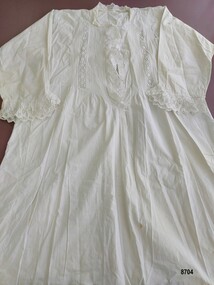
Textile - Nightgown, Circa 1900
... Street, Kensington, Melbourne. Matthew Stephenson (1861 – 1943) who had grown up on the Bendigo goldfields and shifted to Melbourne in the early 1900’s was a train driver and later, a fireman with the railways. His wife Elizabeth Jane (Betsy) Wigley (1865 – 1953) also grew up on the goldfields around Majorca...Street, Kensington, Melbourne. Matthew Stephenson (1861 – 1943) who had grown up on the Bendigo goldfields and shifted to Melbourne in the early 1900’s was a train driver and later, a fireman with the railways. His wife Elizabeth Jane (Betsy) Wigley (1865 – 1953) also grew up on the goldfields around Majorca ...This item is one of a collection of clothing items that belonged to the Stephenson family who lived at 22 McCracken Street, Kensington, Melbourne. Matthew Stephenson (1861 – 1943) who had grown up on the Bendigo goldfields and shifted to Melbourne in the early 1900’s was a train driver and later, a fireman with the railways. His wife Elizabeth Jane (Betsy) Wigley (1865 – 1953) also grew up on the goldfields around Majorca and Bendigo. They married in 1885 in Bendigo. They had two daughters – Ethel Evelyn Stephenson (1886 – 1956) and Lillian or Lila (1891 – 1977) who were milliners and dressmakers and who continued to live in the family home after the death of their parents. The family are recorded as living at 22 McCracken Street, Kensington, as early as 1914. It is not known who made or owned the clothing that makes up this collection but as it appears to be from the late Victorian and early Edwardian era, the different pieces were probably made and worn by any of the three ladies of the house – Betsy, Ethel and/or Lila. During W.W.2, a local Warrnambool couple (Meryl and Tony Everard) boarded with them – Tony was in the airforce training paratroopers to jump into (and survive) enemy territory and his wife Meryl worked in the Methodist baby Home. The Everards developed a close friendship with the Stephensons and were responsible for clearing out the house (and finding this clothing collection) after Lila died in 1977. This nightgown is machine sewn and has an added detailed design of pintucks and broderie anglaise lace to the front yoke and cuffs as a decorative element. The 1800's bought a shift in attitude towards modesty as the Victorian era progressed and by the mid to late 1800's it had become more acceptable ladies to wear simple, modest nightgowns. They tended to have a very loose fit and were usually made of linen, cotton or flannel, which had the advantage of providing warmth and also being easy to wash - a necessity for a garment worn next to the skin. Although the basic design of the nightgown was fairly simple, the wearer was free to add various types of trim e.g. lace, crochet, pintucks, embroidery etc.This item is an example of the needlework skills of women in the late 19th and early 20th century - combining machine stitching with hand embroidery to personalise and embellish a practical item of clothing. A full length lady's cotton nightgown with long sleeves finished with a diagonal pointed cuff of broderie anglaise. The bodice features a front opening placket with 3 buttons and buttonholes and a broderie anglaise cover. On either side of the placket, the bodice has been decorated with rows of vertical pintucks and a broderie anglaise panel insert. There is also a frill of broderie anglaise lace around the neck. The back of the nightgown is gathered onto a yoke.flagstaff hill maritime museum and village, great ocean road, shipwreck coast, warrnambool, nightgown, lady's nightgown, needlework, sewing, broderie anglaise, pintucks, stephenson family -
 Flagstaff Hill Maritime Museum and Village
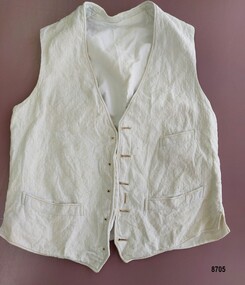
Textile - Waistcoat, circa 1910
... Street, Kensington, Melbourne. Matthew Stephenson (1861 – 1943) who had grown up on the Bendigo goldfields and shifted to Melbourne in the early 1900’s was a train driver and later, a fireman with the railways. His wife Elizabeth Jane (Betsy) Wigley (1865 – 1953) also grew up on the goldfields around Majorca...Street, Kensington, Melbourne. Matthew Stephenson (1861 – 1943) who had grown up on the Bendigo goldfields and shifted to Melbourne in the early 1900’s was a train driver and later, a fireman with the railways. His wife Elizabeth Jane (Betsy) Wigley (1865 – 1953) also grew up on the goldfields around Majorca ...This item is one of a collection of clothing items that belonged to the Stephenson family who lived at 22 McCracken Street, Kensington, Melbourne. Matthew Stephenson (1861 – 1943) who had grown up on the Bendigo goldfields and shifted to Melbourne in the early 1900’s was a train driver and later, a fireman with the railways. His wife Elizabeth Jane (Betsy) Wigley (1865 – 1953) also grew up on the goldfields around Majorca and Bendigo. They married in 1885 in Bendigo. They had two daughters – Ethel Evelyn Stephenson (1886 – 1956) and Lillian or Lila (1891 – 1977) who were milliners and dressmakers and who continued to live in the family home after the death of their parents. The family are recorded as living at 22 McCracken Street, Kensington, as early as 1914. It is not known who made or owned the clothing that makes up this collection but as it appears to be from the late Victorian and early Edwardian era however the vest was probably made by one of the three ladies of the house, for their husband and father, Matthew Stephenson. During W.W.2, a local Warrnambool couple (Meryl and Tony Everard) boarded with them – Tony was in the airforce training paratroopers to jump into (and survive) enemy territory and his wife Meryl worked in the Methodist baby Home. The Everards developed a close friendship with the Stephensons and were responsible for clearing out the house (and finding this clothing collection) after Lila died in 1977. Although by 1916, men's "ready to wear" clothing were widely available, this waistcoat was handmade (possibly by Matthew's wife or daughters). Men's suits in the early part of the twentieth century were predominantly three piece, consisting of a jacket, vest (or waistcoat) and trousers made from matching fabrics. Some men liked to wear a watch attached to their waistcoat with a fob chain. This item is an example of clothing worn by men on special occasions, in the late 19th and early 20th century.A man's waistcoat with cream cotton weave front pieces and cream cotton lining and back. The left front features five machine worked horizontal buttonholes and one vertical buttonhole (for a fob watch) and two inset pockets. The right hand side has five corresponding stud holes and one inset pocket. The studs or buttons are missing. The lining and back of the waistcoat are made from a plain cream cotton fabric. The back also features a cotton strap with a two pronged metal buckle.flagstaff hill maritime museum and village, great ocean road, shipwreck coast, warrnambool, vest, waistcoat, needlework, sewing, stephenson family, man's waistcoat -
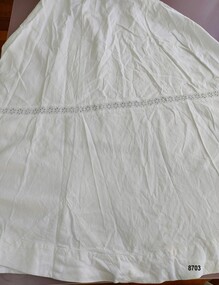 Flagstaff Hill Maritime Museum and Village
Textile - Skirt, circa 1910
... Street, Kensington, Melbourne. Matthew Stephenson (1861 – 1943) who had grown up on the Bendigo goldfields and shifted to Melbourne in the early 1900’s was a train driver and later, a fireman with the railways. His wife Elizabeth Jane (Betsy) Wigley (1865 – 1953) also grew up on the goldfields around Majorca...Street, Kensington, Melbourne. Matthew Stephenson (1861 – 1943) who had grown up on the Bendigo goldfields and shifted to Melbourne in the early 1900’s was a train driver and later, a fireman with the railways. His wife Elizabeth Jane (Betsy) Wigley (1865 – 1953) also grew up on the goldfields around Majorca ...This item is one of a collection of clothing items that belonged to the Stephenson family who lived at 22 McCracken Street, Kensington, Melbourne. Matthew Stephenson (1861 – 1943) who had grown up on the Bendigo goldfields and shifted to Melbourne in the early 1900’s was a train driver and later, a fireman with the railways. His wife Elizabeth Jane (Betsy) Wigley (1865 – 1953) also grew up on the goldfields around Majorca and Bendigo. They married in 1885 in Bendigo. They had two daughters – Ethel Evelyn Stephenson (1886 – 1956) and Lillian or Lila (1891 – 1977) who were milliners and dressmakers and who continued to live in the family home after the death of their parents. The family are recorded as living at 22 McCracken Street, Kensington, as early as 1914. It is not known who made or owned the clothing that makes up this collection but as it appears to be from the late Victorian and early Edwardian era, the different pieces were probably made and worn by any of the three ladies of the house – Betsy, Ethel and/or Lila. During W.W.2, a local Warrnambool couple (Meryl and Tony Everard) boarded with them – Tony was in the airforce training paratroopers to jump into (and survive) enemy territory and his wife Meryl worked in the Methodist baby Home. The Everards developed a close friendship with the Stephensons and were responsible for clearing out the house (and finding this clothing collection) after Lila died in 1977. This skirt features broderie anglaise trim. Although broderie anglaise was a lace that could be made by hand, it was very time consuming to make. St Gallen was a city in Switzerland that had become known for producing quality textiles. At the beginning of the 19th century, the first embroidery machines were developed in St Gallen. Factories used embroidery machines but people also had them in their homes. They were able to produce broderie anglaise for export. By the early 20th century, machine made lace, fabric, ribbons etc. were being sold in drapers shops all over England and Wales to women who were making clothes and furnishings for their families. It is highly likely that the lady who made this skirt brought the lengths of broderie anglaise already made to embellish and personalise her skirt.This item is an example of the needlework skills of women in the late 19th century - creating pintucks and adding lace to personalise and embellish a practical item of clothing. A full length lady's skirt of heavy textured ribbed twill cotton. The top of the skirt is made from five pieces of fabric, sewn together and inserted into a simple waistband. It has an opening with room for 6 hook and eyes (but only the middle three remain). The top section of the skirt is separated from the bottom section by a strip of eyelet embroidery that has been inserted in a horizontal line at the back but becomes slightly diagonal at the front causing the two ends to cross in a decorative X fashion. The bottom of the skirt is the same heavy cotton as the top and one seam features a V shaped insert or patch.flagstaff hill maritime museum and village, great ocean road, shipwreck coast, warrnambool, broderie anglaise, needlework, sewing, stephenson family, skirt, lady's skirt
