
Showing 10 items matching "making the transition"
-
 Moorabbin Air Museum
Book - Pilot training - general aviation, Pilot Training You Can Learn to Fly
... Making the transition...Pilot training - Making the transition Seeking pilot training Flight training begins Inducements Toward soloing From solo through written exam Dual & solo cross country flying "Ticket" to learn Should you fly - can you fly Overview of what a trainee pilot can expect to encounter , circa 1979 Pilot Training You Can Learn to Fly Book Pilot training - general aviation ...Overview of what a trainee pilot can expect to encounter , circa 1979non-fictionOverview of what a trainee pilot can expect to encounter , circa 1979making the transition, seeking pilot training, flight training begins, inducements, toward soloing, from solo through written exam, dual & solo cross country flying, "ticket" to learn, should you fly - can you fly -
 Flagstaff Hill Maritime Museum and Village
Book - Reference Book/History, The Times Newspaper, The Historians History of the World Vol 17 set 1 - Edited by Henry Smith Williams L.L.D. Published by “The Times” 1908, 1908
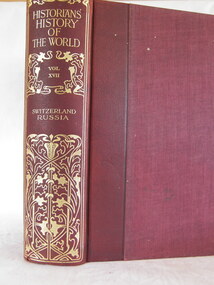
... transition from the histories of Western and Central Europe (France, Netherlands, Germanic Empires) toward the "Eastern Question" and the rise of the Slavic nations. While previous volumes often focus on the formation of modern democracy and the Renaissance, Volume 17 offers a thematic shift dealing heavily with the imperial expansion of Russia and the erosion of traditional city-state models like Switzerland. Historical timing for this publication is important because published in 1908. The Russia section reflected a Western perspective on the Russian Empire just years before the 1917 Revolution, thus making ...Henry Smith Williams’ “The Historians' History of the World” is a chronological and geographical "tapestry" of human events, these twenty five volumes occupy a very specific and prestigious place in historical research. Volume 17 focuses primarily on the history of Switzerland with concluding sections on Russia, and Poland. The volume concludes the Swiss narrative began in volume 16.The Book is part of a 25 volume set with red cloth bindings and gold filigree design to rib.non-fictionHenry Smith Williams’ “The Historians' History of the World” is a chronological and geographical "tapestry" of human events, these twenty five volumes occupy a very specific and prestigious place in historical research. Volume 17 focuses primarily on the history of Switzerland with concluding sections on Russia, and Poland. The volume concludes the Swiss narrative began in volume 16.flagstaff hill, warrnambool, shipwrecked-coast, flagstaff-hill, flagstaff-hill-maritime-museum, maritime-museum, shipwreck-coast, flagstaff-hill-maritime-village, book, the historians history of the world vol 17 set 1 -
 Flagstaff Hill Maritime Museum and Village
Textile - Wall Hanging, curtain, 1854-1855
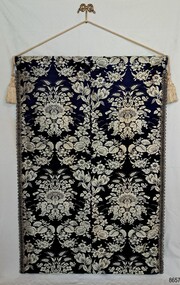
... transition details are incomplete. About a century later, Isabella and Blakiston Robinson’s great-grandson and his wife had the fabric professionally mounted as a wall hanging to showcase the beauty of the woven brocade. Eventually, the custodianship of the curtain was transferred to the donor, who is also a great-grandson of Isabella and Blakiston. He and his wife hung the curtain on the wall of a high-ceilinged room in their home, away from direct light, making...transition details are incomplete. About a century later, Isabella and Blakiston Robinson’s great-grandson and his wife had the fabric professionally mounted as a wall hanging to showcase the beauty of the woven brocade. Eventually, the custodianship of the curtain was transferred to the donor, who is also a great-grandson of Isabella and Blakiston. He and his wife hung the curtain on the wall of a high-ceilinged room in their home, away from direct light, making ...The striking fabric of this wall hanging was recovered from the sinking Schomberg. It was originally one of the many curtains adorning the captain’s cabin and ladies’ saloons that attracted first-class passengers to this luxury vessel, built for comfort and speed. The clipper ship was on its maiden voyage, full of passengers emigrating to Australia in 1855. Its commander was Captain James Nicol Forbes, who had been selected by James Baine & Co for his navigation skills, experience, and reputation for breaking sailing records. However, on December 26th, 1855, the vessel became stranded and sank west of Cape Otway, not quite reaching its destination of Melbourne. A reporter explored the Schomberg before its journey; the following detailed description is an excerpt of his article published in a newspaper after the disastrous voyage was announced. “ … descending by a flight of stairs, covered with carpet of a very rich pattern, we came to the saloon passengers’ cabin. This is a noble place, and all that refined taste would suggest has been done to make each berth a miniature palace. The bedding is of the very best material, and the fittings are replete with every convenience. The carpets are of various coloured velvet pile, and the curtains are of satin damask, lined with white satin … The fronts of the berths are highly decorated, and festoons of flowers are painted on the panels … No two berths are furnished with the same-coloured material … the visitor is, therefore, much pleased with the variety which he has to inspect….” (Trove: Shipping Gazette and Sydney General Trade, 31 Dec 1955, p. 283) The curtain material, ‘folded into a single piece and parcelled for protection’, has been passed down through generations of Captain Forbes’ relatives, starting with his half-sister Isabella Jeffrey Nicol. The curtain has remained with the family, although some transition details are incomplete. About a century later, Isabella and Blakiston Robinson’s great-grandson and his wife had the fabric professionally mounted as a wall hanging to showcase the beauty of the woven brocade. Eventually, the custodianship of the curtain was transferred to the donor, who is also a great-grandson of Isabella and Blakiston. He and his wife hung the curtain on the wall of a high-ceilinged room in their home, away from direct light, making it visible for all to appreciate its beauty and significance. In 2024, they donated the curtain for inclusion among the collection of artefacts that help tell the story of the Schomberg and those who sailed on its first and last voyage. The donor’s aunt was highly involved in the family’s history. She had collected and recorded information that dates back to pre-1341. A footnote included in a handwritten letter dated April 20, 1959, from the late Arthur William Rudd, OBE, MA, LLB, husband of another of the donor’s aunts, states, “The curtains you mentioned came from the Schomberg. AWR.” CAPTAIN JAMES NICOL FORBES (1821-1874) and the donor’s family: - Captain Forbes was born in Aberdeen. In his late teens, he moved to Liverpool, a hub for international trade and an emigration port. By the age of 25, he was master of the Prince of Waterloo and later, the Wakefield. He then commanded the Cleopatra for the James Baines Co., which, two years later, transferred him to command the Maria, providing fast and lucrative passage to the gold fields in Ballarat, Australia. James Baines Co. and shipbuilder Thomas Mackay formed the Black Ball Line of clipper ships in 1852. Forbes was appointed master of the largest ship in the fleet, the marvellous Marco Polo. He broke the record time for the passage to Australia, taking only 68 days at sea, and the return journey in only 76 days, a total of 5 months and 21 days. On his second voyage to Melbourne in the Marco Polo the following year, he took 75 days, and 95 days on the return trip. His accomplishment made him famous. James Baines reported that the Marco Polo was the only ship, sail or steam, to do the round trip within 6 months, and it had done it twice. Captain Forbes then took command of the American-built clipper Lightning, one of four built for the Black Ball line. His 19-year-old half-sister, Isabella Jaffray Nicol, was also onboard when he sailed for Melbourne in 1854. During the 77-day voyage, Isabella met Blakiston Robinson, and not long after the ship arrived in Melbourne on July 31, the couple married, with James Nicol Forbes as a witness, on August 16. When Forbes returned to Liverpool, he took a record-breaking 63 days, which has never been bettered. James Baines Co. ordered a new luxury emigrant ship from Alexander Hall of Aberdeen; the Schomberg was the largest sailing ship ever built in Britain. On October 6, 1855, the vessel departed Liverpool commanded by Captain Forbes, with 430 passengers on board, 54 of whom were First Class. It had almost completed its voyage to Melbourne when, on the night of December 26, it ran aground west of Cape Otway. Captain Doran, master of the steamer Queen, responded to the distress signal while on its way to Portland and, with the agreement of his passengers, rescued as many as possible from the Schomberg and returned to Melbourne with them. Captain Helpman, master of the steamer Champion, rescued most of the remaining Schomberg passengers on December 27. On Friday, 28th, Captain James Lawrence was on his way to Adelaide in the steamer Burra Burra, and called past the Schomberg. He reported that the remaining crew were all doing their duties, but the Schomberg was deteriorating on a sand spit and had about 16 feet of water in its hold. That same day, the schooner Jane Elizabeth collected 220 packages of passengers’ luggage to deliver to Melbourne on the 29th. Two steamers also arrived on the 29th with 20 men to collect passengers’ luggage and valuable ship’s cargo items. They were accompanied by water police, customs agents, company representatives and a Lloyds agent. The decision was made to abandon ship on the 30th due to rough and unsafe conditions. The officials and Captain Forbes voyaged to Melbourne, while the seamen remained behind awaiting rescue. Evacuation by sea became too risky, so on January 2, 1856, while the first Mate and Steward remained at the wreck site, the rest of the crew began the 70-mile march to Warrnambool, led by the band. They arrived on January 5th and left for Melbourne on the steamer Champion on January 10th. Parts of the Schomberg wreck ended up in New Zealand. The curtain is important for its connection to the Schomberg, which was unique for being designed and built in Aberdeen, and commanded by an Aberdonian who was the most celebrated clipper captain of the age. The ship was the largest sailing ship ever built in Britain, and reported as the largest vessel that sailed to Australia. The curtain is an example of the rich decorative furnishings available in 1855. The preservation and respect the donor and his family have shown towards the curtain over many decades reflect its important role in telling the family’s history; the journey, the romantic attachment, the family connection to the sea, and travel in gold rush times. The curtain is significant for its connection to James Nocol Forbes, a famous sailing ship commander who broke several sailing records, one of which has never been bettered. This wall hanging, also known as the Schomberg Curtain, was created from a curtain recovered from the stranded luxury ship Schomberg in December 1855. The woven satin damask fabric in blue and cream has been meticulously joined to blend the intricate pattern. The reverse features a soft cream lining. The hems at the top and bottom of the fabric hold wooden rods. The side edges feature decorative braid that has been hand-stitched in place. On the reverse, the bottom hem includes the same braid, which remains unseen from the front, and the centre of the top hem has a hand-worked, unused buttonhole. Each of the hems varies in depth. The curtain was tastefully mounted later to highlight the beauty of the original saloon curtain. A decorative twisted cord of cream silk threads, accented with gold highlights and decorative tassels, was coiled and attached to the ends of the top rod. The elegant display was completed with an ornate gold hook, chosen to complement the wall hanging.flagstaff hill maritime museum and village, great ocean road, shipwreck coast, shipwreck artefact, memorabilia, curtain, saloon curtain, schomberg, wall hanging, decorative object, domestic item, warrnambool, flagstaff hill, maritime museum, maritime village, maritime history, shipwreck, stranding, schomberg curtain, schomberg wall hanging, luxury ship, 1855, damask, silk damask, blue and cream, captain’s cabin, ladies’ saloon, clipper ship, migrant, emigrant, liverpool to australia, captain james nicol forbes, james forbes, captain forbes, bully forbes, james baines & co, james baines, cape otway, aberdeen, prince of waterloo, wakefield, cleopatra, maria, thomas mackay, black ball line, marco polo, sailing record, lightning, isabella jaffray nocol, blakiston robinson, alexander hall, steamer queen, captain helpman, james lawrence, steamer burra burra, steamer jane elizabeth, water police, customs agents, lloyds agent, ship’s band, walk to warrnambool, march to warrnambool, steamer champion, agnes nicol robinson, arthur william rudd obe ma llb -
 Flagstaff Hill Maritime Museum and Village
Book - Letters/Journals, Charles Kingsley, Charles Kingsley: His Letters and Memories of His Life Vol 2, 1879
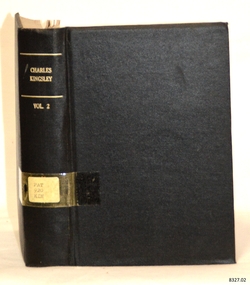
... making of the man, while Volume 2 gives you the peak of his power, his most famous public clashes, and his eventual death. The publisher Charles Kegan Paul (1828–1902) was an author, intellectual and former Anglican clergyman. Having grown disillusioned with the Church of England, he left the ministry and transitioned...making of the man, while Volume 2 gives you the peak of his power, his most famous public clashes, and his eventual death. The publisher Charles Kegan Paul (1828–1902) was an author, intellectual and former Anglican clergyman. Having grown disillusioned with the Church of England, he left the ministry and transitioned ...While Volume 1 introduces Charles Kingsley’s early development and his explosive rise as a radical social reformer, Volume 2 pivots to his mature years as an established public figure. It focuses on his high-profile intellectual battles and his global travels. The transition from Volume 1 to Volume 2 charts a shift from a young, controversial outsider to a celebrated, busy member of the Victorian elite. Volume 1 covers his early life from 1819 to 1856, while Volume 2 spans the years between 1857 and 1875. It documents his mature family life, his appointment as Royal Chaplain to Queen Victoria, his tenure as a professor of Modern History at Cambridge, and his time as Canon of Westminster. It was during these later years that his children's classic, The Water-Babies (1863), and his late historical fiction were published.Charles Kingsley: His Letters and Memories of His Life Vol 2 Author: Charles Kingsley Edited by his wife ( Frances "Fanny" Grenfell) Publisher: C Kegan Paul & Co Date: 1879 Further Information: Sixth Abridged Editionnon-fictionWhile Volume 1 introduces Charles Kingsley’s early development and his explosive rise as a radical social reformer, Volume 2 pivots to his mature years as an established public figure. It focuses on his high-profile intellectual battles and his global travels. The transition from Volume 1 to Volume 2 charts a shift from a young, controversial outsider to a celebrated, busy member of the Victorian elite. Volume 1 covers his early life from 1819 to 1856, while Volume 2 spans the years between 1857 and 1875. It documents his mature family life, his appointment as Royal Chaplain to Queen Victoria, his tenure as a professor of Modern History at Cambridge, and his time as Canon of Westminster. It was during these later years that his children's classic, The Water-Babies (1863), and his late historical fiction were published.flagstaff hill, warrnambool, shipwrecked coast, flagstaff hill maritime museum, maritime museum, shipwreck coast, flagstaff hill maritime village, great ocean road, book, pattison collection, warrnambool library, warrnambool mechanics’ institute, ralph eric pattison, corangamite regional library service, warrnambool city librarian, mechanics’ institute library, victorian library board, warrnambool books and records, warrnambool children’s library, charles kingsley: his letters and memories of his life vol 1, frances "fanny" grenfell, mrs kingsley -
 City of Moorabbin Historical Society (Operating the Box Cottage Museum)
Personal Effects, cut-throat razor “Kings Crown’, 20thC
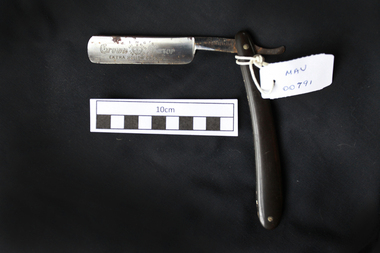
... As times changed, the Weyersberg family transitioned into making cut throat razors. The Greb. ...As times changed, the Weyersberg family transitioned into making cut throat razors. The Greb. ...KING RAZOR MFG. CO.Pittsburgh, Pennsylvania; moved to Indiana, Pennsylvania in 1911.ca. 1904 - 1919 Marked "Made in Germany", although the company's offices were located at 118 E. 28th Street, New York City. ca. 1934-1943 Used the "THE KING OF RAZORS REGISTERED TRADEMARK" trademark. 47-1/2 and Trademark: Crown and Wolf. For 500 years the Weyersberg family has been producing the finest blades in the world. For centuries the King’s Crown™ mark has been synonymous with exacting precision, hand-craftsmanship and quality. For the first few hundred years the blades, made in Solingen, Germany (the “City of Blades”), were for swords. As times changed, the Weyersberg family transitioned into making cut throat razors. The Greb. Weyersberg™ family business.continue to place our mark on each and every product sold as we have done since first being able to register it in 1774. For over a 100 years, the straight razors continue to be produced in Solingen (Germany). King's Crown™A folding cut-throat razoron blade ; KING'S / CROWN 'a crown trademark' RAZOR / EXTRA HOLLOW GROUND around 'trademark' ; SET READY FOR USE on steel handle; MADE IN GERMANYcut-throat razors, straight razors, shaving equipment, steel blades, swords, weyersberg family, king crown pty ltd., solingen, germany, early settlers, market gardeners, moorabbin, bentleigh, cheltenham, -
 NMIT (Northern Melbourne Institute of TAFE)
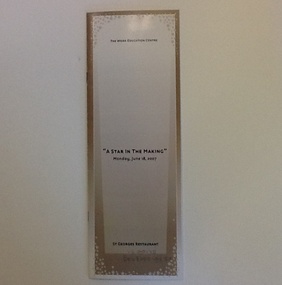
Program - NMIT, A star in the making. Work Education Centre, Graduation Presentation 2007, 2007
... Transition Education, Hospitality and Live Production. Held at St Georges Restaurant on June 18 2007. Lists those present, the organisers and those receiving certificates. work education centre st georges restaurant graduation hospitality nmit 7 page brochure with card cover. A star in the making ...This program lists granduates from the Work Education Centre in 2007, in the areas of Work Education, Transition Education, Hospitality and Live Production. Held at St Georges Restaurant on June 18 2007.Lists those present, the organisers and those receiving certificates.7 page brochure with card cover. work education centre, st georges restaurant, graduation, hospitality, nmit, -
 Nillumbik Shire Council
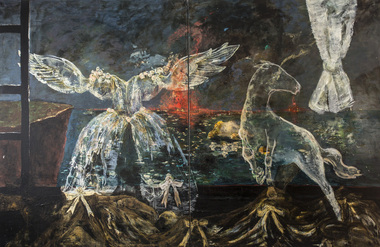
Painting: Adriane Strampp (b.1960 Wisconsin, USA), Adriane Strampp, Into the Night, 1987
... This work encompasses themes and a style of painting (Neo - Expressionism) that was prevalent during the time of its making in the eighties. This work represents a transition from Strampp's highly regarded early paintings of heroic horses in the mid to late 1980’s to her highly regarded paintings of contemporary wedding and/or armour-like bodices dresses of the 1990s. ...Strampp lived and worked at Clifton Pugh's artist colony Dunmoochin from 1980 to 1985. 'Into the Night' is Strampps' "own marriage painting". The wedding dress and horse, "a symbol of virility and passion" represents Strampp and the background landscape was inspired by her stay in Somerset, England. The cliff edge on the left symbolises "an audacious step into the future." The painting "is of a bride, passionate yet absent, about to embark upon a new journey in life, and of the voyage ahead. It is about acknowledging the past, and having the courage to move forward. To take risks". Strampp was largely influenced by both the new German Neo-Expressionists of the time and by English artist John Walker, which is evident in this painting. Her work took on popular stylistic trends and themes of the time, which included a painterly aesthetic and an energetic application of the medium, which transferred to an emotional and or personal connection to subject matter that was communicated symbolically. Strampp is an artist of national significance. This work encompasses themes and a style of painting (Neo - Expressionism) that was prevalent during the time of its making in the eighties. This work represents a transition from Strampp's highly regarded early paintings of heroic horses in the mid to late 1980’s to her highly regarded paintings of contemporary wedding and/or armour-like bodices dresses of the 1990s. Both the 'horse' and 'dress' were often set in empty backgrounds or dreamy/foreboding landscapes. Painted in oil on linen (x2) in a 'Neo-Expressionist' style, 'Into the Night' depicts a ghostly white horse to the right of the painting looking away from a ghostly white wedding dress to the left of the painting. The dress has sprouted white wings and is adorned with bows on the bottom edge of the dress and roses on the sleeves. The dress seems full bodied although there is no figure. The dress and horse are placed in the foreground on a stage like platform with a white curtain framing the picture to the right, and a black ladder and brown cliff edge framing the picture to the left. The background depicts a foreboding and dark cloudy sky and seascape with a firery red landscape burning on the horizon. Signed low right (1988.7b VA) with brush in purple (light) 'Adriane Strampp 87'. into the night, neo expressionism, wedding dress, horse, symbolism, painting, seascape, dramatic, emotional, poetic, strampp -
 Melbourne Legacy
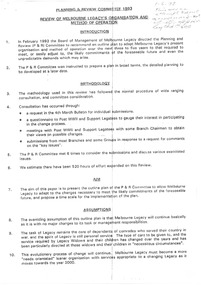
Document, Planning and Review Committee
... The process of making the report is to provide a logical and smooth transition as possible for Melbourne Legacy to function into the future. planning review committee Pencil notation on top right hand corner, page 1. ...The aim of the paper is to present an outline plan for the committee to discuss and if adopted to act as a guide to the future - see item 7 of the paper. The paper outlines assumptions made and recommendations for each year 1994, 1995, 1996. The process of making the report is to provide a logical and smooth transition as possible for Melbourne Legacy to function into the future.White A4 paper with black type about a review of Legacy's organisation and operations.Pencil notation on top right hand corner, page 1. Pencil notation and highlighting of various points throughout.planning, review committee -
 Kew Historical Society Inc
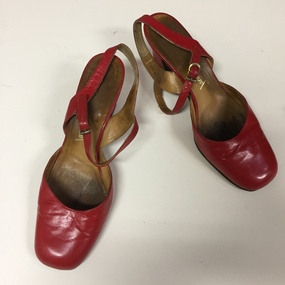
Footwear - Pair of Red Leather Slingbacks, J W Jane, late 1970s
... making techniques. This pair of shoes was created by Jane Webster of Sydney, which began manufacturing shoes in the 1960s women's shoes jane -- shoes -- designer footwear "JANE" A pair of slingback shoes by Jane, styled in red leather. The mid vamp opening paired with the delicate buckle-fastened ankle strap reflects the shift toward lighter, transitional ...The extensive fashion and design collection of the Kew Historical Society has been assembled over a number of decades. One subsection of this collection is shoes, designed and manufactured for Australian women by Australian and European designers. Many of the shoes, while often mass-produced, were generally constructed by skilled artisans using traditional shoe-making techniques. This pair of shoes was created by Jane Webster of Sydney, which began manufacturing shoes in the 1960sA pair of slingback shoes by Jane, styled in red leather. The mid vamp opening paired with the delicate buckle-fastened ankle strap reflects the shift toward lighter, transitional heels popular in the late 1970s."JANE"women's shoes, jane -- shoes -- designer, footwear -
Broadmeadows Historical Society & Museum
Document (collection) - Reports, Unknown, Documents relating to City of Broadmeadows Library Service, 1964/65, 1963-65
... They document: • Implementation challenges of public library policy in Victoria • Dependence on Free Library Service Board subsidy requirements • Strong community advocacy, particularly via organised women’s groups • Transition from regional cooperation attempts to independent municipal action This archive is historically significant as evidence of the early development of public library services in Broadmeadows. It demonstrates the interaction between community advocacy, government policy, and municipal decision making ...Created and accumulated by multiple related entities involved in library establishment efforts, including: • Free Library Service Board of Victoria (survey report) • Broadmeadows Library Promotion Committee • Community representatives and advocacy groups (including women’s organisations) • City of Broadmeadows Council (contextual administrative records) The documents were brought together through shared purpose and subject (library establishment).Created to document the planning, advocacy, and municipal decision making processes relating to the establishment of a public library service in the City of Broadmeadows. The records include: • A formal library survey and planning recommendations • Community advocacy and deputations to Council • Documentation of Council responses and financial considerations • Supporting speaking notes representing organised civic groupsArranged chronologically to reflect the development of the library proposal.Sub collection comprises four typed documents: Library Survey Report (1963) outlining staged development of a municipal library service; Council report and Library Promotion Committee statement (1964–1965) discussing funding and failed regional cooperation; Deputation to Council (15 March 1965) advocating urgent action and increased funding; Speaking notes by Mrs. D. A. Pyke representing women’s organisations (c. 1965)public libraries — victoria, local government — broadmeadows, community advocacy, urban development, education and information access, women’s organisationspublic libraries — victoria, local government — broadmeadows, community advocacy, urban development, education and information access, women’s organisations
