
Showing 159 items matching "manufacturing - vehicle"
-
 Unions Ballarat
Lion pride: 1958-2017 AMWU and Holden, AMWU, 2017
... ...manufacturing - vehicle...Significant to the history of manufacturing (vehicle) in Australia and working conditions of members. btlc ballarat trades and labour council ballarat trades hall manufacturing - vehicle amwu australian manufacturing workers' union unions oral history gmh holden Front cover: title. ...A memento book published by the AMWU dedicated to past and present employees at GMH Holden. Copies were presented to members who were made redundant in 2017. The book is a short history of GMH Holden and includes photographs, members' stories and AMWU achievements over this time. Significant to the history of manufacturing (vehicle) in Australia and working conditions of members.Paperback; grey cover with a photograph of unidentified persons with a Holden vehicle; gold and white lettering.Front cover: title. Back cover: AMWU logo. btlc, ballarat trades and labour council, ballarat trades hall, manufacturing - vehicle, amwu, australian manufacturing workers' union, unions, oral history, gmh, holden -
Unions Ballarat
The people the passion, the pride: 90 years AMWU and Ford Australia, 2017
... ...manufacturing - vehicle...Significant to the history of manufacturing (vehicle) in Australia and working conditions of members. btlc ballarat trades and labour council ballarat trades hall manufacturing - vehicle amwu australian manufacturing workers' union unions oral history Ford Front cover: title. ...A memento book published by the AMWU dedicated to past and present employees at Ford. Copies were presented to members who were made redundant in 2017. The book is a short history of Ford and includes photographs, members' stories and AMWU achievements over this time. Significant to the history of manufacturing (vehicle) in Australia and working conditions of members.Paperback; grey cover with a photograph of unidentified persons with a Ford vehicle; gold and white lettering.Front cover: title. Back cover: AMWU logo.btlc, ballarat trades and labour council, ballarat trades hall, manufacturing - vehicle, amwu, australian manufacturing workers' union, unions, oral history, ford -
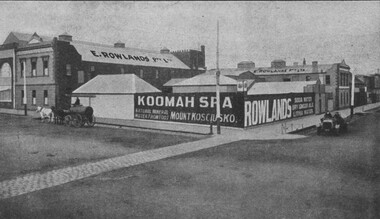 City of Ballarat Libraries
Photograph - Card Box Photographs, E. Rowlands Pty Ltd Soft Drink Factory 1916. From Citizens & Sports publication
... ...Manufacturing...Vehicle...Rowlands e.r. rowlands aerated waters Koomah Spa Building Manufacturing Vehicle Dana Street Doveton Street South E. ...The factory was situated at the corner of Dana and Doveton Streets. Huge advertising for Rowlands and Koomah Spa natural mineral water from Mt Kosciusko. e.r. rowlands, e.r. rowlands aerated waters, koomah spa, building, manufacturing, vehicle, dana street, doveton street south -
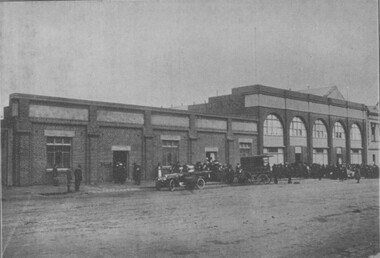 City of Ballarat Libraries
Photograph - Card Box Photographs, Lucas Factory, Ballarat circa 1919
... ...Manufacturing...Vehicle...Lucas Factory Phoenix Foundry Building Manufacturing Vehicle Lucas Factory, Ballarat circa 1919. ...The Lucas Factory was once the Phoenix Foundry on Armstrong Street South.lucas factory, phoenix foundry, building, manufacturing, vehicle -
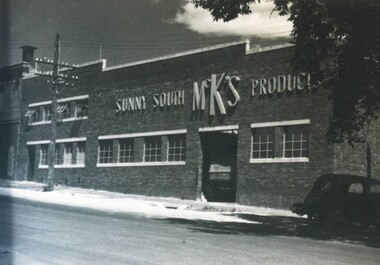 City of Ballarat Libraries
Photograph - McKay's Sunny South Factory, Ballarat circa 1955. From Bartrop's Consultants File
... ...Manufacturing...Vehicle...McKay's Building Manufacturing Vehicle Mair Street Ballarat Photograph McKay's Sunny South Factory, Ballarat circa 1955. ...The factory was located in Mair Street.mckay's, building, manufacturing, vehicle, mair street, ballarat -
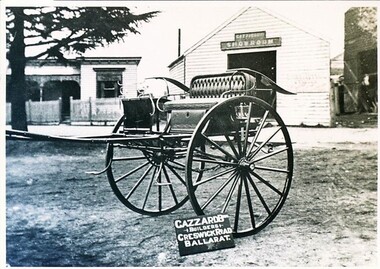 City of Ballarat Libraries
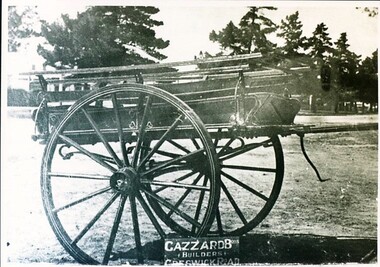
Photograph - Card Box Photographs, Gig made by Gazzard Coach Builders, Ballarat circa 1900
... ...Manufacturing...Vehicle...Gazzard Coach Builders Creswick Road Manufacturing Vehicle Work Gig made by Gazzard Coach Builders, Ballarat circa 1900. ...Shows horse drawn gig outside showroom on Creswick Road. Adjacent to this was the factory but there was also a Livery & Letting Stables.gazzard coach builders, creswick road, manufacturing, vehicle, work -
 City of Ballarat Libraries
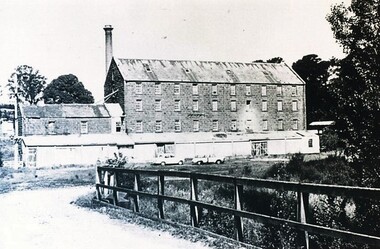
Photograph - Card Box Photographs, Anderson's Mill, Smeaton circa 1960
... ...Manufacturing...Vehicle...Anderson's Mill Smeaton Building Manufacturing Vehicle Anderson's Mill, Smeaton circa 1960. ...Acquired by the then Dept of Conservation Forests & Lands who restored the building & replaced long iron shed with timber veranda.anderson's mill, smeaton, building, manufacturing, vehicle -
 City of Ballarat Libraries
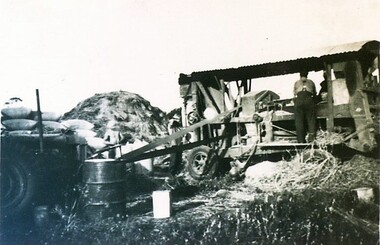
Photograph - Card Box Photographs, Chaff cutting, Millbrook 1939
... ...Manufacturing...Vehicle...Millbrook Farm Work Manufacturing Vehicle Chaff cutting, Millbrook 1939. ...millbrook, farm work, manufacturing, vehicle -
 City of Ballarat Libraries
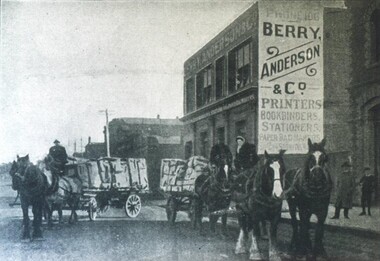
Photograph, Berry Anderson & Co Printing Works circa 1915
... vehicle...manufacturing...It comes from the publication, Beautiful Ballarat. building commerical vehicle manufacturing berry & anderson dana street printing Berry Anderson & Co Printing Works circa 1915. ...Berry Anderson & Co is located in Dana Street. The horsedrawn delivery teams are seen in this photo. It comes from the publication, Beautiful Ballarat.building, commerical, vehicle, manufacturing, berry & anderson, dana street, printing -
 City of Ballarat Libraries
Photograph - Card Box Photographs, Horse Drawn Spring Card, Gazzard Coach Builders, Ballarat circa 1900
... Vehicle...Manufacturing...Gazzard Coach Builders Creswick Road Vehicle Manufacturing Horse Drawn Spring Card, Gazzard Coach Builders, Ballarat circa 1900. ...gazzard coach builders, creswick road, vehicle, manufacturing -
 City of Ballarat Libraries
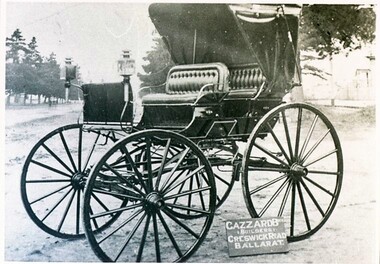
Photograph - Card Box Photographs, Horse Drawn Phaeton Buggy, Gazzard Coach Builders, Ballarat circa 1900
... Vehicle...Manufacturing...Gazzard Coach Builders Creswick Road Vehicle Manufacturing Horse Drawn Phaeton Buggy, Gazzard Coach Builders, Ballarat circa 1900. ...gazzard coach builders, creswick road, vehicle, manufacturing -
 City of Ballarat Libraries
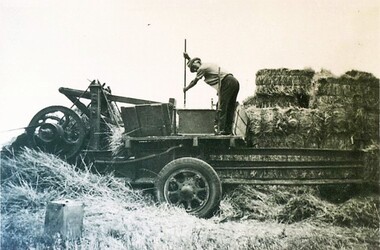
Photograph - Card Box Photographs, Pressing straw into wire tied bales, Millbrook 1939
... Vehicle...Manufacturing...Farm Work Vehicle Manufacturing Pressing straw into wire tied bales, Millbrook 1939. ...farm work, vehicle, manufacturing -
Port Melbourne Historical & Preservation Society
Book, GM Holden Corporate Affairs Department, The Holden Heritage 60 Years, July 2008
... Book produced as the Anniversary Edition celebrating 60 years of Holden vehicle manufacture....Book produced as the Anniversary Edition celebrating 60 years of Holden vehicle manufacture. General Motors-Holden Transport - Motor Vehicles Black covered book with silver Holden logo in centre of front cover. ...Book produced as the Anniversary Edition celebrating 60 years of Holden vehicle manufacture.Black covered book with silver Holden logo in centre of front cover. Title below in red.general motors-holden, transport - motor vehicles -
 Bendigo Historical Society Inc.
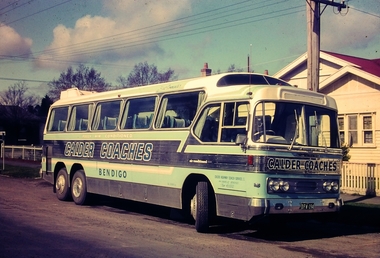
Slide - John Theodore Collection: Calder Coaches, Bendigo, 1970s - 1980s
... With advances in technology and manufacturing processes for heavy vehicles, decreased journey times and increased passenger comfort was suddenly achievable. ...Since merging with Custom Bus, the company designs and manufactures vehicles at production facilities across Australia, including a major site in Sydney (18 Vallance St) 4404.1c Calder Coaches - Three Bendigo Buses in the Depot shed ...With advances in technology and manufacturing processes for heavy vehicles, decreased journey times and increased passenger comfort was suddenly achievable. ...Murray Valley Coaches was a renowned coach company formed in the 1930’s, headquartered in Mildura, which by the early 50’s had an extensive network of service offerings, primarily centring around long distance (regular) coach services and tours. With advances in technology and manufacturing processes for heavy vehicles, decreased journey times and increased passenger comfort was suddenly achievable. All this meant many far places were now reachable and widely accessible within a day or two, resulting in a surge in demand for long distance passenger coach services. Murray Valley Coaches capitalised on these new opportunities in 1945 when they began operating regular coach services between Bendigo and Mildura. By the late 40’s, the route was just a small portion of an expansive network, with frequent services from Mildura to Adelaide, Canberra and Sydney, amongst others. However, with the rise of popularity in the motor car in the early 50’s (due to increased affordability), the company began to experience financial hardship. This saw the sale of the Bendigo – Mildura route on July 1st, 1954 to three drivers; Colin Symes, W.A. Runnalls and Doug Bennetts. Together these three formed Calder Highway Coaches, establishing a depot at 54 High Street/Chapel Street, Bendigo. Over the next 28 years, Calder Coaches built up a deeply established and reputable operation in the Bendigo region, comprising of extensive service offerings, and an equally impressive premier class, renowned fleet. At it’s peak, the company offered Urban, School, and Charter services, alongside an extensive interstate tours program.Calder Coaches Bendigo Buses- Three 135 mm slides; two taken of IQK995 in the street and 1 more of 3 coaches in the depot; IQK995, KLO194 and IFW094 This item includes the following slides: 4404.1a Calder Coaches Bendigo Bus Registration IFW 094 in front of a house 4404.1b Calder Coaches Bendigo Denning Bus, Registration IQK 995 in front of a house. Custom Denning (formerly Denning Manufacturing) is Australia's oldest bus manufacturer, known for producing durable coaches and electric transit buses. Since merging with Custom Bus, the company designs and manufactures vehicles at production facilities across Australia, including a major site in Sydney (18 Vallance St) 4404.1c Calder Coaches - Three Bendigo Buses in the Depot shed history, calder coaches, bendigo, bus, murray valley coaches, john theodore collection -
 Trafalgar Holden Museum
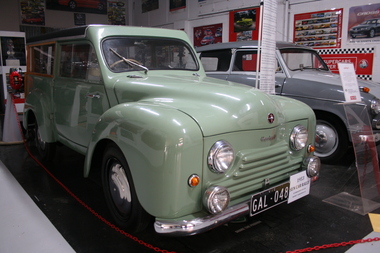
Vehicle - Lloyd Hartnett
... Car was based on a Lloyd motor corporation vehicle, first manufactured in Frankston, Victoria, between 1949 and 1953...Car was based on a Lloyd motor corporation vehicle, first manufactured in Frankston, Victoria, between 1949 and 1953 Built on request of the then Prime minister, Ben Chifley, that Holden build an inexpensive "workingman's car". ...Car was based on a Lloyd motor corporation vehicle, first manufactured in Frankston, Victoria, between 1949 and 1953Built on request of the then Prime minister, Ben Chifley, that Holden build an inexpensive "workingman's car". The Lloyd was Laurence Hartnetts idea of this, and commenced to develop the car The car is powered by a 2 cylinder, 4 stroke horizontally opposed engine of 600 cc capacity.Green 2 door Estate Wagon with vinyl roof and timber window surroundsInsignia badge on bonnet centre, Lloyd Hartnett across grille top vehicle, estate, hartnett, car -
 Trafalgar Holden Museum
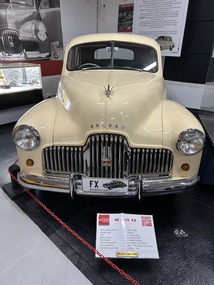
Vehicle - Holden 48 - 215 sedan, 48-215 Holden Sedan, November 1948
... This vehicle later became better known as the FX. This vehicle was manufactured from 1948 to 1953. From here Holden continued to pursue the goal of producing an Australian car. ...This was the first vehicle manufactured solely for the Australian market. ...The 48 - 215 was the first vehicle produced by GMH specifically for the local Australian market. This vehicle later became better known as the FX. This vehicle was manufactured from 1948 to 1953. From here Holden continued to pursue the goal of producing an Australian car. This involved compromise with GM as Holden managing director, Lawrence Harnett, favoured development of a local design, while GM preferred to see an American design as the basis for "Australia's Own Car". In the end the design was based on a previously rejected post war Chevrolet proposal. The Holden was launched in 1948, creating long waiting lists extending through 1949 and beyond. The name ":Holden" was chosen in honour of Sir Edward Holden, the company's first chairman and grandson of J.A.Holden. Other names considered were "GeM", "Austral", "Melba", Woomrah", " Boomerang", "Emu", and "Canbra", a phonetic spelling of Canberra. Although officially designated " 48-215" the car was marketed simply as "Holden" The unofficial usage of the name "FX" originated within Holden referring to the updated suspension on the 48-48 215 of 1953.This was the first vehicle manufactured solely for the Australian market.4 Door sedan, two pane split screen windscreen, lifting boot and bonnet. Powered by an 132.5 Cubic inch motor.Holden Specialautomobile, holden, 1948, vintage, car -
 Flagstaff Hill Maritime Museum and Village
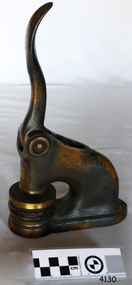
Equipment - Company seal embosser, Unknown
... In the 30 plus years after the closure, the site was used for several ventures, including the Mill Vintage Markets and a vehicle trim manufacturing operation. In 2011 the site was purchased by Little Creatures of Western Australia to become their main brewery for the eastern states of Australia. ...In the 30 plus years after the closure, the site was used for several ventures, including the Mill Vintage Markets and a vehicle trim manufacturing operation. In 2011 the site was purchased by Little Creatures of Western Australia to become their main brewery for the eastern states of Australia. ...The former Albion (West) Woollen and Worsted Mills is a functional structure which has been built in stages, possibly dating from the 1880s, with the earliest sections near to the Barwon River.The Worsted mill operated for about 50 years and at its peak employed around 500 people. In 1973 the mill merged with the British John Foster and Sons Company under some controversial stock and shareholding issues. The mill continued for a short period before closing at a time when much of the Australian textile industry was finding it difficult to compete with overseas operations. In the 30 plus years after the closure, the site was used for several ventures, including the Mill Vintage Markets and a vehicle trim manufacturing operation. In 2011 the site was purchased by Little Creatures of Western Australia to become their main brewery for the eastern states of Australia. Now owned by the Lion Group, Little Creatures started their 60 million dollar transformation of the old mill in 2012. Finally, in 2013 these former walls of industry were soon rattling away to the sounds of a different type of industry, as the first bottles of beer made their way out of the Geelong Little Creatures Brewery. The remaining building of the former Albion Woollen and Worsted Mills has historical significance as one of Geelong's major woollen mills. The venture has operated on the same site for more than a century. The Albion Woollen Mill was one of the four key sites along with Victoria, Barwon and Union Mills that was established in the late 1860s to mid-1870s. These mills were in constant operation on the west side of the Barwon Bridge over the last century and led to Geelong's fame as milling and scouring locality. The Albion Mill was probably the most successful survivor of the early private company operations. It was regarded as a model mill in the late 1880s and was, from all accounts, well-planned and organised with machinery on a par with the great mills of England. It produced high-quality tweeds. Together with the (now demolished) Union Mill it was regarded as the borough's principal industry over the 1870-1900 period and was one of Australia's most significant producers of tweed by 1900. These two mills were more successful, competitive and long-lived than the Barwon and Victoria Mills. The remaining building form is an important reminder of the private ventures of both the Albion and Union Mills and represents a key site of spinning, carding and finishing as well as scouring and dying that occurred in the lower section near to the river. The loss of the adjacent former Union Mill is unfortunate because the complex, together with the former Collins Union Mill office building, was an important reminder of the success of these industries and the reputation they earned for the Geelong region as a centre for quality textile products. Company seal embosser hand operated matte black & brass colour Western District Worsted Mills emblem on frontflagstaff hill, warrnambool, shipwrecked-coast, flagstaff-hill, flagstaff-hill-maritime-museum, maritime-museum, shipwreck-coast, flagstaff-hill-maritime-village -
 Bendigo Military Museum
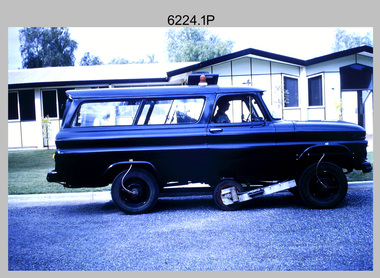
Photograph - Johnson Ground Elevation Meter (JGEM) Survey Vehicle - Army Survey Regiment, Fortuna, Bendigo, c1960s
... A limited number of Ground Elevation Meter (GEM) station wagon type vehicles were manufactured by General Motors Corporation (GMC) in the USA for the United States Geological Survey, Canada’s mapping agencies, RA Svy and National Mapping (Natmap). ...A limited number of Ground Elevation Meter (GEM) station wagon type vehicles were manufactured by General Motors Corporation (GMC) in the USA for the United States Geological Survey, Canada’s mapping agencies, RA Svy and National Mapping (Natmap). ...This is a set of 16 photograph of the Royal Australian Survey Corps’ Johnson Ground Elevation Meter (JGEM) Survey Vehicle taken at the Army Survey Regiment, Fortuna, Bendigo. The JGEM vehicle was extensively used by RA Svy within Australia from the late 1960s. A limited number of Ground Elevation Meter (GEM) station wagon type vehicles were manufactured by General Motors Corporation (GMC) in the USA for the United States Geological Survey, Canada’s mapping agencies, RA Svy and National Mapping (Natmap). The GEM was a four-wheel drive, four-wheel steer vehicle. Four-wheel steering was necessary to avoid systematic errors caused by non-tracking of front and rear wheels on conventionally steered vehicles. The manufacturer substituted the rear axle with a front axle and connected them to form the four-wheel steering mechanism. The two Australian GEM vehicles, referred to as Johnson GEMs (JGEMs) were converted into right-hand drive. After delivery in 1964, acceptance Natmap and RA Svy testing and operator training was undertaken at the Army's School of Military Survey located at Balcombe, Victoria. A small fifth wheel was mounted on a cantilever arm suspension midway between the front and rear wheels on the right side of the vehicle. It was lowered to and raised from its operating position by use of a constant pressure air cylinder. A telescopic bar, suspended between the front and rear axles, provided the reference datum for the angle measurement. The wheel provided the velocity or distance signal through a pulse generator system. A sensitive pendulum mounted on this bar provided the angle measurement for each minute distance traversed. The JGEM contained electromechanical instruments used to determine relative elevations, by trigonometric principles, along a traversed path. These relative elevations were obtained through apparatus which measures the instantaneous angle of inclination of the road and the instantaneous velocity of the meter along such a path. Road routes over which the JGEM operated were planned so that each started and ended as near as practicable to an existing point of known elevation (formally referred to as a level traverse bench mark). The difference in height from the bench mark and the road surface alongside the JGEM’s fifth wheel was measured with a level and staff. Along each route, mapping control photo reference points where new elevation values were required were identified on aerial photographs. Under favourable conditions it was possible to survey as much as 160km in an ordinary working day. The first of RA Svy’s JGEM operations was undertaken in 1:250,000 scale map areas of Queensland. CPL John Hook was the JGEM’s main operator in the early 1970s undertaking operations covering 1:250,000 scale map blocks over northern Victoria and central NSW, each requiring 36 points (9 runs of photography and 4 points across. SPR Lyn Thompson and SPR Bob McDonagh teamed with CPL Hook on some of these JGEM operations. When RA Svy was integrated into the Royal Australian Engineers in 1996, the JGEM vehicle with the Survey Corps collection was donated to its museum. It is believed to be the last of the original manufactured fleet in existence. The JGEM has undergone extensive refurbishment to achieve roadworthiness and is currently housed at The Australian Army Museum of Military Engineering, Hoslworthy Barracks, NSW. It can be viewed by making an appointment with the museum’s curator.This is a set of 16 photograph of the Royal Australian Survey Corps’ Johnson Ground Elevation Meter (JGEM) Survey Vehicle taken at the Army Survey Regiment, Fortuna, Bendigo. The photographs were on 35mm slide film and were scanned at 96 dpi. They are part of the Army Survey Regiment’s Collection. .1) - Photo, colour, c1960s, Johnson Ground Elevation Meter (JGEM) Survey Vehicle .2) - Photo, colour, c1960s, JGEM instrumentation, on-board computer. .3) - Photo, colour, c1960s, JGEM instrumentation. .4) - Photo, colour, c1960s, JGEM instrumentation, on-board computer. .5) - Photo, colour, c1960s, JGEM tyre pressure controller .6) - Photo, colour, c1960s, JGEM rear doors, SGT Geoff Briggs. .7) - Photo, colour, c1960s, JGEM 5th wheel distance/angle measurement device in lowered position, SGT Geoff Briggs. .8) - Photo, colour, c1960s, JGEM 5th wheel distance/angle measurement device in lowered position. .9) & .10) - Photo, colour, c1960s, JGEM tyre pressure system, SGT Geoff Briggs. .11) - Photo, colour, c1960s, JGEM tyre pressure system. SGT Geoff Briggs. .12) - Photo, colour, c1960s, JGEM levelling scope, levelling staff, unidentified technicians. .13) & .14) - Photo, colour, c1960s, JGEM levelling scope, unidentified technician. .15) & .16) - Photo, colour, c1960s, probably survey operation adjusted height plotted on block base sheet. .1P to .16P - Some of the equipment is annotated on the frame of the 35mm slides.royal australian survey corps, rasvy, army survey regiment, army svy regt, fortuna, asr, surveying -
 Flagstaff Hill Maritime Museum and Village
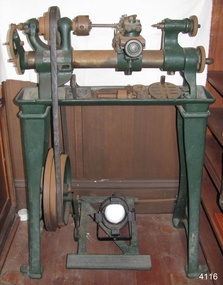
Machine - Treadle Lathe, 1920-1923
... Others, ordered by the Ministry of Supply were employed in turning shells, and many other specific needs of vehicle and aircraft manufacture were catered for by new types of Drummond lathes. ...Others, ordered by the Ministry of Supply were employed in turning shells, and many other specific needs of vehicle and aircraft manufacture were catered for by new types of Drummond lathes. ...The lathe-making business incorporated in 1902 as Drummond Bros Ltd originated in the fertile mind of Mr Arthur Drummond, said to have been living at that time at Pinks Hill, on the southern edge of Broad Street Common, west of Guildford. Mr Drummond, whose accomplishments included several pictures hung in the Royal Academy, was unable to find a lathe suitable for use in model engineering. In 1896 he designed for himself a ‘small centre lathe … which had a compound slide rest with feed-screws and adjustable slides’. He also designed and built ‘lathes of 4.5 inch and 5 inch centre height, which had beds of a special form whereby the use of a gap piece was eliminated but the advantages of a gap-bed lathe were retained’. Assisted by his brother, Mr Frank Drummond, who had served an apprenticeship to an engineering firm at Tunbridge Wells, the first lathes were made in a workshop adjoining Arthur Drummond’s house. The demand that speedily built up led to the decision to form a company and manufacture the lathes for sale commercially. Land was acquired nearby, at Rydes Hill, and the first factory built. The enterprise was a success, and the company quickly established ‘a high reputation in this country and abroad for multi-tool and copying lathes, and gear-cutting machines’. Other lathes were added to the range, including the first of the ’round bed’ machines for which the firm became widely known. A Drummond 3.5 inch lathe was among the equipment of Captain Scott’s 1912 expedition to the South Pole, and large numbers of 3.5 inch and 4 inch designs were exported to Australia, Canada and India. By the outbreak of war in 1914, 5 inch, 6 inch and 7 inch screw cutting lathes, arranged for power drive, were on sale. Large orders were received from the government for 3.5 inch lathes, for use in destroyers and submarines, and 5 inch lathes for the mechanised section of the Army Service Corps. The latter were used in mobile workshops. The factory worked night and day to supply the forces’ needs, until production was disrupted by a fire which destroyed a large part of the works in May 1915. As soon as rebuilding was complete work restarted. At the end of the war the entire production was being taken by the Government departments, a special feature being a precision screw lathe, bought by the Ministry of Munitions in 1918. Between the wars Drummond Bros Ltd introduced new machines for the motor vehicle, and later the aircraft industry, and the works were extended on many occasions to fulfill the increasing orders. The Maxicut multi-tool lathe (1925), designed for high-production turning operations, was one of the first machines of this type to be built in England. It was followed (1928) by an hydraulic version for turning gear blanks, and similar work. Further developments provided machines which, during the Second World War, turned all the crankshafts and propeller shafts for Bristol engines. Others, ordered by the Ministry of Supply were employed in turning shells, and many other specific needs of vehicle and aircraft manufacture were catered for by new types of Drummond lathes. Production of the small centre lathes ceased during the war when the company needed to concentrate on building multi-tool lathes and gear shapers. After the war a completely new Maxicut range was introduced, replacing the older versions, and fully automatic. The types were continually developed, and new versions manufactured until the end of the company’s life in 1980. The disappearance from the scene of Mr Arthur Drummond in 1946, and the end of the company’s autonomous existence in 1953 when the company was acquired by William Asquith Ltd, which was in turn bought by Staveley in 1966, meant that the factory at Rydes Hill became one – albeit very effective – part of a large national engineering company. Achievements at the Guildford works during its last years included the development of automated Maxicut gear-shapers in what was ‘probably the most fully automated gear shop in the country’, while a machine from Guildford was sent to the Osaka Fair in 1962. In 1963 an agreement was signed with Hindustan Machine Tools for the manufacture of Maxicut gear-shapers in state owned factories in Bangalore and Chandigarh. During 1963 the two largest multi-tool lathes ever made in the UK were installed in Ambrose Shardlow’s works in Sheffield for handling cranks up to 14 foot long. In 1976 Drummond lathes were included in Staveley’s £14,000,000 installation in Moscow of an automated production line for Zil motor cars. Up to the end invention continued at Guildford: a new Drummond Multi-turn memory-controlled machine was shown at the International Machine Tool Exhibition in 1977. This could not save the works from the pressures of the late 1970s, and Staveley Industries closed its Guildford site in 1980.An early example of a lathe that was designed primarily for the hobbyist model maker. It is in good condition and sought today by collectors as many of it's attributes were innovative at the time and lead to further development and incorporation of some of its features into more industrial models of production machinery. Lathe, round bed, treadle powered lathe, Drummond Type A, Serial number and maker's inscription. 1920-1923, Made by Drummond Brothers in Guildford, Surrey, England. Lathe is complete with Chuck, Tool post and Tail Stock in situ (30 extra parts)"MADE BY DRUMMOND BROTHERS LIMITED - PATENT TEES - RYDE'S HILL n GUILDFORD SURREY", "Serial Number 01470," "L44" or "L45 " flagstaff hill, warrnambool, shipwrecked coast, flagstaff hill maritime museum, maritime museum, shipwreck coast, flagstaff hill maritime village, great ocean road, lathe 1920-1923, round bed lathe, treadle lathe, drummond type a, guildford surrey, drummond brothers guildford surrey england, tread'e -
 Flagstaff Hill Maritime Museum and Village
Vice, 1800s
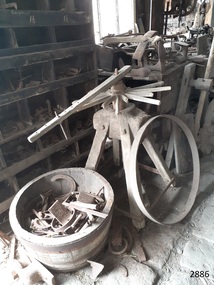
... A wheelwright’s spoke vice would have been very necessary for blacksmiths circa 1800s-1920s as it would have been used in the manufacture and repair of carts, wagons, coaches and other horse-drawn vehicles. ...A wheelwright’s spoke vice would have been very necessary for blacksmiths circa 1800s-1920s as it would have been used in the manufacture and repair of carts, wagons, coaches and other horse-drawn vehicles. ...A wheelwright’s spoke vice was used to hold the wheel hub firmly while the spokes were hammered into the wheel hub, then the spokes would be joined to the wooden wheel felloe before finally the metal flat tyre, or later the rubber tyre, would be attached to the felloe. A wheelwright’s spoke vice would have been very necessary for blacksmiths circa 1800s-1920s as it would have been used in the manufacture and repair of carts, wagons, coaches and other horse-drawn vehicles. This wheelwright’s spoke vice was once used by Harry Goodall of H. Goodall & Sons Pty. Ltd. corner of McKinnon and High Streets, Terang. Victoria. Henry Goodall & Sons Henry Goodall (1870-1936) was proprietor of garages as H. Goodall & Sons Pty. Ltd., at both Terang (McKinnon and High Streets) and Mortlake (Dunlop Street). His business was in operation in at least in 1916 and perhaps well before, considering the date of the tyre bender and its use for wagons with wooden wheels. It was still in operation in 1953, chasing up debtors in Mount Gambier Court. Amongst the employees of H. Goodall & Sons Pty. Ltd. was Ernie Entwistle, a blacksmith (a soldier who died in 1916) and Alfred Hodgetts, radio expert (killed in a fatal accident in 1943, when he was in his early 30s). Henry Goodall was involved in the community as a Justice of Peace, a deputy coroner, President of the Mortlake Hospital, trustee of the Soldiers’ Memorial Hall, and as a prominent Freemason. He and his wife had two sons (Charles and John) and one daughter (Mrs. Chas. Newton, of Skipton). The wheelwright’s spoke vice is significant as it demonstrates how blacksmiths or wheelwrights could make new metal rims for wagon wheels for carts, wagons, stage coaches and carriages over a 135 years ago. The machine is a part of our social history as it demonstrates part of the process of making wagon wheels, which played an important part in aiding the continuation of daily transport needs that people had at the time, such as farming, personal transport and commercial activities. The tool is locally significant as it was used by a local company in Terang and Mortlake in their blacksmith, wheelwright and garage business. Vice; wheelwright’s wheel spoke vice. Manufactured in 1800s. This was once belonged to Harry Goodall & Sons, blacksmith's of Terang. Victoria.flagstaff hill, warrnambool, shipwrecked-coast, flagstaff-hill, flagstaff-hill-maritime-museum, maritime-museum, shipwreck-coast, flagstaff-hill-maritime-village, machinery, wagon wheel, steel rim wheels, henry goodall (1870-1936), terang, wheelwright tool, blacksmith trade, blacksmithing equipment and supplies, h. goodall & sons of terang, terang blacksmith, h. goodall & sons pty ltd, mortlake, ernie entwistle blacksmith, alfred hodgetts radio expert, charles goodall, john goodall, wheel hub, wheel spoke, wheel felloe, wheel tyre, wheel tire -
 Flagstaff Hill Maritime Museum and Village
Functional object - Music stand, Early 19th Century before 1860
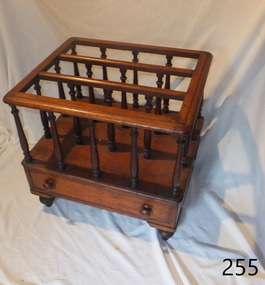
... It was considered “One of Warrnambool’s longest operating businesses with roots dating to 1883 with the design and manufacture of coaches and buggies, progressing to automotive repairs and later specialising in under-vehicle work” ...It was considered “One of Warrnambool’s longest operating businesses with roots dating to 1883 with the design and manufacture of coaches and buggies, progressing to automotive repairs and later specialising in under-vehicle work” The Canterbury appears to have been handmade prior to 1860 as the dovetails are handmade and there are no saw marks on the drawer sides or back as well the sides. ...Thomas Sheraton (1751-1806) appears to have been the first to record the written term “Canterbury” music or magazine stand. In his Cabinet Dictionary of 1803 he refers to “a small music stand” with divisions for holding loose sheet or bound volumes of music. The music stand designed to hold sheet music came into fashion in the late 18th Century in England and was often crafted from mahogany, rosewood or walnut. They were seen as status symbols since music was practiced exclusively by the upper classes of society. In a period when printed music was more widely available and disseminated due to more affordable printing techniques, modern sheet music was very popular and therefore storage for such favoured tunes became a luxury and an opportunity for innovative design by cabinet makers. The Classical period of music, from about 1750 to 1820 and the Romantic Period from around 1815-1910 was the golden age of classical music. And it was at this time that The Canterbury often accompanied the piano in the parlour with styles ranging from Georgian simplicity to Victorian exuberance. Social activities of colonial Victoria would have included evening gatherings of family and friends around the piano to enjoy performances or sing along together with from old and up-to-date music sheets. The Canterbury would also be an elegant and practical place to also store newspapers, magazines, posters and drawings from overseas. The news from ‘home’ would be enjoyed by all. THE INSCRIPTION “Jack Morse” Morse. In 2010 Mr Jack Morse was recognised as one of the “people who have contributed to the long term development of Flagstaff Hill Maritime Village”. He was a member of the Flagstaff hill Planning board and a Current Life Member and had been awarded a Certificate of Service and the provision of an Annual Family Membership for life by Flagstaff Hill. The Morse’s family business, Morse’s Engineering, closed in 2010. It was considered “One of Warrnambool’s longest operating businesses with roots dating to 1883 with the design and manufacture of coaches and buggies, progressing to automotive repairs and later specialising in under-vehicle work” The Canterbury appears to have been handmade prior to 1860 as the dovetails are handmade and there are no saw marks on the drawer sides or back as well the sides. Also the back has small nicks indicating a hand plane or drawer knife was used rather than a saw blade to size the material. Additional indications are that the spindles are slightly different in size meaning they were handmade individually not mass produced. From these indicators the writer believes that the item was made before 1860 as machinery was only used after this date to produce furniture. As yet no individual maker can be attributed to this item, however it is a significant piece historically and is quite valuable if a known maker can be associated with the Canterbury. The item highlights a time in our social history when music played an everyday part in people’s lives as the only entertainment families could enjoy together in their own homes. A Canterbury music stand, having three compartments consisting of twenty turned spindles supporting the slat dividers. A drawer, with two turned wooden handles, is fitted below. The music stand has turnip style turned feet. The drawer front and carcass of the stand are veneered rosewood over a mahogany carcass. The underlined words "Jack Morse" are handwritten underneath the drawer bottom.Hand written inscription on underneath the drawer bottom "Jack Morse".flagstaff hill, warrnambool, shipwrecked-coast, flagstaff-hill, flagstaff-hill-maritime-museum, maritime-museum, shipwreck-coast, flagstaff-hill-maritime-village, canterbury, music rack, magazine rack, music stand, magazine stand, 19th century furniture, occasional furniture, frederick cornwallis, jack morse, morse’s undercar, music, thomas sheraton, regency furniture, music canterbury -
 Flagstaff Hill Maritime Museum and Village
Clock, 1940's
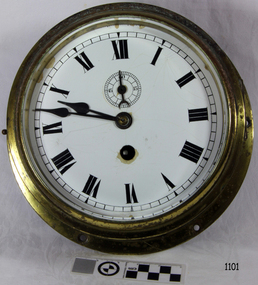
... manufacture domestic clocks in quantity. Moreover, they set out to produce these clocks at a price that the average householder could afford. S Smith & Sons (Motor Accessories) was at this time was the main company in the Smiths group of companies and their business developed both in the motor vehicle field and outside it. ...manufacture domestic clocks in quantity. Moreover, they set out to produce these clocks at a price that the average householder could afford. S Smith & Sons (Motor Accessories) was at this time was the main company in the Smiths group of companies and their business developed both in the motor vehicle field and outside it. ...Smiths began with a craftsman named Samuel Smith who in 1851 opened a shop in Newington Causeway, London, where he made and sold watches, clocks and precision instruments. Samuel had a son, Samuel Jnr who was apprenticed in his fathers business. Samuel Jnr eventually opened his own business at 85 Strand and later opened other premises at 9 Strand, Trafalgar Square and 68 Piccadilly. In 1899 he turned his business into a private limited company, S. Smith & Son Ltd. Samuel Jnr son, Sir Allan Gordon-Smith, joined him as Manager at 9 Strand in 1903 and laid the foundation of the vast Smiths organisation of the future, leading the company towards the supply of accessories for the then developing motor industry making car clocks and the first speedometers patented in 1904. In July 1914 a new company was formed under the name S. Smith & Sons (Motor Accessories) Ltd., to take over the motor accessory business of S. Smith and Son Ltd. and this became the main company of the group which eventually grew to become Smiths Industries Ltd. The original company S Smith and Sons Ltd., continued as jewelers and clock and watchmakers until 1930 when the company was taken over by Bravingtons retail jeweller chain. In 1931 Smiths decided to enter the domestic clock market and formed a new company, Smiths English Clocks Ltd., as the Clock and Watch division of S Smith & Sons (Motor Accessories) Ltd. This is the start of "Smiths Clocks" because this is when they began to manufacture domestic clocks in quantity. Moreover, they set out to produce these clocks at a price that the average householder could afford. S Smith & Sons (Motor Accessories) was at this time was the main company in the Smiths group of companies and their business developed both in the motor vehicle field and outside it. Smiths began to make automatic pilots for aircraft and, through the acquisition of a majority interest in Henry Hughes & Sons Ltd., entered the field of marine instruments. During the war from 1939 to 1945, Smiths' production expanded. There was a demand for motor, aircraft and marine instruments for the Services and the production of industrial instruments and it is at this time that our item was made. In 1944 many changes were made to the Smiths' organisation. The name of the principal company was changed from S Smith & Sons (Motor Accessories) to S. Smith & Sons (England) Ltd. and four new subsidiary selling companies were set up. These were Smiths Motor Accessories Ltd., Smiths Aircraft Instruments Ltd., Smiths Industrial Instruments Ltd., and Smiths English clocks Ltd. The manufacture of clocks and watches ceased in 1979 and 1983 saw Smiths withdraw from producing items for the motor industry.An item that is now regarded as a vintage, sought by horology collectors worldwide and is in excellent condition. The item is unique in that it was made specifically for ships by the Smith company a well known British clock manufacture. Its provenance is well established and it was made during the world war II era specifically for merchant and naval vessels of the time. Naval brass ships bulkhead clock. The clock face is of white enamel with black Roman numerals, an outer minutes ring and black steel hands. There is a subsidiary seconds dial with sweeping hand just above the centre and a fast/slow adjustment lever above that. There is no manufactures name on the dial. There are a beveled glass and brass hinged lid to the front of the clock. The clock is housed in a heavy brass case with screw holes around the circumference for mounting. There are no markings on the clock or mechanism flagstaff hill, warrnambool, shipwrecked-coast, flagstaff-hill, flagstaff-hill-maritime-museum, maritime-museum, shipwreck-coast, flagstaff-hill-maritime-village, s smith and sons, clock, maritime clocks, clock makers, bulkhead clock -
 Gippsland Vehicle Collection
Vehicle Tail Light, 1940 (estimated)
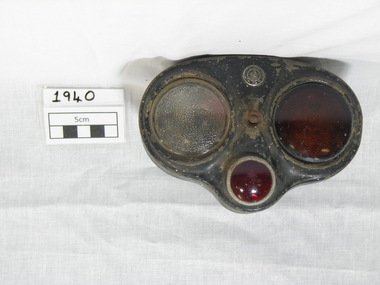
... Lucas Electrical manufactured light and electrical components for many vehicle manufacturers in England and many manufacturers used them as accessories or added extras....Lucas Electrical manufactured light and electrical components for many vehicle manufacturers in England and many manufacturers used them as accessories or added extras. ...Lucas Electrical manufactured light and electrical components for many vehicle manufacturers in England and many manufacturers used them as accessories or added extras.Lucas granted Richards Body Builders of Adelaide, Australia, permission to use the phrase 'King of the Road' as their trade nick name.Kidney shaped metal & glass, four lens number-plate & tail light combinationKing of the Road maker's marktail light, stop light, light tail, king of the road light, number plate light -
 The Beechworth Burke Museum
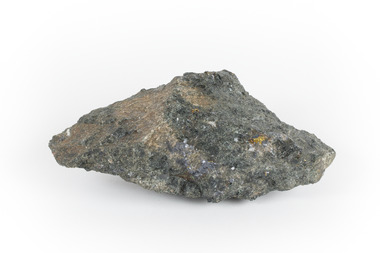
Geological specimen - Mangan Hedenbergite
... manufacture of tin cans. Manganese is a key component of certain widely used aluminium alloys and, in oxide form, dry cell batteries used in electric vehicles. ...This specimen was recovered from Broken Hill, NSW. It was given the name Mangan Hedenbergite in 1819 by Jöns Jakob Berzelius in honor of Mr. Anders Ludvig of Hedenberg who was the first to define hedenbergite as a mineral. Hedenbergite, belongs in the pyroxene group having a monoclinic crystal system. The mineral is extremely rarely found as a pure substance. Mangan Hedenbergite is a manganese bearing variety of Hedenbergite. Manganese is the world’s fourth most used mineral after iron, aluminium, and copper primarily because it has no satisfactory substitute in its major applications. Globally, the steel industry is the primary user of manganese metal, utilizing it as an alloy to enhance the strength and workability of steel and in the manufacture of tin cans. Manganese is a key component of certain widely used aluminium alloys and, in oxide form, dry cell batteries used in electric vehicles. These batteries are in high demand. Another potential use for manganese may as an additive to help coat and protect a car’s engine. Manganese is also used for non-metallurgical purposes such as plant fertilizers, animal feed, and colorants for bricks. This specimen is part of a larger collection of geological and mineral specimens collected from around Australia (and some parts of the world) and donated to the Burke Museum between 1868-1880. A large percentage of these specimens were collected in Victoria as part of the Geological Survey of Victoria that begun in 1852 (in response to the Gold Rush) to study and map the geology of Victoria. Collecting geological specimens was an important part of mapping and understanding the scientific makeup of the earth. Many of these specimens were sent to research and collecting organisations across Australia, including the Burke Museum, to educate and encourage further study.A hand-sized mineral specimen in shades of silver and blackmanganese, open cut mine, manganese ore processing, bell bay, tasmania, northern territory, steel industry, zinc-carbon batteries, alkaline batteries, tin cans -
 Flagstaff Hill Maritime Museum and Village
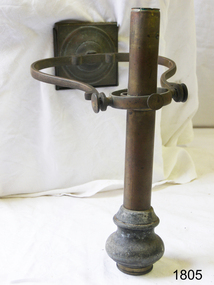
Functional object - Carbide Lamp, Powell & Hanmer, Late 19th to early 20th century
... In 1890 they lodged a Patent for “velocipede” lamps to be used by lightweight wheeled vehicles propelled by a rider, such as a bike, tricycle and railroad handcar. In April of 1913, they were selling headlamps for cars and in 1914 built their second factory manufacturing dynamo lighting sets in Rocky Lane Birmingham, also for the production of dynamos for motor cars. ...In 1890 they lodged a Patent for “velocipede” lamps to be used by lightweight wheeled vehicles propelled by a rider, such as a bike, tricycle and railroad handcar. In April of 1913, they were selling headlamps for cars and in 1914 built their second factory manufacturing dynamo lighting sets in Rocky Lane Birmingham, also for the production of dynamos for motor cars. ...Francis Powell (1861-) and Francis Hanmer (1858-1925) founded Powell and Hanmer Ltd in the Summer of 1885 for the manufacturer of bike and carriage lamps. Their first advertisements began to appear in November of 1885. In 1890 they lodged a Patent for “velocipede” lamps to be used by lightweight wheeled vehicles propelled by a rider, such as a bike, tricycle and railroad handcar. In April of 1913, they were selling headlamps for cars and in 1914 built their second factory manufacturing dynamo lighting sets in Rocky Lane Birmingham, also for the production of dynamos for motor cars. Then in 1929 Powell and Hanmer Ltd, was acquired by the Lucas company which was at that time the main competitor for the manufacture of non-electrical equipment for cycles and motorcycles. When a director of Powell and Hanmer joined the board of Austin motor cars, Lucas feared that Austins might encourage Powell and Hanmer to start to produce electrical equipment for supply to the company and as a result this association might affect Lucas's business with other large vehicle manufacturers. As a result, Lucas made an offer to Powell & Hanmer and purchased the business for £500,000. Carbide lighting was used in rural and urban areas of Australia which were not served by electrification. Its use began shortly after 1900 in many countries and continued past the 1950s. Calcium carbide pellets were placed in a container outside the home, with water piped to the container and allowed to drip on the pellets releasing acetylene. This gas was piped to lighting fixtures inside the house, where it was burned, creating a very bright flame. Carbide lighting was inexpensive but was prone to gas leaks and explosions. Early models of the automobile, motorbike and bicycles used carbide lamps as headlamps. Acetylene gas, derived from carbide, enabled early automobiles to drive safely at night. Thick concave mirrors combined with magnifying lenses projected the acetylene flame light. These type of lights were used until reliable batteries and dynamos became available, and manufacturers switched to electric lights. Acetylene lamps were also used on riverboats for night navigation. The National Museum of Australia has a lamp made in about 1910 that was used onboard the PS Enterprise, an 1878 Australian paddle steamer, currently owned by the National Museum of Australia in Canberra. It is still operational, and one of the oldest working paddle steamers in the world, listed on the Australian Register of Historic Vehicles.Acetylene Carbide lamp, marine pattern burner housing and reflector missing Carbide Lamp, metal. Has plate for attaching to wall, & gimbal to allow lamp to remain vertical. Noneflagstaff hill, warrnambool, flagstaff-hill-maritime-museum, maritime-museum, shipwreck-coast, flagstaff-hill-maritime-village, carbide lamp, motor vehicle, bike lamp, lighting, vehicle lighting, powell, hanmer, acetylene gas lamp, early lighting, marine lighting -
 Greensborough Historical Society
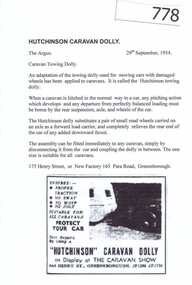
Article, Hutchinson Caravan Dolly, 24/09/1954
... vehicle and vision of the driver. The Hutchinson Caravan Dolly was adapted from a towing dolly used for cars with damaged wheels and manufactured in Greensborough in the 1950's and 1960's. hutchinson caravan dolly 165 para rd 175 henry st towing dollies Nil A 6 page document featuring many colour photographs and reproductions of period advertising on the Hutchinson Caravan Dolly. ...The Hutchinson Caravan Dolly was a device for stopping the rear of a towing vehicle from being drawn down by the weight of the caravan and having a detrimental effect on the steering of the vehicle and vision of the driver.The Hutchinson Caravan Dolly was adapted from a towing dolly used for cars with damaged wheels and manufactured in Greensborough in the 1950's and 1960's. A 6 page document featuring many colour photographs and reproductions of period advertising on the Hutchinson Caravan Dolly. Nilhutchinson caravan dolly, 165 para rd, 175 henry st, towing dollies -
 City of Moorabbin Historical Society (Operating the Box Cottage Museum)
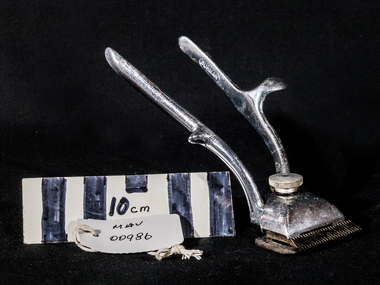
Barbers' Equipment, hair clippers 'BURMAN", c1950
... manufactured Burman-Douglas steering gear. Their recirculating worm and ball design of steering gear was fitted to pre-war vehicles such as the Ford Eight and the Ford Prefect, the Bedford CA, plus heavy trucks and off-road vehicles - both pre and post-war. ...manufactured Burman-Douglas steering gear. Their recirculating worm and ball design of steering gear was fitted to pre-war vehicles such as the Ford Eight and the Ford Prefect, the Bedford CA, plus heavy trucks and off-road vehicles - both pre and post-war. ...Hair clippers are specialized implements used to cut human head hair. They work on the same principle as scissors, but are distinct from scissors and razors. :Hair clippers comprise a pair of sharpened comb-like blades in close contact one above the other which slide sideways relative to each other, a mechanism which may be manual or electrical to make the blades oscillate from side to side, and a handle. The clipper is moved so that hair is positioned between the teeth of the comb, and cut with a scissor action when one blade slides sideways relative to the other. Friction between the blades needs to be as low as possible, which is attained by choice of material and finish, and frequent lubrication. Hair clippers are operated by a pair of handles that are alternately squeezed together and released. Barbers used them to cut hair close and fast. The hair was picked up in locks and the head was rapidly depilated. Mid 20thC such haircuts became popular among boys, and young men in the military and in prisons. Burman & Sons Ltd, of Ryland Road, Birmingham, West Midlands, manufactured Burman-Douglas steering gear. Their recirculating worm and ball design of steering gear was fitted to pre-war vehicles such as the Ford Eight and the Ford Prefect, the Bedford CA, plus heavy trucks and off-road vehicles - both pre and post-war. In its day, Burman-Douglas steering-gear was regarded as.... a "quality" feature of a car chassis specification, but the worm and ball design was eventually surpassed by the cheaper rack and pinion design that dominates today. The company also manufactured motorcycle gearboxes, horse clippers and barbers’ clippers. 1871 Company founded. 1897 Private company. 1930s Gearbox for Ariel Square-four motorcycle. (Exhibit at Birmingham Thinktank museum) 1933 Burman and Sons Limited, manufacturers of horse and barbers' clippers, sheep shearers, motor cycle gear boxes and steering gears, Ryland road, Edgebaston 1953 S. F. Burman, M.B.E., Managing Director, Burman and Sons, Ltd 1955 Acquired by Vono Industrial Products. 1961 Manufacturers of motor and motorcycle accessories. 1,500 employees. 1968 Supplied rack and pinion steering units to Ford 1978 Adwest Group acquired Burman and Sons, the steering gear part of Duport. 1986 Major reduction in staffing at Burman due to fall in demand for its products and delivery problems. A set of hand held barbers’ hair clippers with an adjustable screw, from Burman and Sons Ltd of Birmingham, England. Chrome plated, in good condition, c1950. On left arm ; BURMAN On right arm ; MADE IN ENGLANDbarbers, hairdressing, hair clippers, grooming, horse clippers, cars, motor cycles, gear boxes, rack and pinion , worm and ball, steering gears, steel manufacture, birmingham england, burman and sons ltd, moorabbin, bentleigh, ormond, cheltenham, market gardeners, -
 Fire Services Museum of Victoria
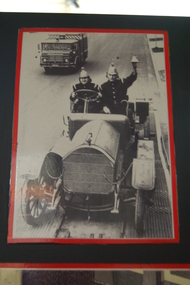
Fire Engine - Pump - Melba, MFB Pierce-Arrow Heavy Pumper, 1911 (exact)
... Unique vehicle fabricated by MFB from chassis of Dame Nellie Melba's salon car Unique vehicle, critical for large fire extinguishing, fully restored melbourne red melba heavy pumper mfb pierce arrow vehicle dame nellie melba fire engine solid tyre Registration No 16658, 1911 Melba Pump, Pierce-Arrow, Pierce-Arrow MFB Heavy Pumper salon car manufactured 1911 Petrol Engine - Straight 6, 48HP, Kelly & Lewis pump, centrifugal, 400 gpm, 5 inputs, 2 outlets, rear mounted PTO driven Converted by MFB from Salon Car into heavy pumper in 1919 Out of service with MFB in 1933 MFB Pierce-Arrow Heavy Pumper Fire Engine - Pump - Melba Pierce-Arrow ...Unique vehicle fabricated by MFB from chassis of Dame Nellie Melba's salon carUnique vehicle, critical for large fire extinguishing, fully restoredPierce-Arrow MFB Heavy Pumper salon car manufactured 1911 Petrol Engine - Straight 6, 48HP, Kelly & Lewis pump, centrifugal, 400 gpm, 5 inputs, 2 outlets, rear mounted PTO driven Converted by MFB from Salon Car into heavy pumper in 1919 Out of service with MFB in 1933Registration No 16658, 1911 Melba Pump, Pierce-Arrow,melbourne, red, melba, heavy pumper, mfb, pierce arrow, vehicle, dame nellie melba, fire engine, solid tyre -
 Flagstaff Hill Maritime Museum and Village
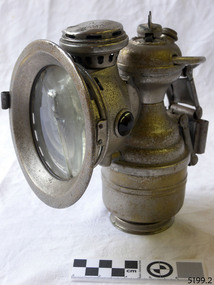
Functional object - Carbide Lamp, Powell & Hanmer, 1920s
... In 1890 they lodged a Patent for “velocipede” lamps to be used by lightweight wheeled vehicles propelled by a rider, such as a bike, tricycle and railroad handcar. In April of 1913, they were selling headlamps for cars and in 1914 built their second factory manufacturing dynamo lighting sets in Rocky Lane Birmingham, also for the production of dynamos for motor cars. ...In 1890 they lodged a Patent for “velocipede” lamps to be used by lightweight wheeled vehicles propelled by a rider, such as a bike, tricycle and railroad handcar. In April of 1913, they were selling headlamps for cars and in 1914 built their second factory manufacturing dynamo lighting sets in Rocky Lane Birmingham, also for the production of dynamos for motor cars. ...Francis Powell (1861-) and Francis Hanmer (1858-1925) founded Powell and Hanmer Ltd in the Summer of 1885 for the manufacturer of bike and carriage lamps. Their first advertisements began to appear in November of 1885. In 1890 they lodged a Patent for “velocipede” lamps to be used by lightweight wheeled vehicles propelled by a rider, such as a bike, tricycle and railroad handcar. In April of 1913, they were selling headlamps for cars and in 1914 built their second factory manufacturing dynamo lighting sets in Rocky Lane Birmingham, also for the production of dynamos for motor cars. Then in 1929 Powell and Hanmer Ltd, was acquired by the Lucas company which was at that time the main competitor for the manufacture of non-electrical equipment for cycles and motorcycles. When a director of Powell and Hanmer joined the board of Austin motor cars, Lucas feared that Austins might encourage Powell and Hanmer to start to produce electrical equipment for supply to the company and as a result this association might affect Lucas's business with other large vehicle manufacturers. As a result, Lucas made an offer to Powell & Hanmer and purchased the business for £500,000. Carbide lighting was used in rural and urban areas of Australia which were not served by electrification. Its use began shortly after 1900 in many countries and continued past the 1950s. Calcium carbide pellets were placed in a container outside the home, with water piped to the container and allowed to drip on the pellets releasing acetylene. This gas was piped to lighting fixtures inside the house, where it was burned, creating a very bright flame. Carbide lighting was inexpensive but was prone to gas leaks and explosions. Early models of the automobile, motorbike and bicycles used carbide lamps as headlamps. Acetylene gas, derived from carbide, enabled early automobiles to drive safely at night. Thick concave mirrors combined with magnifying lenses projected the acetylene flame light. These type of lights were used until reliable batteries and dynamos became available, and manufacturers switched to electric lights. Acetylene lamps were also used on riverboats for night navigation. The National Museum of Australia has a lamp made in about 1910 that was used onboard the PS Enterprise, an 1878 Australian paddle steamer, currently owned by the National Museum of Australia in Canberra. It is still operational, and one of the oldest working paddle steamers in the world, listed on the Australian Register of Historic Vehicles.Acetylene Carbide lamp, Model “Panther” distinct patterned side red and green lenses. These lamps were also known as acetylene gas lamps. They work off a chemical reaction between calcium carbide and water.Model 75flagstaff hill, warrnambool, flagstaff-hill-maritime-museum, maritime-museum, shipwreck-coast, flagstaff-hill-maritime-village, carbide lamp, motor vehicle, bike lamp, lighting, vehicle lighting, powell, hanmer, acetylene gas lamp, early lighting -
 Warrnambool and District Historical Society Inc.
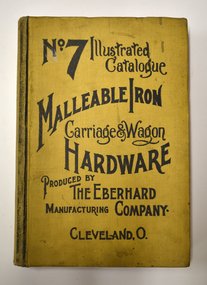
Book - Illustrated Catalogue of Malleable Iron Hardware, The Eberhard Manufacturing Company, No. 7 Illustrated Catalogue Malleable Iron Hardware, 1908
... This company was established in 1877 and progressed from manufacturing parts for carriages and wagons to the production of parts for automobiles, commercial and military vehicles. ...This company was established in 1877 and progressed from manufacturing parts for carriages and wagons to the production of parts for automobiles, commercial and military vehicles. ...Catalogue from American company of malleable hardware itemsThis is a book of 732 pages. It has a yellow cloth cover with black printing and pages edged in red. The contents contain an index and pages of black and white sketches and text.non-fictionCatalogue from American company of malleable hardware itemscarriage and wagon hardware, eberhard manufacturing company
