
Showing 32 items matching "mathematical instrument"
-
 Federation University Historical Collection
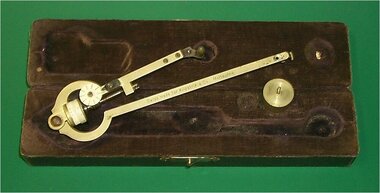
Equipment - Mathematical Instrument, Polar Planimeter, c1900s
... Mathematical Instrument......mathematical instrument...Made for Kilpatrick & Co, Melbourne and used at Ballarat School of Mines. This mathematical instrument allowed users to determine the area of a curved region tracing its boundary. ...Polar Planimeter Equipment Mathematical Instrument ...Made for Kilpatrick & Co, Melbourne and used at Ballarat School of Mines. This mathematical instrument allowed users to determine the area of a curved region tracing its boundary. Two arms - one arm anchored at the end away from the pivot and one arm traced the drawing. The graph produced polar co-ordinates.A polar planimeter, housed in a storage box with molded, velvet lined interior. Hinged lid with clasp. Black fabric outside cover.Swiss made for Kilpatrik & Co. Melbourne Serial No. 62712 Paper sticker on underside of box "Made in Switzerland"planimeter, kilpatrick & co., polar planimeter, ballarat school of mines, mathematical instrument, area, curved region -
 Kew Historical Society Inc
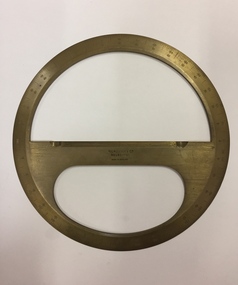
Equipment - Boxed Mathematical Instrument, Kilpatrick & Co, A Victorian cased brass full-circle protractor, 1853-1925
... Boxed Mathematical Instrument......mathematical instrument...A Victorian cased brass full-circle protractor Equipment Boxed Mathematical Instrument Kilpatrick & Co. ...Kilpatrick & Co., Melbourne were active 1853-1925.A brass protractor, used in developing plans in the Engineer's Department of the City of KewCircular brass protractor in a square mahogany lidded case, retailed by Kilpatrick & Co., Melbourne. The protractor was used by staff in the Engineering Department of the former City of Kew. Handwritten inscription on label on lid:" J.R. Gray. G.P Russell,1951, Kew City Engineers used this".protractor, mathematical instrument, city of kew (engineering department) -
 Federation University Historical Collection
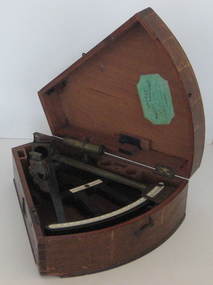
Boxed sextant, Sextant, Betweeen 1840 and 1858
... Keohan - Mathematical Instrument maker & Optician...Sextant Boxed sextant Keohan - Mathematical Instrument maker & Optician ...This item is possibly the sextant donated to the Ballarat School of Mines Museum on 21 October 1885 by D. Turpie of Ballarat.Timber (ebony?) framed sextant with ivory scale, brass radial arm and ivory vernier scale. Mirrors and viewer are set in brass.Maker's label inside the hinged lid.sextant, scientific instrument, d. turpie, navigation, ballarat school of mines museum -
 Federation University Historical Collection
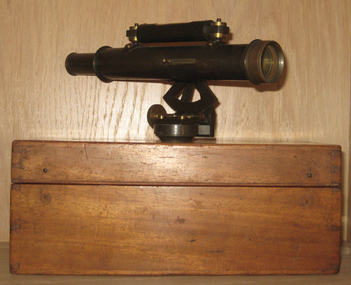
Instrument - Scientific Instrument, Drainage Level
... Matthews, Nautical, Optical & Mathematical Instrument Maker...Matthews, Nautical, Optical & Mathematical Instrument Maker ...Probably used for surveying courses at the Ballarat School of Mines Boxed telescopic sight with longitudu=inal bubble level and a quadrant draduated in +- 40 in 100 22mm diameter. Female screw thread base. Push-Pull focussing. Housed in an hinged timber box.drainage level, scientific intstruments, ballarat school of mines, scientific instruments -
 Whitehorse Historical Society Inc.
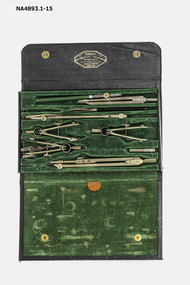
Instrument - Mathematical Instruments
... 13 mathematical instruments in a fitted velvet lined case. ...Crown Mathematical Instruments. British Made. AO Thornton Ltd Manchester England....Instrument Mathematical Instruments ...13 mathematical instruments in a fitted velvet lined case. An outer black pouch to hold case.Crown Mathematical Instruments. British Made. AO Thornton Ltd Manchester England.instruments, measuring -
 Hume City Civic Collection
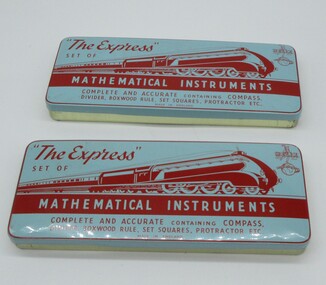
Education kit - Instruments, The Express
... A set of mathematical instruments used in geometry and other more complicated drawing processes....A set of mathematical instruments in a tin. The tin has a blue lid with red and white lettering and the drawing of an express train. ...A set of mathematical instruments used in geometry and other more complicated drawing processes. education department teaching equipment george evans collection A set of mathematical instruments in a tin. ...A set of mathematical instruments used in geometry and other more complicated drawing processes.A set of mathematical instruments in a tin. The tin has a blue lid with red and white lettering and the drawing of an express train. This is a Helix set of mathematical instruments comprising a compass, divider, boxwood ruler, set squares, protractor, eraser, pencil and blotter used in schools.education department, teaching, equipment, george evans collection -
 Whitehorse Historical Society Inc.
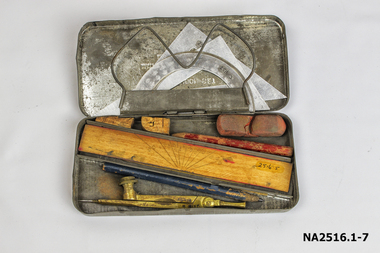
Instrument - Mathematical Instruments
... The School Set of Mathematical Instruments...Instrument Mathematical Instruments ...Believed to be 70 years old.Flat grey box containing four set squares in the lid, one compass, one ruler, two pieces of cork (not numbered), two pencils (not numbered), and an eraser (not numbered).The School Set of Mathematical Instrumentsinstruments, measuring -
 The Ed Muirhead Physics Museum
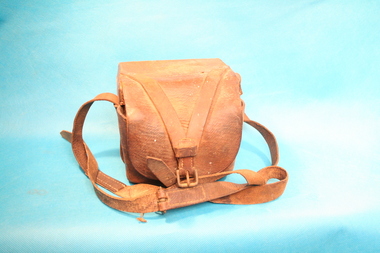
Instrument - Accessory box for a No 6 Director Mk I
... ...Mathematical Instrument...Related to object 463.1 accessory box no 6 director mk i broad arrow Cooke Troughton and Simms Ltd WWII Mathematical Instrument Embossed in lid: 'CASE NO 6 DETECTOR MK 1 / COOKE, TROUGHTON & SIMMS, LTD / 9 / 22 / A.F.A' and broad arrow symbol. ...Possibly related to the range-finding equipment sent from England for dismantling during the 1940s so University of Melbourne Physics staff could develop their own equipment. Related to object 463.1Leather accessory box with shoulder strap and metal buckles. Flip open lid.Embossed in lid: 'CASE NO 6 DETECTOR MK 1 / COOKE, TROUGHTON & SIMMS, LTD / 9 / 22 / A.F.A' and broad arrow symbol.accessory box, no 6 director mk i, broad arrow, cooke troughton and simms ltd, wwii, mathematical instrument -
 Kiewa Valley Historical Society
Ron White's Collection - 1920 - 2019
... H) Pewter Mug presented to Ron - Water Board I) Wall hanging presented to Ron - Scouts J) Ron White's Slide Ruler & Mathematical Instruments K) Collection of 7 books owned by Ron L) Starting Pistol Caps box M) Ice-cream server...White 1989" J) mathematical Instruments have 'R. W' embossed in red on the corner of the cover M) 100 Straitline, Starting Pistol Caps N) National Ice-cream Server with stainless steel spring Size 20 ...H) Pewter Mug presented to Ron - Water Board I) Wall hanging presented to Ron - Scouts J) Ron White's Slide Ruler & Mathematical Instruments K) Collection of 7 books owned by Ron L) Starting Pistol Caps box M) Ice-cream server Ron White's Collection - 1920 - 2019 ...Ron White was born in 1920. He received a Diploma of Mechanical Engineering at Footscray Technical School in 1946. He started work as a laboratory assistant and after several promotions was appointed Senior Operator in 1948. In 1949, he was Engineer, Grade 1 (Hydro Areas). After further promotions he became Assistant Area Engineer, Rubicon at new Eildon Power Station and Area Engineer, Kiewa in commissioning Mt Beauty Terminal Station and West Kiewa Power Station.. By 1956, he was the Area Operations Engineer at Kiewa and four years later the Kiewa Electrical Superintendent (Operations and Maintenance) . In 1961, he was officially recognised as deputy for the General Superintendent, Kiewa. In 1966 he was appointed General Superintendent Kiewa and Kiewa became 'a branch of the Transmission Department'. In 1974, the Rubicon / Eildon Area was also under Ron's control. His title was "Principal Hydro Engineer, Hydro Division, Transmission Operations Department. He held this position until his retirement in 1985.Ron White was an important identity in his role as Principal Hydro Engineer from 1966 to 1985 after the completion of the Kiewa Hydro Electric Scheme. His long period of service involved him in the construction, operation and maintenance of the SECV's Hydro Electric Schemes and administration of related catchment areas. He had a close association with the local communities and care for the welfare of employees. He lived in Mt Beauty and was well respected in the community and beyond. He passed away on 30 September 2019, aged 99 years.A) History of Ron White's Working Life: including papers relating to "Promotion & Staff Appointment" B) Ron White's Retirement - 11th Jan. 1985: papers, cards, letters, photos, disc/plaque C) Ron White's Certificates: Diploma of Mechanical Engineering; First Aid; D) Ron White's Correspondence - miscellaneous E) Ron White's History of the 'Kiewa Scheme' from 1936- 1966. Written 1986 F) Ron White's Photo album Includes photos of him and the 2003 bushfires G) Miscellaneous Photos (not labelled) from Ron's photo album. Possibly relatives including nieces and nephews. H) Pewter Mug presented to Ron - Water Board I) Wall hanging presented to Ron - Scouts J) Ron White's Slide Ruler & Mathematical Instruments K) Collection of 7 books owned by Ron L) Starting Pistol Caps box M) Ice-cream serverF) One photo of Ron with 'Ken Connors'. One photo with 'l to r: Norm Middleton, Graham Napier, Ron White, Les Peart.' G) 2003 fires has a note re time, date and whereabouts of fires H) "Presented To / Ron White / In Appreciation For Service / To The / Kiewa Valley / Water Authority / And / Its predecessor Bodies / December 1994 I) Wall hanging: On emblem - "Lord Baden-Powell Society / The Scout Association of Australia". On Name Plate below - Ronald K. White 1989" J) mathematical Instruments have 'R. W' embossed in red on the corner of the cover M) 100 Straitline, Starting Pistol Caps N) National Ice-cream Server with stainless steel spring Size 20 ron white, hydro engineer, kiewa hydro electric scheme -
 City of Greater Bendigo - Civic Collection
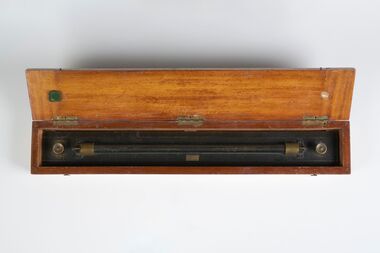
Equipment - Rolling Parallel Ruler, Kilpatrick and Co
... Kilpatrick and Co were London based Mathematical Instrument Makers, Opticians, Goldsmiths, Jewellers and Watchmakers who operated in Melbourne at various Collins Street addresses between 1876 and 1898. ...Kilpatrick and Co were London based Mathematical Instrument Makers, Opticians, Goldsmiths, Jewellers and Watchmakers who operated in Melbourne at various Collins Street addresses between 1876 and 1898. ...Kilpatrick and Co were London based Mathematical Instrument Makers, Opticians, Goldsmiths, Jewellers and Watchmakers who operated in Melbourne at various Collins Street addresses between 1876 and 1898. Believed to have been a part of the Shire of Marong's surveying equipment.Rectangular brass ruler with beveled edges and rollers on underside. Housed in custom made hinged wooden box. Centre front; Kilpatrick & Co., Londoncity of greater bendigo surveying, shire of marong -
 Flagstaff Hill Maritime Museum and Village
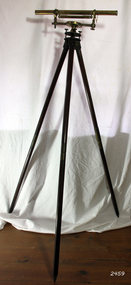
Instrument - Drainage Level, 1750-1795
... Geometrical and Graphical Essays, containing a description of the mathematical instruments used in geometry, civil and military surveying, leveling and perspective (1790). ...Geometrical and Graphical Essays, containing a description of the mathematical instruments used in geometry, civil and military surveying, leveling and perspective (1790). ...Adams jnr wrote many elementary scientific works, as well as on the use of mathematical instruments. He often combined in his written works with religious themes and scientific content, often against the prevailing thoughts of the time. According to one popular magazine of the time (Gentleman's Magazine), his works were often accused of "growing errors of materialism, infidelity, and anarchy". He started writing at a young age and developed a love for it, his main interests included math and science, these subjects he often expressed in his written essay's. Notable works from Adams are. An Essay on Electricity, and Magnetism (1784). Essays on the Microscope (1787). An Essay on Vision, briefly explaining the fabric of the eye (1789). Astronomical and Geographical Essays (1790). A Short Dissertation on the Barometer (1790). Geometrical and Graphical Essays, containing a description of the mathematical instruments used in geometry, civil and military surveying, leveling and perspective (1790). Lectures on Natural and Experimental Philosophy, in five volumes (1794).George Adams Sr and Jnr were both notable opticians and scientific instrument makers of the 18th century. Their contribution to scientific innovation and optical development cannot be underestimated. Having one of their early drainage levels in the collection and in extremely good condition is an asset to the Flagstaff collection.Drainage level or optical level. A brass surveying instrument with Achromatic telescope, bubble level and dial fitted to the Tribrach or footplate that has leveling screws. Tripod is wood and brass with adjustable and unscrewable legs (for ease of transportation). Made by "G. Adams Fleet St, London". Used in surveying and building to transfer, measure and/or set horizontal levels."G. Adams - London".flagstaff hill, warrnambool, shipwrecked-coast, flagstaff-hill, flagstaff-hill-maritime-museum, maritime-museum, shipwreck-coast, flagstaff-hill-maritime-village, george adams fleet street london, optical instrument, scientific instrument, technical instrument, surveyors level, george adams snr, projection microscope -
 National Wool Museum
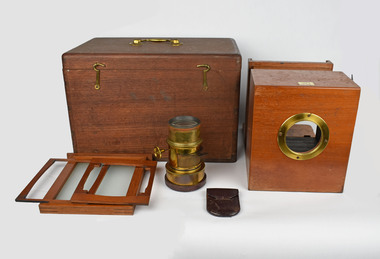
Machine - Sliding Box Plate Camera, 1866-1882
... Made by Cox, F J 1845-1882 (1891), optical & mathematical instrument maker, optician, camera manufacturer, London.Sliding box camera, about 1855. ...Made by Cox, F J 1845-1882 (1891), optical & mathematical instrument maker, optician, camera manufacturer, London.Sliding box camera, about 1855. ...Made by Cox, F J 1845-1882 (1891), optical & mathematical instrument maker, optician, camera manufacturer, London.Sliding box camera, about 1855. This type of camera was in use before bellows became common. The camera belonged to Hugh Strachan who passed it on to an employee, Charlie Lugg. The Strachan family is distinguished in the Geelong wool industry. James Ford Strachan, born in Scotland, established a very successful wool broking business and his sons carried on his work.Wooden case with brass handle lined with green felt containing one sliding box camera, with a brass fitting for a lense, a removable glass focussing screen, which conseals the removable lense inside the camera. Also two small wooden frames for developping the photographs. Also a linen cape and a leather pouch containing metal filters with gradients. Booklet about the life of Charles Lugg who owned the camera before it was passed to his nephew who then donated it to the NWM. Booklet details Lugg's military service, working life in Stachan's wool stores and life in Geelong and Moriac. Measurements of parts (in centimeters): 27 26 41.5 Carry Case 24.5 36.5 21.2 Sliding box Camera 15.4 .5 17.6 slide frame 11 14.5 9.5 lens 152 71 cape 9 1.5 6.5 pouch 8.5 .1 6.5 5.5 Filter Lense 8.5 .1 6.5 4.5 Filter Lense 8.5 .1 6.5 3.5 Filter Lense 8.5 .1 6.5 1.2 Filter Lense F.J. Cox/ 26/Ludgate Hill/ London (Plaque on top of box) Fred J Cox/26 Ludgate Hill/London (Engraved on side of Lens)charles lugg, fred j cox, james ford strachan -
 Flagstaff Hill Maritime Museum and Village
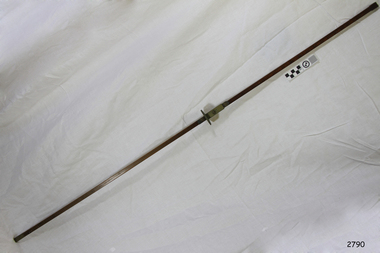
Gauging Rod, 1903-1938
... The firm Dring and Fage were active from 1790 to 1940 in London and were manufacturers of hydrometers and mathematical instruments they became established in London in 1790 by John Dring, who was a brass worker and hydrometer maker, and William Fage. ...The firm Dring and Fage were active from 1790 to 1940 in London and were manufacturers of hydrometers and mathematical instruments they became established in London in 1790 by John Dring, who was a brass worker and hydrometer maker, and William Fage. ...The firm Dring and Fage were active from 1790 to 1940 in London and were manufacturers of hydrometers and mathematical instruments they became established in London in 1790 by John Dring, who was a brass worker and hydrometer maker, and William Fage. Dring and Fage manufactured also saccharometers and other instruments used to measure the strength of alcohol. These instruments were primarily used to calculate excises. They traded at various addresses in London and they were at 56 Stamford St. between 1903 and 1938. By 1850 the company was owned by Edward Hall and Edward Jenkin and in 1940 the company became Dring & Fage Ltd, trading till the 1960s. Historically, gauging has meant measuring a volume, these gauging instruments were used by Customs and Excise and manufacturers for determining the volume and contents of liquid containers. For Customs the determination and collection of duty on imported goods which has had a very long history. Chaucer was a Customs Officer as was his father and grandfather, excise was first officially introduced in 1643, with the aim of maintaining military forces raised by the English Parliament at that time. Excise was initially a duty on home produced alcoholic beverages and soap but being easily applied, spread rapidly to a wide range of goods including imports of varying kinds. The government departments of Customs and Excise merged only in 1909 and it is from around this time that our instrument was made and used. The item demonstrates a long social history of the practice of Government's collecting duty on alcoholic beverages and thereby makes this item historically significant as it was used locally at Port Fairy by the ports Customs agents. Gauging rod or bung rod; ullaging gauge. Long brown wooden gauging rod with brass tips and sliding brass marker. Measurements are marked along the length of the rod. Used for measuring volume of liquor in casks in order for Customs to calculate excise (tax) on the contents. Made by Dring & Fage, London.Engraved “Dring & Fage 56 Stamford St London flagstaff hill, warrnambool, shipwrecked coast, flagstaff hill maritime museum, maritime museum, shipwreck coast, flagstaff hill maritime village, great ocean road, gauging rod, ullaging rods, measuring instruments, customs tax, dring & fage, alcohol measurement -
 Flagstaff Hill Maritime Museum and Village
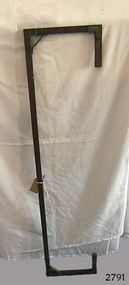
Barrel Calipers, Early 20th Century
... The firm Dring and Fage were active from 1790 to 1940 in London and were manufacturers of hydrometers and mathematical instruments they became established in London in 1790 by John Dring, who was a brass worker and hydrometer maker, and William Fage. ...The firm Dring and Fage were active from 1790 to 1940 in London and were manufacturers of hydrometers and mathematical instruments they became established in London in 1790 by John Dring, who was a brass worker and hydrometer maker, and William Fage. ...The firm Dring and Fage were active from 1790 to 1940 in London and were manufacturers of hydrometers and mathematical instruments they became established in London in 1790 by John Dring, who was a brass worker and hydrometer maker, and William Fage. Dring and Fage manufactured also saccharometers and other instruments used to measure the strength of alcohol. These instruments were primarily used to calculate excises. They traded at various addresses in London and they were at 56 Stamford St. between 1903 and 1938. By 1850 the company was owned by Edward Hall and Edward Jenkin and in 1940 the company became Dring & Fage Ltd, trading till the 1960s.Historically, gauging has meant measuring a volume, these gauging instruments were used by Customs and Excise and manufacturers for determining the volume and contents of liquid containers. For Customs the determination and collection of duty on imported goods which has had a very long history. Chaucer was a Customs Officer as was his father and grandfather, excise was first officially introduced in 1643, with the aim of maintaining military forces raised by the English Parliament at that time. Excise was initially a duty on home produced alcoholic beverages and soap but being easily applied, spread rapidly to a wide range of goods including imports of varying kinds. The government departments of Customs and Excise merged only in 1909 and it is from around this time that our instrument was made and used. The item demonstrates a long social history of the practice of Government's collecting duty on alcoholic beverages and thereby makes this item historically significant as it was used locally at Port Fairy by the ports Customs agents. Boxwood barrel calipers, wooden slide-rule with right angles at each end and brass fittings used for measuring casks length."Dring & Fage Makers to the Customs" stamped on side.flagstaff hill, warrnambool, shipwrecked coast, flagstaff hill maritime museum, maritime museum, shipwreck coast, flagstaff hill maritime village, great ocean road, customs, long calipers, excise duty, barrel calipers -
 Kiewa Valley Historical Society
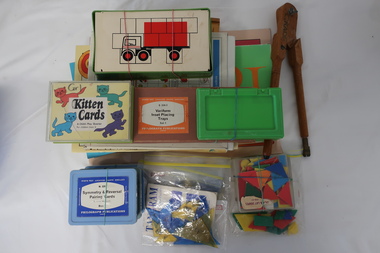
Educational Aids - Primary
... Compass - Mathematical instrument -wooden, large size to fit drawing a circle with chalk on a blackboard...Compass - Mathematical instrument -wooden, large size to fit drawing a circle with chalk on a blackboard Educational Aids - Primary ...Mt Beauty Primary School commenced in 1948. At the time the Educational Aids / games were up to date and plentiful in the Primary grades. Educational aids continue to be updated along with technology.Mt Beauty Primary School began with up to date equipment and teaching methods. This collection is an example of pre-computer equipment.Variety of educational games and aids including those for teaching Italian 1. La Tombola del flori 2. Ecco Pinocchio - illustrated by Edward Dyas 3. Children's Italian Dictionary by Franko Leoni 4. La Befana- Notes for Teachers - Produced by the Catholic Education Office of Victoria 5. Italy a brief outline 6. Orizzonti - April Edition 1995 7. Zucchero filato - illustrated by Edward Dyas 8. La tombola dei negozi 9.Variform Inset Placing Trays Set 1- Philograph Publications 10. Cubes for matching 11. Kitten Cards - A Child's Play Quartet 12. Symmetry & Reversal Pairing Cards Boxes 1,2 & 3 Philograph Publications 13. Picture Dominoes - Hoborn Productions 1980 14. Figura Shapes 15. Colour and Lay Shapes 16. Tessellations 17. Tangram x2 18. Compass - Mathematical instrument -wooden, large size to fit drawing a circle with chalk on a blackboardmt beauty primary school, educational game and aids -
 Flagstaff Hill Maritime Museum and Village
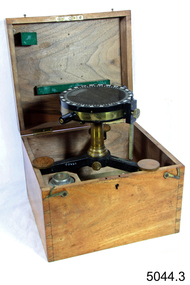
Instrument - Azimuth Compass, Early 20th Century
... Negretti and Zambra 1850-1980s were optical instrument makers and mathematical instrument makers based in London, England. ...Negretti and Zambra 1850-1980s were optical instrument makers and mathematical instrument makers based in London, England. ...Negretti and Zambra 1850-1980s were optical instrument makers and mathematical instrument makers based in London, England. The firm of Negretti and Zambra was established in 1850 by Henry Negretti and Joseph Zambra who had formed a partnership. Their skill was immediately apparent when exhibiting at the 1851 Great Exhibition at Hyde Park, they were the only English instrument makers to receive a prize medal for meteorological instruments, resulting in their appointment as instrument makers to the queen, Greenwich observatory, and the British Meteorological Society. In 1853, when the Crystal Palace was re-erected in Sydenham, Negretti and Zambra became the official photographers of the Crystal Palace Company, which allowed them to photograph the interior and grounds of the new building. The firm made use of this access to produce a number of stereographs. Between 1855 and 1857 Negretti and Zambra commissioned photographer Pierre Rossier to travel to China to document the Second Opium War. Although Rossier subsequently was unable to accompany to Anglo-French forces in that campaign, he nevertheless produced a number of stereographs and other photographs of China, Japan, the Philippines and Siam (now Thailand), which Negretti and Zambra published and that represented the first commercial photographs of those countries. In 1856 Negretti and Zambra sponsored a photographic expedition to Egypt, Nubia and Ethiopia conducted by Francis Firth. In 1864 Negretti and Zambra (themselves) photographed Shakespeare's House at Stratford on Avon. A sepia photograph was then pasted onto card 4" × 2.5". This was then presented to visitors to the Crystal Palace to enable them to compare it with the model erected by Mr E. T. Parr in the Centre Transept. The card itself is headed "Crystal Palace April 23rd 1864." That year they also published a book, titled A Treatise on Meteorological Instruments, (which was reprinted in 1995). Throughout World War One Negretti and Zambra were entirely engaged in the production of various instruments for the Ministry of Munitions. They developed many instruments for the Air Ministry including a mercury-in-steel distance thermometer for taking the oil and air temperatures in aircraft which was patented in 1920. In 1946 the company went private and in 1948 the company was made public, and by 1950 Negretti and Zambra had 821 employees in Britain. In order to increase production and to safeguard future development in 1964, they purchased a modern factory at Aylesbury for all their production. In 1981 Negretti and Zambra were taken over by a group of financial institutions in the form of Western Scientific Instruments and in 1985 the company was acquired by Meggitt Holdings.The subject compass is just one type of the many marine and scientific, optical items this company produced over it’s life time. Negretti and Zambra were prolific manufactures of types of items as well as being very prominent in photography pioneering new innervation's and sponsoring expeditions to little known countries to document peoples daily lives and culture through photography.Azimuth compass on tripod in a fitted wooden box with a round spirit level included, lid of box has three indented circles where the legs of the compass fit when it is set up for use. Stamped "C.M.O. 9" on with Maker Negretti & Zambra London.flagstaff hill, warrnambool, flagstaff-hill, flagstaff-hill-maritime-museum, shipwreck-coast, flagstaff-hill-maritime-village, azimuth compass, nautical instrument, negretti & zambra london, navigational instrument, compass -
 Flagstaff Hill Maritime Museum and Village
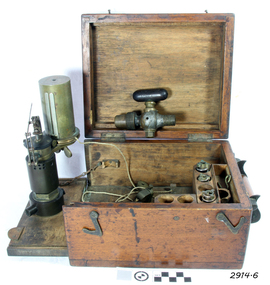
Engine Dynamometer, c.1890’s
... The recorded information could be used in conjunction with mathematical tables. This particular instrument was made by T.S. ...The recorded information could be used in conjunction with mathematical tables. This particular instrument was made by T.S. ...The steam engine indicator, or dynamometer, is an instrument used on a steam engine (such as that of a vessel or train) to measure and record the change in the pressures of the engine’s cylinders during their operating cycle. The engineer would use it to identify problems or defects such as bad valve settings or constricted steam pipes. It could indicate the difference in efficiency caused by adjustments made to the engine, being able to instantly measure the variation of pressure from the engine stroke at any given time. This force of power would be registered by a pencil, fitted to the adjustable arm, which would trace a line on paper wound around the cylinder. The recorded information could be used in conjunction with mathematical tables. This particular instrument was made by T.S. Mc Innes, one of the better manufacturers of engine indicators. Mc Innes engine indicators were still being used in the mid 1900’s. This specific instrument was used by Mark Forsythe of North Berwial, Scotland and late of Ararat, Victoria when he was chief engineer on the “SS Talawena” in 1892. The Port of Warrnambool, in Victoria, harboured steam ships that carried both passengers and cargo along the south west coast in the late 1800’s and into the 1900’s. The engineer of a steam ship was responsible for reaching and maintaining the optimum level of steam energy to serve the locomotion and efficiency of the steam ship. The engineer would use a steam engine indicator to measure and record information to achieve this purpose. Engine Dynamometer or Steam Engine Indicator in square, fitted oak case. This brass instrument is used to measure and record steam pressure for setting up and adjusting valves on a steam engine. It has an oscillating recording drum with vertical, silver clip attached for holding paper in place around the drum. The drum oscillates left to right. There is a pulley attached to a length of cord, which is attached to the drum. Beside the drum is a fine metal arm, vertically adjustable, small hole in the end to hold a pencil. Inscription stamped into bracket of the arm. The engine indicator is mounted on a hinged side of the case that swings out ready for use. Attached chains prevent the side from opening past vertical. There is storage for other accessories and an empty compartment in the base (where a scale or ruler may have been located). The case has a collapsible wooden handle, brass hinges and two brass, hook-shaped catches. There is a code stamped inside the lid. It contains a brass, ‘T’ shaped steam-cock (or stop cock) with two open ends made of metal pipe with different sized threads. (Turning the handle on top opens and closes the space in the pipe and would close off the flow of steam from one end to the other.) Also inside the case are three different spiral springs, each with a threaded nut on the end that has a threaded hole inside it. Used by Mr Mark Forsythe when chief engineer on the SS Talawena in 1892 “T.S. MC INNES PATENT” and “522 _ _” (last 2 digits are unreadable) pressed into the arm of the brass indicator. “[ ] X ’ stamped inside the lid of the case. The 3 springs all have a number stamped into them: (1) “32” and “12” (2) “12” and “16” [above] “12” (3) “64” and “150” Card that came with instrument “This instrument was used by Mark Forsythe of North Berwial Scotland and late of Ararat, Victoria when chief engineer on the SS Talawena in 1892" dynamometer, steam engine indicator, t.s. mcinnes, glasgow, dobbie mcinnes, port of warrnambool, warrnambool, flagstaff hill, flagstaff hill maritime museum, flagstaff hill maritime village, maritime museum, shipwreck coast, great ocean road -
 Federation University Historical Collection
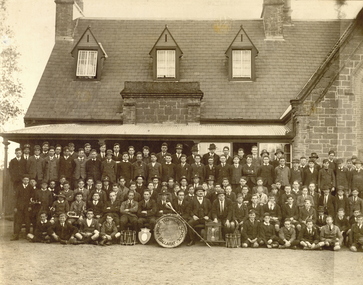
Photograph, Ballarat Junior Technical School at Dana Street, c1913, c1913
... Mathematics and Instrumental Drawing, and introducing students to the various branches of trade work. The second-year students studied for the Junior Technical Certificate and specialized in a course of their choice - either a trade (Woodwork or Fitting and Turning) or a course leading to higher studies at the School of Mines. The photograph shows the students outside the school building. Musical instruments...Mathematics and Instrumental Drawing, and introducing students to the various branches of trade work. The second-year students studied for the Junior Technical Certificate and specialized in a course of their choice - either a trade (Woodwork or Fitting and Turning) or a course leading to higher studies at the School of Mines. The photograph shows the students outside the school building. Musical instruments ...In February 1913 the Ballarat Junior Technical School opened its doors to its 86 pupils. The old bluestone building in the grounds of the Dana Street Primary School became their temporary for eight years. In its early years the school offered only a two-year course. The first year was of a general nature giving a thorough grounding in Mathematics and Instrumental Drawing, and introducing students to the various branches of trade work. The second-year students studied for the Junior Technical Certificate and specialized in a course of their choice - either a trade (Woodwork or Fitting and Turning) or a course leading to higher studies at the School of Mines. The photograph shows the students outside the school building. Musical instruments, trophy and shield are shown. When World War 1 began, the school formed a 16 piece Bugle Band. A squad of Junior Cadets led by Mr A Williams and later Mr H Wakeling competed at the South Street contests. Mr A Steane (the Headmaster) is shown to the right of the bass drum.Black and white copy of original photograph that is mounted on brown card. Photograph shows the students and staff outside the bluestone building at Dana Street Primary School - first location of the Ballarat Junior Technical School. Drums, a shield and a trophy are located in the foreground. The Headmaster, Albert E. Steane is seated in the centre front row. ballarat junior technical school, bass drum, steane, drum, dana street primary school, bluestone, albert steane, a steane, dana st, world war 1, south street contests, junior cadets, williams, wakeling, bugle band, junior technical certificate, mathematics, instrumental drawing, woodwork, turning and fitting, dana street state school -
 Flagstaff Hill Maritime Museum and Village
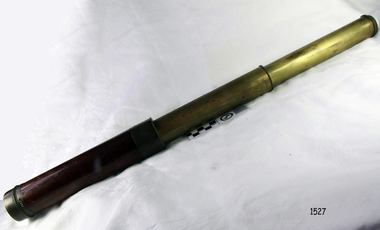
Telescope, 1780-1820
... He went on to describe him as an philosophical instrument maker of optical and mathematical objects, specialising in spectacles, all sorts of surveyors instruments as well as eye glasses of all types. ...He went on to describe him as an philosophical instrument maker of optical and mathematical objects, specialising in spectacles, all sorts of surveyors instruments as well as eye glasses of all types. ...Not much is known about William Rothwell other than he is recorded as working as an optician and scientific instrument maker in Manchester at 277 Deansgate Street from 1780 until 1820. An entry in the “Complete History of the Trades of Manchester” published in 1822, in which the author describes Mr William Rothwell as an intelligent young man who is conversant in several languages. He went on to describe him as an philosophical instrument maker of optical and mathematical objects, specialising in spectacles, all sorts of surveyors instruments as well as eye glasses of all types. At present that is all that is known of William Rothwell other than his products were made to the highest standards of the time. Today his products are now actively sought by collectors and are currently fetching high prices at auction sales overseas. The telescope is a rare item even though not much is known about Rothwell's history his scientific instruments and optical items fetch high prices when they become available as collectors look for rare and well made items from the 18th and 19th centuries. Its completeness and good condition make it a very good addition to the collection at Flagstaff Hill. A three draw military telescope brass with main cylinder section made of wood, main lens is removable for cleaning.Marked "Rothwell, Manchester"flagstaff hill, warrnambool, shipwrecked-coast, flagstaff-hill, flagstaff-hill-maritime-museum, maritime-museum, shipwreck-coast, flagstaff-hill-maritime-village, telescope, william rothwell, scientific instrument, manchester optician, optician -
 Flagstaff Hill Maritime Museum and Village
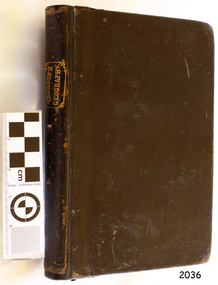
Book - Textbook, Introduction to Modern Geography
... Mathematics at the University of Glasgow. He wrote many school textbooks and reference books, one of which was Introduction to Modern Geography, first published in Belfast in 1827, and revised and published in over 20 more editions. Thomson tutored two of his several children at home. His older son James Thomson (1822-1892) became an engineer and physicist. His younger son William Thomson (1824-1907) became Professor of Natural Philosophy from 1846-1899 at the University of Glasgow, and later the 1st Baron of Kelvin, famous for his designs of nautical instruments...Mathematics at the University of Glasgow. He wrote many school textbooks and reference books, one of which was Introduction to Modern Geography, first published in Belfast in 1827, and revised and published in over 20 more editions. Thomson tutored two of his several children at home. His older son James Thomson (1822-1892) became an engineer and physicist. His younger son William Thomson (1824-1907) became Professor of Natural Philosophy from 1846-1899 at the University of Glasgow, and later the 1st Baron of Kelvin, famous for his designs of nautical instruments ...This mid-19th century scientific reference book, Introduction to Modern Geography, explains geography and astronomy using the globe of the world as a teaching aid. The inscription connects this book to the Bobinawarrah Public Library but research to date has found no further details about the library. The rural area was settled in 1859, but in 2016 its population was only 87. It is situated about 21 kilometres south of the City of Wangaratta, in Northeast Victoria. In 2024 the local community received a grant for preservation of its almost 100-year-old Bobinawarrah Memorial Hall which displays an honour board of the Pioneers of Bobinawarrah 1859-1959. The donor of the book lived in Warrnambool. ABOUT THE AUTHOR, James Thomson (1786-1849): - James Thomson was a British Irish mathematician. He became Professor of Mathematics at the University of Glasgow. He wrote many school textbooks and reference books, one of which was Introduction to Modern Geography, first published in Belfast in 1827, and revised and published in over 20 more editions. Thomson tutored two of his several children at home. His older son James Thomson (1822-1892) became an engineer and physicist. His younger son William Thomson (1824-1907) became Professor of Natural Philosophy from 1846-1899 at the University of Glasgow, and later the 1st Baron of Kelvin, famous for his designs of nautical instruments such as the navigational compass and sounding equipment used in the transatlantic installation of sea cable. William was part of the firm that became famous as Kelvin & Hughes Ltd., suppliers of radar and echo sounders to the Ministry of Transport and the Ministry of Defence. The name continued on as Kelvin & Hughes. James Thomson (1786-1849) was a renowned British Irish mathematician and Professor of Mathematics at the University of Glasgow. He was a respected author of many important school books and textbooks that were widely used to provide understanding of arithmetic and geography. Thomson encouraged practical education and held extra classes for young ladies to learn mathematics and geography, which were a novelty at that time. Many of his works were known and used worldwide. This work was published in many editions. It is now considered as culturally significant as a basis for knowledge about our civilisation and has been made publicly available in overseas countries, and republished and reproduced in a readable format, including its diagrams and maps. Book; scientific textbook. The book has a black leather cover. The front cover is blank, but the spine has an embossed gold vertical title within a rectangular border boasting fancy corners. The fly page has a detailed title. The author is James Thomson. It is the Eighteenth edition, published in Simms & McIntyre of London and Belfast in 1845. An inscription connects it to the Bobinawarrah Public Library in Victoria.Spine within a gold border: "THOMSON'S GEOGRAPHY" Fly Page: "AN INTRODUCTION TO MODERN GEOGRAPHY, WITH AN APPENDIX, CONTAINING AN OUTLINE OF ASTRONOMY, AND THE USE OF THE GLOBES. BY JAMES THOMSON, LL.D., PROFESSOR OF MATHEMATICS IN THE UNIVERSITY OF GLASGOW." "Eighteenth Edition" "LONDON: SIMMS AND McINTYRE, ALDINE CHAMBERS, PATERSOSTER ROW; AND DONEGALL -STREET, BELFAST.""1845"flagstaff hill, flagstaff hill maritime museum and village, warrnambool, maritime museum, maritime village, great ocean road, shipwreck coast, introduction to geography, james thomson, reference book, professor thomson's introduction to modern geography, bobinawarrah public library, james thomson mathematician, james thomson engineer, 19th century irish mathematician, irish presbyterian, william thomson 1st baron of kelvin, professor of mathematics, glasgow university, william thomson professor of natural philosophy, introduction to modern geography, outline of astronomy, use of the globes, james thomson ll.d., simms and mcintyre, 1843, scientific book, school book, lord kelvin, baron kelvin of langs, nautical instruments, marine instruments, transatlantic cable, kelvin & hughes, thomson’s geography, astronomy, geography, world globe, cartography, pioneers of bobinawarrah, textbook -
 Federation University Historical Collection
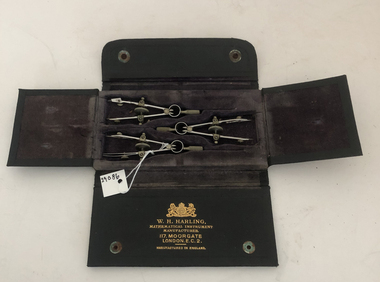
Instrument, W.H. Harling, Mathematical Instruments belonging to Albert Sutton
... Harling and owned by Albert Sutton son of Henry Sutton Mathematical Instruments belonging to Albert Sutton Instrument W.H. ...Henry Sutton is a talented world-wide accepted inventor with inventions relating to the telephone, photography, wireless, cars, motorcycles, and bicycles as well as many more inventions. Henry was also one of four brothers that ran the Sutton's Music Store after the death of their Father Richard Sutton. Henry Sutton taught Applied Electricity at the Ballarat School of Mines in 1883 to 1886.Set of three string bows in a leather case made by W.H. Harling and owned by Albert Sutton son of Henry Suttonhenry sutton, albert sutton, w.h. harling, mathematical instruments, string bows -
 Federation University Historical Collection
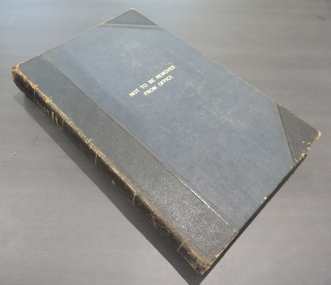
Books, H.E. Daw Government Printer, Ballarat School of Mines and Industries Departmental Papers, 1914-1950, 1914-1950
... instrument making...millinery...milling and gearouting...machine shop practice...metal founding...mining...metallurgy...mineralogy...mathematics...Examinations include: Agriculture, Algebra, Architecture, Arithmetic, Applied Mechanics, Assaying, Biology, Botany, Boilermaking, Building Design, Blacksmithing, Bricklaying, Carpentry and Joinery, Coachbuilding, Cabinet Making, Civil Engineering, Cabinet Making, Commercial, Chemistry, Engineering Drawing, Economics, English, Electrical technology, Electricity and Magnetism, Electric Wiring, Electric Welding, Electrical Fitting, Electrical Trades, Food Analysis, Geology, Geological Mapping, Graphics, Geometry, Heat Engines, Heat Treatment, Hydraulics, Hand Railing, Instrument Making, Millinery, Milling and Gearouting, Machine Shop Practice. Metal Founding, Mining, Metallurgy, Mineralogy, Mathematics, Motor Mechanics, Mine Surveying, Mining Mechanics, Petrology, Physics, Painting and Decorating, Pattern Making, Plastering, Plumbing and Gasfitting, Printing, Refrigeration, Spelling, Science , Shorthand, Surveying. ...Examinations include: Agriculture, Algebra, Architecture, Arithmetic, Applied Mechanics, Assaying, Biology, Botany, Boilermaking, Building Design, Blacksmithing, Bricklaying, Carpentry and Joinery, Coachbuilding, Cabinet Making, Civil Engineering, Cabinet Making, Commercial, Chemistry, Engineering Drawing, Economics, English, Electrical technology, Electricity and Magnetism, Electric Wiring, Electric Welding, Electrical Fitting, Electrical Trades, Food Analysis, Geology, Geological Mapping, Graphics, Geometry, Heat Engines, Heat Treatment, Hydraulics, Hand Railing, Instrument Making, Millinery, Milling and Gearouting, Machine Shop Practice. Metal Founding, Mining, Metallurgy, Mineralogy, Mathematics, Motor Mechanics, Mine Surveying, Mining Mechanics, Petrology, Physics, Painting and Decorating, Pattern Making, Plastering, Plumbing and Gasfitting, Printing, Refrigeration, Spelling, Science , Shorthand, Surveying. ...Used at the Ballarat School of Mines and the Ballarat Technical Art SchoolThis collection of examinations is significant because of its completeness with the full range of examinations between 1914 and 1950.Large leather bound books, with leather spine, containing all examinations held at the Ballarat School of Mines (including the Ballarat Technical Art School and Ballarat Junior Technical School). The examination papers were supplied and printed by the Education Department, Victoria. Examinations include: Agriculture, Algebra, Architecture, Arithmetic, Applied Mechanics, Assaying, Biology, Botany, Boilermaking, Building Design, Blacksmithing, Bricklaying, Carpentry and Joinery, Coachbuilding, Cabinet Making, Civil Engineering, Cabinet Making, Commercial, Chemistry, Engineering Drawing, Economics, English, Electrical technology, Electricity and Magnetism, Electric Wiring, Electric Welding, Electrical Fitting, Electrical Trades, Food Analysis, Geology, Geological Mapping, Graphics, Geometry, Heat Engines, Heat Treatment, Hydraulics, Hand Railing, Instrument Making, Millinery, Milling and Gearouting, Machine Shop Practice. Metal Founding, Mining, Metallurgy, Mineralogy, Mathematics, Motor Mechanics, Mine Surveying, Mining Mechanics, Petrology, Physics, Painting and Decorating, Pattern Making, Plastering, Plumbing and Gasfitting, Printing, Refrigeration, Spelling, Science , Shorthand, Surveying. Signwriting. Sheet Metalwork, Toolmaking, Ladies Tailoring, Trigonometry, Typewriting, Welding, Commercial Geography. Millinery, Dressmaking, Needlework, Decorative Needlework, Architecture, Building Design and Construction, Art (Composition in Form and Colour), Art (Casting Clay MOdels) Art (Drapery), Art (Drawing the Human Figure From Casts), Art (Drawing the Antique from Memory), Art (Drawing from Memory); Art (Drawing Plant Forms from Nature, Art (Drawing Plant Forms From Memory), Art (Drawing from Models and Objects), (Drawing From a Flat Example). Art (Drawing in Light and Shade from a Cast of Ornament or Lower Nature), Art (Drawing Ornament from the Cast), Art (Drawing from Models or Objects), Art (Drawing fro Dressmakers' and Milliners' Fashions), Art (Drawing With the Brush), Art (Drawing from a Flat Example); Art (Modelled Design), Art (General Design), Art (Embossed Leatherwork), Art (Practical Plane Geometry), Art (Practical Solid Geometry), Art (Geometrical Drawing), Carpentry and Joinery, Art (Human Anatomy), Art (Historic Ornament), Art (House Decoration), Art (LEttering), Signwriting, Art (Light Metalwork), Art (Modelling), Art (Modelling the Human Figure from a Life), Art (Stencilling); Art (Wood Carving) Refrigeration, Teaching, Boilermaking, Blacksmithing, Carpentry and Joinery, Coachbuilding and Carriage Drafting, Electric Wiring, Electrical Fitting, Graining and Marbling, Instrument Making , Machine Shop Practice, Metal Founding, Milling and Gear Cutting, Motor Mechanics, Painting and Decorating, Sheet Metalwork, Toolmaking, Printing, Pattern Making, Plumbing and gasfitting, examinations, ballarat school of mines, ballarat technical art school, trades, education department victoria, agriculture, algebra, architecture, arithmetic, applied mechanics, assaying, biology, botany, boilermaking, building design, blacksmithing, bricklaying, carpentry and joinery, coachbuilding, cabinet making, civil engineering, commercial, chemistry, engineering drawing, economics, english, electrical technology, electricity and magnetism, electric wiring, electric welding, electrical fitting, electrical trades, food analysis, geology, geological mapping, graphics, geometry, heat engines, heat treatment, hydraulics, hand railing, instrument making, millinery, milling and gearouting, machine shop practice, metal founding, mining, metallurgy, mineralogy, mathematics, motor mechanics, mine surveying, mining mechanics, petrology, physics, painting and decorating, pattern making, plastering, plumbing and gasfitting, printing, refrigeration, spelling, science, shorthand, surveying, signwriting, sheet metalwork, toolmaking, ladies tailoring, trigonometry, typewriting, welding., dressmaking, needlework, decorative needlework, architecture, building design and construction, art (composition in form and colour), art (casting clay models), art (drapery), art (drawing the human figure from casts), art (drawing the antique from memory), art (drawing from memory), art (drawing plant forms from nature, art (drawing plant forms from memory), art (drawing from models and objects), (drawing from a flat example), art (drawing in light and shade from a cast of ornament or lower nature), art (drawing ornament from the cast), art (drawing from models or objects), art (drawing for dressmakers' and milliners' fashions), art (drawing with the brush), art (drawing from a flat example), art (modelled design), art (general design), art (embossed leatherwork), art (practical plane geometry), art (practical solid geometry), art (geometrical drawing), art (human anatomy), art (historic ornament), art (house decoration), art (lettering), art (light metalwork), art (modelling), art (modelling the human figure from a life, art (stencilling), art (wood carving), teaching, coachbuilding and carriage drafting, graining and marbling, milling and gear cutting, commercial geography, exams, examination book -
 City of Moorabbin Historical Society (Operating the Box Cottage Museum)
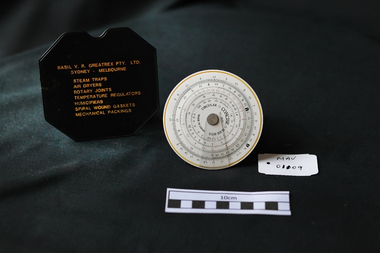
Measuring Equipment, circular slide-scale, 20thC
... A mathematical slide rule Calculator used by engineers, mechanics, and similar trades A typical precision slide rule used in City of Moorabbin 20thC measurements slide-rule slide scale moorabbin cheltenham bentleigh precision instruments concise pty ltd on face ; CIRCULAR 'CONCISE' SLIDE RULE MADE IN JAPAN on protector sleeve ; BASIL V R GREATREX PTY LTD / SYDNEY MELBOURNE / STEAM TRAPS / AIR DRYERS / ROTARY JOINTS / TEMPERATURE REGULATORS / HUMIDIFIERS / SPIRAL WOUND GASKETS,/ MECHANICAL PACKINGS A plastic, circular slide-rule Measuring Equipment, circular slide-scale Concise Ltd ...A mathematical slide rule Calculator used by engineers, mechanics, and similar tradesA typical precision slide rule used in City of Moorabbin 20thCA plastic, circular slide-ruleon face ; CIRCULAR 'CONCISE' SLIDE RULE MADE IN JAPAN on protector sleeve ; BASIL V R GREATREX PTY LTD / SYDNEY MELBOURNE / STEAM TRAPS / AIR DRYERS / ROTARY JOINTS / TEMPERATURE REGULATORS / HUMIDIFIERS / SPIRAL WOUND GASKETS,/ MECHANICAL PACKINGSmeasurements, slide-rule, slide scale, moorabbin, cheltenham, bentleigh, precision instruments, concise pty ltd -
 Greensborough Historical Society
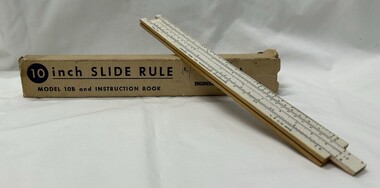
Functional object - Ruler, Engineering Instruments, Inc, 10 inch slide rule model 10B and instruction booklet, 1947-1967
... Instruments, Inc., and the company remained in business until its building burned down in 1967. The model 10-B sold for 25 cents during this period. There is no record that Lawrence ever received a patent for any aspect of his design or manufacturing process. Used up to the 1960s prior to the invention of the electronic calculator. slide rule mathematics ...George Lee Lawrence (1901–1976) established a firm in Chicago to make slide rules for photography. In 1935 he moved to Wabash, Ind., renamed the company Lawrence Engineering Service, and began to manufacture general purpose slide rules. In 1938 he relocated once more to Peru, Ind., and in 1947 it was changed to Engineering Instruments, Inc., and the company remained in business until its building burned down in 1967. The model 10-B sold for 25 cents during this period. There is no record that Lawrence ever received a patent for any aspect of his design or manufacturing process.Used up to the 1960s prior to the invention of the electronic calculator.10 inch one-sided wooden slide rule painted white on the front face, which consists of two divided scales, one fixed and on movable, and a sliding window called a cursor. A, D, and K scales are on the base, and B, CI, and C scales the inside of the slide. The underside of the rule is marked with: tables for equivalents and conversions. Housed in cardboard box with instruction booklet.The top of the base is marked: MADE IN U.S.A. It is also marked ENGINEERING INSTRUMENTS, INC., PERU, INDIANA and PAT. PEND. Underside: This Famous Slide Rule... at a popular price. Solves Problems in Multiplication, Division, Proportion, Squares Roots, Cubes and Cube Roots, Reciprocals, etc., Instantly. Accurately Calibrated White Face on Well Seasoned Hardwood. Both ends of box: MODEL 10B-BK Price of 15 shillings handwritten on box.slide rule, mathematics -
 Flagstaff Hill Maritime Museum and Village
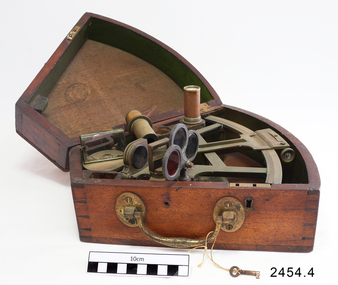
Octant, Mid to late 19th Century
... instruments in the eighteenth and nineteenth century's. There were also two others who are attributed to having created octanes during this period, Caleb Smith, an English insurance broker with a strong interest in astronomy (in 1734), and Jean-Paul Fouchy, a mathematics professor and astronomer in France (in 1732) In 1767 the first edition of the Nautical Almanac tabulated lunar distances, enabling navigators to find the current time from the angle between the sun and the moon. ...instruments in the eighteenth and nineteenth century's. There were also two others who are attributed to having created octanes during this period, Caleb Smith, an English insurance broker with a strong interest in astronomy (in 1734), and Jean-Paul Fouchy, a mathematics professor and astronomer in France (in 1732) In 1767 the first edition of the Nautical Almanac tabulated lunar distances, enabling navigators to find the current time from the angle between the sun and the moon. ...An octant is an astronomical instrument used in measuring the angles of heavenly bodies such as the sun, moon and stars at sea in relation to the horizon. This measurement could then be used to calculate the altitude of the body measured, and then the latitude at sea could also be calculated. The angle of the arms of an octant is 45 degrees, or 1/8 of a circle, which gives the instrument its name. Two men independently developed the octant around 1730: John Hadley (1682–1744), an English mathematician, and Thomas Godfrey (1704–1749), a glazier in Philadelphia. While both have a legitimate and equal claim to the invention, Hadley generally gets the greater share of the credit. This reflects the central role that London and the Royal Society played in the history of scientific instruments in the eighteenth and nineteenth century's. There were also two others who are attributed to having created octanes during this period, Caleb Smith, an English insurance broker with a strong interest in astronomy (in 1734), and Jean-Paul Fouchy, a mathematics professor and astronomer in France (in 1732) In 1767 the first edition of the Nautical Almanac tabulated lunar distances, enabling navigators to find the current time from the angle between the sun and the moon. This angle is sometimes larger than 90°, and thus not possible to measure with an octant. For that reason, Admiral John Campbell, who conducted shipboard experiments with the lunar distance method, suggested a larger instrument and the sextant was developed. From that time onward, the sextant was the instrument that experienced significant development and improvements and was the instrument of choice for naval navigators. The octant continued to be produced well into the 19th century, though it was generally a less accurate and less expensive instrument. The lower price of the octant, including versions without a telescope, made it a practical instrument for ships in the merchant and fishing fleets. One common practice among navigators up to the late nineteenth century was to use both a sextant and an octant. The sextant was used with great care and only for lunar sightings while the octant was used for routine meridional altitude measurements of the sun every day. This protected the very accurate and pricier sextant while using the more affordable octant for general use where it performs well. The invention of the octant was a significant step in providing accuracy of a sailors latitude position at sea and his vessels distance from land when taking sightings of land-based landmarks.Octant with metal handle, three different colored shades are attached, in wooden wedge-shaped box lined with green felt. Key is attached. Two telescope eyepieces are in box. Some parts are missing. Oval ink stamp inside lid of box, scale is graduated to 45 degrees. Ink stamp inside lid of box "SHIPLOVERS SOCIETY OF VICTORIA. LIBRARY"instrument, flagstaff hill, warrnambool, shipwrecked coast, flagstaff hill maritime museum, maritime museum, shipwreck coast, flagstaff hill maritime village, great ocean road, octant, navigation, nautical instrument, navigation instrument, john hadley, sextant, astronomical instrument -
 Warrnambool and District Historical Society Inc.
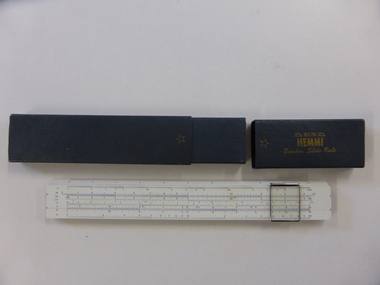
Instruments, Slide Rule, C1955
... A slide rule is an instrument which is used to carry out mathematical calculations. William Oughtred is credited with its invention in 1621, however many others including Isaac Newton have made improvements or modifications over the years. ...A slide rule is an instrument which is used to carry out mathematical calculations. William Oughtred is credited with its invention in 1621, however many others including Isaac Newton have made improvements or modifications over the years. ...A slide rule is an instrument which is used to carry out mathematical calculations. William Oughtred is credited with its invention in 1621, however many others including Isaac Newton have made improvements or modifications over the years. From 1625 to 1800 there were approximately 40 different styles brought forward. with the following 100 years sees over 250 designs created.There have been different versions and modifications to suit scientific, mathematical and engineering requirements. It is interesting to note that many of the buildings of the 19th and 20th centuries have been designed with the use of slide rules. Their use has declined in the last 25-30 years with the advent of computers and specialist calculators.While not directly linked in any way to the history of Warrnambool, this slide rule would have been a item in use by students doing maths at upper secondary level as well as other applications which would make it a familiar object to many people.Coated bamboo with sliding metal framed glass panel or cursor . The bamboo is in three sections with the middle section movable. It is marked in various graduated measurements mainly in dark blue but with some in green and red.It is inside a dark grey rectangular box with a slide off lid on one end.There is a celluloid panel on the back with a conversion table printed on it. There is an accompanying 67 page manual with a pale green cover with black text. On slide rule:Sun Hemmi Japan No 2664S On box: Sun Hemmi Japan No 2664S warrnambool, hemmi slide rule, bamboo slide rule -
 Bendigo Military Museum
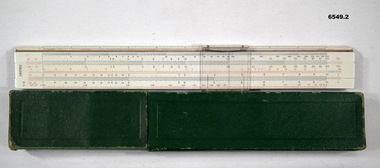
Instrument - SLIDE RULE, 12inch, AW Faber Castell, Circa 1954
... mathematical calculations. It was light weight and easy to use in the field. This slide rule was used by members of 4 Fd Svy Sqn circa 1960 for quick Survey calculations. Royal Australian Survey Corps RASvy Fortuna Army Survey Regiment Army Svy Regt ASR 4 Fd Svy Sqn .1 12 Inch Slide Rule, multi-function Calculator .2 Protective box and carry case for Slide Rule. Green cardboard box. SLIDE RULE, 12inch Instrument ...The slide rule was used for less accurate quick mathematical calculations. It was light weight and easy to use in the field. This slide rule was used by members of 4 Fd Svy Sqn circa 1960 for quick Survey calculations..1 12 Inch Slide Rule, multi-function Calculator .2 Protective box and carry case for Slide Rule. Green cardboard box.royal australian survey corps, rasvy, fortuna, army survey regiment, army svy regt, asr, 4 fd svy sqn -
 The Ed Muirhead Physics Museum
Instrument - Allbrit Planimeter, 20th Century
... allbrit planimeter mathematical instruments Inside the box (insert): 'SCALE / VERNIER POSITION ON TRACER BAR / AREA OF ONE REVOLUTION OF THE MEASURING WHEEL SCALE / ACTUAL / CONSTANT / SCALE Adjustable Allbrit planimeter calibrated for imperial units. ...Adjustable Allbrit planimeter calibrated for imperial units. Assembled to use with the magnifier which can be rotated. There is a checking bar. One revolution = 10 sq inches. Accessory box covered in leatherette with blue velvet padding.Inside the box (insert): 'SCALE / VERNIER POSITION ON TRACER BAR / AREA OF ONE REVOLUTION OF THE MEASURING WHEEL SCALE / ACTUAL / CONSTANT / SCALEallbrit planimeter, mathematical instruments -
 Bellarine Historical Society Museum
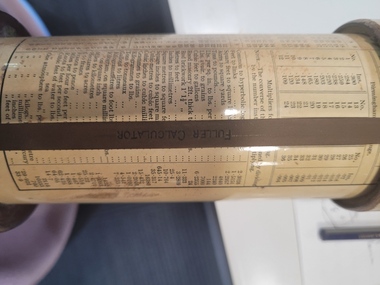
Instrument - Fuller Spiral Cylindrical Slide Rule, W.F. Stanley & Co, 1935
... instrument...Mathematics...Its remarkable length permitted a high level of precision in calculations; calculations could be made to 4 or 5 significant digits scientific instrument Mathematics calculating FULLER CALCULATOR inscribed on brass pointer The fuller calculator, is a cylindrical slide rule with a helical main scale taking 50 turns around the cylinder. ...The Fuller cylindrical slide rule, is a cylindrical slide rule with a helical main scale taking 50 turns around the cylinder. This creates an instrument of considerable precision – it is equivalent to a traditional slide rule 25.40 metres (1,000 inches) long. It was invented in 1878 by George Fuller, professor of engineering at Queen's University Belfast, and despite its size and price it remained on the market for nearly a century because it outperformed nearly all other slide rules. He patented it in Britain in 1878, described it in a journal in 1879 and in that year he also patented it the United States, depositing a patent model. As with other slide rules, the Fuller is limited to calculations based on multiplication and division with additional scales allowing for trigonometrical and exponential functions. The mechanical calculators produced in the same era were generally restricted to addition and subtraction with only advanced versions, like the Arithmometer, able to multiply and divide. Even these advanced machines could not perform trigonometry or exponentiation and they were bigger, heavier and much more expensive than the Fuller. In the mid-twentieth century the handheld Curta mechanical calculator became available which also competed in convenience and price. However, for scientific calculations the Fuller remained viable until 1973 when it was made obsolete by the HP-35 handheld scientific electronic calculator. Fuller's calculators were manufactured by the scientific instrument maker W.F. Stanley & Co. of London who made nearly 14,000 between 1878 and 1973.Like all slide rules, logarithmic scales are used to facilitate calculations more quickly and efficiently. The spiral logarithmic scale greatly increases the precision and computing power of the slide rule. In addition, its tables provide useful information to its users, most likely engineers. Its remarkable length permitted a high level of precision in calculations; calculations could be made to 4 or 5 significant digitsThe fuller calculator, is a cylindrical slide rule with a helical main scale taking 50 turns around the cylinder. There is a papier-mache cylinder fastened to a mahogany handle. A second papier-mache cylinder is a slide fit over the first. Both cylinders are covered in paper varnished with shellac. A brass pointer with an engraved index marker at its tip is attached to the handle and a second brass pointer is attached to the top cap. On the outer cylinder is a helical logarithmic scale 500" (41'8" or about 12.5 m) in length. This cylinder can be slid and rotated upon the inner one and hence with the correct sequence of movements, multiplications and divisions can be made and the answers read off the two pointers which project over the cylindrical scale.FULLER CALCULATOR inscribed on brass pointerscientific instrument, mathematics, calculating -
Moorabbin Air Museum
Book - Aerial navigation, Bennett's Complete Air Navigator
... Aerial navigation Mathematics & form of the Earth Map & chart projections Magnetism & compasses Instruments Meteorology Tides Signals Visual observations Radio & radar observations Astronomical observations Dead reckoning Textbook for Flight Navigator's licence, circa 1961 Bennett's Complete Air Navigator Book Aerial navigation ...Textbook for Flight Navigator's licence, circa 1961non-fictionTextbook for Flight Navigator's licence, circa 1961mathematics & form of the earth, map & chart projections, magnetism & compasses, instruments, meteorology, tides, signals, visual observations, radio & radar observations, astronomical observations, dead reckoning
