
Showing 18 items matching "mechanization "
-
 Wheen Bee Foundation
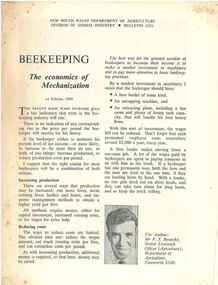
Publication, Benecke, F. S, Beekeeping: the economics of mechanization (Benecke, F. S.), Sydney, 1969, 1969
... Beekeeping: the economics of mechanization (Benecke, F. S.), Sydney, 1969...Beekeeping: the economics of mechanization (Benecke, F. S.), Sydney, 1969 Publication Benecke, F. ... -
 University of Melbourne, Burnley Campus Archives
Document, Onion Growers Field Day, Glenormiston, 1955. Row spacing and management with mechanization, 1955
... Row spacing and management with mechanization...Row spacing and management with mechanization Document ...Notes produced by Dept. of Agriculture, Victoriadepartment of agriculture, vegetables, onions, glenormiston dairy college -
 The 5th/6th Battalion Royal Victoria Regiment Historical Collection
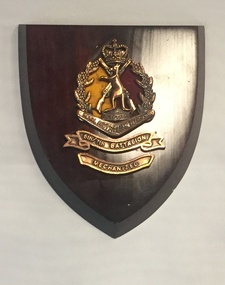
Plaque - Presentation Plaque, 5th/7th Battalion RAR
... The badge is located above a banner that is enscribed " 5th/7th Battalion" "MECHANIZED"...The badge is located above a banner that is enscribed " 5th/7th Battalion" "MECHANIZED" 5th/7th Battalion RAR Plaque Presentation Plaque ...Shield shaped varnished plaque with Bronze RAR hat badge in front of gold and maroon ( 5/7 RAR's colours) felt. The badge is located above a banner that is enscribed " 5th/7th Battalion" "MECHANIZED"5/7rar, wark vc club -
 8th/13th Victorian Mounted Rifles Regimental Collection
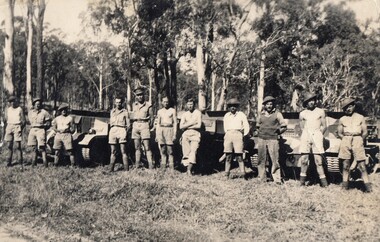
Photograph
... 8th Light Horse converted to mechanized in 1941, receiving Bren Gun carriers at Bonegilla...8th Light Horse converted to mechanized in 1941, receiving Bren Gun carriers at Bonegilla Good image of training 1941 Black and white photograph of men lined up in front of Bren Gun Carriers in forest country. ...8th Light Horse converted to mechanized in 1941, receiving Bren Gun carriers at BonegillaGood image of training 1941Black and white photograph of men lined up in front of Bren Gun Carriers in forest country. Dress varies; shorts, thongs, some ahirts, some without, steel helmets. 8th Light Horse/8th Reconnaisance Battalion -
 8th/13th Victorian Mounted Rifles Regimental Collection
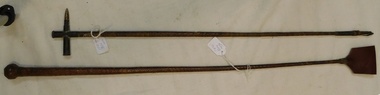
Memorabilia - Riding Crop, c.1918
... Attraction declined with loss of horses and mechanization....Attraction declined with loss of horses and mechanization. Limited display value saddlery riding crops leathercraft horse riding equipment bullet casings wwi 1914-1918 world war one first world war mounted soldiers Two platted leather riding crops - one having two .303 rounds arrange as handle, however end flap is missing. ...Riding crops favoured by Officers in First World War and between wars. Attraction declined with loss of horses and mechanization.Limited display valueTwo platted leather riding crops - one having two .303 rounds arrange as handle, however end flap is missing.saddlery, riding crops, leathercraft, horse riding equipment, bullet casings, wwi, 1914-1918, world war one, first world war, mounted soldiers -
 Warrnambool and District Historical Society Inc.
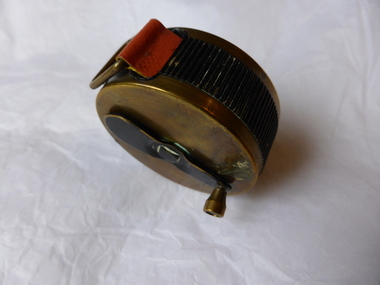
Artefact, Stock measuring tape - retractable
... A similar item with decimal measurements may perhaps be used today though mechanized weighing machines are now available. ...A similar item with decimal measurements may perhaps be used today though mechanized weighing machines are now available. ...This stock measurer would have been used on a farm during the first half of the 20th century. A similar item with decimal measurements may perhaps be used today though mechanized weighing machines are now available. This stock tape measure has no known local significance but it is an interesting item and has its place in the history of agriculture in the district. It will be useful for display. This is a glassfibre measuring tape (imperial measure) in a circular brass holder. The tape has a metal clip at the end. The tape is yellow on one side (measuring weight of pigs) and red on the other side (measuring weight of cattle). The holder has a winding mechanism on the top attached by a brass screw. There is a knob on the winder to hold while turning the winder to bring out the tape to the measurement required and to retract it back into the holder. The holder has a black ridged pattern around the sides. The maker’s marks are etched into the back of the container and printed on the tape. ‘We –Bo’ ‘Comb Maal” On tape: ‘We-Bo Made in Denmark’ ‘Live weight of pigs in lbs in relation to chest-measure in inches’ ‘Live weight of cattle in lbs in relation to chest-measure in inches’ stock tape measure, history of warrnambool, agricultural history -
 Dandenong/Cranbourne RSL Sub Branch
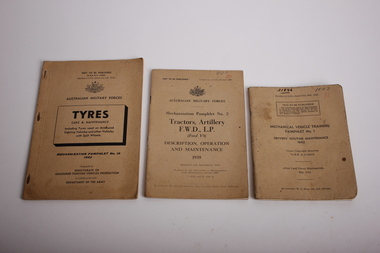
Booklet - Military operation and maintenance handbooks, The Specialty Press Pty Ltd, 1939-1945
... "NOT TO BE PUBLISHED Notified in A.A.Os, October 1939/AUSTRALIAN MILITARY FORCES/ Mechanization Pamphlet No.2/Tractors, Artillery, F.W.D., L.P (Ford V8)/DESCRIPTION, OPERATION/AND MAINTENANCE/1939/ (Reprinted with Amendments, 1940)/ Prepared by the Directorate of Mechanization, Army Headquarters, October 1939./ *A.M.R and O. 1588 B./ Bu Authority: The Specialty Press Pty Ltd., 174 Little Collins Street, Melbourne" 3. ..."NOT TO BE PUBLISHED Notified in A.A.Os, October 1939/AUSTRALIAN MILITARY FORCES/ Mechanization Pamphlet No.2/Tractors, Artillery, F.W.D., L.P (Ford V8)/DESCRIPTION, OPERATION/AND MAINTENANCE/1939/ (Reprinted with Amendments, 1940)/ Prepared by the Directorate of Mechanization, Army Headquarters, October 1939./ *A.M.R and O. 1588 B./ Bu Authority: The Specialty Press Pty Ltd., 174 Little Collins Street, Melbourne" 3. ...Three military operation and maintenance handbooks including Mechanical Vehicle Training, Tractors, Artillery and Tyres Care and Maintenance.1. "Notified in G.O's, dated 31st July, 1942/ *NOT TO BE PUBLISHED/The information given in this document is not to be communicated, either directly or indirectly, to the Press or to any person not holding an official position in His Majesty's Service/ MECHANICAL VEHICLE TRAINING/PAMPHLET No.1/DRIVER'S ROUTINE MAINTENANCE/1942/Crown Copyright Reserved/*A.M.R. & O 1588 B./Allied Land Forces Headquarters,/May 1942/ By Authority: W.A Hamer Pty. Ltd, Printers." 2. "NOT TO BE PUBLISHED Notified in A.A.Os, October 1939/AUSTRALIAN MILITARY FORCES/ Mechanization Pamphlet No.2/Tractors, Artillery, F.W.D., L.P (Ford V8)/DESCRIPTION, OPERATION/AND MAINTENANCE/1939/ (Reprinted with Amendments, 1940)/ Prepared by the Directorate of Mechanization, Army Headquarters, October 1939./ *A.M.R and O. 1588 B./ Bu Authority: The Specialty Press Pty Ltd., 174 Little Collins Street, Melbourne" 3. "NOT TO BE PUBLISHED/ (A.M.R. & O. 1588B)/Notified in G.O's dated 31st July, 1942/ AUSTRALIAN MILITARY FORCES/ TYRES/CARE & MAINTENANCE/ Including Tyres used on Armoured Fighting Vehicles and other Vehicles with Split Wheels/ MECHANIZATION PAMPHLET No. 19/1942/ Prepared by/ DIRECTORIATE OF ARMOURED FIGHTING VEHICLES PRODUCTION/in collaboration with/DEPARTMENT OF THE ARMY"handbooks, maintenance, mechanical, training -
 Warrnambool and District Historical Society Inc.
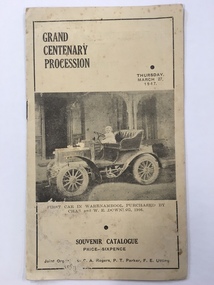
Booklet, Grand Centenary process, 1947
... The printed text on buff-coloured paper gives details of the 29 floats in the ‘Mechanized’ Section and of the 27 floats in the ‘Back to the Horse Pageant’ Section. ...The printed text on buff-coloured paper gives details of the 29 floats in the ‘Mechanized’ Section and of the 27 floats in the ‘Back to the Horse Pageant’ Section. ...This is a program of the Centenary Procession that took place in Warrnambool in 1947 to celebrate the 100th anniversary of the city’s founding in 1847. It was originally intended to celebrate the 100th anniversary in 1940 but these celebrations were postponed because of World War Two. In 1947 centenary celebrations were held but on a less lavish style. 1947 was a more appropriate year as 1847 was the year of the first land sales for Warrnambool and the arrival of the first European settlers in the town. The 1947 celebrations included a Grand Procession which was estimated to have been watched by 20,000 people. A similar number saw the bonfire and fireworks display in Albert Park the same evening. The celebrations lasted a week and included a choral thanksgiving festival in the Botanic Gardens, a massed band display and a ‘Warrnambool Can Make It’ exhibition of local manufactures. The well-known historian and Town Clerk at the time, Henri Worland took a prominent role in the organizing of the celebrations. This little booklet is of considerable importance because it contains a short description of the floats and the names of those connected with the various floats of the Warrnambool Centenary Procession of 1947. It not only gives us a better idea of what and who were in the procession but it now enables us to better label the many photographs we have of this procession and to identify the people in the photographs. The program is a valuable source of information for historians. It also is a good example of the type of celebratory procession that was popular 70 years ago. This is a paper program of the Warrnambool 1947 Centenary procession. It has four pages and a buff-coloured cover. The front cover has a sepia-toned photograph of the first car purchased in Warrnambool (1906) and on the back cover there is an advertisement for Lane’s Bus Services. The inside front cover has an advertisement for Guyett and Sons Furniture Store and there are other advertisements throughout the pages. The printed text on buff-coloured paper gives details of the 29 floats in the ‘Mechanized’ Section and of the 27 floats in the ‘Back to the Horse Pageant’ Section. The pages were stapled but the staples have been removed. There has been some silverfish damage. Front Cover: ‘Grand Centenary Procession, Thursday, March 27, 1947, Souvenir Catalogue, Price Sixpence, Joint Organisers, C.A.Rogers, P.T.Parker, F.E.Utting’. warrnambool centenary, 1947 henri worland -
 Warrnambool and District Historical Society Inc.
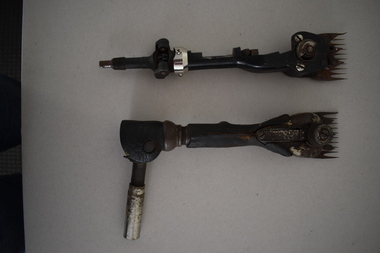
Artefact, Lister, Shearing heads, Early 20th century
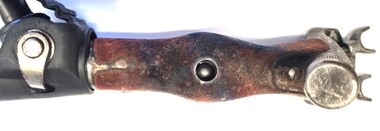
... The great increase in wool production in the mid to late 19th century in Australia led to the need to replace the hand shears with some mechanized form of shearing. The first sheep shearing machine in Australia was patented in 1867 and improvements to this early model were made over the ensuing years. ...These two items are of interest as examples of handpieces used early in the 20th century in the mechanized shearing of sheep. They would be typical of the pieces used in the wool industry in the early 20th century in Western Victoria. ...The woollen industry has always been of the utmost importance in Australia. Although exports have declined over the past decades the production of fine wool still remains important in our economy. The great increase in wool production in the mid to late 19th century in Australia led to the need to replace the hand shears with some mechanized form of shearing. The first sheep shearing machine in Australia was patented in 1867 and improvements to this early model were made over the ensuing years. The early 1890s saw the introduction of flexible drive shafts. The two items here described show this innovation. These two items are of interest as examples of handpieces used early in the 20th century in the mechanized shearing of sheep. They would be typical of the pieces used in the wool industry in the early 20th century in Western Victoria. There are today many local shearers living in Warrnambool and nearby towns and working in the district. .1 This is a metal handpiece for a sheep shearing mechanism. It has a toothed blade attached with metal screws at one end and a jointed metal pipe at the other end for attachment to the shearing machine. The middle section has been covered with black leather for easier gripping. .2 This is a metal handpiece for a sheep shearing mechanism. It has a toothed blade at one end and a flexible metal attachment at the other end to connect it to the shearing machine. Both items are rusted and stained. ‘Sunbeam Flight Lister’sheep shearing in the western district, warrnambool -
 Wodonga & District Historical Society Inc
Tool - Shearing Hand Set
... The increase in wool production in the mid to late 19th century led to the need to replace the hand shears with some mechanized forms of shearing.The first commercially successful sheep shearing machinery by Frederick York Wolseley in New South Wales who was granted a patent for his machine on 28 March 1877. ...The increase in wool production in the mid to late 19th century led to the need to replace the hand shears with some mechanized forms of shearing.The first commercially successful sheep shearing machinery by Frederick York Wolseley in New South Wales who was granted a patent for his machine on 28 March 1877. ...The wool industry has been critical to the Australian economy from the early days of European settlement. The increase in wool production in the mid to late 19th century led to the need to replace the hand shears with some mechanized forms of shearing.The first commercially successful sheep shearing machinery by Frederick York Wolseley in New South Wales who was granted a patent for his machine on 28 March 1877. Many of the early settlers to North East Victoria droved sheep overland from both Sydney and South Australia and established large pastoral runs in the district. Wodonga became a major service centre for the industry and established major saleyards for the pastoral and cattle industries. The handset has the company name "Heiniger" on the side. Heiniger is a Swiss company with subsidiaries in Australia and New Zealand. It was originally established in 1946.This item is connected to a major rural industry in North East Victoria.A metal handpiece for a sheep shearing. A toothed blade is held in place with metal adjustable screws at one end. A jointed metal pipe at the other end allows attachment to the shearing machine. The hinge has been covered with leather.On adjustment knob "Heinger"shearing industry, shearing equipment, shearing handset -
 Vision Australia
Administrative record - Text, 72nd Annual Report 1965 - 1966 Braille Library of Victoria, 1966
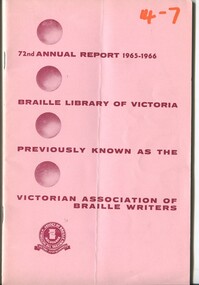
... Rylah who advised that the Free Library Scheme was for municipal councils and that instead a State Library Council (which was being formed) would be a better source of relief, offers of help to contact potential overseas suppliers for electronic and braille equipment, the organisation of the Reservoir auxiliary, establishment of a Machines Committee to look at mechanized forms of Braille production and the possibility of entering into talking book production, improvements to heating, cooking and lighting, needing to use discretion when hiring hall due to an unfortunate incident, donations of Perkins Braillers, brailling of Decimal conversion charts, agreement in prinicipal to a National Braille Reference Library in Canberra, and purchase of Perkins and Stainsby Braillers to improve output of Braille books....Rylah who advised that the Free Library Scheme was for municipal councils and that instead a State Library Council (which was being formed) would be a better source of relief, offers of help to contact potential overseas suppliers for electronic and braille equipment, the organisation of the Reservoir auxiliary, establishment of a Machines Committee to look at mechanized forms of Braille production and the possibility of entering into talking book production, improvements to heating, cooking and lighting, needing to use discretion when hiring hall due to an unfortunate incident, donations of Perkins Braillers, brailling of Decimal conversion charts, agreement in prinicipal to a National Braille Reference Library in Canberra, and purchase of Perkins and Stainsby Braillers to improve output of Braille books. ...Articles include the production of Christmas cards for purchase, a visit by the Chief Secretary Hon. A. Rylah who advised that the Free Library Scheme was for municipal councils and that instead a State Library Council (which was being formed) would be a better source of relief, offers of help to contact potential overseas suppliers for electronic and braille equipment, the organisation of the Reservoir auxiliary, establishment of a Machines Committee to look at mechanized forms of Braille production and the possibility of entering into talking book production, improvements to heating, cooking and lighting, needing to use discretion when hiring hall due to an unfortunate incident, donations of Perkins Braillers, brailling of Decimal conversion charts, agreement in prinicipal to a National Braille Reference Library in Canberra, and purchase of Perkins and Stainsby Braillers to improve output of Braille books.32 pages of text with drawingsbraille library of victoria, annual report, auxiliaries, buildings -
 Colac RSL Sub Branch
Decorative object - Baulch Brothers. Their Service - Our Heritage. Photo/Badge Collection, Baulch Family, 2008
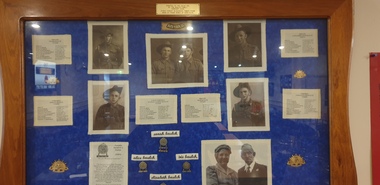
... AMF School of Mechanization. Centre. Lance Corporal Stanley Baulch VX72233. ...AMF School of Mechanization. Centre. Lance Corporal Stanley Baulch VX72233. ...Item donated to Colac RSL by the Baulch Family February 2008. Constructed of Otway Forest Blackwood. Made by Frank Nemec of Eden N.S.W High SignificanceBlackwood Timber Frame. Blue material cloth background, with photos and military badges. Banner - Blue material with gold writingPhoto Frame:- Upper Left. Private Frank Baulch. VX72238 + small Rising Sun Badge. Born 15/11/1911 at Glen Aire, Vic. Enlisted 15/2/1942 in Caulfield, Vic. Discharged 3/12/1945. 2nd/2nd Pioneer Battalion. Lower Left. Corporal Horace Baulch. VX869036 + Large Rising Sun Badge. Born 29/4/1942 at Colac, Vic. Enlisted 29/4/1942 at Seymour, Vic. Discharged 13/3/1946. H.Q. AMF School of Mechanization. Centre. Lance Corporal Stanley Baulch VX72233. Born 8/12/1914 at Gellibrand, Vic. Enlisted 19/1/1942 in Caulfield, Vic. Discharged 5/12/1945. 2nd/2nd Pioneer Battalion. Private Jack Baulch VX72232. Born 18/5/1917 at Colac, Vic. Enlisted 15/1/1942 in Colac, Vic. Discharged 29/1/1946. ? Battalion Lower Centre. Female Relatives Badges and Information sheet. Badges:- Sarah, Alice, Iris and Elizabeth Baulch. Photo Sarah and Fred Baulch. Upper Right. Alexander Baulch VX56771 + small Rising Sun Badge. Born 21/2/1919 at Collingwood, Vic. Enlisted 28/5/1942 at Royal Park, Vic. Discharged 20/11/1945. ? Batt. Lower Right. Norman Baulch. VX86902 + large Rising Sun Badge. Enlisted 28/5/1942 at Royal Park, Vic. Born 5/12/1921 at Colac, Vic. Enlisted 29/7/1942 in Seymour, Vic. Discharged 28/2/1945. ?Batt. -
 City of Melbourne Libraries
Photograph (item), Bull, Hugh Jones, 1897-1993, Unloading timber at Victoria Dock, 1933
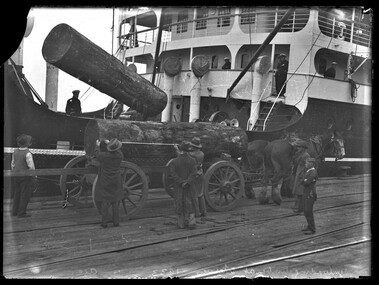
... The Victorian Clydesdale Horse Society reports that Clydesdale working horses were a vital part of Melbourne's infrastructure and agricultural industry in the 1930s, when they reached the peak of their popularity despite the increasing competition from mechanization. Their main roles and usage at this time were: • City Delivery: Clydesdales were a common sight for metropolitan deliveries, particularly for breweries (such as Carlton & United Breweries), milk runs, and bread deliveries. • Industrial Work: They were heavily used for hauling cargo at the docks, in construction, and at specialized sites like the Truganina Explosives Reserve, where they pulled wagons. • Agriculture: In surrounding rural areas, they were the primary power source for ploughing and agricultural machinery. • Specialization: By the 1930s, the Clydesdale was smaller and more compact than the Shire or Percheron breeds, making them ideal for navigation in urban environments. ...The Victorian Clydesdale Horse Society reports that Clydesdale working horses were a vital part of Melbourne's infrastructure and agricultural industry in the 1930s, when they reached the peak of their popularity despite the increasing competition from mechanization. Their main roles and usage at this time were: • City Delivery: Clydesdales were a common sight for metropolitan deliveries, particularly for breweries (such as Carlton & United Breweries), milk runs, and bread deliveries. • Industrial Work: They were heavily used for hauling cargo at the docks, in construction, and at specialized sites like the Truganina Explosives Reserve, where they pulled wagons. • Agriculture: In surrounding rural areas, they were the primary power source for ploughing and agricultural machinery. • Specialization: By the 1930s, the Clydesdale was smaller and more compact than the Shire or Percheron breeds, making them ideal for navigation in urban environments. ...Photographer notations on slide: "Unloading Timber at Wharves 1933 Age B5" Published: Age (Melbourne, Vic.: 1854- ), Tuesday 15 August 1933 MAHOGANY FROM MANILA. (1933, August 15). The Age (Melbourne, Vic. : 1854 - 1954), p. 11. Retrieved January 16, 2026, from http://nla.gov.au/nla.news-article204377024 Published title: MAHOGANY FROM MANILA Published Caption: Age Tue 15 Aug 1933 Caption: Unloading Mahogany Logs brought from Manila, Philippine Islands, by the steamer Taiping, which berthed yesterday at Victoria Dock. The vessel discharged twenty logs, each weighing three tons, the first shipment of this type of timber landed in Melbourne. Research by Project Volunteer, Louise McKenzie: This photograph in many ways epitomises Melbourne in the 1930s. It is a time of enormous growth, development and change. But before delving into that, the photo itself is very powerful. The huge mahogany logs being unloaded appear to be so heavy that the ship itself seems to list to port as they are craned over the side. They are being levered into a cart to which two large and sturdy Clydesdale horses are hitched. In contrast to the traditional horses, the wharf is crisscrossed with modern railway tracks. Unloading is both mechanical and manual, and the scene is one of intense interest to a young boy bystander. The ship appears to be squat and solid, but the whole image also gives a feeling of movement and intensity. The mahogany being delivered to Melbourne would be intended for high quality furniture. In the 1930s Australia actually had a growing timber industry, but much of the eucalyptus wood was being utilised for mass produced furniture, and much of this furniture would then have had a veneer applied to it. The fact that it was economic to import this timber from the “Philippine Islands” – not a traditional trading market for Australia – reflects a Victorian economy that was strong enough to support a growing demand for good quality furniture Mahogany was described as a classic, strong hardwood, often used for dark opulent furniture. In the 1930s the importation of timber from Manila (Philippines) to Australia was a notable trade, particularly in Philippine Lauan (often referred to as Philippine Mahogany), which was used as a cheaper alternative to other hardwoods. 1930s furniture, dominated by the art deco style, used a mix of luxurious exotic woods like mahogany, macassar and ebony for high-end pieces, often veneered over less expensive woods such as walnut, birch and poplar, and with plywood, chrome and lacquer also popular for more practical, streamlined designs during the Depression era. By the mid 1930s timber mills were being relocated away from the immediate dock area, but the fact that these logs were being transported by horse-drawn cart implies that the load would not have had to be taken too far for milling. 1885 the Melbourne Harbour Trust Commissioners had decided that land in or near the city was far too valuable to be used as timber yards. Furthermore, large stacks of timber posed a fire risk. The Trust asked the Victorian Government to reserve a site on the east side of the Yarra River opposite Yarraville and Spotswood. Here, in 1889, the Trust began building six jetties and a wharf specifically for the landing of timber. Clydesdale horses were initially brought to Victoria from Tasmania in the 1830s, and with the 1850s gold rush they were imported direct from Scotland. Melbourne was from its earliest years an important centre of horse-breeding from both imported and colonial-bred stock, providing the well-built draught horse for pulling heavily loaded wagons, the harness horse for delivery work and drawing coaches, and the saddle-horse used for riding. Stud breeding facilities were advertised from the early 1840s. By the 1870s the horse export trade was thriving, and the Port of Melbourne was the country's busiest exporter of horses to Indian, Asian and New Zealand markets. Kirk's Melbourne Horse and Carriage Bazaar in Bourke Street first advertised for business in 1840, and by the 1850s Bourke Street West was famed for its horse bazaars and saleyards. The Victorian Clydesdale Horse Society reports that Clydesdale working horses were a vital part of Melbourne's infrastructure and agricultural industry in the 1930s, when they reached the peak of their popularity despite the increasing competition from mechanization. Their main roles and usage at this time were: • City Delivery: Clydesdales were a common sight for metropolitan deliveries, particularly for breweries (such as Carlton & United Breweries), milk runs, and bread deliveries. • Industrial Work: They were heavily used for hauling cargo at the docks, in construction, and at specialized sites like the Truganina Explosives Reserve, where they pulled wagons. • Agriculture: In surrounding rural areas, they were the primary power source for ploughing and agricultural machinery. • Specialization: By the 1930s, the Clydesdale was smaller and more compact than the Shire or Percheron breeds, making them ideal for navigation in urban environments. After the 1930s their numbers decreased due to the onset of WWI and mechanisation. Wartime petrol rationing led to a brief revival for the working horse, as suburban tradesmen, now used to motor delivery, took their old jinkers out of mothballs. By 1947, however, only 1.5% of city traffic was horse-drawn. In 1952 the large horse cartage company A. Kellet Pty Ltd sold its 250 horses and converted its Richmond stables to storage. In the 1950s at Station and Princes piers, wharf labourers refused to work with the six draught horses still being used to haul trolleys and which were soon superseded by the fork lift, semi-trailer and mobile crane. Where carefully trained horses had once shunted trains in city goods yards, a few hundred a week were now being killed at the abattoirs for pet and human consumption. The last MCC dray horse was withdrawn from service in 1958, but some of the few remaining working animals are used by the mounted police for crowd control at demonstrations and football games. The death knell had also sounded for the associated trades of farrier, saddler and blacksmith. Our photo, therefore, showing the wharf with both the haulage Clydesdales and the rail lines, is a strong visual summary of the social and economic changes experienced in Victoria in the 1930s and on towards the 1950s. Our photo is located at Victoria Dock (also known as Victoria Harbour) which is still an active component of Melbourne’s port system. In 1892 the West Melbourne Dock (later Victoria Dock) was opened, downstream and immediately west of the Spencer Street railway shunting yards. It contained a swing basin for ships, replacing the one which had been provided on the south side of the river, later to be the Duke and Orr dry dock, west of the Charles Grimes Bridge. Further west was the South Wharf along the river bank. The history of Victoria Dock is extremely well described by Ashley Smith in his 2 March 2022 article in Docklands News, and its accompanying aerial photo of the Dock taken in 1934. He writes: "In the early 1930s Victoria Dock was one of the biggest sites for trade and export in Melbourne. A constant queue of ships sailed in, unloaded their cargo, recharged and reloaded, then left for the next port. Around the time this photo was taken (found in a 1934 photo book), the trapezium-shaped basin had been through some changes since its construction in the 1890s. The 497-metre-long Central Pier, finished in 1919, now featured six sheds to house the ever-increasing volume of cargo. The entrance had also been widened in the 1920s to allow better access. Some of the berths featured three-ton jib electric cranes to help with loading cargo and a rail network connected to the State Railway service. By the time construction was completed, the dock was 39 hectares and hailed as the second-largest dock in the world (behind Cavendish Dock, Barrow-in-Furness). To further save costs, excavations were dug to a more reasonable seven metres below low water, instead of British engineer Sir John Coode’s recommended 8.3 metres. Even then, the costs were still around £900,000. It was envisaged, with the extra wharfage, that around thirty 90-metre ships could berth inside. On March 22, 1892, Victoria Dock was opened by Victoria’s Governor, the Earl of Hopetoun (later Australia’s first Governor-General) who opened the sluice to let the Yarra in. It took six days to fill the basin with The Leader newspaper estimating that it would take another six months to completely fill (March 26, 1892). In the end, it took nearly a year before the first ship was allowed to enter on February 20, 1893, when the steamer Hubbuck sailed in to unload 1200 tonnes of cargo in 15 hours. The Argus (February 23, 1893) reported that the ship’s captain, J. R. Brodie, called the Yarra “better than the Thames”, and compared Victoria Dock favourably to the Albert Dock (Liverpool)." This would be a good time to move our focus on to the Taiping, which is the transporter of these giant mahogany logs. The Taiping was a steel-hulled, single-screw passenger-cargo Chinese steamer, which today has the dubious legacy of being involved in a collision headlined as “The Chinese Titanic”. It was constructed by the Hong Kong and Shampoa Dock Company at its facility in Hong Kong, with completion in 1926 for service under the Australia Oriental Line. Her gross register tonnage measured 4,324 tons, reflecting her design for inter-island and coastal trade routes, accommodating both passengers and freight. She operated routes connecting Australian ports with East Asian destinations. As World War II approached, Taiping continued predominantly working the trade routes between China and Australia, until December 1941, when she evacuated women and children from Hong Kong to Manila just before Japanese forces overran the region. She then safely reached Australia despite enemy air raids. Taiping was then requisitioned by the Royal Navy and repurposed as a victualling stores issuing ship for the Eastern Fleet, supporting logistical needs in the Pacific and Indian oceans. Returned to the Australian Oriental Line in 1947, she underwent refitting and by mid-1948 was chartered to the Shanghai Shipping Company, and modified for greater passenger accommodation – approximately 500 passengers. In 1948/49 the Chinese Civil War took place. The Taiping departed Shanghai on 26 January 1949 as one of the final vessels evacuating civilians from to Keelung Harbour in Taiwan. Reports indicate that the Taiping carried double the rated capacity of passengers i.e. 1000. The ship carried families, military personnel, civilians, carrying personal belongings, gold and valuables in hope of resettlement in Nationalist Taiwan. It also held heavy cargo in the form of silver and gold bullion loaded by the Central Bank of China. Because of the risk of patrols, and to conserve fuel, the Captain took the ship away from the usual open-sea passage, and instead navigated along the coast. He also extinguished navigation lights to avoid detection. Shortly after midnight on 27 January 1949 the Taiping collided with the smaller cargo steamer Chien Yuan in the East China Sea near the Zhoushan Archipelago. The Chien Yuan was also operating in darkness. The subsequent collision was catastrophic. The Chien Yuan sank with in 5 minutes, with the loss of 72 of its 74 crew. The Taiping sustained severe structural compromise from the broadside strike and initially remained afloat, then made a swift descent into the freezing water, with no attempt at an organised evacuation. No formal recovery process was instigated, however a distress signal went out. 32 survivors were picked up by the Australian destroyer HMAS Warramunga (on patrol nearby), a passing US vessel found 2 more, and local Zhoushan fishermen retrieved others. In the end, only 37 people survived. The event is remembered as a poignant moment in the mass migration to Taiwan, with families tragically separated. A memorial to the disaster exists at the Keelung Harbour naval base on Taiwan. With its total of over 1,500 deaths, it constituted one of the worst peacetime maritime losses. It is sometimes referred to as the “Oriental Titanic” because of the similarly large loss of life and speed of demise with the RMS Titanic in 1912. A fictional depiction of this event appears in the John Woo movies “The Crossing (Part 1) (2014), and The Crossing II (2015), known in Chinese as “Taiping Wheel”. The narrative weaves a story around pre-disaster romances and wartime turmoil among passengers, culminating in the ship’s rapid sinking. “The production, a high-budget Sino-Taiwanese-Hong Kong co-effort, portrays the event as a microcosm of the 1940s Sino-Japanese and civil war legacies, though critics noted the melodramatic style prioritizing spectacle over historical precision.” In conclusion, it is nice to return to our photo, and observe the people involved in this moment. The dockworkers are, so typical of the 1930s, dressed in what looks to us like formal clothing – dark suits or coats, white shirts, and black hats. I am particularly drawn to the young boy, bare-headed, arms crossed, and so intent on the unloading process. He too is wearing a white shirt, black trousers and jacket, and black shoes. This is 1933 Melbourne – but the haircut he is sporting is now very “hipster” and modern in 2026 Melbourne. References: MAHOGANY FROM MANILA. (1933, August 15). The Age (Melbourne, Vic. : 1854 - 1954), p. 11. Retrieved January 30, 2026, from http://nla.gov.au/nla.news-article204377024 Wikipedia, Taiping steamer, https://en.wikipedia.org/wiki/Taiping_(steamer) Wikipedia, Victoria Dock, https://en.wikipedia.org/wiki/Victoria_Dock_(Melbourne) Docklands News, Ashley Smith, 2 Mar 2022, https://www.docklandsnews.com.au/victoria-dock/ Living Histories: Heritage Council of Victoria, Jill Barnard, 2008, Jetties and Piers, https://livinghistories.net.au/wp-content/uploads/2015/11/Jetties-ONL-intro_Part-1.pdf eMelbourne, Wharves and Docks, https://www.emelbourne.net.au/biogs/EM01612b.htm Australian Academy of Technological Sciences – Harvesting Wood, https://www.austehc.unimelb.edu.au/tia/225.html Old Treasury Building, On the Water – The Docks, https://tinyurl.com/3wkbk66m Old Treasury Building, On The Road, https://tinyurl.com/dw44yr3t Port of Melbourne, Victorian Places, https://www.victorianplaces.com.au/port-of-melbourne Docklands Heritage Study - Environmental History, https://mvga-prod-files.s3.ap-southeast-4.amazonaws.com/public/2024-05/docklands-heritage-review-thematic-environmental-history-1991.pdf eMelbourne, Horses, https://www.emelbourne.net.au/biogs/EM00723b.htm Victorian Clydesdale Horse Society, https://www.clydesdalesvic.org.au/history The Crossing, https://letterboxd.com/film/the-crossing-i/Photographer notations on slide: "Unloading Timber at Wharves 1933 Age B5"ships, shipping, timber industry, shipwrecks, horses, docks, wharves, 1930-1939, wars, docklands -
 Monbulk RSL Sub Branch
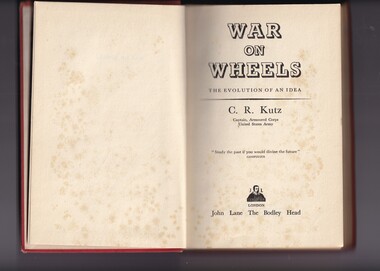
Book, CR Kutz, War on wheels: The evolution of an idea, 1941
... mechanization - military tanks - military science This book is primarily a history of armoured cars, to a lesser extent it is the story of motor artillery, or motorized infantry, of armoured trains and of the tank. ...This book is primarily a history of armoured cars, to a lesser extent it is the story of motor artillery, or motorized infantry, of armoured trains and of the tank.Bibliography, maps, p.275.non-fictionThis book is primarily a history of armoured cars, to a lesser extent it is the story of motor artillery, or motorized infantry, of armoured trains and of the tank.mechanization - military, tanks - military science -
 Monbulk RSL Sub Branch
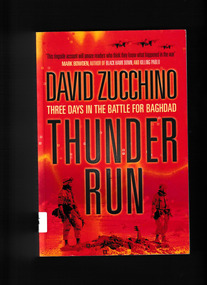
Book, : Atlantic Books, Thunder run : three days in the battle for Baghdad, 2004
... Thunder Run is the story of the surprise assault on Baghdad - one of the most decisive battles in American combat history - by the Spartan Brigade, the Second Brigade of the Third Infantry Division (Mechanized Notes, maps, p.325. Thunder run : three days in the battle for Baghdad Book : Atlantic Books David Zucchino ...In one of the boldest gambles in modern military history, just three battalions and fewer than a thousand men launched a violent thrust of tanks and Bradley Fighting Vehicles into the heart of a city of 5 million people and, in three bloody days of combat, ended the Iraqi war. Thunder Run is the story of the surprise assault on Baghdad - one of the most decisive battles in American combat history - by the Spartan Brigade, the Second Brigade of the Third Infantry Division (MechanizedNotes, maps, p.325.non-fictionIn one of the boldest gambles in modern military history, just three battalions and fewer than a thousand men launched a violent thrust of tanks and Bradley Fighting Vehicles into the heart of a city of 5 million people and, in three bloody days of combat, ended the Iraqi war. Thunder Run is the story of the surprise assault on Baghdad - one of the most decisive battles in American combat history - by the Spartan Brigade, the Second Brigade of the Third Infantry Division (Mechanizediraq war 2003, iraq war - us involvement -
 Monbulk RSL Sub Branch
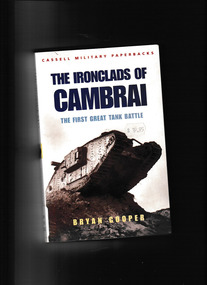
Book, Bryan Cooper, The ironclads of Cambrai: The first great tank battle, 2002
... Tanks - History france - campaigns - passchaendaele When tanks, the newly invented British weapon, were used for the first time in a mass attack on November 20 1917, they not only achieved one of the most remarkable successes of the First World War but set the pattern for the future of mechanized warfare. For the first time in three years of bloody trench warfare, epitomized by the slaughter at Passchendaele which was then reaching its climax, tanks brought about a breakthrough of the massive German defense system of the Hindenburg Line, followed up by British infantry and cavalry divisions. ...When tanks, the newly invented British weapon, were used for the first time in a mass attack on November 20 1917, they not only achieved one of the most remarkable successes of the First World War but set the pattern for the future of mechanized warfare. For the first time in three years of bloody trench warfare, epitomized by the slaughter at Passchendaele which was then reaching its climax, tanks brought about a breakthrough of the massive German defense system of the Hindenburg Line, followed up by British infantry and cavalry divisions. They were supported for the first time by low flying.Index, ill, maps, p.303.non-fictionWhen tanks, the newly invented British weapon, were used for the first time in a mass attack on November 20 1917, they not only achieved one of the most remarkable successes of the First World War but set the pattern for the future of mechanized warfare. For the first time in three years of bloody trench warfare, epitomized by the slaughter at Passchendaele which was then reaching its climax, tanks brought about a breakthrough of the massive German defense system of the Hindenburg Line, followed up by British infantry and cavalry divisions. They were supported for the first time by low flying. tanks - history, france - campaigns - passchaendaele -
Moorabbin Air Museum
Book - AGARD reports, Fault Tolerant Design Concepts for Highly Integrated Flight Critical Guidance and Control Systems
... AGARD reports Trends in integrated flight critical systems Advanced fault tolerant design concepts System architectures Mechanization & integration issues High integrity software design methodologies & algorithms System validation/simulation & flght test experience Overview of advanced fault tolerant design concepts & their practical application to integrated flight critical military systems, circa 1990 Fault Tolerant Design Concepts for Highly Integrated Flight Critical Guidance and Control Systems Book AGARD reports ...Overview of advanced fault tolerant design concepts & their practical application to integrated flight critical military systems, circa 1990non-fictionOverview of advanced fault tolerant design concepts & their practical application to integrated flight critical military systems, circa 1990trends in integrated flight critical systems, advanced fault tolerant design concepts, system architectures, mechanization & integration issues, high integrity software design methodologies & algorithms, system validation/simulation & flght test experience -
Emerald Museum & Nobelius Heritage Park
Equipment - Butter Churn, Unknown maker
... This object is of historic significance as it offers an insight into how butter was produced in households and dairy farms before the process became mechanized. These insights facilitate a better understanding of the agricultural history of the Emerald region, as well as the social history of food production in a domestic setting. dairy industry dairy farm and equipment Farm machinery Farming farm domestic Butter churn Crank: 47797 / Wooden, cube-shaped box with a metal crank affixed to one side and a removable wooden lid on top. ...A butter churn is used to convert cream into butter. This particular type of churn uses a crank to turn a series of paddles to create the required movement to churn the cream into butter. Butter churns such as this were used in domestic houses as well as farms until around the early to mid-20th century. The paddle butter churn was used in farms and domestic settings until the early to mid twentieth century. After a cow was milked, the milk would be left in a cool setting for up to a week until the cream rose to the top. The cream would then be put into the churn to separate the fat of the cream from the buttermilk. The crank-operated paddles would create the necessary movement required to separate the fat. Salt was then added and the butter was kneaded and cleaned. Patting the butter with butter pats into one pound or half pound blocks would complete the process.This object is of historic significance as it offers an insight into how butter was produced in households and dairy farms before the process became mechanized. These insights facilitate a better understanding of the agricultural history of the Emerald region, as well as the social history of food production in a domestic setting.Wooden, cube-shaped box with a metal crank affixed to one side and a removable wooden lid on top. Interior of the box contains wooden paddles which are connected to the metal crank.Crank: 47797 /dairy industry, dairy, farm and equipment, farm machinery, farming, farm, domestic, butter churn
