
Showing 229 items matching "medical form"
-
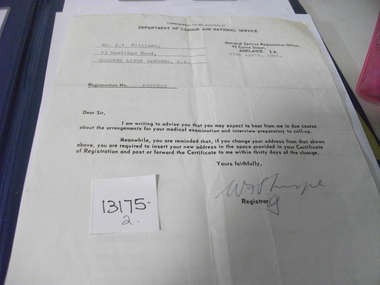 National Vietnam Veterans Museum (NVVM)
Document - Medical form
... Medical form...Reg No. 4002868 Yellowed A4 sheet outlining requirements for medical exam. Document Medical form Department of Labour and National Service ...Yellowed A4 sheet outlining requirements for medical exam.Reg No. 4002868 -
 University of Melbourne, Burnley Campus Archives
Prospectus, Department of Agriculture, Courses at Burnley 1960, 1960
... ...medical form...Prospectus for Diploma Course in Horticulture 1960 and Admission Form, Medical Form, Report Form. 2. Information on Cronin Memorial Horticultural Scholarship. 3. ...Prospectus for Diploma Course in Horticulture 1960 and Admission Form, Medical Form, Report Form. 2. Information on Cronin Memorial Horticultural Scholarship. 3. ...L.H.M Cover (8)prospectus, diploma course in horticulture, admission form, medical form, report form, cronin memorial horticultural scholarship, government scholarships, leaving agricultural science, matriculation agricultural science, part-time evening classes, part-time evening course in horticulture, time-table, short course in poultry management, short course in apiculture, short course for home gardeners, syllabi -
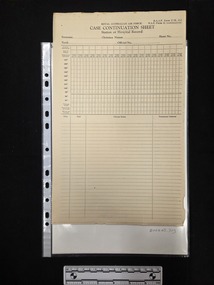 Returned Nurses RSL Sub-branch
Document - Printed documents - unfilled medical forms, Royal Australian Air Force, 1934 - 1943
... Six variously sized printed medical forms on cream paper. The forms have not been filled out. ...Document Printed documents - unfilled medical forms Royal Australian Air Force ...Part of a series of items related to Clare Rothwell Macintire. Clare Rothwell Macintire was born 27 July 1910 in Essendon and enlisted with the Royal Australian Airforce on 3 August 1943. Her service number was 500432. Six variously sized printed medical forms on cream paper. The forms have not been filled out. "DEPARTMENT OF THE ARMY / Repeat Prescription Form" "A.A. Form D 83" "INTERNAL REQUISITION" "A.A. Form D 86" "Occupational Therapy Prescription" "A.A.F.D. 90" "SPECIALIST REPORT" "X-RAY REPORT / LABORATORY REPORT / CONSULTATION REPORT" "Form A.A.F.D.9" "ROYAL AUSTRALIAN AIR FORCE / CASE CONTINUATION SHEET / Station of Hospital Record" "R.A.A.F. Form P/M 41A"army nurse, clare rothwell macintire, wwii, world war two, ww2, rotyal australian air force -
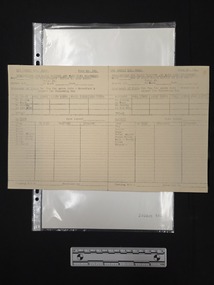 Returned Nurses RSL Sub-branch
Document - Printed documents - unfilled medical forms, Heidelberg Military Hospital, c. 1943
... Six variously sized printed medical forms on cream paper. The forms have not been filled out. ...MEDICAL HOSP." "REQUISITION FOR DAILY RATIONS AND WARD DIET STATEMENT" Form No. 13A" "115 (HEIDELBERG) MILITARY HOSPITAL" "REQUISITION FOR EXPENSE STORES" "Form 122" "115 (HEIDELBERG) MILITARY HOSPITAL" "Ward Statement of DIETS for the day following on which it is rendered" "Form No. 32" "115 (HEIDELBERG) MILITARY HOSPITAL" "No.18" "115 (HEIDELBERG) MILITARY HOSPITAL" "It is requested that the Garrison Engineer provide the following items of maintenance or equipment- & Brand same Type" "Form No.10" "115 (HEIDELBERG) MILITARY HOSPITAL" "REQUISITION ON DRUG STORE" "Form No. 133 200 16-11-43"...Document Printed documents - unfilled medical forms Heidelberg Military Hospital ...Part of a series of items related to Clare Rothwell Macintire. Clare Rothwell Macintire was born 27 July 1910 in Essendon and enlisted with the Royal Australian Airforce on 3 August 1943. Her service number was 500432. Six variously sized printed medical forms on cream paper. The forms have not been filled out. "115 (HEID) MEDICAL HOSP." "REQUISITION FOR DAILY RATIONS AND WARD DIET STATEMENT" Form No. 13A" "115 (HEIDELBERG) MILITARY HOSPITAL" "REQUISITION FOR EXPENSE STORES" "Form 122" "115 (HEIDELBERG) MILITARY HOSPITAL" "Ward Statement of DIETS for the day following on which it is rendered" "Form No. 32" "115 (HEIDELBERG) MILITARY HOSPITAL" "No.18" "115 (HEIDELBERG) MILITARY HOSPITAL" "It is requested that the Garrison Engineer provide the following items of maintenance or equipment- & Brand same Type" "Form No.10" "115 (HEIDELBERG) MILITARY HOSPITAL" "REQUISITION ON DRUG STORE" "Form No. 133 200 16-11-43"army nurse, clare rothwell macintire, wwii, world war two, ww2, rotyal australian air force, heidelberg military hospital -
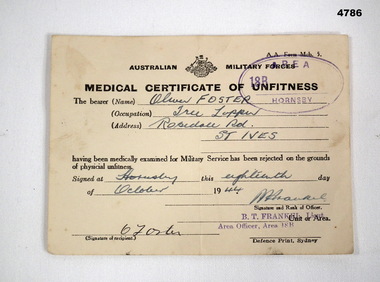 Bendigo Military Museum
Document - CERTIFICATE OF UNFITNESS, Australian Military Forces, 18.10.1944
... Certificate of unfitness medical form A.A.Form Mob.5. Australian Military Forces, all print in black, hand written in blue pen stamped twice in purple, rear is blank....Certificate of unfitness medical form A.A.Form Mob.5. Australian Military Forces, all print in black, hand written in blue pen stamped twice in purple, rear is blank. ...The medical exemption relates to Oliver Foster Tree Lopper Rosedale St St Ives. Refer Cat No 4783Certificate of unfitness medical form A.A.Form Mob.5. Australian Military Forces, all print in black, hand written in blue pen stamped twice in purple, rear is blank.Stamped, “Area 18B Hornsby”, “B.T.FRANKEL LIEUT Area Officer , Area 18B”.documents, certificates, medical -
Tatura Irrigation & Wartime Camps Museum
Folder, 1940s
... Contains: Form of Application for Residence Order for Detention of Enemy Alien Report on Internees Internees - Service and Casualty Form Medical Examination Mobilisation Attestation Form Service and Casualty Form Employment Company Form Determination of Demobilisation Priority Application for Admission of Relative or Friend to Australia Report on Internee Internee - Service and Casualty Form Email correspondence...Contains: Form of Application for Residence Order for Detention of Enemy Alien Report on Internees Internees - Service and Casualty Form Medical Examination Mobilisation Attestation Form Service and Casualty Form Employment Company Form Determination of Demobilisation Priority Application for Admission of Relative or Friend to Australia Report on Internee Internee - Service and Casualty Form Email correspondence Folder ...Forms regarding Joachim Stahr, an internee aboard the Dunera.Documents contained in folder marked "S" in sheet protectors. Contains: Form of Application for Residence Order for Detention of Enemy Alien Report on Internees Internees - Service and Casualty Form Medical Examination Mobilisation Attestation Form Service and Casualty Form Employment Company Form Determination of Demobilisation Priority Application for Admission of Relative or Friend to Australia Report on Internee Internee - Service and Casualty Form Email correspondencejoachim stahr, dunera, ww2 internee -
 Kew Historical Society Inc
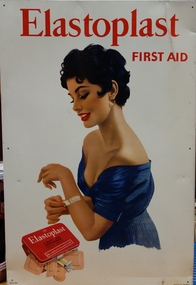
Sign - Advertisement, Beiersdorf, Elastoplast First Aid, 1950s
... Beiersdorf registered the first patent to manufacture medical plasters. One form of plaster was elastoplast. ...Beiersdorf registered the first patent to manufacture medical plasters. One form of plaster was elastoplast. ...Beiersdorf was founded in 1882 when Paul C. Beiersdorf registered the first patent to manufacture medical plasters. One form of plaster was elastoplast. The company formed an Australian branch.Advertising sign on tin for Elastoplast first aid. ELASTOPLAST / First Aidelastoplast, advertising signs -
 Bendigo Military Museum
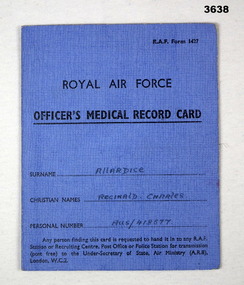
Work on paper - CARD, MEDICAL RECORD, Last entry 15.2.1945
... Officers medical record card RAF form I 417, blue folded Royal Air Force re RC ALLARDICE No Aus/418577. ...Refer Cat No 3627.5 for his service history. vaccinations medical officer On front “ALLARDICE REGINALD CHARLES AUS/418577” Officers medical record card RAF form I 417, blue folded Royal Air Force re RC ALLARDICE No Aus/418577. ...Item relates to Reginald Charles ALLARDICE NO 418577 RAAF. Refer Cat No 3627.5 for his service history.Officers medical record card RAF form I 417, blue folded Royal Air Force re RC ALLARDICE No Aus/418577. Inside written in blue pen details re nature and number of vaccinations.On front “ALLARDICE REGINALD CHARLES AUS/418577”vaccinations, medical, officer -
Tatura Irrigation & Wartime Camps Museum
Document, Maurice HOGAN
... Documents include his mobilization attestation form, medical examination, oath of enlistment, service and casualty form, photograph, group photograph, attestation form, statutory declaration, ...Documents include his mobilization attestation form, medical examination, oath of enlistment, service and casualty form, photograph, group photograph, attestation form, statutory declaration, Maurice Hogan Tatura Australian Army oath of enlistment service and casualty form Plastic folder containing Army records and photographs relating to Maurice Hogan. ...Maurice Hogan was a local Tatura man who joined the Australian Army in 1940. Documents include his mobilization attestation form, medical examination, oath of enlistment, service and casualty form, photograph, group photograph, attestation form, statutory declaration, Plastic folder containing Army records and photographs relating to Maurice Hogan. Copies from NAA.maurice hogan, tatura, australian army, oath of enlistment, service and casualty form -
 Ringwood RSL Sub-Branch
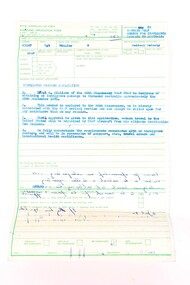
Document - R.Bingley, RAAF Document 4th April 1970. Surrender leaflets Circa 1960
... Paper application form from medical orderley Sgt. R.Bingley No A3147 American Air Force. ...Paper application form from medical orderley Sgt. R.Bingley No A3147 American Air Force. ...Documents from the War in Vietnam 1962 - 197300063.1. Paper application form from medical orderley Sgt. R.Bingley No A3147 American Air Force. Requesting leave in Australia from posting in New Zealand. Form issued by RAAF. Original plus carbon copy. 00063.2. Vietnam War Surrender leaflets. 2 items the same. 00063.3. Same as above, slightly faded on verso left. 00063.4. Paybook -
 Returned Nurses RSL Sub-branch
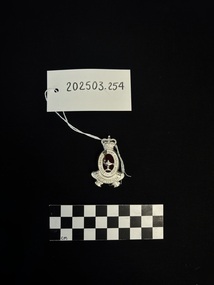
Badge - Collar Badge, Royal Australian Army Nursing Corps (RAANC), unknown
... The Australian Army employs registered general nurses as nursing officers in Army hospitals and medical centres. These officers form the Royal Australian Army Nursing Corps. ...The Australian Army employs registered general nurses as nursing officers in Army hospitals and medical centres. These officers form the Royal Australian Army Nursing Corps. ...The Royal Australian Army Nursing Corps (RAANC) provides health care and medical assistance to Australian Army personnel in military health facilities. The Royal Australian Army Nursing Corps embraces the values of compassion and service to others, reflecting the care and dedication provided to the wounded and sick. The Australian Army employs registered general nurses as nursing officers in Army hospitals and medical centres. These officers form the Royal Australian Army Nursing Corps. The collar badge would have been worn on the collar of official uniform. This badge is in good condition and provides context and interests in nurse uniform. However, it is hard to guarantee that this is an original badge or a replica. Photograph of Royal Australian Army Nursing Corps collar badge. Oval shaped badge surmounted by St Edward's crown. Around the edge of the oval is embossed 'Royal Australian Army Nursing Corps'. In the centre of the oval is a Nightingale oil lamp on a dull cherry coloured felt background. Across the bottom is a scroll embossed with the Latin motto 'Pro Humanitate', translating to 'for humanity'. The metallic nature of the badge leaves it cool to the touch, with rounded edges and a round collar attachment peg, unlike the sharp attachment pegs like typical badges and pins. 'Royal Australian Army Nursing Corps'/ 'Pro Humanitate'[Latin translating to English as 'for humanity']. raanc, uniform, badge, royal australian army nursing corps -
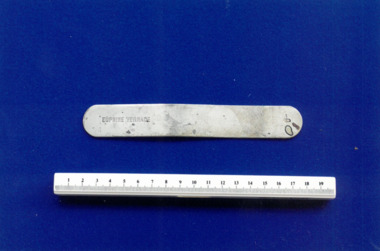 Royal Australian and New Zealand College of Obstetricians & Gynaecologists (RANZCOG)
Tool - Metal tongue depressor
... This tongue depressor, therefore, also functions as a form of medical advertising....This tongue depressor, therefore, also functions as a form of medical advertising. Examination Advertising "EUPNINE VERNADE" Metal tongue depressor with rounded ends and a slight convex curve. ...Believed to have been acquired from Dr Frank Forster. Eupnine Vernade was a product used in the early 20th century for the treatment of bronchitis, asthma, emphysema and bronchiectasis adjuvant in the treatment of sequaelae of influenza. It contained 10% caffeine iodide, and "exerts an intense action on the respiratory tract, stimulating the bronchial secretion and facilitating expectoration. It regulates and strengthens the heart, contracts the blood vessels of the splanchnic area, but dilates those of the heart and lung. It "also exerts a powerful diuretic action, thus diminishing the strain on the heart." This tongue depressor, therefore, also functions as a form of medical advertising.Metal tongue depressor with rounded ends and a slight convex curve. Inscribed "EUPNINE VERNADE"."EUPNINE VERNADE"examination, advertising -
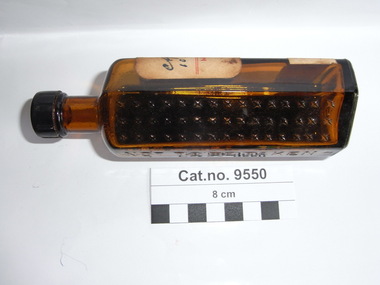 Coal Creek Community Park & Museum
Bottle glass, c. 1918 - c. 1925
... Malvern Medical Association. The friendly societies of Malvern have formed a medical association in connection with the Malvern and District U.F.S. ...Malvern Medical Association. The friendly societies of Malvern have formed a medical association in connection with the Malvern and District U.F.S. ...TROVE : The Age (Melbourne, Vic. : 1854 - 1954) Thursday 22 August 1918 p 6 Article 'Doctors and Lodges. Malvern Medical Association. The friendly societies of Malvern have formed a medical association in connection with the Malvern and District U.F.S. Dispensary. This has been registered as the Malvern and District U.F.S. Medical Association and Dispensary. Practically all the societies have joined it. The committee has appointed as medical officer Dr. J Weir, who is now carrying on the work of the institution. Another doctor is to be appointed shortly to assist him. The committee lately purchased a property in Valetta-street, formerly used by the Church of Christ. Structural alterations have been made, and the business will be transferred from High-street to the new building early in September'. TROVE : The Prahran Telegraph (Vic. : 1889 - 1930) Friday 23 January 1925 p 6 Article 'Malvern Dispensary. ANNUAL REPORT AND BALANCE SHEET. The 16th report and balance sheet for the year ending December 31st last of the Malvern and District U.F.S. Medical Association and Dispensary signed by the president (Mr.Chas. A. W. Smith) has been issued. It is the first annual report since the erection of the new hall and dispensary in Valetta street, and discloses a satisfactory state of affairs. Mr. Smith, who is now a past president of the Dispensary, has been commended on. all sides for the active interest He at all times took in the work of the dispensary, and he has every reason to feel pleased and gratified that the erection of the new building was put in hand and completed during his tenure of office. The enterprise is a credit to the district, and shows that, those associated with friendly societies work in Malvern are imbued with a true progressive spirit. The dispensary is assured of a successful and useful future.........................................'. Hexagonal clear amber glass bottle 1/4 full of liquid with a black bakelite screw top. Two white paper labels with printed red and hand written text. Bottle had three plain sides, two sides with 'x' stipple pattern either side of panel with embossed text. Side panel 'NOT TO BE TAKEN' and '2' near base. On base some indistinct embossed characters near one edge, and an 'AGM' monogram over '1072'. Paper label (top) 'POISON', ''NOT TO BE TAKEN' in red text. Handwritten under 'Apply on pad for 10 to 30 minutes'. Two red printed lines followed by red printed text 'MALVERN & DISTRICT U.F.S., M.A. & DISPENSARY. H.H. PHILLIPS, Chemist VALETTA STREET, MALVERN. Paper label (base) printed in white on a red panel, 'POISON'.poison, friendly societies, amber glass, bakelite, pharmacy -
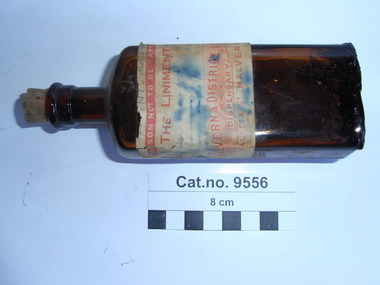 Coal Creek Community Park & Museum
Bottle, glass, c.1818 - c.1925
... Malvern Medical Association. The friendly societies of Malvern have formed a medical association in connection with the Malvern and District U.F.S. ...Malvern Medical Association. The friendly societies of Malvern have formed a medical association in connection with the Malvern and District U.F.S. ...TROVE : The Age (Melbourne, Vic. : 1854 - 1954) Thursday 22 August 1918 p 6 Article 'Doctors and Lodges. Malvern Medical Association. The friendly societies of Malvern have formed a medical association in connection with the Malvern and District U.F.S. Dispensary. This has been registered as the Malvern and District U.F.S. Medical Association and Dispensary. Practically all the societies have joined it. The committee has appointed as medical officer Dr. J Weir, who is now carrying on the work of the institution. Another doctor is to be appointed shortly to assist him. The committee lately purchased a property in Valetta-street, formerly used by the Church of Christ. Structural alterations have been made, and the business will be transferred from High-street to the new building early in September'. TROVE : The Prahran Telegraph (Vic. : 1889 - 1930) Friday 23 January 1925 p 6 Article 'Malvern Dispensary. ANNUAL REPORT AND BALANCE SHEET. The 16th report and balance sheet for the year ending December 31st last of the Malvern and District U.F.S. Medical Association and Dispensary signed by the president (Mr.Chas. A. W. Smith) has been issued. It is the first annual report since the erection of the new hall and dispensary in Valetta street, and discloses a satisfactory state of affairs. Mr. Smith, who is now a past president of the Dispensary, has been commended on. all sides for the active interest He at all times took in the work of the dispensary, and he has every reason to feel pleased and gratified that the erection of the new building was put in hand and completed during his tenure of office. The enterprise is a credit to the district, and shows that, those associated with friendly societies work in Malvern are imbued with a true progressive spirit. The dispensary is assured of a successful and useful future.........................................'. Hexagonal clear amber glass bottle, 1/3 full of liquid with cork stopper, paper label adhered to bottle. Bottle has 3 plain sides, 2 sides with 'x' stipple pattern either side of a panel with embossed text. Base of bottle with embossed monogram, letters and numerals.Embossed on side of bottle 'NOT TO BE TAKEN', '8' (near base). On base of bottle AGM monogram, over 'M422M'. Paper label with red printed text and indecipherable hand writing in blue ink - ink had 'bled'. Red printed text on label 'POISON NOT TO BE TAKEN', illegible handwriting, red printed text 'MALVERN & DISTRICT U.F.S., M.A. & DISPENSARY. VALETTA STREET, MALVERN'.poison, friendly societies, amber glass, pharmacy, topical medications., dispensary -
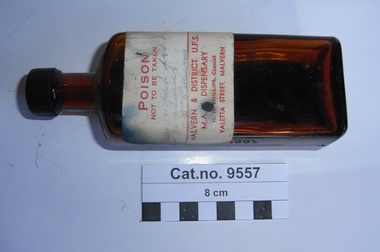 Coal Creek Community Park & Museum
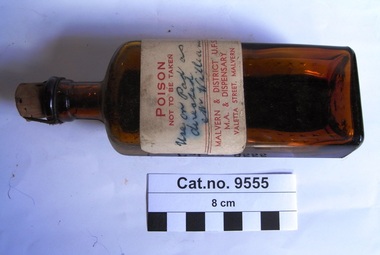
Bottle, glass, c.1918 - c. 1925
... Malvern Medical Association. The friendly societies of Malvern have formed a medical association in connection with the Malvern and District U.F.S. ...Malvern Medical Association. The friendly societies of Malvern have formed a medical association in connection with the Malvern and District U.F.S. ...TROVE : The Age (Melbourne, Vic. : 1854 - 1954) Thursday 22 August 1918 p 6 Article 'Doctors and Lodges. Malvern Medical Association. The friendly societies of Malvern have formed a medical association in connection with the Malvern and District U.F.S. Dispensary. This has been registered as the Malvern and District U.F.S. Medical Association and Dispensary. Practically all the societies have joined it. The committee has appointed as medical officer Dr. J Weir, who is now carrying on the work of the institution. Another doctor is to be appointed shortly to assist him. The committee lately purchased a property in Valetta-street, formerly used by the Church of Christ. Structural alterations have been made, and the business will be transferred from High-street to the new building early in September'. TROVE : The Prahran Telegraph (Vic. : 1889 - 1930) Friday 23 January 1925 p 6 Article 'Malvern Dispensary. ANNUAL REPORT AND BALANCE SHEET. The 16th report and balance sheet for the year ending December 31st last of the Malvern and District U.F.S. Medical Association and Dispensary signed by the president (Mr.Chas. A. W. Smith) has been issued. It is the first annual report since the erection of the new hall and dispensary in Valetta street, and discloses a satisfactory state of affairs. Mr. Smith, who is now a past president of the Dispensary, has been commended on. all sides for the active interest He at all times took in the work of the dispensary, and he has every reason to feel pleased and gratified that the erection of the new building was put in hand and completed during his tenure of office. The enterprise is a credit to the district, and shows that, those associated with friendly societies work in Malvern are imbued with a true progressive spirit. The dispensary is assured of a successful and useful future.........................................'. Hexagonal clear amber glass bottle, 1/4 full of liquid with black Bakelite screw top, paper label adhered to bottle. Bottle has 3 plain sides, 2 sides with 'x' stipple pattern either side of a panel with embossed text. Base of bottle with embossed monogram, letters and numerals.Embossed on side of bottle 'NOT TO BE TAKEN', '1' (near base). On base of bottle AGM monogram, over 'F1072', over 'M'. Some indistinct embossed characters on edge. Paper label with red printed text and hand writing in blue ink. Red printed text on label 'POISON NOT TO BE TAKEN', handwriting 'Use on a pad for 15 to 30 minutes. Mr. Williams', red printed text 'MALVERN & DISTRICT U.F.S., M.A. & DISPENSARY. H.H. PHILLIPS, Chemist. VALETTA STREET, MALVERN'.poison, friendly societies, bakelite, amber glass, pharmacy, dispensery -
 Coal Creek Community Park & Museum
Bottle, glass, 1918 - c. 1925
... Malvern Medical Association. The friendly societies of Malvern have formed a medical association in connection with the Malvern and District U.F.S. ...Malvern Medical Association. The friendly societies of Malvern have formed a medical association in connection with the Malvern and District U.F.S. ...TROVE : The Age (Melbourne, Vic. : 1854 - 1954) Thursday 22 August 1918 p 6 Article 'Doctors and Lodges. Malvern Medical Association. The friendly societies of Malvern have formed a medical association in connection with the Malvern and District U.F.S. Dispensary. This has been registered as the Malvern and District U.F.S. Medical Association and Dispensary. Practically all the societies have joined it. The committee has appointed as medical officer Dr. J Weir, who is now carrying on the work of the institution. Another doctor is to be appointed shortly to assist him. The committee lately purchased a property in Valetta-street, formerly used by the Church of Christ. Structural alterations have been made, and the business will be transferred from High-street to the new building early in September'. TROVE : The Prahran Telegraph (Vic. : 1889 - 1930) Friday 23 January 1925 p 6 Article 'Malvern Dispensary. ANNUAL REPORT AND BALANCE SHEET. The 16th report and balance sheet for the year ending December 31st last of the Malvern and District U.F.S. Medical Association and Dispensary signed by the president (Mr.Chas. A. W. Smith) has been issued. It is the first annual report since the erection of the new hall and dispensary in Valetta street, and discloses a satisfactory state of affairs. Mr. Smith, who is now a past president of the Dispensary, has been commended on. all sides for the active interest He at all times took in the work of the dispensary, and he has every reason to feel pleased and gratified that the erection of the new building was put in hand and completed during his tenure of office. The enterprise is a credit to the district, and shows that, those associated with friendly societies work in Malvern are imbued with a true progressive spirit. The dispensary is assured of a successful and useful future.........................................'. TROVE : Digitised newspaper articles.- The Dispensary Hall in Valetta Street, Malvern was used as a meeting place and dance hall after 1925.Hexagonal clear amber glass bottle, 1/4 full of yellow / brown liquid with cork stopper secured by string. White paper label with red printed text and hand writing. Bottle has 3 plain sides, 2 sides with 'x' stipple pattern either side of a panel with embossed text.Embossed on side of bottle 'NOT TO BE TAKEN', '8'. Embossed on base of bottle '8', followed by an AGM monogram, over one indistinct character and '422M'. On the white paper label printed in red 'POISON' NOT TO BE TAKEN', followed by hand written script in blue ink 'Use on pad as directed. Mr. Williams' , then printed in red, double red lines followed by MALVERN & DISTRICT U.F.S., M.A. & DISPENSARY, VALETTA STREET, MALVERN.poison, friendly societies, amber glass, pharmacist, dispensary, topical medications. -
 Federation University Historical Collection
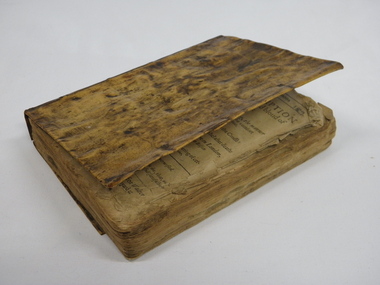
Book, Touching the Full Redemption of Mankind by the Death and Blood of Christ Jesus (human skin cover), 1599
... medical cadavers. Others were produced after criminal trials, with the criminal’s skin used to enclose the record of their own death sentences, creating a form of punishment that would surpass death. ...medical cadavers. Others were produced after criminal trials, with the criminal’s skin used to enclose the record of their own death sentences, creating a form of punishment that would surpass death. ...Anthropodermic Bibliopegy is the name given to the use of human leather to bind books. The name stems from the combination of the Greek root words, human (Anthropos), skin (derma), book (biblion), and fasten (pegia). The practice of creating anthropodermic books was popular throughout the 17th and 18th centuries. Most commonly, anthropodermic books are medical tomes, with the human leather taken from medical cadavers. Others were produced after criminal trials, with the criminal’s skin used to enclose the record of their own death sentences, creating a form of punishment that would surpass death. Other anthropodermic books contain poems or are religious texts. This book was written and printed in 1599 but most probably was rebound later when creation of anthropodermic books became more predominant. The book is a small tome of a religious nature containing the work of Bishop Thomas Bilson, who in a puritanical voice states that the primary argument articulated in this book is that “the metaphorical Calvinist interpretation of Hell as an exclusion from God was accurate then Christ's descent into hell after his crucifixion must refer to an actual existent hell as Christ was neither subject to sin nor able to be separated from the Divine.” The unusual cover of the book has led to many questions, the main being whether the book is covered with human skin. It was confirmed as such in 2014 with DNA testing undertaken by honours student Talanna Buckley at Federation University finding an 100% match to human DNA on the outside cover of the book. This is one of only two confirmed anthropodermic books in Australia, the other is housed at the National Library of Australia. Other forms of testing the leather of books have been found to be more accurate than DNA testing. For example, before DNA testing or PMF (Peptide Mass Fingerprinting) are undertaken many books have been identified as made from human skin through the close examination of the skins patterning. Hair follicles are the focus of the examination as certain patterns and sizes lend themselves to being human. However, many of these books have been proven to not be bound in human skin, the same can be said of books with inscriptions claiming them as anthropodermic. Peptide Mass Fingerprinting (PMF) testing has been found to be the most reliable way of confirming a leather bindings origin. This process involves the sampling of collagen-based materials, cutting the protein to gain specific amino acid combinations which form individual peptide sequences. Each mammal has an individual amino acid sequence in its collagen therefore its peptide mass combination is unique. This form of test can provide a more accurate outcome as collagen will be preserved for longer after the tanning process and will not be damaged in the same way DNA can be by the tanning process. DNA testing can also provide false positives as trace DNA from someone touching the book could be amplified and provide the reading instead of that of the leather itself. However, this book was tested with many controls as well as specific decontamination procedures in order to ensure that it was not trace DNA being tested. This book is historically and spiritually significant because it is a rare example of an early printed English Christian religious tract produced in Old English and Latin.. Its association with Thomas Bilson, who oversaw the final printing and publication of the King James Bible, is important. The covering of this book has been tested for human dna. Findings prove the book is covered with human skin, increasing the rarity of the object.420 page book with unusual leather cover. The book is written in Old English with passages in latin. There is a pressed petal between p.68 and 69. The covering of this book is made of human skin. The practice of binding books in human skin, also known as anthropodermic bibliopegy.Inside cover - James Hendy No 17 (Fu)gends Road Palmers Village Westminster. The gift of his mother Mrs Thomas Hendy. Some notes made through text eg p.112, and a passage written on the last page.religion, bible, edward lowe, edward lotos, thomas bilson, anthropodermic bibliopegy, james hendy, full redemption, religious, leather, wilson, winchester, jesus, puritanical, puritans, bungey, bilson, human skin, skin, human skin cover, human skin binding -
 Flagstaff Hill Maritime Museum and Village
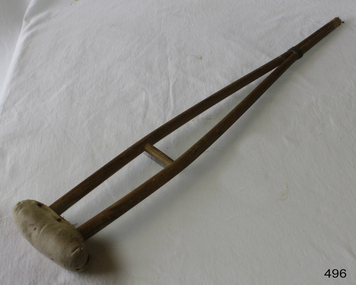
Equipment - Crutch
... medical device which helps a person walk from one spot to another. By helping to bear their body weight, crutches aid mobility in people with either short-term injuries to life-long disabilities. The first evidence of their use dates back to the time of the Pharaohs, clearly visible in a carving dating to nearly 3000 BCE. The earliest crutches were essentially a T-shaped design, which slowly morphed into the more popular V-shape in use today. They were made form...medical device which helps a person walk from one spot to another. By helping to bear their body weight, crutches aid mobility in people with either short-term injuries to life-long disabilities. The first evidence of their use dates back to the time of the Pharaohs, clearly visible in a carving dating to nearly 3000 BCE. The earliest crutches were essentially a T-shaped design, which slowly morphed into the more popular V-shape in use today. They were made form ...“Alas for Tiny Tim, he bore a little crutch, and had his limbs supported by an iron frame!” A Christmas Carol has long proved one of Dickens’ most popular works. Debate still continues over what disease afflicted poor Tiny Tim, but I find it interesting to think about the crutch he used. As a child, crutches were almost a hallmark of the adventurous, from falling out of trees to the consequence of a luxurious skiing accident. Broadly speaking, a crutch is a medical device which helps a person walk from one spot to another. By helping to bear their body weight, crutches aid mobility in people with either short-term injuries to life-long disabilities. The first evidence of their use dates back to the time of the Pharaohs, clearly visible in a carving dating to nearly 3000 BCE. The earliest crutches were essentially a T-shaped design, which slowly morphed into the more popular V-shape in use today. They were made form a piece of hardwood cut to length, and split near the top to create this V-shape. A wooden underarm piece could then be attached for both underarm and handle use. Although uncomfortable as they lacked cushioning, they proved effective. Today, crutches are essentially of two basic designs. Canadian, Lofstrand or forearm crutches are the more popular design used outside of America. They have cuffs which give forearm support, along with grips which allow the user to either hold or rest their hands. These act together to help support the patient’s weight. These type of crutches tend to offer the best alternative for long-term use, and for people with impaired upper body strength. Perhaps for these reasons, underarm or axillary crutches are more commonly used in the States. These consist of a pad designed to rest below the armpit and against the rib cage, along with a hand support parallel to this. The body’s weight is taken by the hands, not the armpit; if used incorrectly, a condition known as crutch paralysis, or crutch palsy can arise from pressure on nerves in the armpit, or axilla. In 1917 Emile Schlick patented the first commercially-produced crutch, catering to the need of wounded returning WWI soldiers. Later, the first customisable crutches – they had a height-adjustable frame – were designed by A.R. Lofstrand, Jr. Crutch mills soon became common through out New England, some of which remain in production today, using production methods dating back to the Civil War. Plus, both types of crutches offer an alternative use: they are ideal for poking people to gain attention. And so back to Tiny Tim. In the 1860s, William Treloar, future Lord Mayor of London, became inspired to help crippled children after attending a public reading of A Christmas Carol. He established the Lord Mayor Treloar Cripple’s Hospital and College, in Alton, where pioneering orthopaedic treatments were used to help children deformed by tuberculosis and other diseases. The hospital closed in 1994. https://bonesurgeon.com.au/crutches-history/ This child's crutch was donated to Flagstaff Hill Maritime Village by the family of Doctor William Roy Angus, Surgeon and Oculist. It is part of the “W.R. Angus Collection” includes historical medical equipment, surgical instruments and material once belonging to Dr Edward Ryan and Dr Thomas Francis Ryan, (both of Nhill, Victoria) as well as Dr Angus’ own belongings. The Collection’s history spans the medical practices of the two Doctors Ryan, from 1885-1926 plus that of Dr Angus, up until 1969. ABOUT THE “W.R.ANGUS COLLECTION” Doctor William Roy Angus M.B., B.S., Adel., 1923, F.R.C.S. Edin.,1928 (also known as Dr Roy Angus) was born in Murrumbeena, Victoria in 1901 and lived until 1970. He qualified as a doctor in 1923 at University of Adelaide, was Resident Medical Officer at the Royal Adelaide Hospital in 1924 and for a period was house surgeon to Sir (then Mr.) Henry Simpson Newland. Dr Angus was briefly an Assistant to Dr Riddell of Kapunda, then commenced private practice at Curramulka, Yorke Peninsula, SA, where he was physician, surgeon and chemist. In 1926, he was appointed as new Medical Assistant to Dr Thomas Francis Ryan (T.F. Ryan, or Tom), in Nhill, Victoria, where his experiences included radiology and pharmacy. In 1927 he was Acting House Surgeon in Dr Tom Ryan’s absence. Dr Angus had become engaged to Gladys Forsyth and they decided he further his studies overseas in the UK in 1927. He studied at London University College Hospital and at Edinburgh Royal Infirmary and in 1928, was awarded FRCS (Fellow from the Royal College of Surgeons), Edinburgh. He worked his passage back to Australia as a Ship’s Surgeon on the on the Australian Commonwealth Line’s T.S.S. Largs Bay. Dr Angus married Gladys in 1929, in Ballarat. (They went on to have one son (Graham 1932, born in SA) and two daughters (Helen (died 12/07/1996) and Berenice (Berry), both born at Mira, Nhill ) According to Berry, her mother Gladys made a lot of their clothes. She was very talented and did some lovely embroidery including lingerie for her trousseau and beautifully handmade baby clothes. Dr Angus was a ‘flying doctor’ for the A.I.M. (Australian Inland Ministry) Aerial Medical Service in 1928 . Its first station was in the remote town of Oodnadatta, where Dr Angus was stationed. He was locum tenens there on North-South Railway at 21 Mile Camp. He took up this ‘flying doctor’ position in response to a call from Dr John Flynn; the organisation was later known as the Flying Doctor Service, then the Royal Flying Doctor Service. A lot of his work during this time involved dental surgery also. Between 1928-1932 he was surgeon at the Curramulka Hospital, Yorke Peninsula, South Australia. In 1933 Dr Angus returned to Nhill and purchased a share of the Nelson Street practice and Mira hospital (a 2 bed ward at the Nelson Street Practice) from Dr Les Middleton one of the Middleton Brothers, the current owners of what previously once Dr Tom Ryan’s practice. Dr Tom and his brother had worked as surgeons included eye surgery. Dr Tom Ryan performed many of his operations in the Mira private hospital on his premises. He had been House Surgeon at the Nhill Hospital 1902-1926. Dr Tom Ryan had one of the only two pieces of radiology equipment in Victoria during his practicing years – The Royal Melbourne Hospital had the other one. Over the years Dr Tom Ryan had gradually set up what was effectively a training school for country general-practitioner-surgeons. Each patient was carefully examined, including using the X-ray machine, and any surgery was discussed and planned with Dr Ryan’s assistants several days in advance. Dr Angus gained experience in using the X-ray machine there during his time as assistant to Dr Ryan. When Dr Angus bought into the Nelson Street premises in Nhill he was also appointed as the Nhill Hospital’s Honorary House Surgeon 1933-1938. His practitioner’s plate from his Nhill surgery is now mounted on the doorway to the Port Medical Office at Flagstaff Hill Maritime Village, Warrnambool. When Dr Angus took up practice in the Dr Edward and Dr Tom Ryan’s old premises he obtained their extensive collection of historical medical equipment and materials spanning 1884-1926. A large part of this collection is now on display at the Port Medical Office at Flagstaff Hill Maritime Village in Warrnambool. In 1939 Dr Angus and his family moved to Warrnambool where he purchased “Birchwood,” the 1852 home and medical practice of Dr John Hunter Henderson, at 214 Koroit Street. (This property was sold in1965 to the State Government and is now the site of the Warrnambool Police Station. and an ALDI sore is on the land that was once their tennis court). The Angus family was able to afford gardeners, cooks and maids; their home was a popular place for visiting dignitaries to stay whilst visiting Warrnambool. Dr Angus had his own silk worm farm at home in a Mulberry tree. His young daughter used his centrifuge for spinning the silk. Dr Angus was appointed on a part-time basis as Port Medical Officer (Health Officer) in Warrnambool and held this position until the 1940’s when the government no longer required the service of a Port Medical Officer in Warrnambool; he was thus Warrnambool’s last serving Port Medical Officer. (Masters of immigrant ships arriving in port reported incidents of diseases, illness and death and the Port Medical Officer made a decision on whether the ship required Quarantine and for how long, in this way preventing contagious illness from spreading from new immigrants to the residents already in the colony.) Dr Angus was a member of the Australian Medical Association, for 35 years and surgeon at the Warrnambool Base Hospital 1939-1942, He served with the Australian Department of Defence as a Surgeon Captain during WWII 1942-45, in Ballarat, Victoria, and in Bonegilla, N.S.W., completing his service just before the end of the war due to suffering from a heart attack. During his convalescence he carved an intricate and ‘most artistic’ chess set from the material that dentures were made from. He then studied ophthalmology at the Royal Melbourne Eye and Ear Hospital and created cosmetically superior artificial eyes by pioneering using the intrascleral cartilage. Angus received accolades from the Ophthalmological Society of Australasia for this work. He returned to Warrnambool to commence practice as an ophthalmologist, pioneering in artificial eye improvements. He was Honorary Consultant Ophthalmologist to Warrnambool Base Hospital for 31 years. He made monthly visits to Portland as a visiting surgeon, to perform eye surgery. He represented the Victorian South-West subdivision of the Australian Medical Association as its secretary between 1949 and 1956 and as chairman from 1956 to 1958. In 1968 Dr Angus was elected member of Spain’s Barraquer Institute of Barcelona after his research work in Intrasclearal cartilage grafting, becoming one of the few Australian ophthalmologists to receive this honour, and in the following year presented his final paper on Living Intrasclearal Cartilage Implants at the Inaugural Meeting of the Australian College of Ophthalmologists in Melbourne In his personal life Dr Angus was a Presbyterian and treated Sunday as a Sabbath, a day of rest. He would visit 3 or 4 country patients on a Sunday, taking his children along ‘for the ride’ and to visit with him. Sunday evenings he would play the pianola and sing Scottish songs to his family. One of Dr Angus’ patients was Margaret MacKenzie, author of a book on local shipwrecks that she’d seen as an eye witness from the late 1880’s in Peterborough, Victoria. In the early 1950’s Dr Angus, painted a picture of a shipwreck for the cover jacket of Margaret’s book, Shipwrecks and More Shipwrecks. She was blind in later life and her daughter wrote the actual book for her. Dr Angus and his wife Gladys were very involved in Warrnambool’s society with a strong interest in civic affairs. He had an interest in people and the community They were both involved in the creation of Flagstaff Hill, including the layout of the gardens. After his death (28th March 1970) his family requested his practitioner’s plate, medical instruments and some personal belongings be displayed in the Port Medical Office surgery at Flagstaff Hill Maritime Village, and be called the “W. R. Angus Collection”.The W.R. Angus Collection is significant for still being located at the site it is connected with, Doctor Angus being the last Port Medical Officer in Warrnambool. The collection of medical instruments and other equipment is culturally significant, being an historical example of medicine from late 19th to mid-20th century. Dr Angus assisted Dr Tom Ryan, a pioneer in the use of X-rays and in ocular surgery.A crutch only suitable for a small child with padded armpit rest. Constructed with wooden joints. Padding nailed on.None.flagstaff hill, warrnambool, shipwrecked-coast, flagstaff-hill, flagstaff-hill-maritime-museum, maritime-museum, shipwreck-coast, flagstaff-hill-maritime-village, crutches, fractures, children's medical support -
 The Beechworth Burke Museum
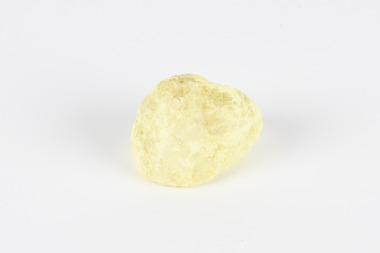
Geological specimen - Native Sulphur, unknown
... In all its forms, sulphur is one of the most commonly occurring minerals on the planet, especially in natural gases, and is key to the make-up of a range of other minerals. It is essential to continuing life on earth, and was used in ancient societies as part of medical care, religious rites, and entertainment, and was key to the invention of gunpowder by the Chinese. ...In all its forms, sulphur is one of the most commonly occurring minerals on the planet, especially in natural gases, and is key to the make-up of a range of other minerals. It is essential to continuing life on earth, and was used in ancient societies as part of medical care, religious rites, and entertainment, and was key to the invention of gunpowder by the Chinese. ...Native Sulphur in its solid form is a yellow crystalline mineral that forms near volcanic vents and fumaroles where it is the solid form of hot gases. It is also frequently found in the subsurface as a by-product of sulphide ore mineralization. In all its forms, sulphur is one of the most commonly occurring minerals on the planet, especially in natural gases, and is key to the make-up of a range of other minerals. It is essential to continuing life on earth, and was used in ancient societies as part of medical care, religious rites, and entertainment, and was key to the invention of gunpowder by the Chinese. Native Sulphur in its solid form is a yellow crystalline mineral that forms near volcanic vents and fumaroles where it is the solid form of hot gases. It is also frequently found in the subsurface as a by-product of sulphide ore mineralization. In all its forms, sulphur is one of the most commonly occurring minerals on the planet, especially in natural gases, and is key to the make-up of a range of other minerals. It is essential to continuing life on earth and was used in ancient societies as part of medical care, religious rites, and entertainment, and was key to the invention of gunpowder by the Chinese. The exact site of extraction for this specimen is unknown, but it was probably collected in New Zealand in the 1850s. Sulphur is significant both for its historical and current uses, and for its nature as one of the most abundant minerals on the planet. Sulphur's importance comes both from its abundance and its role in ensuring survival, creating other minerals, and daily human life. This specimen is significant as representative of sulphur's solid properties. This specimen is part of a larger collection of geological and mineral specimens collected from around Australia (and some parts of the world) and donated to the Burke Museum between 1868-1880. A large percentage of these specimens were collected in Victoria as part of the Geological Survey of Victoria that begun in 1852 (in response to the Gold Rush) to study and map the geology of Victoria. Collecting geological specimens was an important part of mapping and understanding the scientific makeup of the earth. Many of these specimens were sent to research and collecting organisations across Australia, including the Burke Museum, to educate and encourage further study.A solid, small, crystalline mineral specimen that is largely bright yellow, with some darker spotting. geological specimen, geology, geology collection, burke museum, beechworth, sulphur, native sulphur, new zealand, native sulphur specimen, sulphur specimen -
 The Beechworth Burke Museum
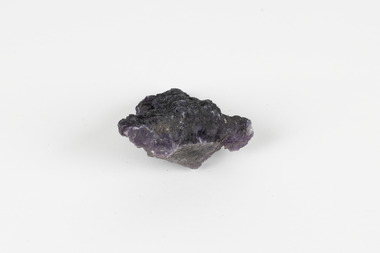
Geological specimen - Fluorite (purple)
... forms of jewellery. Most crystals of the mineral are too coarse for decorative purposes but have been mined under the name fluorspar for a variety of commercial and industrial purposes. These include the production of hydrofluoric acid, smelting metal alloys, producing glazes and ceramic finishes and use in medical and dental products. ...forms of jewellery. Most crystals of the mineral are too coarse for decorative purposes but have been mined under the name fluorspar for a variety of commercial and industrial purposes. These include the production of hydrofluoric acid, smelting metal alloys, producing glazes and ceramic finishes and use in medical and dental products. ...Fluorite comes in a variety of natural colours and crystal formations and glows under ultraviolet light (the word 'fluorescence' comes from the same etymological source). In its pure form, calcium fluoride, it is a colourless combination of the elements calcium and fluorine, but gains its colour from trace elements that infiltrate or replace calcium within its crystal structure during its formation. Although fluorite crystals polish well and can achieve a high level of lustre, the mineral is very soft (4 on MOHS hardness scale) so it is unsuitable for use in rings and must be handled and stored carefully if used in other forms of jewellery. Most crystals of the mineral are too coarse for decorative purposes but have been mined under the name fluorspar for a variety of commercial and industrial purposes. These include the production of hydrofluoric acid, smelting metal alloys, producing glazes and ceramic finishes and use in medical and dental products. An existing label for this specimen indicates that its origin or collection-point was 'probably USA.' Fluorspar, the form of fluorite used commercially and industrially, was mined in significant quantities in the counties of Hardin and Pope in South-Eastern Illinois throughout the Nineteenth and Twentieth Centuries. Fluorite was made Illinois' state mineral in recognition of its contribution to the state's identity and economy. The specimens are significant as examples of surveying activity undertaken to assess and direct the development of the mineral resource industries, as well as the movement to expand human knowledge of earth sciences such as mineralogy and geology in the nineteenth century.The specimen is a piece of purple shaded fluorite (also known as fluorspar), the mineral form of calcium fluoride. The unpolished specimen presents a dark purple interior with a substantial dark grey crust representing the matrix from which the specimen was obtained. Existing label: Flourite / (purple) / probably / USA / BB /burke museum, beechworth, geological, geological specimen, fluorite, flourite, calcium fluoride, hydrofluoric acid, jewellery, indigo shire, north-east victoria, mining, illinois, usa, united states, fluorine, gemstones, purple stones -
 The Beechworth Burke Museum
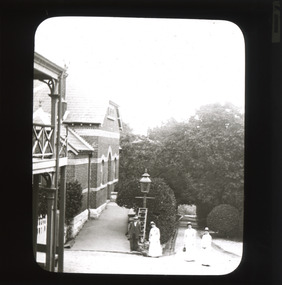
Photograph - Lantern Slide, c1900
... form and bind the emulsion layer to the base plate, including the albumen, wet plate collodion, gelatine dry plate and Woodburytype techniques. Lantern slides and magic lantern technologies are seen as foundational precursors to the development of modern photography and film-making techniques This glass slide is significant because it provides insight into Beechworth's social and medical amenities in the early Twentieth Century, around the time of Australia's Federation into one nation. ...This image appears to show nurses at what is now the Mayday Hills Mental Asylum arriving for work in approximately 1900. These individuals are part of a long history of nursing in Beechworth. Three medical or social welfare facilities opened in the mid-1800s as part of a push by the township to become a regional centre for Government services. These were the Ovens District Hospital (opened in 1857), the Ovens Benevolent Asylum (opened in 1863), and the Beechworth Mental Hospital (opened in 1867 and renamed Mayday Hills Hospital at Centenary celebrations in 1967). It was recognised that the unsettled living conditions, poverty and relative isolation of the Goldfields environment could produce 'mental disturbances' which required local treatment facilities as services in Melbourne were too far away. Carole Woods' publication 'A Titan's Field' describes activities undertaken by patients at Beechworth Mental Hospital as including monthly balls and occasional concerts as well as work to make the facility self-supporting such as farm work and making clothes. She mentions a report in 1870 that the approximately 300 patients were clean and neat with 'no-one in restraint or seclusion' but that by 1905 the organisation had 623 patients which placed strain on building infrastructure such as heating and water supplies, leading to high turnover of nurses and other issues. A program of building works to extend and improve facilities followed over subsequent decades. Lantern slides, sometimes called 'magic lantern' slides, are glass plates on which an image has been secured for the purpose of projection. Glass slides were etched or hand-painted for this purpose from the Eighteenth Century but the process became more popular and accessible to the public with the development of photographic-emulsion slides used with a 'Magic Lantern' device in the mid-Nineteenth Century. Photographic lantern slides comprise a double-negative emulsion layer (forming a positive image) between thin glass plates that are bound together. A number of processes existed to form and bind the emulsion layer to the base plate, including the albumen, wet plate collodion, gelatine dry plate and Woodburytype techniques. Lantern slides and magic lantern technologies are seen as foundational precursors to the development of modern photography and film-making techniques This glass slide is significant because it provides insight into Beechworth's social and medical amenities in the early Twentieth Century, around the time of Australia's Federation into one nation. It is also an example of an early photographic and film-making technology in use in regional Victoria in the time period.Thin translucent sheet of glass with a rectangular image printed on the front and framed in a black backing. It is held together by metals strips to secure the edges of the slide.Obverse: i /burke museum, beechworth, lantern slide, slide, glass slide, plate, burke museum collection, photograph, monochrome, magic lantern, indigo shire, north-east victoria, nineteenth century, 1900s, twentieth century, emulsion slides, nursing, nurses, mental hospitals, lunatic asylums, asylums, social services, social welfare, insane asylums, mental health, infrastructure -
 The Beechworth Burke Museum
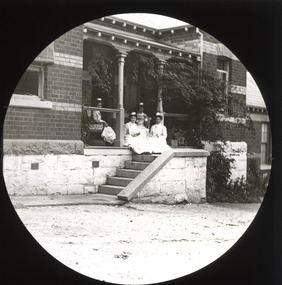
Photograph - Lantern Slide, c1900
... form and bind the emulsion layer to the base plate, including the albumen, wet plate collodion, gelatine dry plate and Woodburytype techniques. Lantern slides and magic lantern technologies are seen as foundational precursors to the development of modern photography and film-making techniques. This glass slide is significant because it provides insight into Beechworth's social and medical ...This image appears to show nurses at what is now the Mayday Hills Mental Asylum in approximately 1900. These individuals are part of a long history of nursing in Beechworth. Three medical or social welfare facilities opened in the mid-1800s as part of a push by the township to become a regional centre for Government services. These were the Ovens District Hospital (opened in 1857), the Ovens Benevolent Asylum (opened in 1863), and the Beechworth Mental Hospital (opened in 1867 and renamed Mayday Hills Hospital at Centenary celebrations in 1967). It was recognised that the unsettled living conditions, poverty and relative isolation of the Goldfields environment could produce 'mental disturbances' which required local treatment facilities as services in Melbourne were too far away. Carole Woods' publication 'A Titan's Field' describes activities undertaken by patients at Beechworth Mental Hospital as including monthly balls and occasional concerts as well as work to make the facility self-supporting such as farm work and making clothes. She mentions a report in 1870 that the approximately 300 patients were clean and neat with 'no-one in restraint or seclusion' but that by 1905 the organisation had 623 patients which placed strain on building infrastructure such as heating and water supplies, leading to high turnover of nurses and other issues. A program of building works to extend and improve facilities followed over subsequent decades. Lantern slides, sometimes called 'magic lantern' slides, are glass plates on which an image has been secured for the purpose of projection. Glass slides were etched or hand-painted for this purpose from the Eighteenth Century but the process became more popular and accessible to the public with the development of photographic-emulsion slides used with a 'Magic Lantern' device in the mid-Nineteenth Century. Photographic lantern slides comprise a double-negative emulsion layer (forming a positive image) between thin glass plates that are bound together. A number of processes existed to form and bind the emulsion layer to the base plate, including the albumen, wet plate collodion, gelatine dry plate and Woodburytype techniques. Lantern slides and magic lantern technologies are seen as foundational precursors to the development of modern photography and film-making techniques.This glass slide is significant because it provides insight into Beechworth's social and medical amenities in the early Twentieth Century, around the time of Australia's Federation into one nation. It is also an example of an early photographic and film-making technology in use in regional Victoria in the time period.Thin translucent sheet of glass with a circular image printed on the front and framed in a black backing. It is held together by metals strips to secure the edges of the slide.burke museum, beechworth, lantern slide, slide, glass slide, plate, burke museum collection, photograph, monochrome, magic lantern, indigo shire, north-east victoria, nineteenth century, 1900s, twentieth century, emulsion slides, nursing, nurses, mental hospitals, lunatic asylums, asylums, social services, social welfare, insane asylums, mental health, infrastructure -
 The Beechworth Burke Museum
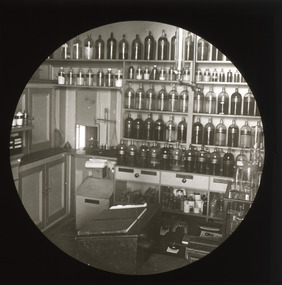
Photograph - Lantern Slide, c1900
... medical pioneers in Australia. Lantern slides, sometimes called 'magic lantern' slides, are glass plates on which an image has been secured for the purpose of projection. Glass slides were etched or hand-painted for this purpose from the Eighteenth Century but the process became more popular and accessible to the public with the development of photographic-emulsion slides used with a 'Magic Lantern' device in the mid-Nineteenth Century. Photographic lantern slides comprise a double-negative emulsion layer (forming...medical pioneers in Australia. Lantern slides, sometimes called 'magic lantern' slides, are glass plates on which an image has been secured for the purpose of projection. Glass slides were etched or hand-painted for this purpose from the Eighteenth Century but the process became more popular and accessible to the public with the development of photographic-emulsion slides used with a 'Magic Lantern' device in the mid-Nineteenth Century. Photographic lantern slides comprise a double-negative emulsion layer (forming ...Chiltern Pharmacy, now called Dow's Pharmacy, opened in 1859 at a time when the township of Chiltern was experiencing a second-wave gold rush that redistributed the balance of commercial and social activity in the region. David McEwan, father of Prime Minister John McEwan, was one of the first pharmacists practicing at the business. It was purchased in 1929 by pharmacist Hilda Dow who ran the business with her apprentice and husband, Roy Dow, until they closed the business in 1968. In 1988, after founding the North East branch of the National Trust, the Dows donated the premises with its entire fittings and stock. Some of the more than 4,000 items in stock at the time of closure in 1968 were present in the shop when the Dows took charge in 1929 and date to the late Nineteenth Century (around the time this image was taken). Hilda Dow (nee Grey) was born in 1897, the daughter of a police magistrate. She enrolled to study at the Victorian College of Pharmacy in 1919 and worked initially for Poynton's Pharmacy in Morwell before purchasing the Chiltern Pharmacy that was later named after her. She was a member of the Pharmaceutical Society of Victoria, a hospital committee and Board, the Red Cross and the Infant Welfare Association and held office for the Chiltern branch of the Country Women's Association. Her sister Helene Grey received an OBE for her work as Lady Superintendent of the Royal Melbourne Hospital. Although Hilda Dow was not Australia's first female pharmacist (this was Caroline Copp in 1880) the preservation of the pharmacy and the stories it presents sheds light on the general issue of recognition for female medical pioneers in Australia. Lantern slides, sometimes called 'magic lantern' slides, are glass plates on which an image has been secured for the purpose of projection. Glass slides were etched or hand-painted for this purpose from the Eighteenth Century but the process became more popular and accessible to the public with the development of photographic-emulsion slides used with a 'Magic Lantern' device in the mid-Nineteenth Century. Photographic lantern slides comprise a double-negative emulsion layer (forming a positive image) between thin glass plates that are bound together. A number of processes existed to form and bind the emulsion layer to the base plate, including the albumen, wet plate collodion, gelatine dry plate and woodburytype techniques. Lantern slides and magic lantern technologies are seen as foundational precursors to the development of modern photography and film-making techniques.This image is significant as it provides insight into social and commercial infrastructure available in the North-East region of Victoria in the late Nineteenth and early Twentieth Centuries. The business pictured is also associated with a Prime Minister of Victoria and some of Victoria's first female medical and pharmaceutical practitioners. Thin translucent sheet of glass with a circular image printed on the front and framed in a black backing. It is held together by metals strips to secure the edges of the slide.burke museum, beechworth, lantern slide, slide, glass slide, plate, burke museum collection, photograph, monochrome, hilda dow, roy dow, chiltern pharmacy, dow's pharmacy, chiltern, indigo shire, north east victoria, history of pharmacies, women in pharmacy, women in medicine, women in business, david mcewan, john mcewan, national trust, national trust victoria, north-east victoria national trust, heritage buildings, industrial heritage, helene grey, pharmaceutical society of victoria, victorian college of pharmacy, country women's association, caroline copp, royal melbourne hospital, red cross, infant welfare association -
 Mission to Seafarers Victoria
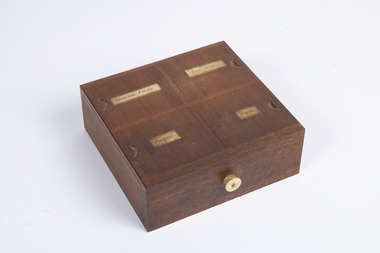
Container - Medium Wood Drawer
... Camphor was a stimulant, narcotic and sudorific and was administered in pill form which included part ipecacuanha and opium to non acute fevers and remedy chromic rheumatism, as part of a liquid mixture to treat violent headaches as well as rheumatism, or in a solid form stored in a small bag worn around a patient's neck as a preservative against infection. Lint was commonly used for medical dressings....Camphor was a stimulant, narcotic and sudorific and was administered in pill form which included part ipecacuanha and opium to non acute fevers and remedy chromic rheumatism, as part of a liquid mixture to treat violent headaches as well as rheumatism, or in a solid form stored in a small bag worn around a patient's neck as a preservative against infection. Lint was commonly used for medical dressings. volum collection Ipecacuan. ...Ipecacuan powder, or Dover's powder, was a common emetic used through the eighteenth and nineteenth century as a sudorific and prescribed for colds, coughs, insomnia, rheumatism, pleurisy, and dysentery. Gum arabic was often used as an additive to promote binding of other ingredients to a liquid medium. Likely gum arabic was not prescribed by itself even though there are some health benefits for doing so, such as slowing the rate of absorption of some drugs within the gut. Camphor was a stimulant, narcotic and sudorific and was administered in pill form which included part ipecacuanha and opium to non acute fevers and remedy chromic rheumatism, as part of a liquid mixture to treat violent headaches as well as rheumatism, or in a solid form stored in a small bag worn around a patient's neck as a preservative against infection. Lint was commonly used for medical dressings.The right one of two marching medium sized wood drawers. Each drawer features four sliding lids on their top face which has a corresponding paper label depending on its contents as well as a small semi-circle notch, these lids slide laterally in pairs for either direction. These drawers are found in the front storage location of the parent item and bellow a row of glass containers.Ipecacuan. Powder. Gum Arabic. Camphor. Lint.volum collection -
Federation University Historical Collection
Newspaper - Newspaper - Article, VIOSH: Analysis of major killer - accidents at work; "The Age" 23 August 1974: Eric Wigglesworth
... Medical Congress, 22 August 1974. In his analysis, he found certain times of the day were more prone to accidents and "that the more children a man has, the more chance he has of having an accident at work." "Some of his more humorous collegues have suggested this is because these people are not new to accidents". Eric became one of the initial group to form...Medical Congress, 22 August 1974. In his analysis, he found certain times of the day were more prone to accidents and "that the more children a man has, the more chance he has of having an accident at work." "Some of his more humorous collegues have suggested this is because these people are not new to accidents". Eric became one of the initial group to form ...Victorian Institute of Occupational Safety and Health (VIOSH) Australia is the Asia-Pacific centre for teaching and research in occupational health and safety (OHS) and is known as one of Australia's leaders on the field. VIOSH has a global reputation for its innovative approach within the field of OHS management. VIOSH had its first intake of students in 1979. At that time the Institution was known as the Ballarat College of Advanced Education. In 1990 it became known as Ballarat University College, then in 1994 as University of Ballarat. It was 2014 that it became Federation University. VIOSH Australia students are safety managers, senior advisors and experienced OHS professionals. They come from all over Australia and industry. Students are taught active research and enquiry; rather than textbook learning and a one-size fits all approach. VIOSH accepts people into the Graduate Diploma of Occupational Hazard Management who have no undergraduate degree - on the basis of extensive work experience and knowledge. Newspaper article about Eric Wigglesworth - Australian accidentologist - researcher who works full-time analysing the third killer in the country - accidents. Eric is a project officer with the Royal Australian College of Surgeons and gave a paper on occupational accidents at the Australian Medical Congress, 22 August 1974. In his analysis, he found certain times of the day were more prone to accidents and "that the more children a man has, the more chance he has of having an accident at work." "Some of his more humorous collegues have suggested this is because these people are not new to accidents". Eric became one of the initial group to form the Victorian Institute of Occupational Safety and Health (VIOSH) at Ballarat.A4 sheet with article stuck on. Photograph of speakerThe Age Date: Friday 23/08/74viosh, victorian institute of occupational safety and health, accidentologist, eric wigglesworth, researcher, royal australian college of surgeons, the age, australian medical congress, work accidents -
 Federation University Historical Collection
Photograph - Photograph - Sepia, Ballarat School of Mines Cadets, 1916, c1916
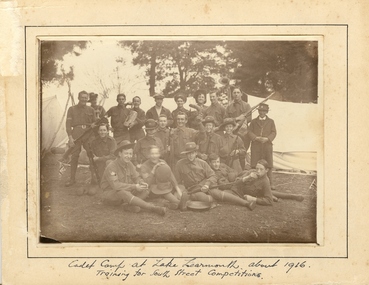
... form their own units. Unlike their junior counterparts, Senior Cadets were issued uniforms, a rifle, and learned the foundations necessary for service in any arm of the defence forces. Boys and men could be exempted from compulsory training if they lived more than five miles from the nearest training site, or were passed medically unfit. ...form their own units. Unlike their junior counterparts, Senior Cadets were issued uniforms, a rifle, and learned the foundations necessary for service in any arm of the defence forces. Boys and men could be exempted from compulsory training if they lived more than five miles from the nearest training site, or were passed medically unfit. ...Field Marshal Viscount Kitchener of Great Britain was invited by Prime Minister Deakin in 1909 to visit Australia and advise on the best way to provide Australia with a land defence. Kitchener’s report echoed the bill, introduced to Parliament in 1909 and supported by the Opposition Labor Party at its 1908 conference, to introduce compulsory military training in peace time (referred to as universal training). On 1 January 1911, the Commonwealth Defence Act 1911 (Cth) was passed as law and all males aged 12 to 26 were required to receive military training. Men were divided according to age, with junior cadets comprising boys 12-14 years of age, senior cadets comprising boys 14-18, and young men aged 18-26 assigned to the home militia defence. The support of schools was vital to the success of the scheme, since the system of cadet training began in the primary schools, with physical training prescribed by military authorities. Junior cadet training was entirely in the hands of school teachers, who had first been trained by military officers. This early training was less military in nature than focused on physical drill and sport. It also acted to inculcate boys with the notions of loyalty to country and empire. At this age, uniforms were not worn, although there were schools with pre-existing uniformed cadet units, who continued to do so. Senior Cadets were organised by Training Areas, administered by Area Officers. If a school had at least 60 senior cadets, they could form their own units. Unlike their junior counterparts, Senior Cadets were issued uniforms, a rifle, and learned the foundations necessary for service in any arm of the defence forces. Boys and men could be exempted from compulsory training if they lived more than five miles from the nearest training site, or were passed medically unfit. Those who failed to register for training were punished with fines or jail sentences, and the severity of this punishment generated some of the strongest opposition to the scheme. While institutions such as the political parties and most churches generally supported universal training, some in the broader labour movement were less enthusiastic, as evidenced in the Daily Herald newspaper’s editorials and letters. Universal military training persisted after the conclusion of World War 1, with the Junior Cadet scheme the first to go, in 1922. Senior cadets and service with the militia was suspended in November 1929. (http://guides.slsa.sa.gov.au/content.php?pid=575383&sid=4788359, accessed 29/10/2015) According to Neil Leckie, Manager of the Ballarat Ranger Military Museum: * Originally 12 – 14 year olds went to Junior Cadets attached to their school. * From age 14 – 17 they were Senior Cadets attached to the local militia unit. * After 1 July of the year a Cadet turned 18, the Cadet left the Senior Cadets and became a member of the Citizen Military Force. * In October 1918 the AIF, Militia and Cadets were renamed to give some connection to the AIF battalion raised in the area. Ballarat saw: 8th Australian Infantry Regiment comprising: * 8th Battalion AIF renamed 1st Battalion 8th Australian Infantry Regiment * 70th Infantry Militia renamed 2nd Battalion 8th Australian Infantry Regiment * 70th Infantry Cadets renamed 3rd B, 8th Australian Infantry. 39th Australian Infantry Regiment comprising: * 39th Battalion AIF renamed 1st Battalion 39th Australian Regiment * 71st Infantry Militia renamed 2nd Bn, 39th Australian Infantry Regiment * 71st Infantry Cadets renamed 3rd Bn, 39th Australian Infantry Regiment Prior to the reorganisation in 1918 the 18th Brigade was the 70th, 71st and 73rd Infantry. It is thought that the 18th Brigade Cadet units in 1920 were those that came from the old: * 69th Infantry (Geelong/Queenscliff) * 70th Infantry (Ballarat/Colac) * 71st Infantry (Ballarat West) * 72nd Infantry Warrnambool) * 73rd Infantry (NW Vic) The next name change came in 1921!Mounted sepia photograph of 21 young males. They are the Ballarat School of Mines Cadets on a training camp at Lake Learmonth. Back row left to right: Harold Wakeling; ? ; T. Wasley; H. Witter; H.V. Maddison (staff); Lieutenant S.J. Proctor, Joe ? ; ? ; B.C. Burrows. Centre left to right: Howard Beanland; ? ; F.N. Gibbs; H. Siemering; P. Riley; ? : E. Adamthwaite. Front row left to right: Albert E. Williams; Francis Davis (RAAF Dec.); A. Miller; W. Shattock; T. Rees From the Ballarat School of Mines Magazine, 1916 "Our Competition Team, 1916 At a parade, held on the 25th August competition teams were called from from the three colleges - Ballarat College, St Patrick's College, and the School of Mines. In each case, a large muster was obtained, twenty-nine volunteering fro the School of Mines. On account of the number in a team being limited to 21, some had to be weeded out. The team decided to have a camp at Learmonth in the vacation for the benefit of training for the coming competitions. The tents, within our baggage, were brought to the Junior Technical School at 10 a.m. on Monday, 11 September. Everything was carted to the station on a lorry, which was very kindly lent by Mr C. Burrow. ... Arriving at our camp, which was in the Park, we first raised the tents. This was done in record time. Three large tents, A.B.C., were pitched one behind the other. We also pitched a smaller one to act as a provisions tent. The provisions supplied by each cadet were placed in this tent. Dinner was ready by 3.30, and was prepared by the three senior non-coms., who also acted as orderlies. Things went alright Monday night, the two senior non-coms. acting as sentries for the first two hours. On Tuesday morning Reville sounded at 7. There was no need for it, however, as nearly all the cadets were up before daylight, owing to their beds being too hard. After physical exercises were gone through we had breakfast. We then had rifle exercises until Messrs A.W. Steane and F.N. King arrived. The former put the team through the table of physical exercises set down for competition work, many valuable points being obtained. The visitors remained for dinner, afterwards returning to Ballarat. Wednesday was uneventful, until the soldiers arrived at about 11 a.m., stopping at the park for lunch. As we handed over the coppers, etc., to them, our lunch was delayed. Two more visitors arrived after lunch, and after taking a few photos returned home. That night we had a "Sing-a-long" in C Tent until "Lights out" sounded at 9.30. After physical exercises ad breakfast on Thursday, we went for a six mile route march round the lake, doing skirmishing on the way. In the afternoon we practised rifle exercises and the march past. A concert was arranged for that night, the chief singers being cadets H. Siemering and W. Shattock. Supper was served at the end of the entertainment. On Friday, Reveille sounded at 6.30 instead of 7, and, as usual, we had physical exercises before breakfast, after which the team went through skirmishing at the reserve. In the afternoon, section drill and the march past were practised. Friday night, being our last night in camp, leave was granted until 10 p.m., "lights out" sounding at 11. Reveille sounded on Saturday at 4.30, the reason being that all kits, tents, etc., had to be packed away ready to catch the 8.15 train to Balalrat. At 7.30 we were all ready to leave for the station. We had a very enjoyable time in the train, each cadet having a chip in at the patriotic songs. On arriving at Ballarat, we found the lorry awaiting us. The luggage was carted to the Junior Technical School, the team following. The team were here dismissed, everyone feeling that he had had a very good time. F.G. Davis"Written in ink on front 'cadet camp at Lake Learmonth about 1916. Training for South Street Competitions. ballarat school of mines, cadets, ballarat school of mines cadets, lake learmonth, world war one, boomerang, camp, cadet camp, h.g. wakeling, harold wakeling, f.g. davis, albert w. steane, f.n. king, h. siermering, w. shattock, francis davis, harold wakeling, t. wasley, h. witter, h.v. maddison, s.j. proctor, b.c. burrows, howard beanland, f.n. gibbs, h. siemering, p. riley, e. adamthwaite, albert e. williams; francis davis, a. miller, w. shattock, t. rees, photography, foto, boxing gloves -
Marysville & District Historical Society
THE TRIANGLE NEWS-VOL 39 NO 22-JUNE 15 2012
... marysville victoria australia open and ready for snow marysville ski centre open what's on when in june buxton reserve committee working bee the committee of management of the gallipoli park precinct intrepid triangle bushwalkers creative triangle marysville triange & youth group agm straying stock a major safety concern marysville community church farewells pastor jamie & roslyn duncan saladin lodge church notices councils partner to support goulburn river valley tourism artists on the acheron exhibition opening and closing dates comedy festival roadshow marysville pharmacy marsyville medical clinic mayor's chair marysville golf report happy hour in recess advertisements adventurous cooks sports & recreation clubs funding opportunities detox your home murrindindi shire sample wines regional catchment strategy forms national emergency medal nominations notice of public consultation alpine resorts strategic plan 2012 real estate state government victoria department of primary industries 2 non executive directors council successful in gaining significant road repairs funds green business assessors murrindindi climate network position vacant department of sustainability & environment marysville community golf & bowls club lake mountain alpine resort councillor comment THE TRIANGLE NEWS-VOL 39 NO 22-JUNE 15 2012 ...marysville, victoria, australia, open and ready for snow, marysville ski centre open, what's on when in june, buxton reserve committee, working bee, the committee of management of the gallipoli park precinct, intrepid triangle bushwalkers, creative triangle, marysville triange & youth group agm, straying stock a major safety concern, marysville community church farewells pastor jamie & roslyn duncan, saladin lodge, church notices, councils partner to support goulburn river valley tourism, artists on the acheron, exhibition opening and closing dates, comedy festival roadshow, marysville pharmacy, marsyville medical clinic, mayor's chair, marysville golf report, happy hour in recess, advertisements, adventurous cooks, sports & recreation clubs funding opportunities, detox your home, murrindindi shire, sample wines, regional catchment strategy forms, national emergency medal nominations, notice of public consultation, alpine resorts strategic plan 2012, real estate, state government victoria, department of primary industries, 2 non executive directors, council successful in gaining significant road repairs funds, green business assessors, murrindindi climate network, position vacant, department of sustainability & environment, marysville community golf & bowls club, lake mountain alpine resort, councillor comment -
Marysville & District Historical Society
THE TRIANGLE NEWS-VOL 36 NO 22-JUNE 19 2009
... marysville victoria australia starting again lynne phelps marysville bakery black saturday marysville central update wanted the lolly shop bruno's art and sculpture garden ses cfa what's on when free advice in marysville marysville & district lions club alexandra visitors information centre marysville fire brigade news seasonal road closures dse to reopen marysville office and depot advertisements murrindindi shire council seniors concert senior citizens hall marysville youth starts rebuild triangle distribution & fire relief centre community advisory groups formed for bushfire recovery documentary on marysville help wanted marysville opportunity shop church notices marysville art show marysville christian fellowship new firewood distribution plan house signs ready for pick up marysville medical centre THE TRIANGLE NEWS-VOL 36 NO 22-JUNE 19 2009 ...marysville, victoria, australia, starting again, lynne phelps, marysville bakery, black saturday, marysville central update, wanted, the lolly shop, bruno's art and sculpture garden, ses, cfa, what's on when, free advice in marysville, marysville & district lions club, alexandra visitors information centre, marysville fire brigade news, seasonal road closures, dse to reopen marysville office and depot, advertisements, murrindindi shire council, seniors concert, senior citizens hall, marysville youth starts rebuild, triangle distribution & fire relief centre, community advisory groups formed for bushfire recovery, documentary on marysville help wanted, marysville opportunity shop, church notices, marysville art show, marysville christian fellowship, new firewood distribution plan, house signs ready for pick up, marysville medical centre -
 Shepparton RSL Sub Branch
Tin, Foot Powder, c. 1960s
... medical foot foot powder athlete's foot vietnam war 1960s On front of tin "[broad arrow]/FOOT POWDER/2 OZ. NET WEIGHT/ MURPHY, LIEBERT PTY. LTD./SYDNEY, AUSTRALIA." Right side "P.D. 5/67". Back of tin "FORMULA/SALICYLIC ACID 3%/STARCH 10%/TALC 87%" Khaki coloured rectangular tin constructed of a rectangular base with rounded edges, attached to one long rectangular section bent into sides, another rectangular piece with rounded edges forms the top. ...This foot powder tin may have been manufactured for use by troops in Vietnam, if the inscription "P.D. 5/69" might refer to it's manufacture in May 1969. Khaki coloured rectangular tin constructed of a rectangular base with rounded edges, attached to one long rectangular section bent into sides, another rectangular piece with rounded edges forms the top. In top of tin, a screw on lid with seven punched holes allows the contents to be shaken out of the tin. Content residue still visible on lid but appears that the tin is otherwise empty. Inscriptions throughout described below.On front of tin "[broad arrow]/FOOT POWDER/2 OZ. NET WEIGHT/ MURPHY, LIEBERT PTY. LTD./SYDNEY, AUSTRALIA." Right side "P.D. 5/67". Back of tin "FORMULA/SALICYLIC ACID 3%/STARCH 10%/TALC 87%" medical, foot, foot powder, athlete's foot, vietnam war, 1960s -
 Flagstaff Hill Maritime Museum and Village
Functional object - Spectacles and Case, 1930s - 1960s
... formed in Sydney in 1932 and publically listed in 1953. These spectacles and case were used by Dr. Angus when testing patients' eyes. The spectacles and case were donated to Flagstaff Hill Maritime Village by the family of Doctor William Roy Angus, Surgeon and Oculist. It is part of the “W.R. Angus Collection” that includes historical medical...formed in Sydney in 1932 and publically listed in 1953. These spectacles and case were used by Dr. Angus when testing patients' eyes. The spectacles and case were donated to Flagstaff Hill Maritime Village by the family of Doctor William Roy Angus, Surgeon and Oculist. It is part of the “W.R. Angus Collection” that includes historical medical ...The history of spectacles The earliest form of spectacles are generally agreed to have been invented in Northern Italy in the thirteenth century. Over hundreds of years of innovation and refinement, they have been perfected into the stylish and functional designs you see today worn by millions of people to correct their eyesight. Here's a look at the key moments that defined the history of spectacles. Thirteenth century - Rivet spectacles The earliest form of spectacles was simply two mounted lenses riveted together at the handle ends. They had no sides and were secured to the face by clamping the nose between the rims, some of which had notches which may have been intended to improve the grip. Even then the wearer could only keep them in place by remaining relatively still and would normally support them with the hand. These spectacles contained convex lenses for the correction of presbyopic long-sightedness and were generally suited only to those few who lived beyond their forties and had the ability to read. Sixteenth century - Nose spectacles Nose spectacles were in more common use by the early sixteenth century. These often had a bow-shaped continuous bridge, almost of a modern appearance, that was sometimes flexible depending upon the material, for example leather or whalebone. The bridge was as much an area to be gripped as to rest on the nose. Spectacles were still usually held in place with the hand whilst being used temporarily for a brief period of reading or close inspection. By now the lenses could be used to correct both long and short sight. The general design changed little through the seventeenth century, though certain refinements increased the flexibility and comfort for some wearers. In some localised areas, notably in Spain, people experimented with ear loops made of string. This allowed them to walk around with their spectacles on. Eighteenth century - Temple glasses Only in the eighteenth century did the first modern eyewear, or ‘glasses’ as we would understand them, start to appear. The lenses might be glass, rock crystal or any other transparent mineral substance and were prone to smashing if the spectacles fell off, so there was an impetus to develop frames that could be worn continuously and would stay in place. London optician Edward Scarlett is credited with developing the modern style of spectacles which were kept in place with arms, known as ‘temples’. These were made of iron or steel and gripped the side of the head but did not yet hook over the ears because often the ears were concealed beneath a powdered wig, such as was fashionable at the time. As temples developed they were made with wide ring ends through which the wearer could pass a ribbon, thus tying the spectacles securely to the head. As spectacles were no longer primarily for use in sedentary activities, people began to be noticed out and about in their spectacles and might come to be identified as a ‘spectacle wearer’. By the end of the eighteenth century, people who needed correction for both distance and near could choose bifocals. Nineteenth century - Pince-nez Pince-nez were a nineteenth century innovation that literally translates as ‘pinching the nose’. They had a spring clip to retain the item in place under its own tension. Sometimes this clip was too tight and the wearer struggled to breathe. If it was too loose the pince-nez could fall off so, for safety and security, they were often connected to the wearer's clothing by a cord or a chain to avoid them being dropped or lost. Pince-nez were sometimes chosen by people who felt that large spectacles were too prominent and drew attention to a physical defect. They were also suitable for mounting lenses that could correct astigmatism. Twentieth century spectacles Spectacle wearing continued to become more widespread, key developments being the supply of spectacles to troops in the First World War, cheaper spectacles being subsidised through insurance schemes arranged by friendly societies, and the beginning of the National Health Service in 1948, when free spectacles were made available to all who might benefit from them. This normalised spectacle wearing and led to a significant increase in the scale of production. Entirely separate categories of women’s spectacles and sports eyewear both emerged in the 1930s. The latter half of the twentieth century saw spectacles become more fashionable and stylish as frames with different shapes, materials, and colours became available. Plastics frames, in particular, allowed a greater choice of colours and textured finishes. Plastic lenses were more durable and could be made lighter and thinner than glass, spurring a renewed interest in rimless designs. Designer eyewear bearing popular high-street brand names encouraged patients to regard spectacles as a desirable commodity, even as a fashion accessory, not just a disability aid. https://www.college-optometrists.org/the-british-optical-association-museum/the-history-of-spectacles The company Optical Prescription Spectacle Makers (OPSM ) was formed in Sydney in 1932 and publically listed in 1953. These spectacles and case were used by Dr. Angus when testing patients' eyes. The spectacles and case were donated to Flagstaff Hill Maritime Village by the family of Doctor William Roy Angus, Surgeon and Oculist. It is part of the “W.R. Angus Collection” that includes historical medical equipment, surgical instruments and material once belonging to Dr Edward Ryan and Dr Thomas Francis Ryan, (both of Nhill, Victoria) as well as Dr Angus’ own belongings. The Collection’s history spans the medical practices of the two Doctors Ryan, from 1885-1926 plus that of Dr Angus, up until 1969. ABOUT THE “W.R.ANGUS COLLECTION” Doctor William Roy Angus M.B., B.S., Adel., 1923, F.R.C.S. Edin.,1928 (also known as Dr Roy Angus) was born in Murrumbeena, Victoria in 1901 and lived until 1970. He qualified as a doctor in 1923 at University of Adelaide, was Resident Medical Officer at the Royal Adelaide Hospital in 1924 and for a period was house surgeon to Sir (then Mr.) Henry Simpson Newland. Dr Angus was briefly an Assistant to Dr Riddell of Kapunda, then commenced private practice at Curramulka, Yorke Peninsula, SA, where he was physician, surgeon and chemist. In 1926, he was appointed as new Medical Assistant to Dr Thomas Francis Ryan (T.F. Ryan, or Tom), in Nhill, Victoria, where his experiences included radiology and pharmacy. In 1927 he was Acting House Surgeon in Dr Tom Ryan’s absence. Dr Angus had become engaged to Gladys Forsyth and they decided he would take time to further his studies overseas in the UK in 1927. He studied at London University College Hospital and at Edinburgh Royal Infirmary and in 1928, was awarded FRCS (Fellow from the Royal College of Surgeons), Edinburgh. He worked his passage back to Australia as a Ship’s Surgeon on the on the Australian Commonwealth Line’s T.S.S. Largs Bay. Dr Angus married Gladys in 1929, in Ballarat. (They went on to have one son (Graham 1932, born in SA) and two daughters (Helen (died 12/07/1996) and Berenice (Berry), both born at Mira, Nhill ) Dr Angus was a ‘flying doctor’ for the A.I.M. (Australian Inland Ministry) Aerial Medical Service in 1928 . The organisation began in South Australia through the Presbyterian Church in that year, with its first station being in the remote town of Oodnadatta, where Dr Angus was stationed. He was locum tenens there on North-South Railway at 21 Mile Camp. He took up this ‘flying doctor’ position in response to a call from Dr John Flynn; the organisation was later known as the Flying Doctor Service, then the Royal Flying Doctor Service. A lot of his work during this time involved dental surgery also. Between 1928-1932 he was surgeon at the Curramulka Hospital, Yorke Peninsula, South Australia. In 1933 Dr Angus returned to Nhill where he’d previously worked as Medical Assistant and purchased a share of the Nelson Street practice and Mira hospital from Dr Les Middleton one of the Middleton Brothers, the current owners of what was once Dr Tom Ryan’s practice. Dr L Middleton was House Surgeon to the Nhill Hospital 1926-1933, when he resigned. [Dr Tom Ryan’s practice had originally belonged to his older brother Dr Edward Ryan, who came to Nhill in 1885. Dr Edward saw patients at his rooms, firstly in Victoria Street and in 1886 in Nelson Street, until 1901. The Nelson Street practice also had a 2 bed ward, called Mira Private Hospital ). Dr Edward Ryan was House Surgeon at the Nhill Hospital 1884-1902 . He also had occasions where he successfully performed veterinary surgery for the local farmers too. Dr Tom Ryan then purchased the practice from his brother in 1901. Both Dr Edward and Dr Tom Ryan work as surgeons included eye surgery. Dr Tom Ryan performed many of his operations in the Mira private hospital on his premises. He too was House Surgeon at the Nhill Hospital 1902-1926. Dr Tom Ryan had one of the only two pieces of radiology equipment in Victoria during his practicing years – The Royal Melbourne Hospital had the other one. Over the years Dr Tom Ryan gradually set up what was effectively a training school for country general-practitioner-surgeons. Each patient was carefully examined, including using the X-ray machine, and any surgery was discussed and planned with Dr Ryan’s assistants several days in advance. Dr Angus gained experience in using the X-ray machine there during his time as assistant to Dr Ryan. Dr Tom Ryan moved from Nhill in 1926. He became a Fellow of the Royal Australasian College of Surgeons in 1927, soon after its formation, a rare accolade for a doctor outside any of the major cities. He remained a bachelor and died suddenly on 7th Dec 1955, aged 91, at his home in Ararat. Scholarships and prizes are still awarded to medical students in the honour of Dr T.F. Ryan and his father, Dr Michael Ryan, and brother, John Patrick Ryan. ] When Dr Angus bought into the Nelson Street premises in Nhill he was also appointed as the Nhill Hospital’s Honorary House Surgeon 1933-1938. His practitioner’s plate from his Nhill surgery states “HOURS Daily, except Tuesdays, Fridays and Saturday afternoons, 9-10am, 2-4pm, 7-8pm. Sundays by appointment”. This plate is now mounted on the doorway to the Port Medical Office at Flagstaff Hill Maritime Village, Warrnambool. Dr Edward Ryan and Dr Tom Ryan had an extensive collection of historical medical equipment and materials spanning 1884-1926 and when Dr Angus took up practice in their old premises he obtained this collection, a large part of which is now on display at the Port Medical Office at Flagstaff Hill Maritime Village in Warrnambool. During his time in Nhill Dr Angus was involved in the merging of the Mira Hospital and Nhill Public Hospital into one public hospital and the property titles passed on to Nhill Hospital in 1939. In 1939 Dr Angus and his family moved to Warrnambool where he purchased “Birchwood,” the 1852 home and medical practice of Dr John Hunter Henderson, at 214 Koroit Street. (This property was sold in1965 to the State Government and is now the site of the Warrnambool Police Station. ). The Angus family was able to afford gardeners, cooks and maids; their home was a popular place for visiting dignitaries to stay whilst visiting Warrnambool. Dr Angus had his own silk worm farm at home in a Mulberry tree. His young daughter used his centrifuge for spinning the silk. Dr Angus was appointed on a part-time basis as Port Medical Officer (Health Officer) in Warrnambool and held this position until the 1940’s when the government no longer required the service of a Port Medical Officer in Warrnambool; he was thus Warrnambool’s last serving Port Medical Officer. (The duties of a Port Medical Officer were outlined by the Colonial Secretary on 21st June, 1839 under the terms of the Quarantine Act. Masters of immigrant ships arriving in port reported incidents of diseases, illness and death and the Port Medical Officer made a decision on whether the ship required Quarantine and for how long, in this way preventing contagious illness from spreading from new immigrants to the residents already in the colony.) Dr Angus was a member of the Australian Medical Association, for 35 years and surgeon at the Warrnambool Base Hospital 1939-1942, He served as a Surgeon Captain during WWII 1941-45, in Ballarat, Victoria, and in Bonegilla, N.S.W., completing his service just before the end of the war due to suffering from a heart attack. During his convalescence he carved an intricate and ‘most artistic’ chess set from the material that dentures were made from. He then studied ophthalmology at the Royal Melbourne Eye and Ear Hospital and created cosmetically superior artificial eyes by pioneering using the intrascleral cartilage. Angus received accolades from the Ophthalmological Society of Australasia for this work. He returned to Warrnambool to commence practice as an ophthalmologist, pioneering in artificial eye improvements. He was Honorary Consultant Ophthalmologist to Warrnambool Base Hospital for 31 years. He made monthly visits to Portland as a visiting surgeon, to perform eye surgery. He represented the Victorian South-West subdivision of the Australian Medical Association as its secretary between 1949 and 1956 and as chairman from 1956 to 1958. In 1968 Dr Angus was elected member of Spain’s Barraquer Institute of Barcelona after his research work in Intrasclearal cartilage grafting, becoming one of the few Australian ophthalmologists to receive this honour, and in the following year presented his final paper on Living Intrasclearal Cartilage Implants at the Inaugural Meeting of the Australian College of Ophthalmologists in Melbourne In his personal life Dr Angus was a Presbyterian and treated Sunday as a Sabbath, a day of rest. He would visit 3 or 4 country patients on a Sunday, taking his children along ‘for the ride’ and to visit with him. Sunday evenings he would play the pianola and sing Scottish songs to his family. One of Dr Angus’ patients was Margaret MacKenzie, author of a book on local shipwrecks that she’d seen as an eye witness from the late 1880’s in Peterborough, Victoria. In the early 1950’s Dr Angus, painted a picture of a shipwreck for the cover jacket of Margaret’s book, Shipwrecks and More Shipwrecks. She was blind in later life and her daughter wrote the actual book for her. Dr Angus and his wife Gladys were very involved in Warrnambool’s society with a strong interest in civic affairs. Their interests included organisations such as Red Cross, Rostrum, Warrnambool and District Historical Society (founding members), Wine and Food Society, Steering Committee for Tertiary Education in Warrnambool, Local National Trust, Good Neighbour Council, Housing Commission Advisory Board, United Services Institute, Legion of Ex-Servicemen, Olympic Pool Committee, Food for Britain Organisation, Warrnambool Hospital, Anti-Cancer Council, Boys’ Club, Charitable Council, National Fitness Council and Air Raid Precautions Group. He was also a member of the Steam Preservation Society and derived much pleasure from a steam traction engine on his farm. He had an interest in people and the community He and his wife Gladys were both involved in the creation of Flagstaff Hill, including the layout of the gardens. After his death (28th March 1970) his family requested his practitioner’s plate, medical instruments and some personal belongings be displayed in the Port Medical Office surgery at Flagstaff Hill Maritime Village, and be called the “W. R. Angus Collection”. The W.R. Angus Collection is significant for still being located at the site it is connected with, Doctor Angus being the last Port Medical Officer in Warrnambool. The collection of medical instruments and other equipment is culturally significant, being an historical example of medicine from late 19th to mid-20th century. Dr Angus assisted Dr Tom Ryan, a pioneer in the use of X-rays and in ocular surgery. Spectacles and case, from the W.R. Angus Collection and used by Dr. Angus testing the sight of his patients. Metal case covered in red leather, black velvet lining. Tan rimmed spectacles. Maker is OPSM. Inscriptions on case, inside case and on spectacle rim.Inscribed on spectacle arms “CONTORA”. Inscription on case in gold print “OPSM Optical Prescription Spectacle Makers Pty Ltd”. Inscription on white oval label inside case is illegible. flagstaff hill, warrnambool, shipwrecked coast, flagstaff hill maritime museum, maritime museum, shipwreck coast, flagstaff hill maritime village, great ocean road, dr w r angus, spectacles and case, optical testing, optometrist examination, opsm optical prescription spectacle makers
