
Showing 25 items matching "medical patches"
-
 Bendigo Military Museum
Uniform - MEDICAL PATCHES, Unknown
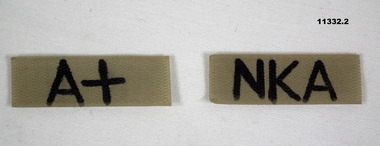
... MEDICAL PATCHES...Medical patches...NKA for known allergies. Uniform MEDICAL PATCHES ...Velcro patches attached to Field Uniform when in action to identify blood type and allergies. Collection relating to Multiple Deployments in several areas of Operations and Peacekeeping, refer Cat No 11268.2 for the complete collection.Two cut off pieces of Velcro with following written on with black texta on pale green. 1. A+ for blood type. 2. NKA for known allergies.1. A+. 2. NKA.medical patches, uniforms -
 Wangaratta RSL Sub Branch
Badge - Cloth badge, c1965
... This "Kangaroo and Joey" patch is a variation of the U.S. Army 82nd Medical Detachment patch. ...This "Kangaroo and Joey" patch is a variation of the U.S. Army 82nd Medical Detachment patch. ...This "Kangaroo and Joey" patch is a variation of the U.S. Army 82nd Medical Detachment patch. It was specifically adopted by the unit during the Vietnam War to pay homage to their close operational ties and frequent medivac missions supporting the Australian Army. These patches were custom-made by local tailors in South Vietnam rather than mass-produced by the U.S. militaryTo directly honour this alliance, the US unit integrated Australia’s national animal into a specialized version of their insignia. Because a mother kangaroo carries and protects her young inside a safe pouch, it served as a perfect metaphor for an air ambulance helicopter carrying the wounded to safety.Embroided cotton patch consisting of a circle design featuring a kangaroo and joey superimposed over a large red cross and white cotton background. A thin black edging around the circle completes the design.DUST OFF 82 MED DET(HA)unit badge, patch, 82 med det (ha), us army, vietnam war -
 Lara RSL Sub Branch
Uniform, Australian Army Hat, Jan 2005
... Australian military felt hat with Puggaree and Chin Strap with Australian Army Medical Corps Badge and a 3rd Health Support Battalion colour patch on side. ...Australian military felt hat with Puggaree and Chin Strap with Australian Army Medical Corps Badge and a 3rd Health Support Battalion colour patch on side. ...Standard Australian Army Hat for use by military personal.Australian military felt hat with Puggaree and Chin Strap with Australian Army Medical Corps Badge and a 3rd Health Support Battalion colour patch on side. Khaki in colour.Sweat band has Mountcastle Pty Ltd. Jan 2005. Size 55. O/N2350008 Printed on it. -
 Flagstaff Hill Maritime Museum and Village
Badge - Australian Military cloth patch, Army Medical Corps, 108 Australian General Hospital, 1939-1945
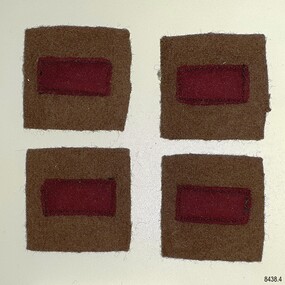
... patches belonged to Dr William Roy Angus and are now part of Flagstaff Hill’s comprehensive W.R. Angus Collection, donated by the family of Dr W R Angus (1901-1970), surgeon and oculist. The badges date to the Second World War era, when Dr Angus was a Surgeon Captain for the Australian Defence Forces in the Army Medical Corps, 108 Australian General Hospital and 106 Australian General Hospital, stationed in Ballarat, Victoria, and in Bonegilla, N.S.W. ...Badges; set of four cloth patches, red rectangles on brown squares. Insignia of the Australian Defence Forces, Army Medical Corps, 108 Australian General Hospital, WWII era. ...Insignia of the Australian Defence Forces, Army Medical Corps, 108 Australian General Hospital, WWII era. Dr W R Angus owned the cloth patches that are now part of the W. ...The four cloth patches belonged to Dr William Roy Angus and are now part of Flagstaff Hill’s comprehensive W.R. Angus Collection, donated by the family of Dr W R Angus (1901-1970), surgeon and oculist. The badges date to the Second World War era, when Dr Angus was a Surgeon Captain for the Australian Defence Forces in the Army Medical Corps, 108 Australian General Hospital and 106 Australian General Hospital, stationed in Ballarat, Victoria, and in Bonegilla, N.S.W. He completed his service just before the end of the war due to suffering from a heart attack. In World War I the troops of the Australian Military Forces staked coloured flags of various shapes and colours in the ground where they camped to identify their units. These flag codes were quickly recognised. The system worked so well that miniature flags were called colour patches. They became part of the uniform, to be worn on both sleeves just below the shoulder. The system was slightly modified for use in the Second World War. The W.R. Angus Collection: - The W.R. Angus Collection includes historical medical equipment, surgical instruments and material belonging to Dr Edward Ryan and Dr Thomas Francis Ryan, (both of Nhill, Victoria) and Dr Angus’ own belongings. The Collection’s history spans the medical practices of the two Doctors Ryan, from 1885-1926 plus that of Dr Angus, up until 1969. It includes historical medical and surgical equipment and instruments from the doctors Edward and Thomas Ryan of Nhill, Victoria. Dr Angus married Gladys in 1927 at Ballarat, the nearest big city to Nhill where he began as a Medical Assistant. He was also Acting House surgeon at the Nhill hospital where their two daughters were born. During World War II He served as a Military Doctor in the Australian Defence Forces. Dr Angus and his family moved to Warrnambool in 1939, where Dr Angus operated his own medical practice. He later added the part-time Port Medical Officer responsibility and was the last person appointed to that position. Both Dr Angus and his wife were very involved in the local community, including the planning stages of the new Flagstaff Hill and the layout of the gardens there. Dr Angus passed away in March 1970.Dr W R Angus (1901-1970), surgeon and oculist, collected a range of military objects including those he personally used during his time as Surgeon Captain in the Australian Defence Forces in World War II. The objects allow insight into military life in the early-to-mid 20th century. The W.R. Angus Collection is significant for still being located at the site it is connected with, Doctor Angus being the last Port Medical Officer in Warrnambool. The Collection includes historical medical objects that date back to the late 1800s.Badges; set of four cloth patches, red rectangles on brown squares. Insignia of the Australian Defence Forces, Army Medical Corps, 108 Australian General Hospital, WWII era. Dr W R Angus owned the cloth patches that are now part of the W. R. Angus Collection.flagstaff hill, warrnambool, maritime village, maritime museum, shipwreck coast, great ocean road, flagstaff hill maritime museum and village, dr w r angus, w.r. angus collection, australian army, surgeon captain, ballarat, bonegilla, badge, insignia, badge collection, world war 2, second world war, australian defence forces, army medical corps, 108 australian general hospital, great war, military uniform, 106 australian general hospital, 1939-1945 -
 Flagstaff Hill Maritime Museum and Village
Badge - Australian Military cloth patch, Army Medical Corps, 106 Australian General Hospital, 1939-1945
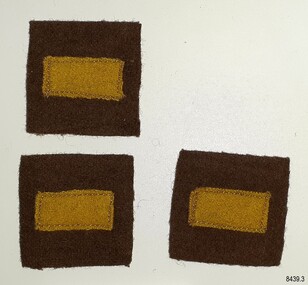
... patches belonged to Dr William Roy Angus and are now part of Flagstaff Hill’s comprehensive W.R. Angus Collection, donated by the family of Dr W R Angus (1901-1970), surgeon and oculist. The badges date to the Second World War era, when Dr Angus was a Surgeon Captain for the Australian Defence Forces in the Army Medical Corps, 108 Australian General Hospital and 106 Australian General Hospital, stationed in Ballarat, Victoria, and in Bonegilla, N.S.W. ...Badges; set of three cloth patches, yellow rectangles on brown squares. Insignia of the Australian Defence Forces, Army Medical Corps, 106 Australian General Hospital, WII era. ...Insignia of the Australian Defence Forces, Army Medical Corps, 106 Australian General Hospital, WII era. Dr W R Angus owned the cloth patches that are now part of the W. ...The three cloth patches belonged to Dr William Roy Angus and are now part of Flagstaff Hill’s comprehensive W.R. Angus Collection, donated by the family of Dr W R Angus (1901-1970), surgeon and oculist. The badges date to the Second World War era, when Dr Angus was a Surgeon Captain for the Australian Defence Forces in the Army Medical Corps, 108 Australian General Hospital and 106 Australian General Hospital, stationed in Ballarat, Victoria, and in Bonegilla, N.S.W. He completed his service just before the end of the war due to suffering from a heart attack. In World War I the troops of the Australian Military Forces staked coloured flags of various shapes and colours in the ground where they camped to identify their units. These flag codes were quickly recognised. The system worked so well that miniature flags were called colour patches. They became part of the uniform, to be worn on both sleeves just below the shoulder. The system was slightly modified for use in the Second World War. The W.R. Angus Collection: - The W.R. Angus Collection includes historical medical equipment, surgical instruments and material belonging to Dr Edward Ryan and Dr Thomas Francis Ryan, (both of Nhill, Victoria) and Dr Angus’ own belongings. The Collection’s history spans the medical practices of the two Doctors Ryan, from 1885-1926 plus that of Dr Angus, up until 1969. It includes historical medical and surgical equipment and instruments from the doctors Edward and Thomas Ryan of Nhill, Victoria. Dr Angus married Gladys in 1927 at Ballarat, the nearest big city to Nhill where he began as a Medical Assistant. He was also Acting House surgeon at the Nhill hospital where their two daughters were born. During World War II He served as a Military Doctor in the Australian Defence Forces. Dr Angus and his family moved to Warrnambool in 1939, where Dr Angus operated his own medical practice. He later added the part-time Port Medical Officer responsibility and was the last person appointed to that position. Both Dr Angus and his wife were very involved in the local community, including the planning stages of the new Flagstaff Hill and the layout of the gardens there. Dr Angus passed away in March 1970.Dr W R Angus (1901-1970), surgeon and oculist, collected a range of military objects including those he personally used during his time as Surgeon Captain in the Australian Defence Forces in World War II. The objects allow insight into military life in the early-to-mid 20th century. The W.R. Angus Collection is significant for still being located at the site it is connected with, Doctor Angus being the last Port Medical Officer in Warrnambool. The Collection includes historical medical objects that date back to the late 1800s.Badges; set of three cloth patches, yellow rectangles on brown squares. Insignia of the Australian Defence Forces, Army Medical Corps, 106 Australian General Hospital, WII era. Dr W R Angus owned the cloth patches that are now part of the W. R. Angus Collection.flagstaff hill, warrnambool, maritime village, maritime museum, shipwreck coast, great ocean road, flagstaff hill maritime museum and village, dr w r angus, w.r. angus collection, australian army, surgeon captain, ballarat, bonegilla, badge, insignia, world war 1, 1914-1918, badge collection, world war 2, second world war, australian defence forces, army medical corps, 108 australian general hospital, great war, military uniform, 106 australian general hospital -
 Flagstaff Hill Maritime Museum and Village
Badge - Australian Military cloth patch, Army Medical Corps, Non-Divisional Units, 1925 - 1942
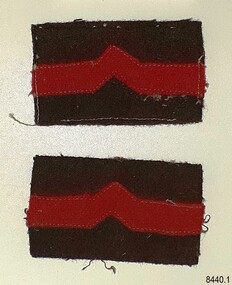
... Medical Corps...Military uniform...cloth patch...During peacetime training, the "brown with a cherry-red crossbar" badge was initially used for the 8th Field Ambulance, 2nd Military District Medical and Veterinary Stores. The colour patch was approved for wear by full-time duty personnel of all medical units apart from the Infantry and Cavalry. ...patch. Pair of two Insignia colour patches.Red stripe with an inverted 'V' shape on brown fabric. Insignia of the Australian Army Medical Corps, Non-Divisional Units. ... represent the history between the First and Second World Wars and the evolution of Australian Army Medical Corps patches. They Dr W R Angus (1901-1970), surgeon and oculist, collected a range of military objects including those he personally used during his time as Surgeon Captain in the Australian Defence Forces in World War II. ...The cloth insignia badges date to 1925-1940, after the First World War and into the early Second World War era. During peacetime training, the "brown with a cherry-red crossbar" badge was initially used for the 8th Field Ambulance, 2nd Military District Medical and Veterinary Stores. The colour patch was approved for wear by full-time duty personnel of all medical units apart from the Infantry and Cavalry. In 1942 these patches were replaced by the new scheme of colour patches introduced by the Australian Army Medical Corps. Dr W R Angus was a Surgeon Captain for the Australian Defence Forces, Army Medical Corps, stationed in Ballarat, Victoria, and in Bonegilla, N.S.W. He completed his service just before the end of the war due to suffering from a heart attack. The badges are now part of Flagstaff Hill’s comprehensive W.R. Angus Collection, donated by the family of Dr W R Angus (1901-1970), surgeon and oculist. The W.R. Angus Collection: - The W.R. Angus Collection includes historical medical equipment, surgical instruments and material belonging to Dr Edward Ryan and Dr Thomas Francis Ryan, (both of Nhill, Victoria) and Dr Angus’ own belongings. The Collection’s history spans the medical practices of the two Doctors Ryan, from 1885-1926 plus that of Dr Angus, up until 1969. It includes historical medical and surgical equipment and instruments from the doctors Edward and Thomas Ryan of Nhill, Victoria. Dr Angus married Gladys in 1927 at Ballarat, the nearest big city to Nhill where he began as a Medical Assistant. He was also Acting House surgeon at the Nhill hospital where their two daughters were born. During World War II He served as a Military Doctor in the Australian Defence Forces. Dr Angus and his family moved to Warrnambool in 1939, where Dr Angus operated his own medical practice. He later added the part-time Port Medical Officer responsibility and was the last person appointed to that position. Both Dr Angus and his wife were very involved in the local community, including the planning stages of the new Flagstaff Hill and the layout of the gardens there. Dr Angus passed away in March 1970.These colour insignia patches represent the history between the First and Second World Wars and the evolution of Australian Army Medical Corps patches. They Dr W R Angus (1901-1970), surgeon and oculist, collected a range of military objects including those he personally used during his time as Surgeon Captain in the Australian Defence Forces in World War II. The item allows insight into military life in the early-to-mid 20th century. The W.R. Angus Collection is significant for still being located at the site it is connected with, Doctor Angus being the last Port Medical Officer in Warrnambool. The Collection includes historical medical objects that date back to the late 1800s.Badge, cloth insignia patch. Pair of two Insignia colour patches.Red stripe with an inverted 'V' shape on brown fabric. Insignia of the Australian Army Medical Corps, Non-Divisional Units. One badge has light-coloured stitches around the perimeter. The cloth patches belonged to Dr W R Angus and are now part of the W. R. Angus Collection.flagstaff hill, warrnambool, maritime village, maritime museum, shipwreck coast, great ocean road, flagstaff hill maritime museum and village, dr w r angus, w.r. angus collection, australian army, surgeon captain, ballarat, bonegilla, badge, insignia, badge collection, world war 2, second world war, australian defence forces, army medical corps, military uniform, cloth patch, insignia patch, australian army medical corp (militia), ww 2, ww ii, 1925-1940, military badge, non-divisional unit, aamc, 1940-1942, 8th field ambulance, peacetime training, insignia history -
 Flagstaff Hill Maritime Museum and Village
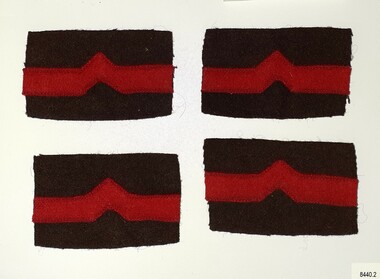
Badge - Australian Military cloth patch, Army Medical Corps, Non-Divisional Units, 1925 - 1942
... Medical Corps...Military uniform...cloth patch...During peacetime training, the "brown with a cherry-red crossbar" badge was initially used for the 8th Field Ambulance, 2nd Military District Medical and Veterinary Stores. The colour patch was approved for wear by full-time duty personnel of all medical units apart from the Infantry and Cavalry. ...patch. Set of four Insignia colour patches.Red stripe with an inverted 'V' shape on brown fabric. Insignia of the Australian Army Medical Corps, Non-Divisional Units. ... represent the history between the First and Second World Wars and the evolution of Australian Army Medical Corps patches. Dr W R Angus (1901-1970), surgeon and oculist, collected a range of military objects including those he personally used during his time as Surgeon Captain in the Australian Defence Forces in World War II. ...The cloth insignia badges date to 1925-1940, after the First World War and into the early Second World War era. During peacetime training, the "brown with a cherry-red crossbar" badge was initially used for the 8th Field Ambulance, 2nd Military District Medical and Veterinary Stores. The colour patch was approved for wear by full-time duty personnel of all medical units apart from the Infantry and Cavalry. In 1942 these patches were replaced by the new scheme of colour patches introduced by the Australian Army Medical Corps. Dr W R Angus was a Surgeon Captain for the Australian Defence Forces, Army Medical Corps, stationed in Ballarat, Victoria, and in Bonegilla, N.S.W. He completed his service just before the end of the war due to suffering from a heart attack. The badges are now part of Flagstaff Hill’s comprehensive W.R. Angus Collection, donated by the family of Dr W R Angus (1901-1970), surgeon and oculist. The W.R. Angus Collection: - The W.R. Angus Collection includes historical medical equipment, surgical instruments and material belonging to Dr Edward Ryan and Dr Thomas Francis Ryan, (both of Nhill, Victoria) and Dr Angus’ own belongings. The Collection’s history spans the medical practices of the two Doctors Ryan, from 1885-1926 plus that of Dr Angus, up until 1969. It includes historical medical and surgical equipment and instruments from the doctors Edward and Thomas Ryan of Nhill, Victoria. Dr Angus married Gladys in 1927 at Ballarat, the nearest big city to Nhill where he began as a Medical Assistant. He was also Acting House surgeon at the Nhill hospital where their two daughters were born. During World War II He served as a Military Doctor in the Australian Defence Forces. Dr Angus and his family moved to Warrnambool in 1939, where Dr Angus operated his own medical practice. He later added the part-time Port Medical Officer responsibility and was the last person appointed to that position. Both Dr Angus and his wife were very involved in the local community, including the planning stages of the new Flagstaff Hill and the layout of the gardens there. Dr Angus passed away in March 1970.These colour insignia patches represent the history between the First and Second World Wars and the evolution of Australian Army Medical Corps patches. Dr W R Angus (1901-1970), surgeon and oculist, collected a range of military objects including those he personally used during his time as Surgeon Captain in the Australian Defence Forces in World War II. The item allows insight into military life in the early-to-mid 20th century. The W.R. Angus Collection is significant for still being located at the site it is connected with, Doctor Angus being the last Port Medical Officer in Warrnambool. The Collection includes historical medical objects that date back to the late 1800s.Badge, cloth insignia patch. Set of four Insignia colour patches.Red stripe with an inverted 'V' shape on brown fabric. Insignia of the Australian Army Medical Corps, Non-Divisional Units. The cloth patches belonged to Dr W R Angus and are now part of the W. R. Angus Collection.flagstaff hill, warrnambool, maritime village, maritime museum, shipwreck coast, great ocean road, flagstaff hill maritime museum and village, dr w r angus, w.r. angus collection, australian army, surgeon captain, ballarat, bonegilla, badge, insignia, badge collection, world war 2, second world war, australian defence forces, army medical corps, military uniform, cloth patch, insignia patch, australian army medical corp (militia), ww 2, ww ii, 1925-1940, military badge, non-divisional unit, aamc, 1940-1942, 8th field ambulance, peacetime training, insignia history -
 Flagstaff Hill Maritime Museum and Village
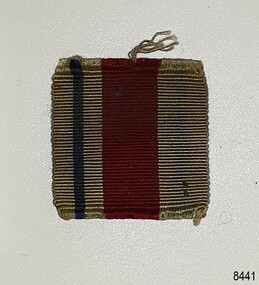
Badge - Insignia Ribbon, 1939-1945
... patch...Australian Army Medical Corp (Militia)...patch is one of a collection of military badges that date to the World War II period. This ribbon has not yet been identified. The badges are now part of Flagstaff Hill’s comprehensive W.R. Angus Collection, donated by the family of Dr W R Angus (1901-1970), surgeon and oculist. Dr W R Angus was a Surgeon Captain for the Australian Defence Forces, Army Medical...Angus Collection Australian Army Surgeon Captain Ballarat Bonegilla badge insignia badge collection World War 2 Second World War Australian Defence Forces Army Medical Corps Military uniform cloth patch insignia patch Australian Army Medical Corp (Militia) WW 2 ww II 1925-1940 Military badge Non-Divisional Unit AAMC 1940-1942 8th Field Ambulance peacetime training insignia history insignia ribbon ribbon patch Badge, woven ribbon insignia patch. ...The cloth insignia patch is one of a collection of military badges that date to the World War II period. This ribbon has not yet been identified. The badges are now part of Flagstaff Hill’s comprehensive W.R. Angus Collection, donated by the family of Dr W R Angus (1901-1970), surgeon and oculist. Dr W R Angus was a Surgeon Captain for the Australian Defence Forces, Army Medical Corps, stationed in Ballarat, Victoria, and in Bonegilla, N.S.W. He completed his service just before the end of the war due to suffering from a heart attack. The W.R. Angus Collection: - The W.R. Angus Collection includes historical medical equipment, surgical instruments and material belonging to Dr Edward Ryan and Dr Thomas Francis Ryan, (both of Nhill, Victoria) and Dr Angus’ own belongings. The Collection’s history spans the medical practices of the two Doctors Ryan, from 1885-1926 plus that of Dr Angus, up until 1969. It includes historical medical and surgical equipment and instruments from the doctors Edward and Thomas Ryan of Nhill, Victoria. Dr Angus married Gladys in 1927 at Ballarat, the nearest big city to Nhill where he began as a Medical Assistant. He was also Acting House surgeon at the Nhill hospital where their two daughters were born. During World War II He served as a Military Doctor in the Australian Defence Forces. Dr Angus and his family moved to Warrnambool in 1939, where Dr Angus operated his own medical practice. He later added the part-time Port Medical Officer responsibility and was the last person appointed to that position. Both Dr Angus and his wife were very involved in the local community, including the planning stages of the new Flagstaff Hill and the layout of the gardens there. Dr Angus passed away in March 1970.This insignia ribbon is connected to the collection of military badges in the W.R. Angus Collection. Dr W R Angus (1901-1970), surgeon and oculist, collected a range of military objects including those he personally used during his time as Surgeon Captain in the Australian Defence Forces in World War II. The item allows insight into military life in the early-to-mid 20th century. The W.R. Angus Collection is significant for still being located at the site it is connected with, Doctor Angus being the last Port Medical Officer in Warrnambool. The Collection includes historical medical objects that date back to the late 1800s.Badge, woven ribbon insignia patch. Rectangular patch has vertical stripes, one is a narrow blue stripe and the other is a wide red or crimson stripe. The cloth patches belonged to Dr W R Angus and are now part of the W. R. Angus Collection.flagstaff hill, warrnambool, maritime village, maritime museum, shipwreck coast, great ocean road, flagstaff hill maritime museum and village, dr w r angus, w.r. angus collection, australian army, surgeon captain, ballarat, bonegilla, badge, insignia, badge collection, world war 2, second world war, australian defence forces, army medical corps, military uniform, cloth patch, insignia patch, australian army medical corp (militia), ww 2, ww ii, 1925-1940, military badge, non-divisional unit, aamc, 1940-1942, 8th field ambulance, peacetime training, insignia history, insignia ribbon, ribbon patch -
 Flagstaff Hill Maritime Museum and Village
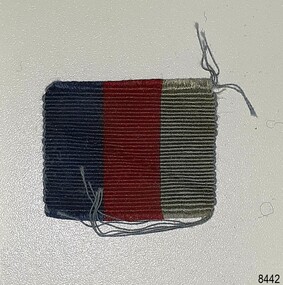
Badge - Insignia Ribbon, 1939-1945
... patch...Australian Army Medical Corp (Militia)...patch is one of a collection of military badges that date to the World War II period. This ribbon has not yet been identified. The badges are now part of Flagstaff Hill’s comprehensive W.R. Angus Collection, donated by the family of Dr W R Angus (1901-1970), surgeon and oculist. Dr W R Angus was a Surgeon Captain for the Australian Defence Forces, Army Medical...Angus Collection Australian Army Surgeon Captain Ballarat Bonegilla badge insignia badge collection World War 2 Second World War Australian Defence Forces Army Medical Corps Military uniform cloth patch insignia patch Australian Army Medical Corp (Militia) WW 2 ww II 1925-1940 Military badge Non-Divisional Unit AAMC 1940-1942 8th Field Ambulance peacetime training insignia history insignia ribbon ribbon patch Badge, woven ribbon insignia patch. ...The cloth insignia patch is one of a collection of military badges that date to the World War II period. This ribbon has not yet been identified. The badges are now part of Flagstaff Hill’s comprehensive W.R. Angus Collection, donated by the family of Dr W R Angus (1901-1970), surgeon and oculist. Dr W R Angus was a Surgeon Captain for the Australian Defence Forces, Army Medical Corps, stationed in Ballarat, Victoria, and in Bonegilla, N.S.W. He completed his service just before the end of the war due to suffering from a heart attack. The W.R. Angus Collection: - The W.R. Angus Collection includes historical medical equipment, surgical instruments and material belonging to Dr Edward Ryan and Dr Thomas Francis Ryan, (both of Nhill, Victoria) and Dr Angus’ own belongings. The Collection’s history spans the medical practices of the two Doctors Ryan, from 1885-1926 plus that of Dr Angus, up until 1969. It includes historical medical and surgical equipment and instruments from the doctors Edward and Thomas Ryan of Nhill, Victoria. Dr Angus married Gladys in 1927 at Ballarat, the nearest big city to Nhill where he began as a Medical Assistant. He was also Acting House surgeon at the Nhill hospital where their two daughters were born. During World War II He served as a Military Doctor in the Australian Defence Forces. Dr Angus and his family moved to Warrnambool in 1939, where Dr Angus operated his own medical practice. He later added the part-time Port Medical Officer responsibility and was the last person appointed to that position. Both Dr Angus and his wife were very involved in the local community, including the planning stages of the new Flagstaff Hill and the layout of the gardens there. Dr Angus passed away in March 1970.This insignia ribbon is connected to the collection of military badges in the W.R. Angus Collection. Dr W R Angus (1901-1970), surgeon and oculist, collected a range of military objects including those he personally used during his time as Surgeon Captain in the Australian Defence Forces in World War II. The item allows insight into military life in the early-to-mid 20th century. The W.R. Angus Collection is significant for still being located at the site it is connected with, Doctor Angus being the last Port Medical Officer in Warrnambool. The Collection includes historical medical objects that date back to the late 1800s.Badge, woven ribbon insignia patch. Rectangular patch has wide vertical stripes, one is a blue stripe and the other is a red or crimson stripe. The cloth patches belonged to Dr W R Angus and are now part of the W. R. Angus Collection.flagstaff hill, warrnambool, maritime village, maritime museum, shipwreck coast, great ocean road, flagstaff hill maritime museum and village, dr w r angus, w.r. angus collection, australian army, surgeon captain, ballarat, bonegilla, badge, insignia, badge collection, world war 2, second world war, australian defence forces, army medical corps, military uniform, cloth patch, insignia patch, australian army medical corp (militia), ww 2, ww ii, 1925-1940, military badge, non-divisional unit, aamc, 1940-1942, 8th field ambulance, peacetime training, insignia history, insignia ribbon, ribbon patch -
 Flagstaff Hill Maritime Museum and Village
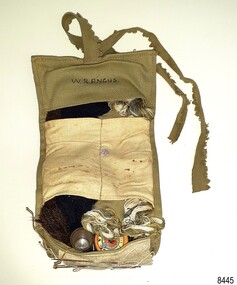
Equipment - Sewing Kit, 1939-1945
... Medical Corp (Militia) WW 2 ww II AAMC sewing kit sewing roll housewife clothing repairs Military Equipment Army issue "W.R. ANGUS" Australian Army sewing kit, WWII era. A rectangular khaki cotton fabric pouch with pockets containing sewing needles, threads of various colours, a thimble and a reel of cotton. The pouch rolls up and is secured with its own ties. It has a handwritten inscription. The cloth patches ...This sewing kit was issued to W.R. Angus during his Military Service in WWII. It is sometimes referred to as a soldier's ‘housewife’ and includes items necessary for mending and adjusting a soldier’s clothing and other fabric items. Earlier Army issue sewing kits were made of leather but were subject to deterioration due to holding moisture if they became wet. The sewing kit is now part of Flagstaff Hill’s comprehensive W.R. Angus Collection, donated by the family of Dr W R Angus (1901-1970), surgeon and oculist. Dr W R Angus was a Surgeon Captain for the Australian Defence Forces, Army Medical Corps, stationed in Ballarat, Victoria, and in Bonegilla, N.S.W. He completed his service just before the end of the war due to suffering from a heart attack. The W.R. Angus Collection: - The W.R. Angus Collection includes historical medical equipment, surgical instruments and material belonging to Dr Edward Ryan and Dr Thomas Francis Ryan, (both of Nhill, Victoria) and Dr Angus’ own belongings. The Collection’s history spans the medical practices of the two Doctors Ryan, from 1885-1926 plus that of Dr Angus, up until 1969. It includes historical medical and surgical equipment and instruments from the doctors Edward and Thomas Ryan of Nhill, Victoria. Dr Angus married Gladys in 1927 at Ballarat, the nearest big city to Nhill where he began as a Medical Assistant. He was also Acting House surgeon at the Nhill hospital where their two daughters were born. During World War II He served as a Military Doctor in the Australian Defence Forces. Dr Angus and his family moved to Warrnambool in 1939, where Dr Angus operated his own medical practice. He later added the part-time Port Medical Officer responsibility and was the last person appointed to that position. Both Dr Angus and his wife were very involved in the local community, including the planning stages of the new Flagstaff Hill and the layout of the gardens there. Dr Angus passed away in March 1970.This item is significant in Australia's War History and its connection with local history. It aids in understanding life in the military and the changes to normal life. Dr W R Angus (1901-1970), surgeon and oculist, collected a range of military objects including those he personally used during his time as Surgeon Captain in the Australian Defence Forces in World War II. The W.R. Angus Collection is significant for still being located at the site it is connected with, Doctor Angus being the last Port Medical Officer in Warrnambool. The Collection includes historical medical objects that date back to the late 1800s.Australian Army sewing kit, WWII era. A rectangular khaki cotton fabric pouch with pockets containing sewing needles, threads of various colours, a thimble and a reel of cotton. The pouch rolls up and is secured with its own ties. It has a handwritten inscription. The cloth patches belonged to Dr W R Angus and are now part of the W. R. Angus Collection."W.R. ANGUS"flagstaff hill, warrnambool, maritime village, maritime museum, shipwreck coast, great ocean road, flagstaff hill maritime museum and village, dr w r angus, w.r. angus collection, australian army, surgeon captain, ballarat, bonegilla, world war 2, second world war, australian defence forces, army medical corps, australian army medical corp (militia), ww 2, ww ii, aamc, sewing kit, sewing roll, housewife, clothing repairs, military equipment, army issue -
 Heidelberg Repatriation Hospital
Uniform - Great Coat WWII, c. 1939-1945
... Medical Corps Khaki Great Coat. Double breasted, calf length with brass epaulettes and sewn shoulder patches for the Corp and crown with Southern Cross below....Shoulder patch reads:ROYAL AUSTRALIAN ARMY / MEDICAL CORPS...Royal Australian Army Medical Corps Uniforms WWII World War Two Second World War Shoulder patch reads:ROYAL AUSTRALIAN ARMY / MEDICAL CORPS Royal Australian Army Medical Corps Khaki Great Coat. ...Royal Australian Army Medical Corps Khaki Great Coat. Double breasted, calf length with brass epaulettes and sewn shoulder patches for the Corp and crown with Southern Cross below.Shoulder patch reads:ROYAL AUSTRALIAN ARMY / MEDICAL CORPSroyal australian army medical corps, uniforms, wwii, world war two, second world war -
 Bendigo Military Museum
Equipment - BED ROLL, WW1
... Medical Officer 8th Battalion sleeping equipment Captain H. Jackson Printed on the outside of the cover in black: 'Captain H. Jackson, Med Officer, 8th Battalion'. Khaki canvas bed roll with padded calico mattress built in. Large side flap to cover occupant. The top has a hood which doubles as a cover for the rolled up bed. Leather straps to secure the rolled up bed are missing but brown leather keepers are present. Various rep[airs are evident including a hessian patch ...Used by Medical Officer Captain Harold Jackson, 8th Battalion, who served on Gallipoli and was mentioned for gallantry. Captain Jackson was a Bendigo based doctor.Khaki canvas bed roll with padded calico mattress built in. Large side flap to cover occupant. The top has a hood which doubles as a cover for the rolled up bed. Leather straps to secure the rolled up bed are missing but brown leather keepers are present. Various rep[airs are evident including a hessian patch sewn on the outside, that partially obscures the owner's name.Printed on the outside of the cover in black: 'Captain H. Jackson, Med Officer, 8th Battalion'.medical officer, 8th battalion, sleeping equipment, captain h. jackson -
 Bendigo Military Museum
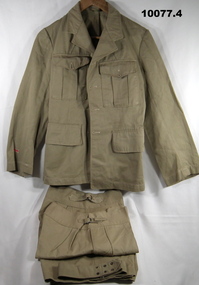
Uniform - WORK DRESS, RAAF, Australian Defence Industries, 1944
... Medical Receiving Station. Refer Cat No. 10052.5P for service history. Uniforms Work Dress RAAF George Henry Haw Manufacturer's details - red ink print. 1. M.TX./ SIZE 16" on right pocket lining. Handwritten - black ink pen "128091/ G. HAW" 3.& 4. Black Ink print - "A^F/ V.324/ MADE IN AUSTRALIA/ 1944/ SIZE 2" Handwritten - black ink pen "128091" on waistband lining. 1.2.3.4. Khaki colour cotton twill fabric. 1. Jacket - work dress style, with collar, four front pockets, top patch ...Uniform issued to "GEORGE HENRY HAW", 128091. Enlisted 22.03.43 - Discharged 18.12.45. Rank LAC No.2 Medical Receiving Station. Refer Cat No. 10052.5P for service history.1.2.3.4. Khaki colour cotton twill fabric. 1. Jacket - work dress style, with collar, four front pockets, top patch with button down flap. Lower - concealed with flap. As above pocket lining. Buttonholes - no buttons. Manufacturer's information - white cotton fabric. Owners information left lower pocket lining. On Right jacket sleeve - service chevron - red and khaki colour. 2. Belt - to above jacket - brown colour plastic button for buckle - no buckle. 3. & 4. Shorts - waistband with side strap and sliding metal buckles. Side pockets Three brown colour plastic fly with two beige colour plastic buttons at waistband. Manufacturer's information - white cotton fabric on waistband lining. Manufacturer's details - red ink print. 1. M.TX./ SIZE 16" on right pocket lining. Handwritten - black ink pen "128091/ G. HAW" 3.& 4. Black Ink print - "A^F/ V.324/ MADE IN AUSTRALIA/ 1944/ SIZE 2" Handwritten - black ink pen "128091" on waistband lining.uniforms, work dress, raaf, george henry haw -
 Bendigo Military Museum
Equipment - DRESSING, BANDAGE & COLOUR PATCH, 1) Johnson & Johnson, 1) 14.2.1985, .2) March 1991
... medicine - first aid Dressings patches .1) Wound dressing in dark green waterproof pack. .2) Triangular bandage. .3) Red Cross colour patch Equipment DRESSING, BANDAGE & COLOUR PATCH. .1) Johnson & Johnson Medical Industries Australia PTY LTD ....1) Wound dressing in dark green waterproof pack. .2) Triangular bandage. .3) Red Cross colour patchmedicine - first aid, dressings, patches -
 Bendigo Military Museum
Uniform - UNIFORM, ARMY, c. 1953
... .1) Jacket - Serge, khaki, maroon lanyard, service ribbons, "ROYAL AUSTRALIAN MEDICAL CORPS" on both upper sleeves and WO 2 rank patches. .2) Trousers - serge, khaki .3) Tie - cotton, light khaki...Field Ambulance WWII Battle Dress .1) Jacket - Serge, khaki, maroon lanyard, service ribbons, "ROYAL AUSTRALIAN MEDICAL CORPS" on both upper sleeves and WO 2 rank patches. .2) Trousers - serge, khaki .3) Tie - cotton, light khaki Uniform UNIFORM, ARMY ...The Battle Dress is a 1953 model, style used for many years. The uniform was issued to William Gamaliel Bartlett, Regt No’s 35052 (VX25300) enlisted in the 2nd AIF on 11.6.1940 age 21 years, 2/9th Field Ambulance, taken POW Malaya, discharged from AIF on 12.11.1945 with the rank of Pte. He later enlisted in the CMF on 20.7.1959, unit OCTU 3 TRG GRP and was discharged in 1974 with the rank of WO 2 after 15 years 32 days. The ribbons on the uniform, five are for WW2 service and one is a long service award. .1) Jacket - Serge, khaki, maroon lanyard, service ribbons, "ROYAL AUSTRALIAN MEDICAL CORPS" on both upper sleeves and WO 2 rank patches. .2) Trousers - serge, khaki .3) Tie - cotton, light khakifield ambulance, wwii, battle dress -
 Bendigo Military Museum
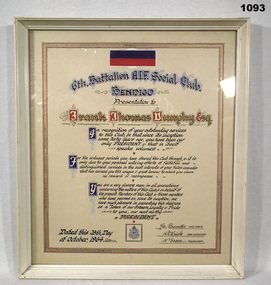
Certificate - CERTIFICATE, FRAMED, c.1964
... Returned to unit 19.2.1917, WIA 5.10.1917 with GSW’s chest & right arm - severe, returned to Australia and discharged medically unfit on 1.10.1918. documents - certificates frame accessories military history "From 6th Battalion AIF Social Club Bendigo - To Frank Thomas Dunphy Esq" Signed in black ink bottom RH: "Les Bennetts- R C Wright - W Green" Frame. Timber, cream painted with glass front. Certificate. Black, white, blue, red & yellow ink, hand written certificate on beige paper. Battalion colour patch ...FRANK THOMAS DUNPHY No 4485 enlisted in the AIF on 12.7.1915 in 14th reinforcements to 6th Batt age 22 years. Embarked for Egypt 28.1.1916, embarked for France 29.3.1916, hospitalised 7.9.1916 with varicose veins, while recovering was hospitalised again with mumps. Returned to unit 19.2.1917, WIA 5.10.1917 with GSW’s chest & right arm - severe, returned to Australia and discharged medically unfit on 1.10.1918.Frame. Timber, cream painted with glass front. Certificate. Black, white, blue, red & yellow ink, hand written certificate on beige paper. Battalion colour patch at the top & RSL badge at bottom with printed blue ink: 28th Day of October 1964. "From 6th Battalion AIF Social Club Bendigo - To Frank Thomas Dunphy Esq" Signed in black ink bottom RH: "Les Bennetts- R C Wright - W Green"documents - certificates, frame accessories, military history -
 National Vietnam Veterans Museum (NVVM)
Accessory, Patch
... medical people doing dust off's. RAAF Dust Off Flying Suit Hudnott Raymant Operational Support Unit/R.A.A.F Vietnam A round cloth patch with a blue border. ...No 1 Operational Support Unit RAAF Vietnam was an unofficial badge and could be purchased as some of the tailor shops on the base. Mainly used on flying suites, which were scrounged from various sources. Usually the only 1OSU personnel issued flying suits were the medical people doing dust off's. A round cloth patch with a blue border. Withing the blue border is yellow lettering. The centre has the number 1 (one) embroidered on it and overlayed that is a red kangaroo. Operational Support Unit/R.A.A.F Vietnam raaf, dust off, flying suit, hudnott, raymant -
 National Vietnam Veterans Museum (NVVM)
Memorabilia - Memorial patch
... This item was donated by Peter S Sims, who served as a Corporal in the Royal Australian Army Medical Corps in Vietnam 1969-70. Cloth Patch Peter Sims NVVM memorial remembrance In memory of 501 Australian brothers who never returned. ...This item was donated by Peter S Sims, who served as a Corporal in the Royal Australian Army Medical Corps in Vietnam 1969-70.Material embroidered patch with black background and gold writing.In memory of 501 Australian brothers who never returned. Vietnam (1962-1973)cloth patch, peter sims, nvvm, memorial, remembrance -
 Bendigo Military Museum
Uniform - BATTLE DRESS, ARMY, 1953 and 1960's
... MEDICAL CORPS". Sleeves with cuff and button. Light Khaki colour cotton fabric - pocket and waist lining. Manufacturers white cotton fabric label (two) on right pocket lining. 2. Trousers - khaki colour wool serge fabric Battle dress style. Two side pockets, two inset rear pockets with concealed button flaps and one patch...MEDICAL CORPS". Sleeves with cuff and button. Light Khaki colour cotton fabric - pocket and waist lining. Manufacturers white cotton fabric label (two) on right pocket lining. 2. Trousers - khaki colour wool serge fabric Battle dress style. Two side pockets, two inset rear pockets with concealed button flaps and one patch ...Names recorded on manufacturers label on jacket. "J.E. COOK", "W. RICHARDSON", "MENTONE GRAMMAR".1. Jacket - Khaki colour wool serge fabric. Battle Dress style, belted at waist with metal buckle. Brown plastic buttons. Collar, shoulder epaulettes with three red, cream and brown fabric rank insignia = Captain. Two front pockets with concealed button down flap. Shoulder sleeve insignia - red with cream colour embroidered lettering "ROYAL AUSTRALIAN ARMY/ MEDICAL CORPS". Sleeves with cuff and button. Light Khaki colour cotton fabric - pocket and waist lining. Manufacturers white cotton fabric label (two) on right pocket lining. 2. Trousers - khaki colour wool serge fabric Battle dress style. Two side pockets, two inset rear pockets with concealed button flaps and one patch pocket left thigh with concealed button flap. Five button fly. Waistband with button down belt keepers. Trouser cuffs have fabric tab with two buttons. khaki colour cotton fabric lining to waistband and pockets. Manufacturers white cotton label on waistband. 3. Braces - set of cotton elastic braces with brown leather button attachments for trousers. Stripes on elastic are beige, black, blue, cream and green in colour. Metal slides for adjustment to wearers size, with stamped lettering. brown leather strap joiner.Manufacturers information on labels. 1. Black ink print "REGIMENTAL NO./ NAME". Handwritten blue ink pen "JE COOK/ MENTONE/ W. RICHARDSON/ GRAMMAR". Red ink print label "M.TX/ SIZE 8" , Purple ink stamp on fabric lining "D^D/ MADE IN AUSTRALIA/ 1953". 2. Black ink print "REGIMENTAL NO./ NAME". Red ink print "M.TX/ SIZE 5". 3. Lettering on metal slides "POLICE/ AND/ FIREMEN". Black ink stamp - back leather strap joiner "???/ ^/ 196?/ 38".uniform, army, battle dress -
 Wangaratta RSL Sub Branch
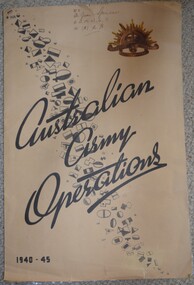
Map, Australian Army Operations 1940-45
... Medical Women's Service at 115 (Heidelberg) Military Hospital. She served with the 130 Australia General Hospital and was deployed overseas to Japan on 17/6/1947 and returned on 26/1/1949 australian army operations private joan spencer aamws 130 agh Hand written at top - VFX Pte Joan Spencer AAMWS 115 (H) M.H. Large cream coloured cardboard folded in three, inside is a coloured map of the Middle East 1940-1942, New Guinea Theatre 1942-1944, Pacific Islands 1944-1945 and Malay and Islands 1942-1945. Front cover has Unit patches ...Large fold out map and chronology of Australian Army Operations between 1940-1945 that belonged to Private Joan Spencer VFX12932 (VF507134) born 12/11/1924 at Albury. The family moved to Wangaratta and Joan was educated at Wangaratta High School before joining the Australian Army Medical Women's Service at 115 (Heidelberg) Military Hospital. She served with the 130 Australia General Hospital and was deployed overseas to Japan on 17/6/1947 and returned on 26/1/1949Large cream coloured cardboard folded in three, inside is a coloured map of the Middle East 1940-1942, New Guinea Theatre 1942-1944, Pacific Islands 1944-1945 and Malay and Islands 1942-1945. Front cover has Unit patches from top left to bottom right corner , at top right corner is the rising sun badge and bottom left corner 1940-45 Back cover is a listed Chronology.Hand written at top - VFX Pte Joan Spencer AAMWS 115 (H) M.H.australian army operations, private joan spencer, aamws, 130 agh -
 Surrey Hills Historical Society Collection
Photograph, Private William Stanley Paull, 1915
... medically unfit. He died 19/04/1949. The photo was possibly taken in England and sent home to family. armed forces world war 1914-1918 uniforms surrey gardens shrine of remembrance 7th battalion monuments and memorials stan paull william stanley paull Sepia studio photo of Private William Stanley Paull, No 431 of the 7th Battalion. He is wearing WW1 army uniform with the jacket buttoned to the collar and a peaked hat with a rising sun badge. There are 2 similar badges on the point of each collar. The (brown and red) patch ...W S Paull was born 12/01/1893 and was known as Stan. His name is listed on The Shrine in the Surrey Gardens. He was severely wounded at the Gallipoli landing on 25/04/1915. He was repatriated to Malta, spent time in 8 different hospitals in England, returned to Australia on 8/10/1915 and discharged medically unfit. He died 19/04/1949. The photo was possibly taken in England and sent home to family.Sepia studio photo of Private William Stanley Paull, No 431 of the 7th Battalion. He is wearing WW1 army uniform with the jacket buttoned to the collar and a peaked hat with a rising sun badge. There are 2 similar badges on the point of each collar. The (brown and red) patch of the 7th Battalion is visible on his right shoulder. He is standing 'at ease'.armed forces, world war, 1914-1918, uniforms, surrey gardens, shrine of remembrance, 7th battalion, monuments and memorials, stan paull, william stanley paull -
 Ringwood RSL Sub-Branch
Equipment - Equipment, First Aid metal Kit
... first aid kit medical supplies bandages metal medical container 6545-66-019-9802 First Aid Kit General purpose For MT (CES 6007) First aid container metal Drab olive green metal container with red cross and yellow writing, Containg first aid equipment 3 first field dressing, Electrolyte powder, Kaolin compound powder, 1 band aid, adhiesive plastic patch. 3 Pin, Safety, Brass, Nickel plated, 1/2 inch 00083.1openend field dressing 00083.2 first field dressing un opened 00083.3 first field dressing un opened 00083.4 kaolin compound powder 00083.5 plastic band aid 00083.6 electrolyte powder 00083.7 safety pins X3 Equipment Equipment, First Aid metal Kit. ...First aid container metal Drab olive green metal container with red cross and yellow writing, Containg first aid equipment 3 first field dressing, Electrolyte powder, Kaolin compound powder, 1 band aid, adhiesive plastic patch. 3 Pin, Safety, Brass, Nickel plated, 1/2 inch 00083.1openend field dressing 00083.2 first field dressing un opened 00083.3 first field dressing un opened 00083.4 kaolin compound powder 00083.5 plastic band aid 00083.6 electrolyte powder 00083.7 safety pins X3 6545-66-019-9802 First Aid Kit General purpose For MT (CES 6007)first aid kit, medical supplies, bandages, metal medical container -
 Tramways/East Melbourne RSL Sub Branch - RSL Victoria Listing id: 27511
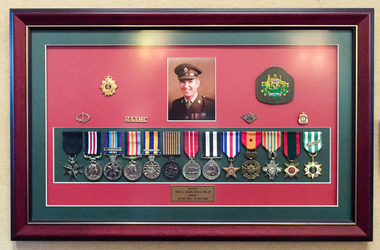
Memorabilia - Medal Board, Ceremonial Medal Board for JJ Davis, 2001
... patch with the Australian Coat of Arms, five metal pins and 13 replica medals as listed below. The information plaque states '5411313 WO1 J.J. DAVIS, SB St J, MM, JP - RAAMC - 30 JAN 1963 - 30 JAN 1986. The five metal pins are: 1. Returned Services League Australia 2. Returned Active Service 3. RAAMC 4. Royal Australian Army Medical...patch with the Australian Coat of Arms, five metal pins and 13 replica medals as listed below. The information plaque states '5411313 WO1 J.J. DAVIS, SB St J, MM, JP - RAAMC - 30 JAN 1963 - 30 JAN 1986. The five metal pins are: 1. Returned Services League Australia 2. Returned Active Service 3. RAAMC 4. Royal Australian Army Medical ...John James Davis (J.J. Davis) was Australia's most decorated NCO in the Vietnam conflict. This plaque commemorates the deeds he performed and medals received.Framed ceremonial medal board for JJ Davis. The piece includes a service photograph of JJ Davis in uniform, a fabric patch with the Australian Coat of Arms, five metal pins and 13 replica medals as listed below. The information plaque states '5411313 WO1 J.J. DAVIS, SB St J, MM, JP - RAAMC - 30 JAN 1963 - 30 JAN 1986. The five metal pins are: 1. Returned Services League Australia 2. Returned Active Service 3. RAAMC 4. Royal Australian Army Medical Corps 5. Knife surrounded by laurel leaves. Replica medals included are: 1. Military Medal 2. Australian Active Service Medal 1945-75, Vietnam 3. Vietnam Medal 4. Defence Force Medal with 1st Clasp 5. National Medal 6. Australian Defence Medal 7. St John 12 Year Long Service Medal with five year clasp 8. Silver Star (Unites States of America) 9. Gallantry Cross with Bronze Star (South Vietnam) 10. The Armed Forces Honour Medal (2nd Class) (South Vietnam) 11. Civil Action Medal (2nd Class) (South Vietnam) 12. Vietnamese Campaign Medal 13. ACT Emergency Service Medal (2003 Bushfires) john jams davis, john james davis, j j davis, vietnam, nco, photographs, portraits, badges, medals -
 Dandenong/Cranbourne RSL Sub Branch
Plaque - 2/22 Battalion plaque
... Medical and supply units with 24 Squadron RAAF. Historical. 2/22 Battalion Lark Force over Service Patch with Rabaul below. ..."Lark Force" defended Rabaul made up of anti-aircraft, anti-tank and artillery batteries. Medical and supply units with 24 Squadron RAAF.Historical.Wooden plaque with metal emblem.2/22 Battalion Lark Force over Service Patch with Rabaul below. Service Number V X 37033 belonging to Pte. A.B.Bishop. -
 Woodend RSL
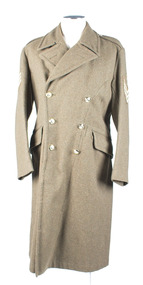
Uniform - Great coat, 1967
... All the metal buttons are decorated with the medical corps symbol, which is a serpent-entwined rod (Rod of Asclepius) surrounded by a laurel wreath and above the rod is a crown (St Edward’s Crown). On the outside of the upper sleeves, just below the shoulder, there is two patches that signifies the rank of Staff Sergeant. ...All the metal buttons are decorated with the medical corps symbol, which is a serpent-entwined rod (Rod of Asclepius) surrounded by a laurel wreath and above the rod is a crown (St Edward’s Crown). On the outside of the upper sleeves, just below the shoulder, there is two patches that signifies the rank of Staff Sergeant. ...It is a woolen khaki green great coat, with inter shoulder lining of khaki green canvas. There are back belt loop holes in the interior, lined by the same canvas. The pockets are made of the same canvas and are not sew to the interior of the coat at the bottom. The insides of the sleeves are lined with a more beige khaki green material. There is a split flap that is 500mm long in the middle at the bottom of the coat, which is fixed shut with two brown plastic buttons and a metal hook and eye at the bottom. The construction of the jacket is four panels and has been taken in at the waist for form above both pockets. The jacket has a back pleat from below the triangle stitching below the nape of the neck. The back belt has three metal insignia buttons, and the backside is lined with canvas. On both shoulders, there are epaulettes which have one metal insignia button each. On the front, there are three metal buttons on each on flap, and when the jacket is done up, the left flap goes on top. It has three button holes on the left flap and one button hole on the right flap for a large brown button on the inside of the left flap. There are two outer pockets on either side of the jacket. Beneath the jacket lapels, on either side there are metal buttons, and there are button holes for them in the middle of the bottom lapel. Where the upper and lower lapels are split, there is a hook and eye. There is a brown plastic button on the underside of both the upper lapels, which is where the extra flap of fabric on the inside of the left jacket flap, can be fixed as a face protector. The tag on the inside reads; DAVID KLEIN PTY. LTD. Victoria 1967 An arrow (Department of defence symbol) SIZE 6 CLASS 8405 66.012.0494 REGIMENTAL NO................... NAME......................... The regimantal number section had a number filled in but then scribbled out and another number written above, which is 359282. The name section was filled in with B.R.MIER. The name and regimental numbers were done in black marker pen. All the metal buttons are decorated with the medical corps symbol, which is a serpent-entwined rod (Rod of Asclepius) surrounded by a laurel wreath and above the rod is a crown (St Edward’s Crown). On the outside of the upper sleeves, just below the shoulder, there is two patches that signifies the rank of Staff Sergeant. The top patch is an embroided St Edward’s Crown and represents the staff rank. It is 47mm wide and 45mm. Below this there is a patch depicting the three stripes/ chevorns of the sergeant rank. The chevorn’s points face down, and the sides measure 66mm, while the depth down to the point is 86mm. The bottom lengths is 100mm on both sides and the top lengths are 9mm. coat, trench coat, great coat, medical corps, staff sergeant, b.p. mier, 359282, david klein pty. ltd., 1967
