
Showing 46 items matching "melbourne fashion houses"
-
 Kew Historical Society Inc
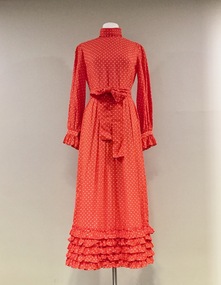
Clothing - Evening dress, Norma Tullo, 1967-8
... ...melbourne fashion houses...Aesthetically significant and rare example of a couture range by Norma Tullo. australian fashion fashion designers norma tullo fashion -- 1960s hippie style evening wear evening dresses dresses melbourne fashion houses tullo couture Label: TULLO COUTURE Long red cotton evening dress with overall white polka-dots, designed by Norma Tullo. ...Norma Tullo began her dressmaking business in 1956. At the age of 20, she rented a small shop in the Metropole Arcade, initiating a career that included manufacturing, designing and retailing. In 1965, she became the first Australian to be selected by Butterick Company Inclusive to join their pattern making company. The stylish Tullo ‘look’ in the first half of the 1960s was young, colourful, feminine and most importantly had a strong American appeal. The patterns were distributed worldwide except to Russia and Germany. In the second half of the 1960s, she developed a new design range, influenced by the American 'hippie' style, featuring floor length dresses with long narrow sleeves, high round collars, and ruffles on the hems and at the cuffs. Patterns and colours became brighter to match prevailing tastes. Patricia Desmarchelier, the donor, purchased this and two other items of evening wear by Norma Tullo in a Brisbane CBD boutique fashion store during 1967/8 for her personal use. At the time, she was an undergraduate student who saved earnestly to buy the outfits to wear to college formals and balls that were popular during those years.Aesthetically significant and rare example of a couture range by Norma Tullo.Long red cotton evening dress with overall white polka-dots, designed by Norma Tullo. The floor length dress has a high rounded collar, long sleeves with ruffles at the cuffs and on the hem. The light-weight cotton outer layer is supported by a thick cotton underlayer. Atypically, the dress has a label stating it is an example of 'Tullo Couture'. Dimensions: Shoulder width 40cm Bust: 92cm Waist: 72cmLabel: TULLO COUTUREaustralian fashion, fashion designers, norma tullo, fashion -- 1960s, hippie style, evening wear, evening dresses, dresses, melbourne fashion houses, tullo couture -
 Kew Historical Society Inc
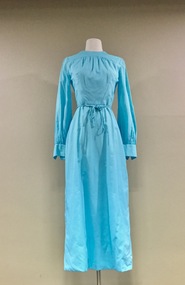
Clothing - Evening dress, Norma Tullo, 1967-8
... ...melbourne fashion houses...Aesthetically significant dress by Norma Tullo. australian fashion fashion designers norma tullo fashion -- 1960s hippie style evening wear evening dresses dresses melbourne fashion houses Label: TULLO Long blue cotton evening dress designed by Norma Tullo. ...Norma Tullo began her dressmaking business in 1956. At the age of 20, she rented a small shop in the Metropole Arcade, initiating a career that included manufacturing, designing and retailing. In 1965, she became the first Australian to be selected by Butterick Company Inclusive to join their pattern making company. The stylish Tullo ‘look’ in the first half of the 1960s was young, colourful, feminine and most importantly had a strong American appeal. The patterns were distributed worldwide except to Russia and Germany. In the second half of the 1960s, she developed a new design range, influenced by the American 'hippie' style, featuring floor length dresses with long narrow sleeves, high round collars, and ruffles on the hems and at the cuffs. Patterns and colours became brighter to match prevailing tastes. Patricia Desmarchelier, the donor, purchased this and two other items of evening wear by Norma Tullo in a Brisbane CBD boutique fashion store during 1967/8 for her personal use. At the time, she was an undergraduate student who saved earnestly to buy the outfits to wear to college formals and balls that were popular during those years.Aesthetically significant dress by Norma Tullo.Long blue cotton evening dress designed by Norma Tullo. The floor length dress has a high rounded collar, long sleeves with buttoned cuffs. The light-weight cotton outer layer is supported by a thicker cotton underlayer. Dimensions: Shoulder width 37.5cm Bust: 90cm Waist: 66cm Hips: 96cmLabel: TULLOaustralian fashion, fashion designers, norma tullo, fashion -- 1960s, hippie style, evening wear, evening dresses, dresses, melbourne fashion houses -
 Kew Historical Society Inc
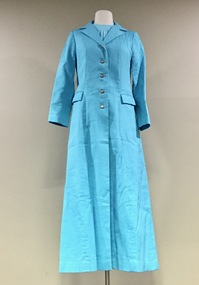
Clothing - Evening coat, Norma Tullo, 1967-8
... ...melbourne fashion houses...Aesthetically significant dress by Norma Tullo. australian fashion fashion designers norma tullo fashion -- 1960s hippie style evening wear evening dresses dresses melbourne fashion houses Label: TULLO Long blue evening coat designed by Norma Tullo. ...Norma Tullo began her dressmaking business in 1956. At the age of 20, she rented a small shop in the Metropole Arcade, initiating a career that included manufacturing, designing and retailing. In 1965, she became the first Australian to be selected by Butterick Company Inclusive to join their pattern making company. The stylish Tullo ‘look’ in the first half of the 1960s was young, colourful, feminine and most importantly had a strong American appeal. The patterns were distributed worldwide except to Russia and Germany. In the second half of the 1960s, she developed a new design range, influenced by the American 'hippie' style, featuring floor length dresses with long narrow sleeves, high round collars, and ruffles on the hems and at the cuffs. Patterns and colours became brighter to match prevailing tastes. Patricia Desmarchelier, the donor, purchased this and two other items of evening wear by Norma Tullo in a Brisbane CBD boutique fashion store during 1967/8 for her personal use. At the time, she was an undergraduate student who saved earnestly to buy the outfits to wear to college formals and balls that were popular during those years.Aesthetically significant dress by Norma Tullo.Long blue evening coat designed by Norma Tullo. The floor length coat has a wing collar, long sleeves and silver buttons at the front. The coat was worn over a long blue evening dress by the same designer and could be worn buttoned or unbuttoned. Dimensions: Shoulder width 38cm Bust: 96cm Waist: 87cm Hips: 116cmLabel: TULLOaustralian fashion, fashion designers, norma tullo, fashion -- 1960s, hippie style, evening wear, evening dresses, dresses, melbourne fashion houses -
 Brighton Historical Society
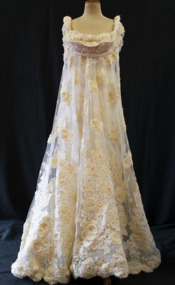
Dress, Wedding dress, 1966
... Made from beaded wool lace, it was commissioned by the Australian Wool Board for the Gown of the Year competition and made by Jinoel, a high-end Melbourne fashion house run by husband and wife team Jill and Noel Kemmelfield....Made from beaded wool lace, it was commissioned by the Australian Wool Board for the Gown of the Year competition and made by Jinoel, a high-end Melbourne fashion house run by husband and wife team Jill and Noel Kemmelfield. wedding dress 1960s coral triplett coral knowles john knowles jinoel australian wool board gown of the year wool lace White French wool lace wedding gown with low neckline and high empire waist. ...This dress was worn by Brighton model Coral Triplett when she married John Knowles at St John's Church, Toorak, on 18 June 1966. Made from beaded wool lace, it was commissioned by the Australian Wool Board for the Gown of the Year competition and made by Jinoel, a high-end Melbourne fashion house run by husband and wife team Jill and Noel Kemmelfield.White French wool lace wedding gown with low neckline and high empire waist. Bodice embroidered with beads.wedding dress, 1960s, coral triplett, coral knowles, john knowles, jinoel, australian wool board, gown of the year, wool lace -
 Federation University Historical Collection
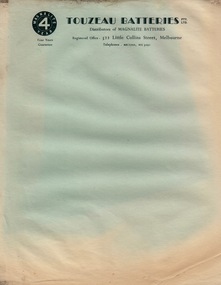
Document - Document - Letterheads, ZILLES COLLECTION: Letterheads of various Companies - Australia
... Melbourne. Distributors of Magnalite Batteries .2 R Tunbridge & Sons Pty Ltd - Sturt and Armstrong Streets, Ballarat. Complete House Furnishers. .3 Arlette Modes - 202b Sturt Street, Ballarat - Women's Fashions .4 William L Whitechurch - 770 Logan Road, Holland Park, Brisbane. ...Melbourne. Distributors of Magnalite Batteries .2 R Tunbridge & Sons Pty Ltd - Sturt and Armstrong Streets, Ballarat. Complete House Furnishers. .3 Arlette Modes - 202b Sturt Street, Ballarat - Women's Fashions .4 William L Whitechurch - 770 Logan Road, Holland Park, Brisbane. ...Zilles Printers was begun by Lewis Zilles in the early 1930s. It was in McKenzie Street Ballarat. His son Jeffrey also became a printer - letterpress, offset and screen printer. The business became Zilles Printers/Graphics and was in Armstrong Street and later Bell Street Ballarat. Letter and Invoice items are for various companies in Australia. The addresses on these papers have no postcodes. This indicates that they are before 1967, the year that they were introduced. .1 Touzeau Batteries Pty Ltd - 522 Little Collins Street, Melbourne. Distributors of Magnalite Batteries .2 R Tunbridge & Sons Pty Ltd - Sturt and Armstrong Streets, Ballarat. Complete House Furnishers. .3 Arlette Modes - 202b Sturt Street, Ballarat - Women's Fashions .4 William L Whitechurch - 770 Logan Road, Holland Park, Brisbane. Chemist & Druggist Supplies .5 Ballarat Timber Co. Pty Ltd - 118 Creswick Road, Ballarat. .6 A F Crotty - 8 Tichbourne Place, South Melbourne. Electroplater. Pages of various sizes, colour and inks. .5 and .6 are InvoicesNames, addresses and phone numbers of companieszilles printers, letterheads, pre postcodes, touzeau batteries, r tunbridge &sons, arlette modes, william whitechurch, ballarat timber, chemist and druggist supplies, a crotty, electroplater, melbourne, ballarat, brisbane, south melbourne, letter paper, invoices -
 Marysville & District Historical Society
THE TRIANGLE NEWS-VOL 41 NO 22-JUNE 13 2014
... marysville victoria australia hillary challenge state championship marysville camp marysville what's on when in june 2014 seasonal influenza vaccine available the committee of management of the gallipoli park precinct marysville community market e creative triangle buxton progress assocn comedy festival after party at crossways church notices marysville golf report new marysville golf & bowls clubhouse blumes fashions christ church marysville mayor's chair by cr margaret rae councillor comment by cr john walsh koriella ward black spur inn open mic marysville & triangle community men's shed advertisements disappointment at mountain of dumped waste residential & rural real estate marysville triangle real estate alexandra library buxton primary school trivia night success marysville midweek netball el kanah eat in eat out menu marysville preschool centre long day care & kindergarten black spur inn kitchen assistant 2014 racv great race victoria bike ride 2014 melbourne international comedy festival in marysville open house day high wood health retreat THE TRIANGLE NEWS-VOL 41 NO 22-JUNE 13 2014 ...marysville, victoria, australia, hillary challenge state championship, marysville camp marysville, what's on when in june, 2014 seasonal influenza vaccine available, the committee of management of the gallipoli park precinct, marysville community market, e, creative triangle, buxton progress assocn, comedy festival after party at crossways, church notices, marysville golf report, new marysville golf & bowls clubhouse, blumes fashions, christ church marysville, mayor's chair by cr margaret rae, councillor comment by cr john walsh koriella ward, black spur inn open mic, marysville & triangle community men's shed, advertisements, disappointment at mountain of dumped waste, residential & rural real estate, marysville triangle real estate, alexandra library, buxton primary school trivia night success, marysville midweek netball, el kanah eat in eat out menu, marysville preschool centre, long day care & kindergarten, black spur inn kitchen assistant, 2014 racv great race victoria bike ride, 2014 melbourne international comedy festival in marysville, open house day high wood health retreat -
 City of Moorabbin Historical Society (Operating the Box Cottage Museum)
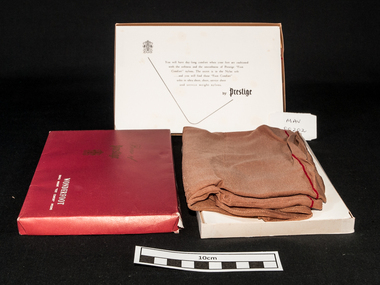
Clothing - Clothing, lady's nylon stockings 'Prestige Wonderfoot'', mid 20thC
... fashioned silk stockings, outselling the best imported brands and giving Prestige dominance of the local hosiery market. With the arrival of British-trained Leslie Gough in 1926, Prestige entered its period of greatest expansion. By 1933 it was spinning its own silk yarn, had diversified into lingerie and commenced business in New Zealand; three years later it was spinning imported rayon filament into hosiery yarn. clothing stockings nylons prestige hosiery pty ltd melbourne bentleigh cheltenham moorabbin Box Lid: House of / Prestige / ‘monogram’ / WONDERSOFT / SERVICE WEIGHT “FOOT COMFORT’ NYLONS. ...Prestige Limited was formed in 1922 by George Foletta to manufacture fine silken hosiery. The company had acquired the Atlas Knitting and Spinning Mills Pty Ltd which had been established in 1920 and produced "Prestige hosiery" from 1921. Prestige Limited merged with Holeproof Hosiery Company (Australia) Pty Ltd in 1964. Both were taken over by Pacific Dunlop in 1968. The Prestige name was dropped in 1978/79. George Gotardo Foletta (1892-1973), hosiery and knitwear manufacturer, was born on 30 January 1892 at Northcote, Melbourne, eldest son of Victorian-born parents Henry Gotardo Foletta, a stonemason of Swiss extraction, and his wife Gertrude, née Bright. Henry repaired the depression-ravaged fortunes of his family by starting a successful fancy goods commission-agency.....George persuaded the demoralized board to restructure around a quality-first marketing policy. By 1924, when George A. Bond & Co. Ltd ( Sydney) was liquidated, Prestige was back in the black. About this time the company became the first Australian knitter to make fully-fashioned silk stockings, outselling the best imported brands and giving Prestige dominance of the local hosiery market. With the arrival of British-trained Leslie Gough in 1926, Prestige entered its period of greatest expansion. By 1933 it was spinning its own silk yarn, had diversified into lingerie and commenced business in New Zealand; three years later it was spinning imported rayon filament into hosiery yarn.A pair of unworn lady's brown nylon 'service weight' stockings made by 'Prestige' Pty Ltd. in the original boxBox Lid: House of / Prestige / ‘monogram’ / WONDERSOFT / SERVICE WEIGHT “FOOT COMFORT’ NYLONS. Box inside lid : ‘monogram’ / You will have day long comfort when your feet are cushioned / with the softness and the smoothness of ‘Prestige “Foot Comfort” nylons. The secret is in the Nylon soles / …and you will find these “ Foot Comfort” / soles in ultra sheer, sheer, service sheer / and service weight nylons. / by Prestigeclothing, stockings, nylons, prestige hosiery pty ltd, melbourne, bentleigh, cheltenham moorabbin -
 Glen Eira Historical Society
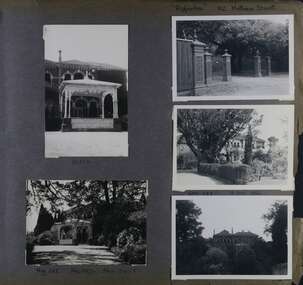
Album - Album page, Ripponlea, 192 Hotham Street, Circa 1972
... While not the first examples, Rippon Lea and the Independent Church in Collins Street were the best and set a fashion which became a distinctly Melbourne style, particularly used for houses and churches. ...This photograph is part of the Caulfield Historical Album 1972. This album was created in approximately 1972 as part of a project by the Caulfield Historical Society to assist in identifying buildings worthy of preservation. The album is related to a Survey the Caulfield Historical Society developed in collaboration with the National Trust of Australia (Victoria) and Caulfield City Council to identify historic buildings within the City of Caulfield that warranted the protection of a National Trust Classification. Principal photographer thought to be Trevor Hart, member of Caulfield Historical Society. Most photographs were taken between 1966-1972 with a small number of photographs being older and from unknown sources. All photographs are black and white except where stated, with 386 photographs over 198 pages.From Victorian Heritage Database citation for Rippon Lea H0614 https://vhd.heritagecouncil.vic.gov.au/places/427(as at 23/10/2020) Rippon Lea was commenced in 1868 by Frederick Sargood, a most successful politician and merchant. He was born in England in 1834 and arrived in Melbourne in 1850. He soon joined his father's wholesale soft goods firm, spending some time as its manager on the goldfields. Sargood entered the Legislative Council in 1874. He was Victoria's first Minister for Defence in 1883. Sir Frederick Sargood was created CMG. In 1885 and KCMG in 1890 as a reward for his contribution to public life. He died suddenly in 1903. Rippon Lea was designed by the leading firm of architects, Reed and Barnes. Joseph Reed had travelled in Europe in 1863, including northern Italy. When he returned he introduced the use of polychromy. While not the first examples, Rippon Lea and the Independent Church in Collins Street were the best and set a fashion which became a distinctly Melbourne style, particularly used for houses and churches. Its popularity was possible because of the new availability of different coloured bricks. Reed's fine Lombardic Romanesque details soon became debased by others. As Sargood's family grew and his fortunes prospered, Rippon Lea was extended to include 33 rooms - a complete mansion. The cast iron porte cochere and the northern conservatory were added in 1897. The architects were Taylor and Fitts. The ballroom was added in 1882 and remodelled in 1889. Many alterations have changed the interior and exterior during the ownerships of Benjamin Nathan and later his daughter Mrs Louisa Jones in the 1930s and are in their own right of significance. Sir Thomas Bent owned the property from 1903 until 1911 but never lived there. He subdivided much of the land. The original garden dates from about 1868, and it seems that William Guilfoyle of the Botanic Gardens was involved. It was redesigned in a more natural style in the 1880s by Sargood and his head gardener, Adam Anderson. The lake, waterfalls, fernery, hill and grotto are balanced by mighty deciduous trees and conifers. These are interspersed with, but never dominated by Australian species such as eucalyptus and other exotics. The sinuous drive with its carefully prepared approach to the house is notable. The original vegetable gardens, orchard and outer paddocks no longer survive. The shade house is important as the largest known in Australia and possibly the world. Its curved plan and form of construction are particularly notable. It was built about 1884.Page 90 of Photograph Album with five photographs (one landscape and 4 portrait) of Ripponlea - two different views of the front entrance to the mansion, one of the front gates and two different views of the main residence.Handwritten: "Ripponlea" 192 Hotham Street [top right] / North [under top left photo] / Neg 255 Dec 1972 MAIN DRIVE [under bottom left photo] / Neg 238 8 OCT 1966 [under middle right photo] / 88 [bottom right]trevor hart, elsternwick, mansion, hotham street, frederick sargood, reed and barnes, cast iron porte cochere, conservatory, 1860's, 1890's, ballroom, 1880's, benjamin nathan, louisa jones, thomas bent, sir thomas bent, william guilfoyle, adam anderson, lake, grotto, shade house, portico, ripponlea, victorian, sir frederick sargood, architects, polychrome bricks, lombardic romanesque architectural style, rippon lea, taylor and fitts, land subdivisions, gardens, drives, vegetable gardens, orchards -
 Glen Eira Historical Society
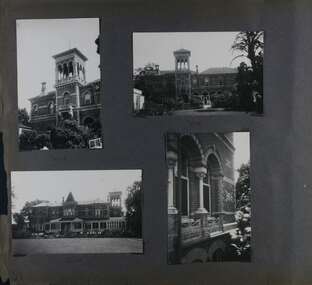
Album - Album page, Ripponlea, 192 Hotham Street, Circa 1972
... While not the first examples, Rippon Lea and the Independent Church in Collins Street were the best and set a fashion which became a distinctly Melbourne style, particularly used for houses and churches. ...This photograph is part of the Caulfield Historical Album 1972. This album was created in approximately 1972 as part of a project by the Caulfield Historical Society to assist in identifying buildings worthy of preservation. The album is related to a Survey the Caulfield Historical Society developed in collaboration with the National Trust of Australia (Victoria) and Caulfield City Council to identify historic buildings within the City of Caulfield that warranted the protection of a National Trust Classification. Principal photographer thought to be Trevor Hart, member of Caulfield Historical Society. Most photographs were taken between 1966-1972 with a small number of photographs being older and from unknown sources. All photographs are black and white except where stated, with 386 photographs over 198 pages.From Victorian Heritage Database citation for Rippon Lea H0614 https://vhd.heritagecouncil.vic.gov.au/places/427(as at 23/10/2020) Rippon Lea was commenced in 1868 by Frederick Sargood, a most successful politician and merchant. He was born in England in 1834 and arrived in Melbourne in 1850. He soon joined his father's wholesale soft goods firm, spending some time as its manager on the goldfields. Sargood entered the Legislative Council in 1874. He was Victoria?s first Minister for Defence in 1883. Sir Frederick Sargood was created CMG. In 1885 and KCMG in 1890 as a reward for his contribution to public life. He died suddenly in 1903. Rippon Lea was designed by the leading firm of architects, Reed and Barnes. Joseph Reed had travelled in Europe in 1863, including northern Italy. When he returned he introduced the use of polychromy. While not the first examples, Rippon Lea and the Independent Church in Collins Street were the best and set a fashion which became a distinctly Melbourne style, particularly used for houses and churches. Its popularity was possible because of the new availability of different coloured bricks. Reed's fine Lombardic Romanesque details soon became debased by others. As Sargood's family grew and his fortunes prospered, Rippon Lea was extended to include 33 rooms - a complete mansion. The cast iron porte cochere and the northern conservatory were added in 1897. The architects were Taylor and Fitts. The ballroom was added in 1882 and remodelled in 1889. Many alterations have changed the interior and exterior during the ownerships of Benjamin Nathan and later his daughter Mrs Louisa Jones in the 1930s and are in their own right of significance. Sir Thomas Bent owned the property from 1903 until 1911 but never lived there. He subdivided much of the land. The original garden dates from about 1868, and it seems that William Guilfoyle of the Botanic Gardens was involved. It was redesigned in a more natural style in the 1880s by Sargood and his head gardener, Adam Anderson. The lake, waterfalls, fernery, hill and grotto are balanced by mighty deciduous trees and conifers. These are interspersed with, but never dominated by Australian species such as eucalyptus and other exotics. The sinuous drive with its carefully prepared approach to the house is notable. The original vegetable gardens, orchard and outer paddocks no longer survive. The shade house is important as the largest known in Australia and possibly the world. Its curved plan and form of construction are particularly notable. It was built about 1884.Page 91 of Photograph Album with four photographs (two portrait and two landscape) of various external views of Ripponlea.Handwritten: SOUTH [under top left photo] / SOUTH [under top right photo] / WEST [under bottom left photo] / 91 [bottom left]trevor hart, elsternwick, mansion, hotham street, frederick sargood, reed and barnes, cast iron porte cochere, conservatory, 1860's, 1890's, ballroom, 1880's, benjamin nathan, louisa jones, thomas bent, sir thomas bent, william guilfoyle, adam anderson, lake, grotto, shade house, portico, ripponlea, victorian, sir frederick sargood, architects, taylor and fitts, rippon lea, polychrome bricks, lombardic romanesque style -
 Glen Eira Historical Society
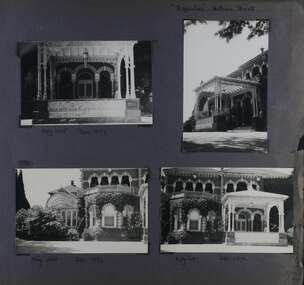
Album - Album page, Ripponlea, Hotham Street, Circa 1972
... While not the first examples, Rippon Lea and the Independent Church in Collins Street were the best and set a fashion which became a distinctly Melbourne style, particularly used for houses and churches. ...This photograph is part of the Caulfield Historical Album 1972. This album was created in approximately 1972 as part of a project by the Caulfield Historical Society to assist in identifying buildings worthy of preservation. The album is related to a Survey the Caulfield Historical Society developed in collaboration with the National Trust of Australia (Victoria) and Caulfield City Council to identify historic buildings within the City of Caulfield that warranted the protection of a National Trust Classification. Principal photographer thought to be Trevor Hart, member of Caulfield Historical Society. Most photographs were taken between 1966-1972 with a small number of photographs being older and from unknown sources. All photographs are black and white except where stated, with 386 photographs over 198 pages.From Victorian Heritage Database citation for Rippon Lea H0614 https://vhd.heritagecouncil.vic.gov.au/places/427(as at 23/10/2020) Rippon Lea was commenced in 1868 by Frederick Sargood, a most successful politician and merchant. He was born in England in 1834 and arrived in Melbourne in 1850. He soon joined his father's wholesale soft goods firm, spending some time as its manager on the goldfields. Sargood entered the Legislative Council in 1874. He was Victoria?s first Minister for Defence in 1883. Sir Frederick Sargood was created CMG. In 1885 and KCMG in 1890 as a reward for his contribution to public life. He died suddenly in 1903. Rippon Lea was designed by the leading firm of architects, Reed and Barnes. Joseph Reed had travelled in Europe in 1863, including northern Italy. When he returned he introduced the use of polychromy. While not the first examples, Rippon Lea and the Independent Church in Collins Street were the best and set a fashion which became a distinctly Melbourne style, particularly used for houses and churches. Its popularity was possible because of the new availability of different coloured bricks. Reed's fine Lombardic Romanesque details soon became debased by others. As Sargood's family grew and his fortunes prospered, Rippon Lea was extended to include 33 rooms - a complete mansion. The cast iron porte cochere and the northern conservatory were added in 1897. The architects were Taylor and Fitts. The ballroom was added in 1882 and remodelled in 1889. Many alterations have changed the interior and exterior during the ownerships of Benjamin Nathan and later his daughter Mrs Louisa Jones in the 1930s and are in their own right of significance. Sir Thomas Bent owned the property from 1903 until 1911 but never lived there. He subdivided much of the land. The original garden dates from about 1868, and it seems that William Guilfoyle of the Botanic Gardens was involved. It was redesigned in a more natural style in the 1880s by Sargood and his head gardener, Adam Anderson. The lake, waterfalls, fernery, hill and grotto are balanced by mighty deciduous trees and conifers. These are interspersed with, but never dominated by Australian species such as eucalyptus and other exotics. The sinuous drive with its carefully prepared approach to the house is notable. The original vegetable gardens, orchard and outer paddocks no longer survive. The shade house is important as the largest known in Australia and possibly the world. Its curved plan and form of construction are particularly notable. It was built about 1884.Page 92 of Photograph Album with four photographs (three landscape and one portrait) of Ripponlea - views of entrance and left front of mansion.Handwritten: "Ripponlea" Hotham Street [top right] / Neg 245 Dec 1972 [under top left photo] / Neg 246 Dec 1972 [under bottom left photo] / Neg 247 Dec 1972 [under bottom right photo] / 92 [bottom right]trevor hart, elsternwick, mansion, hotham street, frederick sargood, reed and barnes, lombardic, romanesque, cast iron porte cochere, conservatory, 1860's, 1890's, ballroom, 1880's, benjamin nathan, louisa jones, thomas bent, sir thomas bent, william guilfoyle, adam anderson, lake, grotto, shade house, portico, ripponlea, victorian, sir frederick sargood, architects, polychrome bricks, lombardic romanesque style, rippon lea, entrances -
 Glen Eira Historical Society
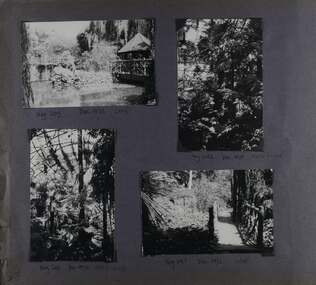
Album - Album page, Ripponlea, Hotham Street, Circa 1972
... While not the first examples, Rippon Lea and the Independent Church in Collins Street were the best and set a fashion which became a distinctly Melbourne style, particularly used for houses and churches. ...This photograph is part of the Caulfield Historical Album 1972. This album was created in approximately 1972 as part of a project by the Caulfield Historical Society to assist in identifying buildings worthy of preservation. The album is related to a Survey the Caulfield Historical Society developed in collaboration with the National Trust of Australia (Victoria) and Caulfield City Council to identify historic buildings within the City of Caulfield that warranted the protection of a National Trust Classification. Principal photographer thought to be Trevor Hart, member of Caulfield Historical Society. Most photographs were taken between 1966-1972 with a small number of photographs being older and from unknown sources. All photographs are black and white except where stated, with 386 photographs over 198 pages.From Victorian Heritage Database citation for Rippon Lea H0614 https://vhd.heritagecouncil.vic.gov.au/places/427(as at 23/10/2020) Rippon Lea was commenced in 1868 by Frederick Sargood, a most successful politician and merchant. He was born in England in 1834 and arrived in Melbourne in 1850. He soon joined his father's wholesale soft goods firm, spending some time as its manager on the goldfields. Sargood entered the Legislative Council in 1874. He was Victoria?s first Minister for Defence in 1883. Sir Frederick Sargood was created CMG. In 1885 and KCMG in 1890 as a reward for his contribution to public life. He died suddenly in 1903. Rippon Lea was designed by the leading firm of architects, Reed and Barnes. Joseph Reed had travelled in Europe in 1863, including northern Italy. When he returned he introduced the use of polychromy. While not the first examples, Rippon Lea and the Independent Church in Collins Street were the best and set a fashion which became a distinctly Melbourne style, particularly used for houses and churches. Its popularity was possible because of the new availability of different coloured bricks. Reed's fine Lombardic Romanesque details soon became debased by others. As Sargood's family grew and his fortunes prospered, Rippon Lea was extended to include 33 rooms - a complete mansion. The cast iron porte cochere and the northern conservatory were added in 1897. The architects were Taylor and Fitts. The ballroom was added in 1882 and remodelled in 1889. Many alterations have changed the interior and exterior during the ownerships of Benjamin Nathan and later his daughter Mrs Louisa Jones in the 1930s and are in their own right of significance. Sir Thomas Bent owned the property from 1903 until 1911 but never lived there. He subdivided much of the land. The original garden dates from about 1868, and it seems that William Guilfoyle of the Botanic Gardens was involved. It was redesigned in a more natural style in the 1880s by Sargood and his head gardener, Adam Anderson. The lake, waterfalls, fernery, hill and grotto are balanced by mighty deciduous trees and conifers. These are interspersed with, but never dominated by Australian species such as eucalyptus and other exotics. The sinuous drive with its carefully prepared approach to the house is notable. The original vegetable gardens, orchard and outer paddocks no longer survive. The shade house is important as the largest known in Australia and possibly the world. Its curved plan and form of construction are particularly notable. It was built about 1884.Page 93 of Photograph Album with four photographs (two landscape and two portrait) of Ripponlea - lake and gardens.Handwritten: Neg 239 Dec 1973 LAKE [under top left photo] / Neg 242 Dec 1973 FERN HOUSE [under top right photo] / Neg 243 Dec 1972 FERN HOUSE [under bottom left photo] / Neg 241 Dec 1972 LAKE [under bottom right photo] / 93 [bottom left]trevor hart, elsternwick, mansion, hotham street, frederick sargood, sargood, reed and barnes, 1860's, 1890's, 1880's, benjamin nathan, nathan, louisa jones, thomas bent, sir thomas bent, william guilfoyle, adam anderson, lake, grotto, shade house, portico, ripponlea, victorian, sir frederick sargood, architects, taylor and fitts, rippon lea, gardens, ferns, bridges, walking trails -
 Glen Eira Historical Society
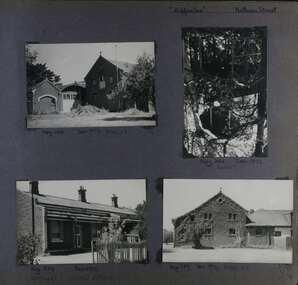
Album - Album page, "Ripponlea", Hotham Street, Circa 1972
... While not the first examples, Rippon Lea and the Independent Church in Collins Street were the best and set a fashion which became a distinctly Melbourne style, particularly used for houses and churches. ...This photograph is part of the Caulfield Historical Album 1972. This album was created in approximately 1972 as part of a project by the Caulfield Historical Society to assist in identifying buildings worthy of preservation. The album is related to a Survey the Caulfield Historical Society developed in collaboration with the National Trust of Australia (Victoria) and Caulfield City Council to identify historic buildings within the City of Caulfield that warranted the protection of a National Trust Classification. Principal photographer thought to be Trevor Hart, member of Caulfield Historical Society. Most photographs were taken between 1966-1972 with a small number of photographs being older and from unknown sources. All photographs are black and white except where stated, with 386 photographs over 198 pages.From Victorian Heritage Database citation for Rippon Lea H0614 https://vhd.heritagecouncil.vic.gov.au/places/427(as at 23/10/2020) Rippon Lea was commenced in 1868 by Frederick Sargood, a most successful politician and merchant. He was born in England in 1834 and arrived in Melbourne in 1850. He soon joined his father's wholesale soft goods firm, spending some time as its manager on the goldfields. Sargood entered the Legislative Council in 1874. He was Victoria?s first Minister for Defence in 1883. Sir Frederick Sargood was created CMG. In 1885 and KCMG in 1890 as a reward for his contribution to public life. He died suddenly in 1903. Rippon Lea was designed by the leading firm of architects, Reed and Barnes. Joseph Reed had travelled in Europe in 1863, including northern Italy. When he returned he introduced the use of polychromy. While not the first examples, Rippon Lea and the Independent Church in Collins Street were the best and set a fashion which became a distinctly Melbourne style, particularly used for houses and churches. Its popularity was possible because of the new availability of different coloured bricks. Reed's fine Lombardic Romanesque details soon became debased by others. As Sargood's family grew and his fortunes prospered, Rippon Lea was extended to include 33 rooms - a complete mansion. The cast iron porte cochere and the northern conservatory were added in 1897. The architects were Taylor and Fitts. The ballroom was added in 1882 and remodelled in 1889. Many alterations have changed the interior and exterior during the ownerships of Benjamin Nathan and later his daughter Mrs Louisa Jones in the 1930s and are in their own right of significance. Sir Thomas Bent owned the property from 1903 until 1911 but never lived there. He subdivided much of the land. The original garden dates from about 1868, and it seems that William Guilfoyle of the Botanic Gardens was involved. It was redesigned in a more natural style in the 1880s by Sargood and his head gardener, Adam Anderson. The lake, waterfalls, fernery, hill and grotto are balanced by mighty deciduous trees and conifers. These are interspersed with, but never dominated by Australian species such as eucalyptus and other exotics. The sinuous drive with its carefully prepared approach to the house is notable. The original vegetable gardens, orchard and outer paddocks no longer survive. The shade house is important as the largest known in Australia and possibly the world. Its curved plan and form of construction are particularly notable. It was built about 1884.Page 94 of Photograph Album with four photographs (three landscape and one portrait) of Ripponlea - stables, lookout and neighbouring cottages.Handwritten: "Ripponlea" Hotham Street [top right] / Neg 256 Dec 1972 STABLES [under top left photo] / Neg 248 Dec 1972 LOOKOUT [under top right photo] / Neg 254 Dec 1972 / COTTAGES WILLOW STREET [under bottom left photo] / Neg 259 Dec 1972 STABLES [under bottom right photo] / 94 [bottom right]trevor hart, elsternwick, mansion, hotham street, frederick sargood, reed and barnes, 1860's, 1890's, 1880's, benjamin nathan, nathan, louisa jones, thomas bent, sir thomas bent, william guilfoyle, guilfoyle, adam anderson, ripponlea, victorian, sir frederick sargood, architects, bricks, polychrome bricks, taylor and fitts, stables, lookouts, cottages, outbuildings, rippon lea -
 Bendigo Historical Society Inc.
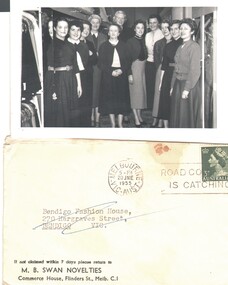
Photograph - GERTRUDE PERRY COLLECTION: GROUP PHOTOGRAPH FEATURING GERTRUDE PERRY, 1955
... Enclosed in an envelope addressed to Bendigo Fashion House, 270 Hargreaves St, Bendigo with Return address of M. B. Swan Novelties, Commerce House, Flinders St Melb. C.1. Postmarked Melbourne...Fashion House 270 Hargreaves St Bendigo M B Swan Novelties Commerce House Flinders St Melb C1 Photograph. Group photograph featuring Gertrude Perry. Black & white photograph of group of women with Gertrude Perry, front right. Enclosed in an envelope addressed to Bendigo Fashion House, 270 Hargreaves St, Bendigo with Return address of M. B. Swan Novelties, Commerce House, Flinders St Melb. C.1. Postmarked Melbourne ...Photograph. Group photograph featuring Gertrude Perry. Black & white photograph of group of women with Gertrude Perry, front right. Enclosed in an envelope addressed to Bendigo Fashion House, 270 Hargreaves St, Bendigo with Return address of M. B. Swan Novelties, Commerce House, Flinders St Melb. C.1. Postmarked Melbourne 20 June 1955.person, group, employees, gertrude perry collection, perry gertrude, bendigo fashion house 270 hargreaves st bendigo, m b swan novelties commerce house flinders st melb c1 -
 Kiewa Valley Historical Society
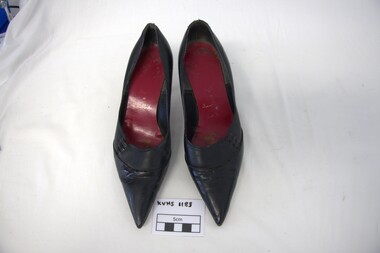
Shoes - Fashion, c1950s
... fashion shoes made in Fitzroy by Ivan Porter of Goold & Porter Pty Ltd, during the 1940s and 1950s. Worn by Doris Melbourne, wife of Arthur, who worked for the State Electricity Commission of Victoria. They would have attended the many social events that took place in Bogong and Mt Beauty during the construction of the Kiewa Hydro Electric Scheme. They lived at Lower Bogong where the steps of their house ...Ladies fashion shoes made in Fitzroy by Ivan Porter of Goold & Porter Pty Ltd, during the 1940s and 1950s.Worn by Doris Melbourne, wife of Arthur, who worked for the State Electricity Commission of Victoria. They would have attended the many social events that took place in Bogong and Mt Beauty during the construction of the Kiewa Hydro Electric Scheme. They lived at Lower Bogong where the steps of their house can still be seen and later, at Bogong Village and Mount BeautyLadies fashion shoes, black, leather and latex with red insole and resin sole, pointed toes, low stiletto heels. Size 4 Three looped narrow black bands joining front and side of the shoe on the outer edge of each shoeBy Ivan porter'Made by/ Goold & Porter Pty Ltd./ Leather & Latex/ Insole/ Resin Sole (Size) 4 is indented on the sole between the toe and heelfashion shoes; lower bogong; secv; goold & porter shoe manufacturers -
 Villa Alba Museum
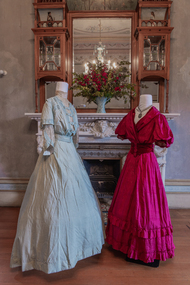
Album - Exhibition photographs, Textiles in Bloom, 2021
... fashion and design exhibition. The theme of the exhibition took its focus from the year-long program at the Museum featuring the use of flowers in design. The walls and ceilings of the house are notable for their use of floral and narrative painted decoration produced, in the early 1880s, for William and Anna Maria Greenlaw by the Melbourne art decoration firm the Paterson Brothers. ...fashion and design exhibition. The theme of the exhibition took its focus from the year-long program at the Museum featuring the use of flowers in design. The walls and ceilings of the house are notable for their use of floral and narrative painted decoration produced, in the early 1880s, for William and Anna Maria Greenlaw by the Melbourne art decoration firm the Paterson Brothers. ...As part of the National Trust's Australian Heritage Festival 2021, the Kew Historical Society and the Villa Alba Museum collaborated to mount a fashion and design exhibition. The theme of the exhibition took its focus from the year-long program at the Museum featuring the use of flowers in design. The walls and ceilings of the house are notable for their use of floral and narrative painted decoration produced, in the early 1880s, for William and Anna Maria Greenlaw by the Melbourne art decoration firm the Paterson Brothers. The examples of fashion and design from the collection of the Kew Historical Society were located on the ground floor of the house: in the drawing room, dining room, morning room and in the vestibule, or ballroom as it was sometimes described in nineteenth century newspapers. The exhibition was supported by the City of Boroondara through Triennial Operational Grant funding for the Kew Historical Society and the Villa Alba Museum.Series of photographs taken by Mitchell Luo Photography of exhibition pieces in situ at the Villa Alba Museum in May 2021.textiles in bloom, exhibitions — villa alba museum, australian heritage festival 2021 -
 RMIT Design Archives
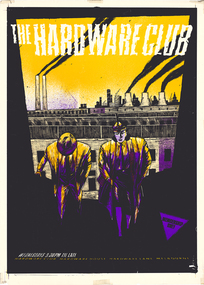
Posters, The Hardware Club, 1983
... The Hardware Club was established in the 1980s in Hardware House, Hardware Lane Melbourne by Andrew Maine, Jules Taylor and Paul Jackson, who all worked together at 3RRR. Artists, fashion...The Hardware Club was established in the 1980s in Hardware House, Hardware Lane Melbourne by Andrew Maine, Jules Taylor and Paul Jackson, who all worked together at 3RRR. Artists, fashion ...The Hardware Club was established in the 1980s in Hardware House, Hardware Lane Melbourne by Andrew Maine, Jules Taylor and Paul Jackson, who all worked together at 3RRR. Artists, fashion designers, and musicians all flocked to the Club in the 1980s. It was the place to experiment with fashion and dance to dawn at a time when may venues closed early. Hardware Houses rooms were perfectly suited for the purpose, its polished wooden floorboards ideal for a dance floor,mezzanine floor for spectators, and crucially the Club had two bars and a 24 hour licence. Initially the trio from 3RRR took over the club on Friday nights only , and then other nights followed. In 1983 graphic Designer Robert Pearce was commissioned to design this poster for The Hardware Club. According to Jules Taylor it was inspired by "subways of New York with a touch of Berlin and Film Noir ..." Ann Carewdesign, graphic design, australian fashion -
 National Wool Museum
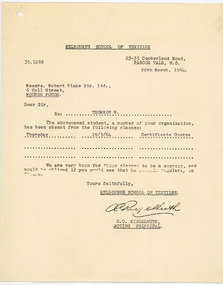
Letter, Melbourne School of Textiles, 20/3/1964
... housed more than 100 machines, including 53 sewing machines and 45 knitting machines. Robert Blake was “a passionate advocate for wool and Australian Made” throughout his whole life. A strong thread that ties through the lifespan of Robert Blake and Kathryn Knitwear is a balance between adopting new innovations without sacrificing the core values of durability, comfort, care and style that had made the brand so well known. Their legacy forms an integral part of both Australian social and manufacturing history. Business Business history Manufacturing Knitting Machine Fashion Textile Production Business Archives Manufacturing Documents Textile Education Melbourne ...Kathryn Knitwear, founded by Robert Blake, manufactured high quality children’s knitwear in Melbourne from the 1940s – 1980s. Robert Blake began manufacturing children’s knitwear in his bedroom in Strathmore using a hand powered machine in the late 1940s. The operation moved to Ascot Vale and Essendon, before eventually establishing a factory in Moonee Ponds in the early 1950s. The business continued to expand, necessitating a move to a new factory in Broadmeadows. By 1962, the Broadmeadows factory was producing an average of 20,000 garments per month, which increased to 24,000 by 1964. Robert Blake’s Son, Brendan recalls that “The Kathryn brand was famous around Australia, anywhere children needed to keep warm and dress smartly. It also won a number of wool fashion awards”, including the 1969 Wool Awards, which was held by the Australian Wool Bureau and published in Women’s Weekly. The Kathryn range was designed for durability, comfort and care, without sacrificing style. They used patterning techniques that increase stretchiness, comfort and fit, as well as integrating decorative elements into the fabric to prevent them from being bulky, uncomfortable or tight. Making longevity of style a priority, Brendan Blake remembers that “there was one particular garment that was in the range for at least thirty years”. He also recalls “In the past, when women have found out that I was associated with Kathryn Knitwear, they would often relate to me the story of a garment they had purchased or received as a gift and, when their child had grown out of it, they would hand it on to another child. Several ladies have told me of purchasing garments for their daughters’ glory box, or saving a particular garment after their daughter had grown out of it. Brendan Blake: “At the peak of their operation they employed approximately two hundred people, mainly women and girls. A family would often seek to send their daughter to work in this company because they knew they would be looked after and safe. One lady wrote to me telling me that working at the Moonee Ponds Factory prior to getting married was the happiest time of her life.” In 1963, workers at the Kathryn factory earned £13 per week, which was 8 shillings and 8 pence higher than the minimum weekly wage for female workers in the textile manufacturing industry (£12 11s 4d). By 1970, the Kathryn Knitwear brand expanded from children’s knitwear into womenswear under the brand name ‘Lady Kathryn’, and for boys and men under ‘Robert Blake’. Continuing to diversify their distribution, they also began exporting ‘Kathryn’ garments to New Zealand, the Pacific Islands, and Japan. ‘Kathryn Knitwear’ was well-known for their early adoption of modern materials and techniques that had broad appeal to their customer base. This is shown in their early use of the acrylic fibre ‘Orlon’ in the 50s and 60s and ‘Superwash’ wool in the 1970s. Many of Kathryn Knitwear’s styles, particularly those that were long running staples of the brand, were available in both wool and Orlon to suit the consumer’s preference. Far from the humble origins of one man in his bedroom with a hand-cranked machine; at its closure in 1980, the Broadmeadows factory of ‘Kathryn’ housed more than 100 machines, including 53 sewing machines and 45 knitting machines. Robert Blake was “a passionate advocate for wool and Australian Made” throughout his whole life. A strong thread that ties through the lifespan of Robert Blake and Kathryn Knitwear is a balance between adopting new innovations without sacrificing the core values of durability, comfort, care and style that had made the brand so well known. Their legacy forms an integral part of both Australian social and manufacturing history.Typewritten letter in black ink on cream paper, with a hole punched in the upper left hand corner. Letter has initially been printed as a form with dotted lines, that have later been printed over.MELBOURNE SCHOOL OF TEXTILES 35.1288 23-35 Cumberland Road, PASCOE VALE, W.8. 20TH March, 1964 Messrs. Robert Blake Pty. Ltd., 6 Hall Street, MOONEE PONDS. Dear Sir Re: …. THOMSON N. …. The abovenames student, a member of your organization, has been absent from the following classes: Thursday / 19/3/64 / Certificate Course We are very keen for these classes to be a success, and would be obliged if you to see that he attends regularly in future. Yours faithfully, MELBOURNE SCHOOL OF TEXTILES. [SIGNATURE] O. C. RIEGULHUTH, ACTING PRINCIPAL.business, business history, manufacturing, knitting machine, fashion textile production, business archives, manufacturing documents, textile education, melbourne school of textiles, vocational training, training, education, school -
 National Wool Museum
Letter, Commonwealth Serum Laboratories, 1963
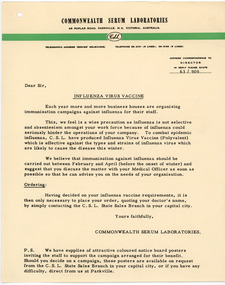
... Business Business history Manufacturing Knitting Machine Fashion Textile Production Business Archives Manufacturing Documents Vaccination Flu Vaccination Public Health Public Health History Epidemiology Influenza Vaccination History COMMONWEALTH SERUM LABORATORIES 45 POPLAR ROAD, PARKVILLE, N.2. VICTORIA, AUSTRALIA TELEGRAPHIC ADDRESS ‘SERUMS’ MELBOURNE / TELEPHONE 38-2101 (5 LINES), 38-5136 (5 LINES) ADDRESS CORRESPONDENCE TO DIRECTOR IN REPLY PLEASE QUOTE 63/909 Dear Sir, INFLUENZA VIRUS VACCINE Each year more and more business houses are organising immunisation campaigns against influenza for their staff. ...Kathryn Knitwear, founded by Robert Blake, manufactured high quality children’s knitwear in Melbourne from the 1940s – 1980s. Robert Blake began manufacturing children’s knitwear in his bedroom in Strathmore using a hand powered machine in the late 1940s. The operation moved to Ascot Vale and Essendon, before eventually establishing a factory in Moonee Ponds in the early 1950s. The business continued to expand, necessitating a move to a new factory in Broadmeadows. By 1962, the Broadmeadows factory was producing an average of 20,000 garments per month, which increased to 24,000 by 1964. Robert Blake’s Son, Brendan recalls that “The Kathryn brand was famous around Australia, anywhere children needed to keep warm and dress smartly. It also won a number of wool fashion awards”, including the 1969 Wool Awards, which was held by the Australian Wool Bureau and published in Women’s Weekly. The Kathryn range was designed for durability, comfort and care, without sacrificing style. They used patterning techniques that increase stretchiness, comfort and fit, as well as integrating decorative elements into the fabric to prevent them from being bulky, uncomfortable or tight. Making longevity of style a priority, Brendan Blake remembers that “there was one particular garment that was in the range for at least thirty years”. He also recalls “In the past, when women have found out that I was associated with Kathryn Knitwear, they would often relate to me the story of a garment they had purchased or received as a gift and, when their child had grown out of it, they would hand it on to another child. Several ladies have told me of purchasing garments for their daughters’ glory box, or saving a particular garment after their daughter had grown out of it. Brendan Blake: “At the peak of their operation they employed approximately two hundred people, mainly women and girls. A family would often seek to send their daughter to work in this company because they knew they would be looked after and safe. One lady wrote to me telling me that working at the Moonee Ponds Factory prior to getting married was the happiest time of her life.” In 1963, workers at the Kathryn factory earned £13 per week, which was 8 shillings and 8 pence higher than the minimum weekly wage for female workers in the textile manufacturing industry (£12 11s 4d). By 1970, the Kathryn Knitwear brand expanded from children’s knitwear into womenswear under the brand name ‘Lady Kathryn’, and for boys and men under ‘Robert Blake’. Continuing to diversify their distribution, they also began exporting ‘Kathryn’ garments to New Zealand, the Pacific Islands, and Japan. ‘Kathryn Knitwear’ was well-known for their early adoption of modern materials and techniques that had broad appeal to their customer base. This is shown in their early use of the acrylic fibre ‘Orlon’ in the 50s and 60s and ‘Superwash’ wool in the 1970s. Many of Kathryn Knitwear’s styles, particularly those that were long running staples of the brand, were available in both wool and Orlon to suit the consumer’s preference. Far from the humble origins of one man in his bedroom with a hand-cranked machine; at its closure in 1980, the Broadmeadows factory of ‘Kathryn’ housed more than 100 machines, including 53 sewing machines and 45 knitting machines. Robert Blake was “a passionate advocate for wool and Australian Made” throughout his whole life. A strong thread that ties through the lifespan of Robert Blake and Kathryn Knitwear is a balance between adopting new innovations without sacrificing the core values of durability, comfort, care and style that had made the brand so well known. Their legacy forms an integral part of both Australian social and manufacturing history.Typewritten letter in black ink on cream paper with green and black letterhead of ‘Commonwealth Serum Laboratories’, marketing influenza vaccines to businesses for their employees.COMMONWEALTH SERUM LABORATORIES 45 POPLAR ROAD, PARKVILLE, N.2. VICTORIA, AUSTRALIA TELEGRAPHIC ADDRESS ‘SERUMS’ MELBOURNE / TELEPHONE 38-2101 (5 LINES), 38-5136 (5 LINES) ADDRESS CORRESPONDENCE TO DIRECTOR IN REPLY PLEASE QUOTE 63/909 Dear Sir, INFLUENZA VIRUS VACCINE Each year more and more business houses are organising immunisation campaigns against influenza for their staff. This, we feel is a wise precaution as influenza is not selective and absenteeism amongst your work force because of influenza could seriously hinder the operations of your company. To combat epidemic influenza, C.S.L. have produced Influenza Virus Vaccine (Polyvalent) which is effective against the types and strains of influenza virus which are likely to cause the disease this winter. We believe that immunization against influenza should be carried out between February and April (before the onset of winter) and suggest that you discuss the matter with your Medical Officer as soon as possible so that he can advise you on the needs of your organization. Ordering: Having decided on your influenza vaccine requirements, it is then only necessary to place your order, quoting your doctor’s name, by simply contacting the C.S.L. State Sales Branch in your capital city. Yours faithfully, COMMONWEALTH SERUM LABORATORIES. P.S. We have supplies of attractive coloured notice board posters inviting the staff to support the campaign arranged for their benefit. Should you decide on a campaign, these posters are available on request from the C.S.L. State Sales Branch in your capital city, or if you have any difficulty, direct from us at Parkville.business, business history, manufacturing, knitting machine, fashion textile production, business archives, manufacturing documents, vaccination, flu vaccination, public health, public health history, epidemiology, influenza, vaccination history -
 National Wool Museum
Letter, 10/7/1967
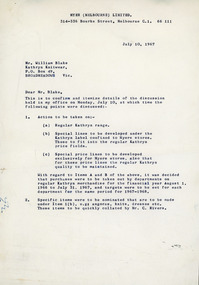
... housed more than 100 machines, including 53 sewing machines and 45 knitting machines. Robert Blake was “a passionate advocate for wool and Australian Made” throughout his whole life. A strong thread that ties through the lifespan of Robert Blake and Kathryn Knitwear is a balance between adopting new innovations without sacrificing the core values of durability, comfort, care and style that had made the brand so well known. Their legacy forms an integral part of both Australian social and manufacturing history. Business Business history Manufacturing Knitting Machine Fashion Textile Production Business Archives Manufacturing Documents Myer Myer Emporium Myer (Melbourne ...Kathryn Knitwear, founded by Robert Blake, manufactured high quality children’s knitwear in Melbourne from the 1940s – 1980s. Robert Blake began manufacturing children’s knitwear in his bedroom in Strathmore using a hand powered machine in the late 1940s. The operation moved to Ascot Vale and Essendon, before eventually establishing a factory in Moonee Ponds in the early 1950s. The business continued to expand, necessitating a move to a new factory in Broadmeadows. By 1962, the Broadmeadows factory was producing an average of 20,000 garments per month, which increased to 24,000 by 1964. Robert Blake’s Son, Brendan recalls that “The Kathryn brand was famous around Australia, anywhere children needed to keep warm and dress smartly. It also won a number of wool fashion awards”, including the 1969 Wool Awards, which was held by the Australian Wool Bureau and published in Women’s Weekly. The Kathryn range was designed for durability, comfort and care, without sacrificing style. They used patterning techniques that increase stretchiness, comfort and fit, as well as integrating decorative elements into the fabric to prevent them from being bulky, uncomfortable or tight. Making longevity of style a priority, Brendan Blake remembers that “there was one particular garment that was in the range for at least thirty years”. He also recalls “In the past, when women have found out that I was associated with Kathryn Knitwear, they would often relate to me the story of a garment they had purchased or received as a gift and, when their child had grown out of it, they would hand it on to another child. Several ladies have told me of purchasing garments for their daughters’ glory box, or saving a particular garment after their daughter had grown out of it. Brendan Blake: “At the peak of their operation they employed approximately two hundred people, mainly women and girls. A family would often seek to send their daughter to work in this company because they knew they would be looked after and safe. One lady wrote to me telling me that working at the Moonee Ponds Factory prior to getting married was the happiest time of her life.” In 1963, workers at the Kathryn factory earned £13 per week, which was 8 shillings and 8 pence higher than the minimum weekly wage for female workers in the textile manufacturing industry (£12 11s 4d). By 1970, the Kathryn Knitwear brand expanded from children’s knitwear into womenswear under the brand name ‘Lady Kathryn’, and for boys and men under ‘Robert Blake’. Continuing to diversify their distribution, they also began exporting ‘Kathryn’ garments to New Zealand, the Pacific Islands, and Japan. ‘Kathryn Knitwear’ was well-known for their early adoption of modern materials and techniques that had broad appeal to their customer base. This is shown in their early use of the acrylic fibre ‘Orlon’ in the 50s and 60s and ‘Superwash’ wool in the 1970s. Many of Kathryn Knitwear’s styles, particularly those that were long running staples of the brand, were available in both wool and Orlon to suit the consumer’s preference. Far from the humble origins of one man in his bedroom with a hand-cranked machine; at its closure in 1980, the Broadmeadows factory of ‘Kathryn’ housed more than 100 machines, including 53 sewing machines and 45 knitting machines. Robert Blake was “a passionate advocate for wool and Australian Made” throughout his whole life. A strong thread that ties through the lifespan of Robert Blake and Kathryn Knitwear is a balance between adopting new innovations without sacrificing the core values of durability, comfort, care and style that had made the brand so well known. Their legacy forms an integral part of both Australian social and manufacturing history.Letter from Myer (Melbourne) Limited to William Blake. The letter confirms and details of a meeting held to discuss business arrangements between Kathryn Knitwear and Myer. Due to the lack of signatory, it is likely there was originally additional pages that have been lost. It is typewritten in blue ink on white paper, with smudges and pen marks evident.MYER (MELBOURNE) LIMITED. 314-336 Bourke Street, Melbourne C.1. 66 111 July 10, 1967 Mr. William Blake Kathryn Knitwear. P.O. Box 49. BROADMEADOWS Vic. Dear Mr. Blake. This is to confirm and itemize details of the discussion held in my office on Monday, July 10, at which time the following points were discussed: - 1. Action to be taken on:- (a) Regular Kathryn range. (b) Special lines to be developed under the Kathryn label confined to Myers stores. These to fit into the regular Kathryn price fields. (c) Special price lines to be developed exclusively for Myers stores, also that for these price lines the regular Kathryn quality to be maintained. With regard to Items A and B of the above, it was decided that purchases were to be taken out by departments on regular Kathryn merchandise for the financial year August 1, 1966 to July 31, 1967, and targets were to be set for each department for the same period for 1967-1968. 2. Specific items were to be nominated that are to be made under Item 1(b), eg: angoras, knits, dresses, etc. these items to be quickly collated by Mr C. Rivers.business, business history, manufacturing, knitting machine, fashion textile production, business archives, manufacturing documents, myer, myer emporium, myer (melbourne) -
 Brighton Historical Society
Clothing - Dressing gown, circa 1894
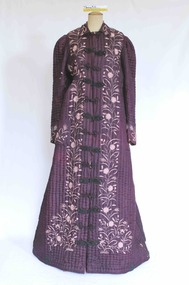
... In 1889, Clara and Septimus moved into the house 'Cantala' in Dandenong Road, Caulfield, where they hosted lavish receptions for Melbourne's elite. Clara was known as a stylish hostess who wore elegant imported fashions. ...In 1889, Clara and Septimus moved into the house 'Cantala' in Dandenong Road, Caulfield, where they hosted lavish receptions for Melbourne's elite. Clara was known as a stylish hostess who wore elegant imported fashions. ...This dressing gown belonged to Clara Johnstone Miller (nee Bell, 1866-1910). Clara was the only daughter of Mr James Bell, a councillor of the Shire of Leigh (today a part of Golden Plains Shire) and owner of Woolbrook Homestead in Teesdale, near Geelong. In 1888, Clara married prominent businessman, racehorse owner, racing identity and pastoralist Septimus Miller (1854-1925). Septimus was the sixth of seven children born to Henry 'Money' Miller and Eliza Miller (nee Mattinson). 'Money' Miller was a well known financier and politician and reputedly one of Australia's wealthiest people in his time. In 1889, Clara and Septimus moved into the house 'Cantala' in Dandenong Road, Caulfield, where they hosted lavish receptions for Melbourne's elite. Clara was known as a stylish hostess who wore elegant imported fashions. This dressing gown is believed to have been manufactured by Japanese silk merchant Shiino Shōbei. Following the opening of the port of Yokohama to foreign trade in 1859, Shōbei began producing western-style silk garments, initially selling them to foreigners living in Japan and later exporting them around the world, even exhibiting at the Melbourne International Exhibition of 1880. His popular exports included quilted 'at-home' gowns or dressing gowns similar to this one. They had one child, Gwendoline Stewart Miller, who died in 1902 at the age of thirteen of diabetes - a largely untreatable condition at the time (insulin would not be discovered until 1921). Clara died in 1910, aged only 44. Septimus subsequently married Helen (nee Henderson), with whom he had a son, Ronald (1915-1990). The Millers were buried in the Brighton General Cemetery in a large Gothic-style vault. Upon Clara's death, Septimus sent much of her clothing and Gwendoline's to her mother Mary Bell. Some of these items were passed down to two of Clara's nieces, Miss Mary Bell and Mrs Lois Lillies, who donated them to BHS around 1973.A hand stitched purple pink silk quilted dressing gown with pale pink embroidery from circa 1894. The dressing gown is embroidered from the collar and shoulders though the centre front body to just above the hemline, on the cuffs and remaining pocket in a pale pink Perle thread embroidery featuring leaves and flowers. The entire gown is hand quilted with vertical parallel lines. The gown's neckline features a flat collar and the sleeve head fits on the neat shoulder line. The sleeve head is gathered and full tapering to a loose flat cuff at the wrist. The front of the garment is currently secured by fourteen decorative frogs of two different styles, none of which appear to be original. There is also evidence of a fifteenth toggle that has been removed from the base. The gown's original left hand pocket has been removed and attached to an area around the right breast presumably to patch a hole or obscure some damage. It is unknown when these modifications have been made. The back of the gown features a gathered pink and black concertina pleated silk insert panel from the neck through to the base of the garment. The garment is lined with a very fine pale pink silk over the woollen batting.clara miller, woolbrook, septimus miller, cantala, gwendoline miller, caulfield, brighton general cemetery, shiino shobei, s. shobey -
 Brighton Historical Society
Dress, 1970s
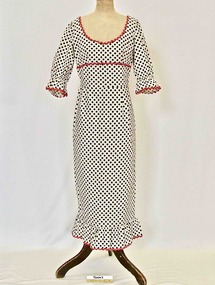
... Melbourne whose notable designs include the heritage-listed Cairo Flats apartment building in Fitzroy. Bernice and Best made a home together in Brighton, raising their family at 80 Were Street. Their son Darren followed in Best's footsteps, becoming an architect, and in 1979 he and his wife Jenny bought a property just down the road from his childhood home - the heritage-listed 1881 Victorian mansion 'Chevy Chase' at 203 Were Street. Bernice lived in the house with with Darren, Jenny and their three children. 1970s fashion ...This dress belonged to Bernice Overend, a longtime Brighton resident. Bernice Adelaide Emily Lawn was born in Ballarat in 1911. In 1938 she married Acheson Best Overend (1909-1977), an early modernist architect in Melbourne whose notable designs include the heritage-listed Cairo Flats apartment building in Fitzroy. Bernice and Best made a home together in Brighton, raising their family at 80 Were Street. Their son Darren followed in Best's footsteps, becoming an architect, and in 1979 he and his wife Jenny bought a property just down the road from his childhood home - the heritage-listed 1881 Victorian mansion 'Chevy Chase' at 203 Were Street. Bernice lived in the house with with Darren, Jenny and their three children.White cotton high-waisted maxi dress printed with black spots and trimmed with red rickrack. Elbow length sleeves. Fastens with centre back zip.Label, printed black on white acetate, centre back: JILLIAN / OF / MELBOURNE1970s fashion, maxi dress, bernice overend, overend family, chevy chase, brighton, melbourne designers, jillian of melbourne -
 Brighton Historical Society
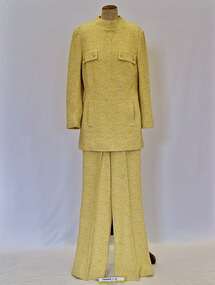
Pant suit
... Melbourne whose notable designs include the heritage-listed Cairo Flats apartment building in Fitzroy. Bernice and Best made a home together in Brighton, raising their family at 80 Were Street. Their son Darren followed in Best's footsteps, becoming an architect, and in 1979 he and his wife Jenny bought a property just down the road from his childhood home - the heritage-listed 1881 Victorian mansion 'Chevy Chase' at 203 Were Street. Bernice lived in the house with Darren, Jenny and their three children. Stell-Ricks was the label of Melbourne fashion...Melbourne whose notable designs include the heritage-listed Cairo Flats apartment building in Fitzroy. Bernice and Best made a home together in Brighton, raising their family at 80 Were Street. Their son Darren followed in Best's footsteps, becoming an architect, and in 1979 he and his wife Jenny bought a property just down the road from his childhood home - the heritage-listed 1881 Victorian mansion 'Chevy Chase' at 203 Were Street. Bernice lived in the house with Darren, Jenny and their three children. Stell-Ricks was the label of Melbourne fashion ...This pant suit belonged to Bernice Overend, a longtime Brighton resident. Bernice Adelaide Emily Lawn was born in Ballarat in 1911. In 1938 she married Acheson Best Overend (1909-1977), an early modernist architect in Melbourne whose notable designs include the heritage-listed Cairo Flats apartment building in Fitzroy. Bernice and Best made a home together in Brighton, raising their family at 80 Were Street. Their son Darren followed in Best's footsteps, becoming an architect, and in 1979 he and his wife Jenny bought a property just down the road from his childhood home - the heritage-listed 1881 Victorian mansion 'Chevy Chase' at 203 Were Street. Bernice lived in the house with Darren, Jenny and their three children. Stell-Ricks was the label of Melbourne fashion designer Stella Dare.Pant suit comprising tunic (.1) and flared pants (.2) made from cream, yellow and gold lurex woven in a floral pattern. Tunic has a pair of non-functional pocket flaps at breast and two finctional pockets at front hip area. Tunic fastens with a centre back zip. Tunic lined with shell pink poyester satin; pants unlined.Label woven white on black acetate centre back tunic: Stell-Ricks / OF MELBOURNE / SUITS TOPCOATSpant suit, 1970s fashion, chevy chase, overend family, bernice overend, melbourne designers, stell-ricks, stella dare -
 Brighton Historical Society
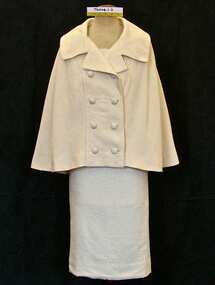
Outfit, Three-piece woman's outfit, 1960s
... Melbourne whose notable designs include the heritage-listed Cairo Flats apartment building in Fitzroy. Bernice and Best made a home together in Brighton, raising their family at 80 Were Street. Their son Darren followed in Best's footsteps, becoming an architect, and in 1979 he and his wife Jenny bought a property just down the road from his childhood home - the heritage-listed 1881 Victorian mansion 'Chevy Chase' at 203 Were Street. Bernice lived in the house with with Darren, Jenny and their three children. woman's suit chevy chase overend family 1960s fashion ...This outfit belonged to Bernice Overend, a longtime Brighton resident. Bernice Adelaide Emily Lawn was born in Ballarat in 1911. In 1938 she married Acheson Best Overend (1909-1977), an early modernist architect in Melbourne whose notable designs include the heritage-listed Cairo Flats apartment building in Fitzroy. Bernice and Best made a home together in Brighton, raising their family at 80 Were Street. Their son Darren followed in Best's footsteps, becoming an architect, and in 1979 he and his wife Jenny bought a property just down the road from his childhood home - the heritage-listed 1881 Victorian mansion 'Chevy Chase' at 203 Were Street. Bernice lived in the house with with Darren, Jenny and their three children.Three-piece woman's outfit comprising double-breasted cape, cropped sleeveless top and skirt; cream wool woven with silver lurex. Top is decorated with a centre front fabric bow and is decoarated with fake pearls. All items lined with cream polyester. .1 - cape .2 - top .3 - skirtLabel printed black on white acetate, centre back cape, top and skirt: DESIGNED AND HANDWOVEN / BY / Robert Maltuswoman's suit, chevy chase, overend family, 1960s fashion, robert maltus, bernice overend, melbourne designers -
 Brighton Historical Society
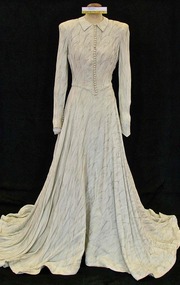
Dress, Wedding dress, 1948
... Melbourne Grammar Chapel on 17 June 1948. In later years the dress was given to an opportunity shop and purchased by Mrs Landells of the Brighton Historical Society. Louris subsequently visited the Society and recognised her dress, and was able to provide BHS with information on it. Also in the Society's collection is a 1950s pink strapless silk chiffon dress worn by Louris, and a wedding photo of Louris taken at her mother and stepfather's home at 53 South Road, Brighton. The couple moved into a house just a few doors down, at 49 South Road. wedding dress 1940s fashion ...Louris Holly Larsen-Disney married Percy James White at Melbourne Grammar Chapel on 17 June 1948. In later years the dress was given to an opportunity shop and purchased by Mrs Landells of the Brighton Historical Society. Louris subsequently visited the Society and recognised her dress, and was able to provide BHS with information on it. Also in the Society's collection is a 1950s pink strapless silk chiffon dress worn by Louris, and a wedding photo of Louris taken at her mother and stepfather's home at 53 South Road, Brighton. The couple moved into a house just a few doors down, at 49 South Road.Wedding dress made from silver metallic thread crepe. Fastens down front with small self-covered buttons and loops. Long fitted sleeves fastened with 10 covered buttons and loops. Full bias cut skirt with train.wedding dress, 1940s fashion, louris holly white, percy james white, brighton -
 Brighton Historical Society
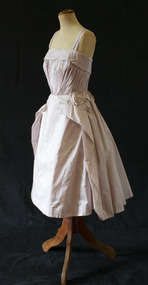
Dress, Cocktail dress, circa 1952
... Established by local designer Ralph Samuel, Hartnell of Melbourne was one of the leading high-end Flinders Lane fashion houses of the 1950s and 1960s. ...Established by local designer Ralph Samuel, Hartnell of Melbourne was one of the leading high-end Flinders Lane fashion houses of the 1950s and 1960s. ...Established by local designer Ralph Samuel, Hartnell of Melbourne was one of the leading high-end Flinders Lane fashion houses of the 1950s and 1960s. This dress still has its original store tag attached, which tells us that it cost 39 pounds, 19 shillings and sixpence - a large amount of money to spend on a dress in 1952. Adjusted for inflation, this price tag equates to approximately $1,480 in today's money.Mauve tucked and folded cocktail dress with twin shoulder straps, ruched bodice and gathered skirt. Rose detail on each hip. Tulle underskirt. Swing tag still attached to back zip.Label, white with blue text: "Exclusively yours, / Hartnell / REGD / MELBOURNE" Swing tag: "THIS GARMENT is made from finest material and designed for the fashion conscious woman / NO. 3633/332 / SIZE SSW / PRICE 39"19"6 / Hartnell of Melbourne Pty. Ltd. / Almond Pink"hartnell of melbourne, 1950s, ralph samuel, melbourne designers, flinders lane -
 Brighton Historical Society
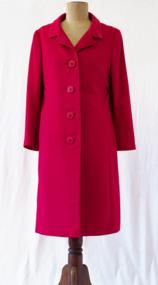
Coat, circa mid-1950s to early 1960s
... Raoul Couture was a high-end fashion house based in Flinders Lane from around 1955 until 1964. Established by designer Ralph Samuel, who also owned Hartnell of Melbourne (circa late 1940s-1971), Raoul was the business's premium label. ...Raoul Couture was a high-end fashion house based in Flinders Lane from around 1955 until 1964. Established by designer Ralph Samuel, who also owned Hartnell of Melbourne (circa late 1940s-1971), Raoul was the business's premium label. ...Raoul Couture was a high-end fashion house based in Flinders Lane from around 1955 until 1964. Established by designer Ralph Samuel, who also owned Hartnell of Melbourne (circa late 1940s-1971), Raoul was the business's premium label. The head designer was Leonard Legge, who later worked for Prue Acton. Brighton Historical Society holds a small collection of Hartnell and Raoul Couture garments, including a Gown of the Year Award-winning dress donated by Ralph Samuel.Red felted wool coat with red silk lining, fastening centre front with four large square-shaped buttons. Single vent/slit up centre back to waist. Loosely belted back with single button fastening.Label, inner collar: "raoul couture / MELB"raoul couture, melbourne designers, flinders lane, ralph samuel, leonard legge, hartnell of melbourne -
 Brighton Historical Society
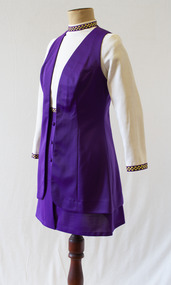
Dress and vest, Dress and tunic vest, circa late 1960s
... Bindi of Melbourne was the youth label of Australian commercial fashion house Len Vogue....Bindi of Melbourne was the youth label of Australian commercial fashion house Len Vogue. nola jennings 1960s bindi of melbourne len vogue Label in both dress and vest, white with black text: "Fashioned for / Bindi / of MELBOURNE" Two smaller labels at bottom: "SIZE 10 / TO FIT / BUST 32" / HIP 34"" and "CRIMP TERY. / C 145 4". ...This dress belonged to Nola Jennings, a long-time Brighton resident. Bindi of Melbourne was the youth label of Australian commercial fashion house Len Vogue.Long-sleeved crimplene dress (.1) with white bodice and short purple skirt. High collar, cuffs and waist have a purple and yellow checkerboard-patterned trim. Four self-covered buttons down the centre front of skirt. Zip at back. Long purple tunic vest (.2) worn over the top.Label in both dress and vest, white with black text: "Fashioned for / Bindi / of MELBOURNE" Two smaller labels at bottom: "SIZE 10 / TO FIT / BUST 32" / HIP 34"" and "CRIMP TERY. / C 145 4".nola jennings, 1960s, bindi of melbourne, len vogue -
Kew Historical Society Inc
Book, State of Victoria, Government House Melbourne, 1999
... fashion and artefacts. Reference books have entered the collection through donation, presentation, collection and purchase. historic buildings -- victoria. government house (melbourne [Melbourne] : State of Victoria, c1999 45 p. : col. ill. ; 30 cm. ...[Melbourne] : State of Victoria, c1999 45 p. : col. ill. ; 30 cm. non-fictionhistoric buildings -- victoria., government house (melbourne -
Kew Historical Society Inc
Book, Australian Council of National Trusts, Historic Houses, 1982
... fashion and artefacts. Reference books have entered the collection through donation, presentation, collection and purchase. Houses of historical importance --Australia Historic buildings -- Australia. Originally published in 2 separate v.: Historic public buildings of Australia; and, Historic houses of Australia. North Melbourne ...Originally published in 2 separate v.: Historic public buildings of Australia; and, Historic houses of Australia. North Melbourne : Cassell Australia, 1971 and 1974.Canberra City : Australian Council of National Trusts, 1982, c1974 604 p. : ill. (some col.), plans ; 32 cm. non-fictionOriginally published in 2 separate v.: Historic public buildings of Australia; and, Historic houses of Australia. North Melbourne : Cassell Australia, 1971 and 1974.houses of historical importance --australia, historic buildings -- australia. -
 Kew Historical Society Inc
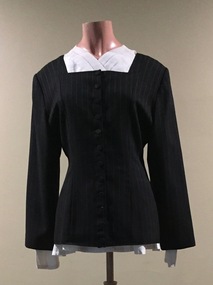
Clothing - Charcoal Grey Pinstripe Wool Jacket, Grey Skirt & White Blouse, Theodore & Scanlan, 1990s
... fashion over an 80-year period. The collection is also significant in that it includes the work of a large number of Melbourne designers from the 1960s to the 1990s. fiona scanlan women's clothing australian fashion - 1980s day wear mcintyre collection gary theodore Label: Theodore and Scanlan Black wool striped jacket with square neck and buttons in the same fabric at front. Other items in the outfit include a grey skirt and a white blouse. Gary Theodore and Fiona Scanlan started their fashion house ...The Fashion & Design collection of the Kew Historical Society includes examples of women’s, men’s, children’s and infants’ clothing from the 18th, 19th and 20th centuries. Items in the collection were largely produced for, or purchased by women in Melbourne, and includes examples of outerwear, protective wear, nightwear, underwear and costume accessories. This outfit is one of a number of items donated to the Fashion Collection by Annie McIntyre, who purchased the outfit in the later 1980s.The McIntyre Collection of clothing and clothing accessories forms one of the largest single donations to our Fashion & Design collection. It includes clothing and clothing accessories worn by four women in the Cohen and McIntyre families across three generations. The items worn by Melbourne architect, and Kew resident, Dione McIntyre date from the 1960s and 1970s, and include evening wear, day wear, hats and shoes. As Dione McIntyre often accompanied her husband, fellow architect Peter McIntyre, to formal events, there are a number of pieces of evening wear among the items. The McIntyre Collection also includes items worn by women of an earlier generation: by Lilian Cohen, Dione McIntyre's mother, and by her mother-in-law, the wife of the architect Robert McIntyre. At the other end of the chronological spectrum are a number of outfits belonging to, worn and donated by Annie McIntyre. These include outfits created by notable late 20th century Australian and/or international fashion designers. The McIntyre Collection is significant historically and artistically as it includes examples of design that demonstrate changing tastes in fashion over an 80-year period. The collection is also significant in that it includes the work of a large number of Melbourne designers from the 1960s to the 1990s. Black wool striped jacket with square neck and buttons in the same fabric at front. Other items in the outfit include a grey skirt and a white blouse. Gary Theodore and Fiona Scanlan started their fashion house in 1987.Label: Theodore and Scanlanfiona scanlan, women's clothing, australian fashion - 1980s, day wear, mcintyre collection, gary theodore
