
Showing 61 items matching "melbourne suburban trains"
-
 Ballarat Tramway Museum
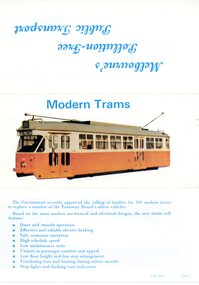
Pamphlet - Pamphlet - Public Transport, Melbourne's Pollution Free Transport
... ...melbourne suburban trains...Fifty new silver trains have been ordered for Melbourne's suburban electric trains with features previously unknown to commuters....Fifty new silver trains have been ordered for Melbourne's suburban electric trains with features previously unknown to commuters. victorian government tramway board pollution free melbourne suburban trains ron bridger collection AS Box 48A Symbol - Ministry of Transport White sheet printed on both sides - blue print Colour photographs - tram, train Melbourne's Pollution Free Transport Pamphlet Pamphlet - Public Transport ...Ron Bridger was an avid collector of items related to transport, predominately Trams. These items include newspaper cuttings, pamphlets, reports, timetables, fares prices plus special items relating to events. Items from Melbourne and regional Victoria, interstate - Adelaide and Sydney, plus overseas, make up this collection. Publication produced by the Ministry of Transport in Victoria. Outlines Melbourne's Pollution-Free Public Transport - Modern Trams and New Trains for Suburban Network. The Government called for tenders for 100 modern trams based on the most modern mechanical and electrical designs. Fifty new silver trains have been ordered for Melbourne's suburban electric trains with features previously unknown to commuters.White sheet printed on both sides - blue print Colour photographs - tram, trainSymbol - Ministry of Transportvictorian government, tramway board, pollution free, melbourne suburban trains, ron bridger collection, as box 48a -
 Melbourne Tram Museum
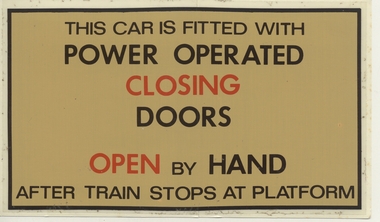
Sign, JBC, power closing doors, 1970's?
... Sign regarding the operation of a Melbourne suburban train door that has been fitted with power closing doors, three colours, adhesive back with the name of the manufacturer "JBC" on the rear. ...Trams tramways Victorian Railways Melbourne Sign regarding the operation of a Melbourne suburban train door that has been fitted with power closing doors, three colours, adhesive back with the name of the manufacturer "JBC" on the rear. ...Sign regarding the operation of a Melbourne suburban train door that has been fitted with power closing doors, three colours, adhesive back with the name of the manufacturer "JBC" on the rear. Has two sheets of paper split in the middle that protected the sign until use. Possibly dates from the time of the introduction of power doors on Harris Trains.trams, tramways, victorian railways, melbourne -
 Ballarat Tramway Museum
Film - Video cassette tape and box, David McLauchlan and Michael Costello, "Transit - Ballarat Vintage Tramway", 1998
... Opens with a title footage of a Hitachi Melbourne suburban train, Melbourne tram 181 and a bus. ...Opens with a title footage of a Hitachi Melbourne suburban train, Melbourne tram 181 and a bus. ...VHS cassette and box, black plastic, with white insert cover, and labels on cassette and VHS video tape. Produced by during winter 1998 by Northern Access Television Association Inc. and showed on channel 31 at a later date. Running time, approx. 13 mins. Features interviews with Stephen Butler, Garry Wood and many views of the tramway, No.12, No. 1. Includes images of Alastair Reither, David Frost, Warren Doubleday as well. Opens with a title footage of a Hitachi Melbourne suburban train, Melbourne tram 181 and a bus. Directed, edited, and interviews by David McLauchlan. Camera and production by Michael Costello. Finishes with historical footage of trams in Ballarat, with music and song of B.A.L.L.A.R.A.T sung by Frank Callahan.btm, northern access tv, channel 31, publicity -
 Ballarat Tramway Museum
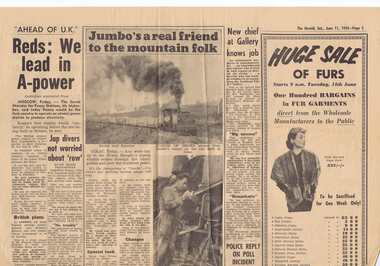
Newspaper, Herald Sun, "Jumbo's a real friend to the mountain folk", "Stainless steel carriages here?", "100 mph "air ride" ", 11/06/1955 12:00:00 AM
... - about future Melbourne suburban trains, quotes the Railways Commissioner Mr. ...- about future Melbourne suburban trains, quotes the Railways Commissioner Mr. ...Clipping from The Herald (Melbourne), Sat. 11 June 1955, with three stories on page 5. "Jumbo's a real friend to the mountain folk" - about the Colac - Beech Forest railway with photographs, "Stainless steel carriages here?" - about future Melbourne suburban trains, quotes the Railways Commissioner Mr. Wishart., "100 mph "air ride" " - about new GM high speed train in the USA. Also has advertisements for Ford Prefects, Fur coats. Contained originally within Reg Item 5623 at the front of this note book. For items see btm5623 loose items list.pdfrailways, colac, melbourne, usa -
Ballarat Tramway Museum
Poster, Hocking ?, MTA 1985 Centenary, 1985
... Div., June 2000 These are black and white versions of the poster, on white paper, different in size - 640H x 445W) 701.2 - as for 701.1m but on glossy paper, titled "Tramways 1885 - 1985". 701.3 - Poster on glossy paper, featuring Melbourne Buses, titled "Buses 1925 - 1985", features 11 different bus types. 701.4 - Poster on glossy paper, featuring Melbourne suburban trains, titled "Railways 1854 - 1985", features 11 different railway trains, or pictures. ...Div., June 2000 These are black and white versions of the poster, on white paper, different in size - 640H x 445W) 701.2 - as for 701.1m but on glossy paper, titled "Tramways 1885 - 1985". 701.3 - Poster on glossy paper, featuring Melbourne Buses, titled "Buses 1925 - 1985", features 11 different bus types. 701.4 - Poster on glossy paper, featuring Melbourne suburban trains, titled "Railways 1854 - 1985", features 11 different railway trains, or pictures. ...A group of four posters published for the centenary of Melbourne trams in 1985 by the Metropolitan Transit Authority 701.1 - Poster on creamy paper, title "The Centennial Celebration of the Melbourne Tram 1885 - 1985", features cable tram dummy, bogie cable trailer, horse tram, A, F, J, S, W2, U, SW2, Z3, and A class of 1984 on poster with three tickets illustrated as well. (two copies of this poster added June 2000 - from the ARHS Vic. Div., June 2000 These are black and white versions of the poster, on white paper, different in size - 640H x 445W) 701.2 - as for 701.1m but on glossy paper, titled "Tramways 1885 - 1985". 701.3 - Poster on glossy paper, featuring Melbourne Buses, titled "Buses 1925 - 1985", features 11 different bus types. 701.4 - Poster on glossy paper, featuring Melbourne suburban trains, titled "Railways 1854 - 1985", features 11 different railway trains, or pictures. Made by Hocking? -on bottom of each poster is a signature, appearing to be the name Hocking.trams, tramways, melbourne, centenaries, posters, public transport -
 Melbourne Tram Museum
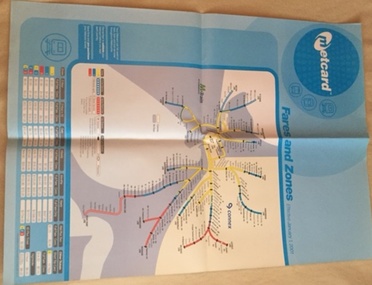
Poster, Metcard, "Metcard Fares and Zones", 2000
... Poster - A1 size, printed on heavy paper, full colour showing Melbourne's Train or suburban railway station system (same map as Reg Item 2510), titled "Metcard Fares and Zones". ...Trams tramways Metcard Fares Connex M>Train Map Tickets Railway Station Poster - A1 size, printed on heavy paper, full colour showing Melbourne's Train or suburban railway station system (same map as Reg Item 2510), titled "Metcard Fares and Zones". ...Poster - A1 size, printed on heavy paper, full colour showing Melbourne's Train or suburban railway station system (same map as Reg Item 2510), titled "Metcard Fares and Zones". Shows the relevant Metcard fares, dated 1/1/2001. Has the areas that M>Train and Connex were responsible for.trams, tramways, metcard, fares, connex, m>train, map, tickets, railway station -
 Puffing Billy Railway
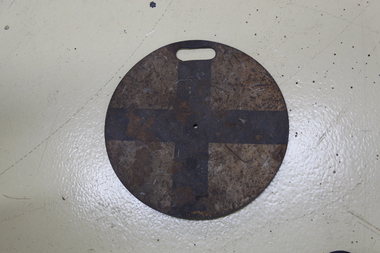
Train Destination Disc
... Train Destination Disc Until the 1980s Melbourne suburban trains used a system of discs by day, and illuminated market lights by night, to indicate their destination. ...Train Destination Disc Until the 1980s Melbourne suburban trains used a system of discs by day, and illuminated market lights by night, to indicate their destination. ...Train Destination Disc Until the 1980s Melbourne suburban trains used a system of discs by day, and illuminated market lights by night, to indicate their destination. Placed on the front of trains to advise a Signalman in the Signal Box the destination of the train. This disk was used on NK1 the Whitfield Motor when it was used by Puffing Billy Railway Info from the diagrams from the 1953 Victorian Railways General Appendix. Black + is Lilydale, Belgrave other Destination Disks were Disks Williamstown Black II Newport Workshops Red = Changed in 76 to Black + Newport-Altona shuttle Red X Werribee Red X St Albans Black X Upfield Black = Broadmeadows Originally Red X changed in 1976 to Red = Epping Black II Hurstbridge Red X Lilydale, Belgrave Black + Alamein Black X Glen Waverley Black = Dandenong Black II Frankston Red = Sandringham Red X St Kilda Originally Black II changed in 1976 to Red X Port Melbourne Red X changed in 1976 to Black X Flinders St - Spencer St Local Red II Showgrounds Red = plus extra white disk on opposite front disk bracket; if only one event, Display Large White 1 and yellow side disk with set number. If two events, second event special trains flip this disk and show large Black Disk with white numeral 2 Race Special Red = plus extra white disk on opposite front disk bracket; if only one event, Display Large White 1 and yellow side disk with set number. If two events, second event special trains flip this disk and show large Black Disk with white numeral 2 For example, Flemington Race trains and Caulfield Race trains on the same day. Flemington carries Red = and White 1 and yellow set number on the side Caulfield carries Red = and Black 2 with yellow set number disc on the side. There was one disc which was never to be used in normal traffic, that was the "Red Cross"; it was reserved for Red Cross trains only.Historic - Victorian Railways - Destination Disk - Black cross - Lilydale, Belgrave Lines This disk was used on NK1 the Whitfield Motor when it was used by Puffing Billy Railway Train Destination Disc Round tin sign painted white with a black cross on white background and a mounting bracket on the rear. Placed on the front of trains prior to the mid 1970s to advise a Signalman in the Signal Box the destination of the train. Black Cross puffing billy, destination disc, victorian railways, lilydale, belgrave lines -
 Melbourne Tram Museum
Album - Photographs - Comeng Dandenong, 1980s - 1990s
... He appears to have worked on the Z3, A1/A2, B1/B2 class trams, Hong Kong LRVs, Comeng Melbourne suburban trains, and later the extra Victorian-purchased XP power cars and XAM sleepers to enable the Riverina XPT to be extended to Melbourne. ...He appears to have worked on the Z3, A1/A2, B1/B2 class trams, Hong Kong LRVs, Comeng Melbourne suburban trains, and later the extra Victorian-purchased XP power cars and XAM sleepers to enable the Riverina XPT to be extended to Melbourne. ...In March 2024, Milissa Box (DTP) was at a trash and treasure market. She'd found a $5 photo album for sale with some photos that she thought might be of interest… From what I can gather it belonged to the gentleman pictured who was a worker at Dandenong in the Comeng and ABB eras. He appears to have worked on the Z3, A1/A2, B1/B2 class trams, Hong Kong LRVs, Comeng Melbourne suburban trains, and later the extra Victorian-purchased XP power cars and XAM sleepers to enable the Riverina XPT to be extended to Melbourne. It's clear he was very proud of the vehicles he'd helped to build. I have scanned a selection of the images, which appear to be a mix of official builder's portraits, team photos, and self-taken shots showing candid everyday scenes on the shop floor. There are also images of the launch of the XP power cars with then-Victorian Premier Joan Kirner; and some personal visits to see the Flying Scotsman, Victorian Goldfields Railway, Coal Creek, etc. Filename Description Date Comeng Scans 2024-03-05 0001 Three Comeng workers (including the photographer) stand in front of Comeng suburban train 697M (Chopper unit) c. June-July 1989 Comeng Scans 2024-03-05 0002 Three Comeng workers (including the photographer) stand in front of Comeng suburban train 697M (Chopper unit) c. June-July 1989 Comeng Scans 2024-03-05 0003 Hong Kong Light Rail Phase 1 LRV 1013 being lifted onto its transport loader c. 1987-88 Comeng Scans 2024-03-05 0004 Walter Wright transport truck (Mack) waits to draw a heavy transport platform out of a shed at Comeng Dandenong. Hong Kong Phase I LRV (1024) can be seen inside the shed c. 1988 Comeng Scans 2024-03-05 0005 Hong Kong Light Rail Phase 1 LRV 1013 on its transport loader in a shed at Comeng Dandenong ready for transport c. 1988 Comeng Scans 2024-03-05 0006 Hong Kong Light Rail Phase 1 LRV 1013 on its transport loader in a shed at Comeng Dandenong ready for transport c. 1988 Comeng Scans 2024-03-05 0007 The photographer is pictured fitting components to the cab of a Phase I Hong Kong LRV No 1026 c. 1988 Comeng Scans 2024-03-05 0008 Hong Kong Light Rail Phase 1 LRV 1013 on its transport loader at Comeng Dandenong ready for transport c. 1988 Comeng Scans 2024-03-05 0009 Hong Kong Light Rail Phase 1 LRV 1013 on its transport loader at Comeng Dandenong ready for transport c. 1988 Comeng Scans 2024-03-05 0010 Hong Kong Light Rail Phase 1 LRV 1013 on its transport loader at Comeng Dandenong ready for transport c. 1988 Comeng Scans 2024-03-05 0011 The photographer and a colleague are pictured in the car park posing for a photo at Comeng Dandenong c. 1988 Comeng Scans 2024-03-05 0012 The photographer and a colleague are pictured inside the cab of Comeng suburban train 697M, posing for a photo at Comeng Dandenong c. 1989 Comeng Scans 2024-03-05 0013 A stainless steel Hitachi train bodyshell is being transported on a truck-trailer. Possibly taken at Martin and King in Bayswater, under transport to the station for railing to Somerton for fitout. This is a later series M car with the rear-mounted pantograph (note the mounting lugs above the non-driving end) c. 1980 Comeng Scans 2024-03-05 0014 A shot at Comeng Dandenong of the onsite workforce standing in front of a Phase I Hong Kong LRV. c.1987-88 Comeng Scans 2024-03-05 0015 A shot at Comeng Dandenong of the onsite workforce standing in front of a Phase I Hong Kong LRV. c.1987-88 Comeng Scans 2024-03-05 0016 Hong Kong Light Rail Phase 1 LRV 1038 on its transport loader at Port of Melbourne ready for transport c. 1988 Comeng Scans 2024-03-05 0017 Three Comeng workers (including the photographer) stand in front of a workbench at Comeng Dandenong c. June-July 1989 Comeng Scans 2024-03-05 0018 A newly completed Comeng train (wearing VicRail teacup orange) on the factory access track at Comeng Dandenong c. 1981 Comeng Scans 2024-03-05 0019 A newly completed Z3 class tram on a transporter, with its bogie frames waiting transport to Preston Workshops for final fitout and commissioning c. 1981 Comeng Scans 2024-03-05 0020 A newly completed Comeng train (wearing VicRail teacup orange) on the factory access track at Comeng Dandenong c. 1981 Comeng Scans 2024-03-05 0021 A newly completed Z3 class tram on a transporter, with its bogie frames waiting transport to Preston Workshops for final fitout and commissioning c. 1981 Comeng Scans 2024-03-05 0022 A Comeng/ABB artist impression presumably part of their bid for the Double Decker demonstrator train for Melbourne. Note the similarity to similar Comeng sets constructed for Sydney. c. Nov 1989 – April 1990 Comeng Scans 2024-03-05 0023 Victorian Railways steam locomotive K 169 on static display at Coal Creek. c. 1980s Comeng Scans 2024-03-05 0024 Comeng suburban train carriage 1190T on a traverser in the yard at Comeng Dandenong. c. June-July 1989 Comeng Scans 2024-03-05 0025 Comeng suburban train carriages the yard at Comeng Dandenong. c. June-July 1989 Comeng Scans 2024-03-05 0026 Comeng suburban train carriages the yard at Comeng Dandenong. c. June-July 1989 Comeng Scans 2024-03-05 0027 Comeng suburban train carriages the yard at Comeng Dandenong. c. June-July 1989 Comeng Scans 2024-03-05 0028 Comeng suburban train carriages the yard at Comeng Dandenong. c. June-July 1989 Comeng Scans 2024-03-05 0029 Comeng suburban train in a shed at Comeng Dandenong. c. June-July 1989 Comeng Scans 2024-03-05 0030 Comeng suburban train carriage 1190T on a traverser in the yard at Comeng Dandenong – possible Factory Acceptance Inspection by the Met c. June-July 1989 Comeng Scans 2024-03-05 0031 Comeng suburban train carriage 1190T being tractor-shunted in the yard at Comeng Dandenong – possible Factory Acceptance Inspection by the Met c. June-July 1989 Comeng Scans 2024-03-05 0032 Two Comeng workers carry a train part (possibly a first aid kit) for fitting to a Comeng suburban train. c. June-July 1989 Comeng Scans 2024-03-05 0033 Comeng suburban train carriage 1190T on a traverser in the yard at Comeng Dandenong – possible Factory Acceptance Inspection by the Met. One of the Met staff appears to be giving one of the Comeng workers a kiss on the cheek. c. June-July 1989 Comeng Scans 2024-03-05 0034 A B2 Class tram is on a low-loader multiwheel transport trailer waiting transport to Preston Workshops; while what appears to be a classic AP6 Valiant Safari Wagon is in the foreground. c. June-July 1989 Comeng Scans 2024-03-05 0035 A B2 Class tram is on a low-loader multiwheel transport trailer waiting transport to Preston Workshops; while a worker poses for a photo with his hand on the rigging. c. June-July 1989 Comeng Scans 2024-03-05 0036 A B2 Class tram is on a low-loader multiwheel transport trailer waiting transport to Preston Workshops; An HT Holden Belmont sedan has been posed in front to appear as if it is towing the heavy vehicle. c. June-July 1989 Comeng Scans 2024-03-05 0037 A B2 Class tram is on a low-loader multiwheel transport trailer waiting transport to Preston Workshops; An HT Holden Belmont sedan has been posed in front to appear as if it is towing the heavy vehicle. c. June-July 1989 Comeng Scans 2024-03-05 0038 A1 Class tram 232 is pictured up on stands while various A/B class tram cab frames are in the foreground in various stages of assembly. Of note, 232 appears to have been returned to Dandenong for major repair or other work, and shows signs of having been in traffic for some time (weathering and wear) c. June-July 1989 Comeng Scans 2024-03-05 0039 various A/B class tram cab frames are in the foreground in various stages of assembly. c. June-July 1989 Comeng Scans 2024-03-05 0040 A group of Comeng Dandenong workers stopped on a tea break. c. June-July 1989 Comeng Scans 2024-03-05 0041 An A/B Class tram cab being fitted out with electronics and controls. c. June-July 1989 Comeng Scans 2024-03-05 0042 A new Comeng suburban train in Metropolitan Transit livery on the test track at Comeng Dandenong. c. mid 1980s Comeng Scans 2024-03-05 0043 A new Comeng suburban train in Metropolitan Transit livery on the test track at Comeng Dandenong. c. mid 1980s Comeng Scans 2024-03-05 0044 Interior shot of a new Comeng suburban train at Comeng Dandenong. c. mid 1980s Comeng Scans 2024-03-05 0045 Interior shot of a new Comeng suburban train at Comeng Dandenong. c. mid 1980s Comeng Scans 2024-03-05 0046 The exterior sign at Dandenong showing ABB brand. Early 1990s Comeng Scans 2024-03-05 0047 A B2 Class tram is on a low-loader multiwheel transport trailer waiting transport to Preston Workshops. Early 1990s Comeng Scans 2024-03-05 0048 The Brush generator and Paxman Valenta engine as fitted inside a new XP power car for NSW Countrylink (paid for by Victoria) c. 1992 Comeng Scans 2024-03-05 0049 An exterior shot of a new Countrylink XP power car for NSW under construction (paid for by Victoria) c. 1992 Comeng Scans 2024-03-05 0050 Two new XAM class XPT sleeper carriages under construction at Comeng Dandenong c. 1992 Comeng Scans 2024-03-05 0051 A B2 class tram under construction at Comeng Dandenong Early 1990s Comeng Scans 2024-03-05 0052 A B2 class tram under construction at Comeng Dandenong Early 1990s Comeng Scans 2024-03-05 0053 An exterior shot of a new Countrylink XP power car for NSW being moved out of the shed c. 1992 Comeng Scans 2024-03-05 0054 An exterior shot of a new Countrylink XP power car at Comeng Dandenong c. 1992 Comeng Scans 2024-03-05 0055 An exterior shot of a new Countrylink XP power car at Comeng Dandenong c. 1992 Comeng Scans 2024-03-05 0056 An exterior shot of a new Countrylink XP power car at Comeng Dandenong c. 1992 Comeng Scans 2024-03-05 0057 B2 class trams under construction at Comeng Dandenong Early 1990s Comeng Scans 2024-03-05 0058 An XP Powercar from NSW wearing the Intercity XPT Candy Livery at Comeng Dandenong. It is not known if this was originally painted in this livery (incorrectly) or if this was one of the first delivered series transported to Dandenong to aid the construction process of the four additional locomotives. Early 1990s Comeng Scans 2024-03-05 0059 Melbourne B2 Class tram B2.2100 (renumbered from 2102) painted in the distinctive Chocolate and Cream livery to mark the completion of 100 B2 class trams Early 1990s Comeng Scans 2024-03-05 0060 A factory forklift wearing a hand painted “We love Labo(u)r” cardboard sign, possibly in connection to a media event with the Victorian Premier onsite at Comeng Dandenong. c. 1992 Comeng Scans 2024-03-05 0061 An exterior shot of a new Countrylink XP power car at Comeng Dandenong c. 1992 Comeng Scans 2024-03-05 0062 Two new new Countrylink XP power cars under construction and final fitout at Comeng Dandenong c. 1992 Comeng Scans 2024-03-05 0063 An exterior shot of a new Countrylink XP power car on the traverser at Comeng Dandenong c. 1992 Comeng Scans 2024-03-05 0064 A B2 Class tram is on a low-loader multiwheel transport trailer waiting transport to Preston Workshops. A large banner is draped on the side explaining that this is the 106th vehicle delivered to the Public Transport Corporation (B2.2108). c. Oct 1992 (based on delivery date) Comeng Scans 2024-03-05 0065 Victorian Premier Joan Kirner addresses a group of dignitaries in front of an ABB banner inside the main administration building at Dandenong, on the occasion of the first XPT power car purchased by Victoria being unveiled at a media event c. 1992 Comeng Scans 2024-03-05 0066 An ABB executive addresses a group of dignitaries in front of an ABB banner inside the main administration building at Dandenong, on the occasion of the first XPT power car purchased by Victoria being unveiled at a media event c. 1992 Comeng Scans 2024-03-05 0067 Victorian Premier Joan Kirner addresses the media in front of a completed XP class XPT power car at Dandenong, on the occasion of the first XPT power car purchased by Victoria being unveiled at a media event c. 1992 Comeng Scans 2024-03-05 0068 An exterior shot of a new Countrylink XP power car at Comeng Dandenong c. 1992 Comeng Scans 2024-03-05 0069 A Melbourne B2 class tram undergoing testing on the test circuit at ABB Dandenong c. early 1990s Comeng Scans 2024-03-05 0070 An XPlorer type DMU emerges from a shed at ABB Dandenong c.1994 Comeng Scans 2024-03-05 0071 Voith final drive axle mounted units for XPlorer railcars waiting to be fitted at Dandenong. c.1994 Comeng Scans 2024-03-05 0072 A completed XAM class sleeper carriage at ABB Dandenong. c.1993 Comeng Scans 2024-03-05 0073 Completed XPlorer railcars wait transfer to South Dynon for bogie exchange and transfer to NSW at ABB Dandenong. c. 1994 Comeng Scans 2024-03-05 0074 A clipping from an ABB internal newsletter outlining the staff-led initiative to commemorate the 100th B2 class tram with a special livery c.1992 Has photographs of ABB, Steamrail tours, Castlemaine and Maldon Railway, Fying Scotsman 4472 visit and Puffing Billy.Yields information about the people and events at Commonwealth Engineering plant Dandenong and the activities of the unknown compiler.Album containing 40 leaves, photos in a heavy card 3 ring spring binder.comeng, commonwealth engineering co., tramcars, hong kong, nsw, sydney, melbourne, railways, the met, b class, cmr, steam engines, abb, asea brown boveri -
Greensborough Historical Society
DVD, Channel 5 Productions et al, The Inner Circle Railway Line, 1888o
... suburban railway line (later electrified) in Melbourne, Australia. It served the inner-northern suburbs of Parkville, Carlton North, Fitzroy North, and Fitzroy and later expanded to outer suburbs. It opened in 1888. In this video, the viewer is taken on a train...suburban railway line (later electrified) in Melbourne, Australia. It served the inner-northern suburbs of Parkville, Carlton North, Fitzroy North, and Fitzroy and later expanded to outer suburbs. It opened in 1888. In this video, the viewer is taken on a train ...The Inner Circle was a steam era suburban railway line (later electrified) in Melbourne, Australia. It served the inner-northern suburbs of Parkville, Carlton North, Fitzroy North, and Fitzroy and later expanded to outer suburbs. It opened in 1888. In this video, the viewer is taken on a train journey around the Melbourne rail network and also looks at the stations and lines that have since closed.Original footage of Melbourne's railways.1 x DVD in black case. DVD of approx 43 minutes.melbourne rail network, transportation, railways -
 Ringwood and District Historical Society
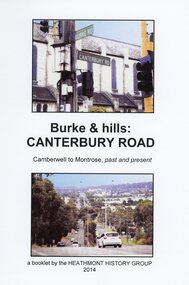
Book, Burke & Hills: Canterbury Road Camberwell to Montrose, by Heathmont History Group - 2014
... Grand homes and churches at one end, major and minor shopping centres along the 25km, factories now where farms were, big box stores, fast food outlets, train stations, resrvoir, traffic, residential stretches, modern apartment blocks, parklands, child-minding centres, sporting ovals, a sewage farm, hotels, quarries, commercial developments, plant nurseries, a golf course, bridges, memorials, Asian food shops, telecommunication towers, bushland, creeks, crossroads, traffic lights, mansions, orchards, swamps ... Delaneys Road, renamed Canterbury Road after a 19th century Victorian Governor, is a fascinating study in land use and history as suburban Melbourne...Grand homes and churches at one end, major and minor shopping centres along the 25km, factories now where farms were, big box stores, fast food outlets, train stations, resrvoir, traffic, residential stretches, modern apartment blocks, parklands, child-minding centres, sporting ovals, a sewage farm, hotels, quarries, commercial developments, plant nurseries, a golf course, bridges, memorials, Asian food shops, telecommunication towers, bushland, creeks, crossroads, traffic lights, mansions, orchards, swamps ... Delaneys Road, renamed Canterbury Road after a 19th century Victorian Governor, is a fascinating study in land use and history as suburban Melbourne ...Soft cover book of 40 pages with spiral wire spine. Compilation of images and descriptive timeline of the geology, geography and European settlement history of Canterbury Road.Soon after beginning at Burke Road Camberwell, Canterbury Road moves into the gentle hills of Canterbury, then on to Surrey Hills, Box Hill and Forest Hill. Further along past these three "hills" come three "monts" - Vermont, Heathmont and at its other end, Montrose, by then in the foothills of the Dandenongs. Grand homes and churches at one end, major and minor shopping centres along the 25km, factories now where farms were, big box stores, fast food outlets, train stations, resrvoir, traffic, residential stretches, modern apartment blocks, parklands, child-minding centres, sporting ovals, a sewage farm, hotels, quarries, commercial developments, plant nurseries, a golf course, bridges, memorials, Asian food shops, telecommunication towers, bushland, creeks, crossroads, traffic lights, mansions, orchards, swamps ... Delaneys Road, renamed Canterbury Road after a 19th century Victorian Governor, is a fascinating study in land use and history as suburban Melbourne has continually diversified and pushed outwards. Compiled by Heathmont History Group, Rita James, Les Prato, Betty Colbert, Jeff Leipold, Gerry Robinson (convenor). -
 Ringwood and District Historical Society
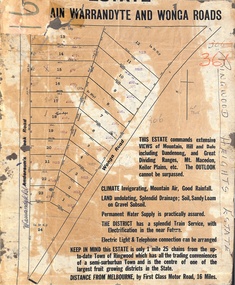
Map, Partially Trimmed Copy of Ringwood Heights Estate, Ringwood, Vic. - circa 1923
... train service, with electrification in the near future. Electric light & telephone connection can be arranged. Keep in mind this estate is only 1 mile 25 chains from the up-to-date town of Ringwood which has all the trading conveniences of a semi-suburban town and is the centre of one of the largest fruit growing districts in the state. Distance from Melbourne...train service, with electrification in the near future. Electric light & telephone connection can be arranged. Keep in mind this estate is only 1 mile 25 chains from the up-to-date town of Ringwood which has all the trading conveniences of a semi-suburban town and is the centre of one of the largest fruit growing districts in the state. Distance from Melbourne ...Clipped copy of a subdivision advertisement on cardboard backing. Sales notations on numbered allotments in Andersons's Creek Road (later Warrandyte Road) and Wonga Road, Ringwood. Handwritten title reference - LP7305. Captions - This Estate commands extensive views of mountain, hill and dale including Dandenong and Great Dividing Ranges, Mt. Macedon, Keilor Plains, etc. The outlook cannot be surpassed. Climate invigorating, mountain air, good rainfall. Land undulating, splendid drainage; soil, sandy loam on gravel subsoil. Permanent water supply is practically assured. The district has a splendid train service, with electrification in the near future. Electric light & telephone connection can be arranged. Keep in mind this estate is only 1 mile 25 chains from the up-to-date town of Ringwood which has all the trading conveniences of a semi-suburban town and is the centre of one of the largest fruit growing districts in the state. Distance from Melbourne by first class motor road, 16 miles. -
 City of Moorabbin Historical Society (Operating the Box Cottage Museum)
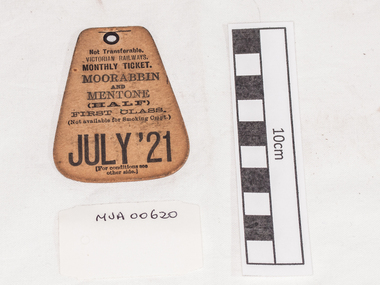
Document, Train Ticket 1921, c1921
... Suburban train monthly ticket use by Mr Marriott in July 1921 to travel between Moorabbin and Mentone. The Marriott family were early settler, market gardeners in Moorabbin Shire. railways moorabbin highett mordialloc mentone cheltenham bentleigh marriott geoff market gardeners early settlers pioneers train tickets melbourne Front Not Transferable / VICTORIAN RAILWAYS/ MONTHLY TICKET / MOORABBIN / AND / MENTONE / (HALF ) / FIRST CLASS / ( Not available for Smoking Compt.) ...A Victorian Railways Suburban train monthly ticket use by Mr Marriott in July 1921 to travel between Moorabbin and Mentone.The Marriott family were early settler, market gardeners in Moorabbin Shire.A Victorian Railway Monthly ticket 1st class Moorabbin and Mentone July 1921Front Not Transferable / VICTORIAN RAILWAYS/ MONTHLY TICKET / MOORABBIN / AND / MENTONE / (HALF ) / FIRST CLASS / ( Not available for Smoking Compt.) /JULY '21 / (For conditions see / other side / Back MOORABBIN / AND / MENTONE / Issued to and accepted by / Sr. Marriott / JULY '21 / 000 / subject to the provisions of the Rail / way Act ................Commissioners / ....... / Albert J.Mullett Govt. Printerrailways, moorabbin, highett, mordialloc, mentone, cheltenham, bentleigh, marriott geoff, market gardeners, early settlers, pioneers, train tickets, melbourne -
 Ringwood and District Historical Society
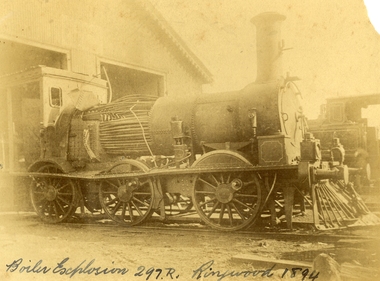
Photograph, Boiler explosion at Ringwood station 20th June 1894 for engine 297R. "Heard in Box Hill"
... They were both attended to and sent up to Melbourne by the last suburban train. Witness had a look at the engine and found the dome and all the plates round the boiler blown clean, away. ...They were both attended to and sent up to Melbourne by the last suburban train. Witness had a look at the engine and found the dome and all the plates round the boiler blown clean, away. ...Black and white photographs - 2 copiesTyped below photograph, "Boiler explosion at Ringwood station 20/6/1894. Heard in Box Hill". Article from newspapers:- Weekly Times (Melbourne, Vic. : 1869 - 1954), Saturday 27 January 1894, page 21 Official enquiry. The Board of Enquiry appointed by the Railway Commissioners to enquire into the causes of the boiler explosion which shattered the locomotive at Ringwood on Saturday night, assembled at the Railway department on Wednesday to commence its deliberations, The board consisted of Mr R. Fulton, engineer, C. W. McLean; engineer to the Marine Board, and Mr Mephan Ferguson, iron-founder. There is some difficulty at the outset about the constitution of the board; It was suggested that the Apt of Parliament contemplated that boards of experts, after the manner of the present one, needed, to have their appointments confirmed by the Governor-in-Council. The point, however, was not considered sufficiently important to prevent the board from proceeding with evidence. Robert Greyford, stationmaster at Ringwood, was the first witness. He said he saw the explosion on Saturday night at about twenty minutes to 8. There was a rush to the engine to see what had happened, and the driver and fireman were both found on the platform of the engine. The driver seemed badly hurt, but the fireman, to all appearances, was not so badly injured. They were both attended to and sent up to Melbourne by the last suburban train. Witness had a look at the engine and found the dome and all the plates round the boiler blown clean, away. The springs were also blown clean away. The Chairman (Mr Fulton) : Did you measure the distance ? Witness: Yes; one of the plates was 209 yards away. A piece from the top of the boiler 15 pounds in weight he found driven into the hard beaten track 410 yards away. Several pieces of boiler plate were found scattered at various distances. The buildings roundabout were injured. The Chairman; Did you notice anything peculiar about either of the driver or the fireman ? — No ; nothing wrong, with either of them. If the engine was blowing off at all, it must have been very light. In your opinion, were they perfectly sober ? — Perfectly. In approaching the station, is there a down or an up grade? — A very slight down grade. How is the road from Healesville ? — Up and down all the way. It is down, grade for about 200 yards coming into Ringwood station. They shut off ; steam about a quarter of a mile away, and come in at a good pace. They generally put on 15 pounds of steam while they are in the station. Mr Ferguson : Had the driver the usual load on ? — Yes ; about the usual load. Witness added that he had known the driver personally for about 10 years, and he had always been a careful, steady, sober man. He did not know the fireman so well. John Palmer, porter at Ringwood station, also saw the explosion. He was attending to the train on its arrival. He was knocked down by the force of the explosion. When he got up he saw the engine driver being carried into the office covered in blood. He noticed nothing peculiar about the driver and fireman, nor about the engine. Mr McLean : How far were you from the engine when you were knocked down ? — From ten to fifteen yards. William Paul, the guard of the train to which the injured locomotive Was attached, said he was looking at the engine at the very moment the explosion occurred. It seemed to come from exactly under the dome. The force of it took him off his feet. He was about 15 yards from the tender. When he rose he tried to reach the engine, but could not do so on account of the steam and coal dust. He called out to know whether any of the passengers were injured, and got no response, so that he concluded they were all right. All the lamps but about half dozen were extinguished by the force of the explosion, although the glass was not broken. He could testify most distinctly that the driver and fireman were both sober. The driver was a man who never drank. The steam started to blow off about a minute and a half before the explosion took place. The last place at which the engine took water was Healesville. The Chairman : Do yon know anything of the quality of the water there ? Is it creek water ? — Yes ; it comes from the Graceburn River. You never heard of its quality ?— No. How long have you known this engine on the road— About 13 months. Hew long have you known the driver on this line ? — About six weeks. I have known the fireman several years. The driver was a strict teetotaller, and I never saw the fireman take anything to drink in his life. Mr T. H, Woodroffe, chief mechanical engineer of the Victorian Railways, produced a report he had written to the secretary, about this explosion. The document gave facts concerning the engine and the explosion. It stated that the rapture seemed to have occurred at the rim of the plates adjoining the fire box. The engine was built at the Phoenix Foundry, Ballarat, in 1883. It was repaired at various times, the last time being in July of last year when it was sent to the Port Melbourne shops, and was then tested to a cold water pressure of 195 and found all right. It was the custom to overhaul all locomotives about every five years. The Chairman : There were no very heavy repairs in July, 1893; were there? — Not to the boilers. The shop manager's report says that the plug and safety tap holes were repaired, five new copper studs put in firebox, ash-pan door repaired, tender cleaned and overhauled, and studs re-rivetted, and boiler tested to pressure of 195, cold water. Mr Woodroffe read the report of the repairs effected to the boiler in December, 1888. That would be the time the plate was put in the boiler. On that occasion three new plates were put in the bottom and the boiler tested up to 195. The Chairman: Do you keep a record of the water used ?— Yes, the water in this case, I think, came from the Maroondah scheme. Mr Woodroffe said boilers were examined front time to time in the running sheds. In his opinion every possible care had been taken to keep the engine in proper care. There might, however, be lessons learnt from this. The Chairman: No doubt. From his examination of the plates [the] witness did not think the state of them could have been detected from the outside. There were no signs of leakage or sweating or anything of that sort. The next witness- was Walter Stinton, workshop manager at Newport and he said that the injured engine had been repeatedly repaired under his charge. He gave a technical account of the repairs effected on various occasions. The testing of locomotives was under his special notice. They had a high pressure pipe running; round the works, and a pump set at 2001b. When the boiler was pumped full of water the pressure when applied up to 1951b. The board appointed by the department to inquire into the Ringwood locomotive boiler explosion sat again at Spencer street on 25th inst. Mr R. Fulton presided and the other members of the board were. Mr Mephan Ferguson and Mr C. W. McLean. Charles Grubb, foreman of the boiler-makers at the Newport workshops, said he had inspected the pieces of plate that had been blown out of the engine, and after examining them, pointed out to the Chief Mechanical Engineer the portion where the plate had started to burst. It was under the lap, on the right hand side of the boiler. The grooving might be accounted for by bad water. During the past twenty years he had examined all the boilers that came into the Williamstown workshops, and while some were hardly marked at all, others were very badly eaten away. The practice was to cut out the defective portions. In this case the boiler was repaired in a similar manner. The Chairman : Can you suggest any other way of repairing so as to prevent accident ? — No, unless by taking out a plate on one side from the joint, and carrying it further up so as to avoid the joints meeting, or by taking out the plate altogether. What would.be the cost .of putting in a new " plate I—Perhaps about double the price; but I wouldn't recommend that course. It would be putting a new plate against plates that have been in use ten years or so and that would not be advisable. I think the present system better. I consider the present system of repairing the best. This is the first we have had so bad like that, to my knowledge. You attributed this to bad water. Is there no other probable cause ? — Well; unless the iron be bad. This was Lowmoor iron. I think this accident was caused by the eating away of plates. This one was the worst I have seen, for the short time it had been running. We use three classes of iron — Lowmoor, Monkbridge and Bowling. By Mr Woodroffe (Chief Mechanical Engineer) ; There are engines still running that were repaired at the same time as this one, in 1888, and. in the same way. These are engines 339 and 333. They have been recently examined and are in splendid order. What in your experience, is the age of a boiler on the Victorian railways? — From 17 to 20 years our earlier boilers stood. The later boilers don't stand so well. How is that? — There is difference in construction, and the material is lighter. The old boilers had thicker plates. Have you been asked in any way to curtail boiler affairs? — No, sir; nor in any way. You have never hesitated to carry out any necessary repairs? — Never. Our orders have been to exercise every care in examining, repairing and renewing boilers. Witness said that his practice was when an engine came into the workshop to find out how long she had been running. If over five years, he informed the workshop manager, and they thought it necessary the tubes were taken nut. If everything was in good order witness reported to the manager. The cost of taking out the tubes and putting them in again was about L20. Mr Woodroffe : Have you ever hesitated to repair a boiler on the score of expense ? — No, never. Mr McLean : Hew do yon ascertain whether a boiler requires repairs?— I keep a record of every boiler examined. From every boiler that comes in I have the dome covers taken off, and when it is practical I get inside. l can almost tell from the top of a boiler what the bottom is like. If there is any doubt about it I have the tubes taken out. If I have suspicion of defective plate I cause to have bored a triangle in the plate at the point where there is the most wear. There is a travelling inspector who visits all the running sheds of the colony except Port Melbourne and tests the boilers. He reports to us and we note what he points out. Alfred Thompson, locomotive inspector of the eastern section, said he knew this engine, 297R. He read a list of her repairs. He heard of the accident on Saturday night and went up to Ringwood. The Chairman : Did you ever notice anything peculiar about the engine? — No, I considered her A1 and would not have hesitated to have put on 140lb pressure owing to the repairs she had undergone. Witness considered that the explosion was caused by the expansion and contraction of the plates ; and, no doubt, the plate had been eaten away through bad water. The other side of the boiler showed: signs of corrosion: By Mr Woodroffe ; Is every care taken with the boilers ? — Yes, every possible care is taken for the safety of boilers, Weekly Times (Melbourne, Vic. : 1869 - 1954), Saturday 27 January 1894, page 7 EXPLOSION OF A LOCOMOTIVE BOILER, NARROW ESACPE FROM FATALITIES. THE DAMAGED ENGINE. [See drawing of loco – saved in “Railways” folder] The explosion of a locomotive boiler at Ringwood on Saturday evening, formed the subject of much discussion in railway circles on Monday. The Minister arrived at the office at an unusually early hour and immediately entered into a consultation with the acting chairman, Mr Kibble, and Mr Commissioner Murray. As the result of the interview it was resolved to ask three gentlemen of acknowledged engineering experience to sib as a board with the . object of inquiring into the cause of the accident and furnishing a report. Mr Richardson and the Commissioners are tally seized of the importance of having a searching investigation into the accident, and, with Mr Murray, the former went to Ringwood to inspect the scene of the disaster. They will he accompanied by Mr Woodroffe. During the morning no official report had come to hand from the driver or fireman of the engine in reference to the accident, but that is thought to be due to the circumstance that they have not sufficiently recovered to be able to give a circumstantial account of what occurred. The engine was one of the old R's, and, Mr Kibble pronounced them to be about the best class of engines used. So far nothing can be said as to the probable cause of the accident, as the broken plating of the engine has not been submitted to the inspection of experts. Weekly Times (Melbourne, Vic. : 1869 - 1954), Saturday 27 January 1894, page 7 STATEMENT BY THE FIREMAN. This morning Thomas Miles, fireman on the engine the boiler of which exploded on Saturday night, is suffering from an injury to the spine, as well as a very severe shaking to the system. He states that he was fireman on the engine attached to the train which left Healesville on Saturday evening, at ten minutes to 8. Everything went all right until Ringwood was reached, when, .just as the train was about to continue its journey, a load explosion took place and Miles remembers nothing more until he was picked np on the platform ; and found himself suffering from a pain in the back, and an injury to his arm. He cannot think of any reason which could have caused the explosion, as there was plenty of water in the boiler, and everything seemed working all right. Mr R. Fulton, consulting engineer, of Queen street; Mr McLean, a member of the Marine Board ; and Mr Mephan Ferguson, engineer, have consented to act as a board to inquire into the cause of the engine boiler explosion at Ringwood on Saturday evening. The board has been appointed under section 117 of Act 1135, which provides that the Governor-in-Council may direct the taking of a such a step. Mr1 Fulton will act as chairman of the board, which met for the first time at the railway offices, Spencer street, this forenoon. Before separating the members of the Board paid a visit to the Prince's Bridge locomotive sheds in company with Mr Woodroffe, the chief mechanical engineer, for the purpose of inspecting the shattered boiler. It has been stated that the explosion is known to have been caused by a flaw in a plate which was put on the boiler about four years ago, but enquiries have tailed to elicit anything in support of that view. The engineers connected with the department are not inclined to say anything on the subject. Weekly Times (Melbourne, Vic. : 1869 - 1954), Saturday 14 April 1894, page 20 The Ringwood Boiler Explosion, The Minister of Railways has received the supplementary report of the board appointed by him to investigate the circumstances connected with the explosion of a locomotive boiler at Ringwood. In their first report the board did not attach blame to anyone. Mr Richardson felt satisfied that the responsibility of having the engines properly inspected and overhauled periodically could be fixed if the inquiry were extended. He therefore referred the matter again to the Board, who took further evidence. In the report now furnished, the Board hold Loco. Inspector Thompson blameable, but point out as a mitigating circumstance that he had not received "written instructions" respecting inspections and overhauls. Weekly Times (Melbourne, Vic. : 1869 - 1954), Saturday 7 July 1894, page 32 The Ringwood Boiler Explosion. The Minister of Railways takes exception to the tone of a paragraph appearing in a morning contemporary respecting the Ringwood boiler explosion. It makes it appear that Mr Richardson has referred the report of the board which considered the facts connected with the explosion to the Crown solicitor simply because he differed from the finding of the board. The Minister explains that when he received the report he found that the responsibility for having boilers properly inspected and overhauled had not been clearly fixed. He personally obtained farther evidence on that point, and arrived at a conclusion, from which the commissioners differed. As he did not like to take upon himself the responsibility of deciding upon the effect of the evidence, he submitted the matter to the Crown Solicitor, but that officer did not furnish him with the information sought. He has, therefore, referred the question to the Attorney-General, together with the draft of a regulation respecting boiler inspections and overhauls in the future. Mr Richardson says that his whole aim is to have the responsibility positively fixed. Weekly Times (Melbourne, Vic. : 1869 - 1954), Saturday 28 April 1894, page 23 The Minister of Railways has completed his consideration of the supplementary report received by him from the Ringwood Boiler Explosion Board. The report, it will be remembered, held Loco-Inspector Thompson blameable for the non-inspection of the boiler, but considered there was extenuating circumstances. There was a certain amount of doubt as to the absolute instructions given for overhauling engines periodically. Mr. Richardson is sending the report on to the Commissioners with instructions that the responsibility respecting inspection of boilers shall be made clear for the future. -
 Eltham District Historical Society Inc
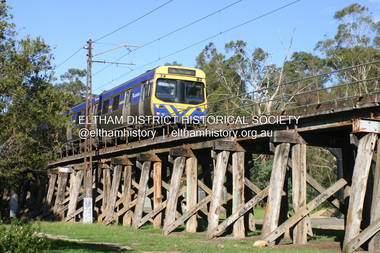
Photograph - Digital Photograph, Alan King, Eltham Railway Trestle Bridge, 28 December 2007
... Melbourne’s metropolitan railway network. Opened in 1902, it is also one of Victoria’s very few timber rail bridges that still carries trains.1 The bridge is part of the railway line extension from Heidelberg - extended to Hurstbridge in 1912. This extension resulted in one of the greatest social changes experienced in Eltham Shire, as it considerably lessened its isolation attracting tourists, artists and suburban commuters particularly after World War Two.2 The bridge has been classified by the National Trust as historically, scientifically, aesthetically and socially significant at state level. ...Melbourne’s metropolitan railway network. Opened in 1902, it is also one of Victoria’s very few timber rail bridges that still carries trains.1 The bridge is part of the railway line extension from Heidelberg - extended to Hurstbridge in 1912. This extension resulted in one of the greatest social changes experienced in Eltham Shire, as it considerably lessened its isolation attracting tourists, artists and suburban commuters particularly after World War Two.2 The bridge has been classified by the National Trust as historically, scientifically, aesthetically and socially significant at state level. ...Covered under National Trust of Australia (Victoria) State Significance and Heritage Overlay, Nillumbik Planning Scheme. Published: Nillumbik Now and Then / Marguerite Marshall 2008; photographs Alan King with Marguerite Marshall.; p103 The Eltham railway trestle bridge is the only one of its kind still regularly used in Melbourne’s metropolitan railway network. Opened in 1902, it is also one of Victoria’s very few timber rail bridges that still carries trains.1 The bridge is part of the railway line extension from Heidelberg - extended to Hurstbridge in 1912. This extension resulted in one of the greatest social changes experienced in Eltham Shire, as it considerably lessened its isolation attracting tourists, artists and suburban commuters particularly after World War Two.2 The bridge has been classified by the National Trust as historically, scientifically, aesthetically and socially significant at state level. But this has not always been recognised, and in 1977, locals fought to save it from destruction. The Victorian Railways proposed to replace the bridge with an earth embankment and large culverts to avoid maintenance problems and fire. This was rejected by the Eltham Council who protested that the bridge helped maintain the area’s rural character, historic link and beauty, as well as avoiding possible serious flooding on the flood plain if a culvert was blocked. The bridge stands as part of a National Trust classified landscape which includes the Alistair Knox Park, named after the local conservationist and architect who helped to make Eltham famous for its mud-brick houses. The landscape includes tall and spreading manna gums and candlebarks, and the historic Shillinglaw Cottage. Artist Walter Withers, one of the Heidelberg School of painters, painted the bridge early in the 20th century. The 38 span single-track railway bridge over creek and road has 34 timber-beam spans and four steel-joist spans, supported by four-pile timber piers and timber abutments. It has almost 200m of timber deck. All of the timbers have been replaced over the years, but the only change to the bridge’s character was the addition of pylons and wiring for electric trains in 1923. A petition for a railway to the shire was first made in 1883. A large deputation of local citizens to the Commissioner of Railways proposed a route passing through Alphington to midway between Greensborough and Eltham up the Diamond Creek valley towards Queenstown and Kinglake. As a result the Princes Bridge-Heidelberg Railway was opened in 1888. From 1888 locals demanded a railway extension. Kangaroo Ground farmers in particular, led by Shire Councillor and Member for Evelyn, Ewen Cameron, said it would assist local farmers and orchardists send their produce to the Melbourne market. In 1890, before the severe economic Depression, an extension of the line to Hurst’s Bridge (now Hurstbridge) was included in a new Railways Bill. The parliamentary delegations were regaled with a banquet at Hurst’s barn and entertained by the Diamond Creek Brass Band, but the extension was abandoned when the Depression struck in 1892-1893. The extension of the railway to Eltham, completed in 1902, was one of the few built in those hard times. That is why the Eltham timber-trestle railway bridge is a rare example of a broad-gauge rail bridge constructed between 1893 and 1910. At the opening, despite persistent drizzle, 300 children waving flags and banners were among the large crowd welcoming the first train, carrying official dignitaries, to Eltham. It had taken 24 years to bring the railway to Eltham. From then Eltham became a popular destination for outings. Mr Orford of Eltham recalled that after the railway came to Eltham ‘the craze for picnics on weekends and holidays began…. During the wattle season, wattle trains came to Eltham frequently. The visitors roamed the creek pulling great armfuls of wattle blossom to take back with them to Melbourne’.3 In 1926 the railway line was electrified as part of the metropolitan rail network. But the Victorian Railways decided not to complete the formerly planned Diamond Valley Railway to Queenstown (now St Andrews) and Kinglake.This collection of almost 130 photos about places and people within the Shire of Nillumbik, an urban and rural municipality in Melbourne's north, contributes to an understanding of the history of the Shire. Published in 2008 immediately prior to the Black Saturday bushfires of February 7, 2009, it documents sites that were impacted, and in some cases destroyed by the fires. It includes photographs taken especially for the publication, creating a unique time capsule representing the Shire in the early 21st century. It remains the most recent comprehenesive publication devoted to the Shire's history connecting local residents to the past. nillumbik now and then (marshall-king) collection, eltham railway trestle bridge, eltham trestle bridge -
 Eltham District Historical Society Inc
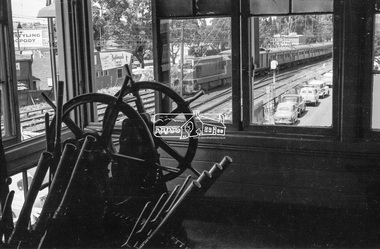
Photograph, George Coop, Box Hill Signal Box, c.Feb. 1964
... train passengers including 'Dialyn's Theatre Shoppe for Nightingale Tightlets & Leotards'. This is not a conventional suburban Tait ‘Red Rattler’ service. It may have come from Lilydale where trains from both Warburton and Healsville were combined to continue the run into Melbourne, a normal service for them at the time. ...train passengers including 'Dialyn's Theatre Shoppe for Nightingale Tightlets & Leotards'. This is not a conventional suburban Tait ‘Red Rattler’ service. It may have come from Lilydale where trains from both Warburton and Healsville were combined to continue the run into Melbourne, a normal service for them at the time. ...A T-class diesel-electric locomotive can bee seen through the window hauling a Tait train. Also advertising on the buildings facing passing train passengers including 'Dialyn's Theatre Shoppe for Nightingale Tightlets & Leotards'. This is not a conventional suburban Tait ‘Red Rattler’ service. It may have come from Lilydale where trains from both Warburton and Healsville were combined to continue the run into Melbourne, a normal service for them at the time. It is unusual as the train is hauled by a diesel which also suggests it may have been a special excursion train from either of those two towns. Normally these combined trains would be hauled by two swing door ‘Red Rattlers’ motor coaches from Lilydale, the start/end of electric service. Digital TIFF file Scan of 35mm Ilford FP3 black and white transparencygeorge coop collection, box hill railway signal box, box hill railway station, signal box -
 Bendigo Historical Society Inc.
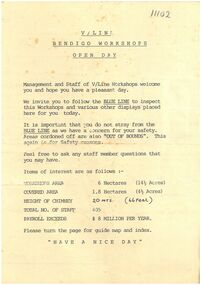
Ephemera - V/Line Bendigo workshops 'Open Day' leaflet
... Other tasks included spring manufacture, construction of stainless steel footwarmers, and assembly of pantographs for electric trains, with a staff of 720 employed during 1966. By the 1980s, refurbishment work was also being carried out on Melbourne suburban electric multiple units. ...Other tasks included spring manufacture, construction of stainless steel footwarmers, and assembly of pantographs for electric trains, with a staff of 720 employed during 1966. By the 1980s, refurbishment work was also being carried out on Melbourne suburban electric multiple units. ...The workshops were opened in November 1917 by the Victorian Railways. It opened in response to political pressures from provincial groups for decentralisation, with the Victorian Railways preferring the cheaper option of expanding the existing Newport Workshops in suburban Melbourne. Furthermore, unemployment had risen in both Bendigo and Ballarat due to a decline in mining operations. The main work carried out was repairs and maintenance of existing wagons and locomotives, however during 1919-22 thirteen new steam locomotives were also built - eight DD class (1033 - 1037, 1047 - 1049) and five A2 class (1078 - 1082). From the 1950s onwards, numerous steam locomotives were scrapped at the workshops. During the years immediately following nominal dieselisation in 1968, they were, at times, cutting up locomotives at the rate of one every two to three weeks. The workshops were also the site of the first VR brass foundry, which was transferred to Newport by the 1960s. Also, throughout 1965, VLX louvred vans were constructed at the workshops, at a rate of one a week. Other tasks included spring manufacture, construction of stainless steel footwarmers, and assembly of pantographs for electric trains, with a staff of 720 employed during 1966. By the 1980s, refurbishment work was also being carried out on Melbourne suburban electric multiple units. The 1980s were also a time of restructuring, and on the breakup of the Victorian Railways the workshops passed to the State Transport Authority and then the Public Transport Corporation. With privatisation the workshops were closed, with the loss of 262 jobs. In February 1996, the workshops were taken over by A Goninan & Co. In October 1999 the workshops were purchased by Great Northern Rail Services, with A Goninan & Co remaining as a tenant. In February 2001 A Goninan & Co vacated the site. The workshops were redeveloped in 2002 at a cost of $6.5 million - $4 million from VicTrack, $2 million from the State Government Regional Infrastructure Development Fund and $500,000 by the City of Greater Bendigo. The Bendigo Rail Workshops at North Bendigo are currently used by Southern Shorthaul Railroad to maintain broad gauge rolling stock for Pacific National, V/Line, Metro Trains Melbourne and CFCLA.Typed document. A4 page folded in half. On tan paper. Document pertaining to Bendigo V/Line workshops open day. Map on inside of folded page. Undated document.train, v/line, workshops, open day -
 Bendigo Historical Society Inc.
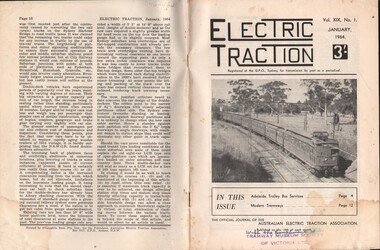
Document - BASIL MILLER COLLECTION: TRAMS - JOURNAL 'ELECTRIC TRACTION', Janaury 1964
... Cover picture was a seven-car suburban electric train of original "swing door" rolling stock passing through parklands in the suburb of Burnley on its way to Melbourne....Cover picture was a seven-car suburban electric train of original "swing door" rolling stock passing through parklands in the suburb of Burnley on its way to Melbourne. ...Journal of Australian Electric Traction Association. Volume XIX, No. 1, January 1964. 16 pages. History of document: Part of 'Basil Miller Collection'. Cover picture was a seven-car suburban electric train of original "swing door" rolling stock passing through parklands in the suburb of Burnley on its way to Melbourne.Pub: Australian Electric Traction Asscn. Printer: O'Loughlin Bros. Pty. Ltd., Sydney NSWdocument -
 Uniting Church Archives - Synod of Victoria
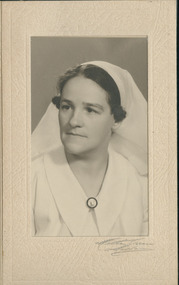
Photograph, C1947
... suburban Melbourne, she had been inspired by stories told to her by other missionaries about the fulfilment to be gained working amongst Aboriginal communities. Given her religious faith and nursing skills, she believed she could make a difference. She worked in Oodnadatta in South Australia for two years (1937-1939), followed by a stint in Innamincka in New South Wales in 1940 -1942. Before she became a nurse, Hilda Foster trained...suburban Melbourne, she had been inspired by stories told to her by other missionaries about the fulfilment to be gained working amongst Aboriginal communities. Given her religious faith and nursing skills, she believed she could make a difference. She worked in Oodnadatta in South Australia for two years (1937-1939), followed by a stint in Innamincka in New South Wales in 1940 -1942. Before she became a nurse, Hilda Foster trained ...Hilda Charlotte Foster, 1902 - 1990, was a Double Certified Nurse when, at the age of 35, she successfully applied to the board of the Australian Inland Mission (AIM) to work at an outback field centre in South Australia. Born and raised in suburban Melbourne, she had been inspired by stories told to her by other missionaries about the fulfilment to be gained working amongst Aboriginal communities. Given her religious faith and nursing skills, she believed she could make a difference. She worked in Oodnadatta in South Australia for two years (1937-1939), followed by a stint in Innamincka in New South Wales in 1940 -1942. Before she became a nurse, Hilda Foster trained to be a Sunday School teacher and was a member of the Sunday School Council of Victoria. She completed first aid courses run through the Presbyterian Deaconesses Institute in Carlton, Victoria, and in 1930 successfully applied to become a trainee nurse at the Austin Hospital for Incurables, in Heidelberg. She commenced her training there in 1931, before moving to the Women's Hospital in 1933. In 1934 she had six months at the Fairfield Infectious Diseases Hospital, before returning to the Austin, where she was employed when she sat her final exams in November 1934. Her combined skills made her a most attractive option for the Australian Inland Mission. As well as being multi-skilled as a nurse, she provided religious instruction and spiritual ministry to members of the community. https://trove.nla.gov.au/people/762093?c=people Sister Foster nursed at Toora Bush Hospital prior to leaving for the Paton Memorial Hospital, Vila, New Hebrides in 1944. She left the New Hebrides in 1946.Matt, black and white, head and shoulders, studio portrait of Sister Hilda Charlotte Foster on card.australian inland mission, presbyterian deaconess, sister hilda charlotte foster, paton memorial hospital vila new hebrides -
 Ballarat Tramway Museum
Book - Book - Scrapbook, Newspaper articles on Melbourne trams, Railway Fares and Buses
... Melbourne and regional Victoria, interstate - Adelaide and Sydney, plus overseas, make up this collection. Articles relating to transport collected by R Bridger in the 1950s. This scrapbook is divided into sections and contains articles collected from newspapers in Victoria and New South Wales. There are also a large number of tickets, pasted in or loose. Detailed lists of pricing for various routes on the suburban trains...Melbourne and regional Victoria, interstate - Adelaide and Sydney, plus overseas, make up this collection. Articles relating to transport collected by R Bridger in the 1950s. This scrapbook is divided into sections and contains articles collected from newspapers in Victoria and New South Wales. There are also a large number of tickets, pasted in or loose. Detailed lists of pricing for various routes on the suburban trains ...Ron Bridger was an avid collector of items related to transport, predominately Trams. These items include newspaper cuttings, pamphlets, reports, timetables, fares prices plus special items relating to events. Items from Melbourne and regional Victoria, interstate - Adelaide and Sydney, plus overseas, make up this collection. Articles relating to transport collected by R Bridger in the 1950s. This scrapbook is divided into sections and contains articles collected from newspapers in Victoria and New South Wales. There are also a large number of tickets, pasted in or loose. Detailed lists of pricing for various routes on the suburban trains. Sydney papers were full of information on buses replacing their trams after 96 years. Small exercise book with blue checked coverBook divided into sections - trams, trains, buses. Articles dated scrapbook, 1950s, victoria, new south wales, tickets, train fares, sydney buses, ron bridger collection, ballarat courier, the sun, essendon gazette, as box 48a -
 Ballarat Tramway Museum
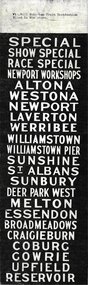
Sign - Sign - Destination Blinds, Trains, Victorian Rail Suburban Train Destination Blind in Miniature: Williamstown and areas north, south etc
... Items from Melbourne and regional Victoria, interstate - Adelaide and Sydney, plus overseas, make up this collection. A suburban train...Items from Melbourne and regional Victoria, interstate - Adelaide and Sydney, plus overseas, make up this collection. A suburban train ...Ron Bridger was an avid collector of items related to transport, predominately Trams. These items include newspaper cuttings, pamphlets, reports, timetables, fares prices plus special items relating to events. Items from Melbourne and regional Victoria, interstate - Adelaide and Sydney, plus overseas, make up this collection. A suburban train destination blind in miniature. Place names indicate the western and northern suburbs that the train travels to. Place names listed are Altona, Westona, Newport, Laverton, Werribee, Williamstown, Williamstown Pier, Sunshine, St Albans, Sunbury, Deer Park West, Melton, Essendon, Broadmeadows, Craigieburn, Coburg, Cowrie, Upfield, Reservoir. Blind also indicates Show Special and Race Special.`List of names on black paper with white print.Place names - stationstrain destination blinds, miniature, railway stations, reservoir, upfield, cowrie, coburgcraigieburn, broadmeadows, essendon, melton, deer park west, sunbury, st albans, sunshine, williamstown pier, werribee, laverton, williamstown, newpoort, westona, altona, newport workshops, race special, show special, special, ron bridger collection -
 Ballarat Tramway Museum
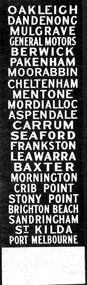
Sign - Sign - Destination Blinds, Trains, Victorian Rail Suburban Train Destination Blind in Miniature: South Eastern Region
... suburban train...oakleigh...dandenong...berwick...pakenham...moorabbin...cheltenham...mentone...mordiallic...aspendale...seaford...baxter...mornington...crib point...brighton beach...port melbourne...Items from Melbourne and regional Victoria, interstate - Adelaide and Sydney, plus overseas, make up this collection. A suburban train...Items from Melbourne and regional Victoria, interstate - Adelaide and Sydney, plus overseas, make up this collection. A suburban train ...Ron Bridger was an avid collector of items related to transport, predominately Trams. These items include newspaper cuttings, pamphlets, reports, timetables, fares prices plus special items relating to events. Items from Melbourne and regional Victoria, interstate - Adelaide and Sydney, plus overseas, make up this collection. A suburban train destination blind in miniature. Place names indicate the eastern and southern suburbs that the train travels to. Place names listed are from Oakleigh to Dandenong, Mulgrave, General Motors, Berwick and Pakenham. From Moorabbin, Cheltenham, Mentone, Mordiallic, Aspendale, Carrum and Seaford. Frankston to Leawarra, Baxter, Mornington, Crib Point, Stony Point, Brighton Beach, Sandringham, St Kilda and Port MelbourneList of names on black paper with white print.Place names - stationstrain destination blinds, miniature, railway stations, ron bridger collection, suburban train, oakleigh, dandenong, berwick, pakenham, moorabbin, cheltenham, mentone, mordiallic, aspendale, seaford, baxter, mornington, crib point, brighton beach, port melbourne -
 Ballarat Tramway Museum
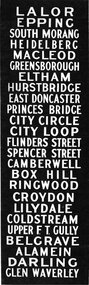
Sign - Sign - Destination Blinds, Trains, Victorian Rail Suburban Train Destination Blind in miniature - North and East stations, Melbourne
... Victorian Rail Suburban Train Destination Blind in miniature - North and East stations, Melbourne...Items from Melbourne and regional Victoria, interstate - Adelaide and Sydney, plus overseas, make up this collection. A suburban train...Items from Melbourne and regional Victoria, interstate - Adelaide and Sydney, plus overseas, make up this collection. A suburban train ...Ron Bridger was an avid collector of items related to transport, predominately Trams. These items include newspaper cuttings, pamphlets, reports, timetables, fares prices plus special items relating to events. Items from Melbourne and regional Victoria, interstate - Adelaide and Sydney, plus overseas, make up this collection. A suburban train destination blind in miniature. Place names indicate the northern and eastern suburbs that the train travels to. Place names listed are Lalor, Epping, South Morang, Heidelberg, Macleod, Greensborough, Eltham, East Doncaster, Princes Bridge, City Circle, City Loop, Flinders Street, Spencer Street, Camberwell, Box Hill, Ringwood, Croydon, Lilydale, Coldstream, Upper Ferntree Gully, Belgrave, Alamein, Darling, Glen Waverley. List of station names on black paper written in whiteStation namestrain destination blind, northern area, eastern area, lalor, epping, south morang, macleod, greensborough, eltham, hurstbridge, east doncaster, princes bridge, city circle, city loop, flinders street, spencer street, camberwell, box hill, ringwood, croydon, lilydale, coldstream, upper ferntree gully, belgrave, alamein, darling, glen waverley -
 St Kilda Historical Society
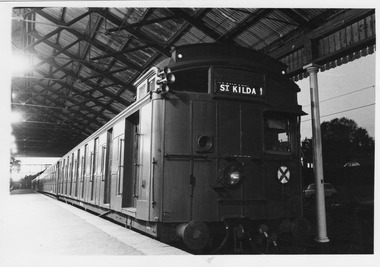
Photograph - Industrial, Red Rattler train, c1980s
... The "Red Rattlers", or Tait trains, were red-painted trains that served Melbourne's suburban railway network from 1910 until 1984 (initially steam-hauled and then electric from 1919). ...The "Red Rattlers", or Tait trains, were red-painted trains that served Melbourne's suburban railway network from 1910 until 1984 (initially steam-hauled and then electric from 1919). ...The "Red Rattlers", or Tait trains, were red-painted trains that served Melbourne's suburban railway network from 1910 until 1984 (initially steam-hauled and then electric from 1919). Known for their timber-bodied construction, rattling windows, and distinct, manual sliding doors. They were common on the St Kilda line and the photo shows one at St Kilda railway station. The St Kilda line officially closed on 31 July 1987.Black and white photograph, unmounteddavid rae collection, st kilda, st kilda train -
 St Kilda Historical Society
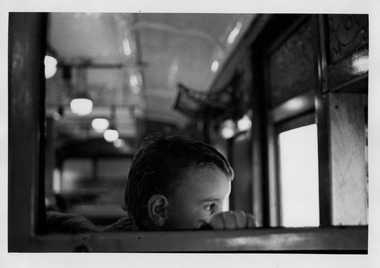
Photograph - Industrial, Red Rattler train, c1980s
... The "Red Rattlers", or Tait trains, were red-painted trains that served Melbourne's suburban railway network from 1910 until 1984 (initially steam-hauled and then electric from 1919). ...The "Red Rattlers", or Tait trains, were red-painted trains that served Melbourne's suburban railway network from 1910 until 1984 (initially steam-hauled and then electric from 1919). ...Child on old St Kilda "Red Rattler" train. The "Red Rattlers", or Tait trains, were red-painted trains that served Melbourne's suburban railway network from 1910 until 1984 (initially steam-hauled and then electric from 1919). Known for their timber-bodied construction, rattling windows, and distinct, manual sliding doors. Black and white photograph, unmounteddavid rae collection, st kilda, st kilda train -
 Ballarat Tramway Museum
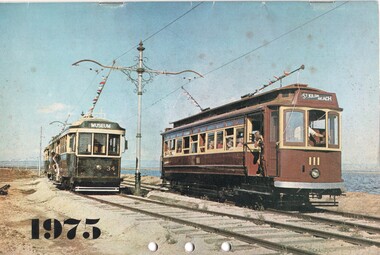
Document - Calendar, Sydney Tramway Museum, 1974
... Features photographs of various Australasian Tramway Systems: Ballarat 34 and Adelaide 111 at the St Kilda Tramway Museum Dunedin 61 Ballarat 37 at the City terminus Bulimba Power Station electric locomotive Newcastle 383 Darling St Balmain Perth Trolley Bus 21 Perth 55 Melbourne Tait train Launceston 26 Sydney Suburban train Adelaide 365 Brisbane 293 VR 28 Geelong 14 - at Eastern Park Sydney tramway museum ...Features photographs of various Australasian Tramway Systems: Ballarat 34 and Adelaide 111 at the St Kilda Tramway Museum Dunedin 61 Ballarat 37 at the City terminus Bulimba Power Station electric locomotive Newcastle 383 Darling St Balmain Perth Trolley Bus 21 Perth 55 Melbourne Tait train Launceston 26 Sydney Suburban train Adelaide 365 Brisbane 293 VR 28 Geelong 14 - at Eastern Park Sydney tramway museum Document Calendar Sydney Tramway Museum ...Calendar 1975 - 28 pages - black and white photos except for the front cover. Produced by the Sydney Tramway Museum. Features photographs of various Australasian Tramway Systems: Ballarat 34 and Adelaide 111 at the St Kilda Tramway Museum Dunedin 61 Ballarat 37 at the City terminus Bulimba Power Station electric locomotive Newcastle 383 Darling St Balmain Perth Trolley Bus 21 Perth 55 Melbourne Tait train Launceston 26 Sydney Suburban train Adelaide 365 Brisbane 293 VR 28 Geelong 14 - at Eastern Park Sydney tramway museum tramways, trams, ballarat, adelaide, newcastle, sydney, dunedin tramways, brisbane, perth, trolley buses, melbourne, launceston, victorian railways, geelong, tram 14, tram 37, tram 34 -
 Sunshine and District Historical Society Incorporated
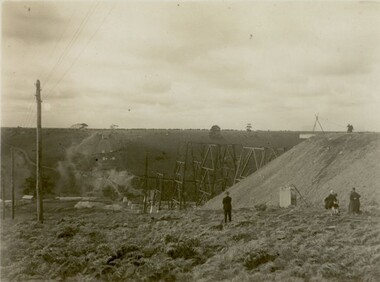
Photograph - Maribyrnong railway bridge construction, 1928
... trains from all parts of the state except Gippsland to have direct access to the Tottenham marshalling and sorting yards. These yards were constructed in the 1920's to relieve congestion in the Melbourne Yard near Spencer Street station. The congestion was being caused by the construction of suburban...trains from all parts of the state except Gippsland to have direct access to the Tottenham marshalling and sorting yards. These yards were constructed in the 1920's to relieve congestion in the Melbourne Yard near Spencer Street station. The congestion was being caused by the construction of suburban ...One man lost his life during the building of this bridge. The bridge was constructed by the Victorian Railways between 1927 to 1929 to carry a new double track goods line. This enabled trains from all parts of the state except Gippsland to have direct access to the Tottenham marshalling and sorting yards. These yards were constructed in the 1920's to relieve congestion in the Melbourne Yard near Spencer Street station. The congestion was being caused by the construction of suburban passenger platforms associated with the electrification of the suburban railway network. Initially the bridge was for goods trains but during the Second World War it was also used by troop trains. When the standard gauge line was built in 1962 all trains to Albury and Sydney have used this route, thus avoiding travelling through Essendon and Pascoe Vale on the suburban tracks. The standard gauge track across the bridge took the place of one of the broad gauge tracks so broad gauge trains crossing the bridge in either direction have to now use the same track. The bridge is 1,257 feet (383.13 metres) long and 180 feet (54.86 metres) above the water level. It is just 63 feet (19.2 metres) short of a quarter mile in length between abutments. There is a similar bridge on the same railway line crossing the Moonee Ponds Creek between Gowenbrae and Glenroy, however it is smaller at 1060 feet (323.08 metres) length and 115 feet (35.05) height.The bridge is now Victorian Heritage Registered under Number: H1197, and Heritage Overlay Numbers HO5, and HO107. On the Heritage Register it is named RAIL BRIDGE (ALBION VIADUCT). According to the Heritage Report the bridge is scientifically and architecturally important because of its large size, and because of the cost effective design features such as two girders per span (one for each track), the K bracing in the towers, and the broad flange beams as columns. When it was being built it was the largest trestle bridge in Australia, and until the Sydney Harbour bridge was constructed it was the highest railway bridge.449.01 - Maribyrnong railway bridge construction.jpg 449.02 - Maribyrnong railway bridge construction.jpg 449.03 - Maribyrnong railway bridge construction.jpg 449.04 - Maribyrnong railway bridge construction.jpg 449.05 - Maribyrnong railway bridge construction.jpgmaribyrnong river, bridge, quarter mile bridge, trestle bridge -
 Sunshine and District Historical Society Incorporated
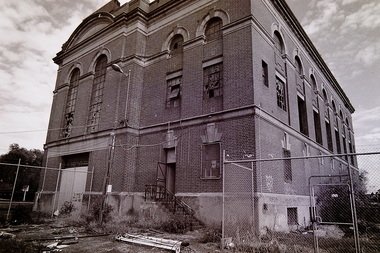
Photograph - Victoria Railway Substation Talmage Street Albion 1991 Photographs, Adam Ellwood, 28th February 1991
... Melbourne’s rail electrification, in the early 20th century. It functioned as a direct‑current (D.C.) traction substation, supplying power to suburban electric trains. ...Melbourne’s rail electrification, in the early 20th century. It functioned as a direct‑current (D.C.) traction substation, supplying power to suburban electric trains. ...This Victorian Railway (VR) D.C. Substation was built as part of the first stage of Melbourne’s rail electrification, in the early 20th century. It functioned as a direct‑current (D.C.) traction substation, supplying power to suburban electric trains. The substation was also briefly associated with H.V. McKay’s Sunshine Harvester Works, supplying power during the early industrial development in Sunshine. Its monumental Renaissance‑style architecture reflected VR’s desire to express technological progress and civic confidence.The Victorian Railway (VR) D.C. Substation is of State historical and architectural significance, representing the era when Victoria undertook large‑scale railway electrification, one of the longest electrified suburban systems in the world at the time.The Power House Talmage St Albiontalmage street, albion, substation -
 Sunshine and District Historical Society Incorporated
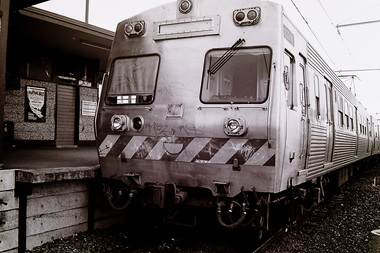
Photograph - St. Albans Railway Station 1990 Photographs, Ken Irwin, 28th April 1990
... St Albans Railway Station has one of the most layered histories of any suburban station in Melbourne’s west, beginning as a speculative land‑development stop in 1887, rebuilt in 1959 to ease traffic congestion, modernised in 2002, and finally transformed into a below‑ground station in 2016 as part of the Level Crossing Removal Project. These photographs, taken by The Advocate in 1990, highlighted the ongoing problems faced by the Department of Transport as trains...St Albans Railway Station has one of the most layered histories of any suburban station in Melbourne’s west, beginning as a speculative land‑development stop in 1887, rebuilt in 1959 to ease traffic congestion, modernised in 2002, and finally transformed into a below‑ground station in 2016 as part of the Level Crossing Removal Project. These photographs, taken by The Advocate in 1990, highlighted the ongoing problems faced by the Department of Transport as trains ...St Albans Railway Station has one of the most layered histories of any suburban station in Melbourne’s west, beginning as a speculative land‑development stop in 1887, rebuilt in 1959 to ease traffic congestion, modernised in 2002, and finally transformed into a below‑ground station in 2016 as part of the Level Crossing Removal Project. These photographs, taken by The Advocate in 1990, highlighted the ongoing problems faced by the Department of Transport as trains stored overnight at St Albans Station were repeatedly targeted by vandals tagging carriages, breaking windows, slashing seats, and causing other damage. In response, 2.9‑metre‑high security fencing topped with barbed wire, along with high‑powered spotlights, was installed to protect the yard.These photographs capture the station when the suburban electrification line ended at the St. Albans Railway Station on the city side of Main Road West and when trains were stored there overnight.St. Albans Station 207.2st. albans railway station, main road west, st. albans -
 Ballarat Tramway Museum
Magazine, Jack Richardson, "Tram Tracks - The Electric Traction Monthly", Jan to June 1947
... Melbourne, SEC, Hobart, VR, Adelaide, Kalgoorlie, Broome, electric trains in Melbourne and Sydney, and AETA notes. Photos include Sydney O, OP and P, VR PERM 63 and interior photo of a MMTB W4 class tram. 2465.2 - Vol. 2, No. 2 - 16 pages, Feb. 1947, with cover printed in dark blue. Has articles on Brisbane 400 class tramcar, Adelaide to Glenelg Brighton - Le Sands tramway, Melbourne Suburban...Melbourne, SEC, Hobart, VR, Adelaide, Kalgoorlie, Broome, electric trains in Melbourne and Sydney, and AETA notes. Photos include Sydney O, OP and P, VR PERM 63 and interior photo of a MMTB W4 class tram. 2465.2 - Vol. 2, No. 2 - 16 pages, Feb. 1947, with cover printed in dark blue. Has articles on Brisbane 400 class tramcar, Adelaide to Glenelg Brighton - Le Sands tramway, Melbourne Suburban ...Six issues of "Tram Tracks - The Electric Traction Monthly" of the Australian Electric Traction Association. Each issue has a standard cover, of the magazine name etc, featuring "Wee Folks Productions" models but are in different colours, all have been saddled stapled with two staples, except No. 6. The Volume and date details have been over printed. Back covers inside back covers have the same advertisements but the font varies vary. The six issues contain advertisements for the Wee Folks productions, Hartleys Sports store, Hearns Hobbies, Wattle Park, Johnson's Variety Store, Barnes Tennis Centre, The Model Dockyard, Robilt Models, Meadmore Model Engineering and Austral Bronze Pty Ltd, Hearns Hobbies, Christie Scale Model Railway and Equipment, Herbert Small (Meccano), the American Subscription Agency, Manufacturers' Mutual Insurance Ltd. 2465.1 - Vol. 2 No. 1 - 16 pages, Jan 1947, with cover printed in red. Has articles on the tram / car debate, Dunedin Tramways, Overlapping fare sections, type of trucks under Sydney tramcars, Brisbane Electric Railway (Power station), The Balmain Counterweight and Trolley buses in Australia. News items include Brisbane, Newcastle, Sydney, Melbourne, SEC, Hobart, VR, Adelaide, Kalgoorlie, Broome, electric trains in Melbourne and Sydney, and AETA notes. Photos include Sydney O, OP and P, VR PERM 63 and interior photo of a MMTB W4 class tram. 2465.2 - Vol. 2, No. 2 - 16 pages, Feb. 1947, with cover printed in dark blue. Has articles on Brisbane 400 class tramcar, Adelaide to Glenelg Brighton - Le Sands tramway, Melbourne Suburban railways, Diesel Electrics on the Southern Railway (US)and Birney Safety Car. News items include Brisbane, Sydney, Melbourne, VR, Fremantle and AETA notes. 2465.3 - Vol. 2, No. 3 - 12 pages, Mar. 1947, with cover printed in brown. Has articles on why NSW trams lose money, Duncan and Frazer, new trams in Johannesburg, Melbourne Suburban railways, and Sydney New Railway (Eastern Suburbs). News items Sydney, Melbourne, SEC, VR and Adelaide and AETA notes. 2465.4 - Vol. 2, No. 4 - 16 pages, Apr. 1947, with cover printed in green. Has articles on Duncan and Fraser (continued), In search of Ancient Warriors (old trams), Brisbane Electric Railway and some unusual fares arrangements. News items include Brisbane, Newcastle, Melbourne, Sydney, SEC, Launceston, Kalgoorlie, overseas, and AETA notes. Editorial looks at claims that the SW6 cars are the finest in the world, back numbers (notes that Tram Tracks started with a mimeographed club news sheet and now have circulation of nearly 200), costs of production etc. Has photographs of the interior of a SW6 850, a plan for Melbourne underground railway, the VR power operations room at Flinders St., Hobart trolley bus and a cartoon about Sydney traffic. 2465.5 - Vol. 2, No. 5 - 16 pages, May 1947, with cover printed in red. Has articles on Australian Light railways, Sydney's relief lines and the start of an article on NSWGT 600/1200V tramcars. Has news items on Brisbane, Sydney, MMTB, VR, Geelong, Ballarat, Launceston, Hobart and AETA notes. Editorial notes the first anniversary of the magazine and has a number of letters regarding this, content and the tram/car debate. 2465.6 - Vol. 2, No. 6 - 20 pages, June 1947, with cover printed in blue. Has articles on Cremorne bridge replacement (with photos), Neutral bay line and Tramcar transmission gears. News items include photos of MMTB track replacements, crowded trams, Brisbane, Sydney, Melbourne, and a photo of a Sydney tram passing under the new bridge work for Circular Quay station. 2465.7 - Vol. 2, No. 12 - pages 1-12, cover has an advert for Hartley Sporting Goods. Has cartoon on fares on Sydney trams by Peterson, not regarding retirement of Mr. H. Bell of MMTB, Melbourne Latrobe St and bus construction, Sydney tram cartoons from Emile Mercier, electric trains and other tramway news. (Item added 24-3-18 - from consolidation of Melbourne Tram Museum and BTM collections) trams, tramways, electric traction, aeta, models, australian tramways, duncan fraser, cartoons -
 Ballarat Tramway Museum
Magazine, Jack Richardson, "Tram Tracks - The Electric Traction Monthly", July to Dec 1948
... Patterson, Acting Director of Commonwealth Road Transport and Chairman of Federal Road Safety Council (very anti tram), news from Brisbane, Launceston, Sydney, Newcastle, Burwood, cost of trams, impressions of transport in Europe and North America, Melbourne and Sydney electric trains, tramways of Newcastle and model notes and AETA news. 2466.6 - Vol. 3, No. 1 - Jan 1948 - 16 pages with photo of Brisbane 407, political news, direct Melbourne to Footscray line proposal, new trams, bogie trams in Ballarat, article on Melbourne cable trams, electric trains, AETA outing in Melbourne and various adverts for model railways. 2466.7 - Vol 3 No. 2 - Feb. 1948 - 16 pages - political news, Ballarat news, traffic in Sturt St and new bogie cars, Christchurch closure, cartoon by Mercier on Sydney Honesty box, Brisbane suburban electrification, general tramway and electric railway news and various adverts for model railways. 2466.8 - Vol. 3 No. 3 - March 1948, with photo of VR 52 on front cover, 16 pages, political news, closures, Reg Ansett offer to buy the Melbourne bus system, Newcastle News, SEC Transfer of cars between the three systems, tramways in the Maribyrnong area, map of Melbourne trams, cartoon by Mercier, Brisbane train electrification and general news. 2466.9 - Vol. 3 No. 6 - June 1948 - 12 pages - MMTB political news, new trams for Sydney, tramways of Newcastle, Invercargill, Sydney Suburban trains, and AETA General news. .6 to .9 added 24-3-18 - from consolidation of Melbourne Tram Museum and BTM collections - ex AETA. ...Patterson, Acting Director of Commonwealth Road Transport and Chairman of Federal Road Safety Council (very anti tram), news from Brisbane, Launceston, Sydney, Newcastle, Burwood, cost of trams, impressions of transport in Europe and North America, Melbourne and Sydney electric trains, tramways of Newcastle and model notes and AETA news. 2466.6 - Vol. 3, No. 1 - Jan 1948 - 16 pages with photo of Brisbane 407, political news, direct Melbourne to Footscray line proposal, new trams, bogie trams in Ballarat, article on Melbourne cable trams, electric trains, AETA outing in Melbourne and various adverts for model railways. 2466.7 - Vol 3 No. 2 - Feb. 1948 - 16 pages - political news, Ballarat news, traffic in Sturt St and new bogie cars, Christchurch closure, cartoon by Mercier on Sydney Honesty box, Brisbane suburban electrification, general tramway and electric railway news and various adverts for model railways. 2466.8 - Vol. 3 No. 3 - March 1948, with photo of VR 52 on front cover, 16 pages, political news, closures, Reg Ansett offer to buy the Melbourne bus system, Newcastle News, SEC Transfer of cars between the three systems, tramways in the Maribyrnong area, map of Melbourne trams, cartoon by Mercier, Brisbane train electrification and general news. 2466.9 - Vol. 3 No. 6 - June 1948 - 12 pages - MMTB political news, new trams for Sydney, tramways of Newcastle, Invercargill, Sydney Suburban trains, and AETA General news. .6 to .9 added 24-3-18 - from consolidation of Melbourne Tram Museum and BTM collections - ex AETA. ...Three issues of "Tram Tracks - The Electric Traction Monthly" of the Australian Electric Traction Association. Each issue has a standard cover, of the magazine name etc, and featuring a front end photo of Victorian Railways tram No. 52 with the destination of Elwood but are in different colours, all have been saddled stapled with a single staple. The Volume and date details have been over printed. Back covers inside covers have the same advertisements. The three issues contain advertisements for the Wee Folks productions, Wattle Park, G&R model railway parts, Richard Noble model electric motors, Hobbyco, Fleet scale model railway equipment, Masseys Sports, Lloyd's Hobbycraft, John Martin Ltd, Johnson's Variety Store, the ARLHS, Barnes Tennis Centre, The Model Dockyard, the American Subscription Agency, Robilt Models, Meadmore Model Engineering and Austral Bronze Pty Ltd, Hearns Hobbies, Christie Scale Model Railway Products and Traction Publications. 2466.1 - Vol. 3 No. 10 - 20 pages, Oct. 1948, with cover printed in red ink. Has articles on anti-tram propaganda, Alphington - Heidelberg duplication and Sydney's early electric trams - C and D class. Also has news items on Brisbane, Newcastle, Sydney, Melbourne, Sandringham - Black Rock, Hobart, Launceston, Perth, Sydney and Melbourne electric trains, Launceston Trolley Buses, AETA notes, and a caricature of the Editor, Jack Richardson. 2466.2 - Vol. 3 No. 11 - 24 pages, Nov. 1948, with cover printed in blue ink. Has articles on construction of tram track in Melbourne (Victoria Parade), Bourke St., tram-bus controversy, (Reg Ansett, Noel Gipps and USNR Commander Quinby), Sydney's early electric trams - C and D class continued. Also news items on Last tram to Mayfield, Sydney, Latrobe St. Melbourne, Adelaide, opening to Alamein, Melbourne show traffic, VR Trams and AETA notes. 2466.3 - Vol. 3 No. 12 - 16 pages, Dec. 1948, with cover printed in green ink. Has articles on Sydney's electric railways, Brisbane Tramways and an AETA Melbourne tour. News items cover Sydney, Newcastle, Melbourne, Geelong, Bendigo, Kalgoorlie, Melbourne and Sydney trains and AETA news. 2466.4 - Vol 3 - No. 7 - 20 pages - July 1948 with cover printed in red ink. Has articles on cost of building trams for Brisbane, Sydney and Melbourne, abandonment of VR trams, Newcastle, Sydney, centre page photo of Y1 611, Sydney Electric train system including map and AETA news. 2466.5 - Vol 3 - No. 9 - 20 pages - Sep 1948 with cover printed in blue ink. Has articles on Mr. T. G. Patterson, Acting Director of Commonwealth Road Transport and Chairman of Federal Road Safety Council (very anti tram), news from Brisbane, Launceston, Sydney, Newcastle, Burwood, cost of trams, impressions of transport in Europe and North America, Melbourne and Sydney electric trains, tramways of Newcastle and model notes and AETA news. 2466.6 - Vol. 3, No. 1 - Jan 1948 - 16 pages with photo of Brisbane 407, political news, direct Melbourne to Footscray line proposal, new trams, bogie trams in Ballarat, article on Melbourne cable trams, electric trains, AETA outing in Melbourne and various adverts for model railways. 2466.7 - Vol 3 No. 2 - Feb. 1948 - 16 pages - political news, Ballarat news, traffic in Sturt St and new bogie cars, Christchurch closure, cartoon by Mercier on Sydney Honesty box, Brisbane suburban electrification, general tramway and electric railway news and various adverts for model railways. 2466.8 - Vol. 3 No. 3 - March 1948, with photo of VR 52 on front cover, 16 pages, political news, closures, Reg Ansett offer to buy the Melbourne bus system, Newcastle News, SEC Transfer of cars between the three systems, tramways in the Maribyrnong area, map of Melbourne trams, cartoon by Mercier, Brisbane train electrification and general news. 2466.9 - Vol. 3 No. 6 - June 1948 - 12 pages - MMTB political news, new trams for Sydney, tramways of Newcastle, Invercargill, Sydney Suburban trains, and AETA General news. .6 to .9 added 24-3-18 - from consolidation of Melbourne Tram Museum and BTM collections - ex AETA. trams, tramways, electric traction, aeta, models, australian tramways, melbourne, sydney, brisbane, newcastle, costs, ballarat, footscray
