
Showing 25 items matching "membership accepted"
-
 Bendigo Historical Society Inc.
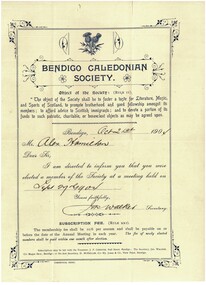
Document - HAMILTON COLLECTION: MEMBERSHIP ACCEPTANCE, 21 october 1904
... ...Membership Accepted...PERFORMING ARTS Elocution Membership Accepted Document. Letter to Mr Alex Hamilton advising him that he had been accepted as a member of the Bendigo Caledonian Society, October 21st 1904. ...Document. Letter to Mr Alex Hamilton advising him that he had been accepted as a member of the Bendigo Caledonian Society, October 21st 1904.performing arts, elocution, membership accepted -
 Bendigo Historical Society Inc.
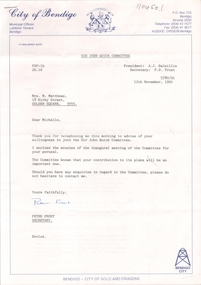
Document - Sir John Quick Committee, Michele Matthews Collection, 04/02/2025
... Letter to Michele Matthews accepting membership of the Committee and Minutes of the first meeting (30.10.91) Members attending inaugural meeting. ...Letter to Michele Matthews accepting membership of the Committee and Minutes of the first meeting (30.10.91) Members attending inaugural meeting. ...The Sir John Quick Committee was formed in 1991 to commemorate the achievements of Sir John Quick who played a prominent role in the federation of Australia. The Committee aimed to raise awareness of the contribution of Sir John Quick and to ensure that he was recognized for the part he played.Bendigo Advertiser article (9.11.91) announcing the inaugural meeting of the Sir John Quick Committee. Letter to Michele Matthews accepting membership of the Committee and Minutes of the first meeting (30.10.91) Members attending inaugural meeting. Committee: Cr John Balsillie (Chairman), Cr. Daniel Mulqueen, Professor Richard Sneddon, Dr. Charles Fahey, Mr George Ellis, Mr. P. Frost. sir john quick, federation, john balsillie -
 City of Moorabbin Historical Society (Operating the Box Cottage Museum)
Newsletter - City of Moorabbin Historical Society Nov. 2015, November 2015
... Mrs Lorna Thatcher was recognised for her long service to CMHS with Life Membership accepted by members. Open Days are listed with an invitation for new members showing the benefits and duties of CMHS membership. ...Mrs Lorna Thatcher was recognised for her long service to CMHS with Life Membership accepted by members. Open Days are listed with an invitation for new members showing the benefits and duties of CMHS membership. ...This is Vol. 4 of the Moorabbin Mirror produced by CMHS members Fran & Holger Bader , Valma Sharp November 2015 The Moorabbin Mirror reflects the history and heritage of the former City of Moorabbin - derived from Mooroobin, ' a resting place' in the Bunurrung spoken language. In 1994 the City of Moorabbin was integrated into the Cities of Bayside, Glen Eira, Kingston and Monash. Members are asked to assist GECC Arts & Culture Dept. with information about the Caulfield Repatriation Hospital. Fran compiled a brief history of the 'Garden Suburb of Ormond, Henry Lawson and ANA Society with a contribution from Rosemary Kelleher describing her father Brian's love of poetry. All members are invited to attend the final Open day on November 29th to join with the Henry Lawson Society and ANA for their Annual Brian Kelleher Memorial Picnic . Photographs of the CMHS at Bunnings, Stanley's Menswear and the 'Unmentionables' display at Box Cottage are included in this issue. The CMHS thanks the retiring President Frank Thatcher and Treasurer Bill Richardson for their work for the Society and welcomes the incoming Committee lead by Mrs Valma Sharp President. Mrs Lorna Thatcher was recognised for her long service to CMHS with Life Membership accepted by members. Open Days are listed with an invitation for new members showing the benefits and duties of CMHS membership. CMHS thanks The Office of the Hon. Andrew Robb AO MP Minister for Trade & Investment, Federal Member for Goldstein, who photocopied this newsletter under community printing entitlements.A4 x 3 paper folded to A5 x 4 pages with colour photographsMoorabbin / Mirror / November 2015 Issue 4moorabbin mirror, bader fran, bader holger, sharp valma,gallipoli landings 1915, robertson macpherson, reitman august, brighton cemetery, bendigo bank ormond, stanley's menwear bentleigh, glen eira historical society, glen eira city council,, thatcher lorna, thatcher frank, richardson bill, henry lawson society, ana society, kelleher brian, sharp valma, monash, kingston, bayside, -
 Melbourne Legacy
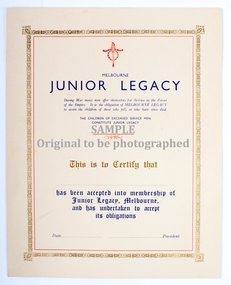
Certificate, Junior Legacy Club, 1944
... A certificate issued to Dulcie Saker to certify she has been accepted into membership of Junior Legacy Melbourne, and has undertaken to accept it's obligations. ...A certificate issued to Dulcie Saker to certify she has been accepted into membership of Junior Legacy Melbourne, and has undertaken to accept it's obligations. ...A certificate issued to Dulcie Saker to certify she has been accepted into membership of Junior Legacy Melbourne, and has undertaken to accept it's obligations. The junior legatee Dulcie Saker, later called Dulcie Cedaro, had a long involvement with Legacy. She would volunteer during badge week and help with the disabled dependants outings. Photo TBAA record of the formalisation process of Junior Legacy membership in 1944.Printed Junior Legacy Membership Certificate on cream card under glass in wooden frame.Inscribed to Dulcie Saker, dated 26th August 1944 and signed T. M. Cosh (Legacy president in 1944)junior legatee, membership, girls' club -
 Melbourne Legacy
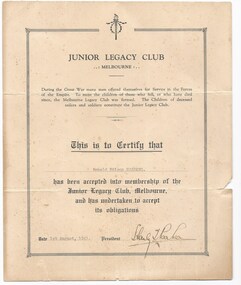
Certificate - Document, certificate, 1941
... membership and importance given to being part of Junior Legacy, Melbourne. Text on the certificate: 'During the Great War many men offered themselves for Service in the Forces of the Empire. To assist the children of those who fell, or who have died since, the Melbourne Legacy Club was formed. The Children of deceased sailors and soldiers constitute the Junior Legacy Club.' Also: that the recipient 'had been accepted... into membership of the Junior Legacy Club, Melbourne and has undertaken to accept its obligations.' ...A certificate that was given by Melbourne Legacy to Junior Legatees. This was presented to Ronald Edison Harding on the 1st August 1941 and signed by the President Stanley Parkes. A good representation of the process of membership and importance given to being part of Junior Legacy, Melbourne. Text on the certificate: 'During the Great War many men offered themselves for Service in the Forces of the Empire. To assist the children of those who fell, or who have died since, the Melbourne Legacy Club was formed. The Children of deceased sailors and soldiers constitute the Junior Legacy Club.' Also: that the recipient 'had been accepted into membership of the Junior Legacy Club, Melbourne and has undertaken to accept its obligations.'A record of the formalisation process of Junior Legacy membershipPrinted certificate for membership in Junior Legacy Melbourne, this one was presented to Ronald Eidson Harding in 1941.Typed is the recipients name Ronald Edison Harding and the date 1st August 1941. Ink signature of Stanley Parkes.junior legatee, membership -
 Red Cliffs Military Museum
Booklet, Eric Stephenson, Your Badge, 1945 (estimated)
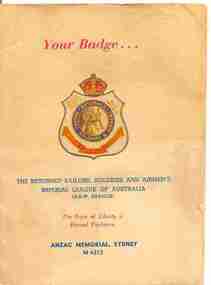
... accepts the new obligations to protect/ the interests of all who shall serve the Empire/ in the present war.// Page 1: A Welcome home/ From your Reception Committee/ The Old and New Diggers.// Page 2& 3: A Message from the State President.// Page 4: Policy of the RSS&AILA.// Pages 5,6,7: R.S.L. Policy.// Pages 8,9,10 & 11: Record of Service (outlines the services the RSL provides and the Principles on which it was established.// Pages 12, 13, 14, 15, 16 & 17: List of Sub-Branches NSW. Women's Services/ Merchant Navy// Centre Page: Nomination for Membership...accepts the new obligations to protect/ the interests of all who shall serve the Empire/ in the present war.// Page 1: A Welcome home/ From your Reception Committee/ The Old and New Diggers.// Page 2& 3: A Message from the State President.// Page 4: Policy of the RSS&AILA.// Pages 5,6,7: R.S.L. Policy.// Pages 8,9,10 & 11: Record of Service (outlines the services the RSL provides and the Principles on which it was established.// Pages 12, 13, 14, 15, 16 & 17: List of Sub-Branches NSW. Women's Services/ Merchant Navy// Centre Page: Nomination for Membership ...A booklet of the Returned Sailors, Soldiers and Airmen's Imperial League of Australia NSW Branch. Front cover has the original RSL badge printed above the Price of Liberty is Eternal Vigilance. ANZAC Memorial Sydney M4313Front Cover: YOUR BADGE/ colour picture of original RSL Badge./ THE RETURNED SAILORS, SOLDIERS & AIRMEN'S IMPERIAL LEAGUE OF AUSTRALIA/ (NSW BRANCH)/ THE PRICE OF LIBERTY IS/ ETERNAL VIGILANCE/ ANZAC MEMORIAL SYDNEY/ M4313// Inside Cover: THE LEAGUES PLEDGE/ November 1939./ "That this Federal congress - the first to be held since the declaration of war/ publicly states that the whole body of the/ RSS&AILA is heart and sole behind/ the new Australian Expiditionary Force, and/ gladly accepts the new obligations to protect/ the interests of all who shall serve the Empire/ in the present war.// Page 1: A Welcome home/ From your Reception Committee/ The Old and New Diggers.// Page 2& 3: A Message from the State President.// Page 4: Policy of the RSS&AILA.// Pages 5,6,7: R.S.L. Policy.// Pages 8,9,10 & 11: Record of Service (outlines the services the RSL provides and the Principles on which it was established.// Pages 12, 13, 14, 15, 16 & 17: List of Sub-Branches NSW. Women's Services/ Merchant Navy// Centre Page: Nomination for Membership // Pages 18,19,20,& 21: War Pensions.// Page 22: Did you know.//Page 23: Eligiblity for Membership.// Page 24: If there were no League. // Pages 25, 26: ANZAC Centre. // Page 27: Memorandum (clear page)// Page 28 Personal memoranda (to be filled in) Conclusion.book, anzac, imperial, sailors, soldiers, league, badge, your, returned, airmen, memorial, hand -
 Bendigo Historical Society Inc.
Document - JOHN FREDERICK HARPER COLLECTION:LODGE REGALIA PRINTED MEMBERSHIP CERTIFICATE, 22 September 1965
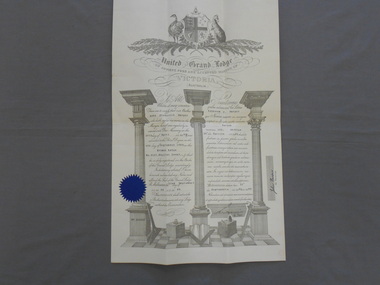
... membership certificate Document. Certificate with the Crest of the United Grand Lodge of Ancient, Free and Accepted Masons of Victoria Australia. ...Document. Certificate with the Crest of the United Grand Lodge of Ancient, Free and Accepted Masons of Victoria Australia. It explains that John Frederick Harper was regularly received into Free Masonry on the 26th day of April, A.L 65 and was admitted to the Third Degree on the 4th day of September 1965 in the Erimus Lodge RO 5021 English Const. In testimony where of I have to hereto subscribed my name and affixed the seal of the Grand Lodge at Melbourne the 22nd day of September AD 1965.document, certificate, lodge membership certificate -
Stawell Historical Society Inc
Memorabilia, Regalia Supplies, Masonic Lodge Memoribillia, 1929 & 1986
... Masonic Vest and Cumberband, Gloves, Bow Tie, & White Lamb Skin Masonic Apron, Life Membership Badge & centenary Badge and Certificate (Instillation) of Acceptence to Numurkah Lodge. ...Three Generations of Masonic Lodge Memebrs Lodge Regalia Kenneth John Hill William John Hill Masonic Vest and Cumberband, Gloves, Bow Tie, & White Lamb Skin Masonic Apron, Life Membership Badge & centenary Badge and Certificate (Instillation) of Acceptence to Numurkah Lodge. ...Three Generations of Masonic Lodge MemebrsMasonic Vest and Cumberband, Gloves, Bow Tie, & White Lamb Skin Masonic Apron, Life Membership Badge & centenary Badge and Certificate (Instillation) of Acceptence to Numurkah Lodge. Belonging to Kenneth John Hill. 1986 Certificate of (Istillation) Acceptence to Euroka Morning Star Lodge Stawell & Clearence Certificate for William John Hill ( Grandfather) May 1929 & 1932Kenneth John Hill William John Hilllodge, regalia -
 National Wool Museum
Book, The Australian Woolclassers' Handbook 1966-1967, 1966
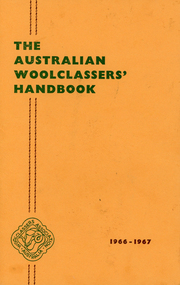
... accepted a donation from Brian Licence in 2022 of several mementoes relating to his career in the wool industry. Brian studied Wool Classing and worked for a decade in this profession before moving to Melbourne which required him to change careers. This Wool Classers’ Handbook was given to Brian in 1966 as part of his membership...accepted a donation from Brian Licence in 2022 of several mementoes relating to his career in the wool industry. Brian studied Wool Classing and worked for a decade in this profession before moving to Melbourne which required him to change careers. This Wool Classers’ Handbook was given to Brian in 1966 as part of his membership ...The National Wool Museum accepted a donation from Brian Licence in 2022 of several mementoes relating to his career in the wool industry. Brian studied Wool Classing and worked for a decade in this profession before moving to Melbourne which required him to change careers. This Wool Classers’ Handbook was given to Brian in 1966 as part of his membership to the Woolclassers’ Association of Australia. Brian was a member of the Woolclassers’ Association from 1962-72. The Woolclassers' Association of Australia was a trade union representing Woolclassers. It amalgamated with the Australian Workers Union in 2009. The Association had 1200 members in 1997. The Australian Woolclassers' Handbook 1966-1967 begins with an orange cover. It has “The Australian Woolclassers’ Handbook” written at the top centre of the cover in green text. Internally, the book is typed and contains information which is of use for Woolclassers and their rights and responsibilities within the association. A selection of pages have been scanned to give an impression of the information within the booklet. The book is a 44-pages long.Printed, green text. Top of cover. “THE / AUSTRALIAN / WOOLCLASSERS’ / HANDBOOK. “ Printed, black text. Bottom right corner of cover “1966-1967” Printed, green text. Bottom left corner of cover. “WOOLCLASSERS / ASSOCIATION / AUSTRALIA” Printed, green ink. Bottom right corner of cover. Picture of Ram’s headwool classing, brian licence, woolclassers’ association of australia -
 National Wool Museum
Booklet - Member's Ticket, 1962-1972
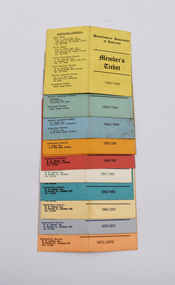
... accepted a donation from Brian Licence in 2022 of several mementoes relating to his career in the wool industry. Brian studied Wool Classing and worked for a decade in this profession before moving to Melbourne which required him to change careers. These Member’s Tickets served as proof of Brian’s membership...accepted a donation from Brian Licence in 2022 of several mementoes relating to his career in the wool industry. Brian studied Wool Classing and worked for a decade in this profession before moving to Melbourne which required him to change careers. These Member’s Tickets served as proof of Brian’s membership ...The National Wool Museum accepted a donation from Brian Licence in 2022 of several mementoes relating to his career in the wool industry. Brian studied Wool Classing and worked for a decade in this profession before moving to Melbourne which required him to change careers. These Member’s Tickets served as proof of Brian’s membership to the Woolclassers’ Association of Australia from 1962 to 1972. The Woolclassers' Association of Australia was a trade union representing Woolclassers in Australia. It amalgamated with the Australian Workers Union in 2009. The Association had 1200 members in 1997. 11 individual-coloured booklets, 10 original and 1 duplicate. The duplicate is from the year 1965/1966 when Brian Licence transferred from being a probationary member of the Woolclassers’ Association of Australia to a full member and hence received a new ticket which reflected this change. Internally, there is no difference in any of the booklets over the 10 years. Externally, there is only a slight change, with the Woolclassers’ Association of Australia's logo being included from 1965/1966 onwards. The booklets are a single piece of card folded at the middle to make 4 pages. The first page gives the name of the association, the year of issue, and in later years the Association's logo. Internally, the booklet provides the location of the Association, the name, address, and signature of who the booklet certifies, and details about the member’s rank, an Overseer, Expert, Full, or Probationary Member. The date and signature of the Secretary of the Association conclude the internal pages. On the rear page, the Head Offices of the Woolclassers’ Association of Australia branches in NSW, Victoria & Tasmania, South Australia, Western Australia, and Queensland are provided. Booklet one is on yellow card with black text and is for the years 1962/1963 Booklet two is on aqua card with black text and is for the years 1963/1964 Booklet three is on blue card with black text and is for the years 1964/1965 Booklet four is on orange card with black text and is for the years 1965/1966 Booklet five is on orange card with black text and is for the years 1966/1967 Booklet six is on red card with black text and is for the years 1967/1968 Booklet seven is on white card with green text and is for the years 1968/1969 Booklet eight is on turquoise card with black text and is for the years 1969/1970 Booklet nine is on cream card with black text and is for the years 1970/1971 Booklet ten is on a lavender card with blue text and is for the years 1971/1972 Booklet eleven is on peach card with black text and is for the years 1972/1973 Multiple. See multimediawool classing, brian licence, woolclassers’ association of australia -
 Wangaratta RSL Sub Branch
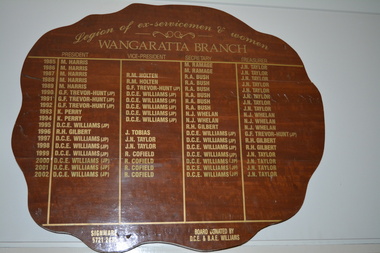
Honour Board, Signware, Legion of Ex-Servicemen & Women
... Formed in December 1944 from a number of existing organisations, membership of the legion is open to all ex-service personnel, including British Commonwealth and Allied personnel, and former members of the peace-time Australian regular and reserve forces, their families, relatives and other persons who abide by and are accepted in accordance with the Constitution. wangaratta legion ex-servicemen & women Legion of ex-servicemen & women, Wangaratta Branch, 1985 - 2002. ...Legion of ex Servicemen and Women - Wangaratta Branch Honour Board containing names of Office Bearers from 1985 to 2002.The Australian Legion of Ex-Servicemen and Women (Vic) Ltd (The Legion) is an ex-service based not for profit association. Formed in December 1944 from a number of existing organisations, membership of the legion is open to all ex-service personnel, including British Commonwealth and Allied personnel, and former members of the peace-time Australian regular and reserve forces, their families, relatives and other persons who abide by and are accepted in accordance with the Constitution.Solid piece of wood with gold writing, has five columns listing the year President, Vice-President Secretary, Treasurer, dating from 1985 to 2002.Legion of ex-servicemen & women, Wangaratta Branch, 1985 - 2002. Signware 5721 2430. wangaratta, legion, ex-servicemen & women -
 Wodonga & District Historical Society Inc
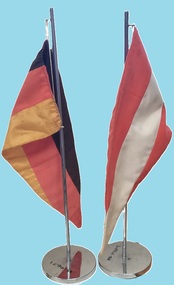
Memorabilia - German and Austrian miniature flags, Unknown
... accepted as members. Interest groups consisted of Competition Air Rifle Shooting Group, a Skat (German Card game) Group, Folk Dancing Group, Ladies Group, Table Tennis Group, Darts Group, Chess Group and the Billiard Group. In later years, as so many Australians became members, the Club’s name was changed to the German Austrian Australian Club. Over recent years patronage and interest in the Club and its activities changed. Children of the original members had become “real Aussies” and did not always want to carry on traditions. Aging membership...accepted as members. Interest groups consisted of Competition Air Rifle Shooting Group, a Skat (German Card game) Group, Folk Dancing Group, Ladies Group, Table Tennis Group, Darts Group, Chess Group and the Billiard Group. In later years, as so many Australians became members, the Club’s name was changed to the German Austrian Australian Club. Over recent years patronage and interest in the Club and its activities changed. Children of the original members had become “real Aussies” and did not always want to carry on traditions. Aging membership ...Thousands of German migrants started a new life at Bonegilla, Victoria in the 1950s. Among them were five men who met each other in Wodonga, became friends and decided to form a German Austrian Club, where they could enjoy the company of likeminded individuals. They were Kurt Mueller, Willi Klimt, Toni Krischa and Erwin Klein from Germany and Manfred Teissl from Austria. On the 16th July 1960, after advertising in the Border Morning Mail, the German Austrian Club in Wodonga was born. Office bearers were Paul Peters as President. Gerhard Ziermann as Secretary and Günter Schmehl as Treasurer. Their aim was "To promote the upkeep of the German language in written and spoken form and to promote good German fellowship, while enjoying functions of a cultural and entertaining nature". By 1963 the Club boasted 40 members, holding meetings at the RSL Clubrooms and other suitable locations before they found a house in Hovell Street, Wodonga. It was used for meetings, Skat meetings, film nights and "Sonnabendschule” or Saturday school where children of members could continue to learn German. The Committee organised a wide range of activities and functions in their small rooms but dreamed of having a bigger home. This became reality in July 1979, when the Committee purchased land from the Albury Wodonga Development Corporation at 5 McFarland Road, Wodonga. The first brick was laid on the Club's land in May 1980, and the double-storey brick building was completed within 12 months voluntarily by Club members. At the same time members supported other organisations and charities in the Wodonga and wider community. The first Oktoberfest in Wodonga was held in 1975, drawing 4,000 attendees. The event was organized to promote German culture, and the profits from the first year were donated to the Wodonga District Hospital, raising $20,000. In 2001 the German Austrian Club was presented with the Certificate of Meritorious Service by the Government of Victoria for Community Works in Wodonga and district. The Club raised $23,000 for the Wodonga Hospital, had numerous fundraisers to assist in bushfires and drought situations and was involved in the Red Cross Calling campaign for many years. After much fundraising, hard work and making their way through extensive government red tape, the Club moved to its new premises in McFarland Road on 1st August 1981. The members continued to make necessary internal adjustments and sought an alcohol licence. The building was officially opened in May 1983. The Club prospered and had 300 members, making it necessary for new applicants to be put on a waiting list to be accepted as members. Interest groups consisted of Competition Air Rifle Shooting Group, a Skat (German Card game) Group, Folk Dancing Group, Ladies Group, Table Tennis Group, Darts Group, Chess Group and the Billiard Group. In later years, as so many Australians became members, the Club’s name was changed to the German Austrian Australian Club. Over recent years patronage and interest in the Club and its activities changed. Children of the original members had become “real Aussies” and did not always want to carry on traditions. Aging membership and lack of volunteers forced the Club to disband in 2025. The Club building has been gifted to the Albury Wodonga Theatre Company.These items are significant because they are representative of an important cultural organisation which operated in Wodonga for over 60 years.Two small flags of Germany and Austria attached to metal stands with string. Each stand has a metal circular base. "Lufthansa" is inscribed on the base.On base: Lufthansagerman austrian australian club, german austrian club -
 Wodonga & District Historical Society Inc
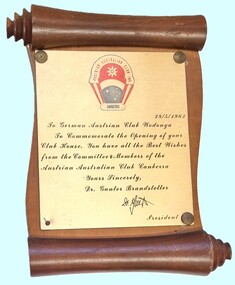
Plaque - German-Austrian Club Wodonga Opening, 1983
... accepted as members. Interest groups formed consisted of Competition Air Rifle Shooting Group, a Skat (German Card game) Group, Folk Dancing Group, Ladies Group, Table Tennis Group, Darts Group, Chess Group and the Billiard Group. In later years, as so many Australians became members, the Club’s name was changed to the German Austrian Australian Club. Over recent years patronage and interest in the Club and its activities changed. Children of the original members had become “real Aussies” and did not always want to carry on traditions. Aging membership...accepted as members. Interest groups formed consisted of Competition Air Rifle Shooting Group, a Skat (German Card game) Group, Folk Dancing Group, Ladies Group, Table Tennis Group, Darts Group, Chess Group and the Billiard Group. In later years, as so many Australians became members, the Club’s name was changed to the German Austrian Australian Club. Over recent years patronage and interest in the Club and its activities changed. Children of the original members had become “real Aussies” and did not always want to carry on traditions. Aging membership ...Thousands of German migrants started a new life at Bonegilla, Victoria in the 1950s. Among them were five men who met each other in Wodonga, became friends and decided to form a German Austrian Club, where they could enjoy the company of likeminded individuals. They were Kurt Mueller, Willi Klimt, Toni Krischa and Erwin Klein from Germany and Manfred Teissl from Austria. On the 16th July 1960, after advertising in the Border Morning Mail the German Austrian Club in Wodonga was born. Office bearers were Paul Peters as President. Gerhard Ziermann as Secretary and Günter Schmehl as Treasurer. Their aim was "To promote the upkeep of the German language in written and spoken form and to promote good German fellowship, while enjoying functions of a cultural and entertaining nature". By 1963 the Club boasted 40 members, holding meetings at the RSL Clubrooms and other suitable locations before they found a house in Hovell Street, Wodonga. It was used for meetings, Skat meetings, film nights and Sonnabendschule” or Saturday school where children of members could continue to learn German. The Committee organised a wide range of activities and functions in their small rooms but dreamed of having a bigger home. This became reality in July 1979, when the Committee purchased land from the Albury Wodonga Development Corporation at 5 McFarland Road, Wodonga. The first brick was laid on the Club's land in May 1980, and the double-story brick building was completed within 12 months voluntarily by Club members. At the same time members supported other organisations and charities in the Wodonga and wider community. The first Oktoberfest in Wodonga was held in 1975, drawing 4,000 attendees. The event was organized to promote German culture, and the profits from the first year were donated to the Wodonga District Hospital, raising $20,000. In 2001 the German Austrian Club was presented with the Certificate of Meritorious Service by the Government of Victoria for Community Works in Wodonga and district. The Club raised $23,000 for the Wodonga Hospital, had numerous fundraisers to assist in bushfires and drought situations and was involved in the Red Cross Calling campaign for many years. After much fundraising, hard work and making their way through extensive government red tape, the Club moved to its new premises in McFarland Road on 1st August 1981. The members continued to make necessary internal adjustments and sought an alcohol licence. The building was officially opened in May 1983. The Club prospered and had 300 members, making it necessary for new applicants to be put on a waiting list to be accepted as members. Interest groups formed consisted of Competition Air Rifle Shooting Group, a Skat (German Card game) Group, Folk Dancing Group, Ladies Group, Table Tennis Group, Darts Group, Chess Group and the Billiard Group. In later years, as so many Australians became members, the Club’s name was changed to the German Austrian Australian Club. Over recent years patronage and interest in the Club and its activities changed. Children of the original members had become “real Aussies” and did not always want to carry on traditions. Aging membership and lack of volunteers forced the Club to disband in 2025. The Club building has been gifted to the Albury Wodonga Theatre Company. These items are significant because they are representative of an important cultural organisation which operated in Wodonga for over 60 years.A metal plaque attached to a wooden backing shaped like a scroll. The text is in the form of a letter.Emblem of the Austrian - Australian Clubs Inc. Canberra 28/5/1983 To German Austrian Club Wodonga To Commemorate the Opening of your Club House. You have all the Best Wishes from the Committee & Members of the Austrian Australian Club Canberra Yours Sincerely, Dr. Gunter Brandstetter Presidentgerman austrian australian club, german migrants wodonga -
 Wodonga & District Historical Society Inc
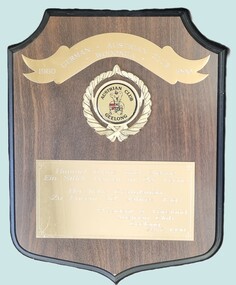
Plaque - German-Austrian Club Wodonga 30th Anniversary, 1990
... accepted as members. Interest groups formed consisted of Competition Air Rifle Shooting Group, a Skat (German Card game) Group, Folk Dancing Group, Ladies Group, Table Tennis Group, Darts Group, Chess Group and the Billiard Group. In later years, as so many Australians became members, the Club’s name was changed to the German Austrian Australian Club. Over recent years patronage and interest in the Club and its activities changed. Children of the original members had become “real Aussies” and did not always want to carry on traditions. Aging membership...accepted as members. Interest groups formed consisted of Competition Air Rifle Shooting Group, a Skat (German Card game) Group, Folk Dancing Group, Ladies Group, Table Tennis Group, Darts Group, Chess Group and the Billiard Group. In later years, as so many Australians became members, the Club’s name was changed to the German Austrian Australian Club. Over recent years patronage and interest in the Club and its activities changed. Children of the original members had become “real Aussies” and did not always want to carry on traditions. Aging membership ...Thousands of German migrants started a new life at Bonegilla, Victoria in the 1950s. Among them were five men who met each other in Wodonga, became friends and decided to form a German Austrian Club, where they could enjoy the company of likeminded individuals. They were Kurt Mueller, Willi Klimt, Toni Krischa and Erwin Klein from Germany and Manfred Teissl from Austria. On the 16th July 1960, after advertising in the Border Morning Mail the German Austrian Club in Wodonga was born. Office bearers were Paul Peters as President. Gerhard Ziermann as Secretary and Günter Schmehl as Treasurer. Their aim was "To promote the upkeep of the German language in written and spoken form and to promote good German fellowship, while enjoying functions of a cultural and entertaining nature". By 1963 the Club boasted 40 members, holding meetings at the RSL Clubrooms and other suitable locations before they found a house in Hovell Street, Wodonga. It was used for meetings, Skat meetings, film nights and Sonnabendschule” or Saturday school where children of members could continue to learn German. The Committee organised a wide range of activities and functions in their small rooms but dreamed of having a bigger home. This became reality in July 1979, when the Committee purchased land from the Albury Wodonga Development Corporation at 5 McFarland Road, Wodonga. The first brick was laid on the Club's land in May 1980, and the double-story brick building was completed within 12 months voluntarily by Club members. At the same time members supported other organisations and charities in the Wodonga and wider community. The first Oktoberfest in Wodonga was held in 1975, drawing 4,000 attendees. The event was organized to promote German culture, and the profits from the first year were donated to the Wodonga District Hospital, raising $20,000. In 2001 the German Austrian Club was presented with the Certificate of Meritorious Service by the Government of Victoria for Community Works in Wodonga and district. The Club raised $23,000 for the Wodonga Hospital, had numerous fundraisers to assist in bushfires and drought situations and was involved in the Red Cross Calling campaign for many years. After much fundraising, hard work and making their way through extensive government red tape, the Club moved to its new premises in McFarland Road on 1st August 1981. The members continued to make necessary internal adjustments and sought an alcohol licence. The building was officially opened in May 1983. The Club prospered and had 300 members, making it necessary for new applicants to be put on a waiting list to be accepted as members. Interest groups formed consisted of Competition Air Rifle Shooting Group, a Skat (German Card game) Group, Folk Dancing Group, Ladies Group, Table Tennis Group, Darts Group, Chess Group and the Billiard Group. In later years, as so many Australians became members, the Club’s name was changed to the German Austrian Australian Club. Over recent years patronage and interest in the Club and its activities changed. Children of the original members had become “real Aussies” and did not always want to carry on traditions. Aging membership and lack of volunteers forced the Club to disband in 2025. The Club building has been gifted to the Albury Wodonga Theatre Company.This item is significant because it is representative of an important cultural organisation which operated in Wodonga for over 60 years.A wooden plaque with metal insignia and a plate with text in German. This plaque was presented by the German Austrian Club of Geelong on the occasion of the 30th Anniversary of the Wodonga Club and bears its insignia.Himmel Glanz und Sterne Ein Stuck Heimat in Der Fern Herzliche Gratulation Zu Eurem 30 Jahres Tag President and Vorstand Translation Sky, splendour and stars A piece of home away from home Congratulations On your 30th anniversary President and Board of Directorsgerman austrian australian club, german migrants wodonga -
 Wodonga & District Historical Society Inc
Plaque - German-Austrian Club Wodonga 40th Anniversary, 2000
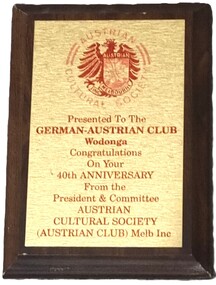
... accepted as members. Interest groups formed consisted of Competition Air Rifle Shooting Group, a Skat (German Card game) Group, Folk Dancing Group, Ladies Group, Table Tennis Group, Darts Group, Chess Group and the Billiard Group. In later years, as so many Australians became members, the Club’s name was changed to the German Austrian Australian Club. Over recent years patronage and interest in the Club and its activities changed. Children of the original members had become “real Aussies” and did not always want to carry on traditions. Aging membership...accepted as members. Interest groups formed consisted of Competition Air Rifle Shooting Group, a Skat (German Card game) Group, Folk Dancing Group, Ladies Group, Table Tennis Group, Darts Group, Chess Group and the Billiard Group. In later years, as so many Australians became members, the Club’s name was changed to the German Austrian Australian Club. Over recent years patronage and interest in the Club and its activities changed. Children of the original members had become “real Aussies” and did not always want to carry on traditions. Aging membership ...Thousands of German migrants started a new life at Bonegilla, Victoria in the 1950s. Among them were five men who met each other in Wodonga, became friends and decided to form a German Austrian Club, where they could enjoy the company of likeminded individuals. They were Kurt Mueller, Willi Klimt, Toni Krischa and Erwin Klein from Germany and Manfred Teissl from Austria. On the 16th July 1960, after advertising in the Border Morning Mail the German Austrian Club in Wodonga was born. Office bearers were Paul Peters as President. Gerhard Ziermann as Secretary and Günter Schmehl as Treasurer. Their aim was "To promote the upkeep of the German language in written and spoken form and to promote good German fellowship, while enjoying functions of a cultural and entertaining nature". By 1963 the Club boasted 40 members, holding meetings at the RSL Clubrooms and other suitable locations before they found a house in Hovell Street, Wodonga. It was used for meetings, Skat meetings, film nights and Sonnabendschule” or Saturday school where children of members could continue to learn German. The Committee organised a wide range of activities and functions in their small rooms but dreamed of having a bigger home. This became reality in July 1979, when the Committee purchased land from the Albury Wodonga Development Corporation at 5 McFarland Road, Wodonga. The first brick was laid on the Club's land in May 1980, and the double-story brick building was completed within 12 months voluntarily by Club members. At the same time members supported other organisations and charities in the Wodonga and wider community. The first Oktoberfest in Wodonga was held in 1975, drawing 4,000 attendees. The event was organized to promote German culture, and the profits from the first year were donated to the Wodonga District Hospital, raising $20,000. In 2001 the German Austrian Club was presented with the Certificate of Meritorious Service by the Government of Victoria for Community Works in Wodonga and district. The Club raised $23,000 for the Wodonga Hospital, had numerous fundraisers to assist in bushfires and drought situations and was involved in the Red Cross Calling campaign for many years. After much fundraising, hard work and making their way through extensive government red tape, the Club moved to its new premises in McFarland Road on 1st August 1981. The members continued to make necessary internal adjustments and sought an alcohol licence. The building was officially opened in May 1983. The Club prospered and had 300 members, making it necessary for new applicants to be put on a waiting list to be accepted as members. Interest groups formed consisted of Competition Air Rifle Shooting Group, a Skat (German Card game) Group, Folk Dancing Group, Ladies Group, Table Tennis Group, Darts Group, Chess Group and the Billiard Group. In later years, as so many Australians became members, the Club’s name was changed to the German Austrian Australian Club. Over recent years patronage and interest in the Club and its activities changed. Children of the original members had become “real Aussies” and did not always want to carry on traditions. Aging membership and lack of volunteers forced the Club to disband in 2025. The Club building has been gifted to the Albury Wodonga Theatre Company.This item is significant because it is representative of an important cultural organisation which operated in Wodonga for over 60 years.A small metal plaque on a wooden backing with red text. It includes the insignia of the Austrian Cultural Society of Melbourne.Presented To The GERMAN-AUSTRIAN CLUB Wodonga Congratulations On Your 40th ANNIVERSARY From the President & Committee AUSTRIAN CULTURAL SOCIETY (AUSTRIAN CLUB) Melb Incgerman austrian australian club, german migrants wodonga -
 Wodonga & District Historical Society Inc
Plaque - German-Austrian Club Wodonga 50th Anniversary, 2010
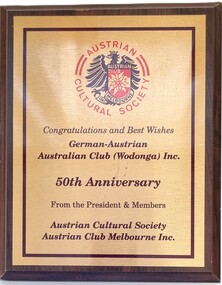
... accepted as members. Interest groups formed consisted of Competition Air Rifle Shooting Group, a Skat (German Card game) Group, Folk Dancing Group, Ladies Group, Table Tennis Group, Darts Group, Chess Group and the Billiard Group. In later years, as so many Australians became members, the Club’s name was changed to the German Austrian Australian Club. Over recent years patronage and interest in the Club and its activities changed. Children of the original members had become “real Aussies” and did not always want to carry on traditions. Aging membership...accepted as members. Interest groups formed consisted of Competition Air Rifle Shooting Group, a Skat (German Card game) Group, Folk Dancing Group, Ladies Group, Table Tennis Group, Darts Group, Chess Group and the Billiard Group. In later years, as so many Australians became members, the Club’s name was changed to the German Austrian Australian Club. Over recent years patronage and interest in the Club and its activities changed. Children of the original members had become “real Aussies” and did not always want to carry on traditions. Aging membership ...Thousands of German migrants started a new life at Bonegilla, Victoria in the 1950s. Among them were five men who met each other in Wodonga, became friends and decided to form a German Austrian Club, where they could enjoy the company of likeminded individuals. They were Kurt Mueller, Willi Klimt, Toni Krischa and Erwin Klein from Germany and Manfred Teissl from Austria. On the 16th July 1960, after advertising in the Border Morning Mail the German Austrian Club in Wodonga was born. Office bearers were Paul Peters as President. Gerhard Ziermann as Secretary and Günter Schmehl as Treasurer. Their aim was "To promote the upkeep of the German language in written and spoken form and to promote good German fellowship, while enjoying functions of a cultural and entertaining nature". By 1963 the Club boasted 40 members, holding meetings at the RSL Clubrooms and other suitable locations before they found a house in Hovell Street, Wodonga. It was used for meetings, Skat meetings, film nights and Sonnabendschule” or Saturday school where children of members could continue to learn German. The Committee organised a wide range of activities and functions in their small rooms but dreamed of having a bigger home. This became reality in July 1979, when the Committee purchased land from the Albury Wodonga Development Corporation at 5 McFarland Road, Wodonga. The first brick was laid on the Club's land in May 1980, and the double-story brick building was completed within 12 months voluntarily by Club members. At the same time members supported other organisations and charities in the Wodonga and wider community. The first Oktoberfest in Wodonga was held in 1975, drawing 4,000 attendees. The event was organized to promote German culture, and the profits from the first year were donated to the Wodonga District Hospital, raising $20,000. In 2001 the German Austrian Club was presented with the Certificate of Meritorious Service by the Government of Victoria for Community Works in Wodonga and district. The Club raised $23,000 for the Wodonga Hospital, had numerous fundraisers to assist in bushfires and drought situations and was involved in the Red Cross Calling campaign for many years. After much fundraising, hard work and making their way through extensive government red tape, the Club moved to its new premises in McFarland Road on 1st August 1981. The members continued to make necessary internal adjustments and sought an alcohol licence. The building was officially opened in May 1983. The Club prospered and had 300 members, making it necessary for new applicants to be put on a waiting list to be accepted as members. Interest groups formed consisted of Competition Air Rifle Shooting Group, a Skat (German Card game) Group, Folk Dancing Group, Ladies Group, Table Tennis Group, Darts Group, Chess Group and the Billiard Group. In later years, as so many Australians became members, the Club’s name was changed to the German Austrian Australian Club. Over recent years patronage and interest in the Club and its activities changed. Children of the original members had become “real Aussies” and did not always want to carry on traditions. Aging membership and lack of volunteers forced the Club to disband in 2025. The Club building has been gifted to the Albury Wodonga Theatre Company.This item is significant because it is representative of an important cultural organisation which operated in Wodonga for over 60 years.A small metal plaque on a wooden backing with red text. It includes the insignia of the Austrian Cultural Society of Melbourne.Congratulations and Best Wishes German-Austrian Australian Club (Wodonga) Inc. 50th Anniversary From the President & Members Austrian Cultural Society Austrian Club Melbourne Inc.german austrian australian club, german migrants wodonga -
 Melbourne Legacy
Document, Reference President's Secret Committee on Candidates for membership, 1966
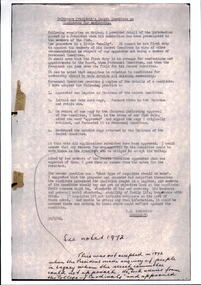
... A record of a defunct committee once used by the President of Legacy. secret committee membership Handwritten note on bottom of page 1 'see notes 1972. This was not accepted in 1972 when the President made enquiry of people in Legacy whom the secret committee could not approach. ...A note for the President's folder about recruiting a secret committee of advisers to help with proposed new members. The second page is a draft of a letter thanking the candidate for agreeing to be on the committee. The third page talks about the committee and is crossed out in blue pen and a note saying 'No longer operative'. Was in a binder of documents that is passed from an outgoing President to the incoming President. It is primarily from the 1930s to 1990s. Most documents are being catalogued separately.A record of a defunct committee once used by the President of Legacy.White A4 paper x 3 pages with black type about a Secret Committee appointed by the President, written in 1966.Handwritten note on bottom of page 1 'see notes 1972. This was not accepted in 1972 when the President made enquiry of people in Legacy whom the secret committee could not approach. He also took advice from the 'College of Cardinals' and approved ...'secret committee, membership -
Northern District School of Nursing. Managed by Bendigo Historical Society Inc.
Newsletter - Northern District School of Nursing Graduates Association - Second Reunion Newsletter, 20 April 1985
... membership and staying informed. Reunions are held every five years, unlike annual hospital-based reunions. Announcement that nursing education will move to colleges, with several institutions already accepting students. ...membership and staying informed. Reunions are held every five years, unlike annual hospital-based reunions. Announcement that nursing education will move to colleges, with several institutions already accepting students. ...The Northern District School of Nursing in Victoria, Australia Graduates Association: Here are the key points from the Northern District School of Nursing Graduates Association reunion invitation and report: Lists of committee members for 1980–1985 and 1985–1990 are provided, including roles and contact details. Membership form included; subscription is $5 for five years (1985–1990).Members are encouraged to update their addresses and invite other graduates to join. Current membership is 234, with 380 invitations sent and about 4,000 total graduates. Recent Reunion Recap:Held on April 20, 1985, at "Lister House" in Bendigo.164 past graduates attended, with representation from four Australian states. Activities included registration, morning tea, tours of Lister House, lunch, and a lecture. Special guests included former tutors and a mother-daughter pair of graduates. Flowers were presented to committee members in appreciation. Next reunion scheduled for April 1990. Questionnaire included to gather preferences for venue, timing, and activities.The N.D.S.N. magazine is no longer produced; this letter serves as the main communication.Graduates are responsible for ensuring their membership and staying informed. Reunions are held every five years, unlike annual hospital-based reunions. Announcement that nursing education will move to colleges, with several institutions already accepting students. Details on new training structure: 1,800 hours study and 1,800 hours clinical work.Financial aspects: estimated $7,500 per student per year, with federal and state government contributions. Hospitals will need to replace trainees with trained staff.Northern District School of Nursing Graduates Association - Second Reunion Newsletter - A4 size 6 pages printed by D G Walker Ltd Railway Place Bendigo This item contains the following document: 3792.5a Northern District School of Nursing Graduates Association - Second Reunion Newsletter - A4 size 6 pages printed by D G Walker Ltd Railway Place Bendigo 3792.5b Copy of abovenurse training, lister house, history, second reunion -
 Northern District School of Nursing. Managed by Bendigo Historical Society Inc.
Document - NDSN Staff Nurse Course - three letters addressed to Mrs. J. O'Shea re Reunion Invitations, March 1980
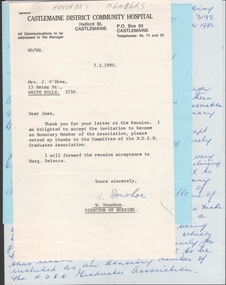
... Each accepting the invitation and their Honorary Membership of the Association. ...Each accepting the invitation and their Honorary Membership of the Association. ...The Northern District School of Nursing opened in 1950 to address the issues around nurse recruitment, training and education that had previously been hospital based. The residential school was to provide theoretical and in-house education and practical training over three years. The students would also receive practical hands-on training in the wards of associated hospitals. The Northern District School of Nursing operated from Lister House, Rowan Street, Bendigo. It was the first independent school of nursing in Victoria and continued until it closed in 1989.Three letters from (W. Donohue, Marjorie Turner & Margot Scott) re their invitation to attend the Northern District School of Nursing Reunion invitation; and to becoming an Honorary Member of the Association. Each accepting the invitation and their Honorary Membership of the Association. Two letters handwritten and one (W. Donohue from Castlemaine District Community Hospital) responses dated March 1980.nurse education, nursing administration -
 Vision Australia
Administrative record - Text, Australian and New Zealand Association of Teachers of the Blind council meeting minutes 16/1/1958 to 17/1/1972, 1958-1972
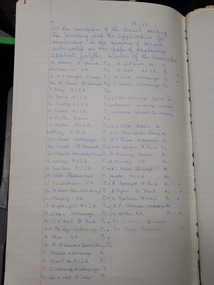
... The New Zealand teachers had accepted to join AATB and the name of the organisation had been updated to The Australian and New Zealand Association of Teachers of the Blind (ANZATB). The membership...The New Zealand teachers had accepted to join AATB and the name of the organisation had been updated to The Australian and New Zealand Association of Teachers of the Blind (ANZATB). The membership ...The minutes contain present, apologies, minutes of last meeting, correspondence, financial, general business. The Australian Association of Teachers of the Blind (AATB) noted in the minutes on 17/1/1958 that the Council on behalf of the Association invite the New Zealand teachers of the blind to join AATB. The New Zealand teachers had accepted to join AATB and the name of the organisation had been updated to The Australian and New Zealand Association of Teachers of the Blind (ANZATB). The membership comprised of Honorary Life Members, Professional Members, Associate Members and Affiliate Members. The minutes do not document an official name change however from July, 1970 the minutes had been headed as Australian and New Zealand Association of Teachers of the Visually Handicapped (ANZATVH).1 volume of handwritten and typed pages, glued or taped to pagesroyal victorian institute for the blind, st lucy's school, st paul's school for the blind, st edmund's school, queensland deaf and blind school -
 University of Melbourne, Burnley Campus Archives
Plaque - Plaque and Research Agreement, The International Plant Propagators' Society Five Year Membership Recognition Plaque and Research Agreement Document, 1995 -2013
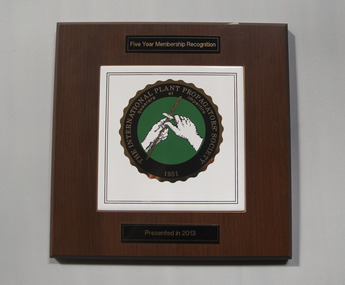
... Membership Recognition (2008-2013). Presented in 2013 to the college. 2. Letter to Mr Ross Gregory Hall, Senior Lecturer (Production Management) dated 25 October 1995 from Jolyon Burnett of the Horticultural Research and Development Corporation (NSW) accepting his application for funding of the NY538 International Plant Propagators Society Australian Region Annual Conference Melbourne May 1996 3. ...Membership Recognition (2008-2013). Presented in 2013 to the college. 2. Letter to Mr Ross Gregory Hall, Senior Lecturer (Production Management) dated 25 October 1995 from Jolyon Burnett of the Horticultural Research and Development Corporation (NSW) accepting his application for funding of the NY538 International Plant Propagators Society Australian Region Annual Conference Melbourne May 1996 3. ...Plaque was presented in 2013 and was hung on the staff room walls until 2015. The letter to Ross Gregory Hall was written by Jolyon Burnett, Senior Industry Program Manager, granting funding for NY538 International Propagators Society Australian Region Annual Conference, Melbourne, May 1996. The agreement between The Horticultural Research and Development Corporation and the Faculty of Agriculture, Forestry and Horticulture for this project was signed by Gregory Moore, Principal of the College in 1995.1. Commerative plaque mounted on bevilled varnished wooden board for Five Year Membership Recognition (2008-2013). Presented in 2013 to the college. 2. Letter to Mr Ross Gregory Hall, Senior Lecturer (Production Management) dated 25 October 1995 from Jolyon Burnett of the Horticultural Research and Development Corporation (NSW) accepting his application for funding of the NY538 International Plant Propagators Society Australian Region Annual Conference Melbourne May 1996 3. Research Agreement between The Horticultural Research and Development Corporation and the Faculty of Agriculture, Forestry and Horticulture - Burnley for an approved NY538 project. Signed by Gregory Moore Principal of the College 27/11/1995 (6 A4 pages)1. Five Year Membership Recognition THE INTERNATIONAL PLATN PROPAGATORS' SOCIETY 1951 quaerere et impertire Presented in 2013. Logo in center.ross gregory hall, jolyon burnett, gregory moore, international plant propagators' society, annual conference 1996, burnley college, artifact -
 Melbourne Legacy
Badge, Legatee Frank Alsope's Member Badge
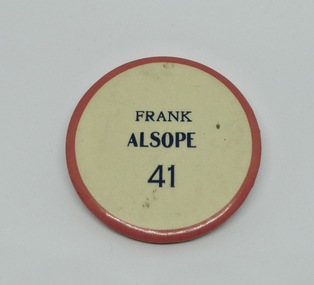
... The number 41 appears to be Legatee Alsope's membership number, which shows that initially members kept track of the order in which they were accepted into Legacy. ...The number 41 appears to be Legatee Alsope's membership number, which shows that initially members kept track of the order in which they were accepted into Legacy. ...An example of a Legatee's badge. These badges were issued to all Legatees to show their name. The number 41 appears to be Legatee Alsope's membership number, which shows that initially members kept track of the order in which they were accepted into Legacy. In the early years of Legacy, membership was restricted to a limited number of members and to those that had skills and abilities that were required. Legatee badges are still circular in shape.An example of an early Legacy badge that Legatees wore.Round metal badge with white background, red border and 'Frank Alsope 41' in blue text.Printed in blue text 'Frank Alsope 41'frank alsope, legatee -
 Melbourne Legacy
Badge, Junior Legacy Club Badge
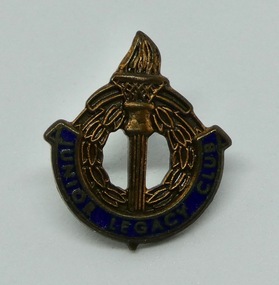
... accepted into Junior Legacy club in 1940. A record of the badge given to junior legatees when they joined Legacy. junior legatee membership JLC Junior Legacy Club Bronze lapel pin x 2 with the Legacy torch and the words Junior Legacy Club in dark blue enamel. ...An example of a Junior Legacy Badge. These were worn by junior legatees. The age of the pin is not known, though it appears older than the 10 pins at 01704. The badge of Legacy is the Torch and Wreath of Laurel. The Torch signifies the undying flame of service and sacrifice of those who gave their lives for their country. The Wreath of Laurel is the symbol of our remembrance of them. It was part of a collection of Legacy items from Valma Hutchinson (nee Wigg), a former junior legatee. Valma was accepted into Junior Legacy club in 1940.A record of the badge given to junior legatees when they joined Legacy.Bronze lapel pin x 2 with the Legacy torch and the words Junior Legacy Club in dark blue enamel. Each badge has a post and a separate butterfly clutch.Junior Legacy Clubjunior legatee, membership, jlc -
 Melbourne Legacy
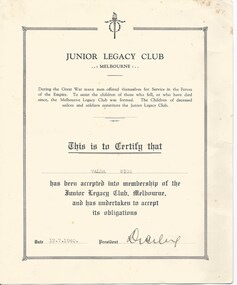
Certificate, Junior Legacy Club, 1940
... accepted into Junior Legacy club in 1940 when she was about 10 years old. An example of the formality surrounding enrolment into Junior Legacy. junior legatee girls' classes JLC Typed 'Valma Wigg' and '12.7.1940' and signed in black ink. Buff colour Junior Legacy membership ...A Junior Legacy Certificate presented to Valma Wigg on 12 July 1940. The text says 'During the Great War many men offered themselves for Service in the Forces of the Empire. To assist the children of those who fell, or who have died since, the Melbourne Legacy Club was formed. The Children of deceased sailors and soldiers constitute the Junior Legacy Club.' It was part of a collection of Legacy items from Valma Hutchinson (nee Wigg), a former junior legatee. Valma was accepted into Junior Legacy club in 1940 when she was about 10 years old.An example of the formality surrounding enrolment into Junior Legacy.Buff colour Junior Legacy membership certificate with black printing.Typed 'Valma Wigg' and '12.7.1940' and signed in black ink.junior legatee, girls' classes, jlc -
 City of Kingston
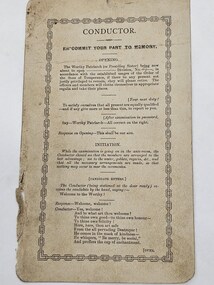
Pamphlet - Meeting protocol, c. 1918
... membership acknowledged. Sitting in the back cover of the 1903 minute book of the Sons of Temperance, Star of Moorabbin Division, this pamphlet gives insight into the formal, ritualised manner of gatherings, particularly the initiation ceremony. The inclusion of 'Presiding Sister' in the script suggests this was created after 1918, when the movement officially accepted ...This pamphlet appears to be the wording for the initiation ceremony of a new member of the Sons of Temperance. The Sons of Temperance was founded in New York in 1842 and brought to New South Wales by the Baptist minister, Dr William Hobbs, a short time later. Division, or local branches, grew quickly so that in October 1864, a provisional Grand Division was formed with a commitment to spread the word on temperance throughout the country, and the advantages gained by joining a temperance benefit society. It was reported that by 1869, in New South Wales, there was a National Division, two Grand Divisions, and one hundred and seven Divisions, with a total membership of 5970. In 1868, members of the Church of Christ, Cheltenham, initiated a meeting to form a Division of the Sons of Temperance, which was subsequently called Star of Moorabbin Division, No 29. The meeting was held at the Cheltenham Temperance Hall on 30 September, with office bearers appointed and the larger membership acknowledged.Sitting in the back cover of the 1903 minute book of the Sons of Temperance, Star of Moorabbin Division, this pamphlet gives insight into the formal, ritualised manner of gatherings, particularly the initiation ceremony. The inclusion of 'Presiding Sister' in the script suggests this was created after 1918, when the movement officially accepted women into its ranks. However, it was placed within a minute that was discontinued in October 1917. Heavy card with black printed text, surrounded by border in a sort of chain link pattern.
