
Showing 18 items matching "metal detector"
-
 Numurkah & District Historical Society
Equipment - Handmade nails (3) and shackle
... ...metal detector...Found by metal detector at the site of an old bridge in Numurkah district ...Found by metal detector at the site of an old bridge in Numurkah district handmade nails shackle metal detector numurkah bridge site 3 x Handmade metal nails / 1 x Handmade metal u-shaped shackle Equipment Handmade nails (3) and shackle ...Found by metal detector at the site of an old bridge in Numurkah district 3 x Handmade metal nails / 1 x Handmade metal u-shaped shacklehandmade nails, shackle, metal detector, numurkah bridge site -
 Tatura Irrigation & Wartime Camps Museum
Book, Metal Detecting in Australia
... Photograph of man with metal detector....Photograph of man with metal detector. Metal Detecting in Australia Book Book ...Metal detecting in Australia.Orange soft cover book with title and author in black print. Photograph of man with metal detector.metal detecting -
 Bendigo Historical Society Inc.
Container - Box of collected items
... Items found by Barry Maggs in the Whipstick National Park with a metal detector. ...Items found by Barry Maggs in the Whipstick National Park with a metal detector. Barry Maggs Whipstick National Park Metal Detection A purple plastic display box with a clear plastic lid. it has ten compartments containing items made from metal, wood and ceramics. a: Five pieces of pipes made from clay wood and metal decoration. b: Clay pipe with a metal decoration. c: Four pieces of metal jewelry one to two centimeters in diameter Including a ring, a flower brooch, a pendant and a button. d: Metal button two in diameter with an inscription Warranted Superior and a coat of arms. ...Items found by Barry Maggs in the Whipstick National Park with a metal detector. A purple plastic display box with a clear plastic lid. it has ten compartments containing items made from metal, wood and ceramics. a: Five pieces of pipes made from clay wood and metal decoration. b: Clay pipe with a metal decoration. c: Four pieces of metal jewelry one to two centimeters in diameter Including a ring, a flower brooch, a pendant and a button. d: Metal button two in diameter with an inscription Warranted Superior and a coat of arms. e: Two metal badges both have ship's anchors on them, one is three centimeters round the other is five centimeters by four centimeters. g: small piece of jewelry made of metal and glass five centimeters long and two centimeters wide. h: Four pieces of hollow metal five to eight centimeters long and one centimeter diameter. i: A piece of hollow metal tube five centimeters long and one centimeter in diameter. It had a small piece of wood and some pieces of paper with printed text inside. j: a metal nail seven centimeters long and one centimeter diameter head. k: pottery, part of a gold crucible three centimeters high and three centimeters in diameter. barry maggs, whipstick national park, metal detection -
 Bendigo Historical Society Inc.
Functional object - Hooks
... Items found with a metal detector by Barry Maggs in the Whipstick National Park. ...Items found with a metal detector by Barry Maggs in the Whipstick National Park. ...Items found with a metal detector by Barry Maggs in the Whipstick National Park. Three metal hooks, one is 28.5 centimeters long with a five-centimeter hook on the end the other is twenty-five centimeters long with a ten centimeter D shackle on the end. Both are very rusted. a; Is 28.5 centimeters long with a five centimeter hook on the end, b; Is twenty centimeters long with a ten centimeter D shackle on the end. c; Is nine centimeters long with a six centimeter hook, the other end has a two centimeter hole. barry maggs, whipstick national park, metal detection, metal hoooks -
 Bendigo Historical Society Inc.
Newspaper - JACK PERRY COLLECTION: NEWSPAPER JOBS GULLY
... Newspaper article re metal detectors and panning. Picture of dam near Jobs Gully railway bridge. ...BENDIGO Mining Alliance Mine Alliance Mine Newspaper article re metal detectors and panning. Picture of dam near Jobs Gully railway bridge. ...Newspaper article re metal detectors and panning. Picture of dam near Jobs Gully railway bridge. Dam used by Alliance Mine.bendigo, mining, alliance mine, alliance mine -
 Sunshine and District Historical Society Incorporated
Functional object - Sun Crescent Church Key
... This key was found using a metal detector opposite (close to) Sun Cres. Possible early key to church vault for Sunday collections or old church key. ...This key was found using a metal detector opposite (close to) Sun Cres. Possible early key to church vault for Sunday collections or old church key. ...This key was found using a metal detector opposite (close to) Sun Cres. Possible early key to church vault for Sunday collections or old church key. Narrative by Alan DashA large door key that has deteriorated in condition as it was found burried in the groundsun crescent, church -
 Bendigo Historical Society Inc.
Container - Box of coins
... Items found by Barry Maggs in the Whipstick National Park with a metal detector. Due to a shortage of coinage many merchants had there trading tokens which latter made illegal. ...Items found by Barry Maggs in the Whipstick National Park with a metal detector. Due to a shortage of coinage many merchants had there trading tokens which latter made illegal. ...Items found by Barry Maggs in the Whipstick National Park with a metal detector. Due to a shortage of coinage many merchants had there trading tokens which latter made illegal. Foreign currency was also used. A clear plastic display box containing 25 coins and merchant's tokens. They range in size from 1.5cm. to 3,5 cm. the dates range from mid nineteenth century to mid twenty century. Denominations of coins include farthings, halfpennies, pennies, two cents, ten cents and some foreign coins. Some of the merchant tokens have a square hole in the middle. Various inscriptions typical on coins.barry maggs, whipstick national park, metal detection, coins, tokens -
 Kew Historical Society Inc
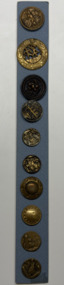
10 buttons on blue card, 1850s onwards
... Each time I drive past that garden my fingers itch to go in and do some weeding!! or hire a metal detector!"...Each time I drive past that garden my fingers itch to go in and do some weeding!! or hire a metal detector!" This item consists of 10 metallic buttons on navy blue card, each having a brass colouring. ...Sally Hearn (1932–2018) was a dedicated button collector and a prominent member of the Victoria Button Collectors Club. Her button collection was featured as a primary display in the 'The Melbourne Story' exhibition at the Melbourne Museum, which opened in mid-2008.The Hearn Collection of locally made and international buttons is historically and aesthetically significant as it illustrates the textile and manufacturing history of button making.This item consists of 10 metallic buttons on navy blue card, each having a brass colouring. Each has significant detailing depicting various creatures and objects.Offical Catalogue Entry: "Mrs Rawlings had been the wardrobe mistress at the Box Hill Theatre. The buttons were among many given to her by the wardrobe mistress at the newly closed down Tivoli Theatre. So these buttons at one time “performed” at the Tivoli! She told she was “sick of the things” and had sprinkled most of them in the garden around the rose bushes! Each time I drive past that garden my fingers itch to go in and do some weeding!! or hire a metal detector!"sally hearn, button collections -
 Emerald Museum & Nobelius Heritage Park
Coin - Coins, Letter and Maps
... Coins were discovered with a metal detector at the site of the Puffing Billy landslide, east of Black Hill, Selby, approximately 30 metres east of a water tank (no longer in existence). ...Coins were discovered with a metal detector at the site of the Puffing Billy landslide, east of Black Hill, Selby, approximately 30 metres east of a water tank (no longer in existence). ...Coins were discovered with a metal detector at the site of the Puffing Billy landslide, east of Black Hill, Selby, approximately 30 metres east of a water tank (no longer in existence). A total of 37 coins were found on two separate visits (24 April 1983 and 19 October 1986). 17 coins were concentrated in an area no larger than a shoe box. Among the coins found, six different countries were represented. Many years before the landslide, Puffing Billy (then known as 'Hissing Jenny') used to stop for water at the water tank. The train travellers would alight and purchase berries in season from the local people, who presumably set up stalls adjacent to the railway line. The finders subsequently donated 20 of the coins to Gus Ryberg for the Emerald Museum.Twenty assorted coins of various currencies, a covering letter and maps.selby victoria australia, rail services, coins, puffing billy railway -
 Wodonga & District Historical Society Inc
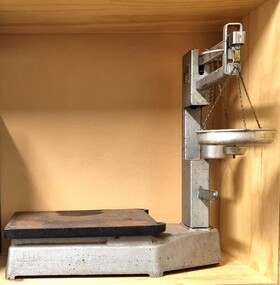
Functional object - Scales - J. Mann & Sons, Mercury Scale Co. Pty. Ltd, c1980
... IN 2023 A&D Weighing is an Australian leader in the supply of electronic weighing scales, balances, metal detectors, checkweighers and weighing systems. ...IN 2023 A&D Weighing is an Australian leader in the supply of electronic weighing scales, balances, metal detectors, checkweighers and weighing systems. ...J. Mann and Sons was first established as a farm produce store in 1921. The range of products was extended in the 1930s and included groceries and hardware, as well as the first petrol bowser in Wodonga outside the store. After WWII, the premises were extended and the range of products continued to increase. In the 1960s the Mann Family opened a new supermarket in Wodonga, in addition to the hardware business, providing steel, plumbing and industrial supplies, and they employed over 100 people at one stage. With changes in the retail industry, the Mann Family sold the main hardware business to Bunnings and the steel and rural produce business to the Kelly brothers in 2006. Mercury Scales was founded in Thebarton, South Australia in 1946. The business experienced rapid growth, leading to its joining with A&D’s global organisation and evolving into A&D Mercury. IN 2023 A&D Weighing is an Australian leader in the supply of electronic weighing scales, balances, metal detectors, checkweighers and weighing systems. This model was approved on 13 February 1980. On 25 March 1988 approval to change the business name to A & D Mercury Pty Ltd was granted by the Australian National Standards Commission. A set of cast iron scales. The measurement on the balance arm is in kilograms. There are 2 trays suspended by chains. bas is fitted with a level indicator and four adjustable feet.On Manufacturer's plate: MERCURY SCALE CO. PTY. LTD. SCALE MANUFACTURERS THEBARTON, S. AUST. INSTRUMENT APPROVAL NUMBERS N.S.C 6/9A/109 M/C No. Q. 760253 CAP 101 kg MODEL No. 211 Cj. mann & sons, mercury scales, wodonga businesses -
 Department of Energy, Environment and Climate Action
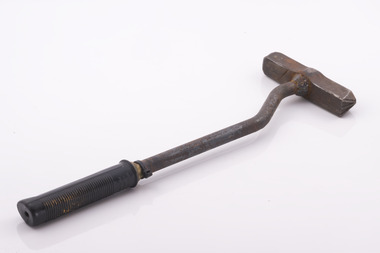
Branding Hammer issued to FCV overseer Jim Browning at Beechworth
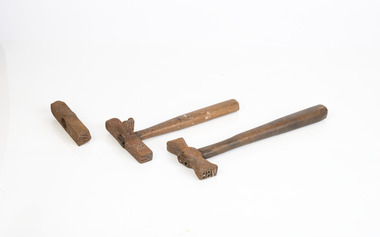
... A register was kept, and contractors paid a substantial deposit to make sure they didn't lose them, but they occasionally turn up by fossickers with metal detectors. While branding hammers are still used in some smaller locations, plastic tags and barcodes are now more common....A register was kept, and contractors paid a substantial deposit to make sure they didn't lose them, but they occasionally turn up by fossickers with metal detectors. While branding hammers are still used in some smaller locations, plastic tags and barcodes are now more common. ...Metal branding hammers were the most common way to control the sale and movement of hardwood timber produce like logs, railway sleepers, fence posts, and poles from Victorian State forests. Royalty was also paid on this basis. The hammer has a crown stamp on one end with a unique number in the middle (453) which identified its owner, and a crows foot or broad arrow on the other. The broad arrow was a symbol traditionally used in Britain and its colonies to mark government property. Forest regulations state that an authorised officer may use the crown mark to identify produce which has been sold and may be removed from the forest, whereas the broad arrow can be used to brand and mark trees which are not to be felled, or to indicate forest produce which has been seized. Hammers were traditionally only ever issued to forest officers and were an important, and closely guarded tool-of-trade. They were not transferred between staff and lending hammers was not permitted. But it was an onerous task for staff to hammer and tally hundreds of logs, or thousands of fence posts each week, so in about 1990 a system was introduced whereby hammers were allocated to logging contractors to grade logs and tally them instead. But there was still spot checking by authorised officers. A register was kept, and contractors paid a substantial deposit to make sure they didn't lose them, but they occasionally turn up by fossickers with metal detectors. While branding hammers are still used in some smaller locations, plastic tags and barcodes are now more common.Metal log branding hammer with a crown stamp on one end with a unique number (453) in the middle which identified its owner, and a crows foot or broad arrow on the other. The unusual bent metal handle was designed to protect user from banging their fingers on the log. It was also fitted with a rubber hand grip. Most FCV branding hammers were issued with wooden handles. The branding hammer 453 was initially issued to Wally Cowell at Beechworth. It was reissued to Jim Browning upon Wally’s retirement The hammer still had a wooden handle, but the it broke and became loose inside hammer head. Russel Pritchard from the Beechworth Depot replaced the handle with a new metal one and put a dog leg in it It mainly branded forest produce cut in Mt. Pilot and Reedy Creek areas. The main logging contractors were Gordon Habeck from Chiltern and Steven Goldsworthy from BeechworthCrown mark one end (453) and Crows foot other endforest harvesting, forests commission victoria (fcv) -
 Department of Energy, Environment and Climate Action
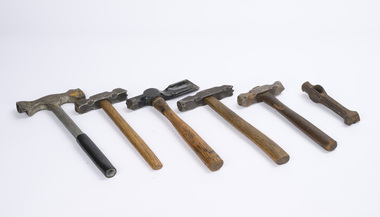
Log Branding Hammers (various)
... A register was kept, and contractors paid a substantial deposit to make sure they didn't lose them, but they occasionally turn up by fossickers with metal detectors. While branding hammers are still used in some smaller locations, plastic tags and barcodes are now more common....A register was kept, and contractors paid a substantial deposit to make sure they didn't lose them, but they occasionally turn up by fossickers with metal detectors. While branding hammers are still used in some smaller locations, plastic tags and barcodes are now more common. ...Metal branding hammers were the most common way to control the sale and movement of hardwood timber produce like logs, railway sleepers, fence posts, and poles from Victorian State forests. Royalty was also paid on this basis. Hammers most commonly had a crown stamp on one end with a unique number in the middle which identified its owner, and a crows foot or broad arrow on the other. The broad arrow was a symbol traditionally used in Britain and its colonies to mark government property. Other local configurations were used by sawmillers, post cutters and pulpwood contactors. Forest regulations state that an authorised officer may use the crown mark to identify produce which has been sold and may be removed from the forest, whereas the broad arrow can be used to brand and mark trees which are not to be felled, or to indicate forest produce which has been seized. Hammers were traditionally only ever issued to forest officers and were an important, and closely guarded tool-of-trade. They were not transferred between staff and lending hammers was not permitted. But it was an onerous task for staff to hammer and tally hundreds of logs, or thousands of fence posts each week, so in about 1990 a system was introduced whereby hammers were allocated to logging contractors to grade logs and tally them instead. But there was still spot checking by authorised officers. A register was kept, and contractors paid a substantial deposit to make sure they didn't lose them, but they occasionally turn up by fossickers with metal detectors. While branding hammers are still used in some smaller locations, plastic tags and barcodes are now more common.Log Grading hammersforests commission victoria (fcv), hand tools, forest harvesting -
 Department of Energy, Environment and Climate Action
Log Branding Hammer
... A register was kept, and contractors paid a substantial deposit to make sure they didn't lose them, but they occasionally turn up by fossickers with metal detectors. While branding hammers are still used in some smaller locations, plastic tags and barcodes are now more common....A register was kept, and contractors paid a substantial deposit to make sure they didn't lose them, but they occasionally turn up by fossickers with metal detectors. While branding hammers are still used in some smaller locations, plastic tags and barcodes are now more common. ...Metal branding hammers were the most common way to control the sale and movement of hardwood timber produce like logs, railway sleepers, fence posts, and poles from Victorian State forests. Royalty was also paid on this basis. Hammers most commonly had a crown stamp on one end with a unique number in the middle which identified its owner, and a crows foot or broad arrow on the other. The broad arrow was a symbol traditionally used in Britain and its colonies to mark government property. Other local configurations were used by sawmillers, post cutters and pulpwood contactors. Forest regulations state that an authorised officer may use the crown mark to identify produce which has been sold and may be removed from the forest, whereas the broad arrow can be used to brand and mark trees which are not to be felled, or to indicate forest produce which has been seized. Hammers were traditionally only ever issued to forest officers and were an important, and closely guarded tool-of-trade. They were not transferred between staff and lending hammers was not permitted. But it was an onerous task for staff to hammer and tally hundreds of logs, or thousands of fence posts each week, so in about 1990 a system was introduced whereby hammers were allocated to logging contractors to grade logs and tally them instead. But there was still spot checking by authorised officers. A register was kept, and contractors paid a substantial deposit to make sure they didn't lose them, but they occasionally turn up by fossickers with metal detectors. While branding hammers are still used in some smaller locations, plastic tags and barcodes are now more common.Log Grading hammersforests commission victoria (fcv), hand tools, forest harvesting -
 Bendigo Historical Society Inc.
Map - METAL DETECTING MAP WITH NOTES: GOLD AND RELIC SITES - BENDIGO KANGAROO FLAT GOLDFIELD
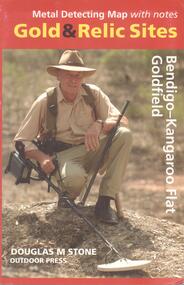
... Enclosed in a coloured cardboard cover with photograph of gold detector. Map METAL DETECTING MAP WITH NOTES: GOLD AND RELIC SITES - BENDIGO KANGAROO FLAT GOLDFIELD ...BHS CollectionMap of the Bendigo and Kangaroo Flat Goldfields with key to diggings, structures, locations of nuggets previously found and topographical features. Enclosed in a coloured cardboard cover with photograph of gold detector.Douglas M Stone, Outdoor Pressmap, bendigo, goldfields -
 The Ed Muirhead Physics Museum
Instrument - Accessory box for a No 6 Director Mk I
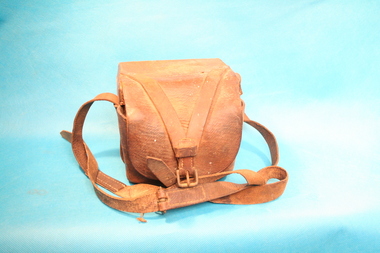
... Related to object 463.1 accessory box no 6 director mk i broad arrow Cooke Troughton and Simms Ltd WWII Mathematical Instrument Embossed in lid: 'CASE NO 6 DETECTOR MK 1 / COOKE, TROUGHTON & SIMMS, LTD / 9 / 22 / A.F.A' and broad arrow symbol. Leather accessory box with shoulder strap and metal buckles. ...Possibly related to the range-finding equipment sent from England for dismantling during the 1940s so University of Melbourne Physics staff could develop their own equipment. Related to object 463.1Leather accessory box with shoulder strap and metal buckles. Flip open lid.Embossed in lid: 'CASE NO 6 DETECTOR MK 1 / COOKE, TROUGHTON & SIMMS, LTD / 9 / 22 / A.F.A' and broad arrow symbol.accessory box, no 6 director mk i, broad arrow, cooke troughton and simms ltd, wwii, mathematical instrument -
 National Vietnam Veterans Museum (NVVM)
Equipment - Mine detecting set
... Green detecting set - Comprising of : Metal Case.Square detecting plate / Coil / loop; Detector wand battery pack and insert, detector unit earphones,spare amplifiers. ...Green detecting set - Comprising of : Metal Case.Square detecting plate / Coil / loop; Detector wand battery pack and insert, detector unit earphones,spare amplifiers. ...Green detecting set - Comprising of : Metal Case.Square detecting plate / Coil / loop; Detector wand battery pack and insert, detector unit earphones,spare amplifiers. Tin w/spare ear pins.Battery pack no Batteries Detector unit cover, probe assembly.Lithium button cells - removed.Detecting Set mine, model P 158. Serial Number 9686, Purchase order CB / 94236,MFR Name Polan Industries inc.FSN 6665 - 966-9071. Insert top /FSN 6665-991-0012 /Detecting set mine /Group 1 /size 15 /MFG Part NO COO- 0309 US property 6665-00-966-9871 Red caution sign on bottom.detecting set. -
 Whitehorse Historical Society Inc.
Equipment - Natural Gas Conversion Testing Kit
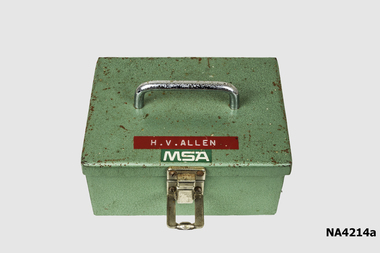
... Gas testing kit in green metal box, with silver handle and clasp (silver colour)|2. Suction ball and pump body.|3. Detector...Gas testing kit in green metal box, with silver handle and clasp (silver colour)|2. Suction ball and pump body.|3. Detector ...All items belonged to Harold Victor Allen who worked for Colonial Gas Association Ltd. Firstly at Footscray and then Box Hill in the 1960's. Retired in 1971. Born in Ballarat in 1906. Apprenticed and worked there till 1945, then moved to Footscray. Eileen, his wife, worked with Harold, helping with the Natural Gas Conversion during Harold's Box Hill time.Change over in Victoria from Gas fired gas supply to Natural Gas supply to Victoria from about 1965 -1. Gas testing kit in green metal box, with silver handle and clasp (silver colour)|2. Suction ball and pump body.|3. Detector tubes of glass capillary. 4. Instruction Manual. 5. Sealing cap ( box of 10) All spare parts |6. Natural Gas Conversion Badge.H.V.Allen MSAgas technology, appliances & accessories -
 National Vietnam Veterans Museum (NVVM)
Manual, Royal Australian Air Force, Royal Australian Air Force: Engineering Publication: Resetting Fire Detectors, Series 3, 4 and 5 (Gaviner) No. 14
... Detectors The manual is cover with yellow plastic with a window at the front. On the cover under the RAAf insigia reads Royal Australian Air Force. Through the wind reads the details of the manual. The manual is held together with a large metal ...This item was donated by Colin Laurence Grey OAM. Colin was the driving force behind many of the displays at the National Vietnam Veterans Museum. He will be remembered for his expertise, and boundless enthusiasm for all things Australian. Colin organised teams of like-minded souls to bring home and restore many important historical aircraft. His success has been recognised and rewarded with an Order of Australian Medal 2000, and he is named in the Worldwide Who’s Who 2014-2015. Colin’s skills as an engineer, tool maker, boiler maker and organiser enabled him to restore steam trains, trucks, tanks, infantry weapons, various aircraft including a MIG-15 jet fighter and his largest project the Consolidated B-24 Liberator bomber. He even replicated two dinosaur skeletons for Museum Victoria. In 1989 Colin joined the fledgling B-24 Liberator Memorial Fund as Project Manager/Restoration Co-Ordinator with the task to build a volunteer organisation that could find the AUD$10m required, source parts and materials for the largest aircraft restoration in Australia. The B-24 program had 10 volunteers, 60 sponsors and an international support network that provided parts, tooling, aviation equipment and political support. Colin’s combined engineering, academic and logistical skills provided the basis for advancing the skills of a very disparate group of volunteers form all walks of life. Colin established links with Centrelink, Corrections Victoria, RMT Uni and the ADF to develop the skills base of many less fortunate individuals of all ages and backgrounds. Colin’s work in this area gained him an AOM (2000). He featured in an ABC Australian Stories program and was awarded a life membership of the organisation. Colin was a founding member and President of the Oceania Aviation Museum Inc. which was instrumental in the historic listing of the joint WW2 USAAC/RAAF facility at Werribee and the Preserve Point Cook Aerodrome Group. Colin developed best practice engineering and fund-raising programs for a volunteer group, the Phillip Island Aquatic Centre. Colin’s constant learning, curiosity, passion and contribution to all things Australian have been an inspiration and a great example to all of us. He will be sorely missed and fondly remembered.The manual is cover with yellow plastic with a window at the front. On the cover under the RAAf insigia reads Royal Australian Air Force. Through the wind reads the details of the manual. The manual is held together with a large metal slide which in on the inside of the coverroyal australian airforce - manuals, resetting fire detectors
