
Showing 17 items matching "methods of measurement"
-
 Moorabbin Air Museum
Manual - Ansett Airlines technical manuals, Ansett Airlines of Australia Technical Training Centre
... ...Methods of measurement...Ansett technical manuals Regulations & docuiments Mathematical concepts & formulae Methods of measurement Overview of administrative structures & mathematical formulae for Ansett trainees, circa 1961 2 clip plastic binder Ansett Airlines of Australia Technical Training Centre Manual Ansett Airlines technical manuals ...Overview of administrative structures & mathematical formulae for Ansett trainees, circa 19612 clip plastic bindernon-fictionOverview of administrative structures & mathematical formulae for Ansett trainees, circa 1961regulations & docuiments, mathematical concepts & formulae, methods of measurement -
 Flagstaff Hill Maritime Museum and Village
Container - Medicine Glass, ca. 1887 to early 20th century
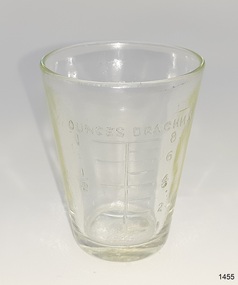
... It is significant also for having the embossing inside the glass, which was likely produced by the turn-mould method of bottle (and container) making. flagstaff hill warrnambool shipwrecked coast flagstaff hill maritime museum maritime museum shipwreck coast flagstaff hill maritime village great ocean road medicine glass measuring glass dose cup medicine dispensing medicine measurement sambell pharmacy warrnambool sambell chemist and dentist internal embossing glass embossed inside 20th century chemist blown glass two-piece mould turn-moulded glass turned bottles "OUNCES DRACHMS" "TABLE TEA" Medicine glass or dose cup; clear glass with small imperfections and ripples in the glass, no side seams and a slightly concave base. ...This small medicine glass has ho manufacturer's or owner's marks. It has no side seams, the base is slightly concave, the embossed inscriptions are inside the glass, the clear glass has slight imperfections and ripples, and the glass is slightly opaque below the lip; these features point to the glass being blown into a mould, partially set, and spun between that mould and an internal mould that had the embossing on it, called a turn-mould process. The lip was then ground to be smooth. The process was patented in 1887 with the title of "Mold for blowing turned bottles".This medicine glass is significant as an example of medical equipment that has a design still used today. It is significant also for having the embossing inside the glass, which was likely produced by the turn-mould method of bottle (and container) making.Medicine glass or dose cup; clear glass with small imperfections and ripples in the glass, no side seams and a slightly concave base. All embossed marks are inside the glass. The imperial measurements are in graduated scales for tablespoons, teaspoons, and ounces and drachmas. "OUNCES DRACHMS" "TABLE TEA"flagstaff hill, warrnambool, shipwrecked coast, flagstaff hill maritime museum, maritime museum, shipwreck coast, flagstaff hill maritime village, great ocean road, medicine glass, measuring glass, dose cup, medicine dispensing, medicine measurement, sambell pharmacy warrnambool, sambell chemist and dentist, internal embossing, glass embossed inside, 20th century chemist, blown glass, two-piece mould, turn-moulded glass, turned bottles -
 Flagstaff Hill Maritime Museum and Village
Booklet - Book and World Chart for Emergency Navigation, George Grady Press, The Raft Book, 1943
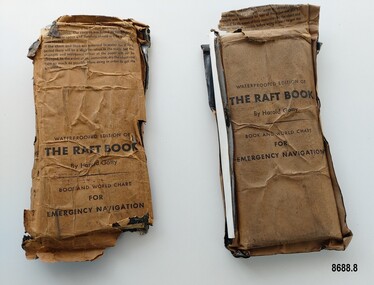
... The booklet included navigational advice and ideas such as ocean currents, estimation of distance, using a compass, measurement of angles, recognising and steering by the stars, land indications from sea birds, migration of sea birds and insects, sounds from the land, the scent of the land and ocean currents and the colour of the sea etc. After W.W.2 Gatty moved to Fiji and formed Fiji Airways (which later became Air Pacific). Harold Gatty died in August 1957. The two copies of "The Raft Book" are significant as they are a written summary of the many methods ...Harold Gatty was born on January 5th, 1903 in Campbell Town, Tasmania. He was a navigator and aviation pioneer. He began his career learning navigation at the age of 14 as a midshipman at the Royal Australian Naval College but withdrew after three years and became an apprenticed ship's officer with the Patrick Steamship Company of Sydney. After W. W. 1 he joined the Australian Merchant Navy where he learned the constellations while standing night watch and became an expert in celestial navigation while serving on many ships sailing between Australia and California. In 1927 he moved to California and opened a navigation school and also a laboratory repairing navigational equipment. At this time he became very interested in air navigation and was aware of the limitations of existing methods and instruments for aerial navigation. He began researching ways of improving aerial navigation. Two early inventions of his were his air sextant and a ground speed and drift indicator which formed the basis of the automatic pilot which later came to be standard equipment on most aircraft. He worked with several record breaking pilots including Ann Morrow Lindbergh (who went on to serve as a navigator for her husband Charles Lindbergh), helped Wiley Post break the world record circumnavigating the Earth, invented a new method of "dead reckoning" that revolutionised the ability to fly safely through cloudy conditions without drifting off course and famously navigated a small plane (whilst trying to cross the Pacific) over 1900 km through fog (with no radio) and using only his dead reckoning techniques, back to their starting point in Japan after they developed fuel problems. In 1932 Gatty received the Distinguished Flying Cross from President Hoover. In 1934 Gatty formed the South Seas Commercial Company with Donald Douglas with the aim to deliver air services to the islands of the South Pacific. The Company was sold to Pan Am but he continued to work for them. In 1935 he went on a sailing expedition investigating several small islands in the South Pacific and was briefly marooned on Baker Island. He was able to use his extensive knowledge of seabird habits to save the crew. He was also very interested in the ability of the Polynesians to navigate using the stars. During the Second World War Gatty was given the honorary rank of Group Captain in the Royal Australian Air Force (RAAF) and worked for the U. S. Army Air Forces (USAAF) in the South Pacific. In 1943 he moved to Washington where he developed a survival book (The Raft Book) specifically for boat crews or air crews flying over the Pacific to help them survive and navigate their life rafts in remote areas of the ocean. The original book was 152 pages long however a condensed version was made which consisted of a 64 page booklet, combined map and star chart and calendar strip enclosed in a waterproof slipcase, to be placed in life rafts for emergency use. The booklet included navigational advice and ideas such as ocean currents, estimation of distance, using a compass, measurement of angles, recognising and steering by the stars, land indications from sea birds, migration of sea birds and insects, sounds from the land, the scent of the land and ocean currents and the colour of the sea etc. After W.W.2 Gatty moved to Fiji and formed Fiji Airways (which later became Air Pacific). Harold Gatty died in August 1957.The two copies of "The Raft Book" are significant as they are a written summary of the many methods of sea navigation (both modern and historical) that existed in the 1940's. They are also a record of Harold Gatty, who played a significant role in the development of modern day aerial navigation using his understanding of different sea navigational techniques.Two rectangular brown packets with waterproof coverings (oiled paper) titled "The Raft Book" by Harold Gatty. Each packet contains a folded 64 page paper booklet with detailed instructions for navigating a small craft in open seas, a folded chart (with a map of the world and oceans, well known constellations, latitude and longitude charts, Greenwich time and a scale for string lengths and Harp scale) and a long folded paper calendar strip.Front of package - "WATERPROOFED EDITION OF/ THE RAFT BOOK / By Harold Gatty / BOOK AND WORLD CHART / FOR / EMERGENCY NAVIGATION / To open envelope tear along above line. If the envelope is used again fold the flap to keep contents dry. 1. This envelope contains a book, chart and tape for emergency navigation. The contents are folded to take up the least possible space and therefore should not be removed until needed. 2. if the chart and tape are immersed in water for a long period, there will be a slight variation in the scale but the strength and resistence to tear of the paper will not be changed. In the event of long immersion, dry the chart and tape as much as possible before using in order to in order to get the greatest accuracy in scale. Front of booklet - THE RAFT BOOK / LORE OF THE SEA AND SKY /By Harold Gatty IMPORTANT FOR YOUR SECURITY/Upon abandoning ship you may have to be your own navigator. Take the following pre/cautions for your own safety:/ Carry a good type of pocket watch / keep it wound and have it running on Greenwich (England) / Time, which you can get from the navigating officer. / Keep track of the date at Greenwich; and on a 24-hour basis, / know whether the time is, say, 6 hours (6 A.M.) showing on / your watch, or 18 hours (6P.M.) Greenwich. / PROECT YOUR WATCH. GET A RUBBER SACK FOR IT (OBTAIN FROM PHARMACIST) AND KEEP IT DRY / KEEP A PENCIL IN YOUR POCKET/ POSITION OF SHIP WHEN ABANDONED PRINTED IN UNITED STATES OF AMERICA GEORGE GRADY PRESS, NEW YORK/COPYRIGHT, 1943, BY HAROLD AND FENNA GATTYflagstaff hill maritime museum and village, shipwreck coast, warrnambool, the raft book, harold gatty, book and world chart for emergency navigation, ww 2, ww ii, navigation, air navigation, aerial navigation, lindbergh, wiley post, dead reckoning, south seas commercial company, u.s. army airforce, usaaf, survival book, life rafts, sea navigation, emergency navigation, fiji airways, harp scale -
 Kiewa Valley Historical Society
Scales Weighing, early 1900's
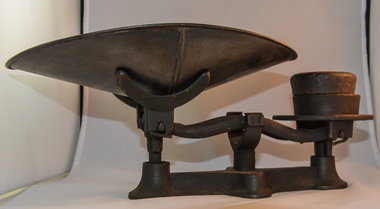
... The meals for which quantity measurements are required for domestic cooking is not exact however the use of cup measurements for large dishes is tedious and these scales offer the capacity for a larger mixture and an easier method for the "cook". ...Although these scales cannot be identified against a historical period of Australian development they are therefore placed in a time frame when commercial markings from manufacurers were not important enough to have domestic kitchen items labeled. These cast iron scales were made for domestic and possibly rural areas and not for cities where demand for known branded utensils was more an issue. These scales are very "basic" and not to the level of weighing detail that commercial scales had to be at. These scales do not show any visible markers for accurate measurement. The "near enough is good enough" principle can be related to these scales.These scales are significant as they identify one of the basic preparation items for the weighing of foodstuff before the televising of "cooking" shows (1960s onward). The meals for which quantity measurements are required for domestic cooking is not exact however the use of cup measurements for large dishes is tedious and these scales offer the capacity for a larger mixture and an easier method for the "cook". As the need for accurate measurements of ingrediants for rural domestic meals has in the past been not been critical the requirement of accuracy that these scales do not provide is of no consequence. Domestic kitchens in the Kiewa Valley and the type of meals produced would not have required the accuracy of ingrediants that "modern " international cuisines of the later 1900's require. These kitchen scale were used whenrecipes had the terms "pinch, dollop, squidge and smidgen" were about as accurate as most recipes needed to be.Black cast iron, medium weighing scales, with a two arm cradle. On one side of the cradle is a two half circle holding frame for the retention of the metal container scoop. This light weight steel scoop/dish allows for the weighing of loose grain or similar type material to be contained and held in place for establish its saleable contents. On the other side of the weighing cradle is a flat circular platform to hold various metal disc. All the disks used on this platform have their weight stamped on them. When the produced filled in the scoop balances with the metal weight on the opposite end of the balance match (visual horizontal appraisal) the appropriate quantity required is obtained. This scale does not have any visual markings on the arms to identify a true balance. It is therefore reasonable to assume that these scales were for domestic use only and not for commercial transactions. There are two weights that are useable with these scales, one is stamped "1 lB"(pound) and one stamped "1" and both are made as a solid round piece of cast metal.The smaller disc has a "1 lb" moulded and pressed form within a marked inner circle and a mouled ridge outer circle enclosure. The other weight is slightly larger and has a moulded "1" located on the top within a raised circular edge.domestic kitchen scales, weighing scales, metal scales -
 National Wool Museum
Clothing - 1984 Los Angeles Olympics Men's Opening Ceremony Shirt, c. 1984
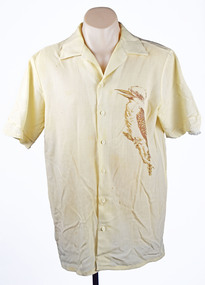
... measurement data collected was shared with the other manufacturers, e.g. Pelaco Shirts, Holeproof Socks and Knitwear, Maddison Belts, and even Hush Puppy Shoes. As the time for the Games approached the AOC made arrangements for combining meeting of all. Selected available athletes at the Australian Institute of Sport, Canberra, where, among other things, they were fitted and supplied with their uniform. The method...measurement data collected was shared with the other manufacturers, e.g. Pelaco Shirts, Holeproof Socks and Knitwear, Maddison Belts, and even Hush Puppy Shoes. As the time for the Games approached the AOC made arrangements for combining meeting of all. Selected available athletes at the Australian Institute of Sport, Canberra, where, among other things, they were fitted and supplied with their uniform. The method ...On the 1984 Los Angeles Olympic Uniforms donator Doug wrote- During the 1980s the Australian wool industry was at its most prosperous times with record numbers of sheep producing wool receiving ever increasing values due to the success of the Reserve Price Scheme, and the overall guidance of the Australian Wool Corporation (AWC). As a humble technician, my role was a low profile newly created position of “Controller, Technical Marketing” where wool was to be marketed on its technical properties, as distinct from the “Product Marketing Group” which exploited trhe traditional high profile approach of marketing wool;s superior fashion attributes. The Woolmark was the tool central to this approach. When the forthcoming Los Angeles Olympic Games was announced, the Product Marketing Group seized upon the chance to show the world that we could make top fashion garments and display them on our elite athletes on the world stage. A concept was launched using a contemporary top designer, Adel Weiss, with the most exclusive fabrics and knits available, and all with a lot of hype. This launch failed dismally for the following reasons- - The designer did a wonderful job presenting an excellent fashion range on perfect skinny models. The AOC however wanted a uniform which had an obvious Australian appearance when fitted to elite, and frequently muscular, athletes. - The fabrics chosen did not reflect the performance required by travelling athletes, there was no recognition of the need for ‘easy care.’ - There was no recognition given to the problem of measuring, manufacturing and distribution of a range of articles when the selected athlete could be domiciled anywhere in Australia. - There was no appreciation of such historical facts as Fletcher Jones, who had been unofficial suppliers dating back to the 1954 Olympics in Melbourne, and the Fletcher Jones board member, who was also an AWC board member, and was not in favour of the change. The project passed from Product Marketing to Public Relations, a big spending off-shoot of the AWC Chairman David Asimus, and due to the day to day operations of the project was passed to me and PR took care of the financial matters. The first task was to meet with the AOC and find out exactly their requirements. This lead to the production of a design and manufacturing brief, cointaining exact time lines for each event required to ensure an appropriate uniform on every athlete chosen to represent his/her country on the date given for the Opening Ceremony in Los Angeles. Working backwards the timeline becomes- 1. Noted the exact date of the Opening Ceremony. 2. Estimated the date for distributing completed garments to each athlete. 3. Estimated the time span available for measuring each athlete and commence making each component of the ensemble to the individual measurements of each athlete. 4. Decided the date for making the final choice of uniform design concept. 5. Decided the date for distribution of the design brief to selected designers. These five steps were spread out over a two year period. The Commonwealth Games occur midway between each Olympic Games, work on the Olympic uniform commences the week after the Commonwealth Games closing ceremony and MUST be ready by the prescribed day two years hence. The project also had to remain cognisant of trade politics existing within the span of the task, as well as the temperament of designers in general. It is no overstatement to say that in the past every designer in Australia believed they could, and should, be chosen to design the Australian Uniform. The final choice of designer almost always faced criticism from the fashion press and any designer who had been overlooked. However, with the contenders receiving an exacting brief the numbers of serious contenders greatly reduced. The Los Angeles Olympic Uniforms. A further reason for the AWC bid failure to design the LA uniform was that the AOC had already chosen Prue Acton to design it. This was based on her proven performance during previous games as she had a talent for creating good taste Australiana. Her design concepts also considered the effect when they were viewed on a single athlete as well as the impact when viewed on a 400 strong team coming on to the arena. A blazer trouser/skirt uniform in bright gold was chosen for the formal uniform. It was my task to select a pure wool faille fabric from Foster Valley weaving mill and have sufficient woven and ready within the prescribed timeline. The trouser/skirt fabric selected was a 60/40 wool polyester plain weave fabric from Macquarie Worsted. This fabric had a small effect thread of linen that was most attractive when dyed to match some eucalyptus bark Prue had brought back from central Australia. For the Opening Ceremony uniform, Prue designed a series of native fauna, a kookaburra for the men’s shirt and a pleated skirt with a rural scene of kangaroos, hills and plants. This presented an insurmountable printing challenge to the local printing industry as it had an unacceptably large repeat size and the number required (50) was also commercially unacceptable. The solution was a DIY mock up at RMIT and the employment of four student designers. The fabric selected for this garment was a light weight 19 micron, pure wool with a very high twist yarn in alternating S and Z twist, warp and weft. This fabric proved to be the solution to a very difficult problem, finding a wool product which is universally acceptable when worn next to the sin by young athletes competing in the heat of a Los Angeles summer. Modifications to this fabric were developed to exploit its success when facing the same problem in future games. Garment Making- The most exacting garment in the ensemble is the tailored blazer, plus the related trouser/skirt. Unfortunately tailoring athletes that come in various shapes and sizes such as; - Weight lifters develop an enormous chest, arms and neck size. A shirt made to a neck size of 52 would produce a shirt with cuffs extending well beyond the wearer’s hands. - Basketball players are up to 7 feet tall and garments relying ona chest measurement grading would produce a shirt with cuffs extending only to elbow length. - Swimmers develop enormous shoulders and slim hips, cyclists by contrast develop thighs I liken to tree trunks and a uniform featuring tight trousers must be avoided at all cost. Suffice to say many ensembles require specialist ‘one off’ treatment for many athletes. Meanwhile there is a comfortable in between group who can accept regular sizes so you can cater for these by having back up stock with plenty of built in contingencies. Athletes may be domiciled anywhere in Australia, this creates a fundamental problem of taking their measurements. The Fletcher Jones organisation was key to answering this problem due to their presence in every capital city, as well as many provincial towns around Australia. Each athlete on being selected for the Olympic Team was simultaneously requested to visit their nearest Fletcher Jones shop. The standardised measurement data collected was shared with the other manufacturers, e.g. Pelaco Shirts, Holeproof Socks and Knitwear, Maddison Belts, and even Hush Puppy Shoes. As the time for the Games approached the AOC made arrangements for combining meeting of all. Selected available athletes at the Australian Institute of Sport, Canberra, where, among other things, they were fitted and supplied with their uniform. The method evolved as follows.Men’s cream coloured button up, collared shirt. Images of a kookaburra have been printed onto the shirt, a single kookaburra on the left breast and a pair of kookaburras on the reverse of the shirt. The kookaburras are printed in a brown tone to complement the cream colour of the fabric.On tag - FMaustralian wool corporation, 1984 los angeles olympics, olympic uniforms, men's uniforms, sport, athletes -
 Lakes Entrance Historical Society
Photograph - Myer Street Lakes Entrance Victoria 1999, M Holding
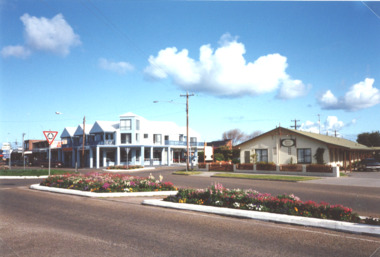
... Myer Street businesses and holiday units opposite Police Station Lakes Entrance Victoria 1999 Inscriptions and markings Languages Production methods Materials Dimensions No dimensions recorded Other measurements Duration Weight Weight unit ...Myer Street businesses and holiday units opposite Police Station Lakes Entrance Victoria 1999 Inscriptions and markings Languages Production methods Materials Dimensions No dimensions recorded Other measurements Duration Weight Weight unit Businesses Roads and Streets Colour photograph of roundabout at intersection of Myer Street with Church and Roadknight Streets taken from Police Station corner shows flower gardens in traffic islands, Myer Street businesses and holiday units opposite Police Station Lakes Entrance Victoria Photograph Myer Street Lakes Entrance Victoria 1999 M Holding ...Myer Street businesses and holiday units opposite Police Station Lakes Entrance Victoria 1999 Inscriptions and markings Languages Production methods Materials Dimensions No dimensions recorded Other measurements Duration Weight Weight unit Colour photograph of roundabout at intersection of Myer Street with Church and Roadknight Streets taken from Police Station corner shows flower gardens in traffic islands, Myer Street businesses and holiday units opposite Police Station Lakes Entrance Victoriabusinesses, roads and streets -
Broadmeadows Historical Society & Museum
Machine - Scales
... This item is significant as it demonstrates a by-gone method of weighing mail. It is also significant as it uses pre-metric measurements, placing its age before 1966. ...Fairbanks weighing scales (to weigh 2 lb) - Fairbanks' most famous invention then became the platform scale for weighing heavy objects. This item is significant as it demonstrates a by-gone method of weighing mail. It is also significant as it uses pre-metric measurements, placing its age before 1966.Post office scales with two dishes and five weights ranging from 1 oz to 2 lb.To weigh 2 lb - Fairbanks, Birminghamscales, postage, mail -
Moorabbin Air Museum
Document (series) - Nomad Development Material - Collection of Vilem Gottlieb
... 1987 74 A seating plan - probably of section at Avalon 75 Copy of the Department of Defence OFFICIAL SECRECY - Crimes Act 1914 1977 76 Technical Officer (Engineering) Duty Statement 1978 77 Memo: Request to train Fight Test Observers as pilots 1980 78 GAF Letter: GAF Test Pilots 1986 79 Letter to the editor of Aircraft 1984 80 GAF/ASTA Letter to the editor of the Geelong Advertiser 1994 81 Geelong Advertiser Article that relates to #80 1994 82 GAF Memorandum of Insurance 1978 83 GAF Duty Statement - Senior Technical Officer (Engineering) Grade 3 84 GAF Duty Statement - Senior Technical Officer (Engineering) Grade 2 85 Suspension folder Nomad Handwritten Certification report N24A-20 - Ground and flight tests - Water methanol injection system 86 Nomad Flight manual supplement - Trial installation - Option G428 - Water-methanol power augmentation system 1980 87 Nomad More handwritten notes about the water/methanol injection system - N24A 88 Nomad Draft Water.methanol power augmentation system flight test schedule - N22S, N22B 89 Nomad Handwritten notes on the water/methanol system 90 Nomad GAF Nomad Model N - Flight test schedule - Water/methanol power augmentation system 91 Nomad GAF Nomad Model N - Flight test schedule - Water/methanol power augmentation system 92 Article - Light-twin engine-out flying by Dennis Newton- Business and Commercial Aviation - November 1987 1987 93 Nomad Handwritten and photocopies attached re conditions for turbine aircraft and federal aviation regulations part 23 94 Mississippi State University Article: Determining Performance Parameters of General Aviation Aircraft - Mississippi State University 95 Technological University, The Netherlands Article: Determination of performance, stability and control characteristics from measurements in non-steady manoeuvres 96 Department of Mechanical and Aerospace Engineering, North Carolina State University Article: Recent results obtained with a new method for measuring aircraft power and drag in flight 1979 97 Mississippi State University Article: Flight test evaluation of a method to determine the level flight performance of a propellor-driven aircraft 1977 98 NASA Report: Practical aspects of using a maximum likelihood estimation method to extract stability and control derivatives from flight data 1976 99 Two photographs of engines unknown 100 Folder Nomad ASTA Aircraft Flight Manual - Nomad Model N22C 2006 101 Plastic Wrapped paper Nomad ASTA Pilot’s Operating Handbook - Model N22S Searchmaster 1990 102 Stapled book Aeronautical Engineering Report: AF-36 - Flight Test Report 103 Manila Folder Nomad ASTA Documentation relating to Florida Court Case 1989 104 Suspension folder Paperwork on recording the weight of aircraft - including aircraft weighing summaries 105 Manila Folder Nomad Brochure: What Nomad is that? ...1987 74 A seating plan - probably of section at Avalon 75 Copy of the Department of Defence OFFICIAL SECRECY - Crimes Act 1914 1977 76 Technical Officer (Engineering) Duty Statement 1978 77 Memo: Request to train Fight Test Observers as pilots 1980 78 GAF Letter: GAF Test Pilots 1986 79 Letter to the editor of Aircraft 1984 80 GAF/ASTA Letter to the editor of the Geelong Advertiser 1994 81 Geelong Advertiser Article that relates to #80 1994 82 GAF Memorandum of Insurance 1978 83 GAF Duty Statement - Senior Technical Officer (Engineering) Grade 3 84 GAF Duty Statement - Senior Technical Officer (Engineering) Grade 2 85 Suspension folder Nomad Handwritten Certification report N24A-20 - Ground and flight tests - Water methanol injection system 86 Nomad Flight manual supplement - Trial installation - Option G428 - Water-methanol power augmentation system 1980 87 Nomad More handwritten notes about the water/methanol injection system - N24A 88 Nomad Draft Water.methanol power augmentation system flight test schedule - N22S, N22B 89 Nomad Handwritten notes on the water/methanol system 90 Nomad GAF Nomad Model N - Flight test schedule - Water/methanol power augmentation system 91 Nomad GAF Nomad Model N - Flight test schedule - Water/methanol power augmentation system 92 Article - Light-twin engine-out flying by Dennis Newton- Business and Commercial Aviation - November 1987 1987 93 Nomad Handwritten and photocopies attached re conditions for turbine aircraft and federal aviation regulations part 23 94 Mississippi State University Article: Determining Performance Parameters of General Aviation Aircraft - Mississippi State University 95 Technological University, The Netherlands Article: Determination of performance, stability and control characteristics from measurements in non-steady manoeuvres 96 Department of Mechanical and Aerospace Engineering, North Carolina State University Article: Recent results obtained with a new method for measuring aircraft power and drag in flight 1979 97 Mississippi State University Article: Flight test evaluation of a method to determine the level flight performance of a propellor-driven aircraft 1977 98 NASA Report: Practical aspects of using a maximum likelihood estimation method to extract stability and control derivatives from flight data 1976 99 Two photographs of engines unknown 100 Folder Nomad ASTA Aircraft Flight Manual - Nomad Model N22C 2006 101 Plastic Wrapped paper Nomad ASTA Pilot’s Operating Handbook - Model N22S Searchmaster 1990 102 Stapled book Aeronautical Engineering Report: AF-36 - Flight Test Report 103 Manila Folder Nomad ASTA Documentation relating to Florida Court Case 1989 104 Suspension folder Paperwork on recording the weight of aircraft - including aircraft weighing summaries 105 Manila Folder Nomad Brochure: What Nomad is that? ...Donation from Anna Gottlieb -
 Melbourne Legacy
Document, Medical Officers Report, 1927
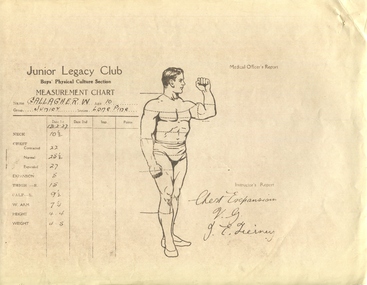
... measurements of junior legatee W. Gallagher. The form was signed J. Teirney, which was Jim Teirney who was the first paid employee of Melbourne Legacy, he was the fitness instructor for many years. The date was 1927 so very early in the history of Legacy working with children of deceased servicemen. Shows Legacy was active in record keeping with proper medical supervision for physical activities of the children, in 1927. The method ...A chart for taking measurements of the Legacy boys. This was a copy of the form that was kept as an example. The data was of measurements of junior legatee W. Gallagher. The form was signed J. Teirney, which was Jim Teirney who was the first paid employee of Melbourne Legacy, he was the fitness instructor for many years. The date was 1927 so very early in the history of Legacy working with children of deceased servicemen. Shows Legacy was active in record keeping with proper medical supervision for physical activities of the children, in 1927.The method of record keeping was all done by hand, time consuming and the storage of records took up a lot of space.Diagram of a measurement chart with sketch of a male body. Printed in black and white.Medical Officers Report. Junior Legacy Club. Name: Gallagher. W., age 10, Group Junior, section Lone Pine. Measurements of the neck, chest, thigh, calf, arm, height and weight. Signed by J.E. Tierneyjunior legatee, exercise classes -
 Department of Energy, Environment and Climate Action
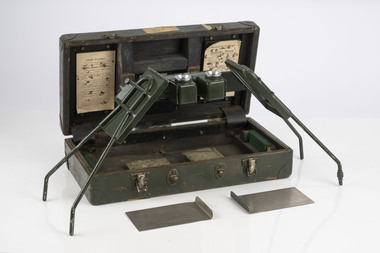
Pocket Stereoscope
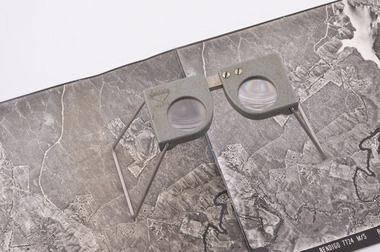
... Simple, cheap and rapid methods of obtaining photographs using 70mm and 35mm cameras were developed Forest measurement Surveying Forests Commission Victoria (FCV) Sokkisha Tokyo Small pocket stereoscope to interprete aerial photographs in the field Adjustable lenses on foldaway wire legs Pocket Stereoscope ...This pocket stereoscope was used to view a pair of separate and overlapping aerial photos as a single three-dimensional image. It was small and could be easily used in the field. Larger, mirror stereoscope were also available in some offices. The aerial images were used to map forest types, timber stands, new roads and tracks, firebreaks, boundaries of timber harvesting, plantations, bushfires, insect and disease attack and so on In 1928, the Forests Commission undertook its first major aerial photography project over 15,000 acres of forest which is said to be the first of its kind in Australia. During the Second World War, large areas of Victoria were photographed by RAAF and used to produce orthophoto maps. By 1945 aerial photography of 13,000 square miles (3.4 M ha) was completed, including much of the inaccessible eastern forests. The Forests Commission started developing its own small format photography in the early 1970s. Simple, cheap and rapid methods of obtaining photographs using 70mm and 35mm cameras were developed Small pocket stereoscope to interprete aerial photographs in the field Adjustable lenses on foldaway wire legsSokkisha Tokyoforest measurement, surveying, forests commission victoria (fcv) -
 Department of Energy, Environment and Climate Action
Wooden tree measuring calipers (inches)
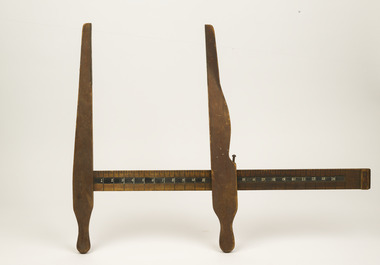
... A tree caliper is another quick method of estimating DBHOB. forest measurement Measurements are in inches (pre metrication in 1974) A crown faint crown mark (331) and crows foot is visible on one end Wooden tree measuring calipers Wooden tree measuring calipers (inches) ...Foresters usually measure the diameter of trees at Breast Height – traditionally 4 foot, 6 inches – now 1.3 m – which is termed Diameter Breast Height Over Bark (DBHOB). The most common way to measure tree diameter is to place a calibrated tape around the stem at breast height. It’s simple, but can be slow, particularly if the scrub is thick, or if there are heaps of trees. A tree caliper is another quick method of estimating DBHOB. Wooden tree measuring calipersMeasurements are in inches (pre metrication in 1974) A crown faint crown mark (331) and crows foot is visible on one end forest measurement -
 Department of Energy, Environment and Climate Action
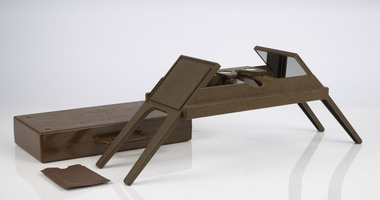
Stereoscope
... Simple, cheap and rapid methods of obtaining photographs using 70mm and 35mm cameras were developed Forests Commission Victoria (FCV) Surveying Forest measurement Foldable metal stereoscope in wooden box with mirror covers Ex Dept of Defence Stereoscope ...This stereoscope was used to view a pair of separate and overlapping aerial photos as a single three-dimensional image. Smaller units and could be easily used in the field but this larger, mirror stereoscope was used in offices. The aerial images were used to map forest types, timber stands, new roads and tracks, firebreaks, boundaries of timber harvesting, plantations, bushfires, insect and disease attack and so on In 1928, the Forests Commission undertook its first major aerial photography project over 15,000 acres of forest which is said to be the first of its kind in Australia. During the Second World War, large areas of Victoria were photographed by the RAAF and used to produce orthophoto maps. By 1945 aerial photography of 13,000 square miles (3.4 M ha) was completed, including much of the inaccessible eastern forests. The Forests Commission started developing its own small format photography in the early 1970s. Simple, cheap and rapid methods of obtaining photographs using 70mm and 35mm cameras were developedFoldable metal stereoscope in wooden box with mirror covers Ex Dept of Defenceforests commission victoria (fcv), surveying, forest measurement -
 Department of Energy, Environment and Climate Action
Foldable Stereoscope
... Simple, cheap and rapid methods of obtaining photographs using 70mm and 35mm cameras were developed Forests Commission Victoria (FCV) Surveying Forest measurement Benalla Foldable plastic stereoscope in box Foldable Stereoscope ...This stereoscope was used to view a pair of separate and overlapping aerial photos as a single three-dimensional image. This smaller foldable unit could be easily used in the field but larger, mirror stereoscope was used in offices. The aerial images were used to map forest types, timber stands, new roads and tracks, firebreaks, boundaries of timber harvesting, plantations, bushfires, insect and disease attack and so on In 1928, the Forests Commission undertook its first major aerial photography project over 15,000 acres of forest which is said to be the first of its kind in Australia. During the Second World War, large areas of Victoria were photographed by RAAF and used to produce orthophoto maps. By 1945 aerial photography of 13,000 square miles (3.4 M ha) was completed, including much of the inaccessible eastern forests. The Forests Commission started developing its own small format photography in the early 1970s. Simple, cheap and rapid methods of obtaining photographs using 70mm and 35mm cameras were developedFoldable plastic stereoscope in box Benallaforests commission victoria (fcv), surveying, forest measurement -
 Department of Energy, Environment and Climate Action
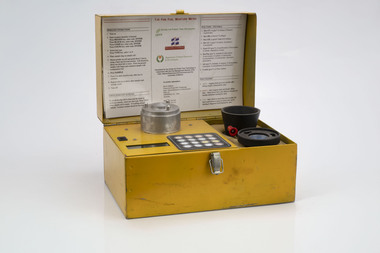
Prototype fuel moisture meter
... One of the most accurate methods is slowly drying a sample of fuel in a conventional oven for 24-48 hours to remove all the moisture and measuring the weight difference, but this takes time and is not practical in the field when rapid measurements are needed. ...One of the most accurate methods is slowly drying a sample of fuel in a conventional oven for 24-48 hours to remove all the moisture and measuring the weight difference, but this takes time and is not practical in the field when rapid measurements are needed. ...Bushfire behaviour is influenced by many things including temperature, relative humidity, forest type, fuel quantity and fuel dryness, topography and even slope. Wind has a dominant effect on the Rate of Spread (ROS), and also bushfire size, shape and direction. Fuel arrangement is as important as fuel quantity (tonnes/ha). Fibrous and ribbon bark, together with elevated and near-surface scrub fuels act as ladders which lead flames into the tree canopy. But the availability of fuel to burn depends largely on its moisture content. When it exceeds 20-25% not much will burn, whereas 12-15% is generally ideal for fuel reduction burning, but if the moisture content drops as low as 7-10% virtually everything will ignite, and fire behaviour becomes extreme. During the afternoon of the Ash Wednesday bushfires on 16 February 1983 fuel moisture contents were recorded at Stawell as low as 2.7%. Fine fuels like leaves and bark can rapidly absorb moisture after a shower of rain, or from the air when the Relative Humidity (RH) is high, and the temperature is low. Conversely, they can also dry out very quickly. So even though the overall fuel quantity in the forest doesn’t change, the fine fuel availability can increase rapidly from zero after rain to many tonnes per hectare as the fuel dries out. This can happen over a few hours on hot and windy days. Heavy fuels like logs on the ground take longer to dry out. Since the 1930s foresters, firefighters and researchers have been working to develop quick and reliable techniques for measuring fuel moisture content. One of the most accurate methods is slowly drying a sample of fuel in a conventional oven for 24-48 hours to remove all the moisture and measuring the weight difference, but this takes time and is not practical in the field when rapid measurements are needed. But oven drying is often used as a benchmark to compare other methods. Microwave ovens are faster but can cause uneven drying and even char the fuel. They are also not very practical for use in the field. Some mathematical models rely on weather records such as rainfall, wind speed, evaporation, cloud cover, shading, relative humidity, slope, aspect and season of the year to predict soil and fuel moisture. The Keetch-Byram Drought Index of soil dryness is the most common. But complex fuels with leaves, twigs, grass etc make the predictive models often inadequate for fine fuels. The most common technique in Victorian forests until recently was the trusty Speedy Moisture Meter. Originally developed in England during the 1920s for measuring moisture in wheat and other grains it was adapted for Australian forest fuels in the 1950s (I think). Fuel was first ground using a Spong mincer, often attached to the bullbar of a vehicle, and a small sample placed into the Speedy together with a measure of calcium carbide and then sealed. A chemical reaction created gas pressure which was read on the external dial. There were important techniques with cleaning, mincing and using the chemicals with the Speedy to give reliable readings, but it was quick, inexpensive, robust, portable and practical in the field. It was used routinely before igniting a fuel reduction burn or measuring fuel moisture differentials on slash burns. But in about 1996, Karen Chatto and Kevin Tolhurst from the Department’s Creswick Research Station developed the Wiltronics Fuel Moisture meter which measured electrical resistance. Wiltronics is an Australian owned company operating from Ballarat. The final result was a kit that was portable, accurate and could reliably measure fuel moisture contents between 3% and 200%. Although expensive, it is now widely used by fire agencies around the world which has virtually relegated the Speedy to the back cupboard.Prototype Fuel moisture meterT-H Fine Fuel Meterforests commission victoria (fcv), bushfire, forest measurement -
Moorabbin Air Museum
Book - AGARD reports, Unsteady Aerodynamics - Fundamentals and Applications to Aircraft Dynamics
... AGARD reports Unsteady flows Dynamic stall of swept & unswept oscillating wings Velocity & turbulence measurements Dynamic simulation of viscous flow Unsteady boundary layer separation Computational aspects of unsteady flows Unsteady boundary layer experiments Overview of advances in methods for experimental & computational predictions of non linear flow phenomena, circa 1985 Unsteady Aerodynamics - Fundamentals and Applications to Aircraft Dynamics Book AGARD reports ...Overview of advances in methods for experimental & computational predictions of non linear flow phenomena, circa 1985non-fictionOverview of advances in methods for experimental & computational predictions of non linear flow phenomena, circa 1985unsteady flows, dynamic stall of swept & unswept oscillating wings, velocity & turbulence measurements, dynamic simulation of viscous flow, unsteady boundary layer separation, computational aspects of unsteady flows, unsteady boundary layer experiments -
 Greensborough Historical Society
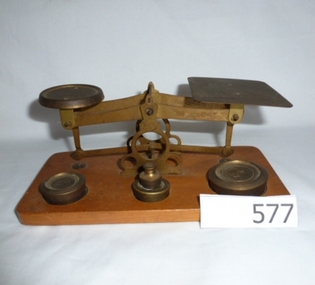
Functional object - Scales, Young Atom, Postage scales, 1950s
... This item is significant as it demonstrates a by-gone method of weighing mail. It is also significant as it uses pre-metric measurements, placing its age before 1966. scales ounces postage mail sec state electricity commission greensborough Each weight is inscribed with its weight - 1/2, 1, 2 and 4 ounces. ...These scales were used to weigh the outgoing mail at the SEC (State Electricity Commission) premises in Main Street Greensborough.This item is significant as it demonstrates a by-gone method of weighing mail. It is also significant as it uses pre-metric measurements, placing its age before 1966.Metal scales on timber base, 4 brass weights.Each weight is inscribed with its weight - 1/2, 1, 2 and 4 ounces.scales, ounces, postage, mail, sec, state electricity commission, greensborough -
Emerald Museum & Nobelius Heritage Park
Functional object - Apothecary weights, H.B. Selby, 1900s
... The apothecary system of weights was tailored to measuring medicinal ingredients; it and the Troy system (which was used for measuring precious metals such as silver and gold) both have twelve ounces to the pound, in comparison to the Avoirdupois method which was used for heavier items and had sixteen ounces to the pound. These measurement systems were used extensively throughout the world until the 1960s when the widespread adoption of the metric system standardised processes....The apothecary system of weights was tailored to measuring medicinal ingredients; it and the Troy system (which was used for measuring precious metals such as silver and gold) both have twelve ounces to the pound, in comparison to the Avoirdupois method which was used for heavier items and had sixteen ounces to the pound. These measurement systems were used extensively throughout the world until the 1960s when the widespread adoption of the metric system standardised processes. ...These Victorian-era apothecary scales are from the collection of equipment used by Dr William Bottomley. Dr Bottomley was born in Fitzroy in 1881 and obtained a Bachelor of Surgery from the University of Melbourne in 1906. He lived in South Yarra with a weekend log cabin called Forest Lodge in Emerald and practiced in Collins Street in Melbourne. These weights were used with a scale to dispense correct quantities of drugs or ingredients; the tweezers may have been used to combine substances on the glass slide ready for use. In the 1920s Dr Bottomley and business partner W.H. Treganowan initiated the Emerald Country Club syndicate to purchase land from Carl Axel Nobelius' Gembrook Nurseries estate, which led to the formation of the golf course and Country Club facilities. Bottomley Drive in Emerald is named after Dr Bottomley; the street is located near Silver Birches, the house commissioned by the doctor from modernist architect Harry Norris. These weights were used with a scale to dispense correct quantities of drugs or ingredients; the tweezers may have been used to combine substances on the glass slide ready for use. The apothecary system of weights was tailored to measuring medicinal ingredients; it and the Troy system (which was used for measuring precious metals such as silver and gold) both have twelve ounces to the pound, in comparison to the Avoirdupois method which was used for heavier items and had sixteen ounces to the pound. These measurement systems were used extensively throughout the world until the 1960s when the widespread adoption of the metric system standardised processes.These items are significant as they provide insights into medical practice in the early Twentieth-Century in Melbourne and surrounds. They are also significant because they were used by Dr William Bottomley, who owned property in Emerald and whose business dealings significantly shaped the development of the town.Wooden box with a metal latch, maker's label and owner's name. Inside the box there is a black cloth lining to encase eight brass and five tin weights, a glass slide and tweezers. There is space for an additional brass weight and eight tin weights, but these spaces are empty.Obverse: D W H BOTTOMLEY / H.B SELBY & CO. LTD. / SCIENTIFIC APPARATUS / MELBOURNE & SYDNEY /emerald, victoria, australia, gold weights, apothecary weights, bottomley, fischer, dr. w f bottomley, w.h. treganowan, harry norris, forest lodge, silver birches, medical practice, drug dispensing, pharmacy equipment, h.b. selby & co, emerald country club and golf course
