
Showing 686 items matching "mid-late 19th century"
-
 Flagstaff Hill Maritime Museum and Village
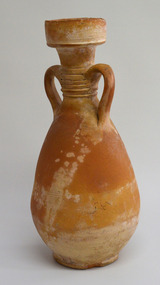
Ceramic - Amphora, mid-to-late 19th century
... ...mid-late 19th century...Thermoluminescence testing indicates the relic was made in the mid-to-late 19th century, and experts suggest it was of North African origin. ...mid-to-late 19th century...Thermoluminescence testing indicates the relic was made in the mid-to-late 19th century, and experts suggest it was of North African origin. ...This amphora or jug has a silhouette shaped like a woman with her hands on her hips, wearing a long, flared-out skirt. The design was used in ancient Greece for pottery storage jars, the neck being narrower than the body. According to reports, this amphora was discovered in 1934 by Joe O'Keeffe, in a sand blowout, or sand hummocks, west of Levy's Point, west of Warrnambool, while he was planting marram grass for Mr Duncan. An article in the Warrnambool Standard newspaper of December 21, 1985, states that the amphora may be linked to the wooden sailing ship called the Mahogany Ship (also called the Ancient Wreck). Thermoluminescence testing indicates the relic was made in the mid-to-late 19th century, and experts suggest it was of North African origin. The presence of the amphora in the dunes, and the amphora itself, is still a mystery. The amphora was donated to Flagstaff Hill on a long-term loan by the Duncan family and displayed to the public for the first time on December 21, 1985. The exhibition continued until February 2023, when the objects on display in the Assistant Lighthouse Keepers Cottage (Shipwreck Museum) were returned to storage to rest, and the redevelopment of the Cottage began. A search for members of the Duncan Family was undertaken by Flagstaff Hill and stakeholders to resolve the loan term, but the family at that time was unknown. As such, to properly care for the amphora, it has been registered until ownership can be determined. The amphora is currently on display in the Great Circle Gallery, where members of the Duncan family recognised it and have since made contact with the museum. The amphora's presence in the hummocks remains an intriguing and tantalising mystery, yet to be solved!The amphora is significant for the mystery it holds. Its origin and connection with the local area have led to local speculation since it was discovered in 1934. Amphora or jug; earthenware, orange clay with areas of cream. The vessel has a wide mouth, a deep lip, two opposing handles between the neck and shoulder, and a bulbous body. The curved handles have a design of six bands between them. There are three rings of small dots encircling the body. The underside has concentric circles in the clay, an uneven edge and pinhole markings. The amphora is kindly on loan from the Duncan family.Pinhole patterns: [3 holes above 3 holes] opposite [3 holes above 3 holes], 1 hole] [ 1 hole above 2 holes] flagstaff hill maritime museum and village, warrnambool, great ocean road, shipwreck coast, amphora, jug, mahogany ship, ancient wreck, joe o'keefe, duncan, thermoluminescence, north africa, levy point, pottery, storage jar, flagstaff hill, maritime museum, maritime village, shipwreck artefact, relic, shipwreck museum, pottery jar, ancient jar, egyptian water pot, greek jar, ceramic jar, mystery, exotic jar, mystery antique, historic jug, 1934, joe o’keefe, marshall duncan, port fairy, 1935, 1985, marshall mckenzie duncan, mac duncan, duncan family, 1981, dan madden, scientific investigation, scientific analysis, scientific dating, north african origin, mid-late 19th century, marram grass, levy’s point -
 Bendigo Historical Society Inc.
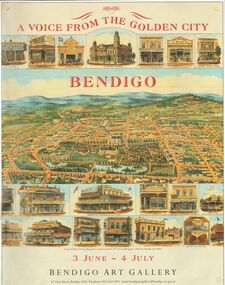
Document - BENDIGO ART GALLERY A VOICE FROM THE GOLDEN CITY EXHIBITION 2001, 1877
... ...mid to late 19th century bendigo...BENDIGO History mid to late 19th century bendigo Francis Williams Niven, Sandhurst. ...Chromolithograph Sandhurst in detail 1877 by Francis Williams Niven. View Point icons including George S. Bissett Draper, Clothing & Millinery, Manning & Co. Drapers, Milliners and Tailors; Pall Mall icons Bent Photographers, W. Lunn Painter and Decorator, J.B. Edwards Watchmakers, John Ingram Hatter and Lyceum Mutual Store & Co; High Street icons T.J. Connelly & Co. Ironmongers; McCrae Street icons Rea & Co Locksmiths and Gun Makers; Williamson Street icons Albert Bush Groicer and Tea Merchant; Bridge Street icons Cohn Brothers Soft Drink and Confectionery; Mitchell Street icons, MA Palk & Co Mourning Attire.Francis Williams Niven, Sandhurst.bendigo, history, mid to late 19th century bendigo -
 Embroiderers Guild, Victoria
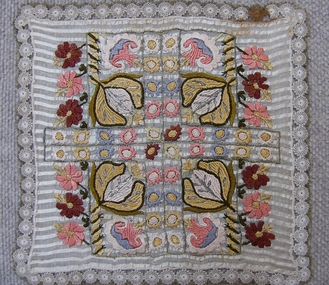
Textile - Mat, Baroness Viola, Late 19th century
... Mid European... Late 19th century...Czechoslovakia Embroidery Surface stitchery Mid European Late 19th century White silk gauze with a self stripe is the background for this ornate design in coloured twisted silks and metal threads. ...Made by Viola, sister of Baroness Felicitas Wiedersperger of Tazovitz. Belonged to the above Baroness.White silk gauze with a self stripe is the background for this ornate design in coloured twisted silks and metal threads. The decorative edge is Armenian edging with an added gilt finish.czechoslovakia, embroidery, surface stitchery, mid european, late 19th century -
 Flagstaff Hill Maritime Museum and Village
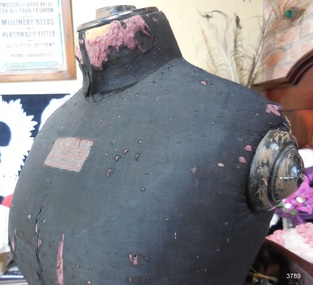
Equipment - Mannequin, J. A. Walker, before April 1874
... It dates to the mid-late 19th century....19th century mannequin dress form display mannequin custom made mannequin dressmaker’s dummy andique mannequin clothing display j.a. walker manufacturer melbourne j.a. walker mannequin manufacturer evening outfit Mannequin maker’s fabric label “J.A. WALKER / MANUFACTURER / MELBOURNE” This wooden display mannequin is from neck to floor length. It has a round pedestal. The mannequin’s bodice has been painted black. It is padded then covered in black fabric. The maker of the mannequin was J.A. Walker of Melbourne. It dates to the mid-late ...THE MANNEQUIN The included wooden mannequin made by J.A. Walker of Melbourne has been very well used, as can be seen from the pin marks and split and torn fabric in areas where pins would have been used many times. The painted wood of the bodice is wearing away. The top of the neck is very rough in the centre, indicating that it possibly had a knob, handle or even a head shape on top. The mannequin could have been used for storing and cleaning of the evening outfit and even in the process of making it. It is made to match the measurements of the outfit beautifully and would be close in measurement to Mrs. Isabella Mitchell. Isabella’s sister-in-law Eliza Russell made her own wedding dress and perhaps she or Isabella herself made the evening outfit using the mannequin for fittings. The mannequin is significant as its size gives an image of the shape of the evening outfit’s owner. It is also significant as an example of the process and skills to create garments of fashion during the period, with many people making their own garments. The mannequin is also an example of an item manufactured in Melbourne in colonial times. This wooden display mannequin is from neck to floor length. It has a round pedestal. The mannequin’s bodice has been painted black. It is padded then covered in black fabric. The maker of the mannequin was J.A. Walker of Melbourne. It dates to the mid-late 19th century.Mannequin maker’s fabric label “J.A. WALKER / MANUFACTURER / MELBOURNE”mannequin wooden, mannequin made in melbourne, dressmaker’s mannequin, 19th century mannequin, dress form, display mannequin, custom made mannequin, dressmaker’s dummy, andique mannequin, clothing display, j.a. walker manufacturer melbourne, j.a. walker mannequin manufacturer, evening outfit -
 Orbost & District Historical Society
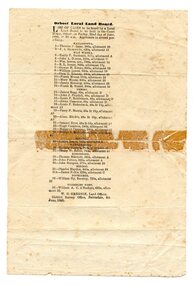
programe, 1888
... These boards were establishe in the mid-late 19th century and generally dealt with disputes about fencing, water rights, general land enquiries and the opening or closing of local roads....These boards were establishe in the mid-late 19th century and generally dealt with disputes about fencing, water rights, general land enquiries and the opening or closing of local roads. ...Local land boards were community based "tribunals" consisting of a chairman appointed by the the state government and two(?) local members who were there or their knowledge of local land management practices. These boards were establishe in the mid-late 19th century and generally dealt with disputes about fencing, water rights, general land enquiries and the opening or closing of local roads.This document is a record of local land issues in the late 19th century. A sheet of paper, held together with sticky tape, stating the names of cases to be read by court regarding land. document land-use land-board gregson -
 Vision Australia
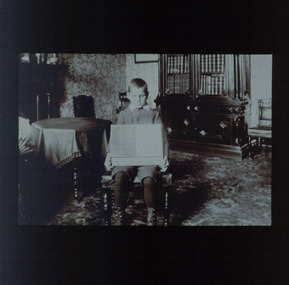
Slide - Image, Boy holding Taylor slate
... William Taylor in the mid-late 19th century, this English invention provided a device that allowed pegs to represent a variety of numbers upon an array, rather than using raised numbers. ...William Taylor in the mid-late 19th century, this English invention provided a device that allowed pegs to represent a variety of numbers upon an array, rather than using raised numbers. ...A boy sits in possibly the Superintendent's reception room at the RVIB building in St Kilda Road, holding a Taylor's mathematical slate. Developed by Rev. William Taylor in the mid-late 19th century, this English invention provided a device that allowed pegs to represent a variety of numbers upon an array, rather than using raised numbers. Various models were produced around the world before it's eventual demise around the early 1970's.B/W image of a boy holding a metal grid in his laproyal victorian institute for the blind, braille equipment -
 Flagstaff Hill Maritime Museum and Village
Weapon - Carronade
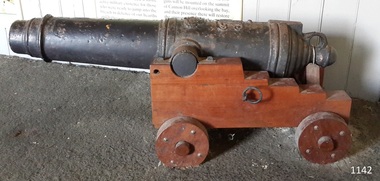
... It is believed this carronade is a replica of a mid-to-late 19th-century Carronade cannon....It is believed this carronade is a replica of a mid-to-late 19th-century Carronade cannon. Weapon Carronade ...This deck cannon is believed to be a replica Carronade as it has no foundry mark, year of manufacture, proof marks or weight of carronade on it. However, its design matches the design of Carronades used in the early to mid 19th century. History: The carronade was designed as a short-range naval weapon with a low muzzle velocity for merchant ships, but it also found a niche role on warships. It was produced by the Carron iron works and was at first sold as a complete system with the gun, mounting, and shot altogether. Carronades initially became popular on British merchant ships during the American Revolutionary War. A lightweight gun that needed only a small gun crew and was devastating at short range was well suited to defending merchant ships against French and American privateers. Its invention is variously attributed to Lieutenant General Robert Melville in 1759, or to Charles Gascoigne, manager of the Carron Company from 1769 to 1779. In its early years, the weapon was sometimes called a "mellvinade" or a "gasconade". The carronade can be seen as the culmination of a development of naval guns reducing the barrel length and thereby the gunpowder charge. The Carron Company was already selling a "new light-constructed" gun, two-thirds of the weight of the standard naval gun and charged with one-sixth of the weight of the ball in powder before it introduced the carronade, which further halved the gunpowder charge. The theory of its design was to use less powder and had other advantages that were advertised in the company's sales pamphlet of the time, state. The smaller gunpowder charge reduced the barrel heating in action, also reduced the recoil. The mounting, attached to the side of the ship on a pivot, took the recoil on a slider, without altering the alignment of the gun. The pamphlet advocated the use of woolen cartridges, which eliminated the need for wadding and worming, although they were more expensive. Carronades also simplified gunnery for comparatively untrained merchant seamen in both aiming and reloading that was part of the rationale for adopting the gun. Other advantages promoted by the company were. The replacement of trunnions by a bolt underneath, to connect the gun to the mounting, reduced the width of the carriage that enhanced the wide angle of fire. A merchant ship would almost always be running away from an enemy, so a wide-angle of fire was much more important than on a warship. A carronade weighed a quarter as much as a standard cannon and used a quarter to a third of the gunpowder charge. This reduced charge allowed Carronades to have a shorter length and much lighter weight than long guns. Increasing the size of the bore and ball reduces the required length of the barrel. The force acting on the ball is proportional to the square of the diameter, while the mass of the ball rises by the cube, so acceleration is slower; thus, the barrel can be shorter and therefore lighter. Long guns were also much heavier than Carronades because they were over-specified to be capable of being double-shotted,(to load cannons with twice the shot, for increased damage at the expense of range). Whereas it was dangerous to do this in a carronade. A ship could carry more carronades, or carronades of a larger caliber, than long guns, and carronades could be mounted on the upper decks, where heavy long guns could cause the ship to be top-heavy and unstable. Carronades also required a smaller gun crew, which was very important for merchant ships, and they were faster to reload. Additional notes: Cannon cast in England, Wales and Scotland had their imperial weight chiselled or engraved in the format of 4-2-0 on the bottom of the cascabel, indicating the weight of the cannon as 4 hundredweight, 2 quarters and 0 pounds. Since a hundredweight equals 112 pounds and a quarter weight is 28 pounds the total weight is 504 pounds or about 228 kilograms. The small bore replica carronade and carriage is part of a collection of nineteenth Century Flagstaff Hill Guns and cannons, and is a representation of carronades used from the early 18th up to the 1850s on merchant and military ships particularly the British Royal Navy until 1850. This example is not significant in the historic sense but demonstrates the type of artillery used aboard vessels of the time for protection & offensive military actions. Cannon, cast iron, small smooth bore cannon on the stepped wooden carriage with wooden wheels. It appears to fire a 12-pound cannonball. The Cannon barrel can have its elevation adjusted via a sliding sloped block at the rear of the cannon. Gun carriage has loops for locating and holding the carriage in position with the use of ropes. It is believed this carronade is a replica of a mid-to-late 19th-century Carronade cannon.Cast into metal; [Royal emblem of Queen Victoria (VR "Victoria Regina")]warrnambool, flagstaff-hill, flagstaff-hill-maritime-museum, maritime-museum, shipwreck-coast, flagstaff-hill-maritime-village, cannon, naval cannon, cannon on carriage, 19th century cannon, fortifications, smooth bore cannon, 12 pounder, carronade, artillery, replica, deck cannon, cannon in carriage, ship cannon -
 Flagstaff Hill Maritime Museum and Village
Functional object - Tap, mid-late 19th century
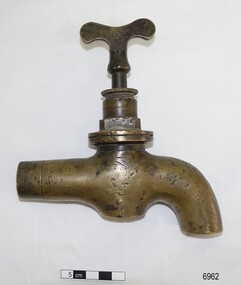
... mid-late 19th century...This large brass tap is typical of industrial tapware of the mid-late 19th and 20th centuries. The location of the tap, when found, is associated with the Warrnambool district and could have easily been from a shipwreck due to the encrustation found inside the tap. ...This type of large, brass tap is typical of the plumbing fittings manufactured in the late 19th and early 20th centuries. The tap has encrustations and concretion inside, showing that it had been in the sea for quite some time. The pipe leading to the spout is squashed, nicked and appears to have been sawn or broken off. It could have once been part of the plumbing from a ship, perhaps from one of the boilers used in the kitchen, for bathing or for laundry or cleaning. The name “BEST” on the tap signifies that it could have been made by Robert Best who began his Birmingham brass foundry c. 1840, and even though The information from the donor is that tap was given to her father (1906-1982) who lived in the Warrnambool district. It was likely given by a cray fisherman or diver, who said that the tap came from the Loch Ard shipwreck, wrecked on Mutton Bird Island, east of Port Campbell, Victoria, on 1st June 1878. This could easily be the case but there is no provenance for it. ROBERT BEST, BRASS FOUNDRY Circa 1840 Robert Best founded his brass foundry business and was referred to as a Brass Chandelier of Birmingham”. In 1864 an advertisement in the Journal of Gas Lighting, Water Supply, & Sanitary Improvement announces Best and Hobson, late Robert Best, 100 Charlotte Street Birmingham, manufacturers of Chandeliers, Brass and iron fittings, Steam and Water-cocks etc. gas apparatus of every description, Plumber's brass foundry, with works at Birmingham and Great Bridge, Staffordshire. In 1867 Best & Lloyd was formed, after Best and Hobson went into liquidation, manufacturing at the Cambray Works of Wattville Road, Handsworth. It was a light industrial engineering works and one of the owners was Robert Dudley Best’s father. Robert Dudley Best (1892-1984) later took over the business of Best & Lloyd. The company is still in business at Downing Street, Smethwick, Birmingham. In 1878, brass ship furniture and bell fittings stamped “BEST” was made by William Udal & Co., who advertised as manufacturers of BEST cast and stamped brass foundry goods. This large brass tap is typical of industrial tapware of the mid-late 19th and 20th centuries. The location of the tap, when found, is associated with the Warrnambool district and could have easily been from a shipwreck due to the encrustation found inside the tap. Due to its design and manufacturer, the tap is associated with the mid-late 19th and early 20th-century manufacture of plumbing fittings. Tap, brass, heavy-duty, with butterfly handle. The design and style are typical of the plumbing of the late 1800s. Inscription pressed into the handle, within rectangular border "BEST". Encrustation and concretion are inside the tap spout. “BEST” on one side of the tap handle (Also, a label from the donor attached to the tap “from the wreckage of the LOCH ARD")flagstaff hill, warrnambool, shipwrecked coast, flagstaff hill maritime museum, maritime museum, shipwreck coast, flagstaff hill maritime village, great ocean road, robert best brass foundry, best and hobson, best & llyod, birmingham brass foundry, brass tap, best brand tap, heavy duty brass tap, industrial brass tap, boiler tap, 19th century plumbing, 19th century tapware, 19th century plumbing fitting, tap with butterfly handle, tap salvaged from shipwreck, brass fittings, steam engine fittings, water-cock fitting -
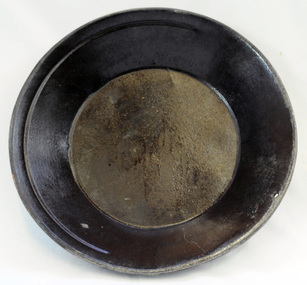 Orbost & District Historical Society
gold panning dish, mid - late 19th century
... mid - late 19th century ...Panning dishes were used for washing fine gold from river sediments or from the residue trapped in cradles and puddling tubs. They were often used on the edge of streams/rivers to sift gold from alluvial soil or crushed quartz. This simple pan would have been filled with sand and gravel which might have contained gold. The pan was submerged in the water and shaken to sort the gold from the gravel and other material, with the lighter material gradually being washed over the lip until only the heavy deposits, such as gold, remained at the bottom. (ref. Museum Victoria) This pan was used by George Henry Douglas Russell Snr. As a young man prior to his enlistment in WW1 he panned for gold using this dish. During the war he became a vet sergeant in charge of horse lines.Gold panning is the oldest and simplest method of extracting gold. Gold pans had widespread use in alluvial gold fields where water is available. This item is an example of the type of pan commonly used on Victorian gold fields.A circular dull metal panning dish which has a wide rolled top lip which tapers down to a smaller diameter for the base which is flat. The pan has been made from ironmetal which has a coating of another metal with a matte grey finish. It has a small hanging hole and a reinforcing ring all around the top.russell-doug gold-panning mining -
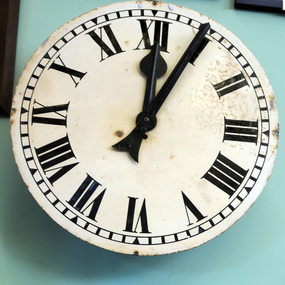 Orbost & District Historical Society
clock, mid-late 19th century
... mid-late 19th century ...The new Post and ·Telegraph Office at Orbost was completed in 1898 This clock was presented by Mr A Cooper to the Postal Dept.in 1899 for erection outside the local post office. The clock arrived in Orbost on Monday 5th June 1899 in the charge of Captain Mortimer of the schooner Orbost. Before the clock could be placed in position permission had to be obtained from the postal department headquarters, and Mr Cooper nominated the appointment of Messrs W. Gluth Snr, J. Watt and H. James as a committee to take charge of the clock on behalf of the people of Orbost. In a letter to Mr Gluth at that time, Mr Cooper said, " If the people of Orbost receive this clock in the same goodwill in which it is given I shall be exceedingly pleased." Mr Alfred Cooper built the Orbost Club Hotel in the early 1890's. Captain Mortimer skippered the Schooner Orbost between Marlo and Melbourne until it was wrecked in 1904This clock is a significant part of Orbost's history.A metal clock from the Orbost Post Office. It is circular with black Roman numerals. It is open with no cover.orbost-post-office cooper-alfred schooner-orbost clock-orbost-post-office -
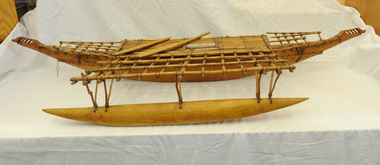 Orbost & District Historical Society
model -outrigger canoe, mid -late 19th century
... mid -late 19th century ...The outrigger gives greater stability and seaworthiness to the canoe. Outrigger canoes were originally developed by the peoples of the islands of Southeast Asia for sea travel, and were used to transport these peoples eastward through to Polynesia and New Zealand more than 2000 Years ago. Today they are still in use. This item possibly came to Orbost with Reverend Alexander Morton . Morton was the minister at the Presbyterian church about 1890. He had spent time in new Hebrides and went on to New Zealand.This item is an example of a handcrafted artefact from the New Hebrides.Detailed model of an outrigger canoe from the Polynesian islands. It isa handmade wooden (possibly breadfruit wood) model of an outrigger canoe - one outrigger attached to the main hull. Bound with string. It has two wooden paddles.handcraft morton-alexander model-outrigger-canoe -
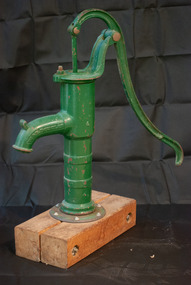 Nillumbik Historical Society Incorporated
Functional object - Hand Pump, W & B Douglas Pump Factory, Hand Pump to Manually Draw Water from Well, Mid - Late 19th Century
... Mid - Late 19th Century ...Hand Pump. Reticulated water did not reach Diamond Creek until 1914. This beautiflly restored hand pump raised water from the outside domed well to provide cool clear water for domestic use.The Hand Pump is a well preserved example of equipment used domestically in the Diamond Creek areaHand pump used for pumping water from shallow wells. Restored by Kim Howard in 1996. Green. Column is screwed to base which is mounted on Redgum planks.PATENTED 1842, W & B DOUGLAS, "MIDD'A CONN.#handpump, #waterpump, #domesticuse -
 Bendigo Historical Society Inc.
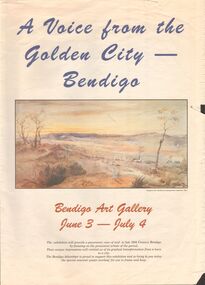
Document - BENDIGO ART GALLERY EXHIBITION A VOICE FROM THE GOLDEN CITY, 1852-1887
... Bendigo Art Gallery Mid to Late 19th Century exhibition on display June 3 to July 4 2001, celebrating the transformation of a town into a city. ...BENDIGO History 19th century bendigo George Rowe Bendigo Art Gallery Mid to Late 19th Century exhibition on display June 3 to July 4 2001, celebrating the transformation of a town into a city. ...Bendigo Art Gallery Mid to Late 19th Century exhibition on display June 3 to July 4 2001, celebrating the transformation of a town into a city. The Bendigo Advertiser is a proud sponsor of exhibition printing a souvenir poster for the occasion depicting a water colour of Kangaroo Flat Sandhurst in 1857 by George Rowe on the cover, a chromolithograph of Sandhurst in 1887 by Francis Niven overleaf and on the back a water colour of the Bendigo Goldfields C.A. Ross & Co. Derwent Store in 1852 by John Cater of Northcote.George Rowebendigo, history, 19th century bendigo -
 Flagstaff Hill Maritime Museum and Village
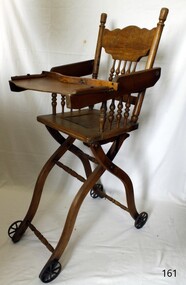
Furniture - Childs high chair, 1890 - 1900
... It appears that the earliest form of child's high chair is attributed to Jonathan Jacobs (1845-1919) a cabinet maker of Browningsville, Pennsylvania USA around the mid to late 19th century. However, children’s chairs from the 18th century and earlier were being used and are in many museum collections around the world that show woodworkers were adapting chair designs for younger users in Europe and America at this time....It appears that the earliest form of child's high chair is attributed to Jonathan Jacobs (1845-1919) a cabinet maker of Browningsville, Pennsylvania USA around the mid to late 19th century. However, children’s chairs from the 18th century and earlier were being used and are in many museum collections around the world that show woodworkers were adapting chair designs for younger users in Europe and America at this time. ...It appears that the earliest form of child's high chair is attributed to Jonathan Jacobs (1845-1919) a cabinet maker of Browningsville, Pennsylvania USA around the mid to late 19th century. However, children’s chairs from the 18th century and earlier were being used and are in many museum collections around the world that show woodworkers were adapting chair designs for younger users in Europe and America at this time.An early children's wooden high chair probably made in America around 1890-1900. Many American manufactures made this type of wooden high chair called an “Eastlake” style and many did not mark their work so it is difficult to determine the subject items exact provenance. A significant item giving a snapshot into the evolution of children's furniture and domestic life during the late Victorian era.Convertible pressed back Victorian era high chair with convertible frame, cast iron wheels, Carved picture of a child to back of seatflagstaff hill, warrnambool, shipwrecked coast, flagstaff hill maritime museum, shipwreck coast, flagstaff hill maritime village, great ocean road, high chair, potty chair, baby furniture, kitchen furniture -
 Bendigo Historical Society Inc.
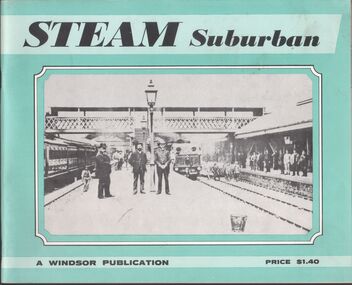
Booklet - Griffith Collection: 'STEAM Suburban'
... Many of the photograph's date from the mid to late 19th century showing steam engines, carriages, railways and stations. ...Many of the photograph's date from the mid to late 19th century showing steam engines, carriages, railways and stations. ...This book was compiled by R. Hudson who wrote in his Author's notes that he was not a historian but a steam enthusiast. The photographs come from the Victorian Railways official history or in ARHS bulletins. Many of the photograph's date from the mid to late 19th century showing steam engines, carriages, railways and stations. The author used photographs occupying much of the page with an informative caption about each photograph.Booklet with light cardboard cover green in colour with black printing. Pages are white with black printing with multiple photographs. Foldout map in the rear of the booklet detailing Melbourne and suburban railways and stations.Front cover: ' STEAM Suburban, A WINDSOR PUBLICATION, PRICE $1.40' Title Page: 'STEAM Suburban' 'A WINDSOR PUBLICATION' 'Wholly set in Australia and printed by Abbott Litho Arts Pty. Ltd., 1-13 Abbottsford Street, West Melbourne, Victoria, 3003.' Author R. Hudsonmelbourne, railways, steam, stations, suburbs -
 Flagstaff Hill Maritime Museum and Village
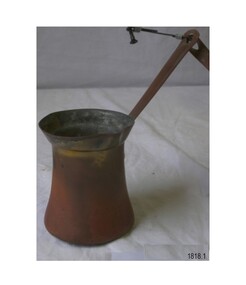
Domestic object - Coffee Pot, 1950s
... During the mid-to-late 19th century, migrants from Greece and Arabia, as well as from many other countries, landed in Australia, contributing to the rich and diverse culture of Australia. ...During the mid-to-late 19th century, migrants from Greece and Arabia, as well as from many other countries, landed in Australia, contributing to the rich and diverse culture of Australia. ...During the mid-to-late 19th century, migrants from Greece and Arabia, as well as from many other countries, landed in Australia, contributing to the rich and diverse culture of Australia. This coffee pot is an example of that culture. In Greece and Arabia, and later in Lebanon, traditional coffee is prepared in a long-handled coffee pot called a "rakwe". The coffee is poured directly from the rakwe into a small cup usually adorned with a decorative pattern called a Finjan. A coffee maker like this multi-purpose pot is used for brewing tea, melting butter, boiling water, and cooking sauces and soups.This coffee pot is an example of kitchen equipment used for both food and beverage preparation. Coffee pots of similar design are still available from stores today.Lebanese coffee pot; a long-handled copper pot, cylindrical with a concave middle, slightly flared base and a flared lip. It was made in Lebanon and includes a stamped inscription.Stamped: "5"warrnambool, shipwreck coast, flagstaff hill, flagstaff hill maritime museum, flagstaff hill maritime village, coffee rakwe, rakwe, coffee pot, coffee maker, arabic, turkish, laeanese, beverage, multi-purpose pot, coffee brewing, cooking, drinking, kitchen equipment -
 Flagstaff Hill Maritime Museum and Village
Journal, May 1868 - June 1877
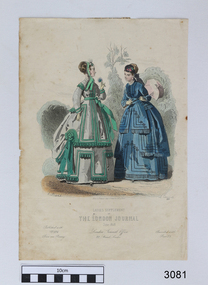
... Preval”, a mid to late 19th century watercolour artist. Covers from 1871 have no signatures but have the word “COPYRIGHT” included in the printing. ...Preval”, a mid to late 19th century watercolour artist. Covers from 1871 have no signatures but have the word “COPYRIGHT” included in the printing. ...This Journal contains a wide variety of lifestyle subjects, showing an interest in in collection of ladies’ fashion covers, newspaper clippings and personal notes appear to have been gathered by a person with interests in fashion, poetry and the home. The covers dating up to 1870 have signatures such as “E. Preval”, a mid to late 19th century watercolour artist. Covers from 1871 have no signatures but have the word “COPYRIGHT” included in the printing. The name below the illustrations “Moine et Falconer” is a French fashion printer and publisher. The loose newspaper cuttings are dated from 1878 to 1927. Journal, comprising a collection of sixty (60) medium weight cartridge paper covers of the “Ladies’ Supplement of the London Journal” with a selection of newspaper clippings pasted to the back of all but two of the covers. The journal covers are dated between years 1868 – 1877. They each have a hand coloured engraving. Below some of the illustrations is a name and address (in French). Some of the covers have a portrait orientation and others are landscape. Some of the covers have a length of additional paper on the left/top with small print, as though there has been a magazine spine attached. The covers have printed dates and numbers, and some of the illustrations are numbered and have one or two signatures. On the reverse of the covers is a selection of newspaper cuttings, including poetry, Household Receipts (recipes, helpful hints on household matters, quotes, fashion, etc.) and personal notes, carefully cut to fit onto the pages. Hand written dates on some of these articles show that they are not all from the same date, and don’t necessarily correspond to the date of the cover. Some of these pages have been assembled upside down to the front cover. Also included are additional notes and loose newspaper cuttings from 1878 – 1927. Under some of the hand coloured engravings are the printed words “Moine et Falconer, imp. r. St Victor, go Paris” (or similar). There are also one or two signatures on the earlier engravings including “E. Preval”. Printed onto the Journal pages “Price one Penny”. Several of the pages have hand drawn lines and pencil script notes. Many of the newspaper cuttings have a date written in pencil on them. For example, “Stuffing Birds”.. The Ladies’ Supplements have been printed with number for “Published with No. –“, and a number for “Presented with Part -”. Some of the reverse pages have pencil notes beside them. flagstaff hill, warrnambool, shipwrecked coast, flagstaff hill maritime museum, maritime museum, shipwreck coast, flagstaff hill maritime village, great ocean road, ladies’ supplement of the london journal, the london journal, journal, 19th century, london journal office, moine et falconer, fashion print, ladies’ clothes, fashion plates, 19th century lifestyle, 19th century fashion, e proval -
 Warrnambool and District Historical Society Inc.
Artefact, Lister, Shearing heads, Early 20th century
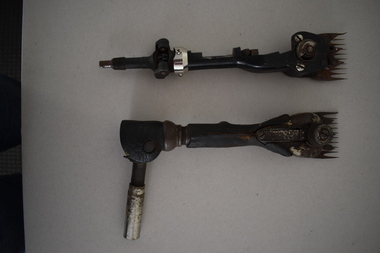
... The great increase in wool production in the mid to late 19th century in Australia led to the need to replace the hand shears with some mechanized form of shearing. ...The great increase in wool production in the mid to late 19th century in Australia led to the need to replace the hand shears with some mechanized form of shearing. ...The woollen industry has always been of the utmost importance in Australia. Although exports have declined over the past decades the production of fine wool still remains important in our economy. The great increase in wool production in the mid to late 19th century in Australia led to the need to replace the hand shears with some mechanized form of shearing. The first sheep shearing machine in Australia was patented in 1867 and improvements to this early model were made over the ensuing years. The early 1890s saw the introduction of flexible drive shafts. The two items here described show this innovation. These two items are of interest as examples of handpieces used early in the 20th century in the mechanized shearing of sheep. They would be typical of the pieces used in the wool industry in the early 20th century in Western Victoria. There are today many local shearers living in Warrnambool and nearby towns and working in the district. .1 This is a metal handpiece for a sheep shearing mechanism. It has a toothed blade attached with metal screws at one end and a jointed metal pipe at the other end for attachment to the shearing machine. The middle section has been covered with black leather for easier gripping. .2 This is a metal handpiece for a sheep shearing mechanism. It has a toothed blade at one end and a flexible metal attachment at the other end to connect it to the shearing machine. Both items are rusted and stained. ‘Sunbeam Flight Lister’sheep shearing in the western district, warrnambool -
 Flagstaff Hill Maritime Museum and Village
Ceramic - Stoneware Bottle, Late 1800s to early 1900s
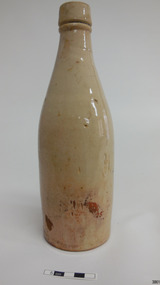
... later from a shipwreck along the coast of Victoria. It may have been amongst the ship's cargo, its provisions or amongst a passenger's personal luggage. It is now part of the John Chance collection. Stoneware bottles similar to this one were in common use during the mid-to-late 19th century...later from a shipwreck along the coast of Victoria. It may have been amongst the ship's cargo, its provisions or amongst a passenger's personal luggage. It is now part of the John Chance collection. Stoneware bottles similar to this one were in common use during the mid-to-late 19th century ...This bottle was recovered decades later from a shipwreck along the coast of Victoria. It may have been amongst the ship's cargo, its provisions or amongst a passenger's personal luggage. It is now part of the John Chance collection. Stoneware bottles similar to this one were in common use during the mid-to-late 19th century. They were used to store and transport. The bottles were handmade using either a potter's wheel or in moulds such as a plaster mould, which gave the bottles uniformity in size and shape. The bottle would then be fired and glazed in a hot kiln. Makers often identified their bottles with the impression of a small symbol or adding a colour to the mouth. The manufacturer often stamped their bottles with their name and logo, and sometimes a message that the bottle remained their property and should be returned to them. The bottles could then be cleaned and refilled.This stoneware bottle is historically significant for its manufacture and use in the late 19th to the early 20th century. The bottle is also significant as it was recovered by John Chance, a diver, from a wreck on the coast of Victoria in the 1960s-70s. Items that come from several wrecks along Victoria's coast have since been donated to the Flagstaff Hill Maritime Village’s museum collection by his family, illustrating this item’s level of historical value.Bottle, salt glazed stoneware, beige, discolouration above base.Noneflagstaff hill, warrnambool, flagstaff hill maritime museum, maritime museum, shipwreck coast, flagstaff hill maritime village, great ocean road, john chance, artefact, stoneware, ironstone, pottery, bottle, antique bottle -
 Wodonga & District Historical Society Inc
Tool - Shearing Hand Set
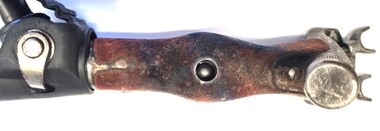
... The increase in wool production in the mid to late 19th century led to the need to replace the hand shears with some mechanized forms of shearing.The first commercially successful sheep shearing machinery by Frederick York Wolseley in New South Wales who was granted a patent for his machine on 28 March 1877. ...The increase in wool production in the mid to late 19th century led to the need to replace the hand shears with some mechanized forms of shearing.The first commercially successful sheep shearing machinery by Frederick York Wolseley in New South Wales who was granted a patent for his machine on 28 March 1877. ...The wool industry has been critical to the Australian economy from the early days of European settlement. The increase in wool production in the mid to late 19th century led to the need to replace the hand shears with some mechanized forms of shearing.The first commercially successful sheep shearing machinery by Frederick York Wolseley in New South Wales who was granted a patent for his machine on 28 March 1877. Many of the early settlers to North East Victoria droved sheep overland from both Sydney and South Australia and established large pastoral runs in the district. Wodonga became a major service centre for the industry and established major saleyards for the pastoral and cattle industries. The handset has the company name "Heiniger" on the side. Heiniger is a Swiss company with subsidiaries in Australia and New Zealand. It was originally established in 1946.This item is connected to a major rural industry in North East Victoria.A metal handpiece for a sheep shearing. A toothed blade is held in place with metal adjustable screws at one end. A jointed metal pipe at the other end allows attachment to the shearing machine. The hinge has been covered with leather.On adjustment knob "Heinger"shearing industry, shearing equipment, shearing handset -
 Flagstaff Hill Maritime Museum and Village
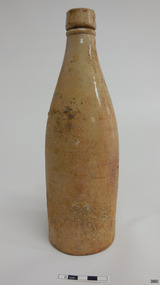
Ceramic - Stoneware Bottle, Late 1800s to early 1900s
... later from a shipwreck along the coast of Victoria. It may have been amongst the ship's cargo, its provisions or amongst a passenger's personal luggage. It is now part of the John Chance collection. Stoneware bottles similar to this one were in common use during the mid-to-late 19th century...later from a shipwreck along the coast of Victoria. It may have been amongst the ship's cargo, its provisions or amongst a passenger's personal luggage. It is now part of the John Chance collection. Stoneware bottles similar to this one were in common use during the mid-to-late 19th century ...This bottle was made in Scotland and recovered decades later from a shipwreck along the coast of Victoria. It may have been amongst the ship's cargo, its provisions or amongst a passenger's personal luggage. It is now part of the John Chance collection. Stoneware bottles similar to this one were in common use during the mid-to-late 19th century. They were used to store and transport. The bottles were handmade using either a potter's wheel or in moulds such as a plaster mould, which gave the bottles uniformity in size and shape. The bottle would then be fired and glazed in a hot kiln. Makers often identified their bottles with the impression of a small symbol or adding a colour to the mouth. The manufacturer usually stamped their bottles with their name and logo, and sometimes a message that the bottle remained their property and should be returned to them. The bottles could then be cleaned and refilled. However, this bottle has no identification marks. This stoneware bottle is historically significant for its manufacture and use in the late 19th to the early 20th century. The bottle is also significant as it was recovered by John Chance, a diver, from a wreck on the coast of Victoria in the 1960s-70s. Items that come from several wrecks along Victoria's coast have since been donated to the Flagstaff Hill Maritime Village’s museum collection by his family, illustrating this item’s level of historical value.Bottle, salt glazed stoneware, beigeNoneflagstaff hill, warrnambool, flagstaff hill maritime museum, maritime museum, shipwreck coast, flagstaff hill maritime village, great ocean road, john chance, shipwreck artefact, stoneware, ironstone, pottery, bottle, antique bottle -
 Flagstaff Hill Maritime Museum and Village
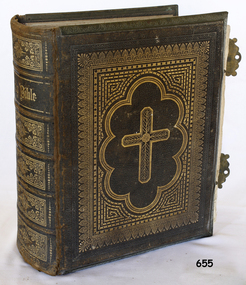
Book - Reference/ Religious Study, James Semple, The Holy Bible, Old & New Testaments, c. 1875
... 19th and early 20th centuries. It was reprinted continuously in the UK, Ireland, Australia, and the United States. The publisher, James Semple, was a mid-to-late 19th-century Scottish publisher, bookbinder, and subscription publisher based in Glasgow. ...19th and early 20th centuries. It was reprinted continuously in the UK, Ireland, Australia, and the United States. The publisher, James Semple, was a mid-to-late 19th-century Scottish publisher, bookbinder, and subscription publisher based in Glasgow. ...This edition is part of what Bible bibliographers classify as the Haydock Quarto Series. It uses the Douay Rheims version (the standard English translation of the Latin Vulgate for Roman Catholics) and is heavily updated with extensive annotations. The subject volume is a large, decorative family Bible. Bibles of this style were peak Victorian subscription publishing, and publishers like Semple typically issued these in unbound parts or sold them via travelling canvassers, bound in heavy, blind stamped or gilt leather meant to serve as a visual centerpiece in a Victorian home.Hard cover book: Bible, Old & New Testaments Editor: Rev. George Leo Haydock Publisher: James Semple, 7 Stirling Road, Glasgow Date: 1875 Further Information: Brown leather bound with extensive gilt pattering to Spine and Front Board, Cross icon to front board and brass book clasps to corners.non-fictionThis edition is part of what Bible bibliographers classify as the Haydock Quarto Series. It uses the Douay Rheims version (the standard English translation of the Latin Vulgate for Roman Catholics) and is heavily updated with extensive annotations. The subject volume is a large, decorative family Bible. Bibles of this style were peak Victorian subscription publishing, and publishers like Semple typically issued these in unbound parts or sold them via travelling canvassers, bound in heavy, blind stamped or gilt leather meant to serve as a visual centerpiece in a Victorian home.flagstaff hill, warrnambool, shipwrecked-coast, flagstaff-hill, flagstaff-hill-maritime-museum, maritime-museum, shipwreck-coast, flagstaff-hill-maritime-village, the holy bible the old testament and the new testament, bible, book, religion, holy bible, rev geo leo haydock, latin vulgate, family bible -
 Flagstaff Hill Maritime Museum and Village
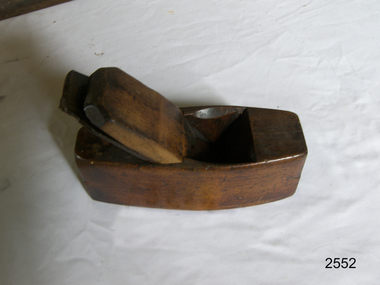
Tool - Wood smoothing plane, 1850-1890
... This plane is a coffin pattern smoothing plane and is unmarked so the maker is unknown however it's design and patina indicate it was probably made in the mid to late 19th century and would be regarded as a vintage or antique item sought after today by collectors of vintage tools. ...This item is a significant tool from the mid to late 19th century that today is quite rare and sought after by collectors. ...A smoothing plane is a wood plane used for making a smooth surface to wood surfaces traditionally, these planes were blocks of wear resistant hardwood, often beech or maple, which were worked to the shape or size required. The blade, or iron was likewise formed to the intended flat or level profile and secured in the body of the plane with a wooden wedge. A traditional cabinetmakers shop might have many, perhaps hundreds, of moulding and smoothing planes for the full range of work to be performed. Large crown mouldings or smoothing plane surfaces required planes of six or more inches in width, which demanded great strength to push and often had additional peg handles on the sides, allowing the craftsman's apprentice or other worker to pull the plane ahead of the master who guided it. This plane is a coffin pattern smoothing plane and is unmarked so the maker is unknown however it's design and patina indicate it was probably made in the mid to late 19th century and would be regarded as a vintage or antique item sought after today by collectors of vintage tools. A vintage tool made by an unknown maker, that was made commercially for firms and individuals who worked in wood and needed a tool that could produce a flat or level finish to timber. These types of planes came in various shapes and sizes to achieve the required finish to timber surfaces used in cabinet making. This item is a significant tool from the mid to late 19th century that today is quite rare and sought after by collectors. It gives us a snapshot of how furniture and other decorative finishes were created on timber by the use of hand tools only. Smoothing Plane Coffin type Noneflagstaff hill, warrnambool, shipwrecked-coast, flagstaff-hill, flagstaff-hill-maritime-museum, maritime-museum, shipwreck-coast, flagstaff-hill-maritime-village, plane -
 Flagstaff Hill Maritime Museum and Village
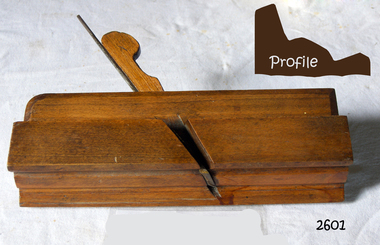
Tool - Complex Moulding Plane, Late 19th to early 20th Century
... This plane is a coffin pattern smoothing plane and is unmarked so the maker is unknown however it's design and patina indicate it was probably made in the mid to late 19th century and would be regarded as a vintage or antique item sought after today by collectors of vintage tools. ...This item is a significant tool from the mid to late 19th century that today is quite rare and sought after by collectors. ...A smoothing or wood plane is a wood plane used for making a smooth or decorative moulding to the surface of wood. Traditionally these planes were made from blocks of wear resistant hardwood, often beech or maple, which were worked to the shape or size required. The blade, or iron was likewise formed to the intended flat or ornamental profile and secured in the body of the plane with a wooden wedge. A traditional cabinetmakers shop might have many, perhaps hundreds, of moulding and smoothing planes for the full range of work to be performed. Large crown Mouldings or smoothing plane surfaces required planes of six or more inches in width, which demanded great strength to push and often had additional peg handles on the sides, allowing the craftsman's apprentice or other worker to pull the plane ahead of the master who guided it. This plane is a coffin pattern smoothing plane and is unmarked so the maker is unknown however it's design and patina indicate it was probably made in the mid to late 19th century and would be regarded as a vintage or antique item sought after today by collectors of vintage tools. A vintage tool made by an unknown maker, that was made commercially for firms and individuals who worked in wood and needed a tool that could produce a flat or level finish to timber. These types of planes came in various shapes and sizes to achieve the required finish to timber surfaces used in cabinet making. This item is a significant tool from the mid to late 19th century that today is quite rare and sought after by collectors. It gives us a snapshot of how furniture and other decorative finishes were created on timber by the use of hand tools only. Complex moulding wood planeNoneflagstaff hill, warrnambool, plane, flagstaff hill, warrnambool, flagstaff hill maritime museum, maritime museum, shipwreck coast, great ocean road, plane, moulding plane, complex moulding plane, cabinet makers tools -
 Flagstaff Hill Maritime Museum and Village
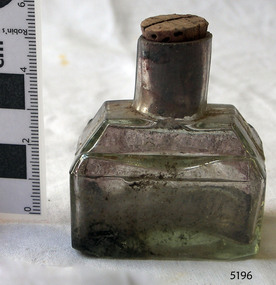
Container - Ink Bottle, Late-19th to early-20th century
... This handmade glass ink bottle was mouth-blown into a two-piece mould, a method often used in the mid-to-late 19th century. The glass blower burst the bottle off the end of his blowpipe with a tool, leaving an uneven mouth and sharp edge on the bottle, which was usually filed. ...This handmade glass ink bottle was mouth-blown into a two-piece mould, a method often used in the mid-to-late 19th century. The glass blower burst the bottle off the end of his blowpipe with a tool, leaving an uneven mouth and sharp edge on the bottle, which was usually filed. ...The design of the bottle is sometimes called a ‘cottage’ or ‘boat’ shape. This handmade glass ink bottle was mouth-blown into a two-piece mould, a method often used in the mid-to-late 19th century. The glass blower burst the bottle off the end of his blowpipe with a tool, leaving an uneven mouth and sharp edge on the bottle, which was usually filed. The bottle was then filled with ink and sealed with a cork. More expensive bottles would have a lip added, which was more time-consuming and costly to produce. The capacity for a bottle such as this was about 3 ½ oz (ounces) equal to about 100 ml. Pen and ink have been in use for handwriting since about the seventh century. A quill pen made from a bird’s feather was used up until around the mid-19th century. In the 1850s a steel point nib for the dip pen was invented and could be manufactured on machines in large quantities. The nis only held a small amount of ink so users had to frequently dip the nib into an ink well for more ink. Handwriting left wet ink on the paper, so the blotting paper was carefully used to absorb the excess ink and prevent smudging. Ink could be purchased as a ready-to-use liquid or in powdered form, which needed to be mixed with water. In the 1880s a successful, portable fountain pen gave smooth-flowing ink and was easy to use. In the mid-20th century, the modern ballpoint pen was readily available and inexpensive, so the fountain pen lost its popularity. However, artisans continue to use nib pens to create beautiful calligraphy.This ink bottle still retains its original cork. The method of manufacture is representative of a 19th-century, handcraft industry that is now largely replaced by mass production. The ink bottle is historically significant as it represents methods of handwritten personal and business communication that were still common up until the mid-20th century when fountain pens and modern ballpoint pens became popular and convenient and typewriters were becoming part of standard office equipment.Victorian 'boat' shaped ink bottle; small rectangular clear glass ink bottle with grooves in shoulders for holding pen. Bottle has side seams and a 'burst-lip'. The bottle retains its cork.flagstaff hill, warrnambool, maritime museum, maritime village, great ocean road, shipwreck coast, ink, nib pen, writing ink, writing, copying, banks, lawyers, commerce, student, permanent ink, stationery, record keeping, handwriting, writing equipment, writing accessory, office supply, cottage bottle, boat bottle, mouth-blown bottle, two-part mould, sheer-lip bottle, burst-lip, cork seal, stencil ink, copy ink -
 Flagstaff Hill Maritime Museum and Village
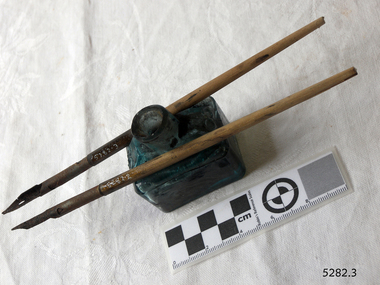
Container - Ink Bottle with pens, Early 20th century
... This method of making bottles was often used in the mid-to-late 19th century. The bottle would then be filled with ink and sealed with a cork. ...This method of making bottles was often used in the mid-to-late 19th century. The bottle would then be filled with ink and sealed with a cork. ...This handmade, aqua glass ink bottle's design is sometimes called a ‘boat’ shape. The base was mouth-blown into a rectangular mould, evidenced by the lack of seams, the pontil, crease lies and the uneven thickness of the glass. The shoulder section was mouth-blown into a two-piece mould and then cut off from the blowpipe. The lip is sometimes referred to as a 'burst-lip, which was often filed to be smooth. This method of making bottles was often used in the mid-to-late 19th century. The bottle would then be filled with ink and sealed with a cork. More expensive bottles would have a lip added, which was more time-consuming and costly. The capacity for a bottle such as this was about 3 ½ oz (ounces) equal to about 100 ml. Pens are a common item for that period. Pen and ink have been used for handwriting since about the seventh century. A quill pen made from a bird’s feather was used until the mid-19th century. In the 1850s a steel point nib for the dip pen was invented and could be manufactured on machines in large quantities. The nis only held a small amount of ink so users had to frequently dip the nib into an ink well for more ink. Handwriting left wet ink on the paper, so the blotting paper was carefully used to absorb the excess ink and prevent smudging. Ink could be purchased as a ready-to-use liquid or in powdered form, which needed to be mixed with water. In the 1880s a successful, portable fountain pen gave smooth-flowing ink and was easy to use. In the mid-20th century, the modern ballpoint pen was readily available and inexpensive, so the fountain pen lost its popularity. However, artisans continue to use nib pens to create beautiful calligraphy.The ink bottle is of interest, being made of aqua glass rather than the more common clear glass. This set of ink bottles and pens is significant because of the bottle's method of manufacture, which is representative of a 19th-century handcraft industry that has now been largely replaced by mass production. The bottle and pens are historically significant as tools used for handwritten communication until the mid-20th century when fountain pens and modern ballpoint pens became popular and convenient and mechanical typewriters became part of standard office equipment.Victorian 'Boat' ink bottle, small rectangular, aqua glass ink bottle with grooves along the long sides for pen rests. The base has a pontil, no seams, and the glass is uneven in thickness. The shoulder has two side seams and there is a ridge where it is joined onto the base; there are round indents on each of the shoulder, on the short sides, four in all. The mouth has rough edges. The neck leans to one side. The glass has impurities, crease lines and bubbles. There is dried ink in the bottle. Two pens with metal nibs are included with the ink bottle. flagstaff hill, warrnambool, maritime museum, maritime village, great ocean road, shipwreck coast, ink, nib pen, writing ink, writing, copying, banks, lawyers, commerce, student, permanent ink, stationery, record keeping, handwriting, writing equipment, writing accessory, office supply, cottage bottle, boat bottle, mouth-blown bottle, two-part mould, sheer-lip bottle, burst-lip, cork seal, copy ink, aqua glass -
 Puffing Billy Railway
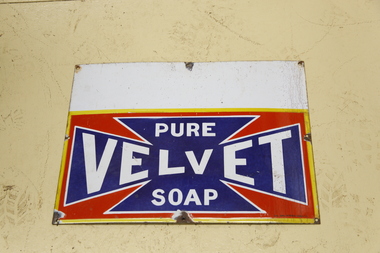
Sign - Advertising - Pure Velvet Soap - Enamel Sign, pre 1950s
... Through merger and expansion the company became the pre-eminent manufacturer of soap and candles in the eastern colonies in the mid to late 19th century. Kitchen also speculated in a number of enterprises but suffered financial setbacks as a result of the 1890s bank crashes. ...Through merger and expansion the company became the pre-eminent manufacturer of soap and candles in the eastern colonies in the mid to late 19th century. Kitchen also speculated in a number of enterprises but suffered financial setbacks as a result of the 1890s bank crashes. ...Velvet Soap was a widely used laundry bar soap launched in 1906, produced by J. Kitchen & Sons, owned by John Ambrose Kitchen (1835 - 1922). Kitchen was born in Britain and emigrated to Victoria in 1854. After a less than successful period at the Caledonian and Blackwood diggings, Kitchen returned to Melbourne and joined his father and brothers in establishing a tallow candle making works. Through merger and expansion the company became the pre-eminent manufacturer of soap and candles in the eastern colonies in the mid to late 19th century. Kitchen also speculated in a number of enterprises but suffered financial setbacks as a result of the 1890s bank crashes. Despite this, the company continued to grow in the early twentieth century with the introduction of products such as Velvet Soap and Solvol. The company merged with the British company Lever Bros in 1914 who eventually took full control of the company in 1924, becoming Lever and Kitchen. Advertising for Velvet Soap in Australia was extensive and pervasive. All manner of surfaces were used to advertise the product such as building walls, roofs, and most commonly, enamelled sheet metal signs which were fastened to any available surface internally and externally. The most common form of sign that Velvet Soap used was the words 'PURE VELVET SOAP' in white lettering within a vivid dark blue, elongated Maltese cross. On the enamelled metal signs the Maltese cross sat on a red background with a yellow border. While this was the dominant form for Velvet Soap signs, there were variations from the standard. The Velvet Soap sign is of historical significance as a representative of painted signs that were once a common form of advertising during the nineteenth and early twentieth centuries. - : http://vhd.heritagecouncil.vic.gov.au/places/14447#sthash.Vb6KAUWl.dpufHistoric - Advertising Sign - Velvet SoapTin sign with white, yellow, red and blue enamel. Pure velvet soap.puffing billy, enamel sign, pure velvet soap -
 Flagstaff Hill Maritime Museum and Village
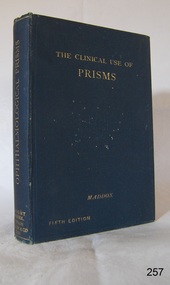
Book - Reference Book Ophthalmology, Ernest Edmund Maddox, The Clinical Use of Prisms, 1907
... The firm originally began as a general printing house before specializing in medical and scientific publishing in the mid-to-late 19th century. They operated out of the Stonebridge Press in Bristol, John Wright & Co. ...The firm originally began as a general printing house before specializing in medical and scientific publishing in the mid-to-late 19th century. They operated out of the Stonebridge Press in Bristol, John Wright & Co. ...The subject volume The Clinical Use of Prisms; and the Decentring of Lenses is a seminal treatise on ophthalmic optics, binocular vision, and the correction of eye muscle imbalances (strabismus and heterophoria). The book covers two core clinical topics. Prismatic Refraction, how light bends through optical prisms, and how clinicians can use prisms to measure, diagnose, and relieve eye strain (asthenopia), double vision (diplopia), and misaligned line of sight. Decentring Lenses is the second and its focusing on the mathematical and practical rules for shifting the optical center of a spectacle lens relative to the patient's pupil. By decentring a standard spherical or cylindrical lens, allowing an optometrist or ophthalmologist to create an intentional "prismatic effect" without needing to grind a separate, heavy prism into the glassHard cover book,The Clinical Use of Prisms Author: Ernest Edmund Maddox Publisher: John Wright & Co Date: 1907 5th Edition Further Information: Front cover & spine blue cloth title, publisher details and author name in gilt lettering.non-fictionThe subject volume The Clinical Use of Prisms; and the Decentring of Lenses is a seminal treatise on ophthalmic optics, binocular vision, and the correction of eye muscle imbalances (strabismus and heterophoria). The book covers two core clinical topics. Prismatic Refraction, how light bends through optical prisms, and how clinicians can use prisms to measure, diagnose, and relieve eye strain (asthenopia), double vision (diplopia), and misaligned line of sight. Decentring Lenses is the second and its focusing on the mathematical and practical rules for shifting the optical center of a spectacle lens relative to the patient's pupil. By decentring a standard spherical or cylindrical lens, allowing an optometrist or ophthalmologist to create an intentional "prismatic effect" without needing to grind a separate, heavy prism into the glassflagstaff hill, warrnambool, shipwrecked-coast, flagstaff-hill, flagstaff-hill-maritime-museum, maritime-museum, shipwreck-coast, flagstaff-hill-maritime-village, the clinical use of prisms, book, ernest f. maddox -
 Flagstaff Hill Maritime Museum and Village
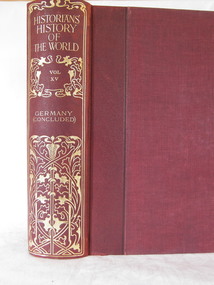
Book - Reference Book/History, Henry Smith Williams, The Historians History of the World Vol 15 set 1 - Edited by Henry Smith Williams L.L.D. Published by “The Times” 1908, 1908
... The volume documents the path to German unification culminating in the mid-to-late 19th century, covering the 1848 Revolutions, the diplomacy of Otto von Bismarck, the Franco-Prussian War (1870–71), and the final crowning of the German Emperor at Versailles. ...The volume documents the path to German unification culminating in the mid-to-late 19th century, covering the 1848 Revolutions, the diplomacy of Otto von Bismarck, the Franco-Prussian War (1870–71), and the final crowning of the German Emperor at Versailles. ...Henry Smith Williams’ “The Historians' History of the World” is a chronological and geographical "tapestry" of human events, these twenty five volumes occupy a very specific and prestigious place in historical research. Volume 15 of “The Historians' History of the World” moves into the heart of modern European power dynamics. Published by The Times in 1908, this volume focuses on the rise of the modern German state and the evolution of the Austrian Empire.The Book is part of a 25 volume set with red cloth bindings and gold filigree design to rib.non-fictionHenry Smith Williams’ “The Historians' History of the World” is a chronological and geographical "tapestry" of human events, these twenty five volumes occupy a very specific and prestigious place in historical research. Volume 15 of “The Historians' History of the World” moves into the heart of modern European power dynamics. Published by The Times in 1908, this volume focuses on the rise of the modern German state and the evolution of the Austrian Empire.flagstaff hill, warrnambool, shipwrecked-coast, flagstaff-hill-maritime-museum, maritime-museum, shipwreck-coast, flagstaff-hill-maritime-village, book, the historians history of the world vol 15 set 1, henry smith williams -
 Flagstaff Hill Maritime Museum and Village
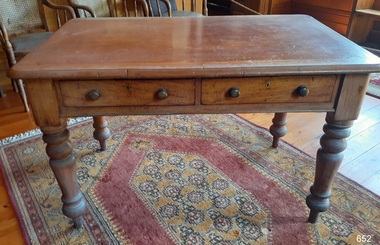
Furniture - Desk, Foy & Gibson, Circa 1880s
... The heavy brass locks fitted into the desk drawers were made by the famous Hobbs & Co of London, mid-late 19th century. In 1860 the business changed hands but the locks were still branded Hobbs & Co. ...The heavy brass locks fitted into the desk drawers were made by the famous Hobbs & Co of London, mid-late 19th century. In 1860 the business changed hands but the locks were still branded Hobbs & Co. ...The design of this small disc is from the Australian Colonial period. The cedar wood desk was made in Australian by Foy & Gibson in the 1880s, most probably in the business’s works in Collingwood, Victoria. The heavy brass locks fitted into the desk drawers were made by the famous Hobbs & Co of London, mid-late 19th century. In 1860 the business changed hands but the locks were still branded Hobbs & Co. The desk is branded with the symbol of Victoria’s Public Works Department. There is currently no information on when, where and by whom this desk was used. However, a very similar desk with Hobbs & Co. locks is on site at the Point Hicks Lightstation in Victoria and was formerly used by the Point Hicks head light keeper there. Other light stations also have similar desks from the P.W.D. (see also ‘Desk, Parks Victoria – Point Hicks Lightstation, Victorian Collections’.) HOBBS & CO., LONDON Alfred Charles Hobbs, 1812-1891, was American born. He became an executive salesman in 1840 for renowned lock manufacturer Day & Newell. His technique of exposing the weaknesses of people’s current locks was very successful in generating sales. He represented Day & Newell at London’s Great Exhibition of 1851, competing with other lock makers. Through the Exhibition he became famous for picking the best trusted Bramah and Chubb locks. Hobbs’ fame led him to found his own company in 1851 then register it in 1852 as Hobbs & Co., London. Hobbs was awarded the Telford Medal by the British Institution of Civil Engineers in 1854 for his paper 'On the Principles and Construction of Locks'. In 1855 the very successful company added partners and became Hobbs, Ashley and Co. In 1860, it traded under the name of Hobbs, Hart & Co. and was based in Cheapside London, where the business remained. Hobbs then returned to America, having sold the complete company to John Mathias Hart. He briefly returned to attend the 21st anniversary celebrations of the successful business in 1872. Hobbs kept himself busy in America, inventing and manufacturing firearm ammunition, for which he held several patents. He passed away there in 1891, a month after his 70th birthday. FOY & GIBSON Mark Foy wan an Irish draper who migrated to Bendigo, Victoria in 1858, attracted by the gold rush. He lived and worked in the area, establishing a drapery business. In the 1870s he moved to Melbourne where there were better prospects for expansion. He chose a place in Smith Street, Collingwood, a suburb of Melbourne, and started his business at the rear. In 1883 Foy retired, bringing in William Gibson as a partner, and then transferred his own share of the company to his son Francis Foy. Not long afterwards Francis sold his half share to Gibson, and the business continued under the name of Foy & Gibson. Francis Foy and he and his brother Mark Foy (junior) moved to Sydney. They established a business there in 1885, named after their father, Mark Foy. Gibson added to his business by starting his own manufacturing works from 1887, producing clothing, millinery, furniture, bedding and hardware for his stores. The factories, warehouses and stores complex became one of Victoria’s largest employers. He set up branches of his stores in Perth, Brisbane and Adelaide and two more branches in Melbourne. Foy & Gibson (usually referred to as Foys) became one of Australia’s largest retail department stores. In 1931 Foy’s little house in Collingwood was still part of the entrance to Foy & Gibson Emporium. In 1955 the company was bought out by Cox Brothers. Later on the stores were sold to various businesses such as David Jones, Woolworths and Harris Scarfe. In 1968 Cox Brothers went into receivership, ending almost 100 years of the business known as Foy’s. The former Foy & Gibson Complex is registered by Heritage Council Victoria. “Designed by William Pitt, this magnificent 19th and early 20th century complex of factories, warehouses and showrooms saw the production of a remarkable range of goods for Foy & Gibson, Melbourne’s earliest department store chain”. (Quoted from the Plaque erected by the Collingwood Historical Society 2007) P.W.D. – Public Works Department, Victoria The desk is stamped “P.W.D,” signifying that it is from the Public Works Department in Victoria, which operated from 1855-1987. The department was responsible for, among other things, the design and supply of office furniture and equipment for public buildings and organisations. This desk is significant historically as it originated from Foy & Gibson, a colonial Australian company that had a positive and strong impact on employment, manufacturing and retailing in Melbourne, Victoria and Australia. The significance of Foy & Gibson to Victoria’s and Australia’s history is marked by the Collingwood Complex being registered in both Heritage Victoria Register (H0755, H0897 and H0896) and National Trust Register (B2668). This locks on this desk are significant for their connection with their manufacturer, Hobbs & Co, who invented a lock that surpassed the security of any other locks produced in the mid-19th century. Desk; Australian Colonial cedar desk, honey coloured. Desktop has a wooden border with a rolled edge and a fitted timber centrepiece. The four tapered legs are tulip turned. Two half-width drawers fit side by side and extend the full depth of the desk. The drawers have dovetail joints. Each drawer has two round wooden knob handles, a keyhole and a fitted, heavy brass lever lock. Inscriptions are on the desktop, drawers, desk leg and lock. Made in Australia circa 1880 by Foy & Gibson, lock made by Hobbs & Co, London.Impressed into timber frame of one drawer “FOY & GIBSON” Impressed into lock “HOBBS & CO / LONDON”, “MACHINE MADE”, “LEVER” Impressed along the front edge of the desktop [indecipherable] text. Impressed into the timber of right front leg “P. W. D.” below a ‘crown’ symbol Handwritten in white chalk under a drawer “206” flagstaff hill, warrnambool, shipwrecked coast, flagstaff hill maritime museum, maritime museum, shipwreck coast, flagstaff hill maritime village, great ocean road, desk, cedar desk, colonial desk, 1880s desk, australian colonial furniture, furniture, office furniture, office equipment, australian made furniture, colonial furniture, colonial hardware, foy & gibson, alfred charles hobbs, hobbs & co london, hobs & co lever lock, cabinetry lock, machine made lever lock, p.w.d., public works department victoria, day & newell, great exhibition of 1851, bramah lock, chubb lock, telford medal 1854, cheapside london, mark foy, mark foy – bendigo draper, smith street collingwood, william gibson, foy & gibson emporium, foy & gibson complex, cox brothers
