
Showing 71 items matching "middle america"
-
 Moorabbin Air Museum
Book - Aviation annuals, World Aviation Annual 1948
... ...Middle America...Aviation annuals World perspective North America Greater Europe Middle America South America Africa USSR Asia Oceania Compilation of aviation data for all nations, circa 1948 World Aviation Annual 1948 Book Aviation annuals ...Compilation of aviation data for all nations, circa 1948non-fictionCompilation of aviation data for all nations, circa 1948world perspective, north america, greater europe, middle america, south america, africa, ussr, asia, oceania -
Moorabbin Air Museum
Book - World aviation annuals, World Aviation Annual 1948
... ...Middle America...World aviation annuals World perspective North America Greater Europe Middle America South America Africa USSR Asia Oceania Economic notebook Overview of aircraft & their specifications, circa 1948 World Aviation Annual 1948 Book World aviation annuals ...Overview of aircraft & their specifications, circa 1948non-fictionOverview of aircraft & their specifications, circa 1948world perspective, north america, greater europe, middle america, south america, africa, ussr, asia, oceania, economic notebook -
 National Vietnam Veterans Museum (NVVM)
Map
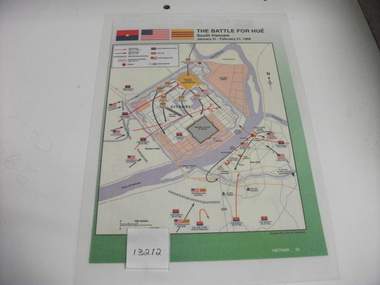
... North Vietnam Army - Red over blue with yellow star in the middle. American stars & stripes flag. SVA Unit - orange base with purple horizontal stripes through the middle. ...North Vietnam Army - Red over blue with yellow star in the middle. American stars & stripes flag. SVA Unit - orange base with purple horizontal stripes through the middle. ...January 30-31 1968. Laminated coloured map of South Vietnam headed "The Tet Offensive". Three flags at the top. North Vietnam Army - Red over blue with yellow star in the middle. American stars & stripes flag. SVA Unit - orange base with purple horizontal stripes through the middle. Reverse is a map of Citadel & Imperial Palace of Peace.The battle for Hue, South Vietnam. January 31 - Feb 21, 1968.tet offensive (1968), north vietnam flag, united states flag, south vietnam flag, the battle for hue, hue -
 Northern District School of Nursing. Managed by Bendigo Historical Society Inc.
Poster - The Eye
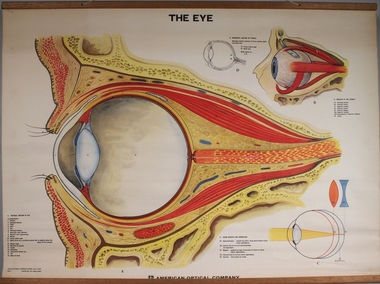
... Printed at the lower left - EDUCATIONAL PRODUCTIONS LTD c 1967 AB7 PRINTED IN ENGLAND Printed in the lower middle - AMERICAN OPTICAL COMPANY (obscured). . ...Printed at the lower left - EDUCATIONAL PRODUCTIONS LTD c 1967 AB7 PRINTED IN ENGLAND Printed in the lower middle - AMERICAN OPTICAL COMPANY (obscured). . ...Educational teaching chart used at the Northern District School of Nursing, Rowan Street, Bendigo. The Northern District School of Nursing opened in 1950 in to address the issues around nurse recruitment, training and education that had previously been hospital based. The residential school was to provide theoretical and in-house education and practical training over three years. The students would also receive practical hands-on training in the wards of associated hospitals. The Northern District School of Nursing operated from Lister House, Rowan Street, Bendigo. It was the first independent school of nursing in Victoria and continued until it closed in 1989. Coloured educational chart of The Eye. Off white paper with canvas backing, wooden header and footer. Printed at the top of the poster - THE EYE The poster has one large, numbered diagram and three smaller numbered diagrams of an eye, labeled - A VERTICAL SECTION OF EYE - B MUSCELS OF THE EYEBALL - C VISION DEFECTS AND CORRECTION - D HORIZONTAL SECTION OF EYEBALL. There are numbered descriptions for each diagram. Printed at the lower left - EDUCATIONAL PRODUCTIONS LTD c 1967 AB7 PRINTED IN ENGLAND Printed in the lower middle - AMERICAN OPTICAL COMPANY (obscured). . northern district school of nursing, lister house, nurse training, educational chart, the eye, american optical company, educational productions limited -
 Northern District School of Nursing. Managed by Bendigo Historical Society Inc.
Poster - The Eye
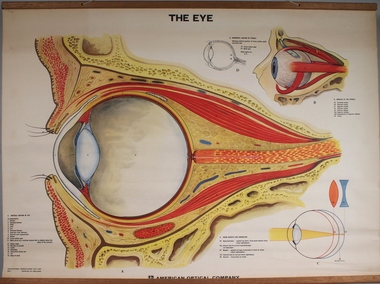
... Printed at the lower left - EDUCATIONAL PRODUCTIONS LTD c 1967 AB7 PRINTED IN ENGLAND Printed in the lower middle - AMERICAN OPTICAL COMPANY . ...Printed at the lower left - EDUCATIONAL PRODUCTIONS LTD c 1967 AB7 PRINTED IN ENGLAND Printed in the lower middle - AMERICAN OPTICAL COMPANY . Poster The Eye ...Educational teaching chart used at the Northern District School of Nursing, Rowan Street, Bendigo. The Northern District School of Nursing opened in 1950 in to address the issues around nurse recruitment, training and education that had previously been hospital based. The residential school was to provide theoretical and in-house education and practical training over three years. The students would also receive practical hands-on training in the wards of associated hospitals. The Northern District School of Nursing operated from Lister House, Rowan Street, Bendigo. It was the first independent school of nursing in Victoria and continued until it closed in 1989. Coloured educational chart of The Eye. Off white paper with canvas backing, wooden header and footer. Written on the rear of the poster DR. ROBINSON Printed at the top of the poster - THE EYE The poster has one large, numbered diagram and three smaller numbered diagrams of an eye, labeled - A VERTICAL SECTION OF EYE - B MUSCELS OF THE EYEBALL - C VISION DEFECTS AND CORRECTION - D HORIZONTAL SECTION OF EYEBALL. There are numbered descriptions for each diagram. Printed at the lower left - EDUCATIONAL PRODUCTIONS LTD c 1967 AB7 PRINTED IN ENGLAND Printed in the lower middle - AMERICAN OPTICAL COMPANY . northern district school of nursing, lister house, nurse training, educational chart, the eye, american optical company, educational productions limited -
 Robin Boyd Foundation
Document - Manuscript, Robin Boyd, Waikiki: The Computer Planned Escape Machine, 1971
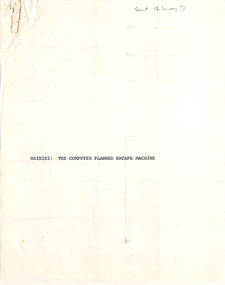
... Extols the virtues of Waikiki as a holiday destination/escape machine, the less-than-Good Taste of the resort combined with its virtues/religious dogma of American middle-class vacation standards. Boyd describes a day of the typical young American hotel occupant, and Honolulu's uniform air of confidence attracting American tourists. ...Extols the virtues of Waikiki as a holiday destination/escape machine, the less-than-Good Taste of the resort combined with its virtues/religious dogma of American middle-class vacation standards. Boyd describes a day of the typical young American hotel occupant, and Honolulu's uniform air of confidence attracting American tourists. ...Extols the virtues of Waikiki as a holiday destination/escape machine, the less-than-Good Taste of the resort combined with its virtues/religious dogma of American middle-class vacation standards. Boyd describes a day of the typical young American hotel occupant, and Honolulu's uniform air of confidence attracting American tourists. This manuscript was published in 'The Sunday Australian' with the title ‘Why I love Waikiki’ on 23/05/1971.Original manuscript of ‘Why I love Waikiki’ published in 'The Sunday Australian', 23/05/1971.Typewritten (1 c copy and 1 p/copy), pencil edits, quarto, 11 pagesSent 12 May 71 - in pencil on front pagewaikiki, honolulu, american tourism, second rate californian architecture, american middle-class vacation standards, robin boyd, manuscript, ohm2022, ohm2022_16 -
 Flagstaff Hill Maritime Museum and Village
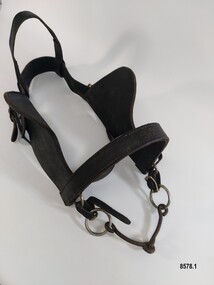
Equipment - Horse Harness, Glenn's Leather Goods, Early to mid-20th century
... Variations of different horse harnesses were also found in Native American and Middle Eastern cultures. Horse Harnesses usually have four basic components which include - 1. ...Variations of different horse harnesses were also found in Native American and Middle Eastern cultures. Horse Harnesses usually have four basic components which include - 1. ...The early settlers of Victoria depended on horse drawn vehicles to farm, make roads and railways, deliver produce and transport people. Horse harnesses were an important requisite for all drivers and could be found wherever there were working horses. Horse Harnesses have played an essential role in different cultures throughout history. Simple, utilitarian horse harnesses made of leather straps and iron rings were being used in early China before AD 500 as well as ancient Greece and Rome allowing horses to pull chariots and ploughs. The Greeks and Romans were the first to use a "horse collar" which distributed the weight of the harness evenly across the horse's chest rather than relying on a "throat harness" that could damage a horse's throat or choke them. During the medieval period, European horse harnesses became more elaborate and decorative. Variations of different horse harnesses were also found in Native American and Middle Eastern cultures. Horse Harnesses usually have four basic components which include - 1. Communication - the bridle, bit and reins allows the driver to communicate instructions and commands to the horse, guiding its movement and direction. 2. Draft - the collar, hame straps, hames, traces and chains enables the horse to draw and pull the load efficiently by distributing the weight and transferring the pulling force to the vehicle. 3. Stopping - the breeching band, pole straps and breast strap helps to control or stabilise the horse and vehicle when moving downhill or stopping. 4. Support - the back pad, backband, belly band and back saddle keep the harness in the correct position and proper alignment. This dray harness is a plain, basic harness and reflects its working class origins. It was used by Mr. Oswald (Jack) Bourke with his horse and dray to firstly deliver drygoods from Sunbury to Melbourne in the 1930's and later (through the 1940's and 1950's up to 1961) when he worked on the garbage round for the Springvale City Council. This horse harness is a significant example of the equipment that was needed wherever horses were being used - particularly in the early years of Victoria's settlement by white settlers. Harnesses such as this example were used with drays, farming equipment, delivery carts and personal transportation.A leather and metal horse harness used with a horse and dray circa 1930's to the early 1960's. It is made up of a number of components. 1. A leather bridle with metal buckles and rings, blinkers and a metal single jointed, snaffle bit that has the initials M B stamped onto the leather. 2. A leather bridle with metal buckles and rings and a metal "straight bar" Eggbut snaffle bit. It has an elongated X design (with 4 dots) stamped onto the leather strap holders near each buckle. 3. A blue and white vinyl halter with one leather patched strap. The nose band and a chin strap are covered with woollen padding. 4. A pair of leather shaft protectors. They have lacing holes along each edge and a repeating design of small shapes (flowers, wings, crosses and arrowheads) which run along the front of each protector. 5. A leather strap with a stainless steel chain and catch and a maker's mark for "Glenn's Leather Goods, Pearcedale Victoria" stamped onto the end. 6. A wide leather strap covered with a webbing sleeve. It has two large metal rings and each end and one ring has a rope attached. 7. A leather strap comprised of three separate sections (two shorter and one longer) joined with two metal rings. The longer section has notches along its length and the shorter section at the other end has a buckle. It also had a maker's mark stamped on it but the mark is very worn and the writing is difficult to read. 8. An adjustable leather horse collar with two buckles and straps at the top opening and two "B's" stamped into the leather. The top of the collar is made from treated leather pieces stitched together and the underneath of the collar is untreated leather. It has a padded indentation running all the way around the collar for the hames to sit in. 9. Two pairs of long leather traces - each having a buckle and notched section at one end and each one is made with three lengths of leather spliced together. 10. A leather strap (with one spliced join) belonging to a horse harness with two shorter straps (each ending with a metal clip) attached to a steel D ring at one end. 11. Three assorted short leather straps - the top one has clips at each end and a buckle (for adjusting the length) in the centre, the middle strap has notches and a buckle and the bottom strap is white with notches and a buckle.Bridle with blinkers - "M B" Bridle - design showing an elongated X with a dot in each section stamped onto strap holder Shaft Protectors - stamped design of flowers, wings, crosses and arrowheads Strap with chain - "Glenn's leather goods / Pearcedale / Victoria" Leather Strap (with two metal rings) - Maker's stamp - "name indecipherable / SADDLER / ...OURNE" Collar - "B / B" Leather strap - flagstaff hill maritime museum and village, warrnambool, great ocean road, sunbury, springvale, dray, delivery dray, harness, horse harness, horse drawn vehicles, working horse, oswald (jack) bourke, bridle, horse collar, hames, shaft protectors -
 Flagstaff Hill Maritime Museum and Village
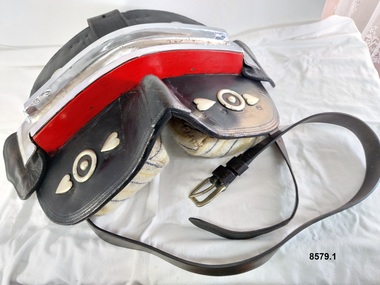
Equipment - Show Harness, R. Mitchell, Saddler, Early to mid-20th century
... Variations of different horse harnesses were also found in Native American and Middle Eastern cultures. Horse Harnesses usually have four basic components which include - 1. ...Variations of different horse harnesses were also found in Native American and Middle Eastern cultures. Horse Harnesses usually have four basic components which include - 1. ...The early settlers of Victoria depended on horse drawn vehicles to farm, make roads and railways, deliver produce and transport people. Horse harnesses were an important requisite for all drivers and could be found wherever there were working horses. Horse Harnesses have played an essential role in different cultures throughout history. Simple, utilitarian horse harnesses made of leather straps and iron rings were being used in early China before AD 500 as well as ancient Greece and Rome, allowing horses to pull chariots and ploughs. The Greeks and Romans were the first to use a "horse collar" which distributed the weight of the harness evenly across the horse's chest rather than relying on a "throat harness" that could damage a horse's throat or choke them. During the medieval period, European horse harnesses became more elaborate and decorative. Variations of different horse harnesses were also found in Native American and Middle Eastern cultures. Horse Harnesses usually have four basic components which include - 1. Communication - the bridle, bit and reins allows the driver to communicate instructions and commands to the horse, guiding its movement and direction. 2. Draft - the collar, hame straps, hames, traces and chains enables the horse to draw and pull the load efficiently by distributing the weight and transferring the pulling force to the vehicle. 3. Stopping - the breeching band, pole straps and breast strap helps to control or stabilise the horse and vehicle when moving downhill or stopping. 4. Support - the back pad, backband, belly band and back saddle keep the harness in the correct position and proper alignment. This show harness was used by Mr. Andy Bourke when showing his Clydesdales at shows or demonstrations. Although a more modern example with decorative embellishments, it still has many essential components traditionally found in an everyday working horse harness. The original purpose of the "housen" for example, was to run rain or drizzle off the horse's neck when they had to work in wet conditions - it was laid flat for this purpose on the top of the collar. Nowadays it is purely for show and is often used to advertise a business or stud. Horse brasses and fly terrets were fastened to various parts of a horse's harness. In the early days they probably began as amulets to ward off evil and to bring good luck and continued to be used as a festive decoration. The heyday of horse brasses was between the years 1851 and 1900. Horse brasses are fastened to various parts of the harness with many of their designs being symbolic. The ornamentation on this harness (although not authentic horse brasses) are based on the horse brasses that were popular in the 19th century. This horse harness is a significant example of the equipment that was needed wherever heavy horses were being used - particularly in the early years of Victoria's settlement by white settlers. Harnesses such as this example were used with stage coaches, drays, farming equipment, delivery carts and personal transportation.A leather and metal horse harness used when showing a Clydesdale (or other breed of heavy horse). It is made up of a number of components. 1. Decorative leather cart saddle with two large cloth pads underneath (which have a scalloped leather and stud border), a raised leather pommel and a silver and red coloured metal back strap holder across the top. It has two symmetrical sets of ornamentation (silver hearts and circles) in the front and a wide strap or girth (with a maker's stamp reading "R. Mitchell Saddler") and buckle which attaches the saddle to the horse. 2. Pair of steel hames which are gently curved (to fit on a horse collar) and are topped with steel knobs. They have several steel rings and lugs (to hold straps and chains) and a "Made in England Warranted Steel" stamp. 3. Breeching harness which consists of a number of leather straps, chains and metal rings including a wide padded leather strap with a scalloped edge that sits on the back of the horse and a thick leather strap that goes around the hind quarters of a horse which is joined to the back strap with four shorter vertical straps and buckles. These straps feature silver and red patent leather trim and silver heart shaped ornamentation. The strap also features the maker's stamp of "R. Mitchell". 4. Decorative leather bridle with blinkers featuring the same silver and red patent leather trim on the cheek piece, brow band and throatlatch. It has a stainless steel "Liverpool Driving Bit" with a curb chain, a variety of decorative silver ornaments (rosettes, diamonds plus a heart and two circles) on each end of the forehead band, dropper and strap as well as a silver metal bell (sometimes known as a "fly terret" or "swinger") that sits on the headpiece of the bridle. 5. Leather "violin shaped" dropper (or hanger) with two silver rosette shaped ornaments and a stainless steel clip on the top 6. Stainless steel "Liverpool Driving Bit" with a straight mouthpiece which is ribbed on one side. It has three rein spots (spaces) and a curb chain. 7. Leather arch shaped "Housen" covered in black and red patent leather and decorated with silver studs (some spelling out F H) and bordered with a red fringe. It has a leather strap at the back and two leather loops on the front. 8. Leather padded backband (Australian style "Stallion Draught Roller") decorated with two groups of nine metal "horse brasses" or harness ornaments displaying horseshoe, starburst and horse head designs on blue, red and white striped webbing. The backband has three notched straps at each end, a buckle near the centre and the initial B stamped in two places underneath. 9. Bellyband made of leather and red, white and blue striped webbing. It has a set of three buckles at each end (which correspond with the notched straps of the backband). 10. Wide, thick leather strap which has a buckle and notches at each end. It also has the maker's stamp of "R. Mitchell Saddler". 11.One pair of long leather traces - each with a buckle and notched loop at one end, decorated with a small silver diamond shaped harness ornament. 12. Length of stainless steel heavy duty chain with two swivel connectors.Saddle - "R.MITCHELL / SADDLER" Hames - "MADE IN ENGLAND / WARRANTED / STEEL" "MADE IN ENGLAND / WARRANTED / unclear" Breeching Straps - "R. MITCHELL / MAKER / R. MITCHELL MAKER" Housen - "F H" Backband "B / B' Wide leather strap - "R. MITCHELL / SADDLER"flagstaff hill maritime museum and village, warrnambool, great ocean road, shipwreck coast, harness, horse harness, show harness, clydesdale horses, andy bourke, horse drawn cart, housen, bridle, hames, breeching straps, dropper, bit, liverpool bit, backband, harness ornamentation, bellyband, back saddle, fly terret -
 Flagstaff Hill Maritime Museum and Village
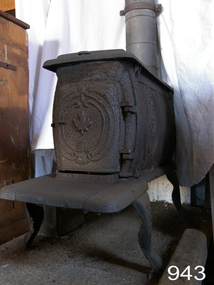
Domestic object - Stove, 1850-1890
... middle of a room by connecting it to a flue. The Franklin stove warmed farmhouses, city dwellings, and frontier cabins throughout North America. ...middle of a room by connecting it to a flue. The Franklin stove warmed farmhouses, city dwellings, and frontier cabins throughout North America. ...In the industrialized world, as stoves replaced open fires and braziers as a source of more efficient and reliable heating, models were developed that could also be used for cooking, and these came to be known as kitchen stoves. The first manufactured cast-iron stove was produced at Lynn, Mass., in 1642. This stove had no grates and was little more than a cast-iron box. About 1740 Benjamin Franklin invented the “Pennsylvania fireplace,” which incorporated the basic principles of the heating stove. The Franklin stove burned wood on a grate and had sliding doors that could be used to control the draft (flow of air) through it. Because the stove was relatively small, it could be installed in a large fireplace or used free-standing in the middle of a room by connecting it to a flue. The Franklin stove warmed farmhouses, city dwellings, and frontier cabins throughout North America. Its design influenced the development of the pot-bellied stove, which was a familiar feature in some homes well into the 20th century. The first round cast-iron stoves with grates for cooking food on them were manufactured by Isaac Orr at Philadelphia, Pa., in 1800. The base-burning stove for burning anthracite coal was invented in 1833 by Jordan A. Mott. The subject item is a mid to late 19th century settlers stove probably of Canadian manufacture imported into Australia around this time. The stove gives us a social snapshot into what life must have been like for our early colonialists using this device for heating and cooking in their meagre homes. Cast iron stove with four-legs, 2 plates on top and a hinged front door. The door has been cast with a maple leaf design and the sides have a pattern cast into them.flagstaff hill, warrnambool, shipwrecked-coast, flagstaff-hill, flagstaff-hill-maritime-museum, maritime-museum, shipwreck-coast, flagstaff-hill-maritime-village, stove, domestic heating, domestic cooking, heater, cooking unit, pot belly stove, wood fired stove, wood stove -
 Flagstaff Hill Maritime Museum and Village
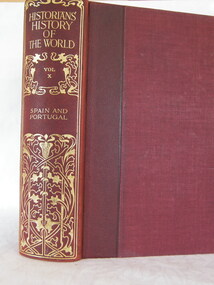
Book - Reference Book/History, Henry Smith Williams, The Historians History of the World Vol 10 set 1 - Edited by Henry Smith Williams L.L.D. Published by “The Times” 1908, 1908
... he Project to write a twenty five volume historical work was initiated by Henry Smith Williams, an American physician and prolific author, the series of books was designed to tell the story of humanity using the actual words of over 2,000 "master historians" (such as Herodotus, Gibbon, and Mommsen), woven together by modern editorial transitions. This specific 1908 set of volumes was published by "The Times" (London). In the early 20th century, The Times entered the book trade to boost its prestige and revenue, notably marketing this set and the “Encyclopedia Britannica”. Volume 10 specifically focuses on the Late “Middle...he Project to write a twenty five volume historical work was initiated by Henry Smith Williams, an American physician and prolific author, the series of books was designed to tell the story of humanity using the actual words of over 2,000 "master historians" (such as Herodotus, Gibbon, and Mommsen), woven together by modern editorial transitions. This specific 1908 set of volumes was published by "The Times" (London). In the early 20th century, The Times entered the book trade to boost its prestige and revenue, notably marketing this set and the “Encyclopedia Britannica”. Volume 10 specifically focuses on the Late “Middle ...The 1908 edition of The Historians' History of the World is a monumental work of Edwardian scholarship, representing a specific era of "universal history" where the goal was to synthesise all human knowledge into a single narrative. Volume 10 specifically focuses on the Late “Middle Ages” and the “Renaissance period”, particularly in Italy and Spain. Starting with the clash of civilisations, Islam vs. Christianity.The Book is part of a 25 volume set with red cloth bindings and gold filigree design to rib.non-fictionThe 1908 edition of The Historians' History of the World is a monumental work of Edwardian scholarship, representing a specific era of "universal history" where the goal was to synthesise all human knowledge into a single narrative. Volume 10 specifically focuses on the Late “Middle Ages” and the “Renaissance period”, particularly in Italy and Spain. Starting with the clash of civilisations, Islam vs. Christianity. flagstaff hill, warrnambool, shipwrecked-coast, flagstaff-hill, flagstaff-hill-maritime-museum, maritime-museum, shipwreck-coast, flagstaff-hill-maritime-village, the historians history of the world vol 10 set 1, book -
 Flagstaff Hill Maritime Museum and Village
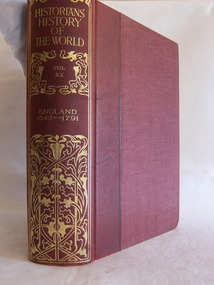
Book - Reference Book/History, Henry Smith Williams, The Historians History of the World Vol 20 set 1 - Edited by Henry Smith Williams L.L.D. Published by “The Times” 1908, 1908
... Middle Ages, Volume 20 represents the "Modern" era. It transitions the reader from the religious conflicts of the Reformation (found in Volume 19) into the birth of modern parliamentary democracy. This volume provides the necessary context for the American ...Henry Smith Williams’ “The Historians' History of the World” is a chronological and geographical "tapestry" of human events, these twenty five volumes occupy a very specific and prestigious place in historical research. Volume 20 focuses on the transformation period of England from the outbreak of the English Civil War to the late 18th century.The Book is part of a 25 volume set with red cloth bindings and gold filigree design to rib.non-fictionHenry Smith Williams’ “The Historians' History of the World” is a chronological and geographical "tapestry" of human events, these twenty five volumes occupy a very specific and prestigious place in historical research. Volume 20 focuses on the transformation period of England from the outbreak of the English Civil War to the late 18th century. warrnambool, flagstaff-hill, flagstaff-hill-maritime-museum, maritime-museum, shipwreck-coast, flagstaff-hill-maritime-village, book, the historians history of the world vol 20 set 1, henry smith williams -
 Flagstaff Hill Maritime Museum and Village
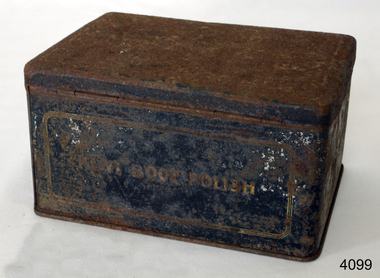
Container - Tin, Kiwi Shoe Polish Manufacture, 1940s
... American armies in World War I. In the UK, Kiwi was for many years manufactured at its British headquarters in Ealing (Brumwell Road, London W5 1DT). From here the factory manufactured for the UK market and exported the Kiwi brand too much of Europe and the Middle East. ...American armies in World War I. In the UK, Kiwi was for many years manufactured at its British headquarters in Ealing (Brumwell Road, London W5 1DT). From here the factory manufactured for the UK market and exported the Kiwi brand too much of Europe and the Middle East. ...The polish was developed in Australia by William Ramsay who named it Kiwi after the flightless bird endemic to New Zealand, the home country of his wife, Annie Elizabeth Meek Ramsay. Its success in Australia expanded overseas when it was adopted by both the British and American armies in World War I. In the UK, Kiwi was for many years manufactured at its British headquarters in Ealing (Brumwell Road, London W5 1DT). From here the factory manufactured for the UK market and exported the Kiwi brand too much of Europe and the Middle East. In the mid-1970s, as part of a major streamlining, the UK factory was closed with production switched to France. The UK operation moved to Surrey at Yately becoming, effectively, a sales and marketing office, with distribution contracted to a third party. In 1980, production for the UK market moved back to the UK and was housed in a factory near Huddersfield. The UK head office was relocated to Maidstone, Kent, where Kiwi had other product interests. Following the global merger with Nicholas Laboratories, the UK head office was again relocated to Slough at the Nicholas building on Bath Road.A significant product as Kiwi is an Australian brand name of shoe polish, first launched and sold in Australia in 1906 and as of 2005 sold in almost 180 countries. Previously owned by the Sara Lee Corporation since 1984, it was sold in 2011 to S. C. Johnson. It is the dominant shoe polish in some countries, including the United Kingdom and the United States, where it has about two thirds of the market. In Malaysia and Singapore, Kiwi has become such a household brand for a shoe polish that the word "kiwi" has been genericized into a verb in the Malay language, meaning "to polish one's shoes".Metal cleaning outfit of Kiwi boot polish brush, scraper, & polish missingKiwi Boot Polish to front of containerflagstaff hill, warrnambool, shipwrecked-coast, flagstaff-hill, flagstaff-hill-maritime-museum, maritime-museum, shipwreck-coast, flagstaff-hill-maritime-village -
 Flagstaff Hill Maritime Museum and Village
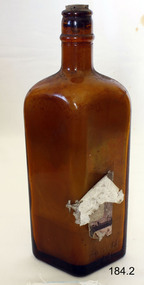
Container - Bottle, Pre 1974
... Then, in the middle of the 19th century, the American Pharmaceutical Association recommended legislation regarding identification of all poison bottles. ...Then, in the middle of the 19th century, the American Pharmaceutical Association recommended legislation regarding identification of all poison bottles. ...Phenyle has been used for decades as a cleaner and disinfectant. It is well know for its use for cleaning outdoor toilets and easily identified by its strong odour. The brown glass bottle is immediately recognised as containing a poison. We've all seen them in a hundred different mystery movie scenes. The medicine cabinet opens and there, sitting on a shelf, is the incriminating object -- the ominous dark bottle with the skull and crossbones on the label. In off-screen reality, however, poison bottles have quite a different identity -- they are distinctive, varied, colorful -- and definitely collectible. Obviously, the one thing that sets the poison bottle apart from all other bottles is the need for prominent and immediate identification as a receptacle for toxic material, and this was achieved in a number of ways, including shape, color, embossing and labeling. Poisons were commonly found in the home for the purpose of controlling rodents and other pests, and were sold by grocers and druggists. For consumer protection, as far back as 1829, New York State made mandatory the marking of the bottles with the word "poison" in large letters. Then, in the middle of the 19th century, the American Pharmaceutical Association recommended legislation regarding identification of all poison bottles. In 1872 the American Medical Association also made recommendations -- namely that poison bottles be made of colored glass, and also have a rough surface on one side -- making them identifiable even in the dark -- and the word "poison" visible on the other (the skull and crossbones wasn't quite as ubiquitous as those movies led us to believe). However, passing these laws was not easy, and the manufacturers were essentially left to do as they wished. For collectors, the high point of poison bottle manufacturing was the period ranging roughly from the 1870s to the 1930s. At that time some, of the bottles were distinguished by particularly bright colors, such as cobalt blue (the most common) and emerald green. Others, particularly rare and collectible, had unusual -- and appropriate -- shapes, including skulls, leg bones and coffins. In order to better identify these lethal vessels by feel (not forgetting that there were many people in this period who could not read) when groping for them in the dark, they had such elaborate tactile patterns as quilted diamonds, lattices, hobnails and prominent vertical or horizontal ribbing, as well as spiky knobs and ridges. In addition, many had sharp points on top for the same precautionary purpose. Further efforts to distinguish poison bottles from others included uncommon multisided and triangular shapes, and unusual, hard-to-open tops, the predecessors of the modern child-proof openings. https://www.southcoasttoday.com/story/lifestyle/2001/08/19/poison-bottles-steeped-in-history/50352280007/The recognition and awareness of bottles containing poisonpous substances is extremely important for safety reasons.Bottle, brown glass, diamond shaped. "Bright Star" phenyle. Paper label attached, but peeling off and badly damaged. Corked with contents. Text moulded into glass, some with a border of stars. Poisonous contents, not to be taken. Registered Number 2140. Volume is 20 fluid ounces. Printed label "Bright Star". Text is moulded in the glass in raised lettering: "PHENYLE" outlined and decorated with star border. "POISONOUS", "NOT TO BE TAKEN" "V / DM / A" within oval, "REGD NO. 2140" (D and O are smaller and underlined) . Base is marked "F190".flagstaff hill, warrnambool, shipwrecked-coast, flagstaff-hill, flagstaff-hill-maritime-museum, maritime-museum, shipwreck-coast, flagstaff-hill-maritime-village, bright star, phenyl, cleaning and disinfecting chemical, poison, bottles -
 Flagstaff Hill Maritime Museum and Village
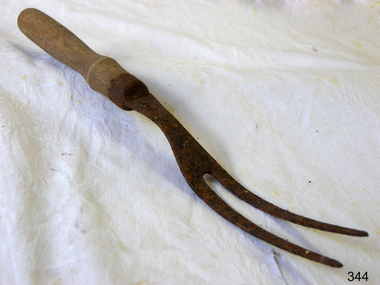
Domestic object - Fork
... Its use spread to what is now the Middle East during the first millennium AD and then spread into Southern Europe during the second millennium. It did not become common in northern Europe until the 18th century and was not common in North America until the 19th century. ...Its use spread to what is now the Middle East during the first millennium AD and then spread into Southern Europe during the second millennium. It did not become common in northern Europe until the 18th century and was not common in North America until the 19th century. ...Naturally, we tend to take commonplace objects for granted, because they have always been there. Yet how many of you actually have thought “hey, where do forks come from?” Well, it takes one trip to China and a 3-year-old laughing at your face because of your desperate attempt to eat with chopsticks to finally appreciate something so ordinary such as a fork. So, where do forks come from? The early history of the fork is obscure. As a kitchen and dining utensil, it is believed to have originated in the Roman Empire, as proved by archaeological evidence. The personal table fork most likely originated in the Eastern Roman (or Byzantine) Empire. Its use spread to what is now the Middle East during the first millennium AD and then spread into Southern Europe during the second millennium. It did not become common in northern Europe until the 18th century and was not common in North America until the 19th century. Carving fork from 1640. Source: Wikipedia/Public Domain Carving Fork from 1640. Source: Wikipedia/Public Domain Some of the earliest known uses of forks with food occurred in Ancient Egypt, where large forks were used as cooking utensils. Bone forks had been found on the burial site of the Bronze Age Qijia culture (2400–1900 BC) as well as later Chinese dynasties’ tombs.The Ancient Greeks used the fork as a serving utensil. Read also: Steven Spielberg to Remake the Classic Musical ‘West Side Story’ In the Roman Empire, bronze and silver forks were used. The use varied according to local customs, social class and the nature of food, but forks of the earlier periods were mostly used as cooking and serving utensils. The personal table fork was most likely invented in the Eastern Roman (Byzantine) Empire, where they were in everyday use by the 4th century (its origin may even go back to Ancient Greece, before the Roman period). Records show that by the 9th century a similar utensil known as a barjyn was in limited use in Persia within some elite circles. By the 10th century, the table fork was in common use throughout the Middle East. Bronze forks made in Persia during the 8th or 9th century.Source: Wikipedia/Public Domain Bronze forks made in Persia during the 8th or 9th century.Source: Wikipedia/Public Domain The first recorded introduction of the fork to Western Europe, as recorded by the theologian and Cardinal Peter Damian, was by Theophano Sklereina the Byzantine wife of Holy Roman Emperor Otto II, who nonchalantly wielded one at an Imperial banquet in 972, astonishing her Western hosts.By the 11th century, the table fork had become increasingly prevalent in the Italian peninsula. It gained a following in Italy before any other Western European region because of historical ties with Byzantium and continued to get popularity due to the increasing presence of pasta in the Italian diet. At first, pasta was consumed using a long wooden spike, but this eventually evolved into three spikes, design better suited to gathering the noodles. In Italy, it became commonplace by the 14th century and was almost universally used by the merchant and upper classes by 1600. It was proper for a guest to arrive with his fork and spoon enclosed in a box called a cadena; this usage was introduced to the French court with Catherine de’ Medici’s entourage. In Portugal, forks were first used at the time of Infanta Beatrice, Duchess of Viseu, King Manuel I of Portugal’s mother around 1450. However, forks were not commonly used in Western Europe until the 16th century when they became part of Italian etiquette. The utensil had also gained some currency in Spain by this time, and its use gradually spread to France. Nevertheless, most of Europe did not adopt the use of the fork until the 18th century. Read also: The 8 Most Famous ‘Functioning Alcoholics’ in History Long after the personal table fork had become commonplace in France, at the supper celebrating the marriage of the Duc de Chartres to Louis XIV’s natural daughter in 1692, the seating was described in the court memoirs of Saint-Simon: “King James having his Queen on his right hand and the King on his left, and each with their cadenas.” In Perrault’s contemporaneous fairy tale of La Belle au bois dormant (1697), each of the fairies invited for the christening is presented with a splendid “fork holder”. The fork’s adoption in northern Europe was slower. Its use was first described in English by Thomas Coryat in a volume of writings on his Italian travels (1611), but for many years it was viewed as an unmanly Italian affectation. Some writers of the Roman Catholic Church expressly disapproved of its use, St. Peter Damian seeing it as “excessive delicacy.” It was not until the 18th century that the fork became commonly used in Great Britain, although some sources say that forks were common in France, England, and Sweden already by the early 17th century. Spaghetti fork By Lady alys - Own work, CC BY-SA 3.0, https://commons.wikimedia.org/w/index.php?curid=6414948 Spaghetti Fork By Lady alys – Own work, CC BY-SA 3.0, The fork did not become popular in North America until near the time of the American Revolution. The curved fork used in most parts of the world today was developed in Germany in the mid 18th century while the standard four-tine design became current in the early 19th century. The fork was important in Germany because they believed that eating with the fingers was rude and disrespectful. The fork led to family dinners and sit-down meals, which are important features of German culture. https://www.thevintagenews.com/2016/08/31/priority-fork-came-italy-european-country-pasta/?chrome=1Serving fork, two prongs, with a shaped wooden handle. Badly rusted.None.flagstaff hill, warrnambool, shipwrecked-coast, flagstaff-hill, flagstaff-hill-maritime-museum, maritime-museum, shipwreck-coast, flagstaff-hill-maritime-village, food, meat, carving -
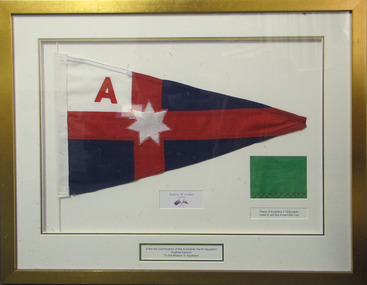 Mission to Seafarers Victoria
Flag - Burgee, framed, 1980s
... middle and Red 'A' on top left. Gilded wooden frame with glazing with three window label inserts. Mount includes at lower right a souvenir green rectangular piece of the Australia II Spinnaker used to win the America's Cup in 1982. ...Cannon' 'From the Commodore of the Australian Yacht Squadron, Andrew Cannon, To the Mission to Seafarers' 'Piece of Australia II Spinnaker Used to win the America's Cup' Mounted triangular pennant style Australian Yacht Squadron flag also known in yachting circles as a burgee. Red, white and blue colours with white star in the middle and Red 'A' on top left. ...National significance. Presented as souvenir by Commodore Mr Andrew M. Cannon AM, of the Australian Yacht Squadron. Date of presentation unknown but commemorates America's Cup victory of Australia II in 1982. Commodore Dacre Smyth, who designed and presented the Naval windows in the MTSV chapel , was also a member of the Squadron. The burgee was designed by Nigel Abbott, twice world sailing champion and graphic designer. The burgee design features the Commonwealth Star in the corner, the A for Australia and the nautical colours of Royal blue – as per the Oxford Concise Dictionary – red and white.A link and souvenir with a significant event in the life of yachtsmen and for the City of Perth and Australia in 1982. The first time in many years that the USA lost this coveted cup and contest.Mounted triangular pennant style Australian Yacht Squadron flag also known in yachting circles as a burgee. Red, white and blue colours with white star in the middle and Red 'A' on top left. Gilded wooden frame with glazing with three window label inserts. Mount includes at lower right a souvenir green rectangular piece of the Australia II Spinnaker used to win the America's Cup in 1982. Sticker on back of frame has framers details.'Commodore Andrew M. Cannon' 'From the Commodore of the Australian Yacht Squadron, Andrew Cannon, To the Mission to Seafarers' 'Piece of Australia II Spinnaker Used to win the America's Cup' australian yacht squadron, andrew m. cannon, commodore, 1982, america's cup, burgee, australia ii, commodore dacre smyth (1923-2008), pennant -
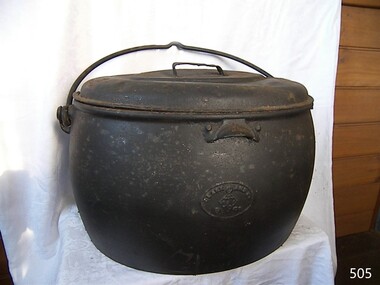 Flagstaff Hill Maritime Museum and Village
Domestic object - Cooking pot and lid, T & C Clarke and Co Ltd, 1880 to1910
... American soldier" invasion during World War II that the Empire mindset was slowly being eroded away. This change was the slowest in semi remote rural areas such as the Warrnambool district. Flagstaff Hill Museum Cooking Appliance Camp Fire Pot Cast Iron T & C Clark & Co Drovers Cooking Pot CLARK & Co. PATENT", Below this a six star triangle with the letter "C" in the middle ...T & C Clark & Company Limited, based at Shakespeare Foundry, was founded in 1795 by Thomas and Charles Clark and grew to be one of the largest iron foundries in Wolverhampton. The firm was the pioneers of Enamelled Cast ironware and the founder Charles Clerk went on to became mayor of Wolverhampton in 1860 after also serving as a Councilor, Alderman, and later Chief Magistrate. The company exhibited many products at the International Exhibition of 1862 at South Kensington, alongside the gardens of the Royal Horticultural Society. The company was also awarded the silver medal for its products at the International Paris Exhibition in 1878. The company's product range included thousands of items, both domestic and industrial. T & C Clark pioneered the use of enamelled cast ironware, after taking out a patent in 1839 guaranteed to be free of lead or arsenic. In the late 1940s and 1950s the company produced acid-resisting enamelled cast iron boiling pans; steam-jacketed pans; stills; square and rectangular tanks; open and closed mixing vessels; flanged pipes; bends and tees; laboratory equipment; small scale plant; evaporating bowls; beakers; sulphonates; and glass-lined mild steel tanks for beer, mineral water, and food. The company is listed as enamelled chemical plant manufacturers in Kelly's 1962 Wolverhampton Directory, but within a few years, the company had ceased trading. The cooking pot is significant because it demonstrates one of the social norms founded by early settlers to this region. That close ties to "Mother England" and the "establishment" was still very strong. The social and family values from the British way of life was ingrained in colonial society until well past Australian Federation in July of 1900. It was not until the friendly "American soldier" invasion during World War II that the Empire mindset was slowly being eroded away. This change was the slowest in semi remote rural areas such as the Warrnambool district. Cast iron open fire cooking pot with lidCLARK & Co. PATENT", Below this a six star triangle with the letter "C" in the middleflagstaff hill museum, cooking appliance, camp fire pot, cast iron, t & c clark & co, drovers cooking pot -
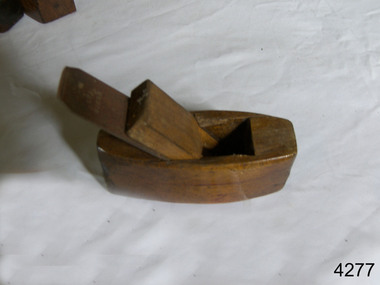 Flagstaff Hill Maritime Museum and Village
Tool - Wood Smoothing Plane, Heinrich Boker, Mid 19th to late 19th Century
... middle and slightly rounded making them more manoeuvrable. It has also been claimed that the coffin design exposes more end grain, enabling the plane to better adjust to changes in humidity. Henry Boker Maker: Heinrich "Henry" Böker of Reimschied-Solingen, Germany and his family was making tools in the 17th century. In 1829 Hermann and Robert Böker added sabres to the company's offerings, in 1837 they emigrated to New York City and established a firm to import German cutlery. H. Boker sabres would be eventually supplied to some American...middle and slightly rounded making them more manoeuvrable. It has also been claimed that the coffin design exposes more end grain, enabling the plane to better adjust to changes in humidity. Henry Boker Maker: Heinrich "Henry" Böker of Reimschied-Solingen, Germany and his family was making tools in the 17th century. In 1829 Hermann and Robert Böker added sabres to the company's offerings, in 1837 they emigrated to New York City and established a firm to import German cutlery. H. Boker sabres would be eventually supplied to some American ...A smoothing plane is typically used after the work piece has been flattened and trued by the other bench planes, such as the jack, fore, and joiner planes. Smoothing planes can also be used to remove marks left by woodworking machinery. When used effectively alongside other bench planes, the smoothing plane should only need a handful of passes removing shavings as fine as 0.002 inches (0.051 mm) or less. The work piece is then ready to be finished, or can be further refined with a card scraper or sandpaper. The smoothing plane is usually held with both hands, and used in a similar manner to the other bench planes. Though designed for smoothing, a smoothing plane can be used as an 'all-round' bench tool and for rougher work depending on how it is set up. Being smaller than other bench planes, the smoothing plane is better able to work on smaller work pieces and around obstructions. Since the 1700s wooden smoothing planes have predominantly been 'coffin shaped' wider in the middle and slightly rounded making them more manoeuvrable. It has also been claimed that the coffin design exposes more end grain, enabling the plane to better adjust to changes in humidity. Henry Boker Maker: Heinrich "Henry" Böker of Reimschied-Solingen, Germany and his family was making tools in the 17th century. In 1829 Hermann and Robert Böker added sabres to the company's offerings, in 1837 they emigrated to New York City and established a firm to import German cutlery. H. Boker sabres would be eventually supplied to some American soldiers during the Civil War. Heinrich Boker in 1869 , a relative of Hermann and Robert, established a cutlery firm in Solingen, a centre of industry and cutting tool manufacturing in Germany. The company became a leader in the manufacture of razors, scissors and eating utensils. As early as 1900 the majority of tools produced by Boker were distributed in the U.S. market by the New York branch of the family, and pocket knives became the company's most important product line. During WWII the Solingen factory was destroyed and all the equipment and inventory was lost. After the war the factory was rebuilt and the company resumed operations, but in the early '60s the company was sold to the scissors manufacturer Wiss & Sons, and in the early 70s Wiss sold out to Cooper Industries. At some point Heinrich Boker adopted the Americanised version of his name, Henry Boker and was used as a brand name for the company's products. A vintage smoothing plane of the coffin pattern made by Henry Boker the item is a rare and significant example of vintage woodworking tools used in the manufacture of wooden items.Smoothing Plane Coffin design. Blade marked Henry Bokerflagstaff hill, warrnambool, maritime-museum, shipwreck-coast, smoothing plane, heinrich boker, carpenters tool, cabinet makers tool -
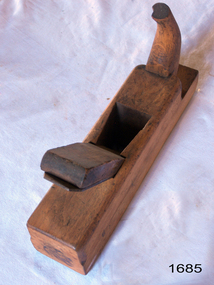 Flagstaff Hill Maritime Museum and Village
Tool - Wood Smoothing Plane, Heinrich Boker, late 19th to early 20th Century
... middle and slightly rounded making them more manoeuvrable. It has also been claimed that the coffin design exposes more end grain, enabling the plane to better adjust to changes in humidity. Henry Boker Maker: Heinrich "Henry" Böker of Reimschied-Solingen, Germany and his family was making tools in the 17th century. In 1829 Hermann and Robert Böker added sabres to the company's offerings, in 1837 they emigrated to New York City and established a firm to import German cutlery. H. Boker sabres would be eventually supplied to some American...middle and slightly rounded making them more manoeuvrable. It has also been claimed that the coffin design exposes more end grain, enabling the plane to better adjust to changes in humidity. Henry Boker Maker: Heinrich "Henry" Böker of Reimschied-Solingen, Germany and his family was making tools in the 17th century. In 1829 Hermann and Robert Böker added sabres to the company's offerings, in 1837 they emigrated to New York City and established a firm to import German cutlery. H. Boker sabres would be eventually supplied to some American ...A smoothing plane is typically used after the work piece has been flattened and trued by the other bench planes, such as the jack, fore, and joiner planes. Smoothing planes can also be used to remove marks left by woodworking machinery. When used effectively alongside other bench planes, the smoothing plane should only need a handful of passes removing shavings as fine as 0.002 inches (0.051 mm) or less. The work piece is then ready to be finished, or can be further refined with a card scraper or sandpaper. The smoothing plane is usually held with both hands, and used in a similar manner to the other bench planes. Though designed for smoothing, a smoothing plane can be used as an 'all-round' bench tool and for rougher work depending on how it is set up. Being smaller than other bench planes, the smoothing plane is better able to work on smaller work pieces and around obstructions. Since the 1700s wooden smoothing planes have predominantly been 'coffin shaped' wider in the middle and slightly rounded making them more manoeuvrable. It has also been claimed that the coffin design exposes more end grain, enabling the plane to better adjust to changes in humidity. Henry Boker Maker: Heinrich "Henry" Böker of Reimschied-Solingen, Germany and his family was making tools in the 17th century. In 1829 Hermann and Robert Böker added sabres to the company's offerings, in 1837 they emigrated to New York City and established a firm to import German cutlery. H. Boker sabres would be eventually supplied to some American soldiers during the Civil War. Heinrich Boker in 1869 , a relative of Hermann and Robert, established a cutlery firm in Solingen, a centre of industry and cutting tool manufacturing in Germany. The company became a leader in the manufacture of razors, scissors and eating utensils. As early as 1900 the majority of tools produced by Boker were distributed in the U.S. market by the New York branch of the family, and pocket knives became the company's most important product line. During WWII the Solingen factory was destroyed and all the equipment and inventory was lost. After the war the factory was rebuilt and the company resumed operations, but in the early '60s the company was sold to the scissors manufacturer Wiss & Sons, and in the early 70s Wiss sold out to Cooper Industries. At some point Heinrich Boker adopted the Americanised version of his name, Henry Boker and was used as a brand name for the company's products. A vintage smoothing plane of the Bismark pattern made by Henry Boker the this plane is now regarded as a collectors item and is an example of vintage woodworking tools used in the manufacture of wooden products.Smoothing Plane Bismark design. Blade marked Henry Bokerflagstaff hill, warrnambool, flagstaff-hill-maritime-museum, maritime-museum, shipwreck-coast, flagstaff-hill-maritime-village, smoothing plane, heinrich boker, carpenters tool, cabinet makers tool -
 Flagstaff Hill Maritime Museum and Village
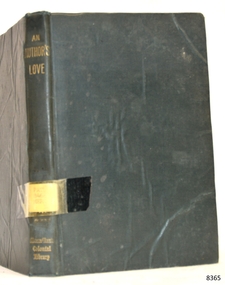
Book - A Fictional Love Story, Elizabeth Balch et al, An Authors Love, 1889
... Middle Eastern travel and exoticism. As well as Glimpses of Old English Homes (1890): Published posthumously, this was a highly regarded travel and historical architectural book. It profiled famous British estates and castles including Arundel and Eridge and was praised for its detailed prose and illustrations. Balch was part of a specific wave of late-Victorian American...Middle Eastern travel and exoticism. As well as Glimpses of Old English Homes (1890): Published posthumously, this was a highly regarded travel and historical architectural book. It profiled famous British estates and castles including Arundel and Eridge and was praised for its detailed prose and illustrations. Balch was part of a specific wave of late-Victorian American ...The book is an epistolary novel (a story told in letters) written by the American author Elizabeth Balch (though it was published anonymously at the time). It was written as a highly clever literary hoax and a sequel of sorts to a major 1873 French literary sensation, Lettres à une Inconnue (Letters to an Unknown) by the famous French dramatist and short-story writer Prosper Mérimée (best known as the author of the novella Carmen). Mérimée had spent over thirty years writing passionate, brilliant, and deeply personal letters to an anonymous woman (later revealed to be Jenny Dacquin). When these were published after his death, they became a massive hit, but the public only ever saw his side of the conversation. Elizabeth Balch decided to write the missing half of the romance.An Authors Love Author: Prosper Merimee's Publisher: Macmillan And Co Date: 1889 Further Information: Being the unpublished letters of Prosper Merimee's 'Inconnue'fictionThe book is an epistolary novel (a story told in letters) written by the American author Elizabeth Balch (though it was published anonymously at the time). It was written as a highly clever literary hoax and a sequel of sorts to a major 1873 French literary sensation, Lettres à une Inconnue (Letters to an Unknown) by the famous French dramatist and short-story writer Prosper Mérimée (best known as the author of the novella Carmen). Mérimée had spent over thirty years writing passionate, brilliant, and deeply personal letters to an anonymous woman (later revealed to be Jenny Dacquin). When these were published after his death, they became a massive hit, but the public only ever saw his side of the conversation. Elizabeth Balch decided to write the missing half of the romance.flagstaff hil, warrnambool, flagstaff hill maritime museum, maritime museum, shipwreck coast, flagstaff hill maritime village, great ocean road, book, pattison collection, warrnambool library, warrnambool mechanics’ institute, ralph eric pattison, corangamite regional library service, warrnambool city librarian, mechanics’ institute library, victorian library board, warrnambool books and records, warrnambool children’s library, an authors love, prosper merimees -
 Flagstaff Hill Maritime Museum and Village
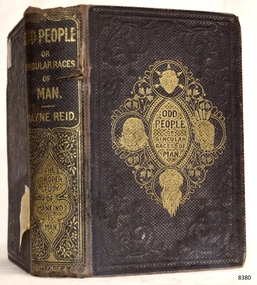
Book - Anthropological Travelogue/Fictional, Captain Mayne Reid, Odd People being A Popular Description of Singular Races of Man, 1860
... He specialized in "juvenile literature"—thrilling adventures set in exotic localities like the American West, the Amazon, and Africa—that combined high stakes with educational facts about botany, zoology, and geography. Despite making a fortune from his books, Reid was a terrible businessman. He was incredibly extravagant; he built an authentic Mexican hacienda in the middle...He specialized in "juvenile literature"—thrilling adventures set in exotic localities like the American West, the Amazon, and Africa—that combined high stakes with educational facts about botany, zoology, and geography. Despite making a fortune from his books, Reid was a terrible businessman. He was incredibly extravagant; he built an authentic Mexican hacienda in the middle ...Odd People: Being a Popular Description of Singular Races of Man (1860) is an interesting piece of 19th-century literature. The book was written by Captain Thomas Mayne Reid (1818–1883), a Scots-Irish American novelist and adventurer. He was immensely popular in the mid-to-late 19th century for his boys' adventure novels, tales of the American West, and travelogues. The true first edition was published in London by Routledge, Warne & Routledge in 1860. In the United States, it was published around the same time (1860/1861) by Ticknor and Fields in Boston, and later editions were retitled The Man-Eaters and Other Odd People. The book is an early work of popular ethnology and anthropology, written for a general audience and heavily marketed toward young readers and armchair travelers of the Victorian era.Book, brown covers, embossed with borders and patterns and gilt decoration and titles. The book includes illustrations. Handwritten inscription on the front paste-down page. The opposite page has a stamped and a handwritten inscription. The book was presented as a prize to a Latin student at the National School, Warrnambool in 1861. Title: Odd People being a Popular Description of Singular Races of Man. Alternate title: Odd People or Singular Races of Man Author: Captain Mayne Reid Publisher: Routledge Warne & Routledge, London Date: 1860 Further information: additional text on the spine reads 'A Proper Study of Mankind is Man'fictionOdd People: Being a Popular Description of Singular Races of Man (1860) is an interesting piece of 19th-century literature. The book was written by Captain Thomas Mayne Reid (1818–1883), a Scots-Irish American novelist and adventurer. He was immensely popular in the mid-to-late 19th century for his boys' adventure novels, tales of the American West, and travelogues. The true first edition was published in London by Routledge, Warne & Routledge in 1860. In the United States, it was published around the same time (1860/1861) by Ticknor and Fields in Boston, and later editions were retitled The Man-Eaters and Other Odd People. The book is an early work of popular ethnology and anthropology, written for a general audience and heavily marketed toward young readers and armchair travelers of the Victorian era.shipwrecked-coast, flagstaff-hill, flagstaff-hill-maritime-museum, warrnambool, maritime-museum, shipwreck-coast, flagstaff-hill-maritime-village, shipwrecked-artefact, book, odd people, captain mayne reid, national school warrnambool., daniel b sellers, classic fiction, the proper study of mankind is man, singular races of man, , routledge warne and routledge, latin student -
 Greensborough Historical Society
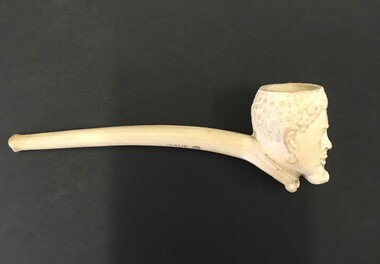
Pipe, Clay pipe with head, 1970s
... Original pipes given to bidders at the time of slave sales in America. This replica made middle to late 20th century....Original pipes given to bidders at the time of slave sales in America. This replica made middle to late 20th century. From a collection held in Greensborough. pipes smoking pipes Made in England stamped on stem. ...Clay pipe, replica depicting the head of Southern Slave. Original pipes given to bidders at the time of slave sales in America. This replica made middle to late 20th century.From a collection held in Greensborough.Replica Clay pipe depicting the head of Southern Slave. No maker's marks.Made in England stamped on stem.pipes, smoking pipes -
 City of Moorabbin Historical Society (Operating the Box Cottage Museum)
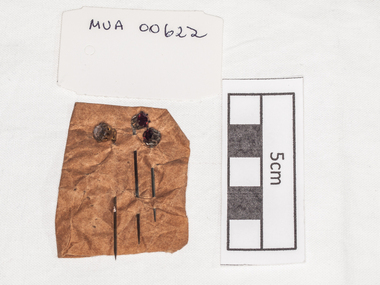
Jewellery, 3 men's lapel pins, c1900
... By the 1860s, wearing cravats had been embraced by the English upper middle classes with a consequently lower quality of materials and designs used in both the neckwear and in the stickpins used to keep it in place. By the 1870s Americans...By the 1860s, wearing cravats had been embraced by the English upper middle classes with a consequently lower quality of materials and designs used in both the neckwear and in the stickpins used to keep it in place. By the 1870s Americans ...A tie pin is a neckwear controlling device, originally worn by wealthy English gentlemen to secure the folds of their cravats. They were first popularized at the beginning of the 19th century. Cravats were made of silk, satin, lace and lightly starched cambric, lawn and muslin, and stickpins were necessary accoutrements to keep these expensive fabrics in place and safe. Stickpins commonly used pearls, and other precious gemstones set in gold or other precious metals and were designed specifically for their owners. By the 1860s, wearing cravats had been embraced by the English upper middle classes with a consequently lower quality of materials and designs used in both the neckwear and in the stickpins used to keep it in place. By the 1870s Americans had embraced stickpins and designs were mass-produced. 3 men's metal lapel pins with coloured glass inserts 1 yellow 2 red jewellery, tie-pins, male neckwear, moorabbin, brighton, early settlers, pioneers, cheltenham -
 City of Moorabbin Historical Society (Operating the Box Cottage Museum)
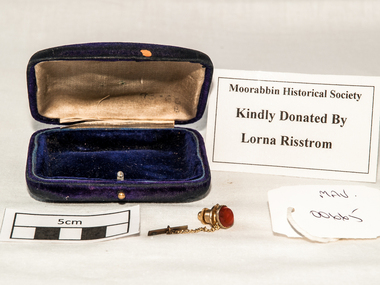
Jewellery, tie stud and chain and a small, velvet covered box, c1900
... By the 1860s, wearing cravats had been embraced by the English upper middle classes with a consequently lower quality of materials and designs used in both the neckwear and in the stickpins used to keep it in place. By the 1870s Americans...By the 1860s, wearing cravats had been embraced by the English upper middle classes with a consequently lower quality of materials and designs used in both the neckwear and in the stickpins used to keep it in place. By the 1870s Americans ...A tie pin is a neckwear-controlling device, originally worn by wealthy English gentlemen to secure the folds of their cravats. They were first popularized at the beginning of the 19th century. Cravats were made of silk, satin, lace and lightly starched cambric, lawn and muslin, and stickpins were necessary accoutrements to keep these expensive fabrics in place and safe. Stickpins commonly used pearls and other precious gemstones set in gold or other precious metals and were designed specifically for their owners. By the 1860s, wearing cravats had been embraced by the English upper middle classes with a consequently lower quality of materials and designs used in both the neckwear and in the stickpins used to keep it in place. By the 1870s Americans had embraced stickpins and designs were mass-producedThe family of Lorna Risstrom were early settlers in Moorabbin ShireA tie-stud and chain in a small, blue velvet covered, silk lined, hinged jewellery box with . The tie-stud has a red stone set in gold metalmoorabbin, bentleigh, cheltenham, early settlers, pioneers, market gardneners, jewellery, risstrom lorna, tie-pins, tie- studs, cravats, silk, lace, -
 Orbost & District Historical Society
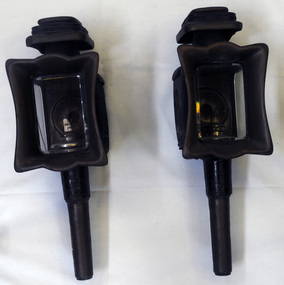
buggy lamps, 1880's -1910
... America Buggies with four wheels were light but comfortable. Many had hoods to keep the sun and rain off passengers. They were generally owned by doctors, ‘squatters’ and business people. Some had small turn-out seats at the back for children. Lamps are placed at different places on the carriage sides: 1 lamp on each side placed close to box seat These lanterns are examples of lighting devices used in the time of horse and carriage transport. lighting kerosene-lights buggy-lamps transport lanterns On ceramic wick holder - B in the middle of BARTONS B Underneath is TRADE MARK Two kerosene lanterns - buggy lamps.They are rectangular in shape and have a chimney on top. ...In the beginning of the19th century, the main mode of transportation was the horse and carriage. Even after the advent of the railway, remote areas still relied on the horse for local transport.Until Australian coachbuilders began making buggies from the 1860s, most were made in America Buggies with four wheels were light but comfortable. Many had hoods to keep the sun and rain off passengers. They were generally owned by doctors, ‘squatters’ and business people. Some had small turn-out seats at the back for children. Lamps are placed at different places on the carriage sides: 1 lamp on each side placed close to box seatThese lanterns are examples of lighting devices used in the time of horse and carriage transport.Two kerosene lanterns - buggy lamps.They are rectangular in shape and have a chimney on top. Both have carrying handles.There are 3 glass windows having two clear white lights and one small red round light on the back. The ceramic burner is made by Barton's.On ceramic wick holder - B in the middle of BARTONS B Underneath is TRADE MARK lighting kerosene-lights buggy-lamps transport lanterns -
 Bendigo Military Museum
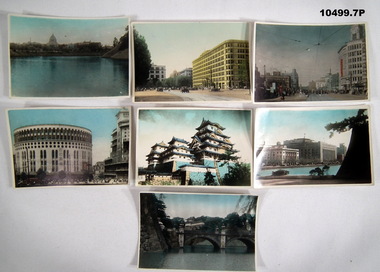
Photograph - STREET VIEWS, TOKYO, BCOF, c.1947
... middle building is General McArthur's H.Q.'s - a fine structure. 7. Handwritten in black ink on back: Entrance to the Imperial Palace, Tokyo. The palace has three moats around it. it is very heavily guarded, at the moment by Americans...middle building is General McArthur's H.Q.'s - a fine structure. 7. Handwritten in black ink on back: Entrance to the Imperial Palace, Tokyo. The palace has three moats around it. it is very heavily guarded, at the moment by Americans and Australian Air Force plus Japanese police 24/7/47'. 1. ...Photographs collected by Alva Marie Bennetts whilst deployed to BCOF, 1947-49. Part of the Bennetts collection. See catalogue No. 9726P for details of Alva Bennetts (No. VFX128835) service record.1. Colour photograph of a view across a body of water to a large building. 2. Colour photograph of a street lined with multi-storied buildings. Vehicles and pedestrians visible. 3. Colour photograph of a street lined with multi-storied buildings. Pedestrians on foot paths. Tram tracks down middle of street. Overhead wires for trams visible. 4. Colour photograph of a high rise circular building. Pedestrians visible in front of building. Japanese character visible on front of building. 5. Colour photograph of a multi level Japanese Castle (Himeji Castle.) 6. Colour photograph of multi level buildings with a body of water and trees in foreground. 7, Colour photograph of a palatial building behind a two arch bridge. Body of water in foreground. 1. Handwritten in black ink on back: “Japan's Diet Building” (The top part reminds me of the Shrine of Remembrance Melbourne). 2. Handwritten in black ink on back: Marunochi Building, Tokyo. 3. Handwritten in black ink on back: Main St Tokyo. 4. Handwritten in black ink on back: Nippon Theatre Off Limits to all troops 6. Handwritten in black ink on back: The middle building is General McArthur's H.Q.'s - a fine structure. 7. Handwritten in black ink on back: Entrance to the Imperial Palace, Tokyo. The palace has three moats around it. it is very heavily guarded, at the moment by Americans and Australian Air Force plus Japanese police 24/7/47'.alva bennetts, bcof, tokyo, japan -
 Bendigo Military Museum
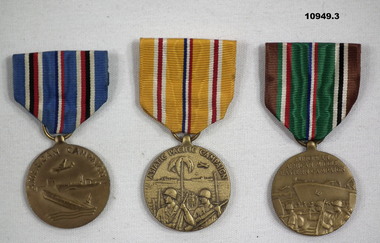
Award - MEDALS, U.S., WW2, Unknown
... American Theatre of Operations up to 2 Mar 1946, including 1 year service in Continental USA. 2. Pacific Campaign Medal - For service in Asiatic - Pacific area during WW2. 3. European - African Medal - Awarded for qualifying service with the European, African & Middle...American Campaign Medal. 2. Pacific Campaign Medal. 3. European - African - Middle Easter Campaign Medal....American Campaign Medal. 2. Pacific Campaign Medal. 3. European - African - Middle Easter Campaign Medal. ...1. American Campaign Medal - For service in Active duty in the WW2 American Theatre of Operations up to 2 Mar 1946, including 1 year service in Continental USA. 2. Pacific Campaign Medal - For service in Asiatic - Pacific area during WW2. 3. European - African Medal - Awarded for qualifying service with the European, African & Middle Eastern Theatres of WW2.Three medals with ribbons - unmounted. 1. American Campaign Medal. 2. Pacific Campaign Medal. 3. European - African - Middle Easter Campaign Medal.No name inscriptions.ron mills collection, medals, us -
 Bendigo Military Museum
Booklet - BOOKLET, ADDRESS, 1939-1943
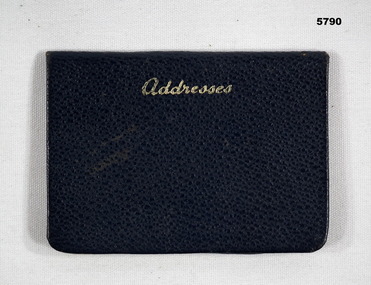
... Enlisted 28.6.1940 as VX40780 age 24 years 5 months, embarked for the Middle East 5.2.1941, embarked for Australia 17.2.1942, disembark 17.3.1943, he marries Margaret Brennan, his record has the date of marriage listed 25.5.1942 Embark for New Guinea 13.5.1942, appointed Lance Bombadier 28.8.1942, hospital 3.7.1943 with Malaria/Dengue Fever, rejoin unit 27.7.1943, appointed Bombadier 3.10.1943 embark for Australia from Buna per HMAT Duntroon 28.11.1943, reported missing presumed dead on 30.11.1943. A Court of enquiry held on board ship 1.12.1943 concluded that between the hours of 0600-0930 he left the ship without authority on 30.11.1943 The day before bing the 29th the Duntroon collided with an American...Enlisted 28.6.1940 as VX40780 age 24 years 5 months, embarked for the Middle East 5.2.1941, embarked for Australia 17.2.1942, disembark 17.3.1943, he marries Margaret Brennan, his record has the date of marriage listed 25.5.1942 Embark for New Guinea 13.5.1942, appointed Lance Bombadier 28.8.1942, hospital 3.7.1943 with Malaria/Dengue Fever, rejoin unit 27.7.1943, appointed Bombadier 3.10.1943 embark for Australia from Buna per HMAT Duntroon 28.11.1943, reported missing presumed dead on 30.11.1943. A Court of enquiry held on board ship 1.12.1943 concluded that between the hours of 0600-0930 he left the ship without authority on 30.11.1943 The day before bing the 29th the Duntroon collided with an American ...This item relates to Bernard John Ruler. Enlisted 28.6.1940 as VX40780 age 24 years 5 months, embarked for the Middle East 5.2.1941, embarked for Australia 17.2.1942, disembark 17.3.1943, he marries Margaret Brennan, his record has the date of marriage listed 25.5.1942 Embark for New Guinea 13.5.1942, appointed Lance Bombadier 28.8.1942, hospital 3.7.1943 with Malaria/Dengue Fever, rejoin unit 27.7.1943, appointed Bombadier 3.10.1943 embark for Australia from Buna per HMAT Duntroon 28.11.1943, reported missing presumed dead on 30.11.1943. A Court of enquiry held on board ship 1.12.1943 concluded that between the hours of 0600-0930 he left the ship without authority on 30.11.1943 The day before bing the 29th the Duntroon collided with an American Destroyer (USS Perkins) at 0200 hrs cutting it in half. The following collection contains other items relating to Margaret and approx 250 letters from Bernard to Margaret during the war and 18 from Margaret to BernardRectangle black vinyl booklet. 18 pages. Addresses of contacts are written in blue and black ink. Pages have gold on the edges.front cover “Addresses”ww2, booklet, address b.j.ruler -
 Bendigo Military Museum
Newspaper - STARS AND STRIPES NEWSPAPER, Stars & Stripes, 6.11.2004
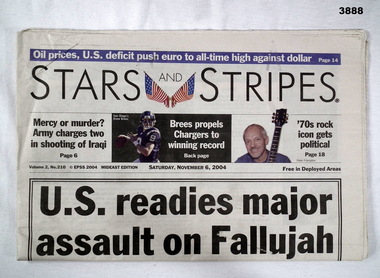
... United States of America “Stars and Stripes” military newspaper, Vol 2, No 210, 32 pages. Has military, current affairs ,sport , Middle East edition....Refer Cat No 3891 for his service details. newspapers united states stars and stripes United States of America “Stars and Stripes” military newspaper, Vol 2, No 210, 32 pages. Has military, current affairs ,sport , Middle East edition. ...Item belonging to Mathew Redwood. Refer Cat No 3891 for his service details.United States of America “Stars and Stripes” military newspaper, Vol 2, No 210, 32 pages. Has military, current affairs ,sport , Middle East edition.newspapers, united states, stars and stripes -
 Glen Eira Historical Society
Album - Album page, Myoora, 405 Alma Road, Circa 1972
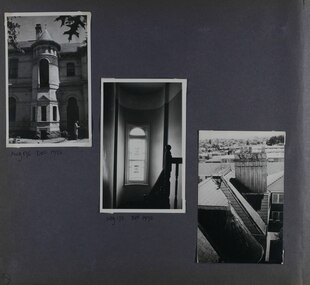
... The main staircase has been removed, minor alterations to decorative features have occurred and additions have been made to the exterior. caulfield north trevor hart alma road mansion myoora tower thomas christian 1880's queen anne cement rendered brick unpainted balconies verandahs anketell henderson continental and english renaissance american romanesque views cast iron work reed henderson & smart flats asymmetrical style slate roofs windows Handwritten: Neg 175 DEC 1972 [underneath top left photograph] / Neg 173 DEC 1972 [underneath middle photograph] / 9 [bottom left] Page 9 of Photograph Album including three black and white photographs. ...This photograph is part of the Caulfield Historical Album 1972. This album was created in approximately 1972 as part of a project by the Caulfield Historical Society to assist in identifying buildings worthy of preservation. The album is related to a Survey the Caulfield Historical Society developed in collaboration with the National Trust of Australia (Victoria) and Caulfield City Council to identify historic buildings within the City of Caulfield that warranted the protection of a National Trust Classification. Principal photographer thought to be Trevor Hart, member of Caulfield Historical Society. Most photographs were taken between 1966-1972 with a small number of photographs being older and from unknown sources. All photographs are black and white except where stated, with 386 photographs over 198 pages.Myoora - Victorian Heritage Register (VHR) Number H0490 From the Victorian Heritage Register Database - Citation for Myoora https://vhd.heritagecouncil.vic.gov.au/places/275 (as at 6/10/2020) Myoora, 405 Alma Road, North Caulfield, was designed by Reed, Henderson & Smart and can be attributed to Anketell Henderson. It was built in 1886 and 1887 for Thomas Christian, who had founded the fabled gold mine, the Day Dawn at Charters Towers. He never occupied the house although his widow lived there for some time. The house was subdivided into three and later six flats. Myoora was one of many large mansions on broad acres with gardens in Caulfield. Perhaps the grandest was Labassa. The mansions date from the 1850s through to the late 1890s. The siting of Myoora on a ridge influenced its planning and composition. A central hall and corridor along the ridge is entered from the centre of the more formal north facade. The entrance is marked by an elaborately detailed tower. A stair turret provides a second accent. The western end of the building is completed by a massively detailed chimney as the service wing. The south facade enjoyed an outlook to port phillip from a two-storey cast iron verandah. Bay windows, chimneys, the tower and the turret and minor details are brought together in a sophisticated asymmetrical composition. This is reflected in the planning. The asymmetry of Myoora pivoting on the tower is the most notable feature of the building. The walls are built of cement rendered brick. The cement render has not been painted. The roof is slate. The balconies and verandah are cast iron. The footings and cellar are bluestone. The architectural firm Reed, Henderson & Smart was very prominent in Victoria in the nineteenth century. Anketell Henderson was an eminent and well respected member of the profession. He worked successfully in London and interstate as well as in Victoria. They were better known for commercial and public buildings. Myoora is an important private commission. The style of Myoora is a combination of details from the Continental and English Renaissance through the boom style and the Queen Anne style. There is also an early influence from the American Romanesque style especially in the stair turret. The latter style was important at the turn of the century and Myoora is a significant precursor. Other buildings of a similar scale survive in Caulfield and elsewhere. Labassa, the most fabulous, is quite different stylistically as are most of the other comparable mansions. Stonnington is perhaps closer but relies on different details from the Queen Anne style and lacks any American influence. For its historical associations through its owners and architects, for its style and composition and for its intactness, Myoora is significant at a State level. The craftmanship of Myoora is what could be expected of a building of the time and type. It is relatively intact and in fair condition. The main staircase has been removed, minor alterations to decorative features have occurred and additions have been made to the exterior.Page 9 of Photograph Album including three black and white photographs. The photos are in a portrait orientation and arranged diagonally across the page from top left to bottom right.Handwritten: Neg 175 DEC 1972 [underneath top left photograph] / Neg 173 DEC 1972 [underneath middle photograph] / 9 [bottom left]caulfield north, trevor hart, alma road, mansion, myoora, tower, thomas christian, 1880's, queen anne, cement rendered brick, unpainted, balconies, verandahs, anketell henderson, continental and english renaissance, american romanesque, views, cast iron work, reed henderson & smart, flats, asymmetrical style, slate roofs, windows -
 Kiewa Valley Historical Society
Organ and stool
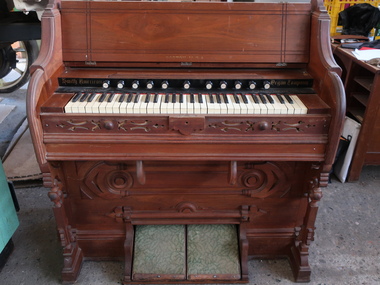
... American / Allan & Co." "Wilkies' ? Wooden organ with 2 hinges to raise the lid from one position and then to the next. There is a decorative wooden barrier to stop the music books from falling onto the keyboard. Above the keyboard are 5 knobs on the left and 6 on the right. The front of the organ is decoratively carved. The 2 foot pedals are covered with cloth. The middle ...Smith and H. W. Smith began in 1852 then became known as the Smith American Organ Company. Located in Boston, U.S.A. This organ was used in St Aidens, the Church of England, TawongaWooden organ with 2 hinges to raise the lid from one position and then to the next. There is a decorative wooden barrier to stop the music books from falling onto the keyboard. Above the keyboard are 5 knobs on the left and 6 on the right. The front of the organ is decoratively carved. The 2 foot pedals are covered with cloth. The middle panel on the back has been repaired. Wooden stool"Boston U.S.A." on the inside "Organ Company / Melbourne" "Smith American / Allan & Co." "Wilkies' ?church organ, music
