
Showing 92 items matching "military drills"
-
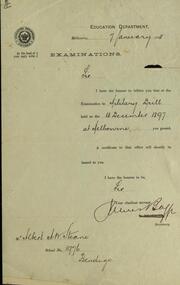 Federation University Historical Collection
Certificate, Education Department, Examinations: Military Drill, 1898, 18/12/1897
... Education Department, Examinations: Military Drill, 1898......military drill...Correspondence outlining that a certificate for military drill will be forwarded....Cadets military drill Education Department Victoria Correspondence outlining that a certificate for military drill will be forwarded. ...Correspondence outlining that a certificate for military drill will be forwarded.cadets, military drill, education department victoria -
 Federation University Historical Collection
Book, Valuable Steps: A History of Physical Educaiton in Victoria
... ...military drills...Physical Education steve moneghetti garry powell military drills physical education centre curriculum research group peter fryar physical drill mary cox frank beairepaire lil beaurepaire physical culture gertrude anderson swimming army cadet training scheme fritz duras eva duras albert willee physical education for victorian schools rosalie virtue maypole royal visit somers camp itinerant staff merlene lee gow folk dancing harvey cox t.l. emerson tom mann merlene nagle erskine house merrylands house golden trout dance tilden tragardh fine motor skills school camps achper little athletics wally bell Blue book of 312 pages Valuable Steps: A History of Physical Educaiton in Victoria Book ...Blue book of 312 pagesnon-fictionphysical education, steve moneghetti, garry powell, military drills, physical education centre, curriculum research group, peter fryar, physical drill, mary cox, frank beairepaire, lil beaurepaire, physical culture, gertrude anderson, swimming, army cadet training scheme, fritz duras, eva duras, albert willee, physical education for victorian schools, rosalie virtue, maypole, royal visit, somers camp, itinerant staff, merlene lee gow, folk dancing, harvey cox, t.l. emerson, tom mann, merlene nagle, erskine house, merrylands house, golden trout, dance, tilden tragardh, fine motor skills, school camps, achper, little athletics, wally bell -
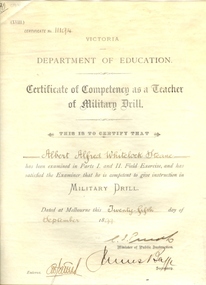 Federation University Historical Collection
Certificate, Education Department Victoria, Certificate of Competencey as a Teacher of Military Drill, 1899, 25/09/1899
... Certificate of Competencey as a Teacher of Military Drill, 1899......military drill...It certifies that Albert Alfred Whitelock Steane was successfully examined in Field Exercise part 1 and 2, and was deemed competent to give instruction in Military Drill. It is certificate number 11194....Steane Albert Steane Victorian Education Department military drill military armed forces field exercise parchment Printed Victorian Education Department certificate on parchment. ...Albert Steane was an early teacher of Sloyd and was appointed Principal of the Ballarat Junior Technical School in 1913.Printed Victorian Education Department certificate on parchment. It certifies that Albert Alfred Whitelock Steane was successfully examined in Field Exercise part 1 and 2, and was deemed competent to give instruction in Military Drill. It is certificate number 11194.steane, albert steane, victorian education department, military drill, military, armed forces, field exercise, parchment -
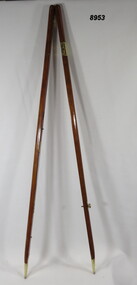 Bendigo Military Museum
Equipment - SWAGGER STICK, C & S LTD, 1965
... Symbolises high standards of military drill, discipline and authority for Regimental Sergeant Major. ...Symbolises high standards of military drill, discipline and authority for Regimental Sergeant Major. ...Symbolises high standards of military drill, discipline and authority for Regimental Sergeant Major. Bluey Addington, refer Cat No 6853.3 for his service details.A pace stick is a hinged, two piece wooden staff used to measure, maintain and check the marching pace to ensure step cadence, and align drill ranks. it is also used to lay out parade ground markers.“WO1 BERTRAM (BLUEY) ADDINGTON, 41843. - B.E.M. E.M. A.A.T.T.V. - C & S - LTD 1965 - 6910^-99-120-6375”passchendaele barracks trust, pbt249, pace stick, marching, equipment -
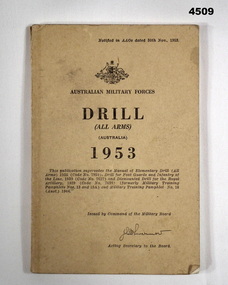 Bendigo Military Museum
Manual - MILITARY DRILL ALL ARMS, Command of the Military Board, C.1953
... MILITARY DRILL ALL ARMS ...Books military...drill...The contents cover 16 differant types of drill from the basics to military Funerals....Manual, Australian Military Forces Drill, all Arms 1953, light Kahki colour cardboard covers, 134 pages, all images and print in black....The contents cover 16 differant types of drill from the basics to military Funerals. Books military drill 1953 Manual, Australian Military Forces Drill, all Arms 1953, light Kahki colour cardboard covers, 134 pages, all images and print in black. ...The contents cover 16 differant types of drill from the basics to military Funerals.Manual, Australian Military Forces Drill, all Arms 1953, light Kahki colour cardboard covers, 134 pages, all images and print in black., books military, drill 1953 -
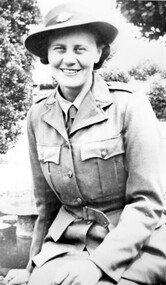 Surrey Hills Historical Society Collection
Photograph, Doris Wright, member of the Australian Women's Army Service
... Training for members of the WANS included air raid drills, first aid, basic military drills, and even shooting, signalling, and mechanics. ...Training for members of the WANS included air raid drills, first aid, basic military drills, and even shooting, signalling, and mechanics. ...Doris Lilian Wright of 214 Union Road was a milliner but joined the Australian Women's Army Service (AWAS) in the early war years. The Women’s Australian National Service (WANS) was inaugurated in 1940. Training for members of the WANS included air raid drills, first aid, basic military drills, and even shooting, signalling, and mechanics. AWAS on formed on 13 August 1941 with the objective of releasing more men into forward areas. The Army was particular with its recruiting and four references were required; another stipulation was that teeth were in good condition. Doris was located at Elwood. Their training area was along the foreshore and one day to their great surprise there were crowds of American Marines – "the cream of the American Army". These were the first Americans to arrive in Australia to strengthen the defence of the country. The Americans soon went north and the AWAS went off to Balcombe on the Mornington Peninsula. At this time there were no uniforms for the girls only ‘giggle’ dresses – of a non-descript colour. They were not expected to appear in public in these and wore civilian dress. Japan had just entered the war and there were more urgent demands on restricted supplies. The formal uniforms eventually arrived.A black and white photograph of a lady in an army uniform and wearing a hat.union road, surrey hills, uniforms, clothing and dress, (miss) doris wright, australian women's army service -
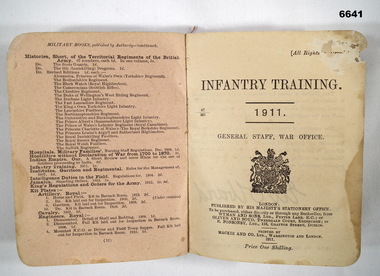 Bendigo Military Museum
Book - BOOK, INFANTRY TRAINING 1911 (UK), His Majesty's Stationery Office/ Mackie & Co. Ltd, 1911
... It has drawings and Military Manoeuvre's. It has drill movements, with and without arms, Coy and Btn level drills, machine gun drill. ...It has drawings and Military Manoeuvre's. It has drill movements, with and without arms, Coy and Btn level drills, machine gun drill. ...This is a pocket sized book. Red Buckram cover. It has 217 pages, printed in black ink. It has drawings and Military Manoeuvre's. It has drill movements, with and without arms, Coy and Btn level drills, machine gun drill. Infantry in battle, Attack Defence, fighting environments, Bayonet drills.Inside in advert section p.5, is written in pencil, Coat 7918, Rifle 4809, Bayonet 4893.passchendaele barracks trust, infantry trg 1911 -
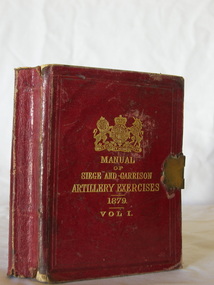 Flagstaff Hill Maritime Museum and Village
Book - Instruction Manual, British War Office, Manual of Siege and Garrison Artillery Exercises Vol 1, ca 24-06-1882
... military training...defense training...British Artillery...Royal Artillery...Gunnery...Gun Drill...The four parts included in this Volume I are: - Part 1 - Gunnery Part 2 - Ammunition Part 3 - Siege Artillery Part 4 - Garrison Gun Drills The remaining six of then parts are: - Part 5 - Material and Appliances Part 6 - Elementary Instruction Part 7 - Machines Part 8 - Mounting and Dismounting Ordnance Part 9 - Sleighs Part 10 - Sheers and Derricks The book is significant to both British and Australian history, being issued for the training of the garrison defense of both countries in the late 10th Century. It is also significant for its connection with other historical military ...This little book has been designed to fit into a small space such as a pocket, backpack or trunk. The brass book lock helps keep the pages and covers together, preserving them from being bent, torn or damaged in handling.The book includes four of ten parts of the Manual, published for use in training the garrison troops, including the placement and firing of cannon. The four parts included in this Volume I are: - Part 1 - Gunnery Part 2 - Ammunition Part 3 - Siege Artillery Part 4 - Garrison Gun Drills The remaining six of then parts are: - Part 5 - Material and Appliances Part 6 - Elementary Instruction Part 7 - Machines Part 8 - Mounting and Dismounting Ordnance Part 9 - Sleighs Part 10 - Sheers and DerricksThe book is significant to both British and Australian history, being issued for the training of the garrison defense of both countries in the late 10th Century. It is also significant for its connection with other historical military items within the Collection at Flagstaff Hill Maritime Museum and Village.Manual of Siege and Garrison Artillery Exercises Vol 1 [Parts I, II, III, IV] Publisher Her Majestys Stationery Office Date 1879, Corrected June 24th 1882 Small, red, hard-cover book with embossed gold letters and British Coat of Arms on the front. The book has a brass closure or locking clip across the text block. There are diagrams and a foldout table within the text. flagstaff hill, flagstaff hill maritime museum and village, warrnambool, maritime museum, maritime village, great ocean road, shipwreck coast, training manual, book, british garrison, garrison artillery, siege exercises, british government training book, technical book, pocket book, manual of siege and garrison artillery exercises vol 1, garrison exercises, military training, defense training, british artillery, royal artillery, gunnery, gun drill, brass book lock, british war office, locking clip, reference book -
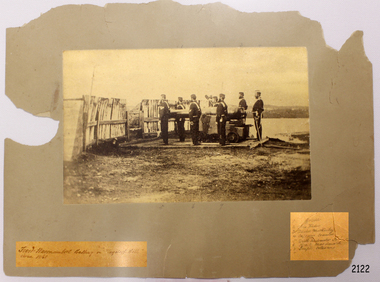 Flagstaff Hill Maritime Museum and Village
Photograph - Military, First Warrnambool Battery on Flagstaff Hill, ca. 1868
... military men on Flagstaff Hill ready for action. The names are listed on the card, handwritten in pencil: 1. Gorrie 2. Chris Hider 3. David McKinley 4. Captain Cramer 5. Drill...military men on Flagstaff Hill ready for action. The names are listed on the card, handwritten in pencil: 1. Gorrie 2. Chris Hider 3. David McKinley 4. Captain Cramer 5. Drill ...There was an active Volunteer Corps in Warrnambool in the 1800s. This photograph shows a group off military men on Flagstaff Hill ready for action. The names are listed on the card, handwritten in pencil: 1. Gorrie 2. Chris Hider 3. David McKinley 4. Captain Cramer 5. Drill Instructor (cannot read name) 6. R.A.C. Macdonald 7. Joseph GladstoneThe militia played a significant role in being prepared to defend the Warrnambool district.Photograph, sepia, mounted on brown card. Depicts the First Warrnambool Battery on Flagstaff Hill. Seven uniformed figures stand beside a cannon mounted on a wooden, waist high carriage. The cannon is aimed between a gap in a timber fence. The lower edge of the card has two labels with handwritten inscriptions; one is the photograph title, the other is a list of seven names written in pencil Photograph is dated ca. 1868. Left hand side: "First Warrnambool Battery on 'Flagstaff Hill'" Right hand side: list of names written in pencil: "1. Gorrie 2. Chris Hider 3. David McKinley 4. Captain Cramer 5. Drill Instructor (cannot read name) 6. R.A.C. Macdonald 7. Joseph Gladstone"flagstaff hill, warrnambool, maritime museum, maritime village, shipwreck coast, great ocean road, militia, volunteer corps, cannon, gun, firearm, first warrnambool battery, warrnambool battery, defence, gorrie, chris hider, david mckinley, captain cramer, drill instructor, r.a.c. macdonald, joseph gladstone -
 Federation University Historical Collection
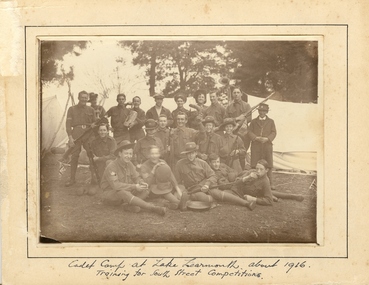
Photograph - Photograph - Sepia, Ballarat School of Mines Cadets, 1916, c1916
... This early training was less military in nature than focused on physical drill and sport. It also acted to inculcate boys with the notions of loyalty to country and empire. ...This early training was less military in nature than focused on physical drill and sport. It also acted to inculcate boys with the notions of loyalty to country and empire. ...Field Marshal Viscount Kitchener of Great Britain was invited by Prime Minister Deakin in 1909 to visit Australia and advise on the best way to provide Australia with a land defence. Kitchener’s report echoed the bill, introduced to Parliament in 1909 and supported by the Opposition Labor Party at its 1908 conference, to introduce compulsory military training in peace time (referred to as universal training). On 1 January 1911, the Commonwealth Defence Act 1911 (Cth) was passed as law and all males aged 12 to 26 were required to receive military training. Men were divided according to age, with junior cadets comprising boys 12-14 years of age, senior cadets comprising boys 14-18, and young men aged 18-26 assigned to the home militia defence. The support of schools was vital to the success of the scheme, since the system of cadet training began in the primary schools, with physical training prescribed by military authorities. Junior cadet training was entirely in the hands of school teachers, who had first been trained by military officers. This early training was less military in nature than focused on physical drill and sport. It also acted to inculcate boys with the notions of loyalty to country and empire. At this age, uniforms were not worn, although there were schools with pre-existing uniformed cadet units, who continued to do so. Senior Cadets were organised by Training Areas, administered by Area Officers. If a school had at least 60 senior cadets, they could form their own units. Unlike their junior counterparts, Senior Cadets were issued uniforms, a rifle, and learned the foundations necessary for service in any arm of the defence forces. Boys and men could be exempted from compulsory training if they lived more than five miles from the nearest training site, or were passed medically unfit. Those who failed to register for training were punished with fines or jail sentences, and the severity of this punishment generated some of the strongest opposition to the scheme. While institutions such as the political parties and most churches generally supported universal training, some in the broader labour movement were less enthusiastic, as evidenced in the Daily Herald newspaper’s editorials and letters. Universal military training persisted after the conclusion of World War 1, with the Junior Cadet scheme the first to go, in 1922. Senior cadets and service with the militia was suspended in November 1929. (http://guides.slsa.sa.gov.au/content.php?pid=575383&sid=4788359, accessed 29/10/2015) According to Neil Leckie, Manager of the Ballarat Ranger Military Museum: * Originally 12 – 14 year olds went to Junior Cadets attached to their school. * From age 14 – 17 they were Senior Cadets attached to the local militia unit. * After 1 July of the year a Cadet turned 18, the Cadet left the Senior Cadets and became a member of the Citizen Military Force. * In October 1918 the AIF, Militia and Cadets were renamed to give some connection to the AIF battalion raised in the area. Ballarat saw: 8th Australian Infantry Regiment comprising: * 8th Battalion AIF renamed 1st Battalion 8th Australian Infantry Regiment * 70th Infantry Militia renamed 2nd Battalion 8th Australian Infantry Regiment * 70th Infantry Cadets renamed 3rd B, 8th Australian Infantry. 39th Australian Infantry Regiment comprising: * 39th Battalion AIF renamed 1st Battalion 39th Australian Regiment * 71st Infantry Militia renamed 2nd Bn, 39th Australian Infantry Regiment * 71st Infantry Cadets renamed 3rd Bn, 39th Australian Infantry Regiment Prior to the reorganisation in 1918 the 18th Brigade was the 70th, 71st and 73rd Infantry. It is thought that the 18th Brigade Cadet units in 1920 were those that came from the old: * 69th Infantry (Geelong/Queenscliff) * 70th Infantry (Ballarat/Colac) * 71st Infantry (Ballarat West) * 72nd Infantry Warrnambool) * 73rd Infantry (NW Vic) The next name change came in 1921!Mounted sepia photograph of 21 young males. They are the Ballarat School of Mines Cadets on a training camp at Lake Learmonth. Back row left to right: Harold Wakeling; ? ; T. Wasley; H. Witter; H.V. Maddison (staff); Lieutenant S.J. Proctor, Joe ? ; ? ; B.C. Burrows. Centre left to right: Howard Beanland; ? ; F.N. Gibbs; H. Siemering; P. Riley; ? : E. Adamthwaite. Front row left to right: Albert E. Williams; Francis Davis (RAAF Dec.); A. Miller; W. Shattock; T. Rees From the Ballarat School of Mines Magazine, 1916 "Our Competition Team, 1916 At a parade, held on the 25th August competition teams were called from from the three colleges - Ballarat College, St Patrick's College, and the School of Mines. In each case, a large muster was obtained, twenty-nine volunteering fro the School of Mines. On account of the number in a team being limited to 21, some had to be weeded out. The team decided to have a camp at Learmonth in the vacation for the benefit of training for the coming competitions. The tents, within our baggage, were brought to the Junior Technical School at 10 a.m. on Monday, 11 September. Everything was carted to the station on a lorry, which was very kindly lent by Mr C. Burrow. ... Arriving at our camp, which was in the Park, we first raised the tents. This was done in record time. Three large tents, A.B.C., were pitched one behind the other. We also pitched a smaller one to act as a provisions tent. The provisions supplied by each cadet were placed in this tent. Dinner was ready by 3.30, and was prepared by the three senior non-coms., who also acted as orderlies. Things went alright Monday night, the two senior non-coms. acting as sentries for the first two hours. On Tuesday morning Reville sounded at 7. There was no need for it, however, as nearly all the cadets were up before daylight, owing to their beds being too hard. After physical exercises were gone through we had breakfast. We then had rifle exercises until Messrs A.W. Steane and F.N. King arrived. The former put the team through the table of physical exercises set down for competition work, many valuable points being obtained. The visitors remained for dinner, afterwards returning to Ballarat. Wednesday was uneventful, until the soldiers arrived at about 11 a.m., stopping at the park for lunch. As we handed over the coppers, etc., to them, our lunch was delayed. Two more visitors arrived after lunch, and after taking a few photos returned home. That night we had a "Sing-a-long" in C Tent until "Lights out" sounded at 9.30. After physical exercises ad breakfast on Thursday, we went for a six mile route march round the lake, doing skirmishing on the way. In the afternoon we practised rifle exercises and the march past. A concert was arranged for that night, the chief singers being cadets H. Siemering and W. Shattock. Supper was served at the end of the entertainment. On Friday, Reveille sounded at 6.30 instead of 7, and, as usual, we had physical exercises before breakfast, after which the team went through skirmishing at the reserve. In the afternoon, section drill and the march past were practised. Friday night, being our last night in camp, leave was granted until 10 p.m., "lights out" sounding at 11. Reveille sounded on Saturday at 4.30, the reason being that all kits, tents, etc., had to be packed away ready to catch the 8.15 train to Balalrat. At 7.30 we were all ready to leave for the station. We had a very enjoyable time in the train, each cadet having a chip in at the patriotic songs. On arriving at Ballarat, we found the lorry awaiting us. The luggage was carted to the Junior Technical School, the team following. The team were here dismissed, everyone feeling that he had had a very good time. F.G. Davis"Written in ink on front 'cadet camp at Lake Learmonth about 1916. Training for South Street Competitions. ballarat school of mines, cadets, ballarat school of mines cadets, lake learmonth, world war one, boomerang, camp, cadet camp, h.g. wakeling, harold wakeling, f.g. davis, albert w. steane, f.n. king, h. siermering, w. shattock, francis davis, harold wakeling, t. wasley, h. witter, h.v. maddison, s.j. proctor, b.c. burrows, howard beanland, f.n. gibbs, h. siemering, p. riley, e. adamthwaite, albert e. williams; francis davis, a. miller, w. shattock, t. rees, photography, foto, boxing gloves -
 Federation University Historical Collection
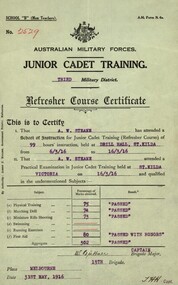
Certificate, Australian Military Forces: Junior Cadet Training, Third Military District, 31/05/1916
... australian military forces...drill...a w steane junior cadet training australian military forces drill hall st Kilda refresher course w buttner melbourne physical training marching drill rifle shooting swimming running first aid 'A.M.Form N. 6a' and 'SCHOOL "B" (Men Teachers) printed at top of page No. written in red pen; 2529 Official seal of Australian Military Forces Signed: W Buttner Captain, 13th Brigade T H H Capt. ...Off white printed form. Sections filled in with purple typing.'A.M.Form N. 6a' and 'SCHOOL "B" (Men Teachers) printed at top of page No. written in red pen; 2529 Official seal of Australian Military Forces Signed: W Buttner Captain, 13th Brigade T H H Capt. Chief Instructora w steane, junior cadet training, australian military forces, drill hall, st kilda, refresher course, w buttner, melbourne, physical training, marching drill, rifle shooting, swimming, running, first aid -
 Geelong RSL Sub Branch
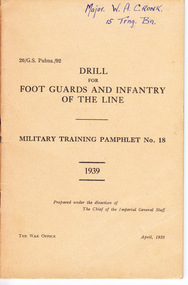
Book, Drill for Foot Guards and Infantry of the Line, 04/1939
... Cronk 15 Trng Bn Military Drill Training Manual 1939 Training Drill Foot Guards Infantry Pamphlet 26/G.S. ...Training Manual Belonging to Major W.A. Cronk 15 Trng BnMilitary Drill Training Manual 1939An oblong book faded buff color cardboard cover white pages. Military Training Pamphlet No18 1939.26/G.S. Pubns./92 Major W.A. Cronk. 15 Trng Bntraining drill foot guards infantry pamphlet -
 Ringwood and District Historical Society
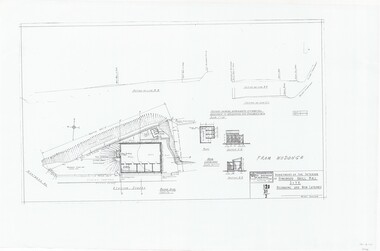
Plan, Drill Hall Site - Design for Military Units and Miniature Rifle Range, Ringwood, Victoria - Circa 1935
... Drill Hall Site - Design for Military Units and Miniature Rifle Range, Ringwood, Victoria - Circa 1935...(c) Plan View, Front and Rear Elevations, Minature Rifle Range at Ringwood Drill Hall. Drill Hall Site - Design for Military Units and Miniature Rifle Range, Ringwood, Victoria - Circa 1935 Plan ...Technical drawings (a) Block Plan - Ringwood Drill Hall Site, Station Street, Ringwood. (b) Plan View, End and Side Elevation, Drill Hall Wodonga - Removed to Ringwood. (c) Plan View, Front and Rear Elevations, Minature Rifle Range at Ringwood Drill Hall.Commonwealth of Australia. Department of The Interior, Works & Services Branch, Victoria. -
 Montmorency–Eltham RSL Sub Branch
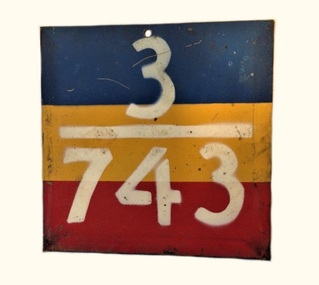
Functional object - Vehicle Identification Plate, metal, Post WWII
... military district Horizontal blue, yellow and red horizontal stripes. Number 3 on top of a narrow horizontal white line with the numbers 743 underneath. Small square shaped steel metal plate. Khaki coloured paint on rear face. Blue, yellow and red horizontal painted stripes on the front face. White coloured numbers with a narrow horizontal white line painted on front face. Small hole drilled ...Identification plate is for the Royal Australian Mechanical and Electrical engineers (RAME), 3rd Military District, vehicle number 743.Vehicle identification plate used by the Australian Army.Small square shaped steel metal plate. Khaki coloured paint on rear face. Blue, yellow and red horizontal painted stripes on the front face. White coloured numbers with a narrow horizontal white line painted on front face. Small hole drilled through the plate on the top.Horizontal blue, yellow and red horizontal stripes. Number 3 on top of a narrow horizontal white line with the numbers 743 underneath.vehicle, identification, plate, rame, 3rd military district -
 Bendigo Military Museum
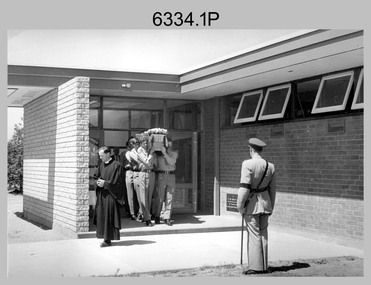
Photograph - Military Funeral, Army Headquarters Survey Regiment Personnel, Mildura, 1968
... This is a set of 26 black & white photographs of troops from the Army Headquarters Survey Regiment undertaking ceremonial drills at a military funeral held at Mildura in 1968. ...This is a set of 26 black & white photographs of troops from the Army Headquarters Survey Regiment undertaking ceremonial drills at a military funeral held at Mildura in1968. ...This is a set of 26 black & white photographs of troops from the Army Headquarters Survey Regiment undertaking ceremonial drills at a military funeral held at Mildura in 1968. ...This is a set of 26 black & white photographs of troops from the Army Headquarters Survey Regiment undertaking ceremonial drills at a military funeral held at Mildura in 1968. As a senior officer of field rank (Colonel or above) led the funeral procession, it is presumed the unknown deceased soldier was also a highly ranked field officer. The location of the funeral service was the Methodist Church in Merbein, based on the sign in photo .2P and the burial was held at the Midura Cemetery in northwest Victoria, based on the annotation on the back of photo .10P.This is a set of 26 black & white photographs of troops from the Army Headquarters Survey Regiment undertaking ceremonial drills at a military funeral held at Mildura in1968. The photographs were printed on photographic paper and are part of the Army Survey Regiment’s Collection. The photographs were scanned at 300 dpi. .1) to .8) - Photo, black & white, 1968. All unidentified. .9) &.10) - Photo, black & white, 1968. Front rank L to R: unidentified (x4), SPR Bob Williams, SPR John McCracken, remainder unidentified. Rear rank L to R: all unidentified. .11) to .13) - Photo, black & white, 1968. File on right: No. 4 - SPR Bob Williams, No. 5 - SPR John McCracken, remainder unidentified. File on left: all unidentified. .14) to .19) - Photo, black & white, 1968. All unidentified. .20) - Photo, black & white, 1968. Front rank L to R: all unidentified. Rear rank L to R: unidentified, SPR John McCracken, SPR Bob Williams, remainder unidentified. .21) to .26) - Photo, black & white, 1968. All unidentified. There are no annotations, except the date ‘1968’ is written on the back of photo .10P. No personnel are identified.royal australian survey corps, rasvy, army survey regiment, army svy regt, fortuna, asr -
 Bendigo Military Museum
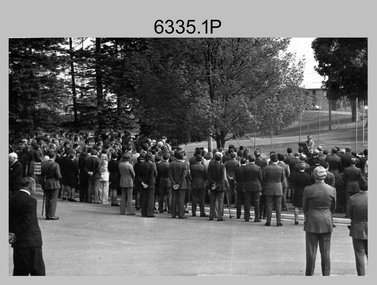
Photograph - Military Funeral for SSGT Peter Dew, Army Survey Regiment, Fortuna, Bendigo, 1977
... This is a set of five black & white photographs of troops from the Army Headquarters Survey Regiment undertaking ceremonial drill at the military funeral for SSGT Peter Dew in 1977. ...This is a set of five black & white photographs of troops from the Army Headquarters Survey Regiment undertaking ceremonial drill at the military funeral for SSGT Peter Dew in 1977. ...This is a set of five black & white photographs of troops from the Army Headquarters Survey Regiment undertaking ceremonial drill at the military funeral for SSGT Peter Dew in 1977. ...This is a set of five black & white photographs of troops from the Army Headquarters Survey Regiment undertaking ceremonial drill at the military funeral for SSGT Peter Dew in 1977. The location of the funeral service was at Fortuna, Bendigo. He was buried at Bendigo Cemetery in Quarry Hill. Peter Dew died in a tragic accident at home. He was fondly remembered as one of Lithographic Squadron’s colourful personalities. See item 6243.7P for photos of Peter Dew at work in Lithographic Squadron. The "Super Animal of the Year" Peter Dew Memorial Award was an award presented to a member of the squadron for a crude act. To view a photo of this award, refer to item 6230 of the Victorian Collections. This is a set of five black & white photographs of troops from the Army Headquarters Survey Regiment undertaking ceremonial drill at the military funeral for SSGT Peter Dew in 1977. The photographs were printed on photographic paper and are part of the Army Survey Regiment’s Collection. The photographs were scanned at 300 dpi. .1) - Photo, black & white, 1977. Unidentified soldiers and civilians. .2) - Photo, black & white, 1977. In front of the tennis court gates: John McCulloch. Remainder unidentified. .3) - Photo, black & white, 1977. Rifle party rear rank right marker: Russ Mollenhauer. Front rank rifle party commander next to right marker: Greg Kidman. Pall bearers in front of vehicle L to R: Dave Miles, Dick Barwald. Remainder unidentified. .4) - Photo, black & white, 1977. Rifle party commander: Greg Kidman. Right file front to back: Russ Mollenhauer, Peter Breukel, Bill Jones, John Anderson. Remainder unidentified. Left file front to back: unidentified (x2), Rhys De Laine, Frank Lenane, Josh Degroot, Gary Drummond. .5) - Photo, black & white, 1977. Left of minister: Alan Toogood. On right of tree L to R: Max Neil, Bob Hayden, Dave Malligan, Le-Anne (Smallshaw) Shirley, Stan Vote. Remainder unidentified.No personnel are identified.royal australian survey corps, rasvy, army survey regiment, army svy regt, fortuna, asr -
 Bendigo Military Museum
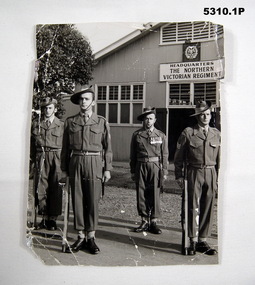
Photograph - PHOTOGRAPHS OF SOLDIERS, 38th BATTALION, 38 Bn, c1950-1962
... Drill Hall was built by Contractor Mr. Midgley. First used Jan 1916. Shut down Circa 2002. The 38 Bn Colours are held within the RSL Military Museum, Bendigo. ...Drill Hall was built by Contractor Mr. Midgley. First used Jan 1916. Shut down Circa 2002. The 38 Bn Colours are held within the RSL Military Museum, Bendigo. ...38 Bn was raised in Bendigo in 1916. Post War it was the CMF Unit until 1967. The Mollison St Drill Hall was built by Contractor Mr. Midgley. First used Jan 1916. Shut down Circa 2002. The 38 Bn Colours are held within the RSL Military Museum, Bendigo. Collection re Harry Burrell MM, refer Cat No 298.4 for his service details.1. Photo of 4 Senior NCO's in battle dress in front of the Mollison Street Drill Hall. 38 Bn Northern Victorian Regiment. The four soldiers have .303 rifles. WO Burrell has the red sash of a Colour Sgt. His MM can be seen. 2. Photo of Regiment Colours 38 Northern Vic Regiment in front of Mollison St Drill Hall. Two Officers, Capt. Emonde holding Queens Colours - 4 Snr NCO's have rifles at the slope with ceremonial tips on their bayonets.1. On rear is written - Cenotaph party/ Warrant Officer 3 sets Guards. 2. On rear is written - '" ANZAC DAY" .38 bn, mollison st, drill hall, photographs -
 Bendigo Military Museum
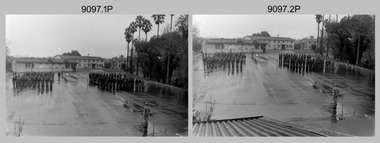
Photograph - Army Survey Regiment Drill Rehearsal, Fortuna, Bendigo, 1991
... Another reason for the drill rehearsal was in preparation for a parade commemorating visit to the unit by a dignitary such as a federal government minister or a highly ranked military officer....Another reason for the drill rehearsal was in preparation for a parade commemorating visit to the unit by a dignitary such as a federal government minister or a highly ranked military officer. ...This set of four black and white photographs were probably taken in June 1991 at a drill rehearsal for the Corps Day Parade scheduled later in late June or early July. The lack of officers with swords on the parade ground suggests this was a preliminary rehearsal leading up to their involvement. Another reason for the drill rehearsal was in preparation for a parade commemorating visit to the unit by a dignitary such as a federal government minister or a highly ranked military officer.This is a set of four photographs of troops from the Army Survey Regiment undertaking drill training at Fortuna, Bendigo in 1991. The black and white photographs are on 35mm negative film and scanned at 96 dpi. They are part of the Army Survey Regiment’s Collection. .1) to .4) - Photo, black & white, 1991. Squadrons from the Army Survey Regiment rehearsing drill movements. No personnel are identified.royal australian survey corps, rasvy, army survey regiment, army svy regt, fortuna -
 Bendigo Military Museum
Administrative record - COMPENDIUM WW1 - WW2, 4) A H Pettifer, Government Printer et al, 2) 14.2.1946; .3) 1.3.1919; .4) 30.11.1954 .5) 24.11.19? - WWI; .6) 31.10.1917; .7) 12.6.1917; .8) Page 1: 20.12.1915, Page 2: 10.12.1915, Page 6: 19.1915; .9) 10.9.1918; .10) 18.4.1919; .11) c.2.3.19?; .12) 18.9.1920; .14) post WWI; .15) 24.4.1920; .17) 18.4.1942; .18) 19.6.1943; .19) 18.3.1947; .20) 1944; .21) 1944; .23) 22.10.1941; .26) 13.9.1944; .27) 1.1944; .30) 7.3.1950; .31) 31.7.1944; .32) 16.4.1942; .33) 13.6.1946; .34) 6.5.1946; .36) a) & b) 3.11.1947; .37) 24.10.1951; .38) 24.9.1957; .39) 9.10.1957; .40) 19.2.1958; .41) 26.2.1958; .42) 1.3.1958; .43) & .44) 7.3.1958; .45) 25.2.1958; .46) 3.1.1948; .47) 26.2.1948; .48) 22.4.1958; .49) 24.2.1958; .50) 12.3.1958; .51) 6.1958; .52) c.Mar/Apr 1958; .53) 5.4.1958; .54) c.end WWII; .55) a.b. 13.6.1967; .56) 26.5.1967; .57) 18.2.1954
... Middle name misspelled, should be Trangmar not Trangman. .6) Congratulating H T ALLAN on receiving the Military Cross award for leading 2 companies which had lost officers during action on Passchendaele Ridge on 9.10.1917. .7) Describes life behind the lines whilst H T ALLAN's battalion has been resting for a month. Daily life consisted of training drills...Middle name misspelled, should be Trangmar not Trangman. .6) Congratulating H T ALLAN on receiving the Military Cross award for leading 2 companies which had lost officers during action on Passchendaele Ridge on 9.10.1917. .7) Describes life behind the lines whilst H T ALLAN's battalion has been resting for a month. Daily life consisted of training drills ...Herbert Trangmar Allan, refer 2755.4 for his extensive service history and wards. .2) Details gifting of a pair of Japanese binoculars to Col H T ALLAN by Pacific Island Regiment. .3) Certificate issued by Winston Churchill, Secretary of State for War (The War of 1914-1918), awarded to Capt H T ALLAN MC. .4) Herbert Trangman ALLAN born 5.1.1895 at Woolwich, NSW. Middle name misspelled, should be Trangmar not Trangman. .6) Congratulating H T ALLAN on receiving the Military Cross award for leading 2 companies which had lost officers during action on Passchendaele Ridge on 9.10.1917. .7) Describes life behind the lines whilst H T ALLAN's battalion has been resting for a month. Daily life consisted of training drills, sport & entertainment. Writer takes time to describe the countryside & weather. .8) Relate to H T ALLAN's military exam results & his promotion to 2nd Lieutenant in 1915. .9) To Herbert Allan's father, Mr P Allan detailing the citation for awarding of the Military Cross to Herbert ALLAN. Original citation appeared in the London Gazette,5.4.1918. .10) Form addressed to Capt H ALLAN MC, 17th Battalion stating his period of enlistment in the 1st AIF was to expire 26.5.1919. .11) Letter from Lord BIRDWOOD (General) to Herbert ALLAN in response to a letter received 19.11.19?. General BIRDWOOD expresses his opinions on difficulties the allied troops face in their fight against the Japanese. .12) Letter to Capt H T ALLAN advising of MID oak leaves sent to him. Details guidelines for attaching oak leaves to both the larger Victory Medal & the small service dress medal. .13) Form details H T ALLAN's WWII Army No, Rank, Unit & Decorations & Medals held. The form has not been signed & dated. .14) Details service record of Lt Col H T ALLAN NX12229. Includes military service from 1912 - 1944, schools & courses attended, decorations, promotions & overseas service. .16) Form issued to H T ALLAN on 15.12.1939 granting permission to leave New Guinea for Australia & return within a period of 12 months. Issued by Customs Office in Salamaua. Lists H T ALLAN's age as 44, height 5' 10" & occupation. .17) Letter from Major General MORSHEAD GOC, AIF (ME) to Major H T ALLAN, OBE, MC congratulating him on being awarded the OBE for outstanding service at Tobruch. .18) Letter from Major General MORSHEAD to Major H T ALLAN, OBE, MC replying to ALLAN's letter of 15.6.1943. MORSHEAD is congratulating ALLAN on his appointment to New Guinea Force, also acknowledges his excellent service record. .19) Letter acknowledges H T ALLAN's resignation from the Office of Production Member of the Australian New Guinea Production Control Board, effective from 28.8.1946. .20) Major General WINDEYER commanded the 20th Brigade from 1942-1946. .22) Card sent from the CO of the 3rd Australian Anti-Tank Regiment. .23) Menu for Farewell Dinner held in the Officer's Mess of the 20th Infantry Brigade, Tobruch on 22.10.1941. .24) Menu & Toast list for Farewell Dinner to Brigadier J J MURRAY DSO MC VD. Attended by H T ALLAN & held in the Officers Mess, 2/17 Australian Infantry Battalion on 22.12.1941. .25) Invitation to Col H T ALLAN by Lady Gowrie (wife of Governor General Baron Gowrie) to attend a Luncheon at Government House, Canberra, ACT. .26) Letter to Major (T/Lt Col) H T ALLAN from Major W A JENNER advising him of his secondment to 2/17 Australian Infantry Battalion & appointment to command 5 Aust Base Sub Area. .27) Application for Africa Star with Eighth Army Clasp signed by H T ALLAN & approved by Lt Colonel of 2/17 Australian Infantry Battalion. H T ALLAN held the rank of Major (substantive) at the time of qualification, 1.3.1942 - 11.1942. He held the rank of Lt Colonel at the time of application in 2.1944. .28) Detailing changes in command & promotions including that of Lt Col H T ALLAN, dated 1.4.19? .29) For Lt Col H T ALLAN detailing movements required by First Australian Army command. .30) Acknowledgement & confirmation of Col H T ALLAN's application for campaign awards for WWII. .31) Letter addressed to Lt Col H T ALLAN from Lt Gen Stanley Sauige requesting information on New Britain for a forthcoming visit. .32) Certificate was presented to H T ALLAN on 16.4.1942 when he was awarded an OBE by King George VI. .33) Document details H T ALLAN's relinguishing of Command of the HQ of Pacific Islands Regiment. ALLAN also relinguished the rank of temporary Colonel & was transferred to the Reserve of Officers with rank of substantive Lt Colonel. .35) Official letter to Colonel H T ALLAN from Joseph Francis, Minister for the Army. The letter acknowledges Col ALLAN's long & distinguished career during both peace & wartime. .36) a) & b) From H T ALLAN (assumed) to Prime Minister J B CHIFFLEY referring to the production of copra in New Guinea, the actions of the Commonwealth Bank in relation to planters & the collaboration of New Guinea natives with the Japanese. Assumed to be a copy of original. .37) Letter to H T ALLAN indicating he had been placed on the Retired List with the rank of Honorary Colonel. .38) Letter invites H T ALLAN to officially open the State Conference in Lae in late March or early April 1958. Invitation was extended due to H T ALLAN for distinguished service in PNG. .39) Letter to H T ALLAN thanking him for accepting the invitation to open the Papua & New Guinea State Conference in late March or early April 1958. .40) Letter from H T ALLAN to Lt Gen Sir Henry WELLS, Chief of the General Staff, Victoria Barracks, Melbourne. ALLAN requests permission to wear his uniform for official engagements during his upcoming visit to New Guinea. ALLAN also offers advice on how to deal with native troops including serving time with them, learning their language & studying their customs. He suggests that this would help quell & dissent & revolt. .41) Reply from Major General DALY to HT ALLAN thanking him for his offer to spend time with the CO of the Pacific Island Regiment to address concerns with that unit. This meeting would coincide with ALLAN's upcoming visit to PNG. .42) HT ALLAN's reply to Major General T J DALY's letter of 26.2.1958. ALLAN requests an opportunity to discuss PIR issues with Major General DALY prior to his visit to PNG. .43) Major General T J DALY's reply to HT ALLAN's request for a meeting to discuss ongoing issues with the Pacific Island Regiment. .44) Letter from HT ALLAN to Brigadier D M CLELAND notifying him that he will be staying in Port Moresby on his way to the RSS&AILA Congress in Lae. .45) Lieutenant Colonel MCGUINN writes to invite Colonel ALLAN to visit the PIR during his visit to New Guinea at the end of March of the beginning of April 1959. .46) Letter of appreciation to H T ALLAN thanking him for his efforts in presenting the case for the Territory of New Guinea during the post WWII transition period. .47) Letter to H T ALLAN from New Guinea Citizens Association, Lae Branch, thanking him for his service on behalf of the people of the Territory of New Guinea. The association offered to send ALLAN a suitable present in recognition of his service. .48) Major General T J DALY's reply to HT ALLAN's suggestions for handling disquiet amongst the native troops in the Pacific Island Regiment. .49) Reply from Lieutenant General WELLS to H T ALLAN granting him permission to wear his uniform on his forthcoming visit to New Guinea. WELLS also notes that he has passed other requests made by ALLAN to Major General DALY. .50) Copy of H T ALLAN's reply to Lieutenant General WELL's letter of 24.2.1958 [.49)]. .51) A written account of Colonel H T Blue ALLAN's visit to New Guinea in 3.1958. Article appeared on p.65 & 67 of the 6.1958 edition of Pacific Islands Monthly. .52) Newspaper account of Colonel H T Blue ALLAN's opening of the Rabaul Branch of the Native Ex Servicemen's Association. Colonel ALLAN spoke of the involvement of the Pacific Islands Regiment during WWII. .53) The Rabaul Times account of Colonel H T Blue ALLAN's opening of the Rabaul Branch of Native Ex Servicemen's Club. Featured on p1, concluded p3. .54) Biographical account of Colonel H T ALLAN's service in WWI & WWII. In addition an account of his success in New Guinea between the wars is included. .55) a.b. Biography of Colonel H T ALLAN written by R W Robson who was the founder of the Pacific Islands Monthly. Article was written following ALLAN's death on 23.5.1967 aged 72. This item is a pre publication copy of Robson's article which appeared in the Pacific Islands Monthly. .56) Text of a valedictory given at the funeral of Colonel Herbert Trangmar ALLAN OBE, MC, ED, NX12229 held 26.5.1967 following his death on 23.5.1967. The speech summarized his life in both wars & civilian life. 57) Invitation issued to Colonel H T & Mrs ALLAN to attend a Garden Party at Government House on 18.2.1954. At this function Colonel H T & Mrs ALLAN were to be presented to her Majesty Queen Elizabeth II.Herbert T ALLAN Collection. The contents are all of various size, the Album is the size documented. .1) Large teal green album containing 16 plastic pockets each with white card insert. Various documents & photos contained in each pocket. .2) Typed letter, black type on cream paper. .3) Certificate mounted on fawn card backed with dark brown veneer. Presented to Capt H T ALLAN MC for being mentioned in despatches on 7.11.1917. .4) New South Wales Birth Certificate extract, printed on pink paper with watermark. .5) Telegram on tissue paper to a sheet of cream paper. Pin located top L corner. Requests the attendance of Lt Herbert ALLAN, Russell Hotel, Russell Square. .6) Typed letter mounted on grey cardboard. .7) 2 page letter on foolscap paper, secured by pin top L corner. Written from France by Herbert (Bert) ALLAN & addressed to his father. .8) 11 pages secured with a clip top L corner. 1st document typed, 2nd handwritten, remainder printed. Relate to H T ALLAN's military exam results. .9) Typed letter from Department of Defence Base Records Office to P ALLAN. .10) Document, printed form to inform the recipient that their period of enlistment in the 1st AIF had expired. .11) 4 page handwritten letter on 2 sheets of paper. 1st page has a printed letterhead. .12) BR Form No 20. Typed formal letter from AIF Base Records Office to accompany Mentioned in Despatches oak leaves sent to the recipient. .13) Form AAFA36 used for recommending the awarding of an Efficiency Decoration. Form details service record & details of a serving soldier. .14) 1 large / 1 small page, numbered, detailing the service record of Lt Col H T ALLAN. Black type on cream paper. 2 pages are loose but evidence of attachment visible. .15) Bachelor of Arts Degree Certificate (testamur) granted by the University of Sydney, awarded to Herbert Trangmar ALLAN. Printed on cream parchment. .16) Proforma document issued by the Territory of New Guinea permitting leave & return to the Territory. Printed 2 sides, black type on cream paper. .17) Letter on Australian Imperial Force letterhead from Major General MORSHEAD to Major H T ALLAN. .18 Letter on HQ2 Aust Corps letterhead from Major General MORSHEAD to Major H T ALLAN. .19) Typed letter on External Territories letterhead from J R Halligan to H T ALLAN. .20) Cream Christmas card folded in 2, sent to H T ALLAN. On front in black lettering is HQ 20th Australian Infantry Brigade below black Rising Sun emblem. Inside in black lettering is With Best Wishes for Christmas and New Year. Christmas 1944. .21) Cream card folded in 2. Front illustration depicts a devil figure riding a platypus & carrying a pennant with 2/13 on it. The devil is depicted attacking a German & Japanese soldier. Below the devil is a boomerang with Greetings Xmas 1944 printed on it. Illustration is in green & black. Inside on LHS is a message from 2/13 Battalion. On RHS is a list of 2/13 battle honours from 1940-1943. On back in black print is 1944-1945 New Guinea Australia. .22) Cream Christmas card folded in 2. Front illustration in brown with word Greetings in green. RHS inside printing in green & brown letters. Artillery badge on back in brown. .23) Cream card folded in 2. Typed menu on cream paper attached inside. Front cover illustrated with 20th Infantry Brigade colour patch & a rat over a scroll with words - So What? .24) Cream card folded in 2. On front black printing accompanied by 2/17 Battalion colour patch that is black over green diamond shape. Inside a list of Toasts & Dinner Menu printed in black. Back page for autographs. .25) Cream invitation card. Black cursive script printing below gold crown on front. .26) Typed letter on cream paper. .27) Typed foolscap application form to claim the Africa Star. .28) & .29) Message form filled with typed orders. .30) Typed letter acknowledging an application for campaign medals & listing eligible awards. .31) Typed letter on bond paper. .32) Certificate on cream parchment. Black print in cursive script. Text details the awarding of an OBE to the recipient. .33) Typed text on Australian Military Forces letterhead. Cream paper. .34) Typed text. Temporary note for H T ALLAN's discharge from AMF. .35) Typed letter on Commonwealth of Australia, Minister for the Army letterhead. .36) a) & b) 2 page letter in black type on cream paper. Pages are loose, letter unsigned. .37) 1 page typed letter on Australian Military Forces letterhead. .38) & .39) 1 page typed letter on Return Sailors, Soldiers & Airmen's Imperial League of Australia, Papua & New Guinea Branch letterhead. .40) 1 page typed letter, unsigned. .41) Single sided typed letter on Australian Military Forces letterhead on cream paper. .42) 1 page typed letter, unsigned on cream paper. .43) Single sided typed letter on Australian Military Forces, Northern Command, Victoria Barracks, Brisbane letterhead on cream paper. .44) Single sided typed letter on cream paper. .45) 2 page typed letter on folded cream paper bearing the letterhead of the Pacific Islands Regiment. .46) 1 page typed letter on cream, lined paper. .47) 1 page typed letter on cream paper. .48) 1 page typed letter on Australian Military Forces, Northern Command Headquarters, Victoria Barracks, Brisbane letterhead on cream paper. .49) 1 page typed letter on Chief of General Staff, Australian Military Forces, Army Headquarters, Victoria Barracks, Melbourne letterhead on cream paper. .50) 1 page copy of an unsigned letter on cream paper. .51) Magazine article: Building a New Nation in New Guinea : Some advice from Colonel Blue ALLAN. Black & white article with a 2nd small section stapled to the main page. Large page features a black & white captioned photo of a group listening to a uniformed Officer deliver a speech. Also features advertising front & back. .52) Newspaper article: Official Opening of Native Ex Servicemen's Club. Black & white typed newspaper article featuring a captioned black & white photo of a uniformed Australian Officer & a group of New Guinea Ex Servicemen. .53) a. b. c. Newspaper article: Master Blue Came Back to the Islands: 4000 Attend Club Opening. 3 Section article cut from a newspaper. One part is the banner of the newspaper with date published. Other sections contain the text of the article. The larger section features a black & white photo of an Australian Army Officer in uniform. .54) Newspaper article, untitled. Black & white typed newspaper article with black & white caricature of an Australian Army Officer featured. .55) a. b. Magazine article: The Story of a Big Man who Loved Soldiering. 2 page black & white typed article with sub headings. .56) Text of a Speech. 2 page typed text written for a valedictory given at a funeral. Pages connected with a staple in the top L corner. .57) Printed, cream card invitation to a Garden Party for the recipient to meet Queen Elizabeth II & The Duke of Edinburgh. Text is in cursive script under the Coat of Arms of Her Majesty. .2) Signature ? Capt S C PIR. .4) Date of issue typed: 30.11.1954 Name of recipient: Herbert Trangman Allan Stamped: T Wells, Registrar General NSW .5) Handwritten: To Lt Herbert Allan, Russell Hotel, Russell Square. Typed: Buckingham Palace OHS. Your attendance is required at Buckingham Palace on Wednesday next the Twentyeighth inst (28.11.19?) at ten o'clock am service dress please telegraph acknowledgement Lord Chamberlain London. Stamped: Central District 24 NO 19. .6) Signed in pencil: W Birdwood. In pencil on back: 15 x 12. .8) p1: Handwritten signature. Copy dated 29.12.1915. p2 Handwritten in ink: P Allan Esq, Mount Hunter Hill. Military Examination. Copy dated 29.12.1915. Handwritten in pencil: Results: H T Allan. Tactics - Distinction 92% HE Barff p3 Underlined in ink: 38th Infantry Herbert Trangmar Allan to be 2nd Lieutenant (provisionally). Dated 16 June 1914. p5 Handwritten: Total 139. Lieut Allan tied with 15 others for 20 place. p7, 9, 10 & 11underlined in ink: H T Allan. p8 Underlined in ink: Allan HT. .9) & .10) Signature in black ink. .12) Handwritten signature in black ink: On back handwritten signature in black ink: Clive Wilkinson, Buddong, Robinson St, Chatswood. Also ? Rd, Cremorne Pt. .13) Handwritten in black ink: Details of HT Allan's Commission Service from 16.6.1914 - 18.2.1946. .15) Handwritten signature of the University Chancellor, Dean of Faculty of Arts & Registrar. Handwritten name of recipient. Seal of the University of Sydney imprinted bottom LHS. .16) Handwritten in black ink: Details of recipient. Stamped in red ink: New Guinea Customs. Stamped in blue ink: H M Customs, Cooktown, dated 17.12.1939. Handwritten on reverse: Signature. Stamped on reverse in red ink: New Guinea Customs, dated 15.12.1939. .17) & .18) Handwritten signature: Major General Morshead. .19) Handwritten signature in black ink: J R Halligan. .20) Handwritten inside in blue ink: Lt Col Allan. Good wishes from your many friends here. Signed by Major General Windeyer. .21) Inside LHS handwritten in blue ink: Lt Col Allan & an indecipherable signature. .22) Inside RHS handwritten: To Major (Blue) Allan OBE MC from Lt Col? .23) On front handwritten in blue ink: H T Allan?. Inside in black ink & pencil are 19 signatures. .24) On front: 3 signatures in black ink & pencil. On back: 36 signatures in black & blue ink & pencil. .25) On back handwritten in black ink: Colonel H T Allan OBE MC, with 3 ink lines below name. .26) Handwritten in blue/black ink: Signature. Handwritten in blue pencil top R corner: A32/3477. Handwritten in black ink bottom L corner: Cond (?) 15/9A. Handwritten in black ink: Signature. .27) Stamped top R corner: 2/17 Bn Received 9.2.1944. Signature in black ink: H T Allan. Signature in black ink: ? Lt Col 2/17 Aust Inf Bn 10.2.1944 Page bottom in pencil: Blue will keep 1 1/4 for you? .30) Handwritten: Details of eligible medals. Handwritten signature: J C K Miller Capt 7.3.50. Handwritten bottom L corner: Col H T Allan Bottom R corner: OBE, MC, 1914-19, Victory, ED, MID 1914-18, MID 1939-45 On back: Steak & Kidney Morris ) Clark ) Vowood ) 10/- 70215 Maughan ) Allan ) .31) Top of page: Imprinted Coat of Arms Top LHS in black ink: TOP SECRET AND PERSONAL Handwritten signature: Stanley Sauige .32) Embossed top L corner: Seal of the Most Excellent Order of the British Empire. Handwritten: Mary R. .32) Signed: Queen Mary, mother of George VI. .33) Handwritten signature. .34) Handwritten in blue ink: HERBERT TRANGMAR ALLAN 6 MAY 46 Handwritten signature. .35) Handwritten signature in blue ink: Joseph Francis, Minister for the Army. .37) Handwritten signature. .38) & .39) Handwritten signature: J W Knight. .41), .43) & .45) Handwritten signature in blue ink. .46) & .47) Handwritten signature in black ink: Henry G Eckhoff. .48) Handwritten signature in blue ink: With best wishes Yours sincerely T J Daly. .49) Handwritten signature in black ink: Yours sincerely H Wells. .57) Handwritten in black ink: Colonel & Mrs H T Allan.certificates, records, awards, administrative, compendium -
 Bendigo Military Museum
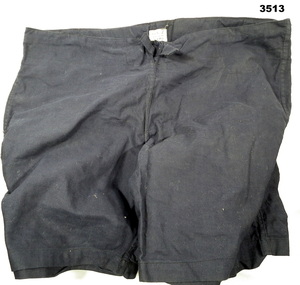
Uniform - SHORTS, 1942
... Uniforms military RAAF Waist band label: Size No 2 Waist 32 ins Dee & Co ↑ 1942 Navy cotton drill shorts with navy drawstring. ...Item re Frederick Gardner DAVEY DFC No 410533 RAAF. Refer Reg No 3536P for his service details.Navy cotton drill shorts with navy drawstring. White label with size details sewn on back waist band.Waist band label: Size No 2 Waist 32 ins Dee & Co ↑ 1942uniforms, military, raaf -
 Bendigo Military Museum
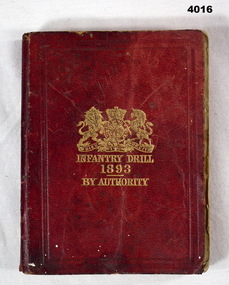
Book - BOOK, INFANTRY, HER MAJESTY"S STATIONARY OFFICE, INFANTRY DRILL 1893 BY AUTHORITY, C.1893
... INFANTRY DRILL 1893 BY AUTHORITY Book BOOK, INFANTRY MILITARY BOOKS HER MAJESTY"S STATIONARY OFFICE ...INFANTRY DRILL 1893 BY AUTHORITY - Infantry Drill Training - BritishCover - hard cover, cardboard, leather - dark red with gold print on front and spine, with gold military coat of arms above print on front. Front embossed to frame print. Pages - 269 pages, cut, stippled edges, coloured light red, off white. Block print including front and back end papers. Illustrated - black and white diagrams and illustrations. Grey lead pencil annotations throughout the book. Contents Page. greylead pencil - " ......./D Coy/69th Battalion" Throughout the book - grey lead pencil - "X"book, infantry, drill, british -
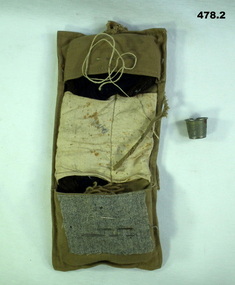 Bendigo Military Museum
Equipment - SEWING KIT, WWII
... used by military personnel to repair uniforms - WWII, commonly called “House wife” handcraft - sewing military - equipment .1) Sewing kit with needles , thread etc. made from khaki cotton drill with ties .2) thimble - Metal cylindrical with no end Equipment SEWING KIT ...used by military personnel to repair uniforms - WWII, commonly called “House wife”.1) Sewing kit with needles , thread etc. made from khaki cotton drill with ties .2) thimble - Metal cylindrical with no endhandcraft - sewing, military - equipment -
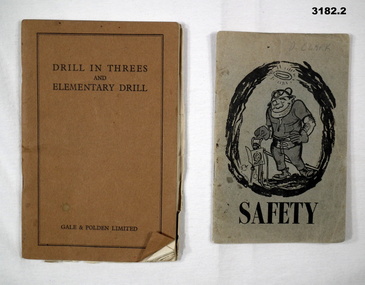 Bendigo Military Museum
Manual - DRILL IN THREES AND MINING SAFETY, 1) Gale & Polden Ltd
... books-military/manuals...Drill...books-military/manuals Drill safety .2) Top right front cover written in pencil: “D CLARK” .1) Titled: Drill in Threes & Elementary Drill. ....1) Titled: Drill in Threes & Elementary Drill. Booklet, fawn cardboard cover, black printing, 40 white pages. .2) Titled: Mining Safety. Booklet, grey cardboard cover, black printing, illustrated, 24 white pages. .2) Top right front cover written in pencil: “D CLARK”books-military/manuals, drill, safety -
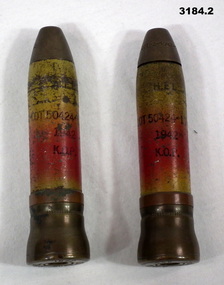 Bendigo Military Museum
Memorabilia - TRENCH ART, SALT & PEPPER SHAKERS, 1942
... military history-souvenirs Trench art .1) Salt: “ Nose cap: Lot 2-50424-214-42”, Shell: “Lot 50424-178 1942 KOP M” , Base: “20MM-M21 1942 GMS” .2) Pepper: Nose cap: “Lot 2-50424-214-42”, Casing: “Lot 50424-178 1942 KOP”, Base: “20MM-M21 1942 GMS” .1) & .2) A pair of steel 20 mm cannon shells made into pepper & salt shakers. Brass nose caps have been drilled ....1) & .2) A pair of steel 20 mm cannon shells made into pepper & salt shakers. Brass nose caps have been drilled out, one has 1 hole & the other 3. The sides are painted red & yellow. A brass shell case is crimped down onto the cannon shell. The copper driving band is unused..1) Salt: “ Nose cap: Lot 2-50424-214-42”, Shell: “Lot 50424-178 1942 KOP M” , Base: “20MM-M21 1942 GMS” .2) Pepper: Nose cap: “Lot 2-50424-214-42”, Casing: “Lot 50424-178 1942 KOP”, Base: “20MM-M21 1942 GMS”military history-souvenirs, trench art -
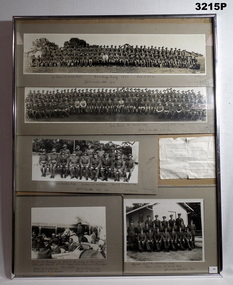 Bendigo Military Museum
Photograph - PHOTOGRAPHS 1930'S, FRAMED, c.1934 - 38
... Black & white group photos of parts of 38th Battalion 1937 & 1938 - Officers of 38th Battalion & 1934 visit to Bendigo of HRH The Duke of Gloucester & military dance invitation to be held at Drill Hall Bendigo Saturday 27.11.1937 at 8 pm. ...Passchendaele Barracks Trust photographs framed 38th Front RHS, bottom corner & LHS back sticker bearing: "No 20" On back in biro trust sticker bearing: "No 13" Black & white group photos of parts of 38th Battalion 1937 & 1938 - Officers of 38th Battalion & 1934 visit to Bendigo of HRH The Duke of Gloucester & military dance invitation to be held at Drill Hall Bendigo Saturday 27.11.1937 at 8 pm. ...Black & white group photos of parts of 38th Battalion 1937 & 1938 - Officers of 38th Battalion & 1934 visit to Bendigo of HRH The Duke of Gloucester & military dance invitation to be held at Drill Hall Bendigo Saturday 27.11.1937 at 8 pm. Photographs framed with silver metal frame on cardboard backing with glass front & wire hanging strap at back.Front RHS, bottom corner & LHS back sticker bearing: "No 20" On back in biro trust sticker bearing: "No 13"passchendaele barracks trust, photographs, framed, 38th -
 Bendigo Military Museum
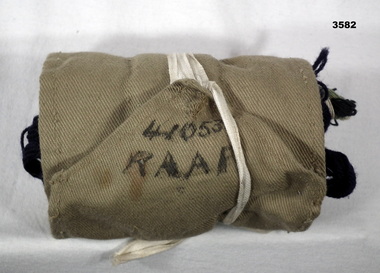
Equipment - SEWING KIT, c.WWII
... Sewing kit military accessory Handwritten in black ink on outside near ties: 410533 RAAF. RAAF issue mending kit. Rectangular, khaki, cotton drill material which can be rolled & secured with 2 white cotton ties. ...Item re Frederick Gardner DAVEY DFC No 410533 RAAF. Refer Reg No 3536P for his service details.RAAF issue mending kit. Rectangular, khaki, cotton drill material which can be rolled & secured with 2 white cotton ties. Inside the roll is a long white pouch divided into 3 sections. At the opposite end to the ties is a khaki pouch with a piece of grey flannel attached. Contents include 2 needles, 1 thimble, 3 silver metal buttons, 2 brown bakelite buttons, 2 hanks of navy wool, 1 hank of khaki wool, 1 hank of black, cream & green thread.Handwritten in black ink on outside near ties: 410533 RAAF.sewing, kit, military, accessory -
 Bendigo Military Museum
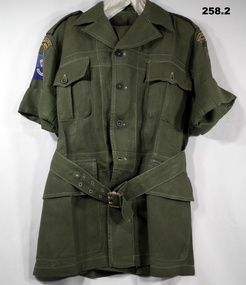
Uniform - TROPICAL UNIFORM, 1954
... Uniforms Tropical Unit Arm Patches, “Royal Australian Electrical and mechanical Engineers” Left sleeve, “Australian Military Forces” Right sleeve, “Commonwealth” .1) Tropical green jacket, cotton drill with shoulder rank epaulettes with “Major” insignia, Unit arm patches on both upper arms, left sleeve has embroidered Rising Sun with lettering under, right sleeve has a blue patch with red crown and lettering, a waist let and metal buckle. .2) Tropical green shorts, cotton drill Uniform TROPICAL UNIFORM ...Uniform issued to “Maj Andrew John BALSILLIE MBE”. Refer Cat No 118.5 for his service details and RSL, Council history..1) Tropical green jacket, cotton drill with shoulder rank epaulettes with “Major” insignia, Unit arm patches on both upper arms, left sleeve has embroidered Rising Sun with lettering under, right sleeve has a blue patch with red crown and lettering, a waist let and metal buckle. .2) Tropical green shorts, cotton drillUnit Arm Patches, “Royal Australian Electrical and mechanical Engineers” Left sleeve, “Australian Military Forces” Right sleeve, “Commonwealth”uniforms, tropical -
 Bendigo Military Museum
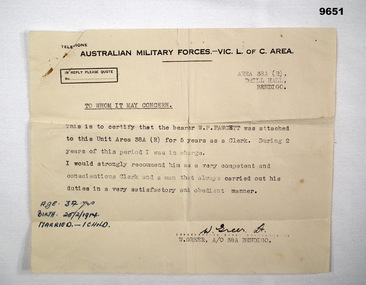
Letter - EMPLOYMENT REFERENCE, Australian Military forces, c.1948
... Top stamped "AUSTRALIAN MILITARY FORCES - VIC L OF C AREA" "AREA 38a, Drill Hall, Bendigo" Signed by W. ...CMF References fawcett 1 Top stamped "AUSTRALIAN MILITARY FORCES - VIC L OF C AREA" "AREA 38a, Drill Hall, Bendigo" Signed by W. ...Reference supplied by Commanding Officer of "William Fawcett". Part of William Fawcett V246452 collection refer Cat No 9627. Small A3 letter giving an employment reference for W.P. Fawcett who worked as a clerk for 5 years for unit area 38ATop stamped "AUSTRALIAN MILITARY FORCES - VIC L OF C AREA" "AREA 38a, Drill Hall, Bendigo" Signed by W. Green (LT) Written in pen on side "Age 34 yrs, Birth 25/2/1914" "Married - 1 child".cmf, references, fawcett 1 -
 Bendigo Military Museum
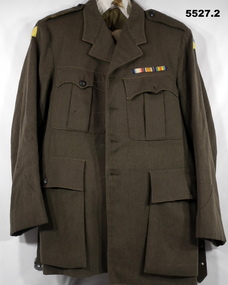
Uniform - SERVICE DRESS, ARMY, 2) Pytchley
... military issue. Unit colour patch on each shoulder (8th ALH). Above the left breast pocket is a World War One trio of medal ribbons. An attached fabric belt has a metal buckle. .2) Light brown cotton drill jodhpurs with button fly. ...military issue. Unit colour patch on each shoulder (8th ALH). Above the left breast pocket is a World War One trio of medal ribbons. An attached fabric belt has a metal buckle. .2) Light brown cotton drill jodhpurs with button fly. ...Part of the Leo Reoch Cohn Collection. Leo Reoch Cohn served in both World War 0ne and World War Two. He enlisted in the 1st AIF on 6.5.1915, initially in the 22nd battalion (No. 1039), aged 18. Shortly after, on 11.9.1915, he transferred to the 8th LHR and embarked for Egypt on 23.9.1915, serving in both Egypt and Palestine. During that period of service, he transferred to the 1st Australian Light Car Patrol on 8.9.1917. This unit later became the 1st Australian Armoured Car Section. Leo began his return journey to Australia on 16.5.1919. Shortly after his RTA, he was discharged. While on active service overseas, he was hospitalized on a number of occasions due to illness. During World War Two, Leo enlisted in the 21st Battalion VDC (No. V360272) on 18.5.1942 at the age of 44. He was appointed Lieutenant on 25.6.1942. Leo's VDC service was terminated on 31.10. 1945 following the end of World War Two. .1) Tailored khaki woollen officer's dress jacket with silk like fabric lining. Two button-down breast pockets and two button down-side pockets. All buttons are military issue. Unit colour patch on each shoulder (8th ALH). Above the left breast pocket is a World War One trio of medal ribbons. An attached fabric belt has a metal buckle. .2) Light brown cotton drill jodhpurs with button fly. Knee reinforcement pad sewn on the inside of each leg. Button down hip pocket and two side pockets. Belt loops and buttons for braces on the waist band..2) On manufacturer's label: 'Pytchley, MADE IN ENGLAND'. Handwritten in black ink on waistband: 'COHN'.uniform, 8th light horse regiment, leo reoch cohn -
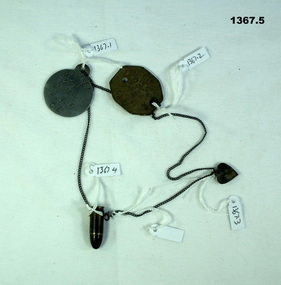 Bendigo Military Museum
Accessory - IDENTITY DISCS & CHAINSET, C.WW1
... Refer 1377 re his brothers service. military equipment - identity costume accessories - jewellery Jones .1) “Jones E.J 3511, 46BTN , AIF, C.E” .2) “3511 E.J Jones 46 Batt, C.E” .4) “ - 17, DWN” .1) Identity disc, aluminium, round re E.J Jones. .2) Identity disc Cardboard material, 8 sided re E.J Jones .3) Pendant, heart shape, metal, attached to 1367.5 (chain) .4) Round brass complete 9mm? has hole drilled ...Edwin James Jones No 3511 AIF enlisted on 15.11.1916 in 9th reinforcements 46th Batt age 18 years 5 months. Embarked for England 11.5.1917, embark for France 2.11.1917, hospital 6.6.1918, records appear to have Influenza and PUO, return to unit 2.8.1918, WIA 25.8.1918 Gassed, mustard severe, returns to Australia classed Gas poisoning, discharged from the AIF 10.3.1919. Refer 1377 re his brothers service..1) Identity disc, aluminium, round re E.J Jones. .2) Identity disc Cardboard material, 8 sided re E.J Jones .3) Pendant, heart shape, metal, attached to 1367.5 (chain) .4) Round brass complete 9mm? has hole drilled through for attachment to 1367.5 (chain) .5) Chain , metal, very small attached to all above .1) “Jones E.J 3511, 46BTN , AIF, C.E” .2) “3511 E.J Jones 46 Batt, C.E” .4) “ - 17, DWN”military equipment - identity, costume accessories - jewellery, jones
