
Showing 77 items matching "military weapons - australia"
-
 Monbulk RSL Sub Branch
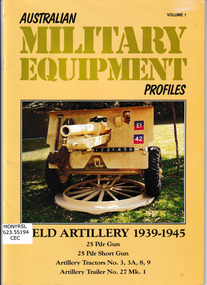
Book, Michael K Cecil, Australian Military Equipment Profiles: Field Artillery 1939-1945. 25 Pdr Gun, 25 Pdr Short Gun, Artillery Tractors No.3, 3A, 8,9, Artillery Trailer No. 27 Mk.1, 1992
... Military weapons - Australia...Monbulk RSL Sub Branch 48 Main Road Monbulk yarra-valley-and-the-dandenong-ranges Military weapons - Australia Weapons - Australia Illustrative and textual description of Australian field artillery 1939-1945 Ill, p.40 Australian Military Equipment Profiles: Field Artillery 1939-1945. 25 Pdr Gun, 25 Pdr Short Gun, Artillery Tractors No.3, 3A, 8,9, Artillery Trailer No. 27 Mk.1 Book Michael K Cecil Michael K Cecil ...Illustrative and textual description of Australian field artillery 1939-1945Ill, p.40non-fictionIllustrative and textual description of Australian field artillery 1939-1945military weapons - australia, weapons - australia -
 Monbulk RSL Sub Branch
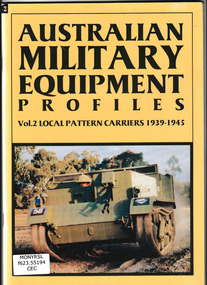
Book, Michael K Cecil, Australian Military Equipment Profiles: Local pattern carriers 1939-1945, 1992
... Military weapons - Australia...Monbulk RSL Sub Branch 48 Main Road Monbulk yarra-valley-and-the-dandenong-ranges Military weapons - Australia Machine gun carriers - Australia Illustrative and textual description of Australian local pattern carriers 1939-1945 Ill, p.48 Australian Military Equipment Profiles: Local pattern carriers 1939-1945 Book Michael K Cecil Michael K Cecil ...Illustrative and textual description of Australian local pattern carriers 1939-1945Ill, p.48non-fictionIllustrative and textual description of Australian local pattern carriers 1939-1945military weapons - australia, machine gun carriers - australia -
 Monbulk RSL Sub Branch
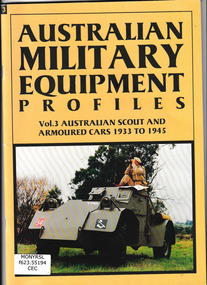
Book, Michael K Cecil, Australian Military Equipment Profiles: Australian scout and armoured cars 1933-1945, 1993
... Military weapons - Australia...Monbulk RSL Sub Branch 48 Main Road Monbulk yarra-valley-and-the-dandenong-ranges Military weapons - Australia Scout and armoured cars - Australia Illustrative and textual description of Australian scout and armoured cars 1933-1945 Ill, p.52 Australian Military Equipment Profiles: Australian scout and armoured cars 1933-1945 Book Michael K Cecil Michael K Cecil ...Illustrative and textual description of Australian scout and armoured cars 1933-1945Ill, p.52non-fictionIllustrative and textual description of Australian scout and armoured cars 1933-1945military weapons - australia, scout and armoured cars - australia -
 Monbulk RSL Sub Branch
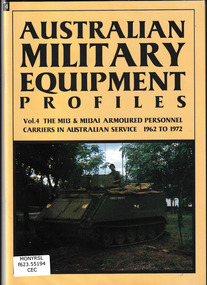
Book, Michael K Cecil, Australian Military Equipment Profiles: The M113 and M113 A1 armoured personnel carriers in Australian service 1962-1972, 1994
... Military weapons - Australia...Monbulk RSL Sub Branch 48 Main Road Monbulk yarra-valley-and-the-dandenong-ranges Military weapons - Australia Armoured personnel carriers - Australia Illustrative and textual description of Australian M113 and M113 A1 armoured personnel carriers in Australian service 1962-1972 Ill, p.56. ...Illustrative and textual description of Australian M113 and M113 A1 armoured personnel carriers in Australian service 1962-1972Ill, p.56.non-fictionIllustrative and textual description of Australian M113 and M113 A1 armoured personnel carriers in Australian service 1962-1972military weapons - australia, armoured personnel carriers - australia -
 National Vietnam Veterans Museum (NVVM)
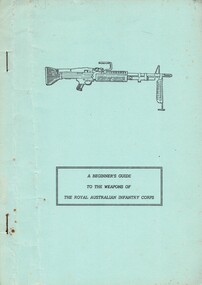
Booklet, A Beginner's Guide to the Weapons of the Royal Australian Infantry Corps
... Military weapons...Australia...National Vietnam Veterans Museum (NVVM) 25 Veterans Drive Newhaven phillip-island-and-the-bass-coast Military weapons Australia - Armed Forces - Service manuals A blue coloured cardboard cover with black information on the front. ...A blue coloured cardboard cover with black information on the front. There is a sketch of a weapon and the title of the booklet is in a box edged with black. There are two rusty metal staples down the left hand side.military weapons, australia - armed forces - service manuals -
 Bendigo Military Museum
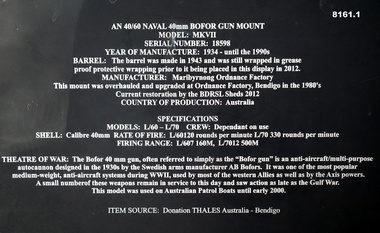
Weapon - NAVAL GUN MOUNT, 40MM, Maribyrnong Ordnance Factory Australia, C.1934 - 1990’s
... Military Museum 37 - 39 Pall Mall Bendigo goldfields This item is on display in the gardens of the Bendigo District RSL Sub Branch Havilah Road. Refer photo .1) for details re manufacture, history and use. brsl smirsl bdrslinc bofor 40 mm naval .1) Plaque metal black on a stand with white text re details of the item. .2) Naval AN 40/60 Bofor Gun Mount Model MKV11 painted blueish colour, barrel black, sits on its traversing base. Weapon NAVAL GUN MOUNT, 40MM Maribyrnong Ordnance Factory Australia ...This item is on display in the gardens of the Bendigo District RSL Sub Branch Havilah Road. Refer photo .1) for details re manufacture, history and use..1) Plaque metal black on a stand with white text re details of the item. .2) Naval AN 40/60 Bofor Gun Mount Model MKV11 painted blueish colour, barrel black, sits on its traversing base.brsl, smirsl, bdrslinc, bofor, 40 mm, naval -
 Bendigo Military Museum
Photograph - The ANZACS TV Series - Army Survey Regiment’s Extras, Phillip Island, Victoria, 1985
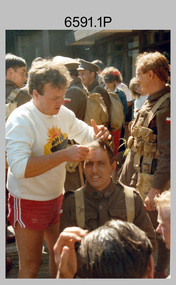
... Military Museum 37 - 39 Pall Mall Bendigo goldfields This is a set of six photographs of Army Survey Regiment personnel who volunteered as extras in the ANZACS TV Series filmed in 1985. Many of the extras playing the roles of Australian soldiers were serving members of the Army Survey Regiment, Bendigo and the Armoured Regiment, Puckapunyal. This was done to keep costs down so that actors did not have to learn how to act as soldiers or to have to teach them how to use the weapons ...This is a set of six photographs of Army Survey Regiment personnel who volunteered as extras in the ANZACS TV Series filmed in 1985. Many of the extras playing the roles of Australian soldiers were serving members of the Army Survey Regiment, Bendigo and the Armoured Regiment, Puckapunyal. This was done to keep costs down so that actors did not have to learn how to act as soldiers or to have to teach them how to use the weapons. Army Svy Regt’s 28 personnel left Bendigo in the early hours of the morning arriving at Phillip Island’s Cowes Motor Inn. Wardrobe staff make-up artists dressed the soldiers from both units in authentic WW1 uniforms in readiness for filming at Woolamai Surf Beach, on the other side of Phillip Island. Filming for the day involved a battle scene simulation of the beach landings at Gallipoli, Turkey. A long day of filming ensued, with 8 arduous re-takes of charges from the beach to the steep cliffs, and the scrubland beyond the cliffs before the producers were satisfied with the footage. The producers provided ample refreshments back at Cowes Motor Inn at the end of the day, before Army Svy Regt’s 28 personnel departed on the 4-hr trip back to Bendigo. This is a set of six photographs of Army Survey Regiment personnel who volunteered as extras in the ANZACS TV Series filmed at Phillip Island, Victoria in 1985. The colour photographs. were printed on photographic paper and are part of the Army Survey Regiment’s Collection. The photographs were scanned at 300 dpi. A newspaper article published by the Bendigo Advertiser on the 29th of October 1985 is stored with the photos. .1) - Photo, colour, 1985. A hairdresser attends to Garry Hudson’s hair at the Cowes Motor Inn. Glen Weatherall is on far right. .2) - Photo, colour, 1985. Production staff preparing a scene at the cliff base at Woolamai Surf Beach. .3) - Photo, colour, 1985. A make-up artist applies simulated wounds to an unidentified soldier. .4) - Photo, colour, 1985. Production staff preparing a beach landing scene. .5) - Photo, colour, 1985. Extras from the Army Svy Regt and 1st Armd Regt gather at Woolamai Surf Beach. L to R in foreground: Gary Tremain, Graham Hales, unidentified, Dave Lawler, unidentified. .6) - Photo, colour, 1985. The 28 extras from the Army Svy Regt at Woolamai Surf Beach. Standing L to R: Terry McIntyre, unidentified, Ian Fitzgerald, unidentified, John Reid, unidentified, Gary Tremain, unidentified (x2), Chad Hardwick, unidentified, Dave Lawler, Barry Hogan, Terry Danger, Peter Imeson, Garry Hudson. Kneeling L to R: unidentified, Peter Ball, Harald Mai, Paul Baker, Alan Staley, Ian McKenzie, Brad Peppler. Sitting: Rod Skidmore. ‘Filming of “ANZACS” 1985’ annotated on cover sleeve.royal australian survey corps, rasvy, army survey regiment, army svy regt, fortuna -
 Bendigo Military Museum
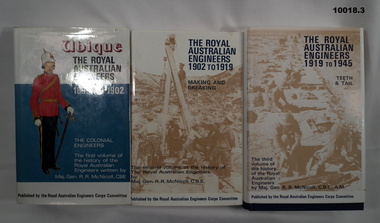
Book - MILITARY HISTORY, ENGINEERS, Ronald McNicoll, "THE ROYAL AUSTRALIAN ENGINEERS" [1] 1835 TO 1902. [2] 1902 TO 1919. [3] 1919 TO 1945.", [1] 1977, [2] 1979, [3] 1982
... Military History Royal Australian Engineers Three volumes, hard covers books with dust covers. 1.2.& 3. Hardcover - cardboard, dark blue colour buckram with gold print on spine. Dust covers - paper, black, white, dark blue print on front and spine. Illustrated. 1. Blue and white colour background with soldier in red and navy colour uniform standing with sword in right hand. 2. Cream and sepia colour background with sepia photograph of Watson's Pier, ANZAC Cove June 1915. 3. Cream and sepia colour background, with sepia photograph of sappers disarming weapons ...Three volumes, hard covers books with dust covers. 1.2.& 3. Hardcover - cardboard, dark blue colour buckram with gold print on spine. Dust covers - paper, black, white, dark blue print on front and spine. Illustrated. 1. Blue and white colour background with soldier in red and navy colour uniform standing with sword in right hand. 2. Cream and sepia colour background with sepia photograph of Watson's Pier, ANZAC Cove June 1915. 3. Cream and sepia colour background, with sepia photograph of sappers disarming weapons. 203, 232, 432 pages - cut, plain off white colour paper. Illustrated - black and white photographs and maps. Endpapers - illustrated 1. Drawing in blue colour. 2. & 3. Maps - black and white colour. publications, books, military history, royal australian engineers -
 Bendigo Military Museum
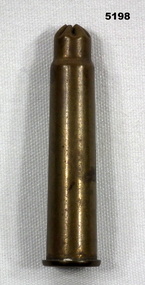
Weapon - CARTRIDGE, BLANK, Australian Army
... Bendigo Military Museum 37 - 39 Pall Mall Bendigo goldfields .303 Blank Cartridge Stamped on the base - MF AQ AI. This is a brass cartridge. It is rimmed, the other end has been crimped over. There is no projectile. Weapon CARTRIDGE, BLANK Australian ...This is a brass cartridge. It is rimmed, the other end has been crimped over. There is no projectile.Stamped on the base - MF AQ AI..303, blank cartridge -
 Bendigo Military Museum
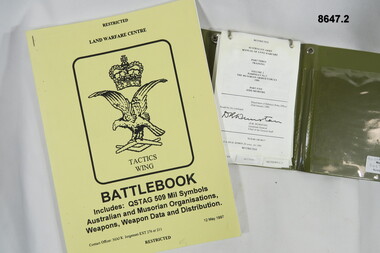
Manual - LAND WARFARE CENTRE, Department of Defence (Army Office), 1997-1980
... Bendigo Military Museum 37 - 39 Pall Mall Bendigo goldfields Passchendaele Barracks Trust Manual Land Warfare PBT 72 58 1. Land Warfare tactics wing battlebook which includes QSTAG Mil Symbols, Australian and Musorian Organisations, Weapons, Weapon Data and Distribution. 2. ...1. Land Warfare tactics wing battlebook which includes QSTAG Mil Symbols, Australian and Musorian Organisations, Weapons, Weapon Data and Distribution. 2. Part Three Training - The Musorian Armed Forces. Part Three, Volume 2, Pamphlet No. 2 1980. Part Five AIDE MEMOIRE.passchendaele barracks trust, manual, land warfare, pbt 72 58 -
 Bendigo Military Museum
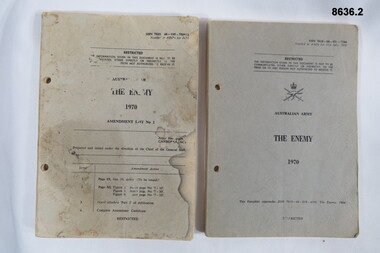
Manual - THE ENEMY, Australian Army, 1970
... Medium size grey Manual providing information about typical Asian Communist Military Forces detailing their organisations characteristics, weapons and tactics. 2. Amendment list No. 1 The Enemy, updating the information to the manual described in 1. Manual THE ENEMY Australian ...1. Medium size grey Manual providing information about typical Asian Communist Military Forces detailing their organisations characteristics, weapons and tactics. 2. Amendment list No. 1 The Enemy, updating the information to the manual described in 1.passchendaele barracks trust, manuals, booklets, -
 Bendigo Military Museum
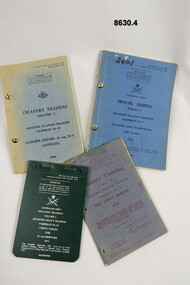
Manual - INFANTRY TRAINING, Australian Armed Forces, 1949, 1966, 1970, 1971
... Military Museum 37 - 39 Pall Mall Bendigo goldfields Passchendaele Barracks Trust PBT 31 36 79 89 Manuals Grenades Mortars Pyrotechnic 2. Black Ink marking, 2401. 3. 1 RVR 86. The aims of these manuals are to teach the recognition, preparation and use of Grenades, Launchers, the 2-inch mortar, Pyrotechnics and Firing Tables. 1. Heavy weapons - Firing Table for 81 mm Mortars 1971. 2. Infantry Training with Grenades and Pyrotechnics. 3. Infantry Training with the Grenade Launcher 40 mm, M79 1966. 4. Infantry Training with the 2 inch Mortar 1949. Manual INFANTRY TRAINING Australian ...The aims of these manuals are to teach the recognition, preparation and use of Grenades, Launchers, the 2-inch mortar, Pyrotechnics and Firing Tables. 1. Heavy weapons - Firing Table for 81 mm Mortars 1971. 2. Infantry Training with Grenades and Pyrotechnics. 3. Infantry Training with the Grenade Launcher 40 mm, M79 1966. 4. Infantry Training with the 2 inch Mortar 1949.2. Black Ink marking, 2401. 3. 1 RVR 86.passchendaele barracks trust, pbt 31 36 79 89, manuals, grenades, mortars, pyrotechnic -
 Bendigo Military Museum
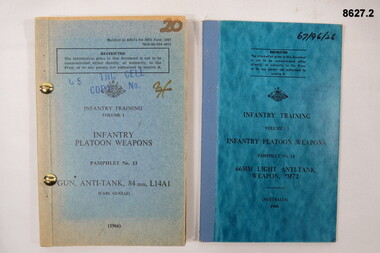
Manual - INFANTRY TRAINING, Australian Military Forces, 1966
... Military Museum 37 - 39 Pall Mall Bendigo goldfields Passchendaele Barracks Trust PBT 27 78 Manuals Pamphlets Training 1. Sgt M. JACK 67/96/26. 2. GS TRG CELL COPY NO. 20 3/- 1. The manual is to provide instructors with the necessary information to train soldiers to handle and fire the 66mm Anti-tank Weapon (L.A.W.). 2. The manual is to provide instructors with the necessary information to train soldiers to handle and fire the 84mm Anti-tank Gun (Carl Gustaf). Manual INFANTRY TRAINING Australian ...1. The manual is to provide instructors with the necessary information to train soldiers to handle and fire the 66mm Anti-tank Weapon (L.A.W.). 2. The manual is to provide instructors with the necessary information to train soldiers to handle and fire the 84mm Anti-tank Gun (Carl Gustaf).1. Sgt M. JACK 67/96/26. 2. GS TRG CELL COPY NO. 20 3/-passchendaele barracks trust, pbt 27 78, manuals, pamphlets, training -
 Bendigo Military Museum
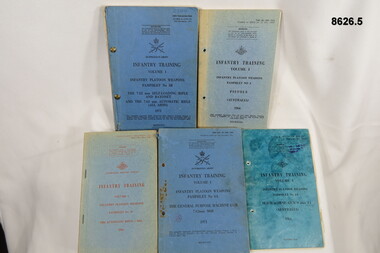
Manual - INFANTRY TRAINING, Australian Military Forces, 1966, 1971
... Military Museum 37 - 39 Pall Mall Bendigo goldfields Passchendaele Barracks Trust PBT 25 26 32 33 83 Manual Training Weapons 2. HQ 4 Task Force 16 George St FITZROY. 1. Provides information on the handling and firing the 9mm self loading and .38 inch revolving Pistols. 2. Provides information on the handling and firing of the Sub-Machine Gun 9mm F1. 3. Provides information and handling of the 262 mm Rifle. 4. provides information and handling of the General purpose Machine Gun 7.62 mm M60. 5. Provides information and handling of the Automatic Rifle M16. Manual INFANTRY TRAINING Australian ...1. Provides information on the handling and firing the 9mm self loading and .38 inch revolving Pistols. 2. Provides information on the handling and firing of the Sub-Machine Gun 9mm F1. 3. Provides information and handling of the 262 mm Rifle. 4. provides information and handling of the General purpose Machine Gun 7.62 mm M60. 5. Provides information and handling of the Automatic Rifle M16.2. HQ 4 Task Force 16 George St FITZROY.passchendaele barracks trust, pbt 25 26 32 33 83, manual, training, weapons -
 Bendigo Military Museum
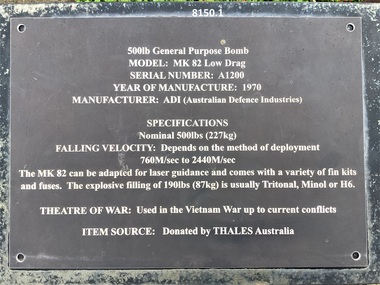
Weapon - BOMB, AERIAL 500 LB, Australian Defence Industries, C.1970
... Military Museum 37 - 39 Pall Mall Bendigo goldfields This item is situated in the Gardens of the Bendigo District RSL Sub Branch Inc Havilah Road. Refer photo .1) for the details re manufacture and history/use. Bdrslinc smirsl brsl 500 Bomb .1) Plaque on metal stand, black with white text re details of a 500 Lb Bomb. .2) Weapon, 500 lb General Purpose Aerial Bomb, cylindrical shape, nose cone tapers to a point, tail tapers to near point with 4 fins attached. Weapon BOMB, AERIAL 500 LB Australian ...This item is situated in the Gardens of the Bendigo District RSL Sub Branch Inc Havilah Road. Refer photo .1) for the details re manufacture and history/use..1) Plaque on metal stand, black with white text re details of a 500 Lb Bomb. .2) Weapon, 500 lb General Purpose Aerial Bomb, cylindrical shape, nose cone tapers to a point, tail tapers to near point with 4 fins attached. bdrslinc, smirsl, brsl, 500, bomb -
 Bendigo Military Museum
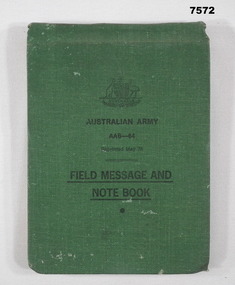
Booklet - FIELD MESSAGE NOTEBOOK, Australian Army, May 1976
... Military Museum 37 - 39 Pall Mall Bendigo goldfields Probably someone's notes to do with SLR's, water transport and trucks. Rifles Trucks Water Transport Army Notebook On one plain page is the date “17 Jul 88 0530 HR” with notes and a male name “Ph. NR”. At the rear are notes on weapon handling. Orders & headlines. Boat Handling - details. Vehicle maintenance & basic fault finding. This is a pocket size, hard cover note book. The cover is green buckram. It shows the Australian ...Probably someone's notes to do with SLR's, water transport and trucks.This is a pocket size, hard cover note book. The cover is green buckram. It shows the Australian Coat of Arms. Army form AAB-64. Inside consists of some blank pages and a large quantity of square lined pages. The squares are 6mm x 6mm. At the back is carbon paper.On one plain page is the date “17 Jul 88 0530 HR” with notes and a male name “Ph. NR”. At the rear are notes on weapon handling. Orders & headlines. Boat Handling - details. Vehicle maintenance & basic fault finding.rifles, trucks, water transport, army, notebook -
 Bendigo Military Museum
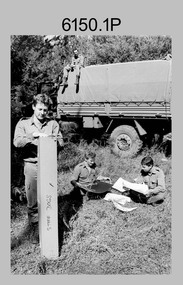
Photograph - Lithographic Squadron Regimental Training, Army Survey Regiment, Bendigo, 1989
... Military Museum 37 - 39 Pall Mall Bendigo goldfields This is a set of 24 photographs of Army Survey Regiment’s Lithographic Squadron personnel undertaking regimental training in an unknown location in April 1989. The purpose of the training was probably to provide personnel a practical knowledge of navigation and map reading, RATEL and Survival in the Field, vehicle camouflage, teamwork and leadership. The training did not include infantry and minor tactics due to the absence of weapons. Although these photos are not annotated other than the month and year, most personnel are positively identified. Royal Australian ...This is a set of 24 photographs of Army Survey Regiment’s Lithographic Squadron personnel undertaking regimental training in an unknown location in April 1989. The purpose of the training was probably to provide personnel a practical knowledge of navigation and map reading, RATEL and Survival in the Field, vehicle camouflage, teamwork and leadership. The training did not include infantry and minor tactics due to the absence of weapons. Although these photos are not annotated other than the month and year, most personnel are positively identified.This is a set of 24 photographs of personnel from Lithographic Squadron, Army Survey Regiment, Fortuna, Bendigo, undergoing regimental training in April 1989. The photographs were on 35mm negative film and scanned at 96 dpi. They are part of the Army Survey Regiment’s Collection. .1) - Photo, black & white, 1989, background L to R: Frank Lenane, Bill Jones, foreground L to R: Gavin McLean, Colin Yeats, Peter Dillon. .2) - Photo, black & white, 1989, Rhys De Laine. .3) - Photo, black & white, 1989, L to R: Peter Breukel, Colin Yeats. .4) - Photo, black & white, 1989, L to R: Colin Yeats., Peter Dillon. .5) - Photo, black & white, 1989, L to R: Graeme Spong, Gavin McLean, unidentified (x2), Peter Breukel, Steve Burke, Bill Jones, Colin Yeats. .6) - Photo, black & white, 1989, L to R: Graeme Spong, Bill Jones, Colin Yeats, Peter Dillon, Peter Breukel, Steve Burke, Colin Yeats. .7) - Photo, black & white, 1989, L to R: Graeme Spong, Bill Jones, Colin Yeats, Peter Dillon, .8) - Photo, black & white, 1989, Colin Yeats. .9) - Photo, black & white, 1989, L to R: Gavin McLean, Colin Yeats. .10) - Photo, black & white, 1989, L to R: Steve Burke, Peter Breukel, Colin Yeats, unidentified. .11) - Photo, black & white, 1989, L to R: Steve Burke, Peter Breukel. .12) - Photo, black & white, 1989, L to R: Peter Breukel, Steve Burke. .13) - Photo, black & white, 1989, Craig Hersant. .14) - Photo, black & white, 1989, L to R: Rob Bogumil, Darren Maher, Paul Baker, Rob Jones, Shona Hastie, unidentified, Chad Hardwick. .15) - Photo, black & white, 1989, L to R: Chad Hardwick, unidentified, Rob Bogumil, Rob Jones, Darren Maher, unidentified, Paul Baker. .16) - Photo, black & white, 1989, L to R: Rob Bogumil, Darren Maher, Chad Hardwick, Rob Jones, unidentified (x2), Paul Baker. .17) to .22) - Photo, black & white, 1989, unidentified personnel applying camouflage to truck. Shona Hastie in truck, .23) - Photo, black & white, 1989, L to R: LT Dave Weston, LT Craig Hersant, Trevor Osborne, Bill Jones. .24) - Photo, black & white, 1989, L to R: Andrew Arman, unidentified, Peter Dillon, Steve Burke, Colin Yeats, Peter Breukel. No personnel are identified. Annotation dated April 1989.royal australian survey corps, rasvy, army survey regiment, army svy regt, fortuna, asr, litho -
 Bendigo Military Museum
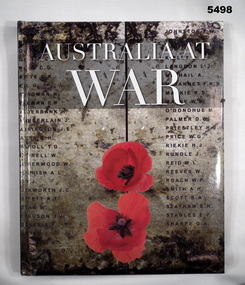
Book, HERRON BOOK DISTRIBUTORS PTY LTD, Australia at War, 2016
... Bendigo Military Museum 37 - 39 Pall Mall Bendigo goldfields ‘AUSTRALIA AT WAR’ The military history of Australia Book War Memorials Military History Hard cover book Hard cover- cardboard, with glossy coloured paper finish, white print on front, spine and back. Front illustration section of a honour roll with two red poppies. Back illustration- close up colour photograph of a hand held military weapon ...‘AUSTRALIA AT WAR’ The military history of Australia Hard cover book Hard cover- cardboard, with glossy coloured paper finish, white print on front, spine and back. Front illustration section of a honour roll with two red poppies. Back illustration- close up colour photograph of a hand held military weapon.book, war memorials, military history -
 Bendigo Military Museum
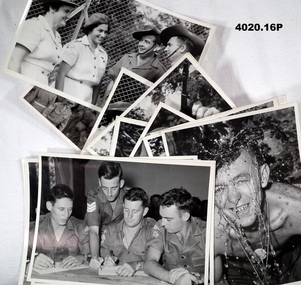
Memorabilia - PHOTOGRAPHS, 1954- 1959 approx
... military korea malaya (.1 - .15) On rear stamped in purple. “Public relations Australian Army Force GHQ FARELF, GUN ....... MC” After GUN on each photo is an individual number. (.16) On rear stamped in purple. “Photo No, please credit to Public relations HQ BCFK” In pencil. “2961” All photos are B & W. (.1 - .4) Three soldiers sitting at a table with one standing looking over. (.5) Soldier throwing water over himself. (.6) Soldier kneeling with an Owen gun aimed. (.7) Soldier cleaning a weapon. (.8) Two soldiers looking out through an aeroplane door. (.9) Soldier, no shirt on aiming a pistol. (.10) Soldier with a dart or rod in his mouth. (.11) Soldier kneeling aiming what appears to be a shotgun ...“FARELF” Far East Land Forces (Malaya) “BCFK” British Commonwealth Force Korea. All photos relate to the collection of Francis William (Dinky) DEAN BEM, VX93960 2nd AIF, 3742 1 RAR 1943 - 1975. Refer Cat No 124.2 for his service history.All photos are B & W. (.1 - .4) Three soldiers sitting at a table with one standing looking over. (.5) Soldier throwing water over himself. (.6) Soldier kneeling with an Owen gun aimed. (.7) Soldier cleaning a weapon. (.8) Two soldiers looking out through an aeroplane door. (.9) Soldier, no shirt on aiming a pistol. (.10) Soldier with a dart or rod in his mouth. (.11) Soldier kneeling aiming what appears to be a shotgun. (.12) Soldier inspecting the bar real of an Owen gun. (.13) Soldier inspecting a pistol. (.14 - .15) Two Nurses talking to two soldiers. (.16) Large group of soldiers on the deck of a ship.(.1 - .15) On rear stamped in purple. “Public relations Australian Army Force GHQ FARELF, GUN ....... MC” After GUN on each photo is an individual number. (.16) On rear stamped in purple. “Photo No, please credit to Public relations HQ BCFK” In pencil. “2961”photography, military, korea, malaya -
 Bendigo Military Museum
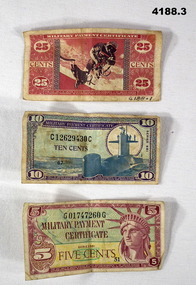
Currency - CERTIFICATES, MILITARY PAYMENT, Vietnam era
... Military Installations, PX’s instead of U.S Dollars. This was to avoid Dollars getting into the black market and used to buy weapons etc. Every few months there would be a shut down and all Payment certificates handed in and new ones issued. They were also used in Australian...Military Installations, PX’s instead of U.S Dollars. This was to avoid Dollars getting into the black market and used to buy weapons etc. Every few months there would be a shut down and all Payment certificates handed in and new ones issued. They were also used in Australian ...These Military payment Certificates were used in U.S Military Installations, PX’s instead of U.S Dollars. This was to avoid Dollars getting into the black market and used to buy weapons etc. Every few months there would be a shut down and all Payment certificates handed in and new ones issued. They were also used in Australian bases in Vietnam. It was not for use in the main stream, if caught changing these certificates for Vietnamese currency you were in serious trouble..1) 25 cent note, Military Payment certificate, red background,for use only by United States Military, features a Submarine on the front and on the back an Astronaut. .2) 10 cent note, Military Payment Certificate, same front and back as .1) except blue back ground. .3) 5 cent note, Military Payment Certificate, red and blue background, features the head of “Statue of Liberty on the front and the back is only 5 cents..1) “SER No C03913187C, series 681”. 2) “ SER No C12629430C”,series 681. .3) “ G01747260G” , series 591”military payment certificate, u.s -
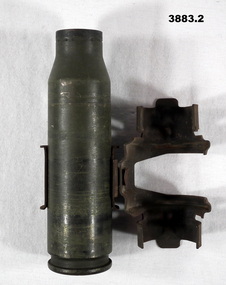 Bendigo Military Museum
Weapon - CARTRIDGE CASE AND LINK
... Bendigo Military Museum 37 - 39 Pall Mall Bendigo goldfields 25mm cartridge case and link section from a M242 25mm Bushmaster Chain Gun mounted on an Australian Light Armoured vehicle (ASLAV). Item souvenired by Mathew Redwood. Refer Cat No 3891 for his service details. cartridge case link belt m 242 On the link belt, “M28 ALK O7F 620 - 009” .1) M 25 cartridge case. .2) Link belt section for .1) Weapon CARTRIDGE CASE AND LINK ...25mm cartridge case and link section from a M242 25mm Bushmaster Chain Gun mounted on an Australian Light Armoured vehicle (ASLAV). Item souvenired by Mathew Redwood. Refer Cat No 3891 for his service details. .1) M 25 cartridge case. .2) Link belt section for .1)On the link belt, “M28 ALK O7F 620 - 009”cartridge case, link belt, m 242 -
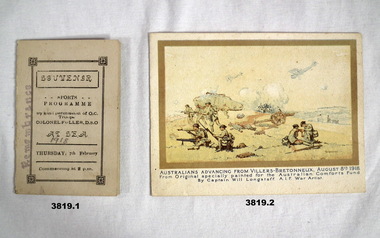 Bendigo Military Museum
Card - CARDS WW1, 1918
... Military Museum 37 - 39 Pall Mall Bendigo goldfields .1) This troop ship was the HMAS A18 Wiltshire which embarked from Sydney on 2.2.1928. This was ascertained by deciphering one of the hand written signatures who was in the 8th Reinforcements 39th Batt AIF. Cards souvenir HMAS Comforts fund .2) “Greetings from Will” .1) Card, folding, Souvenir Sports programme at sea Thursday 7th February 1918 at 2pm. Inside has events & is hand signed by many men. Rear has details of the planning committee. .2) Card folding, from Australian Comforts Fund Xmas & New Year 1918-19. Card shows 2 paintings & 2 images of weapons ....1) This troop ship was the HMAS A18 Wiltshire which embarked from Sydney on 2.2.1928. This was ascertained by deciphering one of the hand written signatures who was in the 8th Reinforcements 39th Batt AIF..1) Card, folding, Souvenir Sports programme at sea Thursday 7th February 1918 at 2pm. Inside has events & is hand signed by many men. Rear has details of the planning committee. .2) Card folding, from Australian Comforts Fund Xmas & New Year 1918-19. Card shows 2 paintings & 2 images of weapons captured by Australians..2) “Greetings from Will”cards, souvenir, hmas, comforts fund -
 Bendigo Military Museum
Weapon - KNIFE, C.1960’s
... Bendigo Military Museum 37 - 39 Pall Mall Bendigo goldfields Item issued to Malcolm Stuart Angus No 3112710, served Vietnam. domestic items-cutlery military equipment-utility knives General purpose knife used by Royal Australian Electrical and Mechanical Engineers. Weapon ...Item issued to Malcolm Stuart Angus No 3112710, served Vietnam.General purpose knife used by Royal Australian Electrical and Mechanical Engineers.domestic items-cutlery, military equipment-utility knives -
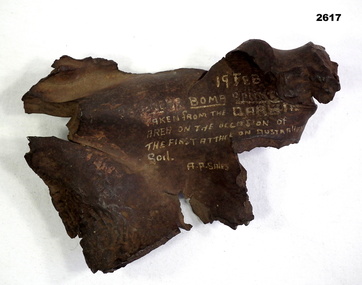 Bendigo Military Museum
Weapon - BOMB SPLINTER, 19.2.1942
... Bendigo Military Museum 37 - 39 Pall Mall Bendigo goldfields arms - ordnance military history - souvenirs Shrapnel Passchendaele Barracks Trust “19 Feb 42 First bomb splinter taken from the Darwin area on the occasion of the first attack on Australian soil’ A P Sales” Brown metal piece with jagged edges from a bomb, ie shrapnel, Weapon BOMB SPLINTER ...Brown metal piece with jagged edges from a bomb, ie shrapnel,“19 Feb 42 First bomb splinter taken from the Darwin area on the occasion of the first attack on Australian soil’ A P Sales”arms - ordnance, military history - souvenirs, shrapnel, passchendaele barracks trust -
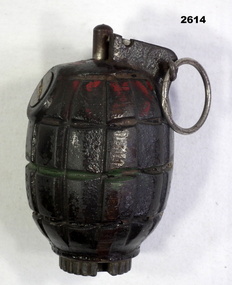 Bendigo Military Museum
Weapon - HAND GRENADE, c.1941
... Bendigo Military Museum 37 - 39 Pall Mall Bendigo goldfields arms - ordnance military history - army metalcraft Grenade weapon Australian WW2 No 36 MK1 Grenade Bottom: “No 36 M MK1 F.L.S. 3.41”. ...Metal hand grenade with pin, some green & red paint over all.Australian WW2 No 36 MK1 Grenade Bottom: “No 36 M MK1 F.L.S. 3.41”. On side: “F.L.H”arms - ordnance, military history - army, metalcraft, grenade, weapon -
 Bendigo Military Museum
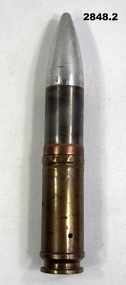
Weapon - PROJECTILE & CASE, C.1954 - 1965
... Australian C.A.C.SABRE fighter jets between 1953 and 1965. The A/P variant shell had a muzzle velocity of 2610 feet/sec. There were two ADEN M/Gs on a C.A.C. SABRE. arms - ammunition military history .1 Projectile, no markings. .2 Shell case. Stamped on the side is RA2/2948 .1) 30mm Projectile. This has an aluminium nose cone. The projectile is probably armour piercing. .2) Brass case. This has a double flanged base. Weapon ...The 30mm cartridge was used in British ADEN aerial machine guns. Introduced in the UK in 1954. The ADEN 30mm guns were used in Australian C.A.C.SABRE fighter jets between 1953 and 1965. The A/P variant shell had a muzzle velocity of 2610 feet/sec. There were two ADEN M/Gs on a C.A.C. SABRE..1) 30mm Projectile. This has an aluminium nose cone. The projectile is probably armour piercing. .2) Brass case. This has a double flanged base..1 Projectile, no markings. .2 Shell case. Stamped on the side is RA2/2948arms - ammunition, military history -
4th/19th Prince of Wales's Light Horse Regiment Unit History Room
Booklet, Harston, Partridge & Co Pty Ltd, Royal Armoured Corps Weapon Training, 1943
... 4th/19th Prince of Wales's Light Horse Regiment Unit History Room 4/19 PWLH Regiment, Building 78 Simpson Barracks Macleod melbourne Armoured Corps Gunnery Range Practices Military Training Pamphlet No 34 Part 6 Royal Armoured Corps Practices (Modified for Australia) 1943 Soft covered lace bound booklet detailing range instructions and various range practices to be used within the Armoured Corps Royal Armoured Corps Weapon Training Booklet Harston, Partridge & Co Pty Ltd ...Soft covered lace bound booklet detailing range instructions and various range practices to be used within the Armoured CorpsMilitary Training Pamphlet No 34 Part 6 Royal Armoured Corps Practices (Modified for Australia) 1943armoured corps, gunnery, range practices -
4th/19th Prince of Wales's Light Horse Regiment Unit History Room
Training Pamphlet, Horticultural Press Pty Ltd, Small Arms Training Vol 1: Weapon Training 1944, 31/8/1944
... 4th/19th Prince of Wales's Light Horse Regiment Unit History Room 4/19 PWLH Regiment, Building 78 Simpson Barracks Macleod melbourne Issued by HQ Australian Military Forces 15 Soft covered 94 page book Small Arms Training Vol 1: Weapon Training 1944 Training Pamphlet Horticultural Press Pty Ltd ...Issued by HQ Australian Military ForcesSoft covered 94 page book15 -
 Bendigo Military Museum
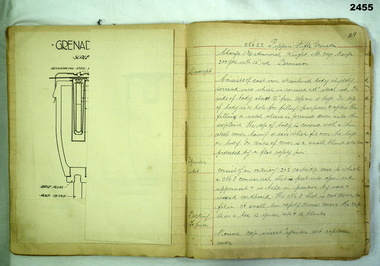
Book - BOMBING SCHOOL NOTES, 27.8.1917
... Australia 4.1.1919 re his wounds, discharged from the AIF medically unfit 30.3.1919. (PUO) Pyrexia of unknown origin. books - military - notes Bombing school “No 2100 Cpl E H JAMES 10th T B LARK HILL” Notes taken at Southern Command Bombing School Lyndhurst 27.8.17. Exercise book, canvas covered, dark blue, blue ruled. Extensively hand written in ink with hand sketches & printed pages of weapons ...ERNEST HENRY JAMES No 2100 enlisted in the AIF in 3rd reinforcements 38th Batt on 8.5.1916 age 25 years 1 month. Promoted Cpl 1.8.1916, embark for England 25.9.1916, detached to 10th Training Batt England 11.12.1916, hospital 5.2.1917 with PUO, rejoin unit 24.5.1917, attended Bombing School 26.8.1917, rejoin unit 8.9.1917, embark for France 2.10.1917 and rejoin 38th Batt, WIA 24.8.1918 GSW to right leg, embark for Australia 4.1.1919 re his wounds, discharged from the AIF medically unfit 30.3.1919. (PUO) Pyrexia of unknown origin.Exercise book, canvas covered, dark blue, blue ruled. Extensively hand written in ink with hand sketches & printed pages of weapons pasted in. The entire book is on notes taken at Bombing School in England in 1917 by E H JAMES, AIF.“No 2100 Cpl E H JAMES 10th T B LARK HILL” Notes taken at Southern Command Bombing School Lyndhurst 27.8.17.books - military - notes, bombing school -
 Bendigo Military Museum
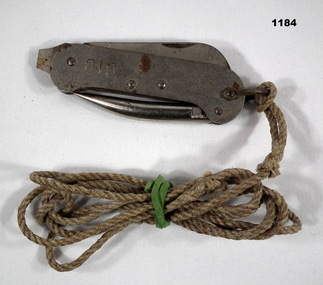
Weapon - KNIFE, CLASP, 1960's
... Refer 638P for his service history. personal effects - pocket knives military history Weapon Clasp knife D^D"- Sterling, Made in Australia Metal Clasp knife with 2 blades and a pointed piece with a rope cord attached. ...Issued to Geoff Murray No 3411521, Vietnam 3 CAV Regt 27.11.67 to 22.10.68, Survey Corp 15.10.69 to 15.10.70. Refer 638P for his service history.Metal Clasp knife with 2 blades and a pointed piece with a rope cord attached.D^D"- Sterling, Made in Australiapersonal effects - pocket knives, military history, weapon, clasp knife
