
Showing 30 items matching "miner petition"
-
 Bendigo Historical Society Inc.
Archive - MINERS' PETITION, 1853
... Miner petition...DVD. Miners' Petition 1853 (Red Ribbon). Print Version....Miner petition red ribbon DVD. Miners' Petition 1853 (Red Ribbon). ...DVD. Miners' Petition 1853 (Red Ribbon). Print Version.miner petition, red ribbon -
 Clunes Museum
Document - EARLY CLUNES DOCUMENTS
... .1 CLUNES TOWN COMMON, 1861, REGULATION FOR THE TOWN COMMON .2 PETITION CLUNES MINERS - 1856 - 7 - PETITION OF MINERS, STOREKEEPERS AND OTHERS RESIDING IN CLUNES .3 BEER BILL, PETITION TO BE ABLE TO SELL ALCOHOL IN CLUNES 1860-1861 .4 PORT PHILIP AND COLONIAL GOLD MINING CAMP - COPY OF CORRESPONDENCE BETWEEN THE SOLICITOR GENERAL AND CLUNES MINING CAMP 1858 .5 LEGISLATIVE ASSEMBLY - EIGHTH REPORT OF THE PRINTING COMMITTEE 17/12/1861 .6 CROWN LAND BILL. ...CLUNES TOWN COMMON MINERSPETITION BEER BILL LEGISLATIVE ASSEMBLY CROWN LAND BILL GOLD FIELDS COMMON JOHN FERRES .1 CLUNES TOWN COMMON, 1861, REGULATION FOR THE TOWN COMMON .2 PETITION CLUNES MINERS - 1856 - 7 - PETITION OF MINERS, STOREKEEPERS AND OTHERS RESIDING IN CLUNES .3 BEER BILL, PETITION TO BE ABLE TO SELL ALCOHOL IN CLUNES 1860-1861 .4 PORT PHILIP AND COLONIAL GOLD MINING CAMP - COPY OF CORRESPONDENCE BETWEEN THE SOLICITOR GENERAL AND CLUNES MINING CAMP 1858 .5 LEGISLATIVE ASSEMBLY - EIGHTH REPORT OF THE PRINTING COMMITTEE 17/12/1861 .6 CROWN LAND BILL. ....1 CLUNES TOWN COMMON, 1861, REGULATION FOR THE TOWN COMMON .2 PETITION CLUNES MINERS - 1856 - 7 - PETITION OF MINERS, STOREKEEPERS AND OTHERS RESIDING IN CLUNES .3 BEER BILL, PETITION TO BE ABLE TO SELL ALCOHOL IN CLUNES 1860-1861 .4 PORT PHILIP AND COLONIAL GOLD MINING CAMP - COPY OF CORRESPONDENCE BETWEEN THE SOLICITOR GENERAL AND CLUNES MINING CAMP 1858 .5 LEGISLATIVE ASSEMBLY - EIGHTH REPORT OF THE PRINTING COMMITTEE 17/12/1861 .6 CROWN LAND BILL. PETITION TO WITHDRAW THE BILL AND REPLACE IT WITH A NEW BILL 1856-7 .7 PROCLAMATION OF GOLD FIELDS COMMON 1860-1861clunes town common, minerspetition, beer bill, legislative assembly, crown land bill, gold fields common, john ferres -
 Bendigo Historical Society Inc.
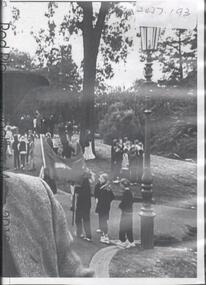
Photograph - RED RIBBON COLLECTION: DVD
... Thousands of miners signed a petition to Governor LaTrobe to no avail. ...Thousands of miners signed a petition to Governor LaTrobe to no avail. ...In 1853, Bendigo Miners protested against the 30 shilling miners licence the had to pay the government. They wore red ribbons to show their protest and shopkeepers hung red ribbons outside their premises in support. Thousands of miners signed a petition to Governor LaTrobe to no avail. A protest gathering in Pall Mall marched to the Government camp on Camp Hill but this was a peaceful event again to no real avail.DVD. Red Ribbon Rebellion - three photos.red ribbon rebellion, bhs -
 Bendigo Historical Society Inc.
Photograph - RED RIBBON COLLECTION: DVD 2010?, 2010
... Thousands of miners signed a petition to Governor LaTrobe to no avail. ...Thousands of miners signed a petition to Governor LaTrobe to no avail. ...In 1853, Bendigo Miners protested against the 30 shilling miners licence the had to pay the government. They wore red ribbons to show their protest and shopkeepers hung red ribbons outside their premises in support. Thousands of miners signed a petition to Governor LaTrobe to no avail. A protest gathering in Pall Mall marched to the Government camp on Camp Hill but this was a peaceful event again to no real avail.DVD. Red Ribbon Rebellion 2010 ? WIN News Stories.red ribbon rebellion, bhs -
 Bendigo Historical Society Inc.
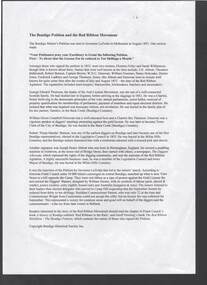
Document - RED RIBBON COLLECTION: DOCUMENT THE BENDIGO PETITION AND THE RED RIBBON MOVEMENT 1853
... Thousands of miners signed a petition to Governor LaTrobe to no avail. ...Thousands of miners signed a petition to Governor LaTrobe to no avail. ...In 1853, Bendigo Miners protested against the 30 shilling miners licence the had to pay the government. They wore red ribbons to show their protest and shopkeepers hung red ribbons outside their premises in support. Thousands of miners signed a petition to Governor LaTrobe to no avail. A protest gathering in Pall Mall marched to the Government camp on Camp Hill but this was a peaceful event again to no real avail.Typed notes on The Bendigo Petition and the Red Ribbon Movement. Amongst the petitioners were two women, Florence Foley and Sarah Williamson. Others include J H Abbott, Theodore Ballerstedt, Robert Benson, Captain Brown, W D C Denovan, William Froomes, Henry Holyoake, Doctor Jones, Frederick Ladbury and George Thomson. Also mentioned is how the petition was resolved. Further reading mentioned is: Frank Cusack's book 'A History of Bendigo entitled 'Red Ribbons in the Rain', and Geoff Hocking's book 'The Red Ribbon Rebellion - The Bendigo Petition, which contains names of those who signed the Petition. Written by the Bendigo Historical Society Inc.event, the bendigo petition and the red ribbon movement 1853, governor la trobe, florence foley, sarah williamson, j h abbott, theodore ballerstedt, robert benson, captain brown, w d c denovan, william froomes, henry holyoake, doctor jones, frederick ladbury, george thomson, george edward thomson, anti-license movement, sanders, william dixon campbell denovan, city of bendigo, back creek (bendigo) cemetery, white hills cemetery, joseph henry abbott, the diggers advocate, frank cusack, gold license fee, diggers' banner, william dexter, commissioner panton, commissioner wright, a history of bendigo, frank cusack, geoff hocking, the red ribbon rebellion - the bendigo petition, bendigo historical society inc -
 Bendigo Historical Society Inc.
Book - BOOK: THE RED RIBBON REBELLION
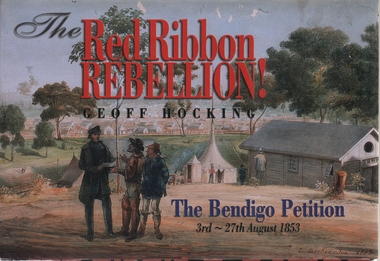
... Thousands of miners signed a petition to Governor LaTrobe to no avail. ...Thousands of miners signed a petition to Governor LaTrobe to no avail. ...In 1853, Bendigo Miners protested against the 30 shilling miners licence the had to pay the government. They wore red ribbons to show their protest and shopkeepers hung red ribbons outside their premises in support. Thousands of miners signed a petition to Governor LaTrobe to no avail. A protest gathering in Pall Mall marched to the Government camp on Camp Hill but this was a peaceful event again to no real avail.The Red Ribbon Rebellion. The bendigo Petition 3rd-27th august 1853. By Geoff Hocking. -
 Bendigo Historical Society Inc.
Document - RED RIBBON COLLECTION: RED RIBBON REBELLION REFERENCE MATERIAL
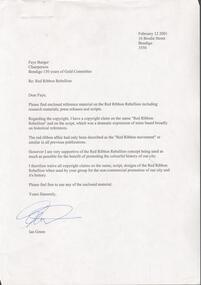
... Thousands of miners signed a petition to Governor LaTrobe to no avail. ...Thousands of miners signed a petition to Governor LaTrobe to no avail. ...In 1853, Bendigo Miners protested against the 30 shilling miners licence the had to pay the government. They wore red ribbons to show their protest and shopkeepers hung red ribbons outside their premises in support. Thousands of miners signed a petition to Governor LaTrobe to no avail. A protest gathering in Pall Mall marched to the Government camp on Camp Hill but this was a peaceful event again to no real avail.Cover letter sent by Ian Green on February 12, 2001 to Faye Burger Chairperson of Bendigo 150 years of Gold Committee. Attached documents including research materials, press releases and scripts relating to the ''Red ribbon Rebellion''bendigo, history, red ribbon rebellion -
Bendigo Historical Society Inc.
Document - SPECIMEN COTTAGE COLLECTION: VARIOUS DOCUMENTS
... Thousands of miners signed a petition to Governor LaTrobe to no avail. ...Thousands of miners signed a petition to Governor LaTrobe to no avail. ...In 1853, Bendigo Miners protested against the 30 shilling miners licence the had to pay the government. They wore red ribbons to show their protest and shopkeepers hung red ribbons outside their premises in support. Thousands of miners signed a petition to Governor LaTrobe to no avail. A protest gathering in Pall Mall marched to the Government camp on Camp Hill but this was a peaceful event again to no real avail.Various documents. The topics are: 4029.1 Public donations and organised charities in Bendigo (1850's to 1900's by Carol Holsworth. 4029.2 The spirit of Bendigo R711 and the loco driver on the return trip from Bendigo by Rod Giri, also several photographs of the train. 4029.3 Diary of a new chum - Johnny Greenfield Gill. 4029.4 Family history by Pat Hocking. 4029.5 The story of the Gaylards as told by Ella Gaylard. 4029.6 Journalism- History first draft by Wayne Gregson. 4029.7 List of residents of Thistle Street, Bendigo approx. 1950's compiled by Cynthia Stringer. 4029.8 Sandhurst club history by David Cotton. 4029.9 Sandhurst boys centre compiled by Brian Dillon. 4029.10 Lily Street Walk 24/04/2018 notes by Jim Evans. 4029.11 Document - All things Bendigo, wine food and music fest. 4029.12 White Hills Sandhurst copies of maps and two pages of district directory1908. 4029.13 Draft report of interview with Noel Smith of 5 Summit Drive, Kennington. 4029.14 Three brothers from Scotland by Rae Alexander Anderson. Also, seven newspaper articles by James Lerk on William, Alexander Rae and John Rae. 4029.15 St. John Presbyterian church, Bendigo. Historical record. 4029.16 Journal of Thomas Llewellyn Raston. 4029.17 Recollections of Sandhurst in the 1850's - Joseph Anderson Panton, 22 segments from Panton manuscript by Terry Davidson. Also, a photographs of a portrait of Joseph Panton. 4029.18 Photocopy of letter of Chinese storekeepers, miners and residents to Joseph Anderson Panton esquire, resident warden of Bendigo dated August 28th, 1858, with transcription and the reply from Esquire Panton dated 29 August, 1858. 4029.19 View street reborn, tours of inspection ''welcome to View Street'' view Street properties part of stage 1 of the project: National Trust Chambers, Temperance Hall, Art Gallery Annexe, Trades Hall, Bendigo Regional Arts Centre, Bendigo Regional Performing Arts Centre, Dudley House. 4029.20 View Street early 1900's in between and now. From handwritten notes by Mr. Bob Carr written in 1989. The handwriting has been transcribed by Beverly Ellis. 4029.21 Transcription of ''Diary of a voyage to the colony of Victoria and back'' June1856-September 1858 by Charles Groves. 4029.22 Adelaide Vale historic homestead built by Cr. John Harney. Tour notes prepared by the Central Victorian Branch of the National Trust. 4029.23 Four pages essay titled Spanish Tomato Growers. 2440.29. Eight pages of notes compiled by Leonard Henderson title: Trade token issuers of Bendigo district. The issuers mentioned are: Grieve, Hodgson, Stead and Williams. 4029.25 City of Bendigo tourist promotion Committee. Eight pages document describing the formation of committee for the promotion of tourism in the City of Bendigo. 4029.26 Article ''The Birdman of Bendigo'' Bendigo Advertiser 17th January 1968 detailing the life of Mr. Redvers James Eddy. 4029.27 Speech presented by Miss Margaret Brennan on the occasion of the Drechsler family reunion, Sunday 5th April 1987. 4029.28 Robert Gray Ford - A man before his time! Talk by James Lerk to the Bendigo Historical Society 3 February 2006. 4029.29 Copy of an article from The Bendigonian Annual from November 16, 1910. The demand for good music, how a Bendigo firm has met it. The article is about the life of Oscar Flight. 4029.30 Five photocopies of the Bendigonian masthead showing the changes through the years, plus the notice of the final issue on April 8th, 1920. 4029.31 The red ribbon rebellion & the Bendigo petition, a proposal to commemorate a significant event in Bendigo. Also three different sizes poster for the August 26, 2016 re-enactment and two invitations to join the red ribbon agitation memorial. 4029.32 Two handwritten pages of notes on the red ribbon rebellion. 4029.33 Three pages of typewritten notes on the Creeth and Howie families. 4029.34 An Australian Edward Medallist - Joseph Davies honoured by Paul Street. 4029.35 A. H. Chisholm obituary. 4029.36 Catalogue auction sale of the entire collection of antique furniture, objects d'art etc of Mr. and Mrs S. Cragg. 4029.37 Two coloured photographs of Cherry Tree Hotel in Melbourne Road just north of Tuckerman's lane, Big Hill. Photos taken March 2000 by Joan Paynter. bendigo, red ribbon rebellion -
 Bendigo Historical Society Inc.
Newspaper - RED RIBBON COLLECTION: VARIOUS NEWSPAPER ARTICLES
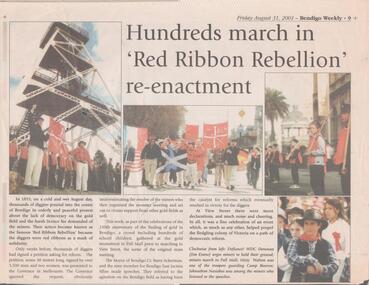
... Thousands of miners signed a petition to Governor LaTrobe to no avail. ...Thousands of miners signed a petition to Governor LaTrobe to no avail. ...In 1853, Bendigo Miners protested against the 30 shilling miners licence the had to pay the government. They wore red ribbons to show their protest and shopkeepers hung red ribbons outside their premises in support. Thousands of miners signed a petition to Governor LaTrobe to no avail. A protest gathering in Pall Mall marched to the Government camp on Camp Hill but this was a peaceful event again to no real avail.Newspaper articles: Bendigo Weekly Friday August 31, 2001. Hundreds march in red ribbon rebellion re-enactment. Bendigo Advertiser, Thursday December 6, 2012. History Lives by Jim Evans - Diggers united in protest. Bendigo Advertiser, Thursday January 10, 2013. History lives by Jim Evans - Milestones to be marked. Bendigo Advertiser, June 20, 2013. History lives by Jim Evans - Community to mark protest anniversary. Bendigo Advertiser, Thursday August 8, 2013. History lives by Jim Evans - Bendigo is ready to rebel.bendigo, history, red ribbon rebellion -
 Bendigo Historical Society Inc.
Poster - RED RIBBON COLLECTION: RED RIBBON REBELLION POSTER
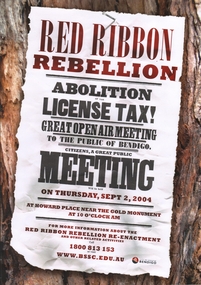
... Thousands of miners signed a petition to Governor LaTrobe to no avail. ...Thousands of miners signed a petition to Governor LaTrobe to no avail. ...In 1853, Bendigo Miners protested against the 30 shilling miners licence the had to pay the government. They wore red ribbons to show their protest and shopkeepers hung red ribbons outside their premises in support. Thousands of miners signed a petition to Governor LaTrobe to no avail. A protest gathering in Pall Mall marched to the Government camp on Camp Hill but this was a peaceful event again to no real avail.Poster produced the Bendigo Historical Society, supported by Bendigo Senior Seconday College, advertising the re-enactment of the Red Ribbon Rebellion (also referred to as the Red Ribbon Agitation) 'Abolition of the license tax, great open air meeting to the public of Bendigo' Held on Thursday September 2, 2004. Poster printed in maroon and black.bendigo, gold mining, red ribbon rebellion -
 Bendigo Historical Society Inc.
Ephemera - RED RIBBON COLLECTION: THREE RED PARTICIPATION RIBBON
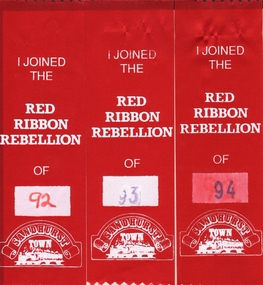
... Thousands of miners signed a petition to Governor LaTrobe to no avail. ...Thousands of miners signed a petition to Governor LaTrobe to no avail. ...In 1853, Bendigo Miners protested against the 30 shilling miners licence the had to pay the government. They wore red ribbons to show their protest and shopkeepers hung red ribbons outside their premises in support. Thousands of miners signed a petition to Governor LaTrobe to no avail. A protest gathering in Pall Mall marched to the Government camp on Camp Hill but this was a peaceful event again to no real avail.Three participation ribbons for Red Ribbon Agitation re-enactments in 1992, 1993 and 1994. Written on ribbons in white print ' I joined the Red Ribbon Rebellion of (year). On bottom, a scroll with Sandhurst Town written.bendigo, history, red ribbon agitation -
 Bendigo Historical Society Inc.
Book - BOOK: THE RED RIBBON REBELLION, 2001
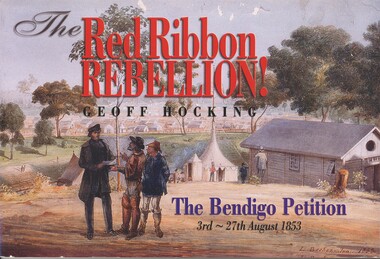
... Thousands of miners signed a petition to Governor LaTrobe to no avail. ...Thousands of miners signed a petition to Governor LaTrobe to no avail. ...In 1853, Bendigo Miners protested against the 30 shilling miners licence the had to pay the government. They wore red ribbons to show their protest and shopkeepers hung red ribbons outside their premises in support. Thousands of miners signed a petition to Governor LaTrobe to no avail. A protest gathering in Pall Mall marched to the Government camp on Camp Hill but this was a peaceful event again to no real avail.The Red Ribbon Rebellion, The Bendigo Petition 3rd - 27th August 1853. Published by New Chum Press, 120 pages with photographs, illustration and maps. Signed inside front cover by Geoff.Hocking.Geoff Hockingbendigo, history, red ribbon rebellion, bendigo - history, red ribbon rebellion, the bendigo petition, eureka stockade. -
 Bendigo Historical Society Inc.
Photograph - 1853 Bendigo Goldfields Petition, abt 1990-2019
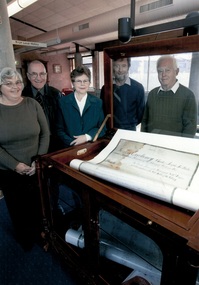
... This flag showed the pick, shovel and cradle representing labour, the scales representing justice, the Roman bundle of sticks meaning unity and the kangaroo and emu of Australia Many thousands of Bendigo miners signed a petition to La Trobe, the Governor of Victoria, protesting against the licence fee. ...This flag showed the pick, shovel and cradle representing labour, the scales representing justice, the Roman bundle of sticks meaning unity and the kangaroo and emu of Australia Many thousands of Bendigo miners signed a petition to La Trobe, the Governor of Victoria, protesting against the licence fee. ...The Red Ribbon Movement of 1853 represented a significant series of events in the history of Bendigo. During that year there was much agitation on the Bendigo gold fields, particularly during July and August of 1853, directed against the payment of what the miners called a tax - a licence fee of thirty shillings ($3) a month for the right to search for gold on what was declared Crown land. They had to pay the licence whether they found gold or not. The miners, or diggers as they were called, also resented the means used by the authorities at the time to collect the gold licence - through so-called 'digger hunts'. The miners were expected to carry their licences with them, and the police, who were often untrained, used harsh methods to check these licences. In Bendigo, the miners took to wearing a red ribbon ‘as a symbol of their protest against the licence. Red was a very common colour in items such as shirts, so was readily available. Shopkeepers too tied red ribbons to their premises as a sign of support for the miners. It should be remembered at that time virtually everyone was a miner. The diggers also had their own banner, designed by William Dexter, a china painter from Devon. This flag showed the pick, shovel and cradle representing labour, the scales representing justice, the Roman bundle of sticks meaning unity and the kangaroo and emu of Australia Many thousands of Bendigo miners signed a petition to La Trobe, the Governor of Victoria, protesting against the licence fee. When the Governor rejected the petition, thousands of diggers marched in peaceful protest. Miners from White Hills, Eaglehawk, Golden Square, Kangaroo Flat as well as from Bendigo Flat, converged on what is now Pall Mall and View Point, surrounding the ~government camp on Camp Hill. The camp had been reinforced with soldiers of the 40 Regiment, as the Government feared bloodshed. The miners then gathered on the hill behind View Point to hear from their leaders - among them George Thomson, Captain Harrison, Captain Brown and W.D.C. Denovan. They resolved to pay a token fee often shillings ($1) for the September licence, whenthey met with Commissioners Panton and Wright on Camp Hill. Although Wright and Panton were sympathetic to the miners, the offer was rejected, but no licence fees were collected for September. Thus a possible bloody conflict was averted by the common sense shown by the miners' leaders and the commissioners. It was a truly democratic protest against arbitrary government and preceded the Eureka Stockade Incident by over a year. Bendigo Historical Society Committee on a Tram, two photos, one of five people standing behind a display cabinet, and the second one a Banner stretched across the tram. On the rear of the photo is "L-R Jim Evans, Terry Davidson, Ron Monro." Second from left is Jim Evans (President) and fourth from the left is Terry Davidson, with extreme right, Ron Munro (Vice President). In the cabinet is the 1853 Bendigo Goldfields Petition (Red Ribbon Rebellion) The society holds the petition in digital form. The diggers had their own banner, designed by William Dexter, a china painter from Devon. This flag showed the pick, shovel and cradle representing labour, the scales representing justice, the Roman bundle of sticks meaning unity and the kangaroo and emu of Australia history, bendigo, tram, 1853 bendigo goldfields petition, red ribbon rebellions -
 Federation University Historical Collection
Magazine, Eureka 150, 2004
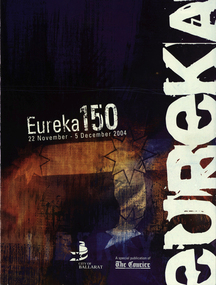
... eureka stockade steve bracks charles doudiet eureka flag aborigines charles latrobe artists bendigo petition peter lalor robert rede miner's right gold license patrick smythe j.b. humffray charles hotham timothy hayes william dargie eureka encyclopedia clare gervasoni dorothy wickham aborigines on the goldfields ian clark Fifty page Ballarat Courier Supplement printed to celebrate the 150th anniversary of the Eureka Stockade. ...Fifty page Ballarat Courier Supplement printed to celebrate the 150th anniversary of the Eureka Stockade. eureka stockade, steve bracks, charles doudiet, eureka flag, aborigines, charles latrobe, artists, bendigo petition, peter lalor, robert rede, miner's right, gold license, patrick smythe, j.b. humffray, charles hotham, timothy hayes, william dargie, eureka encyclopedia, clare gervasoni, dorothy wickham, aborigines on the goldfields, ian clark -
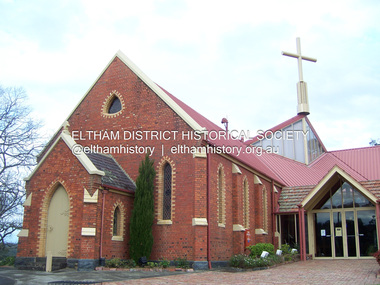 Eltham District Historical Society Inc
Photograph - Digital Photograph, Marguerite Marshall, St John's Anglican Church, Diamond Creek, 7 September 2008
... Then the township grew to 200 families, including miners, civil administration workers and shopkeepers. The resulting growth of Church of England adherents prompted them to petition the Government in 1866 for land to build a church. ...Then the township grew to 200 families, including miners, civil administration workers and shopkeepers. The resulting growth of Church of England adherents prompted them to petition the Government in 1866 for land to build a church. ...The building was designed by Charles Maplestone of Heidelberg, son-in-law to Anthony Beale of St Helena. Maplestone was a prominent architect who came out to Australia with his family in 1852. The foundation stone was laid by Mrs Isabella Maplestone on 11th November 1867. The bricklayers for the church were George Stebbing, H Limmer, H Spicer and a Mr Timm while Thomas Day was the stonemason. Another three years were to pass before sufficient money could be raised for its completion. It was opened by Bishop Perry on 1st November, 1870. The church bell which hung under a tree for 50 years until it was incorporated in the parish hall was brought out from England and presented by Charles Orme. In 1916, the estate of George Martin Pizzey left sufficient money to build the red brick hall, which still stands today (2023) though in January 1969 the hall and bell tower were badly damaged by bushfire. Coincidentally the former home of benefactor, George Pizzey was destroyed in the same fire. Of particular significance are the interior and exterior of the church, the Sunday school and hall with emphasis on pre-World War I fabric (excluding the 1990s additions) and the three coloured glass windows currently suspended in the 1990s entry foyer. In 2011 further alterations were made to the front of the Church. The church is historically significant because it was the oldest public building in the former Diamond Valley Shire, is amongst the oldest buildings in the Shire of Nillumbik and is associated with the early settlement of the Diamond Creek district. The church is historically, socially and spiritually significant because it has been a place of worship for over 150 years and continues to be, an important meeting place in the Shire. The church is aesthetically significant for the three stained glass windows executed by the noted stained glass manufacturers, Ferguson & Urie, as well as the supporting coloured glass windows in the church. The Sunday school & parish hall is architecturally significant because the hall is a well executed and preserved example of the work of noted church architects, North & Williams. It is historically significant because it is connected with local parishioner and Melbourne industrialist, George Pizzey, who bequeathed funds for its construction. Covered under Heritage Overlay, Nillumbik Planning Scheme. National Estate Ntionl Trust of Australia (Victoria) Local significance Published: Nillumbik Now and Then / Marguerite Marshall 2008; photographs Alan King with Marguerite Marshall.; p85 St John’s Anglican Church stands like a beacon on the hill on Main Street, Diamond Creek. Today the church has a large congregation, but its early years were marked by a small congregation struggling to find enough money to survive. It was gold in Diamond Creek that resulted in the building of this National Trust registered property.1 This church is far removed from William Wilson’s humble barn (later the Bowling Green) where the first Anglican church services were conducted – probably the first in the district.2 In the mid 19th century services were infrequent as the Rev Francis Hales, travelling on horseback, also conducted services elsewhere, including at Heidelberg, Coburg, Kinglake, Arthurs Creek, St Andrews and Kangaroo Ground. In 1860 Diamond Creek came under the jurisdiction of the Eltham Parish. Until the mid 1860s the Diamond Creek settlement included only about 20 families who were struggling farmers. But this changed when gold was found in 1862. Then the township grew to 200 families, including miners, civil administration workers and shopkeepers. The resulting growth of Church of England adherents prompted them to petition the Government in 1866 for land to build a church. The area chosen, on which the original building still stands, was at the centre of the proposed township. Today church leaders believe that this conspicuous location is one of the reasons for its exceptional growth. Prominent architect Charles Maplestone designed the building as he did the Presbyterian Church at Kangaroo Ground. St John’s, which is still intact, was built in the Gothic Revival style with the traditional rectangular plan of a central nave and sanctuary at the end. It is typical of small churches built in Victoria at that time, with polychromatic hand-made bricks, a porch, diagonal buttresses and a slate roof.3 The church was officially opened by Lord Bishop Perry on November 1, 1870. But during the next 40 years, due to the varying fortunes of gold mining, the church struggled to remain viable. In 1909 it separated from the Eltham Parish to form a parish with Greensborough. Life became more difficult with the privations of World War One. Then disaster struck in 1915 when fire destroyed the Diamond Creek Gold Mine, wiping out the major livelihood of most parishioners. However the church’s morale was lifted in 1916, when it received a bequest to build the red brick hall, from late parishioner and prominent leather manufacturer, George Pizzey. As prosperity grew, in 1924 the congregation separated from Greensborough, but they rejoined in the 1930s Depression. In the 1950s the wider population soared, impacting on St John’s, and it became a separate parish, becoming responsible for six churches at St Andrews, Hazel Glen, Hurstbridge, St Helena and Yarrambat. As parishioner numbers outgrew the building, extensions were added in 1989 and then in 1993, blending in well with the original building. Church members have made a huge contribution to the local community. John Ryan was a Heidelberg Shire Councillor for 25 years from 1931, Mayor in 1939 and headed several local sporting and other organisations. His son Jock became a clergyman and a local historian heading the Nillumbik Historical Society. Another parishioner, Dr Ted Cordner, came to Diamond Creek in 1920. One of his sons Donald, who was a local doctor, won the Brownlow Medal, was President of the Melbourne Cricket Club and President of the Melbourne Grammar School Council. Roy ‘Monty’ Vale was a state Liberal MP and was related to May Vale, a member of the Heidelberg School of Artists.4 In the early 21st century St John’s Anglican Church is one of the fastest growing congregations in Melbourne. References: St Johns Anglican Church complex, Sunday School and Parish Hall 61 Main Street DIAMOND CREEK, NILLUMBIK SHIRE. (2023, June 7). Retrieved from https://vhd.heritagecouncil.vic.gov.au/places/64023 Diamond Creek, VIC. – St John’s Anglican (2023, June 7). Retrieved from https://www.churchhistories.net.au/church-catalog/diamond-creek-vic-st-johns-anglican This collection of almost 130 photos about places and people within the Shire of Nillumbik, an urban and rural municipality in Melbourne's north, contributes to an understanding of the history of the Shire. Published in 2008 immediately prior to the Black Saturday bushfires of February 7, 2009, it documents sites that were impacted, and in some cases destroyed by the fires. It includes photographs taken especially for the publication, creating a unique time capsule representing the Shire in the early 21st century. It remains the most recent comprehenesive publication devoted to the Shire's history connecting local residents to the past. nillumbik now and then (marshall-king) collection, st john's anglican church, diamond creek -
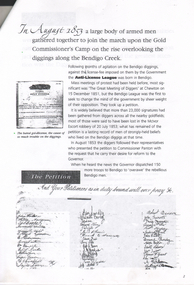 Bendigo Historical Society Inc.
Document - The Red Ribbon Rebellion and the Bendigo Petition
... The petition demanded immediate reform of government administration, a reduction in the licence fee, the right to vote and land reform (with poor returns from diggings, miners wanted affordable land on or near the goldfields). ...Petition. A proposal to commemorate a significant event in the history of Bendigo'. Contents includes a brief history of the Red Ribbon movement; description of the Digger's Banner; information on Governor LaTrobe; William Dixon Campbell Denovan and an outline of the proposed project to commemorate the event. The imposition of a license fee imposed upon the miners...Mining Sandhurst Red Ribbon Rebellion Agitation Denovan LaTrobe miners license fee diggers Nine page photocopy of document titled: ' The Red Ribbon Rebellion & the Bendigo Petition. ...The discovery of gold in Victoria in 1851 initially overwhelmed the Colonial administration. Towns appeared almost overnight and it was challenging to keep law and order. To keep some control over the gold seekers and help pay for the administration of the goldfields, Lieutenant-Governor La Trobe introduced gold licences in September 1851. Miners paid 30 shillings per month (later reduced to £1 per month or £8 per year) for the right to dig a small ‘claim’, usually about eight feet square (2.4m²). Not surprisingly the licence system was unpopular. The licence was expensive – 30 shillings was a substantial sum for most diggers, who might spend months digging for gold without success. Resistance to the licence fee spread throughout the fields. A Miner’s Association was formed at Mount Alexander (Castlemaine) in December 1851 and at Bendigo in 1853 the Red Ribbon Rebellion was led by the Anti-Gold Licence Association. Diggers wore red ribbons in their hats as a sign of protest, refused to pay their licences and collected a ‘monster’ petition which was presented to Lieutenant-Governor La Trobe. The petition demanded immediate reform of government administration, a reduction in the licence fee, the right to vote and land reform (with poor returns from diggings, miners wanted affordable land on or near the goldfields). This proposal to commemorate a significant event in the history of Bendigo, is for the creation of a permanent installation in Bendigo that will commemorate the valour and integrity of the Bendigo diggers, who stood fast against the Government in the early days of protest on the Victorian diggings. Nine page photocopy of document titled: ' The Red Ribbon Rebellion & the Bendigo Petition. A proposal to commemorate a significant event in the history of Bendigo'. Contents includes a brief history of the Red Ribbon movement; description of the Digger's Banner; information on Governor LaTrobe; William Dixon Campbell Denovan and an outline of the proposed project to commemorate the event. The imposition of a license fee imposed upon the miners, by the Government of Victoria, cause a major agitation on the Bendigo diggings and the Anti-License League was born in Bendigo. Signatures were gathered for a petition: 'It is widely believed that more than 23,000 signatures had been gathered from diggers across all the nearby goldfields; most of those were said to have been lost in the McIvor Escort Robbery of 20 July 1853'. The proposal was prepared by Geoff Hocking in consultation with the Bendigo Historical Society and Jim Evans of the Red Ribbon Repertory Co.mining, sandhurst, red ribbon rebellion, agitation, denovan, latrobe, miners, license fee, diggers -
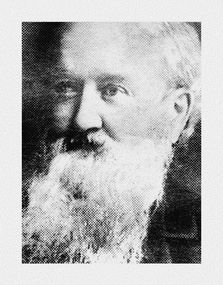 Bendigo Historical Society Inc.
Newspaper - Fortuna Article - "Quartz King's uneasy reign", Nov 02 1997
... Despite being the area's most successful mine owner, Lansell faced hostility from miners and left for Britain in 1880 after a threatening incident. He returned to Bendigo after a petition from thousands of residents, contributing significantly to the city's revival. ...Despite being the area's most successful mine owner, Lansell faced hostility from miners and left for Britain in 1880 after a threatening incident. He returned to Bendigo after a petition from thousands of residents, contributing significantly to the city's revival. ...George Lansell was born in Kent, England, on August 24, 1823. Inspired by his brother Wootton's reports of opportunities, George and his brother William arrived in Port Adelaide in 1853 and moved to Bendigo to seek fortune in gold mining. Lansell initially lost all his savings twice investing in gold mining. His fortunes changed in the early 1860s after successful investments in the Advance and Cinderella mines, laying the foundation for his wealth. He acquired the property Fortuna in 1871. He Married Bedelia Javis, an Irish immigrant, in 1872; she died eight years later at age 38. Despite being the area's most successful mine owner, Lansell faced hostility from miners and left for Britain in 1880 after a threatening incident. He returned to Bendigo after a petition from thousands of residents, contributing significantly to the city's revival. He donated much of his fortune to charities, public buildings, and monuments, including the Rosalind Park Cascades. He died on March 20, 1906, at age 82. His death marked the end of Bendigo's golden era; the goldfields' output declined sharply within a decade.Fortuna Restoration Article - "Quartz King's uneasy reign" - The Herald Sun Sunday Nov 02 1997- Author Adrian Tame This item contains the following: 11217.8a Black and White Photo of George Lansell 11217.8b Part of page 15 - Quartz King's uneasy reignnon-fictionbendigo, fortuna, stan budds, george lansell -
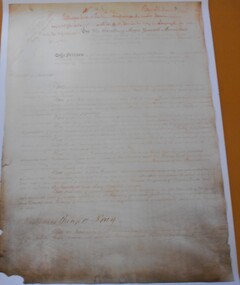 Bendigo Historical Society Inc.
Document - 1856 PETITION COPY
... Copy of petition from Sandhurst Crown Lands occupants to Major General Macarthur, Acting Governor of the colony of Victoria, seeking consideration for the improvements they had made on the lands they occupied under business licenses. Eighteen pages containing signatures, addresses and occupation of 1,387 storekeepers, publicans, miners...BENDIGO History 1856 crown land occupants petition Copy of petition from Sandhurst Crown Lands occupants to Major General Macarthur, Acting Governor of the colony of Victoria, seeking consideration for the improvements they had made on the lands they occupied under business licenses. Eighteen pages containing signatures, addresses and occupation of 1,387 storekeepers, publicans, miners ...Copy of petition from Sandhurst Crown Lands occupants to Major General Macarthur, Acting Governor of the colony of Victoria, seeking consideration for the improvements they had made on the lands they occupied under business licenses. Eighteen pages containing signatures, addresses and occupation of 1,387 storekeepers, publicans, miners, professionals and persons in various types of employment.bendigo, history, 1856 crown land occupants petition -
 Bendigo Historical Society Inc.
Book - STRAUCH COLLECTION: VIRTUAL EXHIBITION AT STATE LIBRARY OF VICTORIA
... Over 5000 miners from Ballarat, Bendigo and Castlemaine signed the petition that was presented to Lt. ...Over 5000 miners from Ballarat, Bendigo and Castlemaine signed the petition that was presented to Lt. ...This was one of the first formal indications of the dissatisfaction among miners of the conditions on the goldfields, including the issue of licences. Over 5000 miners from Ballarat, Bendigo and Castlemaine signed the petition that was presented to Lt. Governor, Charles LaTrobe. These dissatisfactions eventually culminated in the Eureka Stockade rising.Lever arch folder containing copies of 1853 Bendigo Goldfields Petition section 1, Life on the Goldfields section 2 with some black & white illustrations.books, collections, history, bendigo-history-goldfields-miners -
 Bendigo Historical Society Inc.
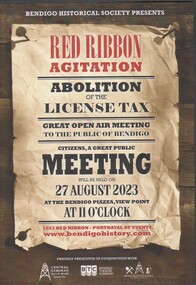
Flyer - Bendigo Historical Society flyer
... The miners wore a red ribbon and signed a petition to Governor Joseph LaTrobe seeking a reduction in the licence fee to 10 shillings per month...The miners wore a red ribbon and signed a petition to Governor Joseph LaTrobe seeking a reduction in the licence fee to 10 shillings per month Red Ribbon Agitation Licence abolition Bendigo Historical Society flyer for the 150 year commemoration of the Red Ribbon Agitation held on 27 August 2023 at the Bendigo Piazza, View Point. ...The Red Ribbon Agitation was a peaceful protest by miners against the 30 shilling per month licence fees they were charged. The miners wore a red ribbon and signed a petition to Governor Joseph LaTrobe seeking a reduction in the licence fee to 10 shillings per month Bendigo Historical Society flyer for the 150 year commemoration of the Red Ribbon Agitation held on 27 August 2023 at the Bendigo Piazza, View Point. Double sided colour printed flyer.red ribbon agitation, licence abolition -
 Bendigo Historical Society Inc.
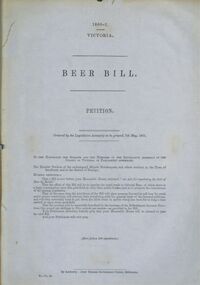
Document - BEER BILL PETITION 1860-1
... Petition to the Honorable the Speaker and the Members of the Legislative Assembly of the Colony of Victoria, in Parliament Assembled. The undersigned Miners...Petition to the Honorable the Speaker and the Members of the Legislative Assembly of the Colony of Victoria, in Parliament Assembled. The undersigned Miners ...Glass framed BEER BILL Petition (Victoria) 1860-1. Petition to the Honorable the Speaker and the Members of the Legislative Assembly of the Colony of Victoria, in Parliament Assembled. The undersigned Miners, Storekeepers and others resident in the town of Sandhurst, and in the district of Bendigo: Humbly Sheweth that a bill now before your Honorable House, intituled ''An Act for Regulating the Sale of Beer by Retail'' The effect of the bill will be to legalise the retail trade in Colonial Beerin other than public houses. Your petitioners humbly pray that your Honorable House will be pleased to pass the said Bill. (here follow 100 Signatures)document, beer bill -
 Bendigo Historical Society Inc.
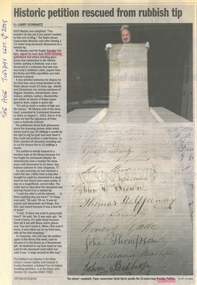
Newspaper - NEWSPAPER COLLECTION: HISTORIC PETITION RESCUED FROM RUBBISH TIP
... The Bendigo petition with the signatures of more than five thousand Victorians details the grievances of miners on the goldfields and was presented to Governor Latrobe....The Bendigo petition with the signatures of more than five thousand Victorians details the grievances of miners on the goldfields and was presented to Governor Latrobe. ...The Age from Tuesday September 6th, 2005. Article by Larry Schwartz titled Historic petition rescued from rubbish tip. The Bendigo petition with the signatures of more than five thousand Victorians details the grievances of miners on the goldfields and was presented to Governor Latrobe.newspaper, the age, historic petition -
 Bendigo Historical Society Inc.
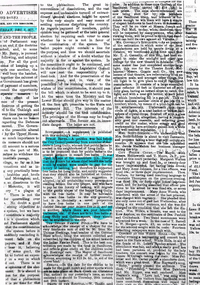
Document - LONG GULLY HISTORY GROUP COLLECTION: PUBLIC BATHS AT LONG GULLY
... Copies of an article in the Bendigo Advertiser Dec 8, 1877 mentioning a petition asking for public baths in Long Gully. Cr Sterry urged that the miners who would benefit from the baths would not be able to pay for bathing and he supported free baths....BENDIGO History long gully history group The Long Gully History Group - Bendigo Advertiser 8 /12/1877 & 2/2/1878 Cr Sterry T Hattam Mr Murray Copies of an article in the Bendigo Advertiser Dec 8, 1877 mentioning a petition asking for public baths in Long Gully. Cr Sterry urged that the miners who would benefit from the baths would not be able to pay for bathing and he supported free baths. ...Copies of an article in the Bendigo Advertiser Dec 8, 1877 mentioning a petition asking for public baths in Long Gully. Cr Sterry urged that the miners who would benefit from the baths would not be able to pay for bathing and he supported free baths.bendigo, history, long gully history group, the long gully history group - bendigo advertiser 8 /12/1877 & 2/2/1878, cr sterry, t hattam, mr murray -
 Bendigo Historical Society Inc.
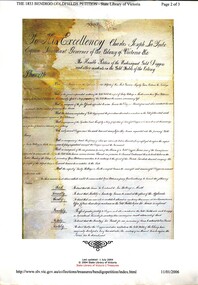
Book - BENDIGO GOLDFIELDS PETITION 1853
... GOLD Goldfields mining licences History-Australia-Victoria-Bendigo-Gold Miners. The 1853 Bendigo Goldfields Petition, containing names of Gold Diggers and other residents, to his Excellency Charles Joseph La Trobe Esq Lieutenant Governor of the Colony of Victoria with their grievances regarding license fees & other matters. ...The 1853 Bendigo Goldfields Petition, containing names of Gold Diggers and other residents, to his Excellency Charles Joseph La Trobe Esq Lieutenant Governor of the Colony of Victoria with their grievances regarding license fees & other matters.gold, goldfields, mining licences, history-australia-victoria-bendigo-gold miners. -
 Bendigo Historical Society Inc.
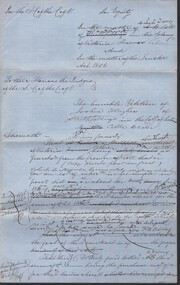
Document - CONNELLY, TATCHELL, DUNLOP COLLECTION: LEGAL PAPERS, 1878 1889
... Miners Connelly Tatchell & Dunlop Diviney Michael Hughes Joshua Freame H S? Flegg Wm Doran Joseph Christopher Hope Tribute Mining Company Commercial Bank Of Australia Ellis Asher Victorian Railways Commissioners Document. Various legal papers. 1 - 1856? - Petition ...Document. Various legal papers. 1 - 1856? - Petition for Vesting Order in the matter of Diviney Michael, late of Sandhurst. Mentions Hughes Joshua and Freame H S? for Flegg Wm Sandhurst. 2 - Hughes J. Application for Vesting Order. Mentions Doran Joseph Christopher & Diviney. 3 - 1878 - In the matter of the Hope Tribute Mining Company Reg and in the matter of the Mining Companies Act 1891 between the Commercial Bank of Australia Ltd. (Appellant) and the Hope Tribute Mining Company Reg (Respondent). Appeal case. 4 - 1889 - Transfer of Land in Kerang from Ellis Asher (Postmaster) to Victorian Railways Commissioners. Contains map of said land.cottage, miners, connelly, tatchell & dunlop, diviney michael, hughes joshua, freame h s?, flegg wm, doran joseph christopher, hope tribute mining company, commercial bank of australia, ellis asher, victorian railways commissioners -
 Chiltern Athenaeum Trust
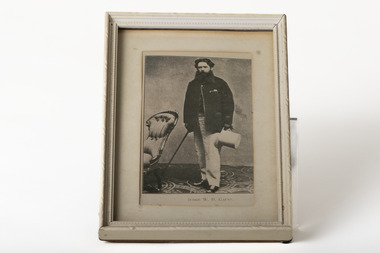
Photograph, JUDGE W. H. GAUNT
... petitioning the Queen in vain over his dismissal he began practice in Ballarat as a barrister. He soon became a leading authority on mining laws; one of the cases in which he was involved was the lengthy inquest on the bodies of the twenty-two miners drowned in the New Australasian mine disaster at Creswick in 1882. ...petitioning the Queen in vain over his dismissal he began practice in Ballarat as a barrister. He soon became a leading authority on mining laws; one of the cases in which he was involved was the lengthy inquest on the bodies of the twenty-two miners drowned in the New Australasian mine disaster at Creswick in 1882. ...This photograph is a copy displayed in the Australian Dictionary of Biography. The original photograph is in the La Trobe Collection in the State Library of Victoria. William Henry Gaunt (1830-1905), judge, was born on 27 July 1830 at Leek, Staffordshire, England, son of John Gaunt, banker, and his wife Mary, née Bakewell. Educated at Leek Grammar School and Whitchurch, Salop, he migrated to Melbourne, and entered the Victorian public service and was rapidly promoted. By March 1854 he was chief clerk at Beechworth, the administrative centre of the Ovens goldfield. In July 1855 the resident warden commended Gaunt as 'a highly valuable public servant' with an intimate knowledge of the district and the 'temper and disposition of the miners'. Appointed sub-warden in the Beechworth district in January 1856 and a Chinese protector in August, he was given control of the extensive Woolshed district. When European miners attacked a party of Chinese at the Buckland River diggings in May 1857 Gaunt was sent to restore order. One of his proclamations, issued in Chinese characters, concluded 'W. H. Gaunt, your protector—tremble and obey!' In June he was appointed a police magistrate and next month was sent to take charge at the Buckland where the Chinese had been expelled from the diggings; the police force assisting him was led by Robert O'Hara Burke. In January 1858 Gaunt was appointed a warden, in November was transferred to Chiltern, north of Beechworth, and in August 1859 was made a commissioner of crown lands. In February 1860 Gaunt was appointed a coroner of Victoria, acting at Indigo, near Chiltern. In April 1865 he was transferred to Beechworth, became visiting justice of the gaol and later moved to Sandhurst. In January 1869 he was appointed returning officer for the mining district of Ballarat and visiting justice of the gaol. He was associated with this area for the rest of his life and won high repute for his integrity. In 1874 he chaired the inaugural meeting of the first Australian competitive swimming club. For years he studied law and was called to the Bar in December 1873. He was one of the many public servants dismissed by Graham Berry on 9 January 1878 (Black Wednesday). After petitioning the Queen in vain over his dismissal he began practice in Ballarat as a barrister. He soon became a leading authority on mining laws; one of the cases in which he was involved was the lengthy inquest on the bodies of the twenty-two miners drowned in the New Australasian mine disaster at Creswick in 1882. He was appointed a temporary judge of the Insolvency Court in 1889 and a County Court judge in 1891. In 1900 he was chairman of the royal commission which considered Metropolitan Board of Works matters, and in 1902 was president of the inquiry into the unification of municipalities in Victoria. In 1860 Gaunt married Elizabeth Mary, the youngest daughter of Frederick Palmer; they had nine children. Of the surviving five sons and two daughters, Ernest Frederick Augustus and Guy Reginald Archer both became admirals and were knighted; Cecil Robert became a lieutenant-colonel, Clive Herbert a government advocate in Rangoon and Mary (Mrs H. L. Miller) one of the first women students to enrol at the University of Melbourne (1881), although she did not complete her degree; she became a successful novelist. Gaunt died on 5 October 1905. An anonymous colleague said: 'I don't think he was ever excelled as a police magistrate, and during the many years he was on the County Court bench he earned the highest regard. His capacities were as unquestioned as his integrity, and more could not be said of any judge'. Select Bibliography Votes and Proceedings (Legislative Assembly, Victoria), 1878, 3, (58) Government Gazette (Victoria), 22 Feb, 15 Aug 1856, 30 June 1857, 5 Jan 1858, 16 Aug 1859, 3 Feb 1860, 7 Mar, 11 Oct 1862, 28 Mar, 4 Apr 1865, 17 May 1867, 9 June 1868, 22, 29 Jan 1869 Ovens and Murray Advertiser, 21 May 1857, 11 Mar 1865 Colonial Secretary's in-letters, goldfields, 25 Mar 1854, 21 July, 18 Nov 1855, 22 Aug 1857 (Public Record Office Victoria) scrapbook and newsclippings (privately held). Related Entries in NCB Sitesview family tree Gaunt, Mary Eliza (daughter)go to ADB entryPhotograph of Judge W. H. Gaunt standing beside chair holding top hat and cane, under glass, in cream frame with cream matte.Printed name underneath: JUDGE W. H. GAUNT -
 City of Ballarat
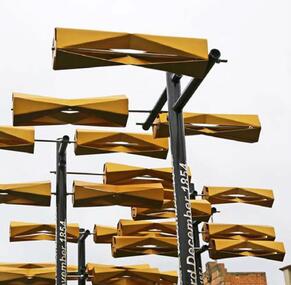
Artwork, other - Public Artwork, Aaron Robinson et al, Flow by Holly Grace and Aaron Robinson, 2014
... Petition is presented to Lt-Governor./ December/ Charles Hotham is appointed Lt-Governor/ 1854 March/ A bill to extend the Elective Franchise is passed by the Legislative Council and sent to London for the assent of the British Parliament. 22nd June/ Lt-Governor Sir Charles Hotham arrives in Victoria. The colony faces mounting debt and Hotham orders weekly licence hunts in an attempt to increase income./ August/ Hotham is acclaimed during his visit to the Ballarat goldfield./ 13th September? Hotham orders twice-weekly licence hunts to further increase revenue./ September – October/ Miners...Petition is presented to Lt-Governor./ December/ Charles Hotham is appointed Lt-Governor/ 1854 March/ A bill to extend the Elective Franchise is passed by the Legislative Council and sent to London for the assent of the British Parliament. 22nd June/ Lt-Governor Sir Charles Hotham arrives in Victoria. The colony faces mounting debt and Hotham orders weekly licence hunts in an attempt to increase income./ August/ Hotham is acclaimed during his visit to the Ballarat goldfield./ 13th September? Hotham orders twice-weekly licence hunts to further increase revenue./ September – October/ Miners ...Water is key to a thriving community and it is through the representation of water Flow enlivens the space at Bakery Hill. Historically ‘water races’ ran through the valleys of the Greater Ballarat area unearthing the minerals that forged prosperity and wealth. This water still flows today unearthing new possibilities for the community. Possibilities focusing on sustainability, ecology, health and prosperity. Flowing over the site a series of kinetic turbines flutter in the wind creating a contemporary water race. The interactive elements offer visual stimulation enticing people to connect with the artwork and in turn the surrounding spaces. Bakery Hill has great historical significance. It’s connection to the Eureka Stockade and the series of events that were to unfold during the 1850’s was to become the turning point in Australian political history. The placement of each turbine is to mirror a point of history in the timeline of events that occurred during the Eureka Stockade. The Water Race is a symbol of possibilities, the ones created by history and those of modern society. It is a visual timeline that can be read by traversing the site. The connecting turbines that flow and turn in sync are a representation of time passing and the interconnectedness of history with the community that surrounds it. The gateway to Bridge Mall is framed through the placement of each turbine allowing the sense of prosperity and wealth to flow through to the surrounding community. This gateway also references the significance of Bakery Hill reinvigorating the historical site by reconnecting it back to its town centre. The artwork is of aesthetic and historical significance to the people of BallaratTwelve steel turbines set on poles with dates attached and a large bronze 'timeline' plaqueFLOW/ Plotting the motion of Wind, Water, History and Time/ by Holly Grace and Aaron Robinson/ This site has great historical significance. It’s connection to the Eureka Stockade and the series of events that unfolded in the 1850’s was to become the turning point in Australian history. The placement of each turbine within this artwork mirrors a point of history in the events that led up to the Eureka Stockade. It is a visual timeline that can be read by traversing the site. The connecting turbines that flow and turn in sync are a representation of time passing. They are a symbol of the community’s connection to their history. 1851 June James Esmond makes the first discovery of gold in Victoria at Clunes./ 1st July The Port Phillip District separates from New South Wales and becomes the Colony of Victoria. It is still subject to British rule./ August Gold is discovered at Buninyong and at Golden Point, Ballarat. Lt-Governor La Trobe introduces the Gold Licence system in an attempt to reduce the colony’s debt./ 20th September First gold licences issued in Ballarat. / 1852 August/ Eureka Lead discovered on the Ballarat goldfields. December Charles La Trobe resigns as Lt-Governor but he is not relieved until 1854/ July – December/ Unrest builds on the various goldfields with protest meetings held in Bendigo and Castlemaine. Bendigo’s Red Ribbon Movement is active on the goldfields and the Bendigo Petition is presented to Lt-Governor./ December/ Charles Hotham is appointed Lt-Governor/ 1854 March/ A bill to extend the Elective Franchise is passed by the Legislative Council and sent to London for the assent of the British Parliament. 22nd June/ Lt-Governor Sir Charles Hotham arrives in Victoria. The colony faces mounting debt and Hotham orders weekly licence hunts in an attempt to increase income./ August/ Hotham is acclaimed during his visit to the Ballarat goldfield./ 13th September? Hotham orders twice-weekly licence hunts to further increase revenue./ September – October/ Miners are experiencing problems – no shafts bottomed on the Eureka Lead for five weeks./ 7th October/ James Scobie is murdered outside the Eureka Hotel. Many diggers believe that publican James Bentley is responsible./ 9th October/ At Scobie’s inquest, Bentley is acquitted, despite strong evidence of his guilt./ 10th October/ Father Smythe’s servant is beaten up by authorities and falsely arrested for not holding a licence./ 15th October/ Mass meeting of miners on Bakery Hill. Catholic miners meet after Mass. // 17th October/ A meeting of up to 10,000 Diggers is held near the Eureka Hotel to protest against Bentley’s acquittal. The meeting results in the burning of the hotel. Three diggers, Westerby, Fletcher and McIntyre, are arrested. Hotham dispatches 400 soldiers to Ballarat. 22nd October/ Another large meeting is held to address grievances. The Catholics send their leaders, Hayes, Kennedy and Manning to meet Rede. The Government Camp is under siege 11th November/ A public meeting on Bakery Hill results in the formal establishment of the Ballarat Reform League and adoption of the League’s proposals./ 21st November/ The enquiry into the Bentley affair is published. It recommends the dismissal of the judge and the establishment of a Royal Commission. 23rd November/ Westerby, Fletcher and McIntyre are convicted of burning the hotel. The Ballarat Reform League demands their release. 27th November/ A deputation from The Ballarat Reform League, including Humffray, Black and Kennedy, meet with Hotham to demand the release of the three prisoners. Hotham does not believe the diggers have the right to “demand anything”, Rede requests reinforcements in Ballarat. 28th November/ Miners attack the troop reinforcements and wagons passing near the Eureka diggings. A drummer boy is seriously wounded. 29th November/ A “Monster Meeting” attended by more than 10,000 diggers is held on Bakery Hill. The Southern Cross flag is flown for the first time. Peter Lalor addresses the miners and a number of diggers burn their licences. 30th November/ A licence hunt occurs in the morning at the order of Commissioner Rede. Another meeting of radical miners is held on Bakery Hill. Peter Lalor becomes leader of the diggers and calls for volunteers. Many diggers wear an oath to defend their rights and liberties under the Southern Cross flag. A number of diggers move to the Eureka Lead and start to erect a stockade. 3rd December In the early hours of Sunday morning 296 soldiers and police led by Captain Thomas proceed from the Government Camp to the Eureka Lead and attack the Stockade. 22 diggers and 7 military are officially listed as being killed. Many others are wounded. Approximately 120 diggers are arrested and marched to the Government Camp. 4th December/ Funeral of some of the fallen diggers and soldiers. Martial Law is proclaimed in Ballarat. Henry Seekamp, editor of the Ballarat Times is charged with seditious libel. 6th December/ Major General Sir Robert Nickle, commander-in-chief of the military forces in the Australian colonies, arrives in Ballarat. 9th December/ General Nickle repeals martial law. 14th December/ The Gold Fields Commission sits for the first time. 18th December/ The first Ballarat sitting of the Gold Fields Commission is held at Bath’s Hotel. 1855 23rd January/ Henry Seekamp is found guilt of sedition and sentenced to three months in prison. 22nd February/ The Eureka trials starts in Melbourne. February to March/ 13 prisoners are tried and acquitted amid great public rejoicing. 27th March Report of the Royal Commission recommends miners’ rights and significant reforms. 10th November/ Peter Lalor and John Basson Humffray are nominated for seats in the legislative Council. 31st December Sir Charles Hotham dies before his resignation takes effect. flow, aaron robinson, holly grace, public art, eureka stockade, bakery hill -
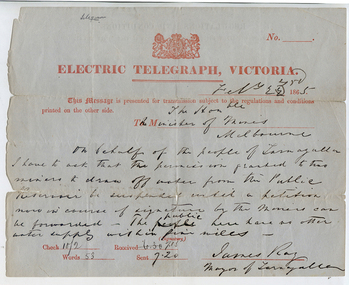 Tarnagulla History Archive
Telegram: Mayor of Tarnagulla to the Minister of Mines, Melbourne, 22nd February 1865
... Reads: "On behalf of the people of Tarnagulla I have to ask that the permission granted to two miners to draw off water from the Public Reservoir be suspended until a petition now in course of signatures by the miners can be forwarded. ...Reads: "On behalf of the people of Tarnagulla I have to ask that the permission granted to two miners to draw off water from the Public Reservoir be suspended until a petition now in course of signatures by the miners can be forwarded. ...Murray Comrie Collection. A telegram sent from James Ray, Mayor of Tarnagulla to the Minister for Mines, Melbourne on 22nd February 1865. Reads: "On behalf of the people of Tarnagulla I have to ask that the permission granted to two miners to draw off water from the Public Reservoir be suspended until a petition now in course of signatures by the miners can be forwarded. The public here have no other water supply within five miles."tarnagulla, post office, telegrams, minister mining, mining, water, reservoir, recreation reserve, resources -
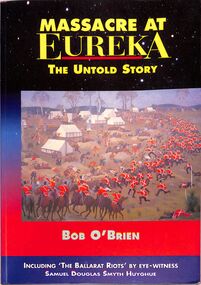 Bendigo Historical Society Inc.
Book - "Massacre at Eureka. The Untold Story.", 1992
... When Ballarat miners organised protest meetings and petitions against their mistreatment and lack of political representation, the government viewed this protest as treason and ordered its forces to teach the miners a lesson. ...When Ballarat miners organised protest meetings and petitions against their mistreatment and lack of political representation, the government viewed this protest as treason and ordered its forces to teach the miners a lesson. ...The Victorian gold discoveries attracted thousands of immigrants who came half way around the world to make a better life for themselves. When Ballarat miners organised protest meetings and petitions against their mistreatment and lack of political representation, the government viewed this protest as treason and ordered its forces to teach the miners a lesson. The miners built their stockade at Eureka as a defence as a defensive measure. The attack on ther miners at Ballarat was on 3rd December, 1854. The Eureka fighting forms part of the eduring legacy of the miners, and rights representation in Australia. "Massacre at Eureka. The Untold Story" written by Bob O'Brien. Foreword by Bernard Barrett, State Historian of Victoria. An account of the Ballarat riots of 1854 - an episode of timeless significance in Australian political culture and history. Published in Australia by Australian Scholarly Publishing in 1992. Published in association with Sovereign Hill and the Museum of Victoria. Soft cover with black, blue and red colors to front and back covers. Depiction of soldiers and miners fighting on front cover. Title printed in Yellow. Book has both color and black and white images throughout. Has index. 175 pp.eureka rebellion, mining, ballarat -
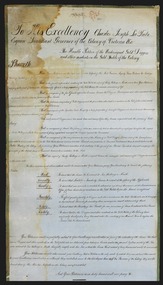 Bendigo Historical Society Inc.
Document - 1856 PETITION OF CROWN LAND OCCUPANTS AT SANDHURST, 1856
... This 1856 petition was one of many sent to the Government from Sandhurst residents reflecting the era when issues around mining laws, civil rights of miners, the intrastructure needs of a fast developing settlement, and land availability and tenure, were all high on the agenda. ...Original petition from Sandhurst Crown Lands occupants to Major General Macarthur, Acting Governor of the colony of Victoria, seeking consideration for the improvements they had made on the lands they occupied under business licenses. Pages of document have been conserved, stored in individual pockets. Eighteen pages of parchment and paper containing signatures, addresses and occupation of 1,387 storekeepers, publicans, miners...This 1856 petition was one of many sent to the Government from Sandhurst residents reflecting the era when issues around mining laws, civil rights of miners, the intrastructure needs of a fast developing settlement, and land availability and tenure, were all high on the agenda. ...This 1856 petition was one of many sent to the Government from Sandhurst residents reflecting the era when issues around mining laws, civil rights of miners, the intrastructure needs of a fast developing settlement, and land availability and tenure, were all high on the agenda. The community was forced to petition government through lack of a properly structured means of representation at that time.Original petition from Sandhurst Crown Lands occupants to Major General Macarthur, Acting Governor of the colony of Victoria, seeking consideration for the improvements they had made on the lands they occupied under business licenses. Pages of document have been conserved, stored in individual pockets. Eighteen pages of parchment and paper containing signatures, addresses and occupation of 1,387 storekeepers, publicans, miners, professionals and persons in various types of employment. In 1959, Cr. Alec Craig donated this item to the Bendigo Historical Society.bendigo, history, 1856 crown land occupants petition, bendigo petition, crown land, democracy, representation, land tenure, land rights
