
Showing 281 items matching "model types "
-
 Moorabbin Air Museum
Book - Pratt & Whitney engines, R-4360 Pratt & Whitney's Major Miracle
... ...Model types & specifications...Pratt & Whitney engines R-4360 development Production & variations Turbocharging/VDT & other ventures Model types & specifications Carburetors & fuel injection Military applications Commercial applications Racing applications Technical history & overview of Pratt & Whitney R-4360 Wasp Major piston engine, circa 2006 R-4360 Pratt & Whitney's Major Miracle Book Pratt & Whitney engines ...Technical history & overview of Pratt & Whitney R-4360 Wasp Major piston engine, circa 2006non-fictionTechnical history & overview of Pratt & Whitney R-4360 Wasp Major piston engine, circa 2006r-4360 development, production & variations, turbocharging/vdt & other ventures, model types & specifications, carburetors & fuel injection, military applications, commercial applications, racing applications -
 Port Fairy Historical Society Museum and Archives
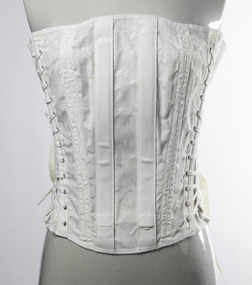
Clothing - corset, 1970-1980
... Model 3987/10 type g. size 37...local history costume female Model 3987/10 type g. size 37 long abdominal corset - peach colour, embroidered lingerie satin, lycra, hooks, lacing eyes, synthetic boning, elastic panels Clothing corset Jenyns patent corsetry ...long abdominal corset - peach colour, embroidered lingerie satin, lycra, hooks, lacing eyes, synthetic boning, elastic panelsModel 3987/10 type g. size 37local history, costume, female -
 Running Rabbits Military Museum operated by the Upwey Belgrave RSL Sub Branch
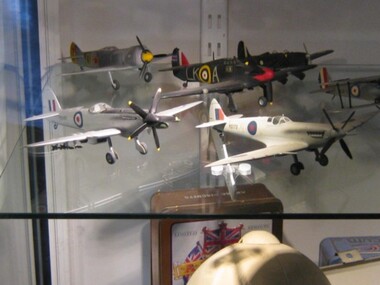
Collection - Model Planes
... Collection of 21 model aircraft of varying types....Collection of 21 model aircraft of varying types. Collection - Model Planes ...Collection of 21 model aircraft of varying types. -
 Deaf Children Australia
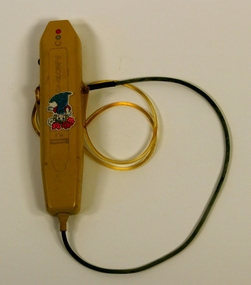
FM Phonic Ear, Phonic Ear, Inc, Manufactured in the late 1960s
... "PHONIC EAR/MODEL HC4211/TYPE GODKENOT" on back. "3335 173" scratched on back. ..."PHONIC EAR/MODEL HC4211/TYPE GODKENOT" on back. "3335 173" scratched on back. ...The Phonic Ear hearing aids were actually auditory trainers for children in school. This is the teachers transmitter which they would wear. Beige FM Microphone Transmitter with plastic loop for over the head and a small black hearing device and a microphone in the top. Individually decorated with plastic girl sticker, upside down, (put there by the wearer?) "PHONIC EAR" "FM/MICROPHONE/TRANSMITTER" on front. "PHONIC EAR/MODEL HC4211/TYPE GODKENOT" on back. "3335 173" scratched on back. deaf children australia, hearing aid, auditory training device, phonic ear -
 Moorabbin Air Museum
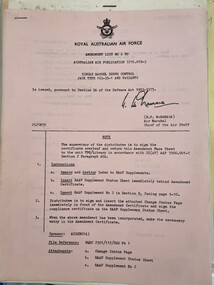
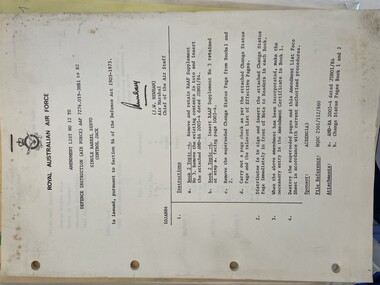
Manual (Item) - (SP) AAP 7276.019-3 Single Barrel Servo Control Jack Type 103-35-1 Amendment List 6
... A manual for part model or type no B99-26-203 and B99-26-204 valve, fuel cut out type 16....A manual for part model or type no B99-26-203 and B99-26-204 valve, fuel cut out type 16. ...Released around 1970 by the Royal Australian Air Force. A manual for part model or type no B99-26-203 and B99-26-204 valve, fuel cut out type 16.royal australian air force, valve and fuel cut out type 16, australian air publication -
 Moorabbin Air Museum
Manual (Item) - (SP) AAP 7276.019-3MB1 to B2 Single Barrel Servo Control Jack Amendment List 12
... A manual for part model or type no B99-26-203 and B99-26-204 valve, fuel cut out type 16....A manual for part model or type no B99-26-203 and B99-26-204 valve, fuel cut out type 16. ...Released around 1970 by the Royal Australian Air Force. A manual for part model or type no B99-26-203 and B99-26-204 valve, fuel cut out type 16.royal australian air force, valve and fuel cut out type 16, australian air publication -
 Moorabbin Air Museum
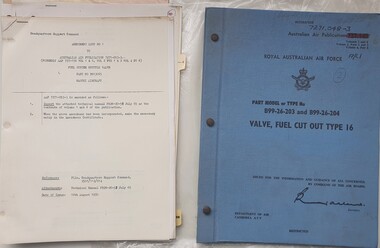
Manual (Item) - (SP) AAP 7271.048-3 727.149 Part Model or Type No B99-26-203 and B99-26-204 Valve, Fuel Cut Out Type 16
... (SP) AAP 7271.048-3 727.149 Part Model or Type No B99-26-203 and B99-26-204 Valve, Fuel Cut Out Type 16...A manual for part model or type no B99-26-203 and B99-26-204 valve, fuel cut out type 16....A manual for part model or type no B99-26-203 and B99-26-204 valve, fuel cut out type 16. ...Released around 1970 by the Royal Australian Air Force. A manual for part model or type no B99-26-203 and B99-26-204 valve, fuel cut out type 16.royal australian air force, valve and fuel cut out type 16, australian air publication -
 Tennis Australia
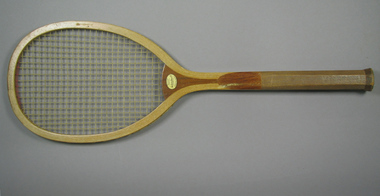
Racquet, Circa 1912
... Decal inscription of model type around crown on obverse: TRIUMPH. Decal of company trademark features on throat on obverse. ...Decal inscription of model type around crown on obverse: TRIUMPH. Decal of company trademark features on throat on obverse. ...A transitional flat-top, wooden racquet with a laminated convex throat. Decal inscription of model type around crown on obverse: TRIUMPH. Decal of company trademark features on throat on obverse. Within a football device is the inscription: TRADE MARK/SCHMELZER'S/KANSAS CITY/SPORTING GOODS. Stamped inscription along right side of stem: THE/SCHMELZER COMPANY. Materials: Wood, Gut, Metal, Ink, Glue, Lacquer, String, Leathertennis -
Frankston RSL Sub Branch
Container, Storage
... Protective container for storage and transporting Bubble Sextant model Mark 1XA type A.M. 6B/218....Protective container for storage and transporting Bubble Sextant model Mark 1XA type A.M. 6B/218. Container, Storage ...Protective container for storage and transporting Bubble Sextant model Mark 1XA type A.M. 6B/218. -
 Department of Energy, Environment and Climate Action
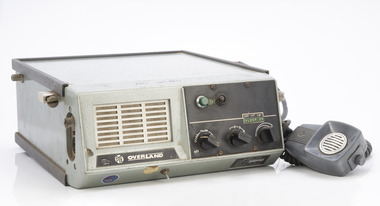
Pye Overland Base Radio
... Pye Overland Callsign VL3OF 35 Model F 25 TYPE FM738D/V/12...Bushfire Radios Forests Commission Victoria (FCV) Pye Overland Callsign VL3OF 35 Model F 25 TYPE FM738D/V/12 Radio with handset Pye Overland Base Radio ...After the 1939 bushfires, the Forests Commission Victoria invested heavily in a radically new communications network. After suffering some inevitable delays due to the war, radio VL3AA switched into full operation in October 1945 proudly beaming out 200 watts across the State. But by today’s standards, the technology was primitive and the reception poor unless the user was on a high point somewhere. The radio signal was "line-of-sight" and bounced between fire towers and relay transmitters across the mountains back to the District offices. The advent of solid-state electronics in the 1960s replaced the more delicate valve sets which enabled greater use of vehicle mounted radios. The Commission continued to research, develop and build new radios at its many workshops around Victoria. The network was supported by a large team of skilled radio technicians. The more secure and versatile State Mobile Radio (SMR) digital trunk system came into operation in about 1995. Upgraded Tait Radios were purchased in 2014 after recommendations of the 2009 Bushfires Royal Commission. But it was the convergence of separate technologies such as 5G mobile phones, high-capacity and light-weight lithium batteries, Wi-Fi, the ever-expanding internet, cloud data storage, digital cameras, GPS, personal organisers and hundreds of supporting Apps into powerful smartphones and tablets which revolutionised bushfire communications from the mid-2000s. Radio with handsetPye Overland Callsign VL3OF 35 Model F 25 TYPE FM738D/V/12bushfire, radios, forests commission victoria (fcv) -
 Kew Historical Society Inc
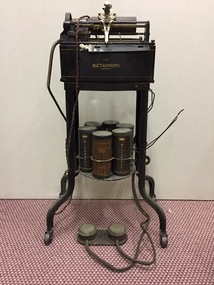
Machine - Dictaphone, The Dictaphone Corporation, 1900-1920
... Metal Label (top): "THE DICTAPHONE / REG US PATENT OFF / TRANSCRIBING MACHINE / DICTAPHONE CORPORATION / NEW YORK / MODEL B10 TYPE X / SOLE MANUFACTURERS MADE IN U.S.A"...Office Equipment imported from United States The dictaphone, intact with its cylinders, has historic local importance as an item used in the old Kew Town Hall and also as a work of technological innovation from the first part of the 20th century. dictaphone kew town hall (walpole street) Metal Label (top): "THE DICTAPHONE / REG US PATENT OFF / TRANSCRIBING MACHINE / DICTAPHONE CORPORATION / NEW YORK / MODEL B10 TYPE X / SOLE MANUFACTURERS MADE IN U.S.A" Metal Dictaphone used in the Kew Town Hall in Walpole Street. ...Office Equipment imported from United StatesThe dictaphone, intact with its cylinders, has historic local importance as an item used in the old Kew Town Hall and also as a work of technological innovation from the first part of the 20th century.Metal Dictaphone used in the Kew Town Hall in Walpole Street.Metal Label (top): "THE DICTAPHONE / REG US PATENT OFF / TRANSCRIBING MACHINE / DICTAPHONE CORPORATION / NEW YORK / MODEL B10 TYPE X / SOLE MANUFACTURERS MADE IN U.S.A"dictaphone, kew town hall (walpole street) -
Frankston RSL Sub Branch
Sextant, Bubble
... Bubble Sextant model Mark 1XA type A.M. 6B/218 in protective storage box. ...Bubble Sextant model Mark 1XA type A.M. 6B/218 in protective storage box. ...Bubble Sextant model Mark 1XA type A.M. 6B/218 in protective storage box. Refer 00348.1 and 00348.2 -
 Bendigo Military Museum
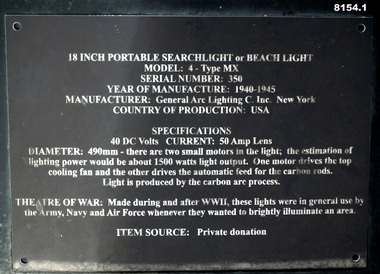
Equipment - SEARCH LIGHT, MOBILE, General Arc Lighting C. Inc New York, C. 1940 - 45
... .1) Plaque black metal on stand with white text re details of the item. .2) Mobile search light portable Model: 4 - Type MX with 49.0 cm lens, mounted on a base with two tyres and towed. ...Refer photo .1) For details re manufacture, history and use. brsl smirsl bdrslinc search light mobile .1) Plaque black metal on stand with white text re details of the item. .2) Mobile search light portable Model: 4 - Type MX with 49.0 cm lens, mounted on a base with two tyres and towed. ...This item is in the gardens of the Bendigo District RSL Sub Branch Inc Havilah Road. Refer photo .1) For details re manufacture, history and use..1) Plaque black metal on stand with white text re details of the item. .2) Mobile search light portable Model: 4 - Type MX with 49.0 cm lens, mounted on a base with two tyres and towed. painted a greyish colour.brsl, smirsl, bdrslinc, search light, mobile -
 Flagstaff Hill Maritime Museum and Village
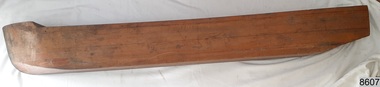
Craft - Ship Model, 20th century
... An authentic half hull ship model of the type used by boat builders as a plan for building a ship's hull. ...An authentic half hull ship model of the type used by boat builders as a plan for building a ship's hull. ...An authentic half hull ship model of the type used by boat builders as a plan for building a ship's hull. It is the model of a barge, a ship used for carrying cargo or as a working platform.The trade of ship building has been carried out for centuries and taught to generations of ship builders. This half hull ship model is part of the process of building the hull of a barge. Flagstaff Hill's collection includes equipment once used on the vessel Reginald M, which at one time was used as a barge to carry grain in South Australia.Ship model, half hull model ship. The half hull model represents a barge. It is made from a length of laminated timber, curved into shape including the bow and stern. The deck is lower than the front and back of the ship model. flagstaff hill maritime museum and village, great ocean road, shipwreck coast, ship model, barge, ship building, half hull, craft, trade, boat builder -
 Tennis Australia
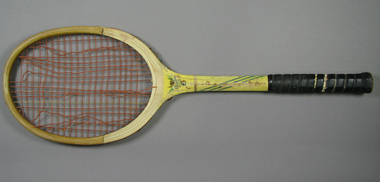
Racquet, Circa 1937
... Amongst a green and yellow background are a number of decals advertising Slazenger, and the model type. Decals across throat, and along stem on obverse: ROYAL CROWN/SLAZENGERS. ...Amongst a green and yellow background are a number of decals advertising Slazenger, and the model type. Decals across throat, and along stem on obverse: ROYAL CROWN/SLAZENGERS. ...A wooden racquet with enamel-painted shoulders, throat, and stem, and leather handle grip. Amongst a green and yellow background are a number of decals advertising Slazenger, and the model type. Decals across throat, and along stem on obverse: ROYAL CROWN/SLAZENGERS. Decal on throat on reverse: CORONATION/MODEL. Decal along right side of stem: SLAZENGER/THE CHOICE OF CHAMPIONS/SLAZENGERS. Racquet may have been issued to commemorate the coronation of either Kings Edward VIII (Jan 1936) or George VI (Dec 1936). Materials: Wood, Gut, Leather, Ribbon, Adhesive tape, Ink, Paint, Glue, Lacquer, Clothtennis -
The Ed Muirhead Physics Museum
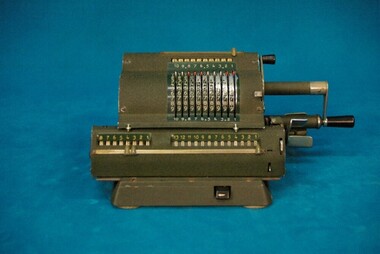
“MULTO” (Brunsviga)
... ODHNER/BRUNSVIGA TYPE MULTO model 13or 113 keys: 10 x 8 x 13 same as F288/M1...ODHNER/BRUNSVIGA TYPE MULTO model 13or 113 keys: 10 x 8 x 13 same as F288/M1 “MULTO” (Brunsviga) ...ODHNER/BRUNSVIGA TYPE MULTO model 13or 113 keys: 10 x 8 x 13 same as F288/M1Ser. no. -
 The Ed Muirhead Physics Museum
“MULTO” (Brunsviga)
... ODHNER/BRUNSVIGA TYPE MULTO model 13or 113 keys: 10 x 8 x 13 same as F288/M1...ODHNER/BRUNSVIGA TYPE MULTO model 13or 113 keys: 10 x 8 x 13 same as F288/M1 “MULTO” (Brunsviga) ...ODHNER/BRUNSVIGA TYPE MULTO model 13or 113 keys: 10 x 8 x 13 same as F288/M1 -
 Tennis Australia
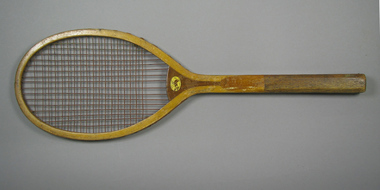
Racquet, Circa 1908
... Decal inscription of model type around crown on obverse is illegible. ...Decal inscription of model type around crown on obverse is illegible. ...An oval, wooden racquet with a laminated convex throat. Decal inscription of model type around crown on obverse is illegible. Decal of company trademark features on throat of obverse. Within a football device is the inscription: TRADE MARK/SCH[MELZER]'S/KA[N]SAS [CIT]Y/S[P]ORTING GOODS. Hand carved name along throat on obverse: JEANETTE. Hand carved initials, in Greek script, across throat on reverse, read 'Pi Delta'. Hand carved inscription further down on handle reads: JOE BROWN. Decal inscription along right side of stem: SCHMELZER ARMS CO./KANSAS CITY, MO. Materials: Wood, Gut, Metal, Ink, Glue, Lacquertennis -
 Geoffrey Kaye Museum of Anaesthetic History
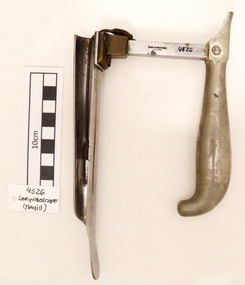
Equipment - Laryngoscope, Magill, c 1900
... Engraved on handle its model type and in the arm of the handle a possible manufacturer name (illegible) and the place where it was made....Engraved on handle its model type and in the arm of the handle a possible manufacturer name (illegible) and the place where it was made. ...Magill's laryngoscope with open straight blade and flat round speculum and a detachable light bulb connector, the bulb is missing. This laryngoscope is a previous version of the battery use ones conceived around 1920 therefore circa 1900. The design of the handle is similar to the Shipway laryngoscopes with a curved and pointed end and anatomical handle grip. The blade attachment place seems to be an adaptation to this kind of blade which differs from original models. The piece has several scratches and deep hit marks, as well as oxidation spots mostly around the internal canal of the blade. There is presence of resin residues on some surfaces. A visible different kind of metal was used at the blade base attachment place and for the light bulb connector. Engraved on handle its model type and in the arm of the handle a possible manufacturer name (illegible) and the place where it was made.Engraved at the handle, MAGILL'S LARYNGOSCOPE. Stamped at the arm of the handle back side, STAINLESS STEEL Stamped at the arm of the handle front side, A[not understandable text might be Allen & Hanburys Ltd.] / LONDON / JZmagill, ivan, laryngoscope, 1900, resin, shipway, light bulb, magill laryngoscope -
 Tennis Australia
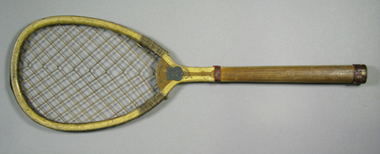
Racquet, Circa 1882, 30 Jun 1883
... The plaque conceals the manufacturer's details, which, from what is still legible, is definitely George G. Bussey. The model type 'THE DIAMOND' and the number 13 features on the upper throat and stem on the obverse, respectively. ...The plaque conceals the manufacturer's details, which, from what is still legible, is definitely George G. Bussey. The model type 'THE DIAMOND' and the number 13 features on the upper throat and stem on the obverse, respectively. ...A wooden racquet with a convex throat and tilt top. The handle is framed by red leather end and stem wraps. String whipping feature at both sides towards the base of the head. The outer frame of the racquet head is sealed with a green painted cloth strip, glued and nailed to it. At the base of the throat on the obverse is a nailed silver plaque, with an engraved inscription and monogram: 30, JUNE, 83/AGF/"YOU KNOW WHO". The plaque conceals the manufacturer's details, which, from what is still legible, is definitely George G. Bussey. The model type 'THE DIAMOND' and the number 13 features on the upper throat and stem on the obverse, respectively. To highlight the model name, the gutstringing is arranged in a rare, diamond pattern. Materials: Wood, Gut, String, Cloth, Leather, Metal, Glue, Lacquertennis -
 Emerald Museum & Nobelius Heritage Park
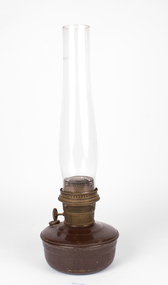
Domestic object - Aladdin Oil Lamp, Aladdin, c. 1943
... Glass chimney, printed: "Aladdin" Wick raiser knob, engraved: ".MANTLE LAMP CO. / NU-TYPE / Model B / Aladdin / PATENTS PENDING / MADE IN / U.S.A / CHICAGO, ILL."...Model 16B, with an Australian-made bowl and American-made burner, as these were cheaper to import from the Chicago warehouse than to make locally. Significant wear around the underside of the lamp's lip may indicate that it was often used with a hanging frame. This lamp demonstrates the lasting necessity of kerosene and oil-powered lighting in more outlying regions like Emerald, even in an age where electricity was beginning to become nationally available. 1940s Domestic Life Glass chimney, printed: "Aladdin" Wick raiser knob, engraved: ".MANTLE LAMP CO. / NU-TYPE / Model B / Aladdin / PATENTS PENDING / MADE IN / U.S.A / CHICAGO, ILL." ...Before electricity was common in households throughout Victoria, kerosene lamps were used to illuminate our homes. The oil lamp manufacturer, Aladdin, arrived in Australia in 1916 after remaining primarily a United States-run company. Their lamps became incredibly popular in Australia following the company's official incoporation in 1924 where, even as the following decades saw a rapid increase in urbanisation and electricity, the demand for kerosene lamps remained high. A unique feature of the Australian-made models was that which allowed them to be transferred to different holders and stems. This meant that one lamp could function in multiple different ways, saving a family from needing to buy multiple lamps to sit in floor stems, on tables, or hang from ceiling brackets. From 1939, adapters could also be purchased to convert a kerosene lamp into an electric one. The lamp featured is likely a Model 16B, with an Australian-made bowl and American-made burner, as these were cheaper to import from the Chicago warehouse than to make locally. Significant wear around the underside of the lamp's lip may indicate that it was often used with a hanging frame.This lamp demonstrates the lasting necessity of kerosene and oil-powered lighting in more outlying regions like Emerald, even in an age where electricity was beginning to become nationally available.An oil lamp composed of two pieces: a metal base and a tall glass chimney. The base of the lamp is circular with a flat bottom and a small lip running around the highest outside edge. Underneath the base is a small hole. A circular cap rests on the top of the base, and protruding vertically from the base is a cylindrical metallic burner. The burner is perforated with many small ventilation holes, and an inscribed knob sticks out from its side. A glass chimney rests over the top of the burner.Glass chimney, printed: "Aladdin" Wick raiser knob, engraved: ".MANTLE LAMP CO. / NU-TYPE / Model B / Aladdin / PATENTS PENDING / MADE IN / U.S.A / CHICAGO, ILL."1940s, domestic life -
 Moorabbin Air Museum
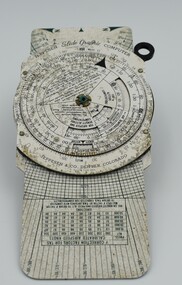
Instrument (item) - Slide Graphic Computer Jeppesen Model CSG-1A
... Slide Graphic Computer Jeppesen Model CSG-1A. Pilot's type MB4, complete with leather pouch. ...Slide Graphic Computer Jeppesen Model CSG-1A. Pilot's type MB4, complete with leather pouch. ... -
 Kiewa Valley Historical Society
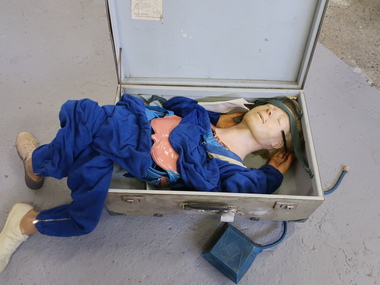
Resusci-Anne and Equipment
... See KVHS 0542 for Resusci-Anne Repair Kit Doll type model with face, arms and legs folded into a 1950s carrying case. ...Wikipedia Used in the Kiewa Valley by Educators of First Aid and emergency workers Resusci Anne first aid emergency education See KVHS 0542 for Resusci-Anne Repair Kit Doll type model with face, arms and legs folded into a 1950s carrying case. ...Resusci Anne was used for teaching both emergency workers and members of the general public. Developed by Asmund S. Laerdal, Peter Safar, and James Elam and produced by the company Laerdal Medical.The first version of rescue Annie was presented by Laerdal in 1960. Later the design was refined and included a simulated carotid pulse, eye pupils that could dilate and constrict and a system for recording the trainee's resuscitation performance on a paper tape. Ref. WikipediaUsed in the Kiewa Valley by Educators of First Aid and emergency workersSee KVHS 0542 for Resusci-Anne Repair Kit Doll type model with face, arms and legs folded into a 1950s carrying case. The model has blue clothing. Enclosed are the instructions for packing the model and papers for treatment of an unconscious patient.resusci anne, first aid, emergency education -
 Bendigo Historical Society Inc.
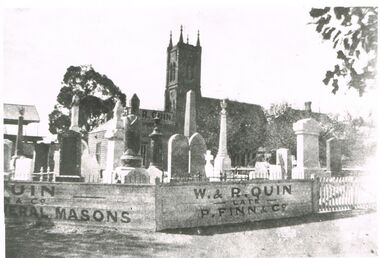
Photograph - PHOTO OF A MASONRY BUSINESS IN MITCHELL STR WITH ST PAULS CHURCH IN THE BACKGROUND
... Inside the yard are models of the types of Headstones that may be purchased....Inside the yard are models of the types of Headstones that may be purchased. ...Black and White photograph of a stone mason's business located at the corner of Myers Street, Lyttleton Terrace and Mitchell Street Bendigo. Names and other on the fence are; W. & R. Quin - late- P. Finn & Co. A partial name on the left makes reference to Funeral Masons. Inside the yard are models of the types of Headstones that may be purchased.business, retail, funeral masonry, stone mason and st pauls cathedral. -
 Ballarat Tramway Museum
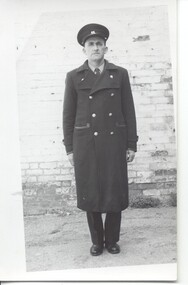
Photograph - Black & White Photograph/s - set of 5, State Electricity Commission of Victoria (SECV), late 1950's?
... Set of five black and white photographs, showing a SEC employee modelling different type of uniforms, c1950/1960. .1 - Winter uniform with Great Coat on - cap badge No. 44 .2 - Summery uniform - no jacket, long sleeve shirt and tie - cap badge No. 44 .3 - Inspectors summer uniform - no jacket .4 - as for .3 .5 - Inspectors winter uniform with Great Coat and cap. ...Has a strong association with the early days of the BTPS in preparing to move the tramcars from the depot and working at the former SEC depot itself in dismantling 0 road.. trams tramways SECV Uniforms Crews Inspectors Set of five black and white photographs, showing a SEC employee modelling different type of uniforms, c1950/1960. .1 - Winter uniform with Great Coat on - cap badge No. 44 .2 - Summery uniform - no jacket, long sleeve shirt and tie - cap badge No. 44 .3 - Inspectors summer uniform - no jacket .4 - as for .3 .5 - Inspectors winter uniform with Great Coat and cap. ...Has a strong association with the early days of the BTPS in preparing to move the tramcars from the depot and working at the former SEC depot itself in dismantling 0 road..Set of five black and white photographs, showing a SEC employee modelling different type of uniforms, c1950/1960. .1 - Winter uniform with Great Coat on - cap badge No. 44 .2 - Summery uniform - no jacket, long sleeve shirt and tie - cap badge No. 44 .3 - Inspectors summer uniform - no jacket .4 - as for .3 .5 - Inspectors winter uniform with Great Coat and cap. See also Reg Item 3907 for a mounted set of these photographs. See also Reg item 1368 for a set of photographs of later uniforms.trams, tramways, secv, uniforms, crews, inspectors -
 Flagstaff Hill Maritime Museum and Village
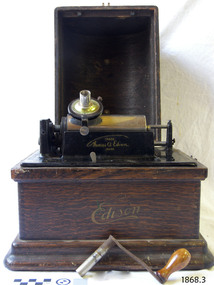
Audio - Phonograph, Thomas A. Edison, Edison Laboratory, c.1909
... The Edison Fireside Phonograph Combination Type A model phonograph was an open horn model. ...Phonograph; Edison Fireside Phonograph, Combination Type, Model A. It is in a wooden case with a domed lid, metal catches on each side and a folding wooden handle. ...The Edison Fireside Phonograph Combination Type A model phonograph was an open horn model. ...The Edison Fireside Phonograph Combination Type A model phonograph was an open horn model. This machine was produced around 1909, just after the introduction of 4-minute record cylinders in 1908.; the selection lever on the front was either 4 or 2-minute choice. This Fireside model has a fluted octagonal horn that attaches to the reproducer on the machine and is suspended by on ring by a horn crane attachment. The phonograph machine is powered purely by mechanical means, winding the crank handle on the side of the machine to start the belt-driven, spring-loaded motor inside. The sound comes from a pre-recorded, vertical cut record cylinder, which slides over the Mandle, a smooth rotating drum. The reproducer, an all-in-one needle, amplifier and speaker, is lowered onto the cylinder, the needle picks up the sound and plays it on the speaker and the attached horn amplifies the sound. The phonograph machine was invented by Thomas Alva Edison in the late 19th century. Edison adopted the idea from the technology of the telegraph machine. He patented the phonograph in early 1878. It was able to record sound and play it back. This amazing invention opened up a whole new world of entertainment, where wax cylinders of pre-recorded sound could be purchased with a wide variety of music and played over and over. The first wax cylinders were white and used a combination of bees' wax and animal fax or tallow. By 1892 Edison was using 'brown wax' cylinders that ranged from cream through to dark brown. The Edison Phonograph Company was formed in 1887 to produce these machines. He sold the company in 1855 to the North American Phonograph Company but bought that company in 1890. He then started the Edison Spring Motor factory in 1895, and the National Phonograph Company in 1896. In 1910 the company became Thomas A. Edison Inc. In 1898 Edison produced the Edison Standard Phonograph, the first phonograph to carry his own trade mark. He began mass producing duplicate copies of his wax cylinders in 1901 using moulds instead of engraving the cylinders. The wax was black and harder than the brown wax. The ends of the cylinders were bevelled so that the title's label could be added. The last phonograph machine to use an external open horn was produced in 1912 due to the much more robust round records being invented. In 1913 Edison started producing the Edison Disc Phonograph. The company stopped trading in 1929.This Edison Fireside Phonograph model is significant for being one of the last models to have an external horn. It is also significant for its connection with the invention of the phonograph, which made music and sound available for domestic enjoyment. It was used for entertainment and education, even teaching languages. It signalled a new era of music that could be reproduced and played anywhere. It is also significant for its short time span of popularity, just a few decades, due to the growing use of records, which gave a much higher quality sound and were more robust.Phonograph; Edison Fireside Phonograph, Combination Type, Model A. It is in a wooden case with a domed lid, metal catches on each side and a folding wooden handle. It has a metal drum and a reproducer mechanism. The metal and wood crank handle starts the machine’s motor. A sliding lever at the front selects the speed for four- or two-minute cylinders. The inscribed plate has the maker, serial number, patents and other information. The reproducer also has an inscription. It has a curved metal open horn attachment. Made in Orange, New Jersey in c.1909. NOTE: the fluted octagonal horn is catalogued separately.Case front, in script, Edison’s early ‘banner’ decal “Edison” On the front of the machine “Thomas A Edison TRADE MARK” On the maker’s plate; "Edison Fireside Phonograph Combination Type" Serial number “14718” Around sound outlet; “C 4076” “REPRODUCER LICENCED FOR USE ONLY ON EDISON PHOTOGRAPHS SOLD BYT.A. EDISON INC.” At the front edge “4 MINUTES 2flagstaff hill, maritime museum, maritime village, warrnambool, great ocean road, shipwreck coast, gramophone, phonograph, music player, entertainment, audio equipment, edison, thomas a edison, horn, phonograph horn, amplifier, audio, sound recording, sound playback, phonograph machine, phonograph cylinder, external horn, edison phonograph company, wax cylinders, sound reproduction, edison spring motor factory, national phonograph company, thomas a. edison inc, crank-operated motor, open horn phonograph, 4 speed, 2 speed -
 Frankston RSL Sub Branch
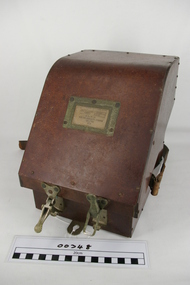
Sextant, Bubble
... Bubble Sextant model Mark 1XA type A.M. 6B/218 in protective storage box. ...The storage case has a label with the following: "A.M. 6B/218 MK IX A" and the number "10772/42 (V)" Bubble Sextant model Mark 1XA type A.M. 6B/218 in protective storage box. ...Bubble Sextant model Mark 1XA type A.M. 6B/218 in protective storage box. Complete, with operation instructions. This is an aviation navigation instrument used by the RAF and RAAF during the World War 2 era. A sextant is used to measure the altitude of celestial bodies above a horizontal line of reference. A navigator can use the horizon as this line of reference, but when an aircraft is above the clouds or flying at night, the navigator can’t see the horizon. The bubble sextant solves this problem by providing an artificial horizon.The storage case has a label with the following: "A.M. 6B/218 MK IX A" and the number "10772/42 (V)" -
 Flagstaff Hill Maritime Museum and Village
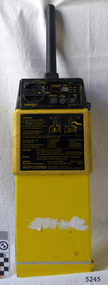
Equipment - EPIRB Transmitter
... "406P (X) EPIRB" “Model 406” "Lokata Type No 92408" "UK Type approved to MPT 1278" "Class 2" "Made by Lokata Ltd, Falmouth Cornwall England TR10 8AE"" "LOKATE LTD. ... "406P (X) EPIRB" “Model 406” "Lokata Type No 92408" "UK Type approved to MPT 1278" "Class 2" "Made by Lokata Ltd, Falmouth Cornwall England TR10 8AE"" "LOKATE LTD. ...This distress EPIRB unit (Emergency Position Indication Radio Beacon) was found on the beach at Levy's Point, Warrnambool, in December 2000 by a Warrnambool resident. Local police were alerted at the time. This distress signal unit is a world-wide COSPAS/SARSAT, satellite assisted, SAR (Search and Rescue) system for location of distress transmissions emitted by an EPIRB. Offshore cruising vessels must have such a unit as part of its essential safety equipment. This model EPIRB relies on four satellites with orbit times of approximately 100 minutes. Earlier units relied solely on aircraft flying overhead to detect and forward on the EPIRB’s location to Search And Rescue authorities, whereas this new system utilises satellites. An employee from the Lokata firm provided additional information about the Lokata EPIRB units. They had a machined aluminium case with labels that were also made on site. The units could be activated manually or automatically released when a magnetic switch in the case casing was activated. This later model, circa 1983, would have been mounted externally on a vessel's bulkhead in a spring-loaded, stainless-steel protective 'skeleton' mounting, The unit released when the water pressure sensor detected a set time it was under the water, in a similar way that life crafts were released. Each unit was registered to a particular vessel - the vessel's details on this unit are indecipherable. The Lokata Company was established in 1970, designing and manufacturing marine products including communications. The company no longer makes products with the “Lokata” brand. In 2001 Sartech Engineering Ltd. took over the support for the Lokata EPIRB beacons. This emergency location device is a late 20th century invention to help save lives at sea. It adds to the history of maritime life, its risks, the lives lost as sea, and the many inventions aimed as rescuing and saving lives. The local area is notorious for the number of lives lost through shipwreck. It also carries stories of heroic efforts to save lives, and other inventions to help reduce the chance of accidents at sea.EPIRB unit; “Emergency Position Indication Radio Beacon”. A distress communication unit for sending a distress location transmission in an emergency at sea. The EPIRB is a yellow, rectangular box with dials, buttons, indicator lights and instruction. An antenna protrudes from the top of the unit. The EPIRB unit sends a 406P (X) EPIRB, with 406M-Hz frequency, 48-hour duration signal. The maker was LOKATA Ltd in England. Remnants of a white label remain on the side. Circa 1980s."NAME OF VESSEL 'SERVICE IF SELF TEST FAILS' " “LO-KATA” moulded into the body. "406P (X) EPIRB" “Model 406” "Lokata Type No 92408" "UK Type approved to MPT 1278" "Class 2" "Made by Lokata Ltd, Falmouth Cornwall England TR10 8AE"" "LOKATE LTD. New North Road Hainault, Ilford Essex IG6 2UR" "ARMED / SAFE / TRANSMIT / CODE / DISPLAY / SET / wait / pass / fail / TEST" "IDENTIFIER / 1349:24034234N" [some characters may be different] "COUNTRY / DENMARK" "VESSEL IDENTITY / 124 [the rest is indecipherable]flagstaff hill, warrnambool, shipwrecked-coast, flagstaff-hill, flagstaff-hill-maritime-museum, maritime-museum, shipwreck-coast, flagstaff-hill-maritime-village, emergency position indicating radio beacon, epirb, lokata ltd, marine safety equipment, satellite transmitting beacon, safety equipment, distress signal, life saving, safety at sea, shipwreck location, lo-kata, falmouth, emergency, beacon, radio signal, communication, marine equipment -
 Ballarat Tramway Museum
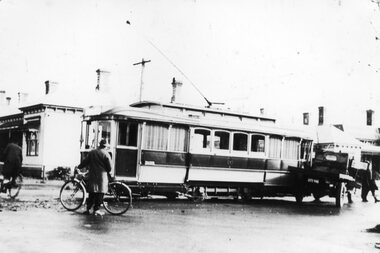
Photograph - Black & White Photograph/s, State Electricity Commission of Victoria (SECV), late 1930's
... The vehicle is a 1928 Model A Ford type AA. The tramcar body card shows it was repaired following an accident June 1939. ...The vehicle is a 1928 Model A Ford type AA. The tramcar body card shows it was repaired following an accident June 1939. ...Black and white photograph of a collision, accident, between SEC Ballarat No. 14 and a motor truck at the intersection of Drummond St. North and Webster St. mid 1939. Note debris on road behind tram, showing possible location of collision. Official SEC photo, there are other photos of this collision in the collection. The vehicle is a 1928 Model A Ford type AA. The tramcar body card shows it was repaired following an accident June 1939. (Note added 2-2-19). See Reg Item 1365.1 > .5 for the larger prints of this photograph. See also Reg Item 3904 for a mounted set of these photographs along with that of Reg Item. 1019, 1366 and 1365.trams, tramways, ballarat, drummond st., accidents , tram 14 -
 Ballarat Tramway Museum
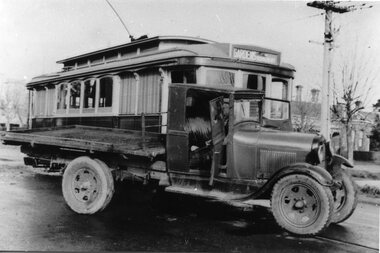
Photograph - Black & White Photograph/s - set of 2, State Electricity Commission of Victoria (SECV), 1930's
... The vehicle is a 1928 Model A Ford type AA. See also Reg Item 6210 for a BTM printed postcard....The vehicle is a 1928 Model A Ford type AA. See also Reg Item 6210 for a BTM printed postcard. ...1019.1 and 1019.2 - Black and white photograph of SEC Tram 14 involved with a collision with a Ford truck during 1939 on the corner of Drummond St. North and Webster St. Ford truck registration 277.745 . Both vehicles have windows smashed and other damage. Tram painted in 1930's colour scheme with a small "Pay as You Enter" sign adjacent to the open door. Known to be SEC photos originally. See SEC Photo collection item. Was reprinted in the Ballarat News during the early to mid 1980's. Other photos of this accident gave close up details of lining used in the tram paint scheme. This was used as the basis of lining done on No. 27. The tramcar body card shows it was repaired following an accident June 1939. (Note added 2-2-19). Photocopy made 4/1999 for display purposes. See Reg Item 1365.1 > .5 for the larger prints of this photograph. See also Reg Item 3904 for a mounted set of these photographs along with that of Reg Item. 580, 1366 and 1365. The vehicle is a 1928 Model A Ford type AA. See also Reg Item 6210 for a BTM printed postcard.On rear stamped on both photos "Copyright / The Ballarat News"trams, tramways, drummond st. nth, accidents, webster st, tram 14
