
Showing 99 items matching "murder of police"
-
 The Beechworth Burke Museum
Photograph - Poster - Reproduction, December 1878
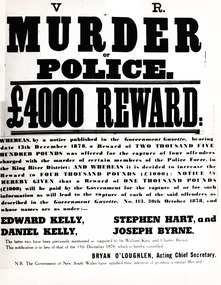
... ...murder of police...The men were charged with the murder of police in the King River District. The poster notes that the previous reward of £2500 offered on 13 December 1878 has been cancelled, and replaced with this increased reward money....Obverse: V / R ./ MURDER / OF / POLICE. /£4000 REWARD:...The members of the Kelly Gang were hiding out in the Beechworth area. kelly album wanted poster reward murder of police Edward Kelly Daniel Kelly Stephen hart Joseph Byrne £4000 King River District 1878 Kelly gang Obverse: V / R ./ MURDER / OF / POLICE. /£4000 REWARD: Black and white rectangular reproduced poster printed on paper Photograph Poster - Reproduction ...Poster created 13th December 1878 by the Government of New South Wales, offering a reward of £4000 for information leading to the capture of Edward Kelly, Daniel Kelly, Stephen Hart and Joseph Bryne. The men were charged with the murder of police in the King River District. The poster notes that the previous reward of £2500 offered on 13 December 1878 has been cancelled, and replaced with this increased reward money.The poster identities numerous Bushrangers who were being charged by the State Police Department in the late 19th Century. The large reward indicates the strong need and desire for information by the Police Department. The members of the Kelly Gang were hiding out in the Beechworth area.Black and white rectangular reproduced poster printed on paperObverse: V / R ./ MURDER / OF / POLICE. /£4000 REWARD:kelly album, wanted poster, reward, murder of police, edward kelly, daniel kelly, stephen hart, joseph byrne, £4000, king river district, 1878, kelly gang -
 The Beechworth Burke Museum
Photograph, c1910
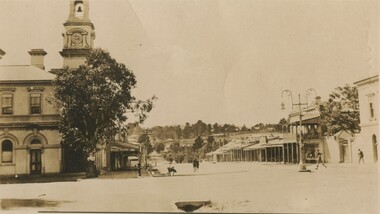
... The P.0. played an important role in communicating news in 1880 of the infamous murders of police at Stringybark Creek and the various exploits of the Kelly gang....The P.0. played an important role in communicating news in 1880 of the infamous murders of police at Stringybark Creek and the various exploits of the Kelly gang. beechworth camp street post office burke museum photograph postcard 1910 Obverse: Camp Street, Beechworth REAL PHOTO SERIES. ...This photograph was taken at the Camp Street Beechworth at the intersection with Ford Street c1910 looking at the post office on the left hand side and a row of shops on the right. The Post Office is the photograph was completed in 1859. Following a fire along Camp St in 1867 the Post Office was rebuilt with a bell and clock tower. The P.0. played an important role in communicating news in 1880 of the infamous murders of police at Stringybark Creek and the various exploits of the Kelly gang.Sepia rectangular postcard printed on gloss card. Obverse: Camp Street, Beechworth REAL PHOTO SERIES. M5911 Reverse: BMM7734.2 VALENTINES REAL PHOTO SERIES Published by the Valentine Publishing Co.Pty.Ltd. Queen St. Melb 1906-1910? beechworth, camp street, post office, burke museum, photograph, postcard, 1910 -
 Greensborough Historical Society
Book, Police Historical Society, In the performance of duty / by Gavin Brown, Gary Presland and Ralph Stavely, 1994_
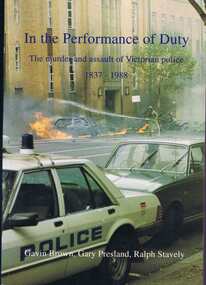
... This book tells of the murder and assault of Victorian police 1837-1988....This book tells of the murder and assault of Victorian police 1837-1988. victoria police ralph stavely gary presland gavin brown 320 p., illus. ...This book tells of the murder and assault of Victorian police 1837-1988.320 p., illus. Paperback.victoria police, ralph stavely, gary presland, gavin brown -
 Victoria Police Museum
Manuscript (Thomas McIntyre), A True Narrative of the Kelly Gang, January - February 1900
... Hand typed manuscript of Constable McIntyre's version of events surrounding the Stringybark Creek police murders and his interpretation of the events relating to the Kelly Gang....Ned Kelly Edward Kelly Kelly Gang Thomas McIntyre Police Murders Stringybark Creek Hand typed manuscript of Constable McIntyre's version of events surrounding the Stringybark Creek police murders and his interpretation of the events relating to the Kelly Gang. ...Hand typed manuscript of Constable McIntyre's version of events surrounding the Stringybark Creek police murders and his interpretation of the events relating to the Kelly Gang.ned kelly, edward kelly, kelly gang, thomas mcintyre, police murders, stringybark creek -
 Victoria Police Museum
Carte de visite (Thomas McIntyre and Edward Monk), Burman, Melbourne, 1878 - 1882
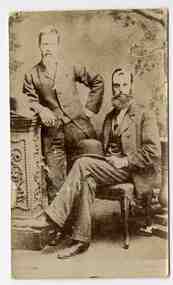
... murder trial. Edward Monk (1844 - 1928) was a selector living in the area, who accompanied the police party sent to returned to collect the bodies of the murdered police. ...murder trial. Edward Monk (1844 - 1928) was a selector living in the area, who accompanied the police party sent to returned to collect the bodies of the murdered police. ...Thomas Newman McIntyre (1846 - 1918) was the sole survivor of the police party murdered by the Kelly Gang at Stringybark Creek on 28 October 1878. Importantly, McIntyre was later the key witness in Ned Kelly's murder trial. Edward Monk (1844 - 1928) was a selector living in the area, who accompanied the police party sent to returned to collect the bodies of the murdered police. Both men became great friends later in life.Small sepia coloured carte de visite photograph of Edward Monk (standing) and Thomas McIntyre (seated), printed on thin photographic paper.Constable McIntyre sitting. Mr Ted Mond standing (of saw mill)ned kelly, kelly gang, thomas mcintyre, stringybark creek, edward monk -
Port Melbourne Historical & Preservation Society
Photograph - Demolition, 225 Princes Street, Port Melbourne, Pat Grainger
... 225 Princes Street was sold and demolished after its owner, Ted Young, was brutally murdered there (multiple stabbing). Police thought they knew who did it but had no evidence. ...225 Princes Street was sold and demolished after its owner, Ted Young, was brutally murdered there (multiple stabbing). Police thought they knew who did it but had no evidence. ...225 Princes Street was sold and demolished after its owner, Ted Young, was brutally murdered there (multiple stabbing). Police thought they knew who did it but had no evidence. Wall of Milk Bar across Princes Street was subsequently demolished.One of three colour photos of 225 Princes Street following demolition (2000?): .01 View from Princes Street through to the back of 70 Station StreetSome notes in pencilbuilt environment - domestic, demolitions, crimes and misdemeanours, edward (ted) young -
Port Melbourne Historical & Preservation Society
Photograph - Back wall of Milk Bar in Princes Street from 70 Station Street, Port Melbourne, Pat Grainger
... 225 Princes Street was sold and demolished after its owner, Ted Young, was brutally murdered there (multiple stabbing). Police thought they knew who did it but had no evidence. ...225 Princes Street was sold and demolished after its owner, Ted Young, was brutally murdered there (multiple stabbing). Police thought they knew who did it but had no evidence. ...225 Princes Street was sold and demolished after its owner, Ted Young, was brutally murdered there (multiple stabbing). Police thought they knew who did it but had no evidence. Wall of Milk Bar across Princes Street was subsequently demolished.One of three colour photos of 225 Princes Street following demolition (2000?): .02 View from 70 Station Street through to Princes Street and back wall of Milk Bar before demolition.Some notes in pencilbuilt environment - domestic, demolitions, crimes and misdemeanours, edward (ted) young -
Port Melbourne Historical & Preservation Society
Photograph - Back wall of Milk Bar in Princes Street from 70 Station Street, Port Melbourne, Pat Grainger
... 225 Princes Street was sold and demolished after its owner, Ted Young, was brutally murdered there (multiple stabbing). Police thought they knew who did it but had no evidence. ...225 Princes Street was sold and demolished after its owner, Ted Young, was brutally murdered there (multiple stabbing). Police thought they knew who did it but had no evidence. ...225 Princes Street was sold and demolished after its owner, Ted Young, was brutally murdered there (multiple stabbing). Police thought they knew who did it but had no evidence. Wall of Milk Bar across Princes Street was subsequently demolished.One of three colour photos of 225 Princes Street following demolition (2000?): .03 Higher view from 70 Station Street through to Princes Street and back wall of Milk Bar at Liardet and Princes before demolition.of the wallSome notes in pencilbuilt environment - domestic, demolitions, crimes and misdemeanours, edward (ted) young -
 Victoria Police Museum
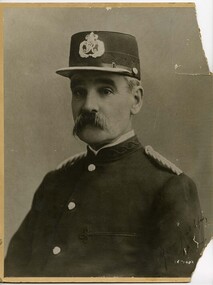
Photograph (Pewtress), Henry Pewtress, 1892
... He was subsequently a member of the murdered Police Memorial Fund established in the Mansfield area after the death of Lonigan, Scanlan and Kennedy in October 1878....He was subsequently a member of the murdered Police Memorial Fund established in the Mansfield area after the death of Lonigan, Scanlan and Kennedy in October 1878. sub-inspector mansfield victoria police ned kelly kelly gang lonigan scanlan kennedy "Pewtress" (Thick felt pen on rear) "CP49" (red felt pen top rear corner) "Supt resigned 9/3/1892 65 years (blue pen on rear) "Yours Faithfully H. ...Henry Pewtress was a sub-inspector of Victoria Police. He was in charge of the Mansfield area when the three police were killed by the Kelly Gang at Stringybark Creek. Pewtress organised the search party but having little local knowledge he went to see Dr Samuel Reynolds and others. They located the bodies of Lonigan and Scanlan easily, but did not find Kenney's until three days later. He was subsequently a member of the murdered Police Memorial Fund established in the Mansfield area after the death of Lonigan, Scanlan and Kennedy in October 1878.Mounted black and white image of Henry Pewtress. Image is signed by Pewtress in bottom right hand corner."Pewtress" (Thick felt pen on rear) "CP49" (red felt pen top rear corner) "Supt resigned 9/3/1892 65 years (blue pen on rear) "Yours Faithfully H. Pewtress" (ink on front bottom right corner)sub-inspector, mansfield, victoria police, ned kelly, kelly gang, lonigan, scanlan, kennedy -
 The Beechworth Burke Museum
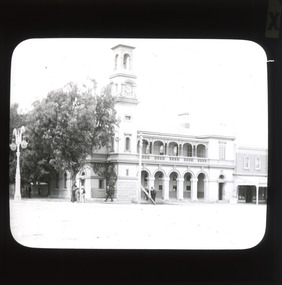
Photograph - Lantern Slide, c1900
... It reportedly played an important role in communicating the news of the 1880 murders of police at Stringybark Creek by the Kelly Gang. ...It reportedly played an important role in communicating the news of the 1880 murders of police at Stringybark Creek by the Kelly Gang. ...This glass slide presents an image of the Old Beechworth Post Office and was taken in the year 1900. The building displayed within the image is not that of the post office in its original form; the post office originally consisted of only a simple wooden building. With the establishment and growth of new towns across Victoria, as well as an increased need for more consistent communications with the City of Melbourne, this modest building was soon deemed inadequate. In 1858 it was brought into the style of the changing times, with the tall clock tower added in 1865. This transition aligned with a pattern of refurbishment and conversion of many Beechworth buildings (which could be seen during the 1860s-70s), aiding in the growth and prosperity of the town. Early makeshift homes were turned into more substantial dwellings, featuring elements such as weatherboard, brick, and granites materials, and gabled or hipped roofs with iron lacework fringing the verandah. These refurbishments were temporarily halted in March of 1867 when a fire swept through the town, damaging many buildings including the post office. This led to further reconstructions on the building, including heightening of the clock tower, and in 1870 the two-storey Italianate style building was completed. The Old Beechworth Post Office itself also holds significance due to its connection with one of Australia's most infamous families. It reportedly played an important role in communicating the news of the 1880 murders of police at Stringybark Creek by the Kelly Gang. Lantern slides, sometimes called 'magic lantern' slides, are glass plates on which an image has been secured for the purpose of projection. Glass slides were etched or hand-painted for this purpose from the Eighteenth Century but the process became more popular and accessible to the public with the development of photographic-emulsion slides used with a 'Magic Lantern' device in the mid-Nineteenth Century. Photographic lantern slides comprise a double-negative emulsion layer (forming a positive image) between thin glass plates that are bound together. A number of processes existed to form and bind the emulsion layer to the base plate, including the albumen, wet plate collodion, gelatine dry plate and woodburytype techniques. Lantern slides and magic lantern technologies are seen as foundational precursors to the development of modern photography and film-making techniques. This glass slide captures social and historical significance as it displays the Old Beechworth Post Office in 1900, a building that demonstrates the prosperity and growth of Beechworth as a town during this time period. This slide also holds a level of aesthetic significance due to the Italianate style building that is featured in its image; a style that became very popular during the nineteenth-century. Thin translucent sheet of glass with a square image printed on the front and framed in a black backing. It is held together by metal strips to secure the edges of the slide.Obverse: x / burke museum, beechworth, lantern slide, slide, glass slide, plate, burke museum collection, photograph, monochrome, beechworth post office, beechworth post office kelly gang, 1900, 1900 beechworth, growth of beechworth, 1867 beechworth fire, old beechworth post office, beechworth post office reconstructions, italianate style, italianate style buildings, italianate style beechworth post office -
 The Beechworth Burke Museum
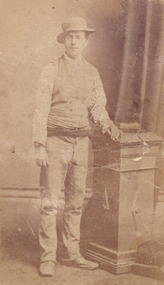
Photograph - Carte de Visite, James Bray, 1870
... The intention behind Sherritt’s murder was for the police to send word to Melbourne that the Kelly gang had murdered Sherritt and a police train would be sent to Glenrowan where the rest of the Kelly gang were waiting. ...The intention behind Sherritt’s murder was for the police to send word to Melbourne that the Kelly gang had murdered Sherritt and a police train would be sent to Glenrowan where the rest of the Kelly gang were waiting. ...This photograph was taken in c.1870 and depicts Aaron Sherrtt who is best known for his involvements with, and eventual assassination by, the Kelly gang. He stands upright in the image with his arm leaning on a podium which reaches his hip. He is wearing an outfit for which he was infamous. Richard Warren, son of the proprietor of the Ovens and Murray Advertiser once stated that “anyone seeing [Aaron] coming down Ford Street would ask, “Who the hell’s this? Some advance agent for the circus?”’. The outfit Aaron wore for this particular photoshoot is reminiscent of this quote. He wears an unusual spotted shirt with a waistcoat and a sash is tied at his waist. He wears boots which turn up slightly at the toes. The hat is a “pork pie” hat which is worn in the typical “Greta Mob” style with the chinstrap under the nose. Aaron Sherritt was born in 1854 in Prahran, Melbourne, to Irish Protestant parents John and Anne. Sherritt stood at 5 foot 10. He had hazel eyes, dark brown hair and pale olive skin. Sherritt was childhood friends with Kelly Gang member, Joe Byrne, having previously attended the same school. Both men had a reputation for stealing horses and on one occasion, after stealing and butchering a cow, Sherritt and Byrne were convicted to six months in Beechworth Gaol (1876). Sherritt, along with Byrne, were reportedly recruited by Ned Kelly in 1877 in stealing stock; however, Sherritt never became a fully-fledged member of the Kelly Gang. Nevertheless, Sherritt scouted for the Kelly Gang in 1878. He later struck a deal with the police (specifically, with Chief Commissioner Standish) to save Joe Byrne's life in exchange for leading the police to the other members of the Gang. From then on, Aaron Sherritt lived the dangerous life of a double agent, providing police with what is assumed today to have been outdated or incorrect information in return for money. On the 26th of June 1880, Aaron Sherritt was murdered in the Woolshed Valley. He was approximately 23-25 years old at death. This event marked the start of the Kelly gang’s last days. Sherritt was murdered by Byrne in front of his wife, 15 year old and heavily pregnant Ellen “Belle” Sherritt and her mother Ellen Barry. Also in the Sherritt dwelling on this particular night were four policemen. The intention behind Sherritt’s murder was for the police to send word to Melbourne that the Kelly gang had murdered Sherritt and a police train would be sent to Glenrowan where the rest of the Kelly gang were waiting. This plan did not go as predicted and ultimately the Kelly gang fell at Glenrowan in 1880. This photograph was taken by James Bray who worked as a professional photographer in Camp Street Beechworth from 1870-1891. He was one of four men who photographed the Kelly Gang after the siege in Glenrowan in 1880. He is also renowned for his previous work photographing members of the Kelly gang. This photograph is part of the Burke Museum "Kelly album" which includes a significant collection of photographs and artefacts connected to Ned Kelly and the Kelly Gang. Ned Kelly and his gang have become ingrained in Australian popular culture and thus many museums, art galleries and private collections house material connected to the Kelly story which allows the events and people to be researched and interpreted. Artefacts and photographs pertaining to the Kelly gang are particularly valuable for Australian museums. This particular photograph is significant for its connection to Beechworth photographer James Bray who is responsible for many images depicting members of the Kelly Gang. The photograph is also of artistic significance as an example of a Carte de Viste dating to 1880 and it's connection to Aaron Sherritt.Sepia rectangular photograph printed on card. Obverse: J.E.Bray./ Photo/ Beechworth Reverse: Portrait & Landscape/ Photographer 5/ Aaron Sherritt J E Bray Signature Beechworth/ Victoria Beware (almost erased out) Negatives Kept. Copies 5I/.Each May/ Be Had By Forwarding Name And Address/ Accompanied With Remittance To/ The Amount Of Order/ Photographs Coloured In Water Colours 10237. kelly album, woolshed valley, 1870s, kelly gang, joe byrne, ned kelly, aaron sherritt, james bray, beechworth, burke museum -
 Flagstaff Hill Maritime Museum and Village
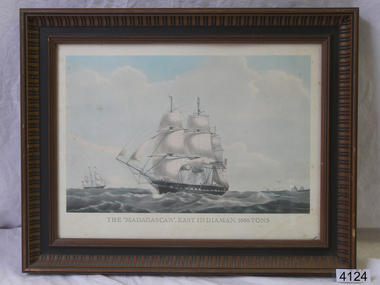
Print - Lithograph Picture, Madagascar Indiaman, Unknown
... police arrested two others, one on board the ship and the other as he was preparing to board. As a result of these arrests, Madagascar did not leave Melbourne until Friday 12 August 1853. After she left Port Phillip Heads Madagascar was never seen again. When the ship became overdue many theories were floated, including spontaneous combustion of the wool cargo, hitting an iceberg and, most controversially, being seized by criminal elements of the passengers and/or crew and scuttled, with the gold being stolen and the remaining passengers and crew murdered. ...police arrested two others, one on board the ship and the other as he was preparing to board. As a result of these arrests, Madagascar did not leave Melbourne until Friday 12 August 1853. After she left Port Phillip Heads Madagascar was never seen again. When the ship became overdue many theories were floated, including spontaneous combustion of the wool cargo, hitting an iceberg and, most controversially, being seized by criminal elements of the passengers and/or crew and scuttled, with the gold being stolen and the remaining passengers and crew murdered. ...Madagascar was a large British merchant ship built for the trade to India and China in 1837 that disappeared on a voyage from Melbourne to London in 1853. The disappearance of Madagascar was one of the great maritime mysteries of the 19th century and has probably been the subject of more speculation than any other 19th-century maritime puzzle, except for the Mary Celeste. Madagascar, the second Blackwall Frigate, was built for George and Henry Green at the Blackwall Yard, London, a shipyard that they co-owned with the Wigram family. A one-eighth share in the vessel was held throughout her 16-year career by her first master Captain William Harrison Walker Walker. Madagascar carried freight, passengers, and troops between England and India until the end of 1852. In addition to her normal crew, she also carried many boys being trained as officers for the merchant marine. Known as midshipmen from naval practice, their parents or guardians paid for their training, and they only received a nominal wage of usually a shilling a month. Due to the Victorian Gold Rush, Madagascar, under the command of Captain Fortescue William Harris, was sent to Melbourne with emigrants. She left Plymouth on 11 March 1853 and, after an uneventful passage of 87 days, reached Melbourne on 10 June. Fourteen of her 60 crew jumped ship for the diggings, and it is believed only about three replacements were signed on. She then loaded a cargo that included wool, rice, and about two tonnes of gold valued at £240,000, and took on board about 110 passengers for London. On Wednesday 10 August, just as she was preparing to sail, police went on board and arrested a bushranger John Francis, who was later found to have been one of those responsible for robbing on 20th July the Melbourne Private Escort between the McIvor goldfield at Heathcote, Victoria and Kyneton. On the following day, the police arrested two others, one on board the ship and the other as he was preparing to board. As a result of these arrests, Madagascar did not leave Melbourne until Friday 12 August 1853. After she left Port Phillip Heads Madagascar was never seen again. When the ship became overdue many theories were floated, including spontaneous combustion of the wool cargo, hitting an iceberg and, most controversially, being seized by criminal elements of the passengers and/or crew and scuttled, with the gold being stolen and the remaining passengers and crew murdered. There have been many rumors as to what happened to Madagascar over the years but what really happened is still a mystery. The lithograph was made around 1950 from an original painting of Madagascar a Vessel with a notorious past and is interesting and a significant item for the ships part in early Victorian history. The picture is it’s self not valuable or can be associated with a significant person in history. The interest lies in the events that are linked to the ship in the mid 19th century.Lithograph of the ship Madagascar, in a wooden frameThe Madagascar East Indiaman 1000 tonsflagstaff hill, warrnambool, shipwrecked-coast, flagstaff-hill, flagstaff-hill-maritime-museum, maritime-museum, shipwreck-coast, flagstaff-hill-maritime-village, lithograph, the madagascar, east indiaman -
 Federation University Historical Collection
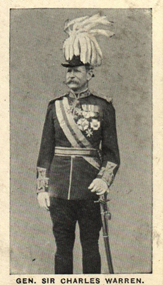
Photograph (black & White), General Sir Charles Warren - South Africa
... Previously he was police chief, the Head of the London Metropolitan Police during the Jack the Ripper murders. In 1876, the Colonial Office appointed him special commissioner to survey the boundary between Griqualand West and the Orange Free State. ...Previously he was police chief, the Head of the London Metropolitan Police during the Jack the Ripper murders. In 1876, the Colonial Office appointed him special commissioner to survey the boundary between Griqualand West and the Orange Free State. ...General Sir Charles Warren was an officer in the British Royal Engineers. He was one of the earliest European archaeologists ofthe Holy Land. Much of his military service was spene in British South Africa. Previously he was police chief, the Head of the London Metropolitan Police during the Jack the Ripper murders. In 1876, the Colonial Office appointed him special commissioner to survey the boundary between Griqualand West and the Orange Free State. For this work he was made a Companion of the Order of St Michael and St George in 1877. He was appointed special commissioner to investigate "native questions" in Bechuanaland and commanded the Northern Border Expedition troops in quelling the rebellion there. In 1879 he became Administrator of Griqualand West. The town Warranton in the Northern Cape Province of South Africa is named after him. In 1882 the Admiralty sent him to Sinai to discover what had happened to Professor Edward Palmer's archaeological expedition. He discovered the members had been robbed and murdered, located their remains and brought their killers to justice. For this he was created a Knight Commander of the Order of St Michael and St George in 1883 , also Knight of Justice of the Order of St John of Jerusalem and in 1884 elected a Fellow of the Royal Society. In 1884 Warren was sent as HM Special Commissioner to command a military expedition to Bechuanaland, to assert British sovereignty in the face of encroachments from Germany and the Transvaal and to suppress the Boer freebooter states of Stellaland and Goshen, which were backed by the Transvaal and were stealing land and cattle from the local Tswana tribes. This became known as the Warren Expedition and achieved its aims without bloodshed. Warren was recalled and in 1885 was made Knight Grand Cross ofthe Order of St Michael and St George. In 1885 Warren stood for election for Parliament but lost the vote. In 1886 he was appointed Commissioner of Police of the Metropolis following Sir Edmund Henderson's resignation. Criticised continually for his decisions and actions he resigned in November 1888. Prior to this time he was appointed Knight Commander of the Order of the Bath, January 1888. On the outbreak of the Boer War in 1899 he returned to service and commanded the 5th Division of the South African Field Force. In January 1990, Warren bungled the second attempted relief of Ladysmith at Tugela River. At the Battle of Spion Kop, January 1990 he had operational command and his failure of judgement, delay and indecision despite his superior forces culminated in the disaster. It has been said that Warren was "perhaps the worst" of the British generals in the Boer War and certainly the most "preposterous". Redvers Buller in a letter to his wife described him as "a duffer", responsible for him losing him "a great chance". Warren was recalled to Britain in August 1900 and never again commanded troops in the field. Individual image from photographed poster of tobacco and cigarette cards.holy land, sir charles warren, british royal engineers, archaeologist, british south africa, london metropolitan police, jack the ripper, colonial office, commissioner, griqualand west, orange free state, companion of the order of st michael and st george, bechuanaland, northern border expedition, warrenton, sinai, professor edward palmer, knight commander of the order of st michael and st george, knight of justice of the order of st johnof jerusalem, fellow of the royal society, knight grand cross of the order of st michael and st george, boer war, redvers buller, knight commander of the order of the bath -
 The Beechworth Burke Museum
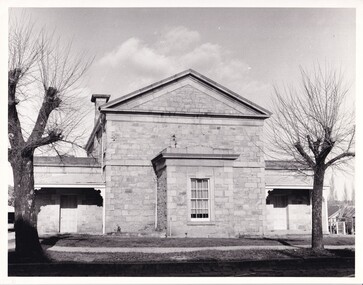
Photograph, c1970
... Police Station. The Courthouse is a significant site in Australia’s legal history because it was the location of more than 40 trials and hearings for the Kelly Gang and their sympathisers. 1850s Beechworth Beechworth Courthouse Ned Kelly 1800s Beechworth Kelly gang Beechworth Historic Courthouse 1858 kelly trials Daniel Kelly Dan Kelly Edward Kelly Ellen Kelly Elizabeth Scott the first woman hanged in Victoria Colony of Victoria 1863 domestic violence related murder Reverse Ministry of Tourism, Melbourne This a rectangular, black and white photograph, unmounted. ...The Beechworth Historic Courthouse is a living history museum in Victoria, Australia. Built in 1858, it has been in continuous service for 131 years and is currently home to a unique collection of artifacts, including its original furniture and fittings. The Courthouse Law Library is also recognised as being of outstanding national significance with many rare books held in the collection. The courthouse was built in 1858 and is located in the centre of the Beechworth Historic Precinct. It was built from granite with a double height gabled courtroom with the entrance via a central projecting porch. The building was classified in 1959 as part of Group Classification (B2615)with Forests Office, Lands Office, Police Lock-up & Police Station. The Courthouse is a significant site in Australia’s legal history because it was the location of more than 40 trials and hearings for the Kelly Gang and their sympathisers.This a rectangular, black and white photograph, unmounted.Reverse Ministry of Tourism, Melbourne1850s beechworth, beechworth courthouse, ned kelly, 1800s beechworth, kelly gang, beechworth historic courthouse, 1858, kelly trials, daniel kelly, dan kelly, edward kelly, ellen kelly, elizabeth scott, the first woman hanged in victoria, colony of victoria, 1863, domestic violence related murder -
 Eltham District Historical Society Inc
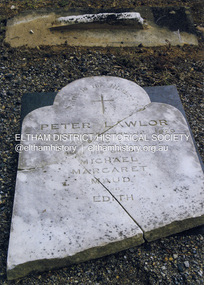
Photograph, Harry Gilham, Grave of Peter Lawlor and children, Eltham Cemetery, Victoria, 2016
... The small wooden building on the very corner is a modern replica of the separate police station/office built around 1885-1900. Cases investigated by Constable Lawlor included murders, stealing (horses, cattle, fowls, watches, linen, clothing), a search for a missing person, and two separate instances of abandoned children seeking help. ...The small wooden building on the very corner is a modern replica of the separate police station/office built around 1885-1900. Cases investigated by Constable Lawlor included murders, stealing (horses, cattle, fowls, watches, linen, clothing), a search for a missing person, and two separate instances of abandoned children seeking help. ...Grave of Peter Lawlor, Eltham's 1st policeman. Gravestone was borrowed from the cemetery & returned many years later. This photo was taken shortly after the (broken) stone was returned to Eltham Cemetery after 20 odd years absence. The Victorian gold rush came to Eltham in the early 1850s and with it came a crime wave. Local traders called for police protection. This led to the appointment in 1857 of Irish-born Peter Lawlor as Senior Constable at Eltham. In 1859 Peter and his wife Kate were able to move into an official police residence at the corner of Maria Street (now Main Road) and Brougham Street, with stables out the back and a large paddock for grazing across the road. Some of their children went to Eltham Primary School. That 1859 police residence is now the home of the Eltham District Historical Society. The small wooden building on the very corner is a modern replica of the separate police station/office built around 1885-1900. Cases investigated by Constable Lawlor included murders, stealing (horses, cattle, fowls, watches, linen, clothing), a search for a missing person, and two separate instances of abandoned children seeking help. He was officially commended in 1866 for bringing to justice a man who had indecently assaulted an 11-year old girl. Sadly, there was a similar but unconnected case only a few months later. But events had a lighter side; in 1871 Kate lent her piano to the Snowflakes Christy Minstrels for a Catholic Church fund-raising concert. Peter was transferred to Prahran in 1872. He died in 1876 and is buried in Eltham Cemetery with four of his children. His headstone was stolen some time after May 1990 but was returned anonymously (broken into three pieces) in August 2013. It is resting on his grave but has not been re-erected. The Inscription reads: Peter Lawlor Who died February 12th 1876 Aged 55 years Also his children Michael Margaret Maud and EdithColour print 21 x 15 cmeltham cemetery, gravestones, edith lawlor, margaret lawlor, maud lawlor, michael lawlor, peter lawlor -
 Eltham District Historical Society Inc
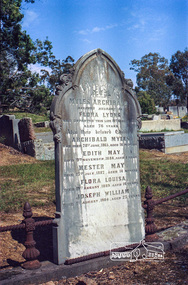
Negative - Photograph, Harry Gilham, Grave of Myles Archibald Lyons and children, Eltham Cemetery, Victoria, Sep 2009
... Police Station. Earlier in his career, he had taken part in a search (one of many) for missing explorers Burke and Wills. At Eltham, his arrests ranged from minor instances of theft, vandalism and larrikinism to serious cases of manslaughter, murder and attempted suicide. ...Police Station. Earlier in his career, he had taken part in a search (one of many) for missing explorers Burke and Wills. At Eltham, his arrests ranged from minor instances of theft, vandalism and larrikinism to serious cases of manslaughter, murder and attempted suicide. ...In 1872 Senior Constable Myles Lyons replaced Peter Lawlor at Eltham Police Station. Earlier in his career, he had taken part in a search (one of many) for missing explorers Burke and Wills. At Eltham, his arrests ranged from minor instances of theft, vandalism and larrikinism to serious cases of manslaughter, murder and attempted suicide. He even tracked down and arrested two Norwegian seamen charged with desertion from their vessel. While conveying a prisoner from Eltham to Melbourne in 1886, he was attacked by the prisoner en route. It seems that much of the local news in the Evelyn Observer was provided by Eltham Shire Secretary C.S. Wingrove. In 1878, Eltham residents held an “Indignation Meeting” at the Evelyn Hotel, complaining that the reporting had denigrated Lyons’ conduct and had stigmatised the character of Eltham’s inhabitants. They passed a resolution castigating Wingrove and supporting Lyons. Wingrove claimed to have been misconstrued. But in 1887 the Evelyn Observer carried a long ranting vitriolic editorial. It complained about inadequate policing generally, then attacked Lyons personally, saying that (although efficient in the past) he had now become incompetent and needed to be replaced by a younger more energetic man. Myles Lyons retired due to ill health in 1889 but remained in Eltham until his death in 1899. He is buried in Eltham Cemetery with his wife Flora and five of their children. Four sons moved to Western Australia where two were killed in unconnected railway accidents. In Loving Memory of Myles Archibald Beloved Husband of Flora Lyons Who Departed This Life 19th August 1899 Also their beloved Children Archibald Myles Myles died at age 75 on the same day as his 14 year old daughter, Flora Louise. Who died 28th June 1865, aged 18 months Edith May Died 9th November, 1884, aged 1 year Hester May Died 17th July, 1887, Aged 14 months Flora Louisa Died 19th August, 1889, aged 14 years Joseph William Died 1st August, 1904, aged 27 yearsRoll of 35mm colour negative film, 6 stripsKodak GC 400-9eltham cemetery, gravestones, edith may lyons, flora louisa lyons, flora lyons, hester may lyons, joseph william lyons, myles archibald lyons, police, archibald myles lyons -
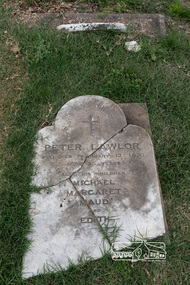 Eltham District Historical Society Inc
Photograph, Peter Pidgeon, Grave of Peter Lawlor and children, Eltham Cemetery, Victoria, 5 April 2021
... The small wooden building on the very corner is a modern replica of the separate police station/office built around 1885-1900. Cases investigated by Constable Lawlor included murders, stealing (horses, cattle, fowls, watches, linen, clothing), a search for a missing person, and two separate instances of abandoned children seeking help. ...The small wooden building on the very corner is a modern replica of the separate police station/office built around 1885-1900. Cases investigated by Constable Lawlor included murders, stealing (horses, cattle, fowls, watches, linen, clothing), a search for a missing person, and two separate instances of abandoned children seeking help. ...The Victorian gold rush came to Eltham in the early 1850s and with it came a crime wave. Local traders called for police protection. This led to the appointment in 1857 of Irish-born Peter Lawlor as Senior Constable at Eltham. In 1859 Peter and his wife Kate were able to move into an official police residence at the corner of Maria Street (now Main Road) and Brougham Street, with stables out the back and a large paddock for grazing across the road. Some of their children went to Eltham Primary School. That 1859 police residence is now the home of the Eltham District Historical Society. The small wooden building on the very corner is a modern replica of the separate police station/office built around 1885-1900. Cases investigated by Constable Lawlor included murders, stealing (horses, cattle, fowls, watches, linen, clothing), a search for a missing person, and two separate instances of abandoned children seeking help. He was officially commended in 1866 for bringing to justice a man who had indecently assaulted an 11-year old girl. Sadly, there was a similar but unconnected case only a few months later. But events had a lighter side; in 1871 Kate lent her piano to the Snowflakes Christy Minstrels for a Catholic Church fund-raising concert. Peter was transferred to Prahran in 1872. He died in 1876 and is buried in Eltham Cemetery with four of his children. His headstone was stolen some time after May 1990 but was returned anonymously (broken into three pieces) in August 2013. It is resting on his grave but has not been re-erected. The Inscription reads: Peter Lawlor Who died February 12th 1876 Aged 55 years Also his children Michael Margaret Maud and EdithBorn Digitaleltham cemetery, gravestones, edith lawlor, margaret lawlor, maud lawlor, michael lawlor, peter lawlor -
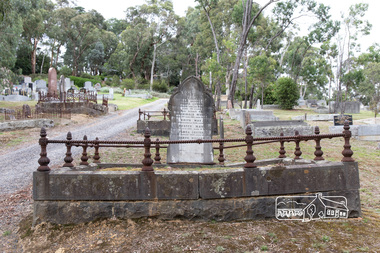 Eltham District Historical Society Inc
Photograph, Peter Pidgeon, Grave of Myles Archibald Lyons and children, Eltham Cemetery, Victoria, 5 April 2021
... Police Station. Earlier in his career, he had taken part in a search (one of many) for missing explorers Burke and Wills. At Eltham, his arrests ranged from minor instances of theft, vandalism and larrikinism to serious cases of manslaughter, murder and attempted suicide. ...Police Station. Earlier in his career, he had taken part in a search (one of many) for missing explorers Burke and Wills. At Eltham, his arrests ranged from minor instances of theft, vandalism and larrikinism to serious cases of manslaughter, murder and attempted suicide. ...In 1872 Senior Constable Myles Lyons replaced Peter Lawlor at Eltham Police Station. Earlier in his career, he had taken part in a search (one of many) for missing explorers Burke and Wills. At Eltham, his arrests ranged from minor instances of theft, vandalism and larrikinism to serious cases of manslaughter, murder and attempted suicide. He even tracked down and arrested two Norwegian seamen charged with desertion from their vessel. While conveying a prisoner from Eltham to Melbourne in 1886, he was attacked by the prisoner en route. It seems that much of the local news in the Evelyn Observer was provided by Eltham Shire Secretary C.S. Wingrove. In 1878, Eltham residents held an “Indignation Meeting” at the Evelyn Hotel, complaining that the reporting had denigrated Lyons’ conduct and had stigmatised the character of Eltham’s inhabitants. They passed a resolution castigating Wingrove and supporting Lyons. Wingrove claimed to have been misconstrued. But in 1887 the Evelyn Observer carried a long ranting vitriolic editorial. It complained about inadequate policing generally, then attacked Lyons personally, saying that (although efficient in the past) he had now become incompetent and needed to be replaced by a younger more energetic man. Myles Lyons retired due to ill health in 1889 but remained in Eltham until his death in 1899. He is buried in Eltham Cemetery with his wife Flora and five of their children. Four sons moved to Western Australia where two were killed in unconnected railway accidents. In Loving Memory of Myles Archibald Beloved Husband of Flora Lyons Who Departed This Life 19th August 1899 Also their beloved Children Archibald Myles Who died 28th June 1865, aged 18 months Edith May Died 9th November, 1884, aged 1 year Hester May Died 17th July, 1887, Aged 14 months Flora Louisa Died 19th August, 1889, aged 14 years Joseph William Died 1st August, 1904, aged 27 yearsBorn Digitaleltham cemetery, gravestones, archibald myles lyons, edith may lyons, flora louisa lyons, flora lyons, hester may lyons, joseph william lyons, myles archibald lyons -
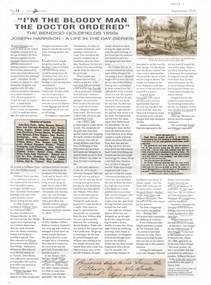 Bendigo Historical Society Inc.
Newspaper - Newspaper article re Joseph Harrison - A Life in the Day Series, "I'm the Bloody Man The Doctor Ordered" The Bendigo Goldfields 1850s, Joseph Harrison - A Life in the Day (Series)
... murder. He died 29 September 1854. https://convictrecords.com.au/convicts/harrison/joseph/112064 Williams Town (Port Phillip) Kilmore Bendigo Creek Sandhurst) Back Creek William Harrison Margaret Barrett Matthew Welsh Peter Parram Anne Hayes Sergeant James Simmonds Police Magistrate Lachlan McLachlan Ellen Robinson (nee Langam) Tasmasine Harrison John Duggan (Corky Jack). ...Joseph Harrison, born York UK Born: 1st Jan 1810, convict sentenced seven years hard labour, transported to Van Diemen's Land - Tasmania. Ticket of Leave August 1837. Arrived Williams Town (Port Phillip). 1840 worked as waterman. Married Margaret Barrett, relocated to Kilmore. Travelled to Bendigo Creek January 1853. By July 1853 had threatened to kill wife and eldest son William. Charged with attempted murder. He died 29 September 1854. https://convictrecords.com.au/convicts/harrison/joseph/112064Newspaper article from The Bendigo Monthly September 2020 Page 12, Includes copies of photographs and other newspaper articles within the story. Story of Joseph Harrison, convict on goldfields. Other place names and persons mentioned in article - Williams Town (Port Phillip), Kilmore, Bendigo Creek Sandhurst), Back Creek; William Harrison, Margaret Barrett, Matthew Welsh, Peter Parram, Anne Hayes, Sergeant James Simmonds, Police Magistrate Lachlan McLachlan, Ellen Robinson (nee Langam), Tasmasine Harrison, John Duggan (Corky Jack).williams town (port phillip), kilmore, bendigo creek sandhurst), back creek, william harrison, margaret barrett, matthew welsh, peter parram, anne hayes, sergeant james simmonds, police magistrate lachlan mclachlan, ellen robinson (nee langam), tasmasine harrison, john duggan (corky jack). -
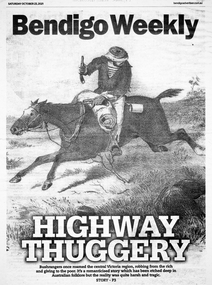 Bendigo Historical Society Inc.
Newspaper - Bendigo Advertiser story Sat Oct 23 2021 entitled "Cop-killer caught out", Sat Oct 23 2021
... police. Bushrangers like Smith were sometimes romanticized as rebellious figures, but the document emphasizes the real violence and fear they caused. Smith, originally William Turner, was a former convict from Tasmania who became a bushranger after escaping to Victoria during the gold rush. He was known for his bravado, often displaying weapons openly among gold diggers. Smith was eventually recognized and arrested in Maryborough after the murder...police. Bushrangers like Smith were sometimes romanticized as rebellious figures, but the document emphasizes the real violence and fear they caused. Smith, originally William Turner, was a former convict from Tasmania who became a bushranger after escaping to Victoria during the gold rush. He was known for his bravado, often displaying weapons openly among gold diggers. Smith was eventually recognized and arrested in Maryborough after the murder ...This document recounts the story of Gipsy Smith (real name William Turner), a notorious bushranger in 19th-century Australia, focusing on his involvement in violent crimes and his eventual capture. Gipsy Smith was involved in a shootout in central Victoria in 1856 that resulted in the death of Sergeant John McNally and the wounding of Constable John Moore. Smith and his accomplice escaped after the incident, which caused public outrage due to McNally's popularity. Smith was part of a group of bushrangers who terrorized travelers, merchants, and goldfields communities with armed robberies and audacious hold-ups. Notable incidents included tying up and robbing multiple victims, and high-speed horse chases with police. Bushrangers like Smith were sometimes romanticized as rebellious figures, but the document emphasizes the real violence and fear they caused. Smith, originally William Turner, was a former convict from Tasmania who became a bushranger after escaping to Victoria during the gold rush. He was known for his bravado, often displaying weapons openly among gold diggers. Smith was eventually recognized and arrested in Maryborough after the murder, narrowly avoiding a murder conviction due to a technicality with his arrest warrant. He was sentenced to 15 years of hard labor for manslaughter. After serving his sentence, Smith was trusted with responsible work, such as driving cattle and managing a farm, suggesting a degree of rehabilitation. The story is part of a historical series highlighting notable events in the region’s past.Bendigo Advertiser story Sat Oct 23 2021 entitled "Cop-killer caught out" This item contains the following documents 3486.51a Bendigo Advertiser Page 1 Title Page - "Highway Thuggery" 3486.51b Bendigo Advertiser Page 3 article "Cop-killer caught out" the story of Gypsy Smith Bushrangerbendigo, gipsy smith bushranger -
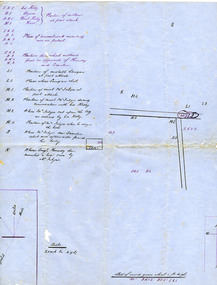 Victoria Police Museum
Map (Thomas McIntyre), 1878 - 1880
... Created by Constable Thomas McIntyre, sole survivor of the police party murdered by the Kelly Gang at Stringybark Creek near Mansfield Victoria in 1878. ...Created by Constable Thomas McIntyre, sole survivor of the police party murdered by the Kelly Gang at Stringybark Creek near Mansfield Victoria in 1878. ...Created by Constable Thomas McIntyre, sole survivor of the police party murdered by the Kelly Gang at Stringybark Creek near Mansfield Victoria in 1878. Thomas McIntyre was the main witness in Ned Kelly's trial.Large hand drawn map of the Stringybark Creek ambush site on blue government paper.ned kelly, kelly gang, victoria police, thomas mcintyre, stringybark creek, thomas lonigan, michael kennedy, thomas scanlan -
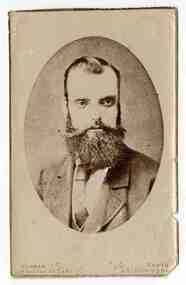 Victoria Police Museum
Carte de Visite (Thomas McIntyre), Burman, Melbourne, 1878 - 1882
... Thomas McIntyre was the sole survivor of the police party murdered by the Kelly Gang at Stringybark Creek in October 1878. ...Thomas McIntyre was the sole survivor of the police party murdered by the Kelly Gang at Stringybark Creek in October 1878. ...Thomas McIntyre was the sole survivor of the police party murdered by the Kelly Gang at Stringybark Creek in October 1878. He was the key witness in Ned Kelly's murder trial.Sepia coloured carte de visite image of Thomas McIntyre printed on thin photographic paper. ned kelly, kelly gang, victoria police, thomas mcintyre -
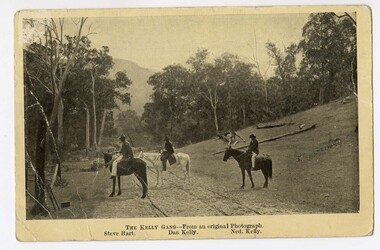 Victoria Police Museum
Postcard (Kelly Gang), Postcard featuring Kelly Gang
... postcard steve hart dan kelly ned kelly kelly gang edward kelly police murders "THE KELLY GANG - From an original Photograph. ...Black and white printed postcard with a photograph believed to be of three members of the Kelly Gang seated on horses in the middle a bushland gully on a dirt road. Mountain and trees in the background."THE KELLY GANG - From an original Photograph. Steve Hart. Dan Kelly. Ned Kelly." (printed on front of postcard) "667" (black felt on reverse of postcard) "BP32" (purple felt pen on reverse of postcard)postcard, steve hart, dan kelly, ned kelly, kelly gang, edward kelly, police murders -
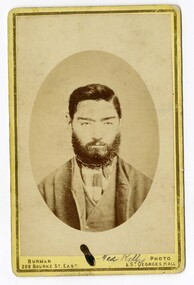 Victoria Police Museum
Carte de Visite (Ned Kelly), Carte de visite Edward
... The back was often a showy piece of lithographic printing with the photographer's name decorated with culicues. stringybark creek edward kelly ned kelly kelly gang police murders bushrangers glenrowan carte de visite michael kennedy police murders "Burman Photo 209 Bourke Street. ...Carte-de-visite is a small black and white photograph stuck to a card. It was invented by French photographer Andre Disderi in 1854 as a method for producing multiple images on a single glass plate, a format for mounting the resulting images on cards. The card on which the photograph was mounted displayed the name of the photographer on the front and back. The back was often a showy piece of lithographic printing with the photographer's name decorated with culicues.Sepia toned photograph of Edward "Ned" Kelly on cardboard in an oval shape."Burman Photo 209 Bourke Street. East & St Georges Hall" (front of carte de visite)stringybark creek, edward kelly, ned kelly, kelly gang, police murders, bushrangers, glenrowan, carte de visite, michael kennedy, police murders -
 Victoria Police Museum
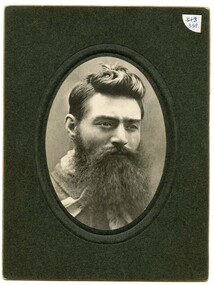
Photograph - Ned Kelly, 10 November 1880
... This is an original image of Edward "Ned" Kelly photographed the day before his execution. ned kelly kelly gang execution police murders "318 (crossed through) 334" (blue ink on white sticker on front top right hand corner of photograph) "P318" (felt pen on reverse of photograph). ...This is an original image of Edward "Ned" Kelly photographed the day before his execution.Black and white photograph of Edward "Ned" Kelly mounted onto dark green board. Photograph is oval in shape and shows Ned Kelly the day before his execution."318 (crossed through) 334" (blue ink on white sticker on front top right hand corner of photograph) "P318" (felt pen on reverse of photograph). "Ned Kelly" (handwritten in black ink). "Public Relations Division (stamped on reverse).ned kelly, kelly gang, execution, police murders -
 Victoria Police Museum
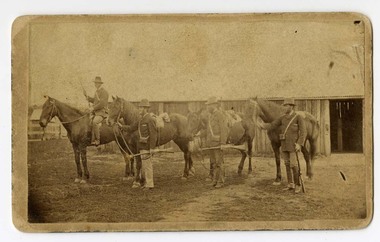
Carte de visite (Search Party), Carte de visite search party
... kelly gang search party ned kelly edward kelly police murders mounted police "...Kelly" (majority of inscription has been torn away) Sepia toned photograph of four mounted police and their horses. ...Sepia toned photograph of four mounted police and their horses. One man is mounted on his horse while the other three are holding theirs by the reins. Each man is also holding a rifle."...Kelly" (majority of inscription has been torn away)kelly gang, search party, ned kelly, edward kelly, police murders, mounted police -
 Victoria Police Museum
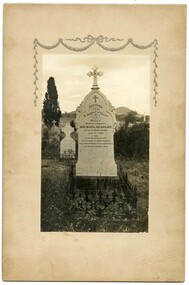
Photograph (Scanlan's Grave), Vallan Studio
... michael scanlan stringybark creek police murders hunt for the kelly gang edward kelly ned kelly Sepia toned photograph of Constable Michael Scanlan's grave stone mounted onto card with embossed scalloped, leaf and ribbon design at top and along top sides. ...Sepia toned photograph of Constable Michael Scanlan's grave stone mounted onto card with embossed scalloped, leaf and ribbon design at top and along top sides.michael scanlan, stringybark creek, police murders, hunt for the kelly gang, edward kelly, ned kelly -
 Victoria Police Museum
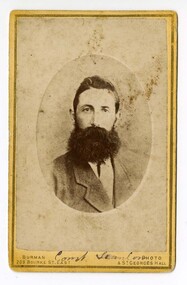
Carte de Visite (Scanlan), Burmans Photographic Rooms, 1870s
... Kelly Gang Police Murders Michael Scanlan Stringybark Creek Black and white carte de visite of Constable Scanlan in an oval shape Carte de Visite (Scanlan) Burmans Photographic Rooms ...Black and white carte de visite of Constable Scanlan in an oval shapekelly gang, police murders, michael scanlan, stringybark creek -
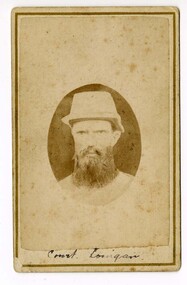 Victoria Police Museum
Carte de Visite (Lonigan)
... Kelly Gang Police Murders Thomas Lonigan Stringybark Creek Const. ...Black and white carte de visite photograph of Constable Lonigan in an oval shapeConst. Lonigan (written in black ink under photograph)kelly gang, police murders, thomas lonigan, stringybark creek -
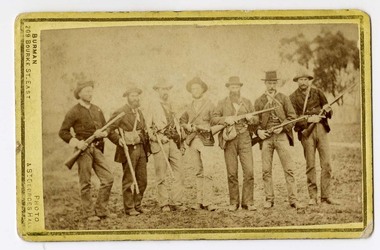 Victoria Police Museum
Carte de Visite (seven armed men), Burman Photo
... Bushrangers Kelly Gang Edward Kelly Ned Kelly Police Murders Charles Gascoigne Daniel Barry Hugh Bracken James Murdoch Arthur William Canny John Phillips John Kelly Black and white carte de visite photograph showing a line of seven armed men standing outdoors Carte de Visite (seven armed men) Burman Photo ...Black and white carte de visite photograph showing a line of seven armed men standing outdoorsbushrangers, kelly gang, edward kelly, ned kelly, police murders, charles gascoigne, daniel barry, hugh bracken, james murdoch arthur, william canny, john phillips, john kelly
