
Showing 8 items matching "museum and souvenir shop"
-
 Ballarat Tramway Museum
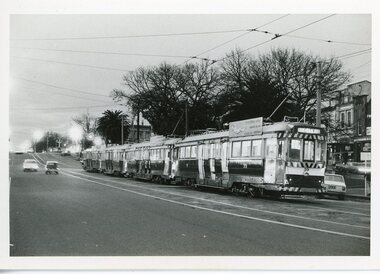
Photograph - Ballarat Tram 39, Ballarat Tram 39 and others at Sturt Street holding depot
... It was converted to a static museum display and souvenir shop. In 1971 it went to the Lions Club of Lismore. ...It was converted to a static museum display and souvenir shop. In 1971 it went to the Lions Club of Lismore. ...Tram 39 was built in 1914 by Duncan and Fraser for the Prahran and Malvern Tramways Trust. It came to Ballarat in 1951 and was part of the SEC's consolidated tramcar fleet. It was converted to a static museum display and souvenir shop. In 1971 it went to the Lions Club of Lismore. Ballarat Tramway Preservation Society acquired it in 1976. (See No. 10755 for a series of 16 photographs of the return of tram 39 to Ballarat. These were taken by Campbell Duncan) The photograph shows Tram 39 and others at the Sturt Street holding depot. This was located in Sturt Street between Greville Street and Lydiard Street. This was where the trams waited to cater for the peak travel times. The numbers on the other trams cannot be identified. Black and white photographtram 39, duncan and fraser, prahran and malvern tramways trust, ballarat 1951, sec fleet, static display, 1971, lions club lismore, ballarat tramway preservation society, 1976, greville street, lydiard street -
 Ballarat Tramway Museum
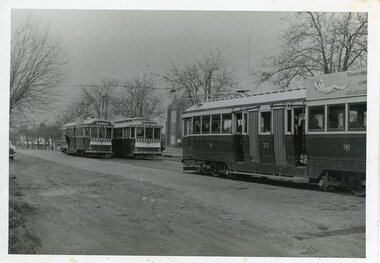
Photograph - Ballarat Trams 35, 39 and 26, Tram 35, 39, 26 in Drummond Street
... It was converted to a static museum display and souvenir shop. In 1971 it went to the Lions Club of Lismore. ...It was converted to a static museum display and souvenir shop. In 1971 it went to the Lions Club of Lismore. ...Ballarat Tram 35 is a maximum traction truck bogie - eight wheels, with drop end and centre combination. It was built in 1916 by Duncan and Fraser for the Hawthorn Tramways Trust. It came to Ballarat in 1947. In 1974 the body went to Ballarat and Clarendon College. Returned to Ballarat Tramway Preservation Society in 1978. Ballarat Tram 26 was built in 1916 by Duncan and Fraser for the Hawthorn Tramways Trust. It came to Ballarat in 1930 and was part of the SEC's consolidated tramcar fleet. In 1971 it transferred to the Ballarat Tramway Preservation Society. Tram 39 was built in 1914 by Duncan and Fraser for the Prahran and Malvern Tramways Trust. It came to Ballarat in 1951 and was part of the SEC's consolidated tramcar fleet. It was converted to a static museum display and souvenir shop. In 1971 it went to the Lions Club of Lismore. Ballarat Tramway Preservation Society acquired it in 1976. (See No. 10755 for a series of 16 photographs of the return of tram 39 to Ballarat. These were taken by Campbell Duncan) Photo shows the trams in Drummond Street at the Urquhart Street loop.Black and white photographtram 35, tram 39, tram 26, duncan and fraser, hawthorn tramway trust, prahran and malvern tramway trust, ballarat, 1916, 1947, ballarat and clarendon college, 1974, ballarat tramway preservation society, 1978, 1930, lions club lismore, static museum display, drummond street, urquhart street loop, campbell duncan, photographer -
 Glenelg Shire Council Cultural Collection
Photograph - Photograph - Portland Maritime Discovery Centre, c. 1998
... Portland Maritime Discovery Museum Portland Harbour museum tourism Back: 'B27' Coloured photograph: Portland Maritime Discovery Centre - inside. ...Coloured photograph: Portland Maritime Discovery Centre - inside. Man reading a book 'Great Ocean Road' in souvenir shopBack: 'B27'portland maritime discovery museum, portland harbour, museum, tourism -
 Orbost & District Historical Society
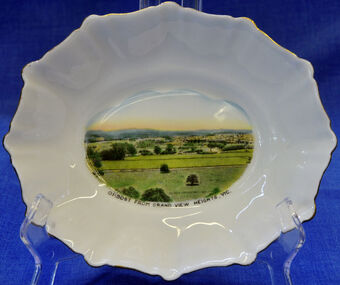
dish, 1950-1970
... souvenir dish. White with gold edging and a picture of Orbost in bottom centre. Picture is a view from Grandview Heights. White, square, bone china dish with fluted rim trimmed with gold. In the centre of the dish there is a coloured transfer of a scene labelled as 'Sturt Street, Ballarat'. The scene shows grand Victorian buildings in the background, shops ...Small china pieces carrying scenic views of holiday destinations were a popular kind of souvenir during much of the 20th century. The pictures on the souvenirs ranged across natural beauty spots (beaches, waterfalls, rivers), civic buildings and monuments (town halls, war memorials), and indicators of local progress (commercial centres and occasionally even industrial sites). Ref: Powerhouse Museum Sydney.Small souvenir dish. White with gold edging and a picture of Orbost in bottom centre. Picture is a view from Grandview Heights. White, square, bone china dish with fluted rim trimmed with gold. In the centre of the dish there is a coloured transfer of a scene labelled as 'Sturt Street, Ballarat'. The scene shows grand Victorian buildings in the background, shops with verandahs and verandah posts lining one side of Sturt Street, trees on the other side of the street, and a tram in the foreground. A transfer on the underside gives manufacturer's information. Read more: http://www.powerhousemuseum.com/collection/database/?irn=12118#ixzz23rwkysrO Under Creative Commons License: Attribution Non-CommercialUnderneath- Royal Stafford -Bone China, Made in England, 3444 Top- Orbost From Grandview Heights, Vic.souvenir dish orbost grandview-heights crockery domestic stafford-royal -
 Flagstaff Hill Maritime Museum and Village
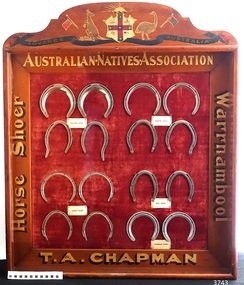
Memorabilia - Horseshoe Case, 1906 – 1907
... shop in Mortlake Rd, Purnim, about 15 mins drive from Warrnambool. Chapman made this horseshoe case especially for the 3rd Exhibition of Australian Manufacturers and Products, held in the Exhibition Building in Melbourne, which was organised and promoted by the Australian Natives Association (ANA). Reference is made to the horseshoe case in the Exhibition’s Souvenir ...The horseshoes in this purpose-built display case were made by Thomas Alfred Chapman in 1906-1907. Chapman operated a blacksmith’s shop in Mortlake Rd, Purnim, about 15 mins drive from Warrnambool. Chapman made this horseshoe case especially for the 3rd Exhibition of Australian Manufacturers and Products, held in the Exhibition Building in Melbourne, which was organised and promoted by the Australian Natives Association (ANA). Reference is made to the horseshoe case in the Exhibition’s Souvenir Catalogue of 1907 on page 85, under the heading 'In the Machinery Section the following exhibits are also shown … 'CHAPMAN, T.A. , Woolsthorpe, via Warrnambool, Case of Horseshoes'. The Australian Natives’ Association (ANA) were a non-partisan and non-sectarian, friendly society founded in Melbourne, Australia in April 1871. It was set-up for the benefit of Australian-born white men, and membership was restricted exclusively to that group. Men of other races including the Chinese and Indigenous people were not allowed to join. The ANA had relatively progressive views on women (for the time) and attracted suffragists seeking support for their cause, and in 1894, the ANA advocated for women’s enfranchisement. Although, white women were only admitted as members from 1964. The organisation was most prominent in Victoria and sought to shape Australia’s national identity and was a training ground for businessmen, trade unionists and politicians including many of Australia’s early prime ministers such as Edmund Barton, Alfred Deakin, James Scullin and Francis Forde, and the first Australian-born governor-general, Isaac Isaacs, was a member. By 1910 it had developed into a nationwide association with real political and social influence, and members would participate in many activities. The ANA lobbied strongly for anti-Chinese legislation and were an ardent believer of colonial unification. Its mission and efforts are largely credited for the successful referendums that resulted in Federation of the six Australian colonies into a new nation, the association’s most important legacy. The ANA was also a supporter of trade protection, and were a staunch advocate of the first act of Australia's new parliament, the Immigration Restriction Act 1901 (cth) or commonly known as the White Australia Policy, which became one of the central pillars of Australian nationalism in the 20th-century. The ANA campaigned against the Australian Federal Government's new immigration policy after the Second World War (non-British immigration from southern and central Europe) in order to maintain a 'white Australia', and resisted changes when the Labor government during the 1970s fully dismantled and abandoned the White Australia Policy. The ANA merged with Manchester Unity Independent Order of Oddfellows, in 1993 to become Australian Unity Ltd. The display case of horseshoes changed hands several times, going from its maker Thomas Chapman to his mother then various other members of his family. The case was also displayed at the Lee Family’s butcher shop at 188 Liebig St Warrnambool, and in the Purnim Hotel during the Warrnambool May Races. In the late 1950s the horseshoe case went to Thomas’s son, Brian. He was a Master Farrier and completed his apprenticeship at Flemington Racecourse, and in Warrnambool he owned a blacksmith business at the Warrnambool Racecourse Grounds. Brian later operated a blacksmith’s at Flagstaff Hill, where his customers would bring their horses to be shod. Brian passed away in August 2017. The horseshoe case is significant as an example of trades in the early 20th century in Western Victoria, Australia. It is also significant as an example of horseshoes from the early 20th century. The horseshoe display case is also significant for its association with the Australian Exhibition of 1907, showcasing Australian produce and manufacturing to the world. The horseshoe display case is locally significant for its association with local families, essential businesses and community events. Display case of homemade horseshoes. Wooden case with glass front containing 16 horse shoes grouped in sets, each set with a label: Made 1906-1907 for Australian Exhibition of 1907 by Thomas Alfred Chapman of Warrnambool. The case contains (a) complete chrome set each of Trotting Shoes, Hunting Shoes and Racing Plates, and (b) one pair of Hind Polo Shoes and one pair of Front Aluminium Shoes. The wooden frame has gold lettering on each side proclaiming “Australian Natives Association, T.A. Chapman, horse shoer, Warrnambool” and is topped by a painted Australian coat of arms. Gold lettering on frame, in the order of top/bottom/ left/right “AUSTRALIAN.NATIVES.ASSOCIATION / T.A. CHAPMAN / Horse Shoer / Warrnambool”flagstaff hill, warrnambool, shipwrecked coast, maritime museum, shipwreck coast, horseshoe display case 1906-1907, chromed set of trotting shoes 1906-1907, chrome set of hunting shoes 1906-1907, chrome set of racing plates 1906-1907, pair of hind polo shoes 1906-1907, pair of front aluminium shoes 1906-1907, australian exhibition 1907, australian natives association (ana), t.a. chapman horse shoer warrnambool, thomas alfred chapman, brian chapman, brian “snacks” chapman, blacksmith warrnambool, warrnambool may races, warrnambool racecourse, purnim hotel, lee family’s butcher shop warrnambool -
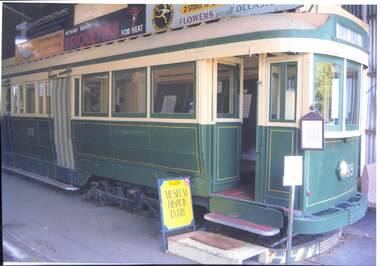 Ballarat Tramway Museum
Photograph - Photograph - coloured, Tram 39 - Maximum Traction truck bogie, drop end and centre combination. Museum Display inside
... ...museum and souvenir shop...Lismore Lions Club bought it in 1971 and displayed it in a recreational reserve until the Ballarat Museum purchased it in 1976. the Museum converted it into a museum display and souvenir centre at the depot until the new Museum building was opened in 2022. tram 39 1914 prahran and malvern tramways trust tram 42 state electricity commission 1951 lismore lions club ballarat tramway museum 1976 museum and souvenir shop new museum 2022 Tram green and cream number 39 in gold on ends and sides. ...The tram was built in 1914 for the Prahran and Malvern Tramways Trust and had the number 42. It was sold to the State Electricity Commission in 1951 and renumbered 39. Lismore Lions Club bought it in 1971 and displayed it in a recreational reserve until the Ballarat Museum purchased it in 1976. the Museum converted it into a museum display and souvenir centre at the depot until the new Museum building was opened in 2022.Large coloured photograph of a tram, laminated. Sign outside - Museum Display EntryTram green and cream number 39 in gold on ends and sides. City Oval in destination window. Advertising boards on top of tram.tram 39, 1914, prahran and malvern tramways trust, tram 42, state electricity commission, 1951, lismore lions club, ballarat tramway museum, 1976, museum and souvenir shop, new museum 2022 -
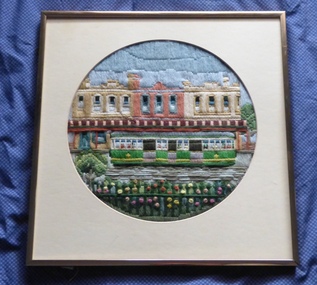 Ballarat Tramway Museum
Textile - Framed Tapestry, c2005
... shops behind and flowers in the foreground. Has a lable in the bottom left hand corner - Irene Cook Niddrie in 12/1990 and titled "Tram at Emerald Hill" - Clarendon St Sth Melbourne. Based on a similar item held by the Melbourne Tram Museum, made by Irene Cook Niddrie in 12/1990 and titled "Tram at Emerald Hill" - Clarendon St Sth Melbourne. Demonstrates a tapestry made to illustrate Melbourne W2 class trams. Trams tramways Tapestry Souvenirs ...Features a Melbourne W2 class tram in Clarendon St Melbourne with terraced shops behind and flowers in the foreground. Has a lable in the bottom left hand corner - Irene Cook Niddrie in 12/1990 and titled "Tram at Emerald Hill" - Clarendon St Sth Melbourne. Based on a similar item held by the Melbourne Tram Museum, made by Irene Cook Niddrie in 12/1990 and titled "Tram at Emerald Hill" - Clarendon St Sth Melbourne. Demonstrates a tapestry made to illustrate Melbourne W2 class trams.Hand made woollen tapestry on a white tapestry backing, stapled to board, placed in a metal frame with a circular cut out off white card. Based on a similar item held by the Melbourne Tram Museum, made by Irene Cook Niddrie in 12/1990 and titled "Tram at Emerald Hill" - Clarendon St Sth Melbourne. trams, tramways, tapestry, souvenirs, memorabilia -
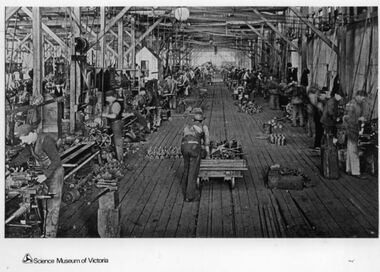 Sunshine and District Historical Society Incorporated
Photograph - HV McKay machine shop
... A photograph of HV McKay machine shop showing its vast size Trolley featured in middle Photograph taken in 1907 for a souvenir of a visit by 600 farmers This photograph is one of a series from the McKay Archives held by the Science Museum of Victoria on HV McKays factory...McKays Sunshine Harvester Works Industry A photograph of HV McKay machine shop showing its vast size Trolley featured in middle Photograph taken in 1907 for a souvenir of a visit by 600 farmers This photograph is one of a series from the McKay Archives held by the Science Museum of Victoria on HV McKays factory HV McKay machine shop Photograph HV McKay machine shop ...A photograph of HV McKay machine shop showing its vast size Trolley featured in middle Photograph taken in 1907 for a souvenir of a visit by 600 farmers This photograph is one of a series from the McKay Archives held by the Science Museum of Victoria on HV McKays factoryh.v. mckays, sunshine harvester works, industry
