
Showing 9 items matching "national trust of australia (nsw)"
-
 Kew Historical Society Inc
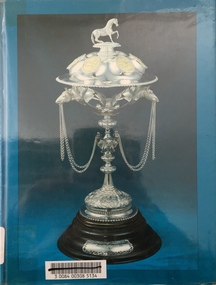
Book, National Trust of Australia (NSW), Australian Silver 1800-1900, 1973
... National Trust of Australia (NSW)...Australian Silver 1800-1900 Book National Trust of Australia (NSW) ...128 pages, 12 unnumbered pages : illustrations ; 25 cm.non-fictionsilverware -- australia., silverwork -- australia -- history -- 19th century. -
 National Wool Museum
Book, Historic Australian Quilts
... ...National Trust of Australia (NSW)...She curated an exhibition on historic Australian quilts for the National Trust of Australia (NSW) which was held at Old Government House, Paramatta between 5 June and 22 August 2000. ...She curated an exhibition on historic Australian quilts for the National Trust of Australia (NSW) which was held at Old Government House, Paramatta between 5 June and 22 August 2000. ...This book provides an overview of the history of quilts in Australia. It was written by well known quilt historian, Annette Gero. She curated an exhibition on historic Australian quilts for the National Trust of Australia (NSW) which was held at Old Government House, Paramatta between 5 June and 22 August 2000. This book is published in conjunction with the exhibition. A quilt now owned by the National Wool Museum (W3157) was display in this exhibition (although it does not feature in the book). Annette Gero has signed the title page.Annette Gero / Historic Australian Quiltsquilting - history patchwork - history, national trust of australia (nsw), gero, dr annette, quilting - history, patchwork - history -
 National Wool Museum
Textile - Red Cross Quilt, 1930-1949
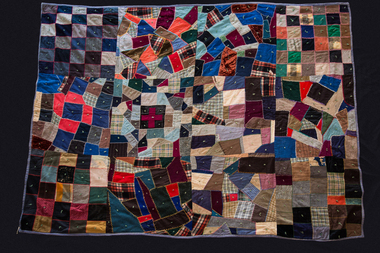
... running stitch group national trust of australia (nsw)...The women sometimes made a quilt as a group activity and Lois suggested that the quilt may have been made by this group. quilting patchwork running stitch group national trust of australia (nsw) running stitch collection densham ms lois geelong quilting patchwork CWA Quilt, rectangular. ...This quilt was purchased from an op shop in Clifton Hill, Vic. by Lois Densham, a quilter and former member of the Running Stitch group who has an interest in historic Australian quilts. The quilt has been displayed in NSW, where it was part of an exhibition of Historic Australian Quilts curated by Annette Gero and held at Old Government House, Paramatta between 5 June and 22 August 2000. Initially purchased in Clifton Hill, it originally came from a source in Highton, Geelong. It is a double bed sized quilt in the classic 'crazy' style with extensive use of herringbone and feather stitching.The pieced style of the quilt, made from squares of patchwork is similar to the style of quilts made by members of the Country Women's Association (CWA). The women sometimes made a quilt as a group activity and Lois suggested that the quilt may have been made by this group.Quilt, rectangular. Made with crazy patchwork in twelve large blocks. The blocks at each corner are fairly regular, whereas the others are full of random pieces. The patches are oversewn with hand embroidered feather stitch in different colours. In the centre there is a block with a maroon cross. Many of the pieces have central 'sprigs' of green embroidery in bullion stitch. The quilt is backed with a blue and green striped fabric.quilting patchwork, running stitch group national trust of australia (nsw), running stitch collection, densham, ms lois, geelong, quilting, patchwork, cwa -
 Sunshine and District Historical Society Incorporated
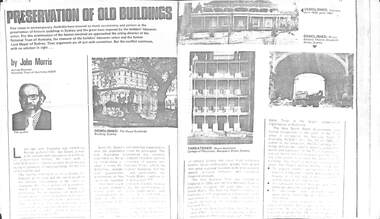
Article - Article by John Morris on Preservation of old buildings, Current affairs bulletin, 1973
... Article by John Morris Acting Director National trust of Australia NSW reporting on preservation and destruction of old buildings in NSW...Building Article by John Morris Acting Director National trust of Australia NSW reporting on preservation and destruction of old buildings in NSW Article Article by John Morris on Preservation of old buildings Current affairs bulletin John Morris ...building -
 National Wool Museum
Quilt, Growth
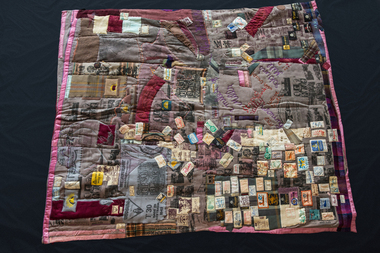
... Quilt used in the exhibition "Wool in the Australian Imagination" (Historic Houses Trust of NSW, 1994) where it was stated that the artist likes to tell people about themselves and their world through her work by the use of familiar fabrics such as blankets. handicrafts quilting woollen mills history running stitch group running stitch collection label highlights of the national wool museum: from waggas to the wool quilt prize - exhibition (22/09/2001 - 02/12/2001) densham ms lois woollen mills - history Quilt entitled "Growth" by Lois Densham, Melbourne, 1987. ...Quilt entitled "Growth" by Lois Densham, Melbourne, 1987. Depicts the growth of the woollen industry in Victoria. Quilt used in the exhibition "Wool in the Australian Imagination" (Historic Houses Trust of NSW, 1994) where it was stated that the artist likes to tell people about themselves and their world through her work by the use of familiar fabrics such as blankets.Quilt entitled "Growth" by Lois Densham, Melbourne, 1987.handicrafts, quilting, woollen mills history, running stitch group, running stitch collection, label, highlights of the national wool museum: from waggas to the wool quilt prize - exhibition (22/09/2001 - 02/12/2001), densham, ms lois, woollen mills - history -
 Puffing Billy Railway
Double Headed Rail, circa 1872 - 1883
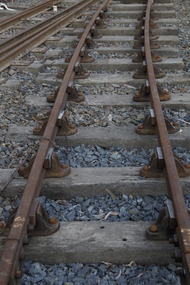
... Info from Engineers Australia Engineering Heritage Victoria Nomination for Recognition under the Engineering Heritage Australia Heritage Recognition Program for the Goldfields Railways - Melbourne , Bendigo & Echuca Railway Page 25 - .2.9.2 Statement from National Trust of Australia (Victoria) Listing number B5323 for Mt Alexander/Murray Valley Rail Line: Page 69 - Theme 3 https://www.engineersaustralia.org.au/portal/system/files/engineering-heritage-australia/nomination-title/Melbourne_%20Bendigo_Echuca%20Railway%20Nomination.pdf The Melbourne, Mount Alexander and Murray River Railway Company was a railway company in Victoria, Australia. It was established on 8 February 1853 to build a railway from Melbourne to Echuca on the Victorian-NSW...Info from Engineers Australia Engineering Heritage Victoria Nomination for Recognition under the Engineering Heritage Australia Heritage Recognition Program for the Goldfields Railways - Melbourne , Bendigo & Echuca Railway Page 25 - .2.9.2 Statement from National Trust of Australia (Victoria) Listing number B5323 for Mt Alexander/Murray Valley Rail Line: Page 69 - Theme 3 https://www.engineersaustralia.org.au/portal/system/files/engineering-heritage-australia/nomination-title/Melbourne_%20Bendigo_Echuca%20Railway%20Nomination.pdf The Melbourne, Mount Alexander and Murray River Railway Company was a railway company in Victoria, Australia. It was established on 8 February 1853 to build a railway from Melbourne to Echuca on the Victorian-NSW ...Double Headed Rail from Ravenswood Station Siding which was dismantled circa 1987 the two rails were stored for a time at Maldon before being donated to Puffing Billy Museum Bearing makers marks of Wilson & Cammell - Dronfield- Steel works Wilson & Cammell made Steel rails at their Dronfield Steel Works, in Dronfield, North East Derbyshire, England from 1872 - 1883 Double-headed rail In late 1830s Britain, railway lines had a vast range of different patterns. One of the earliest lines to use double-headed rail was the London and Birmingham Railway, which had offered a prize for the best design. This rail was supported by chairs and the head and foot of the rail had the same profile. The supposed advantage was that, when the head became worn, the rail could be turned over and re-used. In practice, this form of recycling was not very successful as the chair caused dents in the lower surface, and double-headed rail evolved into bullhead rail in which the head was more substantial than the foot. Info from Wikipedia - Rail Profile https://en.wikipedia.org/wiki/Rail_profile The first records of double headed rail being used In Victoria by Victorian Railways was in 1859, the rails, chairs, oak and trenails were imported from UK. After the 1870’s the Victorian Railways went over to using flat bottom rails, but they still needed replacement double headed rail for lines already laid and this continued up to at least 1883 Wilson & Cammell - Dronfield- Steel works Wilson & Cammell made Steel rails at their Dronfield Steel Works, in Dronfield England from 1872 - 1883 Mount Alexander & Murray River Railway The Melbourne, Mount Alexander & Murray River Railway Company received parliamentary assent in February 1853 to build Victoria's first inland railway from Melbourne to Williamstown, and Melbourne to Bendigo and Echuca. Construction commenced in January 1854 with work on a pier at Williamstown but lack of funds slowed progress, eventually prompting the company to sell out to the government. The 100-mile (162 km) section to Bendigo opened in October 1862. Its cost of £35,000 per mile made it the most expensive railway ever built in Australia. In 1864, the line was extended to Echuca, tapping into the booming Murray-Darling paddlesteamer trade. info from Museums Victoria - Victorian Railways https://museumsvictoria.com.au/railways/theme.aspx?lvl=3&IRN=450&gall=456 1863 Ravenswood Station open on the 1st Feb 1863 Victorian Railways - purchased and imported the Rail and Chairs from Raleigh, Dalgleish, White and Co. London Importation of railway plant : abstract of a return to an order of the Legislative Assembly dated 27th June 1860 for - Copies of the advertisements calling for tenders, the names of the tenderers and the accounts and correspondence with Mr Brunel relating thereto GP V 1859/60 no. C 15 http://www.parliament.vic.gov.au/papers/govpub/VPARL1859-60NoC15.pdf Report from the Select Committee upon the Importation of Railway Plant : together with proceedings of the Committee, minutes of evidence and appendix GP V 1859/60 no. D 38 (2.9 MB) http://www.parliament.vic.gov.au/papers/govpub/VPARL1859-60NoD38.pdf Ravenswood Siding When the Victorian Railways were established in 1856 they adopted one of the popular British permanent way standards - heavy 80lb (36.3kg) double-headed rail held up right in cast iron chairs attached to transverse timber sleepers by wooden pegs called trenails. The Ravenswood Railway siding was constructed in 1862 with 12 feet wrought iron double-head rail held in cast iron chairs with Ransom and May patent compressed keys. Trenails held the chairs to the sleepers and the joints were secured in joint chairs. Joints were subsequently joined using fish plates. It formed part of the Melbourne to Echuca rail line, initially known as the Melbourne, Mt Alexander and Murray River Railway. George Christian Derbyshire, the first Engineer-in-Chair of the Victorian Railways was responsible for the design and construction of the works. No new lines were built in Victoria using double-headed rail after 1870. The siding was disconnected from the main line in 1988. The Ravenswood Railway Siding demonstrates the original 1856 philosophy of the Victorian Railways to adopt British permanent way technology. The siding demonstrates significant aspects in the development of permanent way technology in England and Victoria over the period from the 1830's to the 1880's. The chairs in the Ravenswood siding are physical evidence of early railway technology rendered obsolete 120 years ago, namely joint chairs at rail joints and trenails to secure the chairs to the sleepers. The double-headed rail demonstrates an important stage in the evolution of British rail technology in the 1830s. The old fish plates, square headed bolts and square nuts demonstrate the success of fishing the rail joins. The Ravenswood siding demonstrates the earliest form of rail joint technology developed in England, and existing in Australia, the joint chair. In part of the siding the sequence of joint and intermediate chairs is consistent with the 1856 specifications, that sequence is rare with the joints secured in joint chairs. The survival of chairs in this sequence is rare and almost certainly demonstrates that they remained in continuous use at the same location from 1862 to 1988. This remnant of the Ravenswood siding has survived 126 years. The siding has proved to be the most significant of extant remnant double-headed sidings in Victoria, containing a rare combination of early permanent way technologies. Construction dates 1862, Info from Ravenswood Railway Siding Victorian Heritage Database Report http://vhd.heritagecouncil.vic.gov.au/places/4693/download-report The remaining section of this siding is significant at the State and National levels in that it demonstrates the use of chaired rail by the Victorian Railways Department for the Trunk Lines and, more particularly, the following stages in the evolution of this long obsolete method of permanent way construction: a) The use of joint chairs and intermediate chairs at regular intervals inferring that the original wrought iron rail lengths were 12 feet, as is known through documentary sources to have been the case. The survival of chairs in this sequence is unique and almost certainly demonstrates that they have remained in continuous use at the same location and in the same sequence from 1862 to 1988 . b) The use of joint chairs and intermediate chairs designed for use with trenails. c) The use of later intermediate chairs designed for use with steel pins and the use of fished joints with steel double head chaired rail, representing a second method of constructing the permanent way using chaired rail technology. info from Ravenswood Siding - Melbourne/Echuca Railway Line - Victorian Heritage Database Report http://vhd.heritagecouncil.vic.gov.au/places/70103/download-report Addition to Citation for Melbourne to EchucaRailway Line 1/10/1990 Double Head Rail The surviving lengths of double head rail with chairs on this railway compare with one surviving similar remnant on the Geelong to Ballarat railway and are representative of permanent way construction techniques applied exclusively to the two trunk railways of the 1860's. In this respect they are rare survivors and may be unique at the national level and of technical importance at the international level to the extent that they enhance contemporary understanding of early railway building technology. Surviving lengths of chaired double head rail survive at Kyneton, Ravenswood and Bendigo on this railway and include a number of different types of cast iron intermediate and joint chairs with hardwood keys and metal pins. The Ravenswood siding is of special significance for the diversity of chair types and for the sequence of chairs recalling rail lengths known to be associated with construction of the line in 1862. Construction of the Railway Tenders closed on 24 March 1858 with no less than 133 tenders being received. A contract was let to Cornish and Bruce for £3,356,937 to commence work on 1 June 1858 and complete the line by 31 July 1861. Cornish and Bruce made quick early progress with the Melbourne to Sunbury section being officially opened on 13 January 1859. The line was officially opened to Bendigo (Sandhurst) on 20 October 1862 by the Governor of Victoria, Sir Henry Barkly. A great banquet was held for 800 guests and this was followed by a grand ball. The extension of the line to Echuca was a relatively simple matter as that part of the line was across plain country without any significant engineering challenges. Tenders were called for the work in 1863 and the work was completed in 1864 by contractors Collier and Barry Apart from the line contractors, other firms directly involved were J Shire law and Co (sleepers), R Fulton, Langlands Brothers and Co, William Crossley (water supply), B Moreland, Langlands Brothers and Co (platelayers lorries), E Chambers (iron pins, traversers), Miller and McQuinstan (luggage vans and steam engines) and various contractors for building works. Info from Engineers Australia Engineering Heritage Victoria Nomination for Recognition under the Engineering Heritage Australia Heritage Recognition Program for the Goldfields Railways - Melbourne , Bendigo & Echuca Railway Page 25 - .2.9.2 Statement from National Trust of Australia (Victoria) Listing number B5323 for Mt Alexander/Murray Valley Rail Line: Page 69 - Theme 3 https://www.engineersaustralia.org.au/portal/system/files/engineering-heritage-australia/nomination-title/Melbourne_%20Bendigo_Echuca%20Railway%20Nomination.pdf The Melbourne, Mount Alexander and Murray River Railway Company was a railway company in Victoria, Australia. It was established on 8 February 1853 to build a railway from Melbourne to Echuca on the Victorian-NSW border and a branch railway to Williamstown. The company struggled to make any progress and on 23 May 1856, the colonial Government took over the Company and it became part of the newly established Department of Railways, part of the Board of Land and Works. The Department of Railways became Victorian Railways in 1859. Construction of the Bendigo line commenced in 1858, but this private consortium also met with financial difficulties when it was unable to raise sufficient funds, and was bought out by the Victorian colonial government. The design work was then taken over by Captain Andrew Clarke, R. E., Surveyor-General of Victoria, with bridge designs completed by Bryson and O'Hara The contract for the first stage of the line from Footscray to Sandhurst (now Bendigo), was let to Cornish and Bruce for £3,356,937.2s.2d ($6.714 million) with work commencing on 1 June 1858. Completion of the permanent way was to be by 31 July 1861 https://en.wikipedia.org/wiki/Melbourne,_Mount_Alexander_and_Murray_River_Railway_Company Victorian Railways - purchased and imported the Rail and Chairs from Raleigh, Dalgleish, White and Co. London Importation of railway plant : abstract of a return to an order of the Legislative Assembly dated 27th June 1860 for - Copies of the advertisements calling for tenders, the names of the tenderers and the accounts and correspondence with Mr Brunel relating thereto GP V 1859/60 no. C 15 http://www.parliament.vic.gov.au/papers/govpub/VPARL1859-60NoC15.pdf Report from the Select Committee upon the Importation of Railway Plant : together with proceedings of the Committee, minutes of evidence and appendix GP V 1859/60 no. D 38 (2.9 MB) http://www.parliament.vic.gov.au/papers/govpub/VPARL1859-60NoD38.pdf Victorian Railways : report of the Board of Land and Works November 1862 GP V 1862/63 no. 21 (2.8 MB) https://www.parliament.vic.gov.au/papers/govpub/VPARL1862-63No21.pdfHistoric - Victorian Railways - Double Headed rail Ravenswood Railway Station and Siding Victorian Heritage Database Reports Victorian Heritage Register VHR H1100 Victorian Heritage Register VHR H1786 National Trust VHR H1100 Mount Alexander and Murray River Rail way Line National Trust2 rail lengths of Double Headed Rail made of Iron makers marks : Wilson & Cammell - Dronfield - Steel and 20 joint chairs with metal rail pins Makers mark Wilson & Cammell - Dronfield - Steel (possible date 187? very hard to read ) puffing billy, double headed rail, wilson & cammell - dronfield - steel works, ravenswood station siding, melbourne to echuca rail line, initially known as the melbourne, mt alexander and murray river railway. -
 Vision Australia
Certificate - Text, H.R.H. The Prince of Wales Trophy to Royal Blind Society of N.S.W, 1977
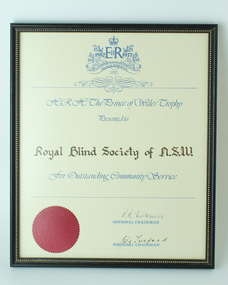
... National Chairman) and Reg Lusford (Regional Chairman). Royal Blind Society of NSW Awards At the head of the page: the Royal crown then below a spray of flowers sit either side of the initials "ER II" and the dates "1952" and "1977" amongst the flowers. Beneath that reads "The Queens Elizabeth Silver Jubilee Trust for Young Australians ...In 1977 the Royal Blind Society of New South Wales was awarded the HRH The Prince of Wales trophy for outstanding community service. The certificate was signed by P.R. Mitchell (National Chairman) and Reg Lusford (Regional Chairman).1 cream page with seal of Queens Silver Jubilee TrustAt the head of the page: the Royal crown then below a spray of flowers sit either side of the initials "ER II" and the dates "1952" and "1977" amongst the flowers. Beneath that reads "The Queens Elizabeth Silver Jubilee Trust for Young Australians". All text and illustrations are in blue.royal blind society of nsw, awards -
 Wodonga & District Historical Society Inc
Certificate - Recognition of Service World War II - Ian Darnton Watson, 1946
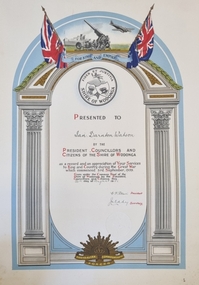
... Australian 2nd Medical Regiment. On discharge he returned home to help his father farm his property, De Kerilleau in Wodonga. De Kerilleau was classified by the National Trust in 1974. Ian described his father, Kenneth as a hardworking, practical man, who for two years from 1929 - 1931, had been the Wodonga Shire President. Cr K. D. Watson was again elected to the Council in 1943 and served until he died in October 1951. In March 1957, he married Miss Lesley Buttfield, of Sydney, NSW...Australian 2nd Medical Regiment. On discharge he returned home to help his father farm his property, De Kerilleau in Wodonga. De Kerilleau was classified by the National Trust in 1974. Ian described his father, Kenneth as a hardworking, practical man, who for two years from 1929 - 1931, had been the Wodonga Shire President. Cr K. D. Watson was again elected to the Council in 1943 and served until he died in October 1951. In March 1957, he married Miss Lesley Buttfield, of Sydney, NSW ...Ian Darnton Watson was a member of a prominent family of civic leaders in Wodonga. He was born on 6th July 1925 in Albury, the first son of Kenneth Darnton Watson and Phyllis Lenore Emily Austin. He completed his primary education at Albury Grammar School, and later became a boarder at Melbourne Church of England Grammar School. He enlisted for service at Albury on 25th January 1944 and commenced full time service on 8th February 1944 at Royal Park in Melbourne, Victoria and was allocated to the 2nd Medium Regiment. He embarked for overseas service in Borneo on 30th July 1945 and disembarked in Australia on 15 April 1947 after serving with the Australian occupation forces in Japan. Mr Watson was discharged on 22 April 1947 at which time he was a member of the Australian 2nd Medical Regiment. On discharge he returned home to help his father farm his property, De Kerilleau in Wodonga. De Kerilleau was classified by the National Trust in 1974. Ian described his father, Kenneth as a hardworking, practical man, who for two years from 1929 - 1931, had been the Wodonga Shire President. Cr K. D. Watson was again elected to the Council in 1943 and served until he died in October 1951. In March 1957, he married Miss Lesley Buttfield, of Sydney, NSW. They had three children, Fiona, John and Rowena. John was later to become a member of Wodonga Council and served as mayor. Ian was past President of the RSL branch at Wodonga, Captain of the Wodonga Rural Fire Brigade, and President of the West Wodonga Primary School Committee. He also served on Wodonga Council from 1974 until his death on 14 December 1981, aged 56.This certificate is significant because it acknowledges the War Service of a prominent member of the Wodonga communityA colour printed certificate presented to Ian Darnton Watson in appreciation for his service for "King and Empire" during World War II. The text is surrounded by columns and an arch. The Australian and British flags are at the top as well as representations of the Navy, Army and Air Force. It also features the logo of the Shire of Wodonga above the text. The badge of the Commonwealth Armed Forces is at the centre bottom of the certificate. This small collection also includes black and white photographs of Ian Watson from his Service Records and another photo in uniformOn Certificate: PRESENTED TO Ian Darnton Watson BY THE PRESIDENT, COUNCILLORS AND CITIZENS OF THE SHIRE OF WODONGA as a record and an appreciation of Your Services to King and Country during the Great War which commenced 3rd September, 1939. Given under the Common Seal of the Shire of Wodonga by the President, Citizens this Councillors and Citizens this 26th day of February 1947watson family wodonga, ian darnton watson, de kerilleau -
 Wodonga & District Historical Society Inc
Certificate - Recognition of Service to RSSAILA Wodonga - Ian D. Watson
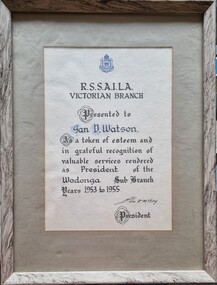
... Australian 2nd Medical Regiment. On discharge he returned home to help his father farm his property, de Kerilleau in Wodonga which was classified by the National Trust in 1974. Ian described his father, Kenneth as a hardworking, practical man, who for two years from 1929 - 1931, had been the Wodonga Shire President. Cr K. D. Watson was again elected to the Council in 1943 and served until he died in October 1951. In March 1957, he married Miss Lesley Buttfield, of Sydney, NSW...Australian 2nd Medical Regiment. On discharge he returned home to help his father farm his property, de Kerilleau in Wodonga which was classified by the National Trust in 1974. Ian described his father, Kenneth as a hardworking, practical man, who for two years from 1929 - 1931, had been the Wodonga Shire President. Cr K. D. Watson was again elected to the Council in 1943 and served until he died in October 1951. In March 1957, he married Miss Lesley Buttfield, of Sydney, NSW ...Ian Darnton Watson was a member of a prominent family of civic leaders in Wodonga. He was born on 6th July 1925 in Albury, the first son of Kenneth Darnton Watson and Phyllis Lenore Emily Austin. He completed his primary education at Albury Grammar School, and later became a boarder at Melbourne Church of England Grammar School. He enlisted for military service at Albury on 25th January 1944 and commenced full time service on 8th February 1944 at Royal Park in Melbourne, Victoria and was allocated to the 2nd Medium Artillery Regiment. He embarked on overseas service in Borneo on 30th July 1945 and disembarked in Australia on 15th April 1947 after serving with the Australian occupation forces in Japan. Mr Watson was discharged on 22nd April 1947 at which time he was a member of the Australian 2nd Medical Regiment. On discharge he returned home to help his father farm his property, de Kerilleau in Wodonga which was classified by the National Trust in 1974. Ian described his father, Kenneth as a hardworking, practical man, who for two years from 1929 - 1931, had been the Wodonga Shire President. Cr K. D. Watson was again elected to the Council in 1943 and served until he died in October 1951. In March 1957, he married Miss Lesley Buttfield, of Sydney, NSW. They had three children, Fiona, John and Rowena. John was later to become a member of Wodonga Council and served as Mayor. Ian was President of the RSSAILA (Returned Sailor's, Soldier's and Airmen's Imperial League of Australia) branch at Wodonga from 1953 to 1955 and remained as a member after that time. The League was renamed to the Returned Services League in 1965. Mr Ian Watson died on 14 December 1981, aged 56.This certificate is significant because it recognises the service of Ian Darnton Watson in support of Returned Servicemen in Wodonga.A framed certificate mounted on card. The frame is plastic with a wood grain finish.On Certificate:- R.S.S.A.I.L.A. VICTORIAN BRANCH Presented to Ian D. Watson, As a token of esteem and in grateful recognition of valuable services rendered as President of the Wodonga Sub Branch Years 1953 to 1955.wodonga rssaila, ian darnton watson, watson family wodonga, rsl wodonga
