
Showing 50 items matching "native bush"
-
 Bendigo Historical Society Inc.
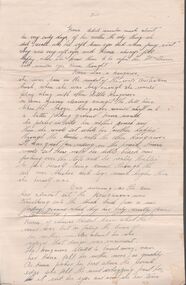
Document - Draft copy of a novel by John Ellison
... ...Native bush...Australiana Native bush Draft short story Three pages handwritten document of what looks like an early draft of a short story or novel set in the Australian bush. ...Three pages handwritten document of what looks like an early draft of a short story or novel set in the Australian bush. Probably written by John Ellison in the 1940s. Part of the Aileen and John Ellison collection.australiana, native bush, draft, short story -
 Tatura Irrigation & Wartime Camps Museum
Photograph, Arthur Knee, 1989
... Remains of concrete kitchen complex, large cactus mid distance, native bush background...Remains of concrete kitchen complex, large cactus mid distance, native bush background Photograph Arthur Knee ...Camp 13, German compound, concrete remains of kitchen complexCamp 13, Camp Road, Murchison, Victoria. Remains of concrete kitchen complex, large cactus mid distance, native bush backgroundcamp 13, pow, german pow, internment camps, murchison victoria, ruins -
 University of Melbourne, Burnley Campus Archives
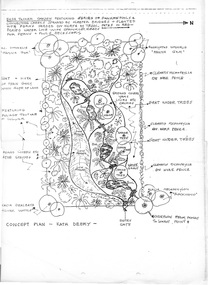
Plan (Item), Bush Tucker Garden. Concept Plan - Kath Deery, 1985?
... native garden...bush...native garden bush tucker Kath Deery A3 copy of plan by Kath Deery for Bush Tucker Garden, including a series of pools and sleeper bridges (not implemented) Bush Tucker Garden. ...native garden, bush tucker, kath deery -
 Whitehorse Historical Society Inc.
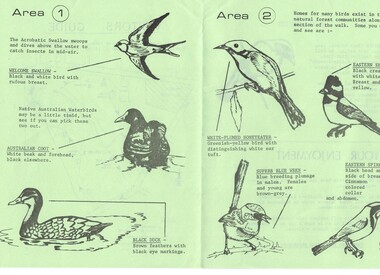
Pamphlet, Blackburn Lake Sanctuary information, 1988
... ...native plants...wildlife...bush...blackburn lake sanctuary city of nunawading adult deaf and dumb society native plants wildlife bush tucker walkabout wurundjeri aboriginal tribe Information pamphlet re history of Blackburn Lake. ...Information pamphlet re history of Blackburn Lake.Information pamphlet re history of Blackburn Lake. Visitors guide sheet and brochure advertising 'Bush Tucker Walkabout'. Open Day, including leaflet about local Wurundjeri tribe and plants they used.Information pamphlet re history of Blackburn Lake. blackburn lake sanctuary, city of nunawading, adult deaf and dumb society, native plants, wildlife, bush tucker walkabout, wurundjeri aboriginal tribe -
 Eltham District Historical Society Inc
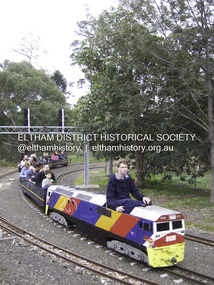
Photograph - Digital Photograph, Marguerite Marshall, Diamond Valley Railway, Eltham Lower Park, 7 September 2008
... The winding track, fringed by native trees and bushes planted by volunteers, stands on crown land managed by Nillumbik Council. ...The winding track, fringed by native trees and bushes planted by volunteers, stands on crown land managed by Nillumbik Council. ...Kids of all ages enjoy the Miniature Railway. Published: Nillumbik Now and Then / Marguerite Marshall 2008; photographs Alan King with Marguerite Marshall.; p163 On Sundays in Eltham thousands of children, mums, dads and grandparents can be seen travelling around Lower Eltham Park in tiny trains. They are among the two and half million passengers who have travelled on the Diamond Valley Railway since it officially began in 1961. The miniature railway originally operated from the 1940s at Chelsworth Park, Ivanhoe, until flooding caused it to be moved to the Eltham Lower Park in 1959. The railway is modelled on the 1920s era – the heyday of passenger rail travel – and the trains are built on a scale of two inches to the foot (1/6). Although not exact replicas, trains include models of the Spirit of Progress, Puffing Billy, The Overland, Dog Boxes, Vic Rail S class, G class and a NSW 81 Class. The three and a half kilometres of track is set amongst native plants and picnic areas. A friendly hoot or the clang of a bell occasionally punctuates the tranquillity as a train emerges from a treed bend with passengers excitedly waving to onlookers. For $3 the train takes you on a 13-minute two-kilometre ride. Passengers sit in single file in the narrow train, which clatters along tracks built to the scale of the Australian narrow gauge of three feet six inches (1.1m). These are used in Queensland, South Australia, Tasmania and Western Australia. Safety standards are stringently kept. Even before you buy a ticket notices tell you that you must wear closed shoes. You can even borrow these, and you are given a pair of socks for the ride! Blue-overalled volunteers check tickets, see you aboard, and drive the train. They are mainly retired men who can at last devote their time to what little boys dream of – playing with trains. Passengers are instructed in safe behaviour, then the station master waves a white flag and off we go. The guard sits at the back with his whistle and green flag at the ready. The winding track, fringed by native trees and bushes planted by volunteers, stands on crown land managed by Nillumbik Council. The train clatters along the track and crosses a bridge over a drain elevated by name to The Blow Fly Creek. We pass by Meadmore Junction at a speed of three kilometres an hour. Then on through a tunnel, accompanied by squeals of delight, and after a few moments of blackness, light glimmers at the end. On we go, past the original platform, along another route past busy Main Road through Pine Creek Station, over a bridge and through another tunnel with more screams of delight.Then a signal stops us before the ‘all clear’ to return to our original point of departure. The railway services its passengers – the largest number of any miniature railway in Australia – with a fleet including: six diesel locomotives, three steam locomotives, eight sets of passenger cars and one battery electric Dog Box set. Members also privately own 20 locomotives and powered carriage sets as well as four carriage sets.1 All the trains are stored on-site in workshops, sheds and a tunnel. The railway is entirely run by volunteers, so that all ticket money is used for maintenance and extensions, and some goes to local charities. Since 1991, the entire railway has been rebuilt, including an upgraded signalling system. About half of the 120 volunteer members are active with about 35 working each Sunday, and a dozen or so working every Wednesday. Members are trained to positions of station assistant, booking officer, train guard, train driver or signalman. Members construct new carriages and locomotives as well as maintaining track, signalling and rolling stock.This collection of almost 130 photos about places and people within the Shire of Nillumbik, an urban and rural municipality in Melbourne's north, contributes to an understanding of the history of the Shire. Published in 2008 immediately prior to the Black Saturday bushfires of February 7, 2009, it documents sites that were impacted, and in some cases destroyed by the fires. It includes photographs taken especially for the publication, creating a unique time capsule representing the Shire in the early 21st century. It remains the most recent comprehenesive publication devoted to the Shire's history connecting local residents to the past. nillumbik now and then (marshall-king) collection, diamond valley railway, eltham lower park -
 Eltham District Historical Society Inc
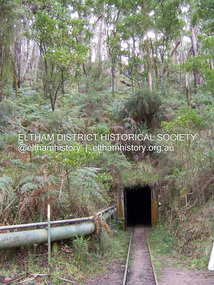
Photograph - Digital Photograph, Marguerite Marshall, One Tree Hill Mine, Smiths Gully, 8 June 2006
... .; p53 Though still a working mine, One Tree Hill Mine at Smiths Gully, now stands in a tranquil reserve surrounded by bush and native animals - in contrast to its heyday. ....; p53 Though still a working mine, One Tree Hill Mine at Smiths Gully, now stands in a tranquil reserve surrounded by bush and native animals - in contrast to its heyday. ...Gold was discovered on One Tree Hill in 1854. The site has been worked intermittently until fairly recent times. Published: Nillumbik Now and Then / Marguerite Marshall 2008; photographs Alan King with Marguerite Marshall.; p53 Though still a working mine, One Tree Hill Mine at Smiths Gully, now stands in a tranquil reserve surrounded by bush and native animals - in contrast to its heyday. In the mid 19th century, when the mine was part of the Caledonia Goldfields, hundreds of men in search of their fortune worked the alluvial gold in the Yarra River, its tributaries and the reefs that made up the goldfields. Miner Stan Bone, assisted by Wilfred Haywood, is the last of the independent gold miners in the area and still uses the quartz crushing battery as miners did when gold was first discovered in the area in 1851.1 Stan, who is the last of six generations of miners in his family, was aged 17 when he began mining on his father Alex’ mine, The Golden Crown in Yarrambat. These days, after blasting the gold-bearing rock in Mystery Reef, one of the four reefs at One Tree Hill, Stan transports it around five kilometres by tip truck to the Black Cameron Mine for crushing. There he uses water from the waterlogged mine, (which still contains gold), as the Happy Valley Creek at One Tree Hill is usually dry.2 The One Tree Hill Mine has been worked for close to a century since it opened around the late 1850s.3 The Swedish Reef was its most productive reef and one of the largest in the area. Around 1859, extractions included 204 ounces (5.8kg) of gold, won from 57 pounds (26kg) of stone.4 Then during World War Two, Stan’s uncle, Bill Wallace, and Alex Bone, closed the mine. In 1973, Stan, with his Uncle Bill, reopened the Black Cameron Mine and worked there until 1988. Stan resumed mining One Tree Hill in 1998. As late as the 1920s gold was picked up by chance! When crossing a gully on his way to vote at the St Andrews Primary School, Bill Joyce picked up some quartz containing gold. This site was to become the Black Cameron Mine. The Caledonia Diggings, named after Scotland’s ancient name by local Scots, began around Market Square (now Smiths Gully) and included Queenstown (St Andrews), Kingstown (Panton Hill) and Diamond Creek. There were also poorer bearing fields in Kangaroo Ground and Swipers Gully (now Research). * None of these compared in riches to the Ballarat and Bendigo fields5, but the Caledonia Diggings continued intermittently for close to 100 years. Gold was discovered in Victoria following a bid to stem the disappearance of much needed workmen to the New South Wales diggings. Several businessmen offered a reward of £200, for the discovery of gold within 200 miles (322 km) of Melbourne. Late in June 1851, gold was first discovered at Andersons Creek, Warrandyte. Then in 1854, George Boston and two other men discovered gold at Smiths Gully. Gold transformed the quiet districts, with a constant flow of families and vehicles on the dirt tracks en route to the Caledonia Diggings. Three thousand people worked the gullies in Market Square, including about 1000 Chinese miners. The square established its own police, mining warden, gold battery, school, shops and cemetery and grog flowed. Market Square flourished until the middle 1860s. Bullocks transported quartz from the Caledonia Goldfields to the crushing machinery at the Queenstown/St Andrews Battery, near Smiths Gully Cemetery. It was destroyed by bushfire in 1962. By the late 1850s, most early alluvial fields were in decline, but minor rushes continued until around 1900 and some until the early 1940s. Some miners did well, although most earned little from their hard labour in the harsh and primitive conditions.6 But according to historian, Mick Woiwod, the gold fields helped to democratise society, as individuals from all walks of life were forced to share experiences, and the ability to succeed, depended less on inherited wealth or social rank.This collection of almost 130 photos about places and people within the Shire of Nillumbik, an urban and rural municipality in Melbourne's north, contributes to an understanding of the history of the Shire. Published in 2008 immediately prior to the Black Saturday bushfires of February 7, 2009, it documents sites that were impacted, and in some cases destroyed by the fires. It includes photographs taken especially for the publication, creating a unique time capsule representing the Shire in the early 21st century. It remains the most recent comprehenesive publication devoted to the Shire's history connecting local residents to the past. nillumbik now and then (marshall-king) collection, gold mining, one tree hill mine, smiths gully -
 Eltham District Historical Society Inc
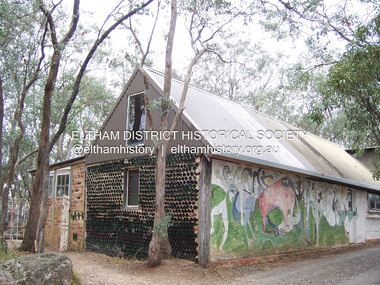
Photograph - Digital Photograph, Marguerite Marshall, Art Gallery at Clifton Pugh's Artists' Colony, Dunmoochin, Barreenong Road, Cottles Bridge, 5 February 2008
... He won the Archibald Prize for portraiture three times, although he preferred painting the bush and native animals. In 1990 not long before he died, Pugh was named the Australian War Memorial’s official artist at the 75th anniversary of the landing at Gallipoli. ...He won the Archibald Prize for portraiture three times, although he preferred painting the bush and native animals. In 1990 not long before he died, Pugh was named the Australian War Memorial’s official artist at the 75th anniversary of the landing at Gallipoli. ...Art Gallery with mural painted by Clifton Pugh (1924-1990) at his Artists' Colony, Dunmoochin, Barreenong Road, Cottles Bridge. Following military service in the second world war, Clifton Pugh studied under artist Sir William Dargie at the National Gallery School in Melbourne as well as Justus Jorgensen, founder of Montsalvat. For a while he lived on the dole but also worked packing eggs for the Belot family saving sufficient to purchase six acres (2.4 ha) of land at Barreenong Road, Cottles Bridge. He accumulated more land and persuaded several other artists and friends to buy land nearby, resulting in a property of approximately 200 acres, stablishing it as one of the first artistic communes in Australia alongside Montsalvat in Eltham. It was around 1951 that Pugh felt he had '"done moochin' around" and so the name of the property evolved. He bought timber from Alistair Knox to build his house on the crest of a hill. Inspired by local goldminer's huts, it was a one room wattle-and-daub structure with dirt floor. Over the years it expanded with thick adobe walls made from local clay, high ceilings and stone floors. All materials other than the local earth were sourced from second hand materials, most found at wreckers' yards. Artists from across the nation were drawn to Dunmoochin, with several setting up houses and shacks on the property, maintaining their independence but sharing their artistic zeal. Artists who worked or resided at Dunmoochin included Mirka Mora, John Perceval, Albert Tucker, Fred Williams, Charles Blackman, Arthur Boyd and John Olsen. In 2002, Pugh's house along with its treasure trove of art and a library of some 20,000 books was destroyed by fire. Traces of Pugh's home remain with the presence of the Victorian doorframe archway with leadlight of intricate design, procured from a demolished Melbourne mansion; and two bronze life-sized female statues created by Pugh and cast by Matcham Skipper. In place of Pugh's house rose two double-storey mud-brick artists' studios topped with corrugated iron rooves curved like the wings of a bird with accommodation for seven. The original studios, gallery and other buildings survived the fire. Covered under Heritage Overlay, Nillumbik Planning Scheme. Published: Nillumbik Now and Then / Marguerite Marshall 2008; photographs Alan King with Marguerite Marshall.; p153 It’s not surprising that artist Clifton Pugh was drawn to Cottles Bridge to establish his artists’ colony Dunmoochin. Undisturbed by the clamour of modern life at Barreenong Road, Pugh was surrounded by the Australian bush he loved, and where his ashes were later scattered. The 200 acres (81ha) of bushland, broken by glimpses of rolling hills, has more than 50 species of orchids and Pugh shared his property with native animals including kangaroos, emus, phascogales, wombats, and diverse bird life. Pugh encouraged these creatures to join him in the bush by creating, with Monash University, a holding station where the animals were raised. Dunmoochin inspired Pugh for such paintings as in a book on orchids and the Death of a Wombat series.1 But his love for the bush was accompanied by the fear that Europeans were destroying it and much of his painting illustrated this fear and his plea for its conservation.2 However it was his house rather than the surrounding bush that was to be destroyed. Tragically in 2002 Pugh’s house, with its treasure of art and library of 20,000 art books, was destroyed by fire. Traces of the beauty of Pugh’s home still remain, however, in the magnificent Victorian doorframe archway with leadlight of intricate design procured from a demolished Melbourne mansion; and two bronze life-sized female statues created by Pugh and cast by Matcham Skipper. Now in place of Pugh’s house, are two double-storey mud-brick artists’ studios topped with corrugated roofs curved like birds’ wings, with accommodation for seven. The original studios, gallery and other buildings remain.3 Pugh grew up on his parents’ hobby farm at Briar Hill and attended the Briar Hill Primary School, then Eltham High School and later Ivanhoe Grammar. At 15 he became a copy boy for the Radio Times newspaper, then worked as a junior in a drafting office. Pugh was to have three wives and two sons. After serving in World War Two in New Guinea and Japan, Pugh studied under artist Sir William Dargie, at the National Gallery School in Melbourne.4 Another of his teachers was Justus Jörgensen, founder of Montsalvat the Eltham Artists’ Colony. Pugh lived on the dole for a while and paid for his first six acres (2.4ha) at Barreenong Road by working as an egg packer for the Belot family. Pugh accumulated more land and persuaded several other artists and friends to buy land nearby, resulting in the 200 acre property. They, too, purchased their land from the Belot family by working with their chickens. Around 1951 Pugh felt he had ‘Done moochin’ around’ and so the name of his property was born. Pugh bought some used timber from architect Alistair Knox to build his house on the crest of a hill. Inspired by local goldminers’ huts it was a one-room wattle-and-daub structure with a dirt floor. It was so small that the only room he could find for his telephone was on the fork of a tree nearby.5 Over the years the mud-brick house grew to 120 squares in the style now synonymous with Eltham. It had thick adobe walls (sun-dried bricks) made from local clay, high ceilings and stone floors with the entire structure made of second-hand materials – most found at wreckers’ yards. Pugh’s first major show in Melbourne in 1957, established him as a distinctive new painter, breaking away from the European tradition ‘yet not closely allied to any particular school of Australian painting’.6 Pugh became internationally known and was awarded the Order of Australia. He won the Archibald Prize for portraiture three times, although he preferred painting the bush and native animals. In 1990 not long before he died, Pugh was named the Australian War Memorial’s official artist at the 75th anniversary of the landing at Gallipoli. Today one of Pugh’s legacies is the Dunmoochin Foundation, which gives seven individual artists or couples and environmental researchers the chance to work in beautiful and peaceful surroundings, usually for a year. By November 2007, more than 80 people had taken part, and the first disabled artist had been chosen to reside in a new studio with disabled access.1 In 1989, not long before Pugh died in 1990 of a heart attack at age 65, he established the Foundation with La Trobe University and the Victorian Conservation Trust now the Trust for Nature. Pugh’s gift to the Australian people – of around 14 hectares of bushland and buildings and about 550 art works – is run by a voluntary board of directors, headed by one of his sons, Shane Pugh. La Trobe University in Victoria stores and curates the art collection and organises its exhibition around Australia.2 The Foundation aims to protect and foster the natural environment and to provide residences, studios and community art facilities at a minimal cost for artists and environmental researchers. They reside at the non-profit organisation for a year at minimal cost. The buildings, some decorated with murals painted by Pugh and including a gallery, were constructed by Pugh, family and friends, with recycled as well as new materials and mud-bricks. The Foundation is inspired by the tradition begun by the Dunmoochin Artists’ Cooperative which formed in the late 1950s as one of the first artistic communes in Australia. Members bought the land collaboratively and built the seven dwellings so that none could overlook another. But, in the late 1960s, the land was split into private land holdings, which ended the cooperative. Dunmoochin attracted visits from the famous artists of the day including guitarists John Williams and Segovia; singer and comedian Rolf Harris; comedian Barry Humphries; and artists Charles Blackman, Arthur Boyd and Mirka Mora. A potters’ community, started by Peter and Helen Laycock with Alma Shanahan, held monthly exhibitions in the 1960s, attracting local, interstate and international visitors – with up to 500 attending at a time.3 Most artists sold their properties and moved away. But two of the original artists remained into the new millennium as did relative newcomer Heja Chong who built on Pugh’s property (now owned by the Dunmoochin Foundation). In 1984 Chong brought the 1000-year-old Japanese Bizan pottery method to Dunmoochin. She helped build (with potters from all over Australia) the distinctive Bizan-style kiln, which fires pottery from eight to 14 days in pine timber, to produce the Bizan unglazed and simple subdued style. The kiln, which is rare in Australia, is very large with adjoining interconnected ovens of different sizes, providing different temperatures and firing conditions. Frank Werther, who befriended Pugh as a fellow student at the National Gallery Art School in Melbourne, built his house off Barreenong Road in 1954. Werther is a painter of the abstract and colourist style and taught art for about 30 years. Like so many in the post-war years in Eltham Shire, as it was called then, Werther built his home in stages using mud-brick and second-hand materials. The L-shaped house is single-storey but two-storey in parts with a corrugated-iron pitched roof. The waterhole used by the Werthers for their water supply is thought to be a former goldmining shaft.4 Alma Shanahan at Barreenong Road was the first to join Pugh around 1953. They also met at the National Gallery Art School and Shanahan at first visited each weekend to work, mainly making mud-bricks. She shared Pugh’s love for the bush, but when their love affair ended, she designed and built her own house a few hundred yards (metres) away. The mud-brick and timber residence, made in stages with local materials, is rectangular, single-storey with a corrugated-iron roof. As a potter, Shanahan did not originally qualify as an official Cooperative member.This collection of almost 130 photos about places and people within the Shire of Nillumbik, an urban and rural municipality in Melbourne's north, contributes to an understanding of the history of the Shire. Published in 2008 immediately prior to the Black Saturday bushfires of February 7, 2009, it documents sites that were impacted, and in some cases destroyed by the fires. It includes photographs taken especially for the publication, creating a unique time capsule representing the Shire in the early 21st century. It remains the most recent comprehenesive publication devoted to the Shire's history connecting local residents to the past. nillumbik now and then (marshall-king) collection, art gallery, clifton pugh, dunmoochin, cottlesbridge, cottles bridge, barreenong road -
 Eltham District Historical Society Inc
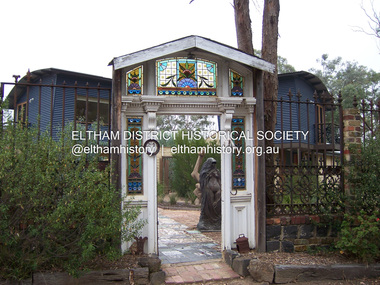
Photograph - Digital Photograph, Marguerite Marshall, Doorway of Clifton Pugh's former house at Dunmoochin, Barreenong Road, Cottles Bridge, 5 February 2008
... He won the Archibald Prize for portraiture three times, although he preferred painting the bush and native animals. In 1990 not long before he died, Pugh was named the Australian War Memorial’s official artist at the 75th anniversary of the landing at Gallipoli. ...He won the Archibald Prize for portraiture three times, although he preferred painting the bush and native animals. In 1990 not long before he died, Pugh was named the Australian War Memorial’s official artist at the 75th anniversary of the landing at Gallipoli. ...Following military service in the second world war, Clifton Pugh studied under artist Sir William Dargie at the National Gallery School in Melbourne as well as Justus Jorgensen, founder of Montsalvat. For a while he lived on the dole but also worked packing eggs for the Belot family saving sufficient to purchase six acres (2.4 ha) of land at Barreenong Road, Cottles Bridge. He accumulated more land and persuaded several other artists and friends to buy land nearby, resulting in a property of approximately 200 acres, stablishing it as one of the first artistic communes in Australia alongside Montsalvat in Eltham. It was around 1951 that Pugh felt he had '"done moochin' around" and so the name of the property evolved. He bought timber from Alistair Knox to build his house on the crest of a hill. Inspired by local goldminer's huts, it was a one room wattle-and-daub structure with dirt floor. Over the years it expanded with thick adobe walls made from local clay, high ceilings and stone floors. All materials other than the local earth were sourced from second hand materials, most found at wreckers' yards. Artists from across the nation were drawn to Dunmoochin, with several setting up houses and shacks on the property, maintaining their independence but sharing their artistic zeal. Artists who worked or resided at Dunmoochin included Mirka Mora, John Perceval, Albert Tucker, Fred Williams, Charles Blackman, Arthur Boyd and John Olsen. In 2002, Pugh's house along with its treasure trove of art and a library of some 20,000 books was destroyed by fire. Traces of Pugh's home remain with the presence of the Victorian doorframe archway with leadlight of intricate design, procured from a demolished Melbourne mansion; and two bronze life-sized female statues created by Pugh and cast by Matcham Skipper. In place of Pugh's house rose two double-storey mud-brick artists' studios topped with corrugated iron rooves curved like the wings of a bird with accommodation for seven. The original studios, gallery and other buildings survived the fire. Covered under Heritage Overlay, Nillumbik Planning Scheme. Published: Nillumbik Now and Then / Marguerite Marshall 2008; photographs Alan King with Marguerite Marshall.; p155 It’s not surprising that artist Clifton Pugh was drawn to Cottles Bridge to establish his artists’ colony Dunmoochin. Undisturbed by the clamour of modern life at Barreenong Road, Pugh was surrounded by the Australian bush he loved, and where his ashes were later scattered. The 200 acres (81ha) of bushland, broken by glimpses of rolling hills, has more than 50 species of orchids and Pugh shared his property with native animals including kangaroos, emus, phascogales, wombats, and diverse bird life. Pugh encouraged these creatures to join him in the bush by creating, with Monash University, a holding station where the animals were raised. Dunmoochin inspired Pugh for such paintings as in a book on orchids and the Death of a Wombat series.1 But his love for the bush was accompanied by the fear that Europeans were destroying it and much of his painting illustrated this fear and his plea for its conservation.2 However it was his house rather than the surrounding bush that was to be destroyed. Tragically in 2002 Pugh’s house, with its treasure of art and library of 20,000 art books, was destroyed by fire. Traces of the beauty of Pugh’s home still remain, however, in the magnificent Victorian doorframe archway with leadlight of intricate design procured from a demolished Melbourne mansion; and two bronze life-sized female statues created by Pugh and cast by Matcham Skipper. Now in place of Pugh’s house, are two double-storey mud-brick artists’ studios topped with corrugated roofs curved like birds’ wings, with accommodation for seven. The original studios, gallery and other buildings remain.3 Pugh grew up on his parents’ hobby farm at Briar Hill and attended the Briar Hill Primary School, then Eltham High School and later Ivanhoe Grammar. At 15 he became a copy boy for the Radio Times newspaper, then worked as a junior in a drafting office. Pugh was to have three wives and two sons. After serving in World War Two in New Guinea and Japan, Pugh studied under artist Sir William Dargie, at the National Gallery School in Melbourne.4 Another of his teachers was Justus Jörgensen, founder of Montsalvat the Eltham Artists’ Colony. Pugh lived on the dole for a while and paid for his first six acres (2.4ha) at Barreenong Road by working as an egg packer for the Belot family. Pugh accumulated more land and persuaded several other artists and friends to buy land nearby, resulting in the 200 acre property. They, too, purchased their land from the Belot family by working with their chickens. Around 1951 Pugh felt he had ‘Done moochin’ around’ and so the name of his property was born. Pugh bought some used timber from architect Alistair Knox to build his house on the crest of a hill. Inspired by local goldminers’ huts it was a one-room wattle-and-daub structure with a dirt floor. It was so small that the only room he could find for his telephone was on the fork of a tree nearby.5 Over the years the mud-brick house grew to 120 squares in the style now synonymous with Eltham. It had thick adobe walls (sun-dried bricks) made from local clay, high ceilings and stone floors with the entire structure made of second-hand materials – most found at wreckers’ yards. Pugh’s first major show in Melbourne in 1957, established him as a distinctive new painter, breaking away from the European tradition ‘yet not closely allied to any particular school of Australian painting’.6 Pugh became internationally known and was awarded the Order of Australia. He won the Archibald Prize for portraiture three times, although he preferred painting the bush and native animals. In 1990 not long before he died, Pugh was named the Australian War Memorial’s official artist at the 75th anniversary of the landing at Gallipoli. Today one of Pugh’s legacies is the Dunmoochin Foundation, which gives seven individual artists or couples and environmental researchers the chance to work in beautiful and peaceful surroundings, usually for a year. By November 2007, more than 80 people had taken part, and the first disabled artist had been chosen to reside in a new studio with disabled access.1 In 1989, not long before Pugh died in 1990 of a heart attack at age 65, he established the Foundation with La Trobe University and the Victorian Conservation Trust now the Trust for Nature. Pugh’s gift to the Australian people – of around 14 hectares of bushland and buildings and about 550 art works – is run by a voluntary board of directors, headed by one of his sons, Shane Pugh. La Trobe University in Victoria stores and curates the art collection and organises its exhibition around Australia.2 The Foundation aims to protect and foster the natural environment and to provide residences, studios and community art facilities at a minimal cost for artists and environmental researchers. They reside at the non-profit organisation for a year at minimal cost. The buildings, some decorated with murals painted by Pugh and including a gallery, were constructed by Pugh, family and friends, with recycled as well as new materials and mud-bricks. The Foundation is inspired by the tradition begun by the Dunmoochin Artists’ Cooperative which formed in the late 1950s as one of the first artistic communes in Australia. Members bought the land collaboratively and built the seven dwellings so that none could overlook another. But, in the late 1960s, the land was split into private land holdings, which ended the cooperative. Dunmoochin attracted visits from the famous artists of the day including guitarists John Williams and Segovia; singer and comedian Rolf Harris; comedian Barry Humphries; and artists Charles Blackman, Arthur Boyd and Mirka Mora. A potters’ community, started by Peter and Helen Laycock with Alma Shanahan, held monthly exhibitions in the 1960s, attracting local, interstate and international visitors – with up to 500 attending at a time.3 Most artists sold their properties and moved away. But two of the original artists remained into the new millennium as did relative newcomer Heja Chong who built on Pugh’s property (now owned by the Dunmoochin Foundation). In 1984 Chong brought the 1000-year-old Japanese Bizan pottery method to Dunmoochin. She helped build (with potters from all over Australia) the distinctive Bizan-style kiln, which fires pottery from eight to 14 days in pine timber, to produce the Bizan unglazed and simple subdued style. The kiln, which is rare in Australia, is very large with adjoining interconnected ovens of different sizes, providing different temperatures and firing conditions. Frank Werther, who befriended Pugh as a fellow student at the National Gallery Art School in Melbourne, built his house off Barreenong Road in 1954. Werther is a painter of the abstract and colourist style and taught art for about 30 years. Like so many in the post-war years in Eltham Shire, as it was called then, Werther built his home in stages using mud-brick and second-hand materials. The L-shaped house is single-storey but two-storey in parts with a corrugated-iron pitched roof. The waterhole used by the Werthers for their water supply is thought to be a former goldmining shaft.4 Alma Shanahan at Barreenong Road was the first to join Pugh around 1953. They also met at the National Gallery Art School and Shanahan at first visited each weekend to work, mainly making mud-bricks. She shared Pugh’s love for the bush, but when their love affair ended, she designed and built her own house a few hundred yards (metres) away. The mud-brick and timber residence, made in stages with local materials, is rectangular, single-storey with a corrugated-iron roof. As a potter, Shanahan did not originally qualify as an official Cooperative member.This collection of almost 130 photos about places and people within the Shire of Nillumbik, an urban and rural municipality in Melbourne's north, contributes to an understanding of the history of the Shire. Published in 2008 immediately prior to the Black Saturday bushfires of February 7, 2009, it documents sites that were impacted, and in some cases destroyed by the fires. It includes photographs taken especially for the publication, creating a unique time capsule representing the Shire in the early 21st century. It remains the most recent comprehenesive publication devoted to the Shire's history connecting local residents to the past. nillumbik now and then (marshall-king) collection, art gallery, clifton pugh, dunmoochin, cottlesbridge, cottles bridge, barreenong road -
 Federation University Historical Collection
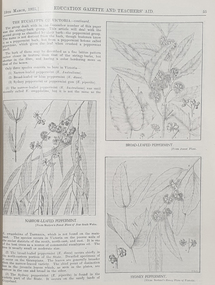
Book, Victoria Education Gazette and Teachers' Aid, 1921-1930, 1921-1930
... Native Ferns, Marybourough Technical School, Memorial School at Villers-Brettonneux .8) Experimental Plots in Country Schools (W.W. Gay), Villers Bretonneaux and its Memorial School. nominated classes for Art Teachers, The Teachers Act 1925, Horsham High School, Richmond Technical School, Farewell to Messrs C.R. Long and Ponsonby Carew-Smyth, Frank Tate, Phyiscal Training, Arbor Day, ANZAC Day, Shakespeare Day,Bendigo Junior Techncial School, Musical Appreciation, Motor Dental Unit, School Camps, Education Act of 1872: Mr Angus McKay's Part (George Mackay), A Bush Fire Experience (Irene Stable), Black Sunday, Californian Red Pine, Women's Education in America, Farewell to Lord and Lady Stradbroke, Grevilia Robusta, Silky Oak, Redwood, John E. ...Native Ferns, Marybourough Technical School, Memorial School at Villers-Brettonneux .8) Experimental Plots in Country Schools (W.W. Gay), Villers Bretonneaux and its Memorial School. nominated classes for Art Teachers, The Teachers Act 1925, Horsham High School, Richmond Technical School, Farewell to Messrs C.R. Long and Ponsonby Carew-Smyth, Frank Tate, Phyiscal Training, Arbor Day, ANZAC Day, Shakespeare Day,Bendigo Junior Techncial School, Musical Appreciation, Motor Dental Unit, School Camps, Education Act of 1872: Mr Angus McKay's Part (George Mackay), A Bush Fire Experience (Irene Stable), Black Sunday, Californian Red Pine, Women's Education in America, Farewell to Lord and Lady Stradbroke, Grevilia Robusta, Silky Oak, Redwood, John E. ...The Victoria Education Gazette and Teachers' Aid was published for Victoria's teachers and was sent to all school on the state. In 1920 The Ballarat School of Mines had donated 136 pounds 14 shillings and 10 pence to the Victorian Education Department's War Relief Account, and the Ballarat Junior Technical School had donated 10 pounds 6 shillings and 10 pence.Ten black hard covered volumes with red tape spine, covering 1921 to 1930. The gazettes include Education Department appointments, transfers, resignations and retirements, vacancies, notices, queries, notices of books, examination papers, original articles, lesson plans, suggestions for lessons, drawing, obituaries, notes on nature study, mathematics, music, sloyd woodwork, English grammar, Victorian State School Swimming Clubs, Geography, penmanship, science, History, Latin, Geography, The School Garden, horticulture, singing, World War One; ANZAC Day, lifesaving, Astronomy, Empire Day, ANZAC Buffet London, Victorian Education Department's War Relief Fund .1) 1928. Articles include: New Caledonia, Swimming and Lifesaving, School forestry, a visit to the pyramids, Exploration of Gippsland, paul de Strezelecki, Angus McMillan, Villers Bretonneux Memorial School, American Black Walnut, Red Gum, Messmate Stringybark, The Great Barrier Reef, retirement of Frank Tate, Stawell High School, Report on Some Aspects of Education in the United States, Jubilee Education Exhibition , New School Readers; measured Drawing Images include: Macarthur Street School's Plantation, Maryborough School Plantation, Pinus Insignis (Radiata) ready for Milling, Creswick State Forest, Metalwork, Daylesford Pine Plantation four years old, Henry Harvey (art Inspector); Omeo School Endowment Plantation; Frank Tate; Stawell High School Drawings From Casts; Lake Tyers School Endowment Plantation, measured drawing, Thomas H. Stuart, GEorge Swinburne. J.R. Tantham-Fryer, Cookery Class, John Edward Thomas. .3) War Savings Stampsm Swimming and Life-saving, Teh Rural School System of Victoria, Imaginative Composition, ANZAC Day, Retardation, Teh Bright Child Hudson Hard Obituary, Leeches, Relief for Distress in Europe, Dental, Teachers' Library, History of Portarlington, J.E. Stevens Obituary, Victorian Teachers in England Images: Swimming and Life-Saving Medallion .3) Swimming and Lifesaving, Bronze medallion, Victoria Leage of Victori, War Savings Stamps, Rural School Sytem of Victoria, .4) War Relief, Talbot Colony for Epileptics Masonmeadows, Discipline New and Old (Percy Samson), Soldier teachers, Preservation of Australian Birds, Arbor Day, Jubilee of Free Education, Teaching Geography, Poery in Schools, School Committees, Shelter Pavilion, Mysia Memorial School, Clovers, Jubilee Exhibition, Domestic Arts, Louis Pasteur, .5) Victoria League of Victoria, An Endowment Scheme (Pine Plantations), School Endowment Plantations, Protecting our trees by Owen Jones,. Victorian State Schools Horticultural Society, Sloyd Woodwork, School Forestry, Thomas Brodribb Obituary and portrait, Imperial Education Conference London, school Management and Method, School plantations, Eucalypt plantations in the Bendix and Heathcote District, Junior Red Cross, Jubilee Education Exhibition, Gould League Competitions, handwriting, The School Magazine, Frank Tate in London, Victorian beetles, Council of Public Education, Villers Bretonneux and its new School, Death of Samuel Summons, Woodwork Summer School, Swimming, Japanese Relief Fund, Retirement of John Cross, reminiscences of the Late Mr Albert Mattingley .6) Thomas H. Trengrove and the Villers Bretonneux School hall and pilaster carvings, forestry, visit of Maryborough teachers to Ballarat Water Reserves, noxious weeds, relief for Distressed Europe, The Dalton Plan, Empire Day, Retirement of Mr Fussell, Centenary of Hume and Hovell Expedition, League of Kindness, Effective Nature Study in a Rural School, Some Facts About Paper and their Bearing Upon School Plantations, Council of the Working Men's College Melbourne, Maria Montessori, University Vacation School, Horticulture in State Schools, An Informal Chat About French Schools (C.R. McRae), The Vacation School, Johann Heinrich Pestalozzi, Inspector's Report on a 5th-class School, Can Children Write Verse, John Adams, Victoria League of Victoria, R.F. Toutcher, Sir James Barbie's Address to High-School Girls, Impressions of a High School Teacher Abroad (R.D. Collman), The Spirit of the School Plantation Scheme, Monument of the Late Mr and Mrs A.T. Sharp at Box Hill Cemetery, The Teaching of Geography, The Treatment of Poetry in Class, Two Difficult Arithmetic Lessons, Location of Principal Australian Timbers, Dr John Smyth, Stammering and its Influence on Education, Wireless Broadcasting as an Educational Medium, Boys School at Villers Brettonneux, The New School at Villers Brettonneux, Bird Day, Messmate or Stringybark, What Every Woman Knows, Director's Report on Denmark .7)1925 . Includes: School Forestry, horticulture, J.H. Betheras retirement, Ivanhoe School, Coburg School, Moorabool Junior Technical School, Villers Bretonneux School hall and pilaster carvings, Francis Ormond, William Charles Kernot, Corsican Pnes at Creswick, Ballarat High School Plantation, Workin Men's College, RMIT, Naorrow LEafed Peppermint, Education and World Peace, Eucalypts of Victoria, John C. Eccles, Blue Gum. Manners, Giving the Poorly Nourished Boy A Chance, Native Ferns, Marybourough Technical School, Memorial School at Villers-Brettonneux .8) Experimental Plots in Country Schools (W.W. Gay), Villers Bretonneaux and its Memorial School. nominated classes for Art Teachers, The Teachers Act 1925, Horsham High School, Richmond Technical School, Farewell to Messrs C.R. Long and Ponsonby Carew-Smyth, Frank Tate, Phyiscal Training, Arbor Day, ANZAC Day, Shakespeare Day,Bendigo Junior Techncial School, Musical Appreciation, Motor Dental Unit, School Camps, Education Act of 1872: Mr Angus McKay's Part (George Mackay), A Bush Fire Experience (Irene Stable), Black Sunday, Californian Red Pine, Women's Education in America, Farewell to Lord and Lady Stradbroke, Grevilia Robusta, Silky Oak, Redwood, John E. Grant, The Need for Research (Donald Clark), Junior Drama, Ida D. Marshall, John Pounds, Australian Books, Fish Creek School, State Boundaries, History in the Curriculum, Ceramic Art in Australia (Percy E. Everett), Choice of School Songs, Tasmanian Beech, Should History be Taught on a National or an International Basis, Hydatid Disease, James Holland Obituary, Florrie Hodges, Queensland Maple, Post Bushfire Ruins at Fumina, Arbor Day at Fumina, Queensland Rosewood, Omeo Endowment Plantation, Bird Day, Junior Red Cross, Pioneers' Day, Edward Henty, Junior Technical Schools, Yellow Pine, History and Progress of Needlework, A.B.C. of Astronomy, Northumberland Mental tests, Queensland Red Cedar, Teh Globe Theatre, .9) 1927 includes The ABC of Astronomy, Atr Theatre, English Beech, Angus McMillan Art Pottery, School Singing, State Schools' Nursery, School endowment plantations, Making a Man, experimental proof of Charles's Law, John Smyth obituary and portrait, Linton Pine Planation, motivation of arithmetic, Women's Classes at Dookie, Swimming and Lifesaving, Pioneers Day, Drawing, Ballarat High School planation, biting fly, Tir-Na-N'og, John Byatt retirement and portrait, Technical Schools Conference at Daylesford, Ethel Osborne and portrait, library. Francis Thompson portrait, Adam Lindsay Gordon, Solar movement, motor transport, Liverpool Cathedral, Teh Story of the Cathedral, Bendigo School of Mines, Omeo School pine plantation, Egypt and the Nile, Self-Criticism Images include Ballarat High School Pine Plantation, Vale Park, Francis Ormond, Woking Men's College (RMIT), W.N. Kernot, A Stand of Corsican Pines at Creswick, Victoria .10) Some Remarks on the Relationship of the technical Schools to the University (Donald Clark) , Present Day Education in England , Memorial to Joseph Cornwall, Spelling, motivation, Singing, State Scholarships, Agriculture, T.W. Bothroyd, The Swimmer - A Summer School Sketch (H.H. Croll), Swimming woodwork, Farewell to Dr Sutton. ,Drowning, War Savings Movement, White Beech. George S. Browne , Example of School Honor Book, Blackwood, Optimistic teacher, Soldier settlement around Shapparton, Oral Hygiene, Cinema Machines, Basketball, Wakter M. Camble obituary, ANZAC day Pilgrimage in England, Froebel's System, Montessori Method, War Relief Fund, New Zealand Kauri Tree, Bat Tenis at a Bush School., Advice to Australian Girls, Chrysanthemums, Royal Visit, National Parks of Victoria, Maurice Copland Obituary, total eclipse of the Moon, School libraries, The teacher and the COmmunity (A.M. Barry), The Reading Lesson, Swimming and Life-saving, MElbourne Teachers' College War Memorial Windows Old Trainees War Memorial, Cultivating a Natinoal Art education gazette, school, education, teaching, teacher, world war one, school plantations, macarthur street pine plantation, school forestry, creswick state forest, anzac day, armistance celebrations, frank tate, frank tate retirement, drawing from cast, education department school readers, lake tyers pine plantation, w.n. kernot, rmit, working men's college, francis ormond, pine plantations, calenbeem park, creswick, villers-brettonneux school hall and carvings, thomas trengrove, corsican pines, creswick, pine endowment plantations, mccarthur st primary school pine plantation, ballarat high school pine plantation, vale park, mount pleasant primary school pine plantation, golden point pine plantation, angus macmillan, paul de strzelecki, gippsland, villers-bretonneaux memorial school, francis thompson, english ash, pestalozzi centenary, shakespeare day, swimming classes, clear pine, cinema in education, american black walnut, red gum, thomas wolliam bothroyd obituary, and portrait, physical training displays, teaching of spelling, ohm's law, blue gum -
 Glenelg Shire Council Cultural Collection
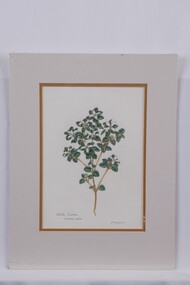
Drawing - Drawing, botanical, Collin Elwyn Woolcock, Correa alba (White Correa), n.d
... native plants. He worked on many publications together with his wife, Dorothy. His work is housed in many collections across Australia including the Glenelg Shire Cultural Collection, to which Collin donated a large collection of his works. It is also found in the State Herbarium of South Australia and the National Herbarium of Victoria. Collin Woolcock botanical Woolcock Collection CEMA botanical drawings Front: White Correa Correa alba (lower left) (blue pencil) CEWoolcock (lower right) (brown pencil) Olearia speciosa (Netted Daisy-bush ...Part of "Woolcock Gallery Collection". Exhibited CEMA 1989.Drawings of a cutting of plant with dark green foliage and eight white flowers. Single drawing on white background with name and signature in lower corners. The work is on white paper mounted in a double matt (grey on gold), unframed and wrapped in plastic.Front: White Correa Correa alba (lower left) (blue pencil) CEWoolcock (lower right) (brown pencil) Olearia speciosa (Netted Daisy-bush) (lower left) (pencil) Back: 23 (upper left) (pen) White Correa (Correa alba) $80. C E Woolcock (sticker, upper left)collin woolcock, botanical, woolcock collection, cema, botanical drawings -
 Glenelg Shire Council Cultural Collection
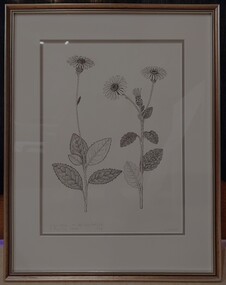
Drawing, Collin Elwyn Woolcock, Olearia Grandiflora (Mt. Lofty Daisy-Bush). Olearia Tomentosa (Toothed Daisy-Bush), n.d
... native plants. He worked on many publications together with his wife, Dorothy. His work is housed in many collections across Australia including the Glenelg Shire Cultural Collection, to which Collin donated a large collection of his works. It is also found in the State Herbarium of South Australia and the National Herbariu Collin Woolcock botanical Woolcock Collection CEMA Bontanical Drawing Front: O. grandiflora (Mt. Loty Daisy-bush ...Part of 'Woolcock Gallery Collection' Exhibited CEMA 1989.Two pen and ink drawings of two daisy plants. On left is stem with fine hairs, large serrated leaves with dark upper side and pale under side, clustered at base of stem, with single flat topped daisy flower at top of stem. To the right is stem view with hairy stem, rippled leaves with dark upper side and pale under side, and three stems at top with 2 daisy flowers in full bloom and one bud. Mounted in a double matt (white on grey), framed under glass in wooden frame with silver detail.Front: O. grandiflora (Mt. Loty Daisy-bush) S.A. O. tomentosa (Toothed Daisy-bush) S.A. (lower left) (pencil). CE Woolcock (signature, lower right) (pencil). Back: 31 (upper left) (pen)collin woolcock, botanical, woolcock collection, cema, bontanical drawing -
Glenelg Shire Council Cultural Collection
Drawing - Drawing, botanical, Collin Elwyn Woolcock, Olearia speciosa (Netted Daisy-bush), 1984
... native plants. He worked on many publications together with his wife, Dorothy. His work is housed in many collections across Australia including the Glenelg Shire Cultural Collection, to which Collin donated a large collection of his works. It is also found in the State Herbarium of South Australia and the National Herbariu Collin Woolcock botanical Woolcock Collection CEMA Front: CEW/84 (lower left in image, next to stem) (maroon pencil) Olearia speciosa (Netted Daisy-bush) (lower left) (pencil) Back: 17 (upper left) (pen) Drawings of a cutting and flower and leaf details of plant with pale orange and green stems, large green crinkle-edged foliage and white daisy-like flowes with orange centres. ...Part of "Woolcock Gallery Collection". Exhibited CEMA 1989.Drawings of a cutting and flower and leaf details of plant with pale orange and green stems, large green crinkle-edged foliage and white daisy-like flowes with orange centres. Six drawings include one branch with foliage and flowers, one flower head detail in orange, white and green (side view), one flower detail (above) one stamen detail (orange and grey) (sideview) and two leaf details, one front (green) and one back (grey). The work is on white paper mounted in a double matt (off-white on pale apricot), framed under glass in a gold and grey-green frame.Front: CEW/84 (lower left in image, next to stem) (maroon pencil) Olearia speciosa (Netted Daisy-bush) (lower left) (pencil) Back: 17 (upper left) (pen)collin woolcock, botanical, woolcock collection, cema -
 Ringwood and District Historical Society
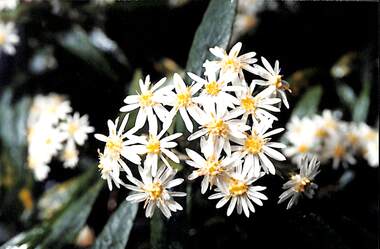
Photograph, Olearia lirata (Snowy Daisy Bush), c. 2000
... Common native plant in the Ringwood area. Photograph of Olearia lirata (Snowy Daisy Bush) indigenous to the Ringwood area, Victoria, Australia Olearia lirata (Snowy Daisy Bush) Photograph Photograph ...Common native plant in the Ringwood area.Photograph of Olearia lirata (Snowy Daisy Bush) indigenous to the Ringwood area, Victoria, Australia -
 Orbost & District Historical Society
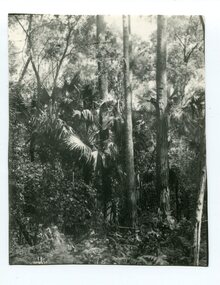
black and white photograph, first half 20th century
... This is a pictorial record of a rare native Australian palm. cabbage-tree-palm-east-gippsland A black / white photograph of small palm trees in a dense bush surrounding. black and white photograph ...Livistona australis - the Cabbage Tree Palm, is a fan palm that grows naturally in the lowland forest and swamps of southern Queensland and along the east coast of Australia and it occurs further south than any other Australian palm species. It is the only palm that is found naturally in Victoria. The early settlers supplemented their meagre rations with the hearts of the Cabbage Tree Palm.This is the southernmost stand of Cabbage Tree Palms in Australia and the only location in Victoria where these palms grow naturally. This is a pictorial record of a rare native Australian palm.A black / white photograph of small palm trees in a dense bush surrounding.cabbage-tree-palm-east-gippsland -
 Flagstaff Hill Maritime Museum and Village
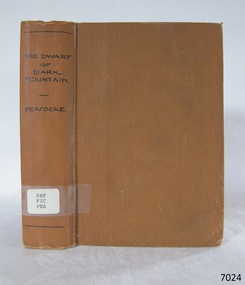
Book - Fictional Story, Isabel Maude Peacocke et al, The Dwarf Of Dark Mountain, 1932-1939
... Typical of Isabel Maud Peacocke's popular juvenile fiction of the 1930s (such as The Cruise of the Crazy Jane and Cathleen with a C), the book weaves together themes of bush navigation and exploration. The children venture through dense ti-tree scrub and native fern gullies, with the narrative centring around the titular "dwarf" of the mountain blending rural Australian and New Zealand family life with wholesome mystery, moral growth, and outdoor adventure. ...The Dwarf of Dark Mountain is a children's adventure novel illustrated by Norman Sutcliffe. Set against the backdrop of the New Zealand bush and rural landscapes, the story follows a group of young protagonists on a mystery-filled adventure centred around a local geological landmark known as "Dark Mountain". Typical of Isabel Maud Peacocke's popular juvenile fiction of the 1930s (such as The Cruise of the Crazy Jane and Cathleen with a C), the book weaves together themes of bush navigation and exploration. The children venture through dense ti-tree scrub and native fern gullies, with the narrative centring around the titular "dwarf" of the mountain blending rural Australian and New Zealand family life with wholesome mystery, moral growth, and outdoor adventure.The Dwarf Of Dark Mountain Author: Isabel Maude Peacocke Illustrator: Norman Sutcliffe Publisher: Ward Lock & Co Date: Further Information: Plain brown/tan cloth binding with the title and author hand-lettered directly onto the spine with no decorative illustration, gilt stamping, or pictorial design. The spine has a Library label with an inscription.fictionThe Dwarf of Dark Mountain is a children's adventure novel illustrated by Norman Sutcliffe. Set against the backdrop of the New Zealand bush and rural landscapes, the story follows a group of young protagonists on a mystery-filled adventure centred around a local geological landmark known as "Dark Mountain". Typical of Isabel Maud Peacocke's popular juvenile fiction of the 1930s (such as The Cruise of the Crazy Jane and Cathleen with a C), the book weaves together themes of bush navigation and exploration. The children venture through dense ti-tree scrub and native fern gullies, with the narrative centring around the titular "dwarf" of the mountain blending rural Australian and New Zealand family life with wholesome mystery, moral growth, and outdoor adventure.warrnambool, shipwrecked-coast, flagstaff-hill, flagstaff-hill-maritime-museum, maritime-museum, shipwreck-coast, flagstaff-hill-maritime-village, shipwrecked-artefact, book, the dwarf of dark mountain, isabel maude peacocke, warrnambool mechanics’ institute, pattison collection, warrnambool library, ralph eric pattison, corangamite regional library service, warrnambool city librarian, mechanics’ institute library, victorian library board, warrnambool books and records, warrnambool children’s library, i. m. cluett., illustrator norman sutcliffe -
 Phillip Island and District Historical Society Inc.
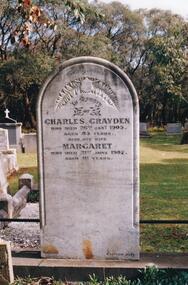
Photograph Album, Kodak, Phillip Island Cemetery, c 1990
... native trees. In all 25 acres of land were set aside as Crown Land in the land settlement of 1868. There are 6.2 acres of wetlands near the cemetery entrance. Phillip Island Cemetery Nancy McHaffie Edith Jeffery 466-27: Charles Grayden: Charles arrived from England on the "Robert Ben" about 1835. On arrival he went bush ...The Album was compiled by Nancy McHaffie late 1990's, with the assistance of Edith Jeffery's, with her book "Garden of Memories" and extensive knowledge of Phillip Island. The Cemetery lies back from the road and is surrounded by Manna Gums, rare Peppermint Gums, Blackwoods and other native trees. In all 25 acres of land were set aside as Crown Land in the land settlement of 1868. There are 6.2 acres of wetlands near the cemetery entrance.466-27: Charles Grayden: Charles arrived from England on the "Robert Ben" about 1835. On arrival he went bush. He later married Margaret Larkie in St. James' old Cathedral, Melbourne on 15th September, 1842. They arrived at Hastings in 1860 then came to Phillip Island to live on Block 33, Newhaven in the year 1867. He died 26th January 1905 aged 85. Margaret died 21st June 1907 aged 81. She is also buried in this grave. 466-28: Joseph Bauer: Joseph was the son of our first owner of the Isle of Wight Hotel. His father came to the Island in 1870 and bought a small private house, then added to it in the style of a Swiss House. It became one of the most comfortable hotels in Victoria. Joseph died aged 19, in 1878.phillip island cemetery, nancy mchaffie, edith jeffery -
 Halls Gap & Grampians Historical Society
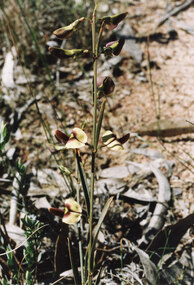
Photograph - Coloured
... The photo is a close-up of a specimen of a type of native pea growing in the bush. Gum leaves and other vegetation also appear in the photo. ...NATURAL HISTORY Flora The photo is a close-up of a specimen of a type of native pea growing in the bush. Gum leaves and other vegetation also appear in the photo. ...The photo is a close-up of a specimen of a type of native pea growing in the bush. Gum leaves and other vegetation also appear in the photo. The flowers have two main colours; gold and rust brown.natural history, flora -
 The Beechworth Burke Museum
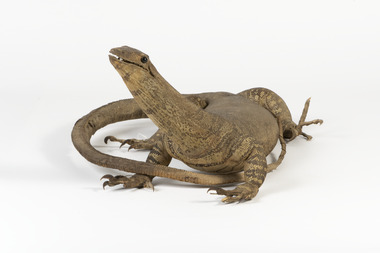
Animal specimen - Sand Goanna, Trustees of the Australian Museum, 1860-1880
... bush settlers in Australia likened goannas to the South American lizards. Goannas retain special cultural and historic significance within Australian folklore and Indigenous culture. They were an important traditional native...bush settlers in Australia likened goannas to the South American lizards. Goannas retain special cultural and historic significance within Australian folklore and Indigenous culture. They were an important traditional native ...Sand goannas are the second largest species of carnivorous lizards found across mainland Australia. They can grow up to 160cm in length and can weigh as much as 6kg. Their common name is derived from "iguana", since early European bush settlers in Australia likened goannas to the South American lizards. Goannas retain special cultural and historic significance within Australian folklore and Indigenous culture. They were an important traditional native food source and are commonly represented in Aboriginal Dreamtime stories. In some Aboriginal languages, the sand goanna is called "bungarra"; a term also commonly used by non-Aboriginal people in Western Australia. In Pitjantjatjara and other central Australian languages, goannas are called "tingka". This specimen is part of a collection of almost 200 animal specimens that were originally acquired as skins from various institutions across Australia, including the Australian Museum and the National Museum of Victoria, as well as individuals such amateur anthropologist Reynell Eveleigh Johns between 1860-1880. These skins were then mounted by members of the Burke Museum Committee and put-on display in the formal space of the Museum’s original exhibition hall where they continue to be on display. This display of taxidermy mounts initially served to instruct visitors to the Burke Museum of the natural world around them, today it serves as an insight into the collecting habits of the 19th century. This specimen is part of a significant and rare taxidermy mount collection in the Burke Museum. This collection is scientifically and culturally important for reminding us of how science continues to shape our understanding of the modern world. They demonstrate a capacity to hold evidence of how Australia’s fauna history existed in the past and are potentially important for future environmental research. This collection continues to be on display in the Museum and has become a key part to interpreting the collecting habits of the 19th century.Small goanna with a streamlined body and textured scaly skin in different shades of olive and brown. It has a long neck and a long tail which narrows towards the tip. The goanna has four short, stocky legs which meet with large, curled claws. Its mouth is slightly slightly open, and it has two black glass eyes.On tag: BMM / 5892 /taxidermy mount, taxidermy, animalia, burke museum, beechworth, australian museum, skin, reynell eveleigh johns, lizard, goanna, sand goanna, monitor lizard, various gouldii -
 Eltham District Historical Society Inc
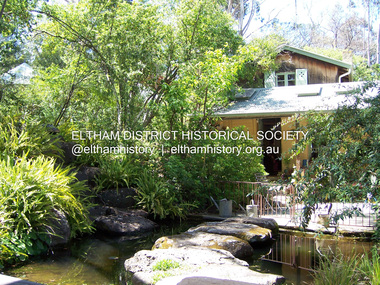
Photograph - Digital Photograph, Marguerite Marshall, Gordon Ford's Garden, 'Fulling', Pitt Street, Eltham, 10 November 2006
... The gate opens onto a sandy gravel path, one of several, which wind around dramatic pools and what appear to be natural bush, but on close inspection are carefully integrated native, indigenous and exotic plantings. ...The gate opens onto a sandy gravel path, one of several, which wind around dramatic pools and what appear to be natural bush, but on close inspection are carefully integrated native, indigenous and exotic plantings. ...'Fulling', the half-hectare property at Pitt Street, Eltham was the home of landscape designer Gordon Ford and his wife Gwen. Ford bought the property in 1948, originally part of an orchard. The garden encapsulates the major trends of Australian garden design in the second half of the 20th century. The garden design is based on mass (plants) and void (paths and pools), textures and forms. It epitomises the Eltham style because of its relaxed informality and attraction to native wildlife. The mud brick house and designed and built by Ford commenced in 1948. Several extensions were added up to 1970 and were built by Graham Rose (Source: information panel for exhibition, n.d.) Covered under Heritage Overlay, Nillumbik Planning Scheme. Published: Nillumbik Now and Then / Marguerite Marshall 2008; photographs Alan King with Marguerite Marshall.; p147 A narrow timber gate opens onto a garden that has had a huge impact on natural garden development in Australia since the 1950s.1 Fulling, the half-hectare property at Pitt St, Eltham, was the home of the landscape designer, Gordon Ford, who died in 1999. The garden ‘encapsulates the major trends of Australian garden design in the second half of the 20th century...and epitomises the Eltham style of garden’.2 It in turn, was influenced by several Victorian major landscape designers of the mid 20th century – Ellis Stones, Peter Glass and Edna Walling. The gate opens onto a sandy gravel path, one of several, which wind around dramatic pools and what appear to be natural bush, but on close inspection are carefully integrated native, indigenous and exotic plantings. Retaining walls and steps of rock through the garden link different terrace levels. Lichen-covered boulders serve as steps across a pool, leading to the triple level mud-brick house. Ford bought the property, which was originally part of an orchard, in 1948. As the son of a Presbyterian minister, Ford received a good education, which included learning Latin. This was advantageous when he worked in plant sales for the Forestry Commission, before the Second World War. In the late 1940s, however, Ford turned to building and landscape gardening. He worked on the Busst house, an early mud-brick building designed by Alistair Knox and at the same time, Ford was employed by Ellis Stones. Knox described Ford as, ‘one of the funniest men of the district. ...Rocky’s (Ellis Stones) Depression stories and Gordon’s memory and quick tongue made the jobs the most enjoyable of all those hysterical times that made Eltham the centre of the eternal laugh, between the years of 1945 and 1950’.3 Ford’s house, like so many after the war, was built progressively, as more space was needed and formerly scarce materials became available. It began with an army-shed of timber-lined walls, now used as the kitchen. Ford then built what is now the lounge room, and the house grew ‘like topsy and on a shoestring,’ says his widow Gwen. A lot of second-hand materials such as window frames were used, a style made famous particularly with their extensive use at Montsalvat, the Eltham Artists’ Colony. The house was constructed as a joint venture with friends, including artist Clifton Pugh, who built Ford’s bedroom for £10. The polished floorboards and solomite (compressed straw) ceilings, interspersed with heavy beams, exude warmth. The result is a home of snug spaces, with soft light and garden vistas. Several other mud-brick buildings were constructed as needed, including a studio and units for bed-and-breakfast clients. The garden, which has been part of the Open Garden Scheme since the mid 1980s, is based on a balance of mass (plants) and void (paths and pools), textures and forms. It epitomises the Eltham style because of its relaxed informal ethos and attracts native animals. Wattlebirds, scrub wrens, pardalotes, currawongs, owls and even kangaroos, have been seen at Fulling. Gwen, a former English teacher who has worked on the garden since around 1970, urged and helped Ford write his book, The Natural Australian Garden.4 Several of Ford’s favourite trees are in the garden, including the native Casuarina or She-Oak. In spring, the garden is dusted with the purple Orthrosanthus multiflorus or blue native irises and rings with the calls of birds attracted to plants like the callistemons, correas and grevilleas.This collection of almost 130 photos about places and people within the Shire of Nillumbik, an urban and rural municipality in Melbourne's north, contributes to an understanding of the history of the Shire. Published in 2008 immediately prior to the Black Saturday bushfires of February 7, 2009, it documents sites that were impacted, and in some cases destroyed by the fires. It includes photographs taken especially for the publication, creating a unique time capsule representing the Shire in the early 21st century. It remains the most recent comprehenesive publication devoted to the Shire's history connecting local residents to the past. nillumbik now and then (marshall-king) collection, eltham, fulling, gordon ford garden, pitt street, eltham mud brick buildings, mud brick house -
 Kiewa Valley Historical Society
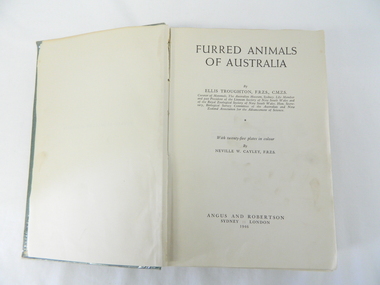
Book - Non Fiction Australian Mammals, Furred Animals of Australia, 1946
... However the rural based pupils would find the chapters and coloured prints more "real" than city located students because they are living day to day in the Australian bush, home to all the various mammals and marsupials presented in this book. australian mammals and marsupials nature books australia wild life On the spine "FURRED ANIMALS OF AUSTRALIA" and underneath "BROUGHTON" and at the bottom "ANGUS & ROBERTSON" This green coloured hard covered book has 178 double sided printed pages and twenty five plate detailing the appearances of native mammals. ...This book was written before the "preservation of Australian Flora and Fauna" movement became a household edict. The book covers all the "known" marsupials of the time and coloured prints are provided where required to show physical and other distinguishing features. Time and extensive searches of hard to reach places in Australia has uncovered a greater range of marsupials than presented in this book. Rural Australia (1940s) had not been as developed and altered as the 1980s onward. This book was used in Primary schools as reference material. Although rural school children would have come across many "real life" encounters with some of the mammals referred to, the diversity and range of mammals presented in this book is quite extensive. Most "city" born children would have only seen the mammals presented in this book at animal zoos in the larger cities.This book details the Australian wide range of mammals, and not just those which school children in the Kiewa Valley could meet "face to face". However the rural based pupils would find the chapters and coloured prints more "real" than city located students because they are living day to day in the Australian bush, home to all the various mammals and marsupials presented in this book.This green coloured hard covered book has 178 double sided printed pages and twenty five plate detailing the appearances of native mammals. The first two pages are frayed and all pages show colouration (yellow) of age. The book has a clear plastic cover as protection placed at a later dateOn the spine "FURRED ANIMALS OF AUSTRALIA" and underneath "BROUGHTON" and at the bottom "ANGUS & ROBERTSON"australian mammals and marsupials, nature books, australia wild life -
 Emerald Museum & Nobelius Heritage Park
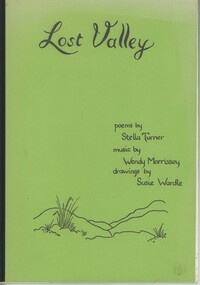
Booklet, Stella Turner et al, Lost Valley, 1986
... These poems set to music are about native orchids which can be observed in the local bush. Stella Turner Wendy Morrissey Susie Wardle This book consists of four poems, each about a native orchid. ...This book consists of four poems, each about a native orchid. Accompanying each poem is a line drawing of that orchid in its natural environment and that is followed by musical notation created for each poem.Green cover. Approx 32 pages. Booklet consists of four poems with black and white line drawings followed by musical notation. The inside front page has the autographs of the poet, the musician and the artist.non-fictionThis book consists of four poems, each about a native orchid. Accompanying each poem is a line drawing of that orchid in its natural environment and that is followed by musical notation created for each poem. stella turner, wendy morrissey, susie wardle -
 Bendigo Historical Society Inc.
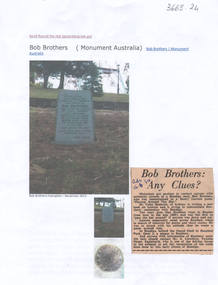
Newspaper - Bob Brothers Memorial, 26th June 1964
... native of this City of Bendigo. His charity, kindness and comradeship, particularly at Bourke on the Darling River, N.S.W., inspired Henry Lawson to characterise him in the story 'Send around the Hat.' 'And I wish that I could immortalise him ' Henry Lawson. Extract from poem: 'Now this is the creed from the Book of the Bush...native of this City of Bendigo. His charity, kindness and comradeship, particularly at Bourke on the Darling River, N.S.W., inspired Henry Lawson to characterise him in the story 'Send around the Hat.' 'And I wish that I could immortalise him ' Henry Lawson. Extract from poem: 'Now this is the creed from the Book of the Bush ...The inscription on the plaque for Bob Brothers reads: 'this sundial and garden court is erected as a memorial and tribute to Bob Brothers, a native of this City of Bendigo. His charity, kindness and comradeship, particularly at Bourke on the Darling River, N.S.W., inspired Henry Lawson to characterise him in the story 'Send around the Hat.' 'And I wish that I could immortalise him ' Henry Lawson. Extract from poem: 'Now this is the creed from the Book of the Bush - Should be simple and plain to a dunce. If a man's in a hole you just pass round the hat - Were he jail bird or gentleman once'Newspaper article titled 'Bob Brothers: Any Clues? with a three page copy of information and a photograph of the Bob Brothers sundial and plaque memorial in Rosalind Park, Bendigo. Newspaper article, 26th June, 1964, Bendigo Advertiser, discusses a proposed book on Henry Lawson by Dr. Colin Roderick of Sydney. Dr. Roderick is attempting to substantiate Brothers' connection with Bendigo and is 'anxious to contact anyone with authentic records of a Bendigo man, Bob Brothers who was immortalised in a Henry Lawson poem, 'Passing Around the Hat.' A. Llewellyn, Eaglehawk was a 'driving force' to get recognition for Brothers' link to Bendigo.bendigo, bob brothers, send around the hat, pass around the hat, dr. colin roderick, henry lawson -
 Bendigo Historical Society Inc.
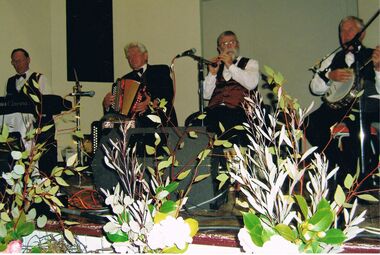
Photograph - PETER ELLIS COLLECTION: BAND PLAYING
... Peter Ellis. Bush band on stage. Native foliage in front of stage. ...Peter Ellis. Bush band on stage. Native foliage in front of stage. ...Colour photograph. Peter Ellis. Bush band on stage. Native foliage in front of stage. Recorder. Banjo. Accordion. Keyboard. Back of photo reads: Peter Ellis playing with the Gay Charmers.entertainment, music, bush band -
 Victorian Interpretive Projects Inc.
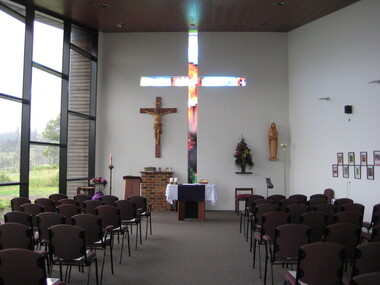
Photograph - Digital, Clare Kathleen Gervasoni, St Mary's Kinglake, 2012, 15/12/2012
... Bush, written in Hebrew. Christ is represented by the cross above the entrance. The previous church was destroyed in the 2009 bushfires. The area is surrounded by 22,000 hectares of Kinglake National Park, the largest National Park close to Melbourne. The park was established in 1928 to protect native...Bush, written in Hebrew. Christ is represented by the cross above the entrance. The previous church was destroyed in the 2009 bushfires. The area is surrounded by 22,000 hectares of Kinglake National Park, the largest National Park close to Melbourne. The park was established in 1928 to protect native ...The images depict the newly completed fourth Catholic Church at Kinglake. The previous three churches having been destroyed by 'Black Saturday' bushfire. The painting is oil on canvas. The historical continuity is expressed by the continuity of the skyline and the disconnectedness of the colours. it is not a literal depiction of each church, but a recognizable and symbolic image conveying resilience of faith of the local community. The first church was burnt down in a bushfire, the second burnt down by vandals, and the three burnt down in the 2009 bushfires known as 'Black Saturday'.The white cross and black fence at the lower left commemorated the remarkable fact that these remained intact after the 2009 bushfires. The red-orange can be the colour of the kinglake soil or the fires. The return of new life is indicated by the green growth on the burnt gumtrees. The presence of the Holy Trinity is shown above the entrance to the church. The return of new life is indicated by the green growth on the burnt gumtrees. The presence of the Holy Trinity is shown above the entrance to the church. The Holy Sprit is symbolized by the sulphur crested cockatoo, an Australian bird instead of the white dove. The symbol for the father is above the church in the triangle which has God's Holy Name (I AM) as given to Moses from the Burning Bush, written in Hebrew. Christ is represented by the cross above the entrance. The previous church was destroyed in the 2009 bushfires. The area is surrounded by 22,000 hectares of Kinglake National Park, the largest National Park close to Melbourne. The park was established in 1928 to protect native flora and fauna. Kinglake takes its name from Alexander Kinglake who travelled through the area in 1870. Photographs showing the newly built St Mary's Catholic Church at Kinglake. .1) Interior of Church .2) Painting of the Four Churches of Kinglake by Judy Racz .3-5) Views from the Church windows to the adjoining landscape .6) St Mary's Church groundskinglake, bushfire, black saturday, church, catholic, racz, st mary's catholic church kinglake -
Bendigo Historical Society Inc.
Newspaper - Bendigo Advertiser Collection: Schools Searching for a Future - Mandurang South Primary School 1628, August 13 1993
... native wildlife and nature-based activities. The school offers standard facilities (oval, courts, shelter) and unique curriculum elements like "bush cooking," making learning relevant to its rural setting. ...native wildlife and nature-based activities. The school offers standard facilities (oval, courts, shelter) and unique curriculum elements like "bush cooking," making learning relevant to its rural setting. ...The document highlights the challenges faced by Mandurang South, a small rural school, in the face of government education reforms and potential closure. Mandurang South was considered an easy target for closure under new government 'quality provision' guidelines. Despite demonstrating a strong curriculum and experienced leadership, the school faced severe staffing reductions: from two teachers plus specialist support to just 1.4 teachers for 32 students. This would require one teacher to manage 31 children across seven grades in a single classroom, raising concerns about educational quality. Parents and teachers collaborated intensively to prepare a submission proving the school's quality, hoping to meet government criteria for survival. Some parents, including former students, expressed willingness to close or merge the school if educational standards could not be maintained, while others wanted to keep it open. The school community was holding a referendum to decide its stance for an upcoming taskforce meeting. Mandurang South and its neighboring school, Mandurang Primary, originated from a split in 1875 due to the distances children had to travel. The school has a rich history, with its original weatherboard building and a notable stand of century-old trees, making it a model for rural education and a point of local pride. The most likely option discussed was merging with Mandurang Primary, which would be ironic given their historical split over a century ago.Mandurang South's situation serves as a test case for the broader impact of educational 'rationalisation' policies on small rural schools. Mr. Balmer was Head Teacher in 1875. Heintervened to stop residents from cutting timber on school grounds, preserving a notable stand of eucalypts and conifers.The school grounds are recognized for their natural beauty, attracting visitors and providing students with daily exposure to native wildlife and nature-based activities. The school offers standard facilities (oval, courts, shelter) and unique curriculum elements like "bush cooking," making learning relevant to its rural setting. Mandurang South School is valued at $50,000–$70,000, but faces closure due to economic constraints and potential staff reductions.There is concern that closure could lead to further school consolidations in the Mandurang valley, as part of a broader government education reform. The possible closure is seen as a loss to the community’s heritage and educational landscape, with uncertainty about the future of other local schools.Schools searching for a Future. Series of photos and information about Mandurang Primary School No. 1628. Pictures by Lisa Honeychurch. Written by Owen Davies. This item contains the following documents: 8091.602a Part of Page 11, the Bendigo Advertiser Friday August 13 1993 8091.602b Part of Page 11, the Bendigo Advertiser Friday August 13 1993 8091.602c Black and White Photo of four kids playing cricket on the oval besides the school - Contact BHS for Details 8091.602d Black and White Photo of Grade Four student Gary Wilkins sitting under a pine tree, possibly reading - Contact BHS for Details 8091.602e Black and White Photo of Grade Four students "Bush Cooking" around a camp fire Left to Right: Travis Singe, Tristian Gillies, Gary Wilkins, Bill Riddell - Contact BHS for Details 8091.602f Black and White Photo Front of Mandurang South School - Contact the BHS for Details 8091.602g Black and White Photo Front of Mandurang South School - Contact the BHS for Details 8091.602h Black and White Photo Two men and three kids in front of the school sign. Left to Right: Brian Murdoch, Brian's daughter Ebony, John's son and daughter, Roger and Erin, and John Murdoch - Contact the BHS for Details 8091.602i Black and White Photo of Mrs Bess Coghill, the former Post Mistress at Mandurang South - Contact the BHS for Details 8091.602j Black and White Photo of the school sign - Contact the BHS for Detailsnewspaper, bendigo advertiser, mandurang south, primary school -
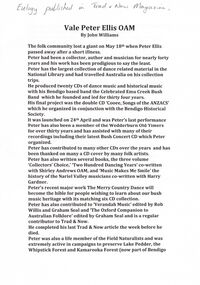 Bendigo Historical Society Inc.
Document - PETER ELLIS COLLECTION: PETER ELLIS EULOGY
... Peter has discovered and named plants in the whipstick and enjoyed propagating native plants. He loved his amazing bush block in suburban Bendigo. ...Peter has discovered and named plants in the whipstick and enjoyed propagating native plants. He loved his amazing bush block in suburban Bendigo. ...2 A4 sheets. Handwritten pencil note at top of first page reads: Eulogy published in Trad & Now Magazine. Vale Peter Ellis OAM. By John Williams. The folk community lost a giant on May 18th when Peter Ellis passed away after a short illness. Peter had been a collector, author and musician for nearly forty years and his work has been prodigious to say the least. Peter has the largest collection of dance related material in the National Library and had travelled Australia on his collection trips. He produced twenty CDs of dance music and historical music with his Bendigo based band the Celebrated Emu Creek Bush Band which he founded and led for thirty four years. His final project was the double CD 'Cooee, Songs of the ANZACS' which he organised in conjunction with the Bendigo Historical Society. It was launched on 24th April and was Peter's last performance. Peter has also been a member of the Wedderburn Old Timers for over thirty years and has assisted with many of their recordings including their latest Bush Concert CD which Peter Organised. Peter has contributed to many other CDs over the years and has been thanked on many a CD cover by many folk artists. Peter has also written several books, the three volume 'Collectors' Choice,' 'Two Hundred Dancing Years' co-written with Shirley Andrews OAM, and 'Music Makes Me Smile' the history of the Nariel Valley musicians co-written with Harry Gardner. Peter's recent major work The Merry Country Dance will become the bible for people wishing to learn about our bush music heritage with its matching six CD collection. Peter has also contributed to 'Verandah Music' edited by Rob Willis and Graham Seal and 'The Oxford Companion to Australian Folklore' edited by Graham Seal and is a regular contributor to Trad & Now. He completed his last Trad & Now article the week before he died. Peter was also a life member of the Field Naturalists and was extremely active in campaigns to preserve Lake Pedder, the Whipstick Forest and Kamarooka Forest (now part of Bendigo National Park and preserved forever) One Tree Hill, Jackass Flat Flora Reserve and Saloman's Gully bushlands. Peter has discovered and named plants in the whipstick and enjoyed propagating native plants. He loved his amazing bush block in suburban Bendigo. Peter was also a keen photographer and had photos published in the book 'Wildflowers of Bendigo'. Peter taught dancing and music classes with Continuing Education for many years and encouraged many young musicians over the years. Peter was an accomplished ballroom dancer and had achieved gold medal status in that field. He was one of Australia's finest exponents of the button accordion, concertina, harmonica and tin whistle. Peter also played piano, organ and ukulele as well as the Swanee whistle and bones. Peter was the founder of the Annual Dinki Di Ball held each September in Eaglehawk as a tribute to the old MC's. Peter was happy playing for fund-raisers for any organisation who asked and also enjoyed plying the big gigs such as for the opening of the Melbourne Museum or for State Parliament. He played in the National Folk Festivals in four states and was a regular at the National in Canberra where he gave regular classes, performed with his bands and was a stalwart of the Aussie section of the session bar. He performed at nearly every Maldon Folk Festival and was MC at Nariel Folk Festival dances for many years. Peter was very proud of his OAM and wore the little medal at all of his performances. That honour was rightly given to one who did so much to preserve Australia's dance history. Peter lived a full life and was a friend to hundreds of people. He was taken far too young and in typical fashion was planning new projects right till the end. His passing is a huge loss for us all but one thing is certain. He will never be forgotten.person, individual, peter ellis oam -
 Bendigo Historical Society Inc.
Newspaper - PETER ELLIS COLLECTION: NEWSPAPER CLIPPINGS
... Bush Band. Ellis - Peter. A close friend colleague, musician, authority on native plants and colonial music researcher. ...Bush Band. Ellis - Peter. A close friend colleague, musician, authority on native plants and colonial music researcher. ...A4 sheet white printer paper with 8 newspaper clippings glued on. Handwritten note reads: Death notices for Peter Ellis - Bendigo Advertiser Wed 20th - Saturday 23rd May 2015. Death Notices. Ellis - Peter OAM. Our college community pays tribute to Peter, a highly respected former staff member and ex-student. He was a highly valued and supportive colleague, mentor and friend. Peter will be remembered for his wealth of scientific knowledge, his love of the natural environment and his contribution to the local and state Lab Technicians Associations. - Principal, staff and Students of Bendigo Senior Secondary College. City of Greater Bendigo. Ellis- Peter. A gentle man with a wonderful passion for Greater Bendigo's natural, built and musical heritage, Peter will be greatly missed by the Greater Bendigo Heritage Advisory Committee. He willingly shared his love and knowledge of the rich and unique heritage around us. Ellis - Peter Nicolaus OAM. You went so quickly. I will miss our trips to Festivals doing crosswords on the way. My sympathy to both families and Brian a great mate to the last. A void impossible to fill. - Mary Smith. Ellis- Peter OAM. A tribute to our intrepid band leader of 34 years who took us on an unforgettable musical journey of preserving and teaching the traditions of dance and music to old and young throughout Australia. You are irreplaceable ' Dirty Pierre' - Past and present members of the celebrated Emu Creek Bush Band. Ellis - Peter OAM. Founder and leader of Emu Creek Bush Band. Australia's largest collector of dancing history. A great friend taken far too young. Au revoir 'Dirty Pierre' - John and Sue Williams. Ellis - Peter OAM. Thanks Pete, you introduced me to a life of extraordinary experiences, amazing friendships, dance and music. We did have some fun. - Marg Hogan. Ellis - Peter. We are so saddened by your passing. Your music and great sense of humour will remain with us. - Wedderburn Old Timers Band. Ellis - Peter. A friend of many years. We will remember your warmth, humour and tireless pursuit to preserve the Natural Environment of Bendigo. Your love and knowledge of the Bendigo Flora was inspirational. - Mary and Patrick Ward. Ellis- Peter. A music and dance man with a warm appreciation and encouragement of diverse talent. - Winzar boys. Death Notices. Ellis - Peter. Greatly respected and loved by his many friends in the traditional music and dance movement across Australia. His achievements were many and he will be missed. - The Traditional Social Dance Association of Victoria. Ellis - Peter. The Bendigo Historical Society is saddened at the passing of fine musician and friend Peter Ellis. - Committee and members, Bendigo Historical Society. Ellis- Peter. A talented musician and long time friend who was always willing to help us. - Members of Euro fest Choir and Inc. Ellis - Peter. Friend and neighbour, nature's gentleman at rest. Sincere sympathy to Robyn, Rick, Ryan and Doug. - Judy Monti. Ellis- Peter OAM Fond memories of 28 years with the band. Sadly Missed. - Stan and Heather Symes. Death Notices. Ellis - Peter OAM Pete, a much loved friend of many years. We fondly remember your knowledge, humour and those great times together, especially in the bush. Deeply missed. - Rob and Glen Moors. Death Notices. Ellis- Peter. Fond memories, so sadly missed. Keep playing your music Peter. Loved cousin Cheryl and families. Ellis -Peter. Loved cousin of Sandra and Phil Jubber and families. Deeply Missed. Ellis - Peter. A long term member of the Bendigo Field Naturalist Club. Deepest sympathy to his friends, he will be sadly missed by all. Ellis - Peter. Leader of the 'Celebrated Emu Creek Bush Band' Memories of lots of great times playing and travelling all over. We learned so much about dancing and music and it just won't be the same. - Don and Julie. Ellis - Peter. Much loved friend, dancer and band leader. - Dianne and Doug Pearse. Death Notices. Ellis - Peter. Peter, you gave so much laughter and happiness to many, many people through your lovely nature and your brilliant music to listen to and dance to. You have left a legacy of music, books and dance as well as unforgettable memories. Rest in peace. - Diana Austin. Death Notices Ellis Peter 27/3/1946 - 18/5/2015 Formerly of Emu Creek Bush Band and the Wedderburn Old Timers). Passed away suddenly at Bendigo Hospice. Loved son of Joan and Allan Nielsen (both Dec). Loving brother of Robyn and Doug. Brother-in-law of Rick and Uncle of Ryan and the extended family. Let the music play on… For Funeral arrangements see later edition. Death Notices. Ellis - Peter Nicolaus O.A.M. Suddenly. An inaugural member of the Bush Dance and Music Club and the Emu Creek Bush Band. A much loved friend, dance instructor and musician. Very generous with his time and knowledge. Passionate collector of dance music and old time dances. Will be sadly missed by all who knew him. - Devastated dance members. Ellis- Peter. OAM 27/3/46 - 18/5/15 Passed away peacefully after a brief illness. Much loved and irreplaceable brother, cousin and uncle to the Lilford, Datson, Burns, Shaw and Kitch families. You enriched our lives. No words can express how much we will miss you. Ellis Pierre (Peter) You were as much a father to me as an uncle. I never told you that or how much I looked up to you. You will be sadly missed - Boswald ( Ryan). Ellis - Peter. We are going to miss our Monday night dinners before rehearsal. A lover of fine wine, good food and great music. Pierre, our Maestro and fearless band leader, we will miss the sound of your squeeze box and your passion for the music. - Paul and Alida Robinson, Emu Creek Bush Band. Ellis - Peter. A close friend colleague, musician, authority on native plants and colonial music researcher. An enormous influence in preserving early Australian dance and dance music. We will all miss you Pete. - Jill and Graeme Balaam. Funeral Notices Ellis. A service of thanksgiving for the life of the late Mr Peter Nicolaus Ellis will be held at the Mulqueen Family Chapel, 15-25 Bridge street, Bendigo on MONDAY (May 25) at 11.00am. A private cremation will follow. Tributes can be left at www.heavenaddress.com Mulqueen Family 15-25 Bridge street, Bendigo Est. 1853 5443 4455.person, individual, peter ellis oam -
 Bendigo Historical Society Inc.
Document - PATHWAY TO HISTORY - BENDIGO CREEK LINEAR PARK
... Drawing of a man and child standing on a bridge over a creek, surrounded by bush and several native animals and birds. ...Drawing of a man and child standing on a bridge over a creek, surrounded by bush and several native animals and birds. Document PATHWAY TO HISTORY - BENDIGO CREEK LINEAR PARK ...Coloured brochure, written on front : 'Pathway to history, Bendigo creek linear park'. Drawing of a man and child standing on a bridge over a creek, surrounded by bush and several native animals and birds. bendigo, parks and gardens, bendigo creek linear park -
 Narre Warren and District Family History Group
Book, National Trust of Australia (Victoria). Casey-Cardinia Branch, Pages from the Past. Snapshot Histories of People, Places & Public Life in Casey & Cardinia, 2011
... Contents include: Richard Gavin Gardiner Casey [Edrington]; The Police Paddocks and the Native Police Corps; The changing face of Berwick township; Coaches, tolls and local councils; Berwick Mechanics Institute and Free Library; Berwick Primary School [No. 40] and Berwick Grammar School; A century of quarrying in Berwick; The German settlement of Harkaway; Emerald’s first State School No. 2110 (1879-1909); The railway to Gippsland; Early sawmilling in West Gippsland; Tooradin and the coastal villages; Some notable early residents and their homes; The draining of the Koo-Wee-Rup swamp; Guest houses at Upper Beaconsfield; Ada Armytage of Holm Park; The soldiers of early Berwick; Memorials, commemorations and avenues of honour; Bush nursing hospitals; The Melbourne Hunt Club [The "Kennels" at Cranbourne]; Growing up in Berwick in the 1930s & 1940s; Growing up in Beaconsfield in the 1930s and 1940s; Casey Airfield; The history of Maryknoll [Catholic farming community]; The filming of “On the beach”; Memories of Ash Wednesday; Maps of the Casey-Cardinia area. ...Contents include: Richard Gavin Gardiner Casey [Edrington]; The Police Paddocks and the Native Police Corps; The changing face of Berwick township; Coaches, tolls and local councils; Berwick Mechanics Institute and Free Library; Berwick Primary School [No. 40] and Berwick Grammar School; A century of quarrying in Berwick; The German settlement of Harkaway; Emerald’s first State School No. 2110 (1879-1909); The railway to Gippsland; Early sawmilling in West Gippsland; Tooradin and the coastal villages; Some notable early residents and their homes; The draining of the Koo-Wee-Rup swamp; Guest houses at Upper Beaconsfield; Ada Armytage of Holm Park; The soldiers of early Berwick; Memorials, commemorations and avenues of honour; Bush nursing hospitals; The Melbourne Hunt Club [The "Kennels" at Cranbourne]; Growing up in Berwick in the 1930s & 1940s; Growing up in Beaconsfield in the 1930s and 1940s; Casey Airfield; The history of Maryknoll [Catholic farming community]; The filming of “On the beach”; Memories of Ash Wednesday; Maps of the Casey-Cardinia area. Notable people : William Lyall and "Harewood'; William Clarke and "Springfield'; Sydney Webb and "Holly Green"; Carl Axel Nobelius; Edwin Flack and "Burnbank"; Carlo Catani;. Includes illustrations, portraits, photographs, maps and bibliography.106 p. : ill., portraits, map, bib., pbk ; 30 cmnon-fictionContents include: Richard Gavin Gardiner Casey [Edrington]; The Police Paddocks and the Native Police Corps; The changing face of Berwick township; Coaches, tolls and local councils; Berwick Mechanics Institute and Free Library; Berwick Primary School [No. 40] and Berwick Grammar School; A century of quarrying in Berwick; The German settlement of Harkaway; Emerald’s first State School No. 2110 (1879-1909); The railway to Gippsland; Early sawmilling in West Gippsland; Tooradin and the coastal villages; Some notable early residents and their homes; The draining of the Koo-Wee-Rup swamp; Guest houses at Upper Beaconsfield; Ada Armytage of Holm Park; The soldiers of early Berwick; Memorials, commemorations and avenues of honour; Bush nursing hospitals; The Melbourne Hunt Club [The "Kennels" at Cranbourne]; Growing up in Berwick in the 1930s & 1940s; Growing up in Beaconsfield in the 1930s and 1940s; Casey Airfield; The history of Maryknoll [Catholic farming community]; The filming of “On the beach”; Memories of Ash Wednesday; Maps of the Casey-Cardinia area. Notable people : William Lyall and "Harewood'; William Clarke and "Springfield'; Sydney Webb and "Holly Green"; Carl Axel Nobelius; Edwin Flack and "Burnbank"; Carlo Catani;. Includes illustrations, portraits, photographs, maps and bibliography. city of casey, cardinia shire (vic.) -
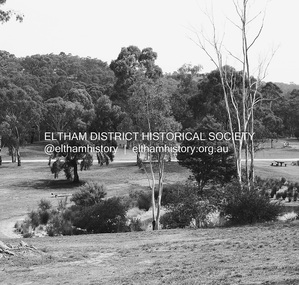 Eltham District Historical Society Inc
Photograph - Digital Photograph, Alan King, Alistair Knox Park, Eltham, 2008
... Informal plantings of Australian indigenous and native species in open and undulating grassed settings blend with the natural landscape of the Diamond Creek to the west. The bush...Informal plantings of Australian indigenous and native species in open and undulating grassed settings blend with the natural landscape of the Diamond Creek to the west. The bush ...Alistair Knox Park, an oasis of peace and beauty. Covered under National Trust of Australia (Victoria) Landscape Significance and Heritage Overlay, Nillumbik Planning Scheme. Published: Nillumbik Now and Then / Marguerite Marshall 2008; photographs Alan King with Marguerite Marshall.; p173 It is hard to imagine that the Alistair Knox Park, an oasis of peace and beauty beside busy Main Road, Eltham, was once the township’s rubbish dump. It was only in the 1970s that the tip was transformed into this beautiful six hectare space, which later earned it a National Trust Landscape classification. Before its life as a dump, the area was used for small farms. Thanks largely to the foresight and efforts of local environmental builder Alistair Knox, the park was designed sympathetically with the character of the wider Eltham landscape. Then, appropriately, the park was named after Knox, who was an Eltham Shire Councillor from 1971 to 1975 and Shire President in 1975. The park designers were four major forces in the urban bush landscape garden –Knox, landscape designer Gordon Ford, artist Peter Glass and landscaper Ivan Stranger. The National Trust citation for the park, originally called Eltham Town Park, includes the Eltham railway trestle bridge and the Shillinglaw Cottage. The citation states ‘the semi-natural setting of the parkland provides a landscape which is evocative of the history of the area’. Manna Gums (Eucalyptus viminalis) and Candlebarks (Eucalyptus rubida) are significant features. Most of the park’s construction was directed by Bob Grant, Superintendent of the Parks and Gardens Department for the Eltham Shire Council. First plantings occurred in Arbour Week in 1973, then the lake and botanic area were completed in 1975, with Federal Government funding, and the toilet block in 1978. Bounded by the Eltham railway line, Panther Place, Main Road, Bridge and Susan Streets, the park is in a valley about a kilometre wide overlooked by steep hills at the east and west. The Diamond Creek flows through it and the picturesque historic timber trestle railway bridge edges the north. Informal plantings of Australian indigenous and native species in open and undulating grassed settings blend with the natural landscape of the Diamond Creek to the west. The bush-style plants, particularly around the creek, balance with open lawns, paths and a cascade flowing from a small lake to another below. A footbridge over the creek leads to the park’s west. The park includes an adventure playground and barbecue areas. The park stands on part of the land bought from the Crown in 1851 by Josiah Holloway, who subdivided it into allotments and which he called Little Eltham. Most of the land was subdivided into residential lots, but the creek valley, on which the park stands, was subdivided into farm-size lots, used mainly for orchards and grazing. One of the earliest owners was John Hicks Petty, who in 1874 bought a plot from Holloway. Other families who owned properties in that area, included Rees, Clark, Waterfall, Graham, Hill and Morant. In 1901 the railway was built through the area. Jock Read, an Eltham resident since around 1920, remembers several farms in the 1920s and ’30s that occupied the site of today’s park. A poultry farm, which extended from present day Panther Place, was owned by the Gahan family. Next to that farm was another for grazing cattle owned by Jack Carrucan. Beside this was land owned by John Lyon. A doctor lived beside this, and at the north-west corner of Bridge Street and Main Road stood a memorial to the soldiers who died in World War One, which was later moved to the RSL site. Mr Read also remembers other farms and orchards west of the creek In the early 1960s the Eltham Council began buying these farms and in the late 1960s turned the areas east of the Diamond Creek into a garbage tip. When this was filled above the creek’s flood plain, the tip was moved to the west of the creek.This collection of almost 130 photos about places and people within the Shire of Nillumbik, an urban and rural municipality in Melbourne's north, contributes to an understanding of the history of the Shire. Published in 2008 immediately prior to the Black Saturday bushfires of February 7, 2009, it documents sites that were impacted, and in some cases destroyed by the fires. It includes photographs taken especially for the publication, creating a unique time capsule representing the Shire in the early 21st century. It remains the most recent comprehenesive publication devoted to the Shire's history connecting local residents to the past. nillumbik now and then (marshall-king) collection, alistair knox park, eltham
