
Showing 23 items matching "normal operations"
-
 Moorabbin Air Museum
Manual - Ansett Boeing 727 Operating manuals, Boeing 727 Operating Manual Pure Freighter Supplement May 1988
... ...Normal operations...Limitations Normal operations Emergency procedures Systems Overview of conversion of Boeing 727 to pure freighter, circa 1988 Spiral bound book type manual Boeing 727 Operating Manual Pure Freighter Supplement May 1988 Manual Ansett Boeing 727 Operating manuals ...Overview of conversion of Boeing 727 to pure freighter, circa 1988Spiral bound book type manual non-fictionOverview of conversion of Boeing 727 to pure freighter, circa 1988limitations, normal operations, emergency procedures, systems -
 Federation University Historical Collection
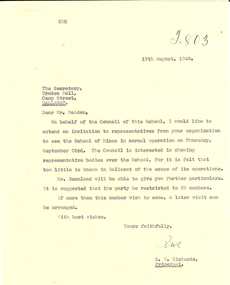
Correspondence, R. W. (Dick) Richards, Ballarat School of Mines invites Members of the Ballarat Trades Hall to Inspect the School, 1948, 19/08/1948
... Typed quarto letter from Dick Richards, Principal of the Ballarat School of Mines, inviting representatives from the Ballarat Trades Hall to see the Ballarat School of Mines in normal operation. ...Richards William McAdam Ballarat Trades Hall Typed quarto letter from Dick Richards, Principal of the Ballarat School of Mines, inviting representatives from the Ballarat Trades Hall to see the Ballarat School of Mines in normal operation. Ballarat School of Mines invites Members of the Ballarat Trades Hall to Inspect the School, 1948 Correspondence R. ...In 1948 the secretary of the Ballarat Trades Hall was William James McAdam. Typed quarto letter from Dick Richards, Principal of the Ballarat School of Mines, inviting representatives from the Ballarat Trades Hall to see the Ballarat School of Mines in normal operation. ballarat school of mines, dick richards, r.w. richards, william mcadam, ballarat trades hall -
 Emerald Museum & Nobelius Heritage Park
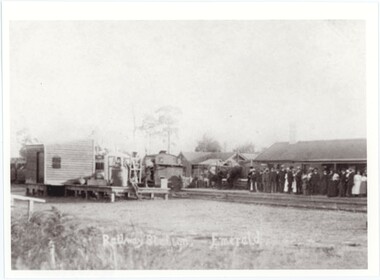
Photograph, Railway Station, Emerald, Early 20th Century
... While it's possible this is a crowd gathered for the opening of the station, it is difficulty to prove either way and could also just be a crowd of passengers for the normal operation of the line....While it's possible this is a crowd gathered for the opening of the station, it is difficulty to prove either way and could also just be a crowd of passengers for the normal operation of the line. This image captures a vital element of Emerald's historical development - the railway. ...Emerald Railway Station opened in 1900 with the line that would eventually become Puffing Billy. The station stayed open until 1954, but judging by context such as the clothing of the people on the platform, this image was likely taken earlier. While it's possible this is a crowd gathered for the opening of the station, it is difficulty to prove either way and could also just be a crowd of passengers for the normal operation of the line.This image captures a vital element of Emerald's historical development - the railway.This item is a modern coy of an older black and white photograph. The photo captures a steam train entering a railway station from the left of the frame, greeted by a crowd of people standing on the station platform to the right. The train is partially obscured by a shed on the photographer's side of the tracks, likely with implements for train maintenance. Several other buildings are visible behind the station, with trees further in the distance.Obverse, Caption: "Railway Station, Emerald"railway, emerald -
 Mission to Seafarers Victoria
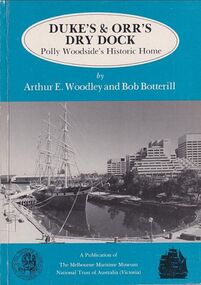
Book, Arthur E. Woodley et al, Duke’s & Orr’s Dry Dock, Polly Woodside’s Historic Home, 1985
... The single dock closed for normal operations in 1975. The site was ceded to the National Trust in 1977, to be used as berth for the historic 'Polly Woodside'. ...The single dock closed for normal operations in 1975. The site was ceded to the National Trust in 1977, to be used as berth for the historic 'Polly Woodside'. ...70 pages : illustrations, facsimiles, mapsnon-fictionduke and orr dry dock, polly woodside, national trust, yarra river, south wharf, interest group -
 Emerald Museum & Nobelius Heritage Park
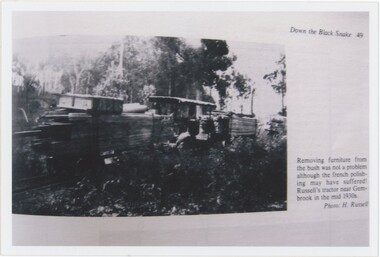
Photograph - Russel's Timber Tractor in Book, H. Russell, Mid-1930s
... Russell, shows relatively normal operation of one of the tractors in the mid-1930s, moving two wagons of processed timber towards Gembrook. ...Russell, shows relatively normal operation of one of the tractors in the mid-1930s, moving two wagons of processed timber towards Gembrook. ...Russel's Mill was located in what is now Bunyip State Park on the Back (or Black Snake) Creek in a relatively clear, flat area beside Ash Landing Road. In 1926 EAC Russel built the mill's 3ft gauge steel rail tramway - with Old Bill's Timber Tractor - to transport timber from the sawmill to what is now Puffing Billy's line. It ran 14 km from Gembrook Station. This tramway was one of only five in the state to use articulated steam power. The Timber Tractor was a six-wheeled Day's model, two of which ran on the Timber Tramway alongside two locomotives - a Kerr Stuart 0-4-2T (which was not powerful enough to do the job) and a geared locomotive built by Day's. The tractors were likely in use until 1953. This photograph, taken by H. Russell, shows relatively normal operation of one of the tractors in the mid-1930s, moving two wagons of processed timber towards Gembrook. Interestingly, the frontmost wagon also appears to be carrying several pieces of furniture. This is a photograph of the book "Bellbrakes, Bullocks & Bushmen: A Sawmilling and Tramway History of Gembrook 1885–1985," by Mike McCarthy. This book is also in our collection, as VEMU1479.Russel's sawmill, through its associated tramway, contributed to keeping the line which is now Puffing Billy running commercially thanks to the quantities of timber it needed to transport. While it has not been operational for a long time, the timber tramway and its rail tractors occupy a significant place in the region's railway history.This item is a photograph of a book, capturing a black and white photograph that was printed in the book and the accompanying printed caption. The photograph features a rail tractor, moving two tractors filled with cut timber. The background is forested and there is vegetation along the line. There appear to be several unclear pieces of furniture on top of the timber in the frontmost wagon.Obverse, Caption in Photographed Book: Top Right: "Down the Black Snake 49" Bottom Right: "Removing furniture from / the bush was not a problem / although the french polish- / ing may have suffered! / Russell's tractor near Gem- / brook in the mid 1930s. / Photo: H. Russel"railway, gembrook, forestry -
Moorabbin Air Museum
Document (Item) - Nomad Model N22S 12.28Fs-1
... Description: AAP7211.016-1 Date: 01/10/81 Author: RAAF Edition/AL Publisher:RAAF Normal aircraft description and operation. Includes all-weather operations, flight characteristics and performance. ...Description: AAP7211.016-1 Date: 01/10/81 Author: RAAF Edition/AL Publisher:RAAF Normal aircraft description and operation. Includes all-weather operations, flight characteristics and performance. ...Description: AAP7211.016-1 Date: 01/10/81 Author: RAAF Edition/AL Publisher:RAAF Normal aircraft description and operation. Includes all-weather operations, flight characteristics and performance. Pages: Binding: Content/Keywords Level of Importance: National. -
 Vision Australia
Equipment - Object, Telesensory Systems, Optacon, 1974
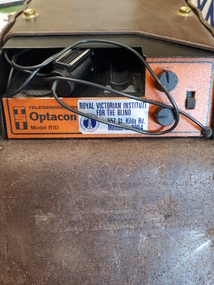
... Designed not be removed from the leather case during normal operation, the On-Off switch is a slide switch located on the right side of the front panel. ...Designed not be removed from the leather case during normal operation, the On-Off switch is a slide switch located on the right side of the front panel. ...The Optacon OPtical-to-TActile-CONverter is a compact, portable reading aid for the blind. It is about the size of a textbook, and weighs less than 2kg. It works by converting a printed image into a tactile image that a blind person can feel with one finger. After a period of training and practice, a blind person can use the Optacon to read ordinary books, magazines, newspapers, and other printed materials. The Optacon was developed after intensive research at Standford University, California, USA and was trialed by clients of the Royal Victorian Institute for the Blind (now part of Vision Australia) in 1973. It has three main sections: 1 a miniature camera, 2 an electronics section, and 3 a tactile stimulator array. The miniature camera, about the size of a pocket knife, is mounted in a housing that has rollers for easy movement along a line of print. The camera is connected to the electronics section by a lightweight cable. The electronics section and the tactile stimulator array are in the main chassis. The array consists of 144 tiny metal rods arranged in six vertical columns and 24 horizontal rows. Each of the rods can vibrate independently. The tips of these rods protrude through holes in a concave finger plate where the index finger is placed flat in order to read. These three components act together to convert the image of a printed letter or other shape into a pattern of vibrating rods, a tactile image of the letter or shape. The letter shape is tactually perceived as an image that moves from right to left on the finger, showing the left or leading edge of the letter first. Letters are felt sequentially rather than all at once, and the image should be kept moving. The Optacon converts a printed O into a tactile form that resembles a crater with a vibrating rim -- a completed circle. C would have a gap or opening on the right side of the curve. The letter F would be felt, sequentially, as a vertical line with two trailing horizontal lines. Because it can convert any ordinary printed image into a corresponding tactile image, the Optacon is not restricted to any special typestyle or language. The camera has a zoom lens that compensates for differences in the size of type. The standard Optacon lens can accommodate type sizes from 6 point to 20 point. With the optional F4A magnifier lens, type sizes as small as 4 point can be read. Powered by a rechargeable battery, and comes with its own battery charger. The battery is contained within the main chassis, and is not removable by the user. There are four basic controls on the Optacon: the Magnification Adjustment zoom button located on the camera section on the side opposite the rollers; and the On-Off switch, the Stimulator Intensity Adjustment knob, and the Threshold Adjustment knob located on the right side of the front panel. The Circuit Breaker protrudes from the right-hand wall inside the chassis compartment. From left to right when the back panel is facing you, are located: the jack for connecting the battery charger; the Battery Check button; the Normal-Invert switch; and the Input/Output I/O connector for use with the Visual Display, when using the Repeater Cable to connect two Optacons to one another or with other accessories. Designed not be removed from the leather case during normal operation, the On-Off switch is a slide switch located on the right side of the front panel. It slides up and snaps into place in the on position. 1 black with orange front, rectangular device in leather case assistive devices, audio equipment -
 Flagstaff Hill Maritime Museum and Village
Textile - Rope Sample, After September 1891
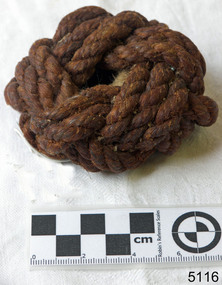
... The light line or rope used to construct this Turk’s Head knot was part of the line line-throwing apparatus used by the Rocket Rescue Crew. In normal operation a rocket carrying the line was fired over a ship, fastened to the ship, then hauled by the crew to pull a heavier rope from shore, which would have a canvas ‘breaches buoy’ attached to it. ...The light line or rope used to construct this Turk’s Head knot was part of the line line-throwing apparatus used by the Rocket Rescue Crew. In normal operation a rocket carrying the line was fired over a ship, fastened to the ship, then hauled by the crew to pull a heavier rope from shore, which would have a canvas ‘breaches buoy’ attached to it. ...The light line or rope used to construct this Turk’s Head knot was part of the line line-throwing apparatus used by the Rocket Rescue Crew. In normal operation a rocket carrying the line was fired over a ship, fastened to the ship, then hauled by the crew to pull a heavier rope from shore, which would have a canvas ‘breaches buoy’ attached to it. A tripod or triangle would be used to keep it free from breakers and rocks. One by one the crew on the wreck would sit in the buoy and be hauled safely back to shore. The three-masted iron barque Fiji had been built in Belfast, Ireland, in 1875 by Harland and Wolfe for a Liverpool based shipping company. The ship departed Hamburg on 22nd May 1891 bound for Melbourne, under the command of Captain William Vickers with a crew of 25. The ship’s manifest shows that she was loaded with a cargo of 260 cases of dynamite, pig iron, steel goods, spirits (whisky, schnapps, gin, brandy), sailcloth, tobacco, coiled fencing wire, concrete, 400 German pianos (Sweet Hapsburg), concertinas and other musical instruments, artists supplies including brushes, porcelain, furniture, china, and general cargo including candles. There were also toys in anticipation for Christmas, including wooden rocking horses, miniature ships, dolls with china limbs and rubber balls. On September 5th, one hundred days out from Hamburg in squally and boisterous south west winds the Cape Otway light was sighted on a bearing differing from Captain Vickers’ calculation of his position. At about 2:30am, Sunday 6th September 1891 land was reported 4-5 miles off the port bow. The captain tried to put the ship on the other tack, but she would not respond. He then tried to turn her the other way but just as the manoeuvre was being completed the Fiji struck rock only 300 yards (274 metres) from shore. The place is known as Wreck Bay, Moonlight Head. Blue lights were burned and rockets fired whilst an effort was made to lower boats but all capsized or swamped and smashed to pieces. Two of the younger crewmen volunteered to swim for the shore, taking a line. One, a Russian named Daniel Carkland, drowned after he was swept away when the line broke. The other, 17 year old able seaman Julius Gebauhr, a German, reached shore safely on his second attempt but without the line, which he had cut lose with his sheath-knife when it become tangled in kelp. He rested on the beach a while then climbed the steep cliffs in search of help. At about 10am on the Sunday morning a party of land selectors - including F. J. Stansmore, Leslie Dickson (or Dixon) and Mott - found Gebauhr. They were near Ryans Den, on their travels on horseback from Princetown towards Moonlight Head, and about 5km from the wreck. Gebauhr was lying in the scrub in a poor state, bleeding and dressed only in singlet, socks and a belt with his sheath-knife, ready for all emergencies. At first they were concerned about his wild and shaggy looking state and what seemed to be gibberish speech, taking him to be an escaped lunatic. They were reassured after he threw his knife away and realised that he was speaking half-English, half-German. They gave him food and brandy and some clothing and were then able to gain information about the wreck. Some of the men took him to Rivernook, a nearby guest house owned by John Evans, where he was cared for. Stansmore and Dickson rode off to try and summon help. Others went down to the site of the wreck. Messages for rescuing the rest of the crew were sent both to Port Campbell for the rocket rescue crew and to Warrnambool for the lifeboat. The S.S. Casino sailed from Portland towards the scene. After travelling the 25 miles to the scene, half of the Port Campbell rocket crew and equipment arrived and set up the rocket tripod on the beach below the cliffs. By this time the crew of the Fiji had been clinging to the jib-boom for almost 15 hours, calling frantically for help. Mr Tregear from the Rocket Crew fired the line. The light line broke and the rocket was carried away. A second line was successfully fired across the ship and made fast. The anxious sailors then attempted to come ashore along the line but, with as many as five at a time, the line sagged considerably and some were washed off. Others, nearly exhausted, had to then make their way through masses of seaweed and were often smothered by waves. Only 14 of the 24 who had remained on the ship made it to shore. Many onlookers on the beach took it in turns to go into the surf and drag half-drowned seamen to safety. These rescuers included Bill (William James) Robe, Edwin Vinge, Hugh Cameron, Fenelon Mott, Arthur Wilkinson and Peter Carmody. (Peter Carmody was also involved in the rescue of men from the Newfield.) Arthur Wilkinson, a 29 year old land selector, swam out to the aid of one of the ship’s crewmen, a carpenter named John Plunken. Plunken was attempting to swim from the Fiji to the shore. Two or three times both men almost reached the shore but were washed back to the wreck. A line was thrown to them and they were both hauled aboard. It was thought that Wilkinson struck his head on the anchor before s they were brought up. He remained unconscious. The carpenter survived this ordeal but Wilkinson later died and his body was washed up the next day. It was 26 year old Bill Robe who hauled out the last man, the captain, who had become tangled in the kelp. The wreck of the Fiji was smashed apart within 20 minutes of the last man being brought ashore, and it settled in about 6m of water. Of the 26 men on the Fiji, 11 in total lost their lives. The remains of 7 bodies were washed onto the beach and their coffins were made from timbers from the wrecked Fiji. They were buried on the cliff top above the wreck. The survivors were warmed by fires on the beach then taken to Rivernook and cared for over the next few days. Funds were raised by local communities soon after the wreck in aid of the sufferers of the Fiji disaster. Captain Vickers was severely reprimanded for his mishandling of the ship. His Masters Certificate was suspended for 12 months. At the time there was also a great deal of public criticism at the slow and disorganised rescue attempt to save those on board. The important canvas ‘breech buoy’ or ‘bucket chair’ and the heavy line from the Rocket Rescue was in the half of the rocket outfit that didn’t make it in time for the rescue: they had been delayed at the Gellibrand River ferry. Communications to Warrnambool were down so the call for help didn’t get through on time and the two or three boats that had been notified of the wreck failed to reach it in time. Much looting occurred of the cargo that washed up on the shore, with nearly every visitor leaving the beach with bulky pockets. One looter was caught with a small load of red and white rubber balls, which were duly confiscated and he was ‘detained’ for 14 days. Essence of peppermint mysteriously turned up in many settlers homes. Sailcloth was salvaged and used for horse rugs and tent flies. Soon after the wreck “Fiji tobacco” was being advertised around Victoria. A Customs officer, trying to prevent some of the looting, was assaulted by looters and thrown over a steep cliff. He managed to cling to a bush lower down until rescued. In 1894 some coiled fencing wire was salvaged from the wreck. Hundreds of coils are still strewn over the site of the wreck, encrusted and solidified. The hull is broken but the vessel’s iron ribs can be seen along with some of the cargo of concrete and pig iron. Captain Vickers presented Bill Robe with his silver-cased pocket watch, the only possession that he still had, as a token for having saved his life and the lives of some of the crew. (The pocket watch came with 2 winding keys, one to wind it and one to change the hands.) Years later Bill passed the watch to his brother-in-law Gib (Gilbert) Hulands as payment of a debt and it has been passed down the family to Gilbert Hulands’ grandson, John Hulands. Seaman Julius Gebauhr later gave his knife, in its hand crafted leather sheath, to F. J. Stansmore for caring for him when he came ashore. The knife handle had a personal inscription on it. A marble headstone on the 200m high cliffs overlooking Wreck Beach, west of Moonlight Head, paying tribute to the men who lost their lives when Fiji ran aground. The scene of the wreck is marked by the anchor from the Fiji, erected by Warrnambool skin divers in 1967.This rope is part of the collection of artefacts from the wreck of the Fiji. Flagstaff Hill’s Fiji collection is of historical significance at a State level because of its association with the wreck Fiji, which is on the Victorian Heritage Register VHR S259. The Fiji is archaeologically significant as the wreck of a typical 19th century international sailing ship with cargo. It is educationally and recreationally significant as one of Victoria's most spectacular historic shipwreck dive sites with structural features and remains of the cargo evident. It also represents aspects of Victoria’s shipping history and its potential to interpret sub-theme 1.5 of Victoria’s Framework of Historical Themes (living with natural processes). The Fiji collection meets the following criteria for assessment: Criterion A: Importance to the course, or pattern, of Victoria’s cultural history. Criterion B: Possession of uncommon, rare or endangered aspects of Victoria’s cultural history Criterion C: Potential to yield information that will contribute to an understanding of Victoria’s cultural history. Rope salvaged from the distress rocket rope line used in the rescue of the crew of the sailing ship “Fiji”. The light-weight brown rope has been crafted into a decorative 'Monkey fist' or 'Turk’s head' knot using three interwoven strands. 1891, shipwrecked coast, flagstaff hill, flagstaff hill maritime museum, maritime museum, shipwrecked artefact, flagstaff hill maritime village, shipwreck coast, warrnambool, rope, moonlight head, wreck bay, distress rocket, line, light line, rocket rescue apparatus, rocket equipment, rocket line -
Moorabbin Air Museum
Document (series) - Nomad Development Material - Collection of Vilem Gottlieb
... 106 Nomad Nomad Series N22 Maintenance Manual figure 203 - Horizontal Stabiliser Trim Control System 107 Nomad Nomad series N22 - N24 108 Map of Portartlington 109 Folder Nomad GAF Nomad N22B Float Plan - Performance Summary 1981 110 Disc Case Nomad 5 computer discs 111 Disc Case 5 computer discs 112 Metal Plate Nomad GAF N24A - 98F 113 Folder Engineering Standard Method for Weighing Aircraft with Portable Electronic Weighing Kits 1988 114 Stapled book Hartzell Propellor Inc Blade Specifications 1981 115 Nomad GAF Brochure: Nomad - The Australian N22B and N24A Turboprop 116 Bound book Nomad ASTA Nomad Performance Torque Charts - N24A-21021 1992 117 Photocopy Nomad SFTE Copy of article: Australian Searchmaster II Delivered to United States - Volume 21, January 1990 1990 118 Photography Nomad Air Safaris Nomad N24A near Mt Cook New Zealand 119 Bound book Nomad GAF N22C - Nomad Performance Summary for DOA Normal Catagory (sic) Operations 120 Stapled book Nomad GAF N24A - Performance Summary for Air Taxi and Commercial Operations to United States FAA/FAR 135 121 Technical Drawings Nomad N22A 122 Bound book Nomad ASTA Acceptance Test Schedule for Nomad N22S Searchmaster Series II Aircraft (does not include radar or FLIR) 1989 123 Manila Folder Nomad GAF Folder of paperwork pertaining to the delivery of aircraft to US Customs 1987 124 Suspension folder Nomad ASTA Project Note N2/120 - Nomad Horizontal stabiliser report 1991 125 Nomad ASTA Army Nomad Modification Program - Acceptance Test Plan 1991 126 Nomad ASTA Memo: Discussion points raised by ARDU 1991 127 Nomad ASTA Minute: NMP Acceptance Test Plan (ATP) 1991 128 Suspension folder Copies of the Civil Aviation Regulations 129 Blank Aircraft weighing and balance sheets 130 Print out of the Computerised track and balance for the H60 helicopter 1989 131 ASTA Letter: Seahawk Flying program 1990 132 ASTA Letter: Training for panel operator 1990 133 ASTA Memo: RAN Seahawk flight operations role 1990 134 Memo: Avionics Course detail 1990 135 Bound book Jetstream Handley Page Flight Manual 1972 136 Bound book Jetstream Handley Page Flight Manual 1969 137 Folder Jetstream Lots of Jetstream data and papers 138 Suspension folder American Jet Industries Publication/brochure 139 Metro II Swearingen Brochure: Metro II by Swearingen 140 Cheyenne IIIA Piper Aircraft Specifications and Performance 19855 141 Australian Light Wing Howard Huges Engineering Brochure: Australian Light Wing 1993 142 SAAB MFI 15 SAAB Brochure: SAAB MFI 15 King Air Exec-Liner Beechcraft Brochure: Beechcraft King Air Exec-Liner 1986 International Corporate Aviation Publication: British Aerospace 125-800 Turbine Islander Article: Turbine Islander in the air 1981 ...106 Nomad Nomad Series N22 Maintenance Manual figure 203 - Horizontal Stabiliser Trim Control System 107 Nomad Nomad series N22 - N24 108 Map of Portartlington 109 Folder Nomad GAF Nomad N22B Float Plan - Performance Summary 1981 110 Disc Case Nomad 5 computer discs 111 Disc Case 5 computer discs 112 Metal Plate Nomad GAF N24A - 98F 113 Folder Engineering Standard Method for Weighing Aircraft with Portable Electronic Weighing Kits 1988 114 Stapled book Hartzell Propellor Inc Blade Specifications 1981 115 Nomad GAF Brochure: Nomad - The Australian N22B and N24A Turboprop 116 Bound book Nomad ASTA Nomad Performance Torque Charts - N24A-21021 1992 117 Photocopy Nomad SFTE Copy of article: Australian Searchmaster II Delivered to United States - Volume 21, January 1990 1990 118 Photography Nomad Air Safaris Nomad N24A near Mt Cook New Zealand 119 Bound book Nomad GAF N22C - Nomad Performance Summary for DOA Normal Catagory (sic) Operations 120 Stapled book Nomad GAF N24A - Performance Summary for Air Taxi and Commercial Operations to United States FAA/FAR 135 121 Technical Drawings Nomad N22A 122 Bound book Nomad ASTA Acceptance Test Schedule for Nomad N22S Searchmaster Series II Aircraft (does not include radar or FLIR) 1989 123 Manila Folder Nomad GAF Folder of paperwork pertaining to the delivery of aircraft to US Customs 1987 124 Suspension folder Nomad ASTA Project Note N2/120 - Nomad Horizontal stabiliser report 1991 125 Nomad ASTA Army Nomad Modification Program - Acceptance Test Plan 1991 126 Nomad ASTA Memo: Discussion points raised by ARDU 1991 127 Nomad ASTA Minute: NMP Acceptance Test Plan (ATP) 1991 128 Suspension folder Copies of the Civil Aviation Regulations 129 Blank Aircraft weighing and balance sheets 130 Print out of the Computerised track and balance for the H60 helicopter 1989 131 ASTA Letter: Seahawk Flying program 1990 132 ASTA Letter: Training for panel operator 1990 133 ASTA Memo: RAN Seahawk flight operations role 1990 134 Memo: Avionics Course detail 1990 135 Bound book Jetstream Handley Page Flight Manual 1972 136 Bound book Jetstream Handley Page Flight Manual 1969 137 Folder Jetstream Lots of Jetstream data and papers 138 Suspension folder American Jet Industries Publication/brochure 139 Metro II Swearingen Brochure: Metro II by Swearingen 140 Cheyenne IIIA Piper Aircraft Specifications and Performance 19855 141 Australian Light Wing Howard Huges Engineering Brochure: Australian Light Wing 1993 142 SAAB MFI 15 SAAB Brochure: SAAB MFI 15 King Air Exec-Liner Beechcraft Brochure: Beechcraft King Air Exec-Liner 1986 International Corporate Aviation Publication: British Aerospace 125-800 Turbine Islander Article: Turbine Islander in the air 1981 Nomad Development Material - Collection of Vilem Gottlieb Document Nomad Development Material - Collection of Vilem Gottlieb ...Donation from Anna Gottlieb -
 Federation University Historical Collection
Object, Synchronome Co. Ltd, Synchronome Frequency Checking Master Clock No. 2191, c1930
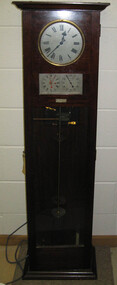
... The clock is a very accurate pendulum clock with provision for varying effective length during operation for precise time regulation. There are two normal time dials and one is controlled by the pendulum and the other is operated by the system frequency. ...The clock is a very accurate pendulum clock with provision for varying effective length during operation for precise time regulation. There are two normal time dials and one is controlled by the pendulum and the other is operated by the system frequency. ...Information from Norman F. Dalton: Ballarat had a reticulated DC supply in the early part of last century and in 1905 had sufficient generating capacity to enable the trams to be changed from horse drawn to DC electricity. The use of electricity increased with the main power station located on Wendouree Parade, near Webster Street, under the ownership of The Electric Supply Company of Victoria. AC generating plant was installed in 1925 and conversion to AC proceeded. In 1934 the company was taken over by the State Electricity Commission Victoria (SECV) and more AC generation was installed and the changeover of customers was accelerated. This is around the time that the Synchronome Frequency Checking Mast Clock was installed at the Wendouree Parade Power Station. The SECV Annual Report of 1921 states: ::Section 11 of the act directed the COmmission to enquire into the question of securing the adoption of such standards of plant and equipment of a system, frequency and pressure for the generation and distribution of electricity as will admit of the efficient interconnection of undertakings throughout the State. In 1934 when the SECV took over the Ballarat operations the question of linking with the State grid had been a planned operation for some years but due to financial considerations had hindered it and in fact would continue to do so for a further 10 years. So while the need for close frequency control for interconnection was hardly an issue, the need to keep electric clocks correct was important, particularly as this item was a frequent sales point to cover the inconvenience and sometimes expense of converting from DC to AC. The clock is a very accurate pendulum clock with provision for varying effective length during operation for precise time regulation. There are two normal time dials and one is controlled by the pendulum and the other is operated by the system frequency. When the clock was in use it was installed by the MEter and Tests Laboratory and the time was checked daily by radio time signals. The two dials were repeated in the operators control panel in the Power Station. A maximum deviation between the two dials was set in the operating instructions (eg 5 seconds) and the operator would correct this when necessary by remote manual alteration of the turbine governor set point. The clock was used to drive and regulate a system of "slave" clocks which were used to display the time in various locations around the power station. A slave clock is a simple clock which is driven by a small electric motor, its accuracy is regulated by the master clock every 30 seconds to ensure that it and all the other slave clocks in the station are on exactly the right time; slave clocks were placed in various locations, from common rooms to workshops. A master clock could potentially run thousands of slave clocks at one plant. The clock also contains a rectifier. A rectifier is a device that is used to convert AC power to more stable DC current.Two clocks in a timber case. Both are electric, one is powered by the main pendulum mechanism, the other is a self contained electric clock. The main mechanism is of the gravity arm and roller type, which sends an impulse to the slave clocks every 30 seconds. The This Synchronome Frequency Checking Master Clock was used at the Ballarat Power Station. Below the main section of the case is a smaller cabinet containing a rectifier to provide consistent DC power for the clock. The rectifier was made by the Victorian company Hilco, which was located in Burwood. There is a high chance this is not the original rectifier from this clock as there appears to be brackets to hold a larger device in the space the rectifier occupies.Front below main clock face on front of case: "Patented Sychronome Brisbane" Lower left-hand clock face: "Frequency time" Lower right-hand clock face: "Standard Seconds" Synchronous electric clock mechanism on door (Frequency time clock): >200/250 V. 50~ >"Synchronomains" Made in England >Direction indicator for clock starting switch >"To start move lever in direction of arrow and release" >"Patent applied for" Mechanism for "standard seconds" clock: >"English Made" >"Patented" >Serial number "321" >0 above right-hand pillar on front-plate Mechanism for "standard seconds" clock: >"English Made" >"Patented" >Serial number "321" >0 above right-hand pillar on front-plate Mechanism for main clock face: >"English Made" >"Patented" >Serial number "8751" >0 above right-hand pillar on front-plate Inside case, back panel, top enamel plate: >Seconds Battery + Pos. > Battery Common or - Neg. >1/2 min dials Inside case, back panel, bottom enamel plate: external seconds dial Inside case, right hand side, electrical knobs: two switches, both "A.C. mains" Pendulum rod, below suspension spring: Serial number (?) 0000005 Rectifier in bottom cabinet: >"Hilco Rectifier" >"A.C. Volts 230/240" >"Model 1060/S" >"A.C. Amperes" >"Serial No. 1060/S >"Phases 1" >"D.C. Volts 6" >"C.P.S. 50" >"D.C. Amperes 1" >"Made in Australia by Hilco Transformers McIntyre St., Burwood, Victoria." Bakelite electrical plug: makers mark Lower cabinet, RH side panel, pressed tin plate: "AC" (upside down) Brass speed adjustment, outer right RH side: "S" and "F" Ivory and wood pendulum beat ruler: >Ruler, with 0 in centre and numbers 1-5 in ascending order from centre on left and right. > "Synchronome Patent." Steel plate, back panel, inside case, right hand side: >N R A" (descending) >"2191" serial number/part number Face of main clock: "Synchronome Electric" synchronome frequency checking master clock, electricity, state electricity commission, wendouree parade power station, secv, clock, time, pendulum, electric supply company of victoria, norman f. dalton, ballarat power station, rectifier, slave clock -
 Kiewa Valley Historical Society
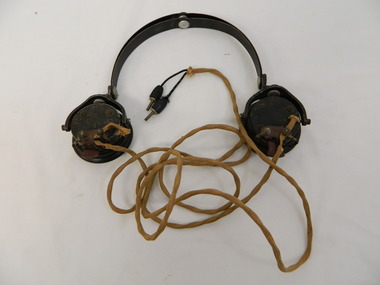
Headphones - Transmitter radio, c1924
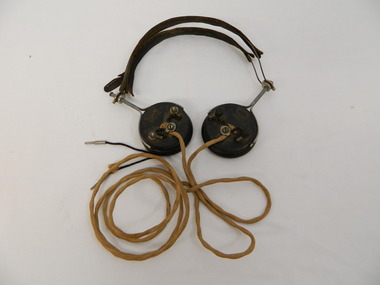
... In operation, the service is similar to a normal telephone system but dispenses with the physical connection of wires and poles between the main terminals. ...In operation, the service is similar to a normal telephone system but dispenses with the physical connection of wires and poles between the main terminals. ...Radio Telephone was minuted during the war. It was approved in 1944 for State Electricity Commission of Victoria use only. It was completed by the end of 1946. Used by the State Electricity Commission of Victoria at Bogong during the construction of the Kiewa Hydro Electric Scheme to connect with head office in Melbourne. It allows one conversation at a time using traffic controls in an unusual system of radio telephone providing communication. At the time it was unique in Australia and installed by the S.E.C.V. technicians. It provided an unattended shortwave radio link between two ordinary telephone switchboards, connecting any of the S.E.C.V.'s internal lines with the telephone system at Bogong and the construction camps beyond. From Bogong, radio phones connect to the outpost stations on the High Plains far above the snow-line. In operation, the service is similar to a normal telephone system but dispenses with the physical connection of wires and poles between the main terminals. Historical: This type of headphone was recommended for amateurs. It may have been used by operators on the Switchboard at Bogong or one of the construction camps on the Kiewa Hydro Electric Scheme. The S.E.C.V installed this unique system of communication to operate their branches especially at Bogong and beyond where the distance was great and often limited by the terrain and weather.Used for a transmitter radio or Radio Telephone as installed by the State Electricity Commission of Victoria 2 round ear pieces. Outside of ear piece has the brand inscribed and 3 points where wires are attached. On opposite edges of the earpieces a metal piece with handle is attached from which the 2 earpieces are connected with curved wire covered by leather to fit on top of the head. Each earpiece has a cord hanging from the middle attachment (on the outside) which joins and then continues as one to 2 metal pins that would fit into holes in the switchboard. On outside of each earpiece - 'Brunet & Co. / Paris' in oval 'Type f' underneathradio telephone. ear phones. head phones.communications.state electricity commission of victoria. kiewa hydro electric scheme. bogong. switchboards. -
 Kiewa Valley Historical Society
Headphone - Transmitter radio
... In operation, the service is similar to a normal telephone system but dispenses with the physical connection of wires and poles between the main terminals....In operation, the service is similar to a normal telephone system but dispenses with the physical connection of wires and poles between the main terminals. ...Radio Telephone: Minuted during the war. It was approved in 1944 for State Electricity Commission of Victoria use only. It was completed by the end of 1946. Used by the State Electricity Commission of Victoria at Bogong during the construction of the Kiewa Hydro Electric Scheme to connect with head office in Melbourne. It allows one conversation at a time using traffic controls in an unusual system of radio telephone providing communication. At the time it was unique in Australia and installed by the S.E.C.V. technicians. It provided an unattended shortwave radio link between two ordinary telephone switchboards, connecting any of the S.E.C.V.'s internal lines with the telephone system at Bogong and the construction camps beyond. From Bogong, radio phones connect to the outpost stations on the High Plains far above the snow-line. In operation, the service is similar to a normal telephone system but dispenses with the physical connection of wires and poles between the main terminals.Historical: This type of headphone was used by operators on the switchboards at Bogong, Mt Beauty or on one of the construction camps on the Kiewa Hydro Electric Scheme. The S.E.C.V. installed this unique system of communication to operate their branches especially at Bogong and beyond where the distance was great and often limited by the weather and terrain.Used for a transmitter radio or Radio Telephone as installed by the State Electricity Commission of Victoria 2 round ear pieces. Outside of each ear piece has the brand inscribed, 4 screws and 1 small piece of metal. The metal has 2 screws attaching the the cord that goes to the 'switchboard'. On opposite edges of the earpieces is a thick metal piece that curves up to which the curved metal headpiece is attached and therefore connecting the earpieces. Each earpiece has a cord hanging from the small metal piece of earphone. This cord joins and then continues as one to the end where there are 2 metal pins coming out of the soft cover.'C-LR ST & C of Sydney'radio telephone. ear phones. headphones. communications. state electricity commission of victoria. kiewa hydro electric scheme. bogong. switchboards. -
 Kiewa Valley Historical Society
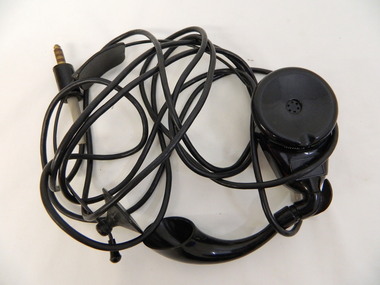
Headphone Set x2
... In operation, the service was similar to a normal telephone system but dispensed with the physical connection of wires and poles between the main terminals....In operation, the service was similar to a normal telephone system but dispensed with the physical connection of wires and poles between the main terminals. ...Radio Telephone was minuted during the war. it was approved in 1944 for the State Electricity Commission of Victoria's use only. it was completed by the end of 1946. used by the State Electricity Commission of Victoria at Bogong during the construction of the Kiewa Hydro Electric Scheme to connect with head office in Melbourne. It allows one conversation at a time using traffic controls in an unusual system of radio telephone providing communication. At the time it was unique in Australia and installed by the S.E.C.V. technicians. It provided unattended shortwave radio link between two ordinary telephone switchboards, connecting any of the S.E.C.V.'s internal lines with the telephone system at Bogong and the construction camps beyond. From Bogong, radio phones connected to the outpost stations on the High Plains far above the snow-line. In operation, the service was similar to a normal telephone system but dispensed with the physical connection of wires and poles between the main terminals.Historical: This headphone set superseded headphones with two earpieces and those without a microphone. This one may have been used by operators on the switchboard at Bogong or Mt Beauty or one of the construction camps on the Kiewa Hydro Electric Scheme. The S.E.C.V. installed this unique system of communication to operate their branches especially at Bogong and beyond where the distance was great and often limited by the terrain and weather.Radio Telephone for SECV switchboard. Black plastic earpiece with microphone. Ear side circular with inscription on outer side then formed into elongated shape narrowing to the curved speaker piece at the narrow end. On top of the narrow end a long rubber cord is attached to a thick brass pin. On top of the wider end a thin stiff wire is attached to curve around the head to a blank rubber earpiece. This head piece has a piece of rectangular rubber attached at the top for comfort.'4408A IW61 / 1'radio telephone, ear phones, head phones. head set. communications, state electricity commission of victoria. kiewa hydro electric scheme. bogong. switchboards -
Moorabbin Air Museum
Manual (Item) - RAAF Mirage Manual, Untitled - Description; Weapons Systems; Emergency Procdures ; Normal Procdures ; All Weather Operation . Etv
... Untitled - Description; Weapons Systems; Emergency Procdures ; Normal Procdures ; All Weather Operation . Etv...RAAF Untitled - Description; Weapons Systems; Emergency Procdures ; Normal Procdures ; All Weather Operation . Etv Manual RAAF Mirage Manual ...RAAF -
Moorabbin Air Museum
Manual (Item) - Tristar Flying Manual Normal Procedures - Adverse Weather Operation
... Tristar Flying Manual Normal Procedures - Adverse Weather Operation...Tristar Flying Manual Normal Procedures - Adverse Weather Operation...British Airways Tristar Flying Manual Normal Procedures - Adverse Weather Operation Manual Tristar Flying Manual Normal Procedures - Adverse Weather Operation ...British Airways -
Ballarat Tramway Museum
Newspaper, The Courier Ballarat, "The Tramway Service", "Tram Traffic Record", Oct. 1947 and March 1953
... Operations Services Two Newspaper cuttings pasted onto a single foolscap sheet: Both from The Courier regarding Ballarat's trams. "The Tramway Service" - 30/10/1947 - Editorial regarding the relocation of the depot, fares, services and notes buses and taxis providing services as well. "Tram Traffic Record" - 12-3-1953 - reporting on a record for passengers carried on a weekday, normal ...Yields information about the moves to relocate the Ballarat Tram depot to a better location and tram traffic.Two Newspaper cuttings pasted onto a single foolscap sheet: Both from The Courier regarding Ballarat's trams. "The Tramway Service" - 30/10/1947 - Editorial regarding the relocation of the depot, fares, services and notes buses and taxis providing services as well. "Tram Traffic Record" - 12-3-1953 - reporting on a record for passengers carried on a weekday, normal service and the Children's display at the City Oval - 26 trams in service, only one remained in the depot. Contained within Reg Item 5507 - Foolscap binder with green covers, black binding edge and metal clips. depot, editorial, tramcar operations, services -
 Ballarat Tramway Museum
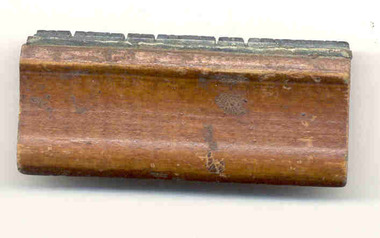
Functional Object - Rubber Stamp, State Electricity Commission of Victoria (SECV), "EXCHANGE OF SHIFTS OR DAYS OFF", 1950's
... Demonstrates aspects of Ballarat's Tramway operations by the SEC in noting for crews a change of shift or change of days off from the normal roster. ...Demonstrates aspects of Ballarat's Tramway operations by the SEC in noting for crews a change of shift or change of days off from the normal roster. Has a strong association with the SEC and tram operations in Ballarat.Rubber stamp and wood stamp base for stamping rosters and/or time sheets with the words "EXCHANGE OF SHIFTS OR DAYS OFF" to indicate when a person had had his shift adjusted, through either a change of shirts or days off to that rostered. Comprises a varnished shaped wooden section, cut from a preformed strip. There is no drawing pin to indicate the front of the stamp, but there is a small notch on the rear of the stamp. trams, tramways, sec, rosters, times, crews -
Ballarat Tramway Museum
Document - Report, State Electricity Commission of Victoria (SECV), "Electricity Supply Department - Geelong Tramways Review 1953", 1953
... Headings are: Early History, Creation of the SEC, Acquirement by the SEC, Agreements with Municipalities, SEC Act, Municipal By-Laws (Buses), proposed extension of the tramway routes, physical characteristics and changes at Geelong, Outlook of SEC as to tramways, Attempts to define transport future, review by the Geelong Tramway Operation by the SEC, tramcars, fares, staff and employees, trams used in normal traffic, daily mileage, average speed of services, service summary, passenger density, present outlook, prospective cost to be faced if existing system is continued, Possible improvements to the present system, extensions to the present tramway system, conclusions. ...Headings are: Early History, Creation of the SEC, Acquirement by the SEC, Agreements with Municipalities, SEC Act, Municipal By-Laws (Buses), proposed extension of the tramway routes, physical characteristics and changes at Geelong, Outlook of SEC as to tramways, Attempts to define transport future, review by the Geelong Tramway Operation by the SEC, tramcars, fares, staff and employees, trams used in normal traffic, daily mileage, average speed of services, service summary, passenger density, present outlook, prospective cost to be faced if existing system is continued, Possible improvements to the present system, extensions to the present tramway system, conclusions. ...Demonstrates a document prepared by the SEC promoting the closure of the Geelong system. Yields historical notes and statistics on the Geelong Tramway system - very detailed information about tram use, services, staffing and routes and the costs of continuing the system in use.Sixteen page carbon copy foolscap document titled "Electricity Supply Department - Geelong Tramways Review 1953". Headings are: Early History, Creation of the SEC, Acquirement by the SEC, Agreements with Municipalities, SEC Act, Municipal By-Laws (Buses), proposed extension of the tramway routes, physical characteristics and changes at Geelong, Outlook of SEC as to tramways, Attempts to define transport future, review by the Geelong Tramway Operation by the SEC, tramcars, fares, staff and employees, trams used in normal traffic, daily mileage, average speed of services, service summary, passenger density, present outlook, prospective cost to be faced if existing system is continued, Possible improvements to the present system, extensions to the present tramway system, conclusions. Probably prepared as one of the reports to be considered by Government in its decision to close the Geelong system in 1956. Parts of text have been used in Reg Item 3478 - Geelong history and statistics. Very good reference document.'BTPS 403" in top right hand corner.trams, tramways, geelong, sec, mesco, history -
Moorabbin Air Museum
Manual (Item) - Ansett W.A. Fokker F28 Fellowship operating manuals, Ansett W.A. Fokker F28 Operating Manual Section 3 Part 1 Normal Operating Procedures and Part 2 Supplementary Procedures Systems Operation
... Fokker F28 Operating Manual Section 3 Part 1 Normal Operating Procedures and Part 2 Supplementary Procedures Systems Operation...Fokker F28 Operating Manual Section 3 Part 1 Normal Operating Procedures and Part 2 Supplementary Procedures Systems Operation Manual Ansett W.A. ...Ansett WA -
Moorabbin Air Museum
Manual - Ansett Boeing 727 operating manuals, Boeing 727 Operating Manual Section 3 Normal Operating Procedures March 1987
... Ansett Boeing 727 operating manuals Cockpit checks Pre flight checks Cockpit checklists & flight procedures Instrument flight procedures Adverse weather operations Ice & fire protection Radio switching/tuning & navigation aids System operation Checklists Overview of normal operating procedures for Boeing 727, circa 1987 Spiral bound book type manual Boeing 727 Operating Manual Section 3 Normal Operating Procedures March 1987 Manual Ansett Boeing 727 operating manuals ...Overview of normal operating procedures for Boeing 727, circa 1987Spiral bound book type manualnon-fictionOverview of normal operating procedures for Boeing 727, circa 1987cockpit checks, pre flight checks, cockpit checklists & flight procedures, instrument flight procedures, adverse weather operations, ice & fire protection, radio switching/tuning & navigation aids, system operation, checklists -
Moorabbin Air Museum
Manual - Trans Australia Airlines Airbus A300, Aeroformation A300 Cabin Famiiarization Study Guide
... TAA Airbus 300 Cabin doors Emergency exits Call system Oxygen system Survival equipment Overview & operating instructions on Airbus A300 cabin layout & systems operated by the flight crew during normal & emergency operations, circa 1981 Spiral bound manual Aeroformation A300 Cabin Famiiarization Study Guide Manual Trans Australia Airlines Airbus A300 ...Overview & operating instructions on Airbus A300 cabin layout & systems operated by the flight crew during normal & emergency operations, circa 1981Spiral bound manualnon-fictionOverview & operating instructions on Airbus A300 cabin layout & systems operated by the flight crew during normal & emergency operations, circa 1981cabin doors, emergency exits, call system, oxygen system, survival equipment -
 Melbourne Tram Museum
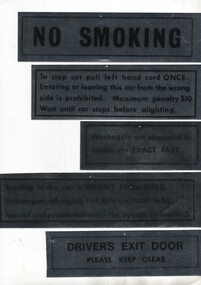
Sign, The Met, Set of 7 The Met tram signs, 1988
... Operations Buses Moomba Set of 7 signs - printed on paper with an adhesive backing. Items 1 to 5 have a silver finish. .1 - No Smoking .2 - To stop car pull left hand cord once. etc. .3 - Passengers are requested to tender the Exact Fare. .4 - Spitting in the car is strictly prohibited .5 - Driver's Exit Door .6 - Normal loading 55 passengers .7 - Patrolled by Transit Patrol Set of 7 The Met tram signs Sign The Met ...Set of 7 signs - printed on paper with an adhesive backing. Items 1 to 5 have a silver finish. .1 - No Smoking .2 - To stop car pull left hand cord once. etc. .3 - Passengers are requested to tender the Exact Fare. .4 - Spitting in the car is strictly prohibited .5 - Driver's Exit Door .6 - Normal loading 55 passengers .7 - Patrolled by Transit Patroltrams, tramways, operations, buses, moomba -
 Victorian Railway History Library
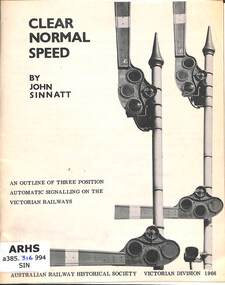
Booklet, Australian Railway Historical Society Victorian Division, Clear Normal Speed: An Outline of Three Position Automatic Signalling on the Victorian Railways, 1966
... railroad operations - Victoria railroad signalling - Victoria Details of the use of 3 position automatic semaphore signals on the Victorian Railways. ill, maps, p.34. Clear Normal ...Details of the use of 3 position automatic semaphore signals on the Victorian Railways.ill, maps, p.34.non-fictionDetails of the use of 3 position automatic semaphore signals on the Victorian Railways.railroad operations - victoria, railroad signalling - victoria
