
Showing 21 items matching "nose cone"
-
 Moorabbin Air Museum
Drawing (item) - Dassault Nose Cone Drawings and Stage Ops
... Dassault Nose Cone Drawings and Stage Ops...Dassault Nose Cone Drawings and Stage Ops...Dassault Nose Cone Drawings and Stage Ops Drawing Dassault Nose Cone Drawings and Stage Ops ... -
Moorabbin Air Museum
Manual (item) - Mirage Cyrano Nose Cone M800545
... Mirage Cyrano Nose Cone M800545...Mirage Cyrano Nose Cone M800545...Mirage Cyrano Nose Cone M800545 Manual Mirage Cyrano Nose Cone M800545 ... -
 The 5th/6th Battalion Royal Victoria Regiment Historical Collection
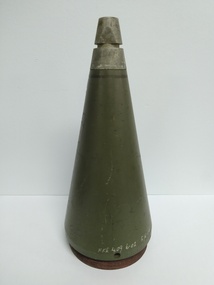
Weapon - Explosive Ordnance-Inert, Nose cone
... Nose cone...Green/ olive nose cone, hollow, with rusted screw thread at base and metal coloured tip. ...Nose cone Weapon Explosive Ordnance-Inert ...Green/ olive nose cone, hollow, with rusted screw thread at base and metal coloured tip. FFE409 6-02 5/6-16 -
 Bendigo Military Museum
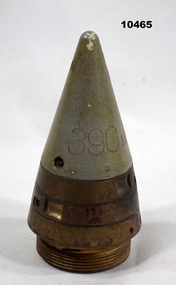
Weapon - NOSE CONE, ARTILLERY
... NOSE CONE, ARTILLERY......Nose cone...Artillery Nose cone The middle ring has "NR11" marked on it. ...This nose cap is in 2 sections. The pointy end is aluminium and the base section is heavy brass. There is a threaded base. On the brass section are three rings. These tapered rings have holes and slots for tools. The very bottom ring has fine graduations marked ) 0 - 30. The bottom, underside, of the base has a round red plate. It has 3 holes. the centre hole looks like it has had a "burnout".The middle ring has "NR11" marked on it. The nose cap has "390 MK-2A".artillery, nose cone -
 Eltham District Historical Society Inc
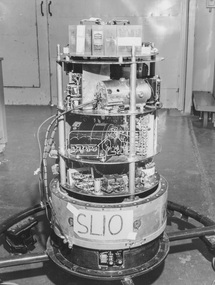
Photograph - Black and White Print, Weapons Research Establishment (WRE), Nose Cone - Skylark Rocket, 17 June, 1960
... Nose Cone - Skylark Rocket, 17 June...On reverse: Nose Cone - Skylark Rocket Also stamped in blue ink: Phone: Ex. 253 STILL PHOTO SECTION W.R.E. ...Alan Gardiner Collection Space Industry 1960-06-17 Rocket Salisbury Skylark Rocket South Australia Weapons Research Establishment (WRE) Woomera 1960 On reverse: Nose Cone - Skylark Rocket Also stamped in blue ink: Phone: Ex. 253 STILL PHOTO SECTION W.R.E. ...On reverse: Nose Cone - Skylark Rocket Also stamped in blue ink: Phone: Ex. 253 STILL PHOTO SECTION W.R.E. SALISBURY, S.A. Neg. No. E1532A (in pencil) Date: 17.6.60 (in pencil) Subject: Skylark Nose. (in pencil) Classification: RESTRICTED (over stamped) 9 Feb 1961 (over stamped)alan gardiner collection, space industry, 1960-06-17, rocket, salisbury, skylark rocket, south australia, weapons research establishment (wre), woomera, 1960 -
 Eltham District Historical Society Inc
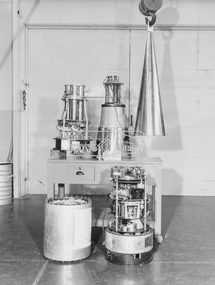
Photograph - Black and White Print, Weapons Research Establishment (WRE), Nose Cone - Skylark Rocket, 17 June, 1960
... Nose Cone - Skylark Rocket, 17 June...On reverse: Nose Cone - Skylark Rocket Also stamped in blue ink: Phone: Ex. 253 STILL PHOTO SECTION W.R.E. ...Alan Gardiner Collection Space Industry 1960-06-17 Rocket Salisbury Skylark Rocket South Australia Weapons Research Establishment (WRE) Woomera 1960 On reverse: Nose Cone - Skylark Rocket Also stamped in blue ink: Phone: Ex. 253 STILL PHOTO SECTION W.R.E. ...On reverse: Nose Cone - Skylark Rocket Also stamped in blue ink: Phone: Ex. 253 STILL PHOTO SECTION W.R.E. SALISBURY, S.A. Neg. No. E1532B (in pencil) Date: 17.6.60 (in pencil) Subject: Skylark Nose. (in pencil) Classification: RESTRICTED (over stamped) 9 Feb 1961 (over stamped)alan gardiner collection, space industry, 1960-06-17, rocket, salisbury, skylark rocket, south australia, weapons research establishment (wre), woomera, 1960 -
 Eltham District Historical Society Inc
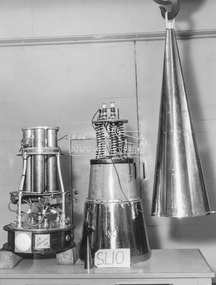
Photograph - Black and White Print, Weapons Research Establishment (WRE), Nose Cone - W.R.E. Skylark Rocket, 17 June, 1960
... Nose Cone - W.R.E. Skylark Rocket, 17 June...On reverse: Nose Cone - W.R.E. Skylark Rocket Also stamped in blue ink: Phone: Ex. 253 STILL PHOTO SECTION W.R.E. ...Alan Gardiner Collection Space Industry 1960-06-17 Rocket Salisbury Skylark Rocket South Australia Weapons Research Establishment (WRE) Woomera 1960 On reverse: Nose Cone - W.R.E. Skylark Rocket Also stamped in blue ink: Phone: Ex. 253 STILL PHOTO SECTION W.R.E. ...On reverse: Nose Cone - W.R.E. Skylark Rocket Also stamped in blue ink: Phone: Ex. 253 STILL PHOTO SECTION W.R.E. SALISBURY, S.A. Neg. No. E1532 (in pencil) Date: 17.6.60 (in pencil) Subject: Skylark Nose. (in pencil) Classification: RESTRICTED (over stamped) 9 Feb 1961 (over stamped)alan gardiner collection, space industry, 1960-06-17, rocket, salisbury, skylark rocket, south australia, weapons research establishment (wre), woomera, 1960 -
 National Vietnam Veterans Museum (NVVM)
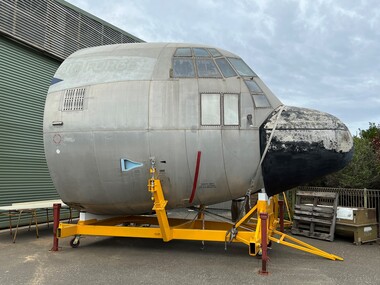
Vehicle - Lockheed C130A Hercules Forward Fuselage A92-214, Abt. 1950's
... The fuselage/nose cone of a C130A Hercules. ...The number 14 is located above the nose cone....C-130 Hercules C-130 Hercules Forward Fuselage Military Transport The number 14 is located above the nose cone. The fuselage/nose cone of a C130A Hercules. ...The C-130 Hercules during the Vietnam War performed airlifts, airdrops for which is was designed. C-130 could disgorge large quantities of cargo and supplies on pallets, either by parachute from altitude or simply pulled out the back dropped with the help of drag chutes and buzz job heights. The fuselage/nose cone of a C130A Hercules. The number 14 is located above the nose cone.c-130 hercules, c-130 hercules forward fuselage, military transport -
 National Vietnam Veterans Museum (NVVM)
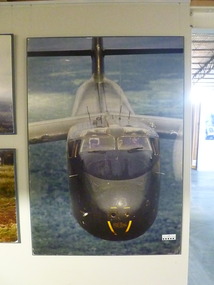
Photograph
... 73 on the Nose cone....Caribou 73 on the Nose cone. Coloured photo of the front view of a Caribou aircraft. ...Coloured photo of the front view of a Caribou aircraft. The pilot & co-pilot are clearly visible in the cockpit. The photo is mounted on a timber board.73 on the Nose cone.caribou -
Moorabbin Air Museum
Drawing - Nose End - Inner Cone, Rolls-Royce Ltd Drawing No. B.K. 889
... Nose End - Inner Cone...B.K. 889 Drawing Nose End - Inner Cone ... -
 Lilydale RSL Sub Branch
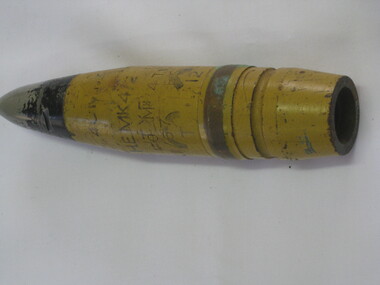
Weapon - Shell Casing
... Military artillery projectile with yellow painted main body, black nose cone and copper driving band near the base...Mk4/TX/B.S.12/1/57/Lot23/ Military artillery projectile with yellow painted main body, black nose cone and copper driving band near the base Weapon Shell Casing ...Military artillery projectile with yellow painted main body, black nose cone and copper driving band near the baseH.E. Mk4/TX/B.S.12/1/57/Lot23/ -
 Bendigo Military Museum
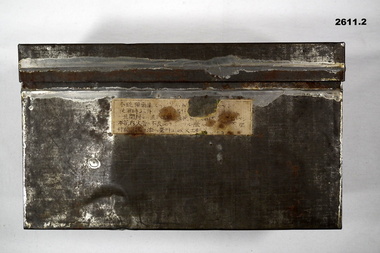
Weapon - TIN, JAPANESE, c.WWII
... Japanese Tin containing 3 nose cones for shells....Japanese Tin containing 3 nose cones for shells. containers - commercial metalcraft Weapons Passchendaele barracks trust .1) & .2) Japanese printed writing on white paper, stained & torn. .1) Metal - tin (empty container), rectangular shape, Japanese printed writing on white paper label on long side .2) Metal - tin , lid of container, rectangular shape, Japanese printed writing on white paper on top side Weapon TIN, JAPANESE ...Japanese Tin containing 3 nose cones for shells..1) Metal - tin (empty container), rectangular shape, Japanese printed writing on white paper label on long side .2) Metal - tin , lid of container, rectangular shape, Japanese printed writing on white paper on top side.1) & .2) Japanese printed writing on white paper, stained & torn.containers - commercial, metalcraft, weapons, passchendaele barracks trust -
 Bendigo Military Museum
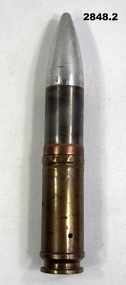
Weapon - PROJECTILE & CASE, C.1954 - 1965
... This has an aluminium nose cone. The projectile is probably armour piercing. .2) Brass case. ...This has an aluminium nose cone. The projectile is probably armour piercing. .2) Brass case. ...The 30mm cartridge was used in British ADEN aerial machine guns. Introduced in the UK in 1954. The ADEN 30mm guns were used in Australian C.A.C.SABRE fighter jets between 1953 and 1965. The A/P variant shell had a muzzle velocity of 2610 feet/sec. There were two ADEN M/Gs on a C.A.C. SABRE..1) 30mm Projectile. This has an aluminium nose cone. The projectile is probably armour piercing. .2) Brass case. This has a double flanged base..1 Projectile, no markings. .2 Shell case. Stamped on the side is RA2/2948arms - ammunition, military history -
 Bendigo Military Museum
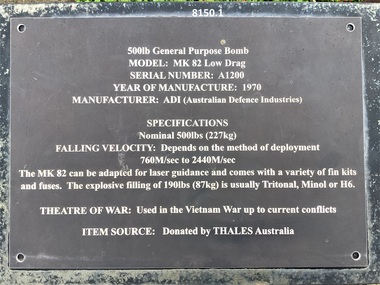
Weapon - BOMB, AERIAL 500 LB, Australian Defence Industries, C.1970
... .1) Plaque on metal stand, black with white text re details of a 500 Lb Bomb. .2) Weapon, 500 lb General Purpose Aerial Bomb, cylindrical shape, nose cone tapers to a point, tail tapers to near point with 4 fins attached. ...Bdrslinc smirsl brsl 500 Bomb .1) Plaque on metal stand, black with white text re details of a 500 Lb Bomb. .2) Weapon, 500 lb General Purpose Aerial Bomb, cylindrical shape, nose cone tapers to a point, tail tapers to near point with 4 fins attached. ...This item is situated in the Gardens of the Bendigo District RSL Sub Branch Inc Havilah Road. Refer photo .1) for the details re manufacture and history/use..1) Plaque on metal stand, black with white text re details of a 500 Lb Bomb. .2) Weapon, 500 lb General Purpose Aerial Bomb, cylindrical shape, nose cone tapers to a point, tail tapers to near point with 4 fins attached. bdrslinc, smirsl, brsl, 500, bomb -
 Friends of the Cerberus Inc
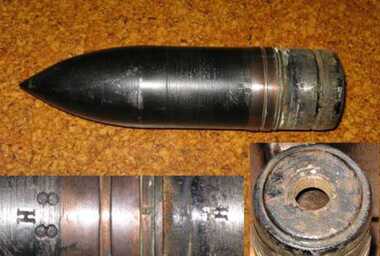
6 pounder Common Shell, 1888
... Cylindrical steel shell with cone shaped nose....The projectile and its shell casing are of the type and age used by the Victorian Naval Forces but could equally have been used by the land forces. common shell hotchkiss 6 pounder ammunition On side - "H/88" Cylindrical steel shell with cone shaped nose. 6 pounder Common Shell Hotchkiss ...Nordenfelt Six pounder quick firing guns were used by land and naval forces to counter torpedo boats.The projectile and its shell casing are of the type and age used by the Victorian Naval Forces but could equally have been used by the land forces.Cylindrical steel shell with cone shaped nose.On side - "H/88"common shell, hotchkiss, 6 pounder, ammunition -
 Australian Gliding Museum
Machine - Glider – Sailplane, 1963
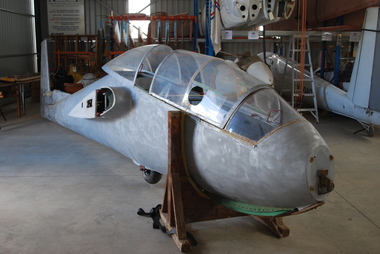
... As received it is stripped of the top coats of paint and a number of components (including, amongst others, tip fairings, nose cone and cockpit elements) that were removed for facilitating the repair process. ...As received it is stripped of the top coats of paint and a number of components (including, amongst others, tip fairings, nose cone and cockpit elements) that were removed for facilitating the repair process. ...The Bocian is a versatile training sailplane that first flew in 1952. The type has been modified in several respects over the course of production by SZD (tailplane and rudder in particular). About 600 have been built; many for export to 27 countries (including Australia). The aerobatic capability and fine performance (best glide ratio of 26) has enabled the Bocian to be used to train competition pilots as well as those of lesser experience. Many world gliding records were set in the 1950s and 1960s in Bocian gliders. The Museum’s example is a type D test flown in Poland on 3 and 4 April 1963. It was imported into Australia in September 1963 by Austerserve Pty Ltd. The first owner was the Alice Springs Gliding Club and the glider had name “Cumulus” painted on the side of the fuselage (since removed). The glider had recorded 726 hours 46 minutes flying time from 2138 launches as at July 1967 when it was transferred to the Darwin Gliding Club. It appears that the glider was damaged in June 1968. The substantial repairs to the fuselage, both wings and tailplane and other minor repairs were completed on 13 October 1968. The glider continued flying with the Darwin Gliding Club until August 1969 at which time the service to that club amounted to 59 hours 7 minutes flying time from 348 flights. Between August 1969 and August 1976 no flights are recorded in the logbook. It is understood that on its last flight at Bachelor, south of Darwin in the Northern Territory (August 1969) it was severely damaged when it crashed after spinning while being auto-tow launched (although this is not expressly mentioned in the logbook). Reg Hancock purchased the damaged glider and rebuilt the port wing and restored it to airworthy condition (September 1976). It was then transferred to Colac, Victoria, and used by the Colac Gliding Group at the Yeo airfield until February 1981, adding another 153 hours from 403 flights to the glider’s record. After airworthy inspection in September 1982 the glider was used by the Geelong Gliding Club until 1983 (logbook details not held). The 20 year survey was then due and the glider fell out of service. In the course of the most recent restoration attempt it was discovered that the glue used in construction had deteriorated and that it was no longer feasible to bring it back to an airworthy condition. Subject to restoration, this exhibit may be representative of the 1950s - 1960s Bocian two seat sailplane typeThis exhibit is a large two seat glider /sailplane of wood and fabric construction. All components are present with the exception of instruments. However, at the time that the aircraft was transferred to the Museum it had been taken apart for major restoration work. As received it is stripped of the top coats of paint and a number of components (including, amongst others, tip fairings, nose cone and cockpit elements) that were removed for facilitating the repair process. The glider, serial number 803, was registered as VH-GNLaustralian gliding, glider, sailplane, bocian, cumulus, alice springs gliding club, darwin gliding club, colac gliding group, geelong gliding club, hancock -
 Bendigo Military Museum
Memorabilia - TRENCH ART, CIGARETTE LIGHTER AND ASHTRAY
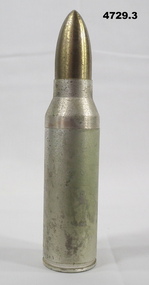
... On top is the flint button and fire hole. 3, The nose cone is shaped like an A.P. projectile. ...On top is the flint button and fire hole. 3, The nose cone is shaped like an A.P. projectile. ...Dean collection, refer Cat No 4575PThis assembly is in the shape of a small cannon shell with projectile. 1. The base is shaped like a cannon shell. Inside is a ring to butt your ashes. It is made of a metal, the coating of which is pock marked. 2. The centre piece is tapered from 5 cm down to 3 cm. Underneath it is the fuel charging socket. On top is the flint button and fire hole. 3, The nose cone is shaped like an A.P. projectile. It tapers from 3 cm to a point.The base of the shell has "CHNA 1953.9. 1-7".war, smoking -
 Sunshine and District Historical Society Incorporated
Photograph - John 'Jack' Horace Jackson Collection - Australia Defence Industries Photographs
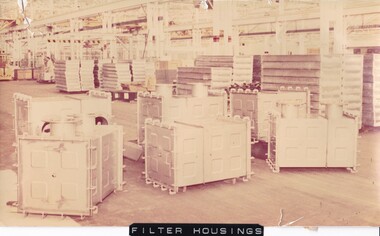
... The flow forming machine show in the picture was manually operated, this would be in the 1970’s and 1980’s when they were making rocket nose cones and similar objects....The flow forming machine show in the picture was manually operated, this would be in the 1970’s and 1980’s when they were making rocket nose cones and similar objects. John "Jack" Horace Jackson John 'Jack' Horace Jackson Collection - Australia Defence Industries Photographs - L.A.W. ...All these products were manufactured at the Ordnance Factory Wests Road Maribyrnong. The practice bombs were used instead of live bombs [explosives filled bombs]. They were cheaper and could be used closer to population centres thus saying in transit times and fuel. They are still made today. The flow forming machine uses a former mounted in a lathe chuck then a sheet of metal [usually aluminium or copper] is placed against the former. The forming tool is mover up and as the metal sheet turns the forming tool starts to form the sheet to the shape of the former. This process is quicker than pressing the shapes. Form shapes are usually round to allow rotation in the machine. The flow forming machine show in the picture was manually operated, this would be in the 1970’s and 1980’s when they were making rocket nose cones and similar objects.John 'Jack' Horace Jackson Collection - Australia Defence Industries Photographs - L.A.W. Warhead John 'Jack' Horace Jackson Collection - Australia Defence Industries Photographs - Filter Housing John 'Jack' Horace Jackson Collection - Australia Defence Industries Photographs - Flow forming Machine John 'Jack' Horace Jackson Collection - Australia Defence Industries Photographs - Flow forming Machine John 'Jack' Horace Jackson Collection - Australia Defence Industries Photographs - 5KG PRAC Bomb Fitted To Carrier John 'Jack' Horace Jackson Collection - Australia Defence Industries Photographs - 11.5LB PRAC Bomb Components Parts John 'Jack' Horace Jackson Collection - Australia Defence Industries Photographs - Comparison 11.5LB & 5KG PRAC Bombsjohn "jack" horace jackson -
 Bendigo Military Museum
Weapon - NOSE CAPS, ARTILLERY, c.WWI
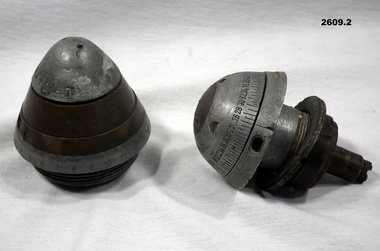
... Shell nose caps, brass, steel & aluminium with graduated markings. .1) Cone shaped nose cap. .2) Broken ring section, brass stem rounded nose cap....These are WW1 graduated nose caps. arms - ammunition military history - souvenirs metalcraft- brassware metalcraft - aluminium Passchendaele barracks trust .1) Graduated markings “0-22” stamped on cone: “146 287 V RAL T” .2) Graduated markings “K-70”, stamped on cap: “Dopp 2. 96. n/A, K514 (3 below 5)” Shell nose caps, brass, steel & aluminium with graduated markings. .1) Cone shaped nose cap. .2) Broken ring section, brass stem rounded nose cap. ...These are WW1 graduated nose caps. Shell nose caps, brass, steel & aluminium with graduated markings. .1) Cone shaped nose cap. .2) Broken ring section, brass stem rounded nose cap..1) Graduated markings “0-22” stamped on cone: “146 287 V RAL T” .2) Graduated markings “K-70”, stamped on cap: “Dopp 2. 96. n/A, K514 (3 below 5)”arms - ammunition, military history - souvenirs, metalcraft- brassware, metalcraft - aluminium, passchendaele barracks trust -
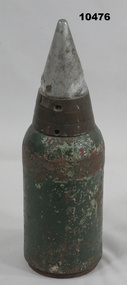 Bendigo Military Museum
Weapon - CANNON SHELL, Unknown
... Hollow cast steel shell “Inert” with no base. On the nose is an aluminium cone and on the steel shell are three brass bands of varying diameters. ...Artillery Cannon shell Nose cap, “390” Hollow cast steel shell “Inert” with no base. On the nose is an aluminium cone and on the steel shell are three brass bands of varying diameters. ...Hollow cast steel shell “Inert” with no base. On the nose is an aluminium cone and on the steel shell are three brass bands of varying diameters. The brass bands have various holes in them. The word “safe”is stamped into the third band. The band closest to the shell (3rd) has numbered graduations 0-30. The shell is rusty and was painted green. Part of the shell base has broken off. Nose cap, “390”artillery, cannon shell -
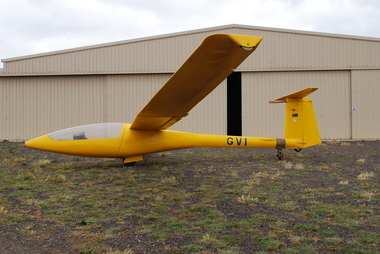 Australian Gliding Museum
Machine - Glider - Sailplane
... The MOBA2 is a notable home built 1970s sailplane design that featured a number of innovative elements including composite construction without the need for expensive jigs, nose cone canopy and asymmetrical placement of control column. australian gliding glider sailplane moba2b moba2c sunderland moba2d victorian motorless flight group vmfg Registration "GVI" on fuselage; Kangaroo, Australian Flag and VMFG decals on vertical stabiliser Composite single seat glider / sailplane finished in bright yellow Machine Glider - Sailplane Gary Sunderland ...MOBA2 is a 15 metre sailplane designed by Gary Sunderland, who was an aeronautical engineer working for the Department of Civil Aviation (Australia) and a member of the Victorian Motorless Flight Group (VMFG). The design gave effect to ideas that he developed circa 1970 for an aircraft that he could build himself. He entered a 13 metre wingspan version of his MOBA design (MOBA2B) in an Australian Gliding sailplane design competition that was announced in 1970. The competition called for sailplane designs with a maximum wingspan of 13 metres that could be built by amateurs in a small workshop with limited tools and facilities. In 1973, Gary’s MOBA was judged by the competition panel as equal best with the other outstanding submission, which were chosen from a field of 19 entrants. However, after gathering further information and deliberation by the competition panel neither of the two outstanding designs were chosen as the winner. Notwithstanding the outcome, in 1974 Gary proceeded built his glider to the original 15 metre design. The wing was equipped with camber changing flaps that were permitted under special standard class rules for the 1974 world championships. Changes were made along the way in the light of construction experience and the completed glider was given the designation MOBA2C. The glider first flew on 12 December 1979. It was never flown in standard class competition as by the time the glider was built the special 1974 rules were revoked and wing flaps were no longer permitted in that class. However, Gary flew MOBA2C in the Australian national gliding competitions held at Benalla in the summer of 1979 / 1980 competing in the open class. After adjustment to the aileron gearing during initial trials MOBA2C was found to fly well and in competition produced performances believed to be better than contemporary standard class sailplanes but not as good as the open class machines. The glider was later modified in a number of respects including amongst other things the installation of spoilers located just forward of the wing flaps and by increasing the chord marginally at the wing root. With these changes the glider type was given the designation MOBA2D. The last recorded flights occurred in February 1996 at which time MOBA2 had flown an aggregate of 401 hours and 59 minutes during its 297 launches. Its operational life was brought to an end due to expansion of the foam in the wings causing distortion of the wing surface.The MOBA2 is a notable home built 1970s sailplane design that featured a number of innovative elements including composite construction without the need for expensive jigs, nose cone canopy and asymmetrical placement of control column.Composite single seat glider / sailplane finished in bright yellowRegistration "GVI" on fuselage; Kangaroo, Australian Flag and VMFG decals on vertical stabiliseraustralian gliding, glider, sailplane, moba2b, moba2c, sunderland, moba2d, victorian motorless flight group, vmfg
