
Showing 22 items matching "nursery employees"
-
 Emerald Museum & Nobelius Heritage Park
Photograph - Packing Shed, Gembrook Nurseries, Unknown maker, 1900-1920
... ...Nursery employees...As a wholesale nursery with high sales volumes it was an important employer of local people. Peak season for employees was during the cooler months, during most farmers' off-season. ...The Nobelius Nursery is listed on the Victorian Heritage Register. 1900s Gembrook Nurseries Nobelius Nurseries Carl Axel Nobelius Packing Shed railway Puffing Billy Railway Nursery employees Farming Agriculture Government initiatives Obverse: 59 NOR (?) ...The Gembrook Nurseries, informally known as the Nobelius Nurseries after the founder Carl Axel Nobelius, began with the purchase of sixty-three acres in 1886 and boomed in the 1890s due to opportunities provided by employment-promoting schemes to develop public parks and gardens and street shade by local and State Governments around Australia. Trees were sold to more than forty councils and Government organisations in the 1890s, including the Department of Agriculture, Lands Department and Victorian Railways. The need to transport nursery products by train via Ferntree Gully rather than by bullock dray to Narre Warren was a factor in the successful petition to develop what is now known as the Puffing Billy Railway. Railway developments in 1900 included the creation of a siding and Packing Shed, known as Nobelius Station, which is featured in this photograph. The Packing Shed was able to handle 250,000 cases of fruit each year. Gembrook Nurseries had an indirect influence on the development of other farms and industries in the region. As a wholesale nursery with high sales volumes it was an important employer of local people. Peak season for employees was during the cooler months, during most farmers' off-season. This provided local farmers with a source of income while their own farms were becoming established.The photograph is significant because it depicts personnel and infrastructure associated with the Gembrook or Nobelius Nurseries, a business which was instrumental to the development of Emerald as a settlement in the 19th and 20th Centuries and also influenced the development of public and private gardens and the farming of several species in Australia and internationally. The Nobelius Nursery is listed on the Victorian Heritage Register.Black and white rectangular photograph printed on print media paper. The image is captioned 'Lunch Hour at the Packing Shed, Gembrook Nurseries.' It depicts thirty-one men (including one adolescent) and one woman posing for a group photograph behind approximately five large product bales resting in a rectangular metal rail cargo carriage. One of the men has a bandage across one eye. The people depicted are wearing clothing indicating the image may have been taken in the early 20th century. The Packing Shed building (built in 1900) and several stacked wooden storage crates are visible behind the group.Obverse: 59 NOR (?) 10 (?) + / LUNCH HOUR AT THE PACKING SHED, GEMBROOK NURSERIES. /1900s, gembrook nurseries, nobelius nurseries, carl axel nobelius, packing shed, railway, puffing billy railway, nursery employees, farming, agriculture, government initiatives -
Emerald Museum & Nobelius Heritage Park
Tool - Name Plate maker, Roovers Bros Co, 1900s
... The name plate maker was used by a number of Nursery employees, contributing to intangible narratives of how stock at Nobelius Nursery was prepared for transport. ...The name plate maker was used by a number of Nursery employees, contributing to intangible narratives of how stock at Nobelius Nursery was prepared for transport. ...The name plate maker was used by a number of Nursery employees, contributing to intangible narratives of how stock at Nobelius Nursery was prepared for transport. It has a high interpretive capacity as an object associated with a tangible, physical process, presenting opportunities for understanding work practices at Nobelius Nursery and nurseries more generally.No similar name plate maker was identified after contact with and/or searches of collections held at National Museum of Australia, Museum Victoria, the Museum of Applied Arts & Sciences or the Australian Garden History Society, Victoria Branch. It is a rare example of its type in Australia. The name plate maker is of historic and social significance. It is associated with the Nobelius Nursery, the largest nursery in the southern hemisphere at its peak prior to WWI (Lyng 1927:75), where it was used from the early 1900s until at least the 1940s. The Nursery was renowned for its supply of plants and trees of high quality and reliability; the name plate maker was part of this process by providing imprinted metal labels that did not fade. The object therefore also demonstrates technological advances of the period. The object holds social significance to employees of Nobelius Nursery who used the machine for several decades to prepare stock for transport to clients.This name plate maker has a hollow hardwood rectangle body and stands on four decorative cast iron legs. It has a cast iron top and further cast iron detail on its front and sides. The top detail lists all numbers and letters to be used in the production of the labels (A-Z, 0-9, space, finish, start and - , ‘), and the front detail reads ‘THIS MACHINE IS SOLD FOR USE IN THE UNITED STATES ONLY. PATENTED NOV. 19 1901, NOV 19 1901, NOV 22 1904, JAN 31 1905 PAT. APPL’D FOR’. The side detail reads ‘PATENT APPLIED FOR’ The inside of the box contains the metal and wooden mechanisms for making embossed metal labels, which are produced inside and then come out the front once printed. Several metal labels remain sitting in the dispensing hollow. This machine is a Roovers ‘name plate’ maker or ‘nameplate’ machine, also known as an ‘embossing machine’ or as in the original patent application as a ‘die press’. It was manufactured from about 1895 by a firm called Roovers Bros Co., of New York, later known as Roovers Bros Inc. Carl Axel Nobelius imported this name plate machine from the USA, indicated by the plate of text at the front, between 1905 and 1915. It is likely that the machine was ordered directly from the manufacturer, as there is no record of the company having had distributors in Australia. The nameplate maker remained at the former nursery site throughout its changes in ownership, until it was donated to Emerald Museum in the 1970s. This machine was used to create metal labels for tree stock at Nobelius Nursery to identify produce, which were otherwise difficult to distinguish as seedlings. According to Syd Jinette, Emerald Resident and ex-nursery worker who used this machine in the 1930s and 1940s, it was used at the nursery since the early 1900s until at least the 1940s, but continued to reside at the site after this time (oral history account held at Emerald Museum). -
Glen Eira Historical Society
Letter - Whittaker, G, Mrs
... Whittaker G Mrs Caulfield Flowers Street Council employees Caulfield council Chinese community Market gardens Quong Sing Bealiba Road Trams Bambra Road Glenhuntly Road Glen Huntly Road Pearce’s Nursery Nurseries Pearce Mr Prisoners Pearce Street Chloris Street Benbow family Griffiths Brothers teas Griffiths Street Longs Bull Paddock Long Mr Methodist Church Hawthorn Road Camden Town Methodist McConchie Harry McConchie Cricket II Glenhuntly Road Camden Court Freeman Street Lomax Frederick Chloris Park Letter Whittaker, G, Mrs ...File contains 2 items: 1/ A handwritten letter by Mrs G. Whittaker on her personal memories/recollections of South Caulfield, which includes neighbours’ transport, homes, businesses and properties, some of which may have been included in ‘Sand, Swamp and Heath’ by Murray and Wells. 2/ Handwritten research note dated 27/09/2013 by Peta Darke concerning Mrs Whittaker’s parents’ house.whittaker g mrs, caulfield, flowers street, council employees, caulfield council, chinese community, market gardens, quong sing, bealiba road, trams, bambra road, glenhuntly road, glen huntly road, pearce’s nursery, nurseries, pearce mr, prisoners, pearce street, chloris street, benbow family, griffiths brothers teas, griffiths street, longs bull paddock, long mr, methodist church, hawthorn road, camden town methodist, mcconchie harry, mcconchie cricket ii, glenhuntly road, camden court, freeman street, lomax frederick, chloris park -
 Vision Australia
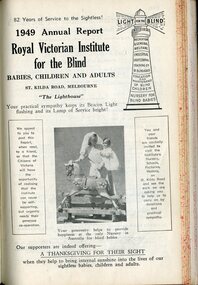
Administrative record - Text, Royal Victorian Institute for the Blind annual report 1949, 1949
... employees and benefactors. These bound volumes of annual reports contain the information sent to subscribers of the Institute and outline the notable events and difficulties facing the blind and the RVIB. This includes Stan Hedger's visit to American, Canada and Great Britain, an overview of the routine and education of children from nursery to leaving age, the Blind People's Social Club who meet regularly in Ormond Hall, images of children in Ormond Hall listening to a movie (which is stopped periodically and the image described when necessary), and George Findlay and Hugh Jeffrey at the organ and violin respectively....employees and benefactors. These bound volumes of annual reports contain the information sent to subscribers of the Institute and outline the notable events and difficulties facing the blind and the RVIB. This includes Stan Hedger's visit to American, Canada and Great Britain, an overview of the routine and education of children from nursery to leaving age, the Blind People's Social Club who meet regularly in Ormond Hall, images of children in Ormond Hall listening to a movie (which is stopped periodically and the image described when necessary), and George Findlay and Hugh Jeffrey at the organ and violin respectively. ...From it's beginning in 1867, the Royal Victorian Institute for the Blind grew in size and its number of employees and benefactors. These bound volumes of annual reports contain the information sent to subscribers of the Institute and outline the notable events and difficulties facing the blind and the RVIB. This includes Stan Hedger's visit to American, Canada and Great Britain, an overview of the routine and education of children from nursery to leaving age, the Blind People's Social Club who meet regularly in Ormond Hall, images of children in Ormond Hall listening to a movie (which is stopped periodically and the image described when necessary), and George Findlay and Hugh Jeffrey at the organ and violin respectively.1 volume bound with illustrations.royal victorian institute for the blind, annual reports, george findlay, hugh jeffrey -
 Vision Australia
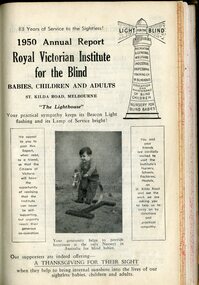
Administrative record - Text, Royal Victorian Institute for the Blind annual report 1950, 1950
... employees and benefactors. These bound volumes of annual reports contain the information sent to subscribers of the Institute and outline the notable events and difficulties facing the blind and the RVIB. This includes the increase of blind babies due to medical care of premature infants, interest free loans to help workers purchase homes, praise for Council of Auxiliaries chairwoman Augusta Tutton, establishment of the Blind Workers Retirement Fund, foundation of the Victorian Guild of Professional Blind, Headmaster Green offers insight into the routines and education of children in the nursery and school, listing of staff including portraits of George Findlay, Donald Forbes, Hugh Jeffrey, Neil Westh and Dorothy Nuske - first blind woman to receive a Bachelor of Music....employees and benefactors. These bound volumes of annual reports contain the information sent to subscribers of the Institute and outline the notable events and difficulties facing the blind and the RVIB. This includes the increase of blind babies due to medical care of premature infants, interest free loans to help workers purchase homes, praise for Council of Auxiliaries chairwoman Augusta Tutton, establishment of the Blind Workers Retirement Fund, foundation of the Victorian Guild of Professional Blind, Headmaster Green offers insight into the routines and education of children in the nursery and school, listing of staff including portraits of George Findlay, Donald Forbes, Hugh Jeffrey, Neil Westh and Dorothy Nuske - first blind woman to receive a Bachelor of Music. ...From it's beginning in 1867, the Royal Victorian Institute for the Blind grew in size and its number of employees and benefactors. These bound volumes of annual reports contain the information sent to subscribers of the Institute and outline the notable events and difficulties facing the blind and the RVIB. This includes the increase of blind babies due to medical care of premature infants, interest free loans to help workers purchase homes, praise for Council of Auxiliaries chairwoman Augusta Tutton, establishment of the Blind Workers Retirement Fund, foundation of the Victorian Guild of Professional Blind, Headmaster Green offers insight into the routines and education of children in the nursery and school, listing of staff including portraits of George Findlay, Donald Forbes, Hugh Jeffrey, Neil Westh and Dorothy Nuske - first blind woman to receive a Bachelor of Music.1 volume bound with illustrations.royal victorian institute for the blind, annual reports, george findlay, donald forbes, hugh jeffrey, neil westh, dorothy hamilton -
 Vision Australia
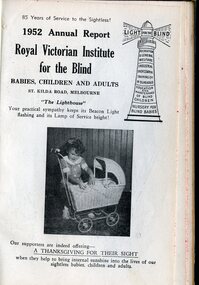
Administrative record - Text, Royal Victorian Institute for the Blind annual report 1952, 1952
... employees and benefactors. These bound volumes of annual reports contain the information sent to subscribers of the Institute and outline the notable events and difficulties facing the blind and the RVIB. This includes a drawing of the proposed buildings at Burwood Road, the first Australian National Conference of Institutions for the Blind held and from this, that the Australian National Council for the Blind be established, a Christmas function for children by the Council of Auxiliaries, subjects and areas taught or encouraged at the nursery and school, background on the Victorian Guild of Professional Blind, Annual Christmas Tree presents to 138 blind workers children, and image of deaf-blind boy in the U.S....employees and benefactors. These bound volumes of annual reports contain the information sent to subscribers of the Institute and outline the notable events and difficulties facing the blind and the RVIB. This includes a drawing of the proposed buildings at Burwood Road, the first Australian National Conference of Institutions for the Blind held and from this, that the Australian National Council for the Blind be established, a Christmas function for children by the Council of Auxiliaries, subjects and areas taught or encouraged at the nursery and school, background on the Victorian Guild of Professional Blind, Annual Christmas Tree presents to 138 blind workers children, and image of deaf-blind boy in the U.S. ...From it's beginning in 1867, the Royal Victorian Institute for the Blind grew in size and its number of employees and benefactors. These bound volumes of annual reports contain the information sent to subscribers of the Institute and outline the notable events and difficulties facing the blind and the RVIB. This includes a drawing of the proposed buildings at Burwood Road, the first Australian National Conference of Institutions for the Blind held and from this, that the Australian National Council for the Blind be established, a Christmas function for children by the Council of Auxiliaries, subjects and areas taught or encouraged at the nursery and school, background on the Victorian Guild of Professional Blind, Annual Christmas Tree presents to 138 blind workers children, and image of deaf-blind boy in the U.S.1 volume bound with illustrations.royal victorian institute for the blind, annual report -
 Vision Australia
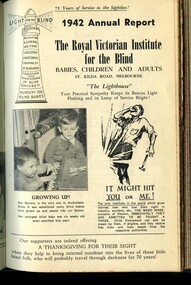
Administrative record - Text, Royal Victorian Institute for the Blind annual report 1942, 1942
... employees and benefactors. These bound volumes of annual reports contain the information sent to subscribers of the Institute and outline the notable events and difficulties facing the blind and the RVIB. These include the acquisition of Ormond Hall, nursery...employees and benefactors. These bound volumes of annual reports contain the information sent to subscribers of the Institute and outline the notable events and difficulties facing the blind and the RVIB. These include the acquisition of Ormond Hall, nursery ...From it's beginning in 1867, the Royal Victorian Institute for the Blind grew in size and its number of employees and benefactors. These bound volumes of annual reports contain the information sent to subscribers of the Institute and outline the notable events and difficulties facing the blind and the RVIB. These include the acquisition of Ormond Hall, nursery and school buildings by the Commonwealth and the transferal of infants and pupils to 'The Georgian' at Olinda with the need for more staff due to more residential staff required, blind pupils formed a 'Junior Red Cross Circle' raising money and also contributed knitwear and splints for mine-sweepers, the loss of Headmaster Garnet Dent, Miss Lenna Bryson and Mrs E Dunkerton on or after the move to Olinda, the appointment of Headmaster Geoffrey E Green, Miss Betty De Huggard and Miss Dulcie Allen, with Mrs Rita Nightingall and Miss Vera Hopton visiting Olinda to provide lessons, Arthur McKay passed his Diploma of Music, 1400 pianos and harmoniums were tuned this year, as most sighted employees are engaged in war work an application was successful with the Director of Manpower to keep some sighted workers in key positions as they may be required to help those blinded by war action, around 25 partially sighted workers have been placed in other factories, several workers passed the Junior First Aid Certificate of St John's Ambulance, and the loss of Dr W.B. Vance who was Honorary Medical Officer for 39 years.1 volume bound with illustrations.royal victorian institute for the blind, annual reports -
 Vision Australia
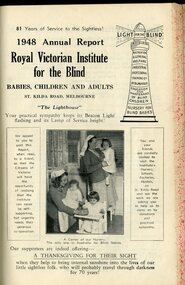
Administrative record - Text, Royal Victorian Institute for the Blind annual report 1948, 1940-1944
... employees and benefactors. These bound volumes of annual reports contain the information sent to subscribers of the Institute and outline the notable events and difficulties facing the blind and the RVIB. This includes the opening of fair at Melbourne Town Hall by Evie Hayes, the death of Dorothy Duke (Blind Auxiliary Organiser) and Cr. Baron Marks (Board Member), Nena Ryan being the first blind person awarded an A.L.C.M. (Elocution), progression of children through nursery...employees and benefactors. These bound volumes of annual reports contain the information sent to subscribers of the Institute and outline the notable events and difficulties facing the blind and the RVIB. This includes the opening of fair at Melbourne Town Hall by Evie Hayes, the death of Dorothy Duke (Blind Auxiliary Organiser) and Cr. Baron Marks (Board Member), Nena Ryan being the first blind person awarded an A.L.C.M. (Elocution), progression of children through nursery ...From it's beginning in 1867, the Royal Victorian Institute for the Blind grew in size and its number of employees and benefactors. These bound volumes of annual reports contain the information sent to subscribers of the Institute and outline the notable events and difficulties facing the blind and the RVIB. This includes the opening of fair at Melbourne Town Hall by Evie Hayes, the death of Dorothy Duke (Blind Auxiliary Organiser) and Cr. Baron Marks (Board Member), Nena Ryan being the first blind person awarded an A.L.C.M. (Elocution), progression of children through nursery and school, and change in Stan Hedger's position from Supervisor and Secretary to Executive Director,.1 volume bound with illustrations.royal victorian institute for the blind, annual reports -
 University of Melbourne, Burnley Campus Archives
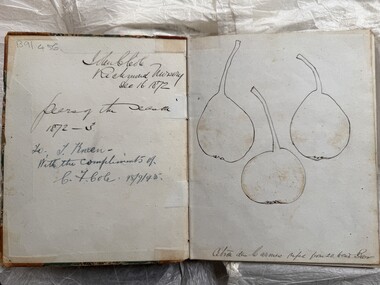
Book - Register, Coles' Richmond Nursery, Pears of the Season 1872-3, 1872-1874
... Author would have been an employee of Coles' Richmond Nursery. The title states records for 72-73 but some varieties go on to also be recorded in 1874....Nursery Dec 16. 1872. Pears of The Season 1872 -73 In blue ink "To T. Kneen with the compliments of C.F. Cole 18/9/45." Notes throughout in black ink and pencil Handwritten bound register of ripe pear varieties, identifiable by traced outlines and juice imprints of half a pear, period when ripe - notes in black ink and pencil. Author would have been an employee ...Handwritten bound register of ripe pear varieties, identifiable by traced outlines and juice imprints of half a pear, period when ripe - notes in black ink and pencil. Author would have been an employee of Coles' Richmond Nursery. The title states records for 72-73 but some varieties go on to also be recorded in 1874.John Clede? Richmond Nursery Dec 16. 1872. Pears of The Season 1872 -73 In blue ink "To T. Kneen with the compliments of C.F. Cole 18/9/45." Notes throughout in black ink and pencilregister, fruits, pears, fruit varieties, sketches, juice imprints, john clede, richmond nursery, 1872, t.h. kneen, c.f. cole, 1945 -
 Sunshine and District Historical Society Incorporated
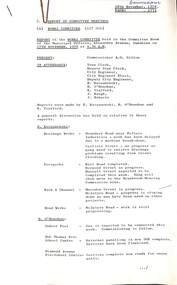
Administrative record - City of Sunshine - Commissioner Mr Alexander Alex George Gillon Collection 1976 - 1982 - Report of Committee Meetings 28th November 1978, City of Sunshine, 28th November 1978
... Second list nor started Hulett Street Private Street Scheme East Side progressing but delayed due to bad weather and stortage of supply of bitument Report of the Finance Committee Report of the City Engineer Western Highway Service Road at Robinson Road Report of the Agenda and Forward Planning Committee Report of the City Librarian Library Hours over the Christmas and New Year Period Report of the Municipal Recreation Officer Swimming Pool Club Use of the New Heated Pool Report of the City Engineer Planning Permit Application Amusement Parlour & Cafe 54A Station Place Additon to Existing Retail Plant Nursery and Live Poutry Sales Lot 1 Emu Road South East Side of Hampstead Road Planning Permit Application Subdivision & Detached Houses Lot 1001 Neale Road North Side Planning Permit Application Subdivision & Detached Houses Lot 1000 Fairfax Circuit & Antioch Court North of Neale Road Preference to Unionist Federated Municipal and Shire Council Employee's Union of Australia Victoria Division Albion Tennis Club Selwyn Park...Second list nor started Hulett Street Private Street Scheme East Side progressing but delayed due to bad weather and stortage of supply of bitument Report of the Finance Committee Report of the City Engineer Western Highway Service Road at Robinson Road Report of the Agenda and Forward Planning Committee Report of the City Librarian Library Hours over the Christmas and New Year Period Report of the Municipal Recreation Officer Swimming Pool Club Use of the New Heated Pool Report of the City Engineer Planning Permit Application Amusement Parlour & Cafe 54A Station Place Additon to Existing Retail Plant Nursery and Live Poutry Sales Lot 1 Emu Road South East Side of Hampstead Road Planning Permit Application Subdivision & Detached Houses Lot 1001 Neale Road North Side Planning Permit Application Subdivision & Detached Houses Lot 1000 Fairfax Circuit & Antioch Court North of Neale Road Preference to Unionist Federated Municipal and Shire Council Employee's Union of Australia Victoria Division Albion Tennis Club Selwyn Park Foolscap sized document. ...Report of Committee Meetings 28th November 1978 Report of the Works Committee Drainage Works Boundary Road Near Potters Industries Delayed Due to Machine Breakdown Drainage Works Carlisle Street No Progress Due to Recent Flooding Footpath Works West Road Completed Footpath Works Norwood Street in progress Footpath Works Burnett Avenue expected to be completed this week Footpath Works Gangs to move to the Braybrook Housing Commission Area soon Kerb & Channel Works Macedon Street in progress Kerb & Channel Works McIntyre Road in progress but slow due to men being used on other projects Road Works McIntyre Road work in progress Indoor Pool Gas is expected to be connected this week Bon Thomas Pre-School Centre External panelling now 90% complete Diamond Avenue Pre-School Centre Services completed now for outer walls Orama Street Child Care Centre Concrete slab poured Highpoint West Child Care Centre No start at present Toilets on Reserves Sewer points now available Diamond Avenue Reserve Mound has been reshaped Sasella Park Mound has been removed Bon Tomas Reserve Work has commence on levelling the site Dempster Park Fence around oval expected to be completed this week Tree Pruning First list from S.E.C. is completed. Second list nor started Hulett Street Private Street Scheme East Side progressing but delayed due to bad weather and stortage of supply of bitument Report of the Finance Committee Report of the City Engineer Western Highway Service Road at Robinson Road Report of the Agenda and Forward Planning Committee Report of the City Librarian Library Hours over the Christmas and New Year Period Report of the Municipal Recreation Officer Swimming Pool Club Use of the New Heated Pool Report of the City Engineer Planning Permit Application Amusement Parlour & Cafe 54A Station Place Additon to Existing Retail Plant Nursery and Live Poutry Sales Lot 1 Emu Road South East Side of Hampstead Road Planning Permit Application Subdivision & Detached Houses Lot 1001 Neale Road North Side Planning Permit Application Subdivision & Detached Houses Lot 1000 Fairfax Circuit & Antioch Court North of Neale Road Preference to Unionist Federated Municipal and Shire Council Employee's Union of Australia Victoria Division Albion Tennis Club Selwyn Park city of sunshine, alexander "alex" george gillon, boundary road, deer park, carlisle street, maidstone, west road, maribyrnong, norwood street, albion, burnett avenue, sunshine, macedon street, mcintyre road, sunshine north, bon thomas pre-school centre, bon thomas reserve, quinn street, diamond avenue pre-school centre, diamond avenue, albanvale, orama street child care centre, orama street, highpoint west child care centre, rosamond road, sasella park, station road, dempster park, phoenix street, hulett street, western highway, station place, emu road, hampstead road, neale road, fairfax circuit, antioch court, albion tennis club, selwyn park, selwyn street -
 Emerald Museum & Nobelius Heritage Park
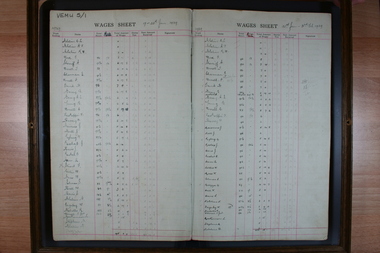
Administrative record - Wages Book, Weekly Wages Book
... Of high significence in the Emerald area as the Nobelius Nurseries was the largest employer in the district and the largest Nursery in the Southern Hemisphere at the time. nobelius nursery emerald wages book List of employees commencing 9th June 1939 to 31st August 1945 Green foolscap size hard cover with canvas binding. ...Wages book showing record of wages paid by Gembrook Nurseries (20/1/1939 - 31/8/1945). Found in shed (Packing shed) on former nursery site by Clem Worrel. Provides a record of names of residents who worked at the nursery, rates of pay and tasks performed.Of high significence in the Emerald area as the Nobelius Nurseries was the largest employer in the district and the largest Nursery in the Southern Hemisphere at the time.Green foolscap size hard cover with canvas binding.List of employees commencing 9th June 1939 to 31st August 1945nobelius nursery emerald wages book -
 Emerald Museum & Nobelius Heritage Park
Administrative record - Cash Books, 4 volumes associated with Gembrook Nurseries from 21/08/1895-30/10/1964, 21/08/1895-30/10/1964
... nursery site. Early volumes include records of personal as well as business expenses incurred by CA Nobelius. Also included are records of tree sales, names of employees and customer details. ...nursery site. Early volumes include records of personal as well as business expenses incurred by CA Nobelius. Also included are records of tree sales, names of employees and customer details. ...Cash book of Gembrook Nurseries (Nobelius Nursery) years 1903 - 1951. The business was purchased by S and L Linton in 1955, but continued to operate under the name of CA Nobelius and Sons. Donated to the museum as a record of a major employer and historical figure of the area. The volumes were found by Clem Worrell in the basement of a shed on the former nursery site. Early volumes include records of personal as well as business expenses incurred by CA Nobelius. Also included are records of tree sales, names of employees and customer details. The cash account books are historically, and socially significant as the entries give an insight into the growth of the company and the details payments from local and other government offices and overseas customers as well as significant companies associations and people. The earlier account books also detail wage payments. Collection of accounting cashbooks kept by the Gembrook NurseryCASH BOOK, various decorative elementsca nobelius and sons, accounting, nobelius nursery, gembrook nurseries, horticulture, s and l linton -
Emerald Museum & Nobelius Heritage Park
Photograph - Nobelius Nursery Packing Shed, Unknown photographer, 1970s
... As a wholesale nursery with high sales volumes it was an important employer of local people. Peak season for employees was during the cooler months, during most farmers' off-season. ...As a wholesale nursery with high sales volumes it was an important employer of local people. Peak season for employees was during the cooler months, during most farmers' off-season. ...The Gembrook Nurseries, informally known as the Nobelius Nurseries after the founder Carl Axel Nobelius, began with the purchase of sixty-three acres in 1886 and boomed in the 1890s due to opportunities provided by employment-promoting schemes to develop public parks and gardens and street shade by local and State Governments around Australia. Trees were sold to more than forty councils and Government organisations in the 1890s, including the Department of Agriculture, Lands Department and Victorian Railways. The need to transport nursery products by train via Ferntree Gully rather than by bullock dray to Narre Warren was a factor in the successful petition to develop what is now known as the Puffing Billy Railway. Railway developments in 1900 included the creation of a siding and Packing Shed, known as Nobelius Station, which is featured in this photograph. The Packing Shed was able to handle 250,000 cases of fruit each year at the height of the nurseries' activities. The image shows the Packing Shed with boarded-up windows, suggesting it was taken prior to the purchase of the facility for use in the Puffing Billy Railway service. Gembrook Nurseries had an indirect influence on the development of other farms and industries in the region. As a wholesale nursery with high sales volumes it was an important employer of local people. Peak season for employees was during the cooler months, during most farmers' off-season. This provided local farmers with a source of income while their own farms were becoming established.The photograph is significant because it depicts infrastructure associated with the Gembrook or Nobelius Nurseries, a business which was instrumental to the development of Emerald as a settlement in the 19th and 20th Centuries and also influenced the development of public and private gardens and the farming of several species in Australia and internationally. The Nobelius Nursery is listed on the Victorian Heritage Register. The image appears to show the Packing Shed building prior to its restoration as a tourist facility.Black and white rectangular photograph printed on print media paper. The image depicts the Gembrook Nurseries Packing Shed building with boarded up windows.Obverse: NOBELIUS NURSERIES / . WEEKEND TRADING . /1970s, gembrook nurseries, puffing billy railway, carl axel nobelius, packing shed, railway stations, farming, agriculture -
Emerald Museum & Nobelius Heritage Park
Photograph - Nobelius Packing Shed, Unknown photographer
... As a wholesale nursery with high sales volumes it was an important employer of local people. Peak season for employees was during the cooler months, during most farmers' off-season. ...As a wholesale nursery with high sales volumes it was an important employer of local people. Peak season for employees was during the cooler months, during most farmers' off-season. ...The Gembrook Nurseries, informally known as the Nobelius Nurseries after the founder Carl Axel Nobelius, began with the purchase of sixty-three acres in 1886 and boomed in the 1890s due to opportunities provided by employment-promoting schemes to develop public parks and gardens and street shade by local and State Governments around Australia. Trees were sold to more than forty councils and Government organisations in the 1890s, including the Department of Agriculture, Lands Department and Victorian Railways. The need to transport nursery products by train via Ferntree Gully rather than by bullock dray to Narre Warren was a factor in the successful petition to develop what is now known as the Puffing Billy Railway. Railway developments in 1900 included the creation of a siding and Packing Shed, known as Nobelius Station, which is featured in this photograph. The Packing Shed was able to handle 250,000 cases of fruit each year at the height of the nurseries' activities. The image shows the Packing Shed prior to the purchase of the facility for use in the Puffing Billy Railway service. Gembrook Nurseries had an indirect influence on the development of other farms and industries in the region. As a wholesale nursery with high sales volumes it was an important employer of local people. Peak season for employees was during the cooler months, during most farmers' off-season. This provided local farmers with a source of income while their own farms were becoming established.The photograph is significant because it depicts infrastructure associated with the Gembrook or Nobelius Nurseries, a business which was instrumental to the development of Emerald as a settlement in the 19th and 20th Centuries and also influenced the development of public and private gardens and the farming of several species in Australia and internationally. The Nobelius Nursery is listed on the Victorian Heritage Register. The image appears to show the Packing Shed building prior to its restoration as a tourist facility.Black and white rectangular photograph printed on print media paper. The image depicts the Gembrook Nurseries Packing Shed building. The building is made from weatherboard and features a brick chimney. There is also a tall tree standing next to the chimney.Obverse: IUS NURSERIES / TRADING ... /gembrook nurseries, puffing billy railway, carl axel nobelius, packing shed, railway stations, farming, agriculture -
Emerald Museum & Nobelius Heritage Park
Book - Religious book, International Tract Society, Limited, Bible Readings for the Home Circle, 1896
... He was an employee of Nobelius family, and was instrumental in saving the last remnant of the Nursery, and preserving it as a public Heritage Park. ...Flora Jane Ryberg (formerly Warner) was one of the first female missionaries sent to the First Nations communities in Alice Springs, Northern Territory, Australia. She was sent there by the London Bible Mission. Her mission was shortlived, and she returned soon after.This book was presented to her by Mrs Logan, wife of the Captain, who began "Mission to Seamen."The record is historically significant as it belonged to Flora Jane Ryberg, the mother of Gus Ryberg OAM; a prominent resident of Emerald. He was an employee of Nobelius family, and was instrumental in saving the last remnant of the Nursery, and preserving it as a public Heritage Park. His effort to establish the Emerald Museum from its inception to current location within the park is a testament to his commitment to conserving local history. It also offers a potential for research into the connections between Emerald and First Nations peoples.Hardcover book with a deep grey and emerald green brushed effect. The edges show a royal blue and faded maroon marbling. Total 597 pages.Obverse: THE ENTRANCE / OF THY WORDS / GIVETH LIGHT / HOLY BIBLE / BIBLE / READINGS / for the / HOME CIRCLE / Spine: BIBLE / READINGS / ILLUSTRATED / Verso: Miss (?) Warner, / A present from / a friend and / her children / Sept (?) 17/00 /religious books, flora ryberg, catholic, mission, alice springs, mission to seamen -
 Emerald Museum & Nobelius Heritage Park
Photograph - Nobelius Employee's Picnic, 1909
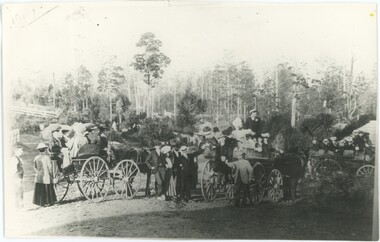
... Cockatoo 1900s Nobelius Nursery Top-left of photograph: "1909" A black and white copy of a photograph of several horse-drawn carts on a road, filled with at least thirty people - men and women - dressed in the styles of the early 20th century. There are trees and buildings in the background, and some of the picnickers are posing for the photograph. Photograph Nobelius Employee's ...This photograph depicts employees of C. A. Nobelius on a fruit growers employee picnic. It is disputed where this photograph was taken - while we have suggested it was in the Cockatoo Creek area (now simply Cockatoo), the State Library's catalogue entry for another copy of this photograph suggests it was likely the Dandenong Ranges based on the Sassafras-Olinda label on one of the carts. Another post specifically labels it as the corner of Mount Dandenong Tourist Road and Monbulk Road, though I don't believe we have enough information to affirm this. This image recalls the workplace recreational events of the area in the early 20th century, and has direct relevance to the Nobelius Nursery.A black and white copy of a photograph of several horse-drawn carts on a road, filled with at least thirty people - men and women - dressed in the styles of the early 20th century. There are trees and buildings in the background, and some of the picnickers are posing for the photograph.Top-left of photograph: "1909"cockatoo, 1900s, nobelius nursery -
Emerald Museum & Nobelius Heritage Park
Photograph - Nobelius Packing Shed, Unknown photographer, 2000s
... As a wholesale nursery with high sales volumes it was an important employer of local people. Peak season for employees was during the cooler months, during most farmers' off-season. ...As a wholesale nursery with high sales volumes it was an important employer of local people. Peak season for employees was during the cooler months, during most farmers' off-season. ...The Gembrook Nurseries, informally known as the Nobelius Nurseries after the founder Carl Axel Nobelius, began with the purchase of sixty-three acres in 1886 and boomed in the 1890s due to opportunities provided by employment-promoting schemes to develop public parks and gardens and street shade by local and State Governments around Australia. Trees were sold to more than forty councils and Government organisations in the 1890s, including the Department of Agriculture, Lands Department and Victorian Railways. The need to transport nursery products by train via Ferntree Gully rather than by bullock dray to Narre Warren was a factor in the successful petition to develop what is now known as the Puffing Billy Railway. Railway developments in 1900 included the creation of a siding and Packing Shed, known as Nobelius Station, which is featured in this photograph. The Packing Shed was able to handle 250,000 cases of fruit each year at the height of the nurseries' activities. The image shows the Packing Shed with boarded-up windows, suggesting it was taken prior to the purchase of the facility for use in the Puffing Billy Railway service. Gembrook Nurseries had an indirect influence on the development of other farms and industries in the region. As a wholesale nursery with high sales volumes it was an important employer of local people. Peak season for employees was during the cooler months, during most farmers' off-season. This provided local farmers with a source of income while their own farms were becoming established.The photograph is significant because it depicts infrastructure associated with the Gembrook or Nobelius Nurseries, a business which was instrumental to the development of Emerald as a settlement in the 19th and 20th Centuries and also influenced the development of public and private gardens and the farming of several species in Australia and internationally. The Nobelius Nursery is listed on the Victorian Heritage Register.A coloured rectangular photograph of the Nobelius Nurseries Packing Shed. The photograph was taken in the grounds looking up towards the packing shed. There are various trees and vegetation throughout the grounds and surrounding the packing shed. The Nobelius Nurseries Packing Shed was used to sort and pack trees to be sent overseas during the 1900s-1940s.No inscriptions/marksnobelius nursery, packing shed, 2000s, puffing billy railway, nobelius heritage park -
Emerald Museum & Nobelius Heritage Park
Photograph - Norm Smith, Helen William & Mitzi Ryberg, Unknown photographer
... Mitzi Ryberg was the daughter of Gus Ryberg OAM; a former employee of the Nobelius and Sons Nursery. Gus was a significant figure in the Emerald community: he played an important role in securing the last remnant of the Nobelius Nursery as a heritage area, and was pivotal in establishing the Emerald Museum as a founding member in 1981. ...Mitzi Ryberg was the daughter of Gus Ryberg OAM; a former employee of the Nobelius and Sons Nursery. Gus was a significant figure in the Emerald community: he played an important role in securing the last remnant of the Nobelius Nursery as a heritage area, and was pivotal in establishing the Emerald Museum as a founding member in 1981. ...Norm Smith was a former bus driver who worked for U.S. Motors Belgrave in the early 1950s. Formerly known as U.S. Bus Lines, the bus and coach company first formed in Monbulk in 1921. They offered a total of six routes under a contract with Public Transport Victoria, including services to Olinda, Belgrave South, Dandenong to Belgrave, as well as Melbourne to Emerald to Dandenong. As of July 2023, Norm is currently the President of the Gembrook RSL Club; at age 90, he is the oldest sub-branch President in Victoria. Mitzi Ryberg was the daughter of Gus Ryberg OAM; a former employee of the Nobelius and Sons Nursery. Gus was a significant figure in the Emerald community: he played an important role in securing the last remnant of the Nobelius Nursery as a heritage area, and was pivotal in establishing the Emerald Museum as a founding member in 1981. Mitzi passed away in July 2023.The record holds strong historic significance as it offers insight into prominent residents of the local area. This significance is further enhanced by the provenance of the record, having been donated to the Emerald Museum by one of the people depicted in the photograph, thus confirming a strong and reliable chain of ownership.Black and white rectangular photograph printed on matte photographic paper. This photograph depicts three smiling people dressed in formal attire, possibly at a social event. From left to right, the people are: Mitzi Ryberg, Norm Smith, and Helen Williams. Norm is positioned in the middle with his arms around Mitzi and Helen. There are three tall drinking glasses visible in the photograph.Reverse: Mitzi Ryberg. Norm Smith / + Helen Williams / Norm Smith U.S. MOTORS bus driver / VEMUP0961 / JOB6673 3 of 5 /mitzi ryberg, gus ryberg, bus, gembrook victoria australia, helen williams, norm smith -
Emerald Museum & Nobelius Heritage Park
Domestic object - Writing equipment, 1900s
... As a wholesale nursery with high sales volumes it was an important employer of local people. Peak season for employees was during the cooler months, during most farmers' off-season. ...As a wholesale nursery with high sales volumes it was an important employer of local people. Peak season for employees was during the cooler months, during most farmers' off-season. ...The item is a glass writing desk set used at Carramar, the family home of Carl Axel Nobelius, who founded the Gembrook Nurseries. Gembrook Nurseries were a major employer in the area, shipping fruit and decorative tree species around Australia and internationally. Carramar was the largest private residence in the area with sixteen rooms in addition to staff accommodations. The Nobelus family entertained several famous or important guests there, including Dame Nellie Melba and the Governor of Victoria, Sir Reginald Talbot. The desk set is thought to have been a gift to Carl Axel Nobelius and his wife Emily on the anniversary of their wedding. The Gembrook Nurseries, informally known as the Nobelius Nurseries after the founder Carl Axel Nobelius, began with the purchase of sixty-three acres in 1886 and boomed in the 1890s due to opportunities provided by employment-promoting schemes to develop public parks and gardens and street shade by local and State Governments around Australia. Trees were sold to more than forty councils and Government organisations in the 1890s, including the Department of Agriculture, Lands Department and Victorian Railways. The need to transport nursery products by train via Ferntree Gully rather than by bullock dray to Narre Warren was a factor in the successful petition to develop what is now known as the Puffing Billy Railway. Gembrook Nurseries had an indirect influence on the development of other farms and industries in the region. As a wholesale nursery with high sales volumes it was an important employer of local people. Peak season for employees was during the cooler months, during most farmers' off-season. This provided local farmers with a source of income while their own farms were becoming established. The desk set appears to be in Art Deco style, which suggests that it was in use at Carramar later in Carl Axel Nobelius' life, prior to his death in 1921, as the style became most popular in the years after the First World War. Carramar was the largest private residence in the area with sixteen rooms in addition to staff accommodations. A real estate listing from the sale of Carramar in 1941 indicates that it had five bedrooms, three reception areas, a large billiards room, two bathrooms, rooms for staff use and a separate six-room gardener's cottage as the home sat within extensive gardens. The Nobelus family entertained several famous or important guests there, including Dame Nellie Melba and the Governor of Victoria, Sir Reginald Talbot.The item is significant due to its association with the estate of Carl Axel Nobelius, a horticulturist whose business activities at the Gembrook Nurseries contributed to both the social and infrastructure development of Emerald and surrounds and the distribution of several plant species internationally.The item is a glass plate on small metal legs. Arranged across the surface of the glass plate are a metal rack suitable for holding letters, a square glass bottle with a metal lid sitting in a square metal receptacle which may have been used for ink and two metal brackets suitable for holding a pen. The metal used is silver-toned.carramar, carl axel nobelius, carl axel nobelius, gembrook nurseries, nobelius nursery, writing equipment, desk set, art deco -
Emerald Museum & Nobelius Heritage Park
Book - Church hymn book, Rodeheaver Co, 1917
... He was an employee of Nobelius family, and was instrumental in saving the last remnant of the Nursery, and preserving it as a public Heritage Park. ...This book, likely published in 1917, features a total of 256 songs intended for use in churches, evangelistic services, and during Sunday school lessons. It comprises a series of church hymns, revival songs, responsive readings, songs for male voices, children's songs, Sunday school songs, and solos and choruses. The book belonged to Flora Ryberg, the mother of Gus Ryberg OAM. Flora played the organ for 25 years at St. Mark's Catholic Church in Emerald, Victoria. Flora Jane Ryberg (formerly Warner) was one of the first female missionaries sent to the First Nations communities in Alice Springs, Northern Territory, Australia. She was sent there by the London Bible Mission. Her mission was shortlived, and she returned soon after.The record is historically significant as it belonged to Flora Jane Ryberg, the mother of Gus Ryberg OAM; a prominent resident of Emerald. He was an employee of Nobelius family, and was instrumental in saving the last remnant of the Nursery, and preserving it as a public Heritage Park. His effort to establish the Emerald Museum from its inception to current location within the park is a testament to his commitment to conserving local history. Additionally, its historic significance is enhanced by the connection to St. Mark's church in Emerald; a longstanding Catholic institution with a history dating back over 100 years.Khaki hardcover book, potentially canvas or leather-bound, filled with sheet music including staves, notes and lyrics, plus printed text. The obverse cover features a black debossed title which reads "Awakening Songs", accompanied by a black image of a stave with notes in a rainbow-style shape in front of a cloud. 256 pages.Obverse: Every cloud will wear a rainbow, If your heart keeps right. / Awakening / Songs /ryberg, flora, st mark's church, church, music, organ, emerald, victoria, australia -
Emerald Museum & Nobelius Heritage Park
Domestic object - Bread plate, mid-20th century
... Gus Ryberg was a former employee of the Nobelius Nurseries who dedicated his retirement years to preserving Emerald history. ...Gus Ryberg was a former employee of the Nobelius Nurseries who dedicated his retirement years to preserving Emerald history. ...Example of utensils used for meals in early to mid-20th century Emerald. Owned by Flora, the wife of Gus Ryberg. Gus Ryberg was a former employee of the Nobelius Nurseries who dedicated his retirement years to preserving Emerald history. His advocacy was influential in the establishment of the Emerald Museum and Nobelius Heritage Park.Circular crystal glass bread plate on wooden pedestal with matching glass salt cellar and spoonInscribed on plate: Give us this day / our daily bread Inscribed underneath spoon: EPNSbread plate, salt cellar and spoon, flora ryberg, gus ryberg -
Emerald Museum & Nobelius Heritage Park
Domestic object - Silver teapot, Unknown maker, 1900s
... The teapot was presented to Carl Oscar Nobelius and Florence Kathleen Prescott by the employees of the Gembrook Nurseries on the occasion of their marriage on April 7, 1904. ...Teapot is inscribed on one side with: Presented to Oscar and Florrie / on the occasion of their Marriage / April 7th 1904 at St Kilda Teapot is inscribed on the other side with: by the Employees of the/ Gembrook Nurseries / Emerald Underneath the kettle: 5 / 390 and indecipherable symbols...The teapot was presented to Carl Oscar Nobelius and Florence Kathleen Prescott by the employees of the Gembrook Nurseries on the occasion of their marriage on April 7, 1904. ...The teapot was presented to Carl Oscar Nobelius and Florence Kathleen Prescott by the employees of the Gembrook Nurseries on the occasion of their marriage on April 7, 1904. Oscar was the oldest son of Carl Axel Nobelius. The botanical trim on the pot may be a reference to the nursery.The Gembrook Nurseries sold trees throughout Australia and overseas and were a significant local employer for decades commencing in 1892.Ornate silver teapot on stand with burner. The teapot has a hinged lid with a 'strawberry' shaped handle. It has two protrusions on each side to fit onto the twig-work stand. The burner sits in the stand below the teapot and has a hinged lid and a handle.Teapot is inscribed on one side with: Presented to Oscar and Florrie / on the occasion of their Marriage / April 7th 1904 at St Kilda Teapot is inscribed on the other side with: by the Employees of the/ Gembrook Nurseries / Emerald Underneath the kettle: 5 / 390 and indecipherable symbolsteapot, oscar nobelius, gembrook nurseries, emerald, victoria, australia
