
Showing 131 items matching "nurses accommodation"
-
 Northern District School of Nursing. Managed by Bendigo Historical Society Inc.
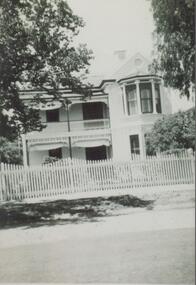
Photograph - Mayfort House
... B&W photograph of Mayfort House, nurses' accommodation, 148 Wattle Street, Bendigo. ...Mayfort House, nurses' accommodation, 148 Wattle Street, Bendigo. ...NDSN Nursing Mayfort House, nurses' accommodation, 148 Wattle Street, Bendigo. ...The Northern District School of Nursing opened in 1950 in to address the issues around nurse recruitment, training and education that had previously been hospital based. The residential school was to provide theoretical and in-house education and practical training over three years. The students would also receive practical hands-on training in the wards of associated hospitals. The Northern District School of Nursing operated from Lister House, Rowan Street, Bendigo. It was the first independent school of nursing in Victoria and continued until it closed in 1989.B&W photograph of Mayfort House, nurses' accommodation, 148 Wattle Street, Bendigo. Now demolished, site of present-day car park.Mayfort House, nurses' accommodation, 148 Wattle Street, Bendigo. Now demolished, site of present-day car park.ndsn, nursing -
 Northern District School of Nursing. Managed by Bendigo Historical Society Inc.
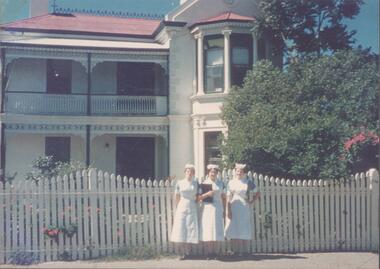
Photograph - Nursing staff outside "Mayfort"
... Mayfort - nurse's accommodation for trainees during P.T.S. intakes....Mayfort - nurse's accommodation for trainees during P.T.S. intakes. ...The Northern District School of Nursing opened in 1950 in to address the issues around nurse recruitment, training and education that had previously been hospital based. The residential school was to provide theoretical and in-house education and practical training over three years. The students would also receive practical hands-on training in the wards of associated hospitals. The Northern District School of Nursing operated from Lister House, Rowan Street, Bendigo. It was the first independent school of nursing in Victoria and continued until it closed in 1989.Three (unnamed) nurses outside "Mayfort", Nurse's accommodation Wattle Street, Bwendigo, the NDSN school's first hostel, View Street. Colour photograph. Mayfort - nurse's accommodation for trainees during P.T.S. intakes.Mayfort, Wattle Streetndsn, nursing, uniforms -
![Front cover of report of Existing conditions of the Alfred Hospital Nurses Home, [ca.1995]](/media/collectors/50187a8f023fd7201471f198/items/695c59050c14b4917557a062/item-media/695dfa9f6f34c7c7c83954fe/item-fit-380x285.jpg?cb=6) Alfred Hospital Nurses League - Nursing History Collection
Alfred Hospital Nurses League - Nursing History CollectionAdministrative record - Existing conditions report, Allom Lovell and Associates, Existing conditions of the Alfred Hospital Nurses Home, ca.1995
... ...Nurses Accommodation...Subsequently the Main Nurses Home of the Alfred Hospital was demolished on August 5th 1996 Of significance to the AHNL as many nurses lived there during their training Alfred Hospital Alfred Hospital Main Nurses Home Nurses Accommodation Previous catalogue number handwritten in red ink at centre top of front cover. ...The Main Nurses Home of the Alfred Hospital was officially closed in 1992, for some time after that it was used to temporarily house some hospital departments and other groups.Conclusion of the report that the building and general amenities were now well below accepted standards, and any upgrading would not be cost effective. Subsequently the Main Nurses Home of the Alfred Hospital was demolished on August 5th 1996Of significance to the AHNL as many nurses lived there during their trainingComb-bound report enclosed in predominately white cardboard cover. The front cover has a broad black stripe at the right vertical margin intersecting with a shorter, narrower blakstripe at top right. The words HEALTH SCIENCE [in white] PLANNING [in grey] CONSULTANTS [in white on grey backgroud] are printed at top right of front cover along with a white logo on a blue background. HEALTH SCIENCE PLANNING CONSULTANTS is also printed in black on the spine. The report contains 48 coloured photographs and 5 floor/site plansPrevious catalogue number handwritten in red ink at centre top of front cover. Handwritten annotations alongside some photographsalfred hospital, alfred hospital main nurses home, nurses accommodation -
![Existing conditions of the Alfred Hospital Nurses Home [ca.1995]](/media/collectors/50187a8f023fd7201471f198/items/698aa288e4259de769721c97/item-media/698c06f75716eb78acd3d3f5/item-fit-380x285.jpg?cb=6) Alfred Hospital Nurses League - Nursing History Collection
Alfred Hospital Nurses League - Nursing History CollectionAdministrative record - Existing conditions report, Allom Lovell and Associates, Existing conditions of the Alfred Hospital Nurses Home, ca.1995
... ...Nurses Accommodation...Subsequently the Main Nurses Home of the Alfred Hospital was demolished on August 5th 1996 Of significance to the AHNL as many nurses lived there during their training Alfred Hospital Alfred Hospital Main Nurses Home Nurses Accommodation 'NURSES/HOME' handwritten on front cover [black ink]. ...The Main Nurses Home of the Alfred Hospital was officially closed in 1992, for some time after that it was used to temporarily house some hospital departments and other groups.Conclusion of the report that the building and general amenities were now well below accepted standards, and any upgrading would not be cost effective. Subsequently the Main Nurses Home of the Alfred Hospital was demolished on August 5th 1996Of significance to the AHNL as many nurses lived there during their trainingComb-bound report enclosed in predominately white cardboard cover. The front cover has a broad black stripe at the right vertical margin intersecting with a short narrower blakstripe at top right. The words HEALTH SCIENCE [in white] PLANNING [in grey] CONSULTANTS [in white on grey backgroud] are printed at top right of front cover along with a white logo on a blue background. HEALTH SCIENCE PLANNING CONSULTANTS is also printed in black on the spine. The report contains 48 coloured photographs and 5 floor/site plans'NURSES/HOME' handwritten on front cover [black ink]. There is also a black ink line at centr top of front coveralfred hospital, alfred hospital main nurses home, nurses accommodation -
 Northern District School of Nursing. Managed by Bendigo Historical Society Inc.
Document - Northern District School of Nursing Prospectus, 1956
... A twelve page Prospectus for Northern District School of Nursing includes photos of hospitals participating, how to make application, photos of nurses’ accommodation, details of training program, general information, pay rates for graduates and details of post graduate work....Nurse Education NDSN Hospitals Prospectus A twelve page Prospectus for Northern District School of Nursing includes photos of hospitals participating, how to make application, photos of nurses’ accommodation, details of training program, general information, pay rates for graduates and details of post graduate work. ...The Northern District School of Nursing opened in 1950 to address the issues around nurse recruitment, training and education that had previously been hospital based. The residential school was to provide theoretical and in-house education and practical training over three years. The students would also receive practical hands-on training in the wards of associated hospitals. The Northern District School of Nursing operated from Lister House, Rowan Street, Bendigo. It was the first independent school of nursing in Victoria and continued until it closed in 1989.A twelve page Prospectus for Northern District School of Nursing includes photos of hospitals participating, how to make application, photos of nurses’ accommodation, details of training program, general information, pay rates for graduates and details of post graduate work.nurse education, ndsn hospitals, prospectus -
 Ballarat Base Hospital Trained Nurses League
Programme - Airdrie House Society Inc., Diamond Jubilee Celebration, Saturday 19th October 1991
... nurses...airdrie...accommodation...airdrie house society inc. diamond jubilee celebration saturday 19th october 1991 1991 home ageing nurses airdrie accommodation A5, blue colour, light-weight card, folded Programme Airdrie House Society Inc., Diamond Jubilee Celebration, Saturday 19th October 1991 ...A5, blue colour, light-weight card, foldedairdrie house society inc., diamond jubilee celebration, saturday 19th october 1991, 1991, home, ageing nurses, airdrie, accommodation -
 City of Ballarat Libraries
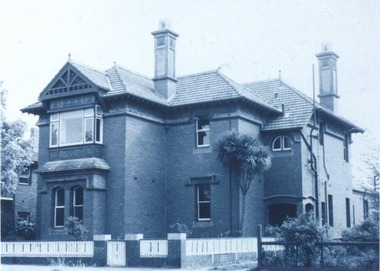
Photograph, Dr Longden's Residence 1938
... During World War 2, it was used as Army Nurses accommodation....During World War 2, it was used as Army Nurses accommodation. Errard Street Ballarat Longden Nurses World War 2 Dr Longden's Residence 1938 Photograph Photograph ...Dr Longden's Residence at 5 Errard Street North. During World War 2, it was used as Army Nurses accommodation.errard street, ballarat, longden, nurses, world war 2 -
 Northern District School of Nursing. Managed by Bendigo Historical Society Inc.
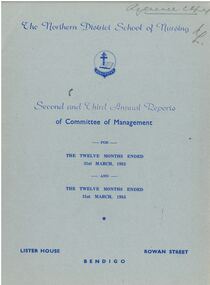
Document - Northern District School of Nursing Second and Third Annual Reports of Committee of Management, 1952/3
... Contents cover Office Bearers and Lecturers. Photos of Nurse accommodation, education details and Maintenance Income and expenditure. ...Contents cover Office Bearers and Lecturers. Photos of Nurse accommodation, education details and Maintenance Income and expenditure. ...The Northern District School of Nursing opened in 1950 to address the issues around nurse recruitment, training and education that had previously been hospital based. The residential school was to provide theoretical and in-house education and practical training over three years. The students would also receive practical hands-on training in the wards of associated hospitals. The Northern District School of Nursing operated from Lister House, Rowan Street, Bendigo. It was the first independent school of nursing in Victoria and continued until it closed in 1989.Printed booklet of 8 pages with soft cardboard slate blue cover fading to brown at edges. Cover has silver and blue printed details 'The Northern District School of Nursing Second and Third Annual Reports' and in blue 'of Committee of Management for the twelve months ended 31st March, 1952 and 31st March 1953, Lister House Rowan Street Bendigo. Contents cover Office Bearers and Lecturers. Photos of Nurse accommodation, education details and Maintenance Income and expenditure. There are four copies.One copy has ‘Reference Copy’ pencilled on front cover with addendum and spelling corrections. Another copy has “N.W.Long’ signed in ink on cover.ndsn, nurse education -
 Department of Health and Human Services
Photograph, Berry Street Kindergarten
... Two flats were also established for short-term family accommodation. The nurses’ home was converted to house the home’s administration function and a social work service. ...Two flats were also established for short-term family accommodation. The nurses’ home was converted to house the home’s administration function and a social work service. ...In 1877 the Victorian Infant Asylum was founded in Kew. In 1881, the asylum relocated to Berry Street in East Melbourne. By 1908, it was called the Foundling Hospital and Infants Home. It was non-denominational and controlled by a committee of management. By 1956, Berry Street consisted of a Mothercraft Training Centre and two main residential units: Berry Street for infants aged zero to 18 months, and Vale Street for toddlers aged zero to two years old. In August 1956, Berry Street was declared an approved category 2 Children's Home. In 1960, Vale Street was converted to an adult nursing home. In 1964, the name was changed to Berry Street Babies Home and Hospital. Berry Street was also an approved adoption agency. By 1968, Berry Street comprised the Training School for Mothercraft Nurses, the adoption agency, an infant life-protection house, a long-stay home for children to three years of age (the toddlers’ wing) and a small house for unmarried mothers. The home's infant life-protection work was seen as a critical agency function, particularly where family illness was putting pressure on mothers and Berry Street was able to provide respite and support. By the late 1960s, 30–40 adoptions annually were being arranged from Berry Street. By 1974 the home's orientation had shifted. Four family group homes had been established (two in Burwood, one in Ashburton and one in St Kilda), the mothercraft training function had been phased out, the toddlers wing converted to day care, and the main building (containing the nursery, administration, kitchen, dining room and single mothers accommodation) was demolished in favour of four home units, which housed 24 children, supervised by cottage parents. Berry Street provided short term, emergency and residential care for 'protection of infant' cases and state wards. Two flats were also established for short-term family accommodation. The nurses’ home was converted to house the home’s administration function and a social work service. The social work service coordinated family aid and family counselling services, and a neighbourhood house. In 1975 Berry Street also provided short-term care for 42 Vietnamese children brought to Australia in the official government-sponsored airlift. In 1976 Berry Street made application to change its category 2 Children's Home classification to category 1, as it was now catering for a wider range of children. It had ceased to be a babies’ home and hospital, and had started providing child and family care, including residential care. In 1977 Berry Street to established a family group home in Richmond to house children affected by the closure of St Cuthbert's Children's Home in Colac. Berry Street changed its name to Berry Street Child and Family Care in 1977. In 1978, the range of services provided by Berry Street Child and Family Care consisted of a social work counselling service, a financial aide, a family aide program using volunteers, two temporary accommodation units each housing eight children, an information and referral service, a neighbourhood house in Richmond, a day care centre for 36 children, and four family group homes. In 1980–81 the family group homes in Burwood were sold and the resources moved to the Richmond area. In 1994, Sutherland Youth and Family Services Inc. amalgamated into Berry Street Inc. During the 1990s, Berry Street combined with the Sutherland Community Resource Centre in Watsonia in Melbourne’s northern region. The agency operates today as Berry Street Victoria and has service centres across metropolitan and country Victoria. https://www.findingrecords.dhhs.vic.gov.au/CollectionResultsPage/BerryStreet -
Federation University Historical Collection
Book - Book - Scrapbook, Ballarat College of Advanced Education: Scrapbook of newspaper cutting, Book 14; November 1983 to June 1984
... The cuttings cover the period from 1 November 1983 to 20 June 1984. . employment advertisements application for enrolment outline of courses peter pilven - potter h r hughan award how to get organised organising personal files 400 million years old plants fossils at bcae new pottery kiln fund for grand piano bcae phys ed aims neville bunning at 81 living on a limited income visiting engineers from india and fiji industrial safety course dennis else student accommodation closure of hostels anne kilminster - northern territory mining education group visits ballarat lecturer's book out soon garry kinnane sandy blythe - paraplegic phys ed teacher ballarat's mature-age mafia lyn bowers heather howard pam bignell sue nichols death of tom turner principal of teachers' college 1950-1970 lynette snibson medal winner new bcae graduates kiran mazumdar visits from india neil trezise at bcae tertiary staff changes to save millions wayne herbertson toni shephard western mining award to chris elliot roped in for triple egg beater heated pool debate nurses will go to college from base to bcae paul rainbow awarded associateship exhibited at the lighthouse sculptor ken palmer chifley bust graduates finding good jobs sir george paton steve moneghetti hopes to run again Book with beige cover, front. ...Newspaper cuttings relating to Ballarat College of Advanced Education. These are from various newspapers and include The Age, Ballarat Courier, The Australian, The Herald. The cuttings cover the period from 1 November 1983 to 20 June 1984. . Book with beige cover, front. Spiral bound.employment advertisements, application for enrolment, outline of courses, peter pilven - potter, h r hughan award, how to get organised, organising personal files, 400 million years old, plants fossils at bcae, new pottery kiln, fund for grand piano, bcae phys ed aims, neville bunning at 81, living on a limited income, visiting engineers from india and fiji, industrial safety course, dennis else, student accommodation, closure of hostels, anne kilminster - northern territory, mining education group visits ballarat, lecturer's book out soon, garry kinnane, sandy blythe - paraplegic, phys ed teacher, ballarat's mature-age mafia, lyn bowers, heather howard, pam bignell, sue nichols, death of tom turner, principal of teachers' college 1950-1970, lynette snibson medal winner, new bcae graduates, kiran mazumdar visits from india, neil trezise at bcae, tertiary staff changes to save millions, wayne herbertson, toni shephard, western mining award to chris elliot, roped in for triple egg beater, heated pool debate, nurses will go to college, from base to bcae, paul rainbow awarded associateship, exhibited at the lighthouse, sculptor ken palmer, chifley bust, graduates finding good jobs, sir george paton, steve moneghetti hopes to run again -
 Kiewa Valley Historical Society
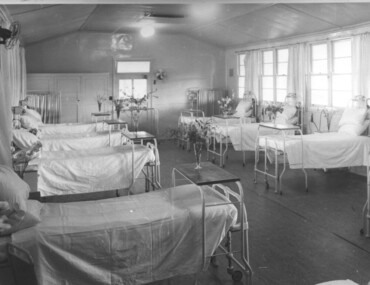
Photograph Tawonga Hospital, A ward at Tawonga Hospital, 1949/50
... nurses home. Construction was commenced by the Hospital and Charities Commission with considerable input from the S.E.C., providing the removal and re-erection of the building, the accommodation for nursing staff and carried all work necessary to make the building operational as a hospital. ...nurses home. Construction was commenced by the Hospital and Charities Commission with considerable input from the S.E.C., providing the removal and re-erection of the building, the accommodation for nursing staff and carried all work necessary to make the building operational as a hospital. ...This photo is of a ward - probably the female ward, as there a many floral arrangements - of the original hospital at Tawonga. This was situated at the corner of Ryders Lane and Kiewa Valley Highway. The building was transported from Bonegilla where it was originally a part of the Bonegilla Military Hospital. The hospital was opened on 24th September, 1949 with a capacity of 12 beds, but was later increased to 35 beds by enclosing the verandahs on 3 sides of the building. 'Add ons' provided theatre, offices, stores and a nurses home. Construction was commenced by the Hospital and Charities Commission with considerable input from the S.E.C., providing the removal and re-erection of the building, the accommodation for nursing staff and carried all work necessary to make the building operational as a hospital. Up until this time the nearest hospital was at Yackandandah. The hospital remained on this site until 1961 when a larger, more suitable building was purchased in Mt. Beauty from the S.E.C.A photographic record of a typical open plan style ward in that era. There were no private rooms. There are portable screens stored at the end of the room to provide "privacy" at the bedside when needed. There is a fan on the wall for cooling. Depicts the rather primitive conditions of that era when compared with todays standards.Black and white photograph of a ward in the Tawonga District Hospitalhospital, ward, tawonga -
 Alfred Hospital Nurses League - Nursing History Collection
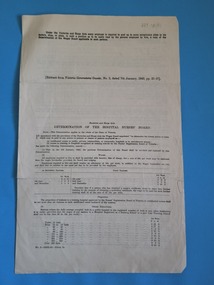
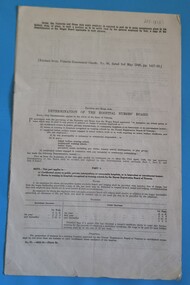
Document - Rates of pay, The Hospital Nurses' Board, Victoria, Extract from Victorian Government Gazette detailing wage rates for hospital nurses 1943, January 1943
... This document, a determination of the Hospital Nurses' Board, applied to the whole State of Victoria. As well as rates of pay, includes conditions, such as if accommodation was provided, 20 shillings could be deducted per week for board and lodging, laundry was to be provided free of charge. ...This document, a determination of the Hospital Nurses' Board, applied to the whole State of Victoria. As well as rates of pay, includes conditions, such as if accommodation was provided, 20 shillings could be deducted per week for board and lodging, laundry was to be provided free of charge. ...This document, a determination of the Hospital Nurses' Board, applied to the whole State of Victoria. As well as rates of pay, includes conditions, such as if accommodation was provided, 20 shillings could be deducted per week for board and lodging, laundry was to be provided free of charge. Ratio of trainee nurses to certified nurses was to be no more than six to one. Nurses were expected to work 50 hours, with one day off per week. Staff nurses and trainees, had three weeks annual leave, higher grades had four weeks. Nurse patient ratio, was 1:10 (day shift) and 1:15 (night shift). The document was authorised by P A Randles(Chairman) and J V Willcox (secretary)Provides insisight into nures remuneration and conditions in Victoria in 1943One sheet of cream paper that has been folded in half. Black print on three pagesnon-fictionprevious catalogue number handwritten [black ink] at top right of first pagenurses pay rates - victoria, nurses remuneration - victoria, nurses salary - victoria, nurses conditions of employment - history-victoria -
 Alfred Hospital Nurses League - Nursing History Collection
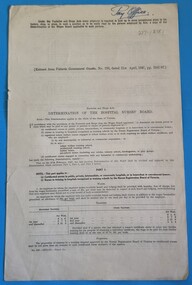
Document - Rates of pay, The Hospital Nurses' Board, Victoria, Extract from Victorian Government Gazette detailing wage rates for hospital nurses 1946, May 1946
... This document, a determination of the Hospital Nurses' Board, applied to the whole State of Victoria. As well as rates of pay, includes conditions, such as if accommodation was provided, 20 shillings could be deducted per week for board and lodging, laundry was to be provided free of charge. ...This document, a determination of the Hospital Nurses' Board, applied to the whole State of Victoria. As well as rates of pay, includes conditions, such as if accommodation was provided, 20 shillings could be deducted per week for board and lodging, laundry was to be provided free of charge. ...This document, a determination of the Hospital Nurses' Board, applied to the whole State of Victoria. As well as rates of pay, includes conditions, such as if accommodation was provided, 20 shillings could be deducted per week for board and lodging, laundry was to be provided free of charge. If accomodation was not available, an allowance of 20 shillings was paid. Ratio of trainee nurses to certified nurses was to be no more than six to one. Nurses were expected to work 50 hours, with one day off per week. Staff nurses and trainees, had three weeks annual leave, higher grades had four weeks. Nurse patient ratio, was 1:10 (day shift) and 1:15 (night shift). Further information is provided for registered infant welfare nurses and cerificated nurses 'engaged in connexion wieh any industrial or commercial undertaking'The document was authorised by P A Randles (Chairman) and J V Willcox (secretary)Provides insisight into nures remuneration and conditions in Victoria in 1946Two sheets of cream paper that has been folded in half and stapled. Black print on fivepagesnon-fictionprevious catalogue number handwritten [black ink] at top right of first pagenurses pay rates - victoria, nurses remuneration - victoria, nurses salary - victoria, nurses conditions of employment - history-victoria -
 Alfred Hospital Nurses League - Nursing History Collection
Document - Rates of pay, The Hospital Nurses' Board, Victoria, Extract from Victorian Government Gazette detailing wage rates for hospital nurses 1947, April 1947
... This document, a determination of the Hospital Nurses' Board, applied to the whole State of Victoria. As well as rates of pay, includes conditions, such as if accommodation was provided, 20 shillings could be deducted per week for boardand lodging, laundry was to be provided free of charge. ...This document, a determination of the Hospital Nurses' Board, applied to the whole State of Victoria. As well as rates of pay, includes conditions, such as if accommodation was provided, 20 shillings could be deducted per week for boardand lodging, laundry was to be provided free of charge. ...This document, a determination of the Hospital Nurses' Board, applied to the whole State of Victoria. As well as rates of pay, includes conditions, such as if accommodation was provided, 20 shillings could be deducted per week for boardand lodging, laundry was to be provided free of charge. If accomodation was not available, an allowance of 20 shillings was paid. Ratio of trainee nurses to certified nurses was to be no more than six to one. Nurses were expected to work 44 hours, with one day off per week. Staff nurses and trainees, had three weeks annual leave, higher grades had four weeks. Nurse patient ratio, was 1:10 (day shift) and 1:15 (night shift). Further information is provided for registered infant welfare nurses and cerificated nurses 'engaged in connexion wieh any industrial or commercial undertaking' The document was authorised by P A Randles (Chairman) and J V Willcox (secretary)Provides insisight into nures remuneration and conditions in Victoria in 1947Two sheets of cream paper that have been folded in half and stapled. Black print on five pagesnon-fiction 'Pay Office' handwrtiten [blue ink] and previous catalogue number handwritten [black ink] at top right of first pagenurses pay rates - victoria, nurses remuneration - victoria, nurses salary - victoria, nurses conditions of employment - history-victoria -
 Alfred Hospital Nurses League - Nursing History Collection
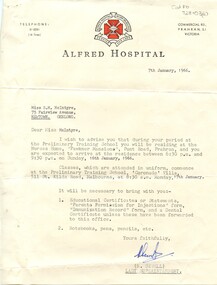
Letter - Letter to S McIntyre, Nancy Sewell, Details of nursing accommodation at the Alfred Hospital, 19960107
... As well as accomodation details, letter contains information about the first day of classes Of significance to the AHNL as an example of the letter most nurses received prior to commencing their training Alfred Hospital Alfred Hospital School of nursing Nurse training- victoria N Sewell has signed her name [blue ink] Previous catalogue number hand written at top right [black ink] Single sheet of off white paper with the letterhead of the Alfred Hospital. Letter is typed [black ink] Details of nursing accommodation ...Letter sent to S McIntyre prior to commencing her nursing training at the Alfred Hopital on January 17th 1966. As well as accomodation details, letter contains information about the first day of classesOf significance to the AHNL as an example of the letter most nurses received prior to commencing their trainingSingle sheet of off white paper with the letterhead of the Alfred Hospital. Letter is typed [black ink] N Sewell has signed her name [blue ink] Previous catalogue number hand written at top right [black ink]alfred hospital, alfred hospital school of nursing, nurse training- victoria -
 Royal District Nursing Service (now known as Bolton Clarke)
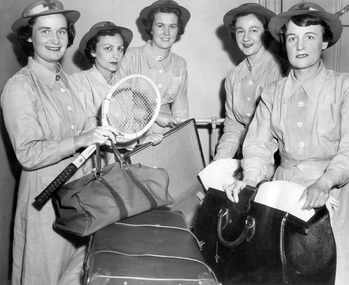
Photograph - Photograph, black and white, 11.1953
... Nurses) of the Melbourne District Nursing Society (MDNS) worked from their own homes which were located in the vicinity of their areas (districts). The Committee meetings were held at the Religious Tract Society rooms at Queen’s walk, off Swanston Street and then at the Library Room at the Melbourne Town Hall. The Annual General Meeting was held at the Town Hall. In November 1891 MDNS was able to rent a two story terraced house at 66 Cardigan Street, Carlton, at £65 a year, which contained accommodation ...The MDNS Sisters are packing their belongs ready to move from their current Nurses Home at 39 Victoria Parade, Collingwood to their new Nurses Home and Headquarters situated at 452 St Kilda Road, Melbourne, then known as 'Airlie'. From its founding in 1885 until 1891 the Trained nurses (Nurses) of the Melbourne District Nursing Society (MDNS) worked from their own homes which were located in the vicinity of their areas (districts). The Committee meetings were held at the Religious Tract Society rooms at Queen’s walk, off Swanston Street and then at the Library Room at the Melbourne Town Hall. The Annual General Meeting was held at the Town Hall. In November 1891 MDNS was able to rent a two story terraced house at 66 Cardigan Street, Carlton, at £65 a year, which contained accommodation for three Nurses and one pupil nurse as well as being used as their Headquarters. They left from their Nurses Home each morning and returned at the end of their shift to write up their book work before retiring for the day. Three years later they moved into a larger terraced house at 49 Drummond Street Carlton which was rented at ‘a very moderate rental’. There was a Board room, apartments for the Nurses and pupil nurse, a large dispensary which patients could attend each evening to have prescriptions signed and bottles refilled with ‘homely remedies’ and elixirs, which were administered for e.g. to Consumptive cases. Doctor’s prescriptions were filled at the Pharmacy. Cupboards containing donated blankets and bedclothes for needy patients were kept in this room, and it was here where the Nurses kept their nursing bags which were refilled at the end of each shift ready for any emergency and for the next day. A list of Doctors the Nurses could call was kept by the telephone. The home also had a kitchen where nourishing soup was made and distributed twice a week to the needy. Milk was also distributed when needed. In 1902 they moved into rented premises at 188 Leicester Street, Carlton and two years later, in 1904, to premises at 5 Royal Terrace, Nicholson Street, Fitzroy where they remained for ten years. In June 1914 at last the Society had sufficient funds to purchase their own terraced premises, ‘Floraston’ 39 Victoria Parade, Collingwood which was their Headquarters and Nurses Home. In 1926 the After-Care Home for recovering patients, (later called After-Care Hospital) was built by the Society next door, running from 41-47 Victoria Parade (became No. 45). There were now two divisions with the After Care having their owned Trained nurses (Sisters) and the District Division of Trained nurses (Sisters) who continued to live at No. 39. In November 1953 the Sisters working in the District Nursing Division moved into their new Headquarters and Nurses Home at 452 St. Kilda Road, Melbourne. In 1957 this Division changed its name to the Melbourne District Nursing Service when it separated from the After-Care Hospital. It was given Royal patronage in 1966 and became Royal District Nursing Service (RDNS). As it expanded, and now with Centres opening throughout the suburbs, the Nurses Home at 452 closed and those rooms used for administrative purposes. It now had outlying districts to service, and with a full fleet of District cars, the Sisters lived in their own homes and visited their closest District Centre each morning to collect their work for the day and returned there at the end of their community duties to do their administrative work. On April the 1st 1996 RDNS Head Office relocated to 31 Alma Road, St. Kilda. Standing in a semi circle of this photograph are 5 Melbourne District Nursing Society (MDNS) Sisters in their long sleeve grey uniform dresses which have a belt, peaked collars and white buttons down the centre. They are wearing their grey brimmed hats with a central Maltese cross on the light colour headband over their short dark curled hair. From Left to Right are Sisters Marianne Metcalf who is smiling and is holding a tennis racket and soft sided oblong travel bag which has two leather straps and handle in her right hand; it is resting on a closed case, which has two leather straps across the lid; this sits in front of her. Next is Gerda Oppenheim who is looking serious and has her right hand on the top of the lid of an open case in front of her, then Beryl Rowley, who is smiling and has her hands on a narrow white metal horizontal pole which has a vertical pole attached. Next is Marcia Parrat who is smiling and is holding a piece of white linen on the open case, and next, on the far right, is Florence Hoey who is holding a piece of white linen on top of an open hard leather travelling bag which is sitting in front of her next to the closed case. melbourne district nursing society, mdns, mdns headquarters, sister marianne metcalf, sister gerda oppenheim, sister beryl rowley, sister marcia parrat, sister florence hoey, royal district nursing service, rdns -
 Northern District School of Nursing. Managed by Bendigo Historical Society Inc.
Booklet - Northern District School of Nursing Prospectus, 1950s
... Nurses work a 40-hour week with at least one or two days off per week and three weeks of annual leave. Accommodation...Nurses work a 40-hour week with at least one or two days off per week and three weeks of annual leave. Accommodation ...Managed by a committee including hospital administrators, medical professionals, and nursing leaders from several regional hospitals. Associated with major hospitals in the Northern District, including Bendigo Base, Mildura Base, Castlemaine, Echuca, Swan Hill, St. Arnaud, and Kyneton District Hospitals. Provide high-quality theoretical and practical nursing training. Raise the standard of nursing education in the region. Maintain the highest principles of nursing practice. Applicants must be at least 17 years old and hold a Proficiency Certificate or higher educational qualification. Application involves submitting forms, certificates, an interview, an aptitude test, and a medical examination. A three-month probationary period follows initial acceptance. Preliminary Training School: Four-week introductory course covering basic nursing, anatomy, hygiene, and practical skills. Practical experience in various hospital departments, guided by senior staff. Study Block Plan: Includes several blocks of theoretical and practical instruction throughout the three-year program. Regular school exams and two state exams (First Professional and Final State) are required for progression and graduation. Nurses work a 40-hour week with at least one or two days off per week and three weeks of annual leave. Accommodation is provided in comfortable hostels with good facilities. Uniforms are supplied free; nurses provide their own shoes and stockings. Salaries and allowances are regulated, with deductions for board and free medical care. Additional Information Post-Graduate Opportunities. Senior positions require further experience and additional certificates (e.g., Midwifery, Infant Welfare).Diploma courses available in administration, teaching, and specialized nursing fields. Bursaries are available for advanced study.Career Prospects: Graduates can pursue roles in administration, teaching, ward and departmental leadership, district and visiting nursing, industrial and school nursing, and more. Opportunities exist both within hospitals and in community or specialized settings.FAQs and Practical Details. Minimal training costs (mainly exam fees and personal items).Living out allowances and travel expenses are covered. Four training intakes per year; waiting periods are short if qualifications are met. Northern District School of Nursing Prospectus - An A4 Booklet of 14 pages with a light cardboard cover. Logo on the front cover. Cambridge Press Bendigo. This item contains the following documents: 3791.1a The Prospectus PDF File 3791.1b Front Cover of the Prospectusnurse training, lister house, northern district school of nursing -
 Northern District School of Nursing. Managed by Bendigo Historical Society Inc.
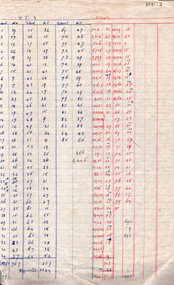
Administrative record - Northern District School of Nursing List of Preliminary Training School, 1950s
... Nurses work a 40-hour week with at least one or two days off per week and three weeks of annual leave. Accommodation...Nurses work a 40-hour week with at least one or two days off per week and three weeks of annual leave. Accommodation ...Managed by a committee including hospital administrators, medical professionals, and nursing leaders from several regional hospitals. Associated with major hospitals in the Northern District, including Bendigo Base, Mildura Base, Castlemaine, Echuca, Swan Hill, St. Arnaud, and Kyneton District Hospitals. Provide high-quality theoretical and practical nursing training. Raise the standard of nursing education in the region. Maintain the highest principles of nursing practice. Applicants must be at least 17 years old and hold a Proficiency Certificate or higher educational qualification. Application involves submitting forms, certificates, an interview, an aptitude test, and a medical examination. A three-month probationary period follows initial acceptance. Preliminary Training School: Four-week introductory course covering basic nursing, anatomy, hygiene, and practical skills. Practical experience in various hospital departments, guided by senior staff. Study Block Plan: Includes several blocks of theoretical and practical instruction throughout the three-year program. Regular school exams and two state exams (First Professional and Final State) are required for progression and graduation. Nurses work a 40-hour week with at least one or two days off per week and three weeks of annual leave. Accommodation is provided in comfortable hostels with good facilities. Uniforms are supplied free; nurses provide their own shoes and stockings. Salaries and allowances are regulated, with deductions for board and free medical care. Additional Information Post-Graduate Opportunities. Senior positions require further experience and additional certificates (e.g., Midwifery, Infant Welfare).Diploma courses available in administration, teaching, and specialized nursing fields. Bursaries are available for advanced study.Career Prospects: Graduates can pursue roles in administration, teaching, ward and departmental leadership, district and visiting nursing, industrial and school nursing, and more. Opportunities exist both within hospitals and in community or specialized settings.FAQs and Practical Details. Minimal training costs (mainly exam fees and personal items).Living out allowances and travel expenses are covered. Four training intakes per year; waiting periods are short if qualifications are met.Northern District School of Nursing List of Preliminary Training School numbers per school; list of school numbers and final pass rates. This item contains the following documents: 3791.2a Spreadsheet of PTS Numbers from Schools 1 to 34nurse training, lister house, northern district school of nursing -
Northern District School of Nursing. Managed by Bendigo Historical Society Inc.
Administrative record - Northern District School of Nursing List of Teaching Staff, 1950s-1989
... Nurses work a 40-hour week with at least one or two days off per week and three weeks of annual leave. Accommodation...Nurses work a 40-hour week with at least one or two days off per week and three weeks of annual leave. Accommodation ...Managed by a committee including hospital administrators, medical professionals, and nursing leaders from several regional hospitals. Associated with major hospitals in the Northern District, including Bendigo Base, Mildura Base, Castlemaine, Echuca, Swan Hill, St. Arnaud, and Kyneton District Hospitals. Provide high-quality theoretical and practical nursing training. Raise the standard of nursing education in the region. Maintain the highest principles of nursing practice. Applicants must be at least 17 years old and hold a Proficiency Certificate or higher educational qualification. Application involves submitting forms, certificates, an interview, an aptitude test, and a medical examination. A three-month probationary period follows initial acceptance. Preliminary Training School: Four-week introductory course covering basic nursing, anatomy, hygiene, and practical skills. Practical experience in various hospital departments, guided by senior staff. Study Block Plan: Includes several blocks of theoretical and practical instruction throughout the three-year program. Regular school exams and two state exams (First Professional and Final State) are required for progression and graduation. Nurses work a 40-hour week with at least one or two days off per week and three weeks of annual leave. Accommodation is provided in comfortable hostels with good facilities. Uniforms are supplied free; nurses provide their own shoes and stockings. Salaries and allowances are regulated, with deductions for board and free medical care. Additional Information Post-Graduate Opportunities. Senior positions require further experience and additional certificates (e.g., Midwifery, Infant Welfare).Diploma courses available in administration, teaching, and specialized nursing fields. Bursaries are available for advanced study.Career Prospects: Graduates can pursue roles in administration, teaching, ward and departmental leadership, district and visiting nursing, industrial and school nursing, and more. Opportunities exist both within hospitals and in community or specialized settings.FAQs and Practical Details. Minimal training costs (mainly exam fees and personal items).Living out allowances and travel expenses are covered. Four training intakes per year; waiting periods are short if qualifications are met.Northern District School of Nursing List of Teaching Staff - three pages This item contains the following documents: 3791.3a This document is a comprehensive listing of teaching staff and alumni associated with N.D.S.N. It includes the following key points: Lists numerous individuals, specifying their roles such as Deputy Dean, Acting Dean, Graduate, and other teaching or administrative positions. Some entries note if the individual is deceased or has moved to another location or institution. Provides home or work addresses for many staff and alumni, often including street, suburb, and sometimes postal codes.Years of Association. Many entries include years of graduation, employment, or tenure (e.g., 1960-64, 1974-75, 1953-54), indicating the period of their involvement with N.D.S.N.Additional Some entries mention further details such as subsequent career moves (e.g., went to England), university affiliations, or special notes like 'deceased.'Occasional references to related institutions or organizations (e.g., B.C.A.E., Central Gippsland Hospital).Document StructureThe information is organized in a tabular format, grouped by staff and alumni, and sometimes by role or year. 3791.3b Typed copy of above 3791.3c Typed copy of abovenurse training, lister house, northern district school of nursing, teaching staff -
Northern District School of Nursing. Managed by Bendigo Historical Society Inc.
Administrative record - Northern District School of Nursing List of Clerical, Domestic and Maintenance Staff, 1950s-1989
... Nurses work a 40-hour week with at least one or two days off per week and three weeks of annual leave. Accommodation...Nurses work a 40-hour week with at least one or two days off per week and three weeks of annual leave. Accommodation ...Managed by a committee including hospital administrators, medical professionals, and nursing leaders from several regional hospitals. Associated with major hospitals in the Northern District, including Bendigo Base, Mildura Base, Castlemaine, Echuca, Swan Hill, St. Arnaud, and Kyneton District Hospitals. Provide high-quality theoretical and practical nursing training. Raise the standard of nursing education in the region. Maintain the highest principles of nursing practice. Applicants must be at least 17 years old and hold a Proficiency Certificate or higher educational qualification. Application involves submitting forms, certificates, an interview, an aptitude test, and a medical examination. A three-month probationary period follows initial acceptance. Preliminary Training School: Four-week introductory course covering basic nursing, anatomy, hygiene, and practical skills. Practical experience in various hospital departments, guided by senior staff. Study Block Plan: Includes several blocks of theoretical and practical instruction throughout the three-year program. Regular school exams and two state exams (First Professional and Final State) are required for progression and graduation. Nurses work a 40-hour week with at least one or two days off per week and three weeks of annual leave. Accommodation is provided in comfortable hostels with good facilities. Uniforms are supplied free; nurses provide their own shoes and stockings. Salaries and allowances are regulated, with deductions for board and free medical care. Additional Information Post-Graduate Opportunities. Senior positions require further experience and additional certificates (e.g., Midwifery, Infant Welfare).Diploma courses available in administration, teaching, and specialized nursing fields. Bursaries are available for advanced study.Career Prospects: Graduates can pursue roles in administration, teaching, ward and departmental leadership, district and visiting nursing, industrial and school nursing, and more. Opportunities exist both within hospitals and in community or specialized settings.FAQs and Practical Details. Minimal training costs (mainly exam fees and personal items).Living out allowances and travel expenses are covered. Four training intakes per year; waiting periods are short if qualifications are met.Northern District School of Nursing List of Clerical Staff - two pages, and List of Domestic and Maintenance Staff, three pages This item contains the following documents: 3791.4a This document is a comprehensive listing of clerical staff and alumni associated with N.D.S.N. The document provides names, addresses, and sometimes additional notes for a large group of people, including both staff and possibly members or affiliates. Many entries include full addresses, indicating the document's use for contact or organizational purposes. Some individuals are identified with specific roles, such as clerical staff, or are listed as being 'C/-N.D.S.N.' There are references to both current and possibly former members (e.g., 'deceased' noted for one individual). Most addresses are located in Bendigo and surrounding areas in Victoria, Australia, indicating a regional focus. 3791.4b This document is a comprehensive roster of domestic and maintenance staff, including both current employees and recent retirees as of early 1989. Staff Listings:Contains names, addresses, and roles of staff members.Includes both domestic (D) and maintenance (M) staff, as well as specialized roles such as night porters (N.P.), residence supervisors (R.S.), cooks, chefs, gardeners, and carpenters. Some entries note if the staff member is retired or deceased. Employment status is indicated (e.g., current, retired, deceased).Some entries include years of service or employment periods.Roles are sometimes abbreviated (e.g., D for Domestic, M for Maintenance, N.P. for Night Porter, H.K. for Housekeeper, Gdnr for Gardener). Most staff entries include home addresses, often with town or suburb and postal codes. Locations are primarily in Bendigo and surrounding areas. Some entries include family relationships or additional notes (e.g., "Like father").Occasional mention of staff studying or having moved to other locations.nurse training, lister house, northern district school of nursing, domestic and maintenance staff, clerical staff -
Northern District School of Nursing. Managed by Bendigo Historical Society Inc.
Administrative record - Northern District School of Nursing List of Students in Preliminary Training Schools (3-8), 1950-51
... Nurses work a 40-hour week with at least one or two days off per week and three weeks of annual leave. Accommodation...Nurses work a 40-hour week with at least one or two days off per week and three weeks of annual leave. Accommodation ...Managed by a committee including hospital administrators, medical professionals, and nursing leaders from several regional hospitals. Associated with major hospitals in the Northern District, including Bendigo Base, Mildura Base, Castlemaine, Echuca, Swan Hill, St. Arnaud, and Kyneton District Hospitals. Provide high-quality theoretical and practical nursing training. Raise the standard of nursing education in the region. Maintain the highest principles of nursing practice. Applicants must be at least 17 years old and hold a Proficiency Certificate or higher educational qualification. Application involves submitting forms, certificates, an interview, an aptitude test, and a medical examination. A three-month probationary period follows initial acceptance. Preliminary Training School: Four-week introductory course covering basic nursing, anatomy, hygiene, and practical skills. Practical experience in various hospital departments, guided by senior staff. Study Block Plan: Includes several blocks of theoretical and practical instruction throughout the three-year program. Regular school exams and two state exams (First Professional and Final State) are required for progression and graduation. Nurses work a 40-hour week with at least one or two days off per week and three weeks of annual leave. Accommodation is provided in comfortable hostels with good facilities. Uniforms are supplied free; nurses provide their own shoes and stockings. Salaries and allowances are regulated, with deductions for board and free medical care. Additional Information Post-Graduate Opportunities. Senior positions require further experience and additional certificates (e.g., Midwifery, Infant Welfare).Diploma courses available in administration, teaching, and specialized nursing fields. Bursaries are available for advanced study.Career Prospects: Graduates can pursue roles in administration, teaching, ward and departmental leadership, district and visiting nursing, industrial and school nursing, and more. Opportunities exist both within hospitals and in community or specialized settings.FAQs and Practical Details. Minimal training costs (mainly exam fees and personal items).Living out allowances and travel expenses are covered. Four training intakes per year; waiting periods are short if qualifications are met.Northern District School of Nursing List of Students in Preliminary Training Schools (3-8) - two typed sheets This item contains the following document: 3791.5a This document is a roster listing individuals who attended various Preliminary Training Schools in between 1950 and 1951. The document records names, addresses, and training locations of attendees at several preliminary training schools.Training sessions are organized by date and location, covering multiple periods from July 1950 to July 1951. Sessions are grouped by date ranges. Each session lists the participants, their home addresses, and the training location (e.g., Bendigo, Mildura, Echuca, Castlemaine, Swan Hill). The roster includes a diverse group of individuals, mostly women, from various towns and regions in Victoria and some from Tasmania and New South Wales. Some addresses are marked as unknown or not available. Main training locations include Bendigo, Mildura, Echuca, Castlemaine, Swan Hill, and Castlemaine. Participants often traveled from different towns to attend these sessions.nurse training, lister house, list of students -
Northern District School of Nursing. Managed by Bendigo Historical Society Inc.
Administrative record - Northern District School of Nursing List of Students in Preliminary Training Schools (3-44), 1950-59
... Nurses work a 40-hour week with at least one or two days off per week and three weeks of annual leave. Accommodation...Nurses work a 40-hour week with at least one or two days off per week and three weeks of annual leave. Accommodation ...Managed by a committee including hospital administrators, medical professionals, and nursing leaders from several regional hospitals. Associated with major hospitals in the Northern District, including Bendigo Base, Mildura Base, Castlemaine, Echuca, Swan Hill, St. Arnaud, and Kyneton District Hospitals. Provide high-quality theoretical and practical nursing training. Raise the standard of nursing education in the region. Maintain the highest principles of nursing practice. Applicants must be at least 17 years old and hold a Proficiency Certificate or higher educational qualification. Application involves submitting forms, certificates, an interview, an aptitude test, and a medical examination. A three-month probationary period follows initial acceptance. Preliminary Training School: Four-week introductory course covering basic nursing, anatomy, hygiene, and practical skills. Practical experience in various hospital departments, guided by senior staff. Study Block Plan: Includes several blocks of theoretical and practical instruction throughout the three-year program. Regular school exams and two state exams (First Professional and Final State) are required for progression and graduation. Nurses work a 40-hour week with at least one or two days off per week and three weeks of annual leave. Accommodation is provided in comfortable hostels with good facilities. Uniforms are supplied free; nurses provide their own shoes and stockings. Salaries and allowances are regulated, with deductions for board and free medical care. Additional Information Post-Graduate Opportunities. Senior positions require further experience and additional certificates (e.g., Midwifery, Infant Welfare).Diploma courses available in administration, teaching, and specialized nursing fields. Bursaries are available for advanced study.Career Prospects: Graduates can pursue roles in administration, teaching, ward and departmental leadership, district and visiting nursing, industrial and school nursing, and more. Opportunities exist both within hospitals and in community or specialized settings.FAQs and Practical Details. Minimal training costs (mainly exam fees and personal items).Living out allowances and travel expenses are covered. Four training intakes per year; waiting periods are short if qualifications are met.Northern District School of Nursing List of Students in Preliminary Training Schools (3-44) - 17 pages This item contains the following document: 3791.6a This document is a comprehensive record of students' attendance at Preliminary Training Schools from 1950 to 1959. It lists the names, addresses, and training dates for each student, organized by training session. The document serves as an attendance and registration log for students attending Preliminary Training Schools over several years. Each entry typically includes the student's full name, home address, and the location or region of their training. Training sessions are grouped by date, with each session listing all attendees. Covers training sessions from July 1950 through at least late 1959.Sessions are sequentially numbered and dated, showing the progression of training cohorts. The document is structured in tabular format, making it easy to reference individual students and their details. Students come from a wide range of towns and regions, including Bendigo, Mildura, Swan Hill, Castlemaine, Echuca, St. Arnaud, Kyneton, and others. Some addresses are listed as unknown or only partially available, indicating incomplete records for a few students. Some students have updated names (e.g., married names) or additional notes about their address or status. The document reflects the mobility and diversity of students entering training during this period.nurse training, lister house, list of students -
Northern District School of Nursing. Managed by Bendigo Historical Society Inc.
Administrative record - Northern District School of Nursing List of Students in Preliminary Training Schools (45-52), 1960-61
... Nurses work a 40-hour week with at least one or two days off per week and three weeks of annual leave. Accommodation...Nurses work a 40-hour week with at least one or two days off per week and three weeks of annual leave. Accommodation ...Managed by a committee including hospital administrators, medical professionals, and nursing leaders from several regional hospitals. Associated with major hospitals in the Northern District, including Bendigo Base, Mildura Base, Castlemaine, Echuca, Swan Hill, St. Arnaud, and Kyneton District Hospitals. Provide high-quality theoretical and practical nursing training. Raise the standard of nursing education in the region. Maintain the highest principles of nursing practice. Applicants must be at least 17 years old and hold a Proficiency Certificate or higher educational qualification. Application involves submitting forms, certificates, an interview, an aptitude test, and a medical examination. A three-month probationary period follows initial acceptance. Preliminary Training School: Four-week introductory course covering basic nursing, anatomy, hygiene, and practical skills. Practical experience in various hospital departments, guided by senior staff. Study Block Plan: Includes several blocks of theoretical and practical instruction throughout the three-year program. Regular school exams and two state exams (First Professional and Final State) are required for progression and graduation. Nurses work a 40-hour week with at least one or two days off per week and three weeks of annual leave. Accommodation is provided in comfortable hostels with good facilities. Uniforms are supplied free; nurses provide their own shoes and stockings. Salaries and allowances are regulated, with deductions for board and free medical care. Additional Information Post-Graduate Opportunities. Senior positions require further experience and additional certificates (e.g., Midwifery, Infant Welfare).Diploma courses available in administration, teaching, and specialized nursing fields. Bursaries are available for advanced study.Career Prospects: Graduates can pursue roles in administration, teaching, ward and departmental leadership, district and visiting nursing, industrial and school nursing, and more. Opportunities exist both within hospitals and in community or specialized settings.FAQs and Practical Details. Minimal training costs (mainly exam fees and personal items).Living out allowances and travel expenses are covered. Four training intakes per year; waiting periods are short if qualifications are met.Northern District School of Nursing List of Students in Preliminary Training Schools (45-52) 3 pages This item contains the following document: 3791.7a This document provides a detailed record of participants in a series of Preliminary Training Schools held between February 1960 and October 1961. Multiple training schools were conducted, each identified by a number (e.g., 45, 46, 47, etc.) and specific dates. Sessions occurred regularly throughout 1960 and 1961. Each entry lists the participant's name, address, and the location or center they were associated with during training (e.g., Mildura, Bendigo, Castlemaine, Echuca, Swan Hill, St. Arnaud).Participants came from various towns and regions, including both urban and rural areas, and occasionally from outside Australia (e.g., Ipoh, Malaysia). Training centers were spread across several locations, with Mildura and Bendigo appearing most frequently as training sites. Other centers included Castlemaine, Echuca, Swan Hill, and St. Arnaud.nurse training, lister house, list of students -
Northern District School of Nursing. Managed by Bendigo Historical Society Inc.
Administrative record - Northern District School of Nursing List of Graduates (School 61-78), 1960s
... Nurses work a 40-hour week with at least one or two days off per week and three weeks of annual leave. Accommodation...Nurses work a 40-hour week with at least one or two days off per week and three weeks of annual leave. Accommodation ...Managed by a committee including hospital administrators, medical professionals, and nursing leaders from several regional hospitals. Associated with major hospitals in the Northern District, including Bendigo Base, Mildura Base, Castlemaine, Echuca, Swan Hill, St. Arnaud, and Kyneton District Hospitals. Provide high-quality theoretical and practical nursing training. Raise the standard of nursing education in the region. Maintain the highest principles of nursing practice. Applicants must be at least 17 years old and hold a Proficiency Certificate or higher educational qualification. Application involves submitting forms, certificates, an interview, an aptitude test, and a medical examination. A three-month probationary period follows initial acceptance. Preliminary Training School: Four-week introductory course covering basic nursing, anatomy, hygiene, and practical skills. Practical experience in various hospital departments, guided by senior staff. Study Block Plan: Includes several blocks of theoretical and practical instruction throughout the three-year program. Regular school exams and two state exams (First Professional and Final State) are required for progression and graduation. Nurses work a 40-hour week with at least one or two days off per week and three weeks of annual leave. Accommodation is provided in comfortable hostels with good facilities. Uniforms are supplied free; nurses provide their own shoes and stockings. Salaries and allowances are regulated, with deductions for board and free medical care. Additional Information Post-Graduate Opportunities. Senior positions require further experience and additional certificates (e.g., Midwifery, Infant Welfare).Diploma courses available in administration, teaching, and specialized nursing fields. Bursaries are available for advanced study.Career Prospects: Graduates can pursue roles in administration, teaching, ward and departmental leadership, district and visiting nursing, industrial and school nursing, and more. Opportunities exist both within hospitals and in community or specialized settings.FAQs and Practical Details. Minimal training costs (mainly exam fees and personal items).Living out allowances and travel expenses are covered. Four training intakes per year; waiting periods are short if qualifications are met.Northern District School of Nursing List of Graduates (School 61-78), 15 pages This item contains the following documents: 3791.8a This document provides a list of graduates along with their allocated hospital for Schools 61 to 78 3791.8b This document provides a list of graduates (with married names and details) for school 77 (Contact the BHS for details)nurse training, lister house, list of graduates -
Northern District School of Nursing. Managed by Bendigo Historical Society Inc.
Administrative record - Northern District School of Nursing List of Students (Schools 80-82), 1970s
... Nurses work a 40-hour week with at least one or two days off per week and three weeks of annual leave. Accommodation...Nurses work a 40-hour week with at least one or two days off per week and three weeks of annual leave. Accommodation ...Managed by a committee including hospital administrators, medical professionals, and nursing leaders from several regional hospitals. Associated with major hospitals in the Northern District, including Bendigo Base, Mildura Base, Castlemaine, Echuca, Swan Hill, St. Arnaud, and Kyneton District Hospitals. Provide high-quality theoretical and practical nursing training. Raise the standard of nursing education in the region. Maintain the highest principles of nursing practice. Applicants must be at least 17 years old and hold a Proficiency Certificate or higher educational qualification. Application involves submitting forms, certificates, an interview, an aptitude test, and a medical examination. A three-month probationary period follows initial acceptance. Preliminary Training School: Four-week introductory course covering basic nursing, anatomy, hygiene, and practical skills. Practical experience in various hospital departments, guided by senior staff. Study Block Plan: Includes several blocks of theoretical and practical instruction throughout the three-year program. Regular school exams and two state exams (First Professional and Final State) are required for progression and graduation. Nurses work a 40-hour week with at least one or two days off per week and three weeks of annual leave. Accommodation is provided in comfortable hostels with good facilities. Uniforms are supplied free; nurses provide their own shoes and stockings. Salaries and allowances are regulated, with deductions for board and free medical care. Additional Information Post-Graduate Opportunities. Senior positions require further experience and additional certificates (e.g., Midwifery, Infant Welfare).Diploma courses available in administration, teaching, and specialized nursing fields. Bursaries are available for advanced study.Career Prospects: Graduates can pursue roles in administration, teaching, ward and departmental leadership, district and visiting nursing, industrial and school nursing, and more. Opportunities exist both within hospitals and in community or specialized settings.FAQs and Practical Details. Minimal training costs (mainly exam fees and personal items).Living out allowances and travel expenses are covered. Four training intakes per year; waiting periods are short if qualifications are met.Northern District School of Nursing List of Students (Schools 80-82) This item contains the following documents: 3791.10a Hand-written document provides a list of students for Schools 80, 81 and 82. Also a list of students who undertook their School 82 exam in June 1976nurse training, lister house, list of students -
Northern District School of Nursing. Managed by Bendigo Historical Society Inc.
Administrative record - Northern District School of Nursing List of Students Final Exam List for School 83, 1976
... Nurses work a 40-hour week with at least one or two days off per week and three weeks of annual leave. Accommodation...Nurses work a 40-hour week with at least one or two days off per week and three weeks of annual leave. Accommodation ...Managed by a committee including hospital administrators, medical professionals, and nursing leaders from several regional hospitals. Associated with major hospitals in the Northern District, including Bendigo Base, Mildura Base, Castlemaine, Echuca, Swan Hill, St. Arnaud, and Kyneton District Hospitals. Provide high-quality theoretical and practical nursing training. Raise the standard of nursing education in the region. Maintain the highest principles of nursing practice. Applicants must be at least 17 years old and hold a Proficiency Certificate or higher educational qualification. Application involves submitting forms, certificates, an interview, an aptitude test, and a medical examination. A three-month probationary period follows initial acceptance. Preliminary Training School: Four-week introductory course covering basic nursing, anatomy, hygiene, and practical skills. Practical experience in various hospital departments, guided by senior staff. Study Block Plan: Includes several blocks of theoretical and practical instruction throughout the three-year program. Regular school exams and two state exams (First Professional and Final State) are required for progression and graduation. Nurses work a 40-hour week with at least one or two days off per week and three weeks of annual leave. Accommodation is provided in comfortable hostels with good facilities. Uniforms are supplied free; nurses provide their own shoes and stockings. Salaries and allowances are regulated, with deductions for board and free medical care. Additional Information Post-Graduate Opportunities. Senior positions require further experience and additional certificates (e.g., Midwifery, Infant Welfare).Diploma courses available in administration, teaching, and specialized nursing fields. Bursaries are available for advanced study.Career Prospects: Graduates can pursue roles in administration, teaching, ward and departmental leadership, district and visiting nursing, industrial and school nursing, and more. Opportunities exist both within hospitals and in community or specialized settings.FAQs and Practical Details. Minimal training costs (mainly exam fees and personal items).Living out allowances and travel expenses are covered. Four training intakes per year; waiting periods are short if qualifications are met.Northern District School of Nursing List of Students Final Exam List for School 83 This item contains the following documents: 3791.11a Typed three page list of students that undertook their School 83 exam in December 1976nurse training, lister house, list of students -
Northern District School of Nursing. Managed by Bendigo Historical Society Inc.
Administrative record - Northern District School of Nursing List of Students for Schools 84 to 85, 1970s
... Nurses work a 40-hour week with at least one or two days off per week and three weeks of annual leave. Accommodation...Nurses work a 40-hour week with at least one or two days off per week and three weeks of annual leave. Accommodation ...Managed by a committee including hospital administrators, medical professionals, and nursing leaders from several regional hospitals. Associated with major hospitals in the Northern District, including Bendigo Base, Mildura Base, Castlemaine, Echuca, Swan Hill, St. Arnaud, and Kyneton District Hospitals. Provide high-quality theoretical and practical nursing training. Raise the standard of nursing education in the region. Maintain the highest principles of nursing practice. Applicants must be at least 17 years old and hold a Proficiency Certificate or higher educational qualification. Application involves submitting forms, certificates, an interview, an aptitude test, and a medical examination. A three-month probationary period follows initial acceptance. Preliminary Training School: Four-week introductory course covering basic nursing, anatomy, hygiene, and practical skills. Practical experience in various hospital departments, guided by senior staff. Study Block Plan: Includes several blocks of theoretical and practical instruction throughout the three-year program. Regular school exams and two state exams (First Professional and Final State) are required for progression and graduation. Nurses work a 40-hour week with at least one or two days off per week and three weeks of annual leave. Accommodation is provided in comfortable hostels with good facilities. Uniforms are supplied free; nurses provide their own shoes and stockings. Salaries and allowances are regulated, with deductions for board and free medical care. Additional Information Post-Graduate Opportunities. Senior positions require further experience and additional certificates (e.g., Midwifery, Infant Welfare).Diploma courses available in administration, teaching, and specialized nursing fields. Bursaries are available for advanced study.Career Prospects: Graduates can pursue roles in administration, teaching, ward and departmental leadership, district and visiting nursing, industrial and school nursing, and more. Opportunities exist both within hospitals and in community or specialized settings.FAQs and Practical Details. Minimal training costs (mainly exam fees and personal items).Living out allowances and travel expenses are covered. Four training intakes per year; waiting periods are short if qualifications are met.Northern District School of Nursing List of Students for Schools 84 to 85 (4 pages) This item contains the following documents: 3791.12a Typed and handwritten lists of students from schools 84 to 85nurse training, lister house, list of students -
Northern District School of Nursing. Managed by Bendigo Historical Society Inc.
Administrative record - Northern District School of Nursing List of Students for Schools 86 to 88, 1970s
... Nurses work a 40-hour week with at least one or two days off per week and three weeks of annual leave. Accommodation...Nurses work a 40-hour week with at least one or two days off per week and three weeks of annual leave. Accommodation ...Managed by a committee including hospital administrators, medical professionals, and nursing leaders from several regional hospitals. Associated with major hospitals in the Northern District, including Bendigo Base, Mildura Base, Castlemaine, Echuca, Swan Hill, St. Arnaud, and Kyneton District Hospitals. Provide high-quality theoretical and practical nursing training. Raise the standard of nursing education in the region. Maintain the highest principles of nursing practice. Applicants must be at least 17 years old and hold a Proficiency Certificate or higher educational qualification. Application involves submitting forms, certificates, an interview, an aptitude test, and a medical examination. A three-month probationary period follows initial acceptance. Preliminary Training School: Four-week introductory course covering basic nursing, anatomy, hygiene, and practical skills. Practical experience in various hospital departments, guided by senior staff. Study Block Plan: Includes several blocks of theoretical and practical instruction throughout the three-year program. Regular school exams and two state exams (First Professional and Final State) are required for progression and graduation. Nurses work a 40-hour week with at least one or two days off per week and three weeks of annual leave. Accommodation is provided in comfortable hostels with good facilities. Uniforms are supplied free; nurses provide their own shoes and stockings. Salaries and allowances are regulated, with deductions for board and free medical care. Additional Information Post-Graduate Opportunities. Senior positions require further experience and additional certificates (e.g., Midwifery, Infant Welfare).Diploma courses available in administration, teaching, and specialized nursing fields. Bursaries are available for advanced study.Career Prospects: Graduates can pursue roles in administration, teaching, ward and departmental leadership, district and visiting nursing, industrial and school nursing, and more. Opportunities exist both within hospitals and in community or specialized settings.FAQs and Practical Details. Minimal training costs (mainly exam fees and personal items).Living out allowances and travel expenses are covered. Four training intakes per year; waiting periods are short if qualifications are met.Northern District School of Nursing List of Students for Schools 86 to 88 This item contains the following documents: 3791.13a Typed and handwritten lists of students from schools 86 to 88 - Six typed pagesnurse training, lister house, list of students -
Northern District School of Nursing. Managed by Bendigo Historical Society Inc.
Administrative record - Northern District School of Nursing List of Students for Schools 89 to 90, 1970s
... Nurses work a 40-hour week with at least one or two days off per week and three weeks of annual leave. Accommodation...Nurses work a 40-hour week with at least one or two days off per week and three weeks of annual leave. Accommodation ...Managed by a committee including hospital administrators, medical professionals, and nursing leaders from several regional hospitals. Associated with major hospitals in the Northern District, including Bendigo Base, Mildura Base, Castlemaine, Echuca, Swan Hill, St. Arnaud, and Kyneton District Hospitals. Provide high-quality theoretical and practical nursing training. Raise the standard of nursing education in the region. Maintain the highest principles of nursing practice. Applicants must be at least 17 years old and hold a Proficiency Certificate or higher educational qualification. Application involves submitting forms, certificates, an interview, an aptitude test, and a medical examination. A three-month probationary period follows initial acceptance. Preliminary Training School: Four-week introductory course covering basic nursing, anatomy, hygiene, and practical skills. Practical experience in various hospital departments, guided by senior staff. Study Block Plan: Includes several blocks of theoretical and practical instruction throughout the three-year program. Regular school exams and two state exams (First Professional and Final State) are required for progression and graduation. Nurses work a 40-hour week with at least one or two days off per week and three weeks of annual leave. Accommodation is provided in comfortable hostels with good facilities. Uniforms are supplied free; nurses provide their own shoes and stockings. Salaries and allowances are regulated, with deductions for board and free medical care. Additional Information Post-Graduate Opportunities. Senior positions require further experience and additional certificates (e.g., Midwifery, Infant Welfare).Diploma courses available in administration, teaching, and specialized nursing fields. Bursaries are available for advanced study.Career Prospects: Graduates can pursue roles in administration, teaching, ward and departmental leadership, district and visiting nursing, industrial and school nursing, and more. Opportunities exist both within hospitals and in community or specialized settings.FAQs and Practical Details. Minimal training costs (mainly exam fees and personal items).Living out allowances and travel expenses are covered. Four training intakes per year; waiting periods are short if qualifications are met.Northern District School of Nursing List of Students for Schools 89 to 90 This item contains the following documents: 3791.14a Typed and handwritten lists of students from schools 89 to 90 - four typed pagesnurse training, lister house, list of students -
 Northern District School of Nursing. Managed by Bendigo Historical Society Inc.
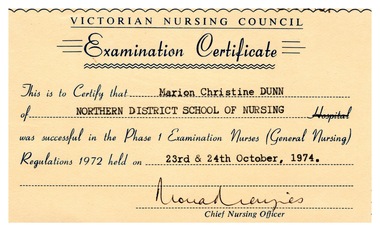
Administrative record - Northern District School of Nursing Progress Report for Nurse M. C. Dunn and other items pertaining to her exams, 1974
... Nurses work a 40-hour week with at least one or two days off per week and three weeks of annual leave. Accommodation...Nurses work a 40-hour week with at least one or two days off per week and three weeks of annual leave. Accommodation ...Managed by a committee including hospital administrators, medical professionals, and nursing leaders from several regional hospitals. Associated with major hospitals in the Northern District, including Bendigo Base, Mildura Base, Castlemaine, Echuca, Swan Hill, St. Arnaud, and Kyneton District Hospitals. Provide high-quality theoretical and practical nursing training. Raise the standard of nursing education in the region. Maintain the highest principles of nursing practice. Applicants must be at least 17 years old and hold a Proficiency Certificate or higher educational qualification. Application involves submitting forms, certificates, an interview, an aptitude test, and a medical examination. A three-month probationary period follows initial acceptance. Preliminary Training School: Four-week introductory course covering basic nursing, anatomy, hygiene, and practical skills. Practical experience in various hospital departments, guided by senior staff. Study Block Plan: Includes several blocks of theoretical and practical instruction throughout the three-year program. Regular school exams and two state exams (First Professional and Final State) are required for progression and graduation. Nurses work a 40-hour week with at least one or two days off per week and three weeks of annual leave. Accommodation is provided in comfortable hostels with good facilities. Uniforms are supplied free; nurses provide their own shoes and stockings. Salaries and allowances are regulated, with deductions for board and free medical care. Additional Information Post-Graduate Opportunities. Senior positions require further experience and additional certificates (e.g., Midwifery, Infant Welfare).Diploma courses available in administration, teaching, and specialized nursing fields. Bursaries are available for advanced study.Career Prospects: Graduates can pursue roles in administration, teaching, ward and departmental leadership, district and visiting nursing, industrial and school nursing, and more. Opportunities exist both within hospitals and in community or specialized settings.FAQs and Practical Details. Minimal training costs (mainly exam fees and personal items).Living out allowances and travel expenses are covered. Four training intakes per year; waiting periods are short if qualifications are met.Northern District School of Nursing Progress Report for Nurse M. C. Dunn and other items pertaining to her exams. This item contains the following six documents: 3791.15a This document is a progress examination report for Nurse M.C. Dunn from the Northern District School of Nursing, summarizing her performance in the Phase 1 Progress Examination held in July 1974. Examination Results Outstanding Performance Passed both Anatomy & Physiology and General Nursing with distinction. Eligible to attend the First Year Study Block and required to sit for the First Professional State Examination in October 1974. Chemistry & Physics will be included in the upcoming examination, with no repeat lectures during the study block. Examiner's General Comments: Anatomy & PhysiologyMost questions were well answered, especially on tissue distribution, limb movement, and muscle functions.Areas needing revision: functions of the skin, diagrams (vertebra, kidney, leaf), function of chordae tendinae, factors maintaining venous return, difference between inspired and expired air, and formation/circulation of cerebrospinal fluid. Some gaps in knowledge about blood volume, urea formation, and water contamination. Generally strong answers on patient care, conversions between measurement systems, and infection prevention.Areas for improvement: dilution of lotions, suitable lotions for skin prep, definitions of pH and specific gravity of urine, and details on sterilization (especially destruction of spores). Good understanding of pressure sore prevention, patient bathing, and care of valuables, though some answers lacked detail or used outdated expressions. 3791.15b This document is a formal acceptance letter addressed to Marion from the Northern District School of Nursing. Marion has been accepted into the Preliminary Training School at the Northern District School of Nursing. Medical and Dental ApprovalHer medical and dental certificates have been reviewed and approved. Marion is scheduled to begin training on 4th February. She is expected to attend on Thursday, 31st January, 1974, prior to the official start. 3791.15c The Victorian Nursing Council's examination instructions for nursing candidates 3791.15d Invitation to a dinner to congratulate the 1973 pilot students in their examination successes 3791.15e Signature of Examiner Card Victorian Nursing Council 3791.15f Examination certificate from the Victorian Nursing Councilnurse training, lister house, marion dunn
