
Showing 12 items matching "oak grove"
-
 Warrnambool and District Historical Society Inc.
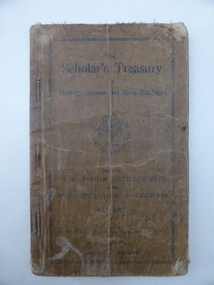
Book, Scholar's treasury, Early 20th century
... ...Oak Grove Yangery... This book belonged to Pearl McCullagh whose address is given as Oak Grove (the name of the property) in Yangery with the name of Illowa S. ...‘Pearl McCullagh, Oak Grove Yangery, Illowa S. School’....This book belonged to Pearl McCullagh whose address is given as Oak Grove (the name of the property) in Yangery with the name of Illowa S. ...This book belonged to Pearl McCullagh whose address is given as Oak Grove (the name of the property) in Yangery with the name of Illowa S. School under the address. Because of the content of the book it is presumed that the ‘S’ stands for Sabbath or Sunday and the Sunday School may have been a Presbyterian one. Yangery is situated between Woodford and Koroit and Illowa, nearby, is about 8 kilometres from Koroit and about 9 kilometres from Warrnambool. Pearl McCullagh was the daughter of Samuel James and Charlotte Jane McCullagh. She was born in 1906 and married Ernest Keen. This book is of interest because it belonged to an early 20th century resident, Pearl McCullagh who lived at Oak Grove in Yangery. This is a soft cover book of 104 pages. The cover is brown with black lettering on the front cover. The cover is crumpled and worn away in places and the pages are dog-eared. The inscription is handwritten in pencil. ‘Pearl McCullagh, Oak Grove Yangery, Illowa S. School’.pearl mccullagh, history of illowa, history of yangery, oak grove yangery -
 Warrnambool and District Historical Society Inc.
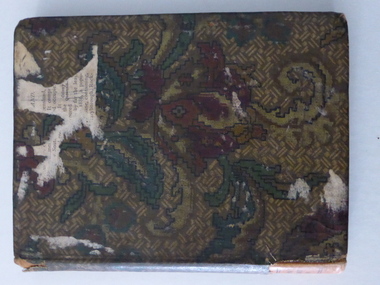
Book, The Victorian Reading book - first edition, 1928 (first edition)
... ...Oak Grove, Yangery...William McCullagh and his wife Margaret had the property Oak Grove at Yangery at the end of the 19th century and in the early decades of the 20th century. ...‘Sylvia McCullagh, Oak Grove, Yangery, Dennington P. Office’ ...This book is of interest not only because it is a first edition copy of one of the well-known Victorian School Readers but also because it was connected to the McCullagh family of Oak Grove, Yangery. History of Warrnambool Oak Grove, Yangery McCullagh family School Readers ‘Sylvia McCullagh, Oak Grove, Yangery, Dennington P. ...This is a first edition copy of the Victorian School Readers (Eighth Book) issued by the Education Department of Victoria. These readers were first published in 1928 and became standard texts for all school children up to Year Eight. They complemented the School Paper which had been published monthly for different year levels since the end of the 19th century. Both the Readers and the School Papers were in widespread use until the late 1940s and the early 1950s. William McCullagh and his wife Margaret had the property Oak Grove at Yangery at the end of the 19th century and in the early decades of the 20th century. Yangery is an agricultural area situated between Woodford and Koroit. There is a record of Silvie Jean McCullagh (parents – William and Margaret) born in 1914 and this is probably the person who owned and used this reader. This book is of interest not only because it is a first edition copy of one of the well-known Victorian School Readers but also because it was connected to the McCullagh family of Oak Grove, Yangery. This is a hard cover book of 260 pages. The cover was originally a burnished brown colour but the book has been covered with a mottled patterned cloth material (red, green and brown). The cover is partly torn off at the bottom of the spine. The book has poetry and prose extracts and includes many black and white sketches, maps, photographs and illustrations. The inscription and some other annotations throughout the book are handwritten in pencil. ‘Sylvia McCullagh, Oak Grove, Yangery, Dennington P. Office’ history of warrnambool, oak grove, yangery, mccullagh family, school readers -
 Flagstaff Hill Maritime Museum and Village
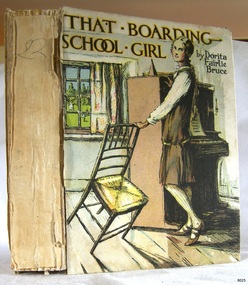
Book - Fiction, Oxford University Press, That Boarding School Girl, 1926
... ...Oak Grove...William and Margaret also made their home at Oak Grove and raised eleven children there, including Sylvia....William and Margaret also made their home at Oak Grove and raised eleven children there, including Sylvia. ...Sylvia Jean Veronica McCullagh Barr (1914–1998) was a student at the Presbyterian Sabbath School in Dennington, near Warrnambool. In December 1930, she received a book as an award from F. Jones, the Sabbath School Superintendent, recognising her involvement and achievements at the school. Sylvia was the granddaughter of James McCullagh (1831–1911) and Elizabeth Eccles (1831–1909), a pioneering couple in the region. Married in 1856, James and Elizabeth settled at Oak Grove, Yangery, Illowa from 1859, where they lived until their deaths. One of James and Elizabeth’s sons, William McCullagh (1873–1940), married Margaret Jane Russell (1879–1981). William and Margaret also made their home at Oak Grove and raised eleven children there, including Sylvia.The book, “That Boarding School Girl” by Dorita Fairlie Bruce, represents an example of literature accessible to older girls during the early 20th century. It was specifically selected as an end-of-year award, recognising consistent attendance at Sabbath School. Such choices highlight the role of books in supporting the educational and moral development of young women during this period. The book is important as a connection to the early township of Dennington, a community distinguished by its established school and church. This association reflects the values the community placed on education and religious instruction. The book’s significance is further enhanced by its relationship with colonial pioneer families in Australia, particularly those from Victoria and the Warrnambool district in southwest Victoria. It is a tangible link to the history and legacy of these early settlers, who were instrumental in shaping the regional development. That Boarding School Girl Author: Dorita Fairlie Bruce Publisher: Oxford University Press Date: 1926 The front cover and the page opposite the fly page have drawn and coloured illustrations. The cloth-covered, hardcover book includes black and white illustrations and coloured illustrations on the front cover and frontispiece. The front cover illustration shows a teenage irl in a school tunic, standing beside a piano with one hand on the backrest of a tilted chair. Inscriptions are printed on the front loose endpaper and handwritten on the fly page. The book belonged to Sylvia McCullagh. It was awarded to her as a prize in 1930.Handwritten on the top of the fly page: "Sylvia McCullagh Den" [ Den - abbreviation for Dennington] " Presbyterian Sabbath School, Dennington. Prize Awarded to: Sylvia McCullagh. December 1930." "F. Jones, Superintendent"flagstaff hill, flagstaff hill maritime museum and village, warrnambool, maritime museum, maritime village, great ocean road, shipwreck coast, book, warrnambool library, warrnambool mechanics’ institute, mechanics’ institute library, victorian library board, warrnambool books and records, warrnambool children’s library, warrnambool public library, that boarding school girl, dorita fairlie bruce, sylvia mccullagh, sylvia jean veronica mccullagh, sylvia barr, james mccullagh, elizabeth eccles mccullagh, william mccullagh, margaret jane russell mccullagh, oak grove, yangery, illowa, dennington, presbyterian sabbath school, presbyterian sunday school, dennington presbyterian church, book award, book prize, book presentation, f. jones, sabbath school superintendent, 1930 -
 Flagstaff Hill Maritime Museum and Village
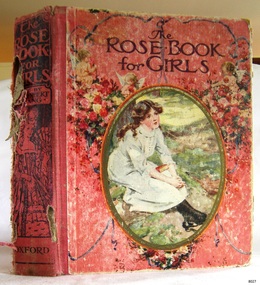
Book - Fiction, Mrs Herbert Strang, editor, The Rose Book for Girls, 1916
... James and Elizabeth married in 1856 and established their home at Oak Grove, Yangery, Illowa from 1859, residing there until their deaths. ...James and Elizabeth married in 1856 and established their home at Oak Grove, Yangery, Illowa from 1859, residing there until their deaths. ...Alma McCullagh was a student at the Presbyterian Sabbath School located in Dennington, near Warrnambool. In January, around 1928, she received a book as an award from R. Conn, her Sabbath School teacher, in recognition of her involvement and achievements at the school. The exact year of this award is based on available records: in January 1928, Alma was presented with a prize by R. Conn, whereas by 1930, the role of awarding prizes had passed to F. Jones. Alma was probably the granddaughter of James McCullagh (1831–1911) and Elizabeth Eccles (1831–1909), who were pioneering settlers in the region. James and Elizabeth married in 1856 and established their home at Oak Grove, Yangery, Illowa from 1859, residing there until their deaths. One of their sons, William McCullagh (1873–1940), married Margaret Jane Russell (1879–1981). William and Margaret continued the family tradition, making their home at Oak Grove as well. They raised eleven children, with Alma likely being among the youngest of their children.The book, “The Rose Book for Girls”, edited by Mrs Herbert Strang, represents an example of literature accessible to older girls during the early 20th century. It was specifically selected as an end-of-year award, recognising consistent attendance at Sabbath School. Such choices highlight the role of books in supporting the educational and moral development of young women during this period. The book is important as a connection to the early township of Dennington, a community distinguished by its established school and church. This association reflects the values the community placed on education and religious instruction. The book’s significance is further enhanced by its relationship with colonial pioneer families in Australia, particularly those from Victoria and the Warrnambool district in southwest Victoria. It is a tangible link to the history and legacy of these early settlers, who were instrumental in shaping the regional development. In addition, the book is notable for its connection to the McCullagh family, a prominent farming family whose contributions supported the social and economic growth of the local district. This historical association enriches its value, situating the book within the broader narrative of community progress and pioneer achievement in the area, and highlighting its place within a tradition of religious life and community building.The Rose Book for Girls A collection of short stories by various authors Edited by Mrs Herbert Strang Publisher: Henry Frowde, Hodder & Stoughton, London Printer: Morrison & Gibb Ltd., Tanfield, Edinburgh, Scotland, UK Date: 1916 Hardcover book. Deep pink front and back covers, decorated with garlands of pink and white flowers, cupids and blue ribbons. The front has a cameo with a seated girl in white, with a book in her lap. Details on the spine: title, author, publisher and a sketched female in 19th-century dress holding a fan. The fly page shows details of the book and has a black and red sketch of two seated girls, one reading, the other stitching. Twenty-five books are listed on the Contents page, as well as the printer's details. Within the book are several colourful sketches. Inscriptions include the name of the book's previous owner, Alma McCullagh.Front loose-end paper: "Presbyterian Sabbath School, Dennington. Prize Awarded to: Alma McCullagh. January. (year is unreadable, circa 1928) R. Conn, Teacher"flagstaff hill, flagstaff hill maritime museum and village, warrnambool, maritime museum, maritime village, great ocean road, shipwreck coast, book, the rose book for girls, mrs herbert strang, short stories, henry frowde, hodder & stoughton, london, morrison & gibb ltd, 1916, alma mccullagh, james mccullagh, elizabeth eccles mccullagh, ca. 1928, dennington, southwest victoria, warrnambool district, presbyterian sabbath school, presbyterian sunday school, dennington presbyterian church, book award, book prize, book presentation, r. conn, sabbath school superintendent -
 Warrnambool and District Historical Society Inc.
Book, Ann Chooses Glory, 1928
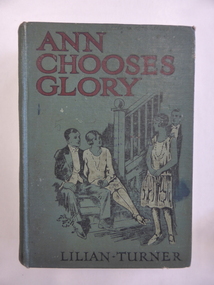
... The McCullagh family had a property in Yangery named Oak Grove....The McCullagh family had a property in Yangery named Oak Grove. This book is of interest because of the 1920s connection to the Dennington Presbyterian Church, the Conn family and the McCullagh families. ...This book was given in 1929 to Alma McCullagh by the Dennington Sabbath (Sunday) School with the teacher being R. Conn. The Dennington Presbyterian Church was originally established in Drummond Street in 1918. In 1951 it was moved to Lindsay Street and demolished in 1968. R. Conn may be Ruby Conn who was born in Warrnambool in 1890 to Joseph and Ann Conn. Joseph Conn was a blacksmith from Illowa in the late 19th century (today in that area we have Conn’s Corner and Conn’s Lane). The McCullagh family had a property in Yangery named Oak Grove.This book is of interest because of the 1920s connection to the Dennington Presbyterian Church, the Conn family and the McCullagh families.This is a hard cover book of 256 pages. The cover is green with red and black lettering and an image of two men and two women inside a building. The cover is torn away on the back right hand corner. There are five full page black and white illustrations scattered throughout the text. The inscriptions are handwritten in black ink. There is a stamp of a lion on the first page.‘Presbyterian Sabbath School Dennington, Prize awarded to Alma McCullagh, January 1929, R. Conn, Teacher’ ‘Alma McCullagh Dennington’ ‘Alma McCullagh’ alma mccullagh, joseph conn, illowa, history of warrnambool, dennington sabbath school, dennington presbyterian church -
 City of Greater Bendigo - Civic Collection
Photograph, W H Robinson, Druids Sandhurst Lodge No. 247, 01 / 11/ 1910
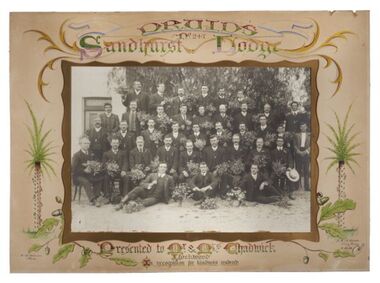
... Many of their ceremonies were carried out in oak groves, which they considered sacred and members were, at that time a mix of priest, judge, doctor and philosopher. ...Many of their ceremonies were carried out in oak groves, which they considered sacred and members were, at that time a mix of priest, judge, doctor and philosopher. ...Druids are known to exist from around the 3rd century B.C. Their name may have come from a Celtic word meaning “knower of the oak tree.” Many of their ceremonies were carried out in oak groves, which they considered sacred and members were, at that time a mix of priest, judge, doctor and philosopher. The Druids enjoyed a revival in the 19th century and were taken up enthusiastically during the Victorian era. Druidry was believed to have been introduced into Australia in 1851 with the setting up of the first lodge in Melbourne under the name United Ancient Order of Druids. Unlike the Freemasons, the Druids were not a secret society and were not selective in who they let in, as long as they paid their dues and acted more like a benevolent society than a spiritual movement. "They originally operated when there were few benefits available from the government or employers and the introduction of sick leave and other employer provided benefits, combined with the gradual introduction of government subsidised medicine, caused the need for them to diminish." Druids House — in Swanston Street, was opened by the Lord Mayor in 1927 and was designed to be the movement's national head office. It was completed at a cost of 19,000 pounds. This photograph was believed to have been commissioned by the Druids of Bendigo to the Licensees of the Queens Head pub where they regularly met, situated on the corner of the Bendigo-Maryborough Rd & the Calder Alternate Hwy ( Lockwood Cross Roads). The old Marong Council offices were situated opposite from 1864 until around 1908 when new offices were then built in Marong. It is believed that this photograph and a photo of the pub were given to Marong Shire by descendants of the publicans, probably in the 90’s. Framed black and white group photographic portrait of 37 members of the Sandhurst Chapter of the Druids staged and shot outdoors. Each of the gentlemen is carrying a bouquet of flowers. The photograph has a gold inner mount with the second mount cut to give the impression of a frame. The outer mount is hand painted with botanical motifs and elaborate text c.t. DRUIDS Sandhurst Lodge/ No 247. l.c Presented to Mr and Mrs Chadwick / Lockwood / in recognition for kindness rendered.W. G. Robinson / Photo and J.H. Gribble / Long Gully / 1,11,10robinson photographer, j.h.b. gribble artist, chadwick, shire of marong, city of greater bendigo portraits, city of greater bendigo community groups -
 Brighton Historical Society
Bodice, circa 1900
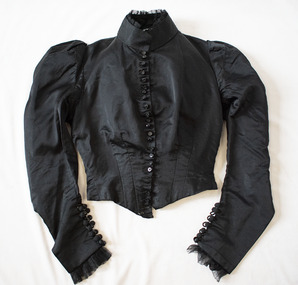
... After selling her practice she returned to Brighton, where she spent the last two decades of her life residing at 25 Oak Grove. Following her death in 1971, her relatives in Brighton donated a number of items from her home to BHS....After selling her practice she returned to Brighton, where she spent the last two decades of her life residing at 25 Oak Grove. Following her death in 1971, her relatives in Brighton donated a number of items from her home to BHS. mary crombie 1900s Black satin bodice, boned, with black faceted glass buttons down the front. ...This bodice belonged to Mary Crombie, an early Victorian dentist, who lived in Brighton while she was studying at the Australian College of Dentistry in the mid-1900s, and later returned to the area in her retirement from 1949-1971. Mary Margaret Crombie (1884-1971) was born at Coan Downs Station near Walgett, northern New South Wales, where her father Henry was station manager. After Henry’s untimely death in 1895, Mary and her mother loved for a few years with family members in St Kilda, before moving into a cottage of their own, ‘Rosewood’, at 42 Asling Street, Brighton around 1899. From here, Mary attended Oberwyl Ladies College in St Kilda and later the Australian College of Dentistry, one of only a few women to study dental surgery at the time. She was apprenticed to Ada Tovell (1865-1932), one of Victoria’s first female dentists, who had her own practice in Collins Street. Mary graduated in 1907 and the following year moved with he mother to Yarram in South Gippsland, where she took over the running of a practice owned by Sale dentist Charles Trood, eventually purchasing it from him in 1915. Speaking to a Brighton newspaper in 1961, Mary said she believed that she was the first woman to start a dental practice in Gippsland. For some locals, this took a little getting used to: “Many were amazed, and had some misgivings, when they found that the local dentist was a woman,” she said. “I always remember a huge farmer (he was about 6 ft. 4 in.), who had fortified himself at the local hotel to face the ordeal of visiting the dentist. He almost turned and ran when he saw me. … He was still more amazed when I pulled out his tooth without undue trouble.” The farmer was the best advertisement she could have asked for, telling everybody about the diminutive lady dentist who had calmly extracted his tooth. Mary practiced in Yarram until her retirement in 1949. After selling her practice she returned to Brighton, where she spent the last two decades of her life residing at 25 Oak Grove. Following her death in 1971, her relatives in Brighton donated a number of items from her home to BHS.Black satin bodice, boned, with black faceted glass buttons down the front. High collar. Both collar and cuffs are edged with a black net ruffle. Two rows of seven black crochet-covered buttons at each cuff, fastening with loops. Stray brown threads poking through fabric around the collar, shoulders and back indicate that these areas may originally have featured lace embellishments.mary crombie, 1900s -
 Glen Eira Historical Society
Album - Album page, Labassa, 4 Manor Grove, Circa 1972
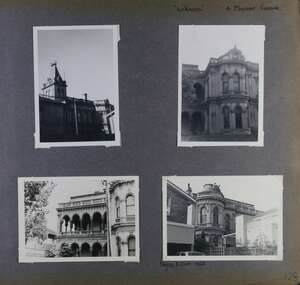
... grove...french renaissance style...l-shaped arcaded verandah...bluestone plinths...balustraded parapet...flat topped mansard roofs...conical roof...elaborate cornices...corinthian columns...caryatid consoles...marble panels...imitation marble...scagliola...tower...conservatory...stables...tennis pavilion...mouldings...decorative glass...caryatids...swagged columns...ornamental cresting...trompe l'oeil ceiling...embossed imitation leather...oak...[Online Data Upgrade Project 2004] trevor hart bracketed eaves slate roof bay windows decorative brackets caulfield north labassa richard a. billing balaclava road orrong road sylliott hill william lyall crouch and wilson alexander william robertson ontario 1880's john a. b. koch mansion john boyd watson labassa grove french renaissance style l-shaped arcaded verandah bluestone plinths balustraded parapet flat topped mansard roofs conical roof elaborate cornices corinthian columns caryatid consoles marble panels imitation marble scagliola tower conservatory stables tennis pavilion mouldings decorative glass caryatids swagged columns ornamental cresting trompe l'oeil ceiling embossed imitation leather oak parquetry stained glass tripartite window triple window ferguson and urie 1870's flats 1920's electric wiring 1860's verandahs curved windows arched windows italianate terraces gargoyles ornamentation ornate entrance la bassa manor grove st kilda east victorian cast iron work john koch richard billing architects electrification john mickle land subdivision mrs watson labassa estate robert hannon national trust of australia (victoria) sculpture Handwritten: "Labassa" 4 Manor Grove [top right] / Neg 232 8 Oct 1966 [under bottom right photo] / 128 [bottom right] Page 128 of Photograph Album with four photographs (two portrait and two landscape) of Labassa. ...This photograph is part of the Caulfield Historical Album 1972. This album was created in approximately 1972 as part of a project by the Caulfield Historical Society to assist in identifying buildings worthy of preservation. The album is related to a Survey the Caulfield Historical Society developed in collaboration with the National Trust of Australia (Victoria) and Caulfield City Council to identify historic buildings within the City of Caulfield that warranted the protection of a National Trust Classification. Principal photographer thought to be Trevor Hart, member of Caulfield Historical Society. Most photographs were taken between 1966-1972 with a small number of photographs being older and from unknown sources. All photographs are black and white except where stated, with 386 photographs over 198 pages. HISTORY:-- From Victorian Heritage Database citation for Labassa https://vhd.heritagecouncil.vic.gov.au/places/278 as at (26/10/2020) Labassa, Caulfield is one of Melbourne's most lavishly decorated nineteenth century mansions. It resulted from the extensive remodelling in 1890, of an earlier house, known as Sylliott Hill, which was begun in 1862-3 for lawyer, Richard A. Billing. The land at the corner of Balaclava and Orrong Roads was first acquired in 1854 by William Lyall, transferred to his partner, John Mickle, in 1859, who also acquired the adjoining allotment in Balaclava Road, and the three allotments were conveyed to Billing. His first eight-roomed house was extended significantly in 1873 into a twenty-roomed house by architects Crouch and Wilson, who were possibly also responsible for the first house. This reflected Billing's success as a barrister, and he resided at this property until his death in 1882. In 1883 prominent Melbourne businessman, Alexander William Robertson, leased the Sylliott Hill property from Billing's widow, and in 1885 he purchased the adjoining allotment in Balaclava Road. He purchased the Billing's property in 1887 and renamed the 6.31 hectare property, Ontario. In 1889-90, Robertson commissioned the German born architect, John A. B. Koch, to extensively remodel the house into a thirty-five roomed mansion. The existing house was extended and altered, largely resulting in the nineteenth century mansion as it now appears. After Robertson's death in 1896, the house was tenanted until it was eventually sold to the mining millionaire, John Boyd Watson, in 1904. He renamed the property Labassa and carried out repair and re-decoration work to the house. In the early twentieth century, many large estates were subdivided into smaller allotments as the demand for land grew and it became difficult to maintain such large estates. After Watson's death in 1911, portions of the Labassa estate were offered for sale, with Mrs Watson retaining a 1.73 hectare portion containing the house. In 1913 forty-six allotments were auctioned at Labassa Estate, with the formation of Labassa Grove and Ontario Street to the east of the property. Labassa was first recorded as containing flats in 1923 and in the late 1920s, the owner, Robert Hannon, built a red brick block of flats adjacent to the house. Subdivision continued, until the National Trust of Australia (Victoria) purchased the house in 1980 and subsequently purchased adjoining sites, one to the south-east in 1984 (house demolished in 1988) and to the west in 1988. Labassa as it now stands is substantially as it appeared when Koch completed the work in 1890. The original two storey house was transformed into a French Renaissance style mansion, with the addition of a two level L-shaped arcaded verandah and two prominent terminating bays to the south and the east. The building is of unpainted cement render with dressed bluestone plinths, balustraded parapet and steep, slate covered, flat topped mansard roofs behind. A truncated conical roof is a feature of the south bay and a helmeted head is incorporated in the parapet over the east bay. The main south and east facades incorporate many cast cement details, including sculptures, elaborate cornices, swagged Corinthian columns and caryatid consoles flanking the entrance porch, as well as pink marble panels and imitation marble, or scagliola, on curved surfaces. At the rear of the building is a two storey wing and a single storey cottage, the former being connected to the main house by a tower. This section of the house was constructed in 1873. The estate at its peak included stables (1873), conservatory (probably 1890) and a tennis pavilion (probably 1890). All of these outbuildings survive, with the stables and conservatory being converted for residential use after 1922. Internally a range of decorative treatments remain from the late nineteenth century and the early twentieth century, both from the Robertson and Watson periods of occupancy. These include wallpapers, ceiling decoration, chimney pieces, mouldings, joinery and decorative glass. From Victorian Heritage Database citation for H0135 Labassa 2/2A Manor Grove Caulfield North https://vhd.heritagecouncil.vic.gov.au/places/278 as at (26/10/2020) HOW IS IT SIGNIFICANT? Labassa, Caulfield is of architectural, aesthetic and historical significance to the State of Victoria. WHY IS IT SIGNIFICANT? Labassa, Caulfield is of architectural significance as the most prominent example of a small number of houses built in Australia in the French Renaissance style. It is of further note due to the German interpretation of the style and the use of Hellenistic sources, via Germany. It is exceptional for its lavish treatment externally, including marble, scagliola, caryatids, swagged columns, mansard roofs and ornamental cresting. Labassa is of architectural significance as the most important surviving example of German architect, John Koch's domestic work. He undertook a large variety of work in Melbourne, including a number of houses, however Labassa is the most lavish example of his work. Labassa is of aesthetic significance for its outstanding assemblage of late nineteenth and early twentieth century European style interior decoration, which remain remarkably intact. These include a trompe l'oeil ceiling, painted ceilings, embossed imitation leather and other papers, chimney pieces, ceramic tilework, oak parquetry and stained glass, including a tripartite window by Ferguson and Urie, probably dating from the 1873 period. Labassa is of historical significance as an illustrative example of the wealth acquired by a number of prominent Victorian families in the second half of the 19th century. The early development of the property, Sylliott Hill, was due to the wealth acquired by Richard Billing, barrister and fifth Victorian to be appointed Queen's Counsel in 1878. The significant development in 1890 of Ontario, is illustrative of the wealth of Alexander Robertson, a partner in Cobb and Co., a director of Goldsborough Mort & Co., and a pastoral speculator. John B. Watson, whose father had acquired great wealth from the goldfields of Bendigo and subsequently invested in city and country properties, was the third resident to impact on the house, particularly the interiors. The Labassa estate is of historical significance as an illustrative example of the development that occurred in such suburbs as Caulfield in the 1880s due to the land boom, its proximity to Melbourne and the establishment of the Melbourne to Gippsland railway in 1879. It is also illustrative of an estate which succumbed to the pressures of subdividing in the early twentieth century, as properties became difficult to maintain and demand for land close to the city grew. It was typically divided into flats in the 1920s and was used as such for about sixty years. It is of historical significance for its associations with the remnants of the earlier estate which remain extant. These include the stables, conservatory (H2005) and tennis pavilion which all remain on separate sites. Also significant are the remains of early electrical wiring and fittings. Labassa was one of the first houses in Caulfield to be electrified and some of the original wires remain. [Online Data Upgrade Project 2004]Page 128 of Photograph Album with four photographs (two portrait and two landscape) of Labassa.Handwritten: "Labassa" 4 Manor Grove [top right] / Neg 232 8 Oct 1966 [under bottom right photo] / 128 [bottom right]trevor hart, bracketed eaves, slate roof, bay windows, decorative brackets, caulfield north, labassa, richard a. billing, balaclava road, orrong road, sylliott hill, william lyall, crouch and wilson, alexander william robertson, ontario, 1880's, john a. b. koch, mansion, john boyd watson, labassa grove, french renaissance style, l-shaped arcaded verandah, bluestone plinths, balustraded parapet, flat topped mansard roofs, conical roof, elaborate cornices, corinthian columns, caryatid consoles, marble panels, imitation marble, scagliola, tower, conservatory, stables, tennis pavilion, mouldings, decorative glass, caryatids, swagged columns, ornamental cresting, trompe l'oeil ceiling, embossed imitation leather, oak parquetry, stained glass, tripartite window, triple window, ferguson and urie, 1870's, flats, 1920's, electric wiring, 1860's, verandahs, curved windows, arched windows, italianate, terraces, gargoyles, ornamentation, ornate entrance, la bassa, manor grove, st kilda east, victorian, cast iron work, john koch, richard billing, architects, electrification, john mickle, land subdivision, mrs watson, labassa estate, robert hannon, national trust of australia (victoria), sculpture -
 Glen Eira Historical Society
Album - Album page, Labassa, 4 Manor Grove, Circa 1972
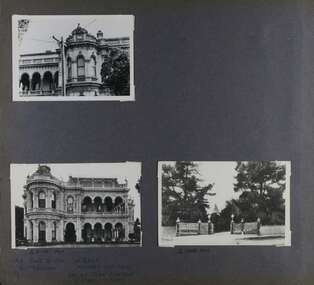
... grove...french renaissance style...l-shaped arcaded verandah...bluestone plinths...balustraded parapet...flat topped mansard roofs...conical roof...elaborate cornices...corinthian columns...caryatid consoles...marble panels...imitation marble...scagliola...tower...conservatory...stables...tennis pavilion...mouldings...decorative glass...caryatids...swagged columns...ornamental cresting...trompe l'oeil ceiling...embossed imitation leather...oak...[Online Data Upgrade Project 2004] trevor hart bracketed eaves intricate lacework slate roof bay windows decorative brackets caulfield north labassa richard a. billing balaclava road orrong road sylliott hill william lyall crouch and wilson alexander william robertson ontario 1880's john a. b. koch mansion john boyd watson labassa grove french renaissance style l-shaped arcaded verandah bluestone plinths balustraded parapet flat topped mansard roofs conical roof elaborate cornices corinthian columns caryatid consoles marble panels imitation marble scagliola tower conservatory stables tennis pavilion mouldings decorative glass caryatids swagged columns ornamental cresting trompe l'oeil ceiling embossed imitation leather oak parquetry stained glass tripartite window triple window ferguson and urie 1870's flats 1920's electric wiring 1860's verandahs curved windows arched windows italianate terraces gargoyles ornamentation ornate entrance la bassa manor grove st kilda east gates cast iron work richard billing architects john koch electrification victorian style drives john mickle land subdivision mrs watson labassa estate robert hannon national trust of australia (victoria) sculpture Handwritten: 4 JUNE 1910 / SALE JUNE 28 1910 "LA BASSA' / "AUSTRALASIAN" FORMERLY "ONTARIO"/ RES OF JOHN B WATSON / 15 ACRES 3 ROADS [under bottom left photo] / 4 JUNE 1910 [under bottom right photo] / 129 [bottom left] Page 129 of Photograph Album with three landscape photographs of Labassa. ...This photograph is part of the Caulfield Historical Album 1972. This album was created in approximately 1972 as part of a project by the Caulfield Historical Society to assist in identifying buildings worthy of preservation. The album is related to a Survey the Caulfield Historical Society developed in collaboration with the National Trust of Australia (Victoria) and Caulfield City Council to identify historic buildings within the City of Caulfield that warranted the protection of a National Trust Classification. Principal photographer thought to be Trevor Hart, member of Caulfield Historical Society. Most photographs were taken between 1966-1972 with a small number of photographs being older and from unknown sources. All photographs are black and white except where stated, with 386 photographs over 198 pages. HISTORY:-- From Victorian Heritage Database citation for Labassa https://vhd.heritagecouncil.vic.gov.au/places/278 as at (26/10/2020) Labassa, Caulfield is one of Melbourne's most lavishly decorated nineteenth century mansions. It resulted from the extensive remodelling in 1890, of an earlier house, known as Sylliott Hill, which was begun in 1862-3 for lawyer, Richard A. Billing. The land at the corner of Balaclava and Orrong Roads was first acquired in 1854 by William Lyall, transferred to his partner, John Mickle, in 1859, who also acquired the adjoining allotment in Balaclava Road, and the three allotments were conveyed to Billing. His first eight-roomed house was extended significantly in 1873 into a twenty-roomed house by architects Crouch and Wilson, who were possibly also responsible for the first house. This reflected Billing's success as a barrister, and he resided at this property until his death in 1882. In 1883 prominent Melbourne businessman, Alexander William Robertson, leased the Sylliott Hill property from Billing's widow, and in 1885 he purchased the adjoining allotment in Balaclava Road. He purchased the Billing's property in 1887 and renamed the 6.31 hectare property, Ontario. In 1889-90, Robertson commissioned the German born architect, John A. B. Koch, to extensively remodel the house into a thirty-five roomed mansion. The existing house was extended and altered, largely resulting in the nineteenth century mansion as it now appears. After Robertson's death in 1896, the house was tenanted until it was eventually sold to the mining millionaire, John Boyd Watson, in 1904. He renamed the property Labassa and carried out repair and re-decoration work to the house. In the early twentieth century, many large estates were subdivided into smaller allotments as the demand for land grew and it became difficult to maintain such large estates. After Watson's death in 1911, portions of the Labassa estate were offered for sale, with Mrs Watson retaining a 1.73 hectare portion containing the house. In 1913 forty-six allotments were auctioned at Labassa Estate, with the formation of Labassa Grove and Ontario Street to the east of the property. Labassa was first recorded as containing flats in 1923 and in the late 1920s, the owner, Robert Hannon, built a red brick block of flats adjacent to the house. Subdivision continued, until the National Trust of Australia (Victoria) purchased the house in 1980 and subsequently purchased adjoining sites, one to the south-east in 1984 (house demolished in 1988) and to the west in 1988. Labassa as it now stands is substantially as it appeared when Koch completed the work in 1890. The original two storey house was transformed into a French Renaissance style mansion, with the addition of a two level L-shaped arcaded verandah and two prominent terminating bays to the south and the east. The building is of unpainted cement render with dressed bluestone plinths, balustraded parapet and steep, slate covered, flat topped mansard roofs behind. A truncated conical roof is a feature of the south bay and a helmeted head is incorporated in the parapet over the east bay. The main south and east facades incorporate many cast cement details, including sculptures, elaborate cornices, swagged Corinthian columns and caryatid consoles flanking the entrance porch, as well as pink marble panels and imitation marble, or scagliola, on curved surfaces. At the rear of the building is a two storey wing and a single storey cottage, the former being connected to the main house by a tower. This section of the house was constructed in 1873. The estate at its peak included stables (1873), conservatory (probably 1890) and a tennis pavilion (probably 1890). All of these outbuildings survive, with the stables and conservatory being converted for residential use after 1922. Internally a range of decorative treatments remain from the late nineteenth century and the early twentieth century, both from the Robertson and Watson periods of occupancy. These include wallpapers, ceiling decoration, chimney pieces, mouldings, joinery and decorative glass.From Victorian Heritage Database citation for H0135 Labassa 2/2A Manor Grove Caulfield North https://vhd.heritagecouncil.vic.gov.au/places/278 as at (26/10/2020) HOW IS IT SIGNIFICANT? Labassa, Caulfield is of architectural, aesthetic and historical significance to the State of Victoria. WHY IS IT SIGNIFICANT? Labassa, Caulfield is of architectural significance as the most prominent example of a small number of houses built in Australia in the French Renaissance style. It is of further note due to the German interpretation of the style and the use of Hellenistic sources, via Germany. It is exceptional for its lavish treatment externally, including marble, scagliola, caryatids, swagged columns, mansard roofs and ornamental cresting. Labassa is of architectural significance as the most important surviving example of German architect, John Koch's domestic work. He undertook a large variety of work in Melbourne, including a number of houses, however Labassa is the most lavish example of his work. Labassa is of aesthetic significance for its outstanding assemblage of late nineteenth and early twentieth century European style interior decoration, which remain remarkably intact. These include a trompe l'oeil ceiling, painted ceilings, embossed imitation leather and other papers, chimney pieces, ceramic tilework, oak parquetry and stained glass, including a tripartite window by Ferguson and Urie, probably dating from the 1873 period. Labassa is of historical significance as an illustrative example of the wealth acquired by a number of prominent Victorian families in the second half of the 19th century. The early development of the property, Sylliott Hill, was due to the wealth acquired by Richard Billing, barrister and fifth Victorian to be appointed Queen's Counsel in 1878. The significant development in 1890 of Ontario, is illustrative of the wealth of Alexander Robertson, a partner in Cobb and Co., a director of Goldsborough Mort & Co., and a pastoral speculator. John B. Watson, whose father had acquired great wealth from the goldfields of Bendigo and subsequently invested in city and country properties, was the third resident to impact on the house, particularly the interiors. The Labassa estate is of historical significance as an illustrative example of the development that occurred in such suburbs as Caulfield in the 1880s due to the land boom, its proximity to Melbourne and the establishment of the Melbourne to Gippsland railway in 1879. It is also illustrative of an estate which succumbed to the pressures of subdividing in the early twentieth century, as properties became difficult to maintain and demand for land close to the city grew. It was typically divided into flats in the 1920s and was used as such for about sixty years. It is of historical significance for its associations with the remnants of the earlier estate which remain extant. These include the stables, conservatory (H2005) and tennis pavilion which all remain on separate sites. Also significant are the remains of early electrical wiring and fittings. Labassa was one of the first houses in Caulfield to be electrified and some of the original wires remain. [Online Data Upgrade Project 2004]Page 129 of Photograph Album with three landscape photographs of Labassa. One of the photographs is of Labassa's drive and gates.Handwritten: 4 JUNE 1910 / SALE JUNE 28 1910 "LA BASSA' / "AUSTRALASIAN" FORMERLY "ONTARIO"/ RES OF JOHN B WATSON / 15 ACRES 3 ROADS [under bottom left photo] / 4 JUNE 1910 [under bottom right photo] / 129 [bottom left]trevor hart, bracketed eaves, intricate lacework, slate roof, bay windows, decorative brackets, caulfield north, labassa, richard a. billing, balaclava road, orrong road, sylliott hill, william lyall, crouch and wilson, alexander william robertson, ontario, 1880's, john a. b. koch, mansion, john boyd watson, labassa grove, french renaissance style, l-shaped arcaded verandah, bluestone plinths, balustraded parapet, flat topped mansard roofs, conical roof, elaborate cornices, corinthian columns, caryatid consoles, marble panels, imitation marble, scagliola, tower, conservatory, stables, tennis pavilion, mouldings, decorative glass, caryatids, swagged columns, ornamental cresting, trompe l'oeil ceiling, embossed imitation leather, oak parquetry, stained glass, tripartite window, triple window, ferguson and urie, 1870's, flats, 1920's, electric wiring, 1860's, verandahs, curved windows, arched windows, italianate, terraces, gargoyles, ornamentation, ornate entrance, la bassa, manor grove, st kilda east, gates, cast iron work, richard billing, architects, john koch, electrification, victorian style, drives, john mickle, land subdivision, mrs watson, labassa estate, robert hannon, national trust of australia (victoria), sculpture -
 Glen Eira Historical Society
Letter - LePage Family
... Grove... North Caulfield... Ford Hazel... Campbell Felicity... Vallati Gladys... Imperial Avenue... Hawthorn Road... Glenhuntly Road... Alder Street... Liquor shops... Halesowen... Grocers... Marsh Victor James Bernard... Berklea Private Hospital... Kooyong Road... Briggs Street... Marsh Alice... Newstead Street... Marsh Lucie... Marsh Charlie E.C.... Marsh Dudley Ward... Murrumbeena state school... Oak...Marsh Phoebe Elizabeth Jane LePage Phoebe Elizabeth Jane LePage Ignatius John Elsternwick Carre Street Orrong Road St Joseph’s Elsternwick State savings bank Elsternwick Norris William Bentleigh Vickery Street Caulfield Historical Society Keating Betty Holland Grove North Caulfield Ford Hazel Campbell Felicity Vallati Gladys Imperial Avenue Hawthorn Road Glenhuntly Road Alder Street Liquor shops Halesowen Grocers Marsh Victor James Bernard Berklea Private Hospital Kooyong Road Briggs Street Marsh Alice Newstead Street Marsh Lucie Marsh Charlie E.C. Marsh Dudley Ward Murrumbeena state school Oak ...This file has 7 items. 1.Certified copy dated 28/05/1975 of birth certificate of Phoebe Elizabeth Marsh on 08/05/1869 in Chewton Victoria, and certified copy dated 22/05/1975 of marriage certificate of Ignatius John LePage and Phoebe Marsh on 14/06/1906 in Bendigo. 2.Photocopy of will of Ignatius John LePage dated 07/09/1933 and of inventory and probate application dated 1940. 3.Photocopy of will of Phoebe LePage dated 06/11/1971. 4.Photocopy of praecipe to probate registrar concerning will of Phoebe LePage dated 28/11/1941. 5.Photocopy of inventory of possessions in the estate of Phoebe Marsh dated 17/03/1942. 6.Correspondence dated 30/01/1994 and 10/05/1994 to Felicity Campbell, of Caulfield Historical Society from William Norris concerning his LePage family history notes. 7.Handwritten notes titled ‘The Marsh Bayle LePage Caulfield Connection’ by William Morris dated 10/01/1994 concerning the LePage family history in the Caulfield area.marsh phoebe elizabeth jane, lepage phoebe elizabeth jane, lepage ignatius john, elsternwick, carre street, orrong road, st joseph’s elsternwick, state savings bank elsternwick, norris william, bentleigh, vickery street, caulfield historical society, keating betty, holland grove, north caulfield, ford hazel, campbell felicity, vallati gladys, imperial avenue, hawthorn road, glenhuntly road, alder street, liquor shops, halesowen, grocers, marsh victor james bernard, berklea private hospital, kooyong road, briggs street, marsh alice, newstead street, marsh lucie, marsh charlie e.c., marsh dudley ward, murrumbeena state school, oak street, phoebe theatre, bayly james b., chloris crescent, bambra road, lepage catherine, turnbull charles, murrumbeena road, murrumbeena, dandenong road, renown theatre, quantrelle madge, gunning margaret, grange road, glenhuntly, mcnamara madge, st george road, lepage winnie, marsh edwin charles, lepage ellen, orrong grove, sandham street, st joseph’s convent -
Kew Historical Society Inc
Archive (Sub-series) - Subject File, Kew Historical Society, Gardens (Kew), 1979
... She refers to: the pear trees planted by William Oswin in c. 1845 near what is now the Burke Road Bridge (she notes that a search for the trees at the time of the construction of the Eastern Freeway was unsuccessful), a camellia planted by the Dannocks near the corner of Derby and High Street, a c.1876 pine tree in Field Place, Henty Court, an 1875 Moreton Bay fig at Tarring, Ruyton, a Moreton Bay fig at Roxeth, Trinity Grammar, an 1840s oak tree and a 120-year old olive tree at Fairholme, Barry Street, 1870 pine trees at D’Estaville, Barry Street, trees at Turinville, Barnard Grove, dating to 1846, pine trees dating from 1845-6 on the Willsmere Farm, red gums in Victoria Park, pine trees in the Cemetery dating from the 1860s, trees in the Alexandra Gardens and at Kew Primary School, palm trees at La Verna, Sackville Street dating from the 1890s, the trees and gardens at Ross House (Charleville), and the trees at Merridale, Sackville Street which date from the 1880s, a magnolia at Lalla Rookh. ...She refers to: the pear trees planted by William Oswin in c. 1845 near what is now the Burke Road Bridge (she notes that a search for the trees at the time of the construction of the Eastern Freeway was unsuccessful), a camellia planted by the Dannocks near the corner of Derby and High Street, a c.1876 pine tree in Field Place, Henty Court, an 1875 Moreton Bay fig at Tarring, Ruyton, a Moreton Bay fig at Roxeth, Trinity Grammar, an 1840s oak tree and a 120-year old olive tree at Fairholme, Barry Street, 1870 pine trees at D’Estaville, Barry Street, trees at Turinville, Barnard Grove, dating to 1846, pine trees dating from 1845-6 on the Willsmere Farm, red gums in Victoria Park, pine trees in the Cemetery dating from the 1860s, trees in the Alexandra Gardens and at Kew Primary School, palm trees at La Verna, Sackville Street dating from the 1890s, the trees and gardens at Ross House (Charleville), and the trees at Merridale, Sackville Street which date from the 1880s, a magnolia at Lalla Rookh. ...Various partiesReference, Research, InformationSecondary Values (KHS Imposed Order)Correspondence and newspaper articles/clippings relating to historic gardens in Kew. The oldest item is a letter from the National Trust Victoria announcing their two-year garden study and seeking information on gardens in Kew. Mavis Rolley, Secretary of the Society, made handwritten notes in response, which are kept in the file. She refers to: the pear trees planted by William Oswin in c. 1845 near what is now the Burke Road Bridge (she notes that a search for the trees at the time of the construction of the Eastern Freeway was unsuccessful), a camellia planted by the Dannocks near the corner of Derby and High Street, a c.1876 pine tree in Field Place, Henty Court, an 1875 Moreton Bay fig at Tarring, Ruyton, a Moreton Bay fig at Roxeth, Trinity Grammar, an 1840s oak tree and a 120-year old olive tree at Fairholme, Barry Street, 1870 pine trees at D’Estaville, Barry Street, trees at Turinville, Barnard Grove, dating to 1846, pine trees dating from 1845-6 on the Willsmere Farm, red gums in Victoria Park, pine trees in the Cemetery dating from the 1860s, trees in the Alexandra Gardens and at Kew Primary School, palm trees at La Verna, Sackville Street dating from the 1890s, the trees and gardens at Ross House (Charleville), and the trees at Merridale, Sackville Street which date from the 1880s, a magnolia at Lalla Rookh. These dates are probably highly contestable. Other handwritten notes from 1979 about significant gardens included: 5 Molesworth Street, Red Bluff - Redmond Street (garden now destroyed), Campion House, Studley Park Road, Raheen, Studley Park Road, Ross House, Cotham Road (Charleville), 7 Adeney Avenue, 20-21 Belmont Avenue, 52 Mary Street, an Edna Walling garden on the corner of Argyle Road and Victor Avenue, Merridale, Sackville Street, Roseneath, and Reno, St John’s Parade.gardens - private - kew (vic), garden design - kew (vic), kew horticultural societygardens - private - kew (vic), garden design - kew (vic), kew horticultural society -
Kew Historical Society Inc
Journal, Kewriosity : September 1988
... Grove Playgroup]/ p4. Friends of Kew Library / p4. Christmas cards for Kew / p4. Kew group to perform at Spoleto Festival [Elysium Ensemble] / p5. Community celebrations at Kew High School [State Education Week] / p5. Kew Community House / Judy Price p6. Student help / p6. Used furniture - can you help? [Belford Oaks ...Council urges 'YES' vote on September 3 [Constitutional recognition for local government]/ p1-2. Meet the Mayor [Cr Allen Martin] / p1. Dates for September / p2. Kew Living launch [Bicentennial project] / p2. Commentary / Cr Allen Martin p3. Amnesty on dogs [registration] / p3. Election results / p3. Former Kew Councillor for County Court [Judge Chester Keon-Cohen] / p3. Willsmere Forum / p3. Notices [North Kew Tennis Club] / p4. Community clean up [Boroondara Bushwalkers] / p4. Pregnancy support / p4. Teenage Disco [Youth Resource Centre] / p4. Friendship and fun at playgroup [Highbury Grove Playgroup]/ p4. Friends of Kew Library / p4. Christmas cards for Kew / p4. Kew group to perform at Spoleto Festival [Elysium Ensemble] / p5. Community celebrations at Kew High School [State Education Week] / p5. Kew Community House / Judy Price p6. Student help / p6. Used furniture - can you help? [Belford Oaks Full Day Care Centre] / p6. Keeping you informed [Kew Citizens’ Advice Bureau] / p6. [Kew] Community Directory [1989] p6. Fun, fitness and family [Kew Little Athletics Centre] / p7. Community recreation for disabled [ Kew Recreation Integration Support Group] / p7. Footy News [Kew Football Club] / p8. Bowls season starts soon [Kew Bowling Club] / p8. Cricket Club invites new members [Deepdene Uniting Cricket Club] / p8. Spring into Spring with volleyball [Kew High School Sports Centre] / p8. 1st Kew Scouts ready to expand / p8.Kewriosity was a local newsletter combining Kew Council and community news. It was published between November 1983 and June 1994, replacing an earlier Kewriosity [broad] Sheet (1979-84). In producing Kewriosity, Council aimed to provide a range of interesting and informative articles covering its deliberations and decision making, together with items of general interest and importance to the Kew community and information not generally available through daily media outlets.non-fictionCouncil urges 'YES' vote on September 3 [Constitutional recognition for local government]/ p1-2. Meet the Mayor [Cr Allen Martin] / p1. Dates for September / p2. Kew Living launch [Bicentennial project] / p2. Commentary / Cr Allen Martin p3. Amnesty on dogs [registration] / p3. Election results / p3. Former Kew Councillor for County Court [Judge Chester Keon-Cohen] / p3. Willsmere Forum / p3. Notices [North Kew Tennis Club] / p4. Community clean up [Boroondara Bushwalkers] / p4. Pregnancy support / p4. Teenage Disco [Youth Resource Centre] / p4. Friendship and fun at playgroup [Highbury Grove Playgroup]/ p4. Friends of Kew Library / p4. Christmas cards for Kew / p4. Kew group to perform at Spoleto Festival [Elysium Ensemble] / p5. Community celebrations at Kew High School [State Education Week] / p5. Kew Community House / Judy Price p6. Student help / p6. Used furniture - can you help? [Belford Oaks Full Day Care Centre] / p6. Keeping you informed [Kew Citizens’ Advice Bureau] / p6. [Kew] Community Directory [1989] p6. Fun, fitness and family [Kew Little Athletics Centre] / p7. Community recreation for disabled [ Kew Recreation Integration Support Group] / p7. Footy News [Kew Football Club] / p8. Bowls season starts soon [Kew Bowling Club] / p8. Cricket Club invites new members [Deepdene Uniting Cricket Club] / p8. Spring into Spring with volleyball [Kew High School Sports Centre] / p8. 1st Kew Scouts ready to expand / p8. publications -- city of kew (vic.), kewriosity, council newsletters, community newsletters
