
Showing 97 items matching "obstetric delivery"
-
 Royal Australian and New Zealand College of Obstetricians & Gynaecologists (RANZCOG)
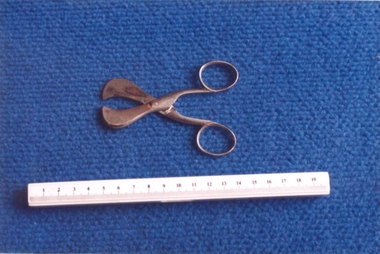
Umbilical cord scissors used by Dr Mitchell Henry O'Sullivan
... Obstetric delivery...Used to cut the umbilical cord during obstetric delivery....Used to cut the umbilical cord during obstetric delivery. Dr Mitchell Henry O'Sullivan worked in the Victorian country town of Casterton as a general practitioner from 1919 until his death in 1977. ...Used to cut the umbilical cord during obstetric delivery.Dr Mitchell Henry O'Sullivan worked in the Victorian country town of Casterton as a general practitioner from 1919 until his death in 1977. He also practiced obstetrics. His son, Dr David More O'Sullivan donated the obstetric bag and its contents to the College in 1999. The gladstone bag and contents are a unique time capsule of the type of instruments and pharmaceuticals used in the inter-war period.Small pair of stainless steel scissors with flanged shaft. American pattern. The number '2' is inscribed on inner aspect on both arms of the scissor.'2'obstetric delivery -
 Royal Australian and New Zealand College of Obstetricians & Gynaecologists (RANZCOG)
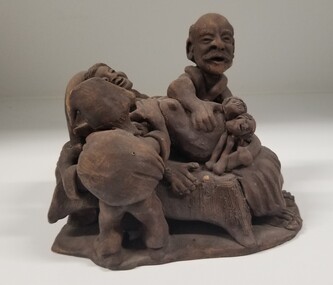
Sculpture - Ceramic vignette of a caesarean section locked twin childbirth
... Obstetric delivery...This is a rare and hazardous obstetric complication, occurring approximately once every 90000 deliveries. It usually results in a low survival rate for the twin that presents first, with a stillborn rate over 50%. ...This piece is believed to be from South America, and is either from Colombia or Peru. Obstetric delivery Ceramic childbirth scene with three figures. ...This is a rare and hazardous obstetric complication, occurring approximately once every 90000 deliveries. It usually results in a low survival rate for the twin that presents first, with a stillborn rate over 50%. This piece is believed to be from South America, and is either from Colombia or Peru.Ceramic childbirth scene with three figures. At centre, a woman lies on a table giving birth. A figure wearing a hat stands to her right, resting their hand on her upper chest in a gesture of support. On her left, a gloved man with receding hairline and a moustache is leaning over her abdomen and is extracting two babies from her womb.obstetric delivery -
 Royal Australian and New Zealand College of Obstetricians & Gynaecologists (RANZCOG)
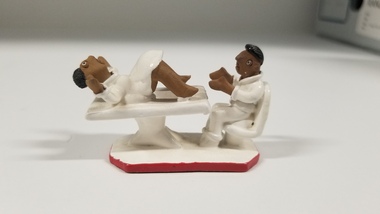
Sculpture - Ceramic vignette of a woman in childbirth
... Obstetric delivery...It was purchased by the donor at the Oxford Street Market in Paddington, Sydney. Obstetric delivery Small ceramic figurine of a woman giving birth, attended by a doctor. ...This piece may originally have been Indian in origin. It was purchased by the donor at the Oxford Street Market in Paddington, Sydney.Small ceramic figurine of a woman giving birth, attended by a doctor. Scene depicts a woman in a white gown lying on her back an obstetric table, with her knees up and feet flat on the table. A doctor dressed in white is sitting on a chair at the end of the table, between the patients legs, with arms raised ready to receive a baby. Both figures in the scene have brown skin and black hair. A word is engraved on the underside of the base of the figurine, which may be the name of the artist, but it is illegible.obstetric delivery -
 Royal Australian and New Zealand College of Obstetricians & Gynaecologists (RANZCOG)
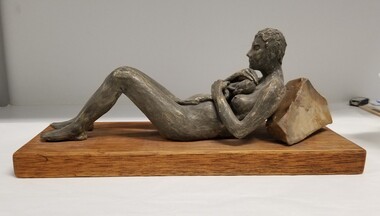
Decorative object - Statue of a mother reclining with a newborn bavy, Victoria Chancellor (nee Simcock)
... Obstetric delivery...This sculpture was a commissioned artwork made by Victora Chancellor (nee Simcock), a Sydney artist. Obstetric delivery Ceramic sculpture, depicting a reclining mother holder her newborn baby. ...This sculpture was a commissioned artwork made by Victora Chancellor (nee Simcock), a Sydney artist.Ceramic sculpture, depicting a reclining mother holder her newborn baby. The mother is lying on her back, with knees drawn up and feel flat on the ground, protectively cradling a newborn baby on her chest. The umbilical cord between baby and mother is still attached. The mothers upper back is resting against a rock, holding her partially upright. Sculpture is mounted on a rectangular wooden base.obstetric delivery -
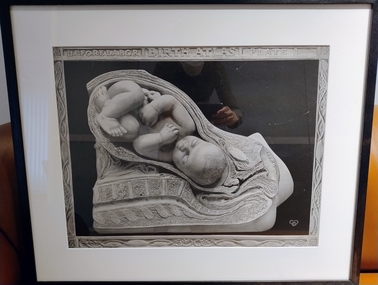 Royal Australian and New Zealand College of Obstetricians & Gynaecologists (RANZCOG)
Print - Reproduction print of plate from 'Birth atlas', Maternity Center Association, 1943, Robert Latou Dickinson et al, Plate 8. Before labour, 1943
... Obstetric delivery...This print was used on the antenatal clinic of St George's Hospital, Kew, Victoria. Obstetric delivery BEFORE LABOR | BIRTH ATLAS | PLATE 8 Black and white reproduction print of a plate from a book, enclosed in a wooden frame. ...A series of six prints showing various stages of labour, donated to the College in 1999. This print was used on the antenatal clinic of St George's Hospital, Kew, Victoria.Black and white reproduction print of a plate from a book, enclosed in a wooden frame. Text at the top of the print reads 'BEFORE LABOR | BIRTH ATLAS | PLATE 8'. The plate depicts a detailed cross section image of a baby in the womb. Label attached to back of work reads: 'Robert Latou DICKINSON and Abram BELSKI/ Plate 8. Before labour/From: Birth atlas: reproduction of twenty-four life size sculptures of fertilization, growth,/stages of labour and involution./New York: Maternity Center Association, 1943. 6th ed./Gift of St Georges Hospital, Kew, 2000'.BEFORE LABOR | BIRTH ATLAS | PLATE 8obstetric delivery -
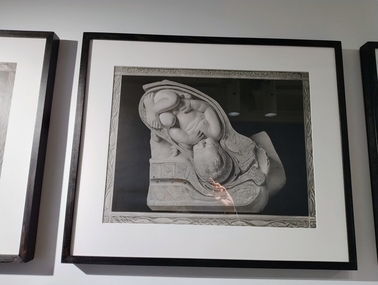 Royal Australian and New Zealand College of Obstetricians & Gynaecologists (RANZCOG)
Print - Reproduction print of plate from 'Birth atlas', Maternity Center Association, 1943, Robert Latou Dickinson et al, Plate 9. Labor cervix dilating & bag of waters, 1943
... Obstetric delivery...This print was used in the antenatal clinic of St George's Hospital, Kew, Victoria. Obstetric delivery LABOR CERVIX DILATING & BAG OF WATERS PLATE 9 Black and white reproduction print of a plate from a book, enclosed in a wooden frame. ...A series of six prints showing various stages of labour, donated to the College in 1999. This print was used in the antenatal clinic of St George's Hospital, Kew, Victoria.Black and white reproduction print of a plate from a book, enclosed in a wooden frame. Text at the top of the print reads 'LABOR CERVIX DILATING & BAG OF WATERS PLATE 9'. The plate depicts a detailed cross section image of a baby in the womb. Label attached to back of work reads: 'Robert Latou DICKINSON and Abram BELSKI/ Plate 9. Labor cervix dilating & bag of waters/From: Birth atlas: reproduction of twenty-four life size sculptures of fertilization, growth,/stages of labour and involution./New York: Maternity Center Association, 1943. 6th ed./Gift of St Georges Hospital, Kew, 2000'.LABOR CERVIX DILATING & BAG OF WATERS PLATE 9obstetric delivery -
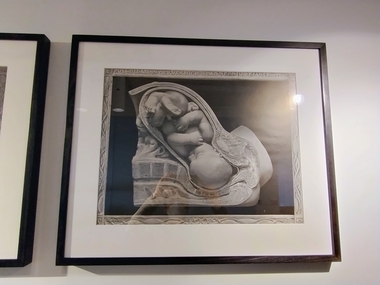 Royal Australian and New Zealand College of Obstetricians & Gynaecologists (RANZCOG)
Print - Reproduction print of plate from 'Birth atlas', Maternity Center Association, 1943, Robert Latou Dickinson et al, Plate 10. Full dilation cervix high head deep in pelvis, 1943
... Obstetric delivery...This print was used in the antenatal clinic of St George's Hospital, Kew, Victoria. Obstetric delivery FULL DILATION CERVIX HIGH HEAD DEEP IN PELVIS PLATE 10 Black and white reproduction print of a plate from a book, enclosed in a wooden frame. ...A series of six prints showing various stages of labour, donated to the College in 1999. This print was used in the antenatal clinic of St George's Hospital, Kew, Victoria.Black and white reproduction print of a plate from a book, enclosed in a wooden frame. Text at the top of the print reads 'FULL DILATION CERVIX HIGH HEAD DEEP IN PELVIS PLATE 10'. The plate depicts a detailed cross section image of a baby in the womb. Label attached to back of work reads: 'Robert Latou DICKINSON and Abram BELSKI/ Plate 10. Full dilation cervix high head deep in pelvis/From: Birth atlas: reproduction of twenty-four life size sculptures of fertilization, growth,/stages of labour and involution./New York: Maternity Center Association, 1943. 6th ed./Gift of St Georges Hospital, Kew, 2000'.FULL DILATION CERVIX HIGH HEAD DEEP IN PELVIS PLATE 10obstetric delivery -
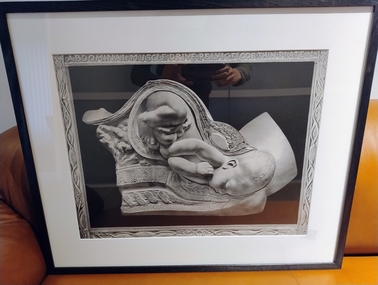 Royal Australian and New Zealand College of Obstetricians & Gynaecologists (RANZCOG)
Print - Reproduction print of plate from 'Birth atlas', Maternity Center Association, 1943, Robert Latou Dickinson et al, Plate 11. Abdominal muscle drive pelvic floor thin, 1943
... Obstetric delivery...This print was used in the antenatal clinic of St George's Hospital, Kew, Victoria. Obstetric delivery ABDOMINAL MUSCLE DRIVE PELVIC FLOOR THIN PLATE 11 Black and white reproduction print of a plate from a book, enclosed in a wooden frame. ...A series of six prints showing various stages of labour, donated to the College in 1999. This print was used in the antenatal clinic of St George's Hospital, Kew, Victoria.Black and white reproduction print of a plate from a book, enclosed in a wooden frame. Text at the top of the print reads 'ABDOMINAL MUSCLE DRIVE PELVIC FLOOR THIN PLATE 11'. The plate depicts a detailed cross section image of a baby in the womb. Label attached to back of work reads: 'Robert Latou DICKINSON and Abram BELSKI/ Plate 11. Abdominal muscle drive pelvic floor thin/From: Birth atlas: reproduction of twenty-four life size sculptures of fertilization, growth,/stages of labour and involution./New York: Maternity Center Association, 1943. 6th ed./Gift of St Georges Hospital, Kew, 2000'.ABDOMINAL MUSCLE DRIVE PELVIC FLOOR THIN PLATE 11obstetric delivery -
 Royal Australian and New Zealand College of Obstetricians & Gynaecologists (RANZCOG)
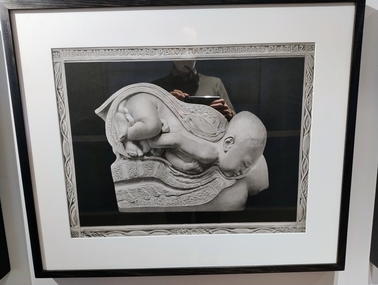
Print - Reproduction print of plate from 'Birth atlas', Maternity Center Association, 1943, Robert Latou Dickinson et al, Plate 12. Head turns upward pelvic floor retreats, 1943
... Obstetric delivery...This print was used in the antenatal clinic of St George's Hospital, Kew. Obstetric delivery HEAD TURNS UPWARD PELVIC FLOOR RETREATS PLATE 12 Black and white reproduction print of a plate from a book, enclosed in a wooden frame. ...A series of six prints showing various stages of labour, donated to the College in 1999. This print was used in the antenatal clinic of St George's Hospital, Kew.Black and white reproduction print of a plate from a book, enclosed in a wooden frame. Text at the top of the print reads 'HEAD TURNS UPWARD PELVIC FLOOR RETREATS PLATE 12'. The plate depicts a detailed cross section image of a baby in the womb. Label attached to back of work reads: 'Robert Latou DICKINSON and Abram BELSKI/ Plate 12. Head turns upward pelvic floor retreats/From: Birth atlas: reproduction of twenty-four life size sculptures of fertilization, growth,/stages of labour and involution./New York: Maternity Center Association, 1943. 6th ed./Gift of St Georges Hospital, Kew, 2000'.HEAD TURNS UPWARD PELVIC FLOOR RETREATS PLATE 12obstetric delivery -
 Royal Australian and New Zealand College of Obstetricians & Gynaecologists (RANZCOG)
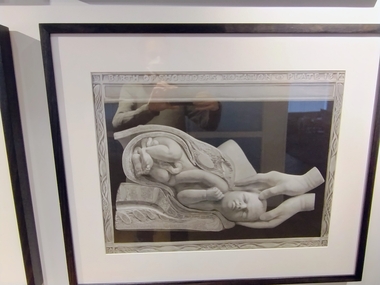
Print - Reproduction print of plate from 'Birth atlas', Maternity Center Association, 1943, Robert Latou Dickinson et al, Plate 13. Birth of shoulders rotation, 1943
... Obstetric delivery...Used in the antenatal clinic of St George's Hospital, Kew, Victoria. Obstetric delivery BIRTH OF SHOULDERS ROTATION PLATE 13 Black and white reproduction print of a plate from a book, enclosed in a wooden frame. ...A series of six prints showing various stages of labour, donated to the College in 1999. Used in the antenatal clinic of St George's Hospital, Kew, Victoria.Black and white reproduction print of a plate from a book, enclosed in a wooden frame. Text at the top of the print reads 'BIRTH OF SHOULDERS ROTATION PLATE 13'. The plate depicts a detailed cross section image of a baby in the womb. Label attached to back of work reads: 'Robert Latou DICKINSON and Abram BELSKI/ Plate 13. Birth of shoulders rotation/From: Birth atlas: reproduction of twenty-four life size sculptures of fertilization, growth,/stages of labour and involution./New York: Maternity Center Association, 1943. 6th ed./Gift of St Georges Hospital, Kew, 2000'.BIRTH OF SHOULDERS ROTATION PLATE 13obstetric delivery -
 Royal Australian and New Zealand College of Obstetricians & Gynaecologists (RANZCOG)
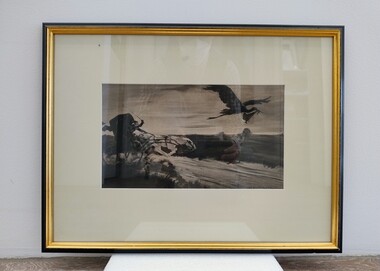
Print - Lithograph, William Balfour Ker (1877-1918), A Hurry Call, The Doctor v The Stork, 1905
... Obstetric delivery...With William Balfour Ker being an artist and declared socialist, this lithograph is significant due to its illustration of the race against time sometimes faced by doctors when trying to get to a patient to assist in birth before the baby is born. Obstetric delivery The artist's signature printed at bottom right corner of image reads 'WM.BALFOUR-KER'. ...William Balfour Ker was a Canadian-American artist. He was also a declared socialist, and his political stance was often reflected in his art. This lithograph is a compelling illustration of the race against time sometimes faced by doctors when trying to get to a patient to assist in birth before the baby is born.A black and white lithograph. At the top right, a stork is flying through the air, with a baby bundled in a cloth which it is holding in its beak. To the left, a horse drawn buggy follows rapidly behind, with the driver wielding a whip and urging on a speeding white horse. The artist's signature printed at bottom right corner of image reads 'WM.BALFOUR-KER'. The lithograph has been mounted and framed in wooden frame. The outer edge of the frame is black, and the inner edge is gold. On the back of the object, a small piece of paper bearing the title of the lithograph has been attached at bottom centre. It reads 'A HURRY CALL, THE DOCTOR v THE STORK'. A second tag attached to the back of the work reads 'From FF', suggesting the donor of this object was Frank Forster. An old display label is attached to the bottom left of the back of the work. A wire and two hooks have been attached to the back of the frame for hanging. The artist's signature printed at bottom right corner of image reads 'WM.BALFOUR-KER'. A second tag attached to the back of the work reads 'From FF', suggesting the donor of this object was Frank Forster. An old display label is attached to the bottom left of the back of the work. A wire and two hooks have been attached to the back of the frame for hanging.obstetric delivery -
 Royal Australian and New Zealand College of Obstetricians & Gynaecologists (RANZCOG)
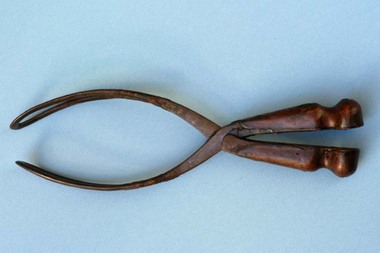
Smellie's obstetric forceps, c. 1750
... Obstetric delivery...Copies of this birth atlas are held in the Frank Forster Library, RANZCOG. Obstetric delivery William Smellie None Smellie's obstetric forceps. ...William Smellie’s straight forceps are one of the most significant pairs of forceps in the Museum collection. William Smellie (1697– 1763), designed these forceps, which were an improvement on the forceps of that time. These forceps were easier to use being shorter and lighter, particularly in the handles, with pelvic curve shaped blades. He invented a locking device for the two blades. The blades were lined with leather and greased with hog’s lard for the ease of delivery and the greater comfort of the patient, this being in the era prior to an understanding of sepsis and the need for surgical hygiene.Smellie was groundbreaking in his understanding of Childbirth and became an influential teacher of Obstetrics. He diligently studied the birthing process, particularly the descent of the baby’s head down the birth canal. His observations lead to him noting that many deaths occurred because of a lack of understanding of this process and the inappropriate handling of forceps. Smellie is generally given the credit for improving the forceps to make them easier to use and less likely to damage the baby. Smellie’s "Treatise on the Theory and Practice of Midwifery" was published In 1751 and became a widely influential teaching resource. Copies of this birth atlas are held in the Frank Forster Library, RANZCOG. Smellie's obstetric forceps. Iron forceps with traces of leather on the two blades. The blades touch at the tips when the blades are fully closed. The handles have a metal sheet coating and would also have been covered in leather originally. There is a notch at the centre to lock the blades in place. Noneobstetric delivery, william smellie -
 Royal Australian and New Zealand College of Obstetricians & Gynaecologists (RANZCOG)
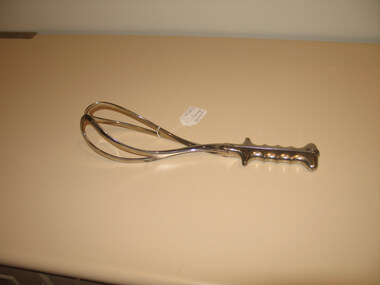
Elliot-type obstetrical forceps used by Colin Noel de Garis
... Obstetric delivery...(Source: Sakornbut, EL, 'Chapter 18 - Intrapartum Procedures', in Ratcliffe SD et al (eds.), 'Family Medicine Obstetrics', 3rd ed., 2008) Obstetric delivery Obstetric forceps, Elliot's. Consists of long shanks, made of forged chrome plated metal with metal handle, four finger grips, and distinctive screw and pin at the end of the handles. ...These forceps belonged to the late Colin Noel de Garis. Also donated was a foetal scalpel electrode applicator- see donation form. There is a note that former honorary curator Peter Renou collected the donation. Peter Renou does not recall being involved in the donation.( Source: Grainne Murphy 15 November 2010.) This design of obstetrical forceps, with a screw in the handle, was introduced by George Thomson Elliot (1827-1871), a New York obstetrician. (Source: National Museum of American History, 'Obstetrical forceps') The 'sliding pivot' on the forceps was designed to prevent the compression of the baby's head. (Source: Elliot, GT, 'Description of a new midwifery forceps : having a sliding pivot to prevent compression of the foetal head, with cases', c.1860)"The Elliot forceps and its modifications (Elliot, Tucker-McLane, Tucker-Luikart) have shorter blades and an accentuated cephalic curve that is more suitable for a rounded fetal head that has not undergone extensive molding. In addition, Elliot instruments, because of their overlapping shanks, do not distend the perineum in the same way as the separated shanks of the Simpson-type forceps." (Source: Sakornbut, EL, 'Chapter 18 - Intrapartum Procedures', in Ratcliffe SD et al (eds.), 'Family Medicine Obstetrics', 3rd ed., 2008) Obstetric forceps, Elliot's. Consists of long shanks, made of forged chrome plated metal with metal handle, four finger grips, and distinctive screw and pin at the end of the handles. This screw functioned as a means of regulating the lateral pressure of the handles when in use. obstetric delivery -
 Royal Australian and New Zealand College of Obstetricians & Gynaecologists (RANZCOG)
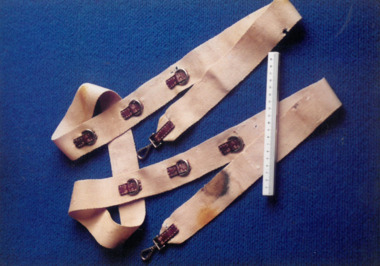
Obstetric stirrups used by Dr Mitchell Henry O'Sullivan
... Obstetric delivery...The bag and contents are a unique time capsule of the type of instruments and pharmaceuticals used in the inter-war period. Obstetric delivery Set of two stirrups. Stirrups consist of long strips of woollen fabric with leather straps at each end and six metal rings sewn into the woollen fabric with leather at intervals. ...Dr Mitchell Henry O'Sullivan worked in the Victorian country town of Casterton as a general practitioner from 1919 until his death in 1977. He also practiced obstetrics. His son, Dr David More O'Sullivan donated his obstetric bag and its contents to the College in 1999. The bag and contents are a unique time capsule of the type of instruments and pharmaceuticals used in the inter-war period. Set of two stirrups. Stirrups consist of long strips of woollen fabric with leather straps at each end and six metal rings sewn into the woollen fabric with leather at intervals.obstetric delivery -
 Royal Australian and New Zealand College of Obstetricians & Gynaecologists (RANZCOG)
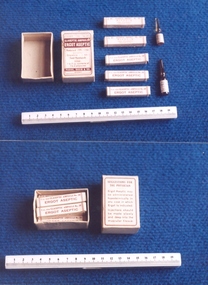
Box of ampoules used by Dr Mitchell Henry O'Sullivan, Parke, Davis and Co, c. 1952
... Obstetric delivery...The bag and contents are a unique time capsule of the type of instruments and pharmaceuticals used in the inter-war period. Obstetric delivery Box, with lid, labelled "CLASEPTIC AMPOULES/ERGOT ASEPTIC", Parke, Davis & Co, Sydney, manufactured February 1952. ...Ergot aseptic was used to stimulate uterine contractions after labour to expel the placenta. Pitocin was also used for this but could also be used during labour to quicken and stimulate the labour process. Dr Mitchell Henry O'Sullivan worked in the Victorian country town of Casterton as a general practitioner from 1919 until his death in 1977. He also practiced obstetrics. His son, Dr David More O'Sullivan donated the obstetric bag and its contents to the College in 1999. The bag and contents are a unique time capsule of the type of instruments and pharmaceuticals used in the inter-war period. Box, with lid, labelled "CLASEPTIC AMPOULES/ERGOT ASEPTIC", Parke, Davis & Co, Sydney, manufactured February 1952. Within the box are three smaller boxes containing glass ampoules of "Ergot Aseptic" and two boxes containing ampoules of Pitocin. obstetric delivery -
 Royal Australian and New Zealand College of Obstetricians & Gynaecologists (RANZCOG)
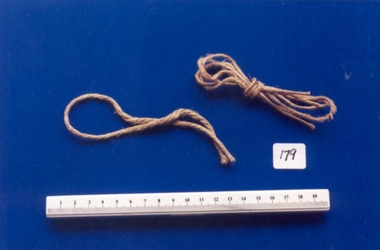
String used by Dr Mitchell Henry O'Sullivan
... Obstetric delivery...The bag and contents are a unique time capsule of the type of instruments and pharmaceuticals used in the inter-war period. Obstetric delivery Brown string, possibly made of hemp, in two separate lengths. ...This type of string, or twine, was frequently used by obstetricians to tie the umbilical cord after the delivery of a baby. Thicker string was favoured because there was less chance of cutting through the soft cord tissue surrounding the umbilical vein. Dr Mitchell Henry O'Sullivan worked in the Victorian country town of Casterton as a general practitioner from 1919 until his death in 1977. He also practiced obstetrics. His son, Dr David More O'Sullivan donated his obstetric bag and its contents to the College in 1999. The bag and contents are a unique time capsule of the type of instruments and pharmaceuticals used in the inter-war period.Brown string, possibly made of hemp, in two separate lengths. obstetric delivery -
 Royal Australian and New Zealand College of Obstetricians & Gynaecologists (RANZCOG)
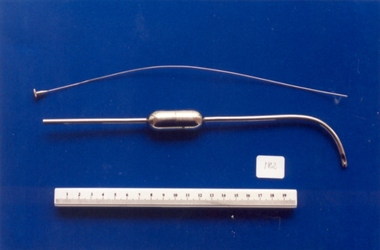
Carton's mucus evacuator, and introducer, used by Dr Mitchell Henry O'Sullivan
... Obstetric delivery...The bag and contents are a unique time capsule of the type of instruments and pharmaceuticals used in the inter-war period. Obstetric delivery Metal evacuator with wire introducer. ...Used for the removal of mucus, chiefly, from newborn infants. The top section of the chamber in the evacuator acted as a receptacle for wool to absorb any excess overflow of fluid/mucus. The lower section of the chamber collected the aspirated fluid. Dr Mitchell Henry O'Sullivan worked in the Victorian country town of Casterton as a general practitioner from 1919 until his death in 1977. He also practiced obstetrics. His son, Dr David More O'Sullivan donated his obstetric bag and its contents to the College in 1999. The bag and contents are a unique time capsule of the type of instruments and pharmaceuticals used in the inter-war period.Metal evacuator with wire introducer. Evacuator has a rounded middle chamber, which is divided into two sections. Proximal end of evacuator is curved to approximately 60 degrees and has two small holes in the end. Introducer is a straight piece of wire attached to a flanged head, with a small, serrated edge. obstetric delivery -
 Royal Australian and New Zealand College of Obstetricians & Gynaecologists (RANZCOG)
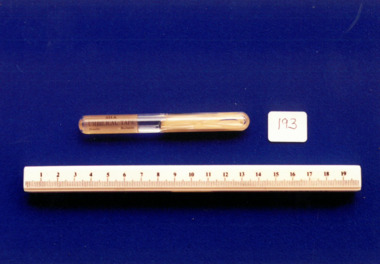
Silk umbilical tape in glass vial used by Dr Mitchell Henry O'Sullivan, Allen & Hanburys, England
... Obstetric delivery...The bag and contents are a unique time capsule of the type of instruments and pharmaceuticals used in the inter-war period. Obstetric delivery Glass vial, containing silk umbilical tape [193.2] in sterile solution. ...To use this tape, the tube would be broken in half using cat-gut breakers.Dr Mitchell Henry O'Sullivan worked in the Victorian country town of Casterton as a general practitioner from 1919 until his death in 1977. He also practiced obstetrics. His son, Dr David More O'Sullivan donated his obstetric bag and its contents to the College in 1999. The bag and contents are a unique time capsule of the type of instruments and pharmaceuticals used in the inter-war period.Glass vial, containing silk umbilical tape [193.2] in sterile solution. The tape is wound around a flat spool.obstetric delivery -
 Royal Australian and New Zealand College of Obstetricians & Gynaecologists (RANZCOG)
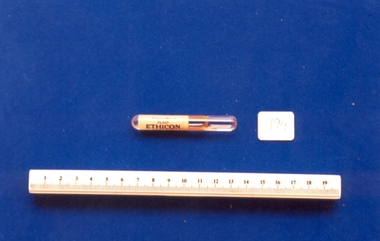
'Ethicon' catgut #1 in glass vial used by Dr Mitchell Henry O'Sullivan, Ethicon
... Obstetric delivery...His son, Dr David More O'Sullivan donated the obstetric bag and its contents to the College in 1999. Obstetric delivery Vial, glass [194.1] containing "Ethicon" catgut number one [194.2] in sterile solution. ...Dr Mitchell Henry O'Sullivan worked in the Victorian country town of Casterton as a general practitioner from 1919 until his death in 1977. He also practiced obstetrics. The gladstone bag and contents are a unique time capsule of the type of instruments and pharmaceuticals used in the inter-war period. His son, Dr David More O'Sullivan donated the obstetric bag and its contents to the College in 1999.Vial, glass [194.1] containing "Ethicon" catgut number one [194.2] in sterile solution. Clear glass vial, moulded and sealed at both ends.obstetric delivery -
 Royal Australian and New Zealand College of Obstetricians & Gynaecologists (RANZCOG)
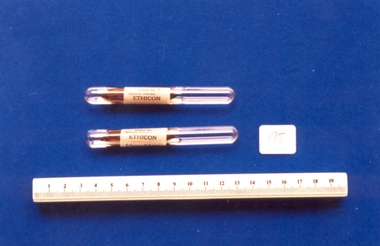
Two glass vials of 'Ethicon' catgut #3 used by Dr Mitchell Henry O'Sullivan, Ethicon
... Obstetric delivery...The bag and contents are a unique time capsule of the type of instruments and pharmaceuticals used in the inter-war period. Obstetric delivery Two glass vials [195.1,.3] with catgut number three "Ethicon" [195.2,.4] in sterile solution. ...Tanned or chronic catgut came from top quality catgut (fat free). A hardening process was then applied to the muscle durations. The process was introduced and perfected by the firm of Mersons of Edinburgh, makers of sterile surgical ligatures in the early 1930s. Once processed the catgut was preserved in an iod-asceptic preserving spirit and hermetically sealed in glass tubes. It was completely sterile and ready for immediate use. The length of the catgut in each tube was five feet, or 2.5m, and could be wound onto glass winders in assorted colours.Dr Mitchell Henry O'Sullivan worked in the Victorian country town of Casterton as a general practitioner from 1919 until his death in 1977. He also practiced obstetrics. His son, Dr David More O'Sullivan donated his obstetric bag and its contents to the College in 1999. The bag and contents are a unique time capsule of the type of instruments and pharmaceuticals used in the inter-war period.Two glass vials [195.1,.3] with catgut number three "Ethicon" [195.2,.4] in sterile solution. Vials are moulded and sealed at both ends.obstetric delivery -
 Royal Australian and New Zealand College of Obstetricians & Gynaecologists (RANZCOG)
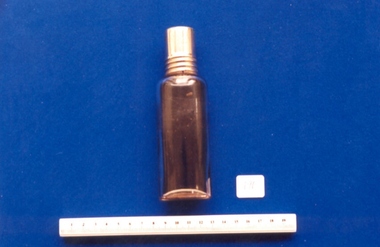
Bottle of iodine solution used by Dr Mitchell Henry O'Sullivan, W.L. M.F.C. Co
... Obstetric delivery...The bag and contents are a unique time capsule of the type of instruments and pharmaceuticals used in the inter-war period. Obstetric delivery Round glass bottle [196.1] containing iodine solution with glass stopper [196.2] and metal screw cap [196.3]. ...Dr Mitchell Henry O'Sullivan worked in the Victorian country town of Casterton as a general practitioner from 1919 until his death in 1977. He also practiced obstetrics. His son, Dr David More O'Sullivan donated his obstetric bag and its contents to the College in 1999. The bag and contents are a unique time capsule of the type of instruments and pharmaceuticals used in the inter-war period.Round glass bottle [196.1] containing iodine solution with glass stopper [196.2] and metal screw cap [196.3]. Bottle has a ridged neck and is approximately half filled with iodine solution. obstetric delivery -
 Royal Australian and New Zealand College of Obstetricians & Gynaecologists (RANZCOG)
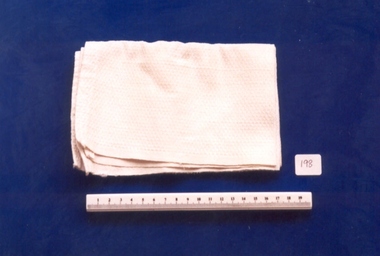
Towel used by Dr Mitchell Henry O'Sullivan
... Obstetric delivery...The bag and contents are a unique time capsule of the type of instruments and pharmaceuticals used in the inter-war period. Obstetric delivery Thick cotton/linen towel, with a 'bubble' or 'chain' design in the material. ...These types of towels were introduced into hospitals in the 1900s, where they were used mostly in operating theatres and on dressing trays. The towels became too costly to launder and were replaced by more modern disposable materials.Dr Mitchell Henry O'Sullivan worked in the Victorian country town of Casterton as a general practitioner from 1919 until his death in 1977. He also practiced obstetrics. His son, Dr David More O'Sullivan donated his obstetric bag and its contents to the College in 1999. The bag and contents are a unique time capsule of the type of instruments and pharmaceuticals used in the inter-war period.Thick cotton/linen towel, with a 'bubble' or 'chain' design in the material. The word "Hospital" is woven into the central band. There is a 1.25cm machined hem on unsealable sides.obstetric delivery -
 Royal Australian and New Zealand College of Obstetricians & Gynaecologists (RANZCOG)
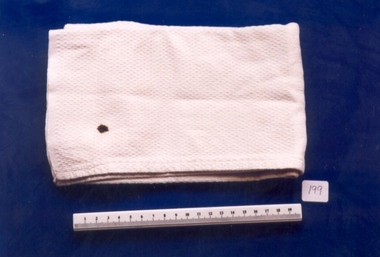
Towel used by Dr Mitchell Henry O'Sullivan
... Obstetric delivery...The bag and contents are a unique time capsule of the type of instruments and pharmaceuticals used in the inter-war period. Obstetric delivery Thick cotton/linen towel, with a 'bubble' or 'chain' design in the material. ...These types of towels were introduced into hospitals in the 1900s, where they were used mostly in operating theatres and on dressing trays. The towels became too costly to launder and were replaced by more modern disposable materials.Dr Mitchell Henry O'Sullivan worked in the Victorian country town of Casterton as a general practitioner from 1919 until his death in 1977. He also practiced obstetrics. His son, Dr David More O'Sullivan donated his obstetric bag and its contents to the College in 1999. The bag and contents are a unique time capsule of the type of instruments and pharmaceuticals used in the inter-war period.Thick cotton/linen towel, with a 'bubble' or 'chain' design in the material. The word "Hospital" is woven twice into the central band. There is a 1cm machined hem on unsealable sides.obstetric delivery -
 Royal Australian and New Zealand College of Obstetricians & Gynaecologists (RANZCOG)
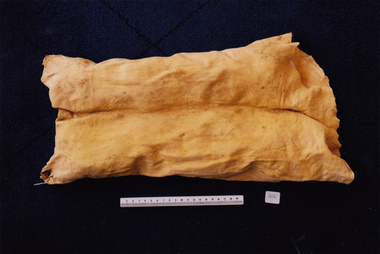
Chamois bag used by Dr Mitchell Henry O'Sullivan
... Obstetric delivery...The bag and contents are a unique time capsule of the type of instruments and pharmaceuticals used in the inter-war period. Obstetric delivery Chamois bag originally used for obstetric forceps. ...Dr Mitchell Henry O'Sullivan worked in the Victorian country town of Casterton as a general practitioner from 1919 until his death in 1977. He also practiced obstetrics. His son, Dr David More O'Sullivan donated his obstetric bag and its contents to the College in 1999. The bag and contents are a unique time capsule of the type of instruments and pharmaceuticals used in the inter-war period.Chamois bag originally used for obstetric forceps. The bag is sewn down the centre to form two compartments.obstetric delivery -
 Royal Australian and New Zealand College of Obstetricians & Gynaecologists (RANZCOG)
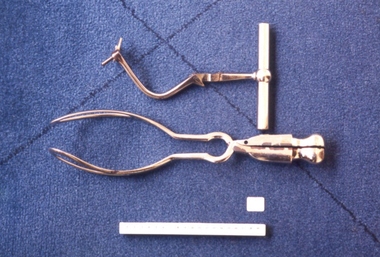
Tool - Barnes-Neville axis traction obstetrical forceps used by Dr Mitchell Henry O'Sullivan, Allen & Hanburys, England
... Obstetric delivery...Neville Barnes Obstetric Forceps have a cephalic and pelvic curve and are used for delivery of babies presenting as occipitoanterior. ...The bag and contents are a unique time capsule of the type of instruments and pharmaceuticals used in the inter-war period. Obstetric delivery 'Allen & Hanburys - London', '3' Set of metal forceps. ...Neville Barnes Obstetric Forceps have a cephalic and pelvic curve and are used for delivery of babies presenting as occipitoanterior. When used, the left blade is put on first followed by the right blade – the baby is then pulled down until the occiput is under the symphysis, then pulled around. (RACGP)Dr Mitchell Henry O'Sullivan worked in the Victorian country town of Casterton as a general practitioner from 1919 until his death in 1977. He also practiced obstetrics. His son, Dr David More O'Sullivan donated his obstetric bag and its contents to the College in 1999. The bag and contents are a unique time capsule of the type of instruments and pharmaceuticals used in the inter-war period.Set of metal forceps. Consists of two blades [204.1,.2] and detachable traction axis [204.3]. Inner aspect of right hand blade is inscribed ' Allen and Hanbury's - London'. '3' inscribed on axis traction handle.'Allen & Hanburys - London', '3'obstetric delivery -
 Royal Australian and New Zealand College of Obstetricians & Gynaecologists (RANZCOG)
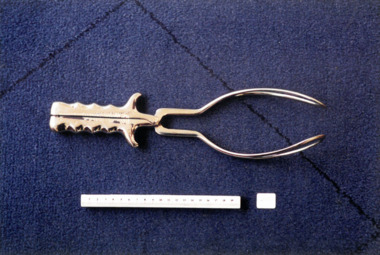
Simpson-type obstetrical forceps used by Dr Mitchell Henry O'Sullivan, Skidmore, 1851- 1898, approximate date of manufacture
... Obstetric delivery...The bag and contents are a unique time capsule of the type of instruments and pharmaceuticals used in the inter-war period. Obstetric delivery Metal forceps, consisting of two blades with detachable traction axis. ...These are long obstetrical forceps following the design of Sir James Young Simpson (1811-1870). They are longer and heavier than Simpson's type of short forceps and were used to deliver babies from higher up the birth canal. Simpson's long and short forceps were adapted in many later designs. (Science Museum Group)Dr Mitchell Henry O'Sullivan worked in the Victorian country town of Casterton as a general practitioner from 1919 until his death in 1977. He also practiced obstetrics. His son, Dr David More O'Sullivan donated his obstetric bag and its contents to the College in 1999. The bag and contents are a unique time capsule of the type of instruments and pharmaceuticals used in the inter-war period.Metal forceps, consisting of two blades with detachable traction axis.obstetric delivery -
 Royal Australian and New Zealand College of Obstetricians & Gynaecologists (RANZCOG)
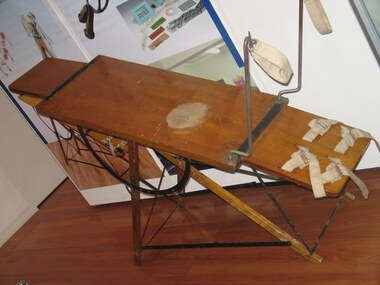
Portable operating table used by Sir Victor Bonney, Allen & Hanburys, England, c. 1900
... Obstetric delivery...To theatre-sisters, labour-ward sisters and young house-surgeons he will always be remembered as the discoverer of Bonney's Blue an antiseptic that was characteristically blue. Obstetric delivery Portable, laminated operating table. ...This operating table belonged to the famous gynaecological surgeon Dr Victor Bonney and was given to Dr Frank Forster in 1953 by his widow Mrs Annie Bonnie, a distant relative of Forster's. Dr Victor Bonney (1872 - 1953) followed his father into medicine and trained at St Bartholomew's and the Middlesex Hospitals. Writing his obituary in 1953, FW Roques said of Bonney that he "'made three great gifts to surgery. First, he was the pioneer of myomectomy; second, with Berkeley, he extended and perfected Wertheim's operation for carcinoma of the cervix; and third, he devised a fine surgical technique emulated by so many of his pupils. To theatre sisters, labour-ward sisters and young house-surgeons he will always be remembered as the discoverer of 'Bonney's Blue' [antiseptic solution].'" Bonney's utilitarian, portable operating table has a round, worn scrubbed patch showing traces of his famous blue solution.This portable operating table was owned and used by pioneering gynaecological surgeon Sir Victor Bonney in London, U.K. c 1900. Dr Bonney employed two theatre sisters and had two sets of instruments and portable operating tables. This made it possible for Dr Bonney to 'complete three or more operations a day by rotating staff and equipment with a chauffeur driven Lanchester or Rolls Royce', delivering them from one house to the next. The donor of the operating table, the late Dr Frank Forster, was a distant relative of Sir Victor Bonney's widow, Annie Appleyard, formerly of Tasmania. When he visited her in the UK after Bonney's death, she offered the operating table to Dr Forster for the RANZCOG Museum. It was still in a canvas bag in the boot of one of Bonney's cars. Sir Victor Bonney was the pioneer of myomectomy, the surgical procedure for removing uterine fibroids. In collaboration with Berkeley, he extended and perfected Wertheim's operation for carcinoma of the cervix. Bonney was an influential teacher, developing and promoting conservatism of surgical technique (minimal intervention) that has had a lasting influence in modern surgical practice. To theatre-sisters, labour-ward sisters and young house-surgeons he will always be remembered as the discoverer of Bonney's Blue an antiseptic that was characteristically blue.Portable, laminated operating table. Plywood rectangular table with two laminated plywood extensions, a head board, and a foot board. At the foot board are insets of canvas straps to support a patient's ankles. Two detachable stirrup poles, each with a canvas strap attached, fit into two holes at the lower end of the table. The table is supported by two timber trellis cross braces with metal bars, and supported at the centre by a metal rod that allows the table to pivot up and down. Two metal arcs with a locking mechanism fix the table at the desired elevation, allowing a Trendelenburg tilt ( a 45 degree tilt, with the patient's head downwards.) The operating table is demountable for transportation and re-assembly.obstetric delivery -
 Royal Australian and New Zealand College of Obstetricians & Gynaecologists (RANZCOG)
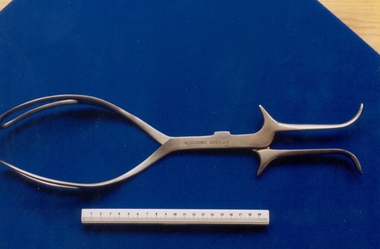
Keilland-type obstetrical forceps used by Dr Beresford Buttery
... Obstetric delivery...(Science Museum Group) Obstetric delivery Forceps, Keilland, obstetric, surgical steel. ...These forceps were owned and used by obstetrician Dr Beresford Buttery.This style of obstetric forceps represent the only major innovation in forceps design during the 1900s. They were introduced by C. Kielland of Oslo in 1915. The forceps have virtually no pelvic curve. They possess a sliding lock. These innovations allow the head of an incorrectly positioned foetus to be rotated before traction is applied. They were made by instrument maker Downs Surgical in 1979. (Science Museum Group)Forceps, Keilland, obstetric, surgical steel. Owned and used by Beresford Buttery and engraved "Beresford Buttery" on the outer arm.obstetric delivery -
 Royal Australian and New Zealand College of Obstetricians & Gynaecologists (RANZCOG)
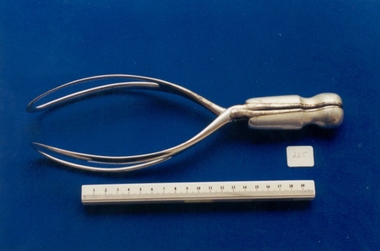
Denman-type short handled obstetric forceps used by Dr Ronald Rome and Dr Kelvin Churches, Lindsay
... Obstetric delivery...(Note from Helen Johnson, 2000). Obstetric delivery "R & C" "Lindsay of London" Set of short handled forceps. ...These forceps were owned and used by Dr Ronald Rome and Dr Kelvin Churches. Notes suggest that these may be a modified set of Denman-type forceps, as appearance of the outer part of the handles indicate they are an 'adaption' for independent use. (Note from Helen Johnson, 2000).Set of short handled forceps. Both blades of forceps are stamped "Lindsay of London" (for manufacturer) and "R & C" (for Dr Ronald Rome and Dr Kelvin Churches). "R & C" "Lindsay of London"obstetric delivery -
 Royal Australian and New Zealand College of Obstetricians & Gynaecologists (RANZCOG)
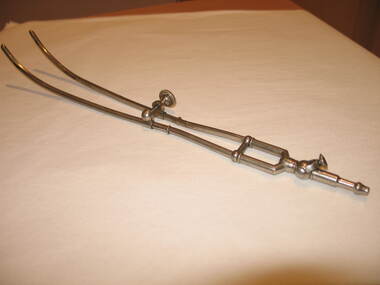
Uterine flushing tube associated with Professor Bruce Mayes
... Obstetric delivery...Warren Jones took it with him to Adelaide where he practiced from 1975. Obstetric delivery Uterine flushing tube. Consists of dilating, double arms with screw mechanism to widen arms. ...Item originally belonged to Professor Bruce Mayes, University of Sydney c1950-65. According to Professor Warren Jones the item had been in a back room of the medical facility and Professor Mayes gave it to Warren Jones, otherwise it may have been thrown out. Warren Jones took it with him to Adelaide where he practiced from 1975.Uterine flushing tube. Consists of dilating, double arms with screw mechanism to widen arms. Stopcock at base, stamped "25" on stem near stopcock.obstetric delivery
