
Showing 191 items matching "officers discharge'"
-
 Bendigo Military Museum
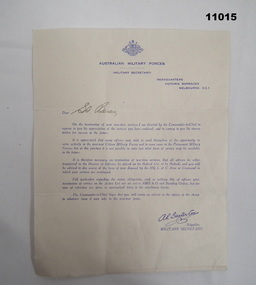
Administrative record - LETTER, Aust Army (AMF), c.1945-1947
... ...Officers discharge'...Beves, refer Cat No 11013.4 for his service details. WW2 Officers discharge' Lt. Beves Addressed to “Beves” in black ink, signed by “AR Baxter Cox” Brigadier. ...The main points of the letter relate to the status of an Officer post war and the positions he may consider being in. Collection re Ivor B.H. Beves, refer Cat No 11013.4 for his service details.Quarto sheet of paper. Commonwealth of Australia crest at top. Australian Military Forces heading, print in blue, signatures in black pen. Addressed to Lt. Beves. Addressed to “Beves” in black ink, signed by “AR Baxter Cox” Brigadier. This is a pro-forma "Lt. Beves" is written in ink.ww2, officers discharge', lt. beves -
 Bendigo Military Museum
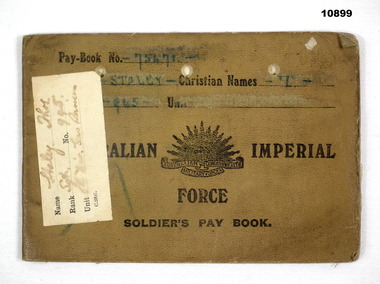
Administrative record - PAYBOOK, WW1
... Stamped in purple, "Boarded, Chief Pay Officer, Discharged"....Stamped in purple, "Boarded, Chief Pay Officer, Discharged". Pay book brown covers with a white sticker on with faded text, 24 pages, entries are in blue & black pen with details of pay and allotments, pay increase's with rank, there are purple stamped marks. ...Pay book re Thomas Staley, refer Cat No 10759.2P for his service details. Staley collection, refer Cat No 10758.2P for more details.Pay book brown covers with a white sticker on with faded text, 24 pages, entries are in blue & black pen with details of pay and allotments, pay increase's with rank, there are purple stamped marks.On the front, "Pay Book No 75471 - Staley". On the white label, "Staley Thos - Sgt - 945 5th Div Gas Services". Stamped in purple, "Boarded, Chief Pay Officer, Discharged".tmstaleycollection, pay -
 Bendigo Military Museum
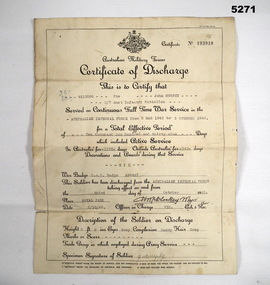
Administrative record - CERTIFICATE OF DISCHARGE, Australian Military Forces, 3 October 1945
... Coat of Arms at top with form giving details of Name, No, Unit, Length o Service, Enlistment Date, Discharge Date, Description of Soldier, Location of Discharge & Signature of both Discharging Officer and Soldier Discharged....Coat of Arms at top with form giving details of Name, No, Unit, Length o Service, Enlistment Date, Discharge Date, Description of Soldier, Location of Discharge & Signature of both Discharging Officer and Soldier Discharged. Administrative record CERTIFICATE OF DISCHARGE Australian Military Forces ...John Murphy VX15580 in 2/7 Australian Infantry Battalion, 5th March 1940 and was discharged on 3rd October 1945 at Royal Park. Refer Cat 512.2 for Service Details.Certificate of Discharge No. 193910, Parchment Paper, light yellow colour with black print. Coat of Arms at top with form giving details of Name, No, Unit, Length o Service, Enlistment Date, Discharge Date, Description of Soldier, Location of Discharge & Signature of both Discharging Officer and Soldier Discharged.Some unrelated numbers written on back and front in pencil.discharge certificate, ww2 -
 Bendigo Military Museum
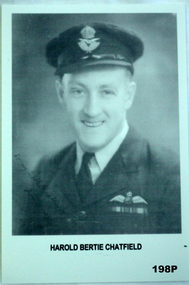
Photograph - RAAF PHOTOGRAPH
... Promoted T/Sgt - Airman Pilot 28.2.42, embark for England for more training 9.4.42, 16.6.43 posted on strength of the RAF, promoted Flt Sgt 19.7.43, posted in Burma with 615 Sqd RAF flying Spitfires 16.10.43, hospital 2.1.44 for 3 months, promoted to Flying Officer 30.12.44, discharged from the Airforce at RAF Station Poona 14.12.45. ...Promoted T/Sgt - Airman Pilot 28.2.42, embark for England for more training 9.4.42, 16.6.43 posted on strength of the RAF, promoted Flt Sgt 19.7.43, posted in Burma with 615 Sqd RAF flying Spitfires 16.10.43, hospital 2.1.44 for 3 months, promoted to Flying Officer 30.12.44, discharged from the Airforce at RAF Station Poona 14.12.45. ...Harold Bertie Chatfield No 401493 (born Bendigo, enlisted Melbourne) in the RAAF on 28.2.1941 age 20 years. Embarked for for Southern Rhodesia for training with No 26 Flying Elementary Training School. Promoted T/Sgt - Airman Pilot 28.2.42, embark for England for more training 9.4.42, 16.6.43 posted on strength of the RAF, promoted Flt Sgt 19.7.43, posted in Burma with 615 Sqd RAF flying Spitfires 16.10.43, hospital 2.1.44 for 3 months, promoted to Flying Officer 30.12.44, discharged from the Airforce at RAF Station Poona 14.12.45. In 2016/17 a recommendation was put forward for Chatfield to be awarded the DFM (Distinguished Flying Medal) relating to 2 actions in Burma. This was downgraded to a Commendation for Gallantry. Refer 196.2, 197, 2331.Copy of B & W photo of Harold Bertie Chatfield, RAAF, in uniform, wings & ribbons. Photo is in plastic stand."To my little Heather". The rest is unreadable.photography - photographs, raaf -
 Bendigo Military Museum
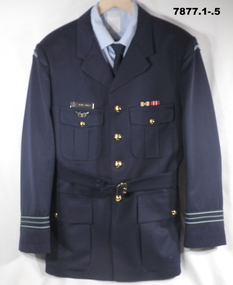
Uniform - SERVICE DRESS, RAAF, 2003
... Posted Executive Officer RAAF Williamtown. 2018 Discharged from RAAF....Posted Executive Officer RAAF Williamtown. 2018 Discharged from RAAF. Uniforms RAAF Service Dress Shane Wright Manufacturers information - black ink print. 1. ...Items in the collection of SQD LEADER "SHANE WRIGHT". Enlisted RAAF 1982 Regiment number 0323963/ 8194842. Became radio technician on Electrical systems on Orion and F111. 1990 became Electrical Systems Specialist promoted to Sgt. 1996 Commissioned as an Officer. Postings: HQ Logistic Command. Aerospace Equipment Systems. OTS as Specialist Military Training Flight Command. 2005 Promoted Sqn Leader. Posted Executive Officer RAAF Williamtown. 2018 Discharged from RAAF.1. 2. 3. Service dress style, dark blue colour wool/polyester fabric. 1. Jacket - collar, four front patch pockets with button down flap. Buttons - gold colour plastic with shank and raised emblem - crown and wings - RAAF. On right pocket, metal RAAF Badge, above metal name badge. Above left pocket - service ribbons. Blue and yellow ribbon - long service with three rosettes, black, red, white ribbon - Defence medal. Sleeves - three rank stripes, black and blue ribbon. Lining - dark blue polyester fabric with concealed pocket. White colour cotton/polyester fabric. Manufacturers label inside left side. 2. Belt - fabric with gold colour plastic buckle with dark blue plastic buttons and strap belt keepers. 3. Trousers - waist band with belt loops, fob pocket, two side pocket and one inset back pocket. Nylon and metal zipper fly and metal closer. Lining - dark blue polyester fabric to waistband and pockets. White colour cotton/polyester fabric. Manufacturers label on back pocket lining.. 4. Shirt - light blue cotton/polyester fabric. Long sleeves, collar, shoulder epaulettes with fabric rank slides - 3 stripes, black and blue ribbon - Sqdn Leader. Top left sleeve - dark blue and white oval shoulder patch, embroidered - wings and "AIR FORCE". Clear plastic buttons. Manufacturers label - illegible. 5. Tie - dark blue colour necktie. polyester/wool. 6. Cap - peaked, Service dress Officer, dark blue colour fabric with black cloth band around exterior of cap. Black colour patent leather chinstrap secured by two gold RAAF buttons around the front half of the brim. RAAF badge on front, Queens Crown with red insert over gold coloured wings over laurel leaves. Interior - black sateen fabric with clear plastic lining. Brown leather look sweatband, White cotton manufacturers label.Manufacturers information - black ink print. 1. "A73/ADA/VICTORIA 2003/ NSN:/ NAME: / SERVICE NO:/ 70% WOOL, 30% POLYESTER/ LAUNDRY INSTRUCTIONS/ DRY CLEAN ONLY/ PRESS ON ORIGINAL CREASES/ USE DAMP CLOTH OR MEDIUM/ TO HOT STEAM IRON/ MADE IN AUSTRALIA" 3. "A72/ADA/ VICTORIA 2003/ NSN:/ NAME: SERVICE NO:/ 70% WOOL 30% POLYESTER/ DRY CLEAN ONLY/ MADE IN AUSTRALIA" 1. 3. Handwritten blue/black ink "S. WRIGHT/ 40594" 5. Black label white embroidered print "NOONE/ IMAGE WEAR/ MADE IN / AUSTRALIA/ 2002" 6. "MOUNT CASTLE PTY LTD/ BRISBANE 1999/ SIZE 59^". Handwritten black ink "S. WRIGHT"uniforms, raaf, service dress, shane wright -
 Flagstaff Hill Maritime Museum and Village
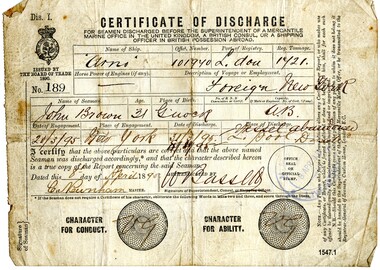
Certificate - Certificates of Discharge, Commonwealth Governments Shipping Offices, 1895 - 1919
... Brown as they list his place and date of birth, his voyages (places of engagement and discharge and the dates of the voyages), the ships he served on (with their tonnage, horsepower, official number and place of registry) plus his ranking, conduct and ability. All certificates are signed by the Master and authenticated by the Shipping Officer..."CERTIFICATE OF DISCHARGE" "FOR SEAMEN DISCHARGED BEFORE THE SUPERINTENDENT OF A MERCANTILE / MARINE OFFICE IN THE UNITED KINGDOM, A BRITISH CONSUL, OR A SHIPPING/OFFICER IN BRITISH POSSESSION ABROAD" Headings filled out include - "Name of Ship", "Official number", "Reg. ...Peregrine "CERTIFICATE OF DISCHARGE" "FOR SEAMEN DISCHARGED BEFORE THE SUPERINTENDENT OF A MERCANTILE / MARINE OFFICE IN THE UNITED KINGDOM, A BRITISH CONSUL, OR A SHIPPING/OFFICER IN BRITISH POSSESSION ABROAD" Headings filled out include - "Name of Ship", "Official number", "Reg. ...The following information is taken from the PROV (Public Records Office of Victoria) website - "In Victoria regulation of the engagement and discharge of seamen was initially subject to New South Wales legislation. An Act to amend and consolidate the Laws relating to Seamen in the Merchant Service of the Colony of New South Wales, and for keeping a Register of Seamen belonging to Ships registered in the said Colony (13 Vic., No.28) of 1849 introduced requirements for ships masters to enter into written agreements with seamen engaged by them as crew, specifying wages and provisions, the capacity in which they would serve and the nature of the voyage. It also required masters to issue to seamen certificates of discharge upon their discharge or upon payment of their wages. The 1849 Act applied only to ships registered in the Colony. In 1854 the Imperial Merchant Shipping Act was passed, which had application to all British ships except those registered in the Colony. Consolidation of the separate laws occured with the passing of the Seamen Statute 1865 (28 Vic.,No.245) which adopted Part III of the Merchant Shipping Act 1854 (17 & 18 Vic, C 104) (see Parliamentary Debates, Session 1, 22 February 1865). The Imperial Act, like the New South Wales Act before it, required the master or owner of every British ship, over a certain tonnage, to enter a written agreement for the engagement and discharge of seamen. The Articles of Agreement (VPRS 566) were to be made at the start of a particular voyage, although running agreements were able to be made for a defined period in which short and frequent voyages would be made. At the end of the voyage the discharge and release of the crew was recorded. The date, place and reason for leaving the ship, and the balance of wages paid upon discharge, were recorded in the articles of agreement. Under the Merchant Shipping Act 1854 each seaman discharged was also to be issued with a certificate of discharge (this series) giving particulars of the ship, period of service and the seamans capacity, ability and conduct. No seaman could be engaged to work on a ship unless he delivered to the person engaging him a discharge from his last ship or a permit to sign articles. In the articles of agreement and in the Release Books (VPRS 945) the crew were required to sign their release of the ship, master or owner from any claims to wages or otherwise in respect of the voyage. In the release books the master also signed a release of the crew from all claims. It appears that in Victoria licensed shipping agents were initially able to facilitate the engagement and discharge of seamen. From 1 April 1859, however, the function was to be performed entirely in the Government Shipping Office (Government Gazette, 29 March 1859). In 1869, the names of Shipping Offices were changed to Mercantile Marine Offices and Shipping Masters to Superintendents of Mercantile Marine Offices. The role of the Shipping Office/Mercantile Marine Office was to facilitate and oversee the engagement and discharge of seamen and apprentices to the sea service. The facilities provided were subject to fees payable by ships masters. The Offices were located within the Department of Trade and Customs (VA 606) until 1901 and then within the Chief Secretarys Department (VA 475) to 1922. Responsibility for attesting master and seamen engagements and discharges transferred to the Commonwealth under Parts II and III of the Commonwealth Navigation Act 1912, which became effective on 1 March 1922 when the Navigation (Master and Seamen) Regulations were passed. Seamens Discharge Certificates 1882 to 1922 This series comprises counterfoils (or stubs) of Certificates of Discharge issued to seamen upon their discharge or upon payment of their wages between 1882 and 1922. The Certificates were signed by the Master of the ship and authorised by the Mercantile Marine Office. The counterfoils record details about the ships, the birthplaces and ages of the seamen, the dates of engagement and discharge, and the capacity, conduct and ability of the seamen." This particular set of Certificates of Discharge belonged to a seaman called John F. Brown. Little is known about him but information taken from the cerificates tell us that John F. Brown was born in Greenock, Scotland in about 1868 and that his rank was "Able Bodied Seaman". All of his cerificates describe his conduct and ability as "V. G. (Very Good). During the period from April 1895 to August 1908, he worked on about twenty two different ships - sailing on several Liverpool to New York voyages in 1895 and 1896. In September 1896 he began working on Australian coastal steamers - travelling up and down the coast of Australia (between the ports of Melbourne, Sydney, Newcastle, Adelaide and Brisbane) until August 1908. There is an eleven year gap in his records and his final certificate was issued in September 1919. Some of the ships he worked on include the "Arno", "Melbourne", "Burrumbeet", "Kalgoorlie", "New Guinea", "Buninyong", "Pilbarra", "Oakworth", "Cintra", "Lady Musgrave", "Dawn", "Moorabool", "Colac", "Ramazon", 'Brisbane", "City of Lincoln", "Peregrine" "Mareeba" and "Wear".Theses certificates are significant examples of the legal paperwork generated by the British and Australian governments in the day to day regulation of working seamen in the late 19th and early 20th centuries. They are also significant as they document the career of a working seaman at that time.This is a set of twenty three "Certificates of Discharge" issued to seaman John F. Brown primarily between the years 1895 and 1908 (although the last one is dated 1919). They have been issued by the Shipping Masters at U.K. Mercantile Marine Office (abroad), the Port of Melbourne Victoria, the Port of Sydney N.S.W., the Port of Newcastle N.S.W. and the Port of Brisbane. They are all of a similar size and layout with slight differences in their crests (depending on the port of issue) and the fonts used over the preceding years. They give a good overview into the career of John F. Brown as they list his place and date of birth, his voyages (places of engagement and discharge and the dates of the voyages), the ships he served on (with their tonnage, horsepower, official number and place of registry) plus his ranking, conduct and ability. All certificates are signed by the Master and authenticated by the Shipping Officer. Eight of the certificates have a purple circular stamp on the back with "S. F. 19 SEPT 1908 GLASGOW""CERTIFICATE OF DISCHARGE" "FOR SEAMEN DISCHARGED BEFORE THE SUPERINTENDENT OF A MERCANTILE / MARINE OFFICE IN THE UNITED KINGDOM, A BRITISH CONSUL, OR A SHIPPING/OFFICER IN BRITISH POSSESSION ABROAD" Headings filled out include - "Name of Ship", "Official number", "Reg. Tonnage", "Horse power of Engine (if any)", "Description of Voyage or Employment", "Name of Seaman", "Age", "Place of Birth", "No. of R.N.R. Commission or Certificate", "Capacity. If mate or Engineer. No of certificate (if any)", "Date of Engagement", "Place of Engagement", Date of Discharge", "Place of Discharge", "I certify that the above particulars are correct and that the abovenamed Seaman was discharged accordingly* and that the character described herein is a true copy of the report concerning the said seaman." "Dated this .... day of ... " , "Authenticated by ...." "Character for Conduct" , "Character for Ability".flagstaff hill, warrnambool, shipwrecked-coast, flagstaff-hill, flagstaff-hill-maritime-museum, maritime-museum, shipwreck-coast, flagstaff-hill-maritime-village, certificate of discharge for j.f.brown, certificate of discharge, certificate, discharge, discharge for j.f.brown, john f. brown, arno, s.s. melbourne, s.s. burrumbeet, s.s. kalgooli, s.s. new guinea, s.s. buninyong, s.s. pilbarra, s.s. oakworth, s.s. lady musgrave, s.s. dawn, s.s. moorabool, s.s. colac, s.s. city of lincoln, s.s. mareeba, s.s. wear, s.s. ramazon, s.s. peregrine -
 Mission to Seafarers Victoria
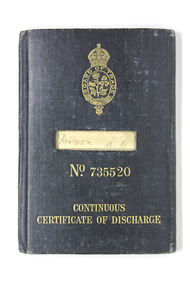
Booklet - Continuous Certificate of Discharge, Continuous Certificate of Discharge: Arthur Oswald Dixon, 1913
... officer of good character and reliable. On leaving seafaring Mr Dixon eventually took up a smallholding in regional Victoria. Unusually for the early 20th C. era of Mr Dixon's service at sea two images of Mr Dixon survive on ID papers and were included in the gift of papers. Personal objects included an unusual small travel size New Testament (see VC record ) heavily annotated provide further insights into the experience of early 20th C. seafarers. licensing registration certificate of discharge mariner papers seafarer certification identity cards identification arthur oswald dixon seamanship seamen sailors officers seafarers wwi merchant navy ran rnr Various - see images Fabric reinforced and backed heavy card covers and service book with multiple pages pre printed for completion by either handwritten entries or ink stamps. ...This important booklet and record of service is first stamped and dated in 1913. It is unlikely to be the first booklet issued as the seafarer Arthur O. Dixon b. 1879 commenced maritime service in 1904 working for the Harrison Line between 1904 and 1914. He enlisted as an RNR officer during WW1. He is recorded as returning to Merchant vessel service with the New Zealand Shipping Co between 1916-1920. He subsequently was employed with Adelaide Steamship Co between 1920 and 1921. All documentation shows him to be regarded as an officer of good character and reliable. On leaving seafaring Mr Dixon eventually took up a smallholding in regional Victoria.Unusually for the early 20th C. era of Mr Dixon's service at sea two images of Mr Dixon survive on ID papers and were included in the gift of papers. Personal objects included an unusual small travel size New Testament (see VC record ) heavily annotated provide further insights into the experience of early 20th C. seafarers.Fabric reinforced and backed heavy card covers and service book with multiple pages pre printed for completion by either handwritten entries or ink stamps. Records service record, dates, status, vessel names, ports, master names, character assessment. A thin pink ribbon is affixed by a staple to Page 26.Various - see images licensing, registration, certificate of discharge, mariner papers, seafarer certification, identity cards, identification, arthur oswald dixon, seamanship, seamen, sailors, officers, seafarers, wwi, merchant navy, ran, rnr -
 Mission to Seafarers Victoria
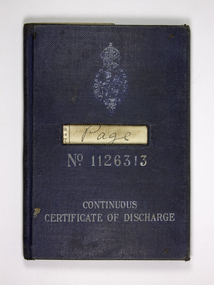
Certificate, Certificate of Discharge
... officers to record details regarding voyages, ships, rating and behaviour of mate. Many yellowed pages with top right corner of each page neatly removed by hand. Fold over flap on hard cover to prevent damage of inside pages. Certificate of Discharge ...Extremely accurate record of Charles Page's merchant navy career, travels and work performance.Legal document - Sturdy small hardcover booklet/log, containing a number of pages with blank spaces for ship's officers to record details regarding voyages, ships, rating and behaviour of mate. Many yellowed pages with top right corner of each page neatly removed by hand. Fold over flap on hard cover to prevent damage of inside pages. charles page, seaman -
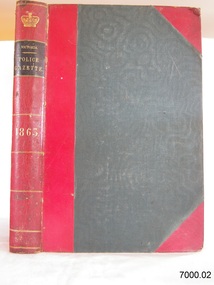 Flagstaff Hill Maritime Museum and Village
Administrative record - Reference Sociology/History, John Ferres, Government Printer, Victoria Police Gazettes for 1863, 1863
... officers, court and justice officials, and government departments about matters relevant to policing across the colony. It commenced in December 1853 and was initially published weekly by the Victoria Police. It was distributed each week to city and rural police stations and to government offices and newspaper publishers. Inclusions in this weekly publication were people wanted for questioning in relation to various crimes, prisoners discharged ...The Victoria Police Gazette was a confidential, internal publication of the Victoria Police, issued to inform police officers, court and justice officials, and government departments about matters relevant to policing across the colony. It commenced in December 1853 and was initially published weekly by the Victoria Police. It was distributed each week to city and rural police stations and to government offices and newspaper publishers. Inclusions in this weekly publication were people wanted for questioning in relation to various crimes, prisoners discharged from city or country gaols, extracts from Police Gazettes in New South Wales, South Australia, Queensland, Tasmania, New Zealand, and occasionally overseas countries, as well as extracts from the Hobart Town Gazette listing escaped convicts and the person to whom they were assigned. There was also a "Missing Friends" section, where most people listed were not criminals but were sought by police so relatives, old friends, or government officials could renew contact with them. In addition, there was a record of deserted wives and children, listing the offender's name, birthplace, age, occupation, last known area of residence, likely future movements and known relatives. There was also a section on court lists, warrants issued, appointments and staffing changes within the police service, arrest and discharge records with physical descriptions, and lists of pastoralists with descriptions of their livestock brands.Hard Bound Volume. Victorian Police Gazettes for 1863 Author: Institutional Government Publication Publisher: John Ferres, Melbourne Date: 1863 Further Information: Compilation of Weekly Victorian Police Gazettes for 1863 in a hard bound volume with red spine and red corner reinforcing. Front panel grey coloured lettering in gilt with gilt banding to spine. Inside is twelve issues of the Police Gazettes for 1863.non-fictionThe Victoria Police Gazette was a confidential, internal publication of the Victoria Police, issued to inform police officers, court and justice officials, and government departments about matters relevant to policing across the colony. It commenced in December 1853 and was initially published weekly by the Victoria Police. It was distributed each week to city and rural police stations and to government offices and newspaper publishers. Inclusions in this weekly publication were people wanted for questioning in relation to various crimes, prisoners discharged from city or country gaols, extracts from Police Gazettes in New South Wales, South Australia, Queensland, Tasmania, New Zealand, and occasionally overseas countries, as well as extracts from the Hobart Town Gazette listing escaped convicts and the person to whom they were assigned. There was also a "Missing Friends" section, where most people listed were not criminals but were sought by police so relatives, old friends, or government officials could renew contact with them. In addition, there was a record of deserted wives and children, listing the offender's name, birthplace, age, occupation, last known area of residence, likely future movements and known relatives. There was also a section on court lists, warrants issued, appointments and staffing changes within the police service, arrest and discharge records with physical descriptions, and lists of pastoralists with descriptions of their livestock brands.warrnambool, shipwrecked-coast, flagstaff-hill, flagstaff-hill-maritime-museum, maritime-museum, shipwreck-coast, flagstaff-hill-maritime-village, shipwrecked-artefact, book, victoria police gazette 1862, victoria police gazette, warrnambool books and records, great ocean road -
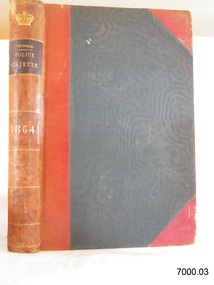 Flagstaff Hill Maritime Museum and Village
Administrative record - Reference Sociology/History, John Ferres, Government Printer, Victoria Police Gazettes for 1864, 1864
... officers, court and justice officials, and government departments about matters relevant to policing across the colony. It commenced in December 1853 and was initially published weekly by the Victoria Police. It was distributed each week to city and rural police stations and to government offices and newspaper publishers. Inclusions in this weekly publication were people wanted for questioning in relation to various crimes, prisoners discharged ...The Victoria Police Gazette was a confidential, internal publication of the Victoria Police, issued to inform police officers, court and justice officials, and government departments about matters relevant to policing across the colony. It commenced in December 1853 and was initially published weekly by the Victoria Police. It was distributed each week to city and rural police stations and to government offices and newspaper publishers. Inclusions in this weekly publication were people wanted for questioning in relation to various crimes, prisoners discharged from city or country gaols, extracts from Police Gazettes in New South Wales, South Australia, Queensland, Tasmania, New Zealand, and occasionally overseas countries, as well as extracts from the Hobart Town Gazette listing escaped convicts and the person to whom they were assigned. There was also a "Missing Friends" section, where most people listed were not criminals but were sought by police so relatives, old friends, or government officials could renew contact with them. In addition, there was a record of deserted wives and children, listing the offender's name, birthplace, age, occupation, last known area of residence, likely future movements and known relatives. There was also a section on court lists, warrants issued, appointments and staffing changes within the police service, arrest and discharge records with physical descriptions, and lists of pastoralists with descriptions of their livestock brands.Hard Bound Volume. Victorian Police Gazettes for 1864 Author: Institutional Government Publication Publisher: John Ferres, Melbourne Date: 1864 Further Information: Compilation of Weekly Victorian Police Gazettes for 1864 in a hard bound volume with red spine and red corner reinforcing. Front panel grey coloured lettering in gilt with gilt banding to spine. Inside is twelve issues of the Police Gazettes for 1864.non-fictionThe Victoria Police Gazette was a confidential, internal publication of the Victoria Police, issued to inform police officers, court and justice officials, and government departments about matters relevant to policing across the colony. It commenced in December 1853 and was initially published weekly by the Victoria Police. It was distributed each week to city and rural police stations and to government offices and newspaper publishers. Inclusions in this weekly publication were people wanted for questioning in relation to various crimes, prisoners discharged from city or country gaols, extracts from Police Gazettes in New South Wales, South Australia, Queensland, Tasmania, New Zealand, and occasionally overseas countries, as well as extracts from the Hobart Town Gazette listing escaped convicts and the person to whom they were assigned. There was also a "Missing Friends" section, where most people listed were not criminals but were sought by police so relatives, old friends, or government officials could renew contact with them. In addition, there was a record of deserted wives and children, listing the offender's name, birthplace, age, occupation, last known area of residence, likely future movements and known relatives. There was also a section on court lists, warrants issued, appointments and staffing changes within the police service, arrest and discharge records with physical descriptions, and lists of pastoralists with descriptions of their livestock brands.warrnambool, shipwrecked-coast, flagstaff-hill, flagstaff-hill-maritime-museum, maritime-museum, shipwreck-coast, flagstaff-hill-maritime-village, shipwrecked-artefact, book, victoria police gazette 1862, victoria police gazette, warrnambool books and records, great ocean road -
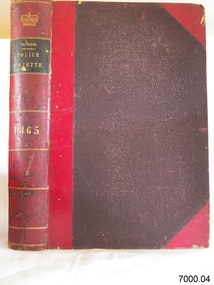 Flagstaff Hill Maritime Museum and Village
Administrative record - Reference Sociology/History, John Ferres, Government Printer, Victoria Police Gazettes for 1865, 1865
... officers, court and justice officials, and government departments about matters relevant to policing across the colony. It commenced in December 1853 and was initially published weekly by the Victoria Police. It was distributed each week to city and rural police stations and to government offices and newspaper publishers. Inclusions in this weekly publication were people wanted for questioning in relation to various crimes, prisoners discharged ...The Victoria Police Gazette was a confidential, internal publication of the Victoria Police, issued to inform police officers, court and justice officials, and government departments about matters relevant to policing across the colony. It commenced in December 1853 and was initially published weekly by the Victoria Police. It was distributed each week to city and rural police stations and to government offices and newspaper publishers. Inclusions in this weekly publication were people wanted for questioning in relation to various crimes, prisoners discharged from city or country gaols, extracts from Police Gazettes in New South Wales, South Australia, Queensland, Tasmania, New Zealand, and occasionally overseas countries, as well as extracts from the Hobart Town Gazette listing escaped convicts and the person to whom they were assigned. There was also a "Missing Friends" section, where most people listed were not criminals but were sought by police so relatives, old friends, or government officials could renew contact with them. In addition, there was a record of deserted wives and children, listing the offender's name, birthplace, age, occupation, last known area of residence, likely future movements and known relatives. There was also a section on court lists, warrants issued, appointments and staffing changes within the police service, arrest and discharge records with physical descriptions, and lists of pastoralists with descriptions of their livestock brands.Hard Bound Volume. Victorian Police Gazettes for 1865 Author: Institutional Government Publication Publisher: John Ferres, Melbourne Date: 1865 Further Information: Compilation of Weekly Victorian Police Gazettes for 1865 in a hard bound volume with red spine and red corner reinforcing. Front panel grey coloured lettering in gilt with gilt banding to spine. Inside is twelve issues of the Police Gazettes for 1865.non-fictionThe Victoria Police Gazette was a confidential, internal publication of the Victoria Police, issued to inform police officers, court and justice officials, and government departments about matters relevant to policing across the colony. It commenced in December 1853 and was initially published weekly by the Victoria Police. It was distributed each week to city and rural police stations and to government offices and newspaper publishers. Inclusions in this weekly publication were people wanted for questioning in relation to various crimes, prisoners discharged from city or country gaols, extracts from Police Gazettes in New South Wales, South Australia, Queensland, Tasmania, New Zealand, and occasionally overseas countries, as well as extracts from the Hobart Town Gazette listing escaped convicts and the person to whom they were assigned. There was also a "Missing Friends" section, where most people listed were not criminals but were sought by police so relatives, old friends, or government officials could renew contact with them. In addition, there was a record of deserted wives and children, listing the offender's name, birthplace, age, occupation, last known area of residence, likely future movements and known relatives. There was also a section on court lists, warrants issued, appointments and staffing changes within the police service, arrest and discharge records with physical descriptions, and lists of pastoralists with descriptions of their livestock brands.warrnambool, shipwrecked-coast, flagstaff-hill, flagstaff-hill-maritime-museum, maritime-museum, shipwreck-coast, flagstaff-hill-maritime-village, shipwrecked-artefact, book, victoria police gazette 1862, victoria police gazette, warrnambool books and records, great ocean road -
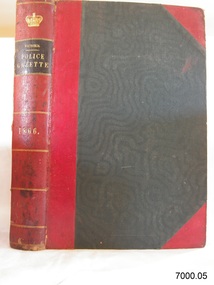 Flagstaff Hill Maritime Museum and Village
Administrative record - Reference Sociology/History, John Ferres, Government Printer, Victoria Police Gazettes for 1866, 1866
... officers, court and justice officials, and government departments about matters relevant to policing across the colony. It commenced in December 1853 and was initially published weekly by the Victoria Police. It was distributed each week to city and rural police stations and to government offices and newspaper publishers. Inclusions in this weekly publication were people wanted for questioning in relation to various crimes, prisoners discharged ...The Victoria Police Gazette was a confidential, internal publication of the Victoria Police, issued to inform police officers, court and justice officials, and government departments about matters relevant to policing across the colony. It commenced in December 1853 and was initially published weekly by the Victoria Police. It was distributed each week to city and rural police stations and to government offices and newspaper publishers. Inclusions in this weekly publication were people wanted for questioning in relation to various crimes, prisoners discharged from city or country gaols, extracts from Police Gazettes in New South Wales, South Australia, Queensland, Tasmania, New Zealand, and occasionally overseas countries, as well as extracts from the Hobart Town Gazette listing escaped convicts and the person to whom they were assigned. There was also a "Missing Friends" section, where most people listed were not criminals but were sought by police so relatives, old friends, or government officials could renew contact with them. In addition, there was a record of deserted wives and children, listing the offender's name, birthplace, age, occupation, last known area of residence, likely future movements and known relatives. There was also a section on court lists, warrants issued, appointments and staffing changes within the police service, arrest and discharge records with physical descriptions, and lists of pastoralists with descriptions of their livestock brands.Hard Bound Volume. Victorian Police Gazettes for 1866 Author: Institutional Government Publication Publisher: John Ferres, Melbourne Date: 1866 Further Information: Compilation of Weekly Victorian Police Gazettes for 1866 in a hard bound volume with red spine and red corner reinforcing. Front panel grey coloured lettering in gilt with gilt banding to spine. Inside is twelve issues of the Police Gazettes for 1866.non-fictionThe Victoria Police Gazette was a confidential, internal publication of the Victoria Police, issued to inform police officers, court and justice officials, and government departments about matters relevant to policing across the colony. It commenced in December 1853 and was initially published weekly by the Victoria Police. It was distributed each week to city and rural police stations and to government offices and newspaper publishers. Inclusions in this weekly publication were people wanted for questioning in relation to various crimes, prisoners discharged from city or country gaols, extracts from Police Gazettes in New South Wales, South Australia, Queensland, Tasmania, New Zealand, and occasionally overseas countries, as well as extracts from the Hobart Town Gazette listing escaped convicts and the person to whom they were assigned. There was also a "Missing Friends" section, where most people listed were not criminals but were sought by police so relatives, old friends, or government officials could renew contact with them. In addition, there was a record of deserted wives and children, listing the offender's name, birthplace, age, occupation, last known area of residence, likely future movements and known relatives. There was also a section on court lists, warrants issued, appointments and staffing changes within the police service, arrest and discharge records with physical descriptions, and lists of pastoralists with descriptions of their livestock brands.warrnambool, shipwrecked-coast, flagstaff-hill, flagstaff-hill-maritime-museum, maritime-museum, shipwreck-coast, flagstaff-hill-maritime-village, shipwrecked-artefact, book, victoria police gazette 1862, victoria police gazette, warrnambool books and records, great ocean road -
 Flagstaff Hill Maritime Museum and Village
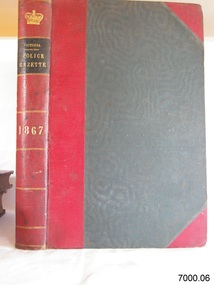
Administrative record - Reference Sociology/History, John Ferres, Government Printer, Victoria Police Gazettes for 1867, 1867
... officers, court and justice officials, and government departments about matters relevant to policing across the colony. It commenced in December 1853 and was initially published weekly by the Victoria Police. It was distributed each week to city and rural police stations and to government offices and newspaper publishers. Inclusions in this weekly publication were people wanted for questioning in relation to various crimes, prisoners discharged ...The Victoria Police Gazette was a confidential, internal publication of the Victoria Police, issued to inform police officers, court and justice officials, and government departments about matters relevant to policing across the colony. It commenced in December 1853 and was initially published weekly by the Victoria Police. It was distributed each week to city and rural police stations and to government offices and newspaper publishers. Inclusions in this weekly publication were people wanted for questioning in relation to various crimes, prisoners discharged from city or country gaols, extracts from Police Gazettes in New South Wales, South Australia, Queensland, Tasmania, New Zealand, and occasionally overseas countries, as well as extracts from the Hobart Town Gazette listing escaped convicts and the person to whom they were assigned. There was also a "Missing Friends" section, where most people listed were not criminals but were sought by police so relatives, old friends, or government officials could renew contact with them. In addition, there was a record of deserted wives and children, listing the offender's name, birthplace, age, occupation, last known area of residence, likely future movements and known relatives. There was also a section on court lists, warrants issued, appointments and staffing changes within the police service, arrest and discharge records with physical descriptions, and lists of pastoralists with descriptions of their livestock brands.Hard Bound Volume. Victorian Police Gazettes for 1867 Author: Institutional Government Publication Publisher: John Ferres, Melbourne Date: 1867 Further Information: Compilation of Weekly Victorian Police Gazettes for 1867 in a hard bound volume with red spine and red corner reinforcing. Front panel grey coloured lettering in gilt with gilt banding to spine. Inside is twelve issues of the Police Gazettes for 1867.non-fictionThe Victoria Police Gazette was a confidential, internal publication of the Victoria Police, issued to inform police officers, court and justice officials, and government departments about matters relevant to policing across the colony. It commenced in December 1853 and was initially published weekly by the Victoria Police. It was distributed each week to city and rural police stations and to government offices and newspaper publishers. Inclusions in this weekly publication were people wanted for questioning in relation to various crimes, prisoners discharged from city or country gaols, extracts from Police Gazettes in New South Wales, South Australia, Queensland, Tasmania, New Zealand, and occasionally overseas countries, as well as extracts from the Hobart Town Gazette listing escaped convicts and the person to whom they were assigned. There was also a "Missing Friends" section, where most people listed were not criminals but were sought by police so relatives, old friends, or government officials could renew contact with them. In addition, there was a record of deserted wives and children, listing the offender's name, birthplace, age, occupation, last known area of residence, likely future movements and known relatives. There was also a section on court lists, warrants issued, appointments and staffing changes within the police service, arrest and discharge records with physical descriptions, and lists of pastoralists with descriptions of their livestock brands.warrnambool, shipwrecked-coast, flagstaff-hill, flagstaff-hill-maritime-museum, maritime-museum, shipwreck-coast, flagstaff-hill-maritime-village, shipwrecked-artefact, book, victoria police gazette 1862, victoria police gazette, warrnambool books and records, great ocean road -
 Flagstaff Hill Maritime Museum and Village
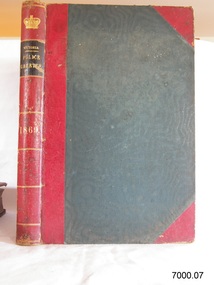
Administrative record - Reference Sociology/History, John Ferres, Government Printer, Victoria Police Gazettes for 1869, 1869
... officers, court and justice officials, and government departments about matters relevant to policing across the colony. It commenced in December 1853 and was initially published weekly by the Victoria Police. It was distributed each week to city and rural police stations and to government offices and newspaper publishers. Inclusions in this weekly publication were people wanted for questioning in relation to various crimes, prisoners discharged ...The Victoria Police Gazette was a confidential, internal publication of the Victoria Police, issued to inform police officers, court and justice officials, and government departments about matters relevant to policing across the colony. It commenced in December 1853 and was initially published weekly by the Victoria Police. It was distributed each week to city and rural police stations and to government offices and newspaper publishers. Inclusions in this weekly publication were people wanted for questioning in relation to various crimes, prisoners discharged from city or country gaols, extracts from Police Gazettes in New South Wales, South Australia, Queensland, Tasmania, New Zealand, and occasionally overseas countries, as well as extracts from the Hobart Town Gazette listing escaped convicts and the person to whom they were assigned. There was also a "Missing Friends" section, where most people listed were not criminals but were sought by police so relatives, old friends, or government officials could renew contact with them. In addition, there was a record of deserted wives and children, listing the offender's name, birthplace, age, occupation, last known area of residence, likely future movements and known relatives. There was also a section on court lists, warrants issued, appointments and staffing changes within the police service, arrest and discharge records with physical descriptions, and lists of pastoralists with descriptions of their livestock brands.Hard Bound Volume. Victorian Police Gazettes for 1869 Author: Institutional Government Publication Publisher: John Ferres, Melbourne Date: 1869 Further Information: Compilation of Weekly Victorian Police Gazettes for 1869 in a hard bound volume with red spine and red corner reinforcing. Front panel grey coloured lettering in gilt with gilt banding to spine. Inside is twelve issues of the Police Gazettes for 1869.non-fictionThe Victoria Police Gazette was a confidential, internal publication of the Victoria Police, issued to inform police officers, court and justice officials, and government departments about matters relevant to policing across the colony. It commenced in December 1853 and was initially published weekly by the Victoria Police. It was distributed each week to city and rural police stations and to government offices and newspaper publishers. Inclusions in this weekly publication were people wanted for questioning in relation to various crimes, prisoners discharged from city or country gaols, extracts from Police Gazettes in New South Wales, South Australia, Queensland, Tasmania, New Zealand, and occasionally overseas countries, as well as extracts from the Hobart Town Gazette listing escaped convicts and the person to whom they were assigned. There was also a "Missing Friends" section, where most people listed were not criminals but were sought by police so relatives, old friends, or government officials could renew contact with them. In addition, there was a record of deserted wives and children, listing the offender's name, birthplace, age, occupation, last known area of residence, likely future movements and known relatives. There was also a section on court lists, warrants issued, appointments and staffing changes within the police service, arrest and discharge records with physical descriptions, and lists of pastoralists with descriptions of their livestock brands.warrnambool, shipwrecked-coast, flagstaff-hill, flagstaff-hill-maritime-museum, maritime-museum, shipwreck-coast, flagstaff-hill-maritime-village, shipwrecked-artefact, book, victoria police gazette 1862, victoria police gazette, warrnambool books and records, great ocean road -
 Montmorency–Eltham RSL Sub Branch
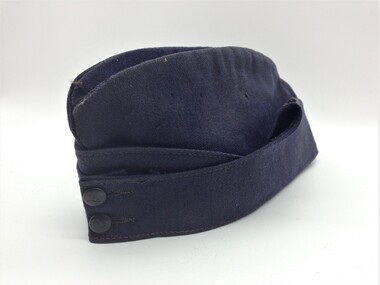
Uniform - Forage Cap, RAAF WW2
... Cap owned by Warrant Officer William Alexander SUMMERS, RAAF., (10814) born at Surrey Hills Vic., 26 APR 1918, enlisted 02 JUL 1940, discharged 24 MAY 1946. ...Cap owned by Warrant Officer William Alexander SUMMERS, RAAF., (10814) born at Surrey Hills Vic., 26 APR 1918, enlisted 02 JUL 1940, discharged 24 MAY 1946. ...Cap owned by Warrant Officer William Alexander SUMMERS, RAAF., (10814) born at Surrey Hills Vic., 26 APR 1918, enlisted 02 JUL 1940, discharged 24 MAY 1946. Last Posting: Air Force Headquarters This Item directly linked to a World War serviceman. Typical uniform item. Dark blue forage cap with two 13mm diameter plastic RAAF buttons on front. Black Cotton liner with off-white label attached. Missing cap badge (eagle and crown) evidenced by mounting plate indentations in liner. Label black stamped with 'LEWIS', 'F arrow S', and ' 7', and handwritten service number '10814' black/blue inkheadgear -
 Montmorency–Eltham RSL Sub Branch
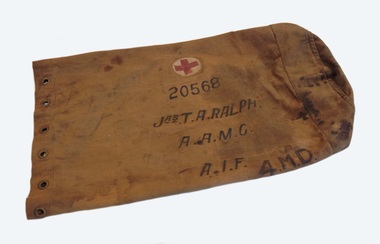
Equipment - Kit Bag, WW1, World War one era
... officer to the 1st Australian Hospital (Hayfield?) on 2 December 1918, and was attached to the 1st Australian Army Hospital (Sutton Vale?) in January 1919. He returned to Australia in Febuary 1920 on the Cape Verde as nursing staff. He was discharged...officer to the 1st Australian Hospital (Hayfield?) on 2 December 1918, and was attached to the 1st Australian Army Hospital (Sutton Vale?) in January 1919. He returned to Australia in Febuary 1920 on the Cape Verde as nursing staff. He was discharged ...The kit bag was used by James Thomas Alfred Ralph, who was born in South Australia on 25 September 1897. He enlisted for service in the First World War on 17 May 1918 in Adelaide with the Australian Medical Corps General Reinforcements. He was allocated the service number 20568 and embarked from Adelaide on the HMT Gaika on 6 August 1918. He arrived in London, England on the 13 October 1918 and allocated to the Australian Army Medical Corps Training Depot. He transferred as a medical officer to the 1st Australian Hospital (Hayfield?) on 2 December 1918, and was attached to the 1st Australian Army Hospital (Sutton Vale?) in January 1919. He returned to Australia in Febuary 1920 on the Cape Verde as nursing staff. He was discharged from service in Adelaide on 17th March 1920.Tan coloured canvas kit bag used by a member of the Australian Army Medical Corps during World War 1. The tubular kit bag has 12 brass eyelets placed around its opening, and is reinforced with a second layer of canvas at its base. The kit bag has a side stitched seam, stiching around the base and top opening. A circular lightweight tan canvas flap is stitched to the top opening at the side seam.On the side if the kit bag is a red cross on a white background, surrounded by a circular yellow line. It also has the numbers 20568, with the words JAS.T. A. RALPH, A.A.M.C, A.I.F., AND 4.M.D. The base of the kit bag has a map of Australia in black ink, with 4.M.D printed in black ink above the map. "Sth. Aus." and numbers "20568" are printed in black ink over the map of Australia. The marking 'broad arrow' is printed in black ink on the inside of the top opening.world war one, kit bag -
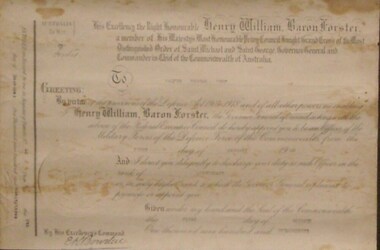 Red Cliffs Military Museum
Certificate, Certificate of Promotion in Rank, 5/12/1923 (exact)
... To Walter Thomas West Greeting: By virtue of the provisions of the Defence Act 1903 - 1918 and of all the other powers me enabling I, Henry William Baron Forster, the Goveneror General a foresaid acting with the advice of the Federal Executive Council, do gereby appoint you to be an officer of the Military Forces of the Defence Force of the Commonwealth from the First Day of January 1920. And I direct you diligently to discharge your duty as such officer in the rank of Lieutenant or in any higher rank to which the Governor General is pleased to promote or appoint you. ...To Walter Thomas West Greeting: By virtue of the provisions of the Defence Act 1903 - 1918 and of all the other powers me enabling I, Henry William Baron Forster, the Goveneror General a foresaid acting with the advice of the Federal Executive Council, do gereby appoint you to be an officer of the Military Forces of the Defence Force of the Commonwealth from the First Day of January 1920. And I direct you diligently to discharge your duty as such officer in the rank of Lieutenant or in any higher rank to which the Governor General is pleased to promote or appoint you. ...This certificate and 5 other documents from the Walter Thomas West Collection, are in a frame 90.40cm x 66.50cm, which has non reflecting glass.Official Australian Government Certificate.Possibly written in old English script and carries the Royal Seal.Main face of Certificate. "His Excellency the Right Honorable Henry William Baron Forster a member of his Majesty's Most Honorable Privy Council Knight Grand Cross of the most Distinguished Order of Saint Michael and Saint George, Governor General and Commander In Chief of the Commonwealth of Australia. To Walter Thomas West Greeting: By virtue of the provisions of the Defence Act 1903 - 1918 and of all the other powers me enabling I, Henry William Baron Forster, the Goveneror General a foresaid acting with the advice of the Federal Executive Council, do gereby appoint you to be an officer of the Military Forces of the Defence Force of the Commonwealth from the First Day of January 1920. And I direct you diligently to discharge your duty as such officer in the rank of Lieutenant or in any higher rank to which the Governor General is pleased to promote or appoint you. Given under my hand and the seal of the Commonwealth this first day of October One Thousand Nine Hundred and Twenty Three. By the Excellency's Command. (signed) E.K. Bowden" Left Hand side Margin: Entered on record by me, in Register of Patents No 40 Page 2 this 5th day of December, One Thousand Nine Hundred and Twenty Three.of, ww1, walter, thomas, west, mm, mc, photo, register, patents, no40, page, 2, , 1923, collection -
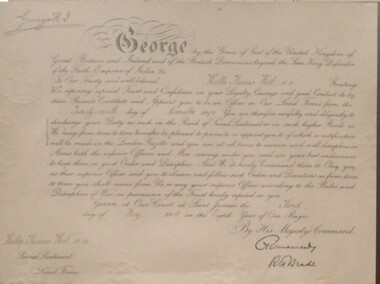 Red Cliffs Military Museum
Certificate, Rank Promotion, 3/5/1918 (exact)
... To our Trusty and well Beloved Walter Thomas West MM Greetings We reposing a special trust and confidence in your Loyalty, Courage and good conduct do by these presents constitute and appoint you to be an Officer in our land forces from the twenty - ninth day of November 1917. You are therefore carefully and diigently to discharge your duty as such in the Rank of Second Lieutenant or in such a higher Rank as we may from time to time hereafter be pleased to promote or Appoint you to, of which notification will be made in the London Gazette, and you are at all times to exercise and well discipline in arms both the inferior Officers and men serving under you and use your best endeavours to keep them in good order and disipline. ...To our Trusty and well Beloved Walter Thomas West MM Greetings We reposing a special trust and confidence in your Loyalty, Courage and good conduct do by these presents constitute and appoint you to be an Officer in our land forces from the twenty - ninth day of November 1917. You are therefore carefully and diigently to discharge your duty as such in the Rank of Second Lieutenant or in such a higher Rank as we may from time to time hereafter be pleased to promote or Appoint you to, of which notification will be made in the London Gazette, and you are at all times to exercise and well discipline in arms both the inferior Officers and men serving under you and use your best endeavours to keep them in good order and disipline. ...This is another of the documents held within a frame 90.5cm X 66.5cm, covered by no-reflective glass of the Walter Thomas West Collection.Official Royal Document Certificate possibly done by caligrapher in old English script,signed by King George V, and a signature which is not decipherable.Top Left hand Corner: George R.I. (Signature of King George V). Main Face of Certificate: 13 George, by the Grace of God of the united Kingdom of Great Britain and Ireland and of the British Dominions beyond the seas. King Defender of the Faith Emporer of India etc. To our Trusty and well Beloved Walter Thomas West MM Greetings We reposing a special trust and confidence in your Loyalty, Courage and good conduct do by these presents constitute and appoint you to be an Officer in our land forces from the twenty - ninth day of November 1917. You are therefore carefully and diigently to discharge your duty as such in the Rank of Second Lieutenant or in such a higher Rank as we may from time to time hereafter be pleased to promote or Appoint you to, of which notification will be made in the London Gazette, and you are at all times to exercise and well discipline in arms both the inferior Officers and men serving under you and use your best endeavours to keep them in good order and disipline. And we do hereby command them to obey you as their superior Officer and you to observe and follow such orders and directions as from time to time you shall receive from us or any of your superior Officers according to the rules and discipline of war in persuance of the trust here by reposed in you. Given at our court at Saint James's the Third Day of May 1918 in the eighth year of our reign. By His Majesty's Command Signature Undecipheral Bottom Left hand corner Walter West MM Second Lieutenant Land Forcesww1, gazette, london, walter, thomas, west, mm, mc, lieutenant, royal, document, 2nd -
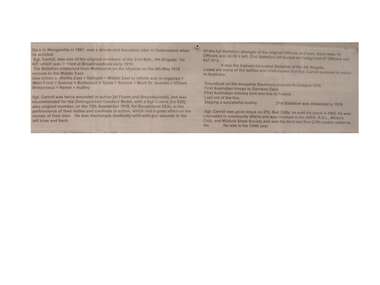 Red Cliffs Military Museum
Document, Life history of Sgt. William Carroll, (estimated); early -mid 1990
... He was discharged medically unfit with gun wounds to his left knee and back. Of the full Battalion strength of the original Officers and men, there were 16 Officers and 24 Or's left. 21st Battalion left buried on foreign soil 47 Officers and 827 Or's. ...He was discharged medically unfit with gun wounds to his left knee and back. Of the full Battalion strength of the original Officers and men, there were 16 Officers and 24 Or's left. 21st Battalion left buried on foreign soil 47 Officers and 827 Or's. ...This short history is in a display of photos and a copy of a letter written home by Sgt Carroll to his Aunt.A brief written life history from birth to death of William Carroll service Number 815. As written by a member of Red Cliffs R.S.L. in consultation with the family.Born in Wangaratta in 1891, was a drover and boundary rider in Queensland when enlisted.Sgt. Carroll was one of the original members of the 21st Battalion, 6th Brigade, 1st AIF, which was formed at Broadmeadows early 1915. The battalion embarked from Melbourne on the Uylsses on the 8th May 1915 enroute to the Middle East. Saw action Middle East> Gallipoli>Middle East to reform and reorganise > Western Front> Somme> Bullecourt> Ypres> Somme> Mont St. Quentin> Villiers Bretonneux> Hamel Mutiny./ Sgt. Carroll was twice wounded in action (at Fluers and Broondseinde)and was recommended for the Distinguished Conduct Medal, with a Sgt Cozens (No 825 also original member, on the 15th September 1916, for exceptional zeal in the performance of their duties and coolness in action, which had a great affect on the moral of their mem. He was discharged medically unfit with gun wounds to his left knee and back. Of the full Battalion strength of the original Officers and men, there were 16 Officers and 24 Or's left. 21st Battalion left buried on foreign soil 47 Officers and 827 Or's. It was the highest decorated Battalion of the 6th Brigade. Listed are some of the Battles and Misfortunes that Sgt. Carrol survived to return to Australia. Torpedoed on the troop ship Southland enroute to Gallipoli 1915;/ First Australian troops to Garrison Cairo; First Australian Infantry Unit into line in France; Last out of the line; Staging a successful mutiny; 21st Battalion was disbanded in 1918. Sgt. Carroll was given block 276 Red Cliffs, he sold his block in 1982. He was interested in Community affairs and was involved in ADFA, RSL, Mildura Club, and Mildura Show Society and was the third last Red Cliffs Soldier Settler to die. He was in his 100th year.medal, distinguished, battalion, aif, 21st, 6th, brigade, 1st, mutiny, gallipoli, wangaratta, 1891, boundary, rider, ulysses, middle, east, western, front, conduct -
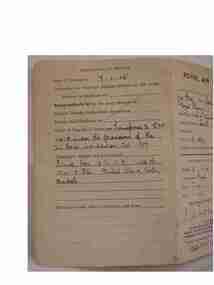 Red Cliffs Military Museum
Discharge Paper WW1, Copy of WW1 Discharge Paper in cover, (estimated); 1921
... Officer in Charge of Records./ * This space is intended to be filled in by any organisation which has registered the man's name and is prepared to/ supply further information.// Back of paper: Particulars of Service/ Date of Enlistement 7.1.15/ Preceeded on Furlough pending Transfer to the Army/ Reserve, or Discharge on... passed medically fit for the Army Reserve on/ Due for Final Discharge on../ Cause of Transfer or Discharge - Transferred to R.A.F. 1-4-18. under the provisions of the/ Air Force (Constitution) Act Oct. 1917./ Campaigns, Medals and Decorations/ France from 15.6.15 to 3.12.16/ 1914-15 Star, British War & Victory/ Medals. ...Officer in Charge of Records./ * This space is intended to be filled in by any organisation which has registered the man's name and is prepared to/ supply further information.// Back of paper: Particulars of Service/ Date of Enlistement 7.1.15/ Preceeded on Furlough pending Transfer to the Army/ Reserve, or Discharge on... passed medically fit for the Army Reserve on/ Due for Final Discharge on../ Cause of Transfer or Discharge - Transferred to R.A.F. 1-4-18. under the provisions of the/ Air Force (Constitution) Act Oct. 1917./ Campaigns, Medals and Decorations/ France from 15.6.15 to 3.12.16/ 1914-15 Star, British War & Victory/ Medals. ...This is a part of the A.J. Roddy Collection. The Family have glued a piece on the envelope which says, "Dad's Discharge Paper/ Royal Irish Rifles & Royal Flying Corps./ 7-1-1915 to Dec 1921. Copy a the Discharge paper of Pte2 James Roddy, Royal Irish Rifles & Royal Flying Corps RAF 7-1-1915 to Dec 1921 and CoverCover: Cover for Certificates/ and other Documents of a/ soldier on Demobilization or Transfer to the Reseve/ or Discharge.// Front of Paper: Top right: Form 2067/ Royal Air Force/ Serial No/ Character Certificate of No 133458/ Rank Pte2 Name Roddy James/ Royal Flying Corp (Regiment (crossed out))/ Born in the Parish of / near the Town of South in the / County of ......... on the / Date 11.7.1897/ Trade as stated by him on Enlistment Postman/ 2 parallel lines/ * Description on Leaving the Colours/ Heoght 5ft 6in. Identification Marks:-/ Complexion Fresh Scar above 1st Lumbar/ Eyes Grey. Vertibrae/ Hair Brown/ Signature of Soldier/ (was signed J. Roddy/ * To prevent impersonation/ In the event of any doubt arising as to the bona fidis of the/ bearer, the above description and signature should be carefully compared with present appearance and hand writing. (16:957) WT 3183C/1875 5m.17/18. P&P Ltd/ Photostat copy of Original Opening the paper inside: The character here given is based on continous records of the holder's conduct and / employment throughout his Military Career./ This is to Certify that No 133458 Rank Pte2 Name Roddy James/ has served with the colours in the Royal Irish Rifles & Royal Flying Corps for 3 83/365 years. 1915-18/ Serving in the Royal Flying Corps as a Batman, and during/ the whole of this period carrying out his duites in a/ satisfactory manner/ There is no record of him having incurred any service/ entries on his conduct sheet during this period./ for service in the R.A.F. see form 280/ Signature ..... Squadron Leader/ Date December 1921 Commanding R.A.F. Records Ruislip/ If further particulars as to his character and record of service are required within three years of above date, apply to/ where he is registered for Civil Employment,/ afterwards to the Officer in Charge of Records./ * This space is intended to be filled in by any organisation which has registered the man's name and is prepared to/ supply further information.// Back of paper: Particulars of Service/ Date of Enlistement 7.1.15/ Preceeded on Furlough pending Transfer to the Army/ Reserve, or Discharge on... passed medically fit for the Army Reserve on/ Due for Final Discharge on../ Cause of Transfer or Discharge - Transferred to R.A.F. 1-4-18. under the provisions of the/ Air Force (Constitution) Act Oct. 1917./ Campaigns, Medals and Decorations/ France from 15.6.15 to 3.12.16/ 1914-15 Star, British War & Victory/ Medals. /Education and other Certificates and dates/corps, ww1, collection, royal, a j, roddy, flying, irish, rifles, pte2, james, 1915 -
 Flagstaff Hill Maritime Museum and Village
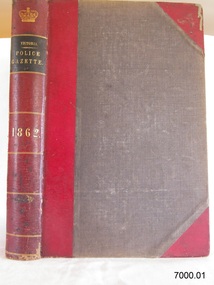
Administrative record - Reference Sociology/History, John Ferres, Government Printer, Victoria Police Gazettes for 1862, 1862
... officers, court and justice officials, and government departments about matters relevant to policing across the colony. It commenced in December 1853 and was initially published weekly by the Victoria Police. It was distributed each week to city and rural police stations and to government offices and newspaper publishers. Inclusions in this weekly publication were people wanted for questioning in relation to various crimes, prisoners discharged ...The Victoria Police Gazette was a confidential, internal publication of the Victoria Police, issued to inform police officers, court and justice officials, and government departments about matters relevant to policing across the colony. It commenced in December 1853 and was initially published weekly by the Victoria Police. It was distributed each week to city and rural police stations and to government offices and newspaper publishers. Inclusions in this weekly publication were people wanted for questioning in relation to various crimes, prisoners discharged from city or country gaols, extracts from Police Gazettes in New South Wales, South Australia, Queensland, Tasmania, New Zealand, and occasionally overseas countries, as well as extracts from the Hobart Town Gazette listing escaped convicts and the person to whom they were assigned. There was also a "Missing Friends" section, where most people listed were not criminals but were sought by police so relatives, old friends, or government officials could renew contact with them. In addition, there was a record of deserted wives and children, listing the offender's name, birthplace, age, occupation, last known area of residence, likely future movements and known relatives. There was also a section on court lists, warrants issued, appointments and staffing changes within the police service, arrest and discharge records with physical descriptions, and lists of pastoralists with descriptions of their livestock brands.Hard Bound Volume. Victorian Police Gazettes for 1862 Author: Institutional Government Publication Publisher: John Ferres, Melbourne Date: 1862 Further Information: Compilation of Weekly Victorian Police Gazettes for 1862 in a hard bound volume with red spine and red corner reinforcing. Front panel grey coloured lettering in gilt with gilt banding to spine. Inside is twelve issues of the Police Gazettes for 1862.non-fictionThe Victoria Police Gazette was a confidential, internal publication of the Victoria Police, issued to inform police officers, court and justice officials, and government departments about matters relevant to policing across the colony. It commenced in December 1853 and was initially published weekly by the Victoria Police. It was distributed each week to city and rural police stations and to government offices and newspaper publishers. Inclusions in this weekly publication were people wanted for questioning in relation to various crimes, prisoners discharged from city or country gaols, extracts from Police Gazettes in New South Wales, South Australia, Queensland, Tasmania, New Zealand, and occasionally overseas countries, as well as extracts from the Hobart Town Gazette listing escaped convicts and the person to whom they were assigned. There was also a "Missing Friends" section, where most people listed were not criminals but were sought by police so relatives, old friends, or government officials could renew contact with them. In addition, there was a record of deserted wives and children, listing the offender's name, birthplace, age, occupation, last known area of residence, likely future movements and known relatives. There was also a section on court lists, warrants issued, appointments and staffing changes within the police service, arrest and discharge records with physical descriptions, and lists of pastoralists with descriptions of their livestock brands.warrnambool, shipwrecked-coast, flagstaff-hill, flagstaff-hill-maritime-museum, maritime-museum, shipwreck-coast, flagstaff-hill-maritime-village, shipwrecked-artefact, book, victoria police gazette 1862, victoria police gazette, warrnambool books and records, great ocean road -
 Flagstaff Hill Maritime Museum and Village
Book, The Old Bus
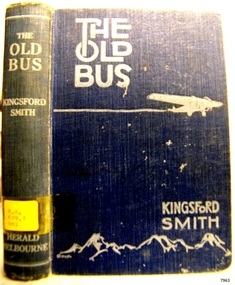
... He was discharged after training in England and commissioned as a second lieutenant in the Royal Flying Corps. He was appointed fling officer and soon joined the 23rd Squadron in France. ...He was discharged after training in England and commissioned as a second lieutenant in the Royal Flying Corps. He was appointed fling officer and soon joined the 23rd Squadron in France. ...Sir Charles Edward Kingsford Smith is a famous Australian, well known in civil aviation history for his courageous endeavours in flight. He broken many flight records for long distance and time travelled and he was also a war hero in World War 1. He has been referred to as being “known to millions of Australians as “Smithy” … he was one of Australia’s true twentieth-century legends”. In honour of his place amongst the world’s famous pioneers his image is featured on Australia’s $20 note, Sydney airport is named after him, there is a memorial to Kingsford Smith, Taylor and Ulm at the Anderson Park, also in Sydney and his plane “Southern Cross” is on view at Brisbane Airport. Kingsford Smith wrote ‘The Old Bus’ (1932) and he and Ulm were co-authors of ‘Story of 'Southern Cross' Trans-Pacific Flight’ (1928). His also wrote a book about his own life ‘My Flying Life’ which was published after his death in 1937. and the story of his life was filmed in Australia in 1946. A BRIEF HISTORY OF SIR CHARLES EDWARD KINGSFORD SMITH (1897 – 1935) … Kingsford Smith was born 9th February 1897 in Brisbane, Queensland, Australia. His parents were William Charles Smith and Catherine Mary, nee Kingsford. His mother’s maiden name of “Kingsford” was added to the family name when they spent time in Canada from around 1903 to 1907, after which they returned to Sydney, Australia. In 1915 Kingsford Smith enlisted in Australian Imperial Force. He served in 4th Signal Troop, 2nd Division Signal Company at Gallipoli Peninsular as a ‘sapper’ or combat engineer and later in Egypt and in France as a dispatch rider. In 1916 Kingsford Smith was transferred to the Australian Flying Corps as a sergeant. He was discharged after training in England and commissioned as a second lieutenant in the Royal Flying Corps. He was appointed fling officer and soon joined the 23rd Squadron in France. He brought down four machines in his first month there and also did invaluable work attacking enemy targets. He was wounded and shot down and later awarded the Military Cross ‘for conspicuous gallantry and devotion to duty’. He was promoted to lieutenant in 1918 and served as a Flying Instructor with the R.F.C. Kingsford Smith was not allowed to participate in the 1919 England to Australia air race because of assumed lack of navigational experience. He and his pilot friend Cyril Maddocks formed a business and flew joy-flights in both England and America. In America he did some stunt flying with a Flying Circus. Kingsford Smith returned to Australia in 1921 and found employment as a pilot. He soon realised the value of air transport in such a vast country. He formed a partnership with pilot Keith Anderson in 1924 and they purchased two Bristol Tourer biplanes. Their business broadened to include Charles Ulm and became the Interstate Flying services in Sydney. Together they performed important ‘demonstration’ flights including a flight around Australia in 10 days and 5 hours using very limited navigational equipment. Kingsford Smith immediately started to search for support to do a trans-Pacific flight. This support came from the New South Wales government, Sidney Myer and G. Allan Hancock, an American oil magnate. On 31st May 1928 Kingsford Smith, Charles Ulm and two American crewmen, Harry Lyan and Jim Warner, took off from Oakland, California and flew to Brisbane via Hawaii and Suva. This historic flight took 83 hours and 38 minutes. Their Fokker plane had three engines and was named the “Southern Cross”. This amazing achievement resulted in huge financial subscriptions. Kingsford Smith was awarded the Air Force Cross and appointed as honorary squadron leader, Royal Australian Air Force. Kingsford Smith flew his Southern Cross plane from Point Cook in Victoria to Perth nonstop. Then in September – October 1928, with Charles Ulm and an Australian crew, he piloted the Southern Cross from Sidney to Christchurch New Zealand. This flight showed that was possible for regular passenger and mail services across the Tasman Sea. Kingsford Smith flew his plane to England to an order for four aircraft, planning to use them for an inter-capital air service in Australia. Sadly on 1st April 1929 he was forced to land, having lost radio contact with the ground and having run into bad weather over north – west Australia. Keith Anderson and Robert Hitchcock both perished before the search party reached them. Once official enquiries were completed the flight to England continued in June and was completed in record time of 12 days and 18 hours. In January 1930 Kingsford Smith piloted the “Southern Cloud”, one of the new Avro Ten planes, on the first flight of his airline, the Australian National Airways, from Sydney to Melbourne. The “Southern Cross” was overhauled in Holland by the Fokker Aircraft Co. and in June 1930 Kingsford Smith achieved an east-west crossing of the Atlantic from Ireland to Newfoundland in 31.5 hours. Kingsford Smith returned to England and took delivery of an Avro Avian biplane that he named the “Southern Cross Junior” and flew solo from England to Darwin, Australia. This record breaking flight took less than 10 days. He beat four other planes that had left England before him and he was 5.5 days faster than Hinkler. Sadly Kingsford Smith’s “Southern Cloud” was lost during a flight from Sydney to Melbourne in 1931 with no surviving crew or passengers; in 1958 the wreckage was discovered in the Snowy Mountains. Later that year Kingsford Smith flew his “Southern Cloud” from Australia to Timor, collecting mail from a damaged Imperial Airways plane in Timor. Other flights followed. Kingsford Smith was knighted in 1932 for his services in Aviation. He returned to selling joy flights then established the Kingsford Smith Air Service, a flying training school in Sydney. In 1933 Kingsford Smith flew the amazing record flight in “Miss Southern Cross” – a Percival Gull - from London to Wyndham in Western Australia in just over ten days. The Australian Commonwealth then gave Kingsford Smith a large grant and he was also appointed as aviation consultant to Vacuum Oil Co. Another flying record was made when Kingsford Smith and Sir P.G. Taylor flow “Lady Southern Cross” from Brisbane to San Francisco in order to sell her there; the west-east-trans-Pacific flight made aviation history. They returned to Australia to make an attempt at the trans-Tasman flight but their attempt failed due to engine failure; they managed to get back to Sydney safely, minus most of their cargo. Kingsford Smith had his unsold “Lady Southern Cross” shipped back to England, from where he and J. T. Pethybridge in the “Lady Southern Cross” attempted another record breaking flight from England The Old Bus Author: Charles Kingsford Smith Publisher: Distibuted by Herald Feature Service Date; 1932Label on spine cover with typed text RA 629.1309 KIN flagstaff hill, warrnambool, shipwrecked coast, flagstaff hill maritime museum, maritime museum, shipwreck coast, flagstaff hill maritime village, great ocean road, the old bus, charles kingsford smith -
 Bendigo Military Museum
Album - BOOKLET OF AUTOGRAPHS & PHOTOGRAPHS, c. 1917
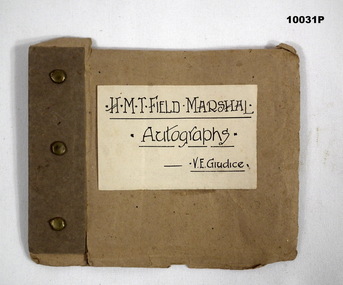
... Discharged 27.1.20 from 55th Battalion. Troopship was a captured German Vessel. Part of the William Thomason Collection. Refer Cat No. 4136P. Photos Autographs William (Bill) Thomason Collection Front cover has "H.M.T. FIELD MARSHAL AUTOGRAPHS - V. E. GIUDICE" Brown rough made booklet with 3 studs with clips binding the pages. Inside 5 white pages with autographs on all pages except First and Last Page. Includes photos of A.I.F. Officers ...From "Vincent Emelio Giudice" No. 53730. Enlisted 12.6.17 in NSW (Reinforcement 4). Embarked for England 19.6.18. Disembarked 26.8.18. Hospitalisation with Bronchitis 14.10.18. Rejoined unit 29.10.18. Promotion to Sergeant 31.8.18. Posted to France as Australian Burials detachment. Discharged 27.1.20 from 55th Battalion. Troopship was a captured German Vessel. Part of the William Thomason Collection. Refer Cat No. 4136P.Brown rough made booklet with 3 studs with clips binding the pages. Inside 5 white pages with autographs on all pages except First and Last Page. Includes photos of A.I.F. Officers, Sergeants, Picture of the convoy, Nurses and on board ship crowd. Label stuck on front cover.Front cover has "H.M.T. FIELD MARSHAL AUTOGRAPHS - V. E. GIUDICE"photos, autographs, william (bill) thomason collection -
 Bendigo Military Museum
Headwear - CAP, PEAKED WW2, C.WW2
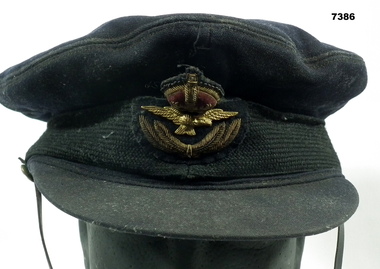
... discharged from the Army on 3.9.1943 to join the RAAF. Enlisted in the RAAF on 4.9.1943 No 431933 as a Aircraftsman, after initial training he was posted to “Air Gunnery School” on 4.2.1944, embarked for England 28.4.1944, went through 3 training units in Bomber Command, posted to 466 Sqd Driffield 19.1.1945. He rose through the ranks from Aircraftsman - LAC - Sgt - Flt Sgt - Fly Officer...discharged from the Army on 3.9.1943 to join the RAAF. Enlisted in the RAAF on 4.9.1943 No 431933 as a Aircraftsman, after initial training he was posted to “Air Gunnery School” on 4.2.1944, embarked for England 28.4.1944, went through 3 training units in Bomber Command, posted to 466 Sqd Driffield 19.1.1945. He rose through the ranks from Aircraftsman - LAC - Sgt - Flt Sgt - Fly Officer ...Peaked cap worn by “Vivian Donald BULLEN". He first enlisted in the 2nd AIF on 11.3.1942 age 22 years 8 months No VX75447, during his time he rose to Acting Cpl, attached to No 4 Chemical Warfare Coy RAE and A.A.O.C in Bendigo, he was hospitalised with a Peptic Ulcer, discharged from the Army on 3.9.1943 to join the RAAF. Enlisted in the RAAF on 4.9.1943 No 431933 as a Aircraftsman, after initial training he was posted to “Air Gunnery School” on 4.2.1944, embarked for England 28.4.1944, went through 3 training units in Bomber Command, posted to 466 Sqd Driffield 19.1.1945. He rose through the ranks from Aircraftsman - LAC - Sgt - Flt Sgt - Fly Officer by 7.10.1945. He flew 13 sorties and was eligible for the France & Germany Star. Embarked for Australia 29.6.1945, discharged from RAAF 9.10.1945. Cap - peaked, navy blue cotton twill, black leather hat band with brass button keepers. RAAF badge in gold and red crown above eagle wings and laurel wreath. Inside cap, leather sweatband and cotton lining. Makers label imprint on sweatband.Sweatband - makers label imprint "Sam Brown Leather". headwear, uniform, ww2, raaf, vivian donald bullen -
 Bendigo Military Museum
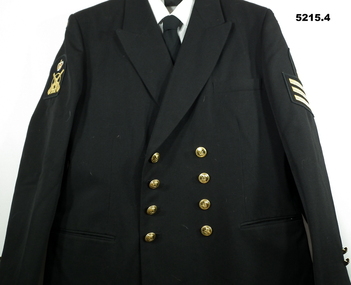
Uniform - UNIFORM, WINTER CEREMONIAL NAVY, ADA - Australian Defence Apparel, 1994-1996
... Promoted to Petty Officer QMG then to HMAS Yarra 1984 then to HMAS Gladstone. Discharged from the RAN June 1987. ...Promoted to Petty Officer QMG then to HMAS Yarra 1984 then to HMAS Gladstone. Discharged from the RAN June 1987. ...David Dixon RAN R112262. Enlisted July 1972 as a Junior recruit age 15 years 9 months at HMAS Leeuwin. Passed out as Ordinary Seamen QMG and posted to HMAS Sydney 111 in Sept 1973. Jan 1974 - Feb 1981 with HMAS Derwent River Class Destroyer. Feb 1981 posted to HMAS Flinders Survey Ship. Sept 1981 promoted to Provisional Petty Officer QMG and then to HMAS Cerberus Gunnery School. Promoted to Petty Officer QMG then to HMAS Yarra 1984 then to HMAS Gladstone. Discharged from the RAN June 1987. Re Enlist 1996 and did a refresher course and posted to HMAS Success Fleet Tanker then HMAS Brisbane till 2001. Posted to HMAS Kuttabul with Recurring Back Injury and Discharged from the RAN May 2002. Total 21 years service with 17 off at Sea.1. Jacket - Black, Wool/Polyester, Insignias, yellow metal buttons. 2. Trousers - Black, Wool/Polyester. 3. Shirt - White, Polyester/Cotton. 4. Tie - Black, Polyester/Viscose. 5. Officers Peaked Cap - Plastic, White and Black, polyester, Elasticised band, Petty Officer Insignia.1. On Jacket - 3 stipes in gold braid. Petty Officer Insignia on Left Shoulder. Category Insignia on Right shoulder - Quartermaster Gunner.uniform, navy -
 Bendigo Military Museum
Certificate - INTERIM DISCHARGE CERTIFICATE, 24.1.1969
... Graeme's National Service discharge took effect on 31.1.1969 - it was signed of to be sent to Graeme on 24.1.1969. certificate interim g a jones Main points, "3790932 - Pte G.A. Jones - DA NS 430/68" Certificate AAF - A199, paper, print in black, entries in black, signed in blue by an Officer and the Recipient. ...Collection re G.A. Jones 3790932, refer Cat No 10053.2P for his service details. Graeme's National Service discharge took effect on 31.1.1969 - it was signed of to be sent to Graeme on 24.1.1969.Certificate AAF - A199, paper, print in black, entries in black, signed in blue by an Officer and the Recipient.Main points, "3790932 - Pte G.A. Jones - DA NS 430/68"certificate, interim, g a jones -
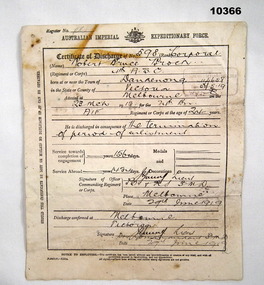 Bendigo Military Museum
Administrative record - CERTIFICATE OF DISCHARGE, WW1, A.I.F Printing section, 23 May 1919
... Also reason for discharge and it is signed off by the Commanding Officer of his unit. ...Also reason for discharge and it is signed off by the Commanding Officer of his unit. ...Pertains to the service of "Robert Bruce Brock" No. 598. Enlisted 23 Mar 1915 in C.Coy, 24th Battn, age 25. Embarking 10th May 1915 to Egypt and served in Gallipoli and France. Discharged 29/6/19 with the rank of Corporal. Part of the collection of William (Bill) Thomason. Refer Cat 4136P.Cream coloured card and one side has details and description of the person discharged. Other side has his name, Rank, Unit and Home Address. Also reason for discharge and it is signed off by the Commanding Officer of his unit. It also has where the discharge took place.Stamp dated "24/5/19".collection of william (bill) thomason, robert bruce brock, certificate of discharge., ww1 -
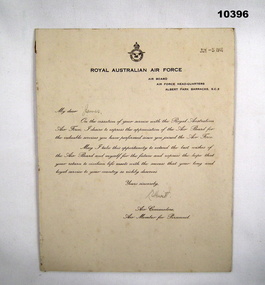 Bendigo Military Museum
Letter - THANKYOU LETTER, WW2, R.A.A.F, Jun 1946
... Officer 2.11.1942, FLT Lieut 1.1.1945. He had postings in QLD, NSW, VIC and New Guinea. New Guinea postings were Fall River, Gurney, Pt Moresby, Milne Bay, Berri between June 1942 - 8.10.1943. Appointment terminated 22.3.1946. Part of the collection of William (Bill) Thomason. Refer Cat No. 4136P. Collection of William (Bill) Thomason Letter of Thanks G.J. Ottoway. Dated "Jun 5 1946" Letter on white paper with heading from Royal Australian Airforce from the Air Board thanking F.L.T. Ottoway James for his service to the RAAF during WW2 after his discharge ...George James Ottoway, (born Sydney, enlisted Melbourne) enlisted No 52834 in the RAAF on 30.3.1942, appointed to a Commission 2.5.1942 No 265088 as a Pilot Officer, Flying Officer 2.11.1942, FLT Lieut 1.1.1945. He had postings in QLD, NSW, VIC and New Guinea. New Guinea postings were Fall River, Gurney, Pt Moresby, Milne Bay, Berri between June 1942 - 8.10.1943. Appointment terminated 22.3.1946. Part of the collection of William (Bill) Thomason. Refer Cat No. 4136P.Letter on white paper with heading from Royal Australian Airforce from the Air Board thanking F.L.T. Ottoway James for his service to the RAAF during WW2 after his discharge in June 1946. Letter is attached to cardboard and signed by Air Commodore.Dated "Jun 5 1946"collection of william (bill) thomason, letter of thanks, g.j. ottoway. -
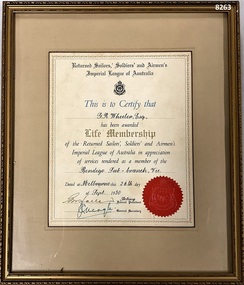 Bendigo Military Museum
Certificate - LIFE MEMBERSHIP OF THE RSL, 1950
... In a 5 page brief of his life which came with his collection he stated that after discharge he spent a lot of time in hospital over the next 15 months. At discharge the medical officer told him that his Life expectancy was 10 years. ...In a 5 page brief of his life which came with his collection he stated that after discharge he spent a lot of time in hospital over the next 15 months. At discharge the medical officer told him that his Life expectancy was 10 years. ...George Robert Wheeler joined the RSL in 1918. In 1936 he started volunteering with the Castlemaine RSL and joined the Committee, he was President in 1939. He moved to Bendigo in 1941 and became involved in Bendigo RSL Funerals and conducted most until late 1948. he did home visits to families who had a loss in WW2. In 1943 he was appointed Honorary Secretary of No 27 District Board, a position he held until 1962. In 1959 he was appointed State Councillor for No 27 District Board until 1968. He was elected to the Committee of the Bendigo RSL Branch in 1942. he served on Committee to 1949 then a year in 1951, a total of 9 years. During those years he was Treasurer for the years 1947/48 & 49. For about 10 years he wrote the Leading paragraphs in the Bendigo Advertiser in the Ex Servicemen's Column. In 1959 he was appointed a Justice of the Peace and retired at age 73. George enlisted on 13.3.1917 as part of the July Reinforcements and posted to Medical Corp No 18465. Pre embarkation he had postings with Clearing Hospital Broadmeadows, No 11 General Hospital, AMC Bendigo, Clearing Hospital Seymour. Embarked 21.11.1917 and disembarked at Australia Camp Suez 15.12.1917 then embarked for Alexandria camp on 31.12.1917 disembarking on 2.1.1918. On 8.1.1918 he embarked for Taranto Southern Italy then finally for England arriving on 24.1.1918. He served with others as Hospital Orderlies in the above places. On 23.2.1918 he was hospitalised with Perineal Abcess, later with Influenza on 14.3.1918 and then "Tubercle Lung" and returned to Australia on 12.5.1918. On arrival he was admitted to No 5 Aust General Hospital on 16.7.1918 then the Military Sanitorium 22.7.1918. He was finally discharged on 22.1.1919. In a 5 page brief of his life which came with his collection he stated that after discharge he spent a lot of time in hospital over the next 15 months. At discharge the medical officer told him that his Life expectancy was 10 years. When at the Army medical training Depot in England he stated that the first time he saw a mans leg cut of he fainted.Life Membership Certificate of the Bendigo RSL, gold frame with brown coloured backing sheet, certificate is white background with text in blue and black, in the RH bottom corner is a red seal. signed and dated by the Acting Federal President and General secretary of the RSLAt the top, "Returned Sailors, Soldiers and Airmens Imperial League of Australia", - "G R Wheeler", "Bendigo Sub - Branch", - "Melbourne 26th Sept 1950". brsl, smirsl, life membership, certificate, gwheeler -
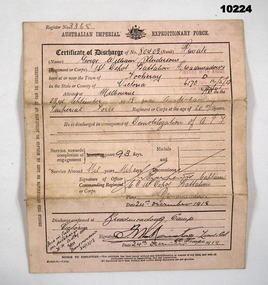 Bendigo Military Museum
Administrative record - CERTIFICATE OF DISCHARGE, 24 Dec 1918
... discharged. Some descriptions of origin and his current regiment. Itemises length of service and signed by Commanding Officer of Regiment and dated 24 Dec 1918....discharged. Some descriptions of origin and his current regiment. Itemises length of service and signed by Commanding Officer of Regiment and dated 24 Dec 1918. ...Certificate for "George William Anderson". Information suggests never served overseas. Was part of the 1st Depot Battalion, Broadmeadows. Part of collection of William (Bill) Thomason, Ref No. 4136P.Yellow/Pink cardboard certificate of discharge. One side has physical description including scars and birthmarks with his intended address and signatory. Main side has name of soldier being discharged. Some descriptions of origin and his current regiment. Itemises length of service and signed by Commanding Officer of Regiment and dated 24 Dec 1918.Noted at bottom "Paid in full on discharge". Stamp at top saying "Issued with badge and other details" and dated 12 May 1919.collection of william (bill) thomason, certificate of discharge, george william anderson, ww1
