
Showing 81 items matching "official duty"
-
 National Vietnam Veterans Museum (NVVM)
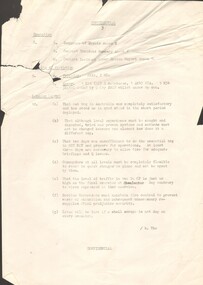
Memorabilia - Original pages 3 and 4 of a Confidential Report by Lt Col Scott
... ...Official Duty...This item was donated by Lt Col Francis Peter Scott (335011) who was with the Royal Australian Infantry Corps and served in Vietnam as Official Duty 3rd Battalion, The Royal Australian Regiment in October 1969 and December 1970. ...This item was donated by Lt Col Francis Peter Scott (335011) who was with the Royal Australian Infantry Corps and served in Vietnam as Official Duty 3rd Battalion, The Royal Australian Regiment in October 1969 and December 1970. ...This item was donated by Lt Col Francis Peter Scott (335011) who was with the Royal Australian Infantry Corps and served in Vietnam as Official Duty 3rd Battalion, The Royal Australian Regiment in October 1969 and December 1970. He also served in Vietnam with the 3rd Battalion, The Royal Australian Regiment from February 1971 to October 1971Original pages 3 and 4 of a Confidential Report describes lessons learnt regarding training in Australia prior to going to Vietnam. See media file for more informaitonlt col francis peter scott, 335011, royal australian infantry corps, official duty, 3rd battalion, the royal australian regiment -
 Whitehorse Historical Society Inc.
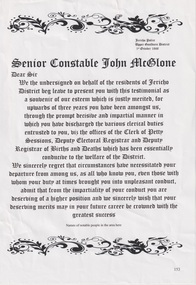
Document, John McGlone, 1/03/1988 12:00:00 AM
... Acknowledging his contribution in official duties in the Jericho District....Photocopy of testimonial presented to Senior Constable John McGlone acknowledging his contribution in official duties in the Jericho District....Acknowledging his contribution in official duties in the Jericho District. Police McGlone John Photocopy of testimonial presented to Senior Constable John McGlone. ...Photocopy of testimonial presented to Senior Constable John McGlone.Photocopy of testimonial presented to Senior Constable John McGlone acknowledging his contribution in official duties in the Jericho District.Photocopy of testimonial presented to Senior Constable John McGlone.police, mcglone, john -
 National Vietnam Veterans Museum (NVVM)
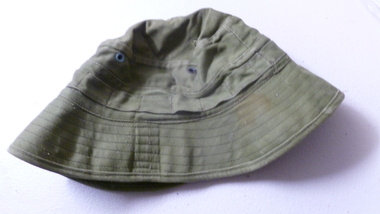
Headwear - Bush hat, giggle hat, 1968
... ...Official Duty...He served with the Australian Army Training Team Vietnam from June 1962 to July 1963, Official Duty (from Army Headquarters, Canberra) August 1965, Australian Service Attaché Staff, Saigon from November 1965 to May 1966 and June 1966 to December 1967....He served with the Australian Army Training Team Vietnam from June 1962 to July 1963, Official Duty (from Army Headquarters, Canberra) August 1965, Australian Service Attaché Staff, Saigon from November 1965 to May 1966 and June 1966 to December 1967. ...This item was donated by Maj (Temp) Peter Raymond Young, (240217) who served with the Australian Intelligence Corps. He served with the Australian Army Training Team Vietnam from June 1962 to July 1963, Official Duty (from Army Headquarters, Canberra) August 1965, Australian Service Attaché Staff, Saigon from November 1965 to May 1966 and June 1966 to December 1967.Australian Army bush hat found in bottom left hand pocket of jacket belonging to Peter Raymond Young 240217 (refer catalogue 11889) has "Copral" written in black ink on inside. label. Has a small hole in crown. Sun Ray hats Pty Ltd. made in Melbourne 1968maj (temp) peter raymond young, 240217, australian intelligence corp, australian army training team vietnam (aattv), official duty, army headquarters, australian service attaché staff, saigon, giggle hat, clothing, bush hat -
 National Vietnam Veterans Museum (NVVM)
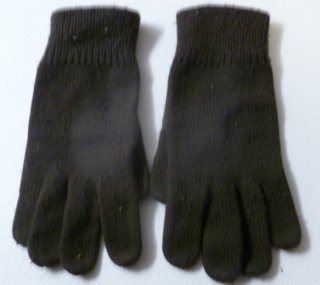
Clothing - A Pair of Gloves
... ...Official Duty...He served with the Australian Army Training Team Vietnam from June 1962 to July 1963, Official Duty (from Army Headquarters, Canberra) August 1965, Australian Service Attache Staff, Saigon from November 1965 to May 1966 and June 1966 to December 1967....He served with the Australian Army Training Team Vietnam from June 1962 to July 1963, Official Duty (from Army Headquarters, Canberra) August 1965, Australian Service Attache Staff, Saigon from November 1965 to May 1966 and June 1966 to December 1967. ...This item was donated by Maj (Temp) Peter Raymond Young, (240217) who served with the Australian Intelligence Corps. He served with the Australian Army Training Team Vietnam from June 1962 to July 1963, Official Duty (from Army Headquarters, Canberra) August 1965, Australian Service Attache Staff, Saigon from November 1965 to May 1966 and June 1966 to December 1967.Pair of dark brown woollen gloves found in bottom right hand pocket of jacket belonging to Peter Raymond Young 240217 - Catalogue No. 11889maj (temp) peter raymond young, 240217, australian intelligence corp, australian army training team vietnam (aattv), official duty, army headquarters, australian service attache staff, gloves, woollen gloves, clothing -
 National Vietnam Veterans Museum (NVVM)
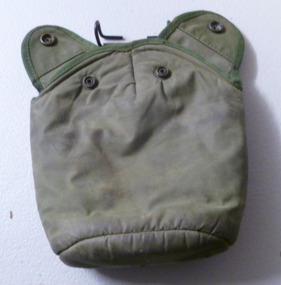
Equipment - Equipment, Army Bottle Holder
... ...Official Duty...He served with the Australian Army Training Team Vietnam from June 1962 to July 1963, Official Duty (from Army Headquarters, Canberra) August 1965, Australian Service Attache Staff, Saigon from November 1965 to May 1966 and June 1966 to December 1967....He served with the Australian Army Training Team Vietnam from June 1962 to July 1963, Official Duty (from Army Headquarters, Canberra) August 1965, Australian Service Attache Staff, Saigon from November 1965 to May 1966 and June 1966 to December 1967. ...This item was donated by Maj (Temp) Peter Raymond Young, (240217) who served with the Australian Intelligence Corps. He served with the Australian Army Training Team Vietnam from June 1962 to July 1963, Official Duty (from Army Headquarters, Canberra) August 1965, Australian Service Attache Staff, Saigon from November 1965 to May 1966 and June 1966 to December 1967.Khaki water bottle holder - possibly canvas with green felt lining 2 metal snap fasteners on flaps, on top metal hooks attached to webbing with a belt loop. maj (temp) peter raymond young, 240217, australian intelligence corp, australian army training team vietnam (aattv), official duty, army headquarters, australian service attaché staff, army equipment, water bottle -
 National Vietnam Veterans Museum (NVVM)
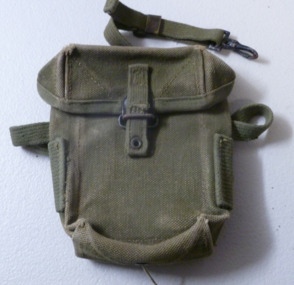
Equipment - Equipment, Army - Ammo/Magazine Holder
... ...Official Duty...He served with the Australian Army Training Team Vietnam from June 1962 to July 1963, Official Duty (from Army Headquarters, Canberra) August 1965, Australian Service Attache Staff, Saigon from November 1965 to May 1966 and June 1966 to December 1967....He served with the Australian Army Training Team Vietnam from June 1962 to July 1963, Official Duty (from Army Headquarters, Canberra) August 1965, Australian Service Attache Staff, Saigon from November 1965 to May 1966 and June 1966 to December 1967. ammunition pouch Maj (Temp) Peter Raymond Young 240217 Australian Intelligence Corp Australian Army Training Team Vietnam (AATTV) Official Duty Army Headquarters Australian Service Attaché Staff Saigon Army equipment Ammunition Pouch Magazine pouch Heavy khaki ammunition and magazine holder with a metal insert in front with black metal fastener. 2 Khaki webbing loops on either side 2 metal clips on back. ...This item was donated by Maj (Temp) Peter Raymond Young, (240217) who served with the Australian Intelligence Corps. He served with the Australian Army Training Team Vietnam from June 1962 to July 1963, Official Duty (from Army Headquarters, Canberra) August 1965, Australian Service Attache Staff, Saigon from November 1965 to May 1966 and June 1966 to December 1967.ammunition pouch Heavy khaki ammunition and magazine holder with a metal insert in front with black metal fastener. 2 Khaki webbing loops on either side 2 metal clips on back. Webbing loop with dog tag fastener on end. Has canvas top which can be fastened to front metal fastener. maj (temp) peter raymond young, 240217, australian intelligence corp, australian army training team vietnam (aattv), official duty, army headquarters, australian service attaché staff, saigon, army equipment, ammunition pouch, magazine pouch -
 National Vietnam Veterans Museum (NVVM)
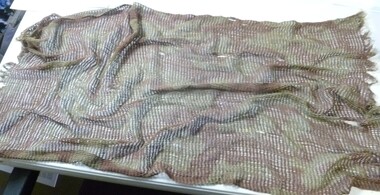
Equipment - Jungle Scarf, Sweat Rag
... ...Official Duty...He served with the Australian Army Training Team Vietnam from June 1962 to July 1963, Official Duty (from Army Headquarters, Canberra) August 1965, Australian Service Attaché Staff, Saigon from November 1965 to May 1966 and June 1966 to December 1967....He served with the Australian Army Training Team Vietnam from June 1962 to July 1963, Official Duty (from Army Headquarters, Canberra) August 1965, Australian Service Attaché Staff, Saigon from November 1965 to May 1966 and June 1966 to December 1967. ...This item was donated by Maj (Temp) Peter Raymond Young, (240217) who served with the Australian Intelligence Corps. He served with the Australian Army Training Team Vietnam from June 1962 to July 1963, Official Duty (from Army Headquarters, Canberra) August 1965, Australian Service Attaché Staff, Saigon from November 1965 to May 1966 and June 1966 to December 1967.Green/brown camouflage scarf has quite a few holes, some have been mended.maj (temp) peter raymond young, 240217, australian intelligence corp, australian army training team vietnam (aattv), official duty, army headquarters, australian service attaché staff, clothing, sweat scarf -
 National Vietnam Veterans Museum (NVVM)
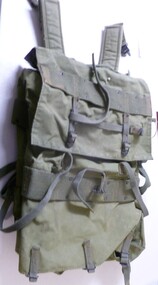
Equipment - Equipment, Army Backpack
... ...Official Duty...He served with the Australian Army Training Team Vietnam from June 1962 to July 1963, Official Duty (from Army Headquarters, Canberra) August 1965, Australian Service Attaché Staff, Saigon from November 1965 to May 1966 and June 1966 to December 1967....He served with the Australian Army Training Team Vietnam from June 1962 to July 1963, Official Duty (from Army Headquarters, Canberra) August 1965, Australian Service Attaché Staff, Saigon from November 1965 to May 1966 and June 1966 to December 1967. ...This item was donated by Maj (Temp) Peter Raymond Young, (240217) who served with the Australian Intelligence Corps. He served with the Australian Army Training Team Vietnam from June 1962 to July 1963, Official Duty (from Army Headquarters, Canberra) August 1965, Australian Service Attaché Staff, Saigon from November 1965 to May 1966 and June 1966 to December 1967.Army khaki canvas backpack and webbing outside camouflage plastic lined. Webbing handle on top. Padded areas on back with padded shoulder straps. Can be opened at either top or bottom. Loops and attachments for storing articles.maj (temp) peter raymond young, 240217, australian intelligence corp, australian army training team vietnam (aattv), official duty, army headquarters, australian service attaché staff, army equipment, backpack -
 National Vietnam Veterans Museum (NVVM)
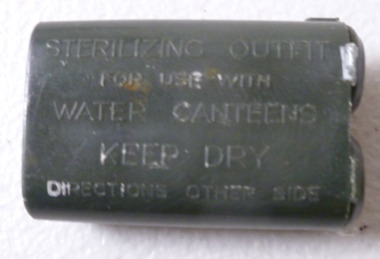
Equipment - Equipment, Army Sterilizing Kit
... ...Official Duty...He served with the Australian Army Training Team Vietnam from June 1962 to July 1963, Official Duty (from Army Headquarters, Canberra) August 1965, Australian Service Attaché Staff, Saigon from November 1965 to May 1966 and June 1966 to December 1967....He served with the Australian Army Training Team Vietnam from June 1962 to July 1963, Official Duty (from Army Headquarters, Canberra) August 1965, Australian Service Attaché Staff, Saigon from November 1965 to May 1966 and June 1966 to December 1967. ...This item was donated by Maj (Temp) Peter Raymond Young, (240217) who served with the Australian Intelligence Corps. He served with the Australian Army Training Team Vietnam from June 1962 to July 1963, Official Duty (from Army Headquarters, Canberra) August 1965, Australian Service Attaché Staff, Saigon from November 1965 to May 1966 and June 1966 to December 1967.Khaki plastic sterilizing kit to containing vials of tablets. Has a strip of Velcro on it used to attach item to webbing.Sterilizing outfit for use with water canteen - keep dry. Directions other side: Follow procedure white tablet first, blue tablet secondmaj (temp) peter raymond young, 240217, australian intelligence corp, australian army training team vietnam (aattv), official duty, army headquarters, australian service attaché staff, army -- equipment, water sterilising, sterilising tablets -
 National Vietnam Veterans Museum (NVVM)
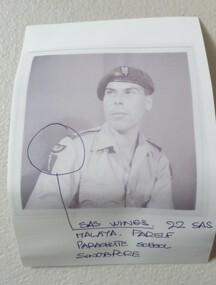
Photograph - A Black and White photograph of Capt. Peter Raymond Young in a Beret and Uniform
... ...Official Duty...He served with the Australian Army Training Team Vietnam from June 1962 to July 1963, Official Duty (from Army Headquarters, Canberra) August 1965, Australian Service Attache Staff, Saigon from November 1965 to May 1966 and June 1966 to December 1967. ...He served with the Australian Army Training Team Vietnam from June 1962 to July 1963, Official Duty (from Army Headquarters, Canberra) August 1965, Australian Service Attache Staff, Saigon from November 1965 to May 1966 and June 1966 to December 1967. ...This item was donated by Maj (Temp) Peter Raymond Young, (240217) who served with the Australian Intelligence Corps. He served with the Australian Army Training Team Vietnam from June 1962 to July 1963, Official Duty (from Army Headquarters, Canberra) August 1965, Australian Service Attache Staff, Saigon from November 1965 to May 1966 and June 1966 to December 1967. Black and white photograph of Capt. Peter Raymond Young in a beret and uniform. Found in top left pocket of his jacket. cat. No. 11889SAS Wings 22 SAS Malaya FARELF Parachute School Singaporemaj (temp) peter raymond young, 240217, australian intelligence corp, australian army training team vietnam (aattv), official duty, army headquarters, australian service attaché staff, sas wings, 22 sas malaya, farelf parachute school singapore, photograhp -
 National Vietnam Veterans Museum (NVVM)
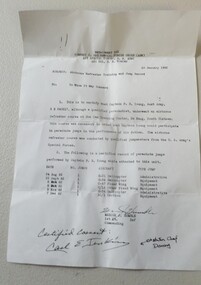
Letter - A letter for Capt. P.R. Young doing a refresher course for parachute jumping so that he could parachute in the course of his duties as Australian Intelligence Service
... ...Official Duty...He served with the Australian Army Training Team Vietnam from June 1962 to July 1963, Official Duty (from Army Headquarters, Canberra) August 1965, Australian Service Attache Staff, Saigon from November 1965 to May 1966 and June 1966 to December 1967....He served with the Australian Army Training Team Vietnam from June 1962 to July 1963, Official Duty (from Army Headquarters, Canberra) August 1965, Australian Service Attache Staff, Saigon from November 1965 to May 1966 and June 1966 to December 1967. ...This item was donated by Maj (Temp) Peter Raymond Young, (240217) who served with the Australian Intelligence Corps. He served with the Australian Army Training Team Vietnam from June 1962 to July 1963, Official Duty (from Army Headquarters, Canberra) August 1965, Australian Service Attache Staff, Saigon from November 1965 to May 1966 and June 1966 to December 1967.A letter for Capt. P.R. Young doing a refresher course for parachute jumping so that he could parachute in the couse of his duties as Australian Intelligence Service dated 10 January 1962 with US special forces. Found in top left hand pocket of jacket. Cat. No. 11889maj (temp) peter raymond young, 240217, australian intelligence corp, australian army training team vietnam (aattv), official duty, army headquarters, australian service attaché staff, parachutist, 173rd airborne, refresher course, ham cam training centre, da nang, u.s. army's special forces, h-21 helicopter, h-34 helicopter, ac/1 caribou -
 National Vietnam Veterans Museum (NVVM)
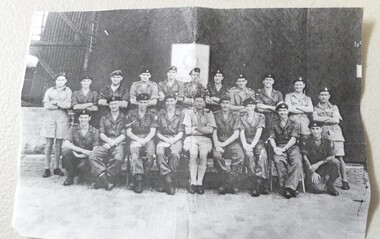
Photograph - A Black and White Photograph of 20 Uniformed Men Having Received Their SAS Wings
... ...Official Duty...He served with the Australian Army Training Team Vietnam from June 1962 to July 1963, Official Duty (from Army Headquarters, Canberra) August 1965, Australian Service Attache Staff, Saigon from November 1965 to May 1966 and June 1966 to December 1967....He served with the Australian Army Training Team Vietnam from June 1962 to July 1963, Official Duty (from Army Headquarters, Canberra) August 1965, Australian Service Attache Staff, Saigon from November 1965 to May 1966 and June 1966 to December 1967. ...This item was donated by Maj (Temp) Peter Raymond Young, (240217) who served with the Australian Intelligence Corps. He served with the Australian Army Training Team Vietnam from June 1962 to July 1963, Official Duty (from Army Headquarters, Canberra) August 1965, Australian Service Attache Staff, Saigon from November 1965 to May 1966 and June 1966 to December 1967.Black and white photograph of 20 uniformed men having received their SAS wings. Capt. Peter Raymond Young in the front row. Found in left hand top pocket of his jacket. Cat. No. 11889Written on the back of the photograph - Young Front Row wearing SAS cap badge ? SAS wings. Parachute ? Singapore 195? Immediately after jump 22 SAS Regiment at KL Malayamaj (temp) peter raymond young, 240217, australian intelligence corp, australian army training team vietnam (aattv), official duty, army headquarters, australian service attaché staff, sas, 22 sas regiment, singapore, parachute, photograhp -
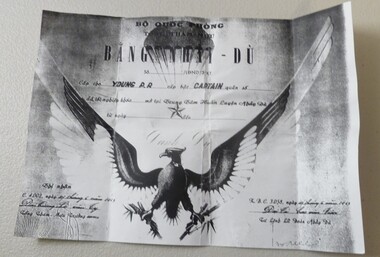 National Vietnam Veterans Museum (NVVM)
Certificate - A Copy of US 1st SF Vietnam Certified for Parachute Jumping for Capt Peter Raymond Young
... ...Official Duty...He served with the Australian Army Training Team Vietnam from June 1962 to July 1963, Official Duty (from Army Headquarters, Canberra) August 1965, Australian Service Attache Staff, Saigon from November 1965 to May 1966 and June 1966 to December 1967....He served with the Australian Army Training Team Vietnam from June 1962 to July 1963, Official Duty (from Army Headquarters, Canberra) August 1965, Australian Service Attache Staff, Saigon from November 1965 to May 1966 and June 1966 to December 1967. ...This item was donated by Maj (Temp) Peter Raymond Young, (240217) who served with the Australian Intelligence Corps. He served with the Australian Army Training Team Vietnam from June 1962 to July 1963, Official Duty (from Army Headquarters, Canberra) August 1965, Australian Service Attache Staff, Saigon from November 1965 to May 1966 and June 1966 to December 1967.Copy of US 1st SF Vietnam certified for parachute jumping. Found in the top left hand pocket of Peter Raymond Young's jacketDetails written in Vietnamesemaj (temp) peter raymond young, 240217, australian intelligence corp, australian army training team vietnam (aattv), official duty, army headquarters, australian service attaché staff, parachute certificate, certificate, sas -
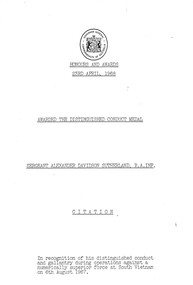 National Vietnam Veterans Museum (NVVM)
Document - A Copy of the documentation for the Awarding of the Distinguished Conduct Medal to Sergeant Alexander Davidson Sutherland, R.A. Inf, Honours and Awards 23rd April, 1968, 1968
... ...Official Duty (from Jungle Training Centre)...Honours and Awards Distinguished Conduct Medal Sgt Alexander (Jock) Davidson Sutherland 311323 Royal Australian Infantry Corps 7th Battalion The Royal Australian Regiment Pte David John Haynes 1731794 Australian National Serviceman 2nd Battalion Military Medal Brig Stuart Clarence Graham 253 Australian Staff Corps Headquarters 1st Australian Task Force Companion of the Distinguished Service Order Maj Brian George Florence 34373 Royal Australian Engineers 1st Field Squadron Official Duty (from Jungle Training Centre) Military Cross Maj Ewart John O'Donnell 235141 5th Battalion Capt William Francis Hindson 37479 1st Battalion 1st Special Air Service Sqnuadron Medal For Gallantry Lt Neville John Clark 279583 Royal Regiment of Australian Artillery 7th Field Regiment 1st Field Regiment 4th Field Regiment 2Lt Graham Henry Ross 37277 WO2 Alec Henry Morris 12840 Australian Army Training Team Vietnam (AATTV) 8th Battalion WO2 Kenneth Alfred Richards 42924 Cpl Harold Charles Spradbrow Sgt Harold Charles Spradbrow 214035 Sgt Ronald Peter Kelly 61652 Royal Australian Army Ordnance Corps 2nd Composite Ordnance Depot 2nd Advance Ordnance Depot George Medal Copies of the documentation for the Awarding of the Distinguished Conduct Medal to Sergeant Alexander Davidson Sutherland, R.A. ...In the newspaper clipping names several soldiers who were awarded various medals for their actions in Vietnam.Copies of the documentation for the Awarding of the Distinguished Conduct Medal to Sergeant Alexander Davidson Sutherland, R.A. Inf. which includes the Citation, a newspaper clipping from The Advertiser dated Wed., April 24, 1968, a newspaper clipping taken on Sgt Sutherland's wedding day and Recommendation or Honours or Awards.honours and awards, distinguished conduct medal, sgt alexander (jock) davidson sutherland, 311323, royal australian infantry corps, 7th battalion, the royal australian regiment, pte david john haynes, 1731794, australian national serviceman, 2nd battalion, military medal, brig stuart clarence graham, 253, australian staff corps, headquarters, 1st australian task force, companion of the distinguished service order, maj brian george florence, 34373, royal australian engineers, 1st field squadron, official duty (from jungle training centre), military cross, maj ewart john o'donnell, 235141, 5th battalion, capt william francis hindson, 37479, 1st battalion, 1st special air service sqnuadron, medal for gallantry, lt neville john clark, 279583, royal regiment of australian artillery, 7th field regiment, 1st field regiment, 4th field regiment, 2lt graham henry ross, 37277, wo2 alec henry morris, 12840, australian army training team vietnam (aattv), 8th battalion, wo2 kenneth alfred richards, 42924, cpl harold charles spradbrow, sgt harold charles spradbrow, 214035, sgt ronald peter kelly, 61652, royal australian army ordnance corps, 2nd composite ordnance depot, 2nd advance ordnance depot, george medal -
 Port Melbourne Historical & Preservation Society
Photograph - Digital image of opening of Maritime Cove 2017, Feb 2017
... She was a persistent advocate for a children' s playground. An official duty was opening Maritime Cove....She was a persistent advocate for a children' s playground. An official duty was opening Maritime Cove. Helen KUCHEL Maritime Cove Port People Digital image of President of Port People opening Maritime Cove. ...Helen KUCHEL was President of Port People for several years. She was a persistent advocate for a children' s playground. An official duty was opening Maritime Cove.Digital image of President of Port People opening Maritime Cove.helen kuchel, maritime cove, port people -
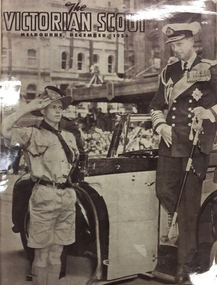 Kew Historical Society Inc
Magazine - Photograph (copy), Scout Association of Victoria, Cover, The Victorian Scout, December 1956, 1956
... During the Royal Visit of 1956, Scouts were selected to undertake official duties....During the Royal Visit of 1956, Scouts were selected to undertake official duties. Cover, The Victorian Scout, December 1956 Magazine Photograph (copy) Scout Association of Victoria ...The Victorian Scout was a monthly magazine produced by the Victorian Branch of the Australian Scout Association.Photographic copy of the cover of the ‘The Victorian Scout’, depicting a Scout opening a door for Prince Phillip. The Scout in the photograph is George Porter, a 1st Kew Scout, who is shown saluting the Prince. ‘The Victorian Scout’ was a monthly magazine for scout leaders. During the Royal Visit of 1956, Scouts were selected to undertake official duties.The Victorian Scout / Melbourne, December, 1956 1st kew scouts, royal visit 1956 (melbourne), scout salutes prince phillip -
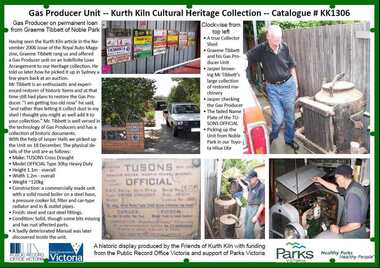 Friends of Kurth Kiln
Tusons Gas Producer Unit, Tusons
... Make: Tysons Cross Draught Model: Official 30hp Heavy Duty Serial: 1368...Make: Tysons Cross Draught Model: Official 30hp Heavy Duty Serial: 1368 A commercially made cast iron unit with a solid round hopper/boiler on a steelframe base. ...In conversation with Mr Tibbett we found out that he obtained this particular unit at an auction in Sydney and brought it home with the intention of one day getting it going again. 'One day' never seemed to come, so he decided to let us have it for our display, rather than jjust collecting dust in his shed.This unit is again of a different manufacturer and construction, highlighting the versatile nature of charcoal producer gas and its applications. A commercially made cast iron unit with a solid round hopper/boiler on a steelframe base. It has a pressure-cooker lid and a car type radiator. Solid built, but rust affected in partsMake: Tysons Cross Draught Model: Official 30hp Heavy Duty Serial: 1368 -
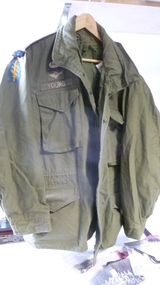 National Vietnam Veterans Museum (NVVM)
Uniform - Uniform, US Army, American Jacket
... He served with the Australian Army Training Team Vietnam from June 1962 to July 1963, Official Duty (from Army Headquarters, Canberra) August 1965, Australian Service Attaché Staff, Saigon from November 1965 to May 1966 and June 1966 to December 1967....He served with the Australian Army Training Team Vietnam from June 1962 to July 1963, Official Duty (from Army Headquarters, Canberra) August 1965, Australian Service Attaché Staff, Saigon from November 1965 to May 1966 and June 1966 to December 1967. ...This item was donated by Maj (Temp) Peter Raymond Young, (240217) who served with the Australian Intelligence Corps. He served with the Australian Army Training Team Vietnam from June 1962 to July 1963, Official Duty (from Army Headquarters, Canberra) August 1965, Australian Service Attaché Staff, Saigon from November 1965 to May 1966 and June 1966 to December 1967.American field jacket owned by Peter Raymond Young 240217, Australian Intelligence Corp (temporary) Major. Khaki lined jacket, long sleeved, four pockets in front, has plastic zipper down middle, also snap fastners and buttons. 1st Special Forces Command (Airborne) shoulder sleeve insignia. Two jump wings insignia on rithe breast over the name young. Zippered pocket on back of collar240217 Capt young, Aust Int corps written in black texta on right bottom of lined jacketamerican army jacket, us army, maj (temp) peter raymond young, 240217, australian intelligence corp, australian army training team vietnam (aattv), australian service attache staff, saigon, clothing -
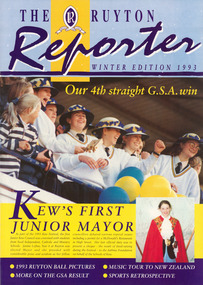 Ruyton Girls' School
Magazine, Ruyton Reporter, 1993
... Janine Loftus, Year 6 at Ruyton was / elected Mayor and she presided with / considerable poise and wisdom as her fellow / councillors debated various topical issues / including a permit for a McDonald's Restaurant / in High Street. Her last official duty was to / present a cheque - the result of fund-raising / during the Festival - to the Asthma Foundation / on behalf of the Schools of Kew. / 1993 RUYTON BALL PICTURES MUSIC TOUR TO NEW ZEALAND / MORE ON THE GSA RESULT SPORTS RETROSPECTIVE /...Janine Loftus, Year 6 at Ruyton was / elected Mayor and she presided with / considerable poise and wisdom as her fellow / councillors debated various topical issues / including a permit for a McDonald's Restaurant / in High Street. Her last official duty was to / present a cheque - the result of fund-raising / during the Festival - to the Asthma Foundation / on behalf of the Schools of Kew. / 1993 RUYTON BALL PICTURES MUSIC TOUR TO NEW ZEALAND / MORE ON THE GSA RESULT SPORTS RETROSPECTIVE / Colour publication printed on paper with staple binding. 12 pages. ...The Ruyton Reporter (formerly known as Ruyton Reports) captures the essential Ruyton Girls' School experience for the broader school community. It has been produced since 1986.The record has strong historic significance as it pertains to one of the oldest girls' school in Victoria, Australia. Ruyton was founded in 1878 in the Bulleen Road, Kew, home of newly widowed Mrs Charlotte Anderson (now High Street South). Thus, the record can be used as a reference example for research into Victorian school history. It also gives insight into the types of activities and events undertaken at Ruyton Girls' School during the period of its production. The record's significance is further enhanced by its exceptionally well-documented provenance, having remained the property of Ruyton Girls' School since its production.Colour publication printed on paper with staple binding. 12 pages.Front Page: THE R RUYTON / RECTE ET FIDE LITER / Reporter / WINTER EDITION 1993 / Our 4th straight G.S.A. win / KEW'S FIRST / JUNIOR MAYOR / As part of the 1993 Kew Festival, the first / Junior Kew Council was convened with students / from local Independent, Catholic and Ministry / Schools. Janine Loftus, Year 6 at Ruyton was / elected Mayor and she presided with / considerable poise and wisdom as her fellow / councillors debated various topical issues / including a permit for a McDonald's Restaurant / in High Street. Her last official duty was to / present a cheque - the result of fund-raising / during the Festival - to the Asthma Foundation / on behalf of the Schools of Kew. / 1993 RUYTON BALL PICTURES MUSIC TOUR TO NEW ZEALAND / MORE ON THE GSA RESULT SPORTS RETROSPECTIVE /ruyton girls' school, ruyton, school, students, newsletter, ruyton reports, ruyton news, kew, victoria, melbourne, girls school -
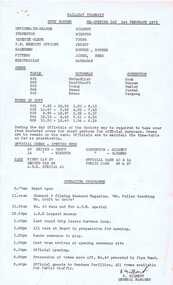 Ballarat Tramway Museum
Document - Roster, Ballarat Tramway Preservation Society (BTPS), "Duty Roster Re-opening Day 1st February 1975", Jan. 1975
... Gives details of officers, crews, time of duty, official crews, trams operated and operating programme, including the ARE visit. 2nd copy added 5/5/06....Gives details of officers, crews, time of duty, official crews, trams operated and operating programme, including the ARE visit. 2nd copy added 5/5/06. ...Duplicated sheet of foolscap paper, titled "Ballarat Tramways / Duty Roster Re-opening Day 1st February 1975" outlining the arrangements for the re-opening celebrations. Gives details of officers, crews, time of duty, official crews, trams operated and operating programme, including the ARE visit. 2nd copy added 5/5/06.trams, tramways, btps, opening, celebrations, rosters -
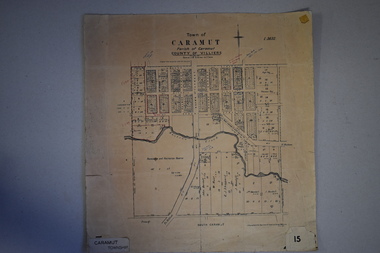 Warrnambool and District Historical Society Inc.
Map, Department of Lands and Survey (Lithographers), Caramut township, 1938
... Both Rolf Crawley and his father, John had private businesses as architects, surveyors and engineers and the map could have been used in connection with both their official Shire duties and their private businesses. ...Both Rolf Crawley and his father, John had private businesses as architects, surveyors and engineers and the map could have been used in connection with both their official Shire duties and their private businesses. ...This map of the township of Caramut was produced in 1938 but shows the original land owners of each town allotment and of the surrounding area. The size of all the allotments and the date of the original purchase are also shown. Caramut is a Victorian Western District town on Mustons Creek on the Hamilton Highway 48 kilometres from Warrnambool. This map was used by Rolf Crawley when he was the engineer for the Shire of Warrnambool from 1935 to 1968. The annotations on the map have probably been made by Rolf Crawley as they refer to the records and letter books of his father, John William Crawley, Junior (Shire of Warrnambool Engineer 1895 to 1935). Both Rolf Crawley and his father, John had private businesses as architects, surveyors and engineers and the map could have been used in connection with both their official Shire duties and their private businesses. The last owner of the map was the surveyor, Michael Hand who took over the business of Rolf Crawley in the late 1960s. This map is of great interest firstly because it has all the historical details of the land first purchased in the town of Caramut and area and secondly because it came from the office of Rolf Crawley, the engineer for the Shire of Warrnambool from 1935 to 1968. This is a buff-coloured paper map with a cloth backing. The map details are in black and white print. There are some handwritten red and black annotations on the map. “Town of Caramut Parish of Caramut County of Villiers’town of caramut, john william crawley junior, warrnambool, rolf crawley, warrnambool -
 Eltham District Historical Society Inc
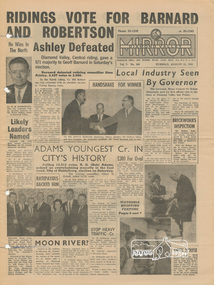
Newspaper, Diamond Valley Mirror, Tuesday, August 31, 1965
... Docksey's last official duty as President. Separate article on the clipping includes the heading: President Rests in Comfort with a photograph and text: A Tribute to Cr. ...Docksey's last official duty as President. Separate article on the clipping includes the heading: President Rests in Comfort with a photograph and text: A Tribute to Cr. ...Includes Newspaper article on page three "Living Memorial Is Trust's Gift To A Shire" a second clipping of which is also attached to cardboard for display purposes. Article includes text and photographs. Living Memorial is Trust's Gift To A Shire Bathed in bright sunshine and now at its best, the Memorial Garden of the Eltham War Memorial provided a perfect setting for the handing over of the Memorial to the people of Eltham last Saturday afternoon. Speaking for the War Memorial Trust, Mr E. P. Harmer, chairman paid tribute to the unselfishh service given by its members , some for more than 20 years. Special tribute was paid to the late Mrs Ada Lyon, a foundation member who, Mr Harmer said, made the Trust her life. A memorial plaque to Mrs Lyon was unveiled by foundation members Mr N. Kerr. Facilities. An infant welfare centre, a pre-school cente and a children's library are built within the memorial. Funds for the buildings were raised by the Trust and theh women's auxiliary. Accepting the Memorial on behalf of the people of the Shire, the Shire President, Cr. L. C. Docksey, assessed the value at beyond £50,000. To make the transaction legal, Cr. Docksey paid the sum of £1 to the Trust. Many foundation members of the Trust and councillors of the Shire were among the official guests. The Shire of Eltham Brass Band provided suitable background music for the ceremony and at. (remaining part of article is missing) Photo: Mrs C RAINS signs the agreement on behalf of the Eltham War Memorial Trust, transferring the Memorial to the Shire of Eltham, as Mr L. Virgo, secretary of the Trust, affixes the seal and Mr. E. P. Harmer, chairman, accepts payment of £1 from Cr. L. C. Docksey, Shire President. In the background are Mrs Harmer, Cr. T. Collins and Mr S. Addison. Accepting the Memorial on behalf of the people of the Shire was Cr. Docksey's last official duty as President. Separate article on the clipping includes the heading: President Rests in Comfort with a photograph and text: A Tribute to Cr. A. K.Lines, first President of the Shire of Diamond Valley, was paid by fellow councilors last Tuesday night. Acting on behalf of all members of the council, Cr. George Upton, in presenting Cr Lines with an armchair, expressed gratitude for his guidance and assistance to the new shire. Newspaper, 12 pages with four holes punched through near centre margin.eltham war memorial building,eltham war memorial trust,eltham pre-school,e. p. harmer,mrs ada lyon,mrs n. kerr,cr. l. c. docksey,shire of eltham brass band,cr. a. k. lines,diamond valley mirror,1965,cr t. collins,mr. s. addison -
 Bendigo Military Museum
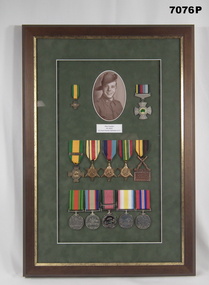
Award - MEDALS & PHOTOGRAPH WW2, Post WW2
... Defence medal, official. 2.Australian Service medal 1939 - 45, official. 3. For Combatant duties in active service, unofficial. 4. ...Defence medal, official. 2.Australian Service medal 1939 - 45, official. 3. For Combatant duties in active service, unofficial. 4. ...Maxwell Barry Cowden VX19297 enlisted in the 2/nd AIF on 30.5.1940 age 18 years (put his age up to 21) in 2/2 Pioneer Battalion AIF, embarked for the Middle East 8.4.1941, promoted L/Cpl 25.6.1941, promoted Cpl 29.10.1941, took part in the Syrian Campaign. On 31.1.1942 the unit embarked for Australian but were diverted to Java to defend it, disembarked 18.2.1942. Java surrendered and they were taken POW, reported MIA on 30.4.1942 then after as POW. As a POW he worked on the Burma Railway. In December 1944 they were on the Hell Ship AWA Maru and sailed for Japan to work in the Coal Mines arriving mid Jan 1945. He was repatriated back to Australia on the HMS Formidable, discharged on 28.11.1945 with the rank of Cpl. Refer also Cat No 7077.Brown wood frame with gold edge, contains a photo and medals on a green background re a WW2 soldier/POW. The medals are a mixture of official and unofficial not in the correct order. Medals top. 1. Miniature Dutch medal 1942 - 45 official. 2. Prisoner of war medal, commemorative unofficial. Centre row. 1.Dutch medal 1942 - 45 official. 2. Africa star, official. 3. 1939 - 45 Star, official. 4. Pacific Star, official. 5. Front line service medal, unofficial. Bottom. 1. Defence medal, official. 2.Australian Service medal 1939 - 45, official. 3. For Combatant duties in active service, unofficial. 4. Foreign service medal, unofficial. 5. British war medal 1939 - 45, official."Max Cowden VX19297 2/2 Pioneer Battalion AIF"award, medals, photo, pow, 2/2 -
 Bendigo Historical Society Inc.
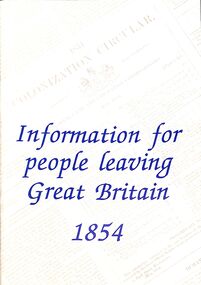
Book - "Information for people leaving Great Britain. 1854.", 1990
... Economic Data: Prevailing local wages, labour demands, and retail prices for provisions and clothing. Official Regulations: Names and duties of emigration officers, summaries of passenger acts, and rules for land sales or crown land disposal. ...Economic Data: Prevailing local wages, labour demands, and retail prices for provisions and clothing. Official Regulations: Names and duties of emigration officers, summaries of passenger acts, and rules for land sales or crown land disposal. ...Colonization Circulars were published in England from 1843 t0 1873, volumes 1 to 32. They were produced by Her Majesty's Colonial Land and Emigration Commissioners. Designed as occasional or annual handbooks to inform prospective migrants about life, travel, and economic conditions in British colonies, including Australia, New Zealand, Canada, and South Africa. Key information included: Travel Details: Costs and lengths of sea passages, and notes on assisted passage schemes. Economic Data: Prevailing local wages, labour demands, and retail prices for provisions and clothing. Official Regulations: Names and duties of emigration officers, summaries of passenger acts, and rules for land sales or crown land disposal. Practical Advice: Suggested outfit requirements for the voyage and guidelines for settlers. Colonial Land and Emigration Commission was created in 1840 to undertake the duties of two earlier and overlapping authorities under the supervision of the secretary of state: the Colonisation Commissioners for South Australia and the Agent General for Emigration. In 1855 it became the Emigration Commission. The commission's powers were gradually given up to the larger colonies as they obtained self-government, and after 1873 it was responsible only for controlling the importation of Indian labour into sugar-producing colonies. It was abolished in 1878 and an Emigration Department was then set up in the Colonial Office. This department was merged with the General Department in 1894, and abolished altogether in 1896. Soft cover. Title written in Royal Blue on front cover. Feint newspaper articles as background on both front and back covers. 38pp. Printed by Acacia Press Pty. Ltd. ISBN 0947158170. Published by Macbeth Genealogical Books, Hampton. The book is a facsimile of the Colonization Circular in May, 1854. No diagrams. colonization circular, emigration, travel -
 Uniting Church Archives - Synod of Victoria
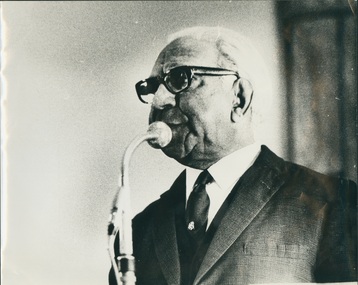
B&W photo of another photo or newspaper photograph of Pastor Sir Douglas Nicholls, Undated
... On 1 December 1976 Sir Douglas was appointed Governor of South Australia, but his health deteriorated within weeks, making it difficult for him to perform his official duties. In March 1977 he hosted Queen Elizabeth during her royal tour and was appointed KCVO. ...On 1 December 1976 Sir Douglas was appointed Governor of South Australia, but his health deteriorated within weeks, making it difficult for him to perform his official duties. In March 1977 he hosted Queen Elizabeth during her royal tour and was appointed KCVO. ...Sir Douglas Ralph Nicholls (1906-1988), footballer, pastor, activist and governor, was born on 9 December 1906 at Cummeragunja Aboriginal mission, New South Wales, fifth child of Herbert Nicholls, seasonal worker, and his wife Florence, née Atkinson. Doug grew up at Cummeragunja, on the Murray River near Barmah, in its golden years of Aboriginal autonomy. Thomas Shadrach James gave him and other Yorta Yorta children a sound primary education, reinforcing the pride and self-assurance gained from their parents. As Doug grew, so too did the powers of the State’s Aboriginal Protection Board. Doug’s elder sister Hilda was removed about 1915. When Doug reached 14, he was moved off under the Aborigines Protection Act (1909) to find work. He took a job with dredging teams constructing levees on the Murray. Like other youths in the region Nicholls played Australian rules football, emulating kinsmen who had won local premierships since the 1890s. Doug and his brother Herbert (‘Dowie’) played with Tongala in the mid-1920s. Melbourne football beckoned, Doug trying out unsuccessfully for Carlton in 1927. He signed with the Northcote Victorian Football Association team, despite his nervousness about his Aboriginality, and was given a job with Northcote City Council. ‘Dowie’ joined him for a season. Doug was short at 5 ft 2 ins (158 cm), but muscular and lightning fast. He competed regularly during a boom in professional running, winning many heat and place prizes. In 1929 he won the Nyah and Warracknabeal gifts, earning a sash and £100 in each, together with a case of cutlery in the latter. Using his speed on the wing for Northcote, he produced great spring and agility from his compact body. The Sporting Globe reported in 1929 that ‘he flashes through packs of big men, whisks around small men . . . and attempts marks at the back of any six-footer’. In front-on clashes he was flattened only to rise again. The sole Aborigine in the VFA, he was known affectionately as the ‘flying Abo’ but called worse by his opponents’ barrackers. He competed for five seasons, being named ‘best and fairest’ twice, appearing in three association grand finals and winning in 1929. Keen to earn more than a seasonal wage, in 1931 Nicholls accepted a three-year contract with Jimmy Sharman’s travelling boxing show. The bouts matched opposites, local against tent boxer, white against black, and sometimes men of different sizes. He faced stiff competition from those who wanted to best the noted Melbourne black footballer, the crowd adding racial abuse. A far better footballer than boxer, he copped some punishment. Fighting in the Melbourne Stadium in December 1931, he was described by Truth as ‘slow and awkward’, but packing a ‘good wallop’. In 1932 Sharman, who treated his boxers fairly, released Nicholls to join the Fitzroy Victorian Football League team, which agreed to employ him as its groundsman. He played fifty-four games for Fitzroy over six seasons until knee trouble forced him out in 1937. Winning cups in 1934 and 1935, he played alongside Haydn Bunton and Wilfred (‘Chicken’) Smallhorn. Grand finals eluded him but he represented Victoria twice. Following his mother’s death, Nicholls revisited the Church of Christ chapel in Northcote, where they had worshipped together. On 17 July 1932 he experienced a conversion. He was soon baptised and witnessed openly, leading his fellow footballers to occasional church parades. Nicholls exhibited leadership qualities. William Cooper, founder of the Australian Aborigines’ League and Nicholls’ Yorta Yorta kinsman and fellow Christian, encouraged the young footballer. In February 1935 Cooper, Nicholls and others lobbied Thomas Paterson, the Commonwealth minister for the interior, over the need for Federal control of Aboriginal affairs. Nicholls attended the Day of Mourning protest for Aborigines held in Sydney on 26 January 1938, declaring: ‘after 150 years our people are still influenced and bossed by white people. I know we can proudly hold our own with others if given the chance’. When Cooper retired in November 1940 Nicholls became secretary of the AAL. On 2 June 1941 Nicholls enlisted in the Citizen Military Forces. He trained at Seymour and Bonegilla before being posted to the 29th Battalion. As Major Frank Corr’s batman, he was popular with other soldiers who tolerated his preaching and Bible reading. His army service was brief, however, and he was discharged in Melbourne on compassionate grounds on 22 January 1942. His biographer claimed that the Fitzroy police requested his return to mediate in the racial tensions developing between servicemen and the mostly respectable Aboriginal families living in crowded and dilapidated Fitzroy housing; Aboriginal people maintain that they requested his release. Nicholls began welfare work and religious services from an Aboriginal home in Gertrude Street, Fitzroy. In April 1942, ‘Dowie’ died of road accident trauma, leaving his wife, Gladys, née Bux, and three children. On 26 December 1942 at Moama Methodist Church, New South Wales, Nicholls married her, a caring gesture which developed into a loving partnership. In January 1943 he initiated ‘Aboriginal Sunday’, featuring a gum leaf orchestra and choir. By 1955 this service had moved to July and later evolved into National Aborigines and Islanders Day Observance Committee (NAIDOC) week. Ordained a Churches of Christ pastor in 1945, Nicholls conducted a vigorous ministry from a chapel in Gore Street, Fitzroy. His work survived on donations, a small honorarium, and his employment as team coach (1947) and curator at the Northcote Football Ground. In the 1950s Gladys established grocery and opportunity shops to earn income and provide services. Their house soon overflowed with people in need or visitors to Melbourne. Nicholls also hosted inspiring African American visitors such as the pianist Winifred Attwell and the singer Harry Belafonte. His ministry extended to Aboriginal country communities. Gladys taught Sunday school, undertook endless fund-raising and welfare work beside her husband, and became his greatest supporter and financial manager. They formed an Aboriginal Girls’ Hostel in 1956, for which they acted as house parents, and bought holiday units for Aborigines at Queenscliff. Persistently advocating Aboriginal rights, Nicholls protested about the impact of the Woomera rocket range on the people of the Warburton Ranges, co-ordinated the production of a concert, Out of the Dark, scripted by Jean Campbell, to rectify the omission of Aborigines from Victoria’s Commonwealth jubilee celebrations, and criticised the Victorian Aboriginal Protection Board. In 1957 when the board was transformed into the Aborigines’ Welfare Board, he and Harold Blair were appointed as Aboriginal representatives. Maintaining the stance of a political moderate, he did not bear grudges and sought to build bridges between black and white. He co-operated with any group that aided the cause, including the Council of Aboriginal Rights, whose executive were members of the Communist Party of Australia. This association attracted the attention of the Australian Security Intelligence Organization, which in 1957 began to keep a file on Nicholls. In May 1957 Nicholls formed the Victorian Aborigines Advancement League with Doris Blackburn and Gordon Bryant, a Federal parliamentarian. As its paid field officer and spokesman, Nicholls contested assimilation policies and used film to raise awareness of issues. When the Welfare Board attempted to close Lake Tyers reserve, Gippsland, he resigned in disgust and led a protest march on parliament in May 1963. The AAL also petitioned the United Nations on land rights in June, perhaps the first indigenous body to do so. He argued for new premises at 58 Cunningham Street, Northcote, opened in 1966 as the ‘Doug Nicholls Centre’. In 1958 Nicholls was a foundation member of the Federal Council for Aboriginal Advancement (Federal Council for the Advancement of Aboriginal and Torres Strait Islanders after 1964), which he served as national field officer (1961) and Victorian secretary (1962-63). While an innovator in tactics, he was alarmed by the influence of confrontational ‘black power’ politics in the AAL and resigned as a director amid turmoil on this issue in 1969, claiming the concept was a ‘bitter word’, not needed in Australia. Similar tensions in FCAATSI led him to join with Kath Walker (Oodgeroo Noonuccal) in establishing the short-lived National Tribal Council as an alternative forum. As the AAL leadership moderated their stance, he returned as president (1969-74) of the new all-Aboriginal organisation. He was also a keen patron of the National Aboriginal Sports Foundation, founded in 1969. Many honours were conferred on Nicholls: he was appointed MBE (1957) and OBE (1968) and knighted (1972). In 1962 he was named Victorian ‘Father of the Year’ and the State’s second Aboriginal justice of the peace. Crowned Melbourne’s 1973 King of Moomba, he was declared Bapu Mamus (a Torres Strait term for ‘headman’) by the NTC. On 1 December 1976 Sir Douglas was appointed Governor of South Australia, but his health deteriorated within weeks, making it difficult for him to perform his official duties. In March 1977 he hosted Queen Elizabeth during her royal tour and was appointed KCVO. He relinquished his governorship on 30 April 1977 following a stroke. Ill health continued to dog him during retirement, but he played his Nelson Eddy records, enjoyed his expanding family, and when able, ministered to the Aboriginal Church at the League’s premises. Sir Douglas Nicholls died on 4 June 1988 at Mooroopna, predeceased (1981) by his wife and survived by his five children. He was given a state funeral and buried in tribal ground at Cummeragunja cemetery. Among the many tributes to him are an oval at Northcote, handed to the AAL in 1982, a Canberra suburb gazetted in 1991, and a fellowship for Indigenous leadership established in 2003, all in his name, and a statue of Sir Doug and Lady Nicholls by Louis Laumen, unveiled in 2007 in Parliament Gardens, Melbourne. Sir Douglas Nicholls is shown speaking at a microphone; head and shoulders; dressed in a suit.Pastor Douglas Nicholls -
Glen Eira Historical Society
Document - ROTARY CLUB OF CAULFIELD
... This file contains 13 official documents pertaining to the Rotary Club of Caulfield: 1/A typewritten copy of the constitution of the Rotary Club of Caulfield (undated). Said document is essentially an instruction manual detailing how the Club is to be administered and the duties of officials. 2/A page (unclear if intended for use as a poster or letter) announcing a Business Persons Breakfast to be held at St. ...This file contains 13 official documents pertaining to the Rotary Club of Caulfield: 1/A typewritten copy of the constitution of the Rotary Club of Caulfield (undated). Said document is essentially an instruction manual detailing how the Club is to be administered and the duties of officials. 2/A page (unclear if intended for use as a poster or letter) announcing a Business Persons Breakfast to be held at St. ...This file contains 13 official documents pertaining to the Rotary Club of Caulfield: 1/A typewritten copy of the constitution of the Rotary Club of Caulfield (undated). Said document is essentially an instruction manual detailing how the Club is to be administered and the duties of officials. 2/A page (unclear if intended for use as a poster or letter) announcing a Business Persons Breakfast to be held at St. Anthony’s Parish Hall on 19/11/1986, wherein Jeff Kennett, M.L.A., Leader of the Opposition of the Parliament of Victoria, will deliver a speech titled ‘Responsibility Before Rights’. 3/A booklet announcing the 25th anniversary celebration of the Rotary Club of Caulfield, to be held at Tudor Court on 24/02/1987. Contains the menu, national anthem, programme, and two lists – one of the founding members of the Club and one of the extant members of the Club. 4/Two copies of a booklet announcing a dinner, to be held at Tudor Court on 10/11/1987, wherein charter will be presented to the Rotary Club of Caulfield-Rosstown by District Governor Ian Knight. Contains a list of extant staff, the menu, the programme, a description of the history of the ‘Wembley Wheel of Friendship’, a list of charter members, and an account of the etymology of the name ‘Rosstown’. 5/Two copies of a page featuring four items of relevance to the Rotary Club of Caulfield. The first is an article (titled ‘Rotary scholar makes it’, author unspecified, source unspecified, undated) about Club scion Mark Collard receiving an MBA from Clarkson University. The second is an article (titled ‘New Caulfield Rotary’, author unspecified, source unspecified, undated) about the presentation dinner to which item 7 pertains. (This article is not present in its entirety, trailing off at the end.) The third is an announcement of a ‘progressive dinner’ to be held on 28/11/1987, also containing an announcement of a bicentennial conference to be held on 19/03/1988. The fourth is an announcement of what appears to be the initiation of some sort of historical re-enactment, the proceeds of which will fund the Rotary Club’s ‘Polio Plus’ project. A title (‘A Long Haul Through Caulfield’) suggests this item may be the header section of an article about said event, but if so, the remainder is not present. Contains three black-and-white photographs; one of Collard with an unidentified woman (presumably his wife), one of Club President Howie Dunlop congratulating Charter President Geoff Oscar, and one of some men riding on a horse-drawn cart. 6/Two copies of a booklet announcing a President Changeover Dinner, to be held on 28/06/1988. Contains the menu, programme, and a list of extant members. 7/Two copies of the weekly bulletin of the Rotary Club of Caulfield, dated 28/06/1988. Contains lists of faculty, notification of the Club’s decision to admit women, notification of upcoming events, a biography of guest speaker Fred Epstein, and a list of the times and places of alternative meetings. 8/Two photocopied statements of the receipts and expenditure of the Rotary Club of Caulfield, one for the period 01/10/1989 – 30/06/1990, and one for the period 01/07/1990 – 27/08/1990. 9/The photocopied minutes of a New Members Committee Meeting of the Rotary Club of Caulfield, dated 02/08/1990. Objects of discussion include fundraising methods and application of funds. 10/A booklet announcing Change Over Night, dated 21/06/1994. Contains the programme, menu, national anthem, and a list of extant faculty. 11/4 unbound pages announcing the winners of the Rotary Youth Photographic Awards, dated 1995 (a more specific date than this is not given). (Pages contain no photographs.) 12/A small note announcing the Murrumbeena Community Market, to be held on 04/12/2010, of which the Rotary Club of Caulfield is one of the sponsors. 13/A booklet announcing a dinner to celebrate the 50th anniversary of the Rotary Club of Caulfield, to be held on 23/02/2012. Contains the programme, menu, a list of past presidents, a description of the history of the Gifu Vase (a trophy in the Club’s possession), and a list of some of the charity projects the Club has been engaged in.rotary club of caulfield, clubs and associations, charitable organisations, kennett jeff m.l.a., st. anthony’s parish hall, grange road, neerim road, glenhuntly, festivals and celebrations, tudor court, gray robin, baird jack, lord john, king john, crittenden doug, gelme anthony, hunkin ed. rev., fryer roy, quine john, bedford f., bell jim, bunny d., cripps e., don john, epstein fred, hattam j., howard w., kerry g., kumnick j., kurrie s., lord l., morrison charles, nelson h., parton willis, perry bruce, pollard r., price f., skuse e., stillwell g., tilley norman, tomlinson charles, watson don, webster j., wilson duncan, fincher roy, wheller john, allen selwyn, christopher don, cohen godfrey, davis keith, davis lloyd, dornbierer w., dunlop howie, fillmore wally, ford john, ford peter, forshaw ken, gales brian, green myer, hind jim, humphreys john, hunter ian, lewis ray, melville jack, oscar geoff, penaluna harry, perlen louis, rampling ross, ronaldson keith, sherlock max, sicklemore graham, smith barry, stapleton ted, summers ron, tovey david, rotary club of caulfield-rosstown, knight ian, tudor court, kooyong road, bellmaine mark, langfelder kurt, morris rob, rome graeme, alma club, wilks street, wills david, blankfield mark, awards, wembley wheel of friendship, bellmaine loretta, cunningham david, cunningham jean, davis pam, davis rex, davis judith, forshaw hannah, graham jeremy, graham kara, hassing andre, hassing arlette, jacobs frank, jacobs june, langfelder judy, morris robert, morris angela, nettlebeck rosalie, oscar enid, rattray john, rattray diana, rome lorraine, sarah ted, sarah denise, sherlock helen, smith suzanne, stapleton jackie, turner brook, turner vicki, tuhiwai tamati, tuhiwai ravina, will arnold, will claire, rosstown, ross william murray, rosstown sugar works, collard mark, rotary foundation, keller chuck, campbell felicitie mrs., campbell jack cr., knight genny, albury civic centre, green tess, tantram avenue, quine gwen, beaver street, rosalind ray, rosalind lweis, devon street, little company of mary hospital, polio plus, smith ian, jackson adrian, miller peter, spence bert, wheller denise, coffey bill, financial documents, receipts, gilmartin e., moran d., kaan a., fillmore wal, coleman peter, coleman moyrha, wesley college elsternwick big band, puddy mark, fradkin barry, fitzgerald gerald, renton robert, herschberg gedeon, kinston david, montgomery peter, dawes shane, silberberg henry, zazryn ben, cohen michael, rotary youth photographic awards, photographic competitions, photography, terry ted mr., terry e. a. mr., eldridge hannah, cottral anne, abdullahi khalid, gostin cassie, podlabeniouk lena, diyab ahmed, draca julijana, pevkoski danilla, wooster heath, lesar dion, sansoni rachel, leatham chelsea, townsend jessie, barker megan, fitzgerald megan, maokhamphiou anthony, smith naomi, fraser sue-ellen, white tanya, murrumbeena community market, koornang uniting church, murrumbeena road, welsh heather, robinson david, kesselschmidt sima, potasz sophie, southwick david, cheyne gordon, ryall keith, arianti listy, westbrook natasha, pollard bob, hancock irey, lovett jack, cooper alby, rundle john, patkin nehama, mcmullen adele, douglas jennie, preston mark, resubal loreto, gifu vase, aoki seiichi, operation firewood, alfred hospital, bus of knowledge, australia day breakfast, bethlehem hospital, caulfield hospital -
 Flagstaff Hill Maritime Museum and Village
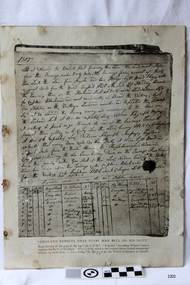
Document - Log Book page, 21/10/1805
... duty...hms victory...sir home popham’s telegraphic code...admiralty official...duty”. Nelson’s signal was transmitted from his ship HMS Victory in 12 separate flag-hoists, according to Sir Home Popham’s Telegraphic Code that had been supplied to the fleet as an experiment, with the numerical flags of the Admiralty official Day Signal book (1799 issue). ...duty”. Nelson’s signal was transmitted from his ship HMS Victory in 12 separate flag-hoists, according to Sir Home Popham’s Telegraphic Code that had been supplied to the fleet as an experiment, with the numerical flags of the Admiralty official Day Signal book (1799 issue). ...This document is a reproduction of the page of the log book from the vessel HMS Euryalus, recording Nelson's famous signal at the Battle of Trafalgar. On October 21, 1805, Admiral Lord Nelson led the British Navy to victory against the French and Spanish navies in the Atlantic Ocean. The event became known as the Battle of Trafalgar. To commence the battle Nelson commanded his now-famous flag signal “England expects that every man will do his duty”. Nelson’s signal was transmitted from his ship HMS Victory in 12 separate flag-hoists, according to Sir Home Popham’s Telegraphic Code that had been supplied to the fleet as an experiment, with the numerical flags of the Admiralty official Day Signal book (1799 issue). The signal flags comprised eight that represented whole words and four that represented single letters - [ENGLAND] [EXPECTS] [THAT] [EVERY] [MAN] [WILL] [DO] [HIS] [D] [U] [T] [Y]. Nelson’s signal was received by the ‘reporting frigates’ who would then send them on to the other vessels. The signal was recorded by Captain Henry Blackwood who was in command of the HMS Euryalus. Captain Blackwood led a squadron of frigates, reporting back to Nelson on the movement of the French and Spanish fleets. Nelson’s famous signal was recorded in the log book of Euryalus and repeated to other vessels. The original log book is a canvas-backed manuscript written up from hour to hour during the battle. It is in the Nelson Collection at Lloyd's. Lloyd’s of London is a large insurance company in the United Kingdom. In 1803 Lloyd’s founded the Lloyd’s Patriotic Fund to honour the brave and provide for the wounded and dependents of those killed in major Napoleonic battles. Over the years Lloyd’s has accumulated an assorted collection of artefacts and memorabilia associated with Nelson, including this log book from HMS Euryalus. In 2003 Lloyds created a temporary exhibition to mark the bicentennial of Nelson’s Battle of Trafalgar. The display included key items from the Nelson Collection celebrating Nelson’s role in British Naval History. Lloyd’s now has a department called The Nelson Collection and Heritage Floor where historical artifacts are displayed and the story of Lloyd’s 300 years of history is told. This document, being a reproduction, is not significant in itself. However it's content is of historical significance for its connection to Admiral Nelson and The Battle of Trafalgar. Through the leadership and victory of Nelson, the British obtained the mastery of the seas over the French and Spanish and opened up the way for Britain to colonise many countries including Australia. The document is also associated with a wood sample from Napoleon's ship Victory that is in our Collection.Reproduction of a page of the log book of HMS Euryalus recording Nelson's famous signal at the Battle of Trafalgar. The original log book entry was handwritten, dated 21 Oct 1805.flagstaff hill, warrnambool, shipwrecked-coast, flagstaff-hill, flagstaff-hill-maritime-museum, maritime-museum, shipwreck-coast, flagstaff-hill-maritime-village, log book, flag signal, hms euryalus, nelson's famous signal, battle of trafalgar, october 21, 1805, admiral lord nelson, french and spanish navies, england expects that every man will do his duty, hms victory, sir home popham’s telegraphic code, admiralty official day signal book (1799 issue), reporting frigates, captain henry blackwood, canvas-backed manuscript, nelson collection at lloyd's, lloyd’s of london, lloyd’s patriotic fund, napoleonic battles, british naval history -
 Flagstaff Hill Maritime Museum and Village
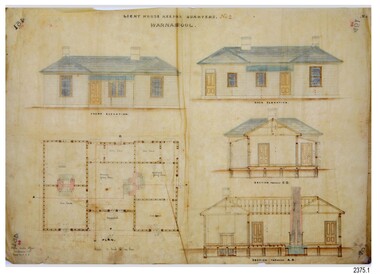
Document - Plans, Lighthouse Keeper's Quarters Warrnambool, 1858-1909
... official titles of Senior Assistant Lighthouse Keeper and Assistant Lighthouse Keeper. They were employed by the Public Service and paid rent to live in the Lighthouse Quarters. They were compulsorily retired at the age of 60, with most receiving a superannuation payment. Despite their time-consuming duties...official titles of Senior Assistant Lighthouse Keeper and Assistant Lighthouse Keeper. They were employed by the Public Service and paid rent to live in the Lighthouse Quarters. They were compulsorily retired at the age of 60, with most receiving a superannuation payment. Despite their time-consuming duties ...The set of seven 1858 plans shows proposed plans for the original Lighthouse Complex that was built on Middle Island in 1858-1859. The whole complex was then transferred to Flagstaff Hill in 1871. The plan, dated 1909, is for proposed additions and repairs to the Quarters at Flagstaff Hill. The plan 'Alterations and Additions' shows alternate plans for changes to the quarters at the Flagstaff Hill location. This plan has no date. The Complex comprised the Lighthouse, the Lighthouse Keepers’ Quarters, the Store (now called the Chart Room) and a Privy, which was not included in these plans. The Keeper’s bluestone Quarters was a cottage divided into two compartments, one for each keeper and his family. The bluestone Store was divided into three; a store, a workshop an oil store (or office). The Privy comprised of a small building also divided into two separate, back-to-back toilets, one for each Keeper and his family. The Flagstaff Hill Keeper's Quarters have had extensions and additions at various times, and these have also been removed at various other times. THE PLANS - *Dec. 1858 (12/58) ‘Lighthouse Keepers Quarters No.2 Warrnambool’ (2375.01)* Public Works Office Melbourne – Front and Back elevations, sections, and floor plan. The drawing shows timber walls. [The floor plan is the closest plan to the current building, however, the walls are timber in this plan.] *Nov. 1858 – No.3 ‘Lighthouse Keepers Quarters Warrnambool’ (2375.02)* Office of Public Works, Melbourne – Back and End elevations and section through. The drawing shows stone walls. One side; Senior Keeper’s bedroom, living room and kitchen with storeroom. Another side; is the Assistant’s bedroom, living room and storeroom. *Nov. 1858 - No.4 ‘Lighthouse Stores Warrnambool’ (2375.03)* Office of Public Works – Front, Side and end elevations, centre section. The drawing shows stone walls. *Nov. 1858 – No.4, ‘Lighthouse Stores No. 2 Warrnambool’ (2375.04)* Office of Public Works – Front, side and end elevations, centre section. The drawing shows timber walls. *Nov. 1858 – ‘Details Lighthouse Keepers Quarters No. 2 Warrnambool’ (2375.05)* Public Works Office Melbourne. The plan shows the foundations, joists and eaves. The drawing shows timber walls. (Nov. 1858 – ‘No.4 ‘Lighthouse No. 2 – Warrnambool’ (2375.06)* Public Works Melbourne (Part of the paper is missing). This plan shows an octagonal tower, internal stairs, a balcony landing, and a weather vane on top. *November 1858 – No. 1, ‘Lighthouse – Warrnambool’ (2375.07)* Office of Public Works Melbourne. This plan shows a round tower, including the stairs, windows on the tower and the weather vane on the top. *4/3/9 [1909] – ‘Additions and Repairs, Lighthouse Quarters, Warrnambool, General Plan’ (2375.8)* Department of Public Works Melbourne’s official stamp is signed by Croft. It shows the floor plans of the Store, Upper Lighthouse and the Quarters. The Store building has three sections; a Store, Work-Shop and Office, with an internal wall between them and separate entries. The Quarters are divided into two dwellings. The Senior Keeper’s side on the left has fireplaces in two of the three bedrooms and there is a pantry and wash house. The Assistant’s side has no fireplaces in the bedrooms and there’s no pantry or washhouse. These plans include proposed changes to the buildings. The Senior Keeper’s Quarters would have a partition on bedroom 2, a bath with plumbing and drainage, a wall moved and a built-in side porch. The Store would also have a built-in porch. The undated plan 'Additions and Alterations' (2375.9) shows alternative arrangements for water tanks, plumbing and such. WARRNAMBOOL'S LADY BAY LIGHTHOUSES- In the 1800s ships sailing from England to Australia began to use Bass Strait as a faster route to Melbourne. Small navigation errors led to many tragic shipwrecks. From 1848 lighthouses were operating along Victoria’s southern coast as a guide for sailors. Coastal towns such as Warrnambool grew and the exchange of trade and passengers were of great benefit. However, the uncertain weather changes, relatively shallow waters and treacherous, hidden rocky reefs were not suitable for a Harbour and in the 1840s and 1850s there were many shipwrecks in the area, with some even stranded in its Lady Bay harbour. A jetty was built in 1850 and a flagstaff to guide seafarers was placed up high on what became known now as Flagstaff Hill. In November 1857 the Victorian Government recommended that Warrnambool Harbour had beacons and two lighthouses to guide vessels into and out of the Harbour safely. The white light of the Middle Island lighthouse was to be used for the first time on September 1, 1859. The red light of the Beach Lighthouse, a wooden obelisk structure, was first operated on March 25, 1860, but in 1868 this light was ‘discontinued’ due to it being too low. Melbourne’s Department of Public Works decided to relocate the Middle Island Lighthouse Complex - Lighthouse, Keeper’s Quarters, Privy, Store Room and even water tanks - to Flagstaff Hill. The lower obelisk was shortened, and a protruding gallery, railing, and external ladder were added, as well as the light from the Beach Lighthouse. A green guiding light was erected on the end of the jetty. The transfer of the Complex began in March 1871. Each shaped stone of the lighthouse was carefully numbered, removed then reassembled on Flagstaff Hill. In 1872 the well was sunk behind the Lighthouse Keeper’s Cottage. The Keepers and families had left Middle Island in April and moved to Flagstaff Hill in October 1871. Vessels entering Lady Bay align the Upper and Lower Lighthouse towers during the day and the lights at night. The Upper Lighthouse is a round tower, the Lower Light is square. The Lighthouses were categorised as harbour lights rather than coastal lights, so they remain under the control of the Victorian Government’s Ports and Harbours section. The lights were originally powered by oil, then acetylene gas, later by electricity, and then converted to solar power in 1988. In 1993 the solar panel was replaced by a battery charger. A decision was made in 1936 to replace the lighthouses’ lights with unattended lights that no longer required Keepers and Assistants. At least 29 Keepers had attended to the lighthouse from its opening in 1859 to when the last official Lightkeepers left In April 1916. The Warrnambool Harbour Board rented out the Quarters from 1916 to 1936. The Board closed down but the rentals continued with other unknown landlords. In the 1970s the Flagstaff Hill Planning Board was set up under the chairmanship of John Lindsay. The Board was to make recommendations to the Warrnambool City Council regarding the use of the buildings and the rest of the Crown Land on the site. The Flagstaff Hill Maritime Village opened in 1975 and began renovating the Cottage in stages, during which time evidence of a 1920s fire was found in the eastern section of the cottage. Additions of a porch on the west and a washroom on the east were made in the 1980s. The western part of the building is now a Shipwreck Museum and the east has returned to a late 19th-century Lighthouse Keeper’s cottage and includes the screen made by Assistant Lighthouse Keeper Thomas Hope during one of his two periods of service there. THE LIGHTHOUSE KEEPERS Lighthouse Keepers were responsible for keeping their Lighthouse’s lights shining at night. They kept a lookout for passing vessels and changes in weather. They were expected to clean, polish and maintain the equipment and buildings. They kept regular and detailed records of who was on watch, and the time the light was lit, trimmed and extinguished. They kept a journal about other events that occurred. They keep regular, accurate Meteorological Logs. It was expected that they were competent in Morse code signalling. They would be called to help in times of disasters and shipwrecks, and to give official statements about these events. Many Lighthouse Keepers also volunteered as members of the lifeboat crew. The Lady Bay lighthouses were officially classified as small, so the Keepers had the official titles of Senior Assistant Lighthouse Keeper and Assistant Lighthouse Keeper. They were employed by the Public Service and paid rent to live in the Lighthouse Quarters. They were compulsorily retired at the age of 60, with most receiving a superannuation payment. Despite their time-consuming duties, there was time to follow hobbies and crafts such as growing vegetables, playing musical instruments, making models of buildings including lighthouses, and crafting furniture pieces. An example of a keeper’s skills is the carved fire screen made by /assistant Keeper Thomas Hope in the early 20th century and displayed in the Lighthouse Keeper’s cottage at Flagstaff Hill. The last occupants of the Middle Island Complex were Senior Keeper Robert Deverell, his Assistant Keeper, Andrew Farncombe, and their families. They all became the first occupants at the Lady Bay Lighthouse Keepers’ Quarters on Merri Street. The Warrnambool Lighthouse Complex plans are the origin of what is now the Lady Bay Lighthouse Complex. They are a record of the people, process and departments involved in bringing the complex into fruition. The plans are significant to the Complex, which is now listed on the Victorian Heritage Register, H1520, for being of historical, scientific (technological) and architectural significance to the State of Victoria. The Complex is significant as an example of early colonial development. The plan are significant for their connection with the important navigational function of the Lighthouses, a function still being performed to this day. The plans are also significant as an example of a product from the Public Works Department in Victoria in the mid-to-late 19th century. The structures built to these plans still stand strong. Plans for the Lighthouse Complex in Warrnambool, including Lighthouses, Keeper's Quarters and Stores. Seven of the plans are on thin fragile paper, one is on thicker, stronger paper. The drawings have been made in pens coloured red and black. They originate from Public Works in Melbourne. Seven were drawn in 1858, one in 1904, the other is not dated.Dec. 1858 - Lighthouse Keepers Quarters No.2 Warrnambool. Public Works Office Melbourne. Nov. 1858 - No.3 ‘Lighthouse Keepers Quarters Warrnambool. Public Works Office Melbourne. Nov. 1858 - No.4 ‘Lighthouse Stores Warrnambool. Office of Public Works. Nov. 1858 - No.4, ‘Lighthouse Stores No. 2 Warrnambool. Office of Public Works. Nov. 1858 - Details Lighthouse Keepers Quarters No. 2 Warrnambool. Public Works Office Melbourne. Nov. 1858 - No.4 ‘Lighthouse No. 2 – Warrnambool. Public Works Melbourne. Nov. 1858 - No. 1, Lighthouse - Warrnambool. Office of Public Works Melbourne. 4/3/9 [1909] - Additions and Repairs, Lighthouse Quarters, Warrnambool, General Plan. Department of Public Works Melbourne. SIGNED "Croft" "15A" on reverse [no date] - Lighthouse Quarters Warrnambool, Additions and Alterations. "9A" on reverseflagstaff hill, warrnambool, lighthouse keeper's cottage, lighthouse residence, lighthouse, plans, public works, melbourne, flagstaff hill maritime museum, maritime museum, shipwreck coast, flagstaff hill maritime village, chart room, quarters, privy, middle island, beach lighthouse, obelisk, lighthouse keeper, assistant keeper, lighthouse complex, lady bay, lady bay complex, keepers, upper lighthouse, lower lighthouse, ports and harbours, cottage, harbour board, flagstaff hill planning board, meteorological record, robert deverell, andrew farncombe, warrnambool port, warrnambool harbour, residence, alterations, repairs, department of works, light keeper -
 Flagstaff Hill Maritime Museum and Village
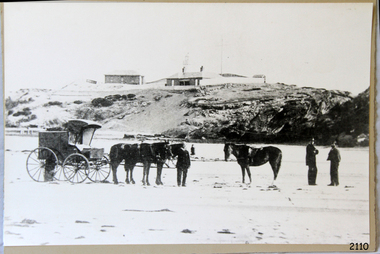
Photograph - Scene - Warrnambool, C. 1854-1871
... official titles of Senior Assistant Lighthouse Keeper and Assistant Lighthouse Keeper. They were employed by the Public Service and paid rent to live in the Lighthouse Quarters. They were compulsorily retired at the age of 60, with most receiving a superannuation payment. Despite their time-consuming duties...official titles of Senior Assistant Lighthouse Keeper and Assistant Lighthouse Keeper. They were employed by the Public Service and paid rent to live in the Lighthouse Quarters. They were compulsorily retired at the age of 60, with most receiving a superannuation payment. Despite their time-consuming duties ...This is an image of the Warrnambool Lighthouse Complex on Middle Island in 1854. The Store, Lighthouse Keeper's Quarters, Lighthouse and Flagstaff are in the background. The foreground shows a covered buggy drawn by two horses and a person in attendance, and another wheeled vehicle behind it with a figure nearby. There is a saddled horse to the right with two males in conversation nearby. The ground is soft, perhaps the riverbed or sandy shore. THE LIGHTHOUSE KEEPERS Lighthouse Keepers were responsible for keeping their Lighthouse’s lights shining at night. They kept a lookout for passing vessels and changes in weather. They were expected to clean, polish and maintain the equipment and buildings. They kept regular and detailed records of who was on watch, and the time the light was lit, trimmed and extinguished. They kept a journal about other events that occurred. They keep regular, accurate Meteorological Logs. It was expected that they were competent in Morse code signalling. They would be called to help in times of disasters and shipwrecks and to give official statements about these events. Many Lighthouse Keepers also volunteered as members of the lifeboat crew. The Lady Bay lighthouses were officially classified as small, so the Keepers had the official titles of Senior Assistant Lighthouse Keeper and Assistant Lighthouse Keeper. They were employed by the Public Service and paid rent to live in the Lighthouse Quarters. They were compulsorily retired at the age of 60, with most receiving a superannuation payment. Despite their time-consuming duties, there was time to follow hobbies and crafts such as growing vegetables, playing musical instruments, making models of buildings including lighthouses, and crafting furniture pieces. An example of a keeper’s skills is the carved fire screen made by /assistant Keeper Thomas Hope in the late 19th century and displayed in the Lighthouse Keeper’s cottage at Flagstaff Hill. Both Alexander and Farncombe had served under Senior Keeper Robert Deverell, who was the first and only Senior Lighthouse Keeper at the Middle Island Complex. John Alexander was the Assistant Keeper in the 1850s. Andrew Farncombe was the last Assistant Keeper at Middle Island, serving there with his family from 1864 to 1871. During 1871 and 1872 the Lighthouse Complex was moved to Flagstaff Hill on Merri Street. Farncombe and Deverell then became the first Keepers and occupants of the Lady Bay Lighthouse Complex at Flagstaff Hill. They continued their service together; overall, Deverell served from 1859 to 1885 and Farncombe from 1864 to 1974. WARRNAMBOOL'S LADY BAY LIGHTHOUSE COMPLEX - The original Lighthouse Complex was built on Middle Island in 1858-1859 then transferred stone-by-stone to Flagstaff Hill in 1871. The Complex comprised the Lighthouse, the Lighthouse Keepers’ Quarters and a Privy. The bluestone Keeper’s Quarters was a cottage divided into two compartments, one for the Senior Keeper and his family, the other for the Assistant Keeper and his family. The bluestone Store was divided into three; a store, a workshop, and an oil store (or office). The Privy comprised a small building also divided into two separate, back-to-back toilets, one for each Keeper and his family. In the 1970s the Flagstaff Hill Planning Board was set up under the chairmanship of John Lindsay. The Board was to make recommendations to the Warrnambool City Council regarding the use of the buildings and the rest of the Crown Land on the site. The Flagstaff Hill Maritime Village opened in 1975 and began renovating the Cottage in stages, during which time evidence of a 1920s fire was found in the eastern section of the cottage. Additions of a porch on the west and a washroom on the east were made in the 1980s. The western part of the building is now a Shipwreck Museum and the east has returned to a late 19th-century Lighthouse Keeper’s cottage and includes the screen made by Assistant Lighthouse Keeper Thomas Hope in the late 19th century. Hope served two periods of time at the Lighthouse. This photograph is significant as a visual record of the original Warrnambool Lighthouse Complex on Middle Island, the origin of what is now the Lady Bay Lighthouse Complex. The photograph is significant for its connection to the Complex, which is now listed on the Victorian Heritage Register, H1520, for being of historical, scientific (technological) and architectural significance to the State of Victoria. The Complex is significant as an example of early colonial development. The photograph is significant for its connection with the important navigational function of the Lighthouses, a function still being performed to this day. The photograph is also significant as it shows an example of buildings organised by the Public Works Department in Victoria in the mid-to-late 19th century. The structures tare still stand strong. Photograph of horses, a buggy and three gentlemen in the foreground and the background shows a lighthouse and accompanying buildings. Printed in black and white. (Another two horse-drawn vehicles are partially visible). The subject is the Lighthouse Complex on Middle Island, Warrnambool, dated between 1854 and 1871.An inscription is handwritten in black pen on the back of the mounting board."The lighthouse and accompanying buildings were / established on Middle Island in 1854, as this / picture shows. In 1871 they were moved to their / present site on Flagstaff Hill."flagstaff hill, flagstaff hill maritime museum, flagstaff hill maritime village, warrnambool, maritime museum, shipwreck coast, lighthouse keeper's cottage, lighthouse residence, lighthouse, chart room, quarters, privy, middle island, beach lighthouse, obelisk, lighthouse complex, lady bay complex, warrnambool port, warrnambool harbour, lady bay, keepers, lighthouse keeper, upper lighthouse, lower lighthouse, assistant keeper, ports and harbours, cottage, meteorological record, 1854, 1871, light keeper -
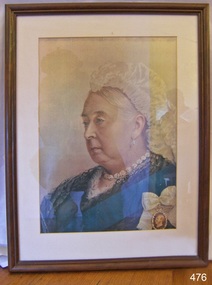 Flagstaff Hill Maritime Museum and Village
Print - Portrait of Queen Victoria, Hoy Art Picture Framing, Original probably painted in 1887 or 1897 to commemorate 50 or 60 years on the throne
... Despite her advanced age, Victoria continued her duties to the end - including an official visit to Dublin in 1900. ...Despite her advanced age, Victoria continued her duties to the end - including an official visit to Dublin in 1900. ...Queen Victoria was born at Kensington Palace, London, on 24 May 1819. She was the only daughter of Edward, Duke of Kent, the fourth son of George III. Her father died shortly after her birth and she became heir to the throne because the three uncles who were ahead of her in the succession - George IV, Frederick Duke of York, and William IV - had no legitimate children who survived. Warmhearted and lively, Victoria had a gift for drawing and painting; educated by a governess at home, she was a natural diarist and kept a regular journal throughout her life. On William IV's death in 1837, she became Queen at the age of 18. Queen Victoria is associated with Britain's great age of industrial expansion, economic progress and, especially, empire. At her death, it was said, Britain had a worldwide empire on which the sun never set. In the early part of her reign, she was influenced by two men: her first Prime Minister, Lord Melbourne, and then her husband, Prince Albert, whom she married in 1840. Both men taught her much about how to be a ruler in a 'constitutional monarchy, in which the monarch had very few powers but could use much influence. Albert took an active interest in the arts, science, trade and industry; the project for which he is best remembered was the Great Exhibition of 1851, the profits from which helped to establish the South Kensington museums complex in London. Her marriage to Prince Albert produced nine children between 1840 and 1857. Most of her children married into other Royal families in Europe. Edward VII (born 1841), married Alexandra, daughter of Christian IX of Denmark. Alfred, Duke of Edinburgh and of Saxe-Coburg and Gotha (born 1844) married Marie of Russia. Arthur, Duke of Connaught (born 1850) married Louise Margaret of Prussia. Leopold, Duke of Albany (born 1853) married Helen of Waldeck-Pyrmont. Victoria, Princess Royal (born 1840) married Friedrich III, German Emperor. Alice (born 1843) married Ludwig IV, Grand Duke of Hesse and by Rhine. Helena (born 1846) married Christian of Schleswig-Holstein. Louise (born 1848) married John Campbell, 9th Duke of Argyll. Beatrice (born 1857) married Henry of Battenberg. Victoria bought Osborne House (later presented to the nation by Edward VII) on the Isle of Wight as a family home in 1845, and Albert bought Balmoral in 1852. Victoria was deeply attached to her husband and she sank into depression after he died, aged 42, in 1861. She had lost a devoted husband and her principal trusted adviser in affairs of state. For the rest of her reign she wore black. Until the late 1860s she rarely appeared in public; although she never neglected her official Correspondence, and continued to give audiences to her ministers and official visitors, she was reluctant to resume a full public life. She was persuaded to open Parliament in person in 1866 and 1867, but she was widely criticised for living in seclusion and quite a strong republican movement developed. Seven attempts were made on Victoria's life, between 1840 and 1882 - her courageous attitude towards these attacks greatly strengthened her popularity. With time, the private urgings of her family and the flattering attention of Benjamin Disraeli, Prime Minister in 1868 and from 1874 to 1880, the Queen gradually resumed her public duties. In foreign policy, the Queen's influence during the middle years of her reign was generally used to support peace and reconciliation. In 1864, Victoria pressed her ministers not to intervene in the Prussia-Denmark war, and her letter to the German Emperor (whose son had married her daughter) in 1875 helped to avert a second Franco-German war. On the Eastern Question in the 1870s - the issue of Britain's policy towards the declining Turkish Empire in Europe - Victoria (unlike Gladstone) believed that Britain, while pressing for necessary reforms, ought to uphold Turkish hegemony as a bulwark of stability against Russia, and maintain bi-partisanship at a time when Britain could be involved in war. Victoria's popularity grew with the increasing imperial sentiment from the 1870s onwards. After the Indian Mutiny of 1857, the government of India was transferred from the East India Company to the Crown, with the position of Governor-General upgraded to Viceroy, and in 1877 Victoria became Empress of India under the Royal Titles Act passed by Disraeli's government. During Victoria's long reign, direct political power moved away from the sovereign. A series of Acts broadened the social and economic base of the electorate. These acts included the Second Reform Act of 1867; the introduction of the secret ballot in 1872, which made it impossible to pressurise voters by bribery or intimidation; and the Representation of the Peoples Act of 1884 - all householders and lodgers in accommodation worth at least £10 a year, and occupiers of land worth £10 a year, were entitled to vote. Despite this decline in the Sovereign's power, Victoria showed that a monarch who had a high level of prestige and who was prepared to master the details of political life could exert an important influence. This was demonstrated by her mediation between the Commons and the Lords, during the acrimonious passing of the Irish Church Disestablishment Act of 1869 and the 1884 Reform Act. It was during Victoria's reign that the modern idea of the constitutional monarch, whose role was to remain above political parties, began to evolve. But Victoria herself was not always non-partisan and she took the opportunity to give her opinions, sometimes very forcefully, in private. After the Second Reform Act of 1867, and the growth of the two-party (Liberal and Conservative) system, the Queen's room for manoeuvre decreased. Her freedom to choose which individual should occupy the premiership was increasingly restricted. In 1880, she tried, unsuccessfully, to stop William Gladstone - whom she disliked as much as she admired Disraeli and whose policies she distrusted - from becoming Prime Minister. She much preferred the Marquess of Hartington, another statesman from the Liberal party which had just won the general election. She did not get her way. She was a very strong supporter of the Empire, which brought her closer both to Disraeli and to the Marquess of Salisbury, her last Prime Minister. Although conservative in some respects - like many at the time she opposed giving women the vote - on social issues, she tended to favour measures to improve the lot of the poor, such as the Royal Commission on housing. She also supported many charities involved in education, hospitals and other areas. Victoria and her family travelled and were seen on an unprecedented scale, thanks to transport improvements and other technical changes such as the spread of newspapers and the invention of photography. Victoria was the first reigning monarch to use trains - she made her first train journey in 1842. In her later years, she became the symbol of the British Empire. Both the Golden (1887) and the Diamond (1897) Jubilees, held to celebrate the 50th and 60th anniversaries of the Queen's accession, were marked with great displays and public ceremonies. On both occasions, Colonial Conferences attended by the Prime Ministers of the self-governing colonies were held. Despite her advanced age, Victoria continued her duties to the end - including an official visit to Dublin in 1900. The Boer War in South Africa overshadowed the end of her reign. As in the Crimean War nearly half a century earlier, Victoria reviewed her troops and visited hospitals; she remained undaunted by British reverses during the campaign: 'We are not interested in the possibilities of defeat; they do not exist.' Victoria died at Osborne House on the Isle of Wight, on 22 January 1901 after a reign which lasted almost 64 years, then the longest in British history. Her son, Edward VII succeeded her. She was buried at Windsor beside Prince Albert, in the Frogmore Royal Mausoleum, which she had built for their final resting place. Above the Mausoleum door are inscribed Victoria's words: "Farewell best beloved, here, at last, I shall rest with thee, with thee in Christ I shall rise again." Source: https://www.royal.uk/queen-victoria This picture captures Queen Victoria in her later years. It may well have been painted to commemorate her Golden Anniversary in 1887, or her Diamond Anniversary in 1897.Picture, print, reproduction of a drawing or photograph of Queen Victoria. She is wearing a dark-coloured dress, white headdress and a diamond necklace and earrings. On her left shoulder is the Royal Order of Victoria and Albert, awarded to female members of the British Royal Family and female courtiers. There are four grades or classes of this Royal Order as well as the Sovereign's Badge, which is exclusive to her. Also across her left shoulder, is a blue riband representing the Order of the Garter. The picture is in a medium-coloured timber frame with a white string across the width at the rear. The label says it was framed by Hoy Art, Warrnambool. The signature of the Queen is on the picture but is not obvious since the picture has been re-framed."HOY ART / PICTURE FRAMING / 48 Kepler St, Warrnambool 3280 / Phone (055) 62 8022" Signature (hidden by new framing) "Victoria H.R.S."flagstaff hill, warrnambool, shipwrecked-coast, flagstaff-hill, flagstaff-hill-maritime-museum, maritime-museum, shipwreck-coast, flagstaff-hill-maritime-village, picture of queen victoria, queen victoria, the royal order of victoria and albert, the order of the garter, hoy art
