
Showing 101 items matching "ordnance service"
-
 4th/19th Prince of Wales's Light Horse Regiment Unit History Room
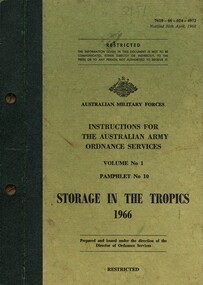
Booklet, Instructions for the Australian Ordnance Service Vol 1 Pam No 10 Storage in the Tropics 1966, 1966
... Instructions for the Australian Ordnance Service Vol 1 Pam No 10 Storage in the Tropics 1966...Instructions for the Australian Ordnance Service Vol 1 Pam No 10 Storage in the Tropics 1966 Booklet ...A hard covered loose leaf booklet the aim of which is to make known the knowledge gleaned during and since World War 2 on the question of storage in the tropics.7610-66-024-4972ordnance, tropical storage -
 National Vietnam Veterans Museum (NVVM)
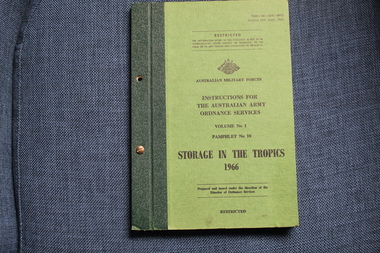
Booklet, Australian Military Forces, Australian Military Forces: Instructions For The Australian Army Ordnance Services, Volume 1 Pamphlet No.10: Storage In The Tropics 1966, 1966
... ...Ordnance Service...Booklet Ausralian Military Forces Ordnance Corps Ordnance Service Storage in the Tropics A yellow/green cardboard cover with dark green binding down the left hand side. ...A yellow/green cardboard cover with dark green binding down the left hand side. Top right hand corner reads 7610-66-024-4972. Under the Australian Coat of Arms is the details of the booklet in black. The booklet is held together with two metal screws down the left hand side.booklet, ausralian military forces, ordnance corps, ordnance service, storage in the tropics -
 Lara RSL Sub Branch
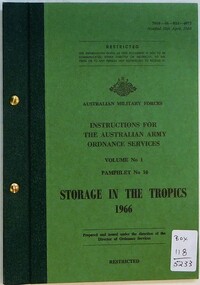
Booklet - australain Military Forces, Storage In The Tropics 1966, 30 April 1968
... 7610-66-024-4972 30/4/1968 Restricted Prepared and issued under the direction of Director of Ordnance Services. 1966...1966 Australian Military forces - Director of Ordnance Services. 1966- Boolet australian army ordnance services - storage in te tropics 7610-66-024-4972 30/4/1968 Restricted Prepared and issued under the direction of Director of Ordnance Services. 1966 Green Cardboard cover and rear with paper molded and thread binding for edge reinforcement Dark green in color. ...1966 Australian Military forces - Director of Ordnance Services. 1966- BooletGreen Cardboard cover and rear with paper molded and thread binding for edge reinforcement Dark green in color. With off white pages inside.7610-66-024-4972 30/4/1968 Restricted Prepared and issued under the direction of Director of Ordnance Services. 1966australian army ordnance services - storage in te tropics -
 8th/13th Victorian Mounted Rifles Regimental Collection
Manual
... Green coloured heavy card covered technical manual, screw bound, adhesive fabric spine being Instructions for the Australian Army Ordnance Services Storage in the Tropics 1966....Moderate research value Ink stamp on title page " 8/13VMR Regimental Collection. " Green coloured heavy card covered technical manual, screw bound, adhesive fabric spine being Instructions for the Australian Army Ordnance Services Storage in the Tropics 1966. Manual ...All field units such as 8/13 VMR had need of methods to store equipment. This document provided a template for storage in tropical conditions.Moderate research valueGreen coloured heavy card covered technical manual, screw bound, adhesive fabric spine being Instructions for the Australian Army Ordnance Services Storage in the Tropics 1966.Ink stamp on title page " 8/13VMR Regimental Collection. " -
 National Vietnam Veterans Museum (NVVM)
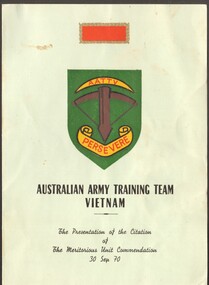
Ephemera - Order of Service- AATTV Meritorious Unit Commendation
... ...Ordnance Corps...Service...Lette Citation Ordnance Corps Service No 3795490 Vietnam AATTV Unit commendation meritorious unit 30 september 1970 A D Lette Cream coloured folded booklet with green AATTV insignia with red citation bar above it . ...This item was collected by National Serviceman Allen D Lette, who served in the Royal Australian Army Ordnance Corps in Vietnam 1969-70. Ordnance provided the vehicles to transport officers to the parade held at Vung Tau to present the citation of The Meritorious Unit Commendation held on 30 September 1970. Pte Lette said he kept the programme because it was a privilege to be in attendance.Cream coloured folded booklet with green AATTV insignia with red citation bar above it . Inside is the order of service for the parade lette, citation, ordnance corps, service no 3795490, vietnam, aattv, unit commendation, meritorious unit, 30 september 1970, a d lette -
Glen Eira Historical Society
Document - KOOYONG ROAD, 75, CAULFIELD NORTH
... Two copies of a pamphlet for the ceremony of the Third Ordnance Services Unit ‘Exercising the Right of the Freedom of Entry to the City of Caulfield’ held on 23/10/1983. ...Two copies of a pamphlet for the ceremony of the Third Ordnance Services Unit ‘Exercising the Right of the Freedom of Entry to the City of Caulfield’ held on 23/10/1983. ...Two copies of a pamphlet for the ceremony of the Third Ordnance Services Unit ‘Exercising the Right of the Freedom of Entry to the City of Caulfield’ held on 23/10/1983. The pamphlet includes a brief history of the unit’s association with the City of Caulfield, a list of individuals holding posts within the Unit, text of the scroll conferring the Freedom of Entry on the Unit, a program of the ceremony, a brief history of the Royal Australian Army Ordnance Corps including the Unit’s use of 75 Kooyong Road as their premises, a brief history of the City of Caulfield from 1937-postwar years, and an explanation of the tradition of conferring Freedom of Entry to a city. The pamphlet includes also: 1/A black and white photograph (47x35mm) of the Mayor of Caulfield, W.R. Walters, undated and unattributed. 2/A black and white photograph (81x69mm) of Major A.G. Storen, Commanding Officer of the Third Ordnance Services Unit, undated and unattributed. 3/A color photograph (88x84mm) of the Sovereign’s Banner, undated and unattributed. 4/A black and white copy (137x87mm) of the scroll conferring Freedom of Entry into the City of Caulfield, which was seated August 4 1978. 5/A color illustration (30x32mm) of the City of Caulfield Coat of Arms. 6/A color illustration (40x32mm) of the Third Ordnance Services Unit, Royal Australian Army Ordnance Corps Coat of Arms. 7/A black and white illustration (21x24mm) of the city of Caulfield Coat of Arms. 8/A black and white illustration (19x14mm) of the City of Caulfield badge. 9/A black and white illustration (22x31mm) of the City of Caulfield banner.walters w.r., storen a.g. major, finning d.j. captain, hately p.g. major, davidson j. (captain), swendson r. (second lieutenant), caulfield, city of caulfield, australian army, the third ordnance services unit royal australian army ordnance corps, caulfield park, caulfield council, north caulfield, campton e.j. (brigadier), walters w.r. mrs., calder g.k., calder g.k. mrs., mahon j. (chief superintendent), city hall, balaclava road, hawthorn road, glen eira road, hartley avenue, kooyong road, caulfield racecourse, caulfield town hall, alma road, red cheques cab company, army headquarters printing press, searchlight company, amenities store, armoured replacement unit, first base printing company r.a.a.o.c., garden vale, caulfield railway station, paddy’s swamp, great dandenong road, glen ferrie road, dandenong road, east caulfield reserve, caulfield military hospital, ‘glen eira’, town hall, ‘war office’, caulfield district road board, shire of caulfield, caulfield recruiting committee for volunteers, city repatriation committee, red cross emergency service, women’s national service, mayor’s patriotic fund, promotions committee for war savings certificates, war savings group scheme, ‘the gazette’, air raid precautions committee, orrong road, armed forces, world war 1939-1945, local government, parades and processions, military reserves, world war 1914-1918, councillors, events and activities, historic events, official events, caulfield john, wyne agar, murphy (mayor), hale p., ison (captain), fisher andrew, morris t.w. (mayor) -
Glen Eira Historical Society
Document - KOOYONG ROAD, 75, CAULFIELD NORTH
... Ordnance Corps... Australian Army... Army Headquarters Printing Press... Searchlight Company... Amenities Store... Armoured Replacement Unit... First Base Printing Company R.A.A.O.C.... Caulfield District Road Board... Shire of Caulfield... Caulfield Recruiting Committee for Volunteers... City Repatriation Committee... Red Cross Emergency Service...Three copies of a pamphlet for the ceremony of the Third Ordnance Services Unit ‘Exercising the Right of the Freedom of Entry to the City of Caulfield’, held on 13/07/1986. ...Three copies of a pamphlet for the ceremony of the Third Ordnance Services Unit ‘Exercising the Right of the Freedom of Entry to the City of Caulfield’, held on 13/07/1986. ...Three copies of a pamphlet for the ceremony of the Third Ordnance Services Unit ‘Exercising the Right of the Freedom of Entry to the City of Caulfield’, held on 13/07/1986. The pamphlet includes a brief history of the Unit’s association with the City of Caulfield, a list of individuals holding posts within the unit, text of the scroll conferring the Freedom of Entry on the Unit, a program of the ceremony, a brief history of the Royal Australian Army Ordnance Corps, including the Unit’s use of 75 Kooyong Road as their premises, a brief history of the city of Caulfield and an explanation of the tradition of conferring Freedom of Entry to a city. The pamphlet includes also: 1/A black and white photograph (61x66mm) of the Mayor of Caulfield, Maxwell Blair, undated and unattributed. 2/A black and white photograph (70x51mm) of Major P.G. Hateley, Commanding Officer of the Third Ordnance Services Unit, undated and unattributed. 3/A black and white photograph (91x90mm) of the Sovereign’s Banner, undated and unattributed. 4/A black and white copy (137-87) of the scroll conferring Freedom of Entry into the City of Caulfield which was seated August 4 1978. 5/A color illustration (30x32mm) of the City of Caulfield Coat of Arms. 6/A colour illustration (40x32mm) of the Third Ordnance Services Unit, Royal Australian Army Ordnance Corps Coat of Arms. 7/A black and white illustration (21x24mm) of the City of Caulfield Coat of Arms. 8/A black and white illustration (19x19mm) of the City of Caulfield badge. 9/A black and white illustration (22x31mm) of the City of Caulfield banner.blair maxwell (mayor), hateley p.g. (major), finning d.j. (captain), lowe g. (captain), barker l.a. (lieutenant), blair mrs., aylen d.r., aylan d.r. mrs., goltz m.h., compton e.j. (brigadier), goltz m.h. (chief superintendant), caulfield john, wynne agar, murphy (mayor), hate p., ison (captain), fisher andrew, morris t.w. (mayor), caulfield, kooyong road, caulfield park, north caulfield, city of caulfield, city hall, balaclava road, hawthorn road, glen eira road, hartley avenue, caulfield racecourse, caulfield town hall, alma road, orrong road, garden vale, caulfield railway station, paddy’s swamp, great dandenong road, glen ferrie road, dandenong road, east caulfield reserve, caulfield military hospital, ‘glen eira’, town hall, ‘war office’, red chequer cab company, caulfield council, third ordnance services unit royal australian army ordnance corps, australian army, army headquarters printing press, searchlight company, amenities store, armoured replacement unit, first base printing company r.a.a.o.c., caulfield district road board, shire of caulfield, caulfield recruiting committee for volunteers, city repatriation committee, red cross emergency service, women’s national service, mayor’s patriotic fund, promotions committee for war savings certificates, war savings group scheme, ‘the gazette’, air raid precautions committee, armed forces, world war 1939-1945, local government, parades and processions, military reserves, world war 1914-1918, councillors, events and activities, historic events, official events -
 National Vietnam Veterans Museum (NVVM)
Letter
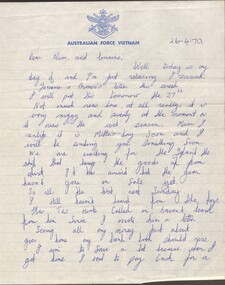
... Pte Allen Doran Lette was in Ordnance Corps Service No 3795490....Pte Allen Doran Lette was in Ordnance Corps Service No 3795490. Lette Letter Ordnance Vietnam Australian Force Vietnam communication A Lette Hand written two-page letter on Australian Force Vietnam paper dated 26/04/1970. ...A two-page hand written letter to Mum and Lorraine from Allen sent in 1970. Pte Allen Doran Lette was in Ordnance Corps Service No 3795490.Hand written two-page letter on Australian Force Vietnam paper dated 26/04/1970. lette, letter, ordnance, vietnam, australian force vietnam, communication, a lette -
Glen Eira Historical Society
Letter - Kooyong Road, 75, Caulfield North
... A handwritten report, 2 pages, by Dorothea E Hancock dated 24/11/1982 concerning the Conferring of the Freedom of Entry to the City of Caulfield upon the Third Ordnance Services Unit Royal Australian Army Ordnance Corps ceremony held in Caulfield Park on 4 August 1978. ...A handwritten report, 2 pages, by Dorothea E Hancock dated 24/11/1982 concerning the Conferring of the Freedom of Entry to the City of Caulfield upon the Third Ordnance Services Unit Royal Australian Army Ordnance Corps ceremony held in Caulfield Park on 4 August 1978. ...A handwritten report, 2 pages, by Dorothea E Hancock dated 24/11/1982 concerning the Conferring of the Freedom of Entry to the City of Caulfield upon the Third Ordnance Services Unit Royal Australian Army Ordnance Corps ceremony held in Caulfield Park on 4 August 1978. Provides history of the occupation of the Units premises at 75 Kooyong Road, North Caulfield and information about the Red Cab company which occupied the premises in the 1930’s.hancock dorothea e, kooyong road, north caulfield, red cab company, yellow cab company, brick houses, caulfield park, city of caulfield, caulfield, taxi’s, armed forces, public transport, third ordnance services unit royal australian army ordnance corps, tanks corps, world war 1939 – 1945 -
 National Vietnam Veterans Museum (NVVM)
Ephemera - Envelope, Air mail
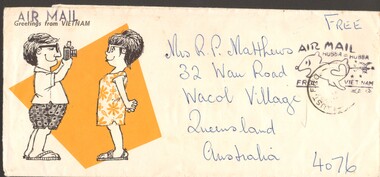
... Royal Australian Army Ordnance Corp, service no.34974. This tourist-style envelope is in stark contrast to the reality of war. ...Royal Australian Army Ordnance Corp, service no.34974. This tourist-style envelope is in stark contrast to the reality of war. ...Sent by Warrant Officer Class 2 Robert Palmer Matthew home to family. Royal Australian Army Ordnance Corp, service no.34974. This tourist-style envelope is in stark contrast to the reality of war. It also shows that Australian soldiers did not pay for postage.Airmail envelope - printed with tourist-looking man in shorts and thongs taking a photo of a woman in a sundress. Image is against an orange shape on the left of the envelope. Addressed and airmail stamped. On Back - print of man with suitcase and bindle over shoulder. Wording 'I should be home soon'. Orange sun design with face drawn on it.Airmail/ Greeting from Vietnam/ Mrs R.P Matthews/ 32 Wau Road/ Walcol Village/ Queensland/ Australia/ 4076/ Free/ Stamp - Airmail/ Hubba=Hubba/ from Vietnam.airmail envelopes, 34974, robert palmer matthews, vietnam, mail, communication, envelope -
 Running Rabbits Military Museum operated by the Upwey Belgrave RSL Sub Branch
Jacket - Service Dress
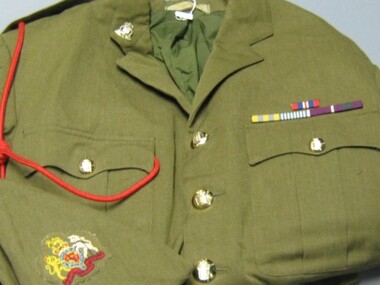
... Army Warrant Officers with lanyard & Ribbons Royal Australian Army Ordnance Corps, Red lanyard, service ribbons War medal 1939-45 Korea, UN service,Long service and good conduct & gen service ???...Uniform 1968 Army Army Warrant Officers with lanyard & Ribbons Royal Australian Army Ordnance Corps, Red lanyard, service ribbons War medal 1939-45 Korea, UN service,Long service and good conduct & gen service ??? ...Army Warrant Officers with lanyard & Ribbons Royal Australian Army Ordnance Corps, Red lanyard, service ribbons War medal 1939-45 Korea, UN service,Long service and good conduct & gen service ???uniform, 1968, army -
 Bendigo Historical Society Inc.
Document - ETHEL PATTISON COLLECTION: CERTIFICATE OF SERVICE FROM COMMONWEALTH, ORDNANCE FACTORY, 1958
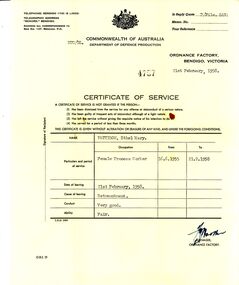
... ETHEL PATTISON COLLECTION: CERTIFICATE OF SERVICE FROM COMMONWEALTH, ORDNANCE FACTORY...Ethel Pattison Certificate of Service from Ordnance Factory between 16 / 6 / 1955 - 21 / 2 / 1958. ...Ethel Pattison Ordnance Factory reference a. Ethel Pattison Certificate of Service from Ordnance Factory between 16 / 6 / 1955 - 21 / 2 / 1958. ...a. Ethel Pattison Certificate of Service from Ordnance Factory between 16 / 6 / 1955 - 21 / 2 / 1958. Described as Female Process Worker, very good, with fair ability. Retrenched. .b O H M S envelope which contained Certificate of Service.ethel pattison, ordnance factory, reference -
 National Vietnam Veterans Museum (NVVM)
Badge - Parachutist badge, United States
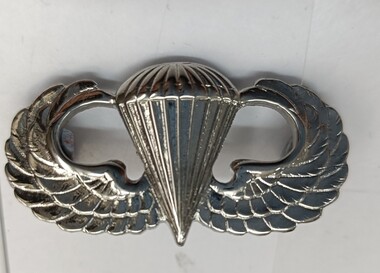
... The badge was brought home by Robert Palmer Matthews, Warrant Officer Class 2, Royal Australian Army Ordnance Corps, 1970-71 Service No: 34974. It was donateddonated by Mrs. ...The badge was brought home by Robert Palmer Matthews, Warrant Officer Class 2, Royal Australian Army Ordnance Corps, 1970-71 Service No: 34974. It was donateddonated by Mrs. ...Small metal parachutist badge, commonly referred to as jump wings, is a military badge of the United States Armed Forces. The badge was brought home by Robert Palmer Matthews, Warrant Officer Class 2, Royal Australian Army Ordnance Corps, 1970-71 Service No: 34974. It was donateddonated by Mrs. R P Matthews andAn oxidized silver badge featuring an open parachute, centered over a pair of stylized spread wings that curve inward.badge, jump wings, united states armed forces, matthews, royal australian army ordnance corps, parachutist badge, parachutist, us army -
 Wodonga & District Historical Society Inc
Functional object - RAEME Shield, c1978
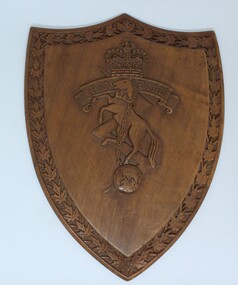
... RAEME Corps was first established in 1942 when the Ordnance Corps and the Service Corps were combined. The royal ascent was granted in 1948. ...RAEME Corps was first established in 1942 when the Ordnance Corps and the Service Corps were combined. The royal ascent was granted in 1948. ...RAEME Corps was first established in 1942 when the Ordnance Corps and the Service Corps were combined. The royal ascent was granted in 1948. The Royal Australian Electrical and Mechanical Engineers (RAEME) is a technical corps tasked with the maintenance of the Army's modern hardware and equipment. RAEME personnel are represented in most Army units. The Royal Australian Electrical and Mechanical Engineers corps motto is ‘Arte et Marte’, which is Latin for ‘With Skill and Fighting’. This item, was presented to the Council of the Rural City of Wodonga in 1978. RAEME has a strong connection with the city of Wodonga through its service and training facilities at the Bandiana base on the edge of Wodonga. A shield shaped plaque carved with the emblem of RAEME corps (The Royal Australian Electrical and Mechanical Engineers corps). The edge of the shield is decorated with carved leaves. An engraved metal plate has been attached to acknowledge the presentation of the plaque to the Council of the Rural City of Wodonga. The rearing horse and chain are symbolic of power under control and the lightning flash, of electrical engineering. The rearing horse also forms part of the crest of the Institution of Mechanical Engineers and, together with the lightning flash, is intended to mark the close relationship which exists between the electrical and mechanical engineers in both civil and military life. The globe is indicative of the impact of engineering on the world generally.Attached to rear of shield "Presented to/The Council of the Rural CIty of Wodonga/ by/ The Commanding Officer and Members of/RAEME Training Centre/ 21 October 1978"raeme, australian army -
 Bendigo Military Museum
Badge - VARIOUS MILITARY BADGES, Unknown
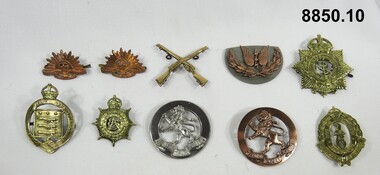
... Australian Army Ordnance. 7. Australian Army Service Corps. 8. Australian 5th Battalion Victorian Scottish Regt. 9. ...Australian Army Ordnance. 7. Australian Army Service Corps. 8. Australian 5th Battalion Victorian Scottish Regt. 9. ...Military badges either gold, silver or brass colour with or without a backing mounting plate, pins. Sizes vary. 1. Australian Rising Sun collar. 2. Australian Rising Sun Collar. 3. Marksman's Badge. 4. Wireless. 5. Australian Army Medical Corps Hat. 6. Australian Army Ordnance. 7. Australian Army Service Corps. 8. Australian 5th Battalion Victorian Scottish Regt. 9. Australian 5th Battalion Victorian Scottish Regt. 10. 6th Battalion City of Mellbourne Regiment Hat. passchendaele barracks trust, pbt61to70, badges -
 Lara RSL Sub Branch
Plaque - RAEME Plaque
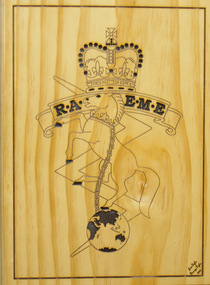
... RAEME Corps was first established in 1942 when the Ordnance Corps and the Service Corps were combined. The royal ascent was granted in 1948. ...RAEME Corps was first established in 1942 when the Ordnance Corps and the Service Corps were combined. The royal ascent was granted in 1948. ...RAEME Corps was first established in 1942 when the Ordnance Corps and the Service Corps were combined. The royal ascent was granted in 1948. Ref: www.raeme.org.au The Royal Australian Electrical and Mechanical Engineers (RAEME) is a technical corps tasked with the maintenance of the Army's modern hardware and equipment. RAEME personnel are represented in most Army units, with the representation varying in size from one or two tradespersons, to small groups of 20 to 30 tradespersons, to large maintenance units with over 150 personnel and a totally integrated military and civilian workforce. The Royal Australian Electrical and Mechanical Engineers corps motto is ‘Arte et Marte’, which is Latin for ‘With Skill and Fighting’. Ref: www.army.gov.auVarnished Wooden BoardRAEME Badge Jan Zyla George Zyla 2020 -
 Wodonga & District Historical Society Inc
Uniform - Australian Military Uniform - RAEME Corps, c1965
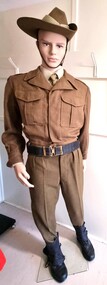
... RAEME Corps was first established in 1942 when the Ordnance Corps and the Service Corps were combined. This uniform was donated by a RAEME member who served during the Vietnam War. ...RAEME Corps was first established in 1942 when the Ordnance Corps and the Service Corps were combined. This uniform was donated by a RAEME member who served during the Vietnam War. ...RAEME Corps was first established in 1942 when the Ordnance Corps and the Service Corps were combined. This uniform was donated by a RAEME member who served during the Vietnam War. The Corps began sending advisers to Vietnam in 1964 and this foreshadowed a massive build- up of RAEME personnel and equipment which peaked in 1971. The first direct RAEME support was provided in early 1965 as part of 1 Aust Logistic Support Coy (1 ALSC). Prior to 1971 the RAEME elements of 1 Australian Logistic Support Group built up to a stage where there were two field workshops. The withdrawal of all Australian forces was completed in 1972 and RAEME reverted to its peacetime role.This uniform was worn by a member of the Wodonga community who served with RAEME during the Vietnam War. RAEME Corps members are also represented at the Army Logistic Training Centre at Bandiana.Australian Military uniform - this uniform was issued during Australia's involvement in the Vietnam war. It was worn by a member of RAEME (The Royal Australian Engineers), Damien Hunt who is a resident of Wodonga.On shoulder badge: "ROYAL AUSTRALIAN ELECTRICAL / & MECHANICAL ENGINEERS"raeme, military uniforms, australian army -
 Wodonga & District Historical Society Inc
Mixed media - Presentation of Prince Philip's Banner to RAEME, 1986
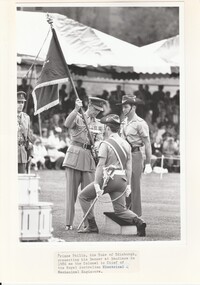
... RAEME Corps was first established in 1942 when the Ordnance Corps and the Service Corps were combined. The royal ascent was granted in 1948. ...RAEME Corps was first established in 1942 when the Ordnance Corps and the Service Corps were combined. The royal ascent was granted in 1948. ...RAEME Corps was first established in 1942 when the Ordnance Corps and the Service Corps were combined. The royal ascent was granted in 1948. The Royal Australian Electrical and Mechanical Engineers (RAEME) is a technical corps tasked with the maintenance of the Army's modern hardware and equipment. RAEME personnel are represented in most Army units. The Royal Australian Electrical and Mechanical Engineers corps motto is ‘Arte et Marte’, which is Latin for ‘With Skill and Fighting’. On the 5th March 1959, His Royal Highness, The Prince Philip, Duke of Edinburgh, accepted the appointment of Colonel-in-Chief of the Corps of the Royal Australian Electrical and Mechanical Engineers. On Tuesday 20 May 1986, His Royal Highness, The Prince Philip, Duke of Edinburgh, Colonel in Chief of the Royal Australian Electrical and Mechanical Engineers (RAEME) presented the Prince Philip Banner to the Corps at a Ceremonial Parade held at the RAEME Training Centre, Bandiana.These items are significant because they document an important event for the RAEME Unit at Bandiana.A collection of images and newspaper articles documenting an important event for the RAEME unit at Bandiana, Victoria. The Prince Philip features the Royal Cipher on the front and the RAEME Badge on the reverse.raeme, prince philip duke of edinburugh -
 Wodonga & District Historical Society Inc
Memorabilia - Commemorative Award from RAEME unit to the Rural City of Wodonga, 1978
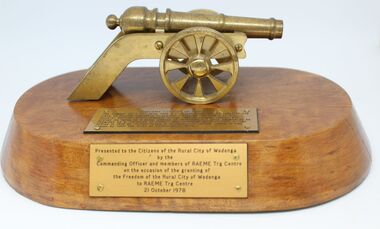
... RAEME Corps was first established in 1942 when the Ordnance Corps and the Service Corps were combined. The royal ascent was granted in 1948. ...RAEME Corps was first established in 1942 when the Ordnance Corps and the Service Corps were combined. The royal ascent was granted in 1948. ...RAEME Corps was first established in 1942 when the Ordnance Corps and the Service Corps were combined. The royal ascent was granted in 1948. The Royal Australian Electrical and Mechanical Engineers (RAEME) is a technical corps tasked with the maintenance of the Army's modern hardware and equipment. RAEME personnel are represented in most Army units. The Royal Australian Electrical and Mechanical Engineers corps motto is ‘Arte et Marte’, which is Latin for ‘With Skill and Fighting’. This item, was presented to the Council of the Rural City of Wodonga in 1978. RAEME has a long association with Wodonga due to its service at the Bandiana base just outside of Wodonga. The inscription on the side of the base reads: "Presented to the Citizens of the Rural City of Wodonga by the Commanding Officer and members of RAEME Trg Centre on the occasion of the granting of the Freedom of the Rural City of Wodonga to RAEME Trg Centre 21 October 1978RAEME Corps has a long association with the city of Wodonga through its involvement in training and logistics at the army base at Bandiana.An award featuring a small model of the cannon "Zamzama" (Captor of Forts) mounted on a polished wooden base. The award includes a plaque outlining the significance of "Zamzama" on the top and another plaque explaining the significance on this award on the front of the base.Explanation of "Zamzama" beside cannon: "ZAMZAMA (CAPTOR OF FORTS)/ The original 14' 4 1/2" long, with 9 1/2" bore, was cast in brass in one/ piece by Muslim engineers in the year 1757 on the orders of the/ emperor AHMAD-SHAH-ABDALI. It was used in several battles and/ proved its value as a great weapon of destruction. It soon became to be/ regarded as a "Tallsman of Power" and continued as such until it was/ ruined in 1818 at Multan. Today it is housed in Lahore, where it was/ placed by H.R.H. the Duke of Edinburgh in 1870."raeme, rural city of wodonga, freedom of the city wodonga, australian military, bandiana -
 Bendigo Military Museum
Pamphlet - COMMEMORATIVE PLAQUE 1997, C.1997
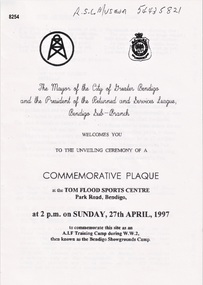
... Service was, Welcome, Mr Alan Holmes (President Bendigo RSL) Introduction of Recruits & Others associated with the Camp. A brief history of the Camp and Anecdotes was read by Mr Alan Holmes. Presentation and unveiling of the Plaque by Cr Barry Ackerman, Mayor City of Greater Bendigo. The wording: "Commemorating this site as an Australian Imperial Force Training Camp during WW2. "To the following Corps we pay Tribute" "10th AIF Training Depot" "Australian Army Medical Corps" "Australian Army Ordnance...Service was, Welcome, Mr Alan Holmes (President Bendigo RSL) Introduction of Recruits & Others associated with the Camp. A brief history of the Camp and Anecdotes was read by Mr Alan Holmes. Presentation and unveiling of the Plaque by Cr Barry Ackerman, Mayor City of Greater Bendigo. The wording: "Commemorating this site as an Australian Imperial Force Training Camp during WW2. "To the following Corps we pay Tribute" "10th AIF Training Depot" "Australian Army Medical Corps" "Australian Army Ordnance ...The Tom Flood Sports Centre was originally called The Bendigo Show Grounds. This plaque was unveiled by the City of Greater Bendigo & the Bendigo RSL Sub Branch to Commemorated the venue as a "Training Camp" during WW2. Order of Service was, Welcome, Mr Alan Holmes (President Bendigo RSL) Introduction of Recruits & Others associated with the Camp. A brief history of the Camp and Anecdotes was read by Mr Alan Holmes. Presentation and unveiling of the Plaque by Cr Barry Ackerman, Mayor City of Greater Bendigo. The wording: "Commemorating this site as an Australian Imperial Force Training Camp during WW2. "To the following Corps we pay Tribute" "10th AIF Training Depot" "Australian Army Medical Corps" "Australian Army Ordnance Corps" "Australian Army Service Corp". "Australian Electrical and Mechanical Engineers" Prayer of Thanksgiving & Commemoration by; Rev J. South. This was followed the "ODE, Last Post, One minutes Silence, Reveille and The National Anthem. As far as records available the Camp was first set up on 17.6.1940 with an Advance Party. The last Troops left there on 30.4.1943 for Ingleburn NSW, the Camp was vacated in May 1943. Pamphlet white paper, A4 folded making 4 pages, all print in black.On the front, "This Commemorative Plaque was unveiled at the Tom Flood Sports Centre Park Road Bendigo Sunday 27th April 1997"brsl, smirsl, plaque, tom flood, training camp -
 Flagstaff Hill Maritime Museum and Village
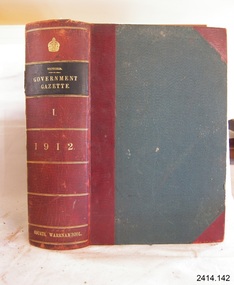
Book - Reference/State Government Notification Gazette, Albert John Mullett, The Victorian Government Gazette 1912 Vol 1 /146, 1912
... ordnance maps, and judicial reports. Mullet's office was responsible for printing high-profile official propaganda and patriotic materials during World War I. This included widely distributed recruitment items such as the iconic "Australians! Your Country Needs You" poster and official guides for peace celebrations and thanksgiving. He oversaw the printing of major historical works including the landmark reference books during his tenure, such as the comprehensive Handbook to Victoria compiled for the British Association for the Advancement of Science's 1914 Australian meeting, and the detailed Education Department's Record of War Service (1914–1919) published in 1921. ...ordnance maps, and judicial reports. Mullet's office was responsible for printing high-profile official propaganda and patriotic materials during World War I. This included widely distributed recruitment items such as the iconic "Australians! Your Country Needs You" poster and official guides for peace celebrations and thanksgiving. He oversaw the printing of major historical works including the landmark reference books during his tenure, such as the comprehensive Handbook to Victoria compiled for the British Association for the Advancement of Science's 1914 Australian meeting, and the detailed Education Department's Record of War Service (1914–1919) published in 1921. ...The Victoria Government Gazette and other government documents from 1887 were printed and published by Robert S. Brain, Government Printer, Melbourne. Brain held the position of Victorian Government Printer through the 1890s and into the early 1900s. The same imprint appears on other official Victorian publications from that era, such as the annual reports of the Board for the Protection of the Aborigines and the colony's Statistical Register. There wasn't really an editor in the modern sense the Gazette was compiled and issued under the authority of the colonial government, via the Chief Secretary's Department, with Brain's printing office producing and publishing it. In May 1906, James Kemp succeeded him, serving as Government Printer from May 1906 to August 1912, with the title of Acting Government Printer right at the very start of his tenure he was stepping into the role Brain had just vacated, and by later in December 1906 he was signing gazettes in that capacity, apparently before his appointment was made permanent. Then in 1912 Albert John Mullett took over the role starting from January 1912 the same way Kemp had as Acting Government Printer with his appointment made permanent in 1913 where he served all through the 1920s.Hard cover book. The Victorian Government Gazette 1912 Vol 1 /146 Printer: Albert John Mullett Publisher: Albert John Mullett Publisher: Authority of The Colonial Government Date: 1912 Further Information: Textured hard cover bound book leather burgundy colour spine with gilt lettering, covers embossed blue cloth & reinforced corners to front and back cover. non-fictionThe Victoria Government Gazette and other government documents from 1887 were printed and published by Robert S. Brain, Government Printer, Melbourne. Brain held the position of Victorian Government Printer through the 1890s and into the early 1900s. The same imprint appears on other official Victorian publications from that era, such as the annual reports of the Board for the Protection of the Aborigines and the colony's Statistical Register. There wasn't really an editor in the modern sense the Gazette was compiled and issued under the authority of the colonial government, via the Chief Secretary's Department, with Brain's printing office producing and publishing it. In May 1906, James Kemp succeeded him, serving as Government Printer from May 1906 to August 1912, with the title of Acting Government Printer right at the very start of his tenure he was stepping into the role Brain had just vacated, and by later in December 1906 he was signing gazettes in that capacity, apparently before his appointment was made permanent. Then in 1912 Albert John Mullett took over the role starting from January 1912 the same way Kemp had as Acting Government Printer with his appointment made permanent in 1913 where he served all through the 1920s. flagstaff hill, warrnambool, shipwrecked-coast, flagstaff-hill, flagstaff-hill-maritime-museum, maritime-museum, shipwreck-coast, flagstaff-hill-maritime-village, book, the victoria government gazette 1912 1 vol 146, the victoria government gazette 1912, the victoria government gazette -
 Flagstaff Hill Maritime Museum and Village
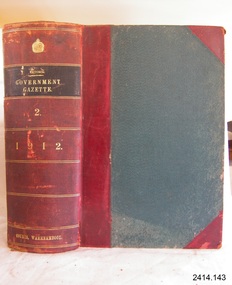
Book - Reference/State Government Notification Gazette, Albert John Mullett, The Victorian Government Gazette 1912 Vol 2 /147, 1912
... ordnance maps, and judicial reports. Mullet's office was responsible for printing high-profile official propaganda and patriotic materials during World War I. This included widely distributed recruitment items such as the iconic "Australians! Your Country Needs You" poster and official guides for peace celebrations and thanksgiving. He oversaw the printing of major historical works including the landmark reference books during his tenure, such as the comprehensive Handbook to Victoria compiled for the British Association for the Advancement of Science's 1914 Australian meeting, and the detailed Education Department's Record of War Service (1914–1919) published in 1921. ...ordnance maps, and judicial reports. Mullet's office was responsible for printing high-profile official propaganda and patriotic materials during World War I. This included widely distributed recruitment items such as the iconic "Australians! Your Country Needs You" poster and official guides for peace celebrations and thanksgiving. He oversaw the printing of major historical works including the landmark reference books during his tenure, such as the comprehensive Handbook to Victoria compiled for the British Association for the Advancement of Science's 1914 Australian meeting, and the detailed Education Department's Record of War Service (1914–1919) published in 1921. ...The Victoria Government Gazette and other government documents from 1887 were printed and published by Robert S. Brain, Government Printer, Melbourne. Brain held the position of Victorian Government Printer through the 1890s and into the early 1900s. The same imprint appears on other official Victorian publications from that era, such as the annual reports of the Board for the Protection of the Aborigines and the colony's Statistical Register. There wasn't really an editor in the modern sense the Gazette was compiled and issued under the authority of the colonial government, via the Chief Secretary's Department, with Brain's printing office producing and publishing it. In May 1906, James Kemp succeeded him, serving as Government Printer from May 1906 to August 1912, with the title of Acting Government Printer right at the very start of his tenure he was stepping into the role Brain had just vacated, and by later in December 1906 he was signing gazettes in that capacity, apparently before his appointment was made permanent. Then in 1912 Albert John Mullett took over the role starting from January 1912 the same way Kemp had as Acting Government Printer with his appointment made permanent in 1913 where he served all through the 1920s.Hard cover book. The Victorian Government Gazette 1912 Vol 2 /147 Printer: Albert John Mullett Publisher: Albert John Mullett Publisher: Authority of The Colonial Government Date: 1912 Further Information: Textured hard cover bound book leather burgundy colour spine with gilt lettering, covers embossed blue cloth & reinforced corners to front and back cover. non-fictionThe Victoria Government Gazette and other government documents from 1887 were printed and published by Robert S. Brain, Government Printer, Melbourne. Brain held the position of Victorian Government Printer through the 1890s and into the early 1900s. The same imprint appears on other official Victorian publications from that era, such as the annual reports of the Board for the Protection of the Aborigines and the colony's Statistical Register. There wasn't really an editor in the modern sense the Gazette was compiled and issued under the authority of the colonial government, via the Chief Secretary's Department, with Brain's printing office producing and publishing it. In May 1906, James Kemp succeeded him, serving as Government Printer from May 1906 to August 1912, with the title of Acting Government Printer right at the very start of his tenure he was stepping into the role Brain had just vacated, and by later in December 1906 he was signing gazettes in that capacity, apparently before his appointment was made permanent. Then in 1912 Albert John Mullett took over the role starting from January 1912 the same way Kemp had as Acting Government Printer with his appointment made permanent in 1913 where he served all through the 1920s. flagstaff hill, warrnambool, shipwrecked-coast, flagstaff-hill, flagstaff-hill-maritime-museum, maritime-museum, shipwreck-coast, flagstaff-hill-maritime-village, book, the victoria government gazette 1912 1 vol 146, the victoria government gazette 1912, the victoria government gazette -
Flagstaff Hill Maritime Museum and Village
Book - Reference/State Government Notification Gazette, Albert John Mullett, The Victorian Government Gazette 1912 Vol 3 /148, 1912
... ordnance maps, and judicial reports. Mullet's office was responsible for printing high-profile official propaganda and patriotic materials during World War I. This included widely distributed recruitment items such as the iconic "Australians! Your Country Needs You" poster and official guides for peace celebrations and thanksgiving. He oversaw the printing of major historical works including the landmark reference books during his tenure, such as the comprehensive Handbook to Victoria compiled for the British Association for the Advancement of Science's 1914 Australian meeting, and the detailed Education Department's Record of War Service (1914–1919) published in 1921. ...ordnance maps, and judicial reports. Mullet's office was responsible for printing high-profile official propaganda and patriotic materials during World War I. This included widely distributed recruitment items such as the iconic "Australians! Your Country Needs You" poster and official guides for peace celebrations and thanksgiving. He oversaw the printing of major historical works including the landmark reference books during his tenure, such as the comprehensive Handbook to Victoria compiled for the British Association for the Advancement of Science's 1914 Australian meeting, and the detailed Education Department's Record of War Service (1914–1919) published in 1921. ...The Victoria Government Gazette and other government documents from 1887 were printed and published by Robert S. Brain, Government Printer, Melbourne. Brain held the position of Victorian Government Printer through the 1890s and into the early 1900s. The same imprint appears on other official Victorian publications from that era, such as the annual reports of the Board for the Protection of the Aborigines and the colony's Statistical Register. There wasn't really an editor in the modern sense the Gazette was compiled and issued under the authority of the colonial government, via the Chief Secretary's Department, with Brain's printing office producing and publishing it. In May 1906, James Kemp succeeded him, serving as Government Printer from May 1906 to August 1912, with the title of Acting Government Printer right at the very start of his tenure he was stepping into the role Brain had just vacated, and by later in December 1906 he was signing gazettes in that capacity, apparently before his appointment was made permanent. Then in 1912 Albert John Mullett took over the role starting from January 1912 the same way Kemp had as Acting Government Printer with his appointment made permanent in 1913 where he served all through the 1920s.Hard cover book. The Victorian Government Gazette 1912 Vol 3 /148 Printer: Albert John Mullett Publisher: Albert John Mullett Publisher: Authority of The Colonial Government Date: 1912 Further Information: Textured hard cover bound book leather burgundy colour spine with gilt lettering, covers embossed blue cloth & reinforced corners to front and back cover. non-fictionThe Victoria Government Gazette and other government documents from 1887 were printed and published by Robert S. Brain, Government Printer, Melbourne. Brain held the position of Victorian Government Printer through the 1890s and into the early 1900s. The same imprint appears on other official Victorian publications from that era, such as the annual reports of the Board for the Protection of the Aborigines and the colony's Statistical Register. There wasn't really an editor in the modern sense the Gazette was compiled and issued under the authority of the colonial government, via the Chief Secretary's Department, with Brain's printing office producing and publishing it. In May 1906, James Kemp succeeded him, serving as Government Printer from May 1906 to August 1912, with the title of Acting Government Printer right at the very start of his tenure he was stepping into the role Brain had just vacated, and by later in December 1906 he was signing gazettes in that capacity, apparently before his appointment was made permanent. Then in 1912 Albert John Mullett took over the role starting from January 1912 the same way Kemp had as Acting Government Printer with his appointment made permanent in 1913 where he served all through the 1920s. flagstaff hill, warrnambool, shipwrecked-coast, flagstaff-hill, flagstaff-hill-maritime-museum, maritime-museum, shipwreck-coast, flagstaff-hill-maritime-village, book, the victoria government gazette 1912 1 vol 146, the victoria government gazette 1912, the victoria government gazette -
 Flagstaff Hill Maritime Museum and Village
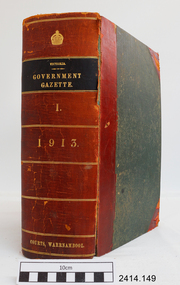
Book - Reference/State Government Notification Gazette, Albert John Mullett, The Victorian Government Gazette 1913 Vol 1 /149 ( Vol Number Mis Print on Volume Title CXLVIX See Note Section), 1913
... ordnance maps, and judicial reports. Mullet's office was responsible for printing high-profile official propaganda and patriotic materials during World War I. This included widely distributed recruitment items such as the iconic "Australians! Your Country Needs You" poster and official guides for peace celebrations and thanksgiving. He oversaw the printing of major historical works including the landmark reference books during his tenure, such as the comprehensive Handbook to Victoria compiled for the British Association for the Advancement of Science's 1914 Australian meeting, and the detailed Education Department's Record of War Service (1914–1919) published in 1921. ...ordnance maps, and judicial reports. Mullet's office was responsible for printing high-profile official propaganda and patriotic materials during World War I. This included widely distributed recruitment items such as the iconic "Australians! Your Country Needs You" poster and official guides for peace celebrations and thanksgiving. He oversaw the printing of major historical works including the landmark reference books during his tenure, such as the comprehensive Handbook to Victoria compiled for the British Association for the Advancement of Science's 1914 Australian meeting, and the detailed Education Department's Record of War Service (1914–1919) published in 1921. ...The Victoria Government Gazette and other government documents from 1887 were printed and published by Robert S. Brain, Government Printer, Melbourne. Brain held the position of Victorian Government Printer through the 1890s and into the early 1900s. The same imprint appears on other official Victorian publications from that era, such as the annual reports of the Board for the Protection of the Aborigines and the colony's Statistical Register. There wasn't really an editor in the modern sense the Gazette was compiled and issued under the authority of the colonial government, via the Chief Secretary's Department, with Brain's printing office producing and publishing it. In May 1906, James Kemp succeeded him, serving as Government Printer from May 1906 to August 1912, with the title of Acting Government Printer right at the very start of his tenure he was stepping into the role Brain had just vacated, and by later in December 1906 he was signing gazettes in that capacity, apparently before his appointment was made permanent. Then in 1912 Albert John Mullett took over the role starting from January 1912 the same way Kemp had as Acting Government Printer with his appointment made permanent in 1913 where he served all through the 1920s.Hard cover book. The Victorian Government Gazette 1913 Vol 1 /149 Printer: Albert John Mullett Publisher: Albert John Mullett Publisher: Authority of The Colonial Government Date: 1913 Further Information: Textured hard cover bound book leather burgundy colour spine with gilt lettering, covers embossed blue cloth & reinforced corners to front and back cover. non-fictionThe Victoria Government Gazette and other government documents from 1887 were printed and published by Robert S. Brain, Government Printer, Melbourne. Brain held the position of Victorian Government Printer through the 1890s and into the early 1900s. The same imprint appears on other official Victorian publications from that era, such as the annual reports of the Board for the Protection of the Aborigines and the colony's Statistical Register. There wasn't really an editor in the modern sense the Gazette was compiled and issued under the authority of the colonial government, via the Chief Secretary's Department, with Brain's printing office producing and publishing it. In May 1906, James Kemp succeeded him, serving as Government Printer from May 1906 to August 1912, with the title of Acting Government Printer right at the very start of his tenure he was stepping into the role Brain had just vacated, and by later in December 1906 he was signing gazettes in that capacity, apparently before his appointment was made permanent. Then in 1912 Albert John Mullett took over the role starting from January 1912 the same way Kemp had as Acting Government Printer with his appointment made permanent in 1913 where he served all through the 1920s. flagstaff hill, warrnambool, shipwrecked-coast, flagstaff-hill, flagstaff-hill-maritime-museum, maritime-museum, shipwreck-coast, flagstaff-hill-maritime-village, book, the victoria government gazette 1912 1 vol 146, the victoria government gazette 1912, the victoria government gazette -
 Flagstaff Hill Maritime Museum and Village
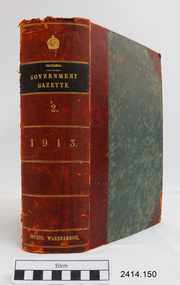
Book - Reference/State Government Notification Gazette, Albert John Mullett, The Victorian Government Gazette 1913 Vol 2 /150, 1913
... ordnance maps, and judicial reports. Mullet's office was responsible for printing high-profile official propaganda and patriotic materials during World War I. This included widely distributed recruitment items such as the iconic "Australians! Your Country Needs You" poster and official guides for peace celebrations and thanksgiving. He oversaw the printing of major historical works including the landmark reference books during his tenure, such as the comprehensive Handbook to Victoria compiled for the British Association for the Advancement of Science's 1914 Australian meeting, and the detailed Education Department's Record of War Service (1914–1919) published in 1921. ...ordnance maps, and judicial reports. Mullet's office was responsible for printing high-profile official propaganda and patriotic materials during World War I. This included widely distributed recruitment items such as the iconic "Australians! Your Country Needs You" poster and official guides for peace celebrations and thanksgiving. He oversaw the printing of major historical works including the landmark reference books during his tenure, such as the comprehensive Handbook to Victoria compiled for the British Association for the Advancement of Science's 1914 Australian meeting, and the detailed Education Department's Record of War Service (1914–1919) published in 1921. ...The Victoria Government Gazette and other government documents from 1887 were printed and published by Robert S. Brain, Government Printer, Melbourne. Brain held the position of Victorian Government Printer through the 1890s and into the early 1900s. The same imprint appears on other official Victorian publications from that era, such as the annual reports of the Board for the Protection of the Aborigines and the colony's Statistical Register. There wasn't really an editor in the modern sense the Gazette was compiled and issued under the authority of the colonial government, via the Chief Secretary's Department, with Brain's printing office producing and publishing it. In May 1906, James Kemp succeeded him, serving as Government Printer from May 1906 to August 1912, with the title of Acting Government Printer right at the very start of his tenure he was stepping into the role Brain had just vacated, and by later in December 1906 he was signing gazettes in that capacity, apparently before his appointment was made permanent. Then in 1912 Albert John Mullett took over the role starting from January 1912 the same way Kemp had as Acting Government Printer with his appointment made permanent in 1913 where he served all through the 1920s.Hard cover book. The Victorian Government Gazette 1913 Vol 2 /150 Printer: Albert John Mullett Publisher: Albert John Mullett Publisher: Authority of The Colonial Government Date: 1913 Further Information: Textured hard cover bound book leather burgundy colour spine with gilt lettering, covers embossed blue cloth & reinforced corners to front and back cover. non-fictionThe Victoria Government Gazette and other government documents from 1887 were printed and published by Robert S. Brain, Government Printer, Melbourne. Brain held the position of Victorian Government Printer through the 1890s and into the early 1900s. The same imprint appears on other official Victorian publications from that era, such as the annual reports of the Board for the Protection of the Aborigines and the colony's Statistical Register. There wasn't really an editor in the modern sense the Gazette was compiled and issued under the authority of the colonial government, via the Chief Secretary's Department, with Brain's printing office producing and publishing it. In May 1906, James Kemp succeeded him, serving as Government Printer from May 1906 to August 1912, with the title of Acting Government Printer right at the very start of his tenure he was stepping into the role Brain had just vacated, and by later in December 1906 he was signing gazettes in that capacity, apparently before his appointment was made permanent. Then in 1912 Albert John Mullett took over the role starting from January 1912 the same way Kemp had as Acting Government Printer with his appointment made permanent in 1913 where he served all through the 1920s. flagstaff hill, warrnambool, shipwrecked-coast, flagstaff-hill, flagstaff-hill-maritime-museum, maritime-museum, shipwreck-coast, flagstaff-hill-maritime-village, book, the victoria government gazette 1912 1 vol 146, the victoria government gazette 1912, the victoria government gazette -
 Flagstaff Hill Maritime Museum and Village
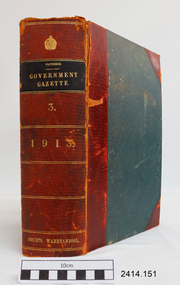
Book - Reference/State Government Notification Gazette, Albert John Mullett, The Victorian Government Gazette 1913 Vol 3 /151, 1913
... ordnance maps, and judicial reports. Mullet's office was responsible for printing high-profile official propaganda and patriotic materials during World War I. This included widely distributed recruitment items such as the iconic "Australians! Your Country Needs You" poster and official guides for peace celebrations and thanksgiving. He oversaw the printing of major historical works including the landmark reference books during his tenure, such as the comprehensive Handbook to Victoria compiled for the British Association for the Advancement of Science's 1914 Australian meeting, and the detailed Education Department's Record of War Service (1914–1919) published in 1921. ...ordnance maps, and judicial reports. Mullet's office was responsible for printing high-profile official propaganda and patriotic materials during World War I. This included widely distributed recruitment items such as the iconic "Australians! Your Country Needs You" poster and official guides for peace celebrations and thanksgiving. He oversaw the printing of major historical works including the landmark reference books during his tenure, such as the comprehensive Handbook to Victoria compiled for the British Association for the Advancement of Science's 1914 Australian meeting, and the detailed Education Department's Record of War Service (1914–1919) published in 1921. ...The Victoria Government Gazette and other government documents from 1887 were printed and published by Robert S. Brain, Government Printer, Melbourne. Brain held the position of Victorian Government Printer through the 1890s and into the early 1900s. The same imprint appears on other official Victorian publications from that era, such as the annual reports of the Board for the Protection of the Aborigines and the colony's Statistical Register. There wasn't really an editor in the modern sense the Gazette was compiled and issued under the authority of the colonial government, via the Chief Secretary's Department, with Brain's printing office producing and publishing it. In May 1906, James Kemp succeeded him, serving as Government Printer from May 1906 to August 1912, with the title of Acting Government Printer right at the very start of his tenure he was stepping into the role Brain had just vacated, and by later in December 1906 he was signing gazettes in that capacity, apparently before his appointment was made permanent. Then in 1912 Albert John Mullett took over the role starting from January 1912 the same way Kemp had as Acting Government Printer with his appointment made permanent in 1913 where he served all through the 1920s.Hard cover book. The Victorian Government Gazette 1913 Vol 3 /151 Printer: Albert John Mullett Publisher: Albert John Mullett Publisher: Authority of The Colonial Government Date: 1913 Further Information: Textured hard cover bound book leather burgundy colour spine with gilt lettering, covers embossed blue cloth & reinforced corners to front and back cover. non-fictionThe Victoria Government Gazette and other government documents from 1887 were printed and published by Robert S. Brain, Government Printer, Melbourne. Brain held the position of Victorian Government Printer through the 1890s and into the early 1900s. The same imprint appears on other official Victorian publications from that era, such as the annual reports of the Board for the Protection of the Aborigines and the colony's Statistical Register. There wasn't really an editor in the modern sense the Gazette was compiled and issued under the authority of the colonial government, via the Chief Secretary's Department, with Brain's printing office producing and publishing it. In May 1906, James Kemp succeeded him, serving as Government Printer from May 1906 to August 1912, with the title of Acting Government Printer right at the very start of his tenure he was stepping into the role Brain had just vacated, and by later in December 1906 he was signing gazettes in that capacity, apparently before his appointment was made permanent. Then in 1912 Albert John Mullett took over the role starting from January 1912 the same way Kemp had as Acting Government Printer with his appointment made permanent in 1913 where he served all through the 1920s. flagstaff hill, warrnambool, shipwrecked-coast, flagstaff-hill, flagstaff-hill-maritime-museum, maritime-museum, shipwreck-coast, flagstaff-hill-maritime-village, book, the victoria government gazette 1912 1 vol 146, the victoria government gazette 1912, the victoria government gazette -
 Flagstaff Hill Maritime Museum and Village
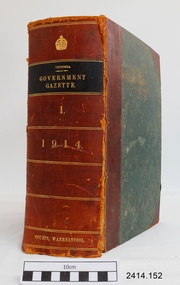
Book - Reference/State Government Notification Gazette, Albert John Mullett, The Victorian Government Gazette 1914 Vol 1 /152, 1914
... ordnance maps, and judicial reports. Mullet's office was responsible for printing high-profile official propaganda and patriotic materials during World War I. This included widely distributed recruitment items such as the iconic "Australians! Your Country Needs You" poster and official guides for peace celebrations and thanksgiving. He oversaw the printing of major historical works including the landmark reference books during his tenure, such as the comprehensive Handbook to Victoria compiled for the British Association for the Advancement of Science's 1914 Australian meeting, and the detailed Education Department's Record of War Service (1914–1919) published in 1921. ...ordnance maps, and judicial reports. Mullet's office was responsible for printing high-profile official propaganda and patriotic materials during World War I. This included widely distributed recruitment items such as the iconic "Australians! Your Country Needs You" poster and official guides for peace celebrations and thanksgiving. He oversaw the printing of major historical works including the landmark reference books during his tenure, such as the comprehensive Handbook to Victoria compiled for the British Association for the Advancement of Science's 1914 Australian meeting, and the detailed Education Department's Record of War Service (1914–1919) published in 1921. ...The Victoria Government Gazette and other government documents from 1887 were printed and published by Robert S. Brain, Government Printer, Melbourne. Brain held the position of Victorian Government Printer through the 1890s and into the early 1900s. The same imprint appears on other official Victorian publications from that era, such as the annual reports of the Board for the Protection of the Aborigines and the colony's Statistical Register. There wasn't really an editor in the modern sense the Gazette was compiled and issued under the authority of the colonial government, via the Chief Secretary's Department, with Brain's printing office producing and publishing it. In May 1906, James Kemp succeeded him, serving as Government Printer from May 1906 to August 1912, with the title of Acting Government Printer right at the very start of his tenure he was stepping into the role Brain had just vacated, and by later in December 1906 he was signing gazettes in that capacity, apparently before his appointment was made permanent. Then in 1912 Albert John Mullett took over the role starting from January 1912 the same way Kemp had as Acting Government Printer with his appointment made permanent in 1913 where he served all through the 1920s.Hard cover book. The Victorian Government Gazette 1914 Vol 1 /152 Printer: Albert John Mullett Publisher: Albert John Mullett Publisher: Authority of The Colonial Government Date: 1914 Further Information: Textured hard cover bound book leather burgundy colour spine with gilt lettering, covers embossed blue cloth & reinforced corners to front and back cover. non-fictionThe Victoria Government Gazette and other government documents from 1887 were printed and published by Robert S. Brain, Government Printer, Melbourne. Brain held the position of Victorian Government Printer through the 1890s and into the early 1900s. The same imprint appears on other official Victorian publications from that era, such as the annual reports of the Board for the Protection of the Aborigines and the colony's Statistical Register. There wasn't really an editor in the modern sense the Gazette was compiled and issued under the authority of the colonial government, via the Chief Secretary's Department, with Brain's printing office producing and publishing it. In May 1906, James Kemp succeeded him, serving as Government Printer from May 1906 to August 1912, with the title of Acting Government Printer right at the very start of his tenure he was stepping into the role Brain had just vacated, and by later in December 1906 he was signing gazettes in that capacity, apparently before his appointment was made permanent. Then in 1912 Albert John Mullett took over the role starting from January 1912 the same way Kemp had as Acting Government Printer with his appointment made permanent in 1913 where he served all through the 1920s. flagstaff hill, warrnambool, shipwrecked-coast, flagstaff-hill, flagstaff-hill-maritime-museum, maritime-museum, shipwreck-coast, flagstaff-hill-maritime-village, book, the victoria government gazette 1912 1 vol 146, the victoria government gazette 1912, the victoria government gazette -
 Flagstaff Hill Maritime Museum and Village
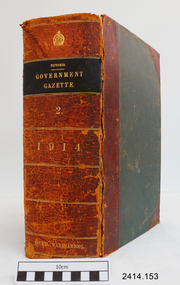
Book - Reference/State Government Notification Gazette, Albert John Mullett, The Victorian Government Gazette 1914 Vol 2 /153, 1914
... ordnance maps, and judicial reports. Mullet's office was responsible for printing high-profile official propaganda and patriotic materials during World War I. This included widely distributed recruitment items such as the iconic "Australians! Your Country Needs You" poster and official guides for peace celebrations and thanksgiving. He oversaw the printing of major historical works including the landmark reference books during his tenure, such as the comprehensive Handbook to Victoria compiled for the British Association for the Advancement of Science's 1914 Australian meeting, and the detailed Education Department's Record of War Service (1914–1919) published in 1921. ...ordnance maps, and judicial reports. Mullet's office was responsible for printing high-profile official propaganda and patriotic materials during World War I. This included widely distributed recruitment items such as the iconic "Australians! Your Country Needs You" poster and official guides for peace celebrations and thanksgiving. He oversaw the printing of major historical works including the landmark reference books during his tenure, such as the comprehensive Handbook to Victoria compiled for the British Association for the Advancement of Science's 1914 Australian meeting, and the detailed Education Department's Record of War Service (1914–1919) published in 1921. ...The Victoria Government Gazette and other government documents from 1887 were printed and published by Robert S. Brain, Government Printer, Melbourne. Brain held the position of Victorian Government Printer through the 1890s and into the early 1900s. The same imprint appears on other official Victorian publications from that era, such as the annual reports of the Board for the Protection of the Aborigines and the colony's Statistical Register. There wasn't really an editor in the modern sense the Gazette was compiled and issued under the authority of the colonial government, via the Chief Secretary's Department, with Brain's printing office producing and publishing it. In May 1906, James Kemp succeeded him, serving as Government Printer from May 1906 to August 1912, with the title of Acting Government Printer right at the very start of his tenure he was stepping into the role Brain had just vacated, and by later in December 1906 he was signing gazettes in that capacity, apparently before his appointment was made permanent. Then in 1912 Albert John Mullett took over the role starting from January 1912 the same way Kemp had as Acting Government Printer with his appointment made permanent in 1913 where he served all through the 1920s.Hard cover book. The Victorian Government Gazette 1914 Vol 2 /153 Printer: Albert John Mullett Publisher: Albert John Mullett Publisher: Authority of The Colonial Government Date: 1914 Further Information: Textured hard cover bound book leather burgundy colour spine with gilt lettering, covers embossed blue cloth & reinforced corners to front and back cover. non-fictionThe Victoria Government Gazette and other government documents from 1887 were printed and published by Robert S. Brain, Government Printer, Melbourne. Brain held the position of Victorian Government Printer through the 1890s and into the early 1900s. The same imprint appears on other official Victorian publications from that era, such as the annual reports of the Board for the Protection of the Aborigines and the colony's Statistical Register. There wasn't really an editor in the modern sense the Gazette was compiled and issued under the authority of the colonial government, via the Chief Secretary's Department, with Brain's printing office producing and publishing it. In May 1906, James Kemp succeeded him, serving as Government Printer from May 1906 to August 1912, with the title of Acting Government Printer right at the very start of his tenure he was stepping into the role Brain had just vacated, and by later in December 1906 he was signing gazettes in that capacity, apparently before his appointment was made permanent. Then in 1912 Albert John Mullett took over the role starting from January 1912 the same way Kemp had as Acting Government Printer with his appointment made permanent in 1913 where he served all through the 1920s. flagstaff hill, warrnambool, shipwrecked-coast, flagstaff-hill, flagstaff-hill-maritime-museum, maritime-museum, shipwreck-coast, flagstaff-hill-maritime-village, book, the victoria government gazette 1912 1 vol 146, the victoria government gazette 1912, the victoria government gazette -
 Shepparton RSL Sub Branch
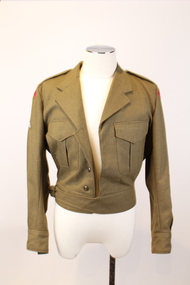
Uniform, Jacket, E.W. PTY/LTD, 1968
... service during the Vietnam War. The wearer of the uniform is unknown, however the patches and flashes attached signify that the serviceman worked for the Royal Australian Army Ordnance Corps, earned qualifications as a parachuter and marksman and ranked highly as a Warrant Officer 1. ...This jacket is part of a Royal Australian Army Ordnance Corps uniform. The Royal Australian Army Ordnance Corps (RAAOC) is responsible for various logistics and organisational operations, such as maintenance of parachutes, fuel distribution, personnel administration, exlosive disposal and laundy operations. The jacket was manufactured in 1968 and was worn by an unknown RAAOC serviceman. The patches on his sleeves denote that he had earned qualifications as a parachuter and a marksman and that he was a Warrant Officer 1. Due to the period of manufacture it can be presumed that the serviceman whom this uniform belonged to served Vietnam War.As an historic military uniform dating to 1968, it is presumed that this item would have been used in service during the Vietnam War. The wearer of the uniform is unknown, however the patches and flashes attached signify that the serviceman worked for the Royal Australian Army Ordnance Corps, earned qualifications as a parachuter and marksman and ranked highly as a Warrant Officer 1. The item is representative of a type of uniform worn by high ranking RAAOC servicemen during the 1960’s. It is also in very good condition for its age.A khaki coloured waist length jacket which is composed of a heavy fabric. The jacket fastens with five buttons down the front and a buckle. The buttons are composed of brown plastic and the buckle is a dark grey metal. The buckle is attached to a waistband on the right-hand side which loops around to a strip of fabric on the left-hand side which passes through the buckle. There are two breast pockets, one on each side of the chest. The right breast pocket is fastened with a brown plastic button and the left breast pocket is missing its button. Each pocket has a flap of fabric which covers the button area. The jacket has a collar and an epaulette on each shoulder which are each fastened with one brown plastic button. There is a ribbon of fabric on the interior of the collar with no inscriptions. There are identical crescent shaped red patches on each shoulder, each showing the words in navy blue stitching "Royal Australian Army Ordinance Corps". The upper right sleeve has a khaki coloured parachuting qualification patch, which depicts an air balloon in white stitching, with wings on either side in light blue stitching. The lower section of each sleeve has a Warrant Officer First Class khaki coloured patch. This depicts a shield in red, black, white, blue and gold stitching in the centre which sits beneath a gold and blue striped line and a gold star. There is a gold kangaroo to the left of these motifs and a gold emu to the right. Beneath these motifs there is a ribbon in white, blue and gold stitching with the word "Australia". In addition there are curvilinear green decorative elements with yellow flowers on their ends. The left-hand sleeve also has a brown marksmen qualification patch. This depicts two crossed rifles in white and brown stitching. There is a white label with printed inscriptions on the interior of the left breast pocket. There is also a band of fabric on the interior back waist band which has three button holes.Printed in black inscriptions on the white label: E.W. PTY/LTD. SOUTH AUSTRALIA 1968 (a broad arrow) Class 8405-66-025-641 Batch A.W... Mill (the ‘A.W...’ is in stamped purple ink and there are some other purple inscriptions that are difficult to decipher) SIZE OF CHEST 39/49PR MATCHING TROUSERS 37 PR DRY CLEAN ONLY CREASE UPPER HALF OF LAPELS ONLY NAME..... ARMY No..... (the number 40 is also wrtten in faded black ink in the top right corner of the label)military, jacket, army, raaoc, royal australian army ordnance corps, parachuting, marksman, warrant officer, uniform -
 Shepparton RSL Sub Branch
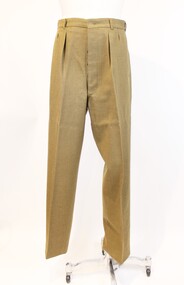
Uniform, trousers, Conway Bros. PTY. LTD, 1969
... service during the Vietnam War. The wearer of the uniform is unknown, however the patches and flashes attached signify that the serviceman worked for the Royal Australian Army Ordnance Corps, earned qualifications as a parachuter and marksman and ranked highly as a Warrant Officer 1. ...These trousers are part of a Royal Australian Army Ordnance Corps uniform. The Royal Australian Army Ordnance Corps (RAAOC) is responsible for various logistics and organisational operations, such as maintenance of parachutes, fuel distribution, personnel administration, exlosive disposal and laundy operations. The trousers were manufactured in 1969 and were worn by an unknown RAAOC serviceman. The patches on the sleeves of the corresponding jacket denote that he had earned qualifications as a parachuter and a marksman and that he was a Warrant Officer 1. Due to the period of manufacture it can be presumed that the serviceman whom this uniform belonged to served in the Vietnam War.As historic military uniform trousers dating to 1968, it is presumed that this item would have been used in service during the Vietnam War. The wearer of the uniform is unknown, however the patches and flashes attached signify that the serviceman worked for the Royal Australian Army Ordnance Corps, earned qualifications as a parachuter and marksman and ranked highly as a Warrant Officer 1. The item is representative of a type of uniform worn by high ranking RAAOC servicemen during the 1960’s. It is also in very good condition for its age.khaki coloured trousers which are composed of a heavy fabric. The trousers button up at the front with 6 plastic buttons. There is an additional strip of fabric attached to the right-hand fly which can be fastened with an extra button on the interior of the left-hand fly. There are an additional 6 buttons along the interior waistband. There are also three buttons on the exterior waistband down the front and a buckle. The buttons are composed of brown plastic. There are two open hip pockets, one on either side, and another button-up pocket on the right-hand side of the back. There is a white label with inscriptions attached to the interior of the back pocket with an extra piece of fabric attached for mending patches.Printed in black inscriptions on the white label: CONWAY BROS. PTY. LTD ADELAIDE 1969 (a broad arrow) Class 8405-66-025-6183 A W M 7 (these characters are stamped in faded black ink) SIZE & WAIST 33R MATCHING JACKET 37-38R in a box are the words: DRY CLEAN ONLY. Re-press on original seams. Creases set by Si-ro-set. Mending patch attached. (end of box containing words) NAME.....DOCKSEY (‘Docksey is in hand-written black ink) ARMY No.....216308 (numbers also hand-written in black ink) (the number 40 is also wrtten in faded black ink in the top right corner of the label)military, army, raaoc, marksman, royal australian army ordnance corps, parachuting, warrant officer, uniform, trousers
