
Showing 40 items matching "other fluids"
-
 Federation University Historical Collection
Booklet, Thermodynamic Properties of Fluids and Other Data, 1959
... Thermodynamic Properties of Fluids and Other Data...thermodynamics fluids alan herbertson y.r. mayhew g.f.c. rogers Soft covered booklet Thermodynamic Properties of Fluids and Other Data Booklet ...Soft covered bookletthermodynamics, fluids, alan herbertson, y.r. mayhew, g.f.c. rogers -
Moorabbin Air Museum
Book - Shell aviation products, The Aeroshell Book
... ...Other fluids...Shell aviation products Classification of products Quality control Storage & handling Retesting Aviation fuels Piston engine oils Turbine engine oils Greases Hydraulic fluids Preservatives Other fluids Overview of Shell aviation products Spiral manual style book The Aeroshell Book Book Shell aviation products ...Overview of Shell aviation productsSpiral manual style booknon-fictionOverview of Shell aviation productsclassification of products, quality control, storage & handling, retesting, aviation fuels, piston engine oils, turbine engine oils, greases, hydraulic fluids, preservatives, other fluids -
 Royal Australian and New Zealand College of Obstetricians & Gynaecologists (RANZCOG)
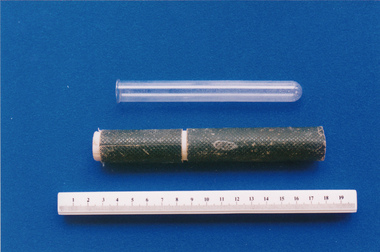
Test tube and case associated with midwife Mary Howlett, c. 1866 - 1920
... This type of test tube would have been used to collect blood or other bodily fluids. IT may also have been used to boil urine to identify the presence of urinary abnormalities such as sugar albumen acetone or bile....This type of test tube would have been used to collect blood or other bodily fluids. IT may also have been used to boil urine to identify the presence of urinary abnormalities such as sugar albumen acetone or bile. ...This type of test tube would have been used to collect blood or other bodily fluids. IT may also have been used to boil urine to identify the presence of urinary abnormalities such as sugar albumen acetone or bile.Mary Howlett (1840-1922) began practising as a country midwife in 1866 in the western district of Victoria. She qualified as a 'ladies monthly nurse' in 1887 and continued to practise as a nurse and midwife until 1920.She began her six months training at the Melbourne Lying-In Hospital. She was known by many as 'Auntie', and her career spanned more than 50 years. Mrs Howlett's midwifery box and contents were given to Dr Frank Forster, and he donated them to the museum collection in 1993.Glass test tube with a thin glass lip in original cylinder cardboard case. Case is in two section, lid and body - lid is lined with white cardboard.diagnostic testing, midwifery -
 Waverley RSL Sub Branch
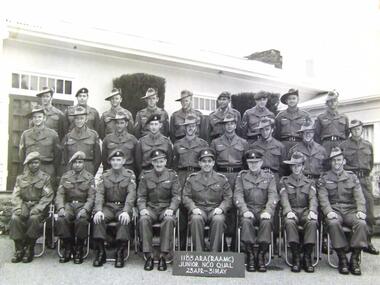
Print NCO QUAL (RAAMC), Name: 11’63 ARA(RAAMC) Junior NCO QUAL 23APR – 31 MAY
... There is also past damage to various parts of the photo from droplets of water or some other fluid. Size: 25cm x 19.8cm Print has been re-photographed and digitally repaired for display (19th September 2012 by: John Dix) Saved as Restored.bmp at highest practical resolution ...There is also past damage to various parts of the photo from droplets of water or some other fluid. Size: 25cm x 19.8cm Print has been re-photographed and digitally repaired for display (19th September 2012 by: John Dix) Saved as Restored.bmp at highest practical resolution Name: 11’63 ARA(RAAMC) Junior NCO QUAL 23APR – 31 MAY Print NCO QUAL (RAAMC) ...Name: 11’63 ARA(RAAMC) Junior NCO QUAL 23APR – 31 MAY Healseville VictoriaDescription: Black and white photograph gloss print mounted in celluloid sheet and stapled through the photograph. Damage to photo from tape having been stuck on photo at some stage and then removed damaging he surface of the photo in all four corners. There is also past damage to various parts of the photo from droplets of water or some other fluid. Size: 25cm x 19.8cm Print has been re-photographed and digitally repaired for display (19th September 2012 by: John Dix) Saved as Restored.bmp at highest practical resolution Name: 11’63 ARA(RAAMC) Junior NCO QUAL 23APR – 31 MAY -
 Royal Australian and New Zealand College of Obstetricians & Gynaecologists (RANZCOG)
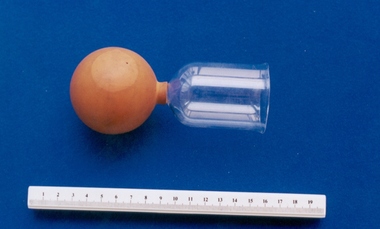
Cupping glass associated with midwife Mary Howlett, c. 1866 - 1920
... Other possible uses include drawing fluid from other parts of the body for conditions such as oedema of the limbs or abdomen....Other possible uses include drawing fluid from other parts of the body for conditions such as oedema of the limbs or abdomen. ...Cupping glasses were in use from the early 1700s onwards. Their purpose was to draw the nipple out from the areola in preparation for breast feeding. They were also used for expressing small quantities of breast milk. Other possible uses include drawing fluid from other parts of the body for conditions such as oedema of the limbs or abdomen.Mary Howlett (1840-1922) began practising as a country midwife in 1866 in the western district of Victoria. She qualified as a 'ladies monthly nurse' in 1887 and continued to practise as a nurse and midwife until 1920. She began her six months training at the Melbourne Lying-In Hospital. She was known by many as 'Auntie', and her career spanned more than 50 years. Mrs Howlett's midwifery box and contents were given to Dr Frank Forster, and he donated them to the museum collection in 1993. Cupping glass, consisting of a glass tube connection and red rubber hand pump.midwifery, infant feeding -
 Bendigo Historical Society Inc.
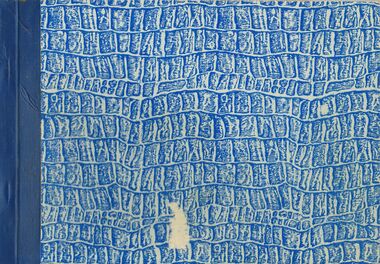
Book - BENDIGO SALEYARDS COLLECTION: CITY OF BENDIGO PURCHASE REQUISITION
... One is a duplicate For All Bull Cattle Colour, dated 3/2/92 for silver and yellow branding fluid. The other is a V/Line Freight Consignment Note dated 5/2/92. ...One is a duplicate For All Bull Cattle Colour, dated 3/2/92 for silver and yellow branding fluid. The other is a V/Line Freight Consignment Note dated 5/2/92. ...Blue duplicate Purchase Requisition Book dated 21/1/92 to 29/7/92.Cover has crocodile pattern and blue cloth tape on the spine. Tape on inside front cover. Items in the book include electrical work/repairs, stationary and office supplies and equipment, branding fluid, hardware, welding, dog food, screenings and spreading and checking scale. Blue duplicate pages and white originals. Last pages have This book is cancelled S? written across it. Back cover is missing. Two loose pages in the book. One is a duplicate For All Bull Cattle Colour, dated 3/2/92 for silver and yellow branding fluid. The other is a V/Line Freight Consignment Note dated 5/2/92. Purchase Requisition book with a red and cream patterned book with a red tape spine and blue pages. Saleyards is written in balck texta on the front of the red spine. Book is dated from 24/8/90 to 8/1/92. Requisitions signed by J M Crimmins and J Richmond. Requisitions were for electrical work, plumbing supplies, office materials, branding fluid, dog food, sheep dip, weed killer, repairs to yards, tools, printing, hay, and repairs to truck wash.bendigo, council, cattle markets, bendigo saleyards collection - city of bendigo purchase requisition, hume & iser, brb electrical, boltons bros, d walker pty otd, all bull albury, bearing & industrial supplies, midland irrigation, watson & crane, ray t thompson, golden triangle communications, blue line office supplies, allweld construction, toledo scales, david bolton, dalgety farmers, j m crimmins, rodger wrigley, dookie college, b p bury, ron dixon, beaurepaires tyers, steven hyde, bendigo scale co, d g walker pty ltd, reece, midland ir, bendigo engineering -
 Flagstaff Hill Maritime Museum and Village
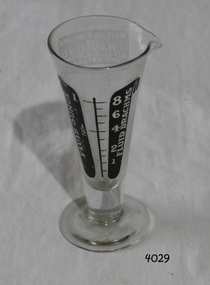
Container - Medicine Glass, J.W. Small & Co, early 20th century
... fluids was used mostly used for medicines but could have been used for measuring photography chemicals. The glass was once owned by Dr W R Angus, who practised in Warrnambool in the 20th century. It was donated by members of his family. Dr Angus enjoyed photography amongst other...fluid drachmas. An opaque label on the back shows maker details. The other side has a label. ...fluid drachmas. An opaque label on the back shows maker details. The other side has a label. ...This measuring glass for fluids was used mostly used for medicines but could have been used for measuring photography chemicals. The glass was once owned by Dr W R Angus, who practised in Warrnambool in the 20th century. It was donated by members of his family. Dr Angus enjoyed photography amongst other hobbies. The maker, J.W. Small & Co. was a long established camera and photography business Camera Corner, in 270 Little Collins Street, Melbourne. At the 1887 Melbourne Exhibition the company showcased bicycles as well as a wide range of photography equipment including cameras and any other accessories and needs for the amateur photographer. In 1887 the sole proprietor of the business was Mr Herbert Small. The firm offered the service of developing and enlarging pictures. In 1894 the firm advertised as photographic and lantern material manufacturers. There were branches in Adelaide and Sydney also. The company was still in business in the 1920's, when Dr Angus graduated as a doctor and surgeon.The medicine glass is significant for its association with Dr William Roy Angus, who practice medicine in Warrnambool for several decades. He and his wife were heavily involved in the community. Dr Angus was also connected to the maritime history of Warrnambool, being the last Port Medical Officer. The glass is also associated with the Melbourne company J.W. Small &O Co, which was 'long established' in 1887.Medicine glass (dose cup or measuring glass), for measuring fluids. This glass holds 1 fluid ounce. Wide mouth with pouring lip tapers sharply to narrow centre of the base, which has a round flat foot. Black inscriptions are on the side of the glass, showing fluid ounces and fluid drachmas. An opaque label on the back shows maker details. The other side has a label. The glass was made in England for the Australian company J.W. Small & Co. It is part of the W R Angus Collection. "FLUID OUNCES" "FLUID DRACHMS" "MADE IN ENGLAND / FOR / J.W. SMALL & CO / MELBOURNE, SYDNEY AND ADELAIDE"flagstaff hill, warrnambool, shipwrecked-coast, flagstaff-hill, flagstaff-hill-maritime-museum, maritime-museum, shipwreck-coast, flagstaff-hill-maritime-village, measuring glass, dose cup, medical equipment, medicine glass, medication administration, w.r. angus, j.w. small & co, fluid measurment, photography equipment -
 The Beechworth Burke Museum
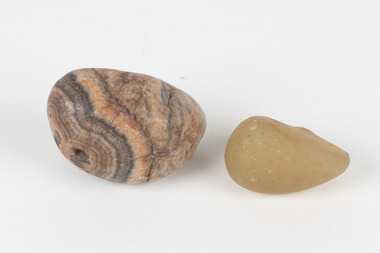
Geological specimen - Agate and Quartz pebbles
... fluid dries and hardens in layers, forming round or egg shaped nodules or geodes within the rocky matrix. Agate is formed of a silica mineral chalcedony similar to quartz. Although relatively common and semi-precious, agate has been prized since at least 1450 BC - an intricately carved agate seal was found in the 2015 excavation of a grave belonging to a Mycenaeum priest or warrior near Pylos in Greece. Agate is also used in jewellery and other...fluid dries and hardens in layers, forming round or egg shaped nodules or geodes within the rocky matrix. Agate is formed of a silica mineral chalcedony similar to quartz. Although relatively common and semi-precious, agate has been prized since at least 1450 BC - an intricately carved agate seal was found in the 2015 excavation of a grave belonging to a Mycenaeum priest or warrior near Pylos in Greece. Agate is also used in jewellery and other ...Agate occurs when amygdales (gas pockets) form in the upper levels of basaltic lava flows. If these pockets or bubbles are iniltrated by water bearing silica in solution, the fluid dries and hardens in layers, forming round or egg shaped nodules or geodes within the rocky matrix. Agate is formed of a silica mineral chalcedony similar to quartz. Although relatively common and semi-precious, agate has been prized since at least 1450 BC - an intricately carved agate seal was found in the 2015 excavation of a grave belonging to a Mycenaeum priest or warrior near Pylos in Greece. Agate is also used in jewellery and other decorative or ritual purposes due to its often striking appearance. Quartz is found all over Australia, including Beechworth in Victoria. It is formed in deep-seated igneous rocks and crystallized through hot aqueous solutions. It can have two forms; Microcrystalline quartz or Crystalline quartz. Microcrystalline quartz is a fine grain quartz where crystalline quartz is often a large crystal. The colour of quartz can vary. These specimens were collected in Victoria in the vicinity of the Burke Museum. Victoria and other regions of Australia were surveyed for sites of potential mineral wealth throughout the 19th Century. The identification of sites containing valuable commodities such as gold, iron ore and gemstones in a locality had the potential to shape the development and history of communities and industries in the area. The discovery of gold in Victoria, for instance, had a significant influence on the development of the area now known as 'the goldfields', including Beechworth; the city of Melbourne and Victoria as a whole.The specimens are significant as examples of surveying activity undertaken to assess and direct the development of the mineral resource industries in Victoria and Australia, as well as the movement to expand human knowledge of earth sciences such as mineralogy and geology in the nineteenth century.Geological specimens of Agate and Quartz respectively; the fist-sized piece of Agate has peach/coral colouring with grey concentric patterning and the smaller piece of quartz is a uniform yellow/orange shade. Existing label: Local pebbles / (agate and / quartz / (yellowish) / egg-shaped). / BB geological specimen, geology, geology collection, burke museum, beechworth, agate, quartz, north-east victoria, indigo shire, geological surveys -
 The Beechworth Burke Museum
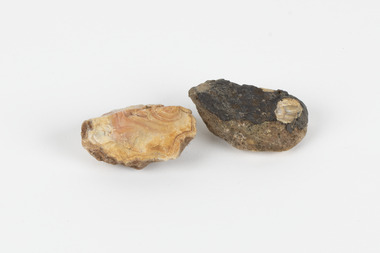
Geological specimen - North Queensland Agates, Unknown
... fluid dries and hardens in layers, forming round or egg shaped nodules or geodes within the rocky matrix. Agate is formed of a silica mineral chalcedony similar to quartz. Although relatively common and semi-precious, agate has been prized since at least 1450 BC - an intricately carved agate seal was found in the 2015 excavation of a grave belonging to a Mycenaeum priest or warrior near Pylos in Greece. Agate is also used in jewellery and other...fluid dries and hardens in layers, forming round or egg shaped nodules or geodes within the rocky matrix. Agate is formed of a silica mineral chalcedony similar to quartz. Although relatively common and semi-precious, agate has been prized since at least 1450 BC - an intricately carved agate seal was found in the 2015 excavation of a grave belonging to a Mycenaeum priest or warrior near Pylos in Greece. Agate is also used in jewellery and other ...Agate occurs when amygdales (gas pockets) form in the upper levels of basaltic lava flows. If these pockets or bubbles are iniltrated by water bearing silica in solution, the fluid dries and hardens in layers, forming round or egg shaped nodules or geodes within the rocky matrix. Agate is formed of a silica mineral chalcedony similar to quartz. Although relatively common and semi-precious, agate has been prized since at least 1450 BC - an intricately carved agate seal was found in the 2015 excavation of a grave belonging to a Mycenaeum priest or warrior near Pylos in Greece. Agate is also used in jewellery and other decorative or ritual purposes due to its often striking appearance. These specimens originated in North Queensland, which contains noted agate-fossicking regions such as in the area surrounding Forsayth. They were collected in approximately 1852 as an adjunct to the Geological Survey of Victoria. It was donated to the Museum in 1868. Victoria and other regions of Australia were surveyed for sites of potential mineral wealth throughout the 19th Century. The identification of sites containing valuable commodities such as gold, iron ore and gemstones in a locality had the potential to shape the development and history of communities and industries in the area. The discovery of gold in Victoria, for instance, had a significant influence on the development of the area now known as 'the goldfields', including Beechworth; the city of Melbourne and Victoria as a whole. The specimens are significant as examples of surveying activity undertaken to assess and direct the development of the mineral resource industries in Victoria and Australia, as well as the movement to expand human knowledge of earth sciences such as mineralogy and geology in the nineteenth century. Two solid egg-sized pieces of peach/orange toned agate (a common semi-precious chalcedony, similar to quartz) with a striped pattern, embedded in a light and dark brown matrix. geological specimen, geology, geology collection, burke museum, beechworth, agate, north queensland agate, 1852 geological survey of victoria, l. hufer - donor, mineralogy, agate specimen, indigo shire -
 The Beechworth Burke Museum
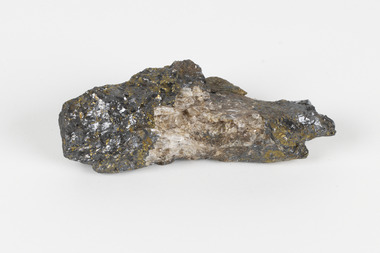
Geological specimen - Sphalerite, Unknown
... fluid. It often forms in veins or in fissures of the existing rock, with colours and crystal shapes dependent on the composition of the the combining elements. It forms isometric crystal shapes including cubes, tetrahedrons, octahedrons, dodecahedrons. This specimen was collected in approximately 1852, in Broken Hill, NSW, as an adjunct to the Geological Survey of Victoria. It was donated to the Museum in 1868. Victoria and other...fluid. It often forms in veins or in fissures of the existing rock, with colours and crystal shapes dependent on the composition of the the combining elements. It forms isometric crystal shapes including cubes, tetrahedrons, octahedrons, dodecahedrons. This specimen was collected in approximately 1852, in Broken Hill, NSW, as an adjunct to the Geological Survey of Victoria. It was donated to the Museum in 1868. Victoria and other ...Sphalerite or sphaelerite is named from the Greek word for 'treacherous' or 'deceiver' as specimens can vary widely in appearance, making them hard to visually identify. It is a zinc sulfide with the chemical composition (Zn,Fe)S, the most important ore of zinc. Specimens of sphalerite can contain iron as a substitute for up to 25% of the usual zinc present, as well as trace elements of gallium, cadmium, geranium and indium. Small amounts of arsenic and manganese may also be detected. Sphalerite is found in igneous, sedimentary and metamorphic rocks. It forms when carbonate rock encounters acidic, zinc-bearing fluid. It often forms in veins or in fissures of the existing rock, with colours and crystal shapes dependent on the composition of the the combining elements. It forms isometric crystal shapes including cubes, tetrahedrons, octahedrons, dodecahedrons. This specimen was collected in approximately 1852, in Broken Hill, NSW, as an adjunct to the Geological Survey of Victoria. It was donated to the Museum in 1868. Victoria and other regions of Australia were surveyed for sites of potential mineral wealth throughout the 19th Century. The identification of sites containing valuable commodities such as gold, iron ore and gemstones in a locality had the potential to shape the development and history of communities and industries in the area. The discovery of gold in Victoria, for instance, had a significant influence on the development of the area now known as 'the goldfields', including Beechworth; the city of Melbourne and Victoria as a whole.The specimen is significant as an examples of surveying activity undertaken to assess and direct the development of the mineral resource industries in Victoria and Australia, as well as the movement to expand human knowledge of earth sciences such as mineralogy and geology in the nineteenth century.A pipe-shaped specimen of sulfide-mineral zinc ore displaying patches of black, brown, beige and gold colouring. The main item has associated broken pieces. geological specimen, geology, geology collection, burke museum, beechworth, mineralogy, indigo shire, geological survey, sphalerite, sphaelerite, zinc ore, broken hill, nsw, victoria, galena, fluorite, chalcopyrite, lead, cadmium, gallium, germanium, indium, iron -
 The Beechworth Burke Museum
Geological specimen - Greenstone / Gabbro, Unknown
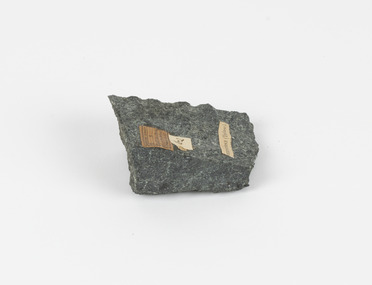
... Greenstone metamorphosed igneous rock Gabbro chlorite actinolite epidote metamorphsis rock cycle various types of rocks sedimentary high heat high pressure mineral-rich fluid metamorphosis foliated metamorphic non-foliated metamorphic convergent plate boundary greenish colour minerals Greenstone/Gabbro/from Ceres west/of Geelong. Has old Geological Survey label/and probably collected by/Richard Daintree in 1861/C.Willam 15/4/21/ Other label: 62 / Greenstone is a solid hand-sized metamorphic mineral of a green colour. ...This specimen was recovered from Ceres West of Geelong, Victoria. Greenstone is the name for any metamorphosed basic igneous rock (in the case of this specimen, Gabbro) that gains its greenish colour to the presence of the minerals chlorite, actinolite, or epidote, hence the term 'green' and 'stone'. Greenstone is often formed through metamorphsis along a convergent plate boundary. In the rock cycle (the series of processes that creates the various types of rocks) there are identified three different types of rocks, which are the sedimentary, the igneous and the metamorphic. Metamorphic rocks started out as sedimentary, igneous or earlier metamorphic rocks but changed from their original condition under the effect of high heat, high pressure or hot, mineral-rich fluid. However, if pressure or heat is too high, then the rock will melt, resulting in the formation of an igneous rock. The name used to describe these types of rocks reflects this specific inherent trait of change, since the word “metamorphic” derives from the Greek word “metamorphosis”, meaning “change of form or structure”. Metamorphic rocks form in the Earth`s crust but can be also found on the surface, due to elevation of the Earth`s surface. They are divided into two categories: the foliated metamorphic and the non-foliated metamorphic rocks. Gabbro is a highly useful mineral that is often polished to create cemetery markers and kitchen benches. It is notable for its qualities of durability, being able to withstand extreme elements and wear. Whilst not rare, Gabbro is of great utility and has been highly desirable for its qualities. This specimen is part of a larger collection of geological and mineral specimens collected from around Australia (and some parts of the world) and donated to the Burke Museum between 1868-1880. A large percentage of these specimens were collected in Victoria as part of the Geological Survey of Victoria that begun in 1852 (in response to the Gold Rush) to study and map the geology of Victoria. Collecting geological specimens was an important part of mapping and understanding the scientific makeup of the earth. Many of these specimens were sent to research and collecting organisations across Australia, including the Burke Museum, to educate and encourage further study.Greenstone is a solid hand-sized metamorphic mineral of a green colour. Greenstone is the name for any metamorphosed basic igneous rock (in the case of this specimen, Gabbro) that gains its greenish colour to the presence of the minerals chlorite, actinolite, or epidote, hence the term 'green' and 'stone'. Gabbro is a medium to coarse grained rocks that consist primarily of plagioclase feldspar and pyroxene. Greenstone is often formed through metamorphsis along a convergent plate boundary. Gabbro forms due to cooling and crystallization of magma underneath Earth's surface. Greenstone/Gabbro/from Ceres west/of Geelong. Has old Geological Survey label/and probably collected by/Richard Daintree in 1861/C.Willam 15/4/21/ Other label: 62 /greenstone, metamorphosed, igneous rock, gabbro, chlorite, actinolite, epidote, metamorphsis, rock cycle, various types of rocks, sedimentary, high heat, high pressure, mineral-rich fluid, metamorphosis, foliated metamorphic, non-foliated metamorphic, convergent plate boundary, greenish colour, minerals -
 Orbost & District Historical Society
Equipment - bottle of ink, Stephens' Inks (Australia) Pty Ltd, 1900 - 1960s
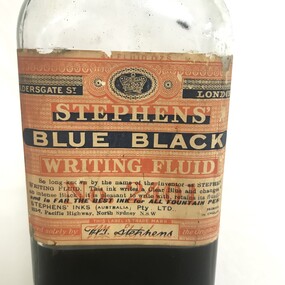
... Label with STEPHENS' BLUE BLACK WRITING FLUID No. 2401 Other words on the label: So long known by the name of the Inventor as STEPHENS' WRITING FLUID. ...This item is significant because of its rarity and because it was such an important part of the equipment used in schools in Australia until c.1960s. education ink pens Label with STEPHENS' BLUE BLACK WRITING FLUID No. 2401 Other words on the label: So long known by the name of the Inventor as STEPHENS' WRITING FLUID. ...This ink was used in Australian schools until the 1960s. It contains 40 ozs. of blue/black ink (writing fluid). It was used for dipping pens. At the beginning of each day, an ink monitor (student) had the job of filling the small containers which were inserted into the student desks. This item is significant because of its rarity and because it was such an important part of the equipment used in schools in Australia until c.1960s. A large clear glass bottle, square shape and with a cork stopper. The top of the bottle has a small lip for pouring the liquid. This bottle is half-full with blue/black liquid. The paper label is coloured orange with black and white printing. The bottle top (attached to the cork) is coloured black and appears to be made of plastic. It has the name Stephens' on the bottle top. At the bottom sides of the bottle are the words THIS BOTTLE IS THE PROPERTY OF STEPHENS' INKS (AUST PTY LTD)Label with STEPHENS' BLUE BLACK WRITING FLUID No. 2401 Other words on the label: So long known by the name of the Inventor as STEPHENS' WRITING FLUID. This ink writes a clear Blue and changes to an intense Black. It is pleasant to write with, retains its fluidity and is FAR THE BEST INK for ALL FOUNTAIN PENS. STEPHENS' INKS (Australia) Pty Ltd. 231-7 Pacific Highway, North Sydney NSW Printed in Englandeducation, ink pens -
 Orbost & District Historical Society
fly catcher, circa 1890
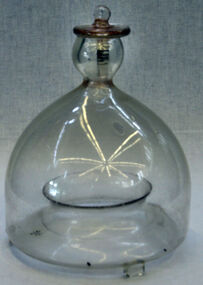
... other bait in the bottom, were unable to find their way out. This trap has small glass legs enabling it to be used standing on a flat surface such as a table. Most were suspended by wire handles. This is an example of a common domestic item no longer commonly used today. fly-catcher pest-control glassware Moulded clear glass fly catcher on small glass legs. Glass stopper. A piece of bait is suspended in the centre and the top opening is covered up with a piece of cloth and a fluid ...Mankind has been bothered by flies ever since time began. This has led to the invention of a number of different fly traps or fly catchers.Glass fly traps were popular during the 19th and early 20th centuries. The flies, being attracted by some sweet liquid or other bait in the bottom, were unable to find their way out. This trap has small glass legs enabling it to be used standing on a flat surface such as a table. Most were suspended by wire handles. This is an example of a common domestic item no longer commonly used today.Moulded clear glass fly catcher on small glass legs. Glass stopper. A piece of bait is suspended in the centre and the top opening is covered up with a piece of cloth and a fluid such as kerosene or similar is put in the gutter below the outer part of the dome. The flying insect is drawn inside by entering the underside opening and then, when trying to leave, flies against the glass and then drops into the catching fluid below.fly-catcher pest-control glassware -
 Glenelg Shire Council Cultural Collection
Equipment - Caponex Implanter, in original box with instruction leaflet, Unknown
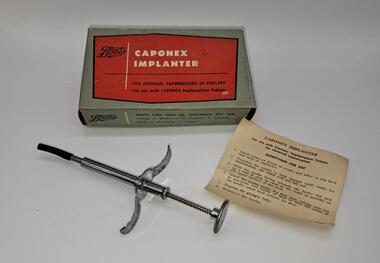
... fluid. Long black rubber tube on the end. In 'Boots' branded box with instruction leaflet. Box is light green and red with white bold block CAPONEX IMPLANTER, all other text is black. ...fluid. Long black rubber tube on the end. In 'Boots' branded box with instruction leaflet. Box is light green and red with white bold block CAPONEX IMPLANTER, all other text is black. ...A Caponex Implanter was used to chemically castrate roosters by inserting a caponex implantation tablet into the neck of the of male chickens to make them grow faster and become more docile. The caponisation of poultry has since been banned in Australia and UK as the chemical remained within the birds which proved to be toxic to human consumption.Evidence of expired practices. 'Boots' branded box containing Caponex Implanter and instruction leaflet. Small surgical applicator. Silver in colour, resembles a syringe with a finger flange and thumb rest on the plunger. Design is for the use of insertion of a tablet rather than fluid. Long black rubber tube on the end. In 'Boots' branded box with instruction leaflet. Box is light green and red with white bold block CAPONEX IMPLANTER, all other text is black. Instruction Leaflet is small on yellowed paper with black text.On the base of the thumb rest: CAPONEX Box front: Boots Logo, CAPONEX IMPLANTER for chemical caponisation of poultry for use with CAPONEX Implantation Tablets. Box Sides: BOOTS PURE DRUG CO. (AUSTRALIA) PTY. LTD Follows with the locations in Australia of Boots. Instruction Leaflet: CAPONEX IMPLANTER for chemical caponisation of poultry for use with CAPONEX Implantation Tablets Directions for use (Directions to follow back and front)poultry, caponex, caponisation -
 Greensborough Historical Society
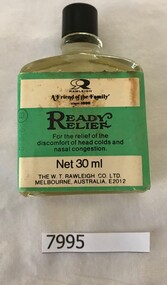
Domestic object - Bottle, W. T. Rawleigh Co. Ltd, Ready relief, 1950s
... other consumer products manufactured in Melbourne and sold by "door-to-door" Rawleigh salesmen in Australia from 1928. Now sold through a network of Rawleigh distributors, located in regional towns and state capitals throughout Australia. medicines rawleigh W.T. Rawleigh Co. Ltd. cold medicines "Rawleigh 'Friend of the Family" Clear glass 30 ml bottle with black bakelite screw top, containing "Ready relief" fluid ...One of a range of medicinal, cosmetic and other consumer products manufactured in Melbourne and sold by "door-to-door" Rawleigh salesmen in Australia from 1928. Now sold through a network of Rawleigh distributors, located in regional towns and state capitals throughout Australia.Clear glass 30 ml bottle with black bakelite screw top, containing "Ready relief" fluid used against discomfort of head colds and nasal congestion. Black and green printed label"Rawleigh 'Friend of the Family"medicines, rawleigh, w.t. rawleigh co. ltd., cold medicines -
 Flagstaff Hill Maritime Museum and Village
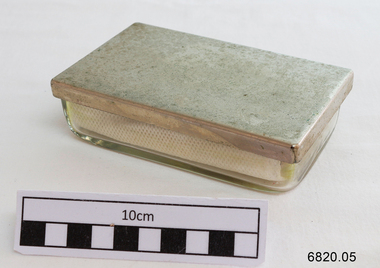
Instrument - Syringe set, 20th century
... His device exemplified the law of physics that became known as Pascal’s Law, which proposes “when there is an increase in pressure at any point in a confined fluid, there is an equal increase at every other point in the container.” ...His device exemplified the law of physics that became known as Pascal’s Law, which proposes “when there is an increase in pressure at any point in a confined fluid, there is an equal increase at every other point in the container.” ...Whether it’s an anaesthetic, blood test, insulin, vitamin shot or vaccination, at a base human level something feels instinctively wrong about having a long thin piece of metal stuck deep into your flesh. And yet, in allowing physicians to administer medicine directly into the bloodstream, the hypodermic needle has been one of the most important inventions of medical science. In the beginning… Typically, it was the Romans. The word ‘syringe’ is derived from Greek mythology. Chased to the edge of a river by the god Pan, a rather chaste nymph by the name of Syrinx magically disguised herself as water reeds. Determined, Pan chopped the hollow reeds off and blew into them to create a musical whistling sound, thereby fashioning the first of his fabled pipes. Taking that concept of ‘hollow tubes’, and having observed how snakes could transmit venom, the practice of administering ointments and unctions via simple piston syringes is originally described in the writings of the first-century Roman scholar Aulus Cornelius Celsus and the equally famous Greek surgeon Galen. It’s unclear if the Egyptian surgeon Ammar bin Ali al-Mawsili was a fan of either of their scribblings, but 800 years later he employed a hollow glass tube and simple suction power to remove cataracts from his patients’ eyes – a technique copied up until the 13th century, but only to extract blood, fluid or poison, not to inject anything. Syringes get modern Then, in 1650, while experimenting with hydrodynamics, the legendary French polymath Blaise Pascal invented the first modern syringe. His device exemplified the law of physics that became known as Pascal’s Law, which proposes “when there is an increase in pressure at any point in a confined fluid, there is an equal increase at every other point in the container.” But it wasn’t until six years later that a fellow Renaissance man, the English architect Sir Christopher Wren took Pascal’s concept and made the first intravenous experiment. Combining hollow goose quills, pig bladders, a kennel of stray dogs and enough opium to fell a herd of elephants, Wren started injecting the hapless mutts with the ‘milk of the poppy’. By the mid-1660s, thinking this seemed like a great idea, two German doctors, Johann Daniel Major and Johann Sigismund Elsholtz, decided to try their hand at squirting various stuff into human subjects. Things didn’t end well, and people died. Consequently, injections fell out of medical favour for 200 years. Let's try again… Enter the Irish doctor Francis Rynd in 1844. Constructing the first-ever hollow steel needle, he used it to inject medicine subcutaneously and then bragged about it in an issue of the Dublin Medical Press. Then, in 1853, depending on who you believe, it was either a Frenchman or a Scot who invented the first real hypodermic needle. The French physician Charles Pravaz adapted Rynd’s needle to administer a coagulant in order to stem bleeding in a sheep by using a system of measuring screws. However, it was the Scottish surgeon Alexander Wood who first combined a hollow steel needle with a proper syringe to inject morphine into a human. Thus, Wood is usually credited with the invention. Sharp advancements Over the following century, the technology was refined and intravenous injections became commonplace – whether in the administering of pain relief, penicillin, insulin, immunisation and blood transfusions, needles became a staple of medicine. By 1946, the Chance Brothers’ Birmingham glassworks factory began mass-producing the first all-glass syringe with interchangeable parts. Then, a decade later, after sterilisation issues in re-used glass syringes had plagued the industry for years, a Kiwi inventor called Colin Murdoch applied for a patent of a disposable plastic syringe. Several patents followed, and the disposable syringe is now widespread. https://www.medibank.com.au/livebetter/be-magazine/wellbeing/the-history-of-the-hypodermic-needle/ This syringe set was donated to Flagstaff Hill Maritime Village by the family of Doctor William Roy Angus, Surgeon and Oculist. It is part of the “W.R. Angus Collection” that includes historical medical equipment, surgical instruments and material once belonging to Dr Edward Ryan and Dr Thomas Francis Ryan, (both of Nhill, Victoria) as well as Dr Angus’ own belongings. The Collection’s history spans the medical practices of the two Doctors Ryan, from 1885-1926 plus that of Dr Angus, up until 1969. ABOUT THE “W.R.ANGUS COLLECTION” Doctor William Roy Angus M.B., B.S., Adel., 1923, F.R.C.S. Edin.,1928 (also known as Dr Roy Angus) was born in Murrumbeena, Victoria in 1901 and lived until 1970. He qualified as a doctor in 1923 at University of Adelaide, was Resident Medical Officer at the Royal Adelaide Hospital in 1924 and for a period was house surgeon to Sir (then Mr.) Henry Simpson Newland. Dr Angus was briefly an Assistant to Dr Riddell of Kapunda, then commenced private practice at Curramulka, Yorke Peninsula, SA, where he was physician, surgeon and chemist. In 1926, he was appointed as new Medical Assistant to Dr Thomas Francis Ryan (T.F. Ryan, or Tom), in Nhill, Victoria, where his experiences included radiology and pharmacy. In 1927 he was Acting House Surgeon in Dr Tom Ryan’s absence. Dr Angus had become engaged to Gladys Forsyth and they decided he would take time to further his studies overseas in the UK in 1927. He studied at London University College Hospital and at Edinburgh Royal Infirmary and in 1928, was awarded FRCS (Fellow from the Royal College of Surgeons), Edinburgh. He worked his passage back to Australia as a Ship’s Surgeon on the on the Australian Commonwealth Line’s T.S.S. Largs Bay. Dr Angus married Gladys in 1929, in Ballarat. (They went on to have one son (Graham 1932, born in SA) and two daughters (Helen (died 12/07/1996) and Berenice (Berry), both born at Mira, Nhill ) Dr Angus was a ‘flying doctor’ for the A.I.M. (Australian Inland Ministry) Aerial Medical Service in 1928 . The organisation began in South Australia through the Presbyterian Church in that year, with its first station being in the remote town of Oodnadatta, where Dr Angus was stationed. He was locum tenens there on North-South Railway at 21 Mile Camp. He took up this ‘flying doctor’ position in response to a call from Dr John Flynn; the organisation was later known as the Flying Doctor Service, then the Royal Flying Doctor Service. A lot of his work during this time involved dental surgery also. Between 1928-1932 he was surgeon at the Curramulka Hospital, Yorke Peninsula, South Australia. In 1933 Dr Angus returned to Nhill where he’d previously worked as Medical Assistant and purchased a share of the Nelson Street practice and Mira hospital from Dr Les Middleton one of the Middleton Brothers, the current owners of what was once Dr Tom Ryan’s practice. Dr L Middleton was House Surgeon to the Nhill Hospital 1926-1933, when he resigned. [Dr Tom Ryan’s practice had originally belonged to his older brother Dr Edward Ryan, who came to Nhill in 1885. Dr Edward saw patients at his rooms, firstly in Victoria Street and in 1886 in Nelson Street, until 1901. The Nelson Street practice also had a 2 bed ward, called Mira Private Hospital ). Dr Edward Ryan was House Surgeon at the Nhill Hospital 1884-1902 . He also had occasions where he successfully performed veterinary surgery for the local farmers too. Dr Tom Ryan then purchased the practice from his brother in 1901. Both Dr Edward and Dr Tom Ryan work as surgeons included eye surgery. Dr Tom Ryan performed many of his operations in the Mira private hospital on his premises. He too was House Surgeon at the Nhill Hospital 1902-1926. Dr Tom Ryan had one of the only two pieces of radiology equipment in Victoria during his practicing years – The Royal Melbourne Hospital had the other one. Over the years Dr Tom Ryan gradually set up what was effectively a training school for country general-practitioner-surgeons. Each patient was carefully examined, including using the X-ray machine, and any surgery was discussed and planned with Dr Ryan’s assistants several days in advance. Dr Angus gained experience in using the X-ray machine there during his time as assistant to Dr Ryan. Dr Tom Ryan moved from Nhill in 1926. He became a Fellow of the Royal Australasian College of Surgeons in 1927, soon after its formation, a rare accolade for a doctor outside any of the major cities. He remained a bachelor and died suddenly on 7th Dec 1955, aged 91, at his home in Ararat. Scholarships and prizes are still awarded to medical students in the honour of Dr T.F. Ryan and his father, Dr Michael Ryan, and brother, John Patrick Ryan. ] When Dr Angus bought into the Nelson Street premises in Nhill he was also appointed as the Nhill Hospital’s Honorary House Surgeon 1933-1938. His practitioner’s plate from his Nhill surgery states “HOURS Daily, except Tuesdays, Fridays and Saturday afternoons, 9-10am, 2-4pm, 7-8pm. Sundays by appointment”. This plate is now mounted on the doorway to the Port Medical Office at Flagstaff Hill Maritime Village, Warrnambool. Dr Edward Ryan and Dr Tom Ryan had an extensive collection of historical medical equipment and materials spanning 1884-1926 and when Dr Angus took up practice in their old premises he obtained this collection, a large part of which is now on display at the Port Medical Office at Flagstaff Hill Maritime Village in Warrnambool. During his time in Nhill Dr Angus was involved in the merging of the Mira Hospital and Nhill Public Hospital into one public hospital and the property titles passed on to Nhill Hospital in 1939. In 1939 Dr Angus and his family moved to Warrnambool where he purchased “Birchwood,” the 1852 home and medical practice of Dr John Hunter Henderson, at 214 Koroit Street. (This property was sold in1965 to the State Government and is now the site of the Warrnambool Police Station. ). The Angus family was able to afford gardeners, cooks and maids; their home was a popular place for visiting dignitaries to stay whilst visiting Warrnambool. Dr Angus had his own silk worm farm at home in a Mulberry tree. His young daughter used his centrifuge for spinning the silk. Dr Angus was appointed on a part-time basis as Port Medical Officer (Health Officer) in Warrnambool and held this position until the 1940’s when the government no longer required the service of a Port Medical Officer in Warrnambool; he was thus Warrnambool’s last serving Port Medical Officer. (The duties of a Port Medical Officer were outlined by the Colonial Secretary on 21st June, 1839 under the terms of the Quarantine Act. Masters of immigrant ships arriving in port reported incidents of diseases, illness and death and the Port Medical Officer made a decision on whether the ship required Quarantine and for how long, in this way preventing contagious illness from spreading from new immigrants to the residents already in the colony.) Dr Angus was a member of the Australian Medical Association, for 35 years and surgeon at the Warrnambool Base Hospital 1939-1942, He served as a Surgeon Captain during WWII1942-45, in Ballarat, Victoria, and in Bonegilla, N.S.W., completing his service just before the end of the war due to suffering from a heart attack. During his convalescence he carved an intricate and ‘most artistic’ chess set from the material that dentures were made from. He then studied ophthalmology at the Royal Melbourne Eye and Ear Hospital and created cosmetically superior artificial eyes by pioneering using the intrascleral cartilage. Angus received accolades from the Ophthalmological Society of Australasia for this work. He returned to Warrnambool to commence practice as an ophthalmologist, pioneering in artificial eye improvements. He was Honorary Consultant Ophthalmologist to Warrnambool Base Hospital for 31 years. He made monthly visits to Portland as a visiting surgeon, to perform eye surgery. He represented the Victorian South-West subdivision of the Australian Medical Association as its secretary between 1949 and 1956 and as chairman from 1956 to 1958. In 1968 Dr Angus was elected member of Spain’s Barraquer Institute of Barcelona after his research work in Intrasclearal cartilage grafting, becoming one of the few Australian ophthalmologists to receive this honour, and in the following year presented his final paper on Living Intrasclearal Cartilage Implants at the Inaugural Meeting of the Australian College of Ophthalmologists in Melbourne In his personal life Dr Angus was a Presbyterian and treated Sunday as a Sabbath, a day of rest. He would visit 3 or 4 country patients on a Sunday, taking his children along ‘for the ride’ and to visit with him. Sunday evenings he would play the pianola and sing Scottish songs to his family. One of Dr Angus’ patients was Margaret MacKenzie, author of a book on local shipwrecks that she’d seen as an eye witness from the late 1880’s in Peterborough, Victoria. In the early 1950’s Dr Angus, painted a picture of a shipwreck for the cover jacket of Margaret’s book, Shipwrecks and More Shipwrecks. She was blind in later life and her daughter wrote the actual book for her. Dr Angus and his wife Gladys were very involved in Warrnambool’s society with a strong interest in civic affairs. Their interests included organisations such as Red Cross, Rostrum, Warrnambool and District Historical Society (founding members), Wine and Food Society, Steering Committee for Tertiary Education in Warrnambool, Local National Trust, Good Neighbour Council, Housing Commission Advisory Board, United Services Institute, Legion of Ex-Servicemen, Olympic Pool Committee, Food for Britain Organisation, Warrnambool Hospital, Anti-Cancer Council, Boys’ Club, Charitable Council, National Fitness Council and Air Raid Precautions Group. He was also a member of the Steam Preservation Society and derived much pleasure from a steam traction engine on his farm. He had an interest in people and the community He and his wife Gladys were both involved in the creation of Flagstaff Hill, including the layout of the gardens. After his death (28th March 1970) his family requested his practitioner’s plate, medical instruments and some personal belongings be displayed in the Port Medical Office surgery at Flagstaff Hill Maritime Village, and be called the “W. R. Angus Collection”. The W.R. Angus Collection is significant for still being located at the site it is connected with, Doctor Angus being the last Port Medical Officer in Warrnambool. The collection of medical instruments and other equipment is culturally significant, being an historical example of medicine from late 19th to mid-20th century. Dr Angus assisted Dr Tom Ryan, a pioneer in the use of X-rays and in ocular surgery. Syringe set (5 pieces) in container, from W.R. Angus Collection. Rectangular glass container with separate stainless steel lid, syringe cylinder, end piece and angle-ended tweezers. Container is lined with gauze and fabric. Scale on syringe is in "cc". Printed on Syringe "B-D LUER-LOK MULTIFIT, MADE IN U.S.A." Stamped into tweezers "STAINLESS STEEL" and "WEISS LONDON"flagstaff hill, warrnambool, shipwrecked coast, flagstaff hill maritime museum, maritime museum, shipwreck coast, flagstaff hill maritime village, great ocean road, dr w r angus, dr ryan, surgical instrument, t.s.s. largs bay, warrnambool base hospital, nhill base hospital, mira hospital, flying doctor, medical treatment, syringe, b d syringe, luer-lok multifit, weiss london, surgical tweezers, hypodermic syringe, injections -
 Flagstaff Hill Maritime Museum and Village
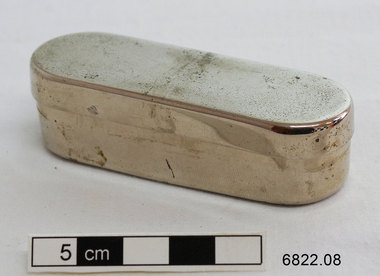
Instrument - Syringe set, c. 1940s
... His device exemplified the law of physics that became known as Pascal’s Law, which proposes “when there is an increase in pressure at any point in a confined fluid, there is an equal increase at every other point in the container.” ...His device exemplified the law of physics that became known as Pascal’s Law, which proposes “when there is an increase in pressure at any point in a confined fluid, there is an equal increase at every other point in the container.” ...Whether it’s an anaesthetic, blood test, insulin, vitamin shot or vaccination, at a base human level something feels instinctively wrong about having a long thin piece of metal stuck deep into your flesh. And yet, in allowing physicians to administer medicine directly into the bloodstream, the hypodermic needle has been one of the most important inventions of medical science. In the beginning… Typically, it was the Romans. The word ‘syringe’ is derived from Greek mythology. Chased to the edge of a river by the god Pan, a rather chaste nymph by the name of Syrinx magically disguised herself as water reeds. Determined, Pan chopped the hollow reeds off and blew into them to create a musical whistling sound, thereby fashioning the first of his fabled pipes. Taking that concept of ‘hollow tubes’, and having observed how snakes could transmit venom, the practice of administering ointments and unctions via simple piston syringes is originally described in the writings of the first-century Roman scholar Aulus Cornelius Celsus and the equally famous Greek surgeon Galen. It’s unclear if the Egyptian surgeon Ammar bin Ali al-Mawsili was a fan of either of their scribblings, but 800 years later he employed a hollow glass tube and simple suction power to remove cataracts from his patients’ eyes – a technique copied up until the 13th century, but only to extract blood, fluid or poison, not to inject anything. Syringes get modern Then, in 1650, while experimenting with hydrodynamics, the legendary French polymath Blaise Pascal invented the first modern syringe. His device exemplified the law of physics that became known as Pascal’s Law, which proposes “when there is an increase in pressure at any point in a confined fluid, there is an equal increase at every other point in the container.” But it wasn’t until six years later that a fellow Renaissance man, the English architect Sir Christopher Wren took Pascal’s concept and made the first intravenous experiment. Combining hollow goose quills, pig bladders, a kennel of stray dogs and enough opium to fell a herd of elephants, Wren started injecting the hapless mutts with the ‘milk of the poppy’. By the mid-1660s, thinking this seemed like a great idea, two German doctors, Johann Daniel Major and Johann Sigismund Elsholtz, decided to try their hand at squirting various stuff into human subjects. Things didn’t end well, and people died. Consequently, injections fell out of medical favour for 200 years. Let's try again… Enter the Irish doctor Francis Rynd in 1844. Constructing the first-ever hollow steel needle, he used it to inject medicine subcutaneously and then bragged about it in an issue of the Dublin Medical Press. Then, in 1853, depending on who you believe, it was either a Frenchman or a Scot who invented the first real hypodermic needle. The French physician Charles Pravaz adapted Rynd’s needle to administer a coagulant in order to stem bleeding in a sheep by using a system of measuring screws. However, it was the Scottish surgeon Alexander Wood who first combined a hollow steel needle with a proper syringe to inject morphine into a human. Thus, Wood is usually credited with the invention. Sharp advancements Over the following century, the technology was refined and intravenous injections became commonplace – whether in the administering of pain relief, penicillin, insulin, immunisation and blood transfusions, needles became a staple of medicine. By 1946, the Chance Brothers’ Birmingham glassworks factory began mass-producing the first all-glass syringe with interchangeable parts. Then, a decade later, after sterilisation issues in re-used glass syringes had plagued the industry for years, a Kiwi inventor called Colin Murdoch applied for a patent of a disposable plastic syringe. Several patents followed, and the disposable syringe is now widespread. https://www.medibank.com.au/livebetter/be-magazine/wellbeing/the-history-of-the-hypodermic-needle/ This syringe set was donated to Flagstaff Hill Maritime Village by the family of Doctor William Roy Angus, Surgeon and Oculist. It is part of the “W.R. Angus Collection” that includes historical medical equipment, surgical instruments and material once belonging to Dr Edward Ryan and Dr Thomas Francis Ryan, (both of Nhill, Victoria) as well as Dr Angus’ own belongings. The Collection’s history spans the medical practices of the two Doctors Ryan, from 1885-1926 plus that of Dr Angus, up until 1969. ABOUT THE “W.R.ANGUS COLLECTION” Doctor William Roy Angus M.B., B.S., Adel., 1923, F.R.C.S. Edin.,1928 (also known as Dr Roy Angus) was born in Murrumbeena, Victoria in 1901 and lived until 1970. He qualified as a doctor in 1923 at University of Adelaide, was Resident Medical Officer at the Royal Adelaide Hospital in 1924 and for a period was house surgeon to Sir (then Mr.) Henry Simpson Newland. Dr Angus was briefly an Assistant to Dr Riddell of Kapunda, then commenced private practice at Curramulka, Yorke Peninsula, SA, where he was physician, surgeon and chemist. In 1926, he was appointed as new Medical Assistant to Dr Thomas Francis Ryan (T.F. Ryan, or Tom), in Nhill, Victoria, where his experiences included radiology and pharmacy. In 1927 he was Acting House Surgeon in Dr Tom Ryan’s absence. Dr Angus had become engaged to Gladys Forsyth and they decided he would take time to further his studies overseas in the UK in 1927. He studied at London University College Hospital and at Edinburgh Royal Infirmary and in 1928, was awarded FRCS (Fellow from the Royal College of Surgeons), Edinburgh. He worked his passage back to Australia as a Ship’s Surgeon on the on the Australian Commonwealth Line’s T.S.S. Largs Bay. Dr Angus married Gladys in 1929, in Ballarat. (They went on to have one son (Graham 1932, born in SA) and two daughters (Helen (died 12/07/1996) and Berenice (Berry), both born at Mira, Nhill ) Dr Angus was a ‘flying doctor’ for the A.I.M. (Australian Inland Ministry) Aerial Medical Service in 1928 . The organisation began in South Australia through the Presbyterian Church in that year, with its first station being in the remote town of Oodnadatta, where Dr Angus was stationed. He was locum tenens there on North-South Railway at 21 Mile Camp. He took up this ‘flying doctor’ position in response to a call from Dr John Flynn; the organisation was later known as the Flying Doctor Service, then the Royal Flying Doctor Service. A lot of his work during this time involved dental surgery also. Between 1928-1932 he was surgeon at the Curramulka Hospital, Yorke Peninsula, South Australia. In 1933 Dr Angus returned to Nhill where he’d previously worked as Medical Assistant and purchased a share of the Nelson Street practice and Mira hospital from Dr Les Middleton one of the Middleton Brothers, the current owners of what was once Dr Tom Ryan’s practice. Dr L Middleton was House Surgeon to the Nhill Hospital 1926-1933, when he resigned. [Dr Tom Ryan’s practice had originally belonged to his older brother Dr Edward Ryan, who came to Nhill in 1885. Dr Edward saw patients at his rooms, firstly in Victoria Street and in 1886 in Nelson Street, until 1901. The Nelson Street practice also had a 2 bed ward, called Mira Private Hospital ). Dr Edward Ryan was House Surgeon at the Nhill Hospital 1884-1902 . He also had occasions where he successfully performed veterinary surgery for the local farmers too. Dr Tom Ryan then purchased the practice from his brother in 1901. Both Dr Edward and Dr Tom Ryan work as surgeons included eye surgery. Dr Tom Ryan performed many of his operations in the Mira private hospital on his premises. He too was House Surgeon at the Nhill Hospital 1902-1926. Dr Tom Ryan had one of the only two pieces of radiology equipment in Victoria during his practicing years – The Royal Melbourne Hospital had the other one. Over the years Dr Tom Ryan gradually set up what was effectively a training school for country general-practitioner-surgeons. Each patient was carefully examined, including using the X-ray machine, and any surgery was discussed and planned with Dr Ryan’s assistants several days in advance. Dr Angus gained experience in using the X-ray machine there during his time as assistant to Dr Ryan. Dr Tom Ryan moved from Nhill in 1926. He became a Fellow of the Royal Australasian College of Surgeons in 1927, soon after its formation, a rare accolade for a doctor outside any of the major cities. He remained a bachelor and died suddenly on 7th Dec 1955, aged 91, at his home in Ararat. Scholarships and prizes are still awarded to medical students in the honour of Dr T.F. Ryan and his father, Dr Michael Ryan, and brother, John Patrick Ryan. ] When Dr Angus bought into the Nelson Street premises in Nhill he was also appointed as the Nhill Hospital’s Honorary House Surgeon 1933-1938. His practitioner’s plate from his Nhill surgery states “HOURS Daily, except Tuesdays, Fridays and Saturday afternoons, 9-10am, 2-4pm, 7-8pm. Sundays by appointment”. This plate is now mounted on the doorway to the Port Medical Office at Flagstaff Hill Maritime Village, Warrnambool. Dr Edward Ryan and Dr Tom Ryan had an extensive collection of historical medical equipment and materials spanning 1884-1926 and when Dr Angus took up practice in their old premises he obtained this collection, a large part of which is now on display at the Port Medical Office at Flagstaff Hill Maritime Village in Warrnambool. During his time in Nhill Dr Angus was involved in the merging of the Mira Hospital and Nhill Public Hospital into one public hospital and the property titles passed on to Nhill Hospital in 1939. In 1939 Dr Angus and his family moved to Warrnambool where he purchased “Birchwood,” the 1852 home and medical practice of Dr John Hunter Henderson, at 214 Koroit Street. (This property was sold in1965 to the State Government and is now the site of the Warrnambool Police Station. ). The Angus family was able to afford gardeners, cooks and maids; their home was a popular place for visiting dignitaries to stay whilst visiting Warrnambool. Dr Angus had his own silk worm farm at home in a Mulberry tree. His young daughter used his centrifuge for spinning the silk. Dr Angus was appointed on a part-time basis as Port Medical Officer (Health Officer) in Warrnambool and held this position until the 1940’s when the government no longer required the service of a Port Medical Officer in Warrnambool; he was thus Warrnambool’s last serving Port Medical Officer. (The duties of a Port Medical Officer were outlined by the Colonial Secretary on 21st June, 1839 under the terms of the Quarantine Act. Masters of immigrant ships arriving in port reported incidents of diseases, illness and death and the Port Medical Officer made a decision on whether the ship required Quarantine and for how long, in this way preventing contagious illness from spreading from new immigrants to the residents already in the colony.) Dr Angus was a member of the Australian Medical Association, for 35 years and surgeon at the Warrnambool Base Hospital 1939-1942, He served as a Surgeon Captain during WWII1942-45, in Ballarat, Victoria, and in Bonegilla, N.S.W., completing his service just before the end of the war due to suffering from a heart attack. During his convalescence he carved an intricate and ‘most artistic’ chess set from the material that dentures were made from. He then studied ophthalmology at the Royal Melbourne Eye and Ear Hospital and created cosmetically superior artificial eyes by pioneering using the intrascleral cartilage. Angus received accolades from the Ophthalmological Society of Australasia for this work. He returned to Warrnambool to commence practice as an ophthalmologist, pioneering in artificial eye improvements. He was Honorary Consultant Ophthalmologist to Warrnambool Base Hospital for 31 years. He made monthly visits to Portland as a visiting surgeon, to perform eye surgery. He represented the Victorian South-West subdivision of the Australian Medical Association as its secretary between 1949 and 1956 and as chairman from 1956 to 1958. In 1968 Dr Angus was elected member of Spain’s Barraquer Institute of Barcelona after his research work in Intrasclearal cartilage grafting, becoming one of the few Australian ophthalmologists to receive this honour, and in the following year presented his final paper on Living Intrasclearal Cartilage Implants at the Inaugural Meeting of the Australian College of Ophthalmologists in Melbourne In his personal life Dr Angus was a Presbyterian and treated Sunday as a Sabbath, a day of rest. He would visit 3 or 4 country patients on a Sunday, taking his children along ‘for the ride’ and to visit with him. Sunday evenings he would play the pianola and sing Scottish songs to his family. One of Dr Angus’ patients was Margaret MacKenzie, author of a book on local shipwrecks that she’d seen as an eye witness from the late 1880’s in Peterborough, Victoria. In the early 1950’s Dr Angus, painted a picture of a shipwreck for the cover jacket of Margaret’s book, Shipwrecks and More Shipwrecks. She was blind in later life and her daughter wrote the actual book for her. Dr Angus and his wife Gladys were very involved in Warrnambool’s society with a strong interest in civic affairs. Their interests included organisations such as Red Cross, Rostrum, Warrnambool and District Historical Society (founding members), Wine and Food Society, Steering Committee for Tertiary Education in Warrnambool, Local National Trust, Good Neighbour Council, Housing Commission Advisory Board, United Services Institute, Legion of Ex-Servicemen, Olympic Pool Committee, Food for Britain Organisation, Warrnambool Hospital, Anti-Cancer Council, Boys’ Club, Charitable Council, National Fitness Council and Air Raid Precautions Group. He was also a member of the Steam Preservation Society and derived much pleasure from a steam traction engine on his farm. He had an interest in people and the community He and his wife Gladys were both involved in the creation of Flagstaff Hill, including the layout of the gardens. After his death (28th March 1970) his family requested his practitioner’s plate, medical instruments and some personal belongings be displayed in the Port Medical Office surgery at Flagstaff Hill Maritime Village, and be called the “W. R. Angus Collection”. The W.R. Angus Collection is significant for still being located at the site it is connected with, Doctor Angus being the last Port Medical Officer in Warrnambool. The collection of medical instruments and other equipment is culturally significant, being an historical example of medicine from late 19th to mid-20th century. Dr Angus assisted Dr Tom Ryan, a pioneer in the use of X-rays and in ocular surgery. Syringe set (8 pieces),part of the W.R. Angus Collection. Pocket syringe kit in oval stainless steel container with separate lid. Container holds syringe cylinder, plunger, 2 needles, blade and cap. Printed on syringe cylinder "FIVEPOINT BRITISH" and symbol of a red star. One needle stamped "22"flagstaff hill, warrnambool, shipwrecked coast, flagstaff hill maritime museum, maritime museum, shipwreck coast, flagstaff hill maritime village, great ocean road, dr w r angus, dr ryan, surgical instrument, t.s.s. largs bay, warrnambool base hospital, nhill base hospital, mira hospital, flying doctor, medical treatment, medical history, medical education, medical text book, fivepoint syringe, general surgical co., injections -
 Kiewa Valley Historical Society
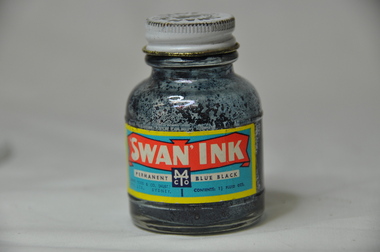
Bottle Swan Ink, Mabie Todd + Co (Aust) Pty Ltd Sydney, 1950's
... others in a small rural region. This however was not the case for Government Departments , banks and the hospital. To highlight certain words or paragraphs due to their importance, the red ink application was not only highly visible but also less likely to be tampered with dip pen ink ink bottle writing methods nib. SWAN TRIPLE FILTERED INK. 'SWAN' INK PERMANENT BLUE BLACK MABIE TODD & CO (AUST) PTY LTD SYDNEY CONTENTS 1 1/2 FLUID ...This refillable ink bottle was extensively in use in the early 1900's, firstly with the nib pen and then with the fountain pen. Both these pens required to be refreshed with ink as they had no long term self storage capacity. The requirement, before the 1970's, for all legal documents, wills and heath certificates etc. forms had to be signed with penned ink and not biro(1950's onward). This caveat was to prevent forgeries (signatures) from ocurring. Hand writing experts can clearly distinguish forgeries because by using nibs, the "natural" and distinctive hand inflections whilst forming the signiture cannot be replicated by forgers.This item is significant to the Kiewa Valley because it details that even in the rural sector,(Kiewa Valley) the legal requirements of the day had to be adhered to. This was even at a time when in the rural areas a "man's word and handshake" was his bond", especially between neighbours or others in a small rural region. This however was not the case for Government Departments , banks and the hospital. To highlight certain words or paragraphs due to their importance, the red ink application was not only highly visible but also less likely to be tampered withThis empty bottle is cylindrical with curved "shoulders" tapering to a neck the size of a 20c coin. It has a white screw on lid bearing the name SWAN triple filtered INK. There is a paper label on the side of the bottle.SWAN TRIPLE FILTERED INK. 'SWAN' INK PERMANENT BLUE BLACK MABIE TODD & CO (AUST) PTY LTD SYDNEY CONTENTS 1 1/2 FLUID OZS.dip pen ink, ink bottle, writing methods, nib. -
 Kiewa Valley Historical Society
Jar/ Demi John Stone Ware, Circa 1860
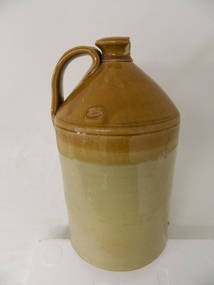
... This kiln glazed container for liquid's, was the type used in the 1700's to mid 1900's to contain fluids mainly for human consumption which needed to retain liquid that could be affected by sunlight and or required to be maintained at a cooler temperatures. Ginger beer and other...This kiln glazed container for liquid's, was the type used in the 1700's to mid 1900's to contain fluids mainly for human consumption which needed to retain liquid that could be affected by sunlight and or required to be maintained at a cooler temperatures. Ginger beer and other ...This kiln glazed container for liquid's, was the type used in the 1700's to mid 1900's to contain fluids mainly for human consumption which needed to retain liquid that could be affected by sunlight and or required to be maintained at a cooler temperatures. Ginger beer and other "brews" for human consumption were the prime target. The ability to refill these vessels were of the utmost importance to the consumer. Over time these containers were reduced in size and produced for "special" liquids e.g. alcoholic Port. This Demi John stone ware was manufactured in Tamworth (England) and imported into Australia during a period when the majority of "quality" domestic items were sourced from "the Mother Country" and the ties between the still "colonial" outpost were very strong. This bondage remained longer in rural communities than in the cities. The "multi-culturalism of the post World War II era resulted in the lessening of the earlier ties. The growing of nationalism, the Aussie evolution, was brought about by the increased social and business/commercial interactions between Australia and the United States of America, post World War II.This container(jug) is very significant to the Kiewa Valley, a rural region that required these type of liquid storage vessels, especially in the late 1800's to the mid 1900's. These were times when household refrigeration, if available, would be from the "block ice" coolers or "cool" storage nooks and crannies within farmhouse locations.This large "stone ware" glazed Demi John, alias Carboy has a capacity of over 20 litres. It has a conical smooth lipped neck top with a wide, flat(three to four finger) carry and poring handle. The top third portion of the jug is caramel in colour and the bottom a darker cream. It has a manufacturer's seal stamped into the surface before glazing. This item would have been corked and then sealed (air tight) with wax.manufacturer's seal "GEORGE SKEY WILNECOTE TAMWORTH"household liquid jar container, 1800's food storage, kiln fired glazed pottery -
 Eltham District Historical Society Inc
Photograph, Eltham - Convention Camp, 1911
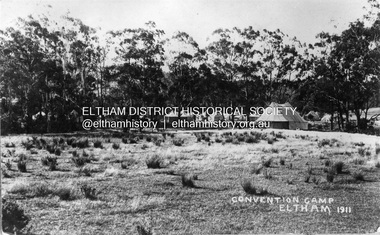
... Other activities included local hikes. A report in the Evelyn Observer on Friday, January 6, 1911, p2 noted: "ELTHAM. The holiday season brought out lots of visitors to our beauty spot. The visitors booked to Eltham on Boxing-Day numbered about 1900, and New Year's Day (Monday) some 1500. The threatening aspect of the weather on the morning of the 2nd and no doubt deterred many from venturing out. Fine weather has prevailed throughout, and the chief sufferers are those who catered for hot, thirsty crowds and did not find them so bent on ices and fluid...Other activities included local hikes. A report in the Evelyn Observer on Friday, January 6, 1911, p2 noted: "ELTHAM. The holiday season brought out lots of visitors to our beauty spot. The visitors booked to Eltham on Boxing-Day numbered about 1900, and New Year's Day (Monday) some 1500. The threatening aspect of the weather on the morning of the 2nd and no doubt deterred many from venturing out. Fine weather has prevailed throughout, and the chief sufferers are those who catered for hot, thirsty crowds and did not find them so bent on ices and fluid ...Tents set up along the Diamond Creek on a property that would become "Willandra," a poultry farm and then in 1956, an aged care facility and residence known as Judge Book Village. It is located west of the railway line, north of the railway station in Eltham on Diamond Street. it is believed that the convention camp was for young people for the purpose of Christian fellowship, bible study and worship. Other activities included local hikes. A report in the Evelyn Observer on Friday, January 6, 1911, p2 noted: "ELTHAM. The holiday season brought out lots of visitors to our beauty spot. The visitors booked to Eltham on Boxing-Day numbered about 1900, and New Year's Day (Monday) some 1500. The threatening aspect of the weather on the morning of the 2nd and no doubt deterred many from venturing out. Fine weather has prevailed throughout, and the chief sufferers are those who catered for hot, thirsty crowds and did not find them so bent on ices and fluid refreshments as is usual at this time of the year. Campers have been strongly in evidence. One especially large camp of Christian enthusiasts being located near the station with dining booth, gospel tent, cooking range, etc., all complete, numbering some twenty tents. These good folk evidently intend to make the best of both worlds, but some of their negro camp meeting methods appear to have shocked the sensibilities of sober-going folk. With the exception of a slight ruction on the railway platform on Monday night, which will probably be aired in the local court, the holiday makers as a whole were very orderly." This photo forms part of a collection of photographs gathered by the Shire of Eltham for their centenary project book, "Pioneers and Painters: 100 years of the Shire of Eltham" by Alan Marshall (1971). The collection of over 500 images is held in partnership between Eltham District Historical Society and Yarra Plenty Regional Library (Eltham Library) and is now formally known as 'The Shire of Eltham Pioneers Photograph Collection.' It is significant in being the first community sourced collection representing the places and people of the Shire's first one hundred years.Digital imagesepp, shire of eltham pioneers photograph collection, eltham, convention camp, judge book village, tents, diamond creek (river), camping, christian camp, boxing day -
 Bendigo Military Museum
Souvenir - BEER MUG, Rats of Tobruk Association, Rats of Tobruk Association - 50th Anniversary - World Reunion 1941-1991, c1991
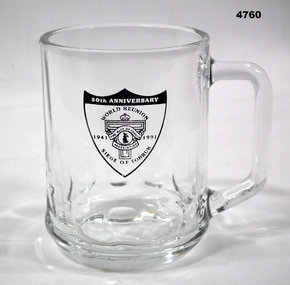
... Fluid ozs. On the side, in gold, is the logo of the Rats of Tobruk Association with other wording around it,...Fluid ozs. On the side, in gold, is the logo of the Rats of Tobruk Association with other wording around it, Rats of Tobruk Association - 50th Anniversary - World Reunion 1941-1991 Souvenir BEER MUG Rats of Tobruk Association ...Dean collection, refer Cat No 4575PPLAIN GLASS BEER POT WITH HANDLE. Volume about 10 Fluid ozs. On the side, in gold, is the logo of the Rats of Tobruk Association with other wording around it,souvenir, rats of tobruk -
 Kiewa Valley Historical Society
Yanckeur Suckers
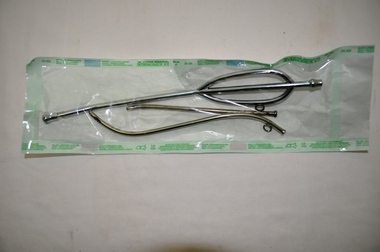
... fluids during an operation. The sterilised pack is an old way of sterilising instruments. Historical: Shows the development of scientific hospital equipment. Provenance: Used in the Tawonga District General Hospital which was remote and therefore required good equipment. Good condition and good interpretation capacity. medical instrument. hospital instrument. doctor. nurse. mt beauty. tawonga. yanckeur. operation. sterilise pack In sterilised bag. 3 metal instruments. 1. long and curved with holes at one end and hollow at the other. ...This medical instrument was used in the Tawonga District General Hospital which was built in the 1950s specifically for the increase in population due to the Kiewa Hydro Scheme. Used for sucking fluids during an operation. The sterilised pack is an old way of sterilising instruments.Historical: Shows the development of scientific hospital equipment. Provenance: Used in the Tawonga District General Hospital which was remote and therefore required good equipment. Good condition and good interpretation capacity.In sterilised bag. 3 metal instruments. 1. long and curved with holes at one end and hollow at the other. Near the hollow end the instrument breaks into 3 and rejoins further along. 2. An elongated "S" like metal instrument with an elongated hollow at one end and hollow at the other end where there is a small loop 3. A straight instrument except for close to one end where there is a hollow. At the other end it is hollow with a small loop near the end.medical instrument. hospital instrument. doctor. nurse. mt beauty. tawonga. yanckeur. operation. sterilise pack -
 Kiewa Valley Historical Society
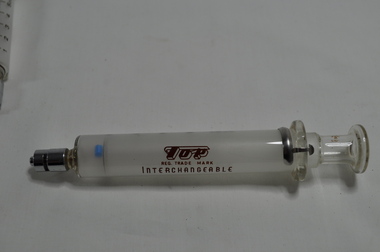
Leur Lock Syringe
... Hollow cylinder has markings for quantity of fluid (up to 10cc) On the other side "TOP / Reg. Trade Mark / Interchangeable" The plunger has no markings....Hollow cylinder has markings for quantity of fluid (up to 10cc) On the other side "TOP / Reg. Trade Mark / Interchangeable" The plunger has no markings. ...These medical / hospital instruments were used in the Tawonga District General Hospital which was built in the 1950s specifically for the increase in population due to the Kiewa Hydro Scheme.Historical: Shows the development of scientific hospital equipment. Provenance: Used in the Tawonga District General Hospital which was remote and therefore required good equipment.The syringe holds 10cc Used to administer liquid drugs. Glass hollow cylinder with needle end steel and with fitting to attach needle. Glass plunger, hollow with wider solid top which prevents the plunger going into the hollow cylinder too far. Glass cylinders frosted.Hollow cylinder has markings for quantity of fluid (up to 10cc) On the other side "TOP / Reg. Trade Mark / Interchangeable" The plunger has no markings.hospital equipment. medical equipment. syringe. tawonga. mt beauty. leurlock. -
Kiewa Valley Historical Society
IV Bottle with Airway
... Used in the delivery of intravenous fluids Clear glass bottle with plastic black lid sealed and with 2 holes through it. A short hard plastic straw for air is in one hole and in the other a long hard plastic straw going down to the bottom. ...Used in the delivery of intravenous fluids Clear glass bottle with plastic black lid sealed and with 2 holes through it. A short hard plastic straw for air is in one hole and in the other a long hard plastic straw going down to the bottom. ...This medical / hospital equipment was used in the Tawonga District General Hospital which was built in the 1950s specifically for the increase in population due to the Kiewa Hydro Scheme.Historical: Shows the development of scientific hospital equipment. Provenance: Used in the Tawonga District General Hospital which was remote and therefore required good equipment.Used in the delivery of intravenous fluids Clear glass bottle with plastic black lid sealed and with 2 holes through it. A short hard plastic straw for air is in one hole and in the other a long hard plastic straw going down to the bottom. The jar is embossed with measurements up to 1000ml. There is a torn label on the bottle. Near the bottom is a white plastic handle which may be able to be attached to something.Embossed measurements with numbers and lines. Also 1000 ml. The label has the title, in blue, Dextrose 10% w/v. On the bottom 8146 is embossed.medical equipment. hospital equipment. tawonga. mt beauty. intravenous fluids -
 Kiewa Valley Historical Society
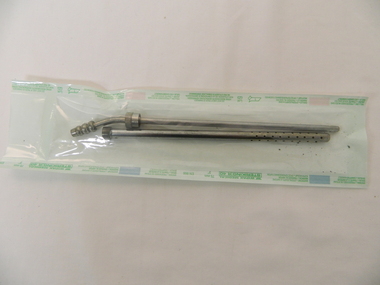
Abdominal Surgical Sucker
... fluid from abdomen. In sealed sterile bag - 2 metal instruments. 1. long thick nail with 9 little holes in 6 rows along the length. Other...fluid from abdomen. In sealed sterile bag - 2 metal instruments. 1. long thick nail with 9 little holes in 6 rows along the length. Other ...This medical instrument was used in the Tawonga District General Hospital which was built in the 1950s specifically for the increase in population due to the Kiewa Hydro Scheme.Historical: Shows the development of scientific hospital equipment. Provenance: Used in the Tawonga District General Hospital which was remote and therefore required good equipment.Used to suck fluid from abdomen. In sealed sterile bag - 2 metal instruments. 1. long thick nail with 9 little holes in 6 rows along the length. Other end is knob with lines embossed around it. 2. Long rod with cap on which the other side of is a bent rod with 3 'beads' at the end. This rod has a hole at the other end.medical instrument. hospital equipment. tawonga. mt beauty.abdomen -
 Kiewa Valley Historical Society
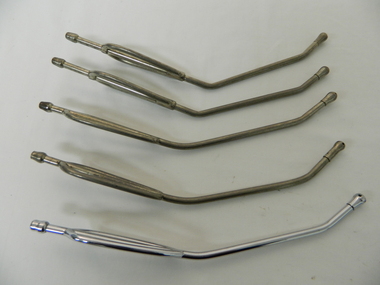
Yanckeur Sucker Head x 5
... fluid, blood or vomit etc. x4 sucker heads dull metal & x1 sucker head shiny metal Long, curved in 3 parts with it splitting into 3 rods (all the same diameter as the original rod) towards one end and a knob at the other....fluid, blood or vomit etc. x4 sucker heads dull metal & x1 sucker head shiny metal Long, curved in 3 parts with it splitting into 3 rods (all the same diameter as the original rod) towards one end and a knob at the other. ...This medical instrument was used in the Tawonga District General Hospital which was built in the 1950s specifically for the increase in population due to the Kiewa Hydro Scheme.Historical: Shows the development of scientific hospital equipment. Provenance: Used in the Tawonga District General Hospital which was remote and therefore required good equipment.Used for sucking excess fluid from the site - could be fluid, blood or vomit etc. x4 sucker heads dull metal & x1 sucker head shiny metal Long, curved in 3 parts with it splitting into 3 rods (all the same diameter as the original rod) towards one end and a knob at the other.medical instrument. hospital equipment. tawonga. mt beauty. yanckeur -
 Kiewa Valley Historical Society
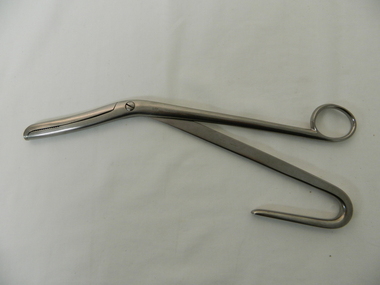
Cheatles Lifting Forceps
... fluid. Dull metal, heavy, long scissors bent at the pivot. One handle has a hook for the fingers, the other a ring for the thumb. ...AMAX Germany - on hook handle - half way along Stainless - on the other handle - near the pivot Used for taking instruments out of the autoclave. Stored by the autoclave in a container of sterilising fluid. ...This medical instrument was used in the Tawonga District General Hospital which was built in the 1950s specifically for the increase in population due to the Kiewa Hydro Scheme. Historical: Shows the development of scientific hospital equipment. Provenance: Used in the Tawonga District General Hospital which was remote and therefore required good equipment.Used for taking instruments out of the autoclave. Stored by the autoclave in a container of sterilising fluid. Dull metal, heavy, long scissors bent at the pivot. One handle has a hook for the fingers, the other a ring for the thumb. The blades are blunt with the top one curving over the bottom one when closed. AMAX Germany - on hook handle - half way along Stainless - on the other handle - near the pivotmedical instrument. hospital equipment. tawonga. mt beauty. -
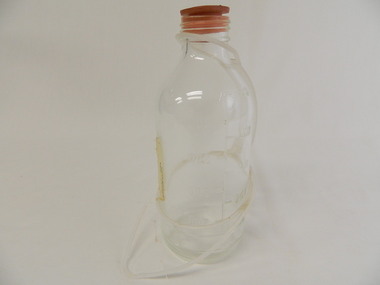 Kiewa Valley Historical Society
Bottle - Medical
... fluid bottle with opaque white plastic holder with rings around the neck and bottle. The wide lower ring has an extension that is oval shaped. The opening has a rubber stopper with 4 holes at the top that don't penetrate the stopper. The bottle is heavily embossed with a measuring gauge one side written for when the bottle is upright and the other...fluid bottle with opaque white plastic holder with rings around the neck and bottle. The wide lower ring has an extension that is oval shaped. The opening has a rubber stopper with 4 holes at the top that don't penetrate the stopper. The bottle is heavily embossed with a measuring gauge one side written for when the bottle is upright and the other ...This bottle was used in the Tawonga District General Hospital which was built in the 1950's specifically for the increase in population due to the Kiewa Hydro Scheme.Historical: Shows the development of scientific hospital equipment. Provenance: Used in the Tawonga district General Hospital which was remote and therefore required good equipment. Good condition and good interpretation capacity.Clear glass Intravenous (IV) fluid bottle with opaque white plastic holder with rings around the neck and bottle. The wide lower ring has an extension that is oval shaped. The opening has a rubber stopper with 4 holes at the top that don't penetrate the stopper. The bottle is heavily embossed with a measuring gauge one side written for when the bottle is upright and the other side written for when the bottle is upside down. Base is heavily embossed. Straight sides taper gradually to a short neck and opening. Note: Unusual because of plastic holder. IV fluid bottle and drainage bottle or could be Wagenestein - form of suction (no suckers so form a vacuum)Gauge: 100, 200, 300, 400, 500. Below gauge 2 embossed lines around the circumference. Base: 5 / Resistent / 500 ml. Around the circumference short lines from outer edge to middle.medical, hospital, intraveneous fluid bottle, wagenestein -
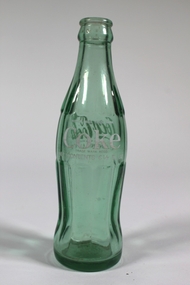 Bendigo Historical Society Inc.
Container - BOTTLES COLLECTION: Coke Bottle FL. OZ
... Australia started to convert to metric weights and measurements 1970. 6 1/2 fluid ounces (FL OZ) equals 192mls Bottle Coco Cola Fluid ounces A curved green glass bottle six centimetres diameter and 20 centimetres high with a two and a half centimetre opening at the top. White writing on one side states BOTTLE REGD. TRADE MARK Coke TRADE MARK REGD. NET CONTENTS 6 1/2 FL OZ The other ...Australia started to convert to metric weights and measurements 1970. 6 1/2 fluid ounces (FL OZ) equals 192mlsA curved green glass bottle six centimetres diameter and 20 centimetres high with a two and a half centimetre opening at the top. White writing on one side states BOTTLE REGD. TRADE MARK Coke TRADE MARK REGD. NET CONTENTS 6 1/2 FL OZ The other side Coco-Cola (in cursive script) TRADE MARK REGD. NET CONTENTS 6 1/2 FL OZbottle, coco cola, fluid ounces -
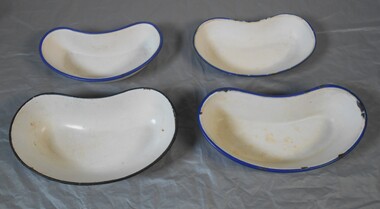 Bendigo Historical Society Inc.
Functional object - Kidney dishes
... other medical waste. The shape of the dish allows it to be held against the patient's body to catch any falling fluids or debris. ...other medical waste. The shape of the dish allows it to be held against the patient's body to catch any falling fluids or debris. ...Four enameled kidney dishes. A kidney dish (British English) or emesis basin (American English) is a shallow basin with a kidney-shaped base and sloping walls used in medical and surgical wards to receive soiled dressings and other medical waste. The shape of the dish allows it to be held against the patient's body to catch any falling fluids or debris. Various sizes of emesis basins are common in healthcare settings. Aileen and John Ellison Collectionmedical, kidney dish
